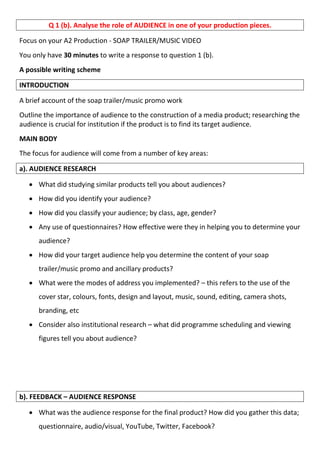
Q 1 (b). Analyse the role of AUDIENCE in one of your production pieces.
Focus on your A2 Production - SOAP TRAILER/MUSIC VIDEO
You only have 30 minutes to write a response to question 1 (b).
A possible writing scheme
INTRODUCTION
A brief account of the soap trailer/music promo work
Outline the importance of audience to the construction of a media product; researching the
audience is crucial for institution if the product is to find its target audience.
MAIN BODY
The focus for audience will come from a number of key areas:
a). AUDIENCE RESEARCH
• What did studying similar products tell you about audiences?
• How did you identify your audience?
• How did you classify your audience; by class, age, gender?
• Any use of questionnaires? How effective were they in helping you to determine your
audience?
• How did your target audience help you determine the content of your soap
trailer/music promo and ancillary products?
• What were the modes of address you implemented? – this refers to the use of the
cover star, colours, fonts, design and layout, music, sound, editing, camera shots,
branding, etc
• Consider also institutional research – what did programme scheduling and viewing
figures tell you about audience?
b). FEEDBACK – AUDIENCE RESPONSE
• What was the audience response for the final product? How did you gather this data;
questionnaire, audio/visual, YouTube, Twitter, Facebook?
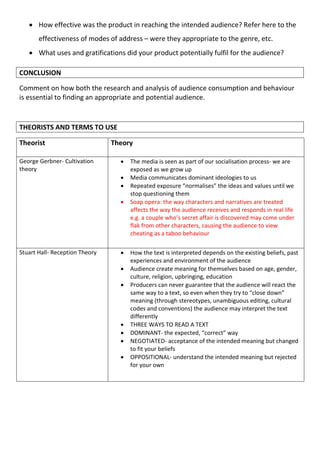
• How effective was the product in reaching the intended audience? Refer here to the
effectiveness of modes of address – were they appropriate to the genre, etc.
• What uses and gratifications did your product potentially fulfil for the audience?
CONCLUSION
Comment on how both the research and analysis of audience consumption and behaviour
is essential to finding an appropriate and potential audience.
THEORISTS AND TERMS TO USE
Theorist Theory
George Gerbner- Cultivation
theory
• The media is seen as part of our socialisation process- we are
exposed as we grow up
• Media communicates dominant ideologies to us
• Repeated exposure “normalises” the ideas and values until we
stop questioning them
• Soap opera: the way characters and narratives are treated
affects the way the audience receives and responds in real life
e.g. a couple who’s secret affair is discovered may come under
flak from other characters, causing the audience to view
cheating as a taboo behaviour
Stuart Hall- Reception Theory • How the text is interpreted depends on the existing beliefs, past
experiences and environment of the audience
• Audience create meaning for themselves based on age, gender,
culture, religion, upbringing, education
• Producers can never guarantee that the audience will react the
same way to a text, so even when they try to “close down”
meaning (through stereotypes, unambiguous editing, cultural
codes and conventions) the audience may interpret the text
differently
• THREE WAYS TO READ A TEXT
• DOMINANT- the expected, “correct” way
• NEGOTIATED- acceptance of the intended meaning but changed
to fit your beliefs
• OPPOSITIONAL- understand the intended meaning but rejected
for your own
Term How would you use it in this essay? (a sentence analysing
your work using this term)
Mass audience
Niche audience
Target audience
Audience consumption
trends
Uses and gratifications
Escapism
Feedback
Catharsis
Cultivation
Reception
Socialisation

1b Audience essay plan

  • 1.
    Q 1 (b).Analyse the role of AUDIENCE in one of your production pieces. Focus on your A2 Production - SOAP TRAILER/MUSIC VIDEO You only have 30 minutes to write a response to question 1 (b). A possible writing scheme INTRODUCTION A brief account of the soap trailer/music promo work Outline the importance of audience to the construction of a media product; researching the audience is crucial for institution if the product is to find its target audience. MAIN BODY The focus for audience will come from a number of key areas: a). AUDIENCE RESEARCH • What did studying similar products tell you about audiences? • How did you identify your audience? • How did you classify your audience; by class, age, gender? • Any use of questionnaires? How effective were they in helping you to determine your audience? • How did your target audience help you determine the content of your soap trailer/music promo and ancillary products? • What were the modes of address you implemented? – this refers to the use of the cover star, colours, fonts, design and layout, music, sound, editing, camera shots, branding, etc • Consider also institutional research – what did programme scheduling and viewing figures tell you about audience? b). FEEDBACK – AUDIENCE RESPONSE • What was the audience response for the final product? How did you gather this data; questionnaire, audio/visual, YouTube, Twitter, Facebook?
  • 2.
    • How effectivewas the product in reaching the intended audience? Refer here to the effectiveness of modes of address – were they appropriate to the genre, etc. • What uses and gratifications did your product potentially fulfil for the audience? CONCLUSION Comment on how both the research and analysis of audience consumption and behaviour is essential to finding an appropriate and potential audience. THEORISTS AND TERMS TO USE Theorist Theory George Gerbner- Cultivation theory • The media is seen as part of our socialisation process- we are exposed as we grow up • Media communicates dominant ideologies to us • Repeated exposure “normalises” the ideas and values until we stop questioning them • Soap opera: the way characters and narratives are treated affects the way the audience receives and responds in real life e.g. a couple who’s secret affair is discovered may come under flak from other characters, causing the audience to view cheating as a taboo behaviour Stuart Hall- Reception Theory • How the text is interpreted depends on the existing beliefs, past experiences and environment of the audience • Audience create meaning for themselves based on age, gender, culture, religion, upbringing, education • Producers can never guarantee that the audience will react the same way to a text, so even when they try to “close down” meaning (through stereotypes, unambiguous editing, cultural codes and conventions) the audience may interpret the text differently • THREE WAYS TO READ A TEXT • DOMINANT- the expected, “correct” way • NEGOTIATED- acceptance of the intended meaning but changed to fit your beliefs • OPPOSITIONAL- understand the intended meaning but rejected for your own
  • 3.
    Term How wouldyou use it in this essay? (a sentence analysing your work using this term) Mass audience Niche audience Target audience Audience consumption trends Uses and gratifications Escapism Feedback Catharsis Cultivation Reception Socialisation