Example answer for Question 1b

    Critical Perspectives: Section A
• Q: Analyse one of your productions in relation to
  media language
• Intro: Define the concept. Explain what the production
  is, be detailed.
• Para 2: What are some of the key features of the
  concept you are being asked to apply? Maybe outline
  two of the theories/ideas of particular theorists, be
  brief.
• Para 3: Start to apply the concept, making close
  reference to your production to show how the concept
  is evident in it.
• Para 4: Try to show ways in which ideas work in
  relation to your production and also ways in which
  those ideas might not apply/could be challenged.
• Para 5: Conclusion
Example
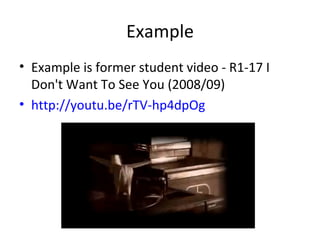
• Example is former student video - R1-17 I
  Don't Want To See You (2008/09)
• http://youtu.be/rTV-hp4dpOg
• Media Language encompasses the technical
  microelements used to create meaning
  specific to the macro-elements of characters,
  narrative and genre. It can also include the
  generic conventions and visual signs and
  symbols, any aspect that has, through
  repetition, come to act as a sort of ‘short
  hand’ for an audience. The production I will
  be analyzing is the main task for my A2
  Advanced Portfolio. I created a music video
  for the song ‘I don’t want to see you’ by the
  band Camera Obscura, a Scottish indie pop
  group.
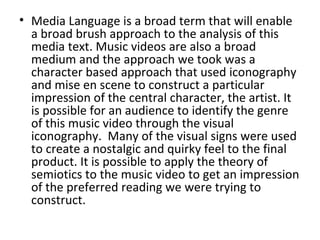
• Media Language is a broad term that will enable
  a broad brush approach to the analysis of this
  media text. Music videos are also a broad
  medium and the approach we took was a
  character based approach that used iconography
  and mise en scene to construct a particular
  impression of the central character, the artist. It
  is possible for an audience to identify the genre
  of this music video through the visual
  iconography. Many of the visual signs were used
  to create a nostalgic and quirky feel to the final
  product. It is possible to apply the theory of
  semiotics to the music video to get an impression
  of the preferred reading we were trying to
  construct.
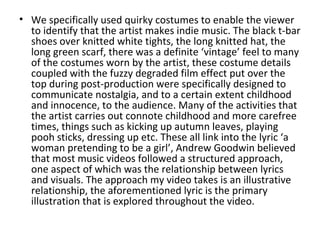
• We specifically used quirky costumes to enable the viewer
  to identify that the artist makes indie music. The black t-bar
  shoes over knitted white tights, the long knitted hat, the
  long green scarf, there was a definite ‘vintage’ feel to many
  of the costumes worn by the artist, these costume details
  coupled with the fuzzy degraded film effect put over the
  top during post-production were specifically designed to
  communicate nostalgia, and to a certain extent childhood
  and innocence, to the audience. Many of the activities that
  the artist carries out connote childhood and more carefree
  times, things such as kicking up autumn leaves, playing
  pooh sticks, dressing up etc. These all link into the lyric ‘a
  woman pretending to be a girl’, Andrew Goodwin believed
  that most music videos followed a structured approach,
  one aspect of which was the relationship between lyrics
  and visuals. The approach my video takes is an illustrative
  relationship, the aforementioned lyric is the primary
  illustration that is explored throughout the video.
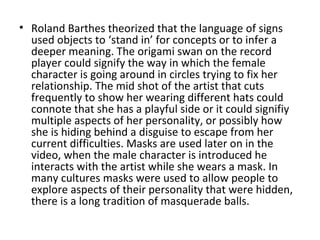
• Roland Barthes theorized that the language of signs
  used objects to ‘stand in’ for concepts or to infer a
  deeper meaning. The origami swan on the record
  player could signify the way in which the female
  character is going around in circles trying to fix her
  relationship. The mid shot of the artist that cuts
  frequently to show her wearing different hats could
  connote that she has a playful side or it could signifiy
  multiple aspects of her personality, or possibly how
  she is hiding behind a disguise to escape from her
  current difficulties. Masks are used later on in the
  video, when the male character is introduced he
  interacts with the artist while she wears a mask. In
  many cultures masks were used to allow people to
  explore aspects of their personality that were hidden,
  there is a long tradition of masquerade balls.
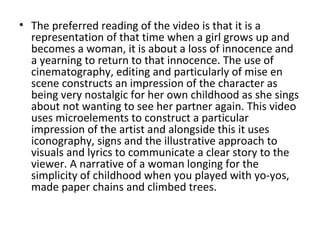
• The preferred reading of the video is that it is a
  representation of that time when a girl grows up and
  becomes a woman, it is about a loss of innocence and
  a yearning to return to that innocence. The use of
  cinematography, editing and particularly of mise en
  scene constructs an impression of the character as
  being very nostalgic for her own childhood as she sings
  about not wanting to see her partner again. This video
  uses microelements to construct a particular
  impression of the artist and alongside this it uses
  iconography, signs and the illustrative approach to
  visuals and lyrics to communicate a clear story to the
  viewer. A narrative of a woman longing for the
  simplicity of childhood when you played with yo-yos,
  made paper chains and climbed trees.
Theories used
•   Semiotics
•   Andrew Goodwin
•   Stuart Hall – Preferred reading
•   Denotation and Connotation
•   How microelements inform macro-elements

Example answer for question 1b

  • 1.
    Example answer forQuestion 1b Critical Perspectives: Section A
  • 2.
    • Q: Analyseone of your productions in relation to media language • Intro: Define the concept. Explain what the production is, be detailed. • Para 2: What are some of the key features of the concept you are being asked to apply? Maybe outline two of the theories/ideas of particular theorists, be brief. • Para 3: Start to apply the concept, making close reference to your production to show how the concept is evident in it. • Para 4: Try to show ways in which ideas work in relation to your production and also ways in which those ideas might not apply/could be challenged. • Para 5: Conclusion
  • 3.
    Example • Example isformer student video - R1-17 I Don't Want To See You (2008/09) • http://youtu.be/rTV-hp4dpOg
  • 4.
    • Media Languageencompasses the technical microelements used to create meaning specific to the macro-elements of characters, narrative and genre. It can also include the generic conventions and visual signs and symbols, any aspect that has, through repetition, come to act as a sort of ‘short hand’ for an audience. The production I will be analyzing is the main task for my A2 Advanced Portfolio. I created a music video for the song ‘I don’t want to see you’ by the band Camera Obscura, a Scottish indie pop group.
  • 5.
    • Media Languageis a broad term that will enable a broad brush approach to the analysis of this media text. Music videos are also a broad medium and the approach we took was a character based approach that used iconography and mise en scene to construct a particular impression of the central character, the artist. It is possible for an audience to identify the genre of this music video through the visual iconography. Many of the visual signs were used to create a nostalgic and quirky feel to the final product. It is possible to apply the theory of semiotics to the music video to get an impression of the preferred reading we were trying to construct.
  • 6.
    • We specificallyused quirky costumes to enable the viewer to identify that the artist makes indie music. The black t-bar shoes over knitted white tights, the long knitted hat, the long green scarf, there was a definite ‘vintage’ feel to many of the costumes worn by the artist, these costume details coupled with the fuzzy degraded film effect put over the top during post-production were specifically designed to communicate nostalgia, and to a certain extent childhood and innocence, to the audience. Many of the activities that the artist carries out connote childhood and more carefree times, things such as kicking up autumn leaves, playing pooh sticks, dressing up etc. These all link into the lyric ‘a woman pretending to be a girl’, Andrew Goodwin believed that most music videos followed a structured approach, one aspect of which was the relationship between lyrics and visuals. The approach my video takes is an illustrative relationship, the aforementioned lyric is the primary illustration that is explored throughout the video.
  • 7.
    • Roland Barthestheorized that the language of signs used objects to ‘stand in’ for concepts or to infer a deeper meaning. The origami swan on the record player could signify the way in which the female character is going around in circles trying to fix her relationship. The mid shot of the artist that cuts frequently to show her wearing different hats could connote that she has a playful side or it could signifiy multiple aspects of her personality, or possibly how she is hiding behind a disguise to escape from her current difficulties. Masks are used later on in the video, when the male character is introduced he interacts with the artist while she wears a mask. In many cultures masks were used to allow people to explore aspects of their personality that were hidden, there is a long tradition of masquerade balls.
  • 8.
    • The preferredreading of the video is that it is a representation of that time when a girl grows up and becomes a woman, it is about a loss of innocence and a yearning to return to that innocence. The use of cinematography, editing and particularly of mise en scene constructs an impression of the character as being very nostalgic for her own childhood as she sings about not wanting to see her partner again. This video uses microelements to construct a particular impression of the artist and alongside this it uses iconography, signs and the illustrative approach to visuals and lyrics to communicate a clear story to the viewer. A narrative of a woman longing for the simplicity of childhood when you played with yo-yos, made paper chains and climbed trees.
  • 9.
    Theories used • Semiotics • Andrew Goodwin • Stuart Hall – Preferred reading • Denotation and Connotation • How microelements inform macro-elements