Half term homework
Q: Apply media language to
one of your coursework
productions.
Read through each others essays
Use the mark scheme to help you mark it
Now check again with the mark scheme.
What level would you give them for each of the three areas?
What level do they get overall?
Give a tick every time they:
•Use terminology accurately
•Make a relevant point (Point)
•Provide evidence from their own work (Evidence)
•Discuss the effect (Analysis)
For top marks
(out of a possible 25)
Explanation/ analysis/argument (9-10 marks)
• There is a clear sense of progression established by the
answer, and a range of articulate reflections on the
production process are offered.
Use of examples (9-10 marks)
• Candidates offer a broad range of specific, relevant and clear
examples of the use of technology in relation to creative skills
development.
Use of terminology (5 marks)
• The use of both production terms and conceptual media
terminology applied throughout is excellent.
Recap
Q1a) ALL cw in relation to:
• Digital Technology
• Creativity
• Research and Planning
• Post-production
• Using conventions from real media texts
Q1b) 1 cw in relation to:
• Genre
• Narrative
• Representation
• Audience
• Media language
= 30 minutes
= 30 minutes
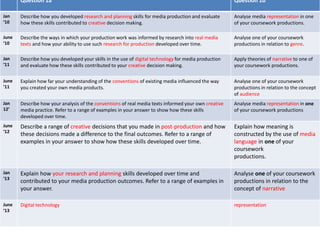
Question 1a Question 1b
Jan
‘10
Describe how you developed research and planning skills for media production and evaluate
how these skills contributed to creative decision making.
Analyse media representation in one
of your coursework productions.
June
‘10
Describe the ways in which your production work was informed by research into real media
texts and how your ability to use such research for production developed over time.
Analyse one of your coursework
productions in relation to genre.
Jan
‘11
Describe how you developed your skills in the use of digital technology for media production
and evaluate how these skills contributed to your creative decision making.
Apply theories of narrative to one of
your coursework productions.
June
‘11
Explain how far your understanding of the conventions of existing media influenced the way
you created your own media products.
Analyse one of your coursework
productions in relation to the concept
of audience
Jan
12’
Describe how your analysis of the conventions of real media texts informed your own creative
media practice. Refer to a range of examples in your answer to show how these skills
developed over time.
Analyse media representation in one
of your coursework productions
June
‘12
Describe a range of creative decisions that you made in post-production and how
these decisions made a difference to the final outcomes. Refer to a range of
examples in your answer to show how these skills developed over time.
Explain how meaning is
constructed by the use of media
language in one of your
coursework
productions.
Jan
‘13
Explain how your research and planning skills developed over time and
contributed to your media production outcomes. Refer to a range of examples in
your answer.
Analyse one of your coursework
productions in relation to the
concept of narrative
June
‘13
Digital technology representation
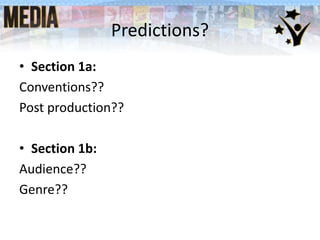
Predictions?
• Section 1a:
Conventions??
Post production??
• Section 1b:
Audience??
Genre??
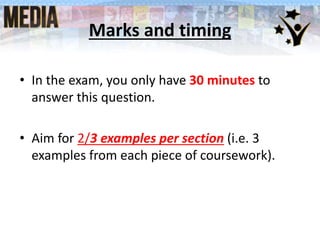
Marks and timing
• In the exam, you only have 30 minutes to
answer this question.
• Aim for 2/3 examples per section (i.e. 3
examples from each piece of coursework).
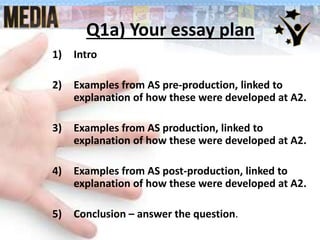
Q1a) Your essay plan
1) Intro
2) Examples from AS pre-production, linked to
explanation of how these were developed at A2.
3) Examples from AS production, linked to
explanation of how these were developed at A2.
4) Examples from AS post-production, linked to
explanation of how these were developed at A2.
5) Conclusion – answer the question.
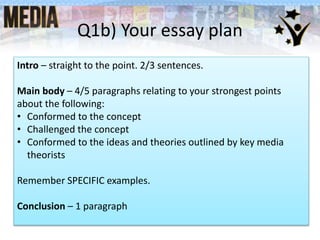
Q1b) Your essay plan
Intro – straight to the point. 2/3 sentences.
Main body – 4/5 paragraphs relating to your strongest points
about the following:
• Conformed to the concept
• Challenged the concept
• Conformed to the ideas and theories outlined by key media
theorists
Remember SPECIFIC examples.
Conclusion – 1 paragraph
Q1a
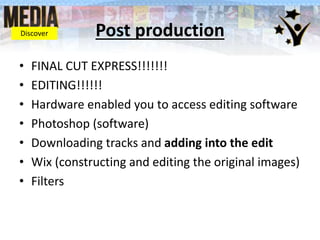
Post production
• FINAL CUT EXPRESS!!!!!!!
• EDITING!!!!!!
• Hardware enabled you to access editing software
• Photoshop (software)
• Downloading tracks and adding into the edit
• Wix (constructing and editing the original images)
• Filters
Discover
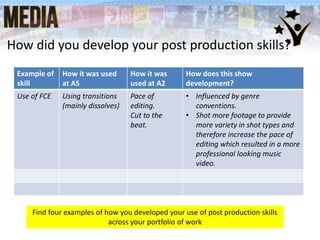
How did you develop your post production skills?
Example of
skill
How it was used
at AS
How it was
used at A2
How does this show
development?
Use of FCE Using transitions
(mainly dissolves)
Pace of
editing.
Cut to the
beat.
• Influenced by genre
conventions.
• Shot more footage to provide
more variety in shot types and
therefore increase the pace of
editing which resulted in a more
professional looking music
video.
Find four examples of how you developed your use of post production skills
across your portfolio of work
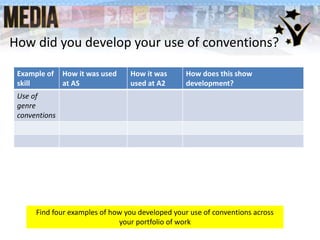
How did you develop your use of conventions?
Example of
skill
How it was used
at AS
How it was
used at A2
How does this show
development?
Use of
genre
conventions
Find four examples of how you developed your use of conventions across
your portfolio of work
Q1b
The idea of audience is changing…
• Julian McDougall (2009) suggests that in the
online age it is getting harder to conceive a
media audience as a stable, identifiable group.
Many argue that an audience is just a
hypothetical group of people imagined for the
sole purpose having a target for a media
product.
Hypodermic Needle Theory
• The Hypodermic Needle Theory, also known
as the Magic Bullet Theory, was the first major
theory concerning the effect of the mass
media on society. Originating in the 1920s, the
theory was based on the premise of an all-
powerful media with uniform and direct effects
on the viewer or audience. (i.e. information is
injected into audiences)
Target audience
Secondary audience
•Demographics
•Psychographics
Uses and
gratification theory
David Morley
Reception theory
Suggested structure – Q1b) Audience
• Intro – outline what you have created.
• Who have you targeted? Explain how.
• How was your product received by an audience?
• How does your use of narrative/medium/mise-en-
scene/character representation appeal to or represent an
audience?
• What does this suggest about your audience? (Link to Julian
McDougal’s theory that web 2.0 is making it difficult to contain a
specific audience) What are the positives and negatives of this?
• Conclusion – Reflection on the successes of targeting a specific
audience. Link to how you feel this medium will target audiences
in the future (consider that we are active not passive audiences –
challenges hypodermic needle theory and how McDougal’s theory
will impact).
Genre theory
Steve Neal said that ‘genre is a repetition with an
underlying pattern of variations’
and
'difference is absolutely essential to the economy
of genre‘.
Q. How is this evident in your own work?
Q1b - Media Language
Pete Fraser:
• Media Language
A lot of people have assumed this is going to be the most difficult
concept to apply, but I don’t think it need be. If you think back to
the AS TV Drama exam, when you had to look at the technical codes
and how they operate, that was an exercise in applying media
language analysis, so for the A2 exam if this one comes up, I’d see it
as pretty similar. For moving image, the language of film and
television is defined by how camera, editing, sound and mise-en-
scene create meaning. Likewise an analysis of print work would
involve looking at how fonts, layout, combinations of text and
image as well as the actual words chosen creates meaning. Useful
theory here might be Roland Barthes on semiotics- denotation and
connotation and for moving image work Bordwell and Thompson
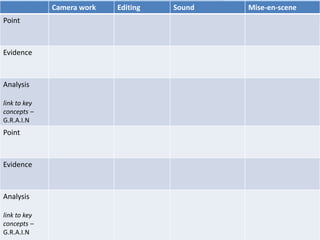
Camera work Editing Sound Mise-en-scene
Point
Evidence
Analysis
link to key
concepts –
G.R.A.I.N
Point
Evidence
Analysis
link to key
concepts –
G.R.A.I.N
What do I need to do now?
• Read over your planning sheets (the grids you were given each week) –
these are a revision resource!
• Look over your production work. Keep looking over it. Make notes as to
the specific examples of shot types, angles, mise-en-scene, sound etc that
support each category.
• Decide which production piece you are going to write about for each area
of section 1b (this may be different dependent on the topic).
• Read over the theory sheets that I gave you for each area of 1b. Can you
quote Steve Neale?
• Look at the example answers that I gave you. Notice how they talk about
SPECIFIC EXAMPLES. Use this as a frame work for a practice answer if you
need.
• Practise planning your answer to each question using the planning
structure that I have given you for each question. The more you do this,
the easier you will find the exam as it will be fresh in your head.
• Practise timed answers – 30 minutes is a short amount of time for each
question.
Final revision lesson section 1 a2 exam

Final revision lesson section 1 a2 exam

  • 1.
    Half term homework Q:Apply media language to one of your coursework productions.
  • 2.
    Read through eachothers essays Use the mark scheme to help you mark it Now check again with the mark scheme. What level would you give them for each of the three areas? What level do they get overall? Give a tick every time they: •Use terminology accurately •Make a relevant point (Point) •Provide evidence from their own work (Evidence) •Discuss the effect (Analysis)
  • 3.
    For top marks (outof a possible 25) Explanation/ analysis/argument (9-10 marks) • There is a clear sense of progression established by the answer, and a range of articulate reflections on the production process are offered. Use of examples (9-10 marks) • Candidates offer a broad range of specific, relevant and clear examples of the use of technology in relation to creative skills development. Use of terminology (5 marks) • The use of both production terms and conceptual media terminology applied throughout is excellent.
  • 4.
    Recap Q1a) ALL cwin relation to: • Digital Technology • Creativity • Research and Planning • Post-production • Using conventions from real media texts Q1b) 1 cw in relation to: • Genre • Narrative • Representation • Audience • Media language = 30 minutes = 30 minutes
  • 5.
    Question 1a Question1b Jan ‘10 Describe how you developed research and planning skills for media production and evaluate how these skills contributed to creative decision making. Analyse media representation in one of your coursework productions. June ‘10 Describe the ways in which your production work was informed by research into real media texts and how your ability to use such research for production developed over time. Analyse one of your coursework productions in relation to genre. Jan ‘11 Describe how you developed your skills in the use of digital technology for media production and evaluate how these skills contributed to your creative decision making. Apply theories of narrative to one of your coursework productions. June ‘11 Explain how far your understanding of the conventions of existing media influenced the way you created your own media products. Analyse one of your coursework productions in relation to the concept of audience Jan 12’ Describe how your analysis of the conventions of real media texts informed your own creative media practice. Refer to a range of examples in your answer to show how these skills developed over time. Analyse media representation in one of your coursework productions June ‘12 Describe a range of creative decisions that you made in post-production and how these decisions made a difference to the final outcomes. Refer to a range of examples in your answer to show how these skills developed over time. Explain how meaning is constructed by the use of media language in one of your coursework productions. Jan ‘13 Explain how your research and planning skills developed over time and contributed to your media production outcomes. Refer to a range of examples in your answer. Analyse one of your coursework productions in relation to the concept of narrative June ‘13 Digital technology representation
  • 6.
    Predictions? • Section 1a: Conventions?? Postproduction?? • Section 1b: Audience?? Genre??
  • 7.
    Marks and timing •In the exam, you only have 30 minutes to answer this question. • Aim for 2/3 examples per section (i.e. 3 examples from each piece of coursework).
  • 8.
    Q1a) Your essayplan 1) Intro 2) Examples from AS pre-production, linked to explanation of how these were developed at A2. 3) Examples from AS production, linked to explanation of how these were developed at A2. 4) Examples from AS post-production, linked to explanation of how these were developed at A2. 5) Conclusion – answer the question.
  • 9.
    Q1b) Your essayplan Intro – straight to the point. 2/3 sentences. Main body – 4/5 paragraphs relating to your strongest points about the following: • Conformed to the concept • Challenged the concept • Conformed to the ideas and theories outlined by key media theorists Remember SPECIFIC examples. Conclusion – 1 paragraph
  • 10.
  • 11.
    Post production • FINALCUT EXPRESS!!!!!!! • EDITING!!!!!! • Hardware enabled you to access editing software • Photoshop (software) • Downloading tracks and adding into the edit • Wix (constructing and editing the original images) • Filters Discover
  • 12.
    How did youdevelop your post production skills? Example of skill How it was used at AS How it was used at A2 How does this show development? Use of FCE Using transitions (mainly dissolves) Pace of editing. Cut to the beat. • Influenced by genre conventions. • Shot more footage to provide more variety in shot types and therefore increase the pace of editing which resulted in a more professional looking music video. Find four examples of how you developed your use of post production skills across your portfolio of work
  • 13.
    How did youdevelop your use of conventions? Example of skill How it was used at AS How it was used at A2 How does this show development? Use of genre conventions Find four examples of how you developed your use of conventions across your portfolio of work
  • 14.
  • 15.
    The idea ofaudience is changing… • Julian McDougall (2009) suggests that in the online age it is getting harder to conceive a media audience as a stable, identifiable group. Many argue that an audience is just a hypothetical group of people imagined for the sole purpose having a target for a media product.
  • 16.
    Hypodermic Needle Theory •The Hypodermic Needle Theory, also known as the Magic Bullet Theory, was the first major theory concerning the effect of the mass media on society. Originating in the 1920s, the theory was based on the premise of an all- powerful media with uniform and direct effects on the viewer or audience. (i.e. information is injected into audiences)
  • 17.
  • 18.
  • 19.
  • 20.
  • 21.
    Suggested structure –Q1b) Audience • Intro – outline what you have created. • Who have you targeted? Explain how. • How was your product received by an audience? • How does your use of narrative/medium/mise-en- scene/character representation appeal to or represent an audience? • What does this suggest about your audience? (Link to Julian McDougal’s theory that web 2.0 is making it difficult to contain a specific audience) What are the positives and negatives of this? • Conclusion – Reflection on the successes of targeting a specific audience. Link to how you feel this medium will target audiences in the future (consider that we are active not passive audiences – challenges hypodermic needle theory and how McDougal’s theory will impact).
  • 22.
    Genre theory Steve Nealsaid that ‘genre is a repetition with an underlying pattern of variations’ and 'difference is absolutely essential to the economy of genre‘. Q. How is this evident in your own work?
  • 23.
    Q1b - MediaLanguage Pete Fraser: • Media Language A lot of people have assumed this is going to be the most difficult concept to apply, but I don’t think it need be. If you think back to the AS TV Drama exam, when you had to look at the technical codes and how they operate, that was an exercise in applying media language analysis, so for the A2 exam if this one comes up, I’d see it as pretty similar. For moving image, the language of film and television is defined by how camera, editing, sound and mise-en- scene create meaning. Likewise an analysis of print work would involve looking at how fonts, layout, combinations of text and image as well as the actual words chosen creates meaning. Useful theory here might be Roland Barthes on semiotics- denotation and connotation and for moving image work Bordwell and Thompson
  • 24.
    Camera work EditingSound Mise-en-scene Point Evidence Analysis link to key concepts – G.R.A.I.N Point Evidence Analysis link to key concepts – G.R.A.I.N
  • 25.
    What do Ineed to do now? • Read over your planning sheets (the grids you were given each week) – these are a revision resource! • Look over your production work. Keep looking over it. Make notes as to the specific examples of shot types, angles, mise-en-scene, sound etc that support each category. • Decide which production piece you are going to write about for each area of section 1b (this may be different dependent on the topic). • Read over the theory sheets that I gave you for each area of 1b. Can you quote Steve Neale? • Look at the example answers that I gave you. Notice how they talk about SPECIFIC EXAMPLES. Use this as a frame work for a practice answer if you need. • Practise planning your answer to each question using the planning structure that I have given you for each question. The more you do this, the easier you will find the exam as it will be fresh in your head. • Practise timed answers – 30 minutes is a short amount of time for each question.