METAL MATRIX NANOCOMPOSITE
Composites
• What arecomposites?
• word “composite” means “made of two or
more differentparts.”
•“A composite is a combination of two or more
different materials that are mixed in aneffort to
blendthebestpropertiesof both.”
Nanocomposite
• Nanocomposites consist of two
phases (i.e nanocrystalline phase +
matrix phase)
– Phase may be
inorganic-inorganic, inorganic-organic or organic-organic
• Nanocomposite means nanosized particles (i.e metals,
semiconductors, dielectric materials, etc) embedded in
different matrix materials (ceramics, glass, polymers, etc).
• Mechanically the term nanocomposites are
differ from conventional composites due to the
exceptionally high surfaceto volume ratio of the
reinforcing and/or its exceptionally high aspect
ratio.
Difference?
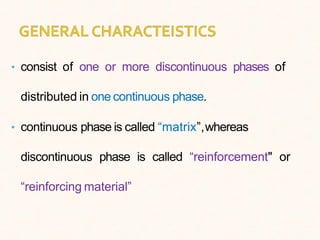
• consist of one or more discontinuous phases of
distributed in one continuous phase.
• continuous phase is called “matrix”,whereas
discontinuous phase is called “reinforcement" or
“reinforcing material”
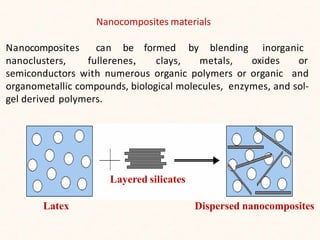
Nanocomposites can be formed by blending inorganic
nanoclusters, fullerenes, clays, metals, oxides or
semiconductors with numerous organic polymers or organic and
organometallic compounds, biological molecules, enzymes, and sol-
gel derived polymers.
Nanocomposites materials
Latex
Layered silicates
Dispersed nanocomposites
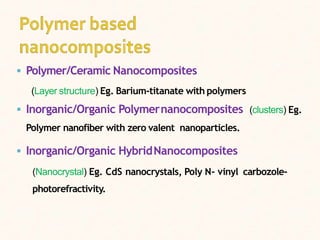
 Polymer/Ceramic Nanocomposites
(Layer structure) Eg. Barium-titanate with polymers
 Inorganic/Organic Polymernanocomposites (clusters) Eg.
Polymer nanofiber with zero valent nanoparticles.
 Inorganic/Organic HybridNanocomposites
(Nanocrystal) Eg. CdS nanocrystals, Poly N- vinyl carbozole-
photorefractivity.
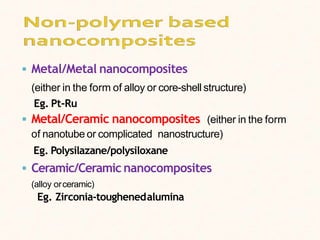
 Metal/Metal nanocomposites
(either in the form of alloy or core-shell structure)
Eg. Pt-Ru
 Metal/Ceramic nanocomposites (either in the form
of nanotube or complicated nanostructure)
Eg. Polysilazane/polysiloxane
 Ceramic/Ceramic nanocomposites
(alloy orceramic)
Eg. Zirconia-toughenedalumina
Metal matrix nanocomposites
• Metal matrix nanocomposites (MMNCs)
comprises of metal as the matrix and ceramic
as the reinforcement.
• This type of composites can be classified as
continuous and non-continuous reinforced
materials.
• Another emerging class of nanocomposites is
Carbon nanotube metal matrix
nanocomposites (CNT-MMNC).
Carbon Nanotube Metal Matrix
Nanocomposites
• It provides high tensile strength and electrical conductivity as compared
to carbon nanotube materials.
• Important considerations in the development of processing techniques
of CNT-MMNCs are (a) economically producible, provide a homogeneous
dispersion of nanotubes in the metallic matrix and lead to strong
interfacial adhesion between the metallic matrix and the carbon
nanotubes.
• Apart from CNT-MMNC another important research area of MMNC are
boron nitride reinforced metal matrix composites and carbon nitride
metal matrix composites
Synthesis Routes for Fabricating Metal Matrix
Nanocomposites
• Metal matrix Nanocomposites can be processed in the liquid
state or in the solid state. The easiest and cheapest method for
processing nanocomposites are
1. solid state
2. liquid state
Solid State Methods
1. Powder Metallurgy (P/M): Powdered metal
and reinforcement are mixed and then
bonded through a process of compaction,
degassing, and thermo-mechanical treatment
(possibly via hot isostatic pressing (HIP) or ex-
trusion).
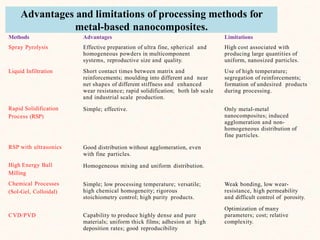
Advantages and limitations of processing methods for
metal-based nanocomposites.
Methods
Spray Pyrolysis
Liquid Infiltration
Limitations
High cost associated with
producing large quantities of
uniform, nanosized particles.
Use of high temperature;
segregation of reinforcements;
formation of undesired products
during processing.
Rapid Solidification
Process (RSP)
Advantages
Effective preparation of ultra fine, spherical and
homogeneous powders in multicomponent
systems, reproductive size and quality.
Short contact times between matrix and
reinforcements; moulding into different and near
net shapes of different stiffness and enhanced
wear resistance; rapid solidification; both lab scale
and industrial scale production.
Simple; effective. Only metal-metal
nanocomposites; induced
agglomeration and non-
homogeneous distribution of
fine particles.
RSP with ultrasonics Good distribution without agglomeration, even
with fine particles.
Homogeneous mixing and uniform distribution.High Energy Ball
Milling
Chemical Processes
(Sol-Gel, Colloidal)
Simple; low processing temperature; versatile;
high chemical homogeneity; rigorous
stoichiometry control; high purity products.
CVD/PVD Capability to produce highly dense and pure
materials; uniform thick films; adhesion at high
deposition rates; good reproducibility
Weak bonding, low wear-
resistance, high permeability
and difficult control of porosity.
Optimization of many
parameters; cost; relative
complexity.
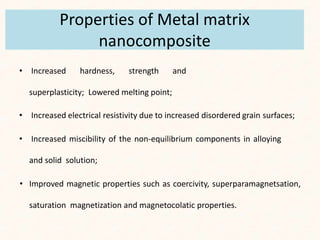
Properties of Metal matrix
nanocomposite
• Increased hardness, strength and
superplasticity; Lowered melting point;
• Increased electrical resistivity due to increased disordered grain surfaces;
• Increased miscibility of the non-equilibrium components in alloying
and solid solution;
• Improved magnetic properties such as coercivity, superparamagnetsation,
saturation magnetization and magnetocolatic properties.
Metal matrix Nanocomposite

Metal matrix Nanocomposite

  • 1.
  • 2.
    Composites • What arecomposites? •word “composite” means “made of two or more differentparts.” •“A composite is a combination of two or more different materials that are mixed in aneffort to blendthebestpropertiesof both.”
  • 3.
    Nanocomposite • Nanocomposites consistof two phases (i.e nanocrystalline phase + matrix phase) – Phase may be inorganic-inorganic, inorganic-organic or organic-organic • Nanocomposite means nanosized particles (i.e metals, semiconductors, dielectric materials, etc) embedded in different matrix materials (ceramics, glass, polymers, etc).
  • 4.
    • Mechanically theterm nanocomposites are differ from conventional composites due to the exceptionally high surfaceto volume ratio of the reinforcing and/or its exceptionally high aspect ratio. Difference?
  • 5.
    • consist ofone or more discontinuous phases of distributed in one continuous phase. • continuous phase is called “matrix”,whereas discontinuous phase is called “reinforcement" or “reinforcing material”
  • 6.
    Nanocomposites can beformed by blending inorganic nanoclusters, fullerenes, clays, metals, oxides or semiconductors with numerous organic polymers or organic and organometallic compounds, biological molecules, enzymes, and sol- gel derived polymers. Nanocomposites materials Latex Layered silicates Dispersed nanocomposites
  • 7.
     Polymer/Ceramic Nanocomposites (Layerstructure) Eg. Barium-titanate with polymers  Inorganic/Organic Polymernanocomposites (clusters) Eg. Polymer nanofiber with zero valent nanoparticles.  Inorganic/Organic HybridNanocomposites (Nanocrystal) Eg. CdS nanocrystals, Poly N- vinyl carbozole- photorefractivity.
  • 8.
     Metal/Metal nanocomposites (eitherin the form of alloy or core-shell structure) Eg. Pt-Ru  Metal/Ceramic nanocomposites (either in the form of nanotube or complicated nanostructure) Eg. Polysilazane/polysiloxane  Ceramic/Ceramic nanocomposites (alloy orceramic) Eg. Zirconia-toughenedalumina
  • 9.
    Metal matrix nanocomposites •Metal matrix nanocomposites (MMNCs) comprises of metal as the matrix and ceramic as the reinforcement. • This type of composites can be classified as continuous and non-continuous reinforced materials. • Another emerging class of nanocomposites is Carbon nanotube metal matrix nanocomposites (CNT-MMNC).
  • 10.
    Carbon Nanotube MetalMatrix Nanocomposites • It provides high tensile strength and electrical conductivity as compared to carbon nanotube materials. • Important considerations in the development of processing techniques of CNT-MMNCs are (a) economically producible, provide a homogeneous dispersion of nanotubes in the metallic matrix and lead to strong interfacial adhesion between the metallic matrix and the carbon nanotubes. • Apart from CNT-MMNC another important research area of MMNC are boron nitride reinforced metal matrix composites and carbon nitride metal matrix composites
  • 11.
    Synthesis Routes forFabricating Metal Matrix Nanocomposites • Metal matrix Nanocomposites can be processed in the liquid state or in the solid state. The easiest and cheapest method for processing nanocomposites are 1. solid state 2. liquid state
  • 12.
    Solid State Methods 1.Powder Metallurgy (P/M): Powdered metal and reinforcement are mixed and then bonded through a process of compaction, degassing, and thermo-mechanical treatment (possibly via hot isostatic pressing (HIP) or ex- trusion).
  • 13.
    Advantages and limitationsof processing methods for metal-based nanocomposites. Methods Spray Pyrolysis Liquid Infiltration Limitations High cost associated with producing large quantities of uniform, nanosized particles. Use of high temperature; segregation of reinforcements; formation of undesired products during processing. Rapid Solidification Process (RSP) Advantages Effective preparation of ultra fine, spherical and homogeneous powders in multicomponent systems, reproductive size and quality. Short contact times between matrix and reinforcements; moulding into different and near net shapes of different stiffness and enhanced wear resistance; rapid solidification; both lab scale and industrial scale production. Simple; effective. Only metal-metal nanocomposites; induced agglomeration and non- homogeneous distribution of fine particles. RSP with ultrasonics Good distribution without agglomeration, even with fine particles. Homogeneous mixing and uniform distribution.High Energy Ball Milling Chemical Processes (Sol-Gel, Colloidal) Simple; low processing temperature; versatile; high chemical homogeneity; rigorous stoichiometry control; high purity products. CVD/PVD Capability to produce highly dense and pure materials; uniform thick films; adhesion at high deposition rates; good reproducibility Weak bonding, low wear- resistance, high permeability and difficult control of porosity. Optimization of many parameters; cost; relative complexity.
  • 14.
    Properties of Metalmatrix nanocomposite • Increased hardness, strength and superplasticity; Lowered melting point; • Increased electrical resistivity due to increased disordered grain surfaces; • Increased miscibility of the non-equilibrium components in alloying and solid solution; • Improved magnetic properties such as coercivity, superparamagnetsation, saturation magnetization and magnetocolatic properties.