NANOFLUIDS: PREPARATION,
CHARACTERIZATION AND
APPLICATIONS
Submitted by
Ahmed Haider Ahmed
Supervised by
Prof. Dr. Ahmed Ali Farghli
1
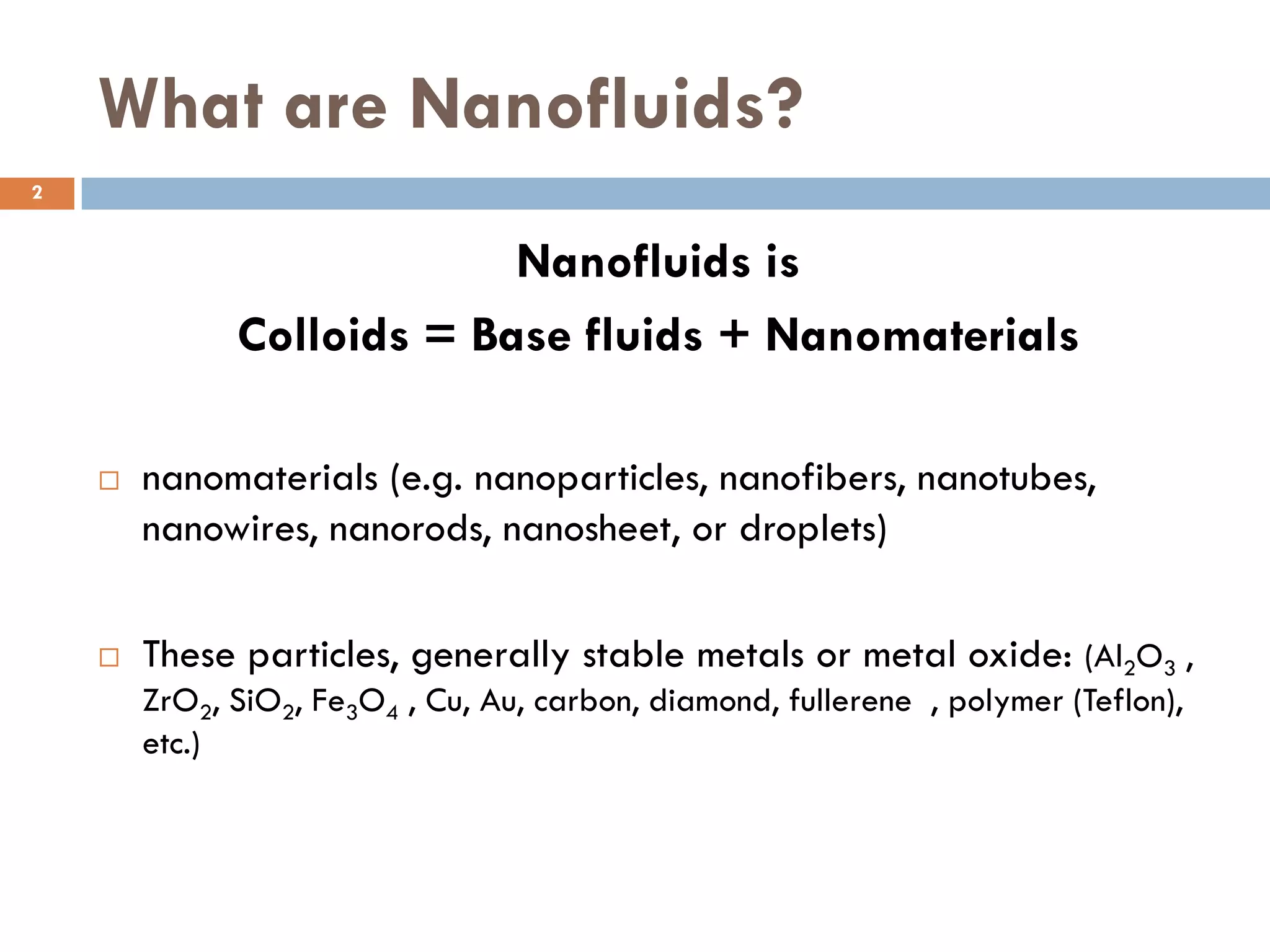
What are Nanofluids?
Nanofluids is
Colloids = Base fluids + Nanomaterials
 nanomaterials (e.g. nanoparticles, nanofibers, nanotubes,
nanowires, nanorods, nanosheet, or droplets)
 These particles, generally stable metals or metal oxide: (Al2O3 ,
ZrO2, SiO2, Fe3O4 , Cu, Au, carbon, diamond, fullerene , polymer (Teflon),
etc.)
2
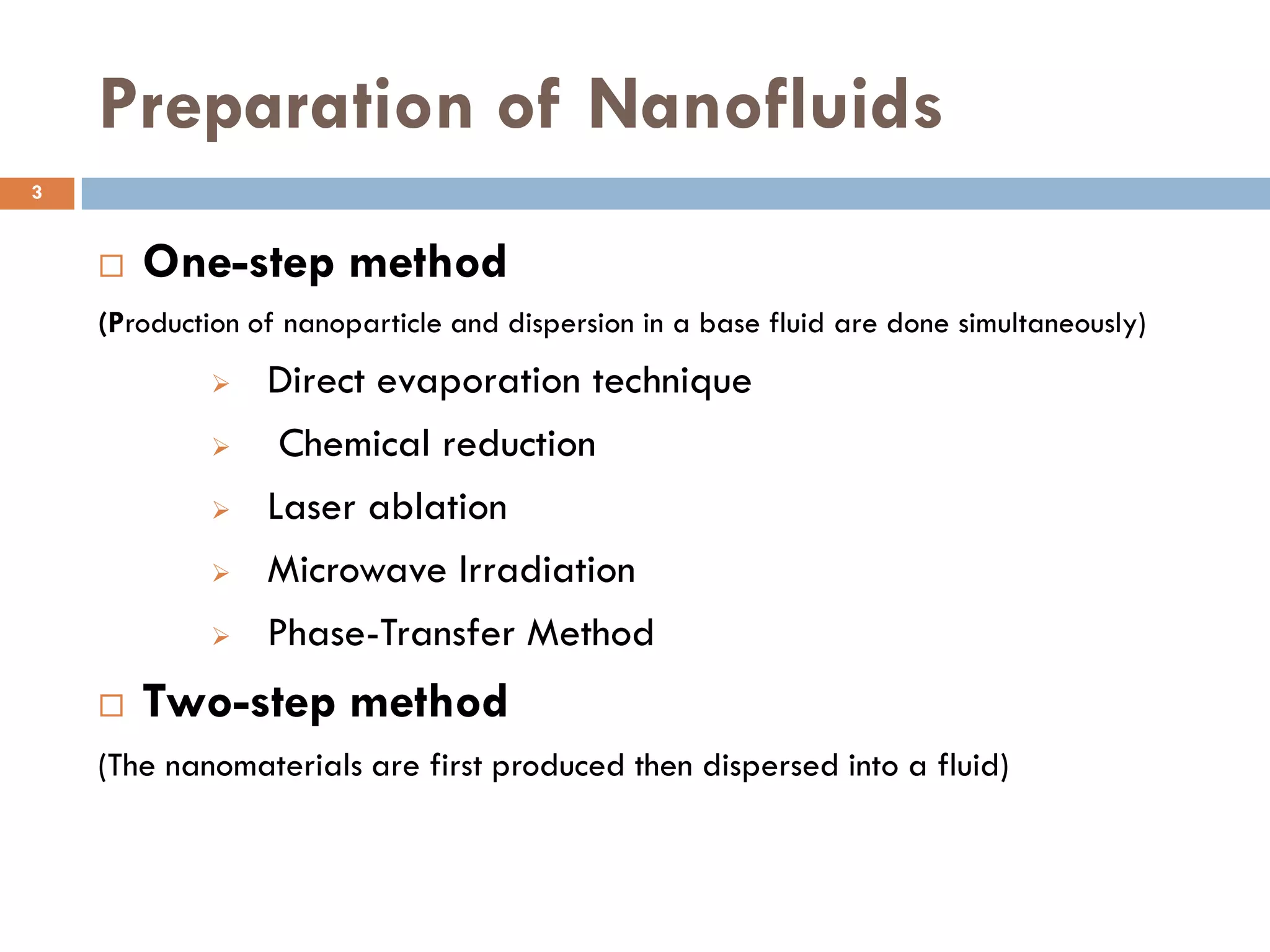
Preparation of Nanofluids
 One-step method
(Production of nanoparticle and dispersion in a base fluid are done simultaneously)
 Direct evaporation technique
 Chemical reduction
 Laser ablation
 Microwave Irradiation
 Phase-Transfer Method
 Two-step method
(The nanomaterials are first produced then dispersed into a fluid)
3
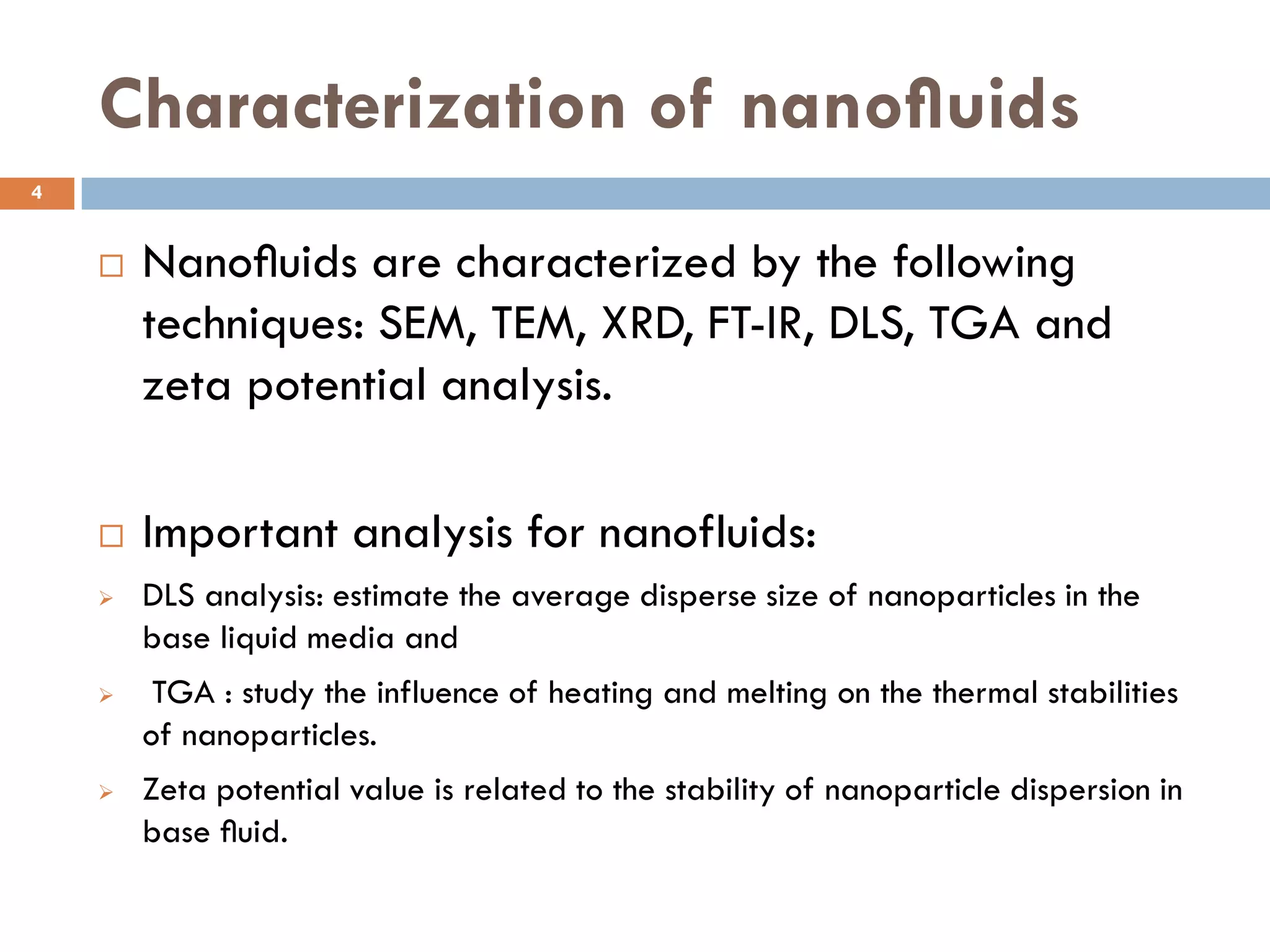
Characterization of nanofluids
 Nanofluids are characterized by the following
techniques: SEM, TEM, XRD, FT-IR, DLS, TGA and
zeta potential analysis.
 Important analysis for nanofluids:
 DLS analysis: estimate the average disperse size of nanoparticles in the
base liquid media and
 TGA : study the influence of heating and melting on the thermal stabilities
of nanoparticles.
 Zeta potential value is related to the stability of nanoparticle dispersion in
base fluid.
4
Properties of nanofluids
 Thermal conductivity
 Viscosity
 Convective heat transfer
 Density
 Specific Heat
5
Thermal conductivity
K of nanofluids depends on many parameters;
base fluids, volume fraction, particle size, shape, temperature, surface
charge, pH value, Brownian motion of nanoparticles, effect of clustering,
nanolayer, dispersion techniques.
 The experimental data shows that k of nanofluid do
not agree with the theoretical models results.
 Transient hot wire technique not transient wire
6
Viscosity
 Viscosity is a measure of the tendency of a liquid to
resist flow.
 The viscosity of nanofluid depends on many parameters;
base fluid properties, particle volume fraction, particle size, particle
shape, temperature, pH value, surfactants, dispersion techniques,
particle size distribution, particle aggregation and temperature.
 linear relationship between viscosity and volume
concentration .
7
5. Application of nanofluids
 Automobile applications
 Solar energy applications
 Mechanical applications
 Reactor-heat exchange
 Optical application
 Biomedical applications
 Electronics cooling
8
Challenges of nanofluids
The main issues and challenges of nanofluids are;
I. The disagreement between most of experimental
data with the theoretical model predictions
II. The poor characterization of the nano suspensions.
III. The lack of understanding of the complex physical
phenomena responsible for the anomalous behavior
of nanofluids
9
Conclusion
 Thermal conductivity, viscosity and specific heat
models of nanofluids are many in literatures.
 The requirement to improve the efficiency of
thermal systems relies highly on the enhancement of
thermal conductivity of base fluid
 The experimental work on viscosity, specific heat
and pressure drop of nanofluid and their
dependence on temperature are limited
10
Conclusion
 Stability of nanofluids is one of the key challenges
hindering the widespread practical application of
nanofluids.
 Studies showed that stability depend on pH,
sonication time, different types of shapes and sizes
of nanoparticles with different base fluids, nanofluid
preparation methods, volume fraction and
surfactants.
11
12
Thank you

Nanofluids: preparation, characterization and applications

  • 1.
    NANOFLUIDS: PREPARATION, CHARACTERIZATION AND APPLICATIONS Submittedby Ahmed Haider Ahmed Supervised by Prof. Dr. Ahmed Ali Farghli 1
  • 2.
    What are Nanofluids? Nanofluidsis Colloids = Base fluids + Nanomaterials  nanomaterials (e.g. nanoparticles, nanofibers, nanotubes, nanowires, nanorods, nanosheet, or droplets)  These particles, generally stable metals or metal oxide: (Al2O3 , ZrO2, SiO2, Fe3O4 , Cu, Au, carbon, diamond, fullerene , polymer (Teflon), etc.) 2
  • 3.
    Preparation of Nanofluids One-step method (Production of nanoparticle and dispersion in a base fluid are done simultaneously)  Direct evaporation technique  Chemical reduction  Laser ablation  Microwave Irradiation  Phase-Transfer Method  Two-step method (The nanomaterials are first produced then dispersed into a fluid) 3
  • 4.
    Characterization of nanofluids Nanofluids are characterized by the following techniques: SEM, TEM, XRD, FT-IR, DLS, TGA and zeta potential analysis.  Important analysis for nanofluids:  DLS analysis: estimate the average disperse size of nanoparticles in the base liquid media and  TGA : study the influence of heating and melting on the thermal stabilities of nanoparticles.  Zeta potential value is related to the stability of nanoparticle dispersion in base fluid. 4
  • 5.
    Properties of nanofluids Thermal conductivity  Viscosity  Convective heat transfer  Density  Specific Heat 5
  • 6.
    Thermal conductivity K ofnanofluids depends on many parameters; base fluids, volume fraction, particle size, shape, temperature, surface charge, pH value, Brownian motion of nanoparticles, effect of clustering, nanolayer, dispersion techniques.  The experimental data shows that k of nanofluid do not agree with the theoretical models results.  Transient hot wire technique not transient wire 6
  • 7.
    Viscosity  Viscosity isa measure of the tendency of a liquid to resist flow.  The viscosity of nanofluid depends on many parameters; base fluid properties, particle volume fraction, particle size, particle shape, temperature, pH value, surfactants, dispersion techniques, particle size distribution, particle aggregation and temperature.  linear relationship between viscosity and volume concentration . 7
  • 8.
    5. Application ofnanofluids  Automobile applications  Solar energy applications  Mechanical applications  Reactor-heat exchange  Optical application  Biomedical applications  Electronics cooling 8
  • 9.
    Challenges of nanofluids Themain issues and challenges of nanofluids are; I. The disagreement between most of experimental data with the theoretical model predictions II. The poor characterization of the nano suspensions. III. The lack of understanding of the complex physical phenomena responsible for the anomalous behavior of nanofluids 9
  • 10.
    Conclusion  Thermal conductivity,viscosity and specific heat models of nanofluids are many in literatures.  The requirement to improve the efficiency of thermal systems relies highly on the enhancement of thermal conductivity of base fluid  The experimental work on viscosity, specific heat and pressure drop of nanofluid and their dependence on temperature are limited 10
  • 11.
    Conclusion  Stability ofnanofluids is one of the key challenges hindering the widespread practical application of nanofluids.  Studies showed that stability depend on pH, sonication time, different types of shapes and sizes of nanoparticles with different base fluids, nanofluid preparation methods, volume fraction and surfactants. 11
  • 12.