REVIEW ON HEAT TRANSFER
ENHANCEMENT WITH TWISTED TAPE
By
Mr. Shekhar S. Babar
Prof. K. D. Devade
MECHANICAL ENGINEERING
(Indira College of Engineering & Management,Pune)
OVERVIEW
 INTRODUCTION
 CLASSIFICATION & APPLICATIONS
 DESIGN CONSIDERATIONS
 MECHANISM OF HEAT TRANSFER
ENHANCEMENT
 NEED FOR HEAT TRANSFER ENHANCEMENT
 ENHANCEMENT TECHNIQUIES
 TWISTED TAPE : A PASSIVE METHOD
 THERMAL CHARACTERISTICS OF HEAT
EXCHANGER WITH TWISTED TAPE
 CONCLUSION
ICEM-MECHANICALENGINEERING
2
INTRODUCTION
 HEAT EXCHANGER
A heat exchanger is a device that transfers thermal
energy from a high-temperature fluid to a low-
temperature fluid with both fluids moving
through the device. A heat exchanger is a device
that is used to transfer thermal energy (enthalpy)
between two or more fluids, between a solid
surface and a fluid, or between solid particulates
and a fluid, at different temperatures and in
thermal contact. In heat exchangers, there are
usually no external heat and work interactions.
ICEM-MECHANICALENGINEERING
3
CLASSIFICATION OF HEAT EXCHANGERS
 According to Transfer process
 Indirect contact type
 Direct contact type
 According to Construction
 Tabular Type -Double Pipe, Shell& tube, Spiral tube, Pipe coil
 Plate Type
 Extended surface type
 Regenerative
 According to Flow arrangement
 According to Heat transfer mechanism
 Single phase convection on both side
 Two phase convection on both side
 Single phase convection on one side & two phase on other side
 Process function
 Condenser Evaporator &
 Heaters, Cooler, Chillers
ICEM-MECHANICALENGINEERING
4
APPLICATIONS OF HEAT EXCHANGERS
 Applications involve heating or cooling of a fluid
stream of concern and evaporation or condensation
of single- or multi component fluid streams.
 In other applications, the objective may be to recover
or reject heat, or sterilize, pasteurize, fractionate,
distill, concentrate, crystallize, or control a process
fluid.
 Heat exchanger for an ocean thermal energy
conversion (OTEC),
 Heat exchangers for process industries, Sugar
factories, diary plants, Chemical industries Heating
and cooling in evaporators,
 Heat exchangers thermal power plants, air-
conditioning equipment, refrigerators, radiators for
space vehicles, automobiles.
ICEM-MECHANICALENGINEERING
5
DESIGN CONSIDERATIONS
 Resistance to heat transfer should be
minimized
 Contingencies should be anticipated via
safety margins; for example, allowance for
fouling during operation.
 The equipment should be sturdy.
 Cost and material requirements should be
low.
 Corrosion should be avoided.
 Pumping cost should be kept low.
 Space required should be kept low.
 Required weight should be kept low.
ICEM-MECHANICALENGINEERING
6
NEED FOR HEAT TRANSFER ENHANCEMENT
 To make the equipment compact
 To achieve a high heat transfer rate using minimum
pumping power
 Minimize the cost of energy and material
 A need for miniaturization of a heat exchanger in specific
applications Space, OTEC
 Working fluids of low thermal conductivity (gases and
oils) and desalination plants
 Increase efficiency of process & system.
 Design optimum heat exchanger size
 Transfer required amount of heat with high effectiveness
 Reduce the volume & weight
 For given temperature difference improved HT
 Effective utilization of energy-Minimum operating cost
ICEM-MECHANICALENGINEERING
7
MECHANISMS OF AUGMENTATION OF HEAT TRANSFER
 Use of a secondary heat transfer surface.
 Disruption of the unenhanced fluid velocity.
 Disruption of the laminar sub layer in the turbulent boundary layer.
 Introducing secondary flows.
 Promoting boundary-layer separation. .
 Enhancing effective thermal conductivity of the fluid under static conditions
 Enhancing effective thermal conductivity of the fluid under dynamic
 Delaying the boundary layer development.
 Thermal dispersion
 Increasing the order of the fluid molecules.
 Redistribution of the flow.
 Modification of radiative property of the convective medium.
 Increasing the difference between the surface and fluid temperatures.
 Increasing fluid flow rate passively.
 Increasing the thermal conductivity of the solid phase using special
Nanotechnology fabrications
ICEM-MECHANICALENGINEERING
8
HEAT TRANSFER ENHANCEMENT TECHNIQUES
 Active method: external power input for the
enhancement of heat transfer
 pulsation by cams and reciprocating plungers
 magnetic field to disturb seeded light particles in a
flowing stream,
 fluid vibration, jet impingement ,Suction
 Passive method: surface or geometrical modifications
to the flow channel by incorporating inserts or
additional devices
 Inserts, Rough surfaces, Coiled / Twisted tape
 Baffles, Extended surface additives,
 Compound method: When any two or more
techniques employed simultaneously
ICEM-MECHANICALENGINEERING
9
ACTIVE METHODS
 Mechanical Aids:
 Surface vibration:
 Fluid vibration:
 Electrostatic fields:
 Injection
 Suction:
 Jet impingement:
ICEM-MECHANICALENGINEERING
10
PASSIVE METHODS
 Treated Surfaces:.
 Rough surfaces:
 Extended surfaces:
 Displaced enhancement devices:.
 Swirl flow devices:
 Coiled tubes:.
 Surface tension devices:
 Additives for liquids:
 Additives for gases:
ICEM-MECHANICALENGINEERING
11
WHY PASSIVE TECHNIQUES?
 These techniques generally use simple surface or
geometrical modifications to the flow channel by
incorporating inserts or additional devices
 It does not need any external power input.
 Insert manufacturing process is simple and these
techniques can be easily employed in an existing heat
exchanger.
 Passive insert configuration can be selected According to
the heat exchanger working condition
 It can be used in design of compact heat exchangers.
 It is not only applicable in heat exchanger but also in solar
air heater and cooling of electronic components (heat
sink).
ICEM-MECHANICALENGINEERING
12
TWISTED TAPE
 TWISTED TAPE :A PASSIVE
METHOD
 Inserts refer to the
additional arrangements
made as an obstacle to
fluid flow so as to
augment heat transfer.
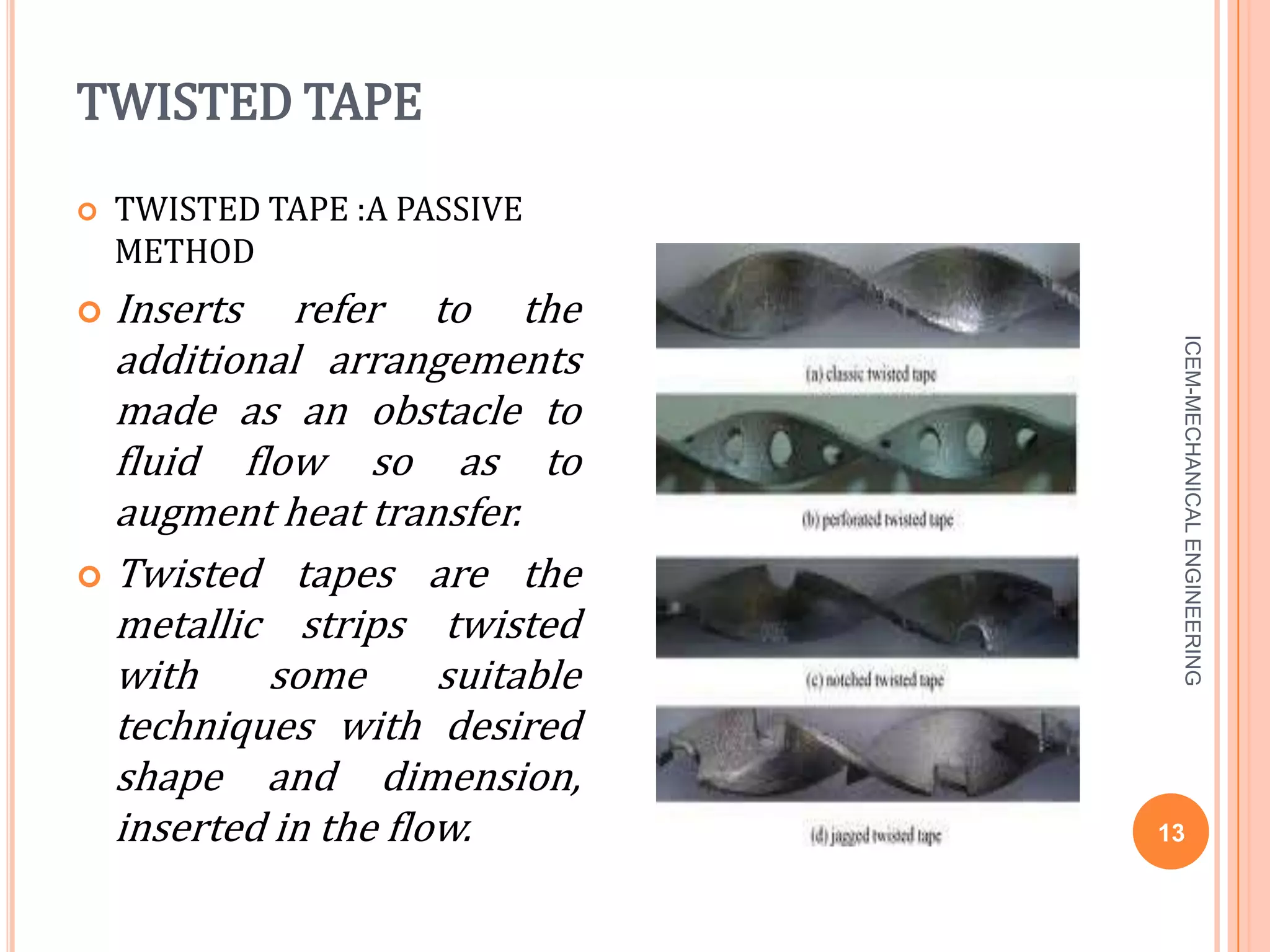
 Twisted tapes are the
metallic strips twisted
with some suitable
techniques with desired
shape and dimension,
inserted in the flow.
ICEM-MECHANICALENGINEERING
13
TYPES OF TWISTED TAPES
 Plain Twisted Tape
 Full length twisted tape
 Varying length twisted tape
 Short length TT
 Regularly spaced twisted tapes
 Tape with attached baffles
 Slotted tapes and tapes with holes
 Tapes with dimpled surface modifications
 Serrated twisted tape
 Edge fold twisted tape
 Oblique teeth Twisted tape
ICEM-MECHANICALENGINEERING
14
TYPES OF TWISTED TAPES
ICEM-MECHANICALENGINEERING
15
ATTRIBUTES OF TWISTED TAPE
ICEM-MECHANICALENGINEERING
 Width (W)
 Thickness (δ)
 Pitch (y)
 Twist ratio (Y)= y/W
 Clearance
ratio(CR)=D/W
 Depth ratio(DR)=d/W
 Width ratio(WR)=w/W
 Wing depth ratio
 Perforated diameter
ratio
16
THERMAL CHARACTERISTICS OF HEAT EXCHANGER
WITH TWISTED TAPE
 TT induce swirl into bulk flow-disrupting boundary layer at tube
surface due to repeated changes in surface geometries, TT
induce turbulence & superimpose vortex motion results thinner
boundary layer
 Effect of TT on Thermal Characteristics of Heat exchangers like
Thermo hydraulic performance, Thermal performance factor, Nu,
Friction factor
 Effect of Twist ratio-TT with Twist ratio-5,7 increases the Heat
transfer rate about 188%-159% than plain tube
 Smaller the TR larger is the Heat transfer but penalty of greater
friction factor & Pressure drop
 Small TR give rise to more Nu, Friction Factor & Enhancement
efficiency at high Re
ICEM-MECHANICALENGINEERING
17
THERMAL CHARACTERISTICS OF HEAT EXCHANGER WITH TWISTED TAPE
ICEM-MECHANICALENGINEERING
Effect of parallel rectangular wing
TT are cut at the edge of tape in straight line
at every pitch length & each cut bend in
450
 It is observed that increase in wing depth
ratio increases heat transfer rate &
Friction factor as well as maximum
thermal performance
 For Wing depth ratio 0.1,0.2,0.3 HTR
increases 78%,91%,100% than plain
tube
 Thermal performance Factor is about
1.36 for Wing depth ratio 0.3
18
THERMAL CHARACTERISTICS OF HEAT EXCHANGER WITH
TWISTED TAPE
Effect of Varying width Twisted Tape
 Enhancement is due to the centrifugal forces resulting
the spiral motion of fluid
 Increasing the width of TT results in increase in Nu
hence the heat transfer rate as well as Friction factor
 For Three TT with different width 26,22,18 mm
enhancement of HT is 48%,40% & 35% than plain
tube & Friction factor rise of 18%,17%15% than plain
tube
 Overall enhancement ratio is 1.62,1.39,1.22
 22mm gives better results with 60% material saving
ICEM-MECHANICALENGINEERING
19
THERMAL CHARACTERISTICS OF HEAT EXCHANGER WITH
TWISTED TAPE
Effect of single, Twin & Triple TT
 When Number of TT increases HTR increases also
increases Friction factor
 Thermal performance factor better for the Twin&
Triple TT than Single TT
 HTR increases 2.5,3,3.5 times more than plain tube
Effect of Half length TT
 HTR increases 40% than plain tube
 On the basis of equal mass flow rate HT performance
is better than Plain tube but on unit pressure drop
basis plain tube is better than half length TT
ICEM-MECHANICALENGINEERING
20
THERMAL CHARACTERISTICS OF HEAT EXCHANGER WITH
TWISTED TAPE
ICEM-MECHANICALENGINEERING
Effect of Perforated TT with parallel wing
 Wing induce extra turbulence near tube
wall & efficiently disrupt thermal
boundary layer
 Hole existing along a core tube diminish
pressure loss within the tube, stream
behaves in between axial & swirl flow.
 Wing depth ratio (w/W) increases
higher turbulence intensity & better
mixing fluid near tube wall hence
higher HTR & greater Friction factor,
Higher Thermal performance factor
 Perforated diameter ratio(d/W) larger
the flow become axial flow lose swirl
intensity between tape & surface wall
 HTR , Friction factor, Thermal
performance factor increases with
decreases in Perforated diameter ratio 21
THERMAL CHARACTERISTICS OF HEAT EXCHANGER WITH TWISTED
TAPE
ICEM-MECHANICALENGINEERING
Effect of Peripherally cut Twisted tape
 TT modified by Peripheral cutting in order to
generate additional turbulence in vicinity of
tube wall
 HT, Nu, Friction factor as well as Thermal
performance factor associated by PCTT
found increased with increasing Tape depth
ratio(d/W) & decreasing width ratio (w/W)
Effect of dimpled tube with TT
 Increase of Nu due to both Turbulence
(dimpled tube) & Swirl flow (TT) higher
reduction of boundary layer thickness &
increase of resultant velocity
 HTR & Friction factor increases with
decreasing both Pitch ratio & Twist ratio
22
CONCLUSION
Twisted tape is commonly used heat transfer enhancement
tool in heat exchanger because its manufacturing process
is simple and these can be easily employed in an existing
heat exchanger. Study of influence different types Twisted
Tapes with different attributes e.g. Twist Ratio, Pitch,
Depth ratio etc & different configuration on Thermal
characteristics of heat exchangers like Heat transfer rate,
friction factor, Thermal performance ratio etc., reveals that
heat exchanger employed with Twisted tape always gives
the enhanced heat transfer with penalty of appreciable
rise in friction & Pressure drop hence selection of the
optimum Twisted Tape for the required working
conditions gives scope for the future work. Future work
may be extended to Change the tape material from
Aluminium to Copper & employing Compound
enhancement techniques.
ICEM-MECHANICALENGINEERING
23
ICEM-MECHANICALENGINEERING
24

Heat transfer enhancement

  • 1.
    REVIEW ON HEATTRANSFER ENHANCEMENT WITH TWISTED TAPE By Mr. Shekhar S. Babar Prof. K. D. Devade MECHANICAL ENGINEERING (Indira College of Engineering & Management,Pune)
  • 2.
    OVERVIEW  INTRODUCTION  CLASSIFICATION& APPLICATIONS  DESIGN CONSIDERATIONS  MECHANISM OF HEAT TRANSFER ENHANCEMENT  NEED FOR HEAT TRANSFER ENHANCEMENT  ENHANCEMENT TECHNIQUIES  TWISTED TAPE : A PASSIVE METHOD  THERMAL CHARACTERISTICS OF HEAT EXCHANGER WITH TWISTED TAPE  CONCLUSION ICEM-MECHANICALENGINEERING 2
  • 3.
    INTRODUCTION  HEAT EXCHANGER Aheat exchanger is a device that transfers thermal energy from a high-temperature fluid to a low- temperature fluid with both fluids moving through the device. A heat exchanger is a device that is used to transfer thermal energy (enthalpy) between two or more fluids, between a solid surface and a fluid, or between solid particulates and a fluid, at different temperatures and in thermal contact. In heat exchangers, there are usually no external heat and work interactions. ICEM-MECHANICALENGINEERING 3
  • 4.
    CLASSIFICATION OF HEATEXCHANGERS  According to Transfer process  Indirect contact type  Direct contact type  According to Construction  Tabular Type -Double Pipe, Shell& tube, Spiral tube, Pipe coil  Plate Type  Extended surface type  Regenerative  According to Flow arrangement  According to Heat transfer mechanism  Single phase convection on both side  Two phase convection on both side  Single phase convection on one side & two phase on other side  Process function  Condenser Evaporator &  Heaters, Cooler, Chillers ICEM-MECHANICALENGINEERING 4
  • 5.
    APPLICATIONS OF HEATEXCHANGERS  Applications involve heating or cooling of a fluid stream of concern and evaporation or condensation of single- or multi component fluid streams.  In other applications, the objective may be to recover or reject heat, or sterilize, pasteurize, fractionate, distill, concentrate, crystallize, or control a process fluid.  Heat exchanger for an ocean thermal energy conversion (OTEC),  Heat exchangers for process industries, Sugar factories, diary plants, Chemical industries Heating and cooling in evaporators,  Heat exchangers thermal power plants, air- conditioning equipment, refrigerators, radiators for space vehicles, automobiles. ICEM-MECHANICALENGINEERING 5
  • 6.
    DESIGN CONSIDERATIONS  Resistanceto heat transfer should be minimized  Contingencies should be anticipated via safety margins; for example, allowance for fouling during operation.  The equipment should be sturdy.  Cost and material requirements should be low.  Corrosion should be avoided.  Pumping cost should be kept low.  Space required should be kept low.  Required weight should be kept low. ICEM-MECHANICALENGINEERING 6
  • 7.
    NEED FOR HEATTRANSFER ENHANCEMENT  To make the equipment compact  To achieve a high heat transfer rate using minimum pumping power  Minimize the cost of energy and material  A need for miniaturization of a heat exchanger in specific applications Space, OTEC  Working fluids of low thermal conductivity (gases and oils) and desalination plants  Increase efficiency of process & system.  Design optimum heat exchanger size  Transfer required amount of heat with high effectiveness  Reduce the volume & weight  For given temperature difference improved HT  Effective utilization of energy-Minimum operating cost ICEM-MECHANICALENGINEERING 7
  • 8.
    MECHANISMS OF AUGMENTATIONOF HEAT TRANSFER  Use of a secondary heat transfer surface.  Disruption of the unenhanced fluid velocity.  Disruption of the laminar sub layer in the turbulent boundary layer.  Introducing secondary flows.  Promoting boundary-layer separation. .  Enhancing effective thermal conductivity of the fluid under static conditions  Enhancing effective thermal conductivity of the fluid under dynamic  Delaying the boundary layer development.  Thermal dispersion  Increasing the order of the fluid molecules.  Redistribution of the flow.  Modification of radiative property of the convective medium.  Increasing the difference between the surface and fluid temperatures.  Increasing fluid flow rate passively.  Increasing the thermal conductivity of the solid phase using special Nanotechnology fabrications ICEM-MECHANICALENGINEERING 8
  • 9.
    HEAT TRANSFER ENHANCEMENTTECHNIQUES  Active method: external power input for the enhancement of heat transfer  pulsation by cams and reciprocating plungers  magnetic field to disturb seeded light particles in a flowing stream,  fluid vibration, jet impingement ,Suction  Passive method: surface or geometrical modifications to the flow channel by incorporating inserts or additional devices  Inserts, Rough surfaces, Coiled / Twisted tape  Baffles, Extended surface additives,  Compound method: When any two or more techniques employed simultaneously ICEM-MECHANICALENGINEERING 9
  • 10.
    ACTIVE METHODS  MechanicalAids:  Surface vibration:  Fluid vibration:  Electrostatic fields:  Injection  Suction:  Jet impingement: ICEM-MECHANICALENGINEERING 10
  • 11.
    PASSIVE METHODS  TreatedSurfaces:.  Rough surfaces:  Extended surfaces:  Displaced enhancement devices:.  Swirl flow devices:  Coiled tubes:.  Surface tension devices:  Additives for liquids:  Additives for gases: ICEM-MECHANICALENGINEERING 11
  • 12.
    WHY PASSIVE TECHNIQUES? These techniques generally use simple surface or geometrical modifications to the flow channel by incorporating inserts or additional devices  It does not need any external power input.  Insert manufacturing process is simple and these techniques can be easily employed in an existing heat exchanger.  Passive insert configuration can be selected According to the heat exchanger working condition  It can be used in design of compact heat exchangers.  It is not only applicable in heat exchanger but also in solar air heater and cooling of electronic components (heat sink). ICEM-MECHANICALENGINEERING 12
  • 13.
    TWISTED TAPE  TWISTEDTAPE :A PASSIVE METHOD  Inserts refer to the additional arrangements made as an obstacle to fluid flow so as to augment heat transfer.  Twisted tapes are the metallic strips twisted with some suitable techniques with desired shape and dimension, inserted in the flow. ICEM-MECHANICALENGINEERING 13
  • 14.
    TYPES OF TWISTEDTAPES  Plain Twisted Tape  Full length twisted tape  Varying length twisted tape  Short length TT  Regularly spaced twisted tapes  Tape with attached baffles  Slotted tapes and tapes with holes  Tapes with dimpled surface modifications  Serrated twisted tape  Edge fold twisted tape  Oblique teeth Twisted tape ICEM-MECHANICALENGINEERING 14
  • 15.
    TYPES OF TWISTEDTAPES ICEM-MECHANICALENGINEERING 15
  • 16.
    ATTRIBUTES OF TWISTEDTAPE ICEM-MECHANICALENGINEERING  Width (W)  Thickness (δ)  Pitch (y)  Twist ratio (Y)= y/W  Clearance ratio(CR)=D/W  Depth ratio(DR)=d/W  Width ratio(WR)=w/W  Wing depth ratio  Perforated diameter ratio 16
  • 17.
    THERMAL CHARACTERISTICS OFHEAT EXCHANGER WITH TWISTED TAPE  TT induce swirl into bulk flow-disrupting boundary layer at tube surface due to repeated changes in surface geometries, TT induce turbulence & superimpose vortex motion results thinner boundary layer  Effect of TT on Thermal Characteristics of Heat exchangers like Thermo hydraulic performance, Thermal performance factor, Nu, Friction factor  Effect of Twist ratio-TT with Twist ratio-5,7 increases the Heat transfer rate about 188%-159% than plain tube  Smaller the TR larger is the Heat transfer but penalty of greater friction factor & Pressure drop  Small TR give rise to more Nu, Friction Factor & Enhancement efficiency at high Re ICEM-MECHANICALENGINEERING 17
  • 18.
    THERMAL CHARACTERISTICS OFHEAT EXCHANGER WITH TWISTED TAPE ICEM-MECHANICALENGINEERING Effect of parallel rectangular wing TT are cut at the edge of tape in straight line at every pitch length & each cut bend in 450  It is observed that increase in wing depth ratio increases heat transfer rate & Friction factor as well as maximum thermal performance  For Wing depth ratio 0.1,0.2,0.3 HTR increases 78%,91%,100% than plain tube  Thermal performance Factor is about 1.36 for Wing depth ratio 0.3 18
  • 19.
    THERMAL CHARACTERISTICS OFHEAT EXCHANGER WITH TWISTED TAPE Effect of Varying width Twisted Tape  Enhancement is due to the centrifugal forces resulting the spiral motion of fluid  Increasing the width of TT results in increase in Nu hence the heat transfer rate as well as Friction factor  For Three TT with different width 26,22,18 mm enhancement of HT is 48%,40% & 35% than plain tube & Friction factor rise of 18%,17%15% than plain tube  Overall enhancement ratio is 1.62,1.39,1.22  22mm gives better results with 60% material saving ICEM-MECHANICALENGINEERING 19
  • 20.
    THERMAL CHARACTERISTICS OFHEAT EXCHANGER WITH TWISTED TAPE Effect of single, Twin & Triple TT  When Number of TT increases HTR increases also increases Friction factor  Thermal performance factor better for the Twin& Triple TT than Single TT  HTR increases 2.5,3,3.5 times more than plain tube Effect of Half length TT  HTR increases 40% than plain tube  On the basis of equal mass flow rate HT performance is better than Plain tube but on unit pressure drop basis plain tube is better than half length TT ICEM-MECHANICALENGINEERING 20
  • 21.
    THERMAL CHARACTERISTICS OFHEAT EXCHANGER WITH TWISTED TAPE ICEM-MECHANICALENGINEERING Effect of Perforated TT with parallel wing  Wing induce extra turbulence near tube wall & efficiently disrupt thermal boundary layer  Hole existing along a core tube diminish pressure loss within the tube, stream behaves in between axial & swirl flow.  Wing depth ratio (w/W) increases higher turbulence intensity & better mixing fluid near tube wall hence higher HTR & greater Friction factor, Higher Thermal performance factor  Perforated diameter ratio(d/W) larger the flow become axial flow lose swirl intensity between tape & surface wall  HTR , Friction factor, Thermal performance factor increases with decreases in Perforated diameter ratio 21
  • 22.
    THERMAL CHARACTERISTICS OFHEAT EXCHANGER WITH TWISTED TAPE ICEM-MECHANICALENGINEERING Effect of Peripherally cut Twisted tape  TT modified by Peripheral cutting in order to generate additional turbulence in vicinity of tube wall  HT, Nu, Friction factor as well as Thermal performance factor associated by PCTT found increased with increasing Tape depth ratio(d/W) & decreasing width ratio (w/W) Effect of dimpled tube with TT  Increase of Nu due to both Turbulence (dimpled tube) & Swirl flow (TT) higher reduction of boundary layer thickness & increase of resultant velocity  HTR & Friction factor increases with decreasing both Pitch ratio & Twist ratio 22
  • 23.
    CONCLUSION Twisted tape iscommonly used heat transfer enhancement tool in heat exchanger because its manufacturing process is simple and these can be easily employed in an existing heat exchanger. Study of influence different types Twisted Tapes with different attributes e.g. Twist Ratio, Pitch, Depth ratio etc & different configuration on Thermal characteristics of heat exchangers like Heat transfer rate, friction factor, Thermal performance ratio etc., reveals that heat exchanger employed with Twisted tape always gives the enhanced heat transfer with penalty of appreciable rise in friction & Pressure drop hence selection of the optimum Twisted Tape for the required working conditions gives scope for the future work. Future work may be extended to Change the tape material from Aluminium to Copper & employing Compound enhancement techniques. ICEM-MECHANICALENGINEERING 23
  • 24.