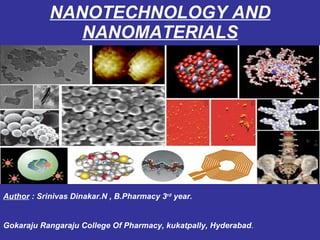
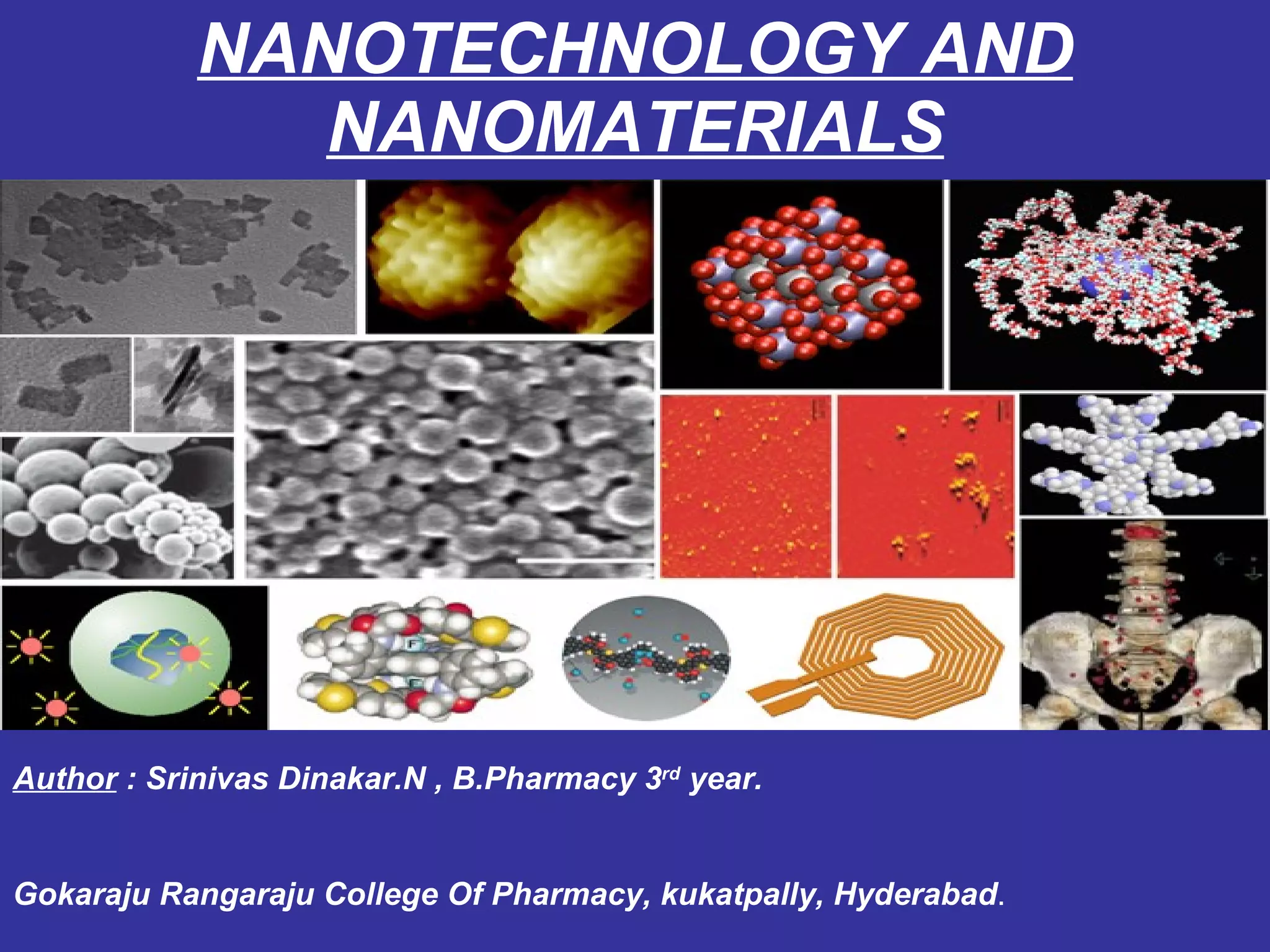
NANOTECHNOLOGY AND NANOMATERIALS Author  : Srinivas Dinakar.N , B.Pharmacy 3 rd  year. Gokaraju Rangaraju College Of Pharmacy, kukatpally, Hyderabad .
INTRODUCTION                       Nanotechnology refers to field of applied science whose theme is to control the matter on atomic  and molecular scale. Nanotechnologically enhanced materials will enable a weight reduction accompanied by  increase in stability and improved functionality.
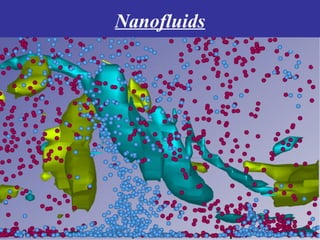
NANOFLUIDS NANOFLUID is a suspension of nanometer size particle in a base liquid. The particle here is defined as a small object that behaves as a whole unit in terms of its transport and properties. .In general carbon,metals,metal oxides serve as nano particles .Water ,ethylene,glycol,lubricants serve as base fluids in  making nanofluids.
Nanofluids
PROPERTIES They are effectively a bridge between bulk materials and   atomic or molecular structures. Size dependent properties are observed.        eg:Quantum confinement is observed in semiconductors . Increase in the energy that occurs when motion of the  particle  is restricted in one or more dimensions by the  potential well.             Superparamagnetism is seen in magnetic materials.          Properties of particles in the fluids changes as their size   approaches the nanoscale.
They exhibit special properties relative to the bulk  material. They exhibit high thermal conductivity which is given  by the  brownian motion of particles. They exhibit unexpected visible properties because they are small enough to confine their electrons and produce quantum effect. They have high surface to volume ratio. They have property of sintering at lower temperatures.
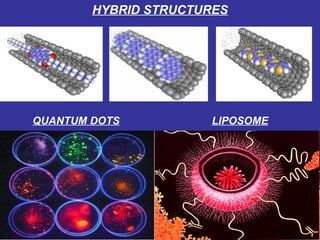
CLASSIFICATION   The particles of the nanofluids ,at the small end size range   are referred to as clusters. These are classified as:                             HYBRID STRUCTURES: these are used in fluids which are  used as materials in semiconductors and as dielectrics.    QUANTUM DOTS: these are used in fluids which are used  for quantization of electronic energy levels.    LIPOSOME: these are used in fluids that find applications in clinical field as delivery systems for anticancer drugs and vaccines.
QUANTUM DOTS LIPOSOME HYBRID STRUCTURES
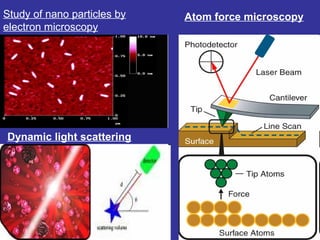
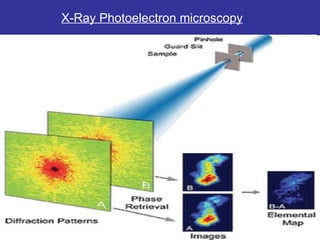
CHARACTERIZATION     Nanofluid characterization is necessary to establish an   understanding and control of nanoparticle synthesis and   applications. Characterization is done by using a variety of different   techniques namely : Electron microscopy. Dynamic light scattering. Atom force microscopy. X-Ray photoelectron microscopy.
Study of nano particles by electron microscopy Dynamic light scattering Atom force microscopy
X-Ray Photoelectron microscopy
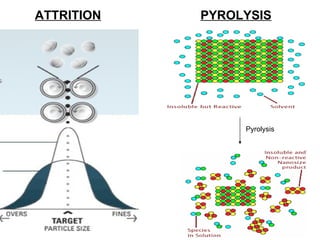
FABRICATION   The common methods for creating nanoparticles  which are the backbone of nanofluids are ATTRITION, PYROLYSIS. In  ATTRITION macro or micro particles of the fluid are grounded in   ball mill or other size reducing mechanism. In PYROLYSIS, a vapour precursor liquid or gas} is forced through an   orifice at high pressure and burned. Resulting solid is air classified   to recover oxide particles from by product gases
ATTRITION Pyrolysis PYROLYSIS
THERMAL PLASMA can also deliver the energy  necessary for the formation of nanoparticles such  that nanofluid is produced.  Main types of thermo plasma are: DC PLASMA JET,  DC ARC PLASMA, RADIO FREQUENCY INDUCTION PLASMA .
In DC ARC PLASMA energy necessary for the evaporation and reaction is provided by the  electric arc that forms between the anode and cathode. In RADIO FREQUENCY INDUCTION PLASMA the energy coupling to the plasma is accompanied through the electric field  generated by the induction coil .  Here the plasma is not in contact with electrodes. If the nanofluids having low melting point are to be produce then   nanoparticles are made from INERT GAS AGGREGATION METHOD.
  INERT GAS AGGREGATION METHOD    The metal chosen is vaporized in vacuum chamber and    super cooled with an inert gas stream. Super cooled metal vapour is then condensed into nanometer size particles. It is then mixed up with the base liquid  and finally the desired nano fluid mixture is obtained
ADVANTAGES 1. Nano fluids are used to remove heat from the  engine. 2. Used to reduce radiator size, pump size,  temperature. 3. Used in heat transfer which depends on distribution  volume fraction, thermal properties of suspended  nanoparticles.
4. Provide enhanced performance properties with respect to heat transfer. 5. Used in heat transfer applications in electronics,  fuel cells. vehicle engines. 6. Yield numerous health and health care advances  such as methods of delivering drugs, new cancer therapies, methods of early detection of diseases.
 
SAFETY ISSUES 1.Nano particles present in the fluids can penetrate cells and tissues, move through the body and brain and  cause biochemical damage. 2.They cause damage to the cardiovascular system.
OUTLOOK AND CHALLENGES Use of nano fluids in a wide variety of applications appears promising but the development  is hindered by factors like:  a. lack of agreement between results obtained in different  laboratories. b. poor characterization of  suspensions. c. size distribution of nanoparticles.
Conclusion Nanotechnology "the manufacturing technology of the 21st  century," should let us economically build a broad range of  complex molecular machines (including, not incidentally, molecular computers). It will let us build fleets of computer controlled molecular tools  much smaller than a human cell and built with the accuracy and  precision of the electronic chips.  They could remove obstructions in the electronic circuits and can provide handful to the professionals. > Nanotechnology is the upcoming branch of science where all of us can expect a new techno world.
REFERENCES Physics of micro and nano particles Novel thermal properties of nanostructured materials, Eastman, J.A. et al.; Materials Science Forum, Volume 312, 1999, Pages 629-634  Mechanisms of heat flow in suspensions of nano-sized particles (nanofluids), P. Keblinski et al; International Journal of Heat and Mass Transfer, Volume 45, Issue 4, February 2002, Pages 855-863
 

Nano Fluids

  • 1.
    NANOTECHNOLOGY AND NANOMATERIALSAuthor : Srinivas Dinakar.N , B.Pharmacy 3 rd year. Gokaraju Rangaraju College Of Pharmacy, kukatpally, Hyderabad .
  • 2.
    INTRODUCTION                      Nanotechnology refers to field of applied science whose theme is to control the matter on atomic and molecular scale. Nanotechnologically enhanced materials will enable a weight reduction accompanied by increase in stability and improved functionality.
  • 3.
    NANOFLUIDS NANOFLUID isa suspension of nanometer size particle in a base liquid. The particle here is defined as a small object that behaves as a whole unit in terms of its transport and properties. .In general carbon,metals,metal oxides serve as nano particles .Water ,ethylene,glycol,lubricants serve as base fluids in making nanofluids.
  • 4.
  • 5.
    PROPERTIES They areeffectively a bridge between bulk materials and atomic or molecular structures. Size dependent properties are observed.        eg:Quantum confinement is observed in semiconductors . Increase in the energy that occurs when motion of the particle is restricted in one or more dimensions by the potential well.             Superparamagnetism is seen in magnetic materials.         Properties of particles in the fluids changes as their size approaches the nanoscale.
  • 6.
    They exhibit specialproperties relative to the bulk material. They exhibit high thermal conductivity which is given by the brownian motion of particles. They exhibit unexpected visible properties because they are small enough to confine their electrons and produce quantum effect. They have high surface to volume ratio. They have property of sintering at lower temperatures.
  • 7.
    CLASSIFICATION   Theparticles of the nanofluids ,at the small end size range are referred to as clusters. These are classified as:                             HYBRID STRUCTURES: these are used in fluids which are used as materials in semiconductors and as dielectrics.   QUANTUM DOTS: these are used in fluids which are used for quantization of electronic energy levels.   LIPOSOME: these are used in fluids that find applications in clinical field as delivery systems for anticancer drugs and vaccines.
  • 8.
    QUANTUM DOTS LIPOSOMEHYBRID STRUCTURES
  • 9.
    CHARACTERIZATION    Nanofluid characterization is necessary to establish an understanding and control of nanoparticle synthesis and applications. Characterization is done by using a variety of different techniques namely : Electron microscopy. Dynamic light scattering. Atom force microscopy. X-Ray photoelectron microscopy.
  • 10.
    Study of nanoparticles by electron microscopy Dynamic light scattering Atom force microscopy
  • 11.
  • 12.
    FABRICATION   Thecommon methods for creating nanoparticles  which are the backbone of nanofluids are ATTRITION, PYROLYSIS. In  ATTRITION macro or micro particles of the fluid are grounded in ball mill or other size reducing mechanism. In PYROLYSIS, a vapour precursor liquid or gas} is forced through an orifice at high pressure and burned. Resulting solid is air classified to recover oxide particles from by product gases
  • 13.
  • 14.
    THERMAL PLASMA canalso deliver the energy necessary for the formation of nanoparticles such that nanofluid is produced. Main types of thermo plasma are: DC PLASMA JET, DC ARC PLASMA, RADIO FREQUENCY INDUCTION PLASMA .
  • 15.
    In DC ARCPLASMA energy necessary for the evaporation and reaction is provided by the  electric arc that forms between the anode and cathode. In RADIO FREQUENCY INDUCTION PLASMA the energy coupling to the plasma is accompanied through the electric field generated by the induction coil . Here the plasma is not in contact with electrodes. If the nanofluids having low melting point are to be produce then nanoparticles are made from INERT GAS AGGREGATION METHOD.
  • 16.
      INERT GASAGGREGATION METHOD   The metal chosen is vaporized in vacuum chamber and   super cooled with an inert gas stream. Super cooled metal vapour is then condensed into nanometer size particles. It is then mixed up with the base liquid  and finally the desired nano fluid mixture is obtained
  • 17.
    ADVANTAGES 1. Nanofluids are used to remove heat from the engine. 2. Used to reduce radiator size, pump size, temperature. 3. Used in heat transfer which depends on distribution volume fraction, thermal properties of suspended nanoparticles.
  • 18.
    4. Provide enhancedperformance properties with respect to heat transfer. 5. Used in heat transfer applications in electronics, fuel cells. vehicle engines. 6. Yield numerous health and health care advances such as methods of delivering drugs, new cancer therapies, methods of early detection of diseases.
  • 19.
  • 20.
    SAFETY ISSUES 1.Nanoparticles present in the fluids can penetrate cells and tissues, move through the body and brain and cause biochemical damage. 2.They cause damage to the cardiovascular system.
  • 21.
    OUTLOOK AND CHALLENGESUse of nano fluids in a wide variety of applications appears promising but the development  is hindered by factors like: a. lack of agreement between results obtained in different laboratories. b. poor characterization of  suspensions. c. size distribution of nanoparticles.
  • 22.
    Conclusion Nanotechnology "themanufacturing technology of the 21st century," should let us economically build a broad range of complex molecular machines (including, not incidentally, molecular computers). It will let us build fleets of computer controlled molecular tools much smaller than a human cell and built with the accuracy and precision of the electronic chips. They could remove obstructions in the electronic circuits and can provide handful to the professionals. > Nanotechnology is the upcoming branch of science where all of us can expect a new techno world.
  • 23.
    REFERENCES Physics ofmicro and nano particles Novel thermal properties of nanostructured materials, Eastman, J.A. et al.; Materials Science Forum, Volume 312, 1999, Pages 629-634 Mechanisms of heat flow in suspensions of nano-sized particles (nanofluids), P. Keblinski et al; International Journal of Heat and Mass Transfer, Volume 45, Issue 4, February 2002, Pages 855-863
  • 24.