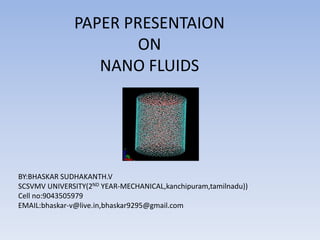
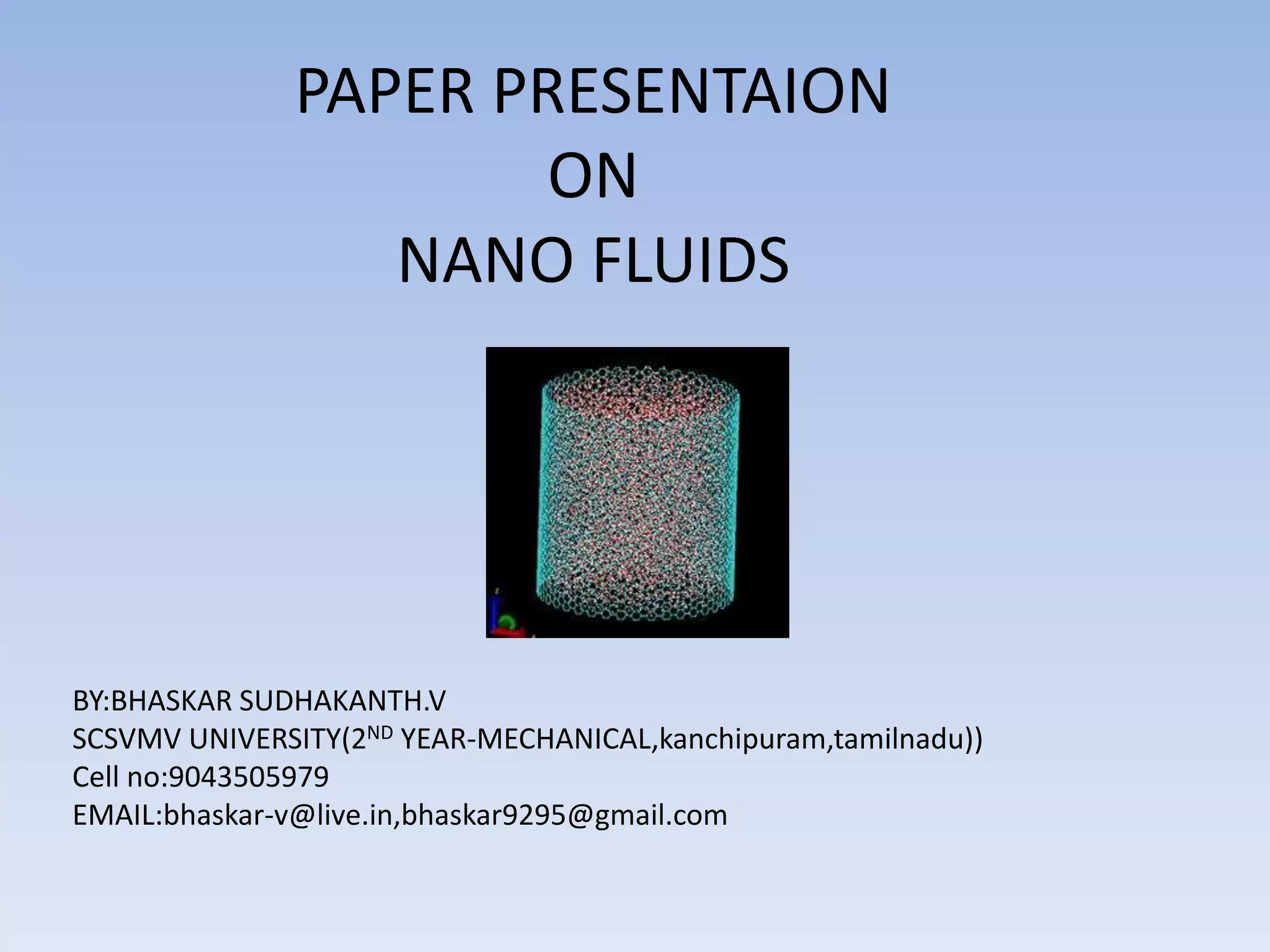
PAPER PRESENTAION
                      ON
                 NANO FLUIDS


BY:BHASKAR SUDHAKANTH.V
SCSVMV UNIVERSITY(2ND YEAR-MECHANICAL,kanchipuram,tamilnadu))
Cell no:9043505979
EMAIL:bhaskar-v@live.in,bhaskar9295@gmail.com
Nanofluids:
Suspensions of nanoparticles in base fluids


Size does matter: unique transport properties, different
from conventional suspensions:
do not settle under gravity, do not block flow, etc …
Enhancing functions and properties by combining and
controlling interactions
Combining different nanoparticles (structure, size) in
different base-fluids with additives
Controlling interactions using different “mixing” methods
and thermal-, flow-, catalyst-, and other field-conditions
Advanced Flow and Heat-Transfer
               Challenges
• The heat rejection requirements are continually increasing due to trends
  toward faster speeds (in the multi-GHz range) and smaller features (to <100
  nm) for microelectronic devices, more power output for engines, and
  brighter beams for optical devices.
• Cooling becomes one of the top technical challenges facing high-tech
  industries such as microelectronics, transportation, manufacturing, and
  metrology.
• Conventional method to increase heat flux rates:
    – extended surfaces such as fins and micro-channels
    – increasing flow rates increases pumping power.
• However, current design solutions already push available technology to its
  limits.
• NEW Technologies and new, advanced fluids with potential to improve flow
  & thermal characteristics are of critical importance.
• Nanofluids are promising to meet and enhance the challenges.
Concept of Nanofluids


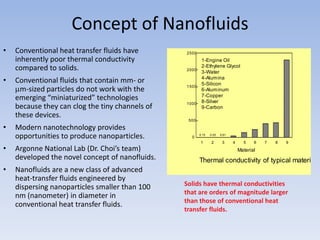
                                                 Thermal conductivity (W/m-K)
•   Conventional heat transfer fluids have                                      2500
    inherently poor thermal conductivity                                                1-Engine Oil
                                                                                        2-Ethylene Glycol
    compared to solids.                                                         2000
                                                                                        3-Water
•   Conventional fluids that contain mm- or                                             4-Alumina
                                                                                        5-Silicon
                                                                                1500
     m-sized particles do not work with the                                             6-Aluminum
                                                                                        7-Copper
    emerging “miniaturized” technologies                                                8-Silver
                                                                                1000
    because they can clog the tiny channels of                                          9-Carbon
    these devices.
                                                                                 500

•   Modern nanotechnology provides
    opportunities to produce nanoparticles.                                       0
                                                                                       0.15   0.25   0.61

                                                                                       1       2      3     4     5    6   7   8   9
•   Argonne National Lab (Dr. Choi’s team)                                                                      Material
    developed the novel concept of nanofluids.                                         Thermal conductivity of typical materials
•   Nanofluids are a new class of advanced
    heat-transfer fluids engineered by
    dispersing nanoparticles smaller than 100                                   Solids have thermal conductivities
    nm (nanometer) in diameter in                                               that are orders of magnitude larger
                                                                                than those of conventional heat
    conventional heat transfer fluids.
                                                                                transfer fluids.
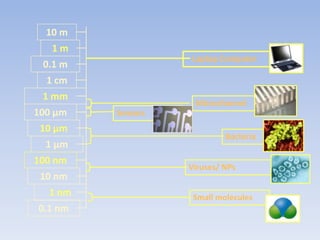
10 m
   1m
                     Laptop Computer
 0.1 m
   1 cm
  1 mm
                      Microchannel
100 µm     Sensors
 10 µm
                              Bacteria
   1 µm
100 nm
                     Viruses/ NPs
 10 nm
    1 nm              Small molecules
 0.1 nm
Why Use Nanoparticles?
•   The basic concept of dispersing solid particles in fluids to enhance thermal conductivity
    can be traced back to Maxwell in the 19th Century.
•   Studies of thermal conductivity of suspensions have been confined to
    mm- or mm-sized particles.
•   The major challenge is the rapid settling of these particles in fluids.
•   Nanoparticles stay suspended much longer than micro-particles and, if below a threshold
    level and/or enhanced with surfactants/stabilizers, remain in suspension almost
    indefinitely.
•   Furthermore, the surface area per unit volume of nanoparticles is much larger (million
    times) than that of microparticles (the number of surface atoms per unit of interior atoms
    of nanoparticles, is very large).
•   These properties can be utilized to develop stable suspensions with enhanced flow, heat-
    transfer, and other characteristics
Materials for Nanoparticles and Base Fluids
Materials for nanoparticles and base fluids are diverse:
1. Nanoparticle materials include:
    – Oxide ceramics – Al2O3, CuO
    – Metal carbides – SiC
    – Nitrides – AlN, SiN
    – Metals – Al, Cu
    – Nonmetals – Graphite, carbon nanotubes
    – Layered – Al + Al2O3, Cu + C
    – PCM – S/S
    – Functionalized nanoparticles
2. Base fluids include:
    – Water
    – Ethylene- or tri-ethylene-glycols and other coolants
    – Oil and other lubricants
    – Bio-fluids
    – Polymer solutions
    – Other common fluids
Methods for Producing
           Nanoparticles/Nanofluids
Two nanofluid production methods has been developed in ANL to
  allow selection of the most appropriate nanoparticle material for a
  particular application.
• In two-step process for oxide nanoparticles (“Kool-Aid”
  method), nanoparticles are produced by evaporation and inert-gas
  condensation processing, and then dispersed (mixed, including
  mechanical agitation and sonification) in base fluid.
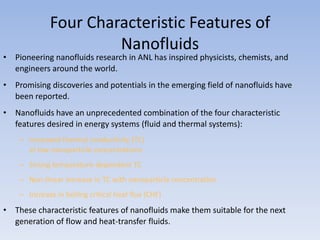
• A patented one-step process (see schematic) simultaneously makes
  and disperses nanoparticles directly into base fluid; best for
  metallic nanofluids.
Other methods:
  Chem. Vapor Evaporation; Chem. Synthesis; new methods…
Four Characteristic Features of
                      Nanofluids
• Pioneering nanofluids research in ANL has inspired physicists, chemists, and
  engineers around the world.
• Promising discoveries and potentials in the emerging field of nanofluids have
  been reported.
• Nanofluids have an unprecedented combination of the four characteristic
  features desired in energy systems (fluid and thermal systems):
    – Increased thermal conductivity (TC)
      at low nanoparticle concentrations
    – Strong temperature-dependent TC
    – Non-linear increase in TC with nanoparticle concentration
    – Increase in boiling critical heat flux (CHF)
• These characteristic features of nanofluids make them suitable for the next
  generation of flow and heat-transfer fluids.
Temperature-Dependent Conductivity

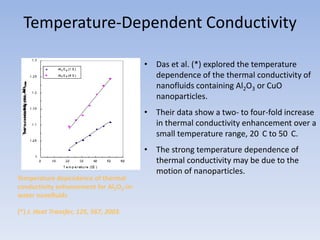
                                         • Das et al. (*) explored the temperature
                                           dependence of the thermal conductivity of
                                           nanofluids containing Al2O3 or CuO
                                           nanoparticles.
                                         • Their data show a two- to four-fold increase
                                           in thermal conductivity enhancement over a
                                           small temperature range, 20 C to 50 C.
                                         • The strong temperature dependence of
                                           thermal conductivity may be due to the
                                           motion of nanoparticles.
Temperature dependence of thermal
conductivity enhancement for Al2O3-in-
water nanofluids

(*) J. Heat Transfer, 125, 567, 2003.
Nanofluid Structure
                                              • Although liquid molecules close to a solid
                                                surface are known to form layered
                                                structures, little is known about the
                                                interactions between this nanolayers and
                                                thermo-physical properties of these
                                                solid/liquid nano-suspensions.
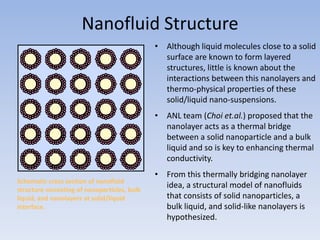
                                              • ANL team (Choi et.al.) proposed that the
                                                nanolayer acts as a thermal bridge
                                                between a solid nanoparticle and a bulk
                                                liquid and so is key to enhancing thermal
                                                conductivity.
                                              • From this thermally bridging nanolayer
Schematic cross section of nanofluid
structure consisting of nanoparticles, bulk
                                                idea, a structural model of nanofluids
liquid, and nanolayers at solid/liquid          that consists of solid nanoparticles, a
interface.                                      bulk liquid, and solid-like nanolayers is
                                                hypothesized.
Summary: Future Research
• Little is known about the physical and chemical surface interactions
  between the nanoparticles and base fluid molecules, in order to
  understand the mechanisms of enhanced flow and thermal behavior of
  nanofluids.
• Improved theoretical understanding of complex nanofluids will have an
  even broader impact
• Development of new experimental methods for characterizing (and
  understanding) nanofluids in the lab and in nature.
• Nanoscale structure and dynamics of the fluids: using a variety of
  scattering methods; small-angle x-ray scattering (SAXS), small-angle
  neutron scattering (SANS), x-ray photon correlation spectroscopy
  (XPCS), laser based photon correlation spectroscopy (PCS) and static
  light scattering.
• Development of computer based models of nanofluid phenomena
  including physical and chemical interactions between nanoparticles and
  base-fluid molecules.

nano fluids

  • 1.
    PAPER PRESENTAION ON NANO FLUIDS BY:BHASKAR SUDHAKANTH.V SCSVMV UNIVERSITY(2ND YEAR-MECHANICAL,kanchipuram,tamilnadu)) Cell no:9043505979 EMAIL:bhaskar-v@live.in,bhaskar9295@gmail.com
  • 2.
    Nanofluids: Suspensions of nanoparticlesin base fluids Size does matter: unique transport properties, different from conventional suspensions: do not settle under gravity, do not block flow, etc … Enhancing functions and properties by combining and controlling interactions Combining different nanoparticles (structure, size) in different base-fluids with additives Controlling interactions using different “mixing” methods and thermal-, flow-, catalyst-, and other field-conditions
  • 3.
    Advanced Flow andHeat-Transfer Challenges • The heat rejection requirements are continually increasing due to trends toward faster speeds (in the multi-GHz range) and smaller features (to <100 nm) for microelectronic devices, more power output for engines, and brighter beams for optical devices. • Cooling becomes one of the top technical challenges facing high-tech industries such as microelectronics, transportation, manufacturing, and metrology. • Conventional method to increase heat flux rates: – extended surfaces such as fins and micro-channels – increasing flow rates increases pumping power. • However, current design solutions already push available technology to its limits. • NEW Technologies and new, advanced fluids with potential to improve flow & thermal characteristics are of critical importance. • Nanofluids are promising to meet and enhance the challenges.
  • 4.
    Concept of Nanofluids Thermal conductivity (W/m-K) • Conventional heat transfer fluids have 2500 inherently poor thermal conductivity 1-Engine Oil 2-Ethylene Glycol compared to solids. 2000 3-Water • Conventional fluids that contain mm- or 4-Alumina 5-Silicon 1500 m-sized particles do not work with the 6-Aluminum 7-Copper emerging “miniaturized” technologies 8-Silver 1000 because they can clog the tiny channels of 9-Carbon these devices. 500 • Modern nanotechnology provides opportunities to produce nanoparticles. 0 0.15 0.25 0.61 1 2 3 4 5 6 7 8 9 • Argonne National Lab (Dr. Choi’s team) Material developed the novel concept of nanofluids. Thermal conductivity of typical materials • Nanofluids are a new class of advanced heat-transfer fluids engineered by dispersing nanoparticles smaller than 100 Solids have thermal conductivities nm (nanometer) in diameter in that are orders of magnitude larger than those of conventional heat conventional heat transfer fluids. transfer fluids.
  • 5.
    10 m 1m Laptop Computer 0.1 m 1 cm 1 mm Microchannel 100 µm Sensors 10 µm Bacteria 1 µm 100 nm Viruses/ NPs 10 nm 1 nm Small molecules 0.1 nm
  • 6.
    Why Use Nanoparticles? • The basic concept of dispersing solid particles in fluids to enhance thermal conductivity can be traced back to Maxwell in the 19th Century. • Studies of thermal conductivity of suspensions have been confined to mm- or mm-sized particles. • The major challenge is the rapid settling of these particles in fluids. • Nanoparticles stay suspended much longer than micro-particles and, if below a threshold level and/or enhanced with surfactants/stabilizers, remain in suspension almost indefinitely. • Furthermore, the surface area per unit volume of nanoparticles is much larger (million times) than that of microparticles (the number of surface atoms per unit of interior atoms of nanoparticles, is very large). • These properties can be utilized to develop stable suspensions with enhanced flow, heat- transfer, and other characteristics
  • 7.
    Materials for Nanoparticlesand Base Fluids Materials for nanoparticles and base fluids are diverse: 1. Nanoparticle materials include: – Oxide ceramics – Al2O3, CuO – Metal carbides – SiC – Nitrides – AlN, SiN – Metals – Al, Cu – Nonmetals – Graphite, carbon nanotubes – Layered – Al + Al2O3, Cu + C – PCM – S/S – Functionalized nanoparticles 2. Base fluids include: – Water – Ethylene- or tri-ethylene-glycols and other coolants – Oil and other lubricants – Bio-fluids – Polymer solutions – Other common fluids
  • 8.
    Methods for Producing Nanoparticles/Nanofluids Two nanofluid production methods has been developed in ANL to allow selection of the most appropriate nanoparticle material for a particular application. • In two-step process for oxide nanoparticles (“Kool-Aid” method), nanoparticles are produced by evaporation and inert-gas condensation processing, and then dispersed (mixed, including mechanical agitation and sonification) in base fluid. • A patented one-step process (see schematic) simultaneously makes and disperses nanoparticles directly into base fluid; best for metallic nanofluids. Other methods: Chem. Vapor Evaporation; Chem. Synthesis; new methods…
  • 9.
    Four Characteristic Featuresof Nanofluids • Pioneering nanofluids research in ANL has inspired physicists, chemists, and engineers around the world. • Promising discoveries and potentials in the emerging field of nanofluids have been reported. • Nanofluids have an unprecedented combination of the four characteristic features desired in energy systems (fluid and thermal systems): – Increased thermal conductivity (TC) at low nanoparticle concentrations – Strong temperature-dependent TC – Non-linear increase in TC with nanoparticle concentration – Increase in boiling critical heat flux (CHF) • These characteristic features of nanofluids make them suitable for the next generation of flow and heat-transfer fluids.
  • 10.
    Temperature-Dependent Conductivity • Das et al. (*) explored the temperature dependence of the thermal conductivity of nanofluids containing Al2O3 or CuO nanoparticles. • Their data show a two- to four-fold increase in thermal conductivity enhancement over a small temperature range, 20 C to 50 C. • The strong temperature dependence of thermal conductivity may be due to the motion of nanoparticles. Temperature dependence of thermal conductivity enhancement for Al2O3-in- water nanofluids (*) J. Heat Transfer, 125, 567, 2003.
  • 11.
    Nanofluid Structure • Although liquid molecules close to a solid surface are known to form layered structures, little is known about the interactions between this nanolayers and thermo-physical properties of these solid/liquid nano-suspensions. • ANL team (Choi et.al.) proposed that the nanolayer acts as a thermal bridge between a solid nanoparticle and a bulk liquid and so is key to enhancing thermal conductivity. • From this thermally bridging nanolayer Schematic cross section of nanofluid structure consisting of nanoparticles, bulk idea, a structural model of nanofluids liquid, and nanolayers at solid/liquid that consists of solid nanoparticles, a interface. bulk liquid, and solid-like nanolayers is hypothesized.
  • 12.
    Summary: Future Research •Little is known about the physical and chemical surface interactions between the nanoparticles and base fluid molecules, in order to understand the mechanisms of enhanced flow and thermal behavior of nanofluids. • Improved theoretical understanding of complex nanofluids will have an even broader impact • Development of new experimental methods for characterizing (and understanding) nanofluids in the lab and in nature. • Nanoscale structure and dynamics of the fluids: using a variety of scattering methods; small-angle x-ray scattering (SAXS), small-angle neutron scattering (SANS), x-ray photon correlation spectroscopy (XPCS), laser based photon correlation spectroscopy (PCS) and static light scattering. • Development of computer based models of nanofluid phenomena including physical and chemical interactions between nanoparticles and base-fluid molecules.