Presented by
A.Akila
II yr M.Tech
Nanoscience & Technology
Anna university-BIT campus
Trichirappalli
 Electrospinning uses an electrical charge to draw very fine
(typically on the micro or nano scale) fibres from a liquid.
 It is a technique for electrostatic fiber formation which utilizes
electrical forces to produce polymer fibers with diameters ranging
from 2 nm to several micrometers using polymer solutions of both
natural and synthetic polymers.
 Electrospinning shares characteristics of both electrospraying and
conventional solution dry spinning of fibers.
 This makes the process particularly suited to the production of
fibers using large and complex molecules.
 This process offers unique capabilities for producing novel
natural nanofibers and fabrics with controllable pore structure.
 This process of electrospinning has gained much attention not
only due to its versatility in spinning a wide variety of
polymeric fibers but also due to its ability to consistently
produce fibers in the submicron range consistently that is
otherwise difficult to achieve by using standard mechanical
fiber-spinning technologies techniques
 This method ensures that no solvent can be carried over into the
final product
Spun Nanofibers Also Offer Several Advantages Such As,
 An extremely high surface-to-volume ratio
 Tuneable porosity
 Malleability to conform to a wide variety of sizes and shapes
 The ability to control the nanofiber composition to achieve
the desired results from its properties and functionality.
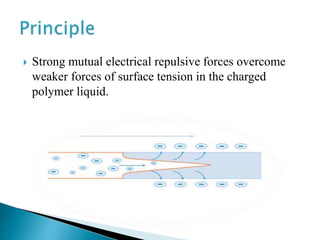
 Strong mutual electrical repulsive forces overcome
weaker forces of surface tension in the charged
polymer liquid.
 It uses an electrostatic forces to produce a fine fibers from polymer
solutions or melts and the fibers thus produced have a thinner
diameter and a larger surface area than those obtained from
conventional spinning processes
 Electrospinning is conducted at room temperature with atmosphere
conditions.
 A DC voltage in the range of several tens of kVs is necessary to
generate the electrospinning.
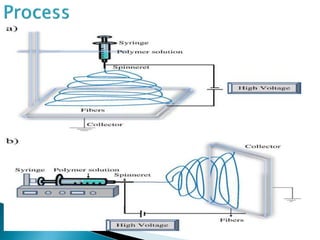
 Basically, an electrospinning system consists of three major
components:
 A high voltage power supply,
 A spinneret and
 A grounded collecting plate.
 Also it utilizes a high voltage source to inject charge of a
certain polarity into a polymer solution or melt, which is then
accelerated towards a collector of opposite polarity.
 Most of the polymers are dissolved in some solvents before
electrospinning.
 The polymer fluid is then introduced into the capillary tube .
 Capillary tube is subjected to an electric field and an electric
charge is induced on the liquid surface due to this field.
 When the electric field applied reaches a critical value , the
repulsive electrical forces overcome the surface tension forces.
 A charged jet of the solution is ejected from the tip of the Taylor
cone.
 A rapid whipping of the jet occurs in the space between the
capillary tip and collector which leads to evaporation of the
solvent, leaving a polymer behind.
 The jet is only stable at the tip of the spinneret and after that
instability starts.
 Thus, the electrospinning process offers a simplified technique
for fiber formation.
 Electrospun nanofibers have been reported as being from
various synthetic polymers, natural polymers or a blend of
both including proteins , nucleic acids and even
polysaccharides.
 Typical natural polymers include collagen, chitosan, gelatin ,
casein, cellulose acetate, silk protein, chitin , fibrinogen etc.
Scaffolds fabricated from natural polymers promise better
clinical functionality.
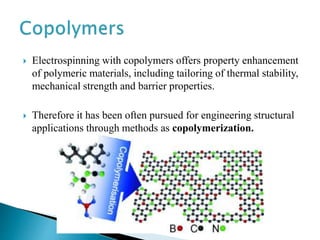
 Electrospinning with copolymers offers property enhancement
of polymeric materials, including tailoring of thermal stability,
mechanical strength and barrier properties.
 Therefore it has been often pursued for engineering structural
applications through methods as copolymerization.
 The solvent used in preparing polymer solutions has a
significant influence on its spinnability.
 Solvents should have some properties such as, good volatility,
vapour pressure, boiling point and should maintain the
integrity of the polymer solution.
 The intermolecular interaction in a polymer–solvent system is
either attractive or repulsive which depends solely on the type
of solvent.
 solvent vapour pressure plays a critical role in determining the
evaporation rate and the drying time.
 Solvent volatility also plays a significant role in the formation of
nanostructures as it influences the phase separation process.
 The properties of solvents have a profound effect on fiber diameter.
 Different properties of solvents such as surface tension, dielectric
constant and boiling point that should be kept in mind during
selection for electrospinning process.
 Electrospinning process is solely governed by ,
 Solution parameter.
 Process parameter.
 Ambient parameter.
 Solution parameters includes,
 viscosity,
 conductivity,
 molecular weight, and
 surface tension and
 Process parameters includes,
 applied electric field,
 tip to collector
 distance and feeding or flow rate.
 Each of these parameters significantly affect the fibers morphology
obtained as a result of electrospinning.
 Ambient parameters includes,
 the humidity and
 temperature of the surroundings.
 This also plays a significant role in determining the morphology
and diameter of electrospun nanofiber.
 The characterization of fibers produced by the electrospinning
process remains one of the most difficult tasks as the chances
of getting single fibers are rare.
 Generally in electrospinning, the spun fibres are characterized
into three distinct categories:
 Geometrical characterizations
 Chemical characterizations.
 Mechanical characterization .
 Geometrical characterizations
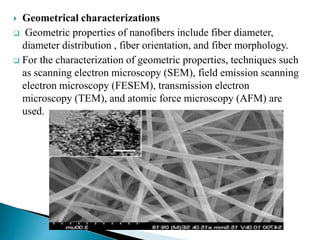
 Geometric properties of nanofibers include fiber diameter,
diameter distribution , fiber orientation, and fiber morphology.
 For the characterization of geometric properties, techniques such
as scanning electron microscopy (SEM), field emission scanning
electron microscopy (FESEM), transmission electron
microscopy (TEM), and atomic force microscopy (AFM) are
used.
 Chemical characterizations
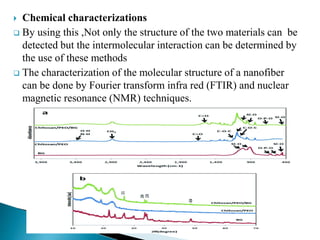
 By using this ,Not only the structure of the two materials can be
detected but the intermolecular interaction can be determined by
the use of these methods
 The characterization of the molecular structure of a nanofiber
can be done by Fourier transform infra red (FTIR) and nuclear
magnetic resonance (NMR) techniques.
 Mechanical characterizations
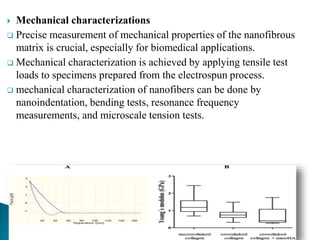
 Precise measurement of mechanical properties of the nanofibrous
matrix is crucial, especially for biomedical applications.
 Mechanical characterization is achieved by applying tensile test
loads to specimens prepared from the electrospun process.
 mechanical characterization of nanofibers can be done by
nanoindentation, bending tests, resonance frequency
measurements, and microscale tension tests.
 High surface to volume ratio
 Very high porosity
 Enhanced physico-mechanical properties
 Manipulation of the solution and process parameters can be
easily done to get the desired fiber morphology and
mechanical strength.
 Electrospinning is a simple, versatile, and cost-effective technology
which generates non-woven fibers with high surface area to volume
ratio, porosity and tunable porosity.
 Melt electrospinning, an alternative means of electrospinning , apart
from solution, is also available that is done with polymer melts,
which alleviates the requirement of solvents.
 Despite of several advantages and success of electrospinning there
are some critical limitations in this process such as small pore size
and lack of proper cellular infiltration inside the fibers.
 In general, the electrospinning process shows excellent promise for
tissue engineering and regenerative medicine.
Electrospinning for nanofibre production

Electrospinning for nanofibre production

  • 1.
    Presented by A.Akila II yrM.Tech Nanoscience & Technology Anna university-BIT campus Trichirappalli
  • 2.
     Electrospinning usesan electrical charge to draw very fine (typically on the micro or nano scale) fibres from a liquid.  It is a technique for electrostatic fiber formation which utilizes electrical forces to produce polymer fibers with diameters ranging from 2 nm to several micrometers using polymer solutions of both natural and synthetic polymers.  Electrospinning shares characteristics of both electrospraying and conventional solution dry spinning of fibers.  This makes the process particularly suited to the production of fibers using large and complex molecules.
  • 3.
     This processoffers unique capabilities for producing novel natural nanofibers and fabrics with controllable pore structure.  This process of electrospinning has gained much attention not only due to its versatility in spinning a wide variety of polymeric fibers but also due to its ability to consistently produce fibers in the submicron range consistently that is otherwise difficult to achieve by using standard mechanical fiber-spinning technologies techniques  This method ensures that no solvent can be carried over into the final product
  • 6.
    Spun Nanofibers AlsoOffer Several Advantages Such As,  An extremely high surface-to-volume ratio  Tuneable porosity  Malleability to conform to a wide variety of sizes and shapes  The ability to control the nanofiber composition to achieve the desired results from its properties and functionality.
  • 7.
     Strong mutualelectrical repulsive forces overcome weaker forces of surface tension in the charged polymer liquid.
  • 9.
     It usesan electrostatic forces to produce a fine fibers from polymer solutions or melts and the fibers thus produced have a thinner diameter and a larger surface area than those obtained from conventional spinning processes  Electrospinning is conducted at room temperature with atmosphere conditions.  A DC voltage in the range of several tens of kVs is necessary to generate the electrospinning.  Basically, an electrospinning system consists of three major components:  A high voltage power supply,  A spinneret and  A grounded collecting plate.
  • 10.
     Also itutilizes a high voltage source to inject charge of a certain polarity into a polymer solution or melt, which is then accelerated towards a collector of opposite polarity.  Most of the polymers are dissolved in some solvents before electrospinning.  The polymer fluid is then introduced into the capillary tube .  Capillary tube is subjected to an electric field and an electric charge is induced on the liquid surface due to this field.  When the electric field applied reaches a critical value , the repulsive electrical forces overcome the surface tension forces.
  • 11.
     A chargedjet of the solution is ejected from the tip of the Taylor cone.  A rapid whipping of the jet occurs in the space between the capillary tip and collector which leads to evaporation of the solvent, leaving a polymer behind.  The jet is only stable at the tip of the spinneret and after that instability starts.  Thus, the electrospinning process offers a simplified technique for fiber formation.
  • 12.
     Electrospun nanofibershave been reported as being from various synthetic polymers, natural polymers or a blend of both including proteins , nucleic acids and even polysaccharides.  Typical natural polymers include collagen, chitosan, gelatin , casein, cellulose acetate, silk protein, chitin , fibrinogen etc. Scaffolds fabricated from natural polymers promise better clinical functionality.
  • 13.
     Electrospinning withcopolymers offers property enhancement of polymeric materials, including tailoring of thermal stability, mechanical strength and barrier properties.  Therefore it has been often pursued for engineering structural applications through methods as copolymerization.
  • 14.
     The solventused in preparing polymer solutions has a significant influence on its spinnability.  Solvents should have some properties such as, good volatility, vapour pressure, boiling point and should maintain the integrity of the polymer solution.  The intermolecular interaction in a polymer–solvent system is either attractive or repulsive which depends solely on the type of solvent.
  • 15.
     solvent vapourpressure plays a critical role in determining the evaporation rate and the drying time.  Solvent volatility also plays a significant role in the formation of nanostructures as it influences the phase separation process.  The properties of solvents have a profound effect on fiber diameter.  Different properties of solvents such as surface tension, dielectric constant and boiling point that should be kept in mind during selection for electrospinning process.
  • 16.
     Electrospinning processis solely governed by ,  Solution parameter.  Process parameter.  Ambient parameter.  Solution parameters includes,  viscosity,  conductivity,  molecular weight, and  surface tension and
  • 17.
     Process parametersincludes,  applied electric field,  tip to collector  distance and feeding or flow rate.  Each of these parameters significantly affect the fibers morphology obtained as a result of electrospinning.  Ambient parameters includes,  the humidity and  temperature of the surroundings.  This also plays a significant role in determining the morphology and diameter of electrospun nanofiber.
  • 18.
     The characterizationof fibers produced by the electrospinning process remains one of the most difficult tasks as the chances of getting single fibers are rare.  Generally in electrospinning, the spun fibres are characterized into three distinct categories:  Geometrical characterizations  Chemical characterizations.  Mechanical characterization .
  • 19.
     Geometrical characterizations Geometric properties of nanofibers include fiber diameter, diameter distribution , fiber orientation, and fiber morphology.  For the characterization of geometric properties, techniques such as scanning electron microscopy (SEM), field emission scanning electron microscopy (FESEM), transmission electron microscopy (TEM), and atomic force microscopy (AFM) are used.
  • 20.
     Chemical characterizations By using this ,Not only the structure of the two materials can be detected but the intermolecular interaction can be determined by the use of these methods  The characterization of the molecular structure of a nanofiber can be done by Fourier transform infra red (FTIR) and nuclear magnetic resonance (NMR) techniques.
  • 21.
     Mechanical characterizations Precise measurement of mechanical properties of the nanofibrous matrix is crucial, especially for biomedical applications.  Mechanical characterization is achieved by applying tensile test loads to specimens prepared from the electrospun process.  mechanical characterization of nanofibers can be done by nanoindentation, bending tests, resonance frequency measurements, and microscale tension tests.
  • 22.
     High surfaceto volume ratio  Very high porosity  Enhanced physico-mechanical properties  Manipulation of the solution and process parameters can be easily done to get the desired fiber morphology and mechanical strength.
  • 24.
     Electrospinning isa simple, versatile, and cost-effective technology which generates non-woven fibers with high surface area to volume ratio, porosity and tunable porosity.  Melt electrospinning, an alternative means of electrospinning , apart from solution, is also available that is done with polymer melts, which alleviates the requirement of solvents.  Despite of several advantages and success of electrospinning there are some critical limitations in this process such as small pore size and lack of proper cellular infiltration inside the fibers.  In general, the electrospinning process shows excellent promise for tissue engineering and regenerative medicine.