NABH
ACCREDITATION
STANDARDS FOR
HOSPITALS
APRIL 2020
5th
NATIONAL ACCREDITATION BOARD
FOR HOSPITALS AND HEALTHCARE
PROVIDERS (NABH)
A P R I L 2 0 2 0
15years
CELEBRATING
QUALITY : SAFETY : WELLNESS
National Accreditation Board
for Hospitals and Healthcare
Providers (NABH)
Accreditation Standards for Hospitals
(5th Edition) April 2020
© All Rights Reserved
No part of this book may be reproduced or transmitted in any form without permission in writing
from the author.
April 2020
ISBN 978-81-944877-5-3
9 788194 487753
These standards along with the Key Performance Indicator Annexures
have been made available free of charge as a downloadable document
on NABH website. I sincerely hope that all healthcare organisations will
certainly benefit from the collective efforts of Technical committee of
NABH and practical suggestions of thousands of Quality Champions
form India and abroad.
ational Accreditation Board for Hospitals and Healthcare
NProviders (NABH), is in its 15th year of creating an ecosystem of
quality in healthcare in India. NABH standards focus on patient
safety and quality of the delivery of services by the hospitals in the
changing healthcare environment. Without being prescriptive, the
objective elements remain informative and guide the organisation in
conducting its operations with a focus on patient safety.
The NABH hallmark methodology of ten Standards Chapters approach
has been retained; but the Objective Elements have been pruned to a
total of 651 out of which 102 are in Core category which will be
mandatorily assessed during each assessment, 459 are in Commitment
category which will be assessed during the final assessment, 60 are in
Achievement category to be assessed during surveillance and 30 are in
Excellence category which will be assessed during re-accreditation.
This objective methodology will aid any healthcare organisation in a
stepwise progression to mature quality system covering the full
accreditation cycle. The scoring methodology has been modified to a
graded scheme to help recognise every progressive effort by the
organisation in the implementation of the standards. The chapter on
Continuous Quality Improvement is now replaced with Patient Safety and
Quality Improvement to increase the focus on this critical aspect of
healthcare. Each chapter now has a bibliography for reference, and this
will provide organisations with a resource for taking quality beyond the
requirements of the objective elements. Another important incentive to
adopt these is the move towards a four-year cycle with a midterm
surveillance at two years.
Over the years, successive NABH standards have brought about not
only paradigm shifts in the hospitals' approach towards delivering the
healthcare services to the patients but have equally sensitised the
healthcare workers and patients towards their rights and responsibilities.
It is my privilege and pride to release and dedicate this 5th Edition of
Hospital Accreditation Standards of NABH to all healthcare workers. This
edition is unique in its approach and has been presented based in
entirety on the suggestions made by various stakeholders. For the first
time, the Objective Elements have been designed to be assessed as
Core, Commitment, Achievement and Excellence.
NABH remains committed to its mission of taking Quality Safety and
Wellness to the last man in the line.
Jai Hind
F
O
R
E
W
O
R
D
Dr. Atul Mohan Kochhar
CEO, NABH
F
O
R
E
W
O
R
D
The NABH hallmark methodology of ten Standards Chapters approach
has been retained; but the Objective Elements have been trimmed to a
total of 651 out of which 102 are in Core category which will be mandatorily
assessed during each assessment, 459 are in Commitment category
which will be assessed during the final assessment, 60 are in
Achievement category to be assessed during surveillance and 30 are in
Excellence category which will be assessed during re-accreditation.
ational Accreditation Board for Hospitals and Healthcare
NProviders (NABH), is in its 15th year of creating an ecosystem of
quality in healthcare in India. NABH standards focus on patient
safety and quality of the delivery of services by the hospitals in the
changing healthcare environment. Without being prescriptive, the
objective elements remain informative and guide the organisation in
conducting its operations with a focus on patient safety.
It is my privilege and pride to release the GUIDEBOOK to the 5th Edition of
Hospital Accreditation Standards of NABH. While the standards along
with the Key Performance Indicator Annexures have been made available
free of charge as a downloadable document on NABH website, the
guidebook cost has been kept very nominal. A complimentary virtual
certificate course has also been bundled. This guidebook edition is
unique in its approach and has been tastefully presented based on a
colour coded approach. For the first time, the Objective Elements have
been designed to be assessed as Core, Commitment, Achievement and
Excellence.
NABH remains committed to its mission of taking Quality Safety and
Wellness to the last man in the line.
Jai Hind
This objective methodology will aid any healthcare organisation in a
stepwise progression to mature quality system covering the full
accreditation cycle. The scoring methodology has been modified to a
graded scheme to help recognise every progressive effort by the
organisation in the implementation of the standards. The chapter on
Continuous Quality Improvement is now replaced with Patient Safety and
Quality Improvement to increase the focus on this critical aspect of
healthcare. Each chapter now has a bibliography for reference, and this
will provide organisations with a resource for taking quality beyond the
requirements of the objective elements. Another important incentive to
adopt these is the move towards a four-year cycle with a midterm
surveillance at two years.
Over the years, successive NABH standards have brought about not only
paradigm shifts in the hospitals' approach towards delivering the
healthcare services to the patients but have equally sensitised the
healthcare workers and patients towards their rights and responsibilities.
I sincerely hope that all healthcare organisations will certainly benefit from
the collective efforts of Technical committee of NABH and practical
suggestions of thousands of Quality Champions form India and abroad.
CEO, NABH
Dr. Atul Mohan Kochhar
Padma Bhushan Dr B. K. Rao, Chairman NABH, has been the guiding
light throughout the development of this edition. I thank him for his
active participation, support and invaluable suggestions despite his
busy clinical schedule.
I thank all our passionate assessors, management of the hospitals,
quality managers, clinicians, nurses and paramedics who gave us
extensive feedback to improve upon the standards.
I thank the officers at NABH Secretariat for working round the clock, to
complete the work within time.
acknowledge the contributions of the following in preparing this
Istandard.
I sincerely thank Dr Ravi P
. Singh, Secretary General of Quality Council
of India for his succinct guidance and continuous support by making
adequate resources available for this process.
I thank all board members of NABH in giving significant suggestions
for betterment of the standard.
To all of you a sincere, heartfelt and, profound - Thank you.
It is entirely due to the overwhelming participation, dedication, and
diligence of all concerned that we could present this document on
schedule.
The Technical Committee of NABH worked relentlessly and
meticulously to accommodate the best practices in patient safety and
healthcare quality, referred to innumerable academic references and
incorporated suggestions made by all of the stakeholders in bringing
this standard to reality. It was, indeed, a mammoth task. I profoundly
thank all the members for playing a pivotal role in the development of
this edition.
A
C
K
N
O
W
L
E
D
G
E
M
E
N
T
Dr. Atul Mohan Kochhar
CEO, NABH
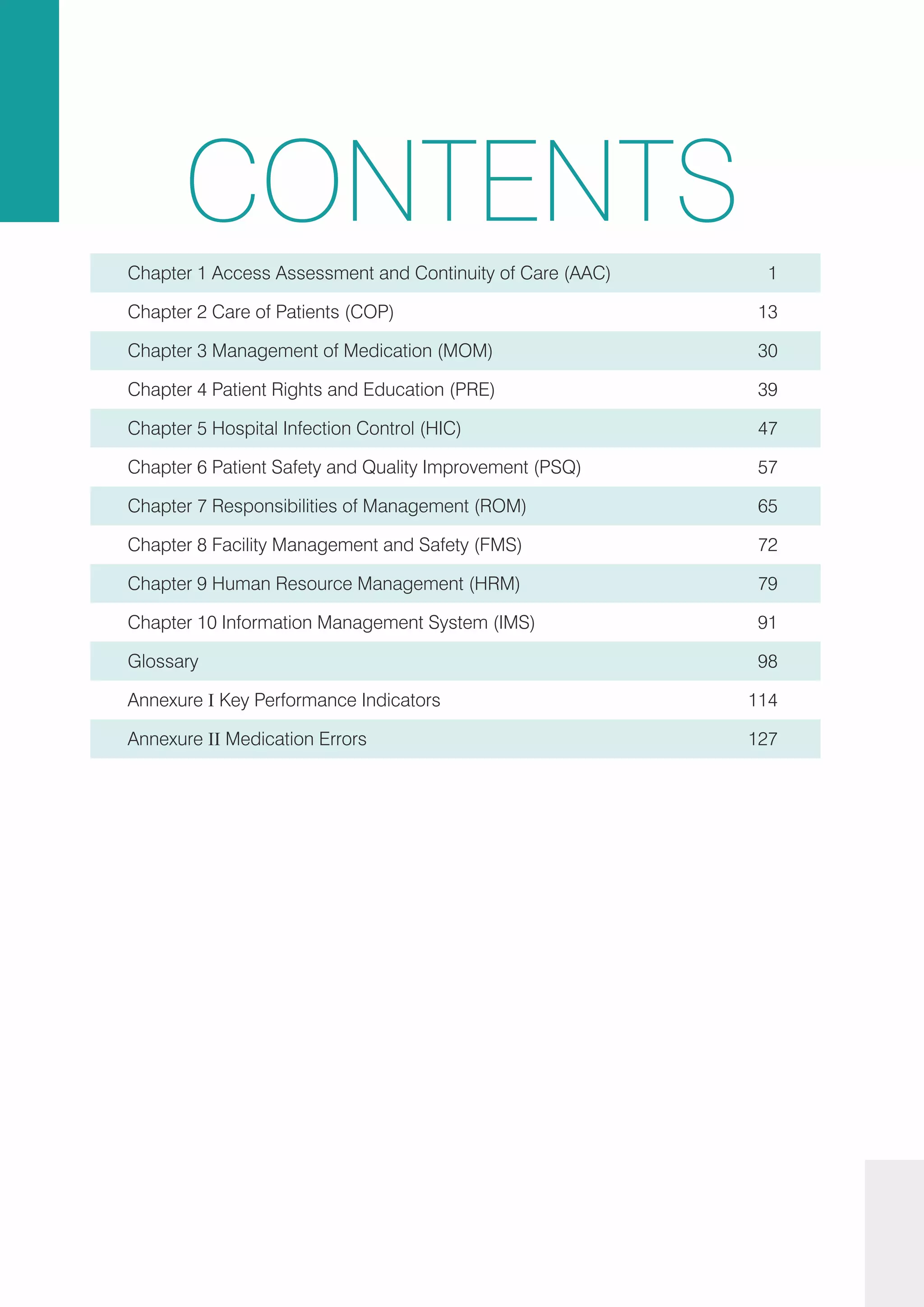
CONTENTS
Chapter 2 Care of Patients (COP) 13
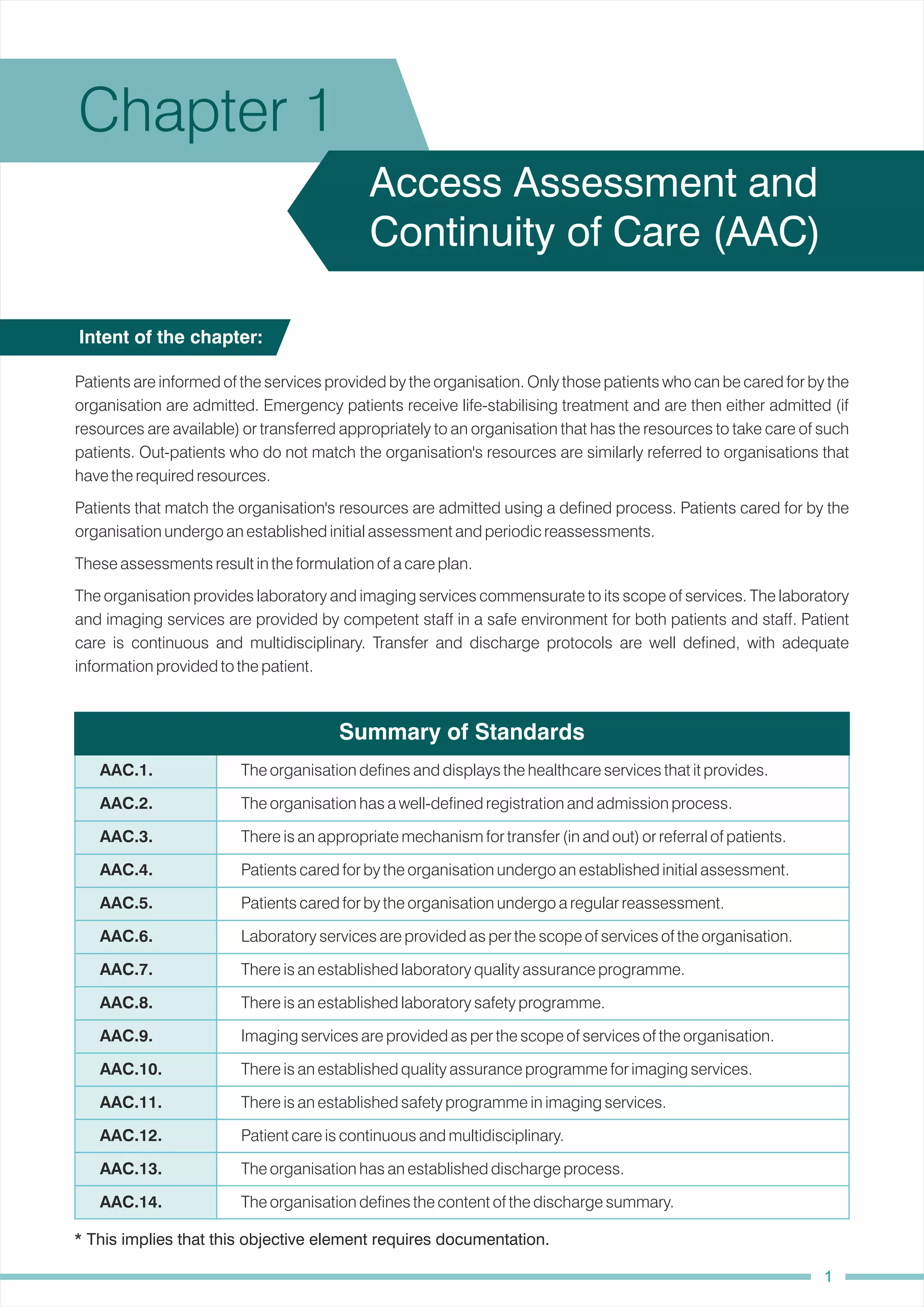
Chapter 1 Access Assessment and Continuity of Care (AAC) 1
Chapter 3 Management of Medication (MOM) 30
Chapter 4 Patient Rights and Education (PRE) 39
Chapter 5 Hospital Infection Control (HIC) 47
Chapter 6 Patient Safety and Quality Improvement (PSQ) 57
Chapter 7 Responsibilities of Management (ROM) 65
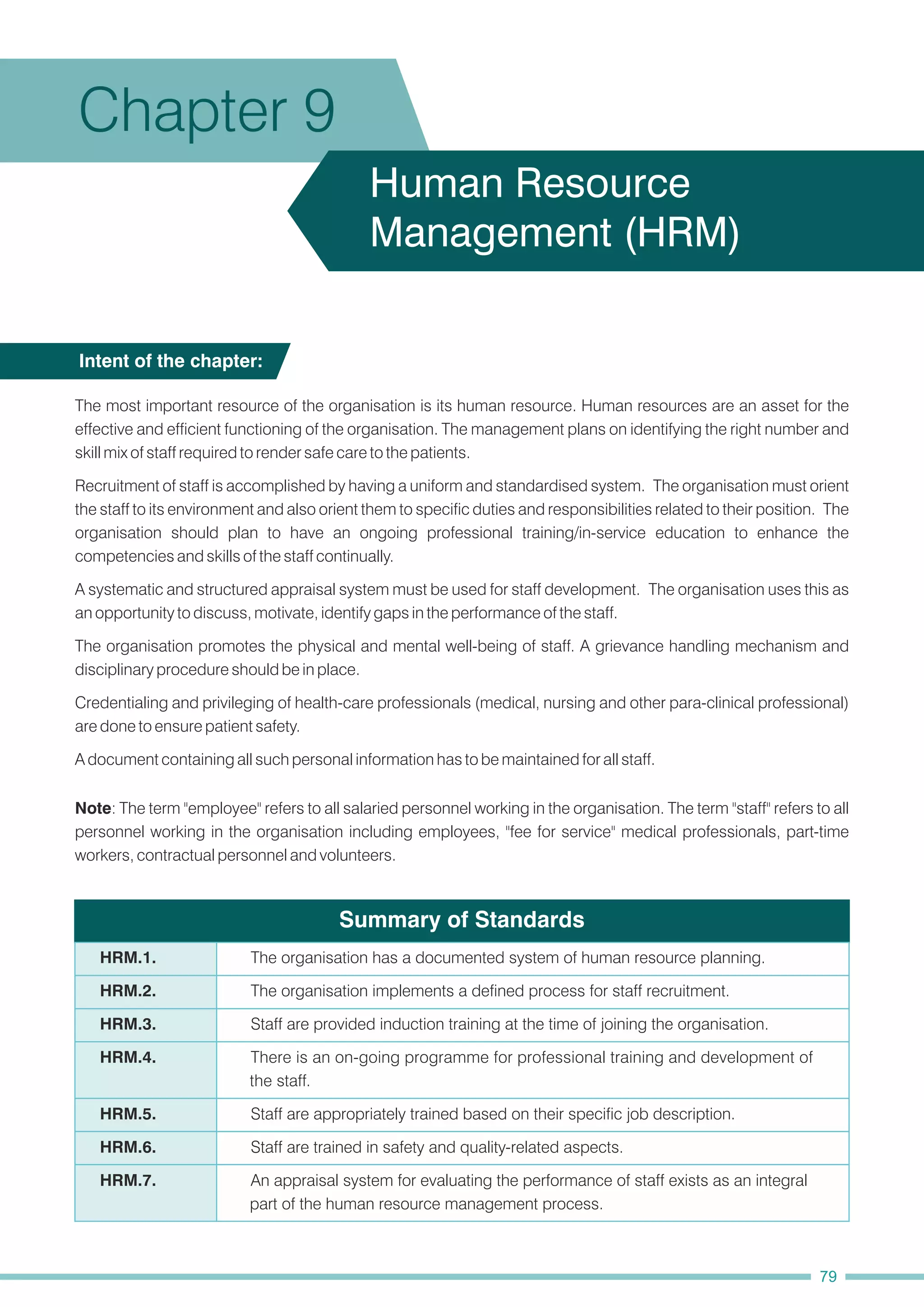
Chapter 9 Human Resource Management (HRM) 79
Annexure II Medication Errors 127
Annexure I Key Performance Indicators 114
Glossary 98
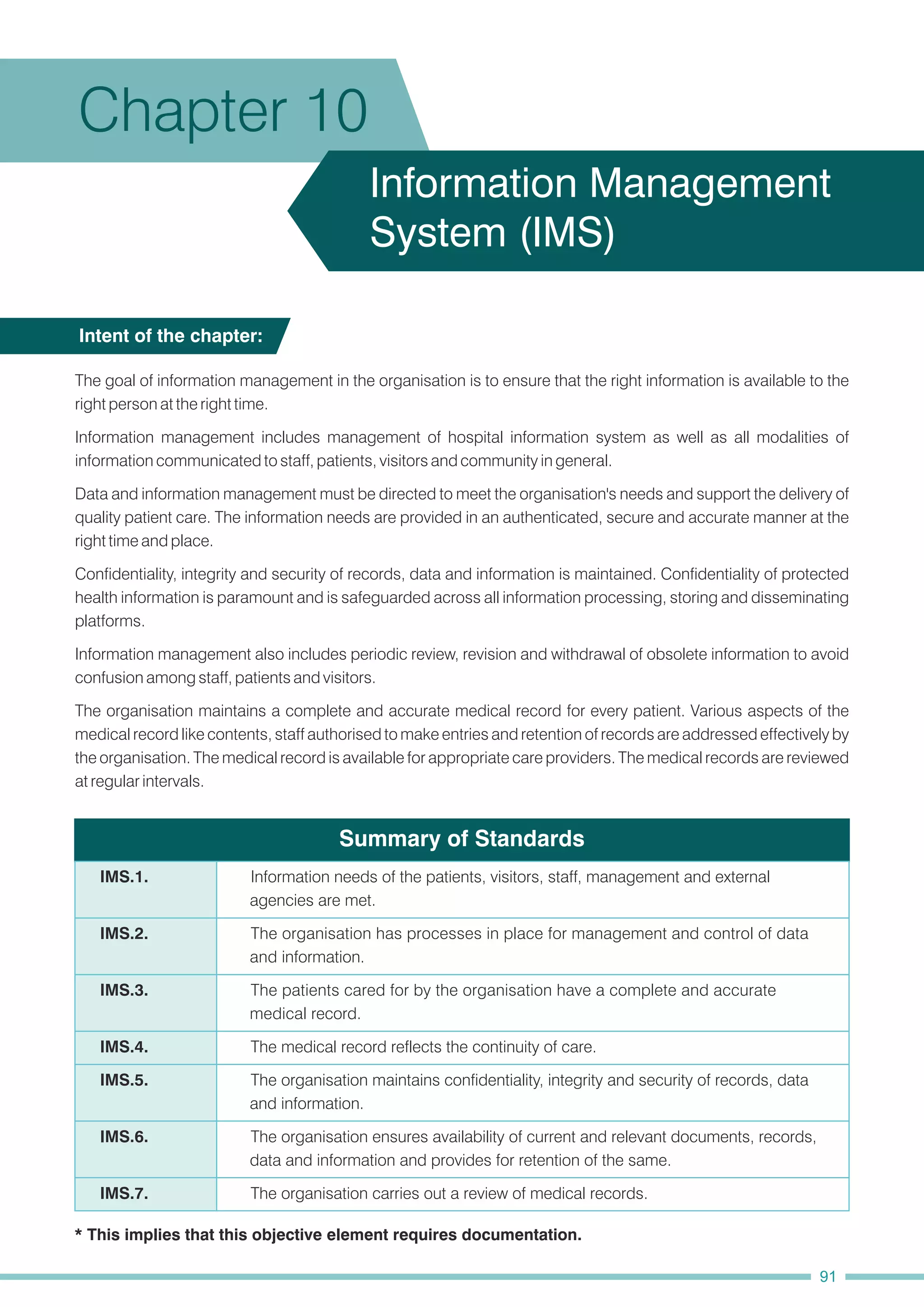
Chapter 10 Information Management System (IMS) 91
Chapter 8 Facility Management and Safety (FMS) 72
Chapter 1
Access Assessment and
Continuity of Care (AAC)
Patients that match the organisation's resources are admitted using a defined process. Patients cared for by the
organisation undergo an established initial assessment and periodic reassessments.
Patients are informed of the services provided by the organisation. Only those patients who can be cared for by the
organisation are admitted. Emergency patients receive life-stabilising treatment and are then either admitted (if
resources are available) or transferred appropriately to an organisation that has the resources to take care of such
patients. Out-patients who do not match the organisation's resources are similarly referred to organisations that
have the required resources.
These assessments result in the formulation of a care plan.
The organisation provides laboratory and imaging services commensurate to its scope of services. The laboratory
and imaging services are provided by competent staff in a safe environment for both patients and staff. Patient
care is continuous and multidisciplinary. Transfer and discharge protocols are well defined, with adequate
information provided to the patient.
Intent of the chapter:
Summary of Standards
Patient care is continuous and multidisciplinary.
There is an established quality assurance programme for imaging services.
There is an established laboratory quality assurance programme.
The organisation defines the content of the discharge summary.
There is an appropriate mechanism for transfer (in and out) or referral of patients.
Laboratory services are provided as per the scope of services of the organisation.
The organisation has a well-defined registration and admission process.
There is an established laboratory safety programme.
The organisation defines and displays the healthcare services that it provides.
Patients cared for by the organisation undergo a regular reassessment.
Patients cared for by the organisation undergo an established initial assessment.
Imaging services are provided as per the scope of services of the organisation.
There is an established safety programme in imaging services.
The organisation has an established discharge process.
AAC.6.
AAC.4.
AAC.9.
AAC.12.
AAC.3.
AAC.2.
AAC.7.
AAC.8.
AAC.13.
AAC.1.
AAC.5.
AAC.10.
AAC.14.
AAC.11.
* This implies that this objective element requires documentation.
1
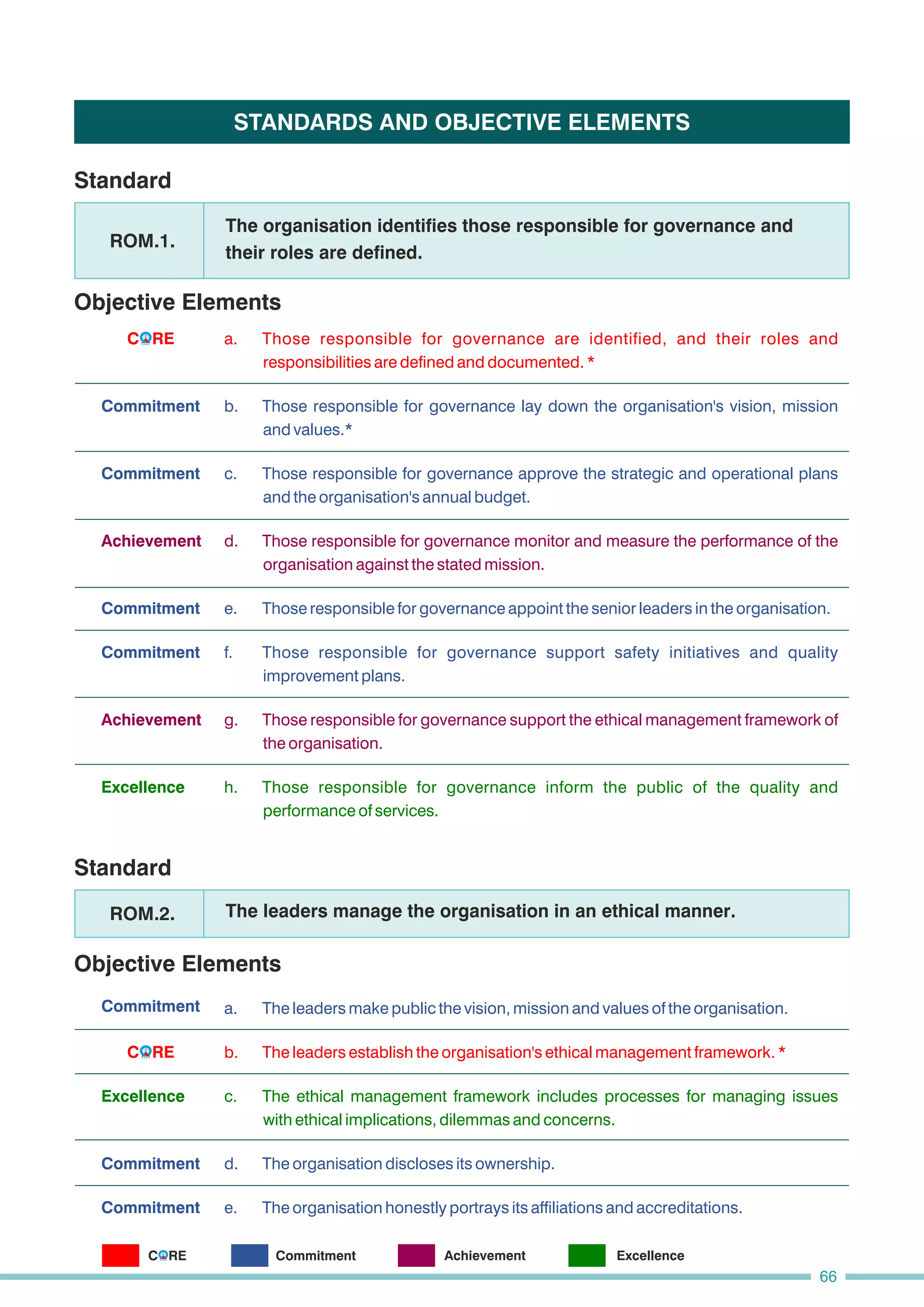
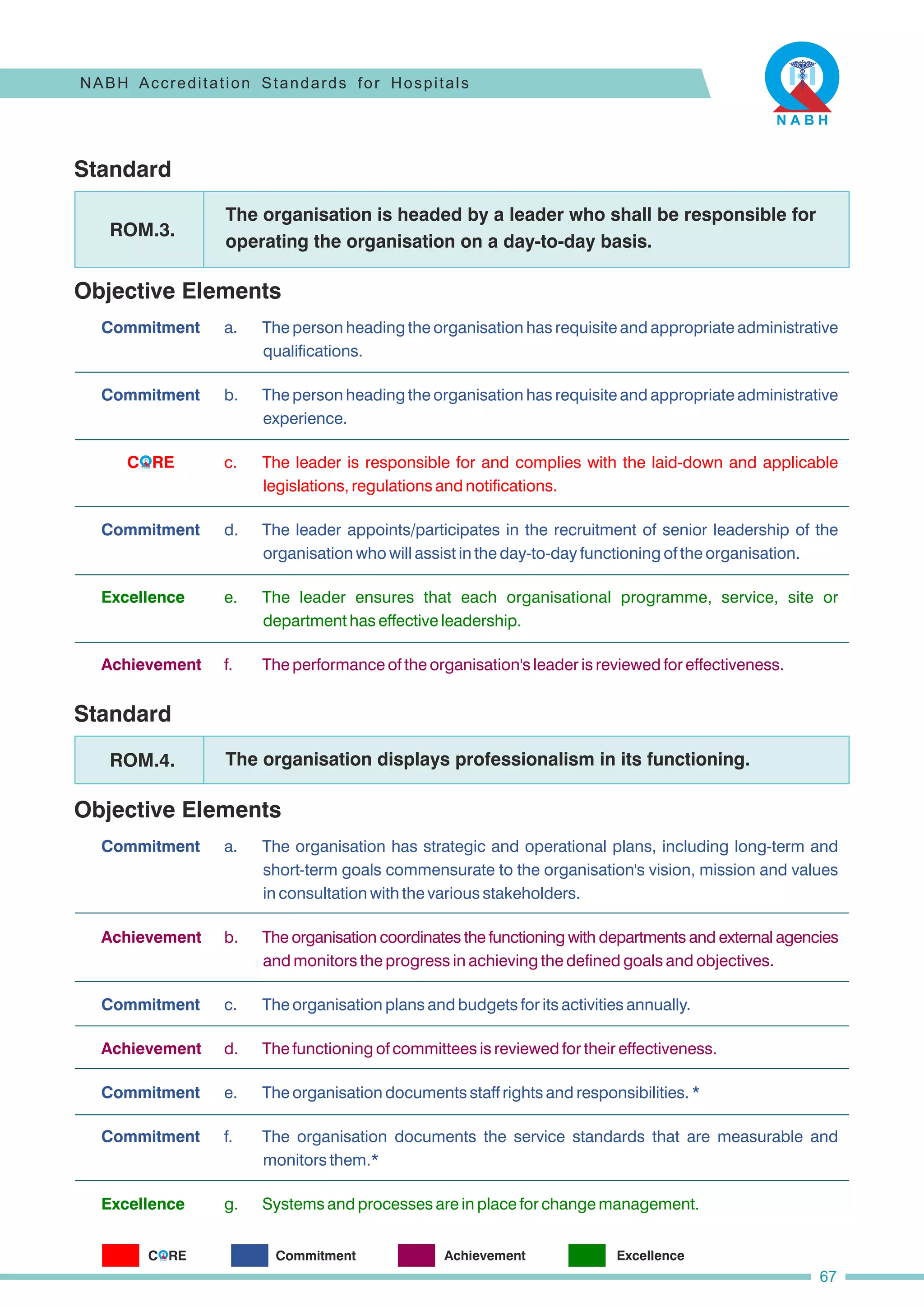
STANDARDS AND OBJECTIVE ELEMENTS
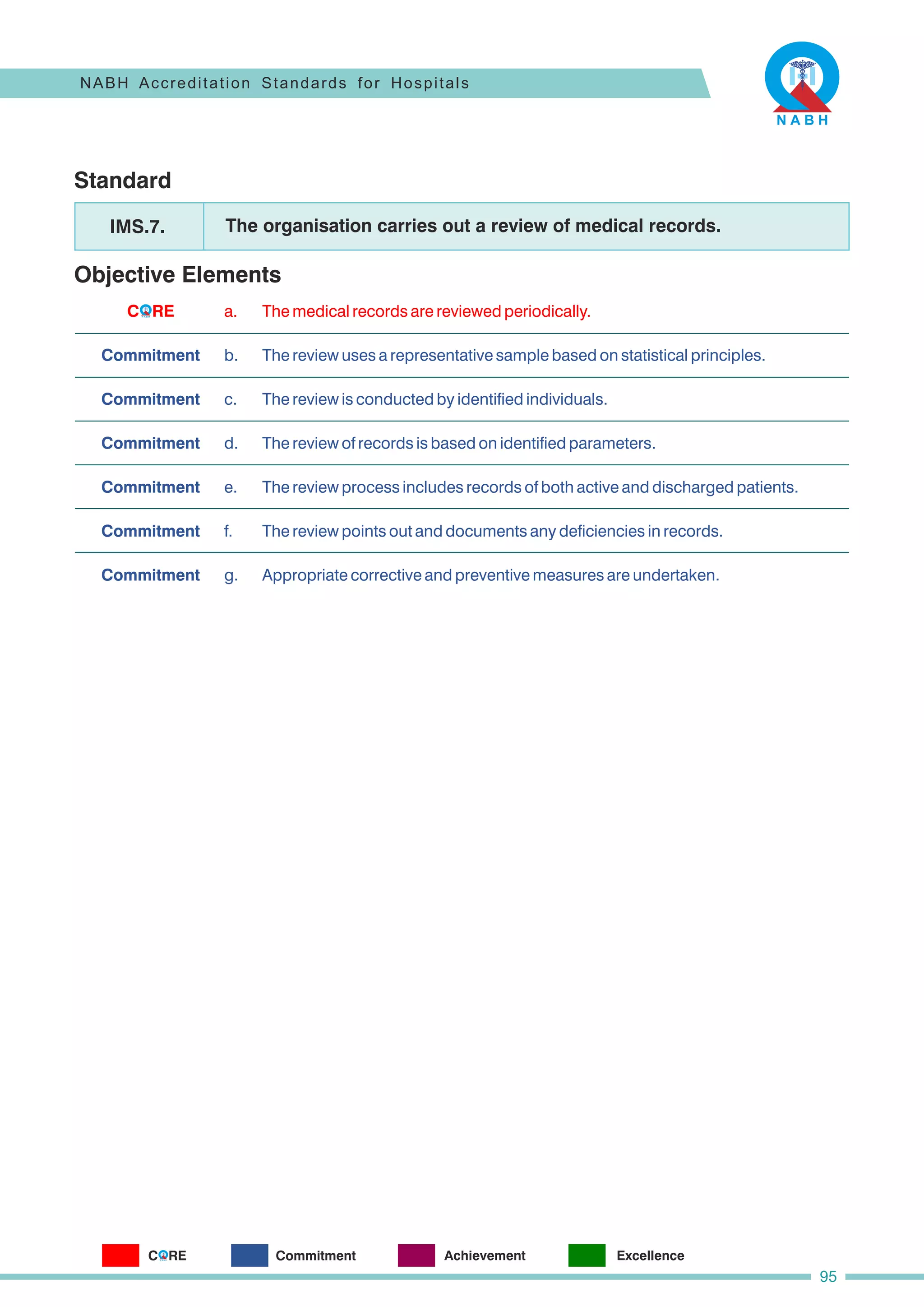
Standard
Objective Elements
Commitment
b. Each defined healthcare service should have diagnostic and treatment services
with suitably qualified personnel who provide out-patient, in-patient and
emergency cover.
c. Scope of the healthcare services of each department is defined. *
a. The healthcare services being provided are defined and are in consonance with
the needs of the community.
d. The organisation's defined healthcare services are prominently displayed.
The organisation defines and displays the healthcare services that
it provides.
AAC.1.
Commitment
Commitment
Commitment
Standard
Objective Elements
Commitment a. The organisation uses written guidance for registering and admitting patients. *
d. The written guidance also addresses managing patients during non-availability
of beds. *
b. A unique identification number is generated at the end of the registration.
c. Patients are accepted only if the organisation can provide the required service.
e. Access to the healthcare services in the organisation is prioritised according to
the clinical needs of the patient. *
AAC.2.
The organisation has a well-defined registration and
admission process.
Commitment
Commitment
Achievement
C RE
O
2
C RE
O Commitment Achievement Excellence
Standard
Objective Elements
Commitment
b. Transfer- out/referral of patients to another facility is done appropriately. *
a. Transfer-in of patients to the organisation is done appropriately. *
c. During transfer or referral, accompanying staff are appropriate to the clinical
condition of the patient.
d. The organisation gives a summary of the patient's condition and the
treatment given.
There is an appropriate mechanism for transfer (in and out) or
referral of patients.
AAC.3.
Standard
Objective Elements
a. The initial assessment of the outpatients, day-care, in-patients and emergency
patients is done. *
c. The initial assessment is performed within a time frame based on the needs of
the patient. *
e. The initial assessment for in-patients results in a documented care plan.
g. The care plan includes the identification of special needs regarding care following
discharge.
f. Thecareplaniscountersignedbytheclinician-in-chargeofthepatientwithin24hours.
b The initial assessment is performed by qualified personnel. *
d. Initial assessment of day-care and in-patients includes nursing assessment,
which is done at the time of admission and documented.
AAC.4.
Patients cared for by the organisation undergo an established
initial assessment.
Commitment
Commitment
Commitment
Commitment
Commitment
Commitment
Achievement
Achievement
Excellence
NABH Accreditation Standards for Hospitals
3
C RE
O
C RE
O Commitment Achievement Excellence
Standard
Objective Elements
e. The organisation lays down guidelines and implements processes to identify
early warning signs of change or deterioration in clinical conditions for initiating
prompt intervention.
d. Staff involved in direct clinical care document reassessments.
c. For in-patients during reassessment, the care plan is monitored and modified,
where found necessary.
a. Patients are reassessed at appropriate intervals to determine their response to
treatment and to plan further treatment or discharge.
b. Out-patients are informed of their next follow-up, where appropriate.
Patients cared for by the organisation undergo a regular reassessment.
AAC.5.
Commitment
Achievement
Commitment
Commitment
Standard
Objective Elements
Commitment a. Scope of the laboratory services is commensurate to the services provided by the
organisation.
b. The infrastructure (physical and equipment) is adequate to provide the defined
scope of services.
c. Human resource is adequate to provide the defined scope of services.
d. Qualified and trained personnel perform and supervise the investigations and
report the results.
e. Requisition for tests, collection, identification, handling, safe transportation,
processing and disposal of a specimen is performed according to written
guidance. *
f. Laboratory results are available within a defined time frame. *
Laboratory services are provided as per the scope of services of
the organisation.
AAC.6.
Commitment
Commitment
Commitment
Commitment
Commitment
NABH Accreditation Standards for Hospitals
4
C RE
O
C RE
O Commitment Achievement Excellence
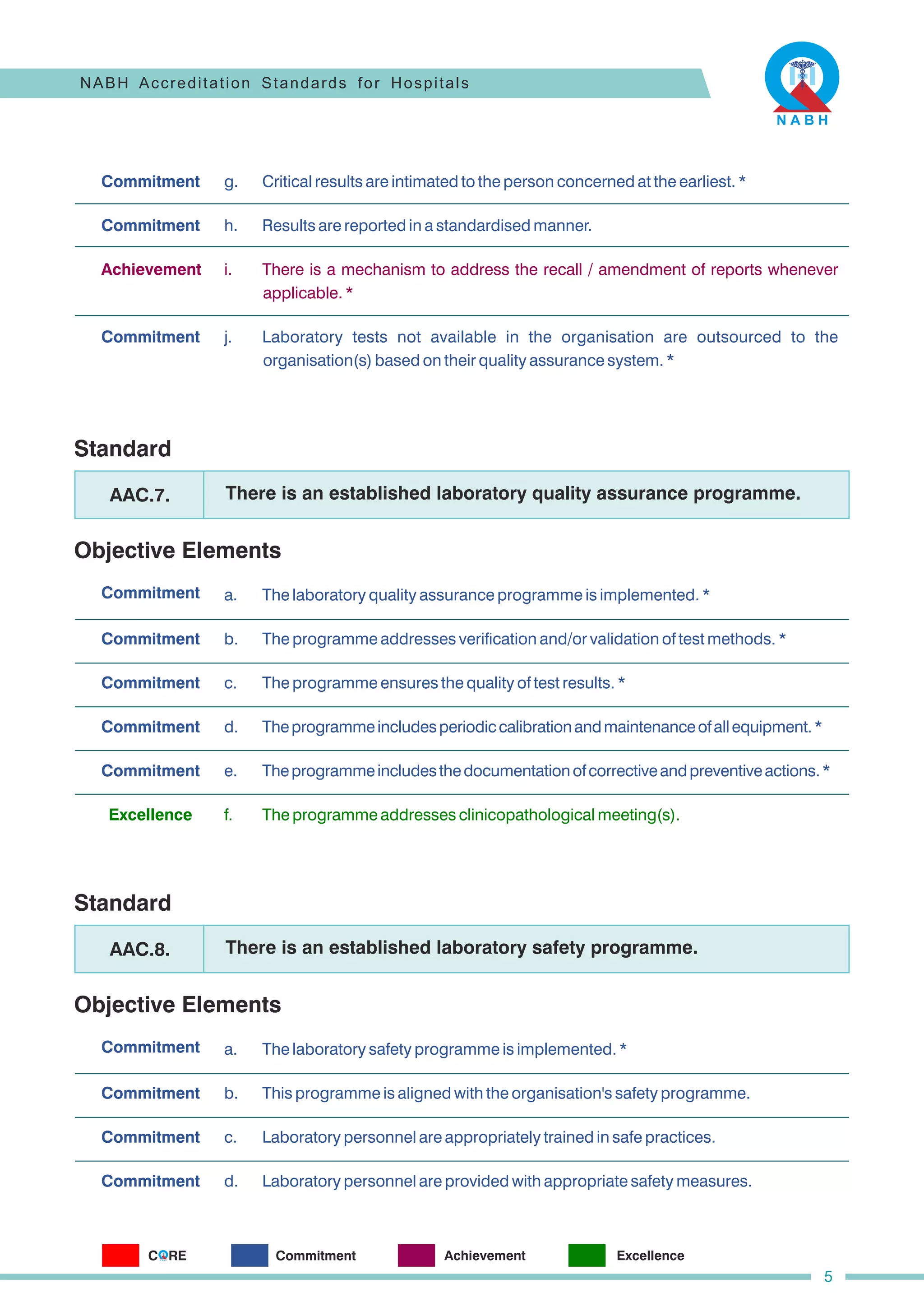
g. Critical results are intimated to the person concerned at the earliest. *
h. Results are reported in a standardised manner.
i. There is a mechanism to address the recall / amendment of reports whenever
applicable. *
j. Laboratory tests not available in the organisation are outsourced to the
organisation(s) based on their quality assurance system. *
Commitment
Commitment
Achievement
Commitment
Standard
Objective Elements
Commitment
d. Theprogrammeincludesperiodiccalibrationandmaintenanceofallequipment.*
b. The programme addresses verification and/or validation of test methods. *
f. The programme addresses clinicopathological meeting(s).
a. The laboratory quality assurance programme is implemented. *
e. Theprogrammeincludesthedocumentationofcorrectiveandpreventiveactions.*
c. The programme ensures the quality of test results. *
There is an established laboratory quality assurance programme.
AAC.7.
Commitment
Commitment
Commitment
Commitment
Excellence
Standard
Objective Elements
Commitment a. The laboratory safety programme is implemented. *
b. This programme is aligned with the organisation's safety programme.
c. Laboratory personnel are appropriately trained in safe practices.
d. Laboratory personnel are provided with appropriate safety measures.
There is an established laboratory safety programme.
AAC.8.
Commitment
Commitment
Commitment
NABH Accreditation Standards for Hospitals
5
C RE
O Commitment Achievement Excellence
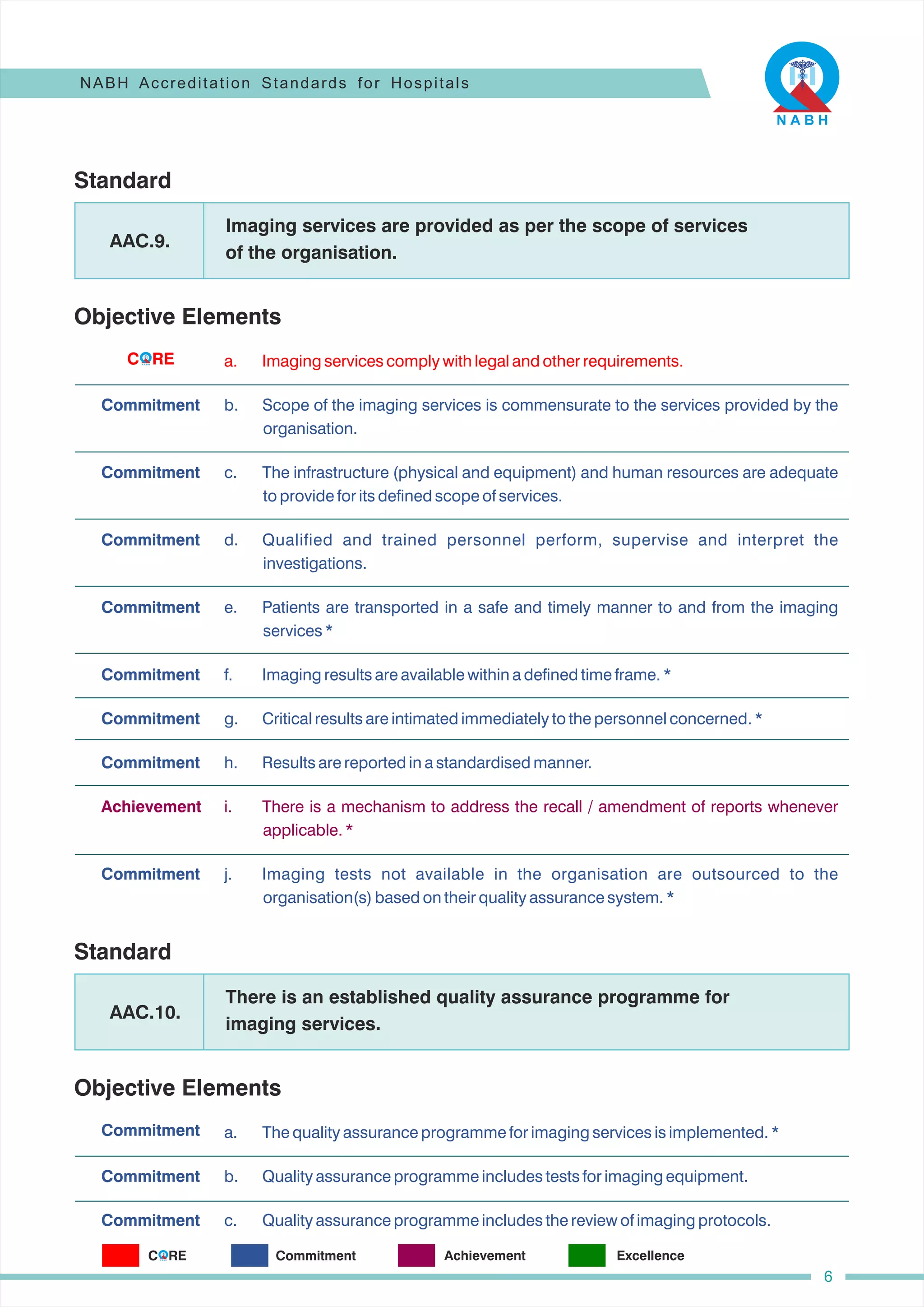
Standard
Objective Elements
c. The infrastructure (physical and equipment) and human resources are adequate
to provide for its defined scope of services.
e. Patients are transported in a safe and timely manner to and from the imaging
services *
a. Imaging services comply with legal and other requirements.
b. Scope of the imaging services is commensurate to the services provided by the
organisation.
d. Qualified and trained personnel perform, supervise and interpret the
investigations.
f. Imaging results are available within a defined time frame. *
g. Critical results are intimated immediately to the personnel concerned. *
h. Results are reported in a standardised manner.
i. There is a mechanism to address the recall / amendment of reports whenever
applicable. *
j. Imaging tests not available in the organisation are outsourced to the
organisation(s) based on their quality assurance system. *
Imaging services are provided as per the scope of services
of the organisation.
AAC.9.
Commitment
Commitment
Commitment
Commitment
Commitment
Commitment
Commitment
Achievement
Commitment
Standard
Objective Elements
Commitment a. The quality assurance programme for imaging services is implemented. *
c. Quality assurance programme includes the review of imaging protocols.
b. Quality assurance programme includes tests for imaging equipment.
There is an established quality assurance programme for
imaging services.
AAC.10.
Commitment
Commitment
NABH Accreditation Standards for Hospitals
6
C RE
O
C RE
O Commitment Achievement Excellence
d. A system is in place to ensure the appropriateness of the investigations and
procedures for the clinical indication.
e. The programme addresses periodic internal/external peer review of imaging
results using appropriate sampling.
f. The programme addresses the clinico-radiological meeting(s).
g. Theprogrammeincludesperiodiccalibrationandmaintenanceofallequipment.*
h. Theprogrammeincludesthedocumentationofcorrectiveandpreventiveactions.*
Achievement
Achievement
Excellence
Commitment
Commitment
Standard
Objective Elements
Commitment
c. Patients are appropriately screened for safety/risk before imaging.
g. Imaging signage is prominently displayed in all appropriate locations.
b. This programme is aligned with the organisation's safety programme.
f. Imaging and ancillary personnel are trained in imaging safety practices and
radiation-safety measures.
e. Radiation-safety and monitoring devices are periodically tested, and results are
documented. *
a The radiation-safety programme is implemented. *
d. Imaging personnel and patients use appropriate radiation safety and monitoring
devices where applicable.
There is an established safety programme in imaging services.
AAC.11.
Commitment
Commitment
Commitment
Commitment
Commitment
Commitment
NABH Accreditation Standards for Hospitals
7
C RE
O Commitment Achievement Excellence
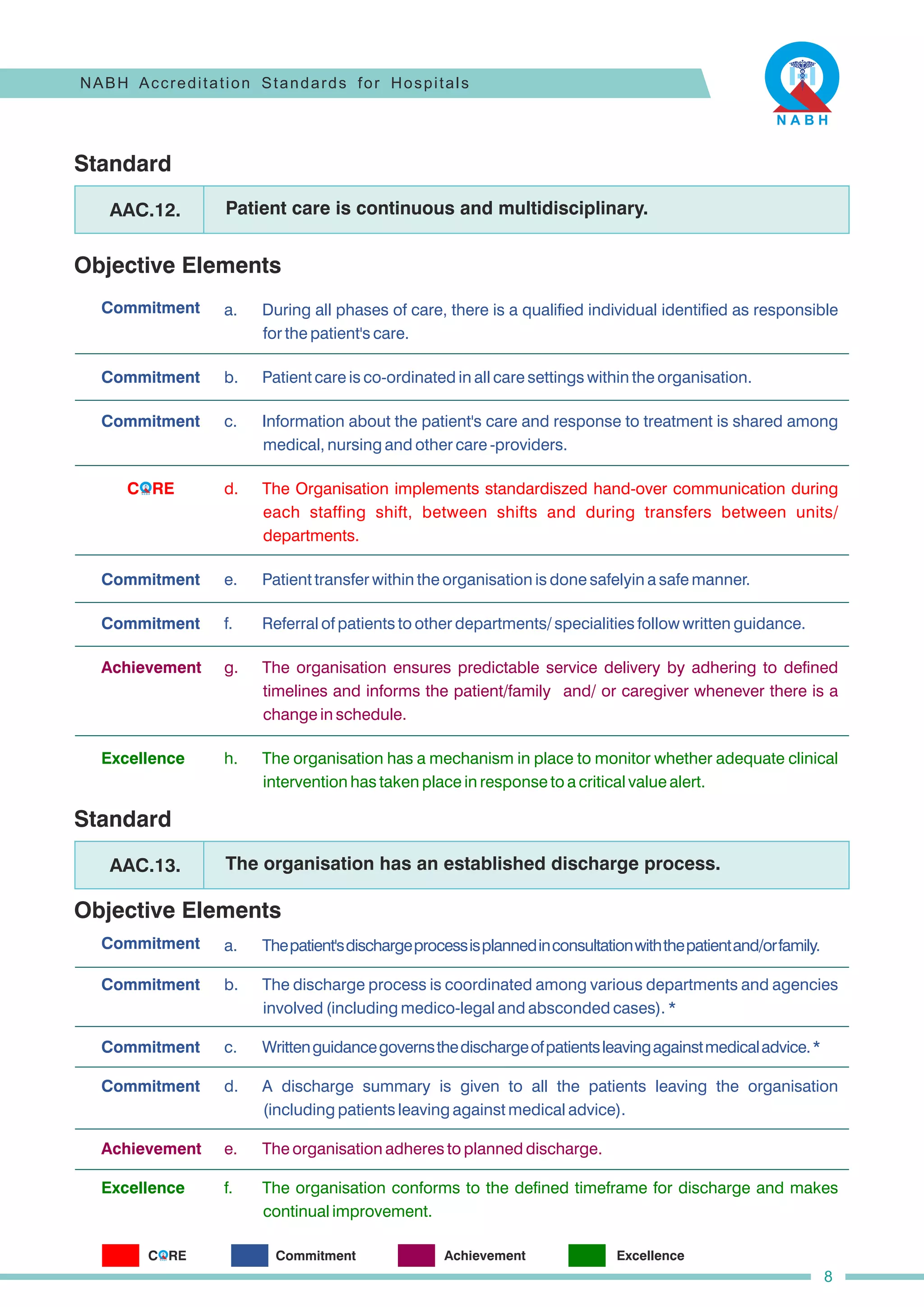
Standard
Objective Elements
Commitment
b. Patient care is co-ordinated in all care settings within the organisation.
d. The Organisation implements standardiszed hand-over communication during
each staffing shift, between shifts and during transfers between units/
departments.
a. During all phases of care, there is a qualified individual identified as responsible
for the patient's care.
c. Information about the patient's care and response to treatment is shared among
medical, nursing and other care -providers.
e. Patient transfer within the organisation is done safelyin a safe manner.
g. The organisation ensures predictable service delivery by adhering to defined
timelines and informs the patient/family and/ or caregiver whenever there is a
change in schedule.
f. Referral of patients to other departments/ specialities follow written guidance.
h. The organisation has a mechanism in place to monitor whether adequate clinical
intervention has taken place in response to a critical value alert.
Patient care is continuous and multidisciplinary.
AAC.12.
Commitment
Commitment
Commitment
Commitment
Achievement
Excellence
Standard
Objective Elements
Commitment
e. The organisation adheres to planned discharge.
f. The organisation conforms to the defined timeframe for discharge and makes
continual improvement.
a. Thepatient'sdischargeprocessisplannedinconsultationwiththepatientand/orfamily.
b. The discharge process is coordinated among various departments and agencies
involved (including medico-legal and absconded cases). *
d. A discharge summary is given to all the patients leaving the organisation
(including patients leaving against medical advice).
c. Writtenguidancegovernsthedischargeofpatientsleavingagainstmedicaladvice.*
The organisation has an established discharge process.
AAC.13.
Commitment
Commitment
Commitment
Achievement
Excellence
NABH Accreditation Standards for Hospitals
8
C RE
O
C RE
O Commitment Achievement Excellence
Standard
Objective Elements
Commitment a. A discharge summary is provided to the patients at the time of discharge.
e. Discharge summary contains follow-up advice, medication and other instructions
in an understandable manner.
c. Discharge summary contains the reasons for admission, significant findings and
diagnosis and the patient's condition at the time of discharge.
b. Discharge summary contains the patient's name, unique identification number,
name of the treating doctor, date of admission and date of discharge
f. Discharge summary incorporates instructions about when and how to obtain
urgent care.
d. Discharge summary contains information regarding investigation results, any
procedure performed, medication administered, and other treatment given.
g. In case of death, the summary of the case also includes the cause of death.
The organisation defines the content of the discharge summary.
AAC.14.
Commitment
Commitment
Commitment
Commitment
Achievement
Commitment
NABH Accreditation Standards for Hospitals
9
C RE
O Commitment Achievement Excellence
14. Goldberg-Stein, S., Frigini, L. A., Long, S., Metwalli, Z., Nguyen, X. V., Parker, M., & Abujudeh, H. (2017). ACR
RADPEER Committee White Paper with 2016 Updates: Revised Scoring System, New Classifications, Self-
Review, and Subspecialized Reports. Journal of the American College of Radiology, 14(8), 1080-1086.
doi:10.1016/j.jacr.2017.03.023
13. Gardner-Thorpe, J., Love, N., Wrightson, J., Walsh, S., & Keeling, N. (2006). The Value of Modified Early
Warning Score (MEWS) in Surgical In-Patients: A Prospective Observational Study. The Annals of The Royal
College of Surgeons of England, 88(6), 571-575. doi:10.1308/003588406x130615
5. Coleman, E. A., Chugh, A., Williams, M. V., Grigsby, J., Glasheen, J. J., McKenzie, M., & Min, S. (2013).
Understanding and Execution of Discharge Instructions. American Journal of Medical Quality, 28(5), 383-
391. doi:10.1177/1062860612472931
7. Content of a discharge summary from a medical ward: views of general practitioners and hospital doctors.
(n.d.). Retrieved from https://www.ncbi.nlm.nih.gov/pmc/articles/PMC5401316/pdf/jrcollphyslond90372-
0047
2. Albrecht, J. S., Gruber-Baldini, A. L., Hirshon, J. M., Brown, C. H., Goldberg, R., Rosenberg, J. H., … Furuno,
J. P
. (2014). Hospital Discharge Instructions: Comprehension and Compliance Among Older Adults. Journal
of General Internal Medicine, 29(11), 1491-1498. doi:10.1007/s11606-014-2956-0
9. Dhingra, N. (2010). WHO Guidelines on Drawing Blood: Best Practices in Phlebotomy. Retrieved from
http://www.euro.who.int/__data/assets/pdf_file/0005/268790/WHO-guidelines-on-drawing-blood-best-
practices-in-phlebotomy-Eng.pdf?ua-1
11. Egan, N. (1999). Managing a bed crisis. Emergency Medicine Journal, 16(2), 145-146.
doi:10.1136/emj.16.2.145
12. Gail M. Keenan; Elizabeth Yakel; Dana Tschannen; Mary Mandeville. (2008). Chapter 49 Documentation and
the Nurse Care Planning Process. In Patient Safety and Quality: An Evidence-Based Handbook for Nurses.
1. Agency for Healthcare Research and Quality. Patient Safety Network. (2012, June). Transfer Troubles.
Retrieved August 12, 2019, from https://psnet.ahrq.gov/webmm/case/269
10. Déry, J., Ruiz, A., Routhier, F., Gagnon, M., Côté, A., Ait-Kadi, D., … Lamontagne, M. (2019). Patient
prioritization tools and their effectiveness in non-emergency healthcare services: a systematic review
protocol. Systematic Reviews, 8(1). doi:10.1186/s13643-019-0992-x
4. Brady, A. P
. (2016). Error and discrepancy in radiology: inevitable or avoidable? Insights into Imaging, 8(1),
171-182. doi:10.1007/s13244-016-0534-1
3. Basics of radiation protection: How to achieve ALARA. Working tips and guidelines. (n.d.). Retrieved from
https://apps.who.int/medicinedocs/documents/s15961e/s15961e.pdf
6. C o m m u n i c a t i o n D u r i n g P a t i e n t H a n d - O v e r s . ( n . d . ) . R e t r i e v e d f r o m
https://www.who.int/patientsafety/solutions/patientsafety/PS-Solution3.pdf
8. Davenport, R. J. (2018). How to do it: the clinicopathological conference. Practical Neurology, 19(2), 143-
146. doi:10.1136/practneurol-2018-001993
15. Gooneratne, M., & Walker, D. (2017). Rapid response systems and the deteriorating patient. British Journal of
Hospital Medicine, 78(3), 124-125. doi:10.12968/hmed.2017.78.3.124
References:
10
28. Patient Transfers. Principles for the safe transfer and handover of patients from acute medical units. (n.d.).
Retrieved from https://www.acutemedicine.org.uk/wp-content/uploads/2010/06/
samprinciplesforsafepatienttransferfromacutemedicine_lkv.pdf
16. Hawkins, R. C. (2007). Laboratory Turnaround Time. Clin Biochem Rev, 28(4), 179-194.
18. Johnson, L., Edward, K., & Giandinoto, J. (2018). A systematic literature review of accuracy in nursing care
p l a n s a n d u s i n g s t a n d a r d i s e d n u r s i n g l a n g u a g e . C o l l e g i a n , 2 5 ( 3 ) , 3 5 5 - 3 6 1 .
doi:10.1016/j.colegn.2017.09.006
19. Kulshrestha, A., & Singh, J. (2016). Inter-hospital and intra-hospital patient transfer: Recent concepts. Indian
Journal of Anaesthesia, 60(7), 451. doi:10.4103/0019-5049.186012
20. Lippi, G., & Mattiuzzi, C. (2016). Critical laboratory values communication: summary recommendations from
available guidelines. Annals of Translational Medicine, 4(20), 400-400. doi:10.21037/atm.2016.09.36
24. Occupational Safety and Health Administration. (2011). Laboratory safety Guidance. Retrieved August 12,
2019, from https://www.osha.gov/Publications/laboratory/OSHA3404laboratory-safety-guidance.pdf
23. Müller, M., Jürgens, J., Redaèlli, M., Klingberg, K., Hautz, W. E., & Stock, S. (2018). Impact of the
communication and patient hand-off tool SBAR on patient safety: a systematic review. BMJ Open, 8(8),
e022202. doi:10.1136/bmjopen-2018-022202
25. Ortiga, B., Salazar, A., Jovell, A., Escarrabill, J., Marca, G., & Corbella, X. (2012). Standardizing admission
and discharge processes to improve patient flow: A cross sectional study. BMC Health Services Research,
12(1). doi:10.1186/1472-6963-12-180
26. Patel, S., Gillon, S. A., & Jones, D. A. (2017). Rapid response systems: recognition and rescue of the
deteriorating hospital patient. British Journal of Hospital Medicine, 78(3), 143-148.
doi:10.12968/hmed.2017.78.3.143
27. Patient Identification. (n.d.). Retrieved from https://www.who.int/patientsafety/solutions/patientsafety/PS-
Solution2.pdf
22. Mahgerefteh, S., Kruskal, J. B., Yam, C. S., Blachar, A., & Sosna, J. (2009). Peer Review in Diagnostic
Radiology: Current State and a Vision for the Future. RadioGraphics, 29(5), 1221-1231.
doi:10.1148/rg.295095086
17. Horwitz, L. I., Moriarty, J. P
., Chen, C., Fogerty, R. L., Brewster, U. C., Kanade, S., … Krumholz, H. M. (2013).
Quality of Discharge Practices and Patient Understanding at an Academic Medical Center. JAMA Internal
Medicine. doi:10.1001/jamainternmed.2013.9318
21. Maharaj, R., Raffaele, I., & Wendon, J. (2015). Rapid response systems: a systematic review and meta-
analysis. Critical Care, 19(1). doi:10.1186/s13054-015-0973-y
29. Schultz, E. M., Pineda, N., Lonhart, J., Davies, S. M., & McDonald, K. M. (2013). A systematic review of the
care coordination measurement landscape. BMC Health Services Research, 13(1). doi:10.1186/1472-6963-
13-119
30. Scope of Hospital Services: External Standards and Guidelines. (n.d.). Retrieved from
https://www.princeton.edu/~ota/disk2/1988/8832/883211.PDF
31. Shahid, S., & Thomas, S. (2018). Situation, Background, Assessment, Recommendation (SBAR)
Communication Tool for Handoff in Health Care - A Narrative Review. Safety in Health, 4(1).
doi:10.1186/s40886-018-0073-1
NABH Accreditation Standards for Hospitals
11
32. Subbe, C. (2001). Validation of a modified Early Warning Score in medical admissions. QJM, 94(10), 521-
526. doi:10.1093/qjmed/94.10.521
35. Warren, J., Fromm, R. E., Orr, R. A., Rotello, L. C., & Horst, H. M. (2004). Guidelines for the inter- and
intrahospital transport of critically ill patients*. Critical Care Medicine, 32(1), 256-262.
doi:10.1097/01.ccm.0000104917.39204.0a
37. Williams, P
., Karuppiah, S., Greentree, K., & Darvall, J. (2019). A checklist for intrahospital transport of critically
ill patients improves compliance with transportation safety guidelines. Australian Critical Care.
doi:10.1016/j.aucc.2019.02.004
38. Winters, B. D., Weaver, S. J., Pfoh, E. R., Yang, T., Pham, J. C., & Dy, S. M. (2013). Rapid-Response Systems
as a Patient Safety Strategy. Annals of Internal Medicine, 158(5_Part_2), 417. doi:10.7326/0003-4819-158-5-
201303051-00009
40. World Health Organization. (2010). WHO guidelines on drawing blood: best practices in phlebotomy.
Retrieved August 12, 2019, from http://www.euro.who.int/__data/assets/pdf_file/0005/268790/WHO-
guidelines-on-drawing-blood-best-practices-in-phlebotomy-Eng.pdf?ua-1
41. World Health Organization. (2011). Laboratory Quality Management System: Handbook. Retrieved from
https://www.who.int/ihr/publications/lqms_en.pdf
42. World Health Organization. (2018). Continuity and coordination of care: a practice brief to support
implementation of the WHO Framework on integrated people-centred health services. Retrieved August 13,
2019, from https://apps.who.int/iris/bitstream/handle/10665/274628/9789241514033-eng.pdf?ua=1
34. Wacogne, I., & Diwakar, V. (2010). Handover and note-keeping: the SBAR approach. Clinical Risk, 16(5), 173-
175. doi:10.1258/cr.2010.010043
43. Yemm, R., Bhattacharya, D., & Wright, D. (2014). What constitutes a high quality discharge summary? A
comparison between the views of secondary and primary care doctors. International Journal of Medical
Education, 5, 125-131. doi:10.5116/ijme.538b.3c2e
39. Wright, J., Williams, R., & Wilkinson, J. R. (1998). Health needs assessment: Development and importance of
health needs assessment. BMJ, 316(7140), 1310-1313. doi:10.1136/bmj.316.7140.1310
33. Subbe, C. P
., & Welch, J. R. (2013). Failure to rescue: using rapid response systems to improve care of the
deteriorating patient in hospital. Clinical Risk, 19(1), 6-11. doi:10.1177/1356262213486451
36. Weston, C., Yune, S., Bass, E., Berkowitz, S., Brotman, D., Deutschendorf, A., … Wu, A. (2017). A Concise
Tool for Measuring Care Coordination from the Provider's Perspective in the Hospital Setting. Journal of
Hospital Medicine, 12(10), 811-817. doi:10.12788/jhm.2795
NABH Accreditation Standards for Hospitals
12
Chapter 2
Care of Patients (COP)
The standards aim to guide and encourage patient safety as the overarching principle for providing care
to patients.
Written guidance, applicable laws and regulations also guide the care of patients who are at higher risk of
morbidity/mortality, high-risk obstetric patients, paediatric patients, patients undergoing procedural sedation,
administration of anaesthesia, patients undergoing surgical procedures and end of life care.
Pain management, nutritional therapy and rehabilitative services are also addressed to provide comprehensive
health care.
The management should have written guidelines for organ donation and procurement. The transplant
programme ensures that it has the right skill mix of staff and other related support systems to ensure safe and high
quality of care.
The organisation provides uniform care to all patients in various settings. The settings include care provided in
outpatient units, day care facilities, in-patient units including critical care units, procedure rooms and operation
theatre. When similar care is provided in these different settings, care delivery is uniform. Written guidance,
applicable laws and regulations guide emergency and ambulance services, cardio-pulmonary resuscitation, use
of blood and blood components, care of patients in the critical care and high dependency units.
Intent of the chapter:
COP
.2. Emergency services are provided in accordance with written guidance, applicable
laws and regulations.
COP
.1. Uniform care to patients is provided in all settings of the organisation and is
guided by written guidance, and the applicable laws and regulations.
COP
.5. Cardio-pulmonary resuscitation services are provided uniformly across the
organisation.
COP
.6. Nursing care is provided to patients in the organisation in consonance with
clinical protocols.
COP
.7. Clinical procedures are performed safely.
COP
.8. Transfusion services are provided as per the scope of services of the
organisation, safely.
COP
.3. Ambulance services ensure safe patient transportation with appropriate care.
COP
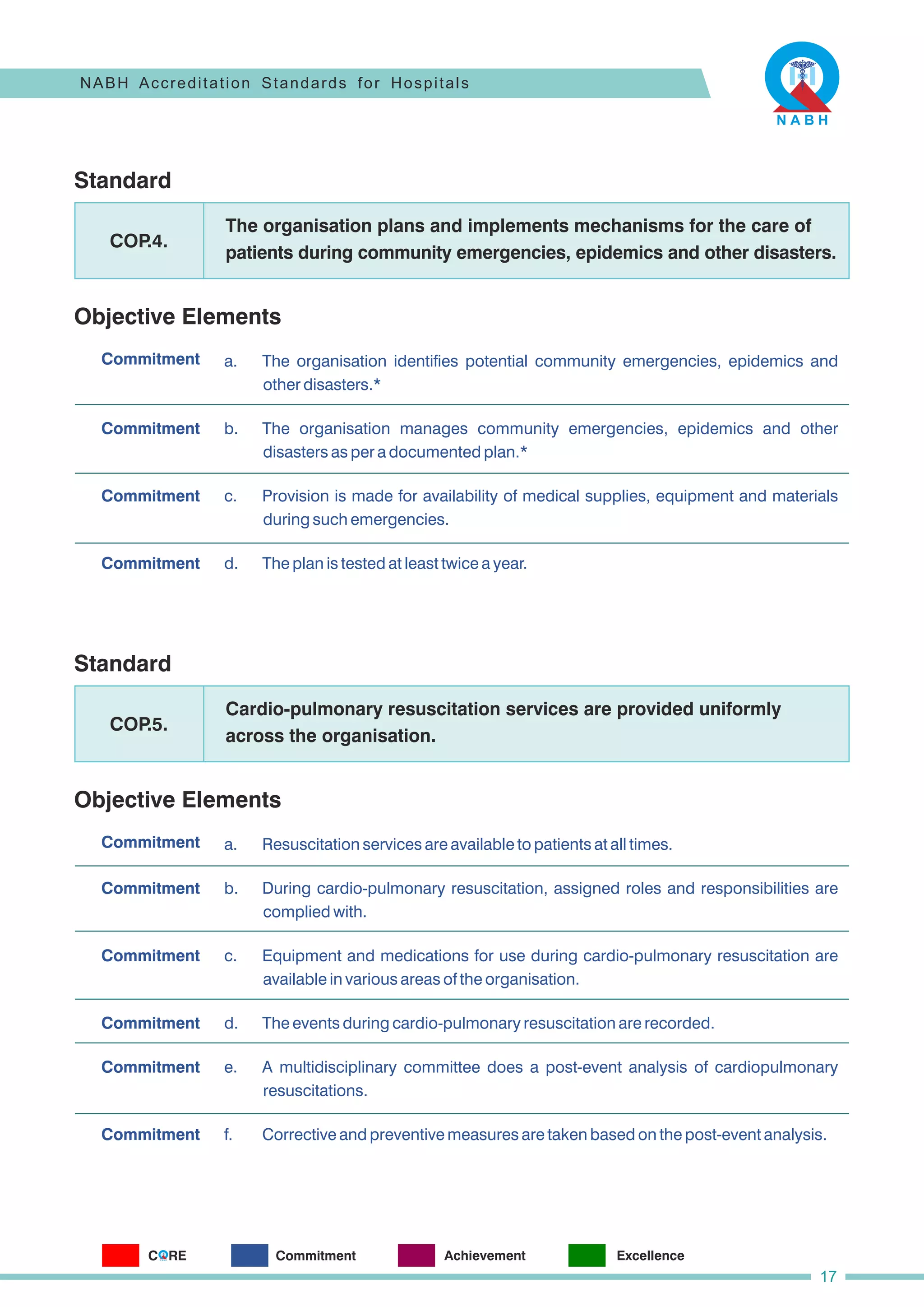
.4. The organisation plans and implements mechanisms for the care of patients
during community emergencies, epidemics and other disasters.
Summary of Standards
13
Summary of Standards
COP
.12. Procedural sedation is provided consistently and safely.
COP
.9. The organisation provides care in intensive care and high dependency units in a
systematic manner.
COP
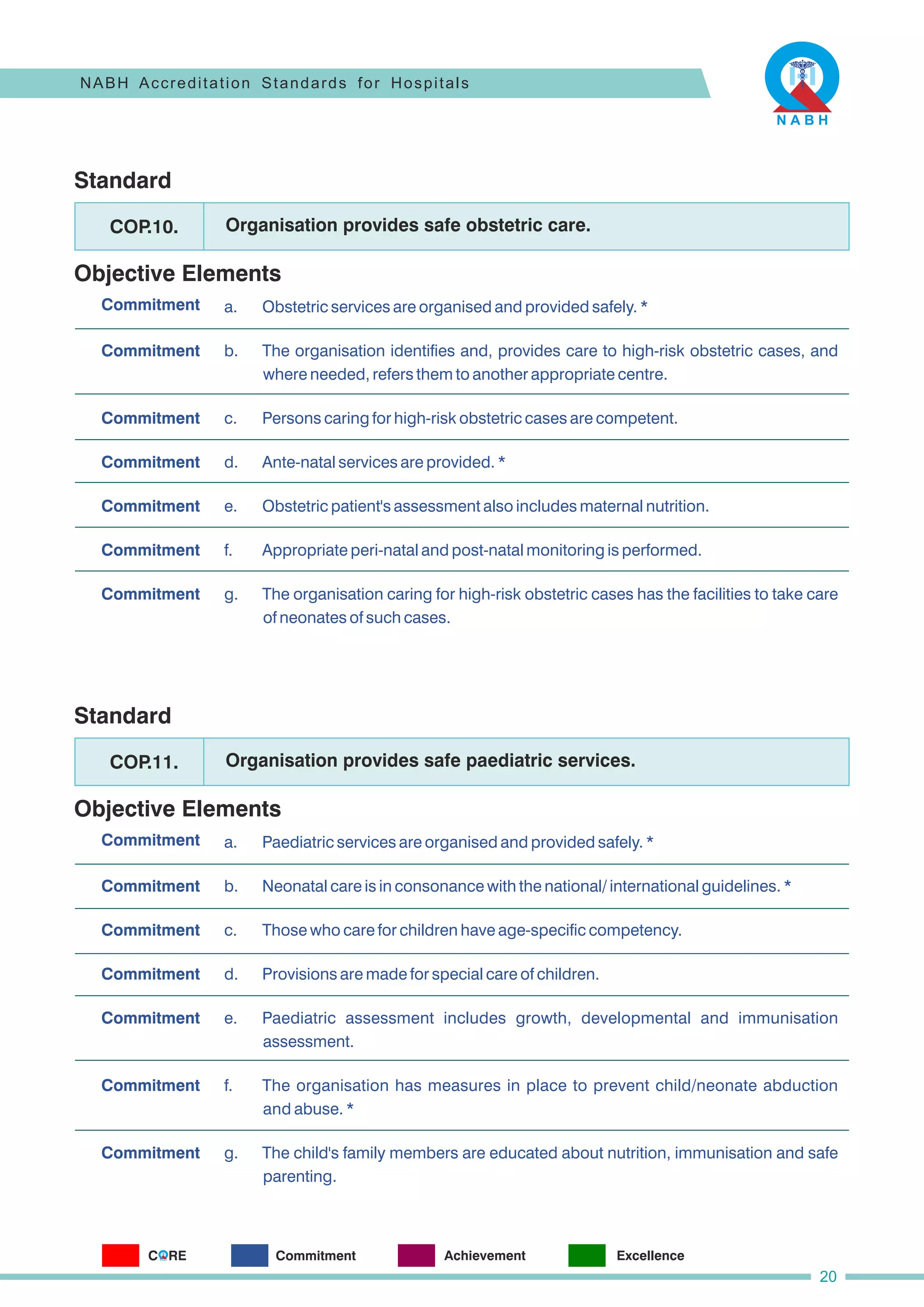
.10. Organisation provides safe obstetric care.
COP
.11. Organisation provides safe paediatric services.
COP
.13. Anaesthesia services are provided in a consistent and safe manner.
COP
.15. The organ transplant programme is carried out safely.
COP
.16. The organisation identifies and manages patients who are at higher risk of
morbidity/mortality.
COP
.17. Pain management for patients is done in a consistent manner.
COP
.18. Rehabilitation services are provided to the patients in a safe, collaborative and
consistent manner.
COP
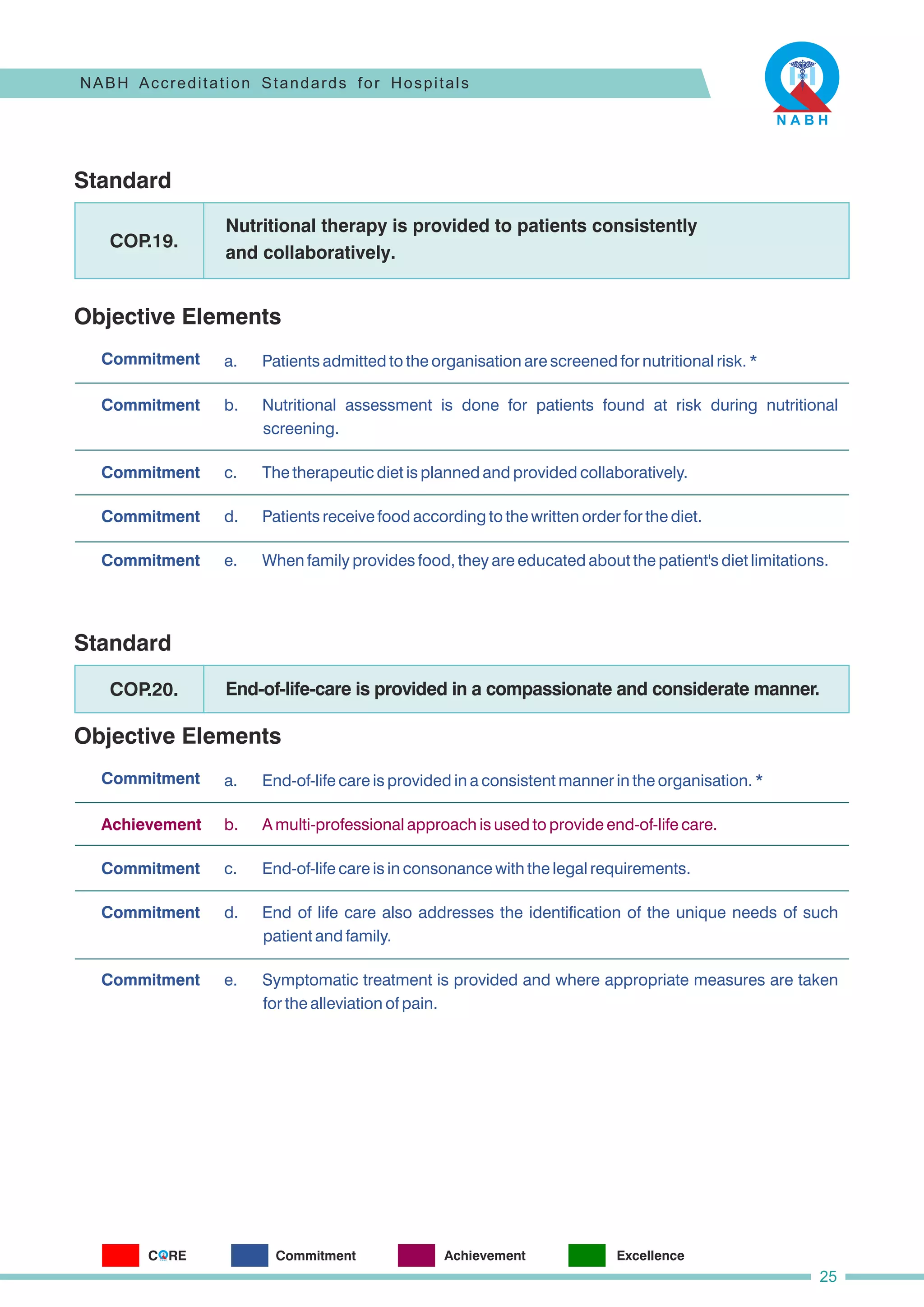
.19. Nutritional therapy is provided to patients consistently and collaboratively.
COP
.20. End of life care is provided in a compassionate and considerate manner.
COP
.14. Surgical services are provided in a consistent and safe manner.
* This implies that this objective element requires documentation.
Standard
Objective Elements
Uniform care to patients is provided in all settings of the
organisation and is guided by written guidance, and the applicable
laws and regulations.
COP
.1.
STANDARDS AND OBJECTIVE ELEMENTS
c. Care shall be provided in consonance with applicable laws and regulations.
a. Uniform care is provided following written guidance. *
b. The organisation has a uniform process for identification of patients and at a
minimum, uses two identifiers.
Commitment
Commitment
NABH Accreditation Standards for Hospitals
14
C RE
O
C RE
O Commitment Achievement Excellence
Achievement
g. Multi-disciplinary and multi-speciality care, where appropriate, is planned based
on best clinical practices/clinical practice guidelines and delivered in a uniform
manner across the organisation.
h. Telemedicine facility is provided safely and securely based on written guidance. *
e. Clinical care pathways are developed, consistently followed across all settings of
care, and reviewed periodically.
f. Care delivery is uniform for a given clinical condition when similar care is provided
in more than one setting. *
d. The organisation adapts evidence-based clinical practice guidelines and/or
clinical protocols to guide uniform patient care.
Excellence
Commitment
Excellence
Commitment
Standard
Objective Elements
Commitment
e. Initiation of appropriate care is guided by a system of triage. *
f. Patients waiting in the emergency are reassessed as appropriate for change in
status.
b. Prevention of patient over-crowding is planned, and crowd management
measures are implemented.
a. There shall be an identified area in the organisation which is easily accessible to
receive and manage emergency patients, with adequate and appropriate
resources.
c. Emergency care is provided in consonance with statutory requirements and in
accordance with the written guidance. *
d. The organisation manages medico-legal cases in accordance with statutory
requirements. *
g. Admission, discharge to home, or transfer to another organisation is
documented.
Emergency services are provided in accordance with written
guidance, applicable laws and regulations.
COP
.2.
Achievement
Commitment
Commitment
Commitment
Commitment
NABH Accreditation Standards for Hospitals
15
C RE
O
C RE
O Commitment Achievement Excellence
Commitment h. In case of discharge to home or transfer to another organisation, a discharge/
transfer note shall be given to the patient.
j. The organisation has systems in place for the management of patients found
dead on arrival and patients who die within a few minutes of arrival *
i. The organisation shall implement a quality assurance programme. *
Achievement
Commitment
Standard
Objective Elements
Commitment
b. There are adequate access and space for the ambulance(s).
g. A mechanism is in place to ensure that emergency medications are available in
the ambulance.
e. The ambulance(s) is checked daily.
i. The emergency department identifies opportunities to initiate treatment at the
earliest when the patient is in transit to the organisation.
h. The ambulance(s) has a proper communication system.*
a. The organisation has access to ambulance services commensurate with the
scope of the services provided by it.
d. The ambulance(s) is operated by trained personnel.
f. Equipment is checked daily using a checklist. *
c. The ambulance(s) is fit for purpose and is appropriately equipped.
Ambulance services ensure safe patient transportation with
appropriate care
COP
.3.
Commitment
Commitment
Commitment
Commitment
Commitment
Commitment
Commitment
Achievement
NABH Accreditation Standards for Hospitals
16
C RE
O Commitment Achievement Excellence
Standard
Objective Elements
Commitment
d. The plan is tested at least twice a year.
a. The organisation identifies potential community emergencies, epidemics and
other disasters.*
b. The organisation manages community emergencies, epidemics and other
disasters as per a documented plan.*
c. Provision is made for availability of medical supplies, equipment and materials
during such emergencies.
The organisation plans and implements mechanisms for the care of
patients during community emergencies, epidemics and other disasters.
COP
.4.
Commitment
Commitment
Commitment
Standard
Objective Elements
Commitment a. Resuscitation services are available to patients at all times.
b. During cardio-pulmonary resuscitation, assigned roles and responsibilities are
complied with.
c. Equipment and medications for use during cardio-pulmonary resuscitation are
available in various areas of the organisation.
d. The events during cardio-pulmonary resuscitation are recorded.
e. A multidisciplinary committee does a post-event analysis of cardiopulmonary
resuscitations.
f. Corrective and preventive measures are taken based on the post-event analysis.
Cardio-pulmonary resuscitation services are provided uniformly
across the organisation.
COP
.5.
Commitment
Commitment
Commitment
Commitment
Commitment
NABH Accreditation Standards for Hospitals
17
C RE
O Commitment Achievement Excellence
Standard
Objective Elements
Commitment
h. Nursesareempoweredtomakepatientcaredecisionswithintheirscopeofpractice.
b. The organisation develops and implements nursing clinical practice guidelines
reflecting current standards of practice. *
e. Nursing care is aligned and integrated with overall patient care.
c. Assignment of patient care is done as per current good clinical/ nursing practice
guidelines.
d. The organisation implements acuity-based staffing to improve patient outcomes.
a. Nursing care is provided to patients in accordance with written guidance. *
f. Care provided by nurses is documented in the patient record.
g. Nurses are provided with appropriate and adequate equipment for providing safe
and efficient nursing care.
Nursing care is provided to patients in the organisation in consonance
with clinical protocols.
COP
.6.
Achievement
Commitment
Excellence
Commitment
Commitment
Commitment
Standard
Objective Elements
Commitment
d. Care is taken to prevent adverse events like a wrong patient, wrong procedure
and wrong site. *
b. Performance of various clinical procedures is based on written guidance. *
e. Informed consent is taken by the personnel performing the procedure, where
applicable.
f. The procedure is done adhering to standard precautions.
g. Patients are appropriately monitored during and after the procedure.
h. Procedures are documented accurately in the patient record.
c. Qualified personnel order, plan, perform and assist in performing procedures.
a. Procedures are performed based on the clinical needs of the patient.
Clinical procedures are performed in a safe manner.
COP
.7.
Commitment
Commitment
Commitment
Commitment
Commitment
Commitment
NABH Accreditation Standards for Hospitals
18
C RE
O
C RE
O
C RE
O Commitment Achievement Excellence
Standard
Objective Elements
Commitment
f. Blood/blood components are available for use in emergency situations within a
defined time-frame. *
d. Informed consent is obtained for transfusion of blood and blood components.
b. Transfusion of blood and blood components is done safely. *
c. Blood and blood components are used rationally. *
g. Post-transfusion form is collected, reactions if any identified and are analysed for
preventive and corrective actions.
h. The organisation shall implement a quality assurance programme. *
e. Informed consent also includes patient and family education about the donation.
a. Scope of transfusion services is commensurate with the services provided by the
organisation.
Transfusion services are provided as per the scope of services of
the organisation, safely.
COP
.8.
Achievement
Achievement
Standard
Objective Elements
Commitment a. Care of patients in intensive care and high dependency units is provided based on
written guidance. *
c. Adequate staff and equipment are available.
f. Infection control practices are followed. *
g. The organisation shall implement a quality assurance programme. *
e. Defined procedures for the situation of bed shortages are followed. *
b. The defined admission and discharge criteria for intensive care and high
dependency units are implemented. *
h. The organisation has a mechanism to counsel the patient and/or family
periodically.
d. The organisation endeavours to upgrade its physical infrastructure to meet
national and international guidelines.
The organisation provides care in intensive care and high
dependency units in a systematic manner.
COP
.9.
Commitment
Commitment
Commitment
Commitment
Commitment
Commitment
Excellence
Commitment
Commitment
Achievement
Commitment
NABH Accreditation Standards for Hospitals
19
C RE
O
C RE
O Commitment Achievement Excellence
Standard
Objective Elements
Commitment a. Obstetric services are organised and provided safely. *
f. Appropriate peri-natal and post-natal monitoring is performed.
g. The organisation caring for high-risk obstetric cases has the facilities to take care
of neonates of such cases.
b. The organisation identifies and, provides care to high-risk obstetric cases, and
where needed, refers them to another appropriate centre.
e. Obstetric patient's assessment also includes maternal nutrition.
c. Persons caring for high-risk obstetric cases are competent.
d. Ante-natal services are provided. *
Organisation provides safe obstetric care.
COP
.10.
Commitment
Commitment
Commitment
Commitment
Commitment
Commitment
Standard
Objective Elements
Commitment
f. The organisation has measures in place to prevent child/neonate abduction
and abuse. *
a. Paediatric services are organised and provided safely. *
c. Those who care for children have age-specific competency.
b. Neonatal care is in consonance with the national/ international guidelines. *
d. Provisions are made for special care of children.
e. Paediatric assessment includes growth, developmental and immunisation
assessment.
g. The child's family members are educated about nutrition, immunisation and safe
parenting.
Organisation provides safe paediatric services.
COP
.11.
Commitment
Commitment
Commitment
Commitment
Commitment
Commitment
NABH Accreditation Standards for Hospitals
20
C RE
O Commitment Achievement Excellence
Standard
Objective Elements
Commitment
c. Competent and trained persons administer sedation.
e. Intra-procedure monitoring includes at a minimum the heart rate, cardiac rhythm,
respiratory rate, blood pressure, oxygen saturation, and level of sedation.
b. Informed consent for administration of procedural sedation is obtained.
a. Procedural sedation is administered in a consistent manner *
g. Criteria are used to determine the appropriateness of discharge from the
observation/recovery area. *
h. Equipment and workforce are available to manage patients who have gone into a
deeper level of sedation than initially intended.
f. Patients are monitored after sedation, and the same is documented.
d. The person monitoring sedation is different from the person performing the
procedure.
Procedural sedation is provided in a consistent and safe manner.
COP
.12.
Commitment
Commitment
Commitment
Commitment
Commitment
Commitment
Commitment
Standard
Objective Elements
Commitment a. Anaesthesia services are provided in a consistent manner*
e. During anaesthesia, monitoring includes regular recording of temperature, heart
rate, cardiac rhythm, respiratory rate, blood pressure, oxygen saturation and end-
tidal carbon dioxide.
c. A pre-induction assessment is performed and documented.
b. The pre-anaesthesia assessment results in the formulation of an anaesthesia plan
which is documented.
d. The anaesthesiologist obtains informed consent for administration of
anaesthesia.
Anaesthesia services are provided in a consistent and safe manner.
COP
.13.
Commitment
Commitment
NABH Accreditation Standards for Hospitals
21
C RE
O
C RE
O
C RE
O Commitment Achievement Excellence
h. The type of anaesthesia and anaesthetic medications used are documented in
the patient record.
i. Procedures shall comply with infection control guidelines to prevent cross-
infection between patients.
g. The anaesthesiologist applies defined criteria to transfer the patient from the
recovery area. *
j. Intraoperative adverse anaesthesia events are recorded and monitored.
f. Patient's post-anaesthesia status is monitored and documented.
Commitment
Commitment
Commitment
Commitment
Achievement
Standard
Objective Elements
Commitment
d. Care is taken to prevent adverse events like the wrong site, wrong patient and
wrong surgery. *
c. Informed consent is obtained by a surgeon before the procedure.
e. An operative note is documented before transfer out of patient from recovery.
f. Postoperative care is guided by a documented plan.
i. The organisation shall implement a quality assurance programme. *
a. Surgical services are provided in a consistent and safe manner. *
j. The quality assurance programme includes surveillance of the operation theatre
environment. *
g. Patient, personnel and material flow conform to infection control practices.
b. Surgical patients have a preoperative assessment, a documented pre-operative
diagnosis, and pre-operative instructions are provided before surgery.
h. Appropriate facilities, equipment, instruments and supplies are available in the
operating theatre.
Surgical services are provided in a consistent and safe manner.
COP
.14.
Commitment
Commitment
Commitment
Commitment
Commitment
Commitment
Achievement
Achievement
NABH Accreditation Standards for Hospitals
22
C RE
O
C RE
O Commitment Achievement Excellence
Standard
Objective Elements
b. Care of transplant patients is guided by clinical practice guidelines. *
d. The organisation shall take measures to create awareness regarding organ
donation.
a. The organ transplant program shall be in consonance with the legal requirements
and shall be conducted ethically.
c. The organisation ensures education and counselling of recipient and donor
through trained/qualified counsellors before organ transplantation.
The organ transplant programme is carried out safely.
COP
.15.
Commitment
Commitment
Standard
Objective Elements
Commitment a. The organisation identifies and manages vulnerable patients. *
b. The organisation provides for a safe and secure environment for the vulnerable
patient.
c. The organisation identifies and manages patients who are at a risk of fall.*
e. The organisation identifies and manages patients who are at risk of developing
deep vein thrombosis.*
f. The organisation identifies and manages patients who need restraints. *
d. The organisation identifies and manages patients who are at risk of
developing/worsening of pressure ulcers.*
The organisation identifies and manages patients who are at higher
risk of morbidity/ mortality.
COP
.16.
Commitment
Commitment
NABH Accreditation Standards for Hospitals
23
C RE
O
C RE
O
C RE
O
C RE
O
C RE
O
C RE
O Commitment Achievement Excellence
Standard
Objective Elements
Commitment a. Patients in pain are effectively managed. *
b. Patients are screened for pain.
c. Patients with pain undergo detailed assessment and periodic reassessment.
d. Pain alleviation measures or medications are initiated and titrated according to
the patient's need and response.
Pain management for patients is done in a consistent manner.
COP
.17.
Commitment
Commitment
Commitment
Standard
Objective Elements
Commitment
b. Rehabilitation services are provided in a consistent manner.
d. There are adequate space and equipment to provide rehabilitation.
e. Care is guided by functional assessment and periodic re-assessments which are
done and documented.
a. Scope of the rehabilitation services at a minimum is commensurate to the services
provided by the organisation.
g. Care pathways are developed, implemented, and reviewed periodically.
f. Care is provided adhering to infection control and safety practices.
c. Care providers collaboratively plan rehabilitation services.
Rehabilitation services are provided to the patients in a safe,
collaborative and consistent manner.
COP
.18.
Commitment
Commitment
Commitment
Commitment
Commitment
Excellence
NABH Accreditation Standards for Hospitals
24
C RE
O Commitment Achievement Excellence
Standard
Objective Elements
Commitment
d. Patients receive food according to the written order for the diet.
b. Nutritional assessment is done for patients found at risk during nutritional
screening.
c. The therapeutic diet is planned and provided collaboratively.
e. When family provides food, they are educated about the patient's diet limitations.
a. Patients admitted to the organisation are screened for nutritional risk. *
Nutritional therapy is provided to patients consistently
and collaboratively.
COP
.19.
Commitment
Commitment
Commitment
Commitment
Standard
Objective Elements
Commitment a. End-of-life care is provided in a consistent manner in the organisation. *
b. A multi-professional approach is used to provide end-of-life care.
d. End of life care also addresses the identification of the unique needs of such
patient and family.
e. Symptomatic treatment is provided and where appropriate measures are taken
for the alleviation of pain.
c. End-of-life care is in consonance with the legal requirements.
End-of-life-care is provided in a compassionate and considerate manner.
COP
.20.
Achievement
Commitment
Commitment
Commitment
NABH Accreditation Standards for Hospitals
25
C RE
O Commitment Achievement Excellence
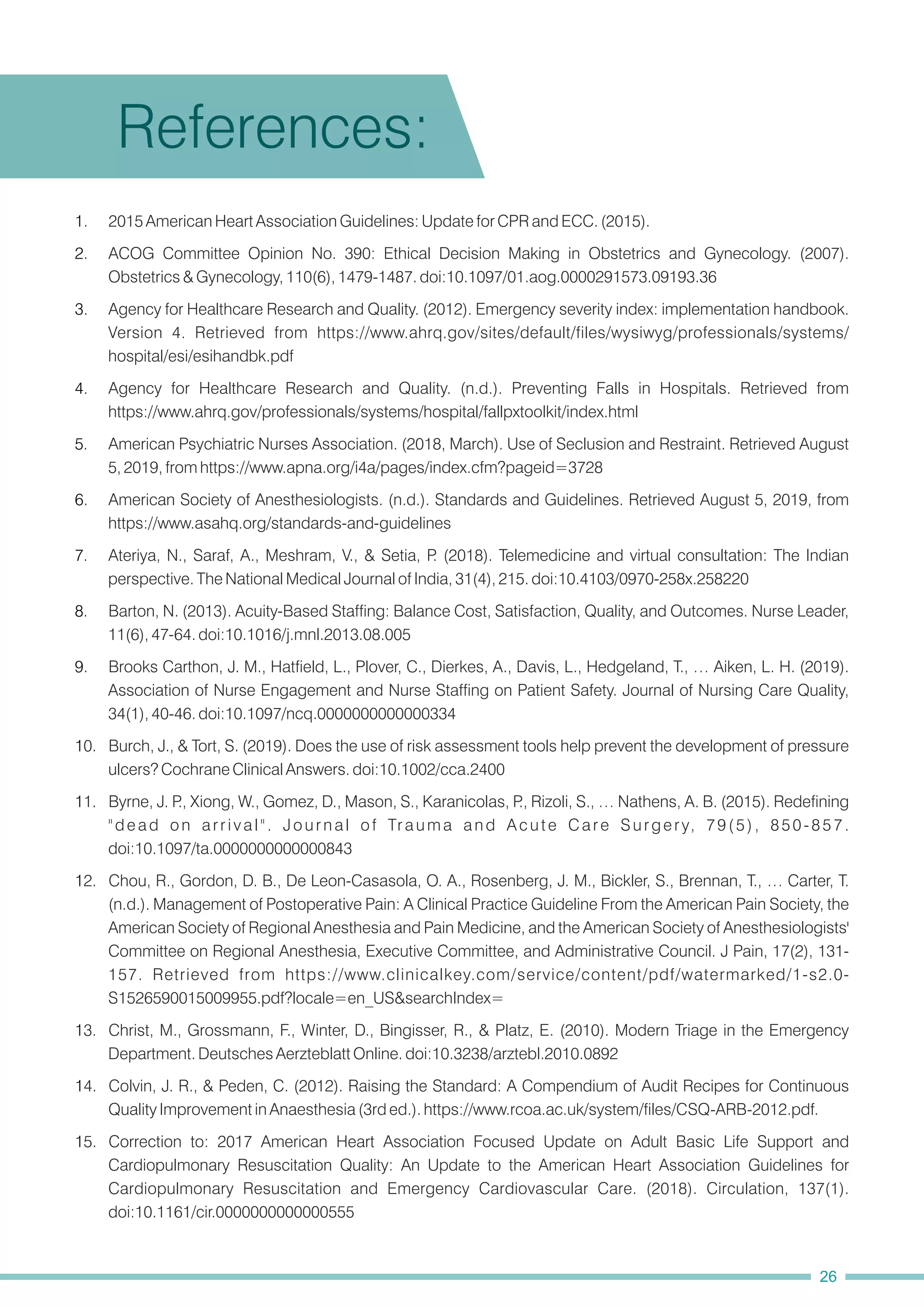
14. Colvin, J. R., & Peden, C. (2012). Raising the Standard: A Compendium of Audit Recipes for Continuous
Quality Improvement in Anaesthesia (3rd ed.). https://www.rcoa.ac.uk/system/files/CSQ-ARB-2012.pdf.
15. Correction to: 2017 American Heart Association Focused Update on Adult Basic Life Support and
Cardiopulmonary Resuscitation Quality: An Update to the American Heart Association Guidelines for
Cardiopulmonary Resuscitation and Emergency Cardiovascular Care. (2018). Circulation, 137(1).
doi:10.1161/cir.0000000000000555
12. Chou, R., Gordon, D. B., De Leon-Casasola, O. A., Rosenberg, J. M., Bickler, S., Brennan, T., … Carter, T.
(n.d.). Management of Postoperative Pain: A Clinical Practice Guideline From the American Pain Society, the
American Society of Regional Anesthesia and Pain Medicine, and the American Society of Anesthesiologists'
Committee on Regional Anesthesia, Executive Committee, and Administrative Council. J Pain, 17(2), 131-
157. Retrieved from https://www.clinicalkey.com/service/content/pdf/watermarked/1-s2.0-
S1526590015009955.pdf?locale=en_US&searchIndex=
10. Burch, J., & Tort, S. (2019). Does the use of risk assessment tools help prevent the development of pressure
ulcers? Cochrane Clinical Answers. doi:10.1002/cca.2400
11. Byrne, J. P
., Xiong, W., Gomez, D., Mason, S., Karanicolas, P
., Rizoli, S., … Nathens, A. B. (2015). Redefining
"dead on arrival". Journal of Trauma and Acute Care Surgery, 79(5), 850-857.
doi:10.1097/ta.0000000000000843
13. Christ, M., Grossmann, F., Winter, D., Bingisser, R., & Platz, E. (2010). Modern Triage in the Emergency
Department. Deutsches Aerzteblatt Online. doi:10.3238/arztebl.2010.0892
2. ACOG Committee Opinion No. 390: Ethical Decision Making in Obstetrics and Gynecology. (2007).
Obstetrics & Gynecology, 110(6), 1479-1487. doi:10.1097/01.aog.0000291573.09193.36
9. Brooks Carthon, J. M., Hatfield, L., Plover, C., Dierkes, A., Davis, L., Hedgeland, T., … Aiken, L. H. (2019).
Association of Nurse Engagement and Nurse Staffing on Patient Safety. Journal of Nursing Care Quality,
34(1), 40-46. doi:10.1097/ncq.0000000000000334
6. American Society of Anesthesiologists. (n.d.). Standards and Guidelines. Retrieved August 5, 2019, from
https://www.asahq.org/standards-and-guidelines
1. 2015 American Heart Association Guidelines: Update for CPR and ECC. (2015).
3. Agency for Healthcare Research and Quality. (2012). Emergency severity index: implementation handbook.
Version 4. Retrieved from https://www.ahrq.gov/sites/default/files/wysiwyg/professionals/systems/
hospital/esi/esihandbk.pdf
4. Agency for Healthcare Research and Quality. (n.d.). Preventing Falls in Hospitals. Retrieved from
https://www.ahrq.gov/professionals/systems/hospital/fallpxtoolkit/index.html
5. American Psychiatric Nurses Association. (2018, March). Use of Seclusion and Restraint. Retrieved August
5, 2019, from https://www.apna.org/i4a/pages/index.cfm?pageid=3728
7. Ateriya, N., Saraf, A., Meshram, V., & Setia, P
. (2018). Telemedicine and virtual consultation: The Indian
perspective. The National Medical Journal of India, 31(4), 215. doi:10.4103/0970-258x.258220
8. Barton, N. (2013). Acuity-Based Staffing: Balance Cost, Satisfaction, Quality, and Outcomes. Nurse Leader,
11(6), 47-64. doi:10.1016/j.mnl.2013.08.005
References:
26
16. Deutsch, E. S., Yonash, R. A., Martin, D. E., Atkins, J. H., Arnold, T. V., & Hunt, C. M. (2018). Wrong-site nerve
blocks: A systematic literature review to guide principles for prevention. Journal of Clinical Anesthesia, 46,
101-111. doi:10.1016/j.jclinane.2017.12.008
20. Hervig, T., Kaada, S., & Seghatchian, J. (2014). Storage and handling of blood components - perspectives.
Transfusion and Apheresis Science, 51(2), 103-106. doi:10.1016/j.transci.2014.10.001
22. Indian Society of Critical Care Medicine. (n.d.). Guidelines. Retrieved August 5, 2019, from
https://isccm.org/guidelines.aspx
27. McClave, S. A., DiBaise, J. K., Mullin, G. E., & Martindale, R. G. (2016). ACG Clinical Guideline: Nutrition
Therapy in the Adult Hospitalized Patient. American Journal of Gastroenterology, 111(3), 315-334.
doi:10.1038/ajg.2016.28
28. Ministry of Health and Family Welfare, Government of India. (n.d.). Standard Treatment
G u i d e l i n e s ( S p e c i a l i t y / S u p e r S p e c i a l i t y w i s e ) . R e t r i e v e d A u g u s t 5 , 2 0 1 9 , f r o m
http://clinicalestablishments.gov.in/En/1068-standard-treatment-guidelines.aspx
18. Haynes, A. B., Berry, W. R., & Gawande, A. A. (2015). What Do We Know About the Safe Surgery Checklist
Now? Annals of Surgery, 261(5), 829-830. doi:10.1097/sla.0000000000001144
19. Henke, P
., & Pannucci, C. (n.d.). VTE Risk Factor Assessment and Prophylaxis. Phlebology, 25(5), 219-223.
Retrieved from https://www.ncbi.nlm.nih.gov/pmc/articles/PMC4487984/pdf/nihms702670.pdf
21. Hinkelbein, J., Lamperti, M., Akeson, J., Santos, J., Costa, J., De Robertis, E., … Fitzgerald, R. (2017).
European Society of Anaesthesiology and European Board of Anaesthesiology guidelines for procedural
sedation and analgesia in adults. European Journal of Anaesthesiology, 1. doi:10.1097/
eja.0000000000000683
30. Montori, V. M., Brito, J. P
., & Murad, M. H. (2013). The Optimal Practice of Evidence-Based Medicine. JAMA,
310(23), 2503. doi:10.1001/jama.2013.281422
17. Dykes, P
. C., Carroll, D. L., Hurley, A., Lipsitz, S., Benoit, A., Chang, F., … Middleton, B. (2010). Fall Prevention
in Acute Care Hospitals. JAMA, 304(17), 1912. doi:10.1001/jama.2010.1567
29. Mishra, S., Mukhopadhyay, K., Tiwari, S., Bangal, R., Yadav, B. S., Sachdeva, A., & Kumar, V. (2017). End-of-
life care: Consensus statement by Indian Academy of Pediatrics. Indian Pediatrics, 54(10), 851-859.
doi:10.1007/s13312-017-1149-4
23. Japanese Society for the Study of Pain. (2018, March). Clinical practice Guideline for Chronic Pain. Retrieved
August 5, 2019, from https://paincenter.jp/img/businessguide/chronicpaintreatmentguide_en.pdf
25. Kleinman, M. E., Goldberger, Z. D., Rea, T., Swor, R. A., Bobrow, B. J., Brennan, E. E., … Travers, A. H. (2018).
2017 American Heart Association Focused Update on Adult Basic Life Support and Cardiopulmonary
Resuscitation Quality: An Update to the American Heart Association Guidelines for Cardiopulmonary
Resuscitation and Emergency Cardiovascular Care. Circulation, 137(1). doi:10.1161/cir.0000000000000539
26. Link, M. S., Berkow, L. C., Kudenchuk, P
. J., Halperin, H. R., Hess, E. P
., Moitra, V. K., … Donnino, M. W. (2015).
Part 7: Adult Advanced Cardiovascular Life Support. Circulation, 132(18 suppl 2), S444-S464.
doi:10.1161/cir.0000000000000261
24. Kleinman, M. E., Brennan, E. E., Goldberger, Z. D., Swor, R. A., Terry, M., Bobrow, B. J., … Rea, T. (2015). Part
5: Adult Basic Life Support and Cardiopulmonary Resuscitation Quality. Circulation, 132(18 suppl 2), S414-
S435. doi:10.1161/cir.0000000000000259
NABH Accreditation Standards for Hospitals
27
34. National Disaster Management Authority, Government of India, S. (n.d.). NDMA Guidelines. Retrieved August
5, 2019, from https://ndma.gov.in/en/ndma-guidelines.html
39. Roback, M., Green, S., Andolfatto, G., Leroy, P
., & Mason, K. (2018). Tracking and Reporting Outcomes Of
Procedural Sedation (TROOPS): Standardized Quality Improvement and Research Tools from the
International Committee for the Advancement of Procedural Sedation. British Journal of Anaesthesia, 120(1),
164-172. doi:10.1016/j.bja.2017.08.004
31. Moore, Z. E., & Patton, D. (2019). Risk assessment tools for the prevention of pressure ulcers. Cochrane
Database of Systematic Reviews. doi:10.1002/14651858.cd006471.pub4
32. National AIDS Control Organisation. Ministry of Health and Family Welfare. Government of India. (2007, May).
Standards For Blood Banks & Blood Transfusion Services. Retrieved August 5, 2019, from
http://naco.gov.in/sites/default/files/Standards%20for%20Blood%20Banks%20and%20Blood%20Transfusi
on%20Services.pdf
35. Nguyen, A. (2015). Acuity-based staffing. Nursing Management (Springhouse), 46(1), 35-39.
doi:10.1097/01.numa.0000459555.94452.e2
36. Pavenski, K., Stanworth, S., Fung, M., Wood, E. M., Pink, J., Murphy, M. F., … Shehata, N. (2018). Quality of
Evidence-Based Guidelines for Transfusion of Red Blood Cells and Plasma: A Systematic Review.
Transfusion Medicine Reviews, 32(3), 135-143. doi:10.1016/j.tmrv.2018.05.004
38. Reay, G., Norris, J. M., Nowell, L., Hayden, K. A., Yokom, K., Lang, E. S., … Abraham, J. (2019). Transition in
Care from EMS Providers to Emergency Department Nurses: A Systematic Review. Prehospital Emergency
Care, 1-13. doi:10.1080/10903127.2019.1632999
37. Practice Guidelines for Moderate Procedural Sedation and Analgesia 2018. (2018). Anesthesiology, 128(3),
437-479. doi:10.1097/aln.0000000000002043
40. Rotter, T., Kinsman, L., James, E. L., Machotta, A., Gothe, H., Willis, J., … Kugler, J. (2010). Clinical pathways:
effects on professional practice, patient outcomes, length of stay and hospital costs. Cochrane Database of
Systematic Reviews. doi:10.1002/14651858.cd006632.pub2
42. Semrau, K. E., Hirschhorn, L. R., Marx Delaney, M., Singh, V. P
., Saurastri, R., Sharma, N., … Gawande, A. A.
(2017). Outcomes of a Coaching-Based WHO Safe Childbirth Checklist Program in India. New England
Journal of Medicine, 377(24), 2313-2324. doi:10.1056/nejmoa1701075
43. Sessler, D. I. (2016). Perioperative thermoregulation and heat balance. The Lancet, 387(10038), 2655-2664.
doi:10.1016/s0140-6736(15)00981-2
44. Singh, D., & Jain, G. (2018). Chapter-49 Declaration of Brain Death in India: Current Status. Critical Care
Update 2017, 273-279. doi:10.5005/jp/books/13063_50
41. Salins, N., Muckaden, M., Nirabhawane, V., Simha, S., Macaden, S., Kulkarni, P
., & Joad, A. (2014). End of life
care policy for the dying: Consensus position statement of indian association of palliative care. Indian Journal
of Palliative Care, 20(3), 171. doi:10.4103/0973-1075.138384
45. Society of Critical care Medicine. (2018, August 22). Guidelines Online. Retrieved August 5, 2019, from
https://www.sccm.org/Research/Guidelines/Guidelines
33. National Council on Aging. (2017, August 29). Malnutrition Screening and Assessment Tools. Retrieved
August 5, 2019, from https://www.ncoa.org/assesssments-tools/malnutrition-screening-assessment-tools/
46. Sury, M., & Greenaway, S. (2018). The NICE Guidelines and Pediatric Sedation in the United Kingdom. The
Pediatric Procedural Sedation Handbook, 306-312. doi:10.1093/med/9780190659110.003.0048
NABH Accreditation Standards for Hospitals
28
49. Validated Malnutrition Screening and Assessment Tools: Comparison Guide. (n.d.). Retrieved August 5,
2019, from https://www.health.qld.gov.au/__data/assets/pdf_file/0021/152454/hphe_scrn_tools.pdf
51. Vanhaecht, K., De Witte, K., Panella, M., & Sermeus, W. (2009). Do pathways lead to better organized care
processes? Journal of Evaluation in Clinical Practice, 15(5), 782-788. doi:10.1111/j.1365-2753.2008.01068.x
48. Turner, J., Siriwardena, A. N., Coster, J., Jacques, R., Irving, A., Crum, A., … Campbell, M. (2019). Developing
new ways of measuring the quality and impact of ambulance service care: the PhOEBE mixed-methods
research programme. Programme Grants for Applied Research, 7(3), 1-90. doi:10.3310/pgfar07030
47. Tripathi, L., & Kumar, P
. (2014). Challenges in pain assessment: Pain intensity scales. Indian Journal of Pain,
28(2), 61. doi:10.4103/0970-5333.132841
50. Van Rein, E. A., Van der Sluijs, R., Voskens, F. J., Lansink, K. W., Houwert, R. M., Lichtveld, R. A., … Van Heijl,
M. (2019). Development and Validation of a Prediction Model for Prehospital Triage of Trauma Patients. JAMA
Surgery, 154(5), 421. doi:10.1001/jamasurg.2018.4752
53. Whitehead, L., & Myers, H. (2016). The effect of hospital nurse staffing models on patient and staff-related
outcomes. International Journal of Nursing Practice, 22(4), 330-332. doi:10.1111/ijn.12463
54. World Health Organization. World Alliance for Patient Safety. (2009). WHO Guidelines for Safe Surgery 2009:
Safe Surgery Saves Lives.
55. World Health Organization. (2012). World Health Organization Guidelines on the Pharmacological Treatment
of Persisting Pain in Children with Medical Illnesses.
57. World Health Organization. (n.d.). Global Atlas of Palliative Care at the End of Life. Retrieved August 5, 2019,
from https://www.who.int/nmh/Global_Atlas_of_Palliative_Care.pdf
58. World Health Organization. (n.d.). WHO Guiding principles on human cell, tissue and organ transplantation.
Retrieved August 5, 2019, from https://www.who.int/transplantation/Guiding_PrinciplesTransplantation_
WHA63.22en.pdf?ua=1
52. Wax, D. B., McCormick, P
. J., Joseph, T. T., & Levin, M. A. (2018). An Automated Critical Event Screening and
Notification System to Facilitate Preanesthesia Record Review. Anesthesia & Analgesia, 126(2), 606-610.
doi:10.1213/ane.0000000000002141
56. World Health Organization. (2019, March 28). The Clinical Use of Blood. Retrieved August 5, 2019, from
https://www.who.int/bloodsafety/clinical_use/en/Handbook_EN.pdf
NABH Accreditation Standards for Hospitals
29
Summary of Standards
The pharmacy should have oversight of all medications stocked out of the pharmacy. The pharmacy should
ensure correct storage (as regards to temperature, light; high-risk medications including look-alike, sound-alike,
etc.), expiry dates and maintenance of documentation.
The availability of emergency medication is stressed upon. The organisation should have a mechanism to ensure
that the emergency medications are standardised throughout the organisation, readily available and replenished
promptly. There should be a monitoring mechanism to ensure that the required medications are always stocked
and well within expiry dates.
The organisation has a safe and organised medication process. The availability, safe storage, prescription,
dispensing and administration of medications is governed by written guidance.
Every high-risk medication order should be verified by an appropriate person to ensure accuracy of the dose,
frequency and route of administration. Safety is paramount when using narcotics, chemotherapeutic agents and
radioactive agents.
The process also includes monitoring of patients after administration and procedures for reporting and analysing
near-misses, medication errors and adverse drug reactions.
Medical supplies and consumables are available for use.
Medications also include blood, implants and devices.
Intent of the chapter:
MOM.1. Pharmacy services and usage of medication is done safely.
MOM.2. The organisation develops, updates and implements a hospital formulary.
MOM.3. Medications are stored appropriately and are available where required.
MOM.4. Medications are prescribed safely and rationally.
MOM.5. Medication orders are written in a uniform manner.
MOM.8. Patients are monitored after medication administration.
MOM.7. Medications are administered safely.
MOM.9. Narcotic drugs and psychotropic substances, chemotherapeutic agents and
radioactive agents are used safely.
MOM.11. Medical supplies and consumables are stored appropriately and are available
where required.
MOM.6. Medications are dispensed in a safe manner.
MOM.10. Implantable prosthesis and medical devices are used in accordance with laid
down criteria.
Chapter 3
Management of
Medication (MOM)
* This implies that this objective element requires documentation.
30
STANDARDS AND OBJECTIVE ELEMENTS
Standard
Objective Elements
Commitment
c. There is a mechanism in place to facilitate the multidisciplinary committee to
monitor literature reviews and best practice information on medication
management and use the information to update medication management
processes.
e. The organisation has a mechanism to inform relevant staff of key changes in
pharmacy services and medication usage to ensure uninterrupted and safe care.
a. Pharmacy services and medication usage are implemented following written
guidance. *
b. A multidisciplinary committee guides the formulation and implementation of
pharmacy services and medication usage.
d. There is a procedure to obtain medication when the pharmacy is closed. *
Pharmacy services and usage of medication is done safely.
MOM.1.
Commitment
Excellence
Commitment
Commitment
Standard
Objective Elements
f. The organisation adheres to the procedure to obtain medications not listed in the
formulary. *
b. The list is reviewed and updated collaboratively by the multidisciplinary
committee at least annually.
c. The current formulary is available for clinicians to refer to.
e. The organisation adheres to the procedure for the acquisition of formulary
medications. *
a. A list of medications appropriate for the patients and as per the scope of the
organisation's clinical services is developed collaboratively by the
multidisciplinary committee.
d. The clinicians adhere to the current formulary.
The organisation develops, updates and implements a hospital formulary.
MOM.2.
Commitment
Commitment
Excellence
Commitment
Commitment
31
C RE
O
C RE
O Commitment Achievement Excellence
Standard
Objective Elements
f. The list of emergency medications is defined and is stored uniformly. *
g. Emergency medications are available all the time and are replenished promptly
when used.
b. Sound inventory control practices guide storage of the medications throughout
the organisation.
c. The organisation defines a list of high-risk medication(s). *
d. High-risk medications are stored in areas of the organisation where it is clinically
necessary.
e. High-risk medications including look-alike, sound-alike medications and
different concentrations of the same medication are stored physically apart
from each other. *
a. Medications are stored in a clean, safe and secure environment; and
incorporating the manufacturer's recommendation(s).
Medications are stored appropriately and are available where required.
MOM.3.
Commitment
Commitment
Standard
Objective Elements
Commitment a. Medication prescription is in consonance with good practices/guidelines for the
rational prescription of medications. *
d. The organisation has a mechanism to assist the clinician in prescribing
appropriate medication.
e. Implementationofverbalordersensuressafemedicationmanagementpractices.*
b. The organisation adheres to the determined minimum requirements of a
prescription. *
c. Drug allergies and previous adverse drug reactions are ascertained before
prescribing.
Medications are prescribed safely and rationally.
MOM.4.
Commitment
Excellence
NABH Accreditation Standards for Hospitals
32
C RE
O
C RE
O
C RE
O
C RE
O
C RE
O
C RE
O
Achievement
C RE
O Commitment Achievement Excellence
h. Reconciliation of medications occurs at transition points of patient care.
f. Audit of medication orders/prescription is carried out to check for safe and
rational prescription of medications.
g. Corrective and/or preventive action(s) is taken based on the audit, where
appropriate.
Achievement
Achievement
Standard
Objective Elements
Commitment
b. Medication orders are written in a uniform location in the medical records, which
also reflects the patient's name and unique identification number.
a. The organisation ensures that only authorised personnel write orders. *
c. Medication orders are legible, dated, timed and signed.
d. Medication orders contain the name of the medicine, route of administration,
strength to be administered and frequency/time of administration.
Medications orders are written in a uniform manner.
MOM.5.
Commitment
Commitment
Commitment
Standard
Objective Elements
Commitment a. Dispensing of medications is done safely. *
c. Near-expiry medications are handled effectively. *
d. Dispensed medications are labelled. *
e. High-risk medication orders are verified before dispensing.
f. Return of medications to the pharmacy is addressed. *
b. Medication recalls are handled effectively. *
Medications are dispensed in a safe manner.
MOM.6.
Commitment
Commitment
Commitment
NABH Accreditation Standards for Hospitals
33
C RE
O
C RE
O
C RE
O
C RE
O Commitment Achievement Excellence
Standard
Objective Elements
Commitment
j. Measurestogovernpatient'sself-administrationofmedicationsareimplemented.*
e. Strength is verified from the order before administration.
k. Measures to govern patient's medications brought from outside the organisation
are implemented. *
c. The patient is identified before administration.
g. Timing is verified from the order before administration.
i. Medication administration is documented.
h. Measures to avoid catheter and tubing mis-connections during medication
administration are implemented. *
f. The route is verified from the order before administration.
a. Medications are administered by those who are permitted by law to do so.
d. Medication is verified from the medication order and physically inspected before
administration.
b. Prepared medication is labelled before preparation of a second drug.
Medications are administered safely.
MOM.7.
Commitment
Commitment
Commitment
Commitment
Commitment
Commitment
Commitment
Commitment
Standard
Objective Elements
Commitment
b. Medications are changed where appropriate based on the monitoring.
c. Theorganisationcapturesnearmiss,medicationerrorandadversedrugreaction.*
d. Near miss, medication error and adverse drug reaction are reported within a
specified time frame. *
e. Nearmiss,medicationerrorandadversedrugreactionarecollectedandanalysed.
f. Corrective and/or preventive action(s) are taken based on the analysis.
a. Patients are monitored after medication administration. *
Patients are monitored after medication administration.
MOM.8.
Commitment
Commitment
Commitment
Commitment
NABH Accreditation Standards for Hospitals
34
C RE
O
C RE
O
C RE
O
C RE
O Commitment Achievement Excellence
Standard
Objective Elements
Commitment a. Narcotic drugs and psychotropic substances, chemotherapeutic agents and
radioactive agents are used safely. *
c. Narcotic drugs and psychotropic substances, chemotherapeutic agents and
radioactive agents drugs are stored securely.
d. Chemotherapy and radioactive agents are prepared properly and safely and
administered by qualified personnel.
e. A proper record is kept of the usage, administration and disposal of narcotic drugs
and psychotropic substances, chemotherapeutic agents and radioactive agents.
b. Narcotic drugs and psychotropic substances, chemotherapeutic agents and
radioactive agents are prescribed by appropriate caregivers.
Narcotic drugs and psychotropic substances, chemotherapeutic
agents and radioactive agents are used in a safe manner.
MOM.9.
Commitment
Commitment
Commitment
Commitment
Standard
Objective Elements
Commitment
e. Recall of implantable prosthesis and medical devices are handled effectively. *
a. Usage of the implantable prosthesis and medical devices is guided by scientific
criteria for each item and national/international recognised guidelines/ approvals
for such specific item(s).
b. The organisation implements a mechanism for the usage of the implantable
prosthesis and medical devices. *
c. Patient and his/her family are counselled for the usage of the implantable
prosthesis and medical device, including precautions if any.
d. The batch and the serial number of the implantable prosthesis and medical
devices are recorded in the patient's medical record, the master logbook and the
discharge summary.
Implantable prosthesis and medical devices are used in
accordance with laid down criteria.
MOM.10.
Commitment
Commitment
Commitment
Achievement
NABH Accreditation Standards for Hospitals
35
C RE
O Commitment Achievement Excellence
Standard
Objective Elements
Commitment
b. Medical supplies and consumables are used in a safe manner, where appropriate.
c. Medical supplies and consumables are stored in a clean, safe and secure
environment; and incorporating the manufacturer's recommendation(s).
d. Sound inventory control practices guide storage of medical supplies and
consumables
e. There is a mechanism in place to verify the condition of medical supplies and
consumables
a. The organisation adheres to the defined process for the acquisition of medical
supplies and consumables. *
Medical supplies and consumables are stored appropriately
and are available where required.
MOM.11.
Commitment
Commitment
Commitment
Commitment
NABH Accreditation Standards for Hospitals
36
C RE
O Commitment Achievement Excellence
14. National Coordinating Council for Medication Error Reporting and Prevention. (2015, January 29).
Recommendations to Enhance Accuracy of Prescription/Medication Order Writing. Retrieved August 2,
2019, from https://www.nccmerp.org/recommendations-enhance-accuracy-prescription-writing
6. Indian Pharmacopoeia Commission, National Coordination Centre. (2017, 1). Pharmacovigilance
Programme of India. Retrieved August 2, 2019, from https://ipc.gov.in//PvPI/pv_home.html
7. Institute for Safe Medication Practices. (2010, January 12). Guidelines for Standard Order Sets. Retrieved
August 2, 2019, from https://www.ismp.org/guidelines/standard-order-sets
9. Institute for Safe Medication Practices. (2016). FDA and ISMP Lists of Look-Alike Drug Names with
Recommended Tall Man Letters. Retrieved August 2, 2019, from https://www.ismp.org/sites/default/files/
attachments/2017-11/tallmanletters.pdf
12. Institute for Safe Medication Practices. (2019, February 28). List of Confused Drug Names. Retrieved August
2, 2019, from https://www.ismp.org/recommendations/confused-drug-names-list
11. Institute for Safe Medication Practices. (2018, August 23). High-Alert Medications in Acute Care Settings.
Retrieved August 2, 2019, from https://www.ismp.org/recommendations/high-alert-medications-acute-list
4. Department of Pharmaceuticals, Ministry of Chemicals and Fertilizers, Government of India. (2018,
December 27). National List of Essential Medicines. Retrieved August 2, 2019, from
http://pharmaceuticals.gov.in/important-document/national-list-essential-medicines
1. Agency for Healthcare Research and Quality Patient Safety Network. (2019, January). Medication Errors and
Adverse Drug Events. Retrieved August 2, 2019, from http://psnet.ahrq.gov/primer.aspx?primerID=23
2. Agency for Healthcare Research and Quality Patient Safety Network. (2019, January). Medication
Reconciliation. Retrieved August 2, 2019, from https://psnet.ahrq.gov/primers/primer/1
5. Graham, L. R., Scudder, L., & Stokowski, L. (2015, October 22). Seven (Potentially) Deadly Prescribing Errors.
Retrieved from http://www.medscape.com/features/slideshow/prescribing-errors#page=1
3. Clinical Excellence Commission (CEC). (n.d.). High-Risk Medicines. Retrieved August 2, 2019, from
http://www.cec.health.nsw.gov.au/programs/high-risk-medicines
8. Institute for Safe Medication Practices. (2011). ISMP Acute Care Guidelines for Timely Administration of
Scheduled Medications. Retrieved August 2, 2019, from https://www.ismp.org/sites/default/files/
attachments/2018-02/tasm.pdf
10. Institute for Safe Medication Practices. (2017, October 2). List of Error-Prone Abbreviations. Retrieved August
2, 2019, from https://www.ismp.org/recommendations/error-prone-abbreviations-list
13. Kahn, S., & Abramson, E. L. (2018). What is new in paediatric medication safety? Archives of Disease in
Childhood, 104(6), 596-599. doi:10.1136/archdischild-2018-315175
15. National Coordinating Council for Medication Error Reporting and Prevention. (2015, September 2).
Recommendations to Reduce Medication Errors Associated with Verbal Medication Orders and
Prescriptions. Retrieved August 2, 2019, from https://www.nccmerp.org/recommendations-reduce-
medication-errors-associated-verbal-medication-orders-and-prescriptions
References:
37
18. National Coordinating Council for Medication Error Reporting and Prevention. (2015, September 2).
Recommendations to Enhance Accuracy of Administration of Medications. Retrieved August 2, 2019, from
https://www.nccmerp.org/recommendations-enhance-accuracy-administration-medications
22. World Health Organization. (n.d.). How to Investigate Drug Use in Health Facilities: Selected Drug Use
I n d i c a t o r s - E D M R e s e a r c h S e r i e s N o . 0 0 7 . R e t r i e v e d A u g u s t 2 , 2 0 1 9 , f r o m
http://apps.who.int/medicinedocs/en/d/Js2289e/
19. National Coordinating Council for Medication Error Reporting and Prevention. (2015, January 30). About
Medication Errors. Retrieved August 2, 2019, from https://www.nccmerp.org/about-medication-errors
17. National Coordinating Council for Medication Error Reporting and Prevention. (2015, January 29).
Recommendations to Enhance Accuracy of Prescription/Medication Order Writing. Retrieved August 2,
2019, from https://www.nccmerp.org/recommendations-enhance-accuracy-prescription-writing
27. World Health Organization. (n.d.). WHO Model Lists of Essential Medicines. Retrieved August 2, 2019, from
https://www.who.int/medicines/publications/essentialmedicines/en/
16. National Coordinating Council for Medication Error Reporting and Prevention. (2015, September 1).
Recommendations to Enhance Accuracy of Dispensing Medications. Retrieved August 2, 2019, from
https://www.nccmerp.org/recommendations-enhance-accuracy-dispensing-medications
21. World Health Organization. (n.d.). Avoiding Catheter and Tubing Mis-Connections. Retrieved August 2, 2019,
from https://www.who.int/patientsafety/solutions/patientsafety/PS-Solution7.pdf?ua=1
20. Tully, A. P
., Hammond, D. A., Li, C., Jarrell, A. S., & Kruer, R. M. (2019). Evaluation of Medication Errors at the
Transition of Care From an ICU to Non-ICU Location. Critical Care Medicine, 47(4), 543-549.
doi:10.1097/ccm.0000000000003633
23. World Health Organization. (n.d.). Improving Medication safety. Retrieved August 2, 2019, from
http://www.who.int/patientsafety/education/curriculum/who_mc_topic-11.pdf
24. World Health Organization. (n.d.). Look-Alike, Sound-Alike Medication Names. Retrieved August 2, 2019,
from https://www.who.int/patientsafety/solutions/patientsafety/PS-Solution1.pdf?ua=1
25. World Health Organization. (n.d.). Rational use of medicines. Retrieved August 2, 2019, from
https://www.who.int/medicines/areas/rational_use/en/
26. World Health Organization. (n.d.). The High 5s Project -Standard Operating Protocol Assuring Medication
Accuracy at Transitions in Care: Medication Reconciliation. Retrieved August 2, 2019, from
https://www.who.int/patientsafety/implementation/solutions/high5s/h5s-sop.pdf
NABH Accreditation Standards for Hospitals
38
Summary of Standards
The organisation defines, protects and promotes the patient and family's rights and responsibilities. The staff is
aware of these rights and is trained to protect them. Patients are informed of their rights and educated about their
responsibilities at the time of entering the organisation.
The expected costs of treatment and care are explained clearly to the patient and/or family.
Patients are educated about the mechanisms available for addressing grievances.
Informed consent is obtained from the patient or family for specified procedures/care. The key components of
information shall include risks, benefits and alternatives.
Patients and families have a right to get information and education about their healthcare needs in a language and
manner that is understood by them.
The organisation develops effective patient-centred communication.
Intent of the chapter:
Chapter 4
Patient Rights and
Education (PRE)
* This implies that this objective element requires documentation.
PRE.1. The organisation protects and promotes patient and family rights and informs
them about their responsibilities during care.
PRE.2. Patient and family rights support individual beliefs, values and involve the patient
and family in decision-making processes.
PRE.3. The patient and/or family members are educated to make informed decisions and
are involved in the care planning and delivery process.
PRE.4. Informed consent is obtained from the patient or family about their care.
PRE.5. Patient and families have a right to information and education about their
healthcare needs.
PRE.6. Patients and families have a right to information on expected costs.
PRE.7. The organisation has a mechanism to capture patient's feedback and to redress
complaints.
PRE.8. The organisation has a system for effective communication with patients
and/or families.
39
STANDARDS AND OBJECTIVE ELEMENTS
Standard
Objective Elements
Commitment
d. Theorganisationhasamechanismtoreportaviolationofpatientandfamilyrights.
a. Patient and family rights and responsibilities are documented, displayed and they
are made aware of the same. *
c. The organisation protects patient and family rights.
e. Violation of patient and family rights are monitored, analysed, and
corrective/preventive action taken by the top leadership of the organisation.
b. Patient and family rights and responsibilities are actively promoted. *
The organisation protects and promotes patient and family rights
and informs them about their responsibilities during care.
PRE.1.
Achievement
Standard
Objective Elements
Commitment
b. Patient and family rights include respect for personal dignity and privacy during
examination, procedures and treatment.
f. Patient and family rights include a right to seek an additional opinion regarding
clinical care.
a. Patients and family rights include respecting values and beliefs, any special
preferences, cultural needs, and responding to requests for spiritual needs.
c. Patient and family rights include protection from neglect or abuse.
d. Patient and family rights include treating patient information as confidential.
e. Patient and family rights include the refusal of treatment.
Patient and family rights support individual beliefs, values and involve
the patient and family in decision-making processes.
PRE.2.
Commitment
Commitment
Commitment
Commitment
40
C RE
O
C RE
O
C RE
O
C RE
O
C RE
O Commitment Achievement Excellence
h. Patient and family rights include a right to complain and information on how to
voice a complaint.
i. Patient and family rights include information on the expected cost of the
treatment.
j. Patient and family rights include access to their clinical records.
g. Patient and family rights include informed consent before the transfusion of blood
and blood components, anaesthesia, surgery, initiation of any research protocol
and any other invasive/high-risk procedures/treatment.
k. Patient and family rights include information on the name of the treating doctor,
care plan, progress and information on their health care needs.
l. Patient rights include determining what information regarding their care would be
provided to self and family.
Commitment
Commitment
Achievement
Commitment
Commitment
Standard
Objective Elements
d. The care plan is prepared and modified in consultation with the patient and/or
family members.
a. The Patient and/or family members are explained about the proposed care,
including the risks, alternatives and benefits.
b. The patient and/or family members are explained about the expected results.
c. The patient and/or family members are explained about the possible
complications.
f. The patient and/or family members are explained about any change in the
patient's condition in a timely manner.
g. The patient and/or family members are provided multi-disciplinary counselling
when appropriate.
e. The patient and/or family members are informed about the results of diagnostic
tests and the diagnosis.
The patient and/or family members are educated to make informed
decisions and are involved in the care planning and delivery process.
PRE.3.
Commitment
Commitment
Achievement
Commitment
Commitment
Achievement
NABH Accreditation Standards for Hospitals
41
C RE
O
C RE
O
C RE
O Commitment Achievement Excellence
Standard
Objective Elements
b. Informed consent process adheres to statutory norms.
d. The organisation describes who can give consent when a patient is incapable of
independent decision making and implements the same. *
e. Informed consent is taken by the person performing the procedure.
a. The organisation obtains informed consent from the patient or family for situations
where informed consent is required. *
c. Informed consent includes information regarding the procedure; it's risks,
benefits, alternatives and as to who will perform the procedure in a language that
they can understand.
Informed consent is obtained from the patient or family about their care.
PRE.4.
Standard
Objective Elements
f. Patient and/or family are educated on various pain management techniques,
when appropriate.
e. Patient and/or family are educated about immunisations.
b. Patient and/or family are educated about the safe and effective use of medication
and the potential side effects of the medication, when appropriate.
h. Patient and/or family are educated about preventing healthcare associated
infections.
a. Patient and/or family are educated in a language and format that they can
understand.
i. The patients and/or family members' special educational needs are identified and
addressed.
g. Patient and/or family are educated about their specific disease process,
complications and prevention strategies.
d. Patient and/or family are educated about diet and nutrition.
c. Patient and/or family are educated about food-drug interaction
Patient and families have a right to information and education about
their healthcare needs.
PRE.5.
Commitment
Commitment
Commitment
Commitment
Commitment
Commitment
Commitment
Commitment
Commitment
Achievement
NABH Accreditation Standards for Hospitals
42
C RE
O
C RE
O
C RE
O
C RE
O
C RE
O Commitment Achievement Excellence
Standard
Objective Elements
a. The patient and/or family members are made aware of the pricing policy in
different settings (out-patient, emergency, ICU and inpatient).
b. The relevant tariff list is available to patients.
c. The patient and/or family members are explained about the expected costs.
d. Patient and/or family are informed about the financial implications when there is a
change in the care plan.
Patients and families have a right to information on expected costs.
PRE.6.
Commitment
Commitment
Commitment
Standard
Objective Elements
Commitment
f. Corrective and/or preventive action(s) are taken based on the analysis where
appropriate.
a. The organisation has a mechanism to capture feedback from patients, which
includes patient satisfaction.
c. The organisation redress patient complaints as per the defined mechanism. *
b. The organisation has a mechanism to capture patient experience.
d. Patient and/or family members are made aware of the procedure for giving
feedback and/or lodging complaints.
e. Feedback and complaints are reviewed and/or analysed within a defined
time frame.
The organisation has a mechanism to capture patient's feedback and
to redress complaints.
PRE.7.
Commitment
Commitment
Commitment
Achievement
NABH Accreditation Standards for Hospitals
43
C RE
O
C RE
O
C RE
O Commitment Achievement Excellence
Standard
Objective Elements
Commitment
b. The organisation shall identify special situations where enhanced communication
with patients and/or families would be required. *
c. Enhanced communication with the patients and/or families is done effectively. *
d. The organisation ensures that there is no unacceptable communication.
e. The organisation has a system to monitor and review the implementation of
effective communication.
a. Communication with the patients and/or families is done effectively. *
The organisation has a system for effective communication
with patients and/or families.
PRE.8.
Commitment
Commitment
Commitment
Achievement
NABH Accreditation Standards for Hospitals
44
C RE
O Commitment Achievement Excellence
12. Marcus, C. (2014). Strategies for improving the quality of verbal patient and family education: a review of the
literature and creation of the EDUCATE model. Health Psychology and Behavioral Medicine, 2(1), 482-495.
doi:10.1080/21642850.2014.900450
16. Neff Newitt, V. (2017). The Art of Breaking Bad News to Patients. Oncology Times, 39(17), 1.
doi:10.1097/01.cot.0000525219.72486.bd
10. Lamba, S., Tyrie, L. S., Bryczkowski, S., & Nagurka, R. (2016). Teaching Surgery Residents the Skills to
Communicate Difficult News to Patient and Family Members: A Literature Review. Journal of Palliative
Medicine, 19(1), 101-107. doi:10.1089/jpm.2015.0292
13. Mullick, P
., Kumar, A., Prakash, S., & Bharadwaj, A. (2015). Consent and the Indian medical practitioner.
Indian Journal of Anaesthesia, 59(11), 695. doi:10.4103/0019-5049.169989
11. Lippincott Solutions. (2017, August 22). 5 Strategies for Providing Effective Patient Education. Retrieved
August 2, 2019, from http://lippincottsolutions.lww.com/blog.entry.html/2017/08/22/5_strategies_forpro-
kDDq.html
14. Munro, C. L., & Savel, R. H. (2013). Communicating and Connecting With Patients and Their Families.
American Journal of Critical Care, 22(1), 4-6. doi:10.4037/ajcc2013249
15. Nandimath, O. (2009). Consent and medical treatment: The legal paradigm in India. Indian Journal of
Urology, 25(3), 343. doi:10.4103/0970-1591.56202
8. Hong, J., Nguyen, T. V., & Prose, N. S. (2013). Compassionate care: Enhancing physician-patient
communication and education in dermatology. Journal of the American Academy of Dermatology, 68(3),
364.e1-364.e10. doi:10.1016/j.jaad.2012.10.060
4. Boissy, A., & Gilligan, T. (2016). Communication the Cleveland Clinic Way: How to Drive a Relationship-
Centered Strategy for Exceptional Patient Experience. New York, NY: McGraw Hill Professional.
5. Burgener, A. M. (2017). Enhancing Communication to Improve Patient Safety and to Increase Patient
Satisfaction. The Health Care Manager, 36(3), 238-243. doi:10.1097/hcm.0000000000000165
9. Ian Anderson Continuing Education Program in End-of-Life Care. (n.d.). Communication with patients and
families. Retrieved August 2, 2019, from https://www.cpd.utoronto.ca/endoflife/Modules/
COMMUNICATIONS%20MODULE.pdf
3. Baile, W. F., & Parker, P. A. (2017). Breaking bad news. Oxford Medicine Online.
doi:10.1093/med/9780198736134.003.0012
2. Baile, W. F. (2000). SPIKES--A Six-Step Protocol for Delivering Bad News: Application to the Patient with
Cancer. The Oncologist, 5(4), 302-311. doi:10.1634/theoncologist.5-4-302
6. Emedicinehealth. (2017, November 20). Patient Rights: Confidentiality & Informed Consent. Retrieved
August 2, 2019, from https://www.emedicinehealth.com/patient_rights/article_em.htm
1. Badarudeen, S., & Sabharwal, S. (2010). Assessing Readability of Patient Education Materials: Current Role
in Orthopaedics. Clinical Orthopaedics and Related Research®, 468(10), 2572-2580. doi:10.1007/s11999-
010-1380-y
7. Gaglio, B. (2016). Health Literacy-An Important Element in Patient-Centered Outcomes Research. Journal of
Health Communication, 21(sup2), 1-3. doi:10.1080/10810730.2016.1184359
References:
45
23. Williams, A. M., Muir, K. W., & Rosdahl, J. A. (2016). Readability of patient education materials in
ophthalmology: a single-institution study and systematic review. BMC Ophthalmology, 16(1).
doi:10.1186/s12886-016-0315-0
21. Rosenbaum, M. E., Ferguson, K. J., & Lobas, J. G. (2004). Teaching Medical Students and Residents Skills
for Delivering Bad News: A Review of Strategies. Academic Medicine, 79(2), 107-117.
doi:10.1097/00001888-200402000-00002
20. Roberts, H., Zhang, D., & Dyer, G. S. (2016). The Readability of AAOS Patient Education Materials. The
Journal of Bone and Joint Surgery, 98(17), e70. doi:10.2106/jbjs.15.00658
18. Provider-Patient Communication. (2016). Health Communication for Health Care Professionals.
doi:10.1891/9780826124425.0004
19. Reader, T. W., Gillespie, A., & Roberts, J. (2014). Patient complaints in healthcare systems: a systematic
review and coding taxonomy. BMJ Quality & Safety, 23(8), 678-689. doi:10.1136/bmjqs-2013-002437
17. Nouri, S. S., & Rudd, R. E. (2015). Health literacy in the "oral exchange": An important element of patient-
provider communication. Patient Education and Counseling, 98(5), 565-571. doi:10.1016/j.pec.2014.12.002
22. U S National Library of Medicine. (n.d.). Patient Rights: MedlinePlus. Retrieved August 2, 2019, from
https://medlineplus.gov/patientrights.html
NABH Accreditation Standards for Hospitals
46
Summary of Standards
The organisation provides proper facilities and adequate resources to support the infection prevention and control
programme. The organisation measures and acts to prevent or reduce the risk of healthcare associated infection
in patients and staff.
The programme includes disinfection/sterilisation activities and biomedical waste (BMW) management.
The organisation implements an effective healthcare associated infection prevention and control programme. The
programme is documented and aims at reducing/eliminating infection risks to patients, visitors and providers of
care. The programme is implemented across the organisation, including clinical areas and support services.
The organisation has an effective antimicrobial management programme through regularly updated antibiotic
policy based on local data and monitors its implementation. Programme also includes monitoring of
antimicrobials usage in the organisation.
Surveillance activities are incorporated in the infection prevention and control programme.
Intent of the chapter:
Chapter 5
Hospital Infection
Control (HIC)
* This implies that this objective element requires documentation.
HIC.2. The organisation provides adequate and appropriate resources for infection
prevention and control.
HIC.5. The organisation takes actions to prevent healthcare associated Infections (HAI)
in patients.
HIC.4. The organisation implements the infection prevention and control programme in
support services.
HIC.6. The organisation performs surveillance to capture and monitor infection
prevention and control data.
HIC.8. The organisation takes action to prevent or reduce healthcare associated
infections in its staff.
HIC.3. The organisation implements the infection prevention and control programme in
clinical areas.
HIC.7. Infection prevention measures include sterilization and/or disinfection of
instruments, equipment and devices.
HIC.1. The organisation has a comprehensive and coordinated Hospital Infection
Prevention and Control (HIC) programme aimed at reducing/eliminating risks to
patients, visitors, providers of care and community.
47
STANDARDS AND OBJECTIVE ELEMENTS
Standard
Objective Elements
a. The hospital infection prevention and control programme is documented, which
aims at preventing and reducing the risk of healthcare associated infections in the
hospital. *
b. The hospital infection prevention and control programme identifies high-risk
activities, and has written guidance to prevent and manage infections for these
activities.*
d. The infection prevention and control programme is reviewed based on infection
control assessment tool.
e. The organisation has a multi-disciplinary infection control committee, which co-
ordinates all infection prevention and control activities. *
f. The organisation has an infection control team, which coordinates the
implementation of all infection prevention and control activities. *
c. The infection prevention and control programme is reviewed and updated at least
once a year.
i. The organisation implements information, education and communication
programme for infection prevention and control activities for the community.
g. The organisation has designated infection control officer as part of the infection
control team. *
h. The organisation has designated infection control nurse(s) as part of the infection
control team. *
j. The organisation participates in managing community outbreaks.
The organisation has a comprehensive and coordinated Hospital
Infection Prevention and Control (HIC) programme aimed at reducing/
eliminating risks to patients, visitors, providers of care and community.
HIC.1.
Commitment
Commitment
Achievement
Commitment
Commitment
Commitment
Commitment
Commitment
Commitment
48
C RE
O
C RE
O Commitment Achievement Excellence
Standard
Objective Elements
a. The management makes available resources required for the infection control
programme.
c. Adequate and appropriate personal protective equipment, soaps, and
disinfectants are available and used correctly.
b. The organisation earmarks adequate funds from its annual budget in this regard.
d. Adequate and appropriate facilities for hand hygiene in all patient-care areas are
accessible to healthcare providers.
e. Isolation/barrier nursing facilities are available.
The organisation provides adequate and appropriate resources
for infection prevention and control.
HIC.2.
Commitment
Commitment
Achievement
Standard
Objective Elements
c. The organisation adheres to transmission-based precautions. *
d. The organisation adheres to safe injection and infusion practices. *
f. The organisation implements the antimicrobial usage policy and monitors the
rational use of antimicrobial agents.
b. The organisation adheres to hand-hygiene guidelines. *
g. The organisation implements an antibiotic stewardship programme. *
a. The organisation adheres to standard precautions at all times. *
e. Appropriate antimicrobial usage policy is established and documented *
The organisation implements the infection prevention and control
programme in clinical areas.
HIC.3.
Commitment
Commitment
Excellence
NABH Accreditation Standards for Hospitals
49
C RE
O
C RE
O
C RE
O
C RE
O
C RE
O
C RE
O
C RE
O Commitment Achievement Excellence
Standard
Objective Elements
Commitment
The organisation implements the infection prevention and control
programme in support services.
HIC.4.
b. The organisation designs and implements a plan to reduce the risk of infection
during construction and renovation. *
e. The organisation adheres to laundry and linen management processes. *
c. The organisation adheres to housekeeping procedures. *
f. The organisation adheres to kitchen sanitation and food-handling issues. *
a. The organisation has appropriate engineering controls to prevent infections. *
d. Biomedical waste (BMW) is handled appropriately and safely.
Commitment
Commitment
Commitment
Standard
Objective Elements
Commitment
The organisation takes actions to prevent healthcare associated
infections (HAI) in patients.
HIC.5.
a. The organisation takes action to prevent catheter-associated urinary tract
Infections.
b. The organisation takes action to prevent infection-related ventilator associated
complication/ventilator-associated pneumonia.
d. The organisation takes action to prevent surgical site infections.
c. The organisation takes action to prevent catheter linked blood stream infections.
Commitment
Commitment
Commitment
NABH Accreditation Standards for Hospitals
50
C RE
O
C RE
O
C RE
O Commitment Achievement Excellence
Standard
Objective Elements
The organisation performs surveillance to capture and monitor
infection prevention and control data.
HIC.6.
b. Verification of data is done regularly by the infection control team.
d. Surveillance includes monitoring compliance with hand-hygiene guidelines.
a. The scope of surveillance incorporates tracking and analysing of infection risks,
rates and trends.
c Surveillance is directed towards the identified high-risk activities.
e. Surveillance includes mechanisms to capture the occurrence of multi-drug-
resistant organisms and highly virulent infections.
f. Surveillance includes monitoring the effectiveness of housekeeping services.
g. Feedback regarding surveillance data is provided regularly to the appropriate
health care provider.
h. The organisation identifies and takes appropriate action to control outbreaks of
infections.
I. Surveillance data is analysed, and appropriate corrective and preventive actions
are taken.
Standard
Objective Elements
Commitment
Infection prevention measures include sterilisation and/or
disinfection of instruments, equipment and devices.
HIC.7.
e. The established recall procedure is implemented when a breakdown in the
sterilisation system is identified. *
b. Cleaning, packing, disinfection and/or sterilisation, storing and the issue of items
is done as per the written guidance. *
c. Reprocessing of single-use instruments, equipment and devices are done as per
written guidance. *
a. The organisation provides adequate space and appropriate zoning for
sterilisation activities.
d. Regular validation tests for sterilisation are carried out and documented. *
Commitment
Commitment
Commitment
Commitment
Commitment
Commitment
Commitment
Commitment
Commitment
NABH Accreditation Standards for Hospitals
51
C RE
O
C RE
O
C RE
O
C RE
O
C RE
O Commitment Achievement Excellence
Standard
Objective Elements
Commitment
The organisation takes action to prevent or reduce healthcare
associated infections in its staff.
HIC.8.
e. Appropriate post-exposure prophylaxis is provided to all staff members
concerned. *
a. The organisation implements occupational health and safety practices to reduce
the risk of transmitting microorganisms among health care providers.
d. The organisation implements measures for blood and body fluid exposure
prevention.
c. The organisation implements work restrictions for health care providers with
transmissible infections.
b. The organisation implements an immunisation policy for its staff. *
Commitment
Achievement
Commitment
Commitment
NABH Accreditation Standards for Hospitals
52
C RE
O Commitment Achievement Excellence
4. Association of Occupational Health Professionals in Healthcare. (2014, April 24). Recommended work
restrictions for communicable diseases in health care workers. Retrieved August 2, 2019, from
https://aohp.org/aohp/Portals/0/Documents/MemberServices/templateandform/WR4CD-HCW.pdf
12. Centers for Disease Control and Prevention. (2019, June 18). CAUTI Guidelines | Guidelines Library |
Infection Control | CDC. Retrieved August 2, 2019, from https://www.cdc.gov/infectioncontrol/
guidelines/CAUTI/index.html
11. Centers for Disease Control and Prevention. (2019, May 24). Disinfection & Sterilization Guidelines |
Guidelines Library | Infection Control | CDC. Retrieved August 2, 2019, from https://www.cdc.gov/
infectioncontrol/guidelines/disinfection/index.html
2. Agency for Healthcare Research and Quality. (2014, August 25). Environmental Cleaning for the Prevention of
Healthcare-Associated Infections (HAI). Retrieved August 2, 2019, from https://effectivehealthcare.
ahrq.gov/topics/healthcare-infections/research-protocol
5. Banach, D. B., Bearman, G., Barnden, M., Hanrahan, J. A., Leekha, S., Morgan, D. J., … Wiemken, T. L.
(2018). Duration of Contact Precautions for Acute-Care Settings. Infection Control & Hospital Epidemiology,
39(2), 127-144. doi:10.1017/ice.2017.245
6. Banach, D. B., Johnston, B. L., Al-Zubeidi, D., Bartlett, A. H., Bleasdale, S. C., & Deloney, V. M. (2017).
Outbreak Response and Incident Management: SHEA Guidance and Resources for Healthcare
Epidemiologists in United States Acute-Care Hospitals. Infection Control & Hospital Epidemiology, 38(12),
1393-1419. doi:10.1017/ice.2017.212
10. Centers for Disease Control and Prevention. (2018, November 6). CDC - Health Care Workers, Prevention
Controls, Infectious Agents - NIOSH Workplace Safety and Health Topic. Retrieved August 2, 2019, from
https://www.cdc.gov/niosh/topics/healthcare/prevention.html
13. Centers for Disease Control and Prevention. (2019, July 22). Isolation Precautions. Retrieved August 2, 2019,
from https://www.cdc.gov/infectioncontrol/guidelines/isolation/index.html
3. Association for Professionals in Infection Control and Epidemiology. (2013, September 10). Use Personal
Protective Equipment. Retrieved August 2, 2019, from https://professionals.site.apic.org/protect-your-
patients/using-ppe-the-right-way/
7. Bearman, G., Bryant, K., Leekha, S., Mayer, J., Munoz-Price, L. S., Murthy, R., … White, J. (2014). Healthcare
Personnel Attire in Non-Operating-Room Settings. Infection Control & Hospital Epidemiology, 35(2), 107-
121. doi:10.1086/675066
9. Centers for Disease Control and Prevention. (2006, April). Outline For Healthcare-Associated Infections
Surveillance. Retrieved August 2, 2019, from https://www.cdc.gov/nhsn/PDFS/
OutlineForHAISurveillance.pdf
8. Centers for Disease Control and Prevention. (2003, June 6). Guidelines for Environmental Infection Control in
Health-Care Facilities: Recommendations of CDC and the Healthcare Infection Control Practices Advisory
Committee (HICPAC). Retrieved August 2, 2019, from https://www.cdc.gov/mmwr/
preview/mmwrhtml/rr5210a1.htm
1. ACOG Committee Opinion No. 769. (2019). Reprocessed Single-Use Devices. Obstetrics & Gynecology,
133(3), e235-e237. doi:10.1097/aog.0000000000003124
References:
53
23. De Sousa Martins, B., Queiroz e Melo, J., Logarinho Monteiro, J., Rente, G., & Teixeira Bastos, P
. (2019).
Reprocessing of Single-Use Medical Devices: Clinical and Financial Results. Portuguese Journal of Public
Health, 1-7. doi:10.1159/000496299
28. Indian Council of Medical Research. (n.d.). Hospital Infection Control Guidelines. Retrieved from
https://www.icmr.nic.in/sites/default/files/guidelines/Hospital_Infection_control_guidelines.pdf
16. Centers for Disease Control and Prevention. (2019, April 1). BSI | Guidelines Library | Infection Control |
CDC. Retrieved August 2, 2019, from https://www.cdc.gov/infectioncontrol/guidelines/bsi/index.html
17. Centers for Disease Control and Prevention. (2019, July 25). Transmission-Based Precautions. Retrieved
August 2, 2019, from https://www.cdc.gov/infectioncontrol/basics/transmission-based-precautions.html
25. Fishman, N. (2012). Policy Statement on Antimicrobial Stewardship by the Society for Healthcare
Epidemiology of America (SHEA), the Infectious Diseases Society of America (IDSA), and the Pediatric
Infectious Diseases Society (PIDS). Infection Control & Hospital Epidemiology, 33(4), 322-327.
doi:10.1086/665010
21. Centers for Disease Control and Prevention. (2019, February 5). Postexposure Prophylaxis. Retrieved August
2, 2019, from https://www.cdc.gov/hepatitis/hbv/pep.htm
14. Centers for Disease Control and Prevention. (2019, March 25). Surgical Site Infection | Guidelines | Infection
Control | CDC. Retrieved August 2, 2019, from https://www.cdc.gov/infectioncontrol/
guidelines/ssi/index.html
19. Centers for Disease Control and Prevention. (2019, June 26). Recommended Vaccines for Healthcare
Workers. Retrieved August 2, 2019, from https://www.cdc.gov/vaccines/adults/rec-vac/hcw.html
20. Centers for Disease Control and Prevention. (2019, July 22). PEP | HIV Basics | HIV/AIDS | CDC. Retrieved
August 2, 2019, from https://www.cdc.gov/hiv/basics/pep.html
15. Centers for Disease Control and Prevention. (2019, April 9). MDRO Management | Guidelines Library |
Infection Control | CDC. Retrieved August 2, 2019, from https://www.cdc.gov/infectioncontrol/
guidelines/mdro/index.html
18. Centers for Disease Control and Prevention. (2019, June 3). Healthcare-associated infections | HAI | CDC.
Retrieved August 2, 2019, from https://www.cdc.gov/hai/index.html
22. Centers for Disease Control and Prevention. (n.d.). Checklist for Prevention of Central Line Associated Blood
Stream Infections. Retrieved August 2, 2019, from https://www.cdc.gov/hai/pdfs/bsi/checklist-for-
CLABSI.pdf
24. Dolan, S. A., Arias, K. M., Felizardo, G., Barnes, S., Kraska, S., Patrick, M., & Bumsted, A. (2016). APIC
position paper: Safe injection, infusion, and medication vial practices in health care. American Journal of
Infection Control, 44(7), 750-757. doi:10.1016/j.ajic.2016.02.033
26. Han, J. H., Sullivan, N., Leas, B. F., Pegues, D. A., Kaczmarek, J. L., & Umscheid, C. A. (2015). Cleaning
Hospital Room Surfaces to Prevent Health Care-Associated Infections. Annals of Internal Medicine, 163(8),
598. doi:10.7326/m15-1192
27. Indian Council of Medical Research. (2017). Treatment Guidelines for Antimicrobial Use in Common
Syndromes. Retrieved August 2, 2019, from https://www.icmr.nic.in/sites/default/files/
guidelines/treatment_guidelines_for_antimicrobial.pdf
NABH Accreditation Standards for Hospitals
54
30. McDonald, L. C., Gerding, D. N., Johnson, S., Bakken, J. S., Carroll, K. C., Coffin, S. E., … Wilcox, M. H.
(2018). Clinical Practice Guidelines for Clostridium difficile Infection in Adults and Children: 2017 Update by
the Infectious Diseases Society of America (IDSA) and Society for Healthcare Epidemiology of America
(SHEA). Clinical Infectious Diseases, 66(7), 987-994. doi:10.1093/cid/ciy149
29. Lee, T. B., Montgomery, O. G., Marx, J., Olmsted, R. N., & Scheckler, W. E. (2007). Recommended practices
for surveillance: Association for Professionals in Infection Control and Epidemiology (APIC), Inc. American
Journal of Infection Control, 35(7), 427-440. doi:10.1016/j.ajic.2007.07.002
31. Ministry of Health & Family Welfare, Government of India. 51. National Centre for Disease Control, Directorate
General of Health Services. (2016). Guidelines for Antimicrobial Use in Infectious Diseases. Retrieved August
2, 2019, from http://pbhealth.gov.in/AMR_guideline7001495889.pdf
34. Munoz-Price, L., Banach, D., Bearman, G., Gould, J., Leekha, S., Morgan, D., . . . Wiemken, T. (2015).
Isolation Precautions for Visitors. Infection Control & Hospital Epidemiology, 36(7), 747-758.
doi:10.1017/ice.2015.67
35. Munoz-Price, L., Bowdle, A., Johnston, B., Bearman, G., Camins, B., Dellinger, E., . . . Birnbach, D. (2019).
Infection prevention in the operating room anesthesia work area. Infection Control & Hospital Epidemiology,
40(1), 1-17. doi:10.1017/ice.2018.303
39. Sfeir, M., Simon, M. S., & Banach, D. (2017). Isolation Precautions for Visitors to Healthcare Settings. Infection
Prevention, 19-27. doi:10.1007/978-3-319-60980-5_4
40. Society for Healthcare Epidemiology of America. (n.d.). Compendium of Strategies to Prevent HAIs.
Retrieved August 2, 2019, from https://www.shea-online.org/index.php/practice-resources/priority-
topics/compendium-of-strategies-to-prevent-hais
41. The Society for Healthcare Epidemiology of America. (n.d.). SHEA Expert Guidance: Infection Prevention in
the Operating Room Anesthesia Work Area. Retrieved August 2, 2019, from https://www.shea-
online.org/index.php/practice-resources/41-current-guidelines/635-shea-expert-guidance-infection-
prevention-in-the-operating-room-anesthesia-work-area
32. Ministry of Health & Family Welfare, Government Of India. (n.d.). Swachhta Guidelines for Public Health
Facilities. Retrieved August 2, 2019, from http://tripuranrhm.gov.in/QA/Guideline/
SwachhtaGuidelinesforPublicHealthFacilities.pdf
38. Petersen, B. T., Cohen, J., Hambrick, R. D., Buttar, N., Greenwald, D. A., Buscaglia, J. M., … Eisen, G. (2017).
Multisociety guideline on reprocessing flexible GI endoscopes: 2016 update. Gastrointestinal Endoscopy,
85(2), 282-294.e1. doi:10.1016/j.gie.2016.10.002
33. Ministry of Health and Family Welfare, Government of India. National AIDS Control Organization. (n.d.).
National Technical Guidelines on Anti Retroviral Treatment. Retrieved August 2, 2019, from
http://naco.gov.in/sites/default/files/NACO%20-%20National%20Technical%20Guidelines%
20on%20ART_October%202018%20%281%29.pdf
36. Occupational Safety and Health Administration. (2018, October 24). Safety and Health Topics | Bloodborne
Pathogens and Needlestick Prevention. Retrieved August 2, 2019, from https://www.osha.gov/SLTC/
bloodbornepathogens/index.html
37. Occupational Safety and Health Administration. (2019, June 11). Safety and Health Topics | Healthcare -
Infectious Diseases. Retrieved August 2, 2019, from https://www.osha.gov/SLTC/
healthcarefacilities/infectious_diseases.html
NABH Accreditation Standards for Hospitals
55
42. Swaminathan, S., Prasad, J., Dhariwal, A. C., Guleria, R., Misra, M. C., Malhotra, R., … Srikantiah, P
. (2017).
Strengthening infection prevention and control and systematic surveillance of healthcare associated
infections in India. BMJ, j3768. doi:10.1136/bmj.j3768
44. World Health Organization. (2009). WHO guidelines on hand hygiene in health care. Retrieved August 2,
2019, from https://www.who.int/gpsc/5may/tools/9789241597906/en/
47. World Health Organization. (2016). Global Guidelines for the Prevention of Surgical Site Infection. Retrieved
August 2, 2019, from https://apps.who.int/iris/bitstream/handle/10665/250680/9789241549882-
eng.pdf?sequence=8
43. World Health Organization. (2007). Standard precautions in health care. Retrieved August 2, 2019, from
https://www.who.int/csr/resources/publications/EPR_AM2_E7.pdf
48. World Health Organization. (2019, April). Summary of WHO Position Papers - Immunization of Health Care
Workers. Retrieved August 2, 2019, from https://www.who.int/immunization/policy/Immunization_
routine_table4.pdf?ua=1
49. World Health Organization. (n.d.). Post-exposure prophylaxis (PEP). Retrieved August 2, 2019, from
https://www.who.int/hiv/topics/prophylaxis/en/
46. World Health Organization. (2016). Guidelines on Core Components of Infection Prevention and Control
Programmes at the National and Acute Health Care Facility Level. Retrieved August 2, 2019, from
https://www.who.int/gpsc/core-components.pdf
45. World Health Organization. (2010, March). WHO best practices for injections and related procedures toolkit.
Retrieved August 2, 2019, from https://apps.who.int/iris/bitstream/handle/10665/44298/9789241599252_
eng.pdf?sequence=1
NABH Accreditation Standards for Hospitals
56
Summary of Standards
National/international patient-safety goals/solutions are implemented.
The organisation should have a robust incident reporting system. Sentinel events shall be defined. All incidents are
investigated, and appropriate action is taken.
The standards encourage an environment of patient safety and continual quality improvement. The patient safety
and quality programme should be documented and involve all areas of the organisation and all staff members.
The organisation should collect data on structures, processes and outcomes, especially in areas of high-risk
situations. The collected data should be collated, analysed and used for further improvements. Appropriate
quality tools shall be used for carrying out quality improvement activities. Clinical audits shall be used as a tool to
improve the quality of patient care. The improvements should be sustained. Department leaders play an active
role in patient safety and quality improvement.
The management should support the patient safety and quality programme.
Intent of the chapter:
Chapter 6
Patient Safety and Quality
Improvement (PSQ)
* This implies that this objective element requires documentation.
PSQ.7. Incidents are collected and analysed to ensure continual quality improvement.
PSQ.4. The organisation uses appropriate quality improvement tools for its quality
improvement activities.
PSQ.3. The organisation identifies key indicators to monitor the structures, processes
and outcomes, which are used as tools for continual improvement.
PSQ.5. There is an established system for clinical audit.
PSQ.2. The organisation implements a structured quality improvement and continuous
monitoring programme.
PSQ.1. The organisation implements a structured patient-safety programme.
PSQ.6. The patient safety and quality improvement programme are supported by the
management.
57
STANDARDS AND OBJECTIVE ELEMENTS
Standard
Objective Elements
e. Designated clinical safety officer(s) coordinates implementation of the clinical
aspects of the patient-safety programme.
c. The programme covers incidents ranging from "no harm" to "sentinel events".
d. Designated patient safety officer(s) coordinates implementation of the patient-
safety programme.
a. The patient-safety programme is developed, implemented and maintained by a
multi-disciplinary safety committee. *
b. The patient-safety programme is comprehensive and covers all the major
elements related to patient safety.
g. The organisation performs proactive analysis of patient safety risks and makes
improvements accordingly.
I. The organisation adapts and implements national/international patient-safety
goals/solutions.
h. The patient-safety programme is reviewed and updated at least once a year.
f. The patient-safety programme identifies opportunities for improvement based on
the review at pre-defined intervals.
The organisation implements a structured patient-safety programme.
PSQ.1.
Commitment
Commitment
Commitment
Excellence
Commitment
Excellence
Commitment
Standard
Objective Elements
The organisation implements a structured quality improvement and
continuous monitoring programme.
PSQ.2.
a. The quality improvement programme is developed, implemented and maintained
by a multi-disciplinary committee.*
b. The quality improvement programme is comprehensive and covers all the major
elements related to quality assurance.*
c. The quality improvement programme improves process efficiency and
effectiveness.
Commitment
Excellence
58
C RE
O
C RE
O
C RE
O
C RE
O Commitment Achievement Excellence
h. There is an established process in the organisation to monitor and improve the
quality of nursing care.*
d. There is a designated individual for coordinating and implementing the quality
improvement programme.*
e. The quality improvement programme identifies opportunities for improvement
based on the review at pre-defined intervals.*
f. The quality improvement programme is reviewed and updated at least
once a year.
g. Audits are conducted at regular intervals as a means of continuous monitoring.*
Commitment
Commitment
Commitment
Commitment
Standard
Objective Elements
Commitment
The organisation identifies key indicators to monitor the structures,
processes and outcomes, which are used as tools for continual improvement.
PSQ.3.
h. The improvements are implemented and evaluated.
c. The organisation identifies and monitors key indicators to oversee the managerial
structures, processes and outcomes.
f. Verification of data is done regularly by the quality team.
a. The organisation identifies and monitors key indicators to oversee the clinical
structures, processes and outcomes.
b. The organisation identifies and monitors the key indicators to oversee infection
control activities.
e. The organisation has a mechanism to capture patient reported outcome
measures.
d. The organisation identifies and monitors key indicators to oversee patient safety
activities.
g. There is a mechanism for analysis of data which results in identifying
opportunities for improvement.
i. Feedback about care and service is communicated to staff.
Commitment
Excellence
Commitment
Commitment
Commitment
Achievement
NABH Accreditation Standards for Hospitals
59
C RE
O
C RE
O
C RE
O
C RE
O Commitment Achievement Excellence
Standard
Objective Elements
The organisation uses appropriate quality improvement tools for
its quality improvement activities.
PSQ.4.
a. The organisation undertakes quality improvement projects.
c. The organisation uses appropriate statistical tools for its quality
improvement activities.
d. The organisation uses appropriate managerial tools for its quality
improvement activities.
b. The organisation uses appropriate analytical tools for its quality
improvement activities.
Commitment
Commitment
Commitment
Standard
Objective Elements
Commitment a. Clinical audits are performed to improve the quality of patient care.
b. The parameters to be audited are defined by the organisation.
c. Medical and nursing staff participate in clinical audit.
d. Patient and staff anonymity are maintained.
e. Clinical audits are documented.
f. Remedial measures are implemented.
There is an established system for clinical audit.
PSQ.5.
Commitment
Commitment
Commitment
Commitment
NABH Accreditation Standards for Hospitals
60
C RE
O
Achievement
C RE
O Commitment Achievement Excellence
Standard
Objective Elements
Achievement
The patient safety and quality improvement programme are
supported by the management.
PSQ.6.
f. The management identifies organisational performance improvement targets.
a. The management creates a culture of safety.
b. The leaders at all levels in the organisation are aware of the intent of the patient
safety and quality improvement programme and the approach to its
implementation.
c. Departmental leaders are involved in patient safety and quality improvement.
d. The management makes available adequate resources required for patient safety
and quality improvement programme.
e. Organisation earmarks adequate funds from its annual budget in this regard.
g. The management uses the feedback obtained from the workforce to improve
patient safety and quality improvement programme.
Commitment
Commitment
Commitment
Commitment
Achievement
Excellence
Standard
Objective Elements
Incidents are collected and analysed to ensure continual
quality improvement.
PSQ.7.
d. Correctiveandpreventiveactionsaretakenbasedonthefindingsofsuchanalysis.
a. The organisation implements an incident management system.*
c. The organisation has established processes for analysis of incidents.
b. The organisation has a mechanism to identify sentinel events.*
e. The organisation incorporates risks identified in the analysis of incidents into the
risk management system.
f. The organisation shall have a process for informing various stakeholders in case
of a near miss/adverse event/sentinel event.
Commitment
Commitment
Commitment
Achievement
Excellence
NABH Accreditation Standards for Hospitals
61
C RE
O
C RE
O Commitment Achievement Excellence
1. Agency for Healthcare Research and Quality Patient Safety Network. (2013, July). Patient Safety Primer:
Update on Safety Culture. Retrieved August 2, 2019, from https://psnet.ahrq.gov/perspectives/
perspective/144/update-on-safety-culture
2. Agency for Healthcare Research and Quality. Patient Safety Network. (2019, January). Root Cause Analysis.
Retrieved August 2, 2019, from https://psnet.ahrq.gov/primers/primer/10/Root-Cause-Analysis
3. Agency for Healthcare Research and Quality. Patient Safety Network. (2019, January). Culture of Safety.
Retrieved from http://psnet.ahrq.gov/primer.aspx?primerID=5
4. Agency for Healthcare Research and Quality. Patient Safety Network. (2019, January). Reporting Patient
Safety Events. Retrieved from https://psnet.ahrq.gov/primers/primer/13/reporting-patient-safety-
events%20on%20April%2016
5. Agency for Healthcare Research and Quality. Patient Safety Primers. (2019, January). Detection of Safety
Hazards. Retrieved August 2, 2019, from https://psnet.ahrq.gov/primers/primer/24/Detection-of-Safety-
Hazards
6. Agency for Healthcare Research and Quality. (2012, September). International Use of the Surveys on Patient
Safety Culture. Retrieved August 2, 2019, from http://www.ahrq.gov/professionals/quality-patient-
safety/patientsafetyculture/pscintusers.html
7. Agency for Healthcare Research and Quality. (n.d.). Section 4: Ways To Approach the Quality Improvement
Process (Page 1 of 2). Retrieved August 2, 2019, from https://www.ahrq.gov/cahps/quality-
improvement/improvement-guide/4-approach-qi-process/index.html
8. Agency for Healthcare Research and Quality. (n.d.). TeamStepps: Strategies and Tools to Enhance
Performance and Patient Safety. Retrieved August 2, 2019, from http://www.ahrq.gov/professionals/
education/curriculum-tools/teamstepps/index.html
9. American Society for Quality. (n.d.). 7 Basic Quality Tools: Quality Management Tools. Retrieved August 2,
2019, from https://asq.org/quality-resources/seven-basic-quality-tools
10. American Society for Quality. (n.d.). Quality Statistics - Statistical Methods for Quality Improvement. Retrieved
August 2, 2019, from https://asq.org/quality-resources/statistics
11. American Society for Quality. (n.d.). What is Root Cause Analysis (RCA)?. Retrieved August 2, 2019, from
https://asq.org/quality-resources/root-cause-analysis
12. Canadian Patient Safety Institute. (2012). Canadian Incident Analysis Framework. Retrieved August 2, 2019,
from https://www.patientsafetyinstitute.ca/en/toolsResources/IncidentAnalysis/Documents/Canadian%
20Incident%20Analysis%20Framework.PDF
15. Donabedian, A. (1983). Quality Assessment and Monitoring. Evaluation & the Health Professions, 6(3), 363-
375. doi:10.1177/016327878300600309
14. Dimick, J. B. (2010). What Makes a "Good" Quality Indicator? Archives of Surgery, 145(3), 295.
doi:10.1001/archsurg.2009.291
13. Charles, R., Hood, B., Derosier, J. M., Gosbee, J. W., Li, Y., Caird, M. S., … Hake, M. E. (2016). How to perform
a root cause analysis for workup and future prevention of medical errors: a review. Patient Safety in Surgery,
10(1). doi:10.1186/s13037-016-0107-8
References:
62
30. Medicine, I. O., Board on Health Care Services, & Committee on Patient Safety and Health Information
Technology. (2012). Health IT and Patient Safety: Building Safer Systems for Better Care. Washington, DC:
National Academies Press.
25. Kötter, T., Blozik, E., & Scherer, M. (2012). Methods for the guideline-based development of quality indicators-
-a systematic review. Implementation Science, 7(1). doi:10.1186/1748-5908-7-21
16. Doyle, C., Lennox, L., & Bell, D. (2013). A systematic review of evidence on the links between patient experience
and clinical safety and effectiveness. BMJ Open, 3(1), e001570. doi:10.1136/bmjopen-2012-001570
18. Fung, C. H., Lim, Y., Mattke, S., Damberg, C., & Shekelle, P
. G. (2008). Systematic Review: The Evidence That
Publishing Patient Care Performance Data Improves Quality of Care. Annals of Internal Medicine, 148(2), 111.
doi:10.7326/0003-4819-148-2-200801150-00006
21. Hughes, R. (2008). Chapter 44 Tools and Strategies for Quality Improvement and Patient Safety. In Patient
Safety and Quality: An Evidence-based Handbook for Nurses.
26. Leonard, M. E. (2013). The Essential Guide for Patient Safety Officers (2nd ed.).
23. Jones, P
., Shepherd, M., Wells, S., Le Fevre, J., & Ameratunga, S. (2014). Review article: What makes a good
healthcare quality indicator? A systematic review and validation study. Emergency Medicine Australasia,
26(2), 113-124. doi:10.1111/1742-6723.12195
28. Limb, C., Fowler, A., Gundogan, B., Koshy, K., & Agha, R. (2017). How to conduct a clinical audit and quality
i m p r o v e m e n t p r o j e c t . I n t e r n a t i o n a l J o u r n a l o f S u r g e r y O n c o l o g y, 2 ( 6 ) , e 2 4 .
doi:10.1097/ij9.0000000000000024
20. The Health Foundation. (2012, May). How can leaders influence a safety culture? Retrieved August 2, 2019,
from https://www.health.org.uk/sites/default/files/HowCanLeadersInfluenceASafetyCulture.pdf
29. Lindblad, S., Ernestam, S., Van Citters, A., Lind, C., Morgan, T., & Nelson, E. (2016). Creating a culture of
health: evolving healthcare systems and patient engagement. QJM, hcw188. doi:10.1093/qjmed/hcw188
32. NEJM Catalyst. (2019, April 17). What is Risk Management in Healthcare? Retrieved August 2, 2019, from
https://catalyst.nejm.org/what-is-risk-management-in-healthcare/
24. Krause, C. (2017). The Case for Quality Improvement. Healthcare Quarterly, 20(1), 25-27.
doi:10.12927/hcq.2017.25138
22. Institute for Healthcare Improvement. (n.d.). Quality Improvement Essentials Toolkit. Retrieved August 2,
2019, from http://www.ihi.org/resources/Pages/Tools/Quality-Improvement-Essentials-Toolkit.aspx
19. Gruen, R. L., Gabbe, B. J., Stelfox, H. T., & Cameron, P
. A. (2011). Indicators of the quality of trauma care and
the performance of trauma systems. British Journal of Surgery, 99(S1), 97-104. doi:10.1002/bjs.7754
27. Leotsakos, A., Zheng, H., Croteau, R., Loeb, J. M., Sherman, H., Hoffman, C., … Munier, B. (2014).
Standardization in patient safety: the WHO High 5s project. International Journal for Quality in Health Care,
26(2), 109-116. doi:10.1093/intqhc/mzu010
31. National Patient Safety Foundation. (n.d.). RCA2 Improving Root Cause Analyses and Actions to Prevent
Harm. Retrieved August 2, 2019, from https://www.ashp.org/-/media/assets/policy-
guidelines/docs/endorsed-documents/endorsed-documents-improving-root-cause-analyses-actions-
prevent-harm.ashx
17. Ewen, B. M., & Bucher, G. (2013). Root Cause Analysis. Home Healthcare Nurse, 31(8), 435-443.
doi:10.1097/nhh.0b013e3182a1dc32
NABH Accreditation Standards for Hospitals
63
44. Weaver, S. J., Lubomksi, L. H., Wilson, R. F., Pfoh, E. R., Martinez, K. A., & Dy, S. M. (2013). Promoting a
Culture of Safety as a Patient Safety Strategy. Annals of Internal Medicine, 158(5_Part_2), 369.
doi:10.7326/0003-4819-158-5-201303051-00002
45. World Health Organization. (2009). Human Factors in Patient Safety. Review of Topics and Tools. Retrieved
A u g u s t 2 , 2 0 1 9 , f r o m
http://www.who.int/patientsafety/research/methods_measures/human_factors/human_factors_review.pdf
40. Trbovich, P
. L., & Griffin, M. (2015). Measuring and improving patient safety culture: still a long way to go. BMJ
Quality & Safety, 25(3), 209-211. doi:10.1136/bmjqs-2015-005038
39. Thomas, L., & Galla, C. (2012). Building a culture of safety through team training and engagement. BMJ
Quality & Safety, 22(5), 425-434. doi:10.1136/bmjqs-2012-001011
38. Thomas, E. J. (2015). The future of measuring patient safety: prospective clinical surveillance. BMJ Quality &
Safety, 24(4), 244-245. doi:10.1136/bmjqs-2015-004078
35. Secanell, M., Groene, O., Arah, O. A., Lopez, M. A., Kutryba, B., Pfaff, H., … Klazinga, N. (2014). Deepening
our understanding of quality improvement in Europe (DUQuE): overview of a study of hospital quality
management in seven countries. Int J Qual Health Care, 2014(1), 5-15. doi:10.1093/intqhc/mzu025
37. Systematic review: the evidence that publishing patient care performance data improves quality of care.
(2009). Clinical Governance: An International Journal, 14(1). doi:10.1108/cgij.2009.24814aae.006
46. World Health Organization. (n.d.). Patient Safety Solutions. Retrieved August 2, 2019, from
https://www.who.int/patientsafety/topics/solutions/en/
34. Santana, M., Ahmed, S., Lorenzetti, D., Jolley, R. J., Manalili, K., Zelinsky, S., … Lu, M. (2019). Measuring
patient-centred system performance: a scoping review of patient-centred care quality indicators. BMJ Open,
9(1), e023596. doi:10.1136/bmjopen-2018-023596
41. Tsai, T. C., Jha, A. K., Gawande, A. A., Huckman, R. S., Bloom, N., & Sadun, R. (2015). Hospital Board And
Management Practices Are Strongly Related To Hospital Performance On Clinical Quality Metrics. Health
Affairs, 34(8), 1304-1311. doi:10.1377/hlthaff.2014.1282
33. Rubin, H. R. (2001). The advantages and disadvantages of process-based measures of health care quality.
International Journal for Quality in Health Care, 13(6), 469-474. doi:10.1093/intqhc/13.6.469
42. University Hospitals Bristol. (n.d.). How To Guides. Retrieved August 2, 2019, from
http://www.uhbristol.nhs.uk/for-clinicians/clinicalaudit/how-to-guides/
36. Swensen, S. J., Dilling, J. A., Mc Carty, P
. M., Bolton, J. W., & Harper Jr., C. M. (2013). The business case for
health-care quality improvement. J Patient Saf, 9(1), 44-52. doi:10.1097/PTS.0b013e3182753e33
43. Wagner, C., Smits, M., Sorra, J., & Huang, C. C. (2013). Assessing patient safety culture in hospitals across
countries. International Journal for Quality in Health Care, 25(3), 213-221. doi:10.1093/intqhc/mzt024
47. World Health Organization. (n.d.). Reporting and learning systems. Retrieved August 2, 2019, from
https://www.who.int/patientsafety/topics/reporting-learning/en/
NABH Accreditation Standards for Hospitals
64
Summary of Standards
Leaders ensure that patient-safety and risk-management issues are an integral part of patient care and hospital
management.
The management of the healthcare organisation is aware of and manages all the key components of governance.
Those responsible for governance are identified and their roles defined. The standards encourage the
governance of the organisation professionally and ethically. The responsibilities of management are defined. The
responsibilities of the leaders at all levels are defined. The management executes its responsibility for compliance
with all applicable regulations.
Note: "Responsible for Governance' refers to the governing entity of the healthcare organisation and can exist in
many configurations. For example, the owner(s), the board of directors, or in the case of public hospitals, the
respective Ministry (Health/Railways/Labour).
Intent of the chapter:
Chapter 7
Responsibilities of
Management (ROM)
* This implies that this objective element requires documentation.
ROM.1. The organisation identifies those responsible for governance and their roles
are defined.
ROM.3. The organisation is headed by a leader who shall be responsible for operating the
organisation on a day-to-day basis.
ROM.4. The organisation displays professionalism in its functioning.
ROM.5. Management ensures that patient-safety aspects and risk-management issues
are an integral part of patient care and hospital management.
ROM.2. The organisation is ethically managed by the leaders.
65
Standard
Objective Elements
The organisation identifies those responsible for governance and
their roles are defined.
ROM.1.
b. Those responsible for governance lay down the organisation's vision, mission
and values.*
a. Those responsible for governance are identified, and their roles and
responsibilities are defined and documented. *
c. Those responsible for governance approve the strategic and operational plans
and the organisation's annual budget.
d. Those responsible for governance monitor and measure the performance of the
organisation against the stated mission.
f. Those responsible for governance support safety initiatives and quality
improvement plans.
g. Those responsible for governance support the ethical management framework of
the organisation.
h. Those responsible for governance inform the public of the quality and
performance of services.
e. Those responsible for governance appoint the senior leaders in the organisation.
STANDARDS AND OBJECTIVE ELEMENTS
Commitment
Commitment
Achievement
Commitment
Commitment
Achievement
Excellence
Standard
Objective Elements
Commitment
d. The organisation discloses its ownership.
c. The ethical management framework includes processes for managing issues
with ethical implications, dilemmas and concerns.
a. The leaders make public the vision, mission and values of the organisation.
b. The leaders establish the organisation's ethical management framework. *
e. The organisation honestly portrays its affiliations and accreditations.
The leaders manage the organisation in an ethical manner.
ROM.2.
Excellence
Commitment
Commitment
66
C RE
O
C RE
O
C RE
O Commitment Achievement Excellence
Standard
Objective Elements
Commitment
The organisation is headed by a leader who shall be responsible for
operating the organisation on a day-to-day basis.
ROM.3.
Commitment
a. The person heading the organisation has requisite and appropriate administrative
qualifications.
e. The leader ensures that each organisational programme, service, site or
department has effective leadership.
d. The leader appoints/participates in the recruitment of senior leadership of the
organisation who will assist in the day-to-day functioning of the organisation.
b. The person heading the organisation has requisite and appropriate administrative
experience.
c. The leader is responsible for and complies with the laid-down and applicable
legislations, regulations and notifications.
f. The performance of the organisation's leader is reviewed for effectiveness.
Commitment
Excellence
Achievement
Standard
Objective Elements
Commitment
The organisation displays professionalism in its functioning.
ROM.4.
a. The organisation has strategic and operational plans, including long-term and
short-term goals commensurate to the organisation's vision, mission and values
in consultation with the various stakeholders.
c. The organisation plans and budgets for its activities annually.
g. Systems and processes are in place for change management.
e. The organisation documents staff rights and responsibilities. *
b. The organisation coordinates the functioning with departments and external agencies
and monitors the progress in achieving the defined goals and objectives.
f. The organisation documents the service standards that are measurable and
monitors them.*
d. The functioning of committees is reviewed for their effectiveness.
Achievement
Commitment
Achievement
Commitment
Commitment
Excellence
NABH Accreditation Standards for Hospitals
67
C RE
O
C RE
O Commitment Achievement Excellence
Standard
Objective Elements
Management ensures that patient-safety aspects and risk-management
issues are an integral part of patient care and hospital management.
ROM.5.
b. Management provides resources for proactive risk assessment and risk-
reduction activities.
f. Management monitors the quality of the outsourced services and improvements
are made as required.
a. Management ensures proactive risk management across the organisation.*
d. Management ensures implementation of systems for internal and external
reporting of system and process failures.*
c. Management ensures integration between quality improvement, risk
management and strategic planning within the organisation.
e. Management ensures that it has a documented agreement for all outsourced
services that include service parameters.
Commitment
Commitment
Achievement
Commitment
Achievement
NABH Accreditation Standards for Hospitals
68
C RE
O
C RE
O Commitment Achievement Excellence
1. Agency for Healthcare Research and Quality Patient Safety Network. Patient Safety Primer. (2013). Update on
Safety Culture. Retrieved August 3, 2019, from https://psnet.ahrq.gov/perspectives/perspective/144/
update-on-safety-culture
5. Arnwine, D. L. (2002). Effective Governance: The Roles and Responsibilities of Board Members. Baylor
University Medical Center Proceedings, 15(1), 19-22. doi:10.1080/08998280.2002.11927809
2. Agency for Healthcare Research and Quality. Patient Safety Network. (2019, March). Building a Safety
Program in a Vast Health Care Network. Retrieved August 3, 2019, from https://psnet.ahrq.gov/perspectives/
perspective/267/Building-a-Safety-Program-in-a-Vast-Health-Care-Network?q=Safety+culture#
3. Agency for Healthcare Research and Quality. Patient Safety Network. (2019, January). Update: Patient
Engagement in Safety. Retrieved August 3, 2019, from https://psnet.ahrq.gov/perspectives/
perspective/263/Update-Patient-Engagement-in-Safety?q=Safety+culture
4. Alam, A. Y. (2016). Steps in the Process of Risk Management in Healthcare. Journal of Epidemiology and
Preventive Medicine, 02(02). doi:10.19104/jepm.2016.118
6. Baba, V. V., & HakemZadeh, F. (2012). Toward a theory of evidence based decision making. Management
Decision, 50(5), 832-867. doi:10.1108/00251741211227546
9. Braithwaite, J., Herkes, J., Ludlow, K., Testa, L., & Lamprell, G. (2017). Association between organisational
and workplace cultures, and patient outcomes: systematic review. BMJ Open, 7(11), e017708.
doi:10.1136/bmjopen-2017-017708
13. Choudhuri, D. (2015). Strategic Planning: A Comprehensive Approach. Retrieved August 3, 2019, from
https://www.structuremag.org/wp-content/uploads/2015/08/D-BusinessPrac-Choudhuri-Sept151.pdf
14. Clay-Williams, R., Ludlow, K., Testa, L., Li, Z., & Braithwaite, J. (2017). Medical leadership, a systematic
narrative review: do hospitals and healthcare organisations perform better when led by doctors? BMJ Open,
7(9), e014474. doi:10.1136/bmjopen-2016-014474
15. Combes, J. R. (2009). Effective boards begin with effective board members. Trustee, 62(9), 26-29.
16. Daly, J., Jackson, D., Mannix, J., Davidson, P
., & Hutchinson, M. (2014). The importance of clinical leadership
in the hospital setting. Journal of Healthcare Leadership, 75. doi:10.2147/jhl.s46161
8. Biller-Andorno, N. (2004). Ethics, EBM, and hospital management. Journal of Medical Ethics, 30(2), 136-140.
doi:10.1136/jme.2003.007161
11. Center for Evidence-Based Management. (2014). Evidence-Based Management: The Basic Principles.
Retrieved August 3, 2019, from https://www.cebma.org/wp-content/uploads/Evidence-Based-Practice-The-
Basic-Principles-vs-Dec-2015.pdf
12. Chatterjee, C., & Srinivasan, V. (2013). Ethical issues in health care sector in India. IIMB Management Review,
25(1), 5. doi:10.1016/j.iimb.2012.12.007
10. Bruning, P
. (2013). Improving Ethical Decision Making in Health Care Leadership. Business and Economics
Journal, 04(02). doi:10.4172/2151-6219.1000e101
7. Balding, C. (2008). From quality assurance to clinical governance. Australian Health Review, 32(3), 383.
doi:10.1071/ah080383
References:
69
32. McSherry, R., Wadding, A., & Pearce, P
. (n.d.). Healthcare Governance Through Effective Leadership.
Effective Healthcare Leadership, 58-75. doi:10.1002/9780470774984.ch5
31. McDonagh, K. J. (2006). Hospital Governing Boards: A Study of Their Effectiveness in Relation to
Organizational Performance. Journal of Healthcare Management, 51(6), 377-389. doi:10.1097/00115514-
200611000-00007
29. Kuhn, A. M. (2002). The need for risk management to evolve to assure a culture of safety. Quality and Safety in
Health Care, 11(2), 158-162. doi:10.1136/qhc.11.2.158
30. Mannion, R., & Davies, H. (2018). Understanding organisational culture for healthcare quality improvement.
BMJ, k4907. doi:10.1136/bmj.k4907
33. Medscape. (n.d.). Common Ethical Dilemmas for Doctors. Retrieved August 3, 2019, from
https://www.medscape.com/courses/section/898063
28. Kaya, G. K., Ward, J. R., & Clarkson, P
. J. (2018). A framework to support risk assessment in hospitals.
International Journal for Quality in Health Care, 31(5), 393-401. doi:10.1093/intqhc/mzy194
17. Davies, H. T. (2000). Organisational culture and quality of health care. Quality in Health Care, 9(2), 111-119.
doi:10.1136/qhc.9.2.111
18. Determining Your Core Values, Mission, and Vision. (2015). Complete Guide to Practice Management, 3-18.
doi:10.1002/9781119204312.ch1
19. Doran, E., Fleming, J., Jordens, C., Stewart, C. L., Letts, J., & Kerridge, I. H. (2015). Managing ethical issues in
patient care and the need for clinical ethics support. Australian Health Review, 39(1), 44.
doi:10.1071/ah14034
20. Effective board members have three qualities. (2019). Board & Administrator for Administrators Only, 35(S7),
2-2. doi:10.1002/ban.30866
22. Government of India. (n.d.). India Code: Home. Digital repository of all central and state acts. Retrieved from
https://indiacode.nic.in/
23. Govind, N. (2014). Between families and doctors. Indian Journal of Medical Ethics.
doi:10.20529/ijme.2014.016
24. Ingersoll, G. L., Witzel, P
. A., & Smith, T. C. (2005). Using Organizational Mission, Vision, and Values to Guide
Professional Practice Model Development and Measurement of Nurse Performance. JONA: The Journal of
Nursing Administration, 35(2), 86???93. doi:10.1097/00005110-200502000-00008
21. Feudtner, C., Schall, T., Nathanson, P
., & Berry, J. (2018). Ethical Framework for Risk Stratification and
Mitigation Programs for Children With Medical Complexity. Pediatrics, 141(Supplement 3), S250-S258.
doi:10.1542/peds.2017-1284j
25. International Organization for Standardization. (n.d.). ISO 31000:2018 Risk management -- Guidelines.
Retrieved August 3, 2019, from https://www.iso.org/standard/65694.html
27. Kaya, G. K., Ward, J. R., & Clarkson, P
. J. (2018). A framework to support risk assessment in hospitals.
International Journal for Quality in Health Care, 31(5), 393-401. doi:10.1093/intqhc/mzy194
26. Jondle, D., Maines, T. D., Burke, M. R., & Young, P
. (2013). Modern risk management through the lens of the
ethical organizational culture. Risk Management, 15(1), 32-49. doi:10.1057/rm.2012.11
NABH Accreditation Standards for Hospitals
70
40. Strategic Planning: Why It Makes a Difference, and How to Do It. (2009). Journal of Oncology Practice, 5(3),
139-143. doi:10.1200/jop.0936501
34. O E C D. ( n . d . ) . G 2 0 / O E C D P r i n c i p l e s o f C o r p o r a t e G o v e r n a n c e . R e t r i e v e d f r o m
https://www.oecd.org/daf/ca/Corporate-Governance-Principles-ENG.pdf
38. Quality and Patient Safety Directorate. (n.d.). Quality and Patient Safety Clinical Governance Development:
an assurance check for health service providers. Retrieved August 3, 2019, from
https://www.pna.ie/images/0405124.pdf
42. Trybou, J., Gemmel, P
., Desmidt, S., & Annemans, L. (2017). Fulfillment of administrative and professional
obligations of hospitals and mission motivation of physicians. BMC Health Services Research, 17(1).
doi:10.1186/s12913-017-1990-0
44. World Health Organization. (2017). Strategizing National Health in the 21st Century: A Handbook. Retrieved
from http://apps.who.int/iris/bitstream/10665/250221/41/9789241549745-eng.pdf?ua=1
36. Orlikoff, J. E., & Totten, M. K. (2007). Center for Healthcare Governance: effective board development:
showing the way toward exceptional governance. Healthc Exec., 22(3), 68-70.
35. Organizational Management-How to Run a Meeting and Make Decisions. (n.d.). Developing Human Service
Leaders, 149-168. doi:10.4135/9781506330389.n11
43. Useem, M. (n.d.). How well-run boards make decisions. Harv Bus Rev., 84(11), 130-6.
39. Rego, A., Araújo, B., & Serrão, D. (2015). The mission, vision and values in hospital management. Journal of
Hospital Administration, 5(1). doi:10.5430/jha.v5n1p62
37. Personal Characteristics of Effective Boards and Members. (2015). Audit Committee Essentials, 33-39.
doi:10.1002/9781119201472.ch3
41. Suchy, K. (2010). A Lack of Standardization: The Basis for the Ethical Issues Surrounding Quality and
Performance Reports. Journal of Healthcare Management, 55(4), 241-251. doi:10.1097/00115514-
201007000-00005
NABH Accreditation Standards for Hospitals
71
Summary of Standards
The organisation is a no-smoking area.
The organisation plans for fire and non-fire emergencies within the facilities.
The organisation provides for safe water, electricity, medical gases and vacuum systems.
The organisation safely manages hazardous materials.
The standards guide the provision of a safe and secure environment for patients, their families, staff and visitors.
The organisation attends to the facility, equipment, and internal physical environment for improving patient safety
and quality of services by consistently addressing issues that may arise out of the same. The organisation does
this through proactive risk analysis, safety rounds, training of staff on the enhancement of safety and management
of disasters. To ensure this, the organisation conducts regular facility inspection rounds and takes the appropriate
action to ensure safety.
The organisation has a programme for medical and utility equipment management.
The organisation works towards measures on being energy efficient.
Intent of the chapter:
Chapter 8
Facility Management
and Safety (FMS)
* This implies that this objective element requires documentation.
FMS.2. The organisation's environment and facilities operate in a planned manner and
promotes environment-friendly measures.
FMS.4. The organisation has a programme for the facility, engineering support services
and utility system.
FMS.6. The organisation has a programme for medical gases, vacuum and compressed air.
FMS.3. The organisation's environment and facilities operate to ensure the safety of
patients, their families, staff and visitors.
FMS.5. The organisation has a programme for medical equipment management.
FMS.7. The organisation has plans for fire and non-fire emergencies within the facilities.
FMS.1. The organisation has a system in place to provide a safe and secure
environment.
72
Standard
Objective Elements
The organisation has a system in place to provide a safe and secure
environment.
FMS.1.
c. Facility inspection rounds to ensure safety are conducted at least once a month.
a. Patient-safety devices and infrastructure are installed across the organisation and
inspected periodically.
e. Before construction, renovation and expansion of existing hospital, risk
assessment are carried out.
b. The organisation has facilities for the differently-abled.
d. Inspection reports of facility rounds are documented, and corrective and
preventive measures are undertaken.
STANDARDS AND OBJECTIVE ELEMENTS
Commitment
Commitment
Excellence
Standard
Objective Elements
Commitment
The organisation's environment and facilities operate in a planned
manner and promotes environment-friendly measures.
FMS.2.
a. Facilities and space provisions are appropriate to the scope of services.
b. As-built and updated drawings are maintained as per statutory requirements.
e. Alternate sources for electricity and water are provided as a backup for any
failure/shortage.
g. The organisation takes initiatives towards an energy-efficient and environmentally
friendly hospital.*
d. Potable water and electricity are available round the clock.
c. There are internal and external sign postings in the organisation in a manner
understood by the patient, families and community.
f. The organisation tests the functioning of these alternate sources at a predefined
frequency.
Commitment
Commitment
Commitment
Excellence
73
C RE
O
C RE
O
C RE
O
C RE
O
C RE
O Commitment Achievement Excellence
Standard
Objective Elements
Excellence
The organisation's environment and facilities operate to ensure the
safety of patients, their families, staff and visitors.
FMS.3.
c. The organisation conducts electrical safety audits for the facility.
a. Patient safety aspects in terms of structural safety of hospitals especially of critical
areas are considered while planning, design and construction of new hospitals
and re-planning, assessment, and retrofitting of existing hospitals.
b. Operational planning identifies areas which need to have extra security and
describes access to different areas in the hospital by staff, patients, and visitors.
e. Hazardous materials are identified and used safely within the organisation.*
d. There is a procedure which addresses the identification and disposal of
material(s) not in use in the organisation. *
f. The plan for managing spills of hazardous materials is implemented. *
Commitment
Achievement
Commitment
Commitment
Standard
Objective Elements
Commitment
The organisation has a programme for the facility, engineering
support services and utility system.
FMS.4.
e. Competent personnel operate, inspect, test and maintain equipment and utility
systems.
b. Equipment is inventoried, and proper logs are maintained as required.
c. The documented operational and maintenance (preventive and breakdown) plan
is implemented. *
d. Utility equipment, are periodically inspected and calibrated (wherever applicable)
for their proper functioning.
a. The organisation plans for utility and engineering equipment in accordance with
its services and strategic plan.
Commitment
Commitment
Commitment
NABH Accreditation Standards for Hospitals
74
C RE
O
C RE
O
C RE
O
C RE
O Commitment Achievement Excellence
f. Maintenance staff is contactable round the clock for emergency repairs.
g. Downtime for critical equipment breakdowns is monitored from reporting to
inspection and implementation of corrective actions.
h. Written guidance supports equipment replacement, identification of unwanted
material and disposal. *
Commitment
Achievement
Commitment
Standard
Objective Elements
Commitment
The organisation has a programme for medical equipment management.
FMS.5.
h. Downtime for critical equipment breakdown is monitored from reporting to
inspection and implementation of corrective actions.
f. Written guidance supports medical equipment replacement and disposal. *
c. The documented operational and maintenance (preventive and breakdown) plan
for medical equipment is implemented. *
g. There is a monitoring of medical equipment and medical devices related to
adverse events, and compliance hazard notices on recalls. *
e. Qualified and trained personnel operate and maintain medical equipment.
b. Medical equipment is inventoried, and proper logs are maintained as required.
d. Medical equipment is periodically inspected and calibrated for their proper
functioning.
a. The organisation plans for medical equipment in accordance with its services and
strategic plan.
Commitment
Commitment
Commitment
Commitment
Commitment
Achievement
NABH Accreditation Standards for Hospitals
75
C RE
O
C RE
O Commitment Achievement Excellence
Standard
Objective Elements
Commitment
The organisation has a programme for medical gases, vacuum and
compressed air.
FMS.6.
a. Written guidance governs the implementation of procurement, handling, storage,
distribution, usage and replenishment of medical gases. *
c. The procedures for medical gases address the safety issues at all levels.
d. Alternate sources for medical gases, vacuum and compressed air are provided
for, in case of failure.
e. The organisation regularly tests the functioning of these alternate sources.
f. There is an operational, inspection, testing and maintenance plan for piped
medical gas, compressed air and vacuum installation. *
b. Medical gases are handled, stored, distributed and used in a safe manner.
Commitment
Commitment
Commitment
Standard
Objective Elements
The organisation has plans for fire and non-fire emergencies within
the facilities.
FMS.7.
b. The organisation has a documented and displayed exit plan in case of fire and
non-fire emergencies.
d. There is a maintenance plan for fire-related equipment and infrastructure *
e. The organisation has a service continuity plan in case of fire and non-fire
emergencies
a. The organisation has plans and provisions for early detection, abatement and
containment of the fire, and non-fire emergencies. *
c. Mock drills are held at least twice a year.
Commitment
Commitment
Commitment
Achievement
NABH Accreditation Standards for Hospitals
76
C RE
O
C RE
O
C RE
O
C RE
O Commitment Achievement Excellence
2. Association for the Advancement of Medical Instrumentation. (n.d.). EQ89: Guidance for the use of medical
equipment maintenance strategies and procedures. Retrieved August 3, 2019, from
https://www.aami.org/productspublications/ProductDetail.aspx?ItemNumber=2421
3. BOC. (n.d.). Handle medical gases safely. Retrieved from http://www.boc-healthcare.com.au/en/
images/HCD186_Gases%20safety%20pocket%20guide_V3_FA_web_tcm350-131320.pdf
4. British Compressed Gases Association. (n.d.). Medical Gases. Retrieved August 3, 2019, from
http://www.bcga.co.uk/pages/index.cfm?page_id=29&title=medical_gases
5. British Standards Institution. (n.d.). BS EN 12021:2014. Retrieved August 3, 2019, from
https://shop.bsigroup.com/ProductDetail?pid=000000000030315779
1. Aggarwal, R., Mytton, O. T., Greaves, F., & Vincent, C. (2010). Technology as applied to patient safety: an
overview. Quality and Safety in Health Care, 19(Suppl 2), i3-i8. doi:10.1136/qshc.2010.040501
7. Coulliette, A. D., & Arduino, M. J. (2015). Hemodialysis and Water Quality. Semin Dial, 26(4), 427-438.
14. Hart, J. R. (2018). Medical Gas and Vacuum Systems Handbook. National Fire Protection Association.
15. Health Facilities Management. (2015, December 2). Infrastructures to improve patient safety. Retrieved August
3, 2019, from https://www.hfmmagazine.com/articles/1827-infrastructures-to-improve-patient-safety
11. Government of India. National Disaster Management Authority. (n.d.). National Disaster Management
Guidelines. Hospital Safety. Retrieved August 3, 2019, from https://ndma.gov.in/images/guidelines/
Guidelines-Hospital-Safety.pdf
9. Dhillon, V. S. (2015). Green Hospital and Climate Change: Their Interrelationship and the Way Forward.
JOURNAL OF CLINICAL AND DIAGNOSTIC RESEARCH. doi:10.7860/jcdr/2015/13693.6942
12. Government of India. National Health MIssion. (n.d.). Biomedical Equipment Management and Maintenance
Program. Retrieved August 3, 2019, from https://nhm.gov.in/New_Updates_2018/NHM_Components/
Health_System_Stregthening/BEMMP/Biomedical_Equipment_Revised_Guidelines.pdf
16. International Organization for Standardization. (n.d.). ISO 10524-1:2018. Retrieved August 3, 2019, from
https://www.iso.org/standard/67190.html
6. Bureau of Indian Standards. (2016). National Building Code of India, 2016. New Delhi.
10. Government of India. Ministry of Health and Family Welfare. (n.d.). Medical Devices Rules 2017. Retrieved
August 3, 2019, from https://mohfw.gov.in/sites/default/files/Medical%20Device%
20Rules%2C%202017.pdf
17. International Organization for Standardization. (n.d.). ISO 10524-2:2018. Retrieved August 3, 2019, from
https://www.iso.org/standard/66690.html
8. Department of Health: Estates and Facilities Division. (2006). Medical Gas Pipeline Systems. London,
England: The Stationery Office.
13. Gudlavalleti, V. (2018). Challenges in Accessing Health Care for People with Disability in the South Asian
Context: A Review. International Journal of Environmental Research and Public Health, 15(11), 2366.
doi:10.3390/ijerph15112366
References:
77
20. International Organization for Standardization. (n.d.). ISO 11197:2016. Retrieved August 3, 2019, from
https://www.iso.org/standard/60316.html
25. International Organization for Standardization. (n.d.). ISO 8573-1:2010. Retrieved August 3, 2019, from
https://www.iso.org/standard/46418.html
21. International Organization for Standardization. (n.d.). ISO 12500-1:2007. Retrieved August 3, 2019, from
https://www.iso.org/standard/41150.html
26. International Organization for Standardization. (n.d.). ISO 9170-1:2017. Retrieved August 3, 2019, from
https://www.iso.org/standard/67451.html
32. World Health Organization. (2014). Safe Management of Wastes from Health-Care Activities(2nd ed.).
Retrieved from https://apps.who.int/iris/bitstream/handle/10665/85349/9789241548564_
eng.pdf?sequence=1
33. World Health Organization. (n.d.). Hospital safety index: guide for evaluators - 2nd ed. Retrieved August 3,
2019, from https://www.who.int/hac/techguidance/hospital_safety_index_evaluators.pdf
19. International Organization for Standardization. (n.d.). ISO 10524-4:2008. Retrieved August 3, 2019, from
https://www.iso.org/standard/41931.html
29. National Health Mission. Ministry of Health & Family Welfare, Government of India. (n.d.). Indian Public Health
Standards. Retrieved August 3, 2019, from https://nhm.gov.in/index1.php?lang=1&level=
2&sublinkid=971&lid=154
27. International Organization for Standardization. (n.d.). ISO 9170-2:2008. Retrieved August 3, 2019, from
https://www.iso.org/standard/42056.html
31. World Health Organization. (2011). Guidelines for Drinking-water Quality (Fourth Edition). Retrieved August 3,
2019, from https://apps.who.int/iris/bitstream/handle/10665/44584/9789241548151_eng.pdf?sequence=1
22. International Organization for Standardization. (n.d.). ISO 15002:2008. Retrieved August 3, 2019, from
https://www.iso.org/standard/42057.html
18. International Organization for Standardization. (n.d.). ISO 10524-3:2019. Retrieved August 3, 2019, from
https://www.iso.org/standard/66691.html
23. International Organization for Standardization. (n.d.). ISO 7396-1:2016. Retrieved August 3, 2019, from
https://www.iso.org/standard/60061.html
24. International Organization for Standardization. (n.d.). ISO 7396-2:2007. Retrieved August 3, 2019, from
https://www.iso.org/standard/41945.html
28. National Fire Protection Association. (2018, January). Medical Gas Cylinder Storage. Retrieved August 3,
2019, from https://www.nfpa.org/~/media/4B6B534171E04E369864672EBB319C4F.pdf
30. Sarangi, S., Babbar, S., & Taneja, D. (n.d.). Safety of the medical gas pipeline system. Journal of
Anaesthesiology Clinical Pharmacology, 34(1), 99-102. Retrieved from http://www.joacp.org/text.asp?2018/
34/1/99/227571
NABH Accreditation Standards for Hospitals
78
Summary of Standards
The most important resource of the organisation is its human resource. Human resources are an asset for the
effective and efficient functioning of the organisation. The management plans on identifying the right number and
skill mix of staff required to render safe care to the patients.
Recruitment of staff is accomplished by having a uniform and standardised system. The organisation must orient
the staff to its environment and also orient them to specific duties and responsibilities related to their position. The
organisation should plan to have an ongoing professional training/in-service education to enhance the
competencies and skills of the staff continually.
A systematic and structured appraisal system must be used for staff development. The organisation uses this as
an opportunity to discuss, motivate, identify gaps in the performance of the staff.
The organisation promotes the physical and mental well-being of staff. A grievance handling mechanism and
disciplinary procedure should be in place.
A document containing all such personal information has to be maintained for all staff.
Note: The term "employee" refers to all salaried personnel working in the organisation. The term "staff" refers to all
personnel working in the organisation including employees, "fee for service" medical professionals, part-time
workers, contractual personnel and volunteers.
Credentialing and privileging of health-care professionals (medical, nursing and other para-clinical professional)
are done to ensure patient safety.
Intent of the chapter:
Chapter 9
Human Resource
Management (HRM)
79
HRM.1. The organisation has a documented system of human resource planning.
HRM.2. The organisation implements a defined process for staff recruitment.
HRM.3. Staff are provided induction training at the time of joining the organisation.
HRM.4. There is an on-going programme for professional training and development of
the staff.
HRM.5. Staff are appropriately trained based on their specific job description.
HRM.6. Staff are trained in safety and quality-related aspects.
HRM.7. An appraisal system for evaluating the performance of staff exists as an integral
part of the human resource management process.
HRM.8. Process for disciplinary and grievance handling is defined and implemented in
the organisation.
HRM.9. The organisation promotes staff well-being and addresses their health and
safety needs.
HRM.10. There is documented personal information for each staff member.
HRM.11. There is a process for credentialing and privileging of medical professionals,
permitted to provide patient care without supervision.
HRM.12. There is a process for credentialing and privileging of nursing professionals,
permitted to provide patient care without supervision.
HRM.13. There is a process for credentialing and privileging of para-clinical professionals,
permitted to provide patient care without supervision.
* This implies that this objective element requires documentation.
NABH Accreditation Standards for Hospitals
80
Summary of Standards
STANDARDS AND OBJECTIVE ELEMENTS
Standard
Objective Elements
Excellence
The organisation has a documented system of human resource planning.
HRM.1.
g. Exit interviews are conducted and used as a tool to improve human resource
practices.
b. The organisation maintains an adequate number and mix of staff to meet the care,
treatment and service needs of the patient.
c. The organisation has contingency plans to manage long- and short-term
workforce shortages, including unplanned shortages.
f. Reporting relationships are defined for each category of staff. *
d. The job specification and job description are defined for each category of staff. *
a. Human resource planning supports the organisation's current and future ability to
meet the care, treatment and service needs of the patient.
e. The organisation performs a background check of new staff.
Achievement
Commitment
Commitment
Commitment
Achievement
Standard
Objective Elements
The organisation implements a defined process for staff recruitment.
HRM.2.
b. A pre-employment medical examination is conducted on the staff.
a. Written guidance governs the process of recruitment. *
c. The organisation defines and implements a code of conduct for its staff.
d. Administrative procedures for human resource management are documented .*
Commitment
Commitment
81
C RE
O
C RE
O
C RE
O
C RE
O Commitment Achievement Excellence
Standard
Objective Elements
Staff are provided induction training at the time of joining the organisation.
HRM.3.
c. The induction training includes awareness on staff rights and responsibilities and
patient rights and responsibilities.
h. The induction training includes an orientation on administrative procedures.
e. The induction training includes training on cardio-pulmonary resuscitation for
staff providing direct patient care.
b. The induction training includes orientation to the organisation's vision, mission
and values.
a. Staff are provided with induction training.
g. The induction training includes orientation to the service standards of the
organisation.
i. The induction training includes an orientation on relevant department/unit/
service/programme's policies and procedures.
d. The induction training includes training on safety.
f. The induction training includes training in hospital infection prevention
and control.
Commitment
Commitment
Commitment
Commitment
Commitment
Commitment
Commitment
Commitment
Standard
Objective Elements
There is an on-going programme for professional training and
development of the staff.
HRM.4.
a. Written guidance governs training and development policy for the staff.*
b. The organisation maintains the training record.
c. Trainingalsooccurswhenjobresponsibilitieschange/newequipmentisintroduced.
d. Feedback mechanisms are in place for improvement of training and development
programme.
e. Evaluation of training effectiveness is done by the organisation.
f. The organisation supports continuing professional development and learning.
Commitment
Commitment
Commitment
Excellence
Achievement
NABH Accreditation Standards for Hospitals
82
C RE
O
C RE
O
C RE
O Commitment Achievement Excellence
Standard
Objective Elements
Commitment
Staff are appropriately trained based on their specific job description.
HRM.5.
b. Staff are trained in handling vulnerable patients.
c Staff are trained in control and restraint techniques.
d. Staff are trained in healthcare communication techniques.
e. Staff involved in direct patient care are provided training on cardiopulmonary
resuscitation periodically.
f. Staff are provided training on infection prevention and control.
a. Staff involved in blood transfusion services are trained on the handling of blood
and blood products.
Commitment
Commitment
Commitment
Commitment
Standard
Objective Elements
Commitment
Staff are trained in safety and quality-related aspects.
HRM.6.
a. Staff are trained on the organisation's safety programme.
c. Staff members are made aware of procedures to follow in the event of an incident.
e. Staff are trained in the organisation's disaster management plan.
g. Staff are trained on the organisation's quality improvement programme
b. Staff are provided training on the detection, handling, minimisation and
elimination of identified risks within the organisation's environment.
d. Staff are trained in occupational safety aspects.
f. Staff are trained in handling fire and non-fire emergencies.
Commitment
Commitment
Commitment
Commitment
NABH Accreditation Standards for Hospitals
83
C RE
O
C RE
O
C RE
O
C RE
O Commitment Achievement Excellence
Standard
Objective Elements
Commitment
An appraisal system for evaluating the performance of staff exists
as an integral part of the human resource management process.
HRM.7.
b. The staff are made aware of the system of appraisal at the time of induction.
d. The appraisal system is used as a tool for further development.
c. Performance is evaluated based on the pre-determined criteria.
e. Performance appraisal is carried out at defined intervals and is documented.
a. Performance appraisal is done for staff within the organisation.*
Commitment
Commitment
Achievement
Commitment
Standard
Objective Elements
Commitment
Process for disciplinary and grievance handling is defined and
implemented in the organisation.
HRM.8.
e. There is a provision for appeals in all disciplinary cases.
f. Actions are taken to redress the grievance.
c. The disciplinary policy and procedure are based on the principles of
natural justice.
a. Written guidance governs disciplinary and grievance handling mechanisms.*
b. The disciplinary and grievance handling mechanism is known to all categories
of staff of the organisation.
d. The disciplinary and grievance procedure is in consonance with the
prevailing laws.
Commitment
Commitment
Commitment
Commitment
NABH Accreditation Standards for Hospitals
84
C RE
O
C RE
O Commitment Achievement Excellence
Standard
Objective Elements
Achievement
The organisation promotes staff well-being and addresses their
health and safety needs.
HRM.9.
a. Staff well-being is promoted.
b. Health problems of the staff, including occupational health hazards, are taken
care of in accordance with the organisation's policy.
c. Health checks of staff dealing with direct patient care are done at least once a year
and the findings/results are documented.
d. Organisation provides treatment to staff who sustain workplace-related injuries.
e. The organisation has measures in place for prevention and handling workplace
violence.
Commitment
Commitment
Commitment
Standard
Objective Elements
Commitment
There is documented personal information for each staff member.
HRM.10.
c. Records of in-service training and education are contained in the personal files.
d. Personal files contain results of all evaluations and remarks.
b. The personal files contain personal information regarding the staff's qualification,
job description, verification of credentials and health status.
a. Personal files are maintained with respect to all staff, and their confidentiality is
ensured
Commitment
Commitment
Commitment
NABH Accreditation Standards for Hospitals
85
C RE
O
C RE
O Commitment Achievement Excellence
Standard
Objective Elements
There is a process for credentialing and privileging of medical
professionals, permitted to provide patient care without supervision.
HRM.11.
e. The requisite services to be provided by the medical professionals are known to
them as well as the various departments/units of the organisation.
c. The information about medical professionals is appropriately verified when
possible.
d. Medical professionals are granted privileges to admit and care for patients in
consonance with their qualification, training, experience and registration.
a. Medical professionals permitted by law, regulation and the organisation to
provide patient care without supervision are identified.
b. The education, registration, training and experience of the identified medical
professionals are documented and updated periodically.
f. Medical professionals admit and care for patients as per their privileging.
Commitment
Commitment
Commitment
Commitment
Standard
Objective Elements
There is a process for credentialing and privileging of nursing
professionals, permitted to provide patient care without supervision
HRM.12.
c. The information about the nursing staff is appropriately verified when possible.
e. The requisite services to be provided by the nursing staff are known to them as
well as the various departments/units of the organisation.
f. Nursing professionals care for patients as per their privileging.
b. The education, registration, training and experience of nursing staff are
appropriately verified, documented and updated periodically.
a. Nursing staff permitted by law, regulation and the organisation to provide patient
care without supervision are identified.
d. Nursing staff are granted privileges in consonance with their qualification,
training, experience and registration.
Commitment
Commitment
Commitment
Commitment
NABH Accreditation Standards for Hospitals
86
C RE
O
C RE
O
C RE
O
C RE
O
C RE
O Commitment Achievement Excellence
Standard
Objective Elements
There is a process for credentialing and privileging of para-clinical
professionals, permitted to provide patient care without supervision.
HRM.13.
c. Para-clinical professionals are granted privileges in consonance with their
qualification, training, experience and registration.
a. Para-clinical professionals permitted by law, regulation and the organisation to
provide patient care without supervision are identified.
d. The requisite services to be provided by the para-clinical professionals are known
to them as well as the various departments/units of the organisation.
e. Para-clinical professionals care for patients as per their privileging.
b. The education, registration, training and experience of para clinical professionals
are appropriately verified, documented and updated periodically.
Commitment
Commitment
Commitment
NABH Accreditation Standards for Hospitals
87
C RE
O
C RE
O
C RE
O Commitment Achievement Excellence
1. Academy Quality Management Committee. (2018). Academy of Nutrition and Dietetics: Revised 2017 Scope
of Practice for the Registered Dietitian Nutritionist. Journal of the Academy of Nutrition and Dietetics, 118(1),
141-165. Retrieved from https://doi.org/10.1016/j.jand.2017.10.002
2. American College of Obstetricians and Gynecologists. (2016, September). Guiding Principles for Privileging
of Innovative Procedures in Gynecologic Surgery. Retrieved August 4, 2019, from https://www.acog.org/-
/media/Committee-Opinions/Committee-on-Patient-Safety-and-Quality-Improvement/co674.pdf?
dmc=1&ts=20190804T1641474075
3. Aswathappa, K. (2013). Human Resource Management 6E (7th ed.). New York, NY: Tata McGraw-
Hill Education.
15. Gillespie, G. L., Gates, D. M., Miller, M., & Howard, P
. K. (2010). Workplace Violence in Healthcare Settings:
Risk Factors and Protective Strategies. Rehabilitation Nursing, 35(5), 177-184. doi:10.1002/j.2048-
7940.2010.tb00045.x
12. Department of Health and Human Services, Centers for Disease Control and Prevention National Institute for
Occupational Safety and Health. (2013). Medical Surveillance for Healthcare Workers Exposed to Hazardous
Drugs. Retrieved August 4, 2019, from https://www.cdc.gov/niosh/docs/wp-solutions/2013-103/pdfs/2013-
103.pdf
14. Gillespie, G. L., Fisher, B. S., & Gates, D. M. (2015). Workplace Violence in Healthcare Settings. Work, 51(1),
3-4. doi:10.3233/wor-152017
4. Barnett, S. D. (2015). Growing Pains of Credentialing Research: Discussions from the Institute of Medicine
Workshop.TheJournalofContinuingEducationinNursing,46(2),53-55.doi:10.3928/00220124-20150121-11
5. Baumann, A., Norman, P
., Blythe, J., Kratina, S., & Deber, R. (2014). Accountability: The Challenge for Medical
and Nursing Regulators. Healthcare Policy | Politiques de Santé, 10(SP), 121-131.
doi:10.12927/hcpol.2014.23911
11. Credentialing and privileging of pharmacists: A resource paper from the Council on Credentialing in
Pharmacy. (2014). American Journal of Health-System Pharmacy, 71(21), 1891-1900.
doi:10.2146/ajhp140420
13. Gesme, D. H., Towle, E. L., & Wiseman, M. (2010). Essentials of Staff Development and Why You Should
Care. Journal of Oncology Practice, 6(2), 104-106. doi:10.1200/jop.091089
6. Baumann, M. H., Simpson, S. Q., Stahl, M., Raoof, S., Marciniuk, D. D., & Gutterman, D. D. (2012). First, Do No
Harm: Less Training != Quality Care. American Journal of Critical Care, 21(4), 227-230.
doi:10.4037/ajcc2012825
8. Chhabra, S. (2016). Health hazards among health care personnel. Journal of Mahatma Gandhi Institute of
Medical Sciences, 21(1), 19. doi:10.4103/0971-9903.178074
7. Britt, L. D. (2009). Use of Board Certification and Recertification in Hospital Privileging-Invited Critique.
Archives of Surgery, 144(8), 752. doi:10.1001/archsurg.2009.27
10. Cook, D. A., Blachman, M. J., Price, D. W., West, C. P
., Berger, R. A., & Wittich, C. M. (2017). Professional
Development Perceptions and Practices Among U.S. Physicians. Academic Medicine, 92(9), 1335-1345.
doi:10.1097/acm.0000000000001624
9. Chhabra, T. N., & Chhabra, M. S. (2014). Human Resources Management (1st ed.). India: Sun publications.
References:
88
26. Occupational Safety and Health Administration. (2019, May 14). Safety and Health Topics | Healthcare.
Retrieved August 4, 2019, from https://www.osha.gov/SLTC/healthcarefacilities/index.html
24. National Institute for Occupational Safety and Health. (2019, June 20). CDC - Health Care Workers - NIOSH
Workplace Safety and Health Topic. Retrieved August 4, 2019, from https://www.cdc.gov/niosh/topics/
healthcare/default.html
25. Niles, N. J. (2012). Basic Concepts of Health Care Human Resource Management (1st ed.). Burlington, MA:
Jones & Bartlett Publishers.
30. Sarre, S., Maben, J., Aldus, C., Schneider, J., Wharrad, H., Nicholson, C., & Arthur, A. (2018). The challenges
of training, support and assessment of healthcare support workers: A qualitative study of experiences in three
English acute hospitals. International Journal of Nursing Studies, 79, 145-153. doi:10.1016/
j.ijnurstu.2017.11.010
28. Pearl, J., Fellinger, E., Dunkin, B., Pauli, E., Trus, T., Marks, J., … Richardson, W. (2016). Guidelines for
privileging and credentialing physicians in gastrointestinal endoscopy. Surgical Endoscopy, 30(8), 3184-
3190. doi:10.1007/s00464-016-5066-8
16. Gorman, T., Dropkin, J., Kamen, J., Nimbalkar, S., Zuckerman, N., Lowe, T., … Freund, A. (2014). Controlling
Health Hazards to Hospital Workers: A Reference Guide. NEW SOLUTIONS: A Journal of Environmental and
Occupational Health Policy, 23(1_suppl), 1-169. doi:10.2190/ns.23.suppl
20. Jones, L., & Moss, F. (2018). What should be in hospital doctors' continuing professional development?
Journal of the Royal Society of Medicine, 112(2), 72-77. doi:10.1177/0141076818808427
21. Kirkpatrick, J. D., & Kirkpatrick, W. K. (2016). Kirkpatrick's Four Levels of Training Evaluation. Association for
Talent Development.
27. Occupational Safety and Health Administration. (n.d.). Guidelines for Preventing Workplace Violence for
Healthcare and Social Service Workers. Retrieved August 4, 2019, from https://www.osha.gov/Publications/
osha3148.pdf
32. Srinivasan, A. V. (2008). Human Resource Management in Hospitals. In Managing a Modern Hospital (2nd
ed.). New Delhi, India: SAGE Publications India.
18. Is credentialing a solution to the workforce crisis? (2017). Emergency Nurse, 25(1), 5-5.
doi:10.7748/en.25.1.5.s1
31. Singh, S. (2014). Credentialing and Privileging in Healthcare Organizations. Handbook of Healthcare Quality
and Patient Safety, 114-114. doi:10.5005/jp/books/12287_9
17. Hravnak, M., & Baldisseri, M. (1997). Credentialing and Privileging. AACN Clinical Issues: Advanced Practice
in Acute and Critical Care, 8(1), 108-115. doi:10.1097/00044067-199702000-00014
19. Izadi, N. (2018). Occupational Health Hazards among Health Care Workers. Public Health Open Access,
2(1). doi:10.23880/phoa-16000120
23. National Institute for Occupational Safety and Health. (2018, October 22). STRESS...At Work. Retrieved
August 4, 2019, from https://www.cdc.gov/niosh/docs/99-101/default.html
22. Kirkpatrick Partners. (2019, August 4). The Kirkpatrick Model. Retrieved from https://kirkpatrickpartners.com/
Our-Philosophy/The-Kirkpatrick-Model
29. Position Statement on Credentialing and Privileging for Nurse Practitioners. (2016). Journal of Pediatric
Health Care, 30(2), A20-A21. doi:10.1016/j.pedhc.2015.11.006
NABH Accreditation Standards for Hospitals
89
35. Wilburn, S. Q., & Eijkemans, G. (2004). Preventing Needlestick Injuries among Healthcare Workers: A WHO-
ICN Collaboration. International Journal of Occupational and Environmental Health, 10(4), 451-456.
doi:10.1179/oeh.2004.10.4.451
34. Tam, V., Zeh, H. J., & Hogg, M. E. (2017). Incorporating Metrics of Surgical Proficiency Into Credentialing and
Privileging Pathways. JAMA Surgery, 152(5), 494. doi:10.1001/jamasurg.2017.0025
33. Steege, A. L., Boiano, J. M., & Sweeney, M. H. (2014). NIOSH Health and Safety Practices Survey of
Healthcare Workers: Training and awareness of employer safety procedures. American Journal of Industrial
Medicine, 57(6), 640-652. doi:10.1002/ajim.22305
36. World Health Organization. (1998). Workload indicators of staffing need (WISN); a manual for
implementation. Retrieved August 4, 2019, from https://apps.who.int/iris/bitstream/handle/10665/64011/
WHO_HRB_98.2.pdf?sequence=1&isAllowed=y
40. World Health Organization. (n.d.). Violence against health workers. Retrieved August 4, 2019, from
https://www.who.int/violence_injury_prevention/violence/workplace/en/
41. Zhao, S., Liu, H., Ma, H., Jiao, M., Li, Y., Hao, Y., … Qiao, H. (2015). Coping with Workplace Violence in
Healthcare Settings: Social Support and Strategies. International Journal of Environmental Research and
Public Health, 12(11), 14429-14444. doi:10.3390/ijerph121114429
37. World Health Organization. (2004). Work Organization and Stress. Retrieved August 4, 2019, from
https://www.who.int/occupational_health/publications/pwh3rev.pdf
38. World Health Organization. (2015, December). Workload indicators of staffing need. Retrieved August 4,
2019, from https://www.who.int/hrh/resources/WISN_Eng_UsersManual.pdf?ua=1
39. World Health Organization. (n.d.). Health workers. Retrieved August 4, 2019, from
https://www.who.int/occupational_health/topics/hcworkers/en/
NABH Accreditation Standards for Hospitals
90
Summary of Standards
The goal of information management in the organisation is to ensure that the right information is available to the
right person at the right time.
Information management includes management of hospital information system as well as all modalities of
information communicated to staff, patients, visitors and community in general.
Data and information management must be directed to meet the organisation's needs and support the delivery of
quality patient care. The information needs are provided in an authenticated, secure and accurate manner at the
right time and place.
Confidentiality, integrity and security of records, data and information is maintained. Confidentiality of protected
health information is paramount and is safeguarded across all information processing, storing and disseminating
platforms.
Information management also includes periodic review, revision and withdrawal of obsolete information to avoid
confusion among staff, patients and visitors.
The organisation maintains a complete and accurate medical record for every patient. Various aspects of the
medical record like contents, staff authorised to make entries and retention of records are addressed effectively by
the organisation. The medical record is available for appropriate care providers. The medical records are reviewed
at regular intervals.
Intent of the chapter:
Chapter 10
Information Management
System (IMS)
IMS.6. The organisation ensures availability of current and relevant documents, records,
data and information and provides for retention of the same.
IMS.1. Information needs of the patients, visitors, staff, management and external
agencies are met.
IMS.2. The organisation has processes in place for management and control of data
and information.
IMS.3. The patients cared for by the organisation have a complete and accurate
medical record.
IMS.4. The medical record reflects the continuity of care.
IMS.5. The organisation maintains confidentiality, integrity and security of records, data
and information.
IMS.7. The organisation carries out a review of medical records.
* This implies that this objective element requires documentation.
91
STANDARDS AND OBJECTIVE ELEMENTS
Standard
Objective Elements
Information needs of the patients, visitors, staff, management and
external agencies are met.
IMS.1.
d. A maintenance plan for information technology and communication network is
implemented.
a. The organisation identifies the information needs of the patients, visitors, staff,
management external agencies and community. *
f. The organisation ensures that information resources are accurate and meet
stakeholder requirements.
e. Contingency plan ensures continuity of information capture, integration and
dissemination.
g. The organisation contributes to external databases in accordance with the law
and regulations.
b. Identified information needs are captured and/or disseminated.
c. Information management and technology acquisitions are commensurate with
the identified information needs.
Commitment
Commitment
Commitment
Achievement
Excellence
Commitment
Standard
Objective Elements
Commitment
The organisation has processes in place for management and control
of data and information.
IMS.2.
b. Data is analysed to meet the information needs.
e. Clinical and managerial staff participate in selecting, integrating and using data
for meeting the information needs.
d. The organisation stores and retrieves data according to its information needs. *
a. Processes for data collection are standardised.
c. The organisation disseminates the information in a timely and accurate manner.
Commitment
Commitment
Commitment
Commitment
92
C RE
O
C RE
O Commitment Achievement Excellence
Standard
Objective Elements
Commitment
The patients cared for by the organisation have a complete and
accurate medical record.
IMS.3.
b. The contents of the medical record are identified and documented. *
d. Authorised staff make the entry in the medical record. *
e. Entry in the medical record is signed, dated and timed.
g. The medical record has only authorised abbreviations.
a. The unique identifier is assigned to the medical record.
c. The medical record provides a complete, up-to-date and chronological account
of patient care.
f. The author of the entry can be identified.
Commitment
Commitment
Commitment
Commitment
Commitment
Standard
Objective Elements
Commitment
The medical record reflects the continuity of care.
IMS.4.
c. The medical record contains the results of investigations and the details of the
care provided.
d. Operativeandotherproceduresperformedareincorporatedinthemedicalrecord.
e. When a patient is transferred to another organisation, the medical record
contains the details of the transfer.
g. In case of death, the medical record contains a copy of the cause of death report.
a. The medical record contains information regarding reasons for admission,
diagnosis and care plan.
h. Care providers have access to current and past medical record.
f. The medical record contains a copy of the discharge summary.
b. The medical record contains the details of assessments, re-assessments and
consultations.
Commitment
Commitment
Commitment
Commitment
Commitment
Commitment
Commitment
NABH Accreditation Standards for Hospitals
93
C RE
O
C RE
O Commitment Achievement Excellence
Standard
Objective Elements
The organisation maintains confidentiality, integrity and security of
records, data and information.
IMS.5.
d. The organisation uses developments in appropriate technology for improving
confidentiality, integrity and security.
a. The organisation maintains the confidentiality of records, data and information.*
b. The organisation maintains the integrity of records, data and information. *
c. The organisation maintains the security of records, data and information.*
e. The organisation discloses privileged health information as authorised by the
patient and/or as required by law.
f. Request for access to information in the medical records by patients/physicians
and other public agencies are addressed consistently.*
Achievement
Commitment
Commitment
Standard
Objective Elements
The organisation ensures availability of current and relevant documents,
records, data and information and provides for retention of the same.
IMS.6.
b. The organisation retains patient's clinical records, data and information according
to its requirements. *
a. The organisation has an effective process for document control. *
d. The destruction of medical records, data and information are in accordance with
the written guidance.*
c. The retention process provides expected confidentiality and security.
Commitment
Commitment
NABH Accreditation Standards for Hospitals
94
C RE
O
C RE
O
C RE
O
C RE
O
C RE
O
C RE
O Commitment Achievement Excellence
Standard
Objective Elements
The organisation carries out a review of medical records.
IMS.7.
a. The medical records are reviewed periodically.
g. Appropriate corrective and preventive measures are undertaken.
e. The review process includes records of both active and discharged patients.
b. The review uses a representative sample based on statistical principles.
c. The review is conducted by identified individuals.
f. The review points out and documents any deficiencies in records.
d. The review of records is based on identified parameters.
Commitment
Commitment
Commitment
Commitment
Commitment
Commitment
NABH Accreditation Standards for Hospitals
95
C RE
O
C RE
O Commitment Achievement Excellence
6. Feldman, S. S., Buchalter, S., & Hayes, L. W. (2018). Health Information Technology in Healthcare Quality and
Patient Safety: Literature Review. JMIR Medical Informatics, 6(2), e10264. doi:10.2196/10264
2. American College of Obstetricians and Gynecologists. (2015, January). Patient Safety and Health
Information Technology. Retrieved September 1, 2019, from https://www.acog.org/-/media/Committee-
Opinions/Committee-on-Patient-Safety-and-Quality-Improvement/co621.pdf?dmc=1&ts=
20190901T1157446882
3. Anderson, J. G. (2010). Improving Patient Safety with Information Technology. Handbook of Research on
Advances in Health Informatics and Electronic Healthcare Applications, 144-152. doi:10.4018/978-1-60566-
030-1.ch009
8. Hamiel, U., Hecht, I., Nemet, A., Pe'er, L., Man, V., Hilely, A., & Achiron, A. (2018). Frequency, comprehension
and attitudes of physicians towards abbreviations in the medical record. Postgraduate Medical Journal,
94(1111), 254-258. doi:10.1136/postgradmedj-2017-135515
13. Ministry of Health and Family Welfare, Government of India. (2016, December 30). Electronic Health Record
(EHR) Standards for India -2016. Retrieved September 1, 2019, from https://mohfw.gov.in/sites/default/files/
EMR-EHR_Standards_for_India_as_notified_by_MOHFW_2016.pdf
7. Hamidovic, H., & Kabil, J. (2011). An Introduction to Information Security Management in Health Care
Organizations. ISACA Journal, 5. Retrieved from https://www.isaca.org/Journal/archives/2011/Volume-
5/Documents/jolv5-11-An-Introduction.pdf
12. Mathiharan, K. (2001). Medical Records. Indian Journal of Medical Ethics, 1(2), 59.
doi:10.20529/IJME.2004.029
10. International Organization for Standardization. (n.d.). ISO 27799:2016. Health Informatics -- Information
Security Management in Health Using ISO/IEC 27002. Retrieved September 2, 2019, from
https://www.iso.org/standard/62777.html
1. Alotaibi, Y., & Federico, F. (2017). The impact of health information technology on patient safety. Saudi
Medical Journal, 38(12), 1173-1180. doi:10.15537/smj.2017.12.20631
9. Haux, R. (2006). Health information systems - past, present, future. International Journal of Medical
Informatics, 75(3-4), 268-281. doi:10.1016/j.ijmedinf.2005.08.002
4. Blum, B. I. (1986). Clinical Information Systems-A Review. West J Med., 145(6), 791-797. Retrieved from
https://www.ncbi.nlm.nih.gov/pmc/articles/PMC1307152/pdf/westjmed00160-0055.pdf
15. National Institute of Biologicals, Ministry of Health & Family Welfare, Government of India. (n.d.).
Haemovigilance Programme of India. Retrieved from http://nib.gov.in/haemovigilance.html
14. Myuran, T., Turner, O., Ben Doostdar, B., & Lovett, B. (2017). The e-CRABEL score: an updated method for
auditing medical records. BMJ Quality Improvement Reports, 6(1), u211253.w4529. doi:10.1136/
bmjquality.u211253.w4529
5. Borycki, E., & Kushniruk, A. (2017). Patient Safety and Health Information Technology. E-Health Two-Sided
Markets, 19-31. doi:10.1016/b978-0-12-805250-1.00004-6
11. Mann, R., & Williams, J. (2003). Standards in medical record keeping. Clinical Medicine, 3(4), 329-332.
doi:10.7861/clinmedicine.3-4-329
References:
96
21. Winter, A., Ammenwerth, E., Bott, O., Brigl, B., Buchauer, A., Gräber, S., … Winter, A. (2001). Strategic
information management plans: the basis for systematic information management in hospitals. International
Journal of Medical Informatics, 64(2-3), 99-109. doi:10.1016/s1386-5056(01)00219-2
17. Royal College of Physicians. (2015, October 26). Generic medical record keeping standards. Retrieved
September 2, 2019, from https://www.rcplondon.ac.uk/projects/outputs/generic-medical-record-keeping-
standards
20. Tuffaha, H., Amer, T., Jayia, P
., Bicknell, C., Rajaretnam, N., & Ziprin, P
. (2012). The STAR score: a method for
auditing clinical records. The Annals of The Royal College of Surgeons of England, 94(4), 235-239.
doi:10.1308/003588412x13171221499865
16. Patient Safety Network, Agency for Healthcare Research and Quality. (2012, July). Patient Safety and Health
Information Technology: Learning from Our Mistakes. Retrieved September 1, 2019, from
https://psnet.ahrq.gov/perspectives/perspective/124/patient-safety-and-health-information-technology-
learning-from-our-mistakes
18. Schweitzer, M., & Hoerbst, A. (2015). A Systematic Investigation on Barriers and Critical Success Factors for
Clinical Information Systems in Integrated Care Settings. Yearbook of Medical Informatics, 24(01), 79-89.
doi:10.15265/iy-2015-018
19. Thomas, J. (2009). Medical records and issues in negligence. Indian Journal of Urology, 25(3), 384.
doi:10.4103/0970-1591.56208
NABH Accreditation Standards for Hospitals
97
Glossary
The commonly-used terminologies in the NABH standards are briefly described and explained herein to remove
any ambiguity regarding their comprehension. The definitions narrated have been taken from various authentic
sources as stated, wherever possible. Notwithstanding the accuracy of the explanations given, in the event of any
discrepancy with a legal requirement enshrined in the law of the land, the provisions of the latter shall apply.
Accreditation
Accreditation
assessment
Advance life support
Adverse drug reaction
Adverse event
Anaesthesia Death
Assessment
Barrier nursing
Basic life support
Accreditation is self-assessment and external peer review process used by
health care organisations to accurately assess their level of performance in
relation to established standards and to implement ways to improve the
health care system continuously.
A response to a drug which is noxious and unintended and which occurs at
doses normally used in man for prophylaxis, diagnosis, or therapy of
disease or for the modification of physiologic function.
An injury related to medical management, in contrast to complications of the
disease. Medical management includes all aspects of care, including
diagnosis and treatment, failure to diagnose or treat, and the systems and
equipment used to deliver care. Adverse events may be preventable or non-
preventable. (WHO Draft Guidelines for Adverse Event Reporting and
Learning Systems)
Emergency medical care for sustaining life, including defibrillation, airway
management, and drugs and medications.
It is defined as death occurring within 24 hours of administration of
anaesthesia due to cases related to anaesthesia. However, death may
occur even afterwards due to the complications.
The nursing of patients with infectious diseases in isolation to prevent the
spread of infection.
As the name implies, the aim is to erect a barrier to the passage of infectious
pathogenic organisms between the contagious patient and other patients
and staff in the hospital, and thence to the outside world. The nurses wear
gowns, masks, and gloves, and they observe strict rules that minimise the
risk of passing on infectious agents.
The evaluation process for assessing the compliance of an organisation
with the applicable standards for determining its accreditation status.
All activities including history taking, physical examination, laboratory
investigations that contribute towards determining the prevailing clinical
status of the patient.
Basic life support (BLS) is the level of medical care which is used for patients
with life-threatening illnesses or injuries until the patient can be given full
medical care
98
Clinical care pathways are standardised evidence-based, multidisciplinary
management plans. They identify an appropriate sequence of clinical
interventions, timeframes, milestones and expected outcomes for a
homogenous patient group.
A plan that identifies patient care needs, lists the strategy to meet those
needs, documents treatment goals and objectives, outlines the criteria for
ending interventions, and documents the individual's progress in meeting
specified goals and objectives. The format of the plan may be guided by
specific policies and procedures, protocols, practice guidelines or a
combination of these. It includes preventive, promotive, curative and
rehabilitative aspects of care.
(Reference: https://goicharters.nic.in/faq.htm)
Activities which are associated with the repair and servicing of site
infrastructure, buildings, plant or equipment within the site's agreed building
capacity allocation which have become inoperable or unusable because of
the failure of component parts.
A rule governing the internal management of an organisation. It can
supplement or complement the government law but cannot countermand it,
e.g. municipal by-laws for construction of hospitals/nursing homes, for
disposal of hazardous and/or infectious waste
Set of operations that establish, under specified conditions, the relationship
between values of quantities indicated by a measuring instrument or
measuring system, or values represented by a material measure or a
reference material, and the corresponding values realised by standards.
Citizen's Charter is a document which represents a systematic effort to focus
on the commitment of the organisation towards its citizens in respects of
standard of services, information, choice and consultation, non-discrimination
and accessibility, grievance redress, courtesy and value for money.
It is a surgical procedure that consists of an examination of a corpse by
dissection to identify the cause, mode and manner of death or to evaluate
any disease or injury that may be present for research or educational
purposes.
Clinical practice guidelines are systematically developed statements to
assist practitioner and patient decisions about appropriate health care for
specific clinical circumstances.
A quality improvement process that seeks to improve patient care and
outcomes through systematic review of care against explicit criteria and the
implementation of change. (Reference: Principles for Best Practice in
Clinical Audit 2002, NICE/CHI)
Breakdown
maintenance
Byelaws
Calibration
Care Plan
Citizen's charter
Clinical audit
Clinical autopsy
Clinical care pathway
Clinical practice
guidelines
NABH Accreditation Standards for Hospitals
99
2. In law, it means active acquiescence or silent compliance by a person
legally capable of consenting. In India, the legal age of consent is 18
years. It may be evidenced by words or acts or by silence when
silence implies concurrence. Actual or implied consent is necessarily
an element in every contract and every agreement.
Data is a record of the event.
Action to eliminate the detected non-conformity (Reference: ISO 9000:2015)
Restricted access to information to individuals who have a need, a reason
and permission for such access. It also includes an individual's right to
personal privacy as well as the privacy of information related to his/her
healthcare records.
The process of obtaining, verifying and assessing the qualification of a
healthcare provider.
A part of a patient record that summarises the reasons for admission,
significant clinical findings, procedures performed, treatment rendered,
patient's condition on discharge and any specific instructions given to the
patient or family (for example follow-up medications).
Demonstrated ability to apply knowledge and skills (para 3.9.2 of ISO 9000: 2015).
Knowledge is the understanding of facts and procedures. Skill is the ability
to perform a specific action.
1. The willingness of a party to undergo examination/procedure/
treatment by a healthcare provider. It may be implied (e.g. patient
registering in OPD), expressed which may be written or verbal.
Informed consent is a type of consent in which the healthcare provider
has a duty to inform his/her patient about the procedure, its potential
risk and benefits, alternative procedure with their risk and benefits
so as to enable the patient to make an informed decision of his/her
health care.
The statistical tool used in quality control to (1) analyse and understand
process variables, (2) determine process capabilities, and to (3) monitor
effects of the variables on the difference between target and actual
performance. Control charts indicate upper and lower control limits, and
often include a central (average) line, to help detect the trend of plotted
values. If all data points are within the control limits, variations in the values
may be due to a common cause and process is said to be 'in control'. If data
points fall outside the control limits, variations may be due to a special
cause, and the process is said to be out of control.
Action to eliminate the cause of a non-conformity and to prevent recurrence.
(Reference: ISO 9000:2015)
Competence
Confidentiality
Consent
Control Charts
Correction
Corrective action
Credentialing
Data
Discharge summary
NABH Accreditation Standards for Hospitals
100
A sequence of activities to be carried out when staff does not conform to the
laid-down norms, rules and regulations of the healthcare organisation.
The preparation, packaging, labelling, record keeping, and transfer of a
prescription drug to a patient or an intermediary, who is responsible for the
administration of the drug. (Reference: Mosby's Medical Dictionary, 9th
edition, 2009, Elsevier.)
The giving of a therapeutic agent to a patient, e.g. by infusion, inhalation,
injection, paste, pessary, suppository or tablet.
Effective Communication is a communication between two or more persons
wherein the intended message is successfully delivered, received and
understood.
The effective communication also includes several other skills such as non-
verbal communication, engaged listening, ability to speak assertively, etc.
All members of the healthcare organisation who are employed full time and
are paid suitable remuneration for their services as per the laid-down policy.
Helps all those with an advanced, progressive, incurable illness to live as
well as possible until they die. It enables the supportive and palliative care
needs of both patient and family to be identified and met throughout the last
phase of life and into bereavement. It includes management of pain and
other symptoms and provision of psychological, social, spiritual and
practical support.
Enhanced communication is using the methods of communication to
ensure meaning and understanding through the recognition of the
limitations of others. The intent is to ensure purposeful, timely and
reliable communication. The communication must be sensitive,
empathetic and inclusive.
Moral principles that govern a person's or group's behaviour.
Evidence-based medicine is the conscientious, explicit, and judicious use
of current best evidence in making decisions about the care of individual
patients.
Amethodusedtoprospectivelyidentifyerrorriskswithinaparticularprocess.
The person(s) with a significant role in the patient's life. It mainly includes
spouse, children and parents. It may also include a person not legally
related to the patient but can make healthcare decisions for a patient if the
patient loses decision-making ability.
An approved list of drugs. Drugs contained in the formulary are generally
those that are determined to be cost-effective and medically effective.
Disciplinary procedure
Drug dispensing
Drug Administration
Effective
communication
Employees
End-of-life Care
Enhanced
communication
Ethics
Evidence-based
medicine
Family
Failure Mode and
Effect Analysis (FMEA)
Formulary
NABH Accreditation Standards for Hospitals
101
The sequence of activities carried out to address the grievances of patients,
visitors, relatives and staff.
The term "goals" refers to a future condition or performance level that one
intends to attain. Goals can be both short- and longer-term. Goals are ends
that guide actions. (Reference: Malcolm Baldridge National Quality Award)
Healthcare-associated infection (HAI), also referred to as "nosocomial" or
"hospital" infection, is an infection occurring in a patient during the process
of care in a hospital or other health care facility which was not present or
incubating at the time of admission. (Reference: World Health Organization)
A high-dependency unit (HDU) is an area for patients who require more
intensive observation, treatment and nursing care than are usually provided
for in a ward. It is a standard of care between the ward and full intensive care.
It is defined as written or verbal reporting of any event in the process of
patient care, that is inconsistent with the deserved patient outcome or
routine operations of the healthcare facility.
High-risk/high-alert medications are medications involved in a high
percentage of medication errors or sentinel events and medications that
carry a high risk for abuse, error, or other adverse outcomes.
A broad statement describing a desired future condition or achievement
without being specific about how much and when. (Reference: American
Society for Quality)
Substances dangerous to human and other living organisms. They include
radioactive or chemical materials.
Organised education/training usually provided in the workplace for
enhancing the skills of staff members or for teaching them new skills relevant
to their jobs/tasks.
The generic term is used to describe the various types of organisation that
provide healthcare services. This includes ambulatory care centres,
hospitals, laboratories, etc.
Examples include medications with a low therapeutic index, controlled
substances, psychotherapeutic medications, and look-alike and sound-
alike medications.
Waste materials dangerous to living organisms. Such materials require
special precautions for disposal. They include the biologic waste that can
transmit disease (for example, blood, tissues) radioactive materials, and
toxic chemicals. Other examples are infectious waste such as used needles,
used bandages and fluid soaked items.
Goal
Grievance- handling
procedures
Hazardous materials
Hazardous waste
Healthcare-
associated infection
Healthcare
organisation
High-dependency unit
High Risk/High
Alert Medications
Incident reporting
In-service education/
training
NABH Accreditation Standards for Hospitals
102
2. A statement of the minimum acceptable qualifications that an
incumbent must possess to perform a given job successfully.
The combination of all technical and administrative actions, including
supervision actions, intended to retain an item in, or restore it to, a state in
which it can perform a required function. (Reference: British Standard
3811:1993)
A statistical measure of the performance of functions, systems or processes
over time. For example, hospital acquired infection rate, mortality rate,
caesarean section rate, absence rate, etc.
Processed data which lends meaning to the raw data.
A brief explanation of the rationale, meaning and significance of the
standards laid down in a particular chapter.
The method of supervising the intake, use and disposal of various goods in
hands. It relates to supervision of the supply, storage and accessibility of
items in order to ensure an adequate supply without stock-outs/excessive
storage. It is also the process of balancing ordering costs against carrying
costs of the inventory so as to minimise total costs.
Separation of an ill person who has a communicable disease (e.g.,measles,
chickenpox, mumps, SARS) from those who are healthy. Isolation prevents
transmission of infection to others and also allows the focused delivery of
specialised health care to ill patients. The period of isolation varies from
disease-to-disease. Isolation facilities can also be extended to patients for
fulfilling their individual, unique needs.
1. It entails an explanation pertaining to duties, responsibilities and
conditions required to perform a job.
2. A summary of the most important features of a job, including the
general nature of the work performed (duties and responsibilities) and
level (i.e., skill, effort, responsibility and working conditions) of the
work performed. It typically includes job specifications that include
employee characteristics required for competent performance of the
job. A job description should describe and focus on the job itself and
not on any specific individual who might fill the job.
1. The qualifications/physical requirements, experience and skills
required to perform a particular job/task.
Any fixed or portable non-drug item or apparatus used for diagnosis,
treatment, monitoring and direct care of a patient.
Indicator
Information
Intent
Inventory control
Isolation
Job description
Job specification
Maintenance
Medical equipment
NABH Accreditation Standards for Hospitals
103
A medication error is any preventable event that may cause or lead to
inappropriate medication use or patient harm while the medication is in the
control of the health care professional, patient, or consumer.
Errors that did not result in patient harm, but could have, can be categorised
as near-misses.
A written order by a physician, dentist, or other designated health
professionals for a medication to be dispensed by a pharmacy for
administration to a patient. (Reference: Mosby's Medical Dictionary, 10th
edition, Elsevier)
A generic term which includes representatives from various disciplines,
professions or service areas.
The performance and analysis of routine measurements aimed at identifying
and detecting changes in the health status or the environment, e.g.
monitoring of growth and nutritional status, air quality in operation theatre. It
requires careful planning and use of standardised procedures and methods
of data collection.
A near-miss is defined when an error is realised just in the nick of time, and
abortive action is instituted to cut short its translation. In no harm scenario,
the error is not recognised, and the deed is done, but fortunately for the
healthcare professional, the expected adverse event does not occur. The
distinction between the two is important and is best exemplified by reactions
to administered drugs in allergic patients. A prophylactic injection of
cephalosporin may be stopped in time because it suddenly transpires that
the patient is known to be allergic to penicillin (near-miss). If this vital piece of
information is overlooked, and the cephalosporin administered, the patient
may fortunately not develop an anaphylactic reaction (no harm event).
A near-miss is an unplanned event that did not result in injury, illness, or
damage--but had the potential to do so.
Such events may be related to professional practice, health care products,
procedures, and systems, including prescribing; order communication;
product labelling, packaging, and nomenclature; compounding;
dispensing; distribution; administration; education; monitoring; and use.
(Reference: The National Coordinating Council for Medication Error
Reporting and Prevention)
An organisation's purpose. This refers to the overall function of an
organisation. The mission answers the question, "What is this organisation
attempting to accomplish?" The mission might define patients,
stakeholders, or markets served, distinctive or core competencies or
technologies used.
This is used synonymously with a near miss. However, some authors draw a
distinction between these two phrases.
Medication error
Medication Order
Mission
Monitoring
Multidisciplinary
Near-miss
No harm
NABH Accreditation Standards for Hospitals
104
(d) Severe acute respiratory syndrome (SARS).
Certain specified diseases, which are required by law to be notified to the
public health authorities. Under the international health regulation (WHO's
International Health Regulations 2005), the following diseases are always
notifiable to WHO:
(e) HIV/AIDS
(c) Malaria
(a) Polio
(b) Influenza
(f) Louse-borne typhus
(a) Smallpox
(d) Rabies
(k) Dengue fever
Evidence of nursing empowerment include initiating and carrying out CPR
even in the absences of physicians, implementing standard protocols in the
ICU such as weaning a patient off ventilator, tapering or titrating inotropic as
per standard policies, nurse-led discussions during patient rounds,
preparing nursing budgets, decisions to procure equipment that aid and
ease nursing care, empowered to correct, stop non-compliance to
protocols defined by the hospital.
(c) Human influenza caused by a new subtype
(b) Poliomyelitis due to wild-type poliovirus
In India, the following is an indicative list of diseases which are also
notifiable, but may vary from state to state:
(i) Leptospirosis
(h) Leprosy
(j) Viral hepatitis
(g) Tuberculosis
Empowerment for nurses may consist of three components: a workplace
that has the requisite structures to promote empowerment; a psychological
belief in one's ability to be empowered; and acknowledgement that there is
power in the relationships and caring that nurses provide.
It could include structural empowerment and psychological empowerment.
Structural empowerment refers to the presence or absence of empowering
conditions in the workplace. Kanter's (1993) theory of structural
empowerment includes a discussion of organisational behaviour and
empowerment. According to this theory, empowerment is promoted in work
environments that provide employees with access to information,
resources, support, and the opportunity to learn and develop. Psychological
empowerment is related to a sense of motivation towards the organisational
environment, based on the dimensions of meaning, competence, self-
determination, and impact
Notifiable
disease
Nursing
empowerment
NABH Accreditation Standards for Hospitals
105
A specific statement of a desired short-term condition or achievement
includes measurable end-results to be accomplished by specific teams or
individuals within time limits. (Reference: American Society for Quality)
The hazards to which an individual is exposed during the course of the
performance of his job. These include physical, chemical, biological,
mechanical and psychosocial hazards.
A graphic representation of the reporting relationship in an organisation.
Hiring of services and facilities from other organisation based upon one's
own requirement in areas where such facilities are either not available or else
are not cost-effective. For example, outsourcing of house-keeping, security,
laboratory/certain special diagnostic facilities. When an activity is
outsourced to other institutions, there should be a memorandum of
understanding that clearly lays down the obligations of both organisations:
the one which is outsourcing and the one who is providing the outsourced
facility. It also addresses the quality-related aspects.
The location where a patient is provided health care as per his needs, e.g.
ICU, speciality ward, private ward and general ward.
A document which contains the chronological sequence of events that a
patient undergoes during his stay in the healthcare organisation. It includes
demographic data of the patient, assessment findings, diagnosis,
consultations, procedures undergone, progress notes and discharge
summary.
Patient-reported experience measures are questionnaires measuring the
patients' perceptions of their experience whilst receiving care.
The operational plan is the part of your strategic plan. It defines how you will
operate in practice to implement your action and monitoring plans - what
your capacity needs are, how you will engage resources, how you will deal
with risks, and how you will ensure the sustainability of the organisation's
achievements.
Patient-reported outcome measures are questionnaires measuring the
patients' views of their health status.
Patient satisfaction is a measure of the extent to which a patient is content
with the health care which they received from their health care provider.
Patient satisfaction is thus a proxy but a very effective indicator to measure
the success of Health care providers.
It is that component of standard which can be measured objectively on a
rating scale. Acceptable compliance with the measurable elements will
determine the overall compliance with the standard.
Objective
Objective element
Occupational
health hazard
Operational plan
Organogram
Outsourcing
Patient-care setting
Patient record/
medical record/
clinical record
Patient-reported
experience measures
(PREMs)
Patient-reported
outcome measures
(PROMs)
Patient Satisfaction and
NABH Accreditation Standards for Hospitals
106
It is the process of evaluating the performance of staff during a defined
period of time with the aim of ascertaining their suitability for the job, the
potential for growth as well as determining training needs.
They are the guidelines for decision-making,e.g. admission, discharge
policies, antibiotic policy,etc.
A prescription is a document given by a physician or other healthcare
practitioner in the form of instructions that govern the care plan for an
individual patient.
It is the process for authorising all medical professionals to admit and treat
patients and provide other clinical services commensurate with their
qualifications and skills.
Confidential information furnished (to facilitate diagnosis and
treatment) by the patient to a professional authorised by law to provide
care and treatment.
(Reference: Miller-Keane Encyclopedia and Dictionary of Medicine,
Nursing, and Allied Health, Seventh Edition, Saunders)
Patient Experience is the sum of all interactions, shaped by an organisation's
culture, that influence patient perceptions across the continuum of care.
The maintenance carried out at predetermined intervals or according to
prescribed criteria and intended to reduce the probability of failure or the
degradation of the functioning of an item.
Medical Equipment that is used to deliver care/intervene at or near the site of
patient care. These are primarily Point-of-care testing (POCT), or bedside
testing equipment that helps in reducing turn-around times. POCT
Machine examples; Glucometer, ABG Analyser, Stat Lab at ICU/ER,
portable USG etc.
Action to eliminate the cause of a potential non-conformity. (Reference ISO
9000:2015)
Legally, it is a written directive, for compounding or dispensing and
administration of drugs, or for other service to a particular patient.
It is a holistic perception that the patient forms about the healthcare provider
based on the overall interactions/ care touchpoints.
It is a set of activities that are performed on plant equipment, machinery, and
systems before the occurrence of a failure in order to protect them and to
prevent or eliminate any degradation in their operating conditions.
Patient Experience
Performance appraisal
Point of care
equipment
Policies
Preventive action
Preventive
maintenance
Privileging
Privileged
communication
Prescription
NABH Accreditation Standards for Hospitals
107
1. Degree to which a set of inherent characteristics fulfil requirements
(Para 3.1.1 of ISO 9000: 2015).
Procedural sedation is a technique of administering sedatives or
dissociative agents with or without analgesics to induce a state that allows
the patient to tolerate unpleasant procedures while maintaining
cardiorespiratory function. Procedural sedation and analgesia (PSA) is
intended to result in a depressed level of consciousness that allows the
patient to maintain oxygenation and airway control independently.
(Reference: The American College of Emergency Physicians)
A set of interrelated or interacting activities which transforms inputs into
outputs (Para 3.4.1 of ISO 9000: 2015).
1. A specified way to carry out an activity or a process (Para 3.4.5
of ISO 9000: 2015).
2. A series of activities for carrying out work which when observed by
all help to ensure the maximum use of resources and efforts to
achieve the desired output.
A sequence of activities designed to implement policies and
accomplish objectives.
A plan or a set of steps to be followed in a study, an investigation or an
intervention.
Part of quality management focussed on providing confidence that quality
requirements will be fulfilled (Para 3.2.11 of ISO 9000:2015).
This is implemented by taking steps to ensure that people will not receive
excessive doses of radiation and by monitoring all sources of radiation to
which they may be exposed.(Reference: McGraw-Hill Dictionary of Scientific
& Technical Terms)
2. Degree of adherence to pre-established criteria or standards.
In a Healthcare setting, this commonly refers to X-ray machines, CT/PET CT
Scans, Electron microscopes, Particle accelerators, Cyclotron etc.
Radioactive substances and radioactive waste are also potential Hazards.
Characteristicsimplyadistinguishingfeature(Para3.5.1ofISO9000:2015).
Imaging Safety includes safety measures to be taken while performing an
MRI, Radiological interventions, Sedation, Anaesthesia, Transfer of patients,
Monitoring patients during imaging procedure etc.
Ongoing response to quality assessment data about a service in ways that
improve the process by which services are provided to consumers/patients.
Radiation safety refers to safety issues and protection from radiation
hazards arising from the handling of radioactive materials or chemicals and
exposure to Ionizing and Non-Ionizing Radiation.
Requirements are a need or expectation that is stated, generally
implied or obligatory (Para 3.1.2 of ISO 9000:2015).
Procedural sedation
Procedure
Process
Programme
Protocol
Quality
Quality assurance
Quality improvement
Radiation Safety
NABH Accreditation Standards for Hospitals
108
Re-assessment
Reconciliation of
medications
Resources
Restraints
Risk abatement
Risk assessment
Risk management
Risk mitigation
Risk reduction
Medication reconciliation is the process of creating the most accurate list
possible of all medications a patient is taking - including drug name,
dosage, frequency, and route - and comparing that list against the
physician's admission, transfer, and/or discharge orders, with the goal of
providing correct medications to the patient at all transition points within the
hospital. (Reference: Institute for Healthcare Improvement)
Devices used to ensure safety by restricting and controlling a person's movement.
Many facilities are "restraint-free" or use alternative methods to help modify
behaviour. Restraint may be physical or chemical (by use of sedatives).
Riskabatementmeansminimisingtheriskorminimisingtheimpactofthatrisk.
Risk assessment is the determination of the quantitative or qualitative value
of risk related to a concrete situation and a recognised threat (also called
hazard). Risk assessment is a step in a risk management procedure.
Clinical and administrative activities to identify, evaluate and reduce the risk
of injury.
Risk mitigation is a strategy to prepare for and lessen the effects of threats
and disasters. Risk mitigation takes steps to reduce the negative effects of
threats and disasters.
It implies a continuous and ongoing assessment of the patient, which is
recorded in the medical records as progress notes.
The conceptual framework of elements considered with the possibilities to
minimise vulnerabilities and disaster risks throughout society to avoid
(prevention) or to limit (mitigation and preparedness) the adverse impacts of
hazards, within the broad context of sustainable development.
It is the decrease in the risk of a healthcare facility, given activity, and
treatment process with respect to patient, staff, visitors and community.
It implies all inputs in terms of men, material, money, machines, minutes
(time), methods, metres (space), skills, knowledge and information that are
needed for the efficient and effective functioning of an organisation.
Root Cause Analysis (RCA) is a structured process that uncovers the
physical, human, and latent causes of any undesirable event in the workplace.
Root cause analysis (RCA) is a method of problem-solving that tries to
identify the root causes of faults or problems that cause operating events.
RCA practice tries to solve problems by attempting to identify and correct
the root causes of events, as opposed to simply addressing their
symptoms. By focusing correction on root causes, problem recurrence can
be prevented. The process involves data collection; cause charting, root
cause identification and recommendation generation and implementation.
Root Cause
Analysis (RCA)
NABH Accreditation Standards for Hospitals
109
A balanced approach for an organisation to address economic, social and
environmental issues in a way that aims to benefit people, communities and
society,e.g. adoption of villages for providing health care, holding of medical
camps and proper disposal of hospital wastes.
The degree to which the risk of an intervention/procedure, in the care
environment is reduced for a patient, visitors and healthcare providers.
A programme focused on patient, staff and visitor safety.
Range of clinical and supportive activities that are provided by a healthcare
organisation.
Protectionfromloss,destruction,tampering,andunauthorisedaccessoruse.
Moderate sedation/analgesia (conscious sedation) - A drug-induced
depression of consciousness during which patients respond purposefully to
verbal commands either alone or accompanied by light tactile stimulation.
No interventions are needed to maintain a patent airway.
Deep sedation/analgesia - A drug-induced depression of consciousness
during which patients cannot be easily aroused but respond purposefully
after repeated or painful stimulation. Patients may need help in maintaining a
patent airway.
Minimal sedation (anxiolysis) - A drug-induced state during which patients
respond normally to verbal commands. Although cognitive function and
coordination may be impaired, ventilatory and cardiovascular functions are
not affected.
A relatively infrequent, unexpected incident, related to system or process
deficiencies, which leads to death or major and enduring loss of function
for a recipient of healthcare services.
Major and enduring loss of function refers to sensory, motor,
physiological, or psychological impairment not present at the time services
were sought or begun. The impairment lasts for a minimum period of two
weeks and is not related to an underlying condition.
Practitioner decisions based on available knowledge, principles and
practices for specific clinical situations.
In addition to routine carried by the healthcare professionals, patients and
family have special educational needs depending on the situation. For
example, a post-surgical patient who has to take care of his wound,
nasogastric tube feeding, patient on tracheostomy getting discharged who
has to be taken care of by the family etc. The special educational needs are
also greatly influenced by the literacy, educational level, language,
emotional barriers and physical and cognitive limitations. Hence it is
important for the staff to determine the special educational needs and the
challenges influencing the effective education.
The administration to an individual, in any setting for any purpose, by any
route, moderate or deep sedation. There are three levels of sedation:
Safety
Safety programme
Scope of services
Security
Sedation
Sentinel events
Social responsibility
Sound clinical practice
Special Educational
needs of the patient
NABH Accreditation Standards for Hospitals
110
2. A set of guidelines protecting first aiders or healthcare professionals
from pathogens. The main message is: "Don't touch or use anything
thathasthevictim'sbodyfluidonitwithoutabarrier."Italsoassumesthat
allbodyfluidofapatientisinfectious,andmustbetreatedaccordingly.
The process by which an organisation envisions its future and develops
strategies, goals, objectives and action plans to achieve that future.
emergency management roles and responsibilities are gathered to discuss,
in a non-threatening environment, various simulated emergency situations.
Standard Precautions apply to blood, all body fluids, secretions, and
excretions (except sweat) regardless of whether or not they contain visible
blood, non-intact skin and mucous membranes
Strategic planning is an organisation's process of defining its strategy or
direction and making decisions on allocating its resources to pursue this
strategy, including its capital and people. Various business analysis
techniques can be used in strategic planning, including SWOT analysis
(Strengths, Weaknesses, Opportunities and Threats), e.g. Organisation can
have a strategic plan to become a market leader in the provision of
cardiothoracic and vascular services. The resource allocation will have to
follow the pattern to achieve the target.
All personnel working in the organisation including employees, "fee-for-
service" medical professionals, part-time workers, contractual personnel
and volunteers.
It is the process of killing or removing microorganisms including their spores
by thermal, chemical or irradiation means.
1. A method of infection control in which all human blood and other
bodily fluids are considered infectious for HIV, HBV and other blood-
bornepathogens,regardlessofpatienthistory.Itencompassesavariety
ofpracticestopreventoccupationalexposure,suchastheuseofpersonal
protectiveequipment(PPE),disposalofsharpsandsafehousekeeping
The continuous scrutiny of factors that determines the occurrence and
distribution of diseases and other conditions of ill health. It implies watching
over with great attention, authority and often with suspicion. It requires
professional analysis and sophisticated interpretation of data leading to
recommendations for control activities.
A table-top exercise is an activity in which key personnel assigned
A statement of expectation that defines the structures and process that must
be substantially in place in an organisation to enhance the quality of care.
(Reference: https://uwpd.wisc.edu/content/uploads/2014/01/What_is_a_
tabletop_exercise.pdf)
Staff
Standard precautions
Standards
Sterilisation
Strategic plan
Surveillance
NABH Accreditation Standards for Hospitals
111
Table-top exercise
Triage is a process of prioritising patients based on the severity of their
condition so as to treat as many as possible when resources are insufficient
for all to be treated immediately.
An overarching statement of the way an organisation wants to be, an ideal
state of being at a future point.
Verbal orders are those orders given by a physician with prescriptive
authority to a licensed person who is authorised by the organisation.
A validated tool refers to a questionnaire/scale that has been developed to
be administered among the intended respondents. The validation
processes should have been completed using a representative sample,
demonstrating adequate reliability (the ability of the instrument to
produce consistent results) and validity (the ability of the instrument to
produce true results).
Validation is verification, where the specified requirements are adequate for
the intended use.
This refers to the guiding principles and behaviours that embody how an
organisation and its people are expected to operate. Values reflect and
reinforce the desired culture of an organisation.
The fundamental beliefs that drive organisational behaviour and
decision-making.
A patient whose vital parameters need external assistance for their
maintenance.
Traceability is the ability to trace the history, application, use and location of
an item or its characteristics through recorded identification data.
(Reference: ISO 9000:2015)
Verification is the provision of objective evidence that a given item fulfils
specified requirements.
This refers to the desired future state of an organisation. The vision
describes where the organisation is headed, what it intends to be, or how it
wishes to be perceived in the future.
A transfusion reaction is a problem that occurs after a patient receives a
transfusion of blood.
Turnaround Ttime (TAT) means the amount of time taken to complete a
process or fulfil a request.
Traceability
Transfusion reaction
Triage
Turn-around-time
Unstable patient
Validated tool
Validation
Values
Verbal order
Verification
Vision
NABH Accreditation Standards for Hospitals
112
Those patients who are prone to injury and disease by virtue of their age,
sex, physical, mental and immunological status,e.g. infants, elderly,
physically- and mentally-challenged, semiconscious/unconscious, those
on immunosuppressive and/or chemotherapeutic agents.
Incidents where staff are abused, threatened or assaulted in circumstances
related to their work, including commuting to and from work, involving an
explicit or implicit challenge to their safety, well-being or health. (Adapted
from European Commission)
Vulnerable patient
Workplace violence
NABH Accreditation Standards for Hospitals
113
ITPI Building, 5th Floor, 4A, IP Estate, Ring Road, New Delhi-110002
Email: helpdesk@nabh.co | Website: www.nabh.co
NATIONAL ACCREDITATION BOARD
FOR HOSPITALS & HEALTHCARE PROVIDERS (NABH)
9 788194 487753
ISBN 978-81-944877-5-3
KEY
PERFORMANCE
INDICATORS
5th
A P R I L 2 0 2 0
NATIONAL ACCREDITATION BOARD
FOR HOSPITALS AND HEALTHCARE
PROVIDERS (NABH)
Annexure-I
NABH Key
Performance Indicators
The intent of the NABH KPIs is to have comprehensive involvement of scope of services for which a HCO has
applied for the accreditation program. Standardised definitions for each indicator along with numerator and
denominator have been explained. Each HCO can have the data set measure, analyse the aggregated data
and appropriate correction, corrective and preventive action can be formulated. Each HCO can also design
their own methodology of data collection but a broad guidance note has been given to facilitate
organisation's compliance.
• Measure and report improvements over time
Suggested minimum sample size to be taken for various audits and KPIs as applicable has been specified.
(Table at the end).
Key Performance Indicators (KPIs) help to systematically monitor, evaluate, and continually improve service
performance. By themselves, KPIs cannot improve performance. However, they do provide “signposts” that
signal progress toward goals and objectives as well as opportunities for sustainable improvements.
The concept of performance in health services represents an instrument for bringing quality, efficiency and
efficacy together. Performance represents the extent to which set objectives are accomplished.
Performance is a multidimensional one, covering various aspects, such as evidence-based practice (EBP),
continuity and integration in healthcare services, health promotion, orientation towards the needs and
expectation of patients and family members.
Well-designed KPIs should help the organisation to do a number of things, including:
• Set performance standards and targets to motivate continual improvement
• Establish baseline information i.e., the current state of performance
• Compare performance across geographic locations
• Benchmark performance against regional and international peers or norms
• Allow stakeholders to independently judge health sector performance.
Healthcare organisations (HCO) are encouraged to capture all data which involves clinical and support
services. The data needs to be analysed and risks, rates and trends for all the indicators have to be
demonstrated for appropriate action.
115
th
NABH Key Performance Indicators: Annexure: 5 Edition Hospital Standards 2020
116
NABH
Key Performance Indicators Expected to be Monitored by
Healthcare Organisation
The Key performance indicators expected to be monitored by healthcare organisation:
S. No. Standards Indicator Unit
Definition Formula
Frequency
of Data
Collation/
Monitoring
Remarks
This shall be captured
either through the HIS,
or through audit. In case
of audit, the sample size
shall be as specified in
the sample size
calculation table.
Day care patients are
not included.
This includes reporting
errors picked up after
dispatch.
This shall be captured in
the laboratory and
radiology. Reporting
errors include
transcription errors.
For better analysis, the
organisation could
capture the data
separately for different
laboratory departments
(For example,
Biochemistry /
Microbiology/Pathology
) and Imaging
modalities (for example,
X-Ray/USG/CT/MRI).
Further, the organisation
could consider
capturing data
pertaining to reporting
errors that were
identified and rectified
before dispatch of the
reports. This would
enable the organisation
to improve on its
process.
Although the indicator is
collated on a monthly
basis, immediate
correction is to be
initiated when such
instances happen.
The time shall begin
from the time that the
patient has arrived at
the bed of the ward till
the time that the initial
assessment has been
completed by a doctor.
Sum of time
taken for
initial the
assessment
Number of
reporting
errors
1.
2.
PSQ3a
PSQ 3a
Time taken for
initial
assessment of
indoor patients
Number of
reporting
errors per
1000
investigations
Total
number of
admissions
Number of
tests
performed
Minutes
/1000
tests
x1000
Monthly
Monthly
117
S. No. Standards Indicator Unit
Definition Formula
Frequency
of Data
Collation/
Monitoring
Remarks
This shall be captured in
the laboratory and
radiology.
This shall be captured
by doing an audit on a
monthly basis. The
audit should be done by
the competent individual
outside of the
department being
audited.
Even if the staff is not
adhering to anyone of
the
organisation's/statutory
safety requirements, it
shall be considered as
non- adherence.
The methodology for
capture shall be as
stated in NABH's
document on
medication errors
This includes only for
in-patients and could be
clubbed with the activity
for capturing medication
errors.
Number of
staff
adhering to
safety
precautions
Total
number of
medication
errors
Number of
medication
charts with
error prone
abbreviation
(s)
3.
4.
5.
PSQ3a
PSQ3a
PSQ3a
Percentage of
adherence to
safety
precautions by
staff working
in diagnostics.
Medication
Errors Rate
Percentage of
medication
charts with
error-prone
abbreviations
Number of
staff audited
Total
number of
opportunitie
s of
medication
errors
Number of
medication
charts
reviewed
Percentage
Percentage
Percentage
Monthly
Monthly
Monthly
X 100
X 100
X 100
A medication error is
any preventable event
that may cause or lead
to inappropriate
medication use or
patient harm while the
medication is in the
control of the
healthcare professional,
patient or consumer.
(Ref: NCC-MERP) ).
Wrong patient errors;
Wrong route of
administration error
Prescribing error
Monitoring error
Administration error
Examples include, but
are not limited to:
Dispensing error
Wrong drug, Wrong
strength, Wrong dose
errors;
Transcribing error
Error-prone
abbreviations shall be
defined in consonance
with the guidelines laid
down by Institution for
Safe Medication
Practices.
th
NABH Key Performance Indicators: Annexure: 5 Edition Hospital Standards 2020
S. No. Standards Indicator Unit
Definition Formula
Frequency
of Data
Collation/
Monitoring
Remarks
The organisation needs
to have a mechanism in
place to ensure that all
adverse drug reactions
are captured and
reported.
The data shall be
captured with a delay of
30 days. This ensures
that the organisation has
adequate time to capture
complications that
require unplanned return
to the OT. For example,
the data which is collated
in January would include
surgeries done in the
month of November.
This also includes
unplanned re-exploration.
This shall not include
surgeries under LA.
However if any such
patient required
unplanned return to the
OT, the same shall be
captured in the Incident
Report Form.
This should be done by
prospective audit. The
audit shall be done when
the surgery is being
performed. A person(s)
working in the OT
complex could be
entrusted with this
responsibility. It is
preferable that the
identity of the person
auditing is anonymised
from the operating team.
The sample size shall be
as specified in the
sample size calculation
sheet. Further sampling
shall be random and
stratified (distributed
across various days and
operating surgeons).
Number of
patients
developing
adverse
drug
reactions
Number of
unplanned
return to OT
Number of
surgeries
where the
procedure
was
followed
6.
7.
8.
PSQ3a
PSQ3a
PSQ3a
Percentage of
in-patients
developing
adverse drug
reaction(s).
Percentage of
unplanned
return to OT
adhered to.
events like
wrong site,
wrong patient
and wrong
surgery have
been
Percentage of
surgeries
where the
organisation's
procedure to
prevent
adverse
Number of
in - patients
Number of
patients who
underwent
surgeries in
the OT
Number of
surgeries
performed
Percentage
Percentage
Percentage
Monthly
Monthly
Monthly
X 100
X 100
X 100
Unplanned return to the
OT is defined as any
secondary procedure
required for a
complication resulting
directly from the index
operation during same
admission. For
example, post-operative
bleeding, debridement,
secondary suturing,
embolectomy,
evaluation under
anaesthesia etc.
Adverse Drug reaction
is a response to a drug
which is noxious and
unintended and which
occurs at doses
normally used in man
for prophylaxis,
diagnosis, or therapy of
disease or for the
modification of
physiologic function.
th
NABH Key Performance Indicators: Annexure: 5 Edition Hospital Standards 2020
118
S. No. Standards Indicator Unit
Definition Formula
Frequency
of Data
Collation/
Monitoring
Remarks
Number of units
includes whole blood
and components.
<= Lower than
expected
Predicted death shall be
calculated from models
such as APACHE, SOFA,
SAPS, MPM, and PRISM
etc.
> = Higher than
expected
1 = Normal/expected
To capture this indicator
it may be a good
practice to capture
during the initial
assessment itself if the
patient had come
within72 hours for
similar complaints.
The organisation shall
use The European and
US National Pressure
Ulcer Advisory panels
(EPUAP and NPUAP)
staging system to look
for worsening pressure
ulcers.
Number of
transfusion
reactions
Actual
deaths in
ICU
Number of
returns to
emergency
within 72
hours with
similar
presenting
complaints
Number of
patients who
develop new
/ worsening
of pressure
ulcer
9.
10.
11.
12.
PSQ3a
PSQ3a
PSQ3a
PSQ3a
Percentage of
transfusion
reactions
Standardised
Mortality Ratio
for ICU
Return to the
emergency
department
within 72
hours with
similar
presenting
complaints
Incidence of
hospital
associated
pressure
ulcers after
admission
(Bed sore per
1000 patient
days)
Number of
units
transfused
Predicted
deaths in
ICU
Number of
patients who
have come
to the
emergency.
Total no. of
patient days
Percentage
Percentage
Percentage
/1000
patient
days
Monthly
Monthly
Monthly
Monthly
X 100
X 100
X 100
X 1000
Standardised Mortality
Ratio is the ratio of the
observed or actual
mortality and the
predicted mortality for a
specified time period. It
requires an estimate of
predicted mortality rate
using a scoring system
(APACHE, SOFA, SAPS,
MPM, and PRISM etc.)
Any adverse reaction to
the transfusion of blood
or blood components
shall be considered as
transfusion reaction. It
may range from a mild
allergic reaction
(including chills/rigors)
to life-threatening
complications like
TRALI and Graft-
Versus-Host Disease.
A pressure ulcer is
localized injury to the
skin and/or underlying
tissue usually over a
bony prominence, as a
result of pressure, or
pressure in
combination with shear
and/or friction.
th
NABH Key Performance Indicators: Annexure: 5 Edition Hospital Standards 2020
119
S. No. Standards Indicator Unit
Definition Formula
Frequency
of Data
Collation/
Monitoring
Remarks
Number of
urinary
catheter
associated
UTIs in a
month
Number of
“Ventilator
Associated
Pneumonia”
in a month
Number of
central line -
associated
blood
stream
infections in
a month.
Number of
surgical site
infections in
a given
month
13.
14.
15.
16.
PSQ3b
PSQ3b
PSQ3b
PSQ3b
Catheter
associated
Urinary tract
infection rate
Ventilator
associated
Pneumonia
rate
Central line -
associated
Blood stream
infection rate
Surgical site
infection rate
Number of
urinary
catheter
days in that
month
Number of
ventilator
days in that
month
No. of
central line
days in that
month
Number of
surgeries
performed in
that month
Monthly
/1000
central line
days
/100
surgical
procedures
/1000
urinary
catheter-
days
/1000
ventilator-
days
Monthly
Monthly
Monthly
X 1000
X 1000
X 1000
X 100
As per the latest
CDC/NHSN definition
CDC/NHSN definition
As per the latest
As per the latest
CDC/NHSN definition
As per the latest
CDC/NHSN definition
Keeping in mind the definition of SSI, the numbers would have to be updated on a continual basis until such time that the monitoring period is over. For example, in January
the data of December would be reported. The denominator would be the number of surgeries performed in December and that would not change. With respect to
numerator,therewouldbesomedatabutitwouldnotbecompletedata.Hence,whatevervaluetheorganisationgetsatthisstagewouldatbestbeapreliminaryvalue.
The organisation will continue to monitor the patients and by end January, would have got complete data with respect to procedures which have a 30-day surveillance
period.AtthispointoftimebasedonthedatathattheorganisationhascollatedthenumeratormaychangeandhencetheSSIrate.
However, this again would not be the final data. The organisation will continue to monitor procedures which have a 90-day surveillance period and if there are new SSIs it
would get added to the numerator and thus the rate would change. The surveillance period for surgeries which are done in December and have a 90-day surveillance
periodwouldendonMarch31st(giveortakeafewdays).
atthispointoftimethattheorganisationcanhavethefinalSSIrateforDecember.
Remarks*
*Remarks
th
NABH Key Performance Indicators: Annexure: 5 Edition Hospital Standards 2020
120
S. No. Standards Indicator Unit
Definition Formula
Frequency
of Data
Collation/
Monitoring
Remarks
performed
Total
number of
Hand
hygiene
actions
Number of
patients who
did receive
appropriate
prophylactic
antibiotic(s)
Number of
cases re-
scheduled
17.
18.
19.
PSQ3b
PSQ3b
PSQ3c
Hand Hygiene
Compliance
Rate
timeframe
Percentage of
cases who
received
appropriate
prophylactic
antibiotics
within the
specified
Percentage of
re- scheduling
of surgeries
Total
number of
hand hygiene
opportunities
Number of
patients who
underwent
surgeries in
the OT
Number of
surgeries
planned
Monthly
Percentage
Percentage
Percentage
Monthly
Monthly
X 100
X 100
X 100
Re-scheduling of
surgeries includes
cancellation and
postponement (beyond
4 hours)of the surgery.
Please refer:
Observation involves
directly watching and
recording the hand
hygiene behaviour of
health care workers and
the physical
environment. Good
reference is WHO hand
hygiene compliance
monitoring tool.
http://www.who.int/entity
/gpsc/5may/Observation
_Form.doc?ua=1
http://www.who.int/gpsc/
5may/tools/en/
Appropriate prophylactic
antibiotic should be
according to hospital
policy. The numerator
shall include patients
who received the
appropriate drug (and
dose) within the
appropriate time. A
patient who was not
given prophylactic
antibiotic because it was
not indicated (e.g. clean
surgery) shall be
included in the
numerator.
A patient, who is given
prophylactic antibiotic
even though it was not
indicated, shall be
considered as having
received it
inappropriately.
Any case included in the
OT list (including
tentative/provisional) but
rescheduled shall be
included in the
numerator.
th
NABH Key Performance Indicators: Annexure: 5 Edition Hospital Standards 2020
121
S. No. Standards Indicator Unit
Definition Formula
Frequency
of Data
Collation/
Monitoring
Remarks
Sum of time
taken
Number of
nursing staff
Sum total
Patient-in
time for
consultation
20.
21.
22.
PSQ3c
PSQ3c
PSQ3c
Turnaround
time for issue
of blood and
blood
components
Nurse-patient
ratio for ICUs
and wards
Waiting time
for out- patient
consultation
Total number
of blood and
blood
Components
cross-
matched/
reserved
Number of
occupied
beds
Total
Number of
out-patients
Monthly
Minutes
Ratio
Minutes
Monthly
Monthly
Waiting time is a length
of time which one must
wait in order for a
specific action to occur,
after that action is
requested or mandated.
Waiting time for out-
patient consu- ltation is
the time from which the
patient has come to the
concerned out- patient
department(it may or
may not be the same
time as registration )till
the time that the
concerned consultant
(not the junior
doctor/resident) begins
the assessment.
Time taken to be
calculated from the
time the request is
received in the blood
bank till the blood is
cross
matched/reserved and
available for
transfusion. .
This will include blood
outsourced from other
Blood Banks, for those
organisations not having
in-house Blood Banks.
It is preferable that in
case of ICU the
organisation capture the
ratio for ventilated and
non-ventilated patients
separately.
The in-charge/supervisor
of the area shall not be
included for calculating
the number of staff.
The HCOs should
calculate the staffing
patterns separately for
ICUs and for the wards.
To be calculated for each
shift separately.
In case of appointment
patients, the time shall
begin with scheduled
appointment time and
end when the concerned
consultant (not the junior
doctor/resident) begins
the assessment. In
cases where the patient
has been seen ahead of
the appointment time,
the waiting time shall be
taken as zero minutes.
th
NABH Key Performance Indicators: Annexure: 5 Edition Hospital Standards 2020
122
S. No. Standards Indicator Unit
Definition Formula
Frequency
of Data
Collation/
Monitoring
Remarks
Sum total
patient
reporting
time
Sum of time
taken for
discharge
Number of
medical
records
having
incomplete
and/or
improper
consent
23.
24.
25.
PSQ4c
PSQ4c
PSQ4c
Waiting time
for diagnostics
Time taken for
discharge
Percentage of
medical
records having
incomplete
and/or
improper
consent
Number of
patients
reported in
Diagnostics
Number of
patients
discharged
Number of
discharges
and deaths
Monthly
Minutes
Minutes
Percentage
Monthly
Monthly
Informed consent is a
type of consent in
which the healthcare
provider has a duty to
inform his/her patient
about the procedure, its
potential risks and
benefits, alternative
procedure or treatment
with their risks and
benefits so as to enable
the patient to take an
informed decision of
his/her healthcare.
Waiting time for
diagnostics is the time
from which the patient
has come to the
diagnostic service
(requisition form has
been presented to the
counter) till the time
that the test is initiated.
The discharge process
is deemed to have
started when the
consultant formally
approves discharge and
ends with the patient
leaving the clinical unit
Waiting time for
diagnostics is applicable
only for out- patients and
for laboratory and
imaging
In case of appointment
patients, the time shall
begin with the scheduled
appointment time and
end when the diagnostic
procedure begins. In
cases where the patient's
diagnostic test
commences ahead of the
appointment time the
waiting time shall be
taken as zero minutes.
In case patients request
additional time to leave
the clinical unit that shall
not be added. The
discharge is deemed to
have been complete
when the formalities for
the same have been
completed.
If any of the essential
element/requirement of
consent is missing it
shall be considered as
incomplete.
If any consent obtained
is invalid/void (consent
obtained from wrong
person/consent obtained
by wrong person etc.) it
is considered as
improper.
X 100
th
NABH Key Performance Indicators: Annexure: 5 Edition Hospital Standards 2020
123
S. No. Standards Indicator Unit
Definition Formula
Frequency
of Data
Collation/
Monitoring
Remarks
Number of
stock outs
of
emergency
drugs
26.
27.
PSQ4c
PSQ4d
Stock out Rate
of Emergency
medications
Number of
variations
observed in
mock drills
Number of
drugs listed
as
emergency
drugs in
hospital
formulary
Total
number of
variations
observed in
a mock drill
Number
Percentage
Monthly
Monthly
A stock out is an event
which occurs when an
item listed as an
emergency medication
by the organisation is
not available upon the
requested need date in
the organisation.
For example, fire mock
drill, disaster drill, Code
Blue Drill, Global
Pandemic preparedness
drill.
Mock drill is a
simulation exercise of
preparedness for any
type of event. It could
be event or disaster.
This is basically a dry
run or preparedness
drill.
To capture this,
organisation should
maintain a register in the
pharmacy and stores
(and also if necessary in
the wards) wherein all
such events are
captured. The
organisation shall
capture the number of
instances. In one
instance, it is possible
that there was stock out
of more than one
emergency drug. For
example, if on the 7th
there was an instance of
stock out of two
emergency drugs and on
24th there was an
instance of stock out of
one emergency drug, the
value of the indicator
would be two.
To capture the variation it
is suggested that every
organisation develop a
checklist to capture the
events during a mock
drill. This shall also
include table top
exercises.
X 100
th
NABH Key Performance Indicators: Annexure: 5 Edition Hospital Standards 2020
124
Number of
parenteral
exposures
30. PSQ3d
Incidence of
needle stick
injuries
Number of
in-patient
days
/1000
patient
days
Monthly
Needle stick injury is a
penetrating stab wound
from a needle (or other
sharp object) that may
result in exposure to
blood or other body
fluids.
Needle stick injuries are
wounds caused by
needles that accidentally
puncture the skin.
Parenteral exposure
means injury due to any
sharp.
This includes only in-
patients.
X 1000
S. No. Standards Indicator Unit
Definition Formula
Frequency
of Data
Collation/
Monitoring
Remarks
29. PSQ4d
Percentage of
near misses
Number of
near misses
reported
Monthly
Errors that did not
result in patient harm,
but could have, can be
categorized as near
misses.
A near miss is an
unplanned event that
did not result in injury,
illness, or damage – but
had the potential to do
so.
A key to any near miss
report is the "lesson
learned". Near miss
reporters can describe
what they observed of
the beginning of the
event, and
The factors that
prevented loss from
occurring.
Number of
patient falls
28. PSQ4d
Patient fall rate
(Falls per 1000
patient days)
Total
number of
patient days
/1000
patient
days
Percentage
Monthly
A fall is defined as
It is an event that
results in a person
coming to rest
inadvertently on the
ground or floor or other
lower level.
“Loss of upright
position that results in
landing on the floor,
ground or an object or
furniture or a sudden,
uncontrolled,
unintentional, non-
purposeful, downward
displacement of the
body to the
floor/ground or hitting
another object like a
chair or stair.”
• on the same level as
a result of slipping,
tripping, or
stumbling, or from a
collision, pushing, or
shoving, by or with
another person
• at different levels–
i.e., from one level to
ground level e.g.
from beds,
wheelchairs or down
stairs
• belowground level,
i.e. into a hole or
other opening in
surface
All types of falls are to be
included whether they
result from physiological
reasons (fainting) or
environmental reasons.
Assisted falls (when
another person attempts
to minimize the impact of
the fall by assisting the
patient's descent to the
floor) should be
included. (NDNQI, 2005).
Falls may be:
X 1000
Number of
incidents
reported
X 100
th
NABH Key Performance Indicators: Annexure: 5 Edition Hospital Standards 2020
125
S. No. Standards Indicator Unit
Definition Formula
Frequency
of Data
Collation/
Monitoring
Remarks
31.
32.
PSQ3d
PSQ3d
Appropriate
handovers
during shift
change (To be
done
separately for
doctors and
nurses) - (per
patient per
shift).
Compliance
rate to
Medication
Prescription in
capitals
Total no. of
handovers
done
appropriately
Total no. of
prescriptions
in capital
letters
Monthly
Monthly
Handover documentation
by each shift can be
used as a guide to
capture the information.
Handover is an important
communication tool used
by the healthcare
workers.
This includes only Out-
patients prescriptions.
Percentage
Percentage
Total no. of
handover
opportunities
Total no. of
prescriptions
X 100
X 100
th
NABH Key Performance Indicators: Annexure: 5 Edition Hospital Standards 2020
126
5000 370
100 80
10000 385
500 222
50 44
20000 392
Screening Population Sample Size*
2000 333
200 133
150 109
1000 286
Sample size calculation
Solvent formula
n= N/(1+Ne²)
(where n = Number of samples, N = Total population and e = Error tolerance)
By using 95% confidence level (margin of error of 0.05)
By using this formula the values calculated are the following:
For values beyond the purview of the table, minimum 10% of the population size
can be taken as representative sample.
Stratified random sampling accurately reflects the population being studied because researchers are stratifying the entire population before
applying random sampling methods. In short, it ensures each subgroup within the population receives proper representation within the sample.
It is preferred to take the samples on Stratified random basis than on Continuous basis to eliminate the bias that can occur in convenient
sampling.
MEDICATION
ERRORS
5th
A P R I L 2 0 2 0
NATIONAL ACCREDITATION BOARD
FOR HOSPITALS AND HEALTHCARE
PROVIDERS (NABH)
Annexure-II
Medication Errors
"A medication error is any preventable event that may cause or lead to inappropriate medication use or
patient harm while the medication is in the control of the health care professional, patient or consumer.
Such events may be related to professional practice, health care products, procedures and systems,
including prescribing, order communication, product labelling, packaging and nomenclature,
compounding, dispensing, distribution, administration, education, monitoring and use."
NCCMERP (National Coordinating Council for Medication Error Reporting and Prevention) defines
medication error as
Definition
128
Explanation of events/ error
Level of Harm Category of Error
An error occurred that may have contributed to or resulted in
permanent patient harm
An error occurred that may have contributed to or resulted in
temporary harm to the patient and required intervention
An error occurred that required intervention necessary to
sustain life
An error occurred that may have contributed to or resulted in
temporary harm to the patient and required initial or prolonged
hospitalization
An error occurred that may have contributed to or resulted in
the patient's death.
An error occurred that reached the patient and required
monitoring to confirm that it resulted in no harm to the patient
and/or required intervention to preclude harm
Circumstances or events that have the capacity to cause error
An error occurred but the error did not reach the patient (An
"error of omission" does reach the patient.)
An error occurred that reached the patient, but did not cause
patient harm.
Category A
Category B
Category C
Category D
Category E
Category F
Category G
Category H
Category I
NO ERROR
ERROR,
NO HARM
ERROR,
HARM
ERROR,
DEATH
Guidebook to NABH Accreditation Standards for Hospitals
 
National Coordinating Council for Medication Error Reporting and Prevention (NCC MERP) index for
categorizing medication errors. © 2001 National Coordinating Council for Medication Error Reporting and
Prevention.
129
130
Guidebook to NABH Accreditation Standards for Hospitals
Algorithm developed by the National Coordinating Council for Medication Error Reporting and Prevention (NCC
MERP) for applying the NCC MERP index for categorizing medication errors. © 2001, National Coordinating
Council for Medication Error Reporting and Prevention.
Methodology
The idea of trying to identify personnel involved in errors is to ensure that the organisation does a proper root cause
analysis and takes appropriate corrective and/or preventive action. It is not meant for punitive action. Process
improvements are a must to reduce errors.
Chart Review, Audit and Self Reporting of Medication Errors are preferred methods in case medication charts are
documented manually in the HCO. Software programmes can be used where prescriptions are generated online.
The format for capturing medication errors by routine chart review is provided in Annexure-1.
Formula
Total number of errors identified
Total number of opportunities
x100
• Total No of errors identified / No of drugs per chart reviewed * No of charts
reviewed
Note:
• Self-reported medication errors, medication errors identified during audits or
medication errors identified by any other methodology shall be added to the
numerator i.e. total number of errors identified.
Sample size
Adhere to the formula stated by NABH Advisory for sample size calculation. The 'population' would be calculated
from the running average of the previous three months admissions.
Care needs to be taken to ensure that files from all clinical specialities.are included. Stratified sampling will help
the organisation achieve this.
131
Guidebook to NABH Accreditation Standards for Hospitals
Correction
Pending analysis, it is imperative that the organisation do correction to mitigate the effect(s) of the error. An
example of how correction could be done is provided below.
For category A and B
For Category C and D
Administer the drug within reasonable time frame
Consult the clinician and follow orders accordingly
Analysis
• Categories of error
• Personnel involved in error
The first step in analysis is collation of data. This would help identify
The data could be collated as per the table below.
DOCTORS
NURSES
PHARMACISTS
TOTAL
A B C D E F G H I Total
The organisation should identify the proper root cause to ensure that effective corrective and/ or preventive action
are taken. It is suggested that appropriate tools are used for the same.
Some of the possible causes of medications errors are provided in the table below.
PEOPLE ENVIRONMENT EQUIPMENT PROCESS
Pharmacy- poor drug
storage- poor
ventilation, lighting,
humidity
Pharmacy space
constraint for storage,
Pharmacy manpower
constraint for dispensing
Inappropriate syringe/
diluent
No cross checking
Casual Attitude
Inexperienced/ New staff
Untrained staff
Shift change time/
in hurry
Emotionally unfit
Defective syringe pumps 'Ten' rights not observed
Wrong stocking
Wrong labelling
132
Guidebook to NABH Accreditation Standards for Hospitals
PEOPLE ENVIRONMENT EQUIPMENT PROCESS
Physically unfit
Wrong indent/ receiving
Patient identification error
Wrong dispensing
pharmacy
Wrong distribution GDA
Illegible handwriting
doctors
Stock outs
Unauthorized
replacement of drug
LASA medicine error
• Pharmacy stock rectification
Some of the common corrective actions include:
• Manpower recruitment
• Training
• Equipment replacement/ rectification
Suggested Reading
2. American Society of Health-System Pharmacists. ASHP guidelines on pre- venting medication errors in
hospitals. Am J Health-Syst Pharm. 2018; 75:1493–1517.
4. Khandelwal AK. Getting it Right. Healthcare Radius 2014; March: 32-34
1. www.nccmerp.org. National Coordinating Council for Medication Error Reporting and Prevention
3. Nrupal Patel, Mira Desai, Samdih Shah et al. A study of medication errors in a tertiary care hospital. Perspect
Clin Res. 2016 Oct-Dec; 7(4): 168–173.
Drug 1 Drug 2 Drug 3 Drug 4 Drug 5 Drug 6 Drug 7 Drug 8 Drug 9 Drug 10
Annexure-1: Medication Chart Review Checklist
Auditor: Date of Audit: Location:
UHID: Date of Admission: Primary Consultant:
In case of no error, kindly write 0; if a particular parameter is not applicable, kindly write NA
Error Perpetuation (Write Category of error from A to I)#
(Multiple errors can be there and documented for each row and column)
1. Incorrect prescription
DOCTORS
Incorrect drug selection
133
Guidebook to NABH Accreditation Standards for Hospitals
Drug 1 Drug 2 Drug 3 Drug 4 Drug 5 Drug 6 Drug 7 Drug 8 Drug 9 Drug 10
In case of no error, kindly write 0; if a particular parameter is not applicable, kindly write NA
Error Perpetuation (Write Category of error from A to I)#
(Multiple errors can be there and documented for each row and column)
No/wrong dose
No/wrong unit
No/wrong frequency
No/wrong route
No/wrong concentration
11.Wrong formulation
dispensed
9. Wrong drug dispensed
6. Non usage of generic
names
13.No/wrong labelling
PHARMACIST
No/wrong rate of
administration
5. Non-usage of capital
letters for drug names
8. Non modification of time
of drug administration/
dose/drug keeping in
mind food-drug
interaction
2. Drug allergies not
documented
4. Non-approved
abbreviations used
14.Delay in dispense >
defined time
12.Expired/Near-expiry drugs
dispensed
10.Wrong dose dispensed
7. Non-modification of drug
dose keeping in mind
drug-drug interaction
3. Illegible handwriting
134
Guidebook to NABH Accreditation Standards for Hospitals
Drug 1 Drug 2 Drug 3 Drug 4 Drug 5 Drug 6 Drug 7 Drug 8 Drug 9 Drug 10
Error Perpetuation (Write Category of error from A to I)#
(Multiple errors can be there and documented for each row and column)
In case of no error, kindly write 0; if a particular parameter is not applicable, kindly write NA
19. Wrong Drug
15. Generic or class
substitute done without
consultation with the
prescribing doctor
NURSES
16. Wrong Patient
17. Dose Omission
18. Improper Dose
20. Wrong Dosage Form
22. Wrong Rate
25. No documentation of
drug administration
26. Incomplete/Improper
documentation by
nursing staff **
27. Documentation without
administrationOthers
21. Wrong Route of
Administration
23. Wrong Duration
24. Wrong Time*
# Select only one of the medication error categories or subcategories, whichever best fits the error that is being
reported. In selecting the patient outcome category, select the highest level severity that applies during the
course of the event. For example, if a patient suffers a severe anaphylactic reaction (Category H) and requires
treatment (Category F) but eventually recovers completely, the event should be coded as Category H.
* Deviation from the organisation's defined timeframe for administration of drugs for which the time has not been
written. The basis for stating 'wrong time' should be evidence-based. The organisation could adopt/adapt the
ISMP Acute Care Guidelines for Timely Administration of Scheduled Medications.
** Incomplete documentation includes missing date, time, signature. Improper documentation includes writing
the wrong dose like instead of stating ½ tablet of 500 mg being administered, stating that 1 tablet of 250 mg
was administered (based on how the medication order was written) or not stating the actual brand that was
administered in cases of brand substitution.
Number of opportunities {Number of cells having a value of either 0 or a value between A to I (excluding
NA)} =
Number of errors (Number of cells having a value between A to I) =
135
Guidebook to NABH Accreditation Standards for Hospitals
ITPI Building, 5th Floor, 4A, IP Estate, Ring Road, New Delhi-110002
Email: helpdesk@nabh.co | Website: www.nabh.co
NATIONAL ACCREDITATION BOARD
FOR HOSPITALS & HEALTHCARE PROVIDERS (NABH)
9 788194 487760
ISBN 978-81-944-8776-0

NABH 5th edition hospital std april 2020

  • 1.
    NABH ACCREDITATION STANDARDS FOR HOSPITALS APRIL 2020 5th NATIONALACCREDITATION BOARD FOR HOSPITALS AND HEALTHCARE PROVIDERS (NABH) A P R I L 2 0 2 0 15years CELEBRATING
  • 2.
    QUALITY : SAFETY: WELLNESS
  • 5.
    National Accreditation Board forHospitals and Healthcare Providers (NABH) Accreditation Standards for Hospitals (5th Edition) April 2020
  • 6.
    © All RightsReserved No part of this book may be reproduced or transmitted in any form without permission in writing from the author. April 2020 ISBN 978-81-944877-5-3 9 788194 487753
  • 7.
    These standards alongwith the Key Performance Indicator Annexures have been made available free of charge as a downloadable document on NABH website. I sincerely hope that all healthcare organisations will certainly benefit from the collective efforts of Technical committee of NABH and practical suggestions of thousands of Quality Champions form India and abroad. ational Accreditation Board for Hospitals and Healthcare NProviders (NABH), is in its 15th year of creating an ecosystem of quality in healthcare in India. NABH standards focus on patient safety and quality of the delivery of services by the hospitals in the changing healthcare environment. Without being prescriptive, the objective elements remain informative and guide the organisation in conducting its operations with a focus on patient safety. The NABH hallmark methodology of ten Standards Chapters approach has been retained; but the Objective Elements have been pruned to a total of 651 out of which 102 are in Core category which will be mandatorily assessed during each assessment, 459 are in Commitment category which will be assessed during the final assessment, 60 are in Achievement category to be assessed during surveillance and 30 are in Excellence category which will be assessed during re-accreditation. This objective methodology will aid any healthcare organisation in a stepwise progression to mature quality system covering the full accreditation cycle. The scoring methodology has been modified to a graded scheme to help recognise every progressive effort by the organisation in the implementation of the standards. The chapter on Continuous Quality Improvement is now replaced with Patient Safety and Quality Improvement to increase the focus on this critical aspect of healthcare. Each chapter now has a bibliography for reference, and this will provide organisations with a resource for taking quality beyond the requirements of the objective elements. Another important incentive to adopt these is the move towards a four-year cycle with a midterm surveillance at two years. Over the years, successive NABH standards have brought about not only paradigm shifts in the hospitals' approach towards delivering the healthcare services to the patients but have equally sensitised the healthcare workers and patients towards their rights and responsibilities. It is my privilege and pride to release and dedicate this 5th Edition of Hospital Accreditation Standards of NABH to all healthcare workers. This edition is unique in its approach and has been presented based in entirety on the suggestions made by various stakeholders. For the first time, the Objective Elements have been designed to be assessed as Core, Commitment, Achievement and Excellence. NABH remains committed to its mission of taking Quality Safety and Wellness to the last man in the line. Jai Hind F O R E W O R D Dr. Atul Mohan Kochhar CEO, NABH
  • 8.
    F O R E W O R D The NABH hallmarkmethodology of ten Standards Chapters approach has been retained; but the Objective Elements have been trimmed to a total of 651 out of which 102 are in Core category which will be mandatorily assessed during each assessment, 459 are in Commitment category which will be assessed during the final assessment, 60 are in Achievement category to be assessed during surveillance and 30 are in Excellence category which will be assessed during re-accreditation. ational Accreditation Board for Hospitals and Healthcare NProviders (NABH), is in its 15th year of creating an ecosystem of quality in healthcare in India. NABH standards focus on patient safety and quality of the delivery of services by the hospitals in the changing healthcare environment. Without being prescriptive, the objective elements remain informative and guide the organisation in conducting its operations with a focus on patient safety. It is my privilege and pride to release the GUIDEBOOK to the 5th Edition of Hospital Accreditation Standards of NABH. While the standards along with the Key Performance Indicator Annexures have been made available free of charge as a downloadable document on NABH website, the guidebook cost has been kept very nominal. A complimentary virtual certificate course has also been bundled. This guidebook edition is unique in its approach and has been tastefully presented based on a colour coded approach. For the first time, the Objective Elements have been designed to be assessed as Core, Commitment, Achievement and Excellence. NABH remains committed to its mission of taking Quality Safety and Wellness to the last man in the line. Jai Hind This objective methodology will aid any healthcare organisation in a stepwise progression to mature quality system covering the full accreditation cycle. The scoring methodology has been modified to a graded scheme to help recognise every progressive effort by the organisation in the implementation of the standards. The chapter on Continuous Quality Improvement is now replaced with Patient Safety and Quality Improvement to increase the focus on this critical aspect of healthcare. Each chapter now has a bibliography for reference, and this will provide organisations with a resource for taking quality beyond the requirements of the objective elements. Another important incentive to adopt these is the move towards a four-year cycle with a midterm surveillance at two years. Over the years, successive NABH standards have brought about not only paradigm shifts in the hospitals' approach towards delivering the healthcare services to the patients but have equally sensitised the healthcare workers and patients towards their rights and responsibilities. I sincerely hope that all healthcare organisations will certainly benefit from the collective efforts of Technical committee of NABH and practical suggestions of thousands of Quality Champions form India and abroad. CEO, NABH Dr. Atul Mohan Kochhar Padma Bhushan Dr B. K. Rao, Chairman NABH, has been the guiding light throughout the development of this edition. I thank him for his active participation, support and invaluable suggestions despite his busy clinical schedule. I thank all our passionate assessors, management of the hospitals, quality managers, clinicians, nurses and paramedics who gave us extensive feedback to improve upon the standards. I thank the officers at NABH Secretariat for working round the clock, to complete the work within time. acknowledge the contributions of the following in preparing this Istandard. I sincerely thank Dr Ravi P . Singh, Secretary General of Quality Council of India for his succinct guidance and continuous support by making adequate resources available for this process. I thank all board members of NABH in giving significant suggestions for betterment of the standard. To all of you a sincere, heartfelt and, profound - Thank you. It is entirely due to the overwhelming participation, dedication, and diligence of all concerned that we could present this document on schedule. The Technical Committee of NABH worked relentlessly and meticulously to accommodate the best practices in patient safety and healthcare quality, referred to innumerable academic references and incorporated suggestions made by all of the stakeholders in bringing this standard to reality. It was, indeed, a mammoth task. I profoundly thank all the members for playing a pivotal role in the development of this edition. A C K N O W L E D G E M E N T Dr. Atul Mohan Kochhar CEO, NABH
  • 10.
    CONTENTS Chapter 2 Careof Patients (COP) 13 Chapter 1 Access Assessment and Continuity of Care (AAC) 1 Chapter 3 Management of Medication (MOM) 30 Chapter 4 Patient Rights and Education (PRE) 39 Chapter 5 Hospital Infection Control (HIC) 47 Chapter 6 Patient Safety and Quality Improvement (PSQ) 57 Chapter 7 Responsibilities of Management (ROM) 65 Chapter 9 Human Resource Management (HRM) 79 Annexure II Medication Errors 127 Annexure I Key Performance Indicators 114 Glossary 98 Chapter 10 Information Management System (IMS) 91 Chapter 8 Facility Management and Safety (FMS) 72
  • 11.
    Chapter 1 Access Assessmentand Continuity of Care (AAC) Patients that match the organisation's resources are admitted using a defined process. Patients cared for by the organisation undergo an established initial assessment and periodic reassessments. Patients are informed of the services provided by the organisation. Only those patients who can be cared for by the organisation are admitted. Emergency patients receive life-stabilising treatment and are then either admitted (if resources are available) or transferred appropriately to an organisation that has the resources to take care of such patients. Out-patients who do not match the organisation's resources are similarly referred to organisations that have the required resources. These assessments result in the formulation of a care plan. The organisation provides laboratory and imaging services commensurate to its scope of services. The laboratory and imaging services are provided by competent staff in a safe environment for both patients and staff. Patient care is continuous and multidisciplinary. Transfer and discharge protocols are well defined, with adequate information provided to the patient. Intent of the chapter: Summary of Standards Patient care is continuous and multidisciplinary. There is an established quality assurance programme for imaging services. There is an established laboratory quality assurance programme. The organisation defines the content of the discharge summary. There is an appropriate mechanism for transfer (in and out) or referral of patients. Laboratory services are provided as per the scope of services of the organisation. The organisation has a well-defined registration and admission process. There is an established laboratory safety programme. The organisation defines and displays the healthcare services that it provides. Patients cared for by the organisation undergo a regular reassessment. Patients cared for by the organisation undergo an established initial assessment. Imaging services are provided as per the scope of services of the organisation. There is an established safety programme in imaging services. The organisation has an established discharge process. AAC.6. AAC.4. AAC.9. AAC.12. AAC.3. AAC.2. AAC.7. AAC.8. AAC.13. AAC.1. AAC.5. AAC.10. AAC.14. AAC.11. * This implies that this objective element requires documentation. 1
  • 12.
    STANDARDS AND OBJECTIVEELEMENTS Standard Objective Elements Commitment b. Each defined healthcare service should have diagnostic and treatment services with suitably qualified personnel who provide out-patient, in-patient and emergency cover. c. Scope of the healthcare services of each department is defined. * a. The healthcare services being provided are defined and are in consonance with the needs of the community. d. The organisation's defined healthcare services are prominently displayed. The organisation defines and displays the healthcare services that it provides. AAC.1. Commitment Commitment Commitment Standard Objective Elements Commitment a. The organisation uses written guidance for registering and admitting patients. * d. The written guidance also addresses managing patients during non-availability of beds. * b. A unique identification number is generated at the end of the registration. c. Patients are accepted only if the organisation can provide the required service. e. Access to the healthcare services in the organisation is prioritised according to the clinical needs of the patient. * AAC.2. The organisation has a well-defined registration and admission process. Commitment Commitment Achievement C RE O 2 C RE O Commitment Achievement Excellence
  • 13.
    Standard Objective Elements Commitment b. Transfer-out/referral of patients to another facility is done appropriately. * a. Transfer-in of patients to the organisation is done appropriately. * c. During transfer or referral, accompanying staff are appropriate to the clinical condition of the patient. d. The organisation gives a summary of the patient's condition and the treatment given. There is an appropriate mechanism for transfer (in and out) or referral of patients. AAC.3. Standard Objective Elements a. The initial assessment of the outpatients, day-care, in-patients and emergency patients is done. * c. The initial assessment is performed within a time frame based on the needs of the patient. * e. The initial assessment for in-patients results in a documented care plan. g. The care plan includes the identification of special needs regarding care following discharge. f. Thecareplaniscountersignedbytheclinician-in-chargeofthepatientwithin24hours. b The initial assessment is performed by qualified personnel. * d. Initial assessment of day-care and in-patients includes nursing assessment, which is done at the time of admission and documented. AAC.4. Patients cared for by the organisation undergo an established initial assessment. Commitment Commitment Commitment Commitment Commitment Commitment Achievement Achievement Excellence NABH Accreditation Standards for Hospitals 3 C RE O C RE O Commitment Achievement Excellence
  • 14.
    Standard Objective Elements e. Theorganisation lays down guidelines and implements processes to identify early warning signs of change or deterioration in clinical conditions for initiating prompt intervention. d. Staff involved in direct clinical care document reassessments. c. For in-patients during reassessment, the care plan is monitored and modified, where found necessary. a. Patients are reassessed at appropriate intervals to determine their response to treatment and to plan further treatment or discharge. b. Out-patients are informed of their next follow-up, where appropriate. Patients cared for by the organisation undergo a regular reassessment. AAC.5. Commitment Achievement Commitment Commitment Standard Objective Elements Commitment a. Scope of the laboratory services is commensurate to the services provided by the organisation. b. The infrastructure (physical and equipment) is adequate to provide the defined scope of services. c. Human resource is adequate to provide the defined scope of services. d. Qualified and trained personnel perform and supervise the investigations and report the results. e. Requisition for tests, collection, identification, handling, safe transportation, processing and disposal of a specimen is performed according to written guidance. * f. Laboratory results are available within a defined time frame. * Laboratory services are provided as per the scope of services of the organisation. AAC.6. Commitment Commitment Commitment Commitment Commitment NABH Accreditation Standards for Hospitals 4 C RE O C RE O Commitment Achievement Excellence
  • 15.
    g. Critical resultsare intimated to the person concerned at the earliest. * h. Results are reported in a standardised manner. i. There is a mechanism to address the recall / amendment of reports whenever applicable. * j. Laboratory tests not available in the organisation are outsourced to the organisation(s) based on their quality assurance system. * Commitment Commitment Achievement Commitment Standard Objective Elements Commitment d. Theprogrammeincludesperiodiccalibrationandmaintenanceofallequipment.* b. The programme addresses verification and/or validation of test methods. * f. The programme addresses clinicopathological meeting(s). a. The laboratory quality assurance programme is implemented. * e. Theprogrammeincludesthedocumentationofcorrectiveandpreventiveactions.* c. The programme ensures the quality of test results. * There is an established laboratory quality assurance programme. AAC.7. Commitment Commitment Commitment Commitment Excellence Standard Objective Elements Commitment a. The laboratory safety programme is implemented. * b. This programme is aligned with the organisation's safety programme. c. Laboratory personnel are appropriately trained in safe practices. d. Laboratory personnel are provided with appropriate safety measures. There is an established laboratory safety programme. AAC.8. Commitment Commitment Commitment NABH Accreditation Standards for Hospitals 5 C RE O Commitment Achievement Excellence
  • 16.
    Standard Objective Elements c. Theinfrastructure (physical and equipment) and human resources are adequate to provide for its defined scope of services. e. Patients are transported in a safe and timely manner to and from the imaging services * a. Imaging services comply with legal and other requirements. b. Scope of the imaging services is commensurate to the services provided by the organisation. d. Qualified and trained personnel perform, supervise and interpret the investigations. f. Imaging results are available within a defined time frame. * g. Critical results are intimated immediately to the personnel concerned. * h. Results are reported in a standardised manner. i. There is a mechanism to address the recall / amendment of reports whenever applicable. * j. Imaging tests not available in the organisation are outsourced to the organisation(s) based on their quality assurance system. * Imaging services are provided as per the scope of services of the organisation. AAC.9. Commitment Commitment Commitment Commitment Commitment Commitment Commitment Achievement Commitment Standard Objective Elements Commitment a. The quality assurance programme for imaging services is implemented. * c. Quality assurance programme includes the review of imaging protocols. b. Quality assurance programme includes tests for imaging equipment. There is an established quality assurance programme for imaging services. AAC.10. Commitment Commitment NABH Accreditation Standards for Hospitals 6 C RE O C RE O Commitment Achievement Excellence
  • 17.
    d. A systemis in place to ensure the appropriateness of the investigations and procedures for the clinical indication. e. The programme addresses periodic internal/external peer review of imaging results using appropriate sampling. f. The programme addresses the clinico-radiological meeting(s). g. Theprogrammeincludesperiodiccalibrationandmaintenanceofallequipment.* h. Theprogrammeincludesthedocumentationofcorrectiveandpreventiveactions.* Achievement Achievement Excellence Commitment Commitment Standard Objective Elements Commitment c. Patients are appropriately screened for safety/risk before imaging. g. Imaging signage is prominently displayed in all appropriate locations. b. This programme is aligned with the organisation's safety programme. f. Imaging and ancillary personnel are trained in imaging safety practices and radiation-safety measures. e. Radiation-safety and monitoring devices are periodically tested, and results are documented. * a The radiation-safety programme is implemented. * d. Imaging personnel and patients use appropriate radiation safety and monitoring devices where applicable. There is an established safety programme in imaging services. AAC.11. Commitment Commitment Commitment Commitment Commitment Commitment NABH Accreditation Standards for Hospitals 7 C RE O Commitment Achievement Excellence
  • 18.
    Standard Objective Elements Commitment b. Patientcare is co-ordinated in all care settings within the organisation. d. The Organisation implements standardiszed hand-over communication during each staffing shift, between shifts and during transfers between units/ departments. a. During all phases of care, there is a qualified individual identified as responsible for the patient's care. c. Information about the patient's care and response to treatment is shared among medical, nursing and other care -providers. e. Patient transfer within the organisation is done safelyin a safe manner. g. The organisation ensures predictable service delivery by adhering to defined timelines and informs the patient/family and/ or caregiver whenever there is a change in schedule. f. Referral of patients to other departments/ specialities follow written guidance. h. The organisation has a mechanism in place to monitor whether adequate clinical intervention has taken place in response to a critical value alert. Patient care is continuous and multidisciplinary. AAC.12. Commitment Commitment Commitment Commitment Achievement Excellence Standard Objective Elements Commitment e. The organisation adheres to planned discharge. f. The organisation conforms to the defined timeframe for discharge and makes continual improvement. a. Thepatient'sdischargeprocessisplannedinconsultationwiththepatientand/orfamily. b. The discharge process is coordinated among various departments and agencies involved (including medico-legal and absconded cases). * d. A discharge summary is given to all the patients leaving the organisation (including patients leaving against medical advice). c. Writtenguidancegovernsthedischargeofpatientsleavingagainstmedicaladvice.* The organisation has an established discharge process. AAC.13. Commitment Commitment Commitment Achievement Excellence NABH Accreditation Standards for Hospitals 8 C RE O C RE O Commitment Achievement Excellence
  • 19.
    Standard Objective Elements Commitment a.A discharge summary is provided to the patients at the time of discharge. e. Discharge summary contains follow-up advice, medication and other instructions in an understandable manner. c. Discharge summary contains the reasons for admission, significant findings and diagnosis and the patient's condition at the time of discharge. b. Discharge summary contains the patient's name, unique identification number, name of the treating doctor, date of admission and date of discharge f. Discharge summary incorporates instructions about when and how to obtain urgent care. d. Discharge summary contains information regarding investigation results, any procedure performed, medication administered, and other treatment given. g. In case of death, the summary of the case also includes the cause of death. The organisation defines the content of the discharge summary. AAC.14. Commitment Commitment Commitment Commitment Achievement Commitment NABH Accreditation Standards for Hospitals 9 C RE O Commitment Achievement Excellence
  • 20.
    14. Goldberg-Stein, S.,Frigini, L. A., Long, S., Metwalli, Z., Nguyen, X. V., Parker, M., & Abujudeh, H. (2017). ACR RADPEER Committee White Paper with 2016 Updates: Revised Scoring System, New Classifications, Self- Review, and Subspecialized Reports. Journal of the American College of Radiology, 14(8), 1080-1086. doi:10.1016/j.jacr.2017.03.023 13. Gardner-Thorpe, J., Love, N., Wrightson, J., Walsh, S., & Keeling, N. (2006). The Value of Modified Early Warning Score (MEWS) in Surgical In-Patients: A Prospective Observational Study. The Annals of The Royal College of Surgeons of England, 88(6), 571-575. doi:10.1308/003588406x130615 5. Coleman, E. A., Chugh, A., Williams, M. V., Grigsby, J., Glasheen, J. J., McKenzie, M., & Min, S. (2013). Understanding and Execution of Discharge Instructions. American Journal of Medical Quality, 28(5), 383- 391. doi:10.1177/1062860612472931 7. Content of a discharge summary from a medical ward: views of general practitioners and hospital doctors. (n.d.). Retrieved from https://www.ncbi.nlm.nih.gov/pmc/articles/PMC5401316/pdf/jrcollphyslond90372- 0047 2. Albrecht, J. S., Gruber-Baldini, A. L., Hirshon, J. M., Brown, C. H., Goldberg, R., Rosenberg, J. H., … Furuno, J. P . (2014). Hospital Discharge Instructions: Comprehension and Compliance Among Older Adults. Journal of General Internal Medicine, 29(11), 1491-1498. doi:10.1007/s11606-014-2956-0 9. Dhingra, N. (2010). WHO Guidelines on Drawing Blood: Best Practices in Phlebotomy. Retrieved from http://www.euro.who.int/__data/assets/pdf_file/0005/268790/WHO-guidelines-on-drawing-blood-best- practices-in-phlebotomy-Eng.pdf?ua-1 11. Egan, N. (1999). Managing a bed crisis. Emergency Medicine Journal, 16(2), 145-146. doi:10.1136/emj.16.2.145 12. Gail M. Keenan; Elizabeth Yakel; Dana Tschannen; Mary Mandeville. (2008). Chapter 49 Documentation and the Nurse Care Planning Process. In Patient Safety and Quality: An Evidence-Based Handbook for Nurses. 1. Agency for Healthcare Research and Quality. Patient Safety Network. (2012, June). Transfer Troubles. Retrieved August 12, 2019, from https://psnet.ahrq.gov/webmm/case/269 10. Déry, J., Ruiz, A., Routhier, F., Gagnon, M., Côté, A., Ait-Kadi, D., … Lamontagne, M. (2019). Patient prioritization tools and their effectiveness in non-emergency healthcare services: a systematic review protocol. Systematic Reviews, 8(1). doi:10.1186/s13643-019-0992-x 4. Brady, A. P . (2016). Error and discrepancy in radiology: inevitable or avoidable? Insights into Imaging, 8(1), 171-182. doi:10.1007/s13244-016-0534-1 3. Basics of radiation protection: How to achieve ALARA. Working tips and guidelines. (n.d.). Retrieved from https://apps.who.int/medicinedocs/documents/s15961e/s15961e.pdf 6. C o m m u n i c a t i o n D u r i n g P a t i e n t H a n d - O v e r s . ( n . d . ) . R e t r i e v e d f r o m https://www.who.int/patientsafety/solutions/patientsafety/PS-Solution3.pdf 8. Davenport, R. J. (2018). How to do it: the clinicopathological conference. Practical Neurology, 19(2), 143- 146. doi:10.1136/practneurol-2018-001993 15. Gooneratne, M., & Walker, D. (2017). Rapid response systems and the deteriorating patient. British Journal of Hospital Medicine, 78(3), 124-125. doi:10.12968/hmed.2017.78.3.124 References: 10
  • 21.
    28. Patient Transfers.Principles for the safe transfer and handover of patients from acute medical units. (n.d.). Retrieved from https://www.acutemedicine.org.uk/wp-content/uploads/2010/06/ samprinciplesforsafepatienttransferfromacutemedicine_lkv.pdf 16. Hawkins, R. C. (2007). Laboratory Turnaround Time. Clin Biochem Rev, 28(4), 179-194. 18. Johnson, L., Edward, K., & Giandinoto, J. (2018). A systematic literature review of accuracy in nursing care p l a n s a n d u s i n g s t a n d a r d i s e d n u r s i n g l a n g u a g e . C o l l e g i a n , 2 5 ( 3 ) , 3 5 5 - 3 6 1 . doi:10.1016/j.colegn.2017.09.006 19. Kulshrestha, A., & Singh, J. (2016). Inter-hospital and intra-hospital patient transfer: Recent concepts. Indian Journal of Anaesthesia, 60(7), 451. doi:10.4103/0019-5049.186012 20. Lippi, G., & Mattiuzzi, C. (2016). Critical laboratory values communication: summary recommendations from available guidelines. Annals of Translational Medicine, 4(20), 400-400. doi:10.21037/atm.2016.09.36 24. Occupational Safety and Health Administration. (2011). Laboratory safety Guidance. Retrieved August 12, 2019, from https://www.osha.gov/Publications/laboratory/OSHA3404laboratory-safety-guidance.pdf 23. Müller, M., Jürgens, J., Redaèlli, M., Klingberg, K., Hautz, W. E., & Stock, S. (2018). Impact of the communication and patient hand-off tool SBAR on patient safety: a systematic review. BMJ Open, 8(8), e022202. doi:10.1136/bmjopen-2018-022202 25. Ortiga, B., Salazar, A., Jovell, A., Escarrabill, J., Marca, G., & Corbella, X. (2012). Standardizing admission and discharge processes to improve patient flow: A cross sectional study. BMC Health Services Research, 12(1). doi:10.1186/1472-6963-12-180 26. Patel, S., Gillon, S. A., & Jones, D. A. (2017). Rapid response systems: recognition and rescue of the deteriorating hospital patient. British Journal of Hospital Medicine, 78(3), 143-148. doi:10.12968/hmed.2017.78.3.143 27. Patient Identification. (n.d.). Retrieved from https://www.who.int/patientsafety/solutions/patientsafety/PS- Solution2.pdf 22. Mahgerefteh, S., Kruskal, J. B., Yam, C. S., Blachar, A., & Sosna, J. (2009). Peer Review in Diagnostic Radiology: Current State and a Vision for the Future. RadioGraphics, 29(5), 1221-1231. doi:10.1148/rg.295095086 17. Horwitz, L. I., Moriarty, J. P ., Chen, C., Fogerty, R. L., Brewster, U. C., Kanade, S., … Krumholz, H. M. (2013). Quality of Discharge Practices and Patient Understanding at an Academic Medical Center. JAMA Internal Medicine. doi:10.1001/jamainternmed.2013.9318 21. Maharaj, R., Raffaele, I., & Wendon, J. (2015). Rapid response systems: a systematic review and meta- analysis. Critical Care, 19(1). doi:10.1186/s13054-015-0973-y 29. Schultz, E. M., Pineda, N., Lonhart, J., Davies, S. M., & McDonald, K. M. (2013). A systematic review of the care coordination measurement landscape. BMC Health Services Research, 13(1). doi:10.1186/1472-6963- 13-119 30. Scope of Hospital Services: External Standards and Guidelines. (n.d.). Retrieved from https://www.princeton.edu/~ota/disk2/1988/8832/883211.PDF 31. Shahid, S., & Thomas, S. (2018). Situation, Background, Assessment, Recommendation (SBAR) Communication Tool for Handoff in Health Care - A Narrative Review. Safety in Health, 4(1). doi:10.1186/s40886-018-0073-1 NABH Accreditation Standards for Hospitals 11
  • 22.
    32. Subbe, C.(2001). Validation of a modified Early Warning Score in medical admissions. QJM, 94(10), 521- 526. doi:10.1093/qjmed/94.10.521 35. Warren, J., Fromm, R. E., Orr, R. A., Rotello, L. C., & Horst, H. M. (2004). Guidelines for the inter- and intrahospital transport of critically ill patients*. Critical Care Medicine, 32(1), 256-262. doi:10.1097/01.ccm.0000104917.39204.0a 37. Williams, P ., Karuppiah, S., Greentree, K., & Darvall, J. (2019). A checklist for intrahospital transport of critically ill patients improves compliance with transportation safety guidelines. Australian Critical Care. doi:10.1016/j.aucc.2019.02.004 38. Winters, B. D., Weaver, S. J., Pfoh, E. R., Yang, T., Pham, J. C., & Dy, S. M. (2013). Rapid-Response Systems as a Patient Safety Strategy. Annals of Internal Medicine, 158(5_Part_2), 417. doi:10.7326/0003-4819-158-5- 201303051-00009 40. World Health Organization. (2010). WHO guidelines on drawing blood: best practices in phlebotomy. Retrieved August 12, 2019, from http://www.euro.who.int/__data/assets/pdf_file/0005/268790/WHO- guidelines-on-drawing-blood-best-practices-in-phlebotomy-Eng.pdf?ua-1 41. World Health Organization. (2011). Laboratory Quality Management System: Handbook. Retrieved from https://www.who.int/ihr/publications/lqms_en.pdf 42. World Health Organization. (2018). Continuity and coordination of care: a practice brief to support implementation of the WHO Framework on integrated people-centred health services. Retrieved August 13, 2019, from https://apps.who.int/iris/bitstream/handle/10665/274628/9789241514033-eng.pdf?ua=1 34. Wacogne, I., & Diwakar, V. (2010). Handover and note-keeping: the SBAR approach. Clinical Risk, 16(5), 173- 175. doi:10.1258/cr.2010.010043 43. Yemm, R., Bhattacharya, D., & Wright, D. (2014). What constitutes a high quality discharge summary? A comparison between the views of secondary and primary care doctors. International Journal of Medical Education, 5, 125-131. doi:10.5116/ijme.538b.3c2e 39. Wright, J., Williams, R., & Wilkinson, J. R. (1998). Health needs assessment: Development and importance of health needs assessment. BMJ, 316(7140), 1310-1313. doi:10.1136/bmj.316.7140.1310 33. Subbe, C. P ., & Welch, J. R. (2013). Failure to rescue: using rapid response systems to improve care of the deteriorating patient in hospital. Clinical Risk, 19(1), 6-11. doi:10.1177/1356262213486451 36. Weston, C., Yune, S., Bass, E., Berkowitz, S., Brotman, D., Deutschendorf, A., … Wu, A. (2017). A Concise Tool for Measuring Care Coordination from the Provider's Perspective in the Hospital Setting. Journal of Hospital Medicine, 12(10), 811-817. doi:10.12788/jhm.2795 NABH Accreditation Standards for Hospitals 12
  • 23.
    Chapter 2 Care ofPatients (COP) The standards aim to guide and encourage patient safety as the overarching principle for providing care to patients. Written guidance, applicable laws and regulations also guide the care of patients who are at higher risk of morbidity/mortality, high-risk obstetric patients, paediatric patients, patients undergoing procedural sedation, administration of anaesthesia, patients undergoing surgical procedures and end of life care. Pain management, nutritional therapy and rehabilitative services are also addressed to provide comprehensive health care. The management should have written guidelines for organ donation and procurement. The transplant programme ensures that it has the right skill mix of staff and other related support systems to ensure safe and high quality of care. The organisation provides uniform care to all patients in various settings. The settings include care provided in outpatient units, day care facilities, in-patient units including critical care units, procedure rooms and operation theatre. When similar care is provided in these different settings, care delivery is uniform. Written guidance, applicable laws and regulations guide emergency and ambulance services, cardio-pulmonary resuscitation, use of blood and blood components, care of patients in the critical care and high dependency units. Intent of the chapter: COP .2. Emergency services are provided in accordance with written guidance, applicable laws and regulations. COP .1. Uniform care to patients is provided in all settings of the organisation and is guided by written guidance, and the applicable laws and regulations. COP .5. Cardio-pulmonary resuscitation services are provided uniformly across the organisation. COP .6. Nursing care is provided to patients in the organisation in consonance with clinical protocols. COP .7. Clinical procedures are performed safely. COP .8. Transfusion services are provided as per the scope of services of the organisation, safely. COP .3. Ambulance services ensure safe patient transportation with appropriate care. COP .4. The organisation plans and implements mechanisms for the care of patients during community emergencies, epidemics and other disasters. Summary of Standards 13
  • 24.
    Summary of Standards COP .12.Procedural sedation is provided consistently and safely. COP .9. The organisation provides care in intensive care and high dependency units in a systematic manner. COP .10. Organisation provides safe obstetric care. COP .11. Organisation provides safe paediatric services. COP .13. Anaesthesia services are provided in a consistent and safe manner. COP .15. The organ transplant programme is carried out safely. COP .16. The organisation identifies and manages patients who are at higher risk of morbidity/mortality. COP .17. Pain management for patients is done in a consistent manner. COP .18. Rehabilitation services are provided to the patients in a safe, collaborative and consistent manner. COP .19. Nutritional therapy is provided to patients consistently and collaboratively. COP .20. End of life care is provided in a compassionate and considerate manner. COP .14. Surgical services are provided in a consistent and safe manner. * This implies that this objective element requires documentation. Standard Objective Elements Uniform care to patients is provided in all settings of the organisation and is guided by written guidance, and the applicable laws and regulations. COP .1. STANDARDS AND OBJECTIVE ELEMENTS c. Care shall be provided in consonance with applicable laws and regulations. a. Uniform care is provided following written guidance. * b. The organisation has a uniform process for identification of patients and at a minimum, uses two identifiers. Commitment Commitment NABH Accreditation Standards for Hospitals 14 C RE O C RE O Commitment Achievement Excellence
  • 25.
    Achievement g. Multi-disciplinary andmulti-speciality care, where appropriate, is planned based on best clinical practices/clinical practice guidelines and delivered in a uniform manner across the organisation. h. Telemedicine facility is provided safely and securely based on written guidance. * e. Clinical care pathways are developed, consistently followed across all settings of care, and reviewed periodically. f. Care delivery is uniform for a given clinical condition when similar care is provided in more than one setting. * d. The organisation adapts evidence-based clinical practice guidelines and/or clinical protocols to guide uniform patient care. Excellence Commitment Excellence Commitment Standard Objective Elements Commitment e. Initiation of appropriate care is guided by a system of triage. * f. Patients waiting in the emergency are reassessed as appropriate for change in status. b. Prevention of patient over-crowding is planned, and crowd management measures are implemented. a. There shall be an identified area in the organisation which is easily accessible to receive and manage emergency patients, with adequate and appropriate resources. c. Emergency care is provided in consonance with statutory requirements and in accordance with the written guidance. * d. The organisation manages medico-legal cases in accordance with statutory requirements. * g. Admission, discharge to home, or transfer to another organisation is documented. Emergency services are provided in accordance with written guidance, applicable laws and regulations. COP .2. Achievement Commitment Commitment Commitment Commitment NABH Accreditation Standards for Hospitals 15 C RE O C RE O Commitment Achievement Excellence
  • 26.
    Commitment h. Incase of discharge to home or transfer to another organisation, a discharge/ transfer note shall be given to the patient. j. The organisation has systems in place for the management of patients found dead on arrival and patients who die within a few minutes of arrival * i. The organisation shall implement a quality assurance programme. * Achievement Commitment Standard Objective Elements Commitment b. There are adequate access and space for the ambulance(s). g. A mechanism is in place to ensure that emergency medications are available in the ambulance. e. The ambulance(s) is checked daily. i. The emergency department identifies opportunities to initiate treatment at the earliest when the patient is in transit to the organisation. h. The ambulance(s) has a proper communication system.* a. The organisation has access to ambulance services commensurate with the scope of the services provided by it. d. The ambulance(s) is operated by trained personnel. f. Equipment is checked daily using a checklist. * c. The ambulance(s) is fit for purpose and is appropriately equipped. Ambulance services ensure safe patient transportation with appropriate care COP .3. Commitment Commitment Commitment Commitment Commitment Commitment Commitment Achievement NABH Accreditation Standards for Hospitals 16 C RE O Commitment Achievement Excellence
  • 27.
    Standard Objective Elements Commitment d. Theplan is tested at least twice a year. a. The organisation identifies potential community emergencies, epidemics and other disasters.* b. The organisation manages community emergencies, epidemics and other disasters as per a documented plan.* c. Provision is made for availability of medical supplies, equipment and materials during such emergencies. The organisation plans and implements mechanisms for the care of patients during community emergencies, epidemics and other disasters. COP .4. Commitment Commitment Commitment Standard Objective Elements Commitment a. Resuscitation services are available to patients at all times. b. During cardio-pulmonary resuscitation, assigned roles and responsibilities are complied with. c. Equipment and medications for use during cardio-pulmonary resuscitation are available in various areas of the organisation. d. The events during cardio-pulmonary resuscitation are recorded. e. A multidisciplinary committee does a post-event analysis of cardiopulmonary resuscitations. f. Corrective and preventive measures are taken based on the post-event analysis. Cardio-pulmonary resuscitation services are provided uniformly across the organisation. COP .5. Commitment Commitment Commitment Commitment Commitment NABH Accreditation Standards for Hospitals 17 C RE O Commitment Achievement Excellence
  • 28.
    Standard Objective Elements Commitment h. Nursesareempoweredtomakepatientcaredecisionswithintheirscopeofpractice. b.The organisation develops and implements nursing clinical practice guidelines reflecting current standards of practice. * e. Nursing care is aligned and integrated with overall patient care. c. Assignment of patient care is done as per current good clinical/ nursing practice guidelines. d. The organisation implements acuity-based staffing to improve patient outcomes. a. Nursing care is provided to patients in accordance with written guidance. * f. Care provided by nurses is documented in the patient record. g. Nurses are provided with appropriate and adequate equipment for providing safe and efficient nursing care. Nursing care is provided to patients in the organisation in consonance with clinical protocols. COP .6. Achievement Commitment Excellence Commitment Commitment Commitment Standard Objective Elements Commitment d. Care is taken to prevent adverse events like a wrong patient, wrong procedure and wrong site. * b. Performance of various clinical procedures is based on written guidance. * e. Informed consent is taken by the personnel performing the procedure, where applicable. f. The procedure is done adhering to standard precautions. g. Patients are appropriately monitored during and after the procedure. h. Procedures are documented accurately in the patient record. c. Qualified personnel order, plan, perform and assist in performing procedures. a. Procedures are performed based on the clinical needs of the patient. Clinical procedures are performed in a safe manner. COP .7. Commitment Commitment Commitment Commitment Commitment Commitment NABH Accreditation Standards for Hospitals 18 C RE O C RE O C RE O Commitment Achievement Excellence
  • 29.
    Standard Objective Elements Commitment f. Blood/bloodcomponents are available for use in emergency situations within a defined time-frame. * d. Informed consent is obtained for transfusion of blood and blood components. b. Transfusion of blood and blood components is done safely. * c. Blood and blood components are used rationally. * g. Post-transfusion form is collected, reactions if any identified and are analysed for preventive and corrective actions. h. The organisation shall implement a quality assurance programme. * e. Informed consent also includes patient and family education about the donation. a. Scope of transfusion services is commensurate with the services provided by the organisation. Transfusion services are provided as per the scope of services of the organisation, safely. COP .8. Achievement Achievement Standard Objective Elements Commitment a. Care of patients in intensive care and high dependency units is provided based on written guidance. * c. Adequate staff and equipment are available. f. Infection control practices are followed. * g. The organisation shall implement a quality assurance programme. * e. Defined procedures for the situation of bed shortages are followed. * b. The defined admission and discharge criteria for intensive care and high dependency units are implemented. * h. The organisation has a mechanism to counsel the patient and/or family periodically. d. The organisation endeavours to upgrade its physical infrastructure to meet national and international guidelines. The organisation provides care in intensive care and high dependency units in a systematic manner. COP .9. Commitment Commitment Commitment Commitment Commitment Commitment Excellence Commitment Commitment Achievement Commitment NABH Accreditation Standards for Hospitals 19 C RE O C RE O Commitment Achievement Excellence
  • 30.
    Standard Objective Elements Commitment a.Obstetric services are organised and provided safely. * f. Appropriate peri-natal and post-natal monitoring is performed. g. The organisation caring for high-risk obstetric cases has the facilities to take care of neonates of such cases. b. The organisation identifies and, provides care to high-risk obstetric cases, and where needed, refers them to another appropriate centre. e. Obstetric patient's assessment also includes maternal nutrition. c. Persons caring for high-risk obstetric cases are competent. d. Ante-natal services are provided. * Organisation provides safe obstetric care. COP .10. Commitment Commitment Commitment Commitment Commitment Commitment Standard Objective Elements Commitment f. The organisation has measures in place to prevent child/neonate abduction and abuse. * a. Paediatric services are organised and provided safely. * c. Those who care for children have age-specific competency. b. Neonatal care is in consonance with the national/ international guidelines. * d. Provisions are made for special care of children. e. Paediatric assessment includes growth, developmental and immunisation assessment. g. The child's family members are educated about nutrition, immunisation and safe parenting. Organisation provides safe paediatric services. COP .11. Commitment Commitment Commitment Commitment Commitment Commitment NABH Accreditation Standards for Hospitals 20 C RE O Commitment Achievement Excellence
  • 31.
    Standard Objective Elements Commitment c. Competentand trained persons administer sedation. e. Intra-procedure monitoring includes at a minimum the heart rate, cardiac rhythm, respiratory rate, blood pressure, oxygen saturation, and level of sedation. b. Informed consent for administration of procedural sedation is obtained. a. Procedural sedation is administered in a consistent manner * g. Criteria are used to determine the appropriateness of discharge from the observation/recovery area. * h. Equipment and workforce are available to manage patients who have gone into a deeper level of sedation than initially intended. f. Patients are monitored after sedation, and the same is documented. d. The person monitoring sedation is different from the person performing the procedure. Procedural sedation is provided in a consistent and safe manner. COP .12. Commitment Commitment Commitment Commitment Commitment Commitment Commitment Standard Objective Elements Commitment a. Anaesthesia services are provided in a consistent manner* e. During anaesthesia, monitoring includes regular recording of temperature, heart rate, cardiac rhythm, respiratory rate, blood pressure, oxygen saturation and end- tidal carbon dioxide. c. A pre-induction assessment is performed and documented. b. The pre-anaesthesia assessment results in the formulation of an anaesthesia plan which is documented. d. The anaesthesiologist obtains informed consent for administration of anaesthesia. Anaesthesia services are provided in a consistent and safe manner. COP .13. Commitment Commitment NABH Accreditation Standards for Hospitals 21 C RE O C RE O C RE O Commitment Achievement Excellence
  • 32.
    h. The typeof anaesthesia and anaesthetic medications used are documented in the patient record. i. Procedures shall comply with infection control guidelines to prevent cross- infection between patients. g. The anaesthesiologist applies defined criteria to transfer the patient from the recovery area. * j. Intraoperative adverse anaesthesia events are recorded and monitored. f. Patient's post-anaesthesia status is monitored and documented. Commitment Commitment Commitment Commitment Achievement Standard Objective Elements Commitment d. Care is taken to prevent adverse events like the wrong site, wrong patient and wrong surgery. * c. Informed consent is obtained by a surgeon before the procedure. e. An operative note is documented before transfer out of patient from recovery. f. Postoperative care is guided by a documented plan. i. The organisation shall implement a quality assurance programme. * a. Surgical services are provided in a consistent and safe manner. * j. The quality assurance programme includes surveillance of the operation theatre environment. * g. Patient, personnel and material flow conform to infection control practices. b. Surgical patients have a preoperative assessment, a documented pre-operative diagnosis, and pre-operative instructions are provided before surgery. h. Appropriate facilities, equipment, instruments and supplies are available in the operating theatre. Surgical services are provided in a consistent and safe manner. COP .14. Commitment Commitment Commitment Commitment Commitment Commitment Achievement Achievement NABH Accreditation Standards for Hospitals 22 C RE O C RE O Commitment Achievement Excellence
  • 33.
    Standard Objective Elements b. Careof transplant patients is guided by clinical practice guidelines. * d. The organisation shall take measures to create awareness regarding organ donation. a. The organ transplant program shall be in consonance with the legal requirements and shall be conducted ethically. c. The organisation ensures education and counselling of recipient and donor through trained/qualified counsellors before organ transplantation. The organ transplant programme is carried out safely. COP .15. Commitment Commitment Standard Objective Elements Commitment a. The organisation identifies and manages vulnerable patients. * b. The organisation provides for a safe and secure environment for the vulnerable patient. c. The organisation identifies and manages patients who are at a risk of fall.* e. The organisation identifies and manages patients who are at risk of developing deep vein thrombosis.* f. The organisation identifies and manages patients who need restraints. * d. The organisation identifies and manages patients who are at risk of developing/worsening of pressure ulcers.* The organisation identifies and manages patients who are at higher risk of morbidity/ mortality. COP .16. Commitment Commitment NABH Accreditation Standards for Hospitals 23 C RE O C RE O C RE O C RE O C RE O C RE O Commitment Achievement Excellence
  • 34.
    Standard Objective Elements Commitment a.Patients in pain are effectively managed. * b. Patients are screened for pain. c. Patients with pain undergo detailed assessment and periodic reassessment. d. Pain alleviation measures or medications are initiated and titrated according to the patient's need and response. Pain management for patients is done in a consistent manner. COP .17. Commitment Commitment Commitment Standard Objective Elements Commitment b. Rehabilitation services are provided in a consistent manner. d. There are adequate space and equipment to provide rehabilitation. e. Care is guided by functional assessment and periodic re-assessments which are done and documented. a. Scope of the rehabilitation services at a minimum is commensurate to the services provided by the organisation. g. Care pathways are developed, implemented, and reviewed periodically. f. Care is provided adhering to infection control and safety practices. c. Care providers collaboratively plan rehabilitation services. Rehabilitation services are provided to the patients in a safe, collaborative and consistent manner. COP .18. Commitment Commitment Commitment Commitment Commitment Excellence NABH Accreditation Standards for Hospitals 24 C RE O Commitment Achievement Excellence
  • 35.
    Standard Objective Elements Commitment d. Patientsreceive food according to the written order for the diet. b. Nutritional assessment is done for patients found at risk during nutritional screening. c. The therapeutic diet is planned and provided collaboratively. e. When family provides food, they are educated about the patient's diet limitations. a. Patients admitted to the organisation are screened for nutritional risk. * Nutritional therapy is provided to patients consistently and collaboratively. COP .19. Commitment Commitment Commitment Commitment Standard Objective Elements Commitment a. End-of-life care is provided in a consistent manner in the organisation. * b. A multi-professional approach is used to provide end-of-life care. d. End of life care also addresses the identification of the unique needs of such patient and family. e. Symptomatic treatment is provided and where appropriate measures are taken for the alleviation of pain. c. End-of-life care is in consonance with the legal requirements. End-of-life-care is provided in a compassionate and considerate manner. COP .20. Achievement Commitment Commitment Commitment NABH Accreditation Standards for Hospitals 25 C RE O Commitment Achievement Excellence
  • 36.
    14. Colvin, J.R., & Peden, C. (2012). Raising the Standard: A Compendium of Audit Recipes for Continuous Quality Improvement in Anaesthesia (3rd ed.). https://www.rcoa.ac.uk/system/files/CSQ-ARB-2012.pdf. 15. Correction to: 2017 American Heart Association Focused Update on Adult Basic Life Support and Cardiopulmonary Resuscitation Quality: An Update to the American Heart Association Guidelines for Cardiopulmonary Resuscitation and Emergency Cardiovascular Care. (2018). Circulation, 137(1). doi:10.1161/cir.0000000000000555 12. Chou, R., Gordon, D. B., De Leon-Casasola, O. A., Rosenberg, J. M., Bickler, S., Brennan, T., … Carter, T. (n.d.). Management of Postoperative Pain: A Clinical Practice Guideline From the American Pain Society, the American Society of Regional Anesthesia and Pain Medicine, and the American Society of Anesthesiologists' Committee on Regional Anesthesia, Executive Committee, and Administrative Council. J Pain, 17(2), 131- 157. Retrieved from https://www.clinicalkey.com/service/content/pdf/watermarked/1-s2.0- S1526590015009955.pdf?locale=en_US&searchIndex= 10. Burch, J., & Tort, S. (2019). Does the use of risk assessment tools help prevent the development of pressure ulcers? Cochrane Clinical Answers. doi:10.1002/cca.2400 11. Byrne, J. P ., Xiong, W., Gomez, D., Mason, S., Karanicolas, P ., Rizoli, S., … Nathens, A. B. (2015). Redefining "dead on arrival". Journal of Trauma and Acute Care Surgery, 79(5), 850-857. doi:10.1097/ta.0000000000000843 13. Christ, M., Grossmann, F., Winter, D., Bingisser, R., & Platz, E. (2010). Modern Triage in the Emergency Department. Deutsches Aerzteblatt Online. doi:10.3238/arztebl.2010.0892 2. ACOG Committee Opinion No. 390: Ethical Decision Making in Obstetrics and Gynecology. (2007). Obstetrics & Gynecology, 110(6), 1479-1487. doi:10.1097/01.aog.0000291573.09193.36 9. Brooks Carthon, J. M., Hatfield, L., Plover, C., Dierkes, A., Davis, L., Hedgeland, T., … Aiken, L. H. (2019). Association of Nurse Engagement and Nurse Staffing on Patient Safety. Journal of Nursing Care Quality, 34(1), 40-46. doi:10.1097/ncq.0000000000000334 6. American Society of Anesthesiologists. (n.d.). Standards and Guidelines. Retrieved August 5, 2019, from https://www.asahq.org/standards-and-guidelines 1. 2015 American Heart Association Guidelines: Update for CPR and ECC. (2015). 3. Agency for Healthcare Research and Quality. (2012). Emergency severity index: implementation handbook. Version 4. Retrieved from https://www.ahrq.gov/sites/default/files/wysiwyg/professionals/systems/ hospital/esi/esihandbk.pdf 4. Agency for Healthcare Research and Quality. (n.d.). Preventing Falls in Hospitals. Retrieved from https://www.ahrq.gov/professionals/systems/hospital/fallpxtoolkit/index.html 5. American Psychiatric Nurses Association. (2018, March). Use of Seclusion and Restraint. Retrieved August 5, 2019, from https://www.apna.org/i4a/pages/index.cfm?pageid=3728 7. Ateriya, N., Saraf, A., Meshram, V., & Setia, P . (2018). Telemedicine and virtual consultation: The Indian perspective. The National Medical Journal of India, 31(4), 215. doi:10.4103/0970-258x.258220 8. Barton, N. (2013). Acuity-Based Staffing: Balance Cost, Satisfaction, Quality, and Outcomes. Nurse Leader, 11(6), 47-64. doi:10.1016/j.mnl.2013.08.005 References: 26
  • 37.
    16. Deutsch, E.S., Yonash, R. A., Martin, D. E., Atkins, J. H., Arnold, T. V., & Hunt, C. M. (2018). Wrong-site nerve blocks: A systematic literature review to guide principles for prevention. Journal of Clinical Anesthesia, 46, 101-111. doi:10.1016/j.jclinane.2017.12.008 20. Hervig, T., Kaada, S., & Seghatchian, J. (2014). Storage and handling of blood components - perspectives. Transfusion and Apheresis Science, 51(2), 103-106. doi:10.1016/j.transci.2014.10.001 22. Indian Society of Critical Care Medicine. (n.d.). Guidelines. Retrieved August 5, 2019, from https://isccm.org/guidelines.aspx 27. McClave, S. A., DiBaise, J. K., Mullin, G. E., & Martindale, R. G. (2016). ACG Clinical Guideline: Nutrition Therapy in the Adult Hospitalized Patient. American Journal of Gastroenterology, 111(3), 315-334. doi:10.1038/ajg.2016.28 28. Ministry of Health and Family Welfare, Government of India. (n.d.). Standard Treatment G u i d e l i n e s ( S p e c i a l i t y / S u p e r S p e c i a l i t y w i s e ) . R e t r i e v e d A u g u s t 5 , 2 0 1 9 , f r o m http://clinicalestablishments.gov.in/En/1068-standard-treatment-guidelines.aspx 18. Haynes, A. B., Berry, W. R., & Gawande, A. A. (2015). What Do We Know About the Safe Surgery Checklist Now? Annals of Surgery, 261(5), 829-830. doi:10.1097/sla.0000000000001144 19. Henke, P ., & Pannucci, C. (n.d.). VTE Risk Factor Assessment and Prophylaxis. Phlebology, 25(5), 219-223. Retrieved from https://www.ncbi.nlm.nih.gov/pmc/articles/PMC4487984/pdf/nihms702670.pdf 21. Hinkelbein, J., Lamperti, M., Akeson, J., Santos, J., Costa, J., De Robertis, E., … Fitzgerald, R. (2017). European Society of Anaesthesiology and European Board of Anaesthesiology guidelines for procedural sedation and analgesia in adults. European Journal of Anaesthesiology, 1. doi:10.1097/ eja.0000000000000683 30. Montori, V. M., Brito, J. P ., & Murad, M. H. (2013). The Optimal Practice of Evidence-Based Medicine. JAMA, 310(23), 2503. doi:10.1001/jama.2013.281422 17. Dykes, P . C., Carroll, D. L., Hurley, A., Lipsitz, S., Benoit, A., Chang, F., … Middleton, B. (2010). Fall Prevention in Acute Care Hospitals. JAMA, 304(17), 1912. doi:10.1001/jama.2010.1567 29. Mishra, S., Mukhopadhyay, K., Tiwari, S., Bangal, R., Yadav, B. S., Sachdeva, A., & Kumar, V. (2017). End-of- life care: Consensus statement by Indian Academy of Pediatrics. Indian Pediatrics, 54(10), 851-859. doi:10.1007/s13312-017-1149-4 23. Japanese Society for the Study of Pain. (2018, March). Clinical practice Guideline for Chronic Pain. Retrieved August 5, 2019, from https://paincenter.jp/img/businessguide/chronicpaintreatmentguide_en.pdf 25. Kleinman, M. E., Goldberger, Z. D., Rea, T., Swor, R. A., Bobrow, B. J., Brennan, E. E., … Travers, A. H. (2018). 2017 American Heart Association Focused Update on Adult Basic Life Support and Cardiopulmonary Resuscitation Quality: An Update to the American Heart Association Guidelines for Cardiopulmonary Resuscitation and Emergency Cardiovascular Care. Circulation, 137(1). doi:10.1161/cir.0000000000000539 26. Link, M. S., Berkow, L. C., Kudenchuk, P . J., Halperin, H. R., Hess, E. P ., Moitra, V. K., … Donnino, M. W. (2015). Part 7: Adult Advanced Cardiovascular Life Support. Circulation, 132(18 suppl 2), S444-S464. doi:10.1161/cir.0000000000000261 24. Kleinman, M. E., Brennan, E. E., Goldberger, Z. D., Swor, R. A., Terry, M., Bobrow, B. J., … Rea, T. (2015). Part 5: Adult Basic Life Support and Cardiopulmonary Resuscitation Quality. Circulation, 132(18 suppl 2), S414- S435. doi:10.1161/cir.0000000000000259 NABH Accreditation Standards for Hospitals 27
  • 38.
    34. National DisasterManagement Authority, Government of India, S. (n.d.). NDMA Guidelines. Retrieved August 5, 2019, from https://ndma.gov.in/en/ndma-guidelines.html 39. Roback, M., Green, S., Andolfatto, G., Leroy, P ., & Mason, K. (2018). Tracking and Reporting Outcomes Of Procedural Sedation (TROOPS): Standardized Quality Improvement and Research Tools from the International Committee for the Advancement of Procedural Sedation. British Journal of Anaesthesia, 120(1), 164-172. doi:10.1016/j.bja.2017.08.004 31. Moore, Z. E., & Patton, D. (2019). Risk assessment tools for the prevention of pressure ulcers. Cochrane Database of Systematic Reviews. doi:10.1002/14651858.cd006471.pub4 32. National AIDS Control Organisation. Ministry of Health and Family Welfare. Government of India. (2007, May). Standards For Blood Banks & Blood Transfusion Services. Retrieved August 5, 2019, from http://naco.gov.in/sites/default/files/Standards%20for%20Blood%20Banks%20and%20Blood%20Transfusi on%20Services.pdf 35. Nguyen, A. (2015). Acuity-based staffing. Nursing Management (Springhouse), 46(1), 35-39. doi:10.1097/01.numa.0000459555.94452.e2 36. Pavenski, K., Stanworth, S., Fung, M., Wood, E. M., Pink, J., Murphy, M. F., … Shehata, N. (2018). Quality of Evidence-Based Guidelines for Transfusion of Red Blood Cells and Plasma: A Systematic Review. Transfusion Medicine Reviews, 32(3), 135-143. doi:10.1016/j.tmrv.2018.05.004 38. Reay, G., Norris, J. M., Nowell, L., Hayden, K. A., Yokom, K., Lang, E. S., … Abraham, J. (2019). Transition in Care from EMS Providers to Emergency Department Nurses: A Systematic Review. Prehospital Emergency Care, 1-13. doi:10.1080/10903127.2019.1632999 37. Practice Guidelines for Moderate Procedural Sedation and Analgesia 2018. (2018). Anesthesiology, 128(3), 437-479. doi:10.1097/aln.0000000000002043 40. Rotter, T., Kinsman, L., James, E. L., Machotta, A., Gothe, H., Willis, J., … Kugler, J. (2010). Clinical pathways: effects on professional practice, patient outcomes, length of stay and hospital costs. Cochrane Database of Systematic Reviews. doi:10.1002/14651858.cd006632.pub2 42. Semrau, K. E., Hirschhorn, L. R., Marx Delaney, M., Singh, V. P ., Saurastri, R., Sharma, N., … Gawande, A. A. (2017). Outcomes of a Coaching-Based WHO Safe Childbirth Checklist Program in India. New England Journal of Medicine, 377(24), 2313-2324. doi:10.1056/nejmoa1701075 43. Sessler, D. I. (2016). Perioperative thermoregulation and heat balance. The Lancet, 387(10038), 2655-2664. doi:10.1016/s0140-6736(15)00981-2 44. Singh, D., & Jain, G. (2018). Chapter-49 Declaration of Brain Death in India: Current Status. Critical Care Update 2017, 273-279. doi:10.5005/jp/books/13063_50 41. Salins, N., Muckaden, M., Nirabhawane, V., Simha, S., Macaden, S., Kulkarni, P ., & Joad, A. (2014). End of life care policy for the dying: Consensus position statement of indian association of palliative care. Indian Journal of Palliative Care, 20(3), 171. doi:10.4103/0973-1075.138384 45. Society of Critical care Medicine. (2018, August 22). Guidelines Online. Retrieved August 5, 2019, from https://www.sccm.org/Research/Guidelines/Guidelines 33. National Council on Aging. (2017, August 29). Malnutrition Screening and Assessment Tools. Retrieved August 5, 2019, from https://www.ncoa.org/assesssments-tools/malnutrition-screening-assessment-tools/ 46. Sury, M., & Greenaway, S. (2018). The NICE Guidelines and Pediatric Sedation in the United Kingdom. The Pediatric Procedural Sedation Handbook, 306-312. doi:10.1093/med/9780190659110.003.0048 NABH Accreditation Standards for Hospitals 28
  • 39.
    49. Validated MalnutritionScreening and Assessment Tools: Comparison Guide. (n.d.). Retrieved August 5, 2019, from https://www.health.qld.gov.au/__data/assets/pdf_file/0021/152454/hphe_scrn_tools.pdf 51. Vanhaecht, K., De Witte, K., Panella, M., & Sermeus, W. (2009). Do pathways lead to better organized care processes? Journal of Evaluation in Clinical Practice, 15(5), 782-788. doi:10.1111/j.1365-2753.2008.01068.x 48. Turner, J., Siriwardena, A. N., Coster, J., Jacques, R., Irving, A., Crum, A., … Campbell, M. (2019). Developing new ways of measuring the quality and impact of ambulance service care: the PhOEBE mixed-methods research programme. Programme Grants for Applied Research, 7(3), 1-90. doi:10.3310/pgfar07030 47. Tripathi, L., & Kumar, P . (2014). Challenges in pain assessment: Pain intensity scales. Indian Journal of Pain, 28(2), 61. doi:10.4103/0970-5333.132841 50. Van Rein, E. A., Van der Sluijs, R., Voskens, F. J., Lansink, K. W., Houwert, R. M., Lichtveld, R. A., … Van Heijl, M. (2019). Development and Validation of a Prediction Model for Prehospital Triage of Trauma Patients. JAMA Surgery, 154(5), 421. doi:10.1001/jamasurg.2018.4752 53. Whitehead, L., & Myers, H. (2016). The effect of hospital nurse staffing models on patient and staff-related outcomes. International Journal of Nursing Practice, 22(4), 330-332. doi:10.1111/ijn.12463 54. World Health Organization. World Alliance for Patient Safety. (2009). WHO Guidelines for Safe Surgery 2009: Safe Surgery Saves Lives. 55. World Health Organization. (2012). World Health Organization Guidelines on the Pharmacological Treatment of Persisting Pain in Children with Medical Illnesses. 57. World Health Organization. (n.d.). Global Atlas of Palliative Care at the End of Life. Retrieved August 5, 2019, from https://www.who.int/nmh/Global_Atlas_of_Palliative_Care.pdf 58. World Health Organization. (n.d.). WHO Guiding principles on human cell, tissue and organ transplantation. Retrieved August 5, 2019, from https://www.who.int/transplantation/Guiding_PrinciplesTransplantation_ WHA63.22en.pdf?ua=1 52. Wax, D. B., McCormick, P . J., Joseph, T. T., & Levin, M. A. (2018). An Automated Critical Event Screening and Notification System to Facilitate Preanesthesia Record Review. Anesthesia & Analgesia, 126(2), 606-610. doi:10.1213/ane.0000000000002141 56. World Health Organization. (2019, March 28). The Clinical Use of Blood. Retrieved August 5, 2019, from https://www.who.int/bloodsafety/clinical_use/en/Handbook_EN.pdf NABH Accreditation Standards for Hospitals 29
  • 40.
    Summary of Standards Thepharmacy should have oversight of all medications stocked out of the pharmacy. The pharmacy should ensure correct storage (as regards to temperature, light; high-risk medications including look-alike, sound-alike, etc.), expiry dates and maintenance of documentation. The availability of emergency medication is stressed upon. The organisation should have a mechanism to ensure that the emergency medications are standardised throughout the organisation, readily available and replenished promptly. There should be a monitoring mechanism to ensure that the required medications are always stocked and well within expiry dates. The organisation has a safe and organised medication process. The availability, safe storage, prescription, dispensing and administration of medications is governed by written guidance. Every high-risk medication order should be verified by an appropriate person to ensure accuracy of the dose, frequency and route of administration. Safety is paramount when using narcotics, chemotherapeutic agents and radioactive agents. The process also includes monitoring of patients after administration and procedures for reporting and analysing near-misses, medication errors and adverse drug reactions. Medical supplies and consumables are available for use. Medications also include blood, implants and devices. Intent of the chapter: MOM.1. Pharmacy services and usage of medication is done safely. MOM.2. The organisation develops, updates and implements a hospital formulary. MOM.3. Medications are stored appropriately and are available where required. MOM.4. Medications are prescribed safely and rationally. MOM.5. Medication orders are written in a uniform manner. MOM.8. Patients are monitored after medication administration. MOM.7. Medications are administered safely. MOM.9. Narcotic drugs and psychotropic substances, chemotherapeutic agents and radioactive agents are used safely. MOM.11. Medical supplies and consumables are stored appropriately and are available where required. MOM.6. Medications are dispensed in a safe manner. MOM.10. Implantable prosthesis and medical devices are used in accordance with laid down criteria. Chapter 3 Management of Medication (MOM) * This implies that this objective element requires documentation. 30
  • 41.
    STANDARDS AND OBJECTIVEELEMENTS Standard Objective Elements Commitment c. There is a mechanism in place to facilitate the multidisciplinary committee to monitor literature reviews and best practice information on medication management and use the information to update medication management processes. e. The organisation has a mechanism to inform relevant staff of key changes in pharmacy services and medication usage to ensure uninterrupted and safe care. a. Pharmacy services and medication usage are implemented following written guidance. * b. A multidisciplinary committee guides the formulation and implementation of pharmacy services and medication usage. d. There is a procedure to obtain medication when the pharmacy is closed. * Pharmacy services and usage of medication is done safely. MOM.1. Commitment Excellence Commitment Commitment Standard Objective Elements f. The organisation adheres to the procedure to obtain medications not listed in the formulary. * b. The list is reviewed and updated collaboratively by the multidisciplinary committee at least annually. c. The current formulary is available for clinicians to refer to. e. The organisation adheres to the procedure for the acquisition of formulary medications. * a. A list of medications appropriate for the patients and as per the scope of the organisation's clinical services is developed collaboratively by the multidisciplinary committee. d. The clinicians adhere to the current formulary. The organisation develops, updates and implements a hospital formulary. MOM.2. Commitment Commitment Excellence Commitment Commitment 31 C RE O C RE O Commitment Achievement Excellence
  • 42.
    Standard Objective Elements f. Thelist of emergency medications is defined and is stored uniformly. * g. Emergency medications are available all the time and are replenished promptly when used. b. Sound inventory control practices guide storage of the medications throughout the organisation. c. The organisation defines a list of high-risk medication(s). * d. High-risk medications are stored in areas of the organisation where it is clinically necessary. e. High-risk medications including look-alike, sound-alike medications and different concentrations of the same medication are stored physically apart from each other. * a. Medications are stored in a clean, safe and secure environment; and incorporating the manufacturer's recommendation(s). Medications are stored appropriately and are available where required. MOM.3. Commitment Commitment Standard Objective Elements Commitment a. Medication prescription is in consonance with good practices/guidelines for the rational prescription of medications. * d. The organisation has a mechanism to assist the clinician in prescribing appropriate medication. e. Implementationofverbalordersensuressafemedicationmanagementpractices.* b. The organisation adheres to the determined minimum requirements of a prescription. * c. Drug allergies and previous adverse drug reactions are ascertained before prescribing. Medications are prescribed safely and rationally. MOM.4. Commitment Excellence NABH Accreditation Standards for Hospitals 32 C RE O C RE O C RE O C RE O C RE O C RE O Achievement C RE O Commitment Achievement Excellence
  • 43.
    h. Reconciliation ofmedications occurs at transition points of patient care. f. Audit of medication orders/prescription is carried out to check for safe and rational prescription of medications. g. Corrective and/or preventive action(s) is taken based on the audit, where appropriate. Achievement Achievement Standard Objective Elements Commitment b. Medication orders are written in a uniform location in the medical records, which also reflects the patient's name and unique identification number. a. The organisation ensures that only authorised personnel write orders. * c. Medication orders are legible, dated, timed and signed. d. Medication orders contain the name of the medicine, route of administration, strength to be administered and frequency/time of administration. Medications orders are written in a uniform manner. MOM.5. Commitment Commitment Commitment Standard Objective Elements Commitment a. Dispensing of medications is done safely. * c. Near-expiry medications are handled effectively. * d. Dispensed medications are labelled. * e. High-risk medication orders are verified before dispensing. f. Return of medications to the pharmacy is addressed. * b. Medication recalls are handled effectively. * Medications are dispensed in a safe manner. MOM.6. Commitment Commitment Commitment NABH Accreditation Standards for Hospitals 33 C RE O C RE O C RE O C RE O Commitment Achievement Excellence
  • 44.
    Standard Objective Elements Commitment j. Measurestogovernpatient'sself-administrationofmedicationsareimplemented.* e.Strength is verified from the order before administration. k. Measures to govern patient's medications brought from outside the organisation are implemented. * c. The patient is identified before administration. g. Timing is verified from the order before administration. i. Medication administration is documented. h. Measures to avoid catheter and tubing mis-connections during medication administration are implemented. * f. The route is verified from the order before administration. a. Medications are administered by those who are permitted by law to do so. d. Medication is verified from the medication order and physically inspected before administration. b. Prepared medication is labelled before preparation of a second drug. Medications are administered safely. MOM.7. Commitment Commitment Commitment Commitment Commitment Commitment Commitment Commitment Standard Objective Elements Commitment b. Medications are changed where appropriate based on the monitoring. c. Theorganisationcapturesnearmiss,medicationerrorandadversedrugreaction.* d. Near miss, medication error and adverse drug reaction are reported within a specified time frame. * e. Nearmiss,medicationerrorandadversedrugreactionarecollectedandanalysed. f. Corrective and/or preventive action(s) are taken based on the analysis. a. Patients are monitored after medication administration. * Patients are monitored after medication administration. MOM.8. Commitment Commitment Commitment Commitment NABH Accreditation Standards for Hospitals 34 C RE O C RE O C RE O C RE O Commitment Achievement Excellence
  • 45.
    Standard Objective Elements Commitment a.Narcotic drugs and psychotropic substances, chemotherapeutic agents and radioactive agents are used safely. * c. Narcotic drugs and psychotropic substances, chemotherapeutic agents and radioactive agents drugs are stored securely. d. Chemotherapy and radioactive agents are prepared properly and safely and administered by qualified personnel. e. A proper record is kept of the usage, administration and disposal of narcotic drugs and psychotropic substances, chemotherapeutic agents and radioactive agents. b. Narcotic drugs and psychotropic substances, chemotherapeutic agents and radioactive agents are prescribed by appropriate caregivers. Narcotic drugs and psychotropic substances, chemotherapeutic agents and radioactive agents are used in a safe manner. MOM.9. Commitment Commitment Commitment Commitment Standard Objective Elements Commitment e. Recall of implantable prosthesis and medical devices are handled effectively. * a. Usage of the implantable prosthesis and medical devices is guided by scientific criteria for each item and national/international recognised guidelines/ approvals for such specific item(s). b. The organisation implements a mechanism for the usage of the implantable prosthesis and medical devices. * c. Patient and his/her family are counselled for the usage of the implantable prosthesis and medical device, including precautions if any. d. The batch and the serial number of the implantable prosthesis and medical devices are recorded in the patient's medical record, the master logbook and the discharge summary. Implantable prosthesis and medical devices are used in accordance with laid down criteria. MOM.10. Commitment Commitment Commitment Achievement NABH Accreditation Standards for Hospitals 35 C RE O Commitment Achievement Excellence
  • 46.
    Standard Objective Elements Commitment b. Medicalsupplies and consumables are used in a safe manner, where appropriate. c. Medical supplies and consumables are stored in a clean, safe and secure environment; and incorporating the manufacturer's recommendation(s). d. Sound inventory control practices guide storage of medical supplies and consumables e. There is a mechanism in place to verify the condition of medical supplies and consumables a. The organisation adheres to the defined process for the acquisition of medical supplies and consumables. * Medical supplies and consumables are stored appropriately and are available where required. MOM.11. Commitment Commitment Commitment Commitment NABH Accreditation Standards for Hospitals 36 C RE O Commitment Achievement Excellence
  • 47.
    14. National CoordinatingCouncil for Medication Error Reporting and Prevention. (2015, January 29). Recommendations to Enhance Accuracy of Prescription/Medication Order Writing. Retrieved August 2, 2019, from https://www.nccmerp.org/recommendations-enhance-accuracy-prescription-writing 6. Indian Pharmacopoeia Commission, National Coordination Centre. (2017, 1). Pharmacovigilance Programme of India. Retrieved August 2, 2019, from https://ipc.gov.in//PvPI/pv_home.html 7. Institute for Safe Medication Practices. (2010, January 12). Guidelines for Standard Order Sets. Retrieved August 2, 2019, from https://www.ismp.org/guidelines/standard-order-sets 9. Institute for Safe Medication Practices. (2016). FDA and ISMP Lists of Look-Alike Drug Names with Recommended Tall Man Letters. Retrieved August 2, 2019, from https://www.ismp.org/sites/default/files/ attachments/2017-11/tallmanletters.pdf 12. Institute for Safe Medication Practices. (2019, February 28). List of Confused Drug Names. Retrieved August 2, 2019, from https://www.ismp.org/recommendations/confused-drug-names-list 11. Institute for Safe Medication Practices. (2018, August 23). High-Alert Medications in Acute Care Settings. Retrieved August 2, 2019, from https://www.ismp.org/recommendations/high-alert-medications-acute-list 4. Department of Pharmaceuticals, Ministry of Chemicals and Fertilizers, Government of India. (2018, December 27). National List of Essential Medicines. Retrieved August 2, 2019, from http://pharmaceuticals.gov.in/important-document/national-list-essential-medicines 1. Agency for Healthcare Research and Quality Patient Safety Network. (2019, January). Medication Errors and Adverse Drug Events. Retrieved August 2, 2019, from http://psnet.ahrq.gov/primer.aspx?primerID=23 2. Agency for Healthcare Research and Quality Patient Safety Network. (2019, January). Medication Reconciliation. Retrieved August 2, 2019, from https://psnet.ahrq.gov/primers/primer/1 5. Graham, L. R., Scudder, L., & Stokowski, L. (2015, October 22). Seven (Potentially) Deadly Prescribing Errors. Retrieved from http://www.medscape.com/features/slideshow/prescribing-errors#page=1 3. Clinical Excellence Commission (CEC). (n.d.). High-Risk Medicines. Retrieved August 2, 2019, from http://www.cec.health.nsw.gov.au/programs/high-risk-medicines 8. Institute for Safe Medication Practices. (2011). ISMP Acute Care Guidelines for Timely Administration of Scheduled Medications. Retrieved August 2, 2019, from https://www.ismp.org/sites/default/files/ attachments/2018-02/tasm.pdf 10. Institute for Safe Medication Practices. (2017, October 2). List of Error-Prone Abbreviations. Retrieved August 2, 2019, from https://www.ismp.org/recommendations/error-prone-abbreviations-list 13. Kahn, S., & Abramson, E. L. (2018). What is new in paediatric medication safety? Archives of Disease in Childhood, 104(6), 596-599. doi:10.1136/archdischild-2018-315175 15. National Coordinating Council for Medication Error Reporting and Prevention. (2015, September 2). Recommendations to Reduce Medication Errors Associated with Verbal Medication Orders and Prescriptions. Retrieved August 2, 2019, from https://www.nccmerp.org/recommendations-reduce- medication-errors-associated-verbal-medication-orders-and-prescriptions References: 37
  • 48.
    18. National CoordinatingCouncil for Medication Error Reporting and Prevention. (2015, September 2). Recommendations to Enhance Accuracy of Administration of Medications. Retrieved August 2, 2019, from https://www.nccmerp.org/recommendations-enhance-accuracy-administration-medications 22. World Health Organization. (n.d.). How to Investigate Drug Use in Health Facilities: Selected Drug Use I n d i c a t o r s - E D M R e s e a r c h S e r i e s N o . 0 0 7 . R e t r i e v e d A u g u s t 2 , 2 0 1 9 , f r o m http://apps.who.int/medicinedocs/en/d/Js2289e/ 19. National Coordinating Council for Medication Error Reporting and Prevention. (2015, January 30). About Medication Errors. Retrieved August 2, 2019, from https://www.nccmerp.org/about-medication-errors 17. National Coordinating Council for Medication Error Reporting and Prevention. (2015, January 29). Recommendations to Enhance Accuracy of Prescription/Medication Order Writing. Retrieved August 2, 2019, from https://www.nccmerp.org/recommendations-enhance-accuracy-prescription-writing 27. World Health Organization. (n.d.). WHO Model Lists of Essential Medicines. Retrieved August 2, 2019, from https://www.who.int/medicines/publications/essentialmedicines/en/ 16. National Coordinating Council for Medication Error Reporting and Prevention. (2015, September 1). Recommendations to Enhance Accuracy of Dispensing Medications. Retrieved August 2, 2019, from https://www.nccmerp.org/recommendations-enhance-accuracy-dispensing-medications 21. World Health Organization. (n.d.). Avoiding Catheter and Tubing Mis-Connections. Retrieved August 2, 2019, from https://www.who.int/patientsafety/solutions/patientsafety/PS-Solution7.pdf?ua=1 20. Tully, A. P ., Hammond, D. A., Li, C., Jarrell, A. S., & Kruer, R. M. (2019). Evaluation of Medication Errors at the Transition of Care From an ICU to Non-ICU Location. Critical Care Medicine, 47(4), 543-549. doi:10.1097/ccm.0000000000003633 23. World Health Organization. (n.d.). Improving Medication safety. Retrieved August 2, 2019, from http://www.who.int/patientsafety/education/curriculum/who_mc_topic-11.pdf 24. World Health Organization. (n.d.). Look-Alike, Sound-Alike Medication Names. Retrieved August 2, 2019, from https://www.who.int/patientsafety/solutions/patientsafety/PS-Solution1.pdf?ua=1 25. World Health Organization. (n.d.). Rational use of medicines. Retrieved August 2, 2019, from https://www.who.int/medicines/areas/rational_use/en/ 26. World Health Organization. (n.d.). The High 5s Project -Standard Operating Protocol Assuring Medication Accuracy at Transitions in Care: Medication Reconciliation. Retrieved August 2, 2019, from https://www.who.int/patientsafety/implementation/solutions/high5s/h5s-sop.pdf NABH Accreditation Standards for Hospitals 38
  • 49.
    Summary of Standards Theorganisation defines, protects and promotes the patient and family's rights and responsibilities. The staff is aware of these rights and is trained to protect them. Patients are informed of their rights and educated about their responsibilities at the time of entering the organisation. The expected costs of treatment and care are explained clearly to the patient and/or family. Patients are educated about the mechanisms available for addressing grievances. Informed consent is obtained from the patient or family for specified procedures/care. The key components of information shall include risks, benefits and alternatives. Patients and families have a right to get information and education about their healthcare needs in a language and manner that is understood by them. The organisation develops effective patient-centred communication. Intent of the chapter: Chapter 4 Patient Rights and Education (PRE) * This implies that this objective element requires documentation. PRE.1. The organisation protects and promotes patient and family rights and informs them about their responsibilities during care. PRE.2. Patient and family rights support individual beliefs, values and involve the patient and family in decision-making processes. PRE.3. The patient and/or family members are educated to make informed decisions and are involved in the care planning and delivery process. PRE.4. Informed consent is obtained from the patient or family about their care. PRE.5. Patient and families have a right to information and education about their healthcare needs. PRE.6. Patients and families have a right to information on expected costs. PRE.7. The organisation has a mechanism to capture patient's feedback and to redress complaints. PRE.8. The organisation has a system for effective communication with patients and/or families. 39
  • 50.
    STANDARDS AND OBJECTIVEELEMENTS Standard Objective Elements Commitment d. Theorganisationhasamechanismtoreportaviolationofpatientandfamilyrights. a. Patient and family rights and responsibilities are documented, displayed and they are made aware of the same. * c. The organisation protects patient and family rights. e. Violation of patient and family rights are monitored, analysed, and corrective/preventive action taken by the top leadership of the organisation. b. Patient and family rights and responsibilities are actively promoted. * The organisation protects and promotes patient and family rights and informs them about their responsibilities during care. PRE.1. Achievement Standard Objective Elements Commitment b. Patient and family rights include respect for personal dignity and privacy during examination, procedures and treatment. f. Patient and family rights include a right to seek an additional opinion regarding clinical care. a. Patients and family rights include respecting values and beliefs, any special preferences, cultural needs, and responding to requests for spiritual needs. c. Patient and family rights include protection from neglect or abuse. d. Patient and family rights include treating patient information as confidential. e. Patient and family rights include the refusal of treatment. Patient and family rights support individual beliefs, values and involve the patient and family in decision-making processes. PRE.2. Commitment Commitment Commitment Commitment 40 C RE O C RE O C RE O C RE O C RE O Commitment Achievement Excellence
  • 51.
    h. Patient andfamily rights include a right to complain and information on how to voice a complaint. i. Patient and family rights include information on the expected cost of the treatment. j. Patient and family rights include access to their clinical records. g. Patient and family rights include informed consent before the transfusion of blood and blood components, anaesthesia, surgery, initiation of any research protocol and any other invasive/high-risk procedures/treatment. k. Patient and family rights include information on the name of the treating doctor, care plan, progress and information on their health care needs. l. Patient rights include determining what information regarding their care would be provided to self and family. Commitment Commitment Achievement Commitment Commitment Standard Objective Elements d. The care plan is prepared and modified in consultation with the patient and/or family members. a. The Patient and/or family members are explained about the proposed care, including the risks, alternatives and benefits. b. The patient and/or family members are explained about the expected results. c. The patient and/or family members are explained about the possible complications. f. The patient and/or family members are explained about any change in the patient's condition in a timely manner. g. The patient and/or family members are provided multi-disciplinary counselling when appropriate. e. The patient and/or family members are informed about the results of diagnostic tests and the diagnosis. The patient and/or family members are educated to make informed decisions and are involved in the care planning and delivery process. PRE.3. Commitment Commitment Achievement Commitment Commitment Achievement NABH Accreditation Standards for Hospitals 41 C RE O C RE O C RE O Commitment Achievement Excellence
  • 52.
    Standard Objective Elements b. Informedconsent process adheres to statutory norms. d. The organisation describes who can give consent when a patient is incapable of independent decision making and implements the same. * e. Informed consent is taken by the person performing the procedure. a. The organisation obtains informed consent from the patient or family for situations where informed consent is required. * c. Informed consent includes information regarding the procedure; it's risks, benefits, alternatives and as to who will perform the procedure in a language that they can understand. Informed consent is obtained from the patient or family about their care. PRE.4. Standard Objective Elements f. Patient and/or family are educated on various pain management techniques, when appropriate. e. Patient and/or family are educated about immunisations. b. Patient and/or family are educated about the safe and effective use of medication and the potential side effects of the medication, when appropriate. h. Patient and/or family are educated about preventing healthcare associated infections. a. Patient and/or family are educated in a language and format that they can understand. i. The patients and/or family members' special educational needs are identified and addressed. g. Patient and/or family are educated about their specific disease process, complications and prevention strategies. d. Patient and/or family are educated about diet and nutrition. c. Patient and/or family are educated about food-drug interaction Patient and families have a right to information and education about their healthcare needs. PRE.5. Commitment Commitment Commitment Commitment Commitment Commitment Commitment Commitment Commitment Achievement NABH Accreditation Standards for Hospitals 42 C RE O C RE O C RE O C RE O C RE O Commitment Achievement Excellence
  • 53.
    Standard Objective Elements a. Thepatient and/or family members are made aware of the pricing policy in different settings (out-patient, emergency, ICU and inpatient). b. The relevant tariff list is available to patients. c. The patient and/or family members are explained about the expected costs. d. Patient and/or family are informed about the financial implications when there is a change in the care plan. Patients and families have a right to information on expected costs. PRE.6. Commitment Commitment Commitment Standard Objective Elements Commitment f. Corrective and/or preventive action(s) are taken based on the analysis where appropriate. a. The organisation has a mechanism to capture feedback from patients, which includes patient satisfaction. c. The organisation redress patient complaints as per the defined mechanism. * b. The organisation has a mechanism to capture patient experience. d. Patient and/or family members are made aware of the procedure for giving feedback and/or lodging complaints. e. Feedback and complaints are reviewed and/or analysed within a defined time frame. The organisation has a mechanism to capture patient's feedback and to redress complaints. PRE.7. Commitment Commitment Commitment Achievement NABH Accreditation Standards for Hospitals 43 C RE O C RE O C RE O Commitment Achievement Excellence
  • 54.
    Standard Objective Elements Commitment b. Theorganisation shall identify special situations where enhanced communication with patients and/or families would be required. * c. Enhanced communication with the patients and/or families is done effectively. * d. The organisation ensures that there is no unacceptable communication. e. The organisation has a system to monitor and review the implementation of effective communication. a. Communication with the patients and/or families is done effectively. * The organisation has a system for effective communication with patients and/or families. PRE.8. Commitment Commitment Commitment Achievement NABH Accreditation Standards for Hospitals 44 C RE O Commitment Achievement Excellence
  • 55.
    12. Marcus, C.(2014). Strategies for improving the quality of verbal patient and family education: a review of the literature and creation of the EDUCATE model. Health Psychology and Behavioral Medicine, 2(1), 482-495. doi:10.1080/21642850.2014.900450 16. Neff Newitt, V. (2017). The Art of Breaking Bad News to Patients. Oncology Times, 39(17), 1. doi:10.1097/01.cot.0000525219.72486.bd 10. Lamba, S., Tyrie, L. S., Bryczkowski, S., & Nagurka, R. (2016). Teaching Surgery Residents the Skills to Communicate Difficult News to Patient and Family Members: A Literature Review. Journal of Palliative Medicine, 19(1), 101-107. doi:10.1089/jpm.2015.0292 13. Mullick, P ., Kumar, A., Prakash, S., & Bharadwaj, A. (2015). Consent and the Indian medical practitioner. Indian Journal of Anaesthesia, 59(11), 695. doi:10.4103/0019-5049.169989 11. Lippincott Solutions. (2017, August 22). 5 Strategies for Providing Effective Patient Education. Retrieved August 2, 2019, from http://lippincottsolutions.lww.com/blog.entry.html/2017/08/22/5_strategies_forpro- kDDq.html 14. Munro, C. L., & Savel, R. H. (2013). Communicating and Connecting With Patients and Their Families. American Journal of Critical Care, 22(1), 4-6. doi:10.4037/ajcc2013249 15. Nandimath, O. (2009). Consent and medical treatment: The legal paradigm in India. Indian Journal of Urology, 25(3), 343. doi:10.4103/0970-1591.56202 8. Hong, J., Nguyen, T. V., & Prose, N. S. (2013). Compassionate care: Enhancing physician-patient communication and education in dermatology. Journal of the American Academy of Dermatology, 68(3), 364.e1-364.e10. doi:10.1016/j.jaad.2012.10.060 4. Boissy, A., & Gilligan, T. (2016). Communication the Cleveland Clinic Way: How to Drive a Relationship- Centered Strategy for Exceptional Patient Experience. New York, NY: McGraw Hill Professional. 5. Burgener, A. M. (2017). Enhancing Communication to Improve Patient Safety and to Increase Patient Satisfaction. The Health Care Manager, 36(3), 238-243. doi:10.1097/hcm.0000000000000165 9. Ian Anderson Continuing Education Program in End-of-Life Care. (n.d.). Communication with patients and families. Retrieved August 2, 2019, from https://www.cpd.utoronto.ca/endoflife/Modules/ COMMUNICATIONS%20MODULE.pdf 3. Baile, W. F., & Parker, P. A. (2017). Breaking bad news. Oxford Medicine Online. doi:10.1093/med/9780198736134.003.0012 2. Baile, W. F. (2000). SPIKES--A Six-Step Protocol for Delivering Bad News: Application to the Patient with Cancer. The Oncologist, 5(4), 302-311. doi:10.1634/theoncologist.5-4-302 6. Emedicinehealth. (2017, November 20). Patient Rights: Confidentiality & Informed Consent. Retrieved August 2, 2019, from https://www.emedicinehealth.com/patient_rights/article_em.htm 1. Badarudeen, S., & Sabharwal, S. (2010). Assessing Readability of Patient Education Materials: Current Role in Orthopaedics. Clinical Orthopaedics and Related Research®, 468(10), 2572-2580. doi:10.1007/s11999- 010-1380-y 7. Gaglio, B. (2016). Health Literacy-An Important Element in Patient-Centered Outcomes Research. Journal of Health Communication, 21(sup2), 1-3. doi:10.1080/10810730.2016.1184359 References: 45
  • 56.
    23. Williams, A.M., Muir, K. W., & Rosdahl, J. A. (2016). Readability of patient education materials in ophthalmology: a single-institution study and systematic review. BMC Ophthalmology, 16(1). doi:10.1186/s12886-016-0315-0 21. Rosenbaum, M. E., Ferguson, K. J., & Lobas, J. G. (2004). Teaching Medical Students and Residents Skills for Delivering Bad News: A Review of Strategies. Academic Medicine, 79(2), 107-117. doi:10.1097/00001888-200402000-00002 20. Roberts, H., Zhang, D., & Dyer, G. S. (2016). The Readability of AAOS Patient Education Materials. The Journal of Bone and Joint Surgery, 98(17), e70. doi:10.2106/jbjs.15.00658 18. Provider-Patient Communication. (2016). Health Communication for Health Care Professionals. doi:10.1891/9780826124425.0004 19. Reader, T. W., Gillespie, A., & Roberts, J. (2014). Patient complaints in healthcare systems: a systematic review and coding taxonomy. BMJ Quality & Safety, 23(8), 678-689. doi:10.1136/bmjqs-2013-002437 17. Nouri, S. S., & Rudd, R. E. (2015). Health literacy in the "oral exchange": An important element of patient- provider communication. Patient Education and Counseling, 98(5), 565-571. doi:10.1016/j.pec.2014.12.002 22. U S National Library of Medicine. (n.d.). Patient Rights: MedlinePlus. Retrieved August 2, 2019, from https://medlineplus.gov/patientrights.html NABH Accreditation Standards for Hospitals 46
  • 57.
    Summary of Standards Theorganisation provides proper facilities and adequate resources to support the infection prevention and control programme. The organisation measures and acts to prevent or reduce the risk of healthcare associated infection in patients and staff. The programme includes disinfection/sterilisation activities and biomedical waste (BMW) management. The organisation implements an effective healthcare associated infection prevention and control programme. The programme is documented and aims at reducing/eliminating infection risks to patients, visitors and providers of care. The programme is implemented across the organisation, including clinical areas and support services. The organisation has an effective antimicrobial management programme through regularly updated antibiotic policy based on local data and monitors its implementation. Programme also includes monitoring of antimicrobials usage in the organisation. Surveillance activities are incorporated in the infection prevention and control programme. Intent of the chapter: Chapter 5 Hospital Infection Control (HIC) * This implies that this objective element requires documentation. HIC.2. The organisation provides adequate and appropriate resources for infection prevention and control. HIC.5. The organisation takes actions to prevent healthcare associated Infections (HAI) in patients. HIC.4. The organisation implements the infection prevention and control programme in support services. HIC.6. The organisation performs surveillance to capture and monitor infection prevention and control data. HIC.8. The organisation takes action to prevent or reduce healthcare associated infections in its staff. HIC.3. The organisation implements the infection prevention and control programme in clinical areas. HIC.7. Infection prevention measures include sterilization and/or disinfection of instruments, equipment and devices. HIC.1. The organisation has a comprehensive and coordinated Hospital Infection Prevention and Control (HIC) programme aimed at reducing/eliminating risks to patients, visitors, providers of care and community. 47
  • 58.
    STANDARDS AND OBJECTIVEELEMENTS Standard Objective Elements a. The hospital infection prevention and control programme is documented, which aims at preventing and reducing the risk of healthcare associated infections in the hospital. * b. The hospital infection prevention and control programme identifies high-risk activities, and has written guidance to prevent and manage infections for these activities.* d. The infection prevention and control programme is reviewed based on infection control assessment tool. e. The organisation has a multi-disciplinary infection control committee, which co- ordinates all infection prevention and control activities. * f. The organisation has an infection control team, which coordinates the implementation of all infection prevention and control activities. * c. The infection prevention and control programme is reviewed and updated at least once a year. i. The organisation implements information, education and communication programme for infection prevention and control activities for the community. g. The organisation has designated infection control officer as part of the infection control team. * h. The organisation has designated infection control nurse(s) as part of the infection control team. * j. The organisation participates in managing community outbreaks. The organisation has a comprehensive and coordinated Hospital Infection Prevention and Control (HIC) programme aimed at reducing/ eliminating risks to patients, visitors, providers of care and community. HIC.1. Commitment Commitment Achievement Commitment Commitment Commitment Commitment Commitment Commitment 48 C RE O C RE O Commitment Achievement Excellence
  • 59.
    Standard Objective Elements a. Themanagement makes available resources required for the infection control programme. c. Adequate and appropriate personal protective equipment, soaps, and disinfectants are available and used correctly. b. The organisation earmarks adequate funds from its annual budget in this regard. d. Adequate and appropriate facilities for hand hygiene in all patient-care areas are accessible to healthcare providers. e. Isolation/barrier nursing facilities are available. The organisation provides adequate and appropriate resources for infection prevention and control. HIC.2. Commitment Commitment Achievement Standard Objective Elements c. The organisation adheres to transmission-based precautions. * d. The organisation adheres to safe injection and infusion practices. * f. The organisation implements the antimicrobial usage policy and monitors the rational use of antimicrobial agents. b. The organisation adheres to hand-hygiene guidelines. * g. The organisation implements an antibiotic stewardship programme. * a. The organisation adheres to standard precautions at all times. * e. Appropriate antimicrobial usage policy is established and documented * The organisation implements the infection prevention and control programme in clinical areas. HIC.3. Commitment Commitment Excellence NABH Accreditation Standards for Hospitals 49 C RE O C RE O C RE O C RE O C RE O C RE O C RE O Commitment Achievement Excellence
  • 60.
    Standard Objective Elements Commitment The organisationimplements the infection prevention and control programme in support services. HIC.4. b. The organisation designs and implements a plan to reduce the risk of infection during construction and renovation. * e. The organisation adheres to laundry and linen management processes. * c. The organisation adheres to housekeeping procedures. * f. The organisation adheres to kitchen sanitation and food-handling issues. * a. The organisation has appropriate engineering controls to prevent infections. * d. Biomedical waste (BMW) is handled appropriately and safely. Commitment Commitment Commitment Standard Objective Elements Commitment The organisation takes actions to prevent healthcare associated infections (HAI) in patients. HIC.5. a. The organisation takes action to prevent catheter-associated urinary tract Infections. b. The organisation takes action to prevent infection-related ventilator associated complication/ventilator-associated pneumonia. d. The organisation takes action to prevent surgical site infections. c. The organisation takes action to prevent catheter linked blood stream infections. Commitment Commitment Commitment NABH Accreditation Standards for Hospitals 50 C RE O C RE O C RE O Commitment Achievement Excellence
  • 61.
    Standard Objective Elements The organisationperforms surveillance to capture and monitor infection prevention and control data. HIC.6. b. Verification of data is done regularly by the infection control team. d. Surveillance includes monitoring compliance with hand-hygiene guidelines. a. The scope of surveillance incorporates tracking and analysing of infection risks, rates and trends. c Surveillance is directed towards the identified high-risk activities. e. Surveillance includes mechanisms to capture the occurrence of multi-drug- resistant organisms and highly virulent infections. f. Surveillance includes monitoring the effectiveness of housekeeping services. g. Feedback regarding surveillance data is provided regularly to the appropriate health care provider. h. The organisation identifies and takes appropriate action to control outbreaks of infections. I. Surveillance data is analysed, and appropriate corrective and preventive actions are taken. Standard Objective Elements Commitment Infection prevention measures include sterilisation and/or disinfection of instruments, equipment and devices. HIC.7. e. The established recall procedure is implemented when a breakdown in the sterilisation system is identified. * b. Cleaning, packing, disinfection and/or sterilisation, storing and the issue of items is done as per the written guidance. * c. Reprocessing of single-use instruments, equipment and devices are done as per written guidance. * a. The organisation provides adequate space and appropriate zoning for sterilisation activities. d. Regular validation tests for sterilisation are carried out and documented. * Commitment Commitment Commitment Commitment Commitment Commitment Commitment Commitment Commitment NABH Accreditation Standards for Hospitals 51 C RE O C RE O C RE O C RE O C RE O Commitment Achievement Excellence
  • 62.
    Standard Objective Elements Commitment The organisationtakes action to prevent or reduce healthcare associated infections in its staff. HIC.8. e. Appropriate post-exposure prophylaxis is provided to all staff members concerned. * a. The organisation implements occupational health and safety practices to reduce the risk of transmitting microorganisms among health care providers. d. The organisation implements measures for blood and body fluid exposure prevention. c. The organisation implements work restrictions for health care providers with transmissible infections. b. The organisation implements an immunisation policy for its staff. * Commitment Achievement Commitment Commitment NABH Accreditation Standards for Hospitals 52 C RE O Commitment Achievement Excellence
  • 63.
    4. Association ofOccupational Health Professionals in Healthcare. (2014, April 24). Recommended work restrictions for communicable diseases in health care workers. Retrieved August 2, 2019, from https://aohp.org/aohp/Portals/0/Documents/MemberServices/templateandform/WR4CD-HCW.pdf 12. Centers for Disease Control and Prevention. (2019, June 18). CAUTI Guidelines | Guidelines Library | Infection Control | CDC. Retrieved August 2, 2019, from https://www.cdc.gov/infectioncontrol/ guidelines/CAUTI/index.html 11. Centers for Disease Control and Prevention. (2019, May 24). Disinfection & Sterilization Guidelines | Guidelines Library | Infection Control | CDC. Retrieved August 2, 2019, from https://www.cdc.gov/ infectioncontrol/guidelines/disinfection/index.html 2. Agency for Healthcare Research and Quality. (2014, August 25). Environmental Cleaning for the Prevention of Healthcare-Associated Infections (HAI). Retrieved August 2, 2019, from https://effectivehealthcare. ahrq.gov/topics/healthcare-infections/research-protocol 5. Banach, D. B., Bearman, G., Barnden, M., Hanrahan, J. A., Leekha, S., Morgan, D. J., … Wiemken, T. L. (2018). Duration of Contact Precautions for Acute-Care Settings. Infection Control & Hospital Epidemiology, 39(2), 127-144. doi:10.1017/ice.2017.245 6. Banach, D. B., Johnston, B. L., Al-Zubeidi, D., Bartlett, A. H., Bleasdale, S. C., & Deloney, V. M. (2017). Outbreak Response and Incident Management: SHEA Guidance and Resources for Healthcare Epidemiologists in United States Acute-Care Hospitals. Infection Control & Hospital Epidemiology, 38(12), 1393-1419. doi:10.1017/ice.2017.212 10. Centers for Disease Control and Prevention. (2018, November 6). CDC - Health Care Workers, Prevention Controls, Infectious Agents - NIOSH Workplace Safety and Health Topic. Retrieved August 2, 2019, from https://www.cdc.gov/niosh/topics/healthcare/prevention.html 13. Centers for Disease Control and Prevention. (2019, July 22). Isolation Precautions. Retrieved August 2, 2019, from https://www.cdc.gov/infectioncontrol/guidelines/isolation/index.html 3. Association for Professionals in Infection Control and Epidemiology. (2013, September 10). Use Personal Protective Equipment. Retrieved August 2, 2019, from https://professionals.site.apic.org/protect-your- patients/using-ppe-the-right-way/ 7. Bearman, G., Bryant, K., Leekha, S., Mayer, J., Munoz-Price, L. S., Murthy, R., … White, J. (2014). Healthcare Personnel Attire in Non-Operating-Room Settings. Infection Control & Hospital Epidemiology, 35(2), 107- 121. doi:10.1086/675066 9. Centers for Disease Control and Prevention. (2006, April). Outline For Healthcare-Associated Infections Surveillance. Retrieved August 2, 2019, from https://www.cdc.gov/nhsn/PDFS/ OutlineForHAISurveillance.pdf 8. Centers for Disease Control and Prevention. (2003, June 6). Guidelines for Environmental Infection Control in Health-Care Facilities: Recommendations of CDC and the Healthcare Infection Control Practices Advisory Committee (HICPAC). Retrieved August 2, 2019, from https://www.cdc.gov/mmwr/ preview/mmwrhtml/rr5210a1.htm 1. ACOG Committee Opinion No. 769. (2019). Reprocessed Single-Use Devices. Obstetrics & Gynecology, 133(3), e235-e237. doi:10.1097/aog.0000000000003124 References: 53
  • 64.
    23. De SousaMartins, B., Queiroz e Melo, J., Logarinho Monteiro, J., Rente, G., & Teixeira Bastos, P . (2019). Reprocessing of Single-Use Medical Devices: Clinical and Financial Results. Portuguese Journal of Public Health, 1-7. doi:10.1159/000496299 28. Indian Council of Medical Research. (n.d.). Hospital Infection Control Guidelines. Retrieved from https://www.icmr.nic.in/sites/default/files/guidelines/Hospital_Infection_control_guidelines.pdf 16. Centers for Disease Control and Prevention. (2019, April 1). BSI | Guidelines Library | Infection Control | CDC. Retrieved August 2, 2019, from https://www.cdc.gov/infectioncontrol/guidelines/bsi/index.html 17. Centers for Disease Control and Prevention. (2019, July 25). Transmission-Based Precautions. Retrieved August 2, 2019, from https://www.cdc.gov/infectioncontrol/basics/transmission-based-precautions.html 25. Fishman, N. (2012). Policy Statement on Antimicrobial Stewardship by the Society for Healthcare Epidemiology of America (SHEA), the Infectious Diseases Society of America (IDSA), and the Pediatric Infectious Diseases Society (PIDS). Infection Control & Hospital Epidemiology, 33(4), 322-327. doi:10.1086/665010 21. Centers for Disease Control and Prevention. (2019, February 5). Postexposure Prophylaxis. Retrieved August 2, 2019, from https://www.cdc.gov/hepatitis/hbv/pep.htm 14. Centers for Disease Control and Prevention. (2019, March 25). Surgical Site Infection | Guidelines | Infection Control | CDC. Retrieved August 2, 2019, from https://www.cdc.gov/infectioncontrol/ guidelines/ssi/index.html 19. Centers for Disease Control and Prevention. (2019, June 26). Recommended Vaccines for Healthcare Workers. Retrieved August 2, 2019, from https://www.cdc.gov/vaccines/adults/rec-vac/hcw.html 20. Centers for Disease Control and Prevention. (2019, July 22). PEP | HIV Basics | HIV/AIDS | CDC. Retrieved August 2, 2019, from https://www.cdc.gov/hiv/basics/pep.html 15. Centers for Disease Control and Prevention. (2019, April 9). MDRO Management | Guidelines Library | Infection Control | CDC. Retrieved August 2, 2019, from https://www.cdc.gov/infectioncontrol/ guidelines/mdro/index.html 18. Centers for Disease Control and Prevention. (2019, June 3). Healthcare-associated infections | HAI | CDC. Retrieved August 2, 2019, from https://www.cdc.gov/hai/index.html 22. Centers for Disease Control and Prevention. (n.d.). Checklist for Prevention of Central Line Associated Blood Stream Infections. Retrieved August 2, 2019, from https://www.cdc.gov/hai/pdfs/bsi/checklist-for- CLABSI.pdf 24. Dolan, S. A., Arias, K. M., Felizardo, G., Barnes, S., Kraska, S., Patrick, M., & Bumsted, A. (2016). APIC position paper: Safe injection, infusion, and medication vial practices in health care. American Journal of Infection Control, 44(7), 750-757. doi:10.1016/j.ajic.2016.02.033 26. Han, J. H., Sullivan, N., Leas, B. F., Pegues, D. A., Kaczmarek, J. L., & Umscheid, C. A. (2015). Cleaning Hospital Room Surfaces to Prevent Health Care-Associated Infections. Annals of Internal Medicine, 163(8), 598. doi:10.7326/m15-1192 27. Indian Council of Medical Research. (2017). Treatment Guidelines for Antimicrobial Use in Common Syndromes. Retrieved August 2, 2019, from https://www.icmr.nic.in/sites/default/files/ guidelines/treatment_guidelines_for_antimicrobial.pdf NABH Accreditation Standards for Hospitals 54
  • 65.
    30. McDonald, L.C., Gerding, D. N., Johnson, S., Bakken, J. S., Carroll, K. C., Coffin, S. E., … Wilcox, M. H. (2018). Clinical Practice Guidelines for Clostridium difficile Infection in Adults and Children: 2017 Update by the Infectious Diseases Society of America (IDSA) and Society for Healthcare Epidemiology of America (SHEA). Clinical Infectious Diseases, 66(7), 987-994. doi:10.1093/cid/ciy149 29. Lee, T. B., Montgomery, O. G., Marx, J., Olmsted, R. N., & Scheckler, W. E. (2007). Recommended practices for surveillance: Association for Professionals in Infection Control and Epidemiology (APIC), Inc. American Journal of Infection Control, 35(7), 427-440. doi:10.1016/j.ajic.2007.07.002 31. Ministry of Health & Family Welfare, Government of India. 51. National Centre for Disease Control, Directorate General of Health Services. (2016). Guidelines for Antimicrobial Use in Infectious Diseases. Retrieved August 2, 2019, from http://pbhealth.gov.in/AMR_guideline7001495889.pdf 34. Munoz-Price, L., Banach, D., Bearman, G., Gould, J., Leekha, S., Morgan, D., . . . Wiemken, T. (2015). Isolation Precautions for Visitors. Infection Control & Hospital Epidemiology, 36(7), 747-758. doi:10.1017/ice.2015.67 35. Munoz-Price, L., Bowdle, A., Johnston, B., Bearman, G., Camins, B., Dellinger, E., . . . Birnbach, D. (2019). Infection prevention in the operating room anesthesia work area. Infection Control & Hospital Epidemiology, 40(1), 1-17. doi:10.1017/ice.2018.303 39. Sfeir, M., Simon, M. S., & Banach, D. (2017). Isolation Precautions for Visitors to Healthcare Settings. Infection Prevention, 19-27. doi:10.1007/978-3-319-60980-5_4 40. Society for Healthcare Epidemiology of America. (n.d.). Compendium of Strategies to Prevent HAIs. Retrieved August 2, 2019, from https://www.shea-online.org/index.php/practice-resources/priority- topics/compendium-of-strategies-to-prevent-hais 41. The Society for Healthcare Epidemiology of America. (n.d.). SHEA Expert Guidance: Infection Prevention in the Operating Room Anesthesia Work Area. Retrieved August 2, 2019, from https://www.shea- online.org/index.php/practice-resources/41-current-guidelines/635-shea-expert-guidance-infection- prevention-in-the-operating-room-anesthesia-work-area 32. Ministry of Health & Family Welfare, Government Of India. (n.d.). Swachhta Guidelines for Public Health Facilities. Retrieved August 2, 2019, from http://tripuranrhm.gov.in/QA/Guideline/ SwachhtaGuidelinesforPublicHealthFacilities.pdf 38. Petersen, B. T., Cohen, J., Hambrick, R. D., Buttar, N., Greenwald, D. A., Buscaglia, J. M., … Eisen, G. (2017). Multisociety guideline on reprocessing flexible GI endoscopes: 2016 update. Gastrointestinal Endoscopy, 85(2), 282-294.e1. doi:10.1016/j.gie.2016.10.002 33. Ministry of Health and Family Welfare, Government of India. National AIDS Control Organization. (n.d.). National Technical Guidelines on Anti Retroviral Treatment. Retrieved August 2, 2019, from http://naco.gov.in/sites/default/files/NACO%20-%20National%20Technical%20Guidelines% 20on%20ART_October%202018%20%281%29.pdf 36. Occupational Safety and Health Administration. (2018, October 24). Safety and Health Topics | Bloodborne Pathogens and Needlestick Prevention. Retrieved August 2, 2019, from https://www.osha.gov/SLTC/ bloodbornepathogens/index.html 37. Occupational Safety and Health Administration. (2019, June 11). Safety and Health Topics | Healthcare - Infectious Diseases. Retrieved August 2, 2019, from https://www.osha.gov/SLTC/ healthcarefacilities/infectious_diseases.html NABH Accreditation Standards for Hospitals 55
  • 66.
    42. Swaminathan, S.,Prasad, J., Dhariwal, A. C., Guleria, R., Misra, M. C., Malhotra, R., … Srikantiah, P . (2017). Strengthening infection prevention and control and systematic surveillance of healthcare associated infections in India. BMJ, j3768. doi:10.1136/bmj.j3768 44. World Health Organization. (2009). WHO guidelines on hand hygiene in health care. Retrieved August 2, 2019, from https://www.who.int/gpsc/5may/tools/9789241597906/en/ 47. World Health Organization. (2016). Global Guidelines for the Prevention of Surgical Site Infection. Retrieved August 2, 2019, from https://apps.who.int/iris/bitstream/handle/10665/250680/9789241549882- eng.pdf?sequence=8 43. World Health Organization. (2007). Standard precautions in health care. Retrieved August 2, 2019, from https://www.who.int/csr/resources/publications/EPR_AM2_E7.pdf 48. World Health Organization. (2019, April). Summary of WHO Position Papers - Immunization of Health Care Workers. Retrieved August 2, 2019, from https://www.who.int/immunization/policy/Immunization_ routine_table4.pdf?ua=1 49. World Health Organization. (n.d.). Post-exposure prophylaxis (PEP). Retrieved August 2, 2019, from https://www.who.int/hiv/topics/prophylaxis/en/ 46. World Health Organization. (2016). Guidelines on Core Components of Infection Prevention and Control Programmes at the National and Acute Health Care Facility Level. Retrieved August 2, 2019, from https://www.who.int/gpsc/core-components.pdf 45. World Health Organization. (2010, March). WHO best practices for injections and related procedures toolkit. Retrieved August 2, 2019, from https://apps.who.int/iris/bitstream/handle/10665/44298/9789241599252_ eng.pdf?sequence=1 NABH Accreditation Standards for Hospitals 56
  • 67.
    Summary of Standards National/internationalpatient-safety goals/solutions are implemented. The organisation should have a robust incident reporting system. Sentinel events shall be defined. All incidents are investigated, and appropriate action is taken. The standards encourage an environment of patient safety and continual quality improvement. The patient safety and quality programme should be documented and involve all areas of the organisation and all staff members. The organisation should collect data on structures, processes and outcomes, especially in areas of high-risk situations. The collected data should be collated, analysed and used for further improvements. Appropriate quality tools shall be used for carrying out quality improvement activities. Clinical audits shall be used as a tool to improve the quality of patient care. The improvements should be sustained. Department leaders play an active role in patient safety and quality improvement. The management should support the patient safety and quality programme. Intent of the chapter: Chapter 6 Patient Safety and Quality Improvement (PSQ) * This implies that this objective element requires documentation. PSQ.7. Incidents are collected and analysed to ensure continual quality improvement. PSQ.4. The organisation uses appropriate quality improvement tools for its quality improvement activities. PSQ.3. The organisation identifies key indicators to monitor the structures, processes and outcomes, which are used as tools for continual improvement. PSQ.5. There is an established system for clinical audit. PSQ.2. The organisation implements a structured quality improvement and continuous monitoring programme. PSQ.1. The organisation implements a structured patient-safety programme. PSQ.6. The patient safety and quality improvement programme are supported by the management. 57
  • 68.
    STANDARDS AND OBJECTIVEELEMENTS Standard Objective Elements e. Designated clinical safety officer(s) coordinates implementation of the clinical aspects of the patient-safety programme. c. The programme covers incidents ranging from "no harm" to "sentinel events". d. Designated patient safety officer(s) coordinates implementation of the patient- safety programme. a. The patient-safety programme is developed, implemented and maintained by a multi-disciplinary safety committee. * b. The patient-safety programme is comprehensive and covers all the major elements related to patient safety. g. The organisation performs proactive analysis of patient safety risks and makes improvements accordingly. I. The organisation adapts and implements national/international patient-safety goals/solutions. h. The patient-safety programme is reviewed and updated at least once a year. f. The patient-safety programme identifies opportunities for improvement based on the review at pre-defined intervals. The organisation implements a structured patient-safety programme. PSQ.1. Commitment Commitment Commitment Excellence Commitment Excellence Commitment Standard Objective Elements The organisation implements a structured quality improvement and continuous monitoring programme. PSQ.2. a. The quality improvement programme is developed, implemented and maintained by a multi-disciplinary committee.* b. The quality improvement programme is comprehensive and covers all the major elements related to quality assurance.* c. The quality improvement programme improves process efficiency and effectiveness. Commitment Excellence 58 C RE O C RE O C RE O C RE O Commitment Achievement Excellence
  • 69.
    h. There isan established process in the organisation to monitor and improve the quality of nursing care.* d. There is a designated individual for coordinating and implementing the quality improvement programme.* e. The quality improvement programme identifies opportunities for improvement based on the review at pre-defined intervals.* f. The quality improvement programme is reviewed and updated at least once a year. g. Audits are conducted at regular intervals as a means of continuous monitoring.* Commitment Commitment Commitment Commitment Standard Objective Elements Commitment The organisation identifies key indicators to monitor the structures, processes and outcomes, which are used as tools for continual improvement. PSQ.3. h. The improvements are implemented and evaluated. c. The organisation identifies and monitors key indicators to oversee the managerial structures, processes and outcomes. f. Verification of data is done regularly by the quality team. a. The organisation identifies and monitors key indicators to oversee the clinical structures, processes and outcomes. b. The organisation identifies and monitors the key indicators to oversee infection control activities. e. The organisation has a mechanism to capture patient reported outcome measures. d. The organisation identifies and monitors key indicators to oversee patient safety activities. g. There is a mechanism for analysis of data which results in identifying opportunities for improvement. i. Feedback about care and service is communicated to staff. Commitment Excellence Commitment Commitment Commitment Achievement NABH Accreditation Standards for Hospitals 59 C RE O C RE O C RE O C RE O Commitment Achievement Excellence
  • 70.
    Standard Objective Elements The organisationuses appropriate quality improvement tools for its quality improvement activities. PSQ.4. a. The organisation undertakes quality improvement projects. c. The organisation uses appropriate statistical tools for its quality improvement activities. d. The organisation uses appropriate managerial tools for its quality improvement activities. b. The organisation uses appropriate analytical tools for its quality improvement activities. Commitment Commitment Commitment Standard Objective Elements Commitment a. Clinical audits are performed to improve the quality of patient care. b. The parameters to be audited are defined by the organisation. c. Medical and nursing staff participate in clinical audit. d. Patient and staff anonymity are maintained. e. Clinical audits are documented. f. Remedial measures are implemented. There is an established system for clinical audit. PSQ.5. Commitment Commitment Commitment Commitment NABH Accreditation Standards for Hospitals 60 C RE O Achievement C RE O Commitment Achievement Excellence
  • 71.
    Standard Objective Elements Achievement The patientsafety and quality improvement programme are supported by the management. PSQ.6. f. The management identifies organisational performance improvement targets. a. The management creates a culture of safety. b. The leaders at all levels in the organisation are aware of the intent of the patient safety and quality improvement programme and the approach to its implementation. c. Departmental leaders are involved in patient safety and quality improvement. d. The management makes available adequate resources required for patient safety and quality improvement programme. e. Organisation earmarks adequate funds from its annual budget in this regard. g. The management uses the feedback obtained from the workforce to improve patient safety and quality improvement programme. Commitment Commitment Commitment Commitment Achievement Excellence Standard Objective Elements Incidents are collected and analysed to ensure continual quality improvement. PSQ.7. d. Correctiveandpreventiveactionsaretakenbasedonthefindingsofsuchanalysis. a. The organisation implements an incident management system.* c. The organisation has established processes for analysis of incidents. b. The organisation has a mechanism to identify sentinel events.* e. The organisation incorporates risks identified in the analysis of incidents into the risk management system. f. The organisation shall have a process for informing various stakeholders in case of a near miss/adverse event/sentinel event. Commitment Commitment Commitment Achievement Excellence NABH Accreditation Standards for Hospitals 61 C RE O C RE O Commitment Achievement Excellence
  • 72.
    1. Agency forHealthcare Research and Quality Patient Safety Network. (2013, July). Patient Safety Primer: Update on Safety Culture. Retrieved August 2, 2019, from https://psnet.ahrq.gov/perspectives/ perspective/144/update-on-safety-culture 2. Agency for Healthcare Research and Quality. Patient Safety Network. (2019, January). Root Cause Analysis. Retrieved August 2, 2019, from https://psnet.ahrq.gov/primers/primer/10/Root-Cause-Analysis 3. Agency for Healthcare Research and Quality. Patient Safety Network. (2019, January). Culture of Safety. Retrieved from http://psnet.ahrq.gov/primer.aspx?primerID=5 4. Agency for Healthcare Research and Quality. Patient Safety Network. (2019, January). Reporting Patient Safety Events. Retrieved from https://psnet.ahrq.gov/primers/primer/13/reporting-patient-safety- events%20on%20April%2016 5. Agency for Healthcare Research and Quality. Patient Safety Primers. (2019, January). Detection of Safety Hazards. Retrieved August 2, 2019, from https://psnet.ahrq.gov/primers/primer/24/Detection-of-Safety- Hazards 6. Agency for Healthcare Research and Quality. (2012, September). International Use of the Surveys on Patient Safety Culture. Retrieved August 2, 2019, from http://www.ahrq.gov/professionals/quality-patient- safety/patientsafetyculture/pscintusers.html 7. Agency for Healthcare Research and Quality. (n.d.). Section 4: Ways To Approach the Quality Improvement Process (Page 1 of 2). Retrieved August 2, 2019, from https://www.ahrq.gov/cahps/quality- improvement/improvement-guide/4-approach-qi-process/index.html 8. Agency for Healthcare Research and Quality. (n.d.). TeamStepps: Strategies and Tools to Enhance Performance and Patient Safety. Retrieved August 2, 2019, from http://www.ahrq.gov/professionals/ education/curriculum-tools/teamstepps/index.html 9. American Society for Quality. (n.d.). 7 Basic Quality Tools: Quality Management Tools. Retrieved August 2, 2019, from https://asq.org/quality-resources/seven-basic-quality-tools 10. American Society for Quality. (n.d.). Quality Statistics - Statistical Methods for Quality Improvement. Retrieved August 2, 2019, from https://asq.org/quality-resources/statistics 11. American Society for Quality. (n.d.). What is Root Cause Analysis (RCA)?. Retrieved August 2, 2019, from https://asq.org/quality-resources/root-cause-analysis 12. Canadian Patient Safety Institute. (2012). Canadian Incident Analysis Framework. Retrieved August 2, 2019, from https://www.patientsafetyinstitute.ca/en/toolsResources/IncidentAnalysis/Documents/Canadian% 20Incident%20Analysis%20Framework.PDF 15. Donabedian, A. (1983). Quality Assessment and Monitoring. Evaluation & the Health Professions, 6(3), 363- 375. doi:10.1177/016327878300600309 14. Dimick, J. B. (2010). What Makes a "Good" Quality Indicator? Archives of Surgery, 145(3), 295. doi:10.1001/archsurg.2009.291 13. Charles, R., Hood, B., Derosier, J. M., Gosbee, J. W., Li, Y., Caird, M. S., … Hake, M. E. (2016). How to perform a root cause analysis for workup and future prevention of medical errors: a review. Patient Safety in Surgery, 10(1). doi:10.1186/s13037-016-0107-8 References: 62
  • 73.
    30. Medicine, I.O., Board on Health Care Services, & Committee on Patient Safety and Health Information Technology. (2012). Health IT and Patient Safety: Building Safer Systems for Better Care. Washington, DC: National Academies Press. 25. Kötter, T., Blozik, E., & Scherer, M. (2012). Methods for the guideline-based development of quality indicators- -a systematic review. Implementation Science, 7(1). doi:10.1186/1748-5908-7-21 16. Doyle, C., Lennox, L., & Bell, D. (2013). A systematic review of evidence on the links between patient experience and clinical safety and effectiveness. BMJ Open, 3(1), e001570. doi:10.1136/bmjopen-2012-001570 18. Fung, C. H., Lim, Y., Mattke, S., Damberg, C., & Shekelle, P . G. (2008). Systematic Review: The Evidence That Publishing Patient Care Performance Data Improves Quality of Care. Annals of Internal Medicine, 148(2), 111. doi:10.7326/0003-4819-148-2-200801150-00006 21. Hughes, R. (2008). Chapter 44 Tools and Strategies for Quality Improvement and Patient Safety. In Patient Safety and Quality: An Evidence-based Handbook for Nurses. 26. Leonard, M. E. (2013). The Essential Guide for Patient Safety Officers (2nd ed.). 23. Jones, P ., Shepherd, M., Wells, S., Le Fevre, J., & Ameratunga, S. (2014). Review article: What makes a good healthcare quality indicator? A systematic review and validation study. Emergency Medicine Australasia, 26(2), 113-124. doi:10.1111/1742-6723.12195 28. Limb, C., Fowler, A., Gundogan, B., Koshy, K., & Agha, R. (2017). How to conduct a clinical audit and quality i m p r o v e m e n t p r o j e c t . I n t e r n a t i o n a l J o u r n a l o f S u r g e r y O n c o l o g y, 2 ( 6 ) , e 2 4 . doi:10.1097/ij9.0000000000000024 20. The Health Foundation. (2012, May). How can leaders influence a safety culture? Retrieved August 2, 2019, from https://www.health.org.uk/sites/default/files/HowCanLeadersInfluenceASafetyCulture.pdf 29. Lindblad, S., Ernestam, S., Van Citters, A., Lind, C., Morgan, T., & Nelson, E. (2016). Creating a culture of health: evolving healthcare systems and patient engagement. QJM, hcw188. doi:10.1093/qjmed/hcw188 32. NEJM Catalyst. (2019, April 17). What is Risk Management in Healthcare? Retrieved August 2, 2019, from https://catalyst.nejm.org/what-is-risk-management-in-healthcare/ 24. Krause, C. (2017). The Case for Quality Improvement. Healthcare Quarterly, 20(1), 25-27. doi:10.12927/hcq.2017.25138 22. Institute for Healthcare Improvement. (n.d.). Quality Improvement Essentials Toolkit. Retrieved August 2, 2019, from http://www.ihi.org/resources/Pages/Tools/Quality-Improvement-Essentials-Toolkit.aspx 19. Gruen, R. L., Gabbe, B. J., Stelfox, H. T., & Cameron, P . A. (2011). Indicators of the quality of trauma care and the performance of trauma systems. British Journal of Surgery, 99(S1), 97-104. doi:10.1002/bjs.7754 27. Leotsakos, A., Zheng, H., Croteau, R., Loeb, J. M., Sherman, H., Hoffman, C., … Munier, B. (2014). Standardization in patient safety: the WHO High 5s project. International Journal for Quality in Health Care, 26(2), 109-116. doi:10.1093/intqhc/mzu010 31. National Patient Safety Foundation. (n.d.). RCA2 Improving Root Cause Analyses and Actions to Prevent Harm. Retrieved August 2, 2019, from https://www.ashp.org/-/media/assets/policy- guidelines/docs/endorsed-documents/endorsed-documents-improving-root-cause-analyses-actions- prevent-harm.ashx 17. Ewen, B. M., & Bucher, G. (2013). Root Cause Analysis. Home Healthcare Nurse, 31(8), 435-443. doi:10.1097/nhh.0b013e3182a1dc32 NABH Accreditation Standards for Hospitals 63
  • 74.
    44. Weaver, S.J., Lubomksi, L. H., Wilson, R. F., Pfoh, E. R., Martinez, K. A., & Dy, S. M. (2013). Promoting a Culture of Safety as a Patient Safety Strategy. Annals of Internal Medicine, 158(5_Part_2), 369. doi:10.7326/0003-4819-158-5-201303051-00002 45. World Health Organization. (2009). Human Factors in Patient Safety. Review of Topics and Tools. Retrieved A u g u s t 2 , 2 0 1 9 , f r o m http://www.who.int/patientsafety/research/methods_measures/human_factors/human_factors_review.pdf 40. Trbovich, P . L., & Griffin, M. (2015). Measuring and improving patient safety culture: still a long way to go. BMJ Quality & Safety, 25(3), 209-211. doi:10.1136/bmjqs-2015-005038 39. Thomas, L., & Galla, C. (2012). Building a culture of safety through team training and engagement. BMJ Quality & Safety, 22(5), 425-434. doi:10.1136/bmjqs-2012-001011 38. Thomas, E. J. (2015). The future of measuring patient safety: prospective clinical surveillance. BMJ Quality & Safety, 24(4), 244-245. doi:10.1136/bmjqs-2015-004078 35. Secanell, M., Groene, O., Arah, O. A., Lopez, M. A., Kutryba, B., Pfaff, H., … Klazinga, N. (2014). Deepening our understanding of quality improvement in Europe (DUQuE): overview of a study of hospital quality management in seven countries. Int J Qual Health Care, 2014(1), 5-15. doi:10.1093/intqhc/mzu025 37. Systematic review: the evidence that publishing patient care performance data improves quality of care. (2009). Clinical Governance: An International Journal, 14(1). doi:10.1108/cgij.2009.24814aae.006 46. World Health Organization. (n.d.). Patient Safety Solutions. Retrieved August 2, 2019, from https://www.who.int/patientsafety/topics/solutions/en/ 34. Santana, M., Ahmed, S., Lorenzetti, D., Jolley, R. J., Manalili, K., Zelinsky, S., … Lu, M. (2019). Measuring patient-centred system performance: a scoping review of patient-centred care quality indicators. BMJ Open, 9(1), e023596. doi:10.1136/bmjopen-2018-023596 41. Tsai, T. C., Jha, A. K., Gawande, A. A., Huckman, R. S., Bloom, N., & Sadun, R. (2015). Hospital Board And Management Practices Are Strongly Related To Hospital Performance On Clinical Quality Metrics. Health Affairs, 34(8), 1304-1311. doi:10.1377/hlthaff.2014.1282 33. Rubin, H. R. (2001). The advantages and disadvantages of process-based measures of health care quality. International Journal for Quality in Health Care, 13(6), 469-474. doi:10.1093/intqhc/13.6.469 42. University Hospitals Bristol. (n.d.). How To Guides. Retrieved August 2, 2019, from http://www.uhbristol.nhs.uk/for-clinicians/clinicalaudit/how-to-guides/ 36. Swensen, S. J., Dilling, J. A., Mc Carty, P . M., Bolton, J. W., & Harper Jr., C. M. (2013). The business case for health-care quality improvement. J Patient Saf, 9(1), 44-52. doi:10.1097/PTS.0b013e3182753e33 43. Wagner, C., Smits, M., Sorra, J., & Huang, C. C. (2013). Assessing patient safety culture in hospitals across countries. International Journal for Quality in Health Care, 25(3), 213-221. doi:10.1093/intqhc/mzt024 47. World Health Organization. (n.d.). Reporting and learning systems. Retrieved August 2, 2019, from https://www.who.int/patientsafety/topics/reporting-learning/en/ NABH Accreditation Standards for Hospitals 64
  • 75.
    Summary of Standards Leadersensure that patient-safety and risk-management issues are an integral part of patient care and hospital management. The management of the healthcare organisation is aware of and manages all the key components of governance. Those responsible for governance are identified and their roles defined. The standards encourage the governance of the organisation professionally and ethically. The responsibilities of management are defined. The responsibilities of the leaders at all levels are defined. The management executes its responsibility for compliance with all applicable regulations. Note: "Responsible for Governance' refers to the governing entity of the healthcare organisation and can exist in many configurations. For example, the owner(s), the board of directors, or in the case of public hospitals, the respective Ministry (Health/Railways/Labour). Intent of the chapter: Chapter 7 Responsibilities of Management (ROM) * This implies that this objective element requires documentation. ROM.1. The organisation identifies those responsible for governance and their roles are defined. ROM.3. The organisation is headed by a leader who shall be responsible for operating the organisation on a day-to-day basis. ROM.4. The organisation displays professionalism in its functioning. ROM.5. Management ensures that patient-safety aspects and risk-management issues are an integral part of patient care and hospital management. ROM.2. The organisation is ethically managed by the leaders. 65
  • 76.
    Standard Objective Elements The organisationidentifies those responsible for governance and their roles are defined. ROM.1. b. Those responsible for governance lay down the organisation's vision, mission and values.* a. Those responsible for governance are identified, and their roles and responsibilities are defined and documented. * c. Those responsible for governance approve the strategic and operational plans and the organisation's annual budget. d. Those responsible for governance monitor and measure the performance of the organisation against the stated mission. f. Those responsible for governance support safety initiatives and quality improvement plans. g. Those responsible for governance support the ethical management framework of the organisation. h. Those responsible for governance inform the public of the quality and performance of services. e. Those responsible for governance appoint the senior leaders in the organisation. STANDARDS AND OBJECTIVE ELEMENTS Commitment Commitment Achievement Commitment Commitment Achievement Excellence Standard Objective Elements Commitment d. The organisation discloses its ownership. c. The ethical management framework includes processes for managing issues with ethical implications, dilemmas and concerns. a. The leaders make public the vision, mission and values of the organisation. b. The leaders establish the organisation's ethical management framework. * e. The organisation honestly portrays its affiliations and accreditations. The leaders manage the organisation in an ethical manner. ROM.2. Excellence Commitment Commitment 66 C RE O C RE O C RE O Commitment Achievement Excellence
  • 77.
    Standard Objective Elements Commitment The organisationis headed by a leader who shall be responsible for operating the organisation on a day-to-day basis. ROM.3. Commitment a. The person heading the organisation has requisite and appropriate administrative qualifications. e. The leader ensures that each organisational programme, service, site or department has effective leadership. d. The leader appoints/participates in the recruitment of senior leadership of the organisation who will assist in the day-to-day functioning of the organisation. b. The person heading the organisation has requisite and appropriate administrative experience. c. The leader is responsible for and complies with the laid-down and applicable legislations, regulations and notifications. f. The performance of the organisation's leader is reviewed for effectiveness. Commitment Excellence Achievement Standard Objective Elements Commitment The organisation displays professionalism in its functioning. ROM.4. a. The organisation has strategic and operational plans, including long-term and short-term goals commensurate to the organisation's vision, mission and values in consultation with the various stakeholders. c. The organisation plans and budgets for its activities annually. g. Systems and processes are in place for change management. e. The organisation documents staff rights and responsibilities. * b. The organisation coordinates the functioning with departments and external agencies and monitors the progress in achieving the defined goals and objectives. f. The organisation documents the service standards that are measurable and monitors them.* d. The functioning of committees is reviewed for their effectiveness. Achievement Commitment Achievement Commitment Commitment Excellence NABH Accreditation Standards for Hospitals 67 C RE O C RE O Commitment Achievement Excellence
  • 78.
    Standard Objective Elements Management ensuresthat patient-safety aspects and risk-management issues are an integral part of patient care and hospital management. ROM.5. b. Management provides resources for proactive risk assessment and risk- reduction activities. f. Management monitors the quality of the outsourced services and improvements are made as required. a. Management ensures proactive risk management across the organisation.* d. Management ensures implementation of systems for internal and external reporting of system and process failures.* c. Management ensures integration between quality improvement, risk management and strategic planning within the organisation. e. Management ensures that it has a documented agreement for all outsourced services that include service parameters. Commitment Commitment Achievement Commitment Achievement NABH Accreditation Standards for Hospitals 68 C RE O C RE O Commitment Achievement Excellence
  • 79.
    1. Agency forHealthcare Research and Quality Patient Safety Network. Patient Safety Primer. (2013). Update on Safety Culture. Retrieved August 3, 2019, from https://psnet.ahrq.gov/perspectives/perspective/144/ update-on-safety-culture 5. Arnwine, D. L. (2002). Effective Governance: The Roles and Responsibilities of Board Members. Baylor University Medical Center Proceedings, 15(1), 19-22. doi:10.1080/08998280.2002.11927809 2. Agency for Healthcare Research and Quality. Patient Safety Network. (2019, March). Building a Safety Program in a Vast Health Care Network. Retrieved August 3, 2019, from https://psnet.ahrq.gov/perspectives/ perspective/267/Building-a-Safety-Program-in-a-Vast-Health-Care-Network?q=Safety+culture# 3. Agency for Healthcare Research and Quality. Patient Safety Network. (2019, January). Update: Patient Engagement in Safety. Retrieved August 3, 2019, from https://psnet.ahrq.gov/perspectives/ perspective/263/Update-Patient-Engagement-in-Safety?q=Safety+culture 4. Alam, A. Y. (2016). Steps in the Process of Risk Management in Healthcare. Journal of Epidemiology and Preventive Medicine, 02(02). doi:10.19104/jepm.2016.118 6. Baba, V. V., & HakemZadeh, F. (2012). Toward a theory of evidence based decision making. Management Decision, 50(5), 832-867. doi:10.1108/00251741211227546 9. Braithwaite, J., Herkes, J., Ludlow, K., Testa, L., & Lamprell, G. (2017). Association between organisational and workplace cultures, and patient outcomes: systematic review. BMJ Open, 7(11), e017708. doi:10.1136/bmjopen-2017-017708 13. Choudhuri, D. (2015). Strategic Planning: A Comprehensive Approach. Retrieved August 3, 2019, from https://www.structuremag.org/wp-content/uploads/2015/08/D-BusinessPrac-Choudhuri-Sept151.pdf 14. Clay-Williams, R., Ludlow, K., Testa, L., Li, Z., & Braithwaite, J. (2017). Medical leadership, a systematic narrative review: do hospitals and healthcare organisations perform better when led by doctors? BMJ Open, 7(9), e014474. doi:10.1136/bmjopen-2016-014474 15. Combes, J. R. (2009). Effective boards begin with effective board members. Trustee, 62(9), 26-29. 16. Daly, J., Jackson, D., Mannix, J., Davidson, P ., & Hutchinson, M. (2014). The importance of clinical leadership in the hospital setting. Journal of Healthcare Leadership, 75. doi:10.2147/jhl.s46161 8. Biller-Andorno, N. (2004). Ethics, EBM, and hospital management. Journal of Medical Ethics, 30(2), 136-140. doi:10.1136/jme.2003.007161 11. Center for Evidence-Based Management. (2014). Evidence-Based Management: The Basic Principles. Retrieved August 3, 2019, from https://www.cebma.org/wp-content/uploads/Evidence-Based-Practice-The- Basic-Principles-vs-Dec-2015.pdf 12. Chatterjee, C., & Srinivasan, V. (2013). Ethical issues in health care sector in India. IIMB Management Review, 25(1), 5. doi:10.1016/j.iimb.2012.12.007 10. Bruning, P . (2013). Improving Ethical Decision Making in Health Care Leadership. Business and Economics Journal, 04(02). doi:10.4172/2151-6219.1000e101 7. Balding, C. (2008). From quality assurance to clinical governance. Australian Health Review, 32(3), 383. doi:10.1071/ah080383 References: 69
  • 80.
    32. McSherry, R.,Wadding, A., & Pearce, P . (n.d.). Healthcare Governance Through Effective Leadership. Effective Healthcare Leadership, 58-75. doi:10.1002/9780470774984.ch5 31. McDonagh, K. J. (2006). Hospital Governing Boards: A Study of Their Effectiveness in Relation to Organizational Performance. Journal of Healthcare Management, 51(6), 377-389. doi:10.1097/00115514- 200611000-00007 29. Kuhn, A. M. (2002). The need for risk management to evolve to assure a culture of safety. Quality and Safety in Health Care, 11(2), 158-162. doi:10.1136/qhc.11.2.158 30. Mannion, R., & Davies, H. (2018). Understanding organisational culture for healthcare quality improvement. BMJ, k4907. doi:10.1136/bmj.k4907 33. Medscape. (n.d.). Common Ethical Dilemmas for Doctors. Retrieved August 3, 2019, from https://www.medscape.com/courses/section/898063 28. Kaya, G. K., Ward, J. R., & Clarkson, P . J. (2018). A framework to support risk assessment in hospitals. International Journal for Quality in Health Care, 31(5), 393-401. doi:10.1093/intqhc/mzy194 17. Davies, H. T. (2000). Organisational culture and quality of health care. Quality in Health Care, 9(2), 111-119. doi:10.1136/qhc.9.2.111 18. Determining Your Core Values, Mission, and Vision. (2015). Complete Guide to Practice Management, 3-18. doi:10.1002/9781119204312.ch1 19. Doran, E., Fleming, J., Jordens, C., Stewart, C. L., Letts, J., & Kerridge, I. H. (2015). Managing ethical issues in patient care and the need for clinical ethics support. Australian Health Review, 39(1), 44. doi:10.1071/ah14034 20. Effective board members have three qualities. (2019). Board & Administrator for Administrators Only, 35(S7), 2-2. doi:10.1002/ban.30866 22. Government of India. (n.d.). India Code: Home. Digital repository of all central and state acts. Retrieved from https://indiacode.nic.in/ 23. Govind, N. (2014). Between families and doctors. Indian Journal of Medical Ethics. doi:10.20529/ijme.2014.016 24. Ingersoll, G. L., Witzel, P . A., & Smith, T. C. (2005). Using Organizational Mission, Vision, and Values to Guide Professional Practice Model Development and Measurement of Nurse Performance. JONA: The Journal of Nursing Administration, 35(2), 86???93. doi:10.1097/00005110-200502000-00008 21. Feudtner, C., Schall, T., Nathanson, P ., & Berry, J. (2018). Ethical Framework for Risk Stratification and Mitigation Programs for Children With Medical Complexity. Pediatrics, 141(Supplement 3), S250-S258. doi:10.1542/peds.2017-1284j 25. International Organization for Standardization. (n.d.). ISO 31000:2018 Risk management -- Guidelines. Retrieved August 3, 2019, from https://www.iso.org/standard/65694.html 27. Kaya, G. K., Ward, J. R., & Clarkson, P . J. (2018). A framework to support risk assessment in hospitals. International Journal for Quality in Health Care, 31(5), 393-401. doi:10.1093/intqhc/mzy194 26. Jondle, D., Maines, T. D., Burke, M. R., & Young, P . (2013). Modern risk management through the lens of the ethical organizational culture. Risk Management, 15(1), 32-49. doi:10.1057/rm.2012.11 NABH Accreditation Standards for Hospitals 70
  • 81.
    40. Strategic Planning:Why It Makes a Difference, and How to Do It. (2009). Journal of Oncology Practice, 5(3), 139-143. doi:10.1200/jop.0936501 34. O E C D. ( n . d . ) . G 2 0 / O E C D P r i n c i p l e s o f C o r p o r a t e G o v e r n a n c e . R e t r i e v e d f r o m https://www.oecd.org/daf/ca/Corporate-Governance-Principles-ENG.pdf 38. Quality and Patient Safety Directorate. (n.d.). Quality and Patient Safety Clinical Governance Development: an assurance check for health service providers. Retrieved August 3, 2019, from https://www.pna.ie/images/0405124.pdf 42. Trybou, J., Gemmel, P ., Desmidt, S., & Annemans, L. (2017). Fulfillment of administrative and professional obligations of hospitals and mission motivation of physicians. BMC Health Services Research, 17(1). doi:10.1186/s12913-017-1990-0 44. World Health Organization. (2017). Strategizing National Health in the 21st Century: A Handbook. Retrieved from http://apps.who.int/iris/bitstream/10665/250221/41/9789241549745-eng.pdf?ua=1 36. Orlikoff, J. E., & Totten, M. K. (2007). Center for Healthcare Governance: effective board development: showing the way toward exceptional governance. Healthc Exec., 22(3), 68-70. 35. Organizational Management-How to Run a Meeting and Make Decisions. (n.d.). Developing Human Service Leaders, 149-168. doi:10.4135/9781506330389.n11 43. Useem, M. (n.d.). How well-run boards make decisions. Harv Bus Rev., 84(11), 130-6. 39. Rego, A., Araújo, B., & Serrão, D. (2015). The mission, vision and values in hospital management. Journal of Hospital Administration, 5(1). doi:10.5430/jha.v5n1p62 37. Personal Characteristics of Effective Boards and Members. (2015). Audit Committee Essentials, 33-39. doi:10.1002/9781119201472.ch3 41. Suchy, K. (2010). A Lack of Standardization: The Basis for the Ethical Issues Surrounding Quality and Performance Reports. Journal of Healthcare Management, 55(4), 241-251. doi:10.1097/00115514- 201007000-00005 NABH Accreditation Standards for Hospitals 71
  • 82.
    Summary of Standards Theorganisation is a no-smoking area. The organisation plans for fire and non-fire emergencies within the facilities. The organisation provides for safe water, electricity, medical gases and vacuum systems. The organisation safely manages hazardous materials. The standards guide the provision of a safe and secure environment for patients, their families, staff and visitors. The organisation attends to the facility, equipment, and internal physical environment for improving patient safety and quality of services by consistently addressing issues that may arise out of the same. The organisation does this through proactive risk analysis, safety rounds, training of staff on the enhancement of safety and management of disasters. To ensure this, the organisation conducts regular facility inspection rounds and takes the appropriate action to ensure safety. The organisation has a programme for medical and utility equipment management. The organisation works towards measures on being energy efficient. Intent of the chapter: Chapter 8 Facility Management and Safety (FMS) * This implies that this objective element requires documentation. FMS.2. The organisation's environment and facilities operate in a planned manner and promotes environment-friendly measures. FMS.4. The organisation has a programme for the facility, engineering support services and utility system. FMS.6. The organisation has a programme for medical gases, vacuum and compressed air. FMS.3. The organisation's environment and facilities operate to ensure the safety of patients, their families, staff and visitors. FMS.5. The organisation has a programme for medical equipment management. FMS.7. The organisation has plans for fire and non-fire emergencies within the facilities. FMS.1. The organisation has a system in place to provide a safe and secure environment. 72
  • 83.
    Standard Objective Elements The organisationhas a system in place to provide a safe and secure environment. FMS.1. c. Facility inspection rounds to ensure safety are conducted at least once a month. a. Patient-safety devices and infrastructure are installed across the organisation and inspected periodically. e. Before construction, renovation and expansion of existing hospital, risk assessment are carried out. b. The organisation has facilities for the differently-abled. d. Inspection reports of facility rounds are documented, and corrective and preventive measures are undertaken. STANDARDS AND OBJECTIVE ELEMENTS Commitment Commitment Excellence Standard Objective Elements Commitment The organisation's environment and facilities operate in a planned manner and promotes environment-friendly measures. FMS.2. a. Facilities and space provisions are appropriate to the scope of services. b. As-built and updated drawings are maintained as per statutory requirements. e. Alternate sources for electricity and water are provided as a backup for any failure/shortage. g. The organisation takes initiatives towards an energy-efficient and environmentally friendly hospital.* d. Potable water and electricity are available round the clock. c. There are internal and external sign postings in the organisation in a manner understood by the patient, families and community. f. The organisation tests the functioning of these alternate sources at a predefined frequency. Commitment Commitment Commitment Excellence 73 C RE O C RE O C RE O C RE O C RE O Commitment Achievement Excellence
  • 84.
    Standard Objective Elements Excellence The organisation'senvironment and facilities operate to ensure the safety of patients, their families, staff and visitors. FMS.3. c. The organisation conducts electrical safety audits for the facility. a. Patient safety aspects in terms of structural safety of hospitals especially of critical areas are considered while planning, design and construction of new hospitals and re-planning, assessment, and retrofitting of existing hospitals. b. Operational planning identifies areas which need to have extra security and describes access to different areas in the hospital by staff, patients, and visitors. e. Hazardous materials are identified and used safely within the organisation.* d. There is a procedure which addresses the identification and disposal of material(s) not in use in the organisation. * f. The plan for managing spills of hazardous materials is implemented. * Commitment Achievement Commitment Commitment Standard Objective Elements Commitment The organisation has a programme for the facility, engineering support services and utility system. FMS.4. e. Competent personnel operate, inspect, test and maintain equipment and utility systems. b. Equipment is inventoried, and proper logs are maintained as required. c. The documented operational and maintenance (preventive and breakdown) plan is implemented. * d. Utility equipment, are periodically inspected and calibrated (wherever applicable) for their proper functioning. a. The organisation plans for utility and engineering equipment in accordance with its services and strategic plan. Commitment Commitment Commitment NABH Accreditation Standards for Hospitals 74 C RE O C RE O C RE O C RE O Commitment Achievement Excellence
  • 85.
    f. Maintenance staffis contactable round the clock for emergency repairs. g. Downtime for critical equipment breakdowns is monitored from reporting to inspection and implementation of corrective actions. h. Written guidance supports equipment replacement, identification of unwanted material and disposal. * Commitment Achievement Commitment Standard Objective Elements Commitment The organisation has a programme for medical equipment management. FMS.5. h. Downtime for critical equipment breakdown is monitored from reporting to inspection and implementation of corrective actions. f. Written guidance supports medical equipment replacement and disposal. * c. The documented operational and maintenance (preventive and breakdown) plan for medical equipment is implemented. * g. There is a monitoring of medical equipment and medical devices related to adverse events, and compliance hazard notices on recalls. * e. Qualified and trained personnel operate and maintain medical equipment. b. Medical equipment is inventoried, and proper logs are maintained as required. d. Medical equipment is periodically inspected and calibrated for their proper functioning. a. The organisation plans for medical equipment in accordance with its services and strategic plan. Commitment Commitment Commitment Commitment Commitment Achievement NABH Accreditation Standards for Hospitals 75 C RE O C RE O Commitment Achievement Excellence
  • 86.
    Standard Objective Elements Commitment The organisationhas a programme for medical gases, vacuum and compressed air. FMS.6. a. Written guidance governs the implementation of procurement, handling, storage, distribution, usage and replenishment of medical gases. * c. The procedures for medical gases address the safety issues at all levels. d. Alternate sources for medical gases, vacuum and compressed air are provided for, in case of failure. e. The organisation regularly tests the functioning of these alternate sources. f. There is an operational, inspection, testing and maintenance plan for piped medical gas, compressed air and vacuum installation. * b. Medical gases are handled, stored, distributed and used in a safe manner. Commitment Commitment Commitment Standard Objective Elements The organisation has plans for fire and non-fire emergencies within the facilities. FMS.7. b. The organisation has a documented and displayed exit plan in case of fire and non-fire emergencies. d. There is a maintenance plan for fire-related equipment and infrastructure * e. The organisation has a service continuity plan in case of fire and non-fire emergencies a. The organisation has plans and provisions for early detection, abatement and containment of the fire, and non-fire emergencies. * c. Mock drills are held at least twice a year. Commitment Commitment Commitment Achievement NABH Accreditation Standards for Hospitals 76 C RE O C RE O C RE O C RE O Commitment Achievement Excellence
  • 87.
    2. Association forthe Advancement of Medical Instrumentation. (n.d.). EQ89: Guidance for the use of medical equipment maintenance strategies and procedures. Retrieved August 3, 2019, from https://www.aami.org/productspublications/ProductDetail.aspx?ItemNumber=2421 3. BOC. (n.d.). Handle medical gases safely. Retrieved from http://www.boc-healthcare.com.au/en/ images/HCD186_Gases%20safety%20pocket%20guide_V3_FA_web_tcm350-131320.pdf 4. British Compressed Gases Association. (n.d.). Medical Gases. Retrieved August 3, 2019, from http://www.bcga.co.uk/pages/index.cfm?page_id=29&title=medical_gases 5. British Standards Institution. (n.d.). BS EN 12021:2014. Retrieved August 3, 2019, from https://shop.bsigroup.com/ProductDetail?pid=000000000030315779 1. Aggarwal, R., Mytton, O. T., Greaves, F., & Vincent, C. (2010). Technology as applied to patient safety: an overview. Quality and Safety in Health Care, 19(Suppl 2), i3-i8. doi:10.1136/qshc.2010.040501 7. Coulliette, A. D., & Arduino, M. J. (2015). Hemodialysis and Water Quality. Semin Dial, 26(4), 427-438. 14. Hart, J. R. (2018). Medical Gas and Vacuum Systems Handbook. National Fire Protection Association. 15. Health Facilities Management. (2015, December 2). Infrastructures to improve patient safety. Retrieved August 3, 2019, from https://www.hfmmagazine.com/articles/1827-infrastructures-to-improve-patient-safety 11. Government of India. National Disaster Management Authority. (n.d.). National Disaster Management Guidelines. Hospital Safety. Retrieved August 3, 2019, from https://ndma.gov.in/images/guidelines/ Guidelines-Hospital-Safety.pdf 9. Dhillon, V. S. (2015). Green Hospital and Climate Change: Their Interrelationship and the Way Forward. JOURNAL OF CLINICAL AND DIAGNOSTIC RESEARCH. doi:10.7860/jcdr/2015/13693.6942 12. Government of India. National Health MIssion. (n.d.). Biomedical Equipment Management and Maintenance Program. Retrieved August 3, 2019, from https://nhm.gov.in/New_Updates_2018/NHM_Components/ Health_System_Stregthening/BEMMP/Biomedical_Equipment_Revised_Guidelines.pdf 16. International Organization for Standardization. (n.d.). ISO 10524-1:2018. Retrieved August 3, 2019, from https://www.iso.org/standard/67190.html 6. Bureau of Indian Standards. (2016). National Building Code of India, 2016. New Delhi. 10. Government of India. Ministry of Health and Family Welfare. (n.d.). Medical Devices Rules 2017. Retrieved August 3, 2019, from https://mohfw.gov.in/sites/default/files/Medical%20Device% 20Rules%2C%202017.pdf 17. International Organization for Standardization. (n.d.). ISO 10524-2:2018. Retrieved August 3, 2019, from https://www.iso.org/standard/66690.html 8. Department of Health: Estates and Facilities Division. (2006). Medical Gas Pipeline Systems. London, England: The Stationery Office. 13. Gudlavalleti, V. (2018). Challenges in Accessing Health Care for People with Disability in the South Asian Context: A Review. International Journal of Environmental Research and Public Health, 15(11), 2366. doi:10.3390/ijerph15112366 References: 77
  • 88.
    20. International Organizationfor Standardization. (n.d.). ISO 11197:2016. Retrieved August 3, 2019, from https://www.iso.org/standard/60316.html 25. International Organization for Standardization. (n.d.). ISO 8573-1:2010. Retrieved August 3, 2019, from https://www.iso.org/standard/46418.html 21. International Organization for Standardization. (n.d.). ISO 12500-1:2007. Retrieved August 3, 2019, from https://www.iso.org/standard/41150.html 26. International Organization for Standardization. (n.d.). ISO 9170-1:2017. Retrieved August 3, 2019, from https://www.iso.org/standard/67451.html 32. World Health Organization. (2014). Safe Management of Wastes from Health-Care Activities(2nd ed.). Retrieved from https://apps.who.int/iris/bitstream/handle/10665/85349/9789241548564_ eng.pdf?sequence=1 33. World Health Organization. (n.d.). Hospital safety index: guide for evaluators - 2nd ed. Retrieved August 3, 2019, from https://www.who.int/hac/techguidance/hospital_safety_index_evaluators.pdf 19. International Organization for Standardization. (n.d.). ISO 10524-4:2008. Retrieved August 3, 2019, from https://www.iso.org/standard/41931.html 29. National Health Mission. Ministry of Health & Family Welfare, Government of India. (n.d.). Indian Public Health Standards. Retrieved August 3, 2019, from https://nhm.gov.in/index1.php?lang=1&level= 2&sublinkid=971&lid=154 27. International Organization for Standardization. (n.d.). ISO 9170-2:2008. Retrieved August 3, 2019, from https://www.iso.org/standard/42056.html 31. World Health Organization. (2011). Guidelines for Drinking-water Quality (Fourth Edition). Retrieved August 3, 2019, from https://apps.who.int/iris/bitstream/handle/10665/44584/9789241548151_eng.pdf?sequence=1 22. International Organization for Standardization. (n.d.). ISO 15002:2008. Retrieved August 3, 2019, from https://www.iso.org/standard/42057.html 18. International Organization for Standardization. (n.d.). ISO 10524-3:2019. Retrieved August 3, 2019, from https://www.iso.org/standard/66691.html 23. International Organization for Standardization. (n.d.). ISO 7396-1:2016. Retrieved August 3, 2019, from https://www.iso.org/standard/60061.html 24. International Organization for Standardization. (n.d.). ISO 7396-2:2007. Retrieved August 3, 2019, from https://www.iso.org/standard/41945.html 28. National Fire Protection Association. (2018, January). Medical Gas Cylinder Storage. Retrieved August 3, 2019, from https://www.nfpa.org/~/media/4B6B534171E04E369864672EBB319C4F.pdf 30. Sarangi, S., Babbar, S., & Taneja, D. (n.d.). Safety of the medical gas pipeline system. Journal of Anaesthesiology Clinical Pharmacology, 34(1), 99-102. Retrieved from http://www.joacp.org/text.asp?2018/ 34/1/99/227571 NABH Accreditation Standards for Hospitals 78
  • 89.
    Summary of Standards Themost important resource of the organisation is its human resource. Human resources are an asset for the effective and efficient functioning of the organisation. The management plans on identifying the right number and skill mix of staff required to render safe care to the patients. Recruitment of staff is accomplished by having a uniform and standardised system. The organisation must orient the staff to its environment and also orient them to specific duties and responsibilities related to their position. The organisation should plan to have an ongoing professional training/in-service education to enhance the competencies and skills of the staff continually. A systematic and structured appraisal system must be used for staff development. The organisation uses this as an opportunity to discuss, motivate, identify gaps in the performance of the staff. The organisation promotes the physical and mental well-being of staff. A grievance handling mechanism and disciplinary procedure should be in place. A document containing all such personal information has to be maintained for all staff. Note: The term "employee" refers to all salaried personnel working in the organisation. The term "staff" refers to all personnel working in the organisation including employees, "fee for service" medical professionals, part-time workers, contractual personnel and volunteers. Credentialing and privileging of health-care professionals (medical, nursing and other para-clinical professional) are done to ensure patient safety. Intent of the chapter: Chapter 9 Human Resource Management (HRM) 79 HRM.1. The organisation has a documented system of human resource planning. HRM.2. The organisation implements a defined process for staff recruitment. HRM.3. Staff are provided induction training at the time of joining the organisation. HRM.4. There is an on-going programme for professional training and development of the staff. HRM.5. Staff are appropriately trained based on their specific job description. HRM.6. Staff are trained in safety and quality-related aspects. HRM.7. An appraisal system for evaluating the performance of staff exists as an integral part of the human resource management process.
  • 90.
    HRM.8. Process fordisciplinary and grievance handling is defined and implemented in the organisation. HRM.9. The organisation promotes staff well-being and addresses their health and safety needs. HRM.10. There is documented personal information for each staff member. HRM.11. There is a process for credentialing and privileging of medical professionals, permitted to provide patient care without supervision. HRM.12. There is a process for credentialing and privileging of nursing professionals, permitted to provide patient care without supervision. HRM.13. There is a process for credentialing and privileging of para-clinical professionals, permitted to provide patient care without supervision. * This implies that this objective element requires documentation. NABH Accreditation Standards for Hospitals 80 Summary of Standards
  • 91.
    STANDARDS AND OBJECTIVEELEMENTS Standard Objective Elements Excellence The organisation has a documented system of human resource planning. HRM.1. g. Exit interviews are conducted and used as a tool to improve human resource practices. b. The organisation maintains an adequate number and mix of staff to meet the care, treatment and service needs of the patient. c. The organisation has contingency plans to manage long- and short-term workforce shortages, including unplanned shortages. f. Reporting relationships are defined for each category of staff. * d. The job specification and job description are defined for each category of staff. * a. Human resource planning supports the organisation's current and future ability to meet the care, treatment and service needs of the patient. e. The organisation performs a background check of new staff. Achievement Commitment Commitment Commitment Achievement Standard Objective Elements The organisation implements a defined process for staff recruitment. HRM.2. b. A pre-employment medical examination is conducted on the staff. a. Written guidance governs the process of recruitment. * c. The organisation defines and implements a code of conduct for its staff. d. Administrative procedures for human resource management are documented .* Commitment Commitment 81 C RE O C RE O C RE O C RE O Commitment Achievement Excellence
  • 92.
    Standard Objective Elements Staff areprovided induction training at the time of joining the organisation. HRM.3. c. The induction training includes awareness on staff rights and responsibilities and patient rights and responsibilities. h. The induction training includes an orientation on administrative procedures. e. The induction training includes training on cardio-pulmonary resuscitation for staff providing direct patient care. b. The induction training includes orientation to the organisation's vision, mission and values. a. Staff are provided with induction training. g. The induction training includes orientation to the service standards of the organisation. i. The induction training includes an orientation on relevant department/unit/ service/programme's policies and procedures. d. The induction training includes training on safety. f. The induction training includes training in hospital infection prevention and control. Commitment Commitment Commitment Commitment Commitment Commitment Commitment Commitment Standard Objective Elements There is an on-going programme for professional training and development of the staff. HRM.4. a. Written guidance governs training and development policy for the staff.* b. The organisation maintains the training record. c. Trainingalsooccurswhenjobresponsibilitieschange/newequipmentisintroduced. d. Feedback mechanisms are in place for improvement of training and development programme. e. Evaluation of training effectiveness is done by the organisation. f. The organisation supports continuing professional development and learning. Commitment Commitment Commitment Excellence Achievement NABH Accreditation Standards for Hospitals 82 C RE O C RE O C RE O Commitment Achievement Excellence
  • 93.
    Standard Objective Elements Commitment Staff areappropriately trained based on their specific job description. HRM.5. b. Staff are trained in handling vulnerable patients. c Staff are trained in control and restraint techniques. d. Staff are trained in healthcare communication techniques. e. Staff involved in direct patient care are provided training on cardiopulmonary resuscitation periodically. f. Staff are provided training on infection prevention and control. a. Staff involved in blood transfusion services are trained on the handling of blood and blood products. Commitment Commitment Commitment Commitment Standard Objective Elements Commitment Staff are trained in safety and quality-related aspects. HRM.6. a. Staff are trained on the organisation's safety programme. c. Staff members are made aware of procedures to follow in the event of an incident. e. Staff are trained in the organisation's disaster management plan. g. Staff are trained on the organisation's quality improvement programme b. Staff are provided training on the detection, handling, minimisation and elimination of identified risks within the organisation's environment. d. Staff are trained in occupational safety aspects. f. Staff are trained in handling fire and non-fire emergencies. Commitment Commitment Commitment Commitment NABH Accreditation Standards for Hospitals 83 C RE O C RE O C RE O C RE O Commitment Achievement Excellence
  • 94.
    Standard Objective Elements Commitment An appraisalsystem for evaluating the performance of staff exists as an integral part of the human resource management process. HRM.7. b. The staff are made aware of the system of appraisal at the time of induction. d. The appraisal system is used as a tool for further development. c. Performance is evaluated based on the pre-determined criteria. e. Performance appraisal is carried out at defined intervals and is documented. a. Performance appraisal is done for staff within the organisation.* Commitment Commitment Achievement Commitment Standard Objective Elements Commitment Process for disciplinary and grievance handling is defined and implemented in the organisation. HRM.8. e. There is a provision for appeals in all disciplinary cases. f. Actions are taken to redress the grievance. c. The disciplinary policy and procedure are based on the principles of natural justice. a. Written guidance governs disciplinary and grievance handling mechanisms.* b. The disciplinary and grievance handling mechanism is known to all categories of staff of the organisation. d. The disciplinary and grievance procedure is in consonance with the prevailing laws. Commitment Commitment Commitment Commitment NABH Accreditation Standards for Hospitals 84 C RE O C RE O Commitment Achievement Excellence
  • 95.
    Standard Objective Elements Achievement The organisationpromotes staff well-being and addresses their health and safety needs. HRM.9. a. Staff well-being is promoted. b. Health problems of the staff, including occupational health hazards, are taken care of in accordance with the organisation's policy. c. Health checks of staff dealing with direct patient care are done at least once a year and the findings/results are documented. d. Organisation provides treatment to staff who sustain workplace-related injuries. e. The organisation has measures in place for prevention and handling workplace violence. Commitment Commitment Commitment Standard Objective Elements Commitment There is documented personal information for each staff member. HRM.10. c. Records of in-service training and education are contained in the personal files. d. Personal files contain results of all evaluations and remarks. b. The personal files contain personal information regarding the staff's qualification, job description, verification of credentials and health status. a. Personal files are maintained with respect to all staff, and their confidentiality is ensured Commitment Commitment Commitment NABH Accreditation Standards for Hospitals 85 C RE O C RE O Commitment Achievement Excellence
  • 96.
    Standard Objective Elements There isa process for credentialing and privileging of medical professionals, permitted to provide patient care without supervision. HRM.11. e. The requisite services to be provided by the medical professionals are known to them as well as the various departments/units of the organisation. c. The information about medical professionals is appropriately verified when possible. d. Medical professionals are granted privileges to admit and care for patients in consonance with their qualification, training, experience and registration. a. Medical professionals permitted by law, regulation and the organisation to provide patient care without supervision are identified. b. The education, registration, training and experience of the identified medical professionals are documented and updated periodically. f. Medical professionals admit and care for patients as per their privileging. Commitment Commitment Commitment Commitment Standard Objective Elements There is a process for credentialing and privileging of nursing professionals, permitted to provide patient care without supervision HRM.12. c. The information about the nursing staff is appropriately verified when possible. e. The requisite services to be provided by the nursing staff are known to them as well as the various departments/units of the organisation. f. Nursing professionals care for patients as per their privileging. b. The education, registration, training and experience of nursing staff are appropriately verified, documented and updated periodically. a. Nursing staff permitted by law, regulation and the organisation to provide patient care without supervision are identified. d. Nursing staff are granted privileges in consonance with their qualification, training, experience and registration. Commitment Commitment Commitment Commitment NABH Accreditation Standards for Hospitals 86 C RE O C RE O C RE O C RE O C RE O Commitment Achievement Excellence
  • 97.
    Standard Objective Elements There isa process for credentialing and privileging of para-clinical professionals, permitted to provide patient care without supervision. HRM.13. c. Para-clinical professionals are granted privileges in consonance with their qualification, training, experience and registration. a. Para-clinical professionals permitted by law, regulation and the organisation to provide patient care without supervision are identified. d. The requisite services to be provided by the para-clinical professionals are known to them as well as the various departments/units of the organisation. e. Para-clinical professionals care for patients as per their privileging. b. The education, registration, training and experience of para clinical professionals are appropriately verified, documented and updated periodically. Commitment Commitment Commitment NABH Accreditation Standards for Hospitals 87 C RE O C RE O C RE O Commitment Achievement Excellence
  • 98.
    1. Academy QualityManagement Committee. (2018). Academy of Nutrition and Dietetics: Revised 2017 Scope of Practice for the Registered Dietitian Nutritionist. Journal of the Academy of Nutrition and Dietetics, 118(1), 141-165. Retrieved from https://doi.org/10.1016/j.jand.2017.10.002 2. American College of Obstetricians and Gynecologists. (2016, September). Guiding Principles for Privileging of Innovative Procedures in Gynecologic Surgery. Retrieved August 4, 2019, from https://www.acog.org/- /media/Committee-Opinions/Committee-on-Patient-Safety-and-Quality-Improvement/co674.pdf? dmc=1&ts=20190804T1641474075 3. Aswathappa, K. (2013). Human Resource Management 6E (7th ed.). New York, NY: Tata McGraw- Hill Education. 15. Gillespie, G. L., Gates, D. M., Miller, M., & Howard, P . K. (2010). Workplace Violence in Healthcare Settings: Risk Factors and Protective Strategies. Rehabilitation Nursing, 35(5), 177-184. doi:10.1002/j.2048- 7940.2010.tb00045.x 12. Department of Health and Human Services, Centers for Disease Control and Prevention National Institute for Occupational Safety and Health. (2013). Medical Surveillance for Healthcare Workers Exposed to Hazardous Drugs. Retrieved August 4, 2019, from https://www.cdc.gov/niosh/docs/wp-solutions/2013-103/pdfs/2013- 103.pdf 14. Gillespie, G. L., Fisher, B. S., & Gates, D. M. (2015). Workplace Violence in Healthcare Settings. Work, 51(1), 3-4. doi:10.3233/wor-152017 4. Barnett, S. D. (2015). Growing Pains of Credentialing Research: Discussions from the Institute of Medicine Workshop.TheJournalofContinuingEducationinNursing,46(2),53-55.doi:10.3928/00220124-20150121-11 5. Baumann, A., Norman, P ., Blythe, J., Kratina, S., & Deber, R. (2014). Accountability: The Challenge for Medical and Nursing Regulators. Healthcare Policy | Politiques de Santé, 10(SP), 121-131. doi:10.12927/hcpol.2014.23911 11. Credentialing and privileging of pharmacists: A resource paper from the Council on Credentialing in Pharmacy. (2014). American Journal of Health-System Pharmacy, 71(21), 1891-1900. doi:10.2146/ajhp140420 13. Gesme, D. H., Towle, E. L., & Wiseman, M. (2010). Essentials of Staff Development and Why You Should Care. Journal of Oncology Practice, 6(2), 104-106. doi:10.1200/jop.091089 6. Baumann, M. H., Simpson, S. Q., Stahl, M., Raoof, S., Marciniuk, D. D., & Gutterman, D. D. (2012). First, Do No Harm: Less Training != Quality Care. American Journal of Critical Care, 21(4), 227-230. doi:10.4037/ajcc2012825 8. Chhabra, S. (2016). Health hazards among health care personnel. Journal of Mahatma Gandhi Institute of Medical Sciences, 21(1), 19. doi:10.4103/0971-9903.178074 7. Britt, L. D. (2009). Use of Board Certification and Recertification in Hospital Privileging-Invited Critique. Archives of Surgery, 144(8), 752. doi:10.1001/archsurg.2009.27 10. Cook, D. A., Blachman, M. J., Price, D. W., West, C. P ., Berger, R. A., & Wittich, C. M. (2017). Professional Development Perceptions and Practices Among U.S. Physicians. Academic Medicine, 92(9), 1335-1345. doi:10.1097/acm.0000000000001624 9. Chhabra, T. N., & Chhabra, M. S. (2014). Human Resources Management (1st ed.). India: Sun publications. References: 88
  • 99.
    26. Occupational Safetyand Health Administration. (2019, May 14). Safety and Health Topics | Healthcare. Retrieved August 4, 2019, from https://www.osha.gov/SLTC/healthcarefacilities/index.html 24. National Institute for Occupational Safety and Health. (2019, June 20). CDC - Health Care Workers - NIOSH Workplace Safety and Health Topic. Retrieved August 4, 2019, from https://www.cdc.gov/niosh/topics/ healthcare/default.html 25. Niles, N. J. (2012). Basic Concepts of Health Care Human Resource Management (1st ed.). Burlington, MA: Jones & Bartlett Publishers. 30. Sarre, S., Maben, J., Aldus, C., Schneider, J., Wharrad, H., Nicholson, C., & Arthur, A. (2018). The challenges of training, support and assessment of healthcare support workers: A qualitative study of experiences in three English acute hospitals. International Journal of Nursing Studies, 79, 145-153. doi:10.1016/ j.ijnurstu.2017.11.010 28. Pearl, J., Fellinger, E., Dunkin, B., Pauli, E., Trus, T., Marks, J., … Richardson, W. (2016). Guidelines for privileging and credentialing physicians in gastrointestinal endoscopy. Surgical Endoscopy, 30(8), 3184- 3190. doi:10.1007/s00464-016-5066-8 16. Gorman, T., Dropkin, J., Kamen, J., Nimbalkar, S., Zuckerman, N., Lowe, T., … Freund, A. (2014). Controlling Health Hazards to Hospital Workers: A Reference Guide. NEW SOLUTIONS: A Journal of Environmental and Occupational Health Policy, 23(1_suppl), 1-169. doi:10.2190/ns.23.suppl 20. Jones, L., & Moss, F. (2018). What should be in hospital doctors' continuing professional development? Journal of the Royal Society of Medicine, 112(2), 72-77. doi:10.1177/0141076818808427 21. Kirkpatrick, J. D., & Kirkpatrick, W. K. (2016). Kirkpatrick's Four Levels of Training Evaluation. Association for Talent Development. 27. Occupational Safety and Health Administration. (n.d.). Guidelines for Preventing Workplace Violence for Healthcare and Social Service Workers. Retrieved August 4, 2019, from https://www.osha.gov/Publications/ osha3148.pdf 32. Srinivasan, A. V. (2008). Human Resource Management in Hospitals. In Managing a Modern Hospital (2nd ed.). New Delhi, India: SAGE Publications India. 18. Is credentialing a solution to the workforce crisis? (2017). Emergency Nurse, 25(1), 5-5. doi:10.7748/en.25.1.5.s1 31. Singh, S. (2014). Credentialing and Privileging in Healthcare Organizations. Handbook of Healthcare Quality and Patient Safety, 114-114. doi:10.5005/jp/books/12287_9 17. Hravnak, M., & Baldisseri, M. (1997). Credentialing and Privileging. AACN Clinical Issues: Advanced Practice in Acute and Critical Care, 8(1), 108-115. doi:10.1097/00044067-199702000-00014 19. Izadi, N. (2018). Occupational Health Hazards among Health Care Workers. Public Health Open Access, 2(1). doi:10.23880/phoa-16000120 23. National Institute for Occupational Safety and Health. (2018, October 22). STRESS...At Work. Retrieved August 4, 2019, from https://www.cdc.gov/niosh/docs/99-101/default.html 22. Kirkpatrick Partners. (2019, August 4). The Kirkpatrick Model. Retrieved from https://kirkpatrickpartners.com/ Our-Philosophy/The-Kirkpatrick-Model 29. Position Statement on Credentialing and Privileging for Nurse Practitioners. (2016). Journal of Pediatric Health Care, 30(2), A20-A21. doi:10.1016/j.pedhc.2015.11.006 NABH Accreditation Standards for Hospitals 89
  • 100.
    35. Wilburn, S.Q., & Eijkemans, G. (2004). Preventing Needlestick Injuries among Healthcare Workers: A WHO- ICN Collaboration. International Journal of Occupational and Environmental Health, 10(4), 451-456. doi:10.1179/oeh.2004.10.4.451 34. Tam, V., Zeh, H. J., & Hogg, M. E. (2017). Incorporating Metrics of Surgical Proficiency Into Credentialing and Privileging Pathways. JAMA Surgery, 152(5), 494. doi:10.1001/jamasurg.2017.0025 33. Steege, A. L., Boiano, J. M., & Sweeney, M. H. (2014). NIOSH Health and Safety Practices Survey of Healthcare Workers: Training and awareness of employer safety procedures. American Journal of Industrial Medicine, 57(6), 640-652. doi:10.1002/ajim.22305 36. World Health Organization. (1998). Workload indicators of staffing need (WISN); a manual for implementation. Retrieved August 4, 2019, from https://apps.who.int/iris/bitstream/handle/10665/64011/ WHO_HRB_98.2.pdf?sequence=1&isAllowed=y 40. World Health Organization. (n.d.). Violence against health workers. Retrieved August 4, 2019, from https://www.who.int/violence_injury_prevention/violence/workplace/en/ 41. Zhao, S., Liu, H., Ma, H., Jiao, M., Li, Y., Hao, Y., … Qiao, H. (2015). Coping with Workplace Violence in Healthcare Settings: Social Support and Strategies. International Journal of Environmental Research and Public Health, 12(11), 14429-14444. doi:10.3390/ijerph121114429 37. World Health Organization. (2004). Work Organization and Stress. Retrieved August 4, 2019, from https://www.who.int/occupational_health/publications/pwh3rev.pdf 38. World Health Organization. (2015, December). Workload indicators of staffing need. Retrieved August 4, 2019, from https://www.who.int/hrh/resources/WISN_Eng_UsersManual.pdf?ua=1 39. World Health Organization. (n.d.). Health workers. Retrieved August 4, 2019, from https://www.who.int/occupational_health/topics/hcworkers/en/ NABH Accreditation Standards for Hospitals 90
  • 101.
    Summary of Standards Thegoal of information management in the organisation is to ensure that the right information is available to the right person at the right time. Information management includes management of hospital information system as well as all modalities of information communicated to staff, patients, visitors and community in general. Data and information management must be directed to meet the organisation's needs and support the delivery of quality patient care. The information needs are provided in an authenticated, secure and accurate manner at the right time and place. Confidentiality, integrity and security of records, data and information is maintained. Confidentiality of protected health information is paramount and is safeguarded across all information processing, storing and disseminating platforms. Information management also includes periodic review, revision and withdrawal of obsolete information to avoid confusion among staff, patients and visitors. The organisation maintains a complete and accurate medical record for every patient. Various aspects of the medical record like contents, staff authorised to make entries and retention of records are addressed effectively by the organisation. The medical record is available for appropriate care providers. The medical records are reviewed at regular intervals. Intent of the chapter: Chapter 10 Information Management System (IMS) IMS.6. The organisation ensures availability of current and relevant documents, records, data and information and provides for retention of the same. IMS.1. Information needs of the patients, visitors, staff, management and external agencies are met. IMS.2. The organisation has processes in place for management and control of data and information. IMS.3. The patients cared for by the organisation have a complete and accurate medical record. IMS.4. The medical record reflects the continuity of care. IMS.5. The organisation maintains confidentiality, integrity and security of records, data and information. IMS.7. The organisation carries out a review of medical records. * This implies that this objective element requires documentation. 91
  • 102.
    STANDARDS AND OBJECTIVEELEMENTS Standard Objective Elements Information needs of the patients, visitors, staff, management and external agencies are met. IMS.1. d. A maintenance plan for information technology and communication network is implemented. a. The organisation identifies the information needs of the patients, visitors, staff, management external agencies and community. * f. The organisation ensures that information resources are accurate and meet stakeholder requirements. e. Contingency plan ensures continuity of information capture, integration and dissemination. g. The organisation contributes to external databases in accordance with the law and regulations. b. Identified information needs are captured and/or disseminated. c. Information management and technology acquisitions are commensurate with the identified information needs. Commitment Commitment Commitment Achievement Excellence Commitment Standard Objective Elements Commitment The organisation has processes in place for management and control of data and information. IMS.2. b. Data is analysed to meet the information needs. e. Clinical and managerial staff participate in selecting, integrating and using data for meeting the information needs. d. The organisation stores and retrieves data according to its information needs. * a. Processes for data collection are standardised. c. The organisation disseminates the information in a timely and accurate manner. Commitment Commitment Commitment Commitment 92 C RE O C RE O Commitment Achievement Excellence
  • 103.
    Standard Objective Elements Commitment The patientscared for by the organisation have a complete and accurate medical record. IMS.3. b. The contents of the medical record are identified and documented. * d. Authorised staff make the entry in the medical record. * e. Entry in the medical record is signed, dated and timed. g. The medical record has only authorised abbreviations. a. The unique identifier is assigned to the medical record. c. The medical record provides a complete, up-to-date and chronological account of patient care. f. The author of the entry can be identified. Commitment Commitment Commitment Commitment Commitment Standard Objective Elements Commitment The medical record reflects the continuity of care. IMS.4. c. The medical record contains the results of investigations and the details of the care provided. d. Operativeandotherproceduresperformedareincorporatedinthemedicalrecord. e. When a patient is transferred to another organisation, the medical record contains the details of the transfer. g. In case of death, the medical record contains a copy of the cause of death report. a. The medical record contains information regarding reasons for admission, diagnosis and care plan. h. Care providers have access to current and past medical record. f. The medical record contains a copy of the discharge summary. b. The medical record contains the details of assessments, re-assessments and consultations. Commitment Commitment Commitment Commitment Commitment Commitment Commitment NABH Accreditation Standards for Hospitals 93 C RE O C RE O Commitment Achievement Excellence
  • 104.
    Standard Objective Elements The organisationmaintains confidentiality, integrity and security of records, data and information. IMS.5. d. The organisation uses developments in appropriate technology for improving confidentiality, integrity and security. a. The organisation maintains the confidentiality of records, data and information.* b. The organisation maintains the integrity of records, data and information. * c. The organisation maintains the security of records, data and information.* e. The organisation discloses privileged health information as authorised by the patient and/or as required by law. f. Request for access to information in the medical records by patients/physicians and other public agencies are addressed consistently.* Achievement Commitment Commitment Standard Objective Elements The organisation ensures availability of current and relevant documents, records, data and information and provides for retention of the same. IMS.6. b. The organisation retains patient's clinical records, data and information according to its requirements. * a. The organisation has an effective process for document control. * d. The destruction of medical records, data and information are in accordance with the written guidance.* c. The retention process provides expected confidentiality and security. Commitment Commitment NABH Accreditation Standards for Hospitals 94 C RE O C RE O C RE O C RE O C RE O C RE O Commitment Achievement Excellence
  • 105.
    Standard Objective Elements The organisationcarries out a review of medical records. IMS.7. a. The medical records are reviewed periodically. g. Appropriate corrective and preventive measures are undertaken. e. The review process includes records of both active and discharged patients. b. The review uses a representative sample based on statistical principles. c. The review is conducted by identified individuals. f. The review points out and documents any deficiencies in records. d. The review of records is based on identified parameters. Commitment Commitment Commitment Commitment Commitment Commitment NABH Accreditation Standards for Hospitals 95 C RE O C RE O Commitment Achievement Excellence
  • 106.
    6. Feldman, S.S., Buchalter, S., & Hayes, L. W. (2018). Health Information Technology in Healthcare Quality and Patient Safety: Literature Review. JMIR Medical Informatics, 6(2), e10264. doi:10.2196/10264 2. American College of Obstetricians and Gynecologists. (2015, January). Patient Safety and Health Information Technology. Retrieved September 1, 2019, from https://www.acog.org/-/media/Committee- Opinions/Committee-on-Patient-Safety-and-Quality-Improvement/co621.pdf?dmc=1&ts= 20190901T1157446882 3. Anderson, J. G. (2010). Improving Patient Safety with Information Technology. Handbook of Research on Advances in Health Informatics and Electronic Healthcare Applications, 144-152. doi:10.4018/978-1-60566- 030-1.ch009 8. Hamiel, U., Hecht, I., Nemet, A., Pe'er, L., Man, V., Hilely, A., & Achiron, A. (2018). Frequency, comprehension and attitudes of physicians towards abbreviations in the medical record. Postgraduate Medical Journal, 94(1111), 254-258. doi:10.1136/postgradmedj-2017-135515 13. Ministry of Health and Family Welfare, Government of India. (2016, December 30). Electronic Health Record (EHR) Standards for India -2016. Retrieved September 1, 2019, from https://mohfw.gov.in/sites/default/files/ EMR-EHR_Standards_for_India_as_notified_by_MOHFW_2016.pdf 7. Hamidovic, H., & Kabil, J. (2011). An Introduction to Information Security Management in Health Care Organizations. ISACA Journal, 5. Retrieved from https://www.isaca.org/Journal/archives/2011/Volume- 5/Documents/jolv5-11-An-Introduction.pdf 12. Mathiharan, K. (2001). Medical Records. Indian Journal of Medical Ethics, 1(2), 59. doi:10.20529/IJME.2004.029 10. International Organization for Standardization. (n.d.). ISO 27799:2016. Health Informatics -- Information Security Management in Health Using ISO/IEC 27002. Retrieved September 2, 2019, from https://www.iso.org/standard/62777.html 1. Alotaibi, Y., & Federico, F. (2017). The impact of health information technology on patient safety. Saudi Medical Journal, 38(12), 1173-1180. doi:10.15537/smj.2017.12.20631 9. Haux, R. (2006). Health information systems - past, present, future. International Journal of Medical Informatics, 75(3-4), 268-281. doi:10.1016/j.ijmedinf.2005.08.002 4. Blum, B. I. (1986). Clinical Information Systems-A Review. West J Med., 145(6), 791-797. Retrieved from https://www.ncbi.nlm.nih.gov/pmc/articles/PMC1307152/pdf/westjmed00160-0055.pdf 15. National Institute of Biologicals, Ministry of Health & Family Welfare, Government of India. (n.d.). Haemovigilance Programme of India. Retrieved from http://nib.gov.in/haemovigilance.html 14. Myuran, T., Turner, O., Ben Doostdar, B., & Lovett, B. (2017). The e-CRABEL score: an updated method for auditing medical records. BMJ Quality Improvement Reports, 6(1), u211253.w4529. doi:10.1136/ bmjquality.u211253.w4529 5. Borycki, E., & Kushniruk, A. (2017). Patient Safety and Health Information Technology. E-Health Two-Sided Markets, 19-31. doi:10.1016/b978-0-12-805250-1.00004-6 11. Mann, R., & Williams, J. (2003). Standards in medical record keeping. Clinical Medicine, 3(4), 329-332. doi:10.7861/clinmedicine.3-4-329 References: 96
  • 107.
    21. Winter, A.,Ammenwerth, E., Bott, O., Brigl, B., Buchauer, A., Gräber, S., … Winter, A. (2001). Strategic information management plans: the basis for systematic information management in hospitals. International Journal of Medical Informatics, 64(2-3), 99-109. doi:10.1016/s1386-5056(01)00219-2 17. Royal College of Physicians. (2015, October 26). Generic medical record keeping standards. Retrieved September 2, 2019, from https://www.rcplondon.ac.uk/projects/outputs/generic-medical-record-keeping- standards 20. Tuffaha, H., Amer, T., Jayia, P ., Bicknell, C., Rajaretnam, N., & Ziprin, P . (2012). The STAR score: a method for auditing clinical records. The Annals of The Royal College of Surgeons of England, 94(4), 235-239. doi:10.1308/003588412x13171221499865 16. Patient Safety Network, Agency for Healthcare Research and Quality. (2012, July). Patient Safety and Health Information Technology: Learning from Our Mistakes. Retrieved September 1, 2019, from https://psnet.ahrq.gov/perspectives/perspective/124/patient-safety-and-health-information-technology- learning-from-our-mistakes 18. Schweitzer, M., & Hoerbst, A. (2015). A Systematic Investigation on Barriers and Critical Success Factors for Clinical Information Systems in Integrated Care Settings. Yearbook of Medical Informatics, 24(01), 79-89. doi:10.15265/iy-2015-018 19. Thomas, J. (2009). Medical records and issues in negligence. Indian Journal of Urology, 25(3), 384. doi:10.4103/0970-1591.56208 NABH Accreditation Standards for Hospitals 97
  • 108.
    Glossary The commonly-used terminologiesin the NABH standards are briefly described and explained herein to remove any ambiguity regarding their comprehension. The definitions narrated have been taken from various authentic sources as stated, wherever possible. Notwithstanding the accuracy of the explanations given, in the event of any discrepancy with a legal requirement enshrined in the law of the land, the provisions of the latter shall apply. Accreditation Accreditation assessment Advance life support Adverse drug reaction Adverse event Anaesthesia Death Assessment Barrier nursing Basic life support Accreditation is self-assessment and external peer review process used by health care organisations to accurately assess their level of performance in relation to established standards and to implement ways to improve the health care system continuously. A response to a drug which is noxious and unintended and which occurs at doses normally used in man for prophylaxis, diagnosis, or therapy of disease or for the modification of physiologic function. An injury related to medical management, in contrast to complications of the disease. Medical management includes all aspects of care, including diagnosis and treatment, failure to diagnose or treat, and the systems and equipment used to deliver care. Adverse events may be preventable or non- preventable. (WHO Draft Guidelines for Adverse Event Reporting and Learning Systems) Emergency medical care for sustaining life, including defibrillation, airway management, and drugs and medications. It is defined as death occurring within 24 hours of administration of anaesthesia due to cases related to anaesthesia. However, death may occur even afterwards due to the complications. The nursing of patients with infectious diseases in isolation to prevent the spread of infection. As the name implies, the aim is to erect a barrier to the passage of infectious pathogenic organisms between the contagious patient and other patients and staff in the hospital, and thence to the outside world. The nurses wear gowns, masks, and gloves, and they observe strict rules that minimise the risk of passing on infectious agents. The evaluation process for assessing the compliance of an organisation with the applicable standards for determining its accreditation status. All activities including history taking, physical examination, laboratory investigations that contribute towards determining the prevailing clinical status of the patient. Basic life support (BLS) is the level of medical care which is used for patients with life-threatening illnesses or injuries until the patient can be given full medical care 98
  • 109.
    Clinical care pathwaysare standardised evidence-based, multidisciplinary management plans. They identify an appropriate sequence of clinical interventions, timeframes, milestones and expected outcomes for a homogenous patient group. A plan that identifies patient care needs, lists the strategy to meet those needs, documents treatment goals and objectives, outlines the criteria for ending interventions, and documents the individual's progress in meeting specified goals and objectives. The format of the plan may be guided by specific policies and procedures, protocols, practice guidelines or a combination of these. It includes preventive, promotive, curative and rehabilitative aspects of care. (Reference: https://goicharters.nic.in/faq.htm) Activities which are associated with the repair and servicing of site infrastructure, buildings, plant or equipment within the site's agreed building capacity allocation which have become inoperable or unusable because of the failure of component parts. A rule governing the internal management of an organisation. It can supplement or complement the government law but cannot countermand it, e.g. municipal by-laws for construction of hospitals/nursing homes, for disposal of hazardous and/or infectious waste Set of operations that establish, under specified conditions, the relationship between values of quantities indicated by a measuring instrument or measuring system, or values represented by a material measure or a reference material, and the corresponding values realised by standards. Citizen's Charter is a document which represents a systematic effort to focus on the commitment of the organisation towards its citizens in respects of standard of services, information, choice and consultation, non-discrimination and accessibility, grievance redress, courtesy and value for money. It is a surgical procedure that consists of an examination of a corpse by dissection to identify the cause, mode and manner of death or to evaluate any disease or injury that may be present for research or educational purposes. Clinical practice guidelines are systematically developed statements to assist practitioner and patient decisions about appropriate health care for specific clinical circumstances. A quality improvement process that seeks to improve patient care and outcomes through systematic review of care against explicit criteria and the implementation of change. (Reference: Principles for Best Practice in Clinical Audit 2002, NICE/CHI) Breakdown maintenance Byelaws Calibration Care Plan Citizen's charter Clinical audit Clinical autopsy Clinical care pathway Clinical practice guidelines NABH Accreditation Standards for Hospitals 99
  • 110.
    2. In law,it means active acquiescence or silent compliance by a person legally capable of consenting. In India, the legal age of consent is 18 years. It may be evidenced by words or acts or by silence when silence implies concurrence. Actual or implied consent is necessarily an element in every contract and every agreement. Data is a record of the event. Action to eliminate the detected non-conformity (Reference: ISO 9000:2015) Restricted access to information to individuals who have a need, a reason and permission for such access. It also includes an individual's right to personal privacy as well as the privacy of information related to his/her healthcare records. The process of obtaining, verifying and assessing the qualification of a healthcare provider. A part of a patient record that summarises the reasons for admission, significant clinical findings, procedures performed, treatment rendered, patient's condition on discharge and any specific instructions given to the patient or family (for example follow-up medications). Demonstrated ability to apply knowledge and skills (para 3.9.2 of ISO 9000: 2015). Knowledge is the understanding of facts and procedures. Skill is the ability to perform a specific action. 1. The willingness of a party to undergo examination/procedure/ treatment by a healthcare provider. It may be implied (e.g. patient registering in OPD), expressed which may be written or verbal. Informed consent is a type of consent in which the healthcare provider has a duty to inform his/her patient about the procedure, its potential risk and benefits, alternative procedure with their risk and benefits so as to enable the patient to make an informed decision of his/her health care. The statistical tool used in quality control to (1) analyse and understand process variables, (2) determine process capabilities, and to (3) monitor effects of the variables on the difference between target and actual performance. Control charts indicate upper and lower control limits, and often include a central (average) line, to help detect the trend of plotted values. If all data points are within the control limits, variations in the values may be due to a common cause and process is said to be 'in control'. If data points fall outside the control limits, variations may be due to a special cause, and the process is said to be out of control. Action to eliminate the cause of a non-conformity and to prevent recurrence. (Reference: ISO 9000:2015) Competence Confidentiality Consent Control Charts Correction Corrective action Credentialing Data Discharge summary NABH Accreditation Standards for Hospitals 100
  • 111.
    A sequence ofactivities to be carried out when staff does not conform to the laid-down norms, rules and regulations of the healthcare organisation. The preparation, packaging, labelling, record keeping, and transfer of a prescription drug to a patient or an intermediary, who is responsible for the administration of the drug. (Reference: Mosby's Medical Dictionary, 9th edition, 2009, Elsevier.) The giving of a therapeutic agent to a patient, e.g. by infusion, inhalation, injection, paste, pessary, suppository or tablet. Effective Communication is a communication between two or more persons wherein the intended message is successfully delivered, received and understood. The effective communication also includes several other skills such as non- verbal communication, engaged listening, ability to speak assertively, etc. All members of the healthcare organisation who are employed full time and are paid suitable remuneration for their services as per the laid-down policy. Helps all those with an advanced, progressive, incurable illness to live as well as possible until they die. It enables the supportive and palliative care needs of both patient and family to be identified and met throughout the last phase of life and into bereavement. It includes management of pain and other symptoms and provision of psychological, social, spiritual and practical support. Enhanced communication is using the methods of communication to ensure meaning and understanding through the recognition of the limitations of others. The intent is to ensure purposeful, timely and reliable communication. The communication must be sensitive, empathetic and inclusive. Moral principles that govern a person's or group's behaviour. Evidence-based medicine is the conscientious, explicit, and judicious use of current best evidence in making decisions about the care of individual patients. Amethodusedtoprospectivelyidentifyerrorriskswithinaparticularprocess. The person(s) with a significant role in the patient's life. It mainly includes spouse, children and parents. It may also include a person not legally related to the patient but can make healthcare decisions for a patient if the patient loses decision-making ability. An approved list of drugs. Drugs contained in the formulary are generally those that are determined to be cost-effective and medically effective. Disciplinary procedure Drug dispensing Drug Administration Effective communication Employees End-of-life Care Enhanced communication Ethics Evidence-based medicine Family Failure Mode and Effect Analysis (FMEA) Formulary NABH Accreditation Standards for Hospitals 101
  • 112.
    The sequence ofactivities carried out to address the grievances of patients, visitors, relatives and staff. The term "goals" refers to a future condition or performance level that one intends to attain. Goals can be both short- and longer-term. Goals are ends that guide actions. (Reference: Malcolm Baldridge National Quality Award) Healthcare-associated infection (HAI), also referred to as "nosocomial" or "hospital" infection, is an infection occurring in a patient during the process of care in a hospital or other health care facility which was not present or incubating at the time of admission. (Reference: World Health Organization) A high-dependency unit (HDU) is an area for patients who require more intensive observation, treatment and nursing care than are usually provided for in a ward. It is a standard of care between the ward and full intensive care. It is defined as written or verbal reporting of any event in the process of patient care, that is inconsistent with the deserved patient outcome or routine operations of the healthcare facility. High-risk/high-alert medications are medications involved in a high percentage of medication errors or sentinel events and medications that carry a high risk for abuse, error, or other adverse outcomes. A broad statement describing a desired future condition or achievement without being specific about how much and when. (Reference: American Society for Quality) Substances dangerous to human and other living organisms. They include radioactive or chemical materials. Organised education/training usually provided in the workplace for enhancing the skills of staff members or for teaching them new skills relevant to their jobs/tasks. The generic term is used to describe the various types of organisation that provide healthcare services. This includes ambulatory care centres, hospitals, laboratories, etc. Examples include medications with a low therapeutic index, controlled substances, psychotherapeutic medications, and look-alike and sound- alike medications. Waste materials dangerous to living organisms. Such materials require special precautions for disposal. They include the biologic waste that can transmit disease (for example, blood, tissues) radioactive materials, and toxic chemicals. Other examples are infectious waste such as used needles, used bandages and fluid soaked items. Goal Grievance- handling procedures Hazardous materials Hazardous waste Healthcare- associated infection Healthcare organisation High-dependency unit High Risk/High Alert Medications Incident reporting In-service education/ training NABH Accreditation Standards for Hospitals 102
  • 113.
    2. A statementof the minimum acceptable qualifications that an incumbent must possess to perform a given job successfully. The combination of all technical and administrative actions, including supervision actions, intended to retain an item in, or restore it to, a state in which it can perform a required function. (Reference: British Standard 3811:1993) A statistical measure of the performance of functions, systems or processes over time. For example, hospital acquired infection rate, mortality rate, caesarean section rate, absence rate, etc. Processed data which lends meaning to the raw data. A brief explanation of the rationale, meaning and significance of the standards laid down in a particular chapter. The method of supervising the intake, use and disposal of various goods in hands. It relates to supervision of the supply, storage and accessibility of items in order to ensure an adequate supply without stock-outs/excessive storage. It is also the process of balancing ordering costs against carrying costs of the inventory so as to minimise total costs. Separation of an ill person who has a communicable disease (e.g.,measles, chickenpox, mumps, SARS) from those who are healthy. Isolation prevents transmission of infection to others and also allows the focused delivery of specialised health care to ill patients. The period of isolation varies from disease-to-disease. Isolation facilities can also be extended to patients for fulfilling their individual, unique needs. 1. It entails an explanation pertaining to duties, responsibilities and conditions required to perform a job. 2. A summary of the most important features of a job, including the general nature of the work performed (duties and responsibilities) and level (i.e., skill, effort, responsibility and working conditions) of the work performed. It typically includes job specifications that include employee characteristics required for competent performance of the job. A job description should describe and focus on the job itself and not on any specific individual who might fill the job. 1. The qualifications/physical requirements, experience and skills required to perform a particular job/task. Any fixed or portable non-drug item or apparatus used for diagnosis, treatment, monitoring and direct care of a patient. Indicator Information Intent Inventory control Isolation Job description Job specification Maintenance Medical equipment NABH Accreditation Standards for Hospitals 103
  • 114.
    A medication erroris any preventable event that may cause or lead to inappropriate medication use or patient harm while the medication is in the control of the health care professional, patient, or consumer. Errors that did not result in patient harm, but could have, can be categorised as near-misses. A written order by a physician, dentist, or other designated health professionals for a medication to be dispensed by a pharmacy for administration to a patient. (Reference: Mosby's Medical Dictionary, 10th edition, Elsevier) A generic term which includes representatives from various disciplines, professions or service areas. The performance and analysis of routine measurements aimed at identifying and detecting changes in the health status or the environment, e.g. monitoring of growth and nutritional status, air quality in operation theatre. It requires careful planning and use of standardised procedures and methods of data collection. A near-miss is defined when an error is realised just in the nick of time, and abortive action is instituted to cut short its translation. In no harm scenario, the error is not recognised, and the deed is done, but fortunately for the healthcare professional, the expected adverse event does not occur. The distinction between the two is important and is best exemplified by reactions to administered drugs in allergic patients. A prophylactic injection of cephalosporin may be stopped in time because it suddenly transpires that the patient is known to be allergic to penicillin (near-miss). If this vital piece of information is overlooked, and the cephalosporin administered, the patient may fortunately not develop an anaphylactic reaction (no harm event). A near-miss is an unplanned event that did not result in injury, illness, or damage--but had the potential to do so. Such events may be related to professional practice, health care products, procedures, and systems, including prescribing; order communication; product labelling, packaging, and nomenclature; compounding; dispensing; distribution; administration; education; monitoring; and use. (Reference: The National Coordinating Council for Medication Error Reporting and Prevention) An organisation's purpose. This refers to the overall function of an organisation. The mission answers the question, "What is this organisation attempting to accomplish?" The mission might define patients, stakeholders, or markets served, distinctive or core competencies or technologies used. This is used synonymously with a near miss. However, some authors draw a distinction between these two phrases. Medication error Medication Order Mission Monitoring Multidisciplinary Near-miss No harm NABH Accreditation Standards for Hospitals 104
  • 115.
    (d) Severe acuterespiratory syndrome (SARS). Certain specified diseases, which are required by law to be notified to the public health authorities. Under the international health regulation (WHO's International Health Regulations 2005), the following diseases are always notifiable to WHO: (e) HIV/AIDS (c) Malaria (a) Polio (b) Influenza (f) Louse-borne typhus (a) Smallpox (d) Rabies (k) Dengue fever Evidence of nursing empowerment include initiating and carrying out CPR even in the absences of physicians, implementing standard protocols in the ICU such as weaning a patient off ventilator, tapering or titrating inotropic as per standard policies, nurse-led discussions during patient rounds, preparing nursing budgets, decisions to procure equipment that aid and ease nursing care, empowered to correct, stop non-compliance to protocols defined by the hospital. (c) Human influenza caused by a new subtype (b) Poliomyelitis due to wild-type poliovirus In India, the following is an indicative list of diseases which are also notifiable, but may vary from state to state: (i) Leptospirosis (h) Leprosy (j) Viral hepatitis (g) Tuberculosis Empowerment for nurses may consist of three components: a workplace that has the requisite structures to promote empowerment; a psychological belief in one's ability to be empowered; and acknowledgement that there is power in the relationships and caring that nurses provide. It could include structural empowerment and psychological empowerment. Structural empowerment refers to the presence or absence of empowering conditions in the workplace. Kanter's (1993) theory of structural empowerment includes a discussion of organisational behaviour and empowerment. According to this theory, empowerment is promoted in work environments that provide employees with access to information, resources, support, and the opportunity to learn and develop. Psychological empowerment is related to a sense of motivation towards the organisational environment, based on the dimensions of meaning, competence, self- determination, and impact Notifiable disease Nursing empowerment NABH Accreditation Standards for Hospitals 105
  • 116.
    A specific statementof a desired short-term condition or achievement includes measurable end-results to be accomplished by specific teams or individuals within time limits. (Reference: American Society for Quality) The hazards to which an individual is exposed during the course of the performance of his job. These include physical, chemical, biological, mechanical and psychosocial hazards. A graphic representation of the reporting relationship in an organisation. Hiring of services and facilities from other organisation based upon one's own requirement in areas where such facilities are either not available or else are not cost-effective. For example, outsourcing of house-keeping, security, laboratory/certain special diagnostic facilities. When an activity is outsourced to other institutions, there should be a memorandum of understanding that clearly lays down the obligations of both organisations: the one which is outsourcing and the one who is providing the outsourced facility. It also addresses the quality-related aspects. The location where a patient is provided health care as per his needs, e.g. ICU, speciality ward, private ward and general ward. A document which contains the chronological sequence of events that a patient undergoes during his stay in the healthcare organisation. It includes demographic data of the patient, assessment findings, diagnosis, consultations, procedures undergone, progress notes and discharge summary. Patient-reported experience measures are questionnaires measuring the patients' perceptions of their experience whilst receiving care. The operational plan is the part of your strategic plan. It defines how you will operate in practice to implement your action and monitoring plans - what your capacity needs are, how you will engage resources, how you will deal with risks, and how you will ensure the sustainability of the organisation's achievements. Patient-reported outcome measures are questionnaires measuring the patients' views of their health status. Patient satisfaction is a measure of the extent to which a patient is content with the health care which they received from their health care provider. Patient satisfaction is thus a proxy but a very effective indicator to measure the success of Health care providers. It is that component of standard which can be measured objectively on a rating scale. Acceptable compliance with the measurable elements will determine the overall compliance with the standard. Objective Objective element Occupational health hazard Operational plan Organogram Outsourcing Patient-care setting Patient record/ medical record/ clinical record Patient-reported experience measures (PREMs) Patient-reported outcome measures (PROMs) Patient Satisfaction and NABH Accreditation Standards for Hospitals 106
  • 117.
    It is theprocess of evaluating the performance of staff during a defined period of time with the aim of ascertaining their suitability for the job, the potential for growth as well as determining training needs. They are the guidelines for decision-making,e.g. admission, discharge policies, antibiotic policy,etc. A prescription is a document given by a physician or other healthcare practitioner in the form of instructions that govern the care plan for an individual patient. It is the process for authorising all medical professionals to admit and treat patients and provide other clinical services commensurate with their qualifications and skills. Confidential information furnished (to facilitate diagnosis and treatment) by the patient to a professional authorised by law to provide care and treatment. (Reference: Miller-Keane Encyclopedia and Dictionary of Medicine, Nursing, and Allied Health, Seventh Edition, Saunders) Patient Experience is the sum of all interactions, shaped by an organisation's culture, that influence patient perceptions across the continuum of care. The maintenance carried out at predetermined intervals or according to prescribed criteria and intended to reduce the probability of failure or the degradation of the functioning of an item. Medical Equipment that is used to deliver care/intervene at or near the site of patient care. These are primarily Point-of-care testing (POCT), or bedside testing equipment that helps in reducing turn-around times. POCT Machine examples; Glucometer, ABG Analyser, Stat Lab at ICU/ER, portable USG etc. Action to eliminate the cause of a potential non-conformity. (Reference ISO 9000:2015) Legally, it is a written directive, for compounding or dispensing and administration of drugs, or for other service to a particular patient. It is a holistic perception that the patient forms about the healthcare provider based on the overall interactions/ care touchpoints. It is a set of activities that are performed on plant equipment, machinery, and systems before the occurrence of a failure in order to protect them and to prevent or eliminate any degradation in their operating conditions. Patient Experience Performance appraisal Point of care equipment Policies Preventive action Preventive maintenance Privileging Privileged communication Prescription NABH Accreditation Standards for Hospitals 107
  • 118.
    1. Degree towhich a set of inherent characteristics fulfil requirements (Para 3.1.1 of ISO 9000: 2015). Procedural sedation is a technique of administering sedatives or dissociative agents with or without analgesics to induce a state that allows the patient to tolerate unpleasant procedures while maintaining cardiorespiratory function. Procedural sedation and analgesia (PSA) is intended to result in a depressed level of consciousness that allows the patient to maintain oxygenation and airway control independently. (Reference: The American College of Emergency Physicians) A set of interrelated or interacting activities which transforms inputs into outputs (Para 3.4.1 of ISO 9000: 2015). 1. A specified way to carry out an activity or a process (Para 3.4.5 of ISO 9000: 2015). 2. A series of activities for carrying out work which when observed by all help to ensure the maximum use of resources and efforts to achieve the desired output. A sequence of activities designed to implement policies and accomplish objectives. A plan or a set of steps to be followed in a study, an investigation or an intervention. Part of quality management focussed on providing confidence that quality requirements will be fulfilled (Para 3.2.11 of ISO 9000:2015). This is implemented by taking steps to ensure that people will not receive excessive doses of radiation and by monitoring all sources of radiation to which they may be exposed.(Reference: McGraw-Hill Dictionary of Scientific & Technical Terms) 2. Degree of adherence to pre-established criteria or standards. In a Healthcare setting, this commonly refers to X-ray machines, CT/PET CT Scans, Electron microscopes, Particle accelerators, Cyclotron etc. Radioactive substances and radioactive waste are also potential Hazards. Characteristicsimplyadistinguishingfeature(Para3.5.1ofISO9000:2015). Imaging Safety includes safety measures to be taken while performing an MRI, Radiological interventions, Sedation, Anaesthesia, Transfer of patients, Monitoring patients during imaging procedure etc. Ongoing response to quality assessment data about a service in ways that improve the process by which services are provided to consumers/patients. Radiation safety refers to safety issues and protection from radiation hazards arising from the handling of radioactive materials or chemicals and exposure to Ionizing and Non-Ionizing Radiation. Requirements are a need or expectation that is stated, generally implied or obligatory (Para 3.1.2 of ISO 9000:2015). Procedural sedation Procedure Process Programme Protocol Quality Quality assurance Quality improvement Radiation Safety NABH Accreditation Standards for Hospitals 108
  • 119.
    Re-assessment Reconciliation of medications Resources Restraints Risk abatement Riskassessment Risk management Risk mitigation Risk reduction Medication reconciliation is the process of creating the most accurate list possible of all medications a patient is taking - including drug name, dosage, frequency, and route - and comparing that list against the physician's admission, transfer, and/or discharge orders, with the goal of providing correct medications to the patient at all transition points within the hospital. (Reference: Institute for Healthcare Improvement) Devices used to ensure safety by restricting and controlling a person's movement. Many facilities are "restraint-free" or use alternative methods to help modify behaviour. Restraint may be physical or chemical (by use of sedatives). Riskabatementmeansminimisingtheriskorminimisingtheimpactofthatrisk. Risk assessment is the determination of the quantitative or qualitative value of risk related to a concrete situation and a recognised threat (also called hazard). Risk assessment is a step in a risk management procedure. Clinical and administrative activities to identify, evaluate and reduce the risk of injury. Risk mitigation is a strategy to prepare for and lessen the effects of threats and disasters. Risk mitigation takes steps to reduce the negative effects of threats and disasters. It implies a continuous and ongoing assessment of the patient, which is recorded in the medical records as progress notes. The conceptual framework of elements considered with the possibilities to minimise vulnerabilities and disaster risks throughout society to avoid (prevention) or to limit (mitigation and preparedness) the adverse impacts of hazards, within the broad context of sustainable development. It is the decrease in the risk of a healthcare facility, given activity, and treatment process with respect to patient, staff, visitors and community. It implies all inputs in terms of men, material, money, machines, minutes (time), methods, metres (space), skills, knowledge and information that are needed for the efficient and effective functioning of an organisation. Root Cause Analysis (RCA) is a structured process that uncovers the physical, human, and latent causes of any undesirable event in the workplace. Root cause analysis (RCA) is a method of problem-solving that tries to identify the root causes of faults or problems that cause operating events. RCA practice tries to solve problems by attempting to identify and correct the root causes of events, as opposed to simply addressing their symptoms. By focusing correction on root causes, problem recurrence can be prevented. The process involves data collection; cause charting, root cause identification and recommendation generation and implementation. Root Cause Analysis (RCA) NABH Accreditation Standards for Hospitals 109
  • 120.
    A balanced approachfor an organisation to address economic, social and environmental issues in a way that aims to benefit people, communities and society,e.g. adoption of villages for providing health care, holding of medical camps and proper disposal of hospital wastes. The degree to which the risk of an intervention/procedure, in the care environment is reduced for a patient, visitors and healthcare providers. A programme focused on patient, staff and visitor safety. Range of clinical and supportive activities that are provided by a healthcare organisation. Protectionfromloss,destruction,tampering,andunauthorisedaccessoruse. Moderate sedation/analgesia (conscious sedation) - A drug-induced depression of consciousness during which patients respond purposefully to verbal commands either alone or accompanied by light tactile stimulation. No interventions are needed to maintain a patent airway. Deep sedation/analgesia - A drug-induced depression of consciousness during which patients cannot be easily aroused but respond purposefully after repeated or painful stimulation. Patients may need help in maintaining a patent airway. Minimal sedation (anxiolysis) - A drug-induced state during which patients respond normally to verbal commands. Although cognitive function and coordination may be impaired, ventilatory and cardiovascular functions are not affected. A relatively infrequent, unexpected incident, related to system or process deficiencies, which leads to death or major and enduring loss of function for a recipient of healthcare services. Major and enduring loss of function refers to sensory, motor, physiological, or psychological impairment not present at the time services were sought or begun. The impairment lasts for a minimum period of two weeks and is not related to an underlying condition. Practitioner decisions based on available knowledge, principles and practices for specific clinical situations. In addition to routine carried by the healthcare professionals, patients and family have special educational needs depending on the situation. For example, a post-surgical patient who has to take care of his wound, nasogastric tube feeding, patient on tracheostomy getting discharged who has to be taken care of by the family etc. The special educational needs are also greatly influenced by the literacy, educational level, language, emotional barriers and physical and cognitive limitations. Hence it is important for the staff to determine the special educational needs and the challenges influencing the effective education. The administration to an individual, in any setting for any purpose, by any route, moderate or deep sedation. There are three levels of sedation: Safety Safety programme Scope of services Security Sedation Sentinel events Social responsibility Sound clinical practice Special Educational needs of the patient NABH Accreditation Standards for Hospitals 110
  • 121.
    2. A setof guidelines protecting first aiders or healthcare professionals from pathogens. The main message is: "Don't touch or use anything thathasthevictim'sbodyfluidonitwithoutabarrier."Italsoassumesthat allbodyfluidofapatientisinfectious,andmustbetreatedaccordingly. The process by which an organisation envisions its future and develops strategies, goals, objectives and action plans to achieve that future. emergency management roles and responsibilities are gathered to discuss, in a non-threatening environment, various simulated emergency situations. Standard Precautions apply to blood, all body fluids, secretions, and excretions (except sweat) regardless of whether or not they contain visible blood, non-intact skin and mucous membranes Strategic planning is an organisation's process of defining its strategy or direction and making decisions on allocating its resources to pursue this strategy, including its capital and people. Various business analysis techniques can be used in strategic planning, including SWOT analysis (Strengths, Weaknesses, Opportunities and Threats), e.g. Organisation can have a strategic plan to become a market leader in the provision of cardiothoracic and vascular services. The resource allocation will have to follow the pattern to achieve the target. All personnel working in the organisation including employees, "fee-for- service" medical professionals, part-time workers, contractual personnel and volunteers. It is the process of killing or removing microorganisms including their spores by thermal, chemical or irradiation means. 1. A method of infection control in which all human blood and other bodily fluids are considered infectious for HIV, HBV and other blood- bornepathogens,regardlessofpatienthistory.Itencompassesavariety ofpracticestopreventoccupationalexposure,suchastheuseofpersonal protectiveequipment(PPE),disposalofsharpsandsafehousekeeping The continuous scrutiny of factors that determines the occurrence and distribution of diseases and other conditions of ill health. It implies watching over with great attention, authority and often with suspicion. It requires professional analysis and sophisticated interpretation of data leading to recommendations for control activities. A table-top exercise is an activity in which key personnel assigned A statement of expectation that defines the structures and process that must be substantially in place in an organisation to enhance the quality of care. (Reference: https://uwpd.wisc.edu/content/uploads/2014/01/What_is_a_ tabletop_exercise.pdf) Staff Standard precautions Standards Sterilisation Strategic plan Surveillance NABH Accreditation Standards for Hospitals 111 Table-top exercise
  • 122.
    Triage is aprocess of prioritising patients based on the severity of their condition so as to treat as many as possible when resources are insufficient for all to be treated immediately. An overarching statement of the way an organisation wants to be, an ideal state of being at a future point. Verbal orders are those orders given by a physician with prescriptive authority to a licensed person who is authorised by the organisation. A validated tool refers to a questionnaire/scale that has been developed to be administered among the intended respondents. The validation processes should have been completed using a representative sample, demonstrating adequate reliability (the ability of the instrument to produce consistent results) and validity (the ability of the instrument to produce true results). Validation is verification, where the specified requirements are adequate for the intended use. This refers to the guiding principles and behaviours that embody how an organisation and its people are expected to operate. Values reflect and reinforce the desired culture of an organisation. The fundamental beliefs that drive organisational behaviour and decision-making. A patient whose vital parameters need external assistance for their maintenance. Traceability is the ability to trace the history, application, use and location of an item or its characteristics through recorded identification data. (Reference: ISO 9000:2015) Verification is the provision of objective evidence that a given item fulfils specified requirements. This refers to the desired future state of an organisation. The vision describes where the organisation is headed, what it intends to be, or how it wishes to be perceived in the future. A transfusion reaction is a problem that occurs after a patient receives a transfusion of blood. Turnaround Ttime (TAT) means the amount of time taken to complete a process or fulfil a request. Traceability Transfusion reaction Triage Turn-around-time Unstable patient Validated tool Validation Values Verbal order Verification Vision NABH Accreditation Standards for Hospitals 112
  • 123.
    Those patients whoare prone to injury and disease by virtue of their age, sex, physical, mental and immunological status,e.g. infants, elderly, physically- and mentally-challenged, semiconscious/unconscious, those on immunosuppressive and/or chemotherapeutic agents. Incidents where staff are abused, threatened or assaulted in circumstances related to their work, including commuting to and from work, involving an explicit or implicit challenge to their safety, well-being or health. (Adapted from European Commission) Vulnerable patient Workplace violence NABH Accreditation Standards for Hospitals 113
  • 124.
    ITPI Building, 5thFloor, 4A, IP Estate, Ring Road, New Delhi-110002 Email: helpdesk@nabh.co | Website: www.nabh.co NATIONAL ACCREDITATION BOARD FOR HOSPITALS & HEALTHCARE PROVIDERS (NABH) 9 788194 487753 ISBN 978-81-944877-5-3 KEY PERFORMANCE INDICATORS 5th A P R I L 2 0 2 0 NATIONAL ACCREDITATION BOARD FOR HOSPITALS AND HEALTHCARE PROVIDERS (NABH) Annexure-I
  • 125.
    NABH Key Performance Indicators Theintent of the NABH KPIs is to have comprehensive involvement of scope of services for which a HCO has applied for the accreditation program. Standardised definitions for each indicator along with numerator and denominator have been explained. Each HCO can have the data set measure, analyse the aggregated data and appropriate correction, corrective and preventive action can be formulated. Each HCO can also design their own methodology of data collection but a broad guidance note has been given to facilitate organisation's compliance. • Measure and report improvements over time Suggested minimum sample size to be taken for various audits and KPIs as applicable has been specified. (Table at the end). Key Performance Indicators (KPIs) help to systematically monitor, evaluate, and continually improve service performance. By themselves, KPIs cannot improve performance. However, they do provide “signposts” that signal progress toward goals and objectives as well as opportunities for sustainable improvements. The concept of performance in health services represents an instrument for bringing quality, efficiency and efficacy together. Performance represents the extent to which set objectives are accomplished. Performance is a multidimensional one, covering various aspects, such as evidence-based practice (EBP), continuity and integration in healthcare services, health promotion, orientation towards the needs and expectation of patients and family members. Well-designed KPIs should help the organisation to do a number of things, including: • Set performance standards and targets to motivate continual improvement • Establish baseline information i.e., the current state of performance • Compare performance across geographic locations • Benchmark performance against regional and international peers or norms • Allow stakeholders to independently judge health sector performance. Healthcare organisations (HCO) are encouraged to capture all data which involves clinical and support services. The data needs to be analysed and risks, rates and trends for all the indicators have to be demonstrated for appropriate action. 115
  • 126.
    th NABH Key PerformanceIndicators: Annexure: 5 Edition Hospital Standards 2020 116 NABH Key Performance Indicators Expected to be Monitored by Healthcare Organisation The Key performance indicators expected to be monitored by healthcare organisation: S. No. Standards Indicator Unit Definition Formula Frequency of Data Collation/ Monitoring Remarks This shall be captured either through the HIS, or through audit. In case of audit, the sample size shall be as specified in the sample size calculation table. Day care patients are not included. This includes reporting errors picked up after dispatch. This shall be captured in the laboratory and radiology. Reporting errors include transcription errors. For better analysis, the organisation could capture the data separately for different laboratory departments (For example, Biochemistry / Microbiology/Pathology ) and Imaging modalities (for example, X-Ray/USG/CT/MRI). Further, the organisation could consider capturing data pertaining to reporting errors that were identified and rectified before dispatch of the reports. This would enable the organisation to improve on its process. Although the indicator is collated on a monthly basis, immediate correction is to be initiated when such instances happen. The time shall begin from the time that the patient has arrived at the bed of the ward till the time that the initial assessment has been completed by a doctor. Sum of time taken for initial the assessment Number of reporting errors 1. 2. PSQ3a PSQ 3a Time taken for initial assessment of indoor patients Number of reporting errors per 1000 investigations Total number of admissions Number of tests performed Minutes /1000 tests x1000 Monthly Monthly
  • 127.
    117 S. No. StandardsIndicator Unit Definition Formula Frequency of Data Collation/ Monitoring Remarks This shall be captured in the laboratory and radiology. This shall be captured by doing an audit on a monthly basis. The audit should be done by the competent individual outside of the department being audited. Even if the staff is not adhering to anyone of the organisation's/statutory safety requirements, it shall be considered as non- adherence. The methodology for capture shall be as stated in NABH's document on medication errors This includes only for in-patients and could be clubbed with the activity for capturing medication errors. Number of staff adhering to safety precautions Total number of medication errors Number of medication charts with error prone abbreviation (s) 3. 4. 5. PSQ3a PSQ3a PSQ3a Percentage of adherence to safety precautions by staff working in diagnostics. Medication Errors Rate Percentage of medication charts with error-prone abbreviations Number of staff audited Total number of opportunitie s of medication errors Number of medication charts reviewed Percentage Percentage Percentage Monthly Monthly Monthly X 100 X 100 X 100 A medication error is any preventable event that may cause or lead to inappropriate medication use or patient harm while the medication is in the control of the healthcare professional, patient or consumer. (Ref: NCC-MERP) ). Wrong patient errors; Wrong route of administration error Prescribing error Monitoring error Administration error Examples include, but are not limited to: Dispensing error Wrong drug, Wrong strength, Wrong dose errors; Transcribing error Error-prone abbreviations shall be defined in consonance with the guidelines laid down by Institution for Safe Medication Practices. th NABH Key Performance Indicators: Annexure: 5 Edition Hospital Standards 2020
  • 128.
    S. No. StandardsIndicator Unit Definition Formula Frequency of Data Collation/ Monitoring Remarks The organisation needs to have a mechanism in place to ensure that all adverse drug reactions are captured and reported. The data shall be captured with a delay of 30 days. This ensures that the organisation has adequate time to capture complications that require unplanned return to the OT. For example, the data which is collated in January would include surgeries done in the month of November. This also includes unplanned re-exploration. This shall not include surgeries under LA. However if any such patient required unplanned return to the OT, the same shall be captured in the Incident Report Form. This should be done by prospective audit. The audit shall be done when the surgery is being performed. A person(s) working in the OT complex could be entrusted with this responsibility. It is preferable that the identity of the person auditing is anonymised from the operating team. The sample size shall be as specified in the sample size calculation sheet. Further sampling shall be random and stratified (distributed across various days and operating surgeons). Number of patients developing adverse drug reactions Number of unplanned return to OT Number of surgeries where the procedure was followed 6. 7. 8. PSQ3a PSQ3a PSQ3a Percentage of in-patients developing adverse drug reaction(s). Percentage of unplanned return to OT adhered to. events like wrong site, wrong patient and wrong surgery have been Percentage of surgeries where the organisation's procedure to prevent adverse Number of in - patients Number of patients who underwent surgeries in the OT Number of surgeries performed Percentage Percentage Percentage Monthly Monthly Monthly X 100 X 100 X 100 Unplanned return to the OT is defined as any secondary procedure required for a complication resulting directly from the index operation during same admission. For example, post-operative bleeding, debridement, secondary suturing, embolectomy, evaluation under anaesthesia etc. Adverse Drug reaction is a response to a drug which is noxious and unintended and which occurs at doses normally used in man for prophylaxis, diagnosis, or therapy of disease or for the modification of physiologic function. th NABH Key Performance Indicators: Annexure: 5 Edition Hospital Standards 2020 118
  • 129.
    S. No. StandardsIndicator Unit Definition Formula Frequency of Data Collation/ Monitoring Remarks Number of units includes whole blood and components. <= Lower than expected Predicted death shall be calculated from models such as APACHE, SOFA, SAPS, MPM, and PRISM etc. > = Higher than expected 1 = Normal/expected To capture this indicator it may be a good practice to capture during the initial assessment itself if the patient had come within72 hours for similar complaints. The organisation shall use The European and US National Pressure Ulcer Advisory panels (EPUAP and NPUAP) staging system to look for worsening pressure ulcers. Number of transfusion reactions Actual deaths in ICU Number of returns to emergency within 72 hours with similar presenting complaints Number of patients who develop new / worsening of pressure ulcer 9. 10. 11. 12. PSQ3a PSQ3a PSQ3a PSQ3a Percentage of transfusion reactions Standardised Mortality Ratio for ICU Return to the emergency department within 72 hours with similar presenting complaints Incidence of hospital associated pressure ulcers after admission (Bed sore per 1000 patient days) Number of units transfused Predicted deaths in ICU Number of patients who have come to the emergency. Total no. of patient days Percentage Percentage Percentage /1000 patient days Monthly Monthly Monthly Monthly X 100 X 100 X 100 X 1000 Standardised Mortality Ratio is the ratio of the observed or actual mortality and the predicted mortality for a specified time period. It requires an estimate of predicted mortality rate using a scoring system (APACHE, SOFA, SAPS, MPM, and PRISM etc.) Any adverse reaction to the transfusion of blood or blood components shall be considered as transfusion reaction. It may range from a mild allergic reaction (including chills/rigors) to life-threatening complications like TRALI and Graft- Versus-Host Disease. A pressure ulcer is localized injury to the skin and/or underlying tissue usually over a bony prominence, as a result of pressure, or pressure in combination with shear and/or friction. th NABH Key Performance Indicators: Annexure: 5 Edition Hospital Standards 2020 119
  • 130.
    S. No. StandardsIndicator Unit Definition Formula Frequency of Data Collation/ Monitoring Remarks Number of urinary catheter associated UTIs in a month Number of “Ventilator Associated Pneumonia” in a month Number of central line - associated blood stream infections in a month. Number of surgical site infections in a given month 13. 14. 15. 16. PSQ3b PSQ3b PSQ3b PSQ3b Catheter associated Urinary tract infection rate Ventilator associated Pneumonia rate Central line - associated Blood stream infection rate Surgical site infection rate Number of urinary catheter days in that month Number of ventilator days in that month No. of central line days in that month Number of surgeries performed in that month Monthly /1000 central line days /100 surgical procedures /1000 urinary catheter- days /1000 ventilator- days Monthly Monthly Monthly X 1000 X 1000 X 1000 X 100 As per the latest CDC/NHSN definition CDC/NHSN definition As per the latest As per the latest CDC/NHSN definition As per the latest CDC/NHSN definition Keeping in mind the definition of SSI, the numbers would have to be updated on a continual basis until such time that the monitoring period is over. For example, in January the data of December would be reported. The denominator would be the number of surgeries performed in December and that would not change. With respect to numerator,therewouldbesomedatabutitwouldnotbecompletedata.Hence,whatevervaluetheorganisationgetsatthisstagewouldatbestbeapreliminaryvalue. The organisation will continue to monitor the patients and by end January, would have got complete data with respect to procedures which have a 30-day surveillance period.AtthispointoftimebasedonthedatathattheorganisationhascollatedthenumeratormaychangeandhencetheSSIrate. However, this again would not be the final data. The organisation will continue to monitor procedures which have a 90-day surveillance period and if there are new SSIs it would get added to the numerator and thus the rate would change. The surveillance period for surgeries which are done in December and have a 90-day surveillance periodwouldendonMarch31st(giveortakeafewdays). atthispointoftimethattheorganisationcanhavethefinalSSIrateforDecember. Remarks* *Remarks th NABH Key Performance Indicators: Annexure: 5 Edition Hospital Standards 2020 120
  • 131.
    S. No. StandardsIndicator Unit Definition Formula Frequency of Data Collation/ Monitoring Remarks performed Total number of Hand hygiene actions Number of patients who did receive appropriate prophylactic antibiotic(s) Number of cases re- scheduled 17. 18. 19. PSQ3b PSQ3b PSQ3c Hand Hygiene Compliance Rate timeframe Percentage of cases who received appropriate prophylactic antibiotics within the specified Percentage of re- scheduling of surgeries Total number of hand hygiene opportunities Number of patients who underwent surgeries in the OT Number of surgeries planned Monthly Percentage Percentage Percentage Monthly Monthly X 100 X 100 X 100 Re-scheduling of surgeries includes cancellation and postponement (beyond 4 hours)of the surgery. Please refer: Observation involves directly watching and recording the hand hygiene behaviour of health care workers and the physical environment. Good reference is WHO hand hygiene compliance monitoring tool. http://www.who.int/entity /gpsc/5may/Observation _Form.doc?ua=1 http://www.who.int/gpsc/ 5may/tools/en/ Appropriate prophylactic antibiotic should be according to hospital policy. The numerator shall include patients who received the appropriate drug (and dose) within the appropriate time. A patient who was not given prophylactic antibiotic because it was not indicated (e.g. clean surgery) shall be included in the numerator. A patient, who is given prophylactic antibiotic even though it was not indicated, shall be considered as having received it inappropriately. Any case included in the OT list (including tentative/provisional) but rescheduled shall be included in the numerator. th NABH Key Performance Indicators: Annexure: 5 Edition Hospital Standards 2020 121
  • 132.
    S. No. StandardsIndicator Unit Definition Formula Frequency of Data Collation/ Monitoring Remarks Sum of time taken Number of nursing staff Sum total Patient-in time for consultation 20. 21. 22. PSQ3c PSQ3c PSQ3c Turnaround time for issue of blood and blood components Nurse-patient ratio for ICUs and wards Waiting time for out- patient consultation Total number of blood and blood Components cross- matched/ reserved Number of occupied beds Total Number of out-patients Monthly Minutes Ratio Minutes Monthly Monthly Waiting time is a length of time which one must wait in order for a specific action to occur, after that action is requested or mandated. Waiting time for out- patient consu- ltation is the time from which the patient has come to the concerned out- patient department(it may or may not be the same time as registration )till the time that the concerned consultant (not the junior doctor/resident) begins the assessment. Time taken to be calculated from the time the request is received in the blood bank till the blood is cross matched/reserved and available for transfusion. . This will include blood outsourced from other Blood Banks, for those organisations not having in-house Blood Banks. It is preferable that in case of ICU the organisation capture the ratio for ventilated and non-ventilated patients separately. The in-charge/supervisor of the area shall not be included for calculating the number of staff. The HCOs should calculate the staffing patterns separately for ICUs and for the wards. To be calculated for each shift separately. In case of appointment patients, the time shall begin with scheduled appointment time and end when the concerned consultant (not the junior doctor/resident) begins the assessment. In cases where the patient has been seen ahead of the appointment time, the waiting time shall be taken as zero minutes. th NABH Key Performance Indicators: Annexure: 5 Edition Hospital Standards 2020 122
  • 133.
    S. No. StandardsIndicator Unit Definition Formula Frequency of Data Collation/ Monitoring Remarks Sum total patient reporting time Sum of time taken for discharge Number of medical records having incomplete and/or improper consent 23. 24. 25. PSQ4c PSQ4c PSQ4c Waiting time for diagnostics Time taken for discharge Percentage of medical records having incomplete and/or improper consent Number of patients reported in Diagnostics Number of patients discharged Number of discharges and deaths Monthly Minutes Minutes Percentage Monthly Monthly Informed consent is a type of consent in which the healthcare provider has a duty to inform his/her patient about the procedure, its potential risks and benefits, alternative procedure or treatment with their risks and benefits so as to enable the patient to take an informed decision of his/her healthcare. Waiting time for diagnostics is the time from which the patient has come to the diagnostic service (requisition form has been presented to the counter) till the time that the test is initiated. The discharge process is deemed to have started when the consultant formally approves discharge and ends with the patient leaving the clinical unit Waiting time for diagnostics is applicable only for out- patients and for laboratory and imaging In case of appointment patients, the time shall begin with the scheduled appointment time and end when the diagnostic procedure begins. In cases where the patient's diagnostic test commences ahead of the appointment time the waiting time shall be taken as zero minutes. In case patients request additional time to leave the clinical unit that shall not be added. The discharge is deemed to have been complete when the formalities for the same have been completed. If any of the essential element/requirement of consent is missing it shall be considered as incomplete. If any consent obtained is invalid/void (consent obtained from wrong person/consent obtained by wrong person etc.) it is considered as improper. X 100 th NABH Key Performance Indicators: Annexure: 5 Edition Hospital Standards 2020 123
  • 134.
    S. No. StandardsIndicator Unit Definition Formula Frequency of Data Collation/ Monitoring Remarks Number of stock outs of emergency drugs 26. 27. PSQ4c PSQ4d Stock out Rate of Emergency medications Number of variations observed in mock drills Number of drugs listed as emergency drugs in hospital formulary Total number of variations observed in a mock drill Number Percentage Monthly Monthly A stock out is an event which occurs when an item listed as an emergency medication by the organisation is not available upon the requested need date in the organisation. For example, fire mock drill, disaster drill, Code Blue Drill, Global Pandemic preparedness drill. Mock drill is a simulation exercise of preparedness for any type of event. It could be event or disaster. This is basically a dry run or preparedness drill. To capture this, organisation should maintain a register in the pharmacy and stores (and also if necessary in the wards) wherein all such events are captured. The organisation shall capture the number of instances. In one instance, it is possible that there was stock out of more than one emergency drug. For example, if on the 7th there was an instance of stock out of two emergency drugs and on 24th there was an instance of stock out of one emergency drug, the value of the indicator would be two. To capture the variation it is suggested that every organisation develop a checklist to capture the events during a mock drill. This shall also include table top exercises. X 100 th NABH Key Performance Indicators: Annexure: 5 Edition Hospital Standards 2020 124
  • 135.
    Number of parenteral exposures 30. PSQ3d Incidenceof needle stick injuries Number of in-patient days /1000 patient days Monthly Needle stick injury is a penetrating stab wound from a needle (or other sharp object) that may result in exposure to blood or other body fluids. Needle stick injuries are wounds caused by needles that accidentally puncture the skin. Parenteral exposure means injury due to any sharp. This includes only in- patients. X 1000 S. No. Standards Indicator Unit Definition Formula Frequency of Data Collation/ Monitoring Remarks 29. PSQ4d Percentage of near misses Number of near misses reported Monthly Errors that did not result in patient harm, but could have, can be categorized as near misses. A near miss is an unplanned event that did not result in injury, illness, or damage – but had the potential to do so. A key to any near miss report is the "lesson learned". Near miss reporters can describe what they observed of the beginning of the event, and The factors that prevented loss from occurring. Number of patient falls 28. PSQ4d Patient fall rate (Falls per 1000 patient days) Total number of patient days /1000 patient days Percentage Monthly A fall is defined as It is an event that results in a person coming to rest inadvertently on the ground or floor or other lower level. “Loss of upright position that results in landing on the floor, ground or an object or furniture or a sudden, uncontrolled, unintentional, non- purposeful, downward displacement of the body to the floor/ground or hitting another object like a chair or stair.” • on the same level as a result of slipping, tripping, or stumbling, or from a collision, pushing, or shoving, by or with another person • at different levels– i.e., from one level to ground level e.g. from beds, wheelchairs or down stairs • belowground level, i.e. into a hole or other opening in surface All types of falls are to be included whether they result from physiological reasons (fainting) or environmental reasons. Assisted falls (when another person attempts to minimize the impact of the fall by assisting the patient's descent to the floor) should be included. (NDNQI, 2005). Falls may be: X 1000 Number of incidents reported X 100 th NABH Key Performance Indicators: Annexure: 5 Edition Hospital Standards 2020 125
  • 136.
    S. No. StandardsIndicator Unit Definition Formula Frequency of Data Collation/ Monitoring Remarks 31. 32. PSQ3d PSQ3d Appropriate handovers during shift change (To be done separately for doctors and nurses) - (per patient per shift). Compliance rate to Medication Prescription in capitals Total no. of handovers done appropriately Total no. of prescriptions in capital letters Monthly Monthly Handover documentation by each shift can be used as a guide to capture the information. Handover is an important communication tool used by the healthcare workers. This includes only Out- patients prescriptions. Percentage Percentage Total no. of handover opportunities Total no. of prescriptions X 100 X 100 th NABH Key Performance Indicators: Annexure: 5 Edition Hospital Standards 2020 126 5000 370 100 80 10000 385 500 222 50 44 20000 392 Screening Population Sample Size* 2000 333 200 133 150 109 1000 286 Sample size calculation Solvent formula n= N/(1+Ne²) (where n = Number of samples, N = Total population and e = Error tolerance) By using 95% confidence level (margin of error of 0.05) By using this formula the values calculated are the following: For values beyond the purview of the table, minimum 10% of the population size can be taken as representative sample. Stratified random sampling accurately reflects the population being studied because researchers are stratifying the entire population before applying random sampling methods. In short, it ensures each subgroup within the population receives proper representation within the sample. It is preferred to take the samples on Stratified random basis than on Continuous basis to eliminate the bias that can occur in convenient sampling.
  • 137.
    MEDICATION ERRORS 5th A P RI L 2 0 2 0 NATIONAL ACCREDITATION BOARD FOR HOSPITALS AND HEALTHCARE PROVIDERS (NABH) Annexure-II
  • 138.
    Medication Errors "A medicationerror is any preventable event that may cause or lead to inappropriate medication use or patient harm while the medication is in the control of the health care professional, patient or consumer. Such events may be related to professional practice, health care products, procedures and systems, including prescribing, order communication, product labelling, packaging and nomenclature, compounding, dispensing, distribution, administration, education, monitoring and use." NCCMERP (National Coordinating Council for Medication Error Reporting and Prevention) defines medication error as Definition 128 Explanation of events/ error Level of Harm Category of Error An error occurred that may have contributed to or resulted in permanent patient harm An error occurred that may have contributed to or resulted in temporary harm to the patient and required intervention An error occurred that required intervention necessary to sustain life An error occurred that may have contributed to or resulted in temporary harm to the patient and required initial or prolonged hospitalization An error occurred that may have contributed to or resulted in the patient's death. An error occurred that reached the patient and required monitoring to confirm that it resulted in no harm to the patient and/or required intervention to preclude harm Circumstances or events that have the capacity to cause error An error occurred but the error did not reach the patient (An "error of omission" does reach the patient.) An error occurred that reached the patient, but did not cause patient harm. Category A Category B Category C Category D Category E Category F Category G Category H Category I NO ERROR ERROR, NO HARM ERROR, HARM ERROR, DEATH
  • 139.
    Guidebook to NABHAccreditation Standards for Hospitals   National Coordinating Council for Medication Error Reporting and Prevention (NCC MERP) index for categorizing medication errors. © 2001 National Coordinating Council for Medication Error Reporting and Prevention. 129
  • 140.
    130 Guidebook to NABHAccreditation Standards for Hospitals
  • 141.
    Algorithm developed bythe National Coordinating Council for Medication Error Reporting and Prevention (NCC MERP) for applying the NCC MERP index for categorizing medication errors. © 2001, National Coordinating Council for Medication Error Reporting and Prevention. Methodology The idea of trying to identify personnel involved in errors is to ensure that the organisation does a proper root cause analysis and takes appropriate corrective and/or preventive action. It is not meant for punitive action. Process improvements are a must to reduce errors. Chart Review, Audit and Self Reporting of Medication Errors are preferred methods in case medication charts are documented manually in the HCO. Software programmes can be used where prescriptions are generated online. The format for capturing medication errors by routine chart review is provided in Annexure-1. Formula Total number of errors identified Total number of opportunities x100 • Total No of errors identified / No of drugs per chart reviewed * No of charts reviewed Note: • Self-reported medication errors, medication errors identified during audits or medication errors identified by any other methodology shall be added to the numerator i.e. total number of errors identified. Sample size Adhere to the formula stated by NABH Advisory for sample size calculation. The 'population' would be calculated from the running average of the previous three months admissions. Care needs to be taken to ensure that files from all clinical specialities.are included. Stratified sampling will help the organisation achieve this. 131 Guidebook to NABH Accreditation Standards for Hospitals
  • 142.
    Correction Pending analysis, itis imperative that the organisation do correction to mitigate the effect(s) of the error. An example of how correction could be done is provided below. For category A and B For Category C and D Administer the drug within reasonable time frame Consult the clinician and follow orders accordingly Analysis • Categories of error • Personnel involved in error The first step in analysis is collation of data. This would help identify The data could be collated as per the table below. DOCTORS NURSES PHARMACISTS TOTAL A B C D E F G H I Total The organisation should identify the proper root cause to ensure that effective corrective and/ or preventive action are taken. It is suggested that appropriate tools are used for the same. Some of the possible causes of medications errors are provided in the table below. PEOPLE ENVIRONMENT EQUIPMENT PROCESS Pharmacy- poor drug storage- poor ventilation, lighting, humidity Pharmacy space constraint for storage, Pharmacy manpower constraint for dispensing Inappropriate syringe/ diluent No cross checking Casual Attitude Inexperienced/ New staff Untrained staff Shift change time/ in hurry Emotionally unfit Defective syringe pumps 'Ten' rights not observed Wrong stocking Wrong labelling 132 Guidebook to NABH Accreditation Standards for Hospitals
  • 143.
    PEOPLE ENVIRONMENT EQUIPMENTPROCESS Physically unfit Wrong indent/ receiving Patient identification error Wrong dispensing pharmacy Wrong distribution GDA Illegible handwriting doctors Stock outs Unauthorized replacement of drug LASA medicine error • Pharmacy stock rectification Some of the common corrective actions include: • Manpower recruitment • Training • Equipment replacement/ rectification Suggested Reading 2. American Society of Health-System Pharmacists. ASHP guidelines on pre- venting medication errors in hospitals. Am J Health-Syst Pharm. 2018; 75:1493–1517. 4. Khandelwal AK. Getting it Right. Healthcare Radius 2014; March: 32-34 1. www.nccmerp.org. National Coordinating Council for Medication Error Reporting and Prevention 3. Nrupal Patel, Mira Desai, Samdih Shah et al. A study of medication errors in a tertiary care hospital. Perspect Clin Res. 2016 Oct-Dec; 7(4): 168–173. Drug 1 Drug 2 Drug 3 Drug 4 Drug 5 Drug 6 Drug 7 Drug 8 Drug 9 Drug 10 Annexure-1: Medication Chart Review Checklist Auditor: Date of Audit: Location: UHID: Date of Admission: Primary Consultant: In case of no error, kindly write 0; if a particular parameter is not applicable, kindly write NA Error Perpetuation (Write Category of error from A to I)# (Multiple errors can be there and documented for each row and column) 1. Incorrect prescription DOCTORS Incorrect drug selection 133 Guidebook to NABH Accreditation Standards for Hospitals
  • 144.
    Drug 1 Drug2 Drug 3 Drug 4 Drug 5 Drug 6 Drug 7 Drug 8 Drug 9 Drug 10 In case of no error, kindly write 0; if a particular parameter is not applicable, kindly write NA Error Perpetuation (Write Category of error from A to I)# (Multiple errors can be there and documented for each row and column) No/wrong dose No/wrong unit No/wrong frequency No/wrong route No/wrong concentration 11.Wrong formulation dispensed 9. Wrong drug dispensed 6. Non usage of generic names 13.No/wrong labelling PHARMACIST No/wrong rate of administration 5. Non-usage of capital letters for drug names 8. Non modification of time of drug administration/ dose/drug keeping in mind food-drug interaction 2. Drug allergies not documented 4. Non-approved abbreviations used 14.Delay in dispense > defined time 12.Expired/Near-expiry drugs dispensed 10.Wrong dose dispensed 7. Non-modification of drug dose keeping in mind drug-drug interaction 3. Illegible handwriting 134 Guidebook to NABH Accreditation Standards for Hospitals
  • 145.
    Drug 1 Drug2 Drug 3 Drug 4 Drug 5 Drug 6 Drug 7 Drug 8 Drug 9 Drug 10 Error Perpetuation (Write Category of error from A to I)# (Multiple errors can be there and documented for each row and column) In case of no error, kindly write 0; if a particular parameter is not applicable, kindly write NA 19. Wrong Drug 15. Generic or class substitute done without consultation with the prescribing doctor NURSES 16. Wrong Patient 17. Dose Omission 18. Improper Dose 20. Wrong Dosage Form 22. Wrong Rate 25. No documentation of drug administration 26. Incomplete/Improper documentation by nursing staff ** 27. Documentation without administrationOthers 21. Wrong Route of Administration 23. Wrong Duration 24. Wrong Time* # Select only one of the medication error categories or subcategories, whichever best fits the error that is being reported. In selecting the patient outcome category, select the highest level severity that applies during the course of the event. For example, if a patient suffers a severe anaphylactic reaction (Category H) and requires treatment (Category F) but eventually recovers completely, the event should be coded as Category H. * Deviation from the organisation's defined timeframe for administration of drugs for which the time has not been written. The basis for stating 'wrong time' should be evidence-based. The organisation could adopt/adapt the ISMP Acute Care Guidelines for Timely Administration of Scheduled Medications. ** Incomplete documentation includes missing date, time, signature. Improper documentation includes writing the wrong dose like instead of stating ½ tablet of 500 mg being administered, stating that 1 tablet of 250 mg was administered (based on how the medication order was written) or not stating the actual brand that was administered in cases of brand substitution. Number of opportunities {Number of cells having a value of either 0 or a value between A to I (excluding NA)} = Number of errors (Number of cells having a value between A to I) = 135 Guidebook to NABH Accreditation Standards for Hospitals
  • 148.
    ITPI Building, 5thFloor, 4A, IP Estate, Ring Road, New Delhi-110002 Email: helpdesk@nabh.co | Website: www.nabh.co NATIONAL ACCREDITATION BOARD FOR HOSPITALS & HEALTHCARE PROVIDERS (NABH) 9 788194 487760 ISBN 978-81-944-8776-0