Clinical Supportive 
Service Department 
Rabeendra Basnet
Contents: 
Laboratory Service Management 
Radio-Diagnosis Services 
Central Sterile Supply Department 
Hospital Pharmacy
Other Supportive Service 
Departments 
 Medical Records 
 Housekeeping 
 Dietary Service Department 
 Hospital Waste Management 
 Hospital Infection Control 
 IT and Medical Equipment Management 
 Medico Social Services
Laboratory Service 
 Basic diagnostic service for ongoing and 
periodic treatment procedures. 
 Clinical judgment and confirmation of 
diagnosis. 
 Clinically and financially assisting 
department of any hospital. 
 Based on investigation, research and 
education.
Types of Laboratory 
 OPD Laboratory: 
Central laboratory attached with OPD services that 
are catered to the need of OPD patients only. 
 IPD Laboratory: 
Ward service including laboratory service for ongoing 
investigation, diagnosis and treatment procedures. 
 Emergency Laboratory: 
These are emergency support service providing : 
- round the clock laboratory services 
- Restricted emergency laboratory services
Radio-Diagnosis Services 
 The practice of modern medicine and surgery 
has increased the use of such specialized 
services as Radiology. 
 Diagnostic and therapeutic arms of the 
hospital. 
 The radiology services may be organized as 
three separate departments, namely, 
diagnostic radiology, therapeutic radiology 
and nuclear medicine.
Functions of Radiology 
departments 
 The main function of this department is to 
assist the physician in the diagnosis and 
treatment of a patient's disease through the 
use of radiography, fluoroscopy a radioisotopes 
and high voltage acceleration. 
 The primary function is to provide reliable 
radiological services to the patients. 
 Secondary function is to engage in essential 
research for medical advancement 
 Participate in educational program for hospital 
resident and in service program for the medical 
staff.
Types of Equipment 
 X-ray machine 
 CT Scan machine 
 MRI machine 
 Echocardiogram 
 Ultrasound-Color Doppler 
 Developer 
 Fixer etc.
Central Sterile Supply Department 
(CSSD) 
 CSSD refers to Central Sterile Supply Department. 
Usually at early days it was termed as SSD (Sterile 
Supply Department). 
 The main objectives of both SSD and CSSD are the 
same i.e. to supply sterilized and disinfected 
equipments, free of bacteria to the user department. 
 It is directly related to quality care provided by the 
hospitals; also related to positive impact of the society; 
and the cost and benefits to the organization it self. 
 It is the department responsible for processing, 
sterilizing and dispensing of almost all items for sterile 
equipment sets and dressings in the hospitals.
WHO (1986) recommended that each hospital 
should follow: 
 Aseptic Techniques 
 Disinfection and sterilization techniques 
 Antibiotic policies 
 Surveillance of present routines 
 Evaluation of prevention and control measures
Why Centralization? 
For economic reason, efficiency of operations and 
maintenance of high standard, hospitals have found it 
preferable for all reusable supplies and equipment requiring 
special cleaning, disinfection or sterilization to be handled 
centrally whenever possible. 
Advantages 
 Need for fewer supervisory staff 
 Greater care in overcoming staff deployment problems in 
case of absenteeism 
 Optimum equipment utilization 
 Smaller capital and power costs 
 Greater flexibility in production planning 
 Overall economy
Hospital Pharmacy 
 Pharmacy is one of the most extensively used 
therapeutic facilities of the hospital. 
 It is also one of the highest revenue generating 
centers. 
 A good pharmacy is a blend of several things: 
qualified personnel, modern facilities, efficient 
organization and operations, sound budgeting 
and the support and cooperation of the medical, 
nursing and administrative staff of the hospital.
 The specialty of hospital pharmacy has been 
defined as the department or services in a 
hospital, which is under the direction of 
professionally competent, legally qualified 
pharmacist, and from which all medications are 
supplied to the nursing units and other services, 
 Special prescriptions are filled for ambulatory 
patients and outpatients, 
 Narcotic and other prescribed drugs are dispensed, 
where biological are stored and dispensed, 
injectable preparations should be prepared and 
sterilized, and where professional supplies are 
often stocked and dispensed.
Objectives 
 Assure continuous availability of essential and life 
saving documents. 
 To store and provide standard quality 
drugs/diagnostic agents and medical disposable 
for the patient. 
 To provide unbiased information to all concerned. 
 To maintain good relation with hospital and its 
departments. 
 To help hospital in providing continuing education 
and training to medical staff and intern.
Functions 
 To purchase, receive, store, compound package, label and 
dispose pharmaceutical items. 
 Plan and organize pharmacy department, establish policies 
and procedures and implement them in accordance with the 
policies of the hospital. 
 Participate in performing therapeutic assessment of drugs 
and in a preparation of a hospital formulary so that equally 
effective but less expensive drugs may be put on the 
formulary. 
 Keeping the 'WHO' recommended drugs as 'essential drugs' 
and assure their continuous availability. 
 Comply with statutory regulations, initiating license to be 
obtained and maintained records as legally required.
Other Supportive Services 
Medical Records 
Medical record is the assembly of notes, 
forms, reports and summaries of the patient 
during the treatment of illness. 
It includes written notations, clinical 
analysis, consultation summaries and so on. 
It is document of facts, which contain 
statement by trained observer of the 
conditions found and of the application and 
result of examinations and therapy.
Characteristics of good medical record: 
 Accurate: Medical record should be accurate. Otherwise, there is 
no meaning of keeping medical records. To justify the purpose 
medical record should be accurate. 
 Complete: It must contain sufficient data written in sequential 
order of events to justify the diagnosis and warrant the treatment. 
 Adequate: Medical records should contain all the necessary 
information and complete progress not written by the attending 
doctor. 
 Comprehensive: Medical records should contain comprehensive 
and adequate information to point and easily understood. 
 Economical: Medical records should be economical. It should not 
be over burden economically on administration to maintain. 
 Properly planned: Medical records should be kept according to 
scientific methods such as arrangements of shelves, filing, 
indexing, coding etc. should be on proper sequence and easy to 
understand. 
 Timely: It should be time saving rather than time consuming to 
maintain, retrieve and enter the data and so on.
Components of medical 
record: 
Medical records comprise various forms, notes, data and sheets. 
Components of medical records can be categorized into main three 
components: 
 Social data: It consists of general information regarding patient's 
identification such as his name, age, sex, community, religion, 
residential address, marital status, occupation, address and so on. 
Most of this information should furnish during the admission at 
the admission counter or during the registration of the patient. 
 Administrative data: It consists of patient's OPD registration 
number, name of the OPD, name of the unit head, X-ray 
registration number and other investigation, reference number. 
This information is helpful for coding, indexing and filing of the 
patient record and to maintain and retrieve the files 
systematically. 
 Clinical data: Clinical data could be collected at two levels - OPD 
and Ward. It consists of past history (family history and past 
illness), physical examination, provisional diagnosis, advice, 
follow-up at the OPD level. In the ward level, it consists of 
admission record, progress note, summary sheet, discharge 
summary, doctor's note, operation note, nurses bedside record, 
investigation report, graphic charts, recommendations and so on.
Housekeeping 
 Housekeeping may be defined as the provision of 
a clean, comfortable and safe environment. 
 Hospital housekeeping is an essential public 
service agency. 
 Good housekeeping has direct effect on the 
health, comfort and morale of patients, doctors, 
visitors and hospital personnel. 
 It is not confined to the housekeeping 
department, as every member of staff in the 
establishment should be concerned with the 
provision of these facilities in their own 
department.
Dietary Service Department 
 Good food is important in the treatment of the 
patients and a part of total care. 
 Procurement, storage and accounting of food 
materials in all forms. 
 Menu Planning, recipe standardization, 
preparation, distribution of modified diet. 
 Education of patients both indoor and out patients 
through nutrition and dietician clinics. 
 Assisting in research projects on metabolic 
diseases.
Hospital Waste Management 
 Health care waste is defined as the waste 
resulting from patient’s diagnosis, prevention, 
research and treatment procedures as well as 
waste generated from all other health care 
establishments, research facilities and 
laboratories. 
 It includes waste like sharps, solid, waste , body 
fluid, cultures, medicines, chemical reagents, 
tissues, infected dressing materials human 
excreta, placenta, paper, plastic etc.
Hospital Infection Control 
 Hospital infection is called “nosocomial 
infection” 
 It affects both patient and hospital 
 Nosocomial infection is acquired while in 
hospital or health agency is providing 
health services to patient. 
 It is the infection that develops in patients 
after more than 48 hours of 
hospitalization. 
 Causes of Infections in Hospital are 
Urinary tract, Surgical or traumatic 
wound, respiratory tract, blood stream, 
etc.
IT and Medical Equipment 
Management 
 The goal of health care system is to provide high 
quality diagnostic, therapeutic and rehabilitative 
services with the aid of sophisticated machine, 
equipment and devices. 
 Medical practitioners are equipment oriented. 
 So the basics for all these requirements needed 
well trained and qualified manpower. 
 IT and Medical Equipment play vital role for cost 
minimization, automation, easy access, prompt 
service delivery, data analysis and interpretation, 
etc.
Medico Social Services 
 Social work’s involvement in health care is as old as 
the profession itself. 
 Health care delivering system is a social practice. 
 These may cast local, regional, national or 
international concept for understanding the health 
status of the boundary less people. 
 Social services integrates 
- Hospital owners and social work 
- Hospital Administration and social workers 
- Establishing the healthy relationship with 
surroundings.
Security System 
 Security Sytem is important for both quality 
healthcare and public safety. 
 It is known to be safe heaven for physical 
and emotional need. 
 It plays essential role to be implented in 
large scale emergencies such as natural 
disasters or terrorist attacks. 
 Hospital must provide system for security on 
employees, patients and visitors. 
 It has a priorities in the field of Cash and 
accounting counters, Infant units, ICU, 
Emergency unit, Psychiatric units, etc.
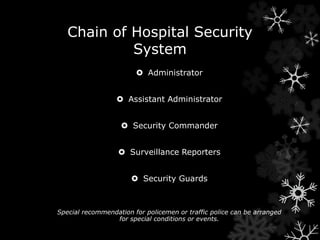
Chain of Hospital Security 
System 
 Administrator 
 Assistant Administrator 
 Security Commander 
 Surveillance Reporters 
 Security Guards 
Special recommendation for policemen or traffic police can be arranged 
for special conditions or events.
Any Questions?
Clinical supportive service department

Clinical supportive service department

  • 1.
    Clinical Supportive ServiceDepartment Rabeendra Basnet
  • 2.
    Contents: Laboratory ServiceManagement Radio-Diagnosis Services Central Sterile Supply Department Hospital Pharmacy
  • 3.
    Other Supportive Service Departments  Medical Records  Housekeeping  Dietary Service Department  Hospital Waste Management  Hospital Infection Control  IT and Medical Equipment Management  Medico Social Services
  • 4.
    Laboratory Service Basic diagnostic service for ongoing and periodic treatment procedures.  Clinical judgment and confirmation of diagnosis.  Clinically and financially assisting department of any hospital.  Based on investigation, research and education.
  • 5.
    Types of Laboratory  OPD Laboratory: Central laboratory attached with OPD services that are catered to the need of OPD patients only.  IPD Laboratory: Ward service including laboratory service for ongoing investigation, diagnosis and treatment procedures.  Emergency Laboratory: These are emergency support service providing : - round the clock laboratory services - Restricted emergency laboratory services
  • 6.
    Radio-Diagnosis Services The practice of modern medicine and surgery has increased the use of such specialized services as Radiology.  Diagnostic and therapeutic arms of the hospital.  The radiology services may be organized as three separate departments, namely, diagnostic radiology, therapeutic radiology and nuclear medicine.
  • 7.
    Functions of Radiology departments  The main function of this department is to assist the physician in the diagnosis and treatment of a patient's disease through the use of radiography, fluoroscopy a radioisotopes and high voltage acceleration.  The primary function is to provide reliable radiological services to the patients.  Secondary function is to engage in essential research for medical advancement  Participate in educational program for hospital resident and in service program for the medical staff.
  • 8.
    Types of Equipment  X-ray machine  CT Scan machine  MRI machine  Echocardiogram  Ultrasound-Color Doppler  Developer  Fixer etc.
  • 9.
    Central Sterile SupplyDepartment (CSSD)  CSSD refers to Central Sterile Supply Department. Usually at early days it was termed as SSD (Sterile Supply Department).  The main objectives of both SSD and CSSD are the same i.e. to supply sterilized and disinfected equipments, free of bacteria to the user department.  It is directly related to quality care provided by the hospitals; also related to positive impact of the society; and the cost and benefits to the organization it self.  It is the department responsible for processing, sterilizing and dispensing of almost all items for sterile equipment sets and dressings in the hospitals.
  • 10.
    WHO (1986) recommendedthat each hospital should follow:  Aseptic Techniques  Disinfection and sterilization techniques  Antibiotic policies  Surveillance of present routines  Evaluation of prevention and control measures
  • 11.
    Why Centralization? Foreconomic reason, efficiency of operations and maintenance of high standard, hospitals have found it preferable for all reusable supplies and equipment requiring special cleaning, disinfection or sterilization to be handled centrally whenever possible. Advantages  Need for fewer supervisory staff  Greater care in overcoming staff deployment problems in case of absenteeism  Optimum equipment utilization  Smaller capital and power costs  Greater flexibility in production planning  Overall economy
  • 12.
    Hospital Pharmacy Pharmacy is one of the most extensively used therapeutic facilities of the hospital.  It is also one of the highest revenue generating centers.  A good pharmacy is a blend of several things: qualified personnel, modern facilities, efficient organization and operations, sound budgeting and the support and cooperation of the medical, nursing and administrative staff of the hospital.
  • 13.
     The specialtyof hospital pharmacy has been defined as the department or services in a hospital, which is under the direction of professionally competent, legally qualified pharmacist, and from which all medications are supplied to the nursing units and other services,  Special prescriptions are filled for ambulatory patients and outpatients,  Narcotic and other prescribed drugs are dispensed, where biological are stored and dispensed, injectable preparations should be prepared and sterilized, and where professional supplies are often stocked and dispensed.
  • 14.
    Objectives  Assurecontinuous availability of essential and life saving documents.  To store and provide standard quality drugs/diagnostic agents and medical disposable for the patient.  To provide unbiased information to all concerned.  To maintain good relation with hospital and its departments.  To help hospital in providing continuing education and training to medical staff and intern.
  • 15.
    Functions  Topurchase, receive, store, compound package, label and dispose pharmaceutical items.  Plan and organize pharmacy department, establish policies and procedures and implement them in accordance with the policies of the hospital.  Participate in performing therapeutic assessment of drugs and in a preparation of a hospital formulary so that equally effective but less expensive drugs may be put on the formulary.  Keeping the 'WHO' recommended drugs as 'essential drugs' and assure their continuous availability.  Comply with statutory regulations, initiating license to be obtained and maintained records as legally required.
  • 16.
    Other Supportive Services Medical Records Medical record is the assembly of notes, forms, reports and summaries of the patient during the treatment of illness. It includes written notations, clinical analysis, consultation summaries and so on. It is document of facts, which contain statement by trained observer of the conditions found and of the application and result of examinations and therapy.
  • 17.
    Characteristics of goodmedical record:  Accurate: Medical record should be accurate. Otherwise, there is no meaning of keeping medical records. To justify the purpose medical record should be accurate.  Complete: It must contain sufficient data written in sequential order of events to justify the diagnosis and warrant the treatment.  Adequate: Medical records should contain all the necessary information and complete progress not written by the attending doctor.  Comprehensive: Medical records should contain comprehensive and adequate information to point and easily understood.  Economical: Medical records should be economical. It should not be over burden economically on administration to maintain.  Properly planned: Medical records should be kept according to scientific methods such as arrangements of shelves, filing, indexing, coding etc. should be on proper sequence and easy to understand.  Timely: It should be time saving rather than time consuming to maintain, retrieve and enter the data and so on.
  • 18.
    Components of medical record: Medical records comprise various forms, notes, data and sheets. Components of medical records can be categorized into main three components:  Social data: It consists of general information regarding patient's identification such as his name, age, sex, community, religion, residential address, marital status, occupation, address and so on. Most of this information should furnish during the admission at the admission counter or during the registration of the patient.  Administrative data: It consists of patient's OPD registration number, name of the OPD, name of the unit head, X-ray registration number and other investigation, reference number. This information is helpful for coding, indexing and filing of the patient record and to maintain and retrieve the files systematically.  Clinical data: Clinical data could be collected at two levels - OPD and Ward. It consists of past history (family history and past illness), physical examination, provisional diagnosis, advice, follow-up at the OPD level. In the ward level, it consists of admission record, progress note, summary sheet, discharge summary, doctor's note, operation note, nurses bedside record, investigation report, graphic charts, recommendations and so on.
  • 19.
    Housekeeping  Housekeepingmay be defined as the provision of a clean, comfortable and safe environment.  Hospital housekeeping is an essential public service agency.  Good housekeeping has direct effect on the health, comfort and morale of patients, doctors, visitors and hospital personnel.  It is not confined to the housekeeping department, as every member of staff in the establishment should be concerned with the provision of these facilities in their own department.
  • 20.
    Dietary Service Department  Good food is important in the treatment of the patients and a part of total care.  Procurement, storage and accounting of food materials in all forms.  Menu Planning, recipe standardization, preparation, distribution of modified diet.  Education of patients both indoor and out patients through nutrition and dietician clinics.  Assisting in research projects on metabolic diseases.
  • 21.
    Hospital Waste Management  Health care waste is defined as the waste resulting from patient’s diagnosis, prevention, research and treatment procedures as well as waste generated from all other health care establishments, research facilities and laboratories.  It includes waste like sharps, solid, waste , body fluid, cultures, medicines, chemical reagents, tissues, infected dressing materials human excreta, placenta, paper, plastic etc.
  • 22.
    Hospital Infection Control  Hospital infection is called “nosocomial infection”  It affects both patient and hospital  Nosocomial infection is acquired while in hospital or health agency is providing health services to patient.  It is the infection that develops in patients after more than 48 hours of hospitalization.  Causes of Infections in Hospital are Urinary tract, Surgical or traumatic wound, respiratory tract, blood stream, etc.
  • 23.
    IT and MedicalEquipment Management  The goal of health care system is to provide high quality diagnostic, therapeutic and rehabilitative services with the aid of sophisticated machine, equipment and devices.  Medical practitioners are equipment oriented.  So the basics for all these requirements needed well trained and qualified manpower.  IT and Medical Equipment play vital role for cost minimization, automation, easy access, prompt service delivery, data analysis and interpretation, etc.
  • 24.
    Medico Social Services  Social work’s involvement in health care is as old as the profession itself.  Health care delivering system is a social practice.  These may cast local, regional, national or international concept for understanding the health status of the boundary less people.  Social services integrates - Hospital owners and social work - Hospital Administration and social workers - Establishing the healthy relationship with surroundings.
  • 25.
    Security System Security Sytem is important for both quality healthcare and public safety.  It is known to be safe heaven for physical and emotional need.  It plays essential role to be implented in large scale emergencies such as natural disasters or terrorist attacks.  Hospital must provide system for security on employees, patients and visitors.  It has a priorities in the field of Cash and accounting counters, Infant units, ICU, Emergency unit, Psychiatric units, etc.
  • 26.
    Chain of HospitalSecurity System  Administrator  Assistant Administrator  Security Commander  Surveillance Reporters  Security Guards Special recommendation for policemen or traffic police can be arranged for special conditions or events.
  • 27.