NABH
PRE ACCREDITATION
ENTRY LEVEL
CERTIFICATION FOR
HOSPITALS
B. Y. L. NAIR CH.
HOSPITAL
• NATIONAL ACCREDITATION BOARD FOR HOSPITALS AND
HEALTHCARE PROVIDERS (NABH)
• NABH is a constituent Board of Quality Council of India (QCI),
which is an autonomous organization under the Department for
Promotion of Industry and Internal Trade (DPIIT), Ministry of
Commerce and Industry.
• NABH is set up to establish and operate accreditation and other
allied programs for healthcare organizations.
• NABH is an Institutional Member as well as a Board member of
the International Society for Quality in Health Care (lSQua) and on
the board of the Asian Society for Quality in Healthcare (ASQua).
INTRODUCTION
2
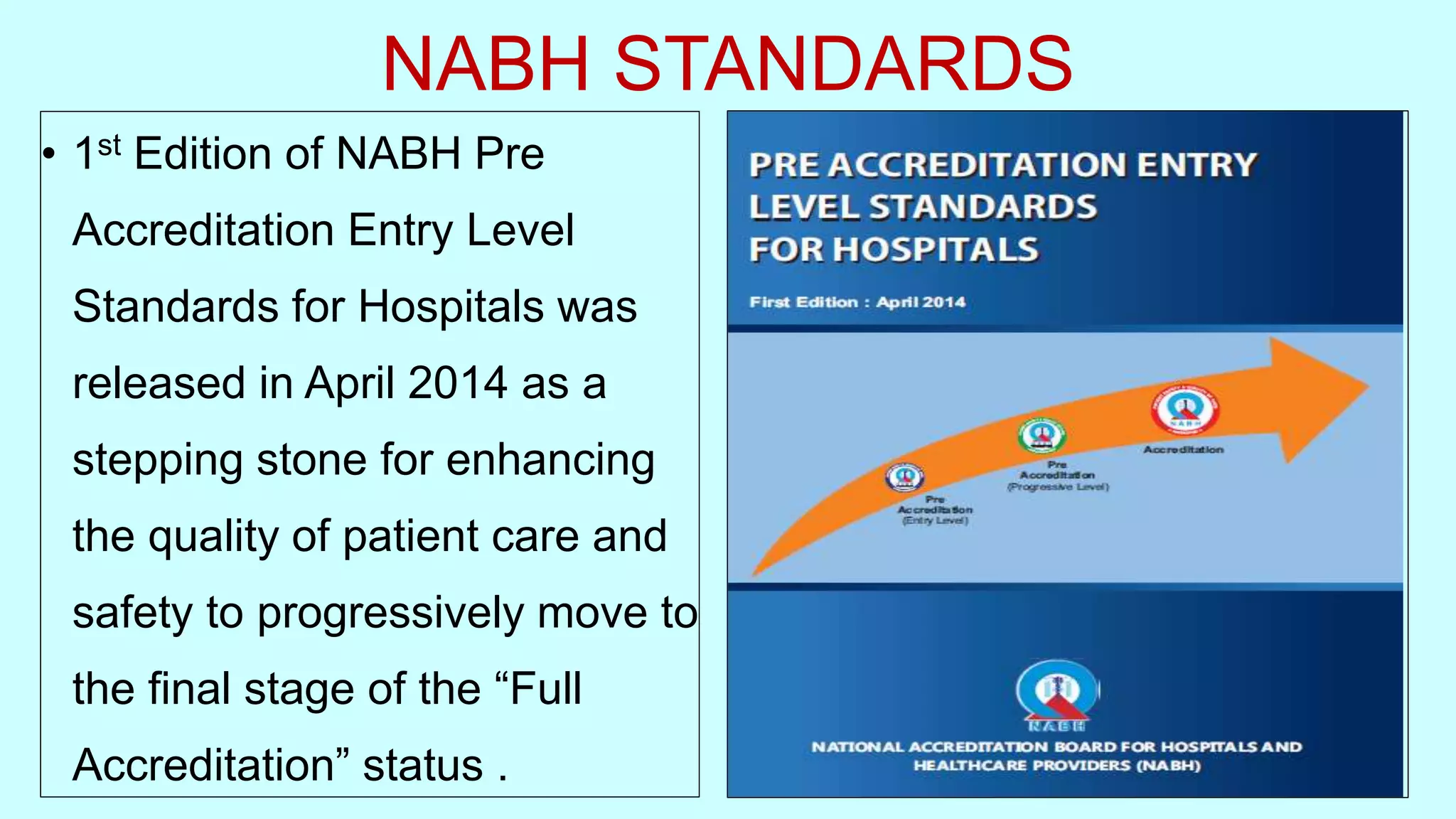
• 1st Edition of NABH Pre
Accreditation Entry Level
Standards for Hospitals was
released in April 2014 as a
stepping stone for enhancing
the quality of patient care and
safety to progressively move to
the final stage of the “Full
Accreditation” status .
NABH STANDARDS
3
4
OVERALL CHANGES
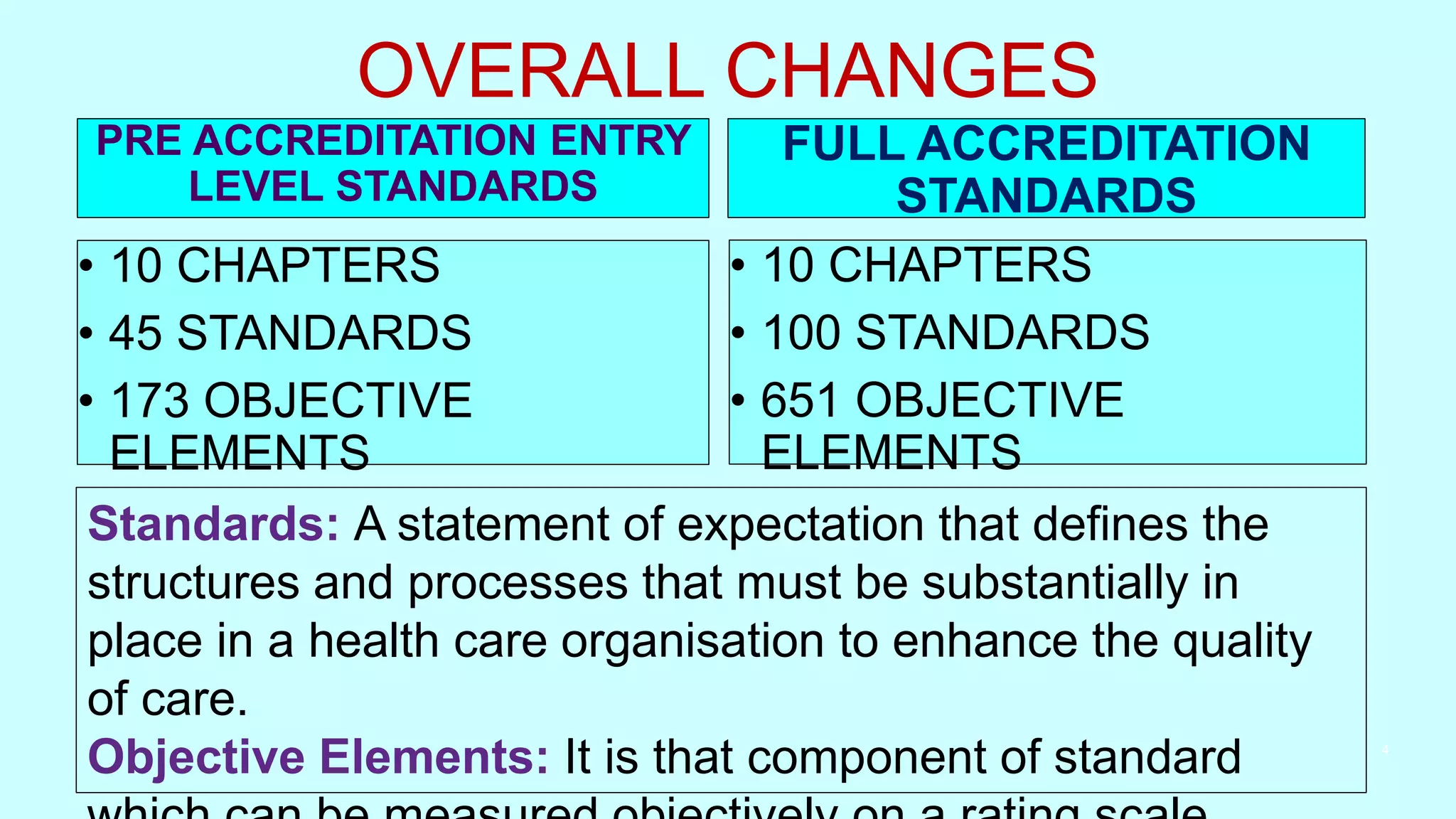
• 10 CHAPTERS
• 45 STANDARDS
• 173 OBJECTIVE
ELEMENTS
FULL ACCREDITATION
STANDARDS
• 10 CHAPTERS
• 100 STANDARDS
• 651 OBJECTIVE
ELEMENTS
PRE ACCREDITATION ENTRY
LEVEL STANDARDS
Standards: A statement of expectation that defines the
structures and processes that must be substantially in
place in a health care organisation to enhance the quality
of care.
Objective Elements: It is that component of standard
• NABH Standards are listed in 10 Chapters.
• First 5 Chapters are patient centric chapters and the last 5 chapters are
organisation centric chapters.
• There are total 45 Standards spread over these 10 chapters.
• Each Standard consists of Objective Elements (OE).
• There are total 173 Objective Elements.
• The distribution of Standards and Objective Elements is given in the
following table.
NABH STANDARDS
5
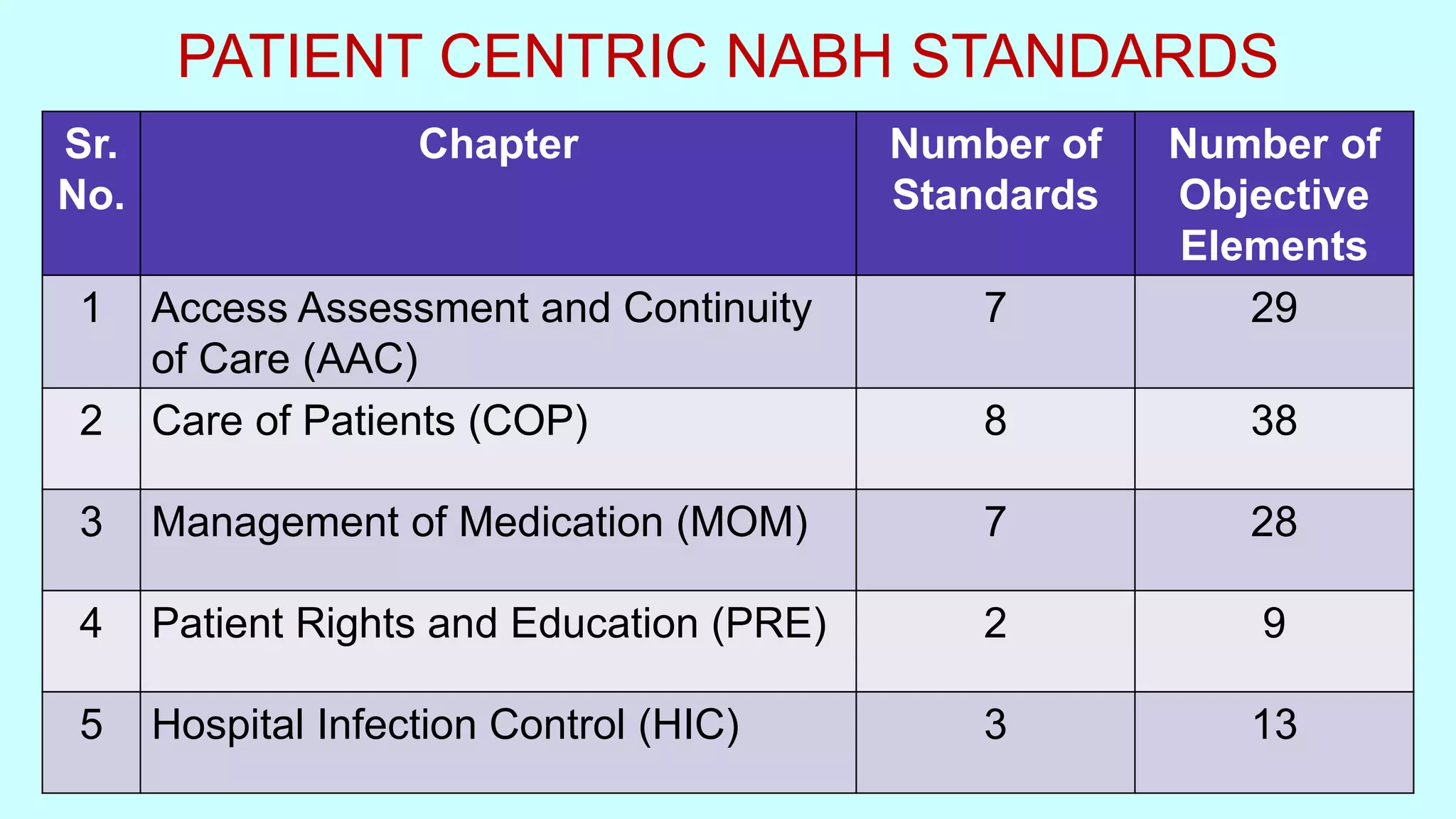
PATIENT CENTRIC NABH STANDARDS
6
Sr.
No.
Chapter Number of
Standards
Number of
Objective
Elements
1 Access Assessment and Continuity
of Care (AAC)
7 29
2 Care of Patients (COP) 8 38
3 Management of Medication (MOM) 7 28
4 Patient Rights and Education (PRE) 2 9
5 Hospital Infection Control (HIC) 3 13
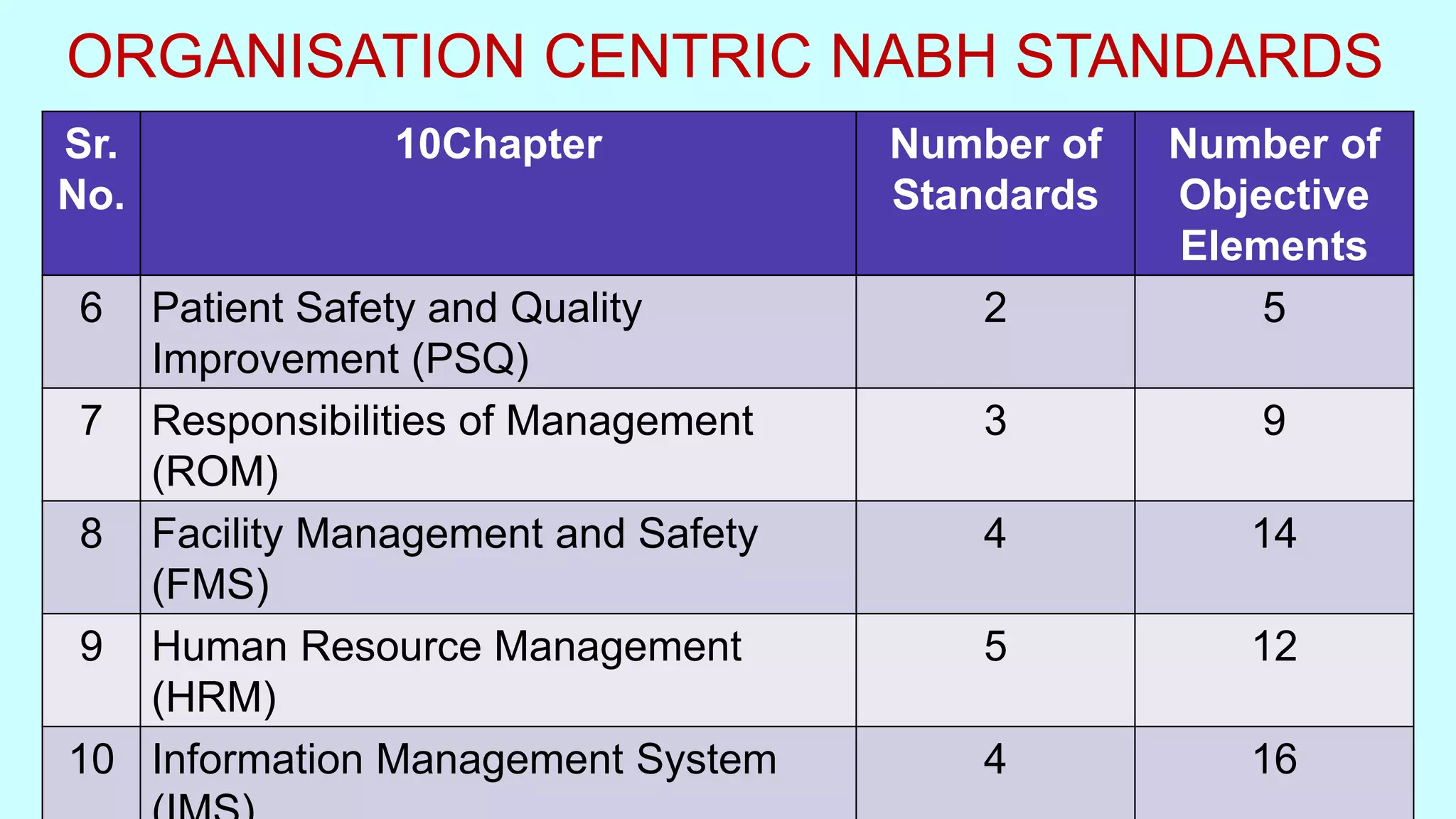
ORGANISATION CENTRIC NABH STANDARDS
7
Sr.
No.
10Chapter Number of
Standards
Number of
Objective
Elements
6 Patient Safety and Quality
Improvement (PSQ)
2 5
7 Responsibilities of Management
(ROM)
3 9
8 Facility Management and Safety
(FMS)
4 14
9 Human Resource Management
(HRM)
5 12
10 Information Management System 4 16
• Compliance to the requirement: 10
• Partial compliance to the requirement: 5 (if any of the sample is found to
be noncomplying out of total samples selected)
• Non-compliance to the requirement: 0
• Not Applicable: NA
• Evaluation Criteria:
• Overall score of minimum 50% in all standards
• Overall score of minimum 50% in each chapter
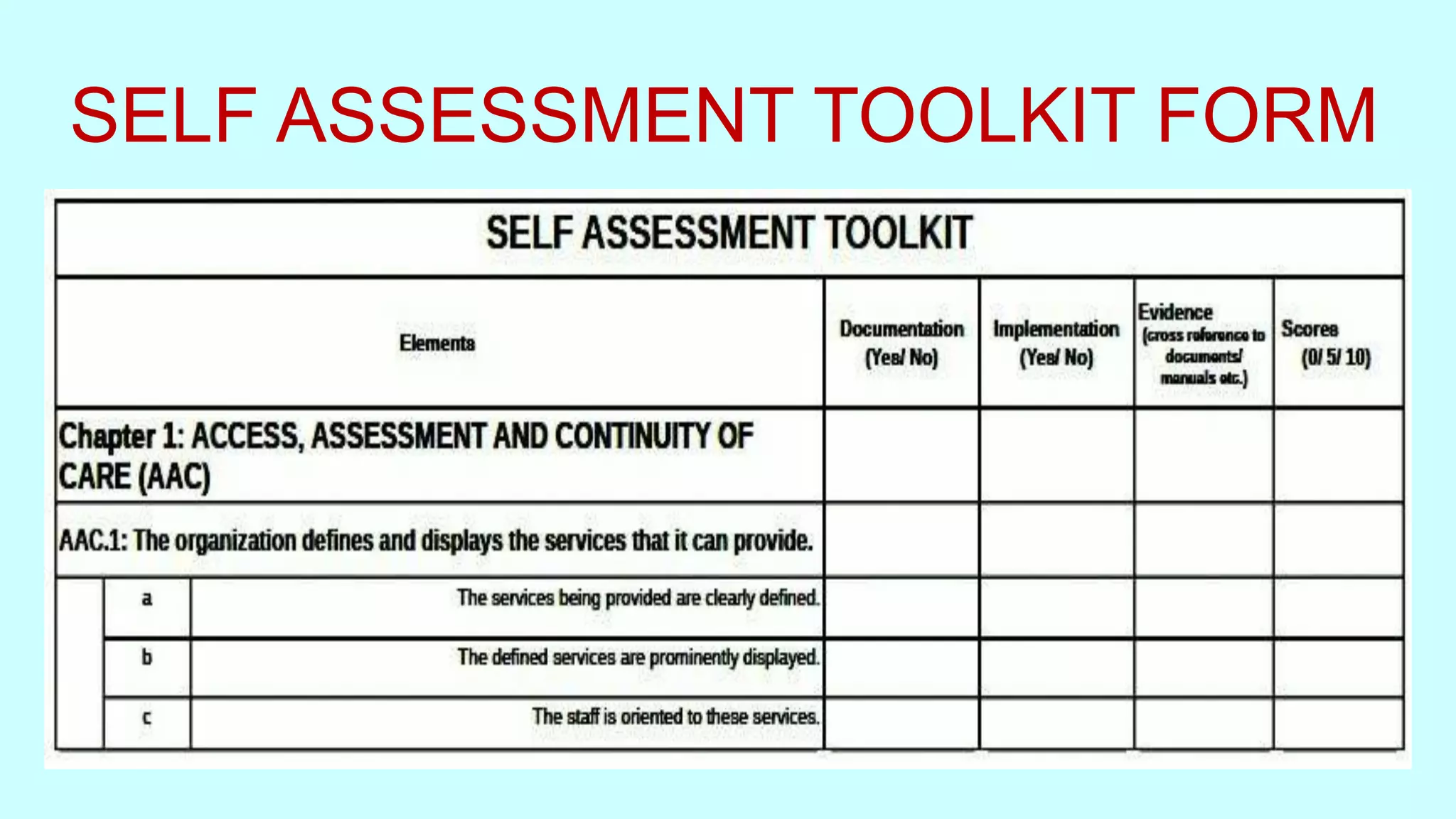
SELF ASSESSMENT SCORING SYSTEM
8
Objective
Elements
Documentation
(Yes/No)
Implementation
(Yes/No)
Evidence
(Cross
Reference To
Documents/
Manuals, Etc.)
Score
(0/5/10)
SELF ASSESSMENT TOOLKIT FORM
9
SELF ASSESSMENT TOOLKIT FORM
10
Thank
You
Dr. Surendra S.
Wadikar
Professor (Additional)
Dept. of Physiology

PRESENTATION NABH ENTRY LEVEL CERTIFICATION FOR HOSPITALS.pptx

  • 1.
    NABH PRE ACCREDITATION ENTRY LEVEL CERTIFICATIONFOR HOSPITALS B. Y. L. NAIR CH. HOSPITAL
  • 2.
    • NATIONAL ACCREDITATIONBOARD FOR HOSPITALS AND HEALTHCARE PROVIDERS (NABH) • NABH is a constituent Board of Quality Council of India (QCI), which is an autonomous organization under the Department for Promotion of Industry and Internal Trade (DPIIT), Ministry of Commerce and Industry. • NABH is set up to establish and operate accreditation and other allied programs for healthcare organizations. • NABH is an Institutional Member as well as a Board member of the International Society for Quality in Health Care (lSQua) and on the board of the Asian Society for Quality in Healthcare (ASQua). INTRODUCTION 2
  • 3.
    • 1st Editionof NABH Pre Accreditation Entry Level Standards for Hospitals was released in April 2014 as a stepping stone for enhancing the quality of patient care and safety to progressively move to the final stage of the “Full Accreditation” status . NABH STANDARDS 3
  • 4.
    4 OVERALL CHANGES • 10CHAPTERS • 45 STANDARDS • 173 OBJECTIVE ELEMENTS FULL ACCREDITATION STANDARDS • 10 CHAPTERS • 100 STANDARDS • 651 OBJECTIVE ELEMENTS PRE ACCREDITATION ENTRY LEVEL STANDARDS Standards: A statement of expectation that defines the structures and processes that must be substantially in place in a health care organisation to enhance the quality of care. Objective Elements: It is that component of standard
  • 5.
    • NABH Standardsare listed in 10 Chapters. • First 5 Chapters are patient centric chapters and the last 5 chapters are organisation centric chapters. • There are total 45 Standards spread over these 10 chapters. • Each Standard consists of Objective Elements (OE). • There are total 173 Objective Elements. • The distribution of Standards and Objective Elements is given in the following table. NABH STANDARDS 5
  • 6.
    PATIENT CENTRIC NABHSTANDARDS 6 Sr. No. Chapter Number of Standards Number of Objective Elements 1 Access Assessment and Continuity of Care (AAC) 7 29 2 Care of Patients (COP) 8 38 3 Management of Medication (MOM) 7 28 4 Patient Rights and Education (PRE) 2 9 5 Hospital Infection Control (HIC) 3 13
  • 7.
    ORGANISATION CENTRIC NABHSTANDARDS 7 Sr. No. 10Chapter Number of Standards Number of Objective Elements 6 Patient Safety and Quality Improvement (PSQ) 2 5 7 Responsibilities of Management (ROM) 3 9 8 Facility Management and Safety (FMS) 4 14 9 Human Resource Management (HRM) 5 12 10 Information Management System 4 16
  • 8.
    • Compliance tothe requirement: 10 • Partial compliance to the requirement: 5 (if any of the sample is found to be noncomplying out of total samples selected) • Non-compliance to the requirement: 0 • Not Applicable: NA • Evaluation Criteria: • Overall score of minimum 50% in all standards • Overall score of minimum 50% in each chapter SELF ASSESSMENT SCORING SYSTEM 8
  • 9.
  • 10.
  • 11.
    Thank You Dr. Surendra S. Wadikar Professor(Additional) Dept. of Physiology