Overview on
NABH System
Dr. Mahesh Patel
Healthcare Quality Professional
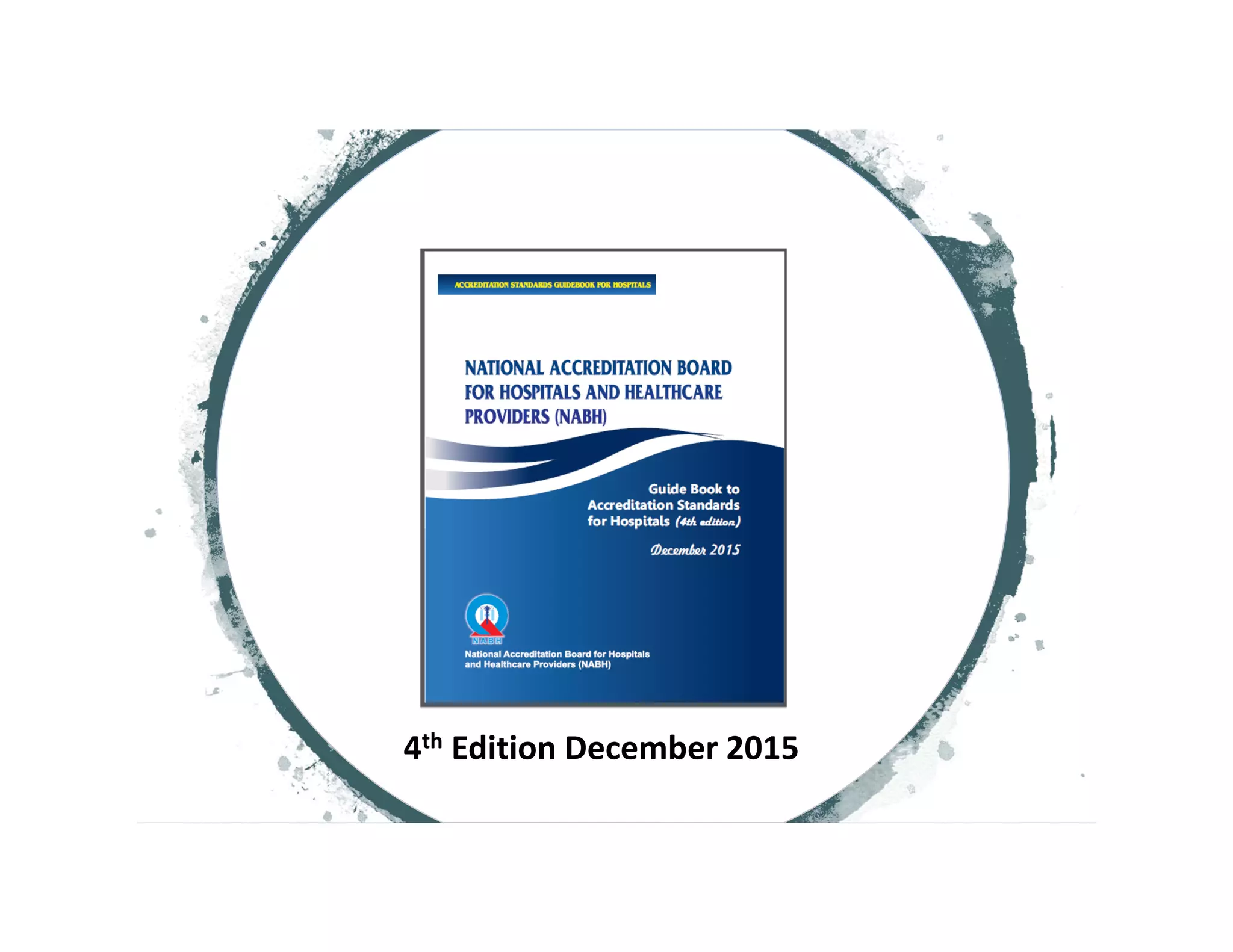
4th Edition December 2015
NABH 4th Edition
• 105 Standards
• 683 Objective Elements
• 10 Chapters
• 72 Quality Indicators
• Standards are non-prescriptive
• Guidance (remarks,
interpretations) is integrated
• Shall/should vs. can/could
• Intent of each chapter explained
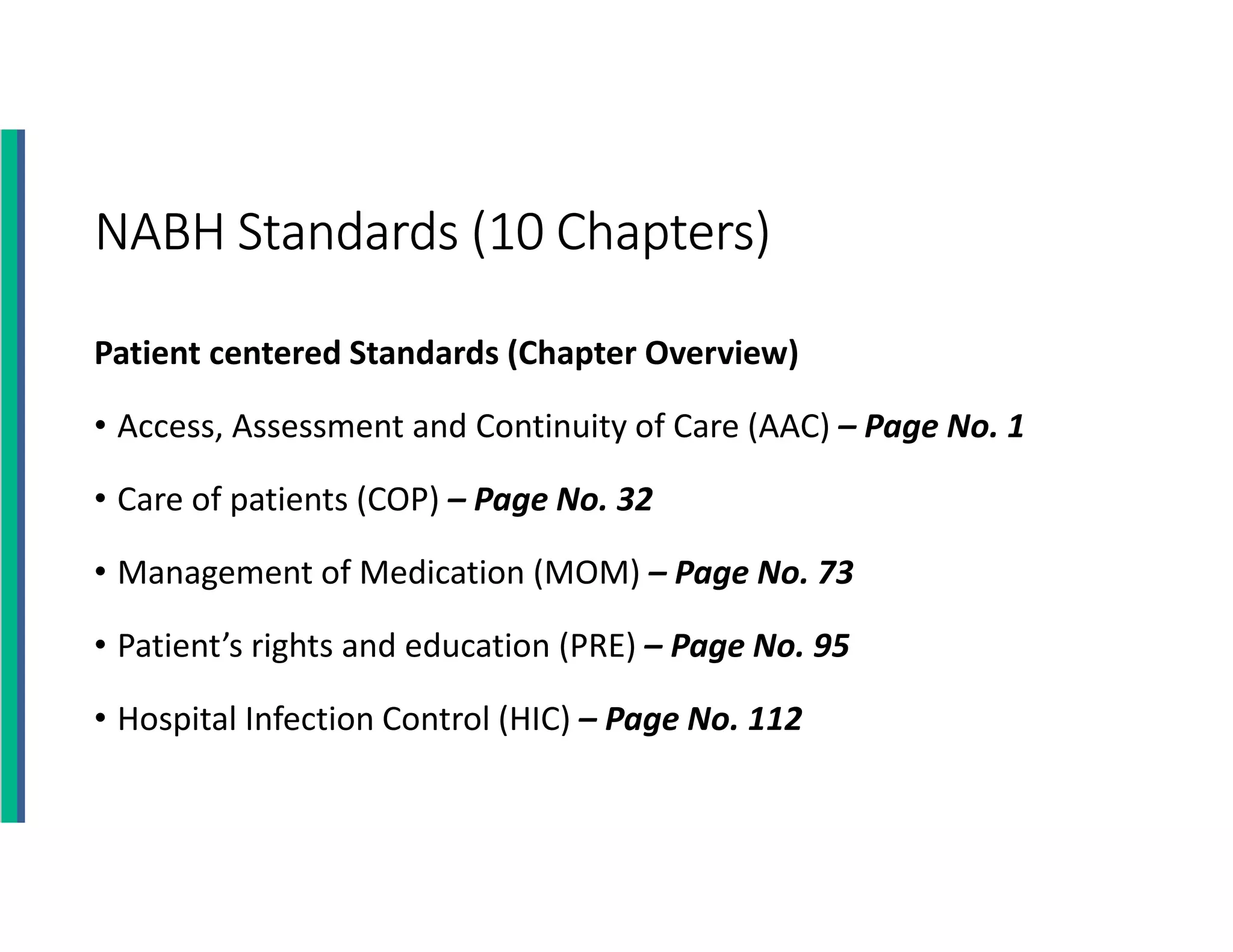
NABH Standards (10 Chapters)
Patient centered Standards (Chapter Overview)
• Access, Assessment and Continuity of Care (AAC) – Page No. 1
• Care of patients (COP) – Page No. 32
• Management of Medication (MOM) – Page No. 73
• Patient’s rights and education (PRE) – Page No. 95
• Hospital Infection Control (HIC) – Page No. 112
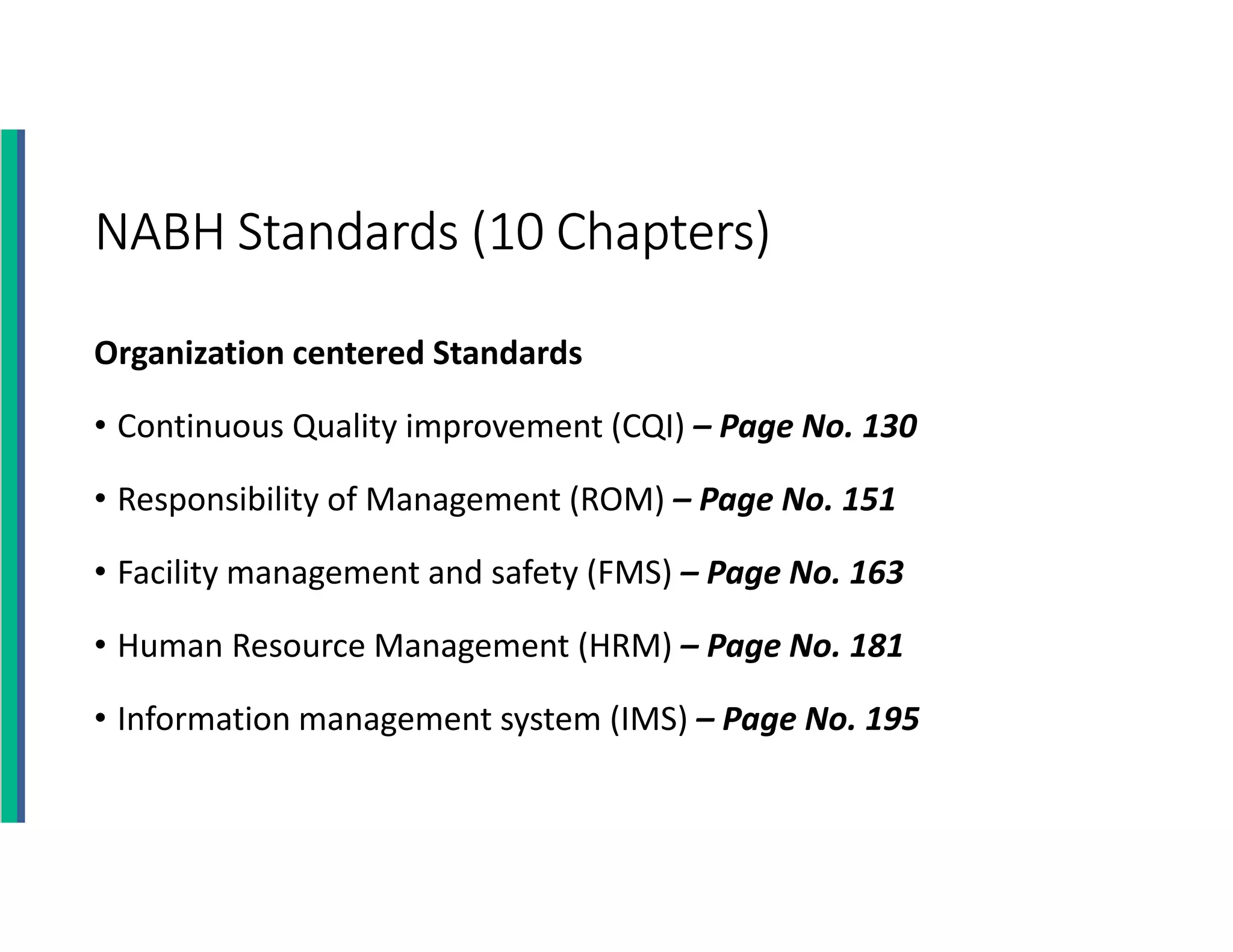
NABH Standards (10 Chapters)
Organization centered Standards
• Continuous Quality improvement (CQI) – Page No. 130
• Responsibility of Management (ROM) – Page No. 151
• Facility management and safety (FMS) – Page No. 163
• Human Resource Management (HRM) – Page No. 181
• Information management system (IMS) – Page No. 195
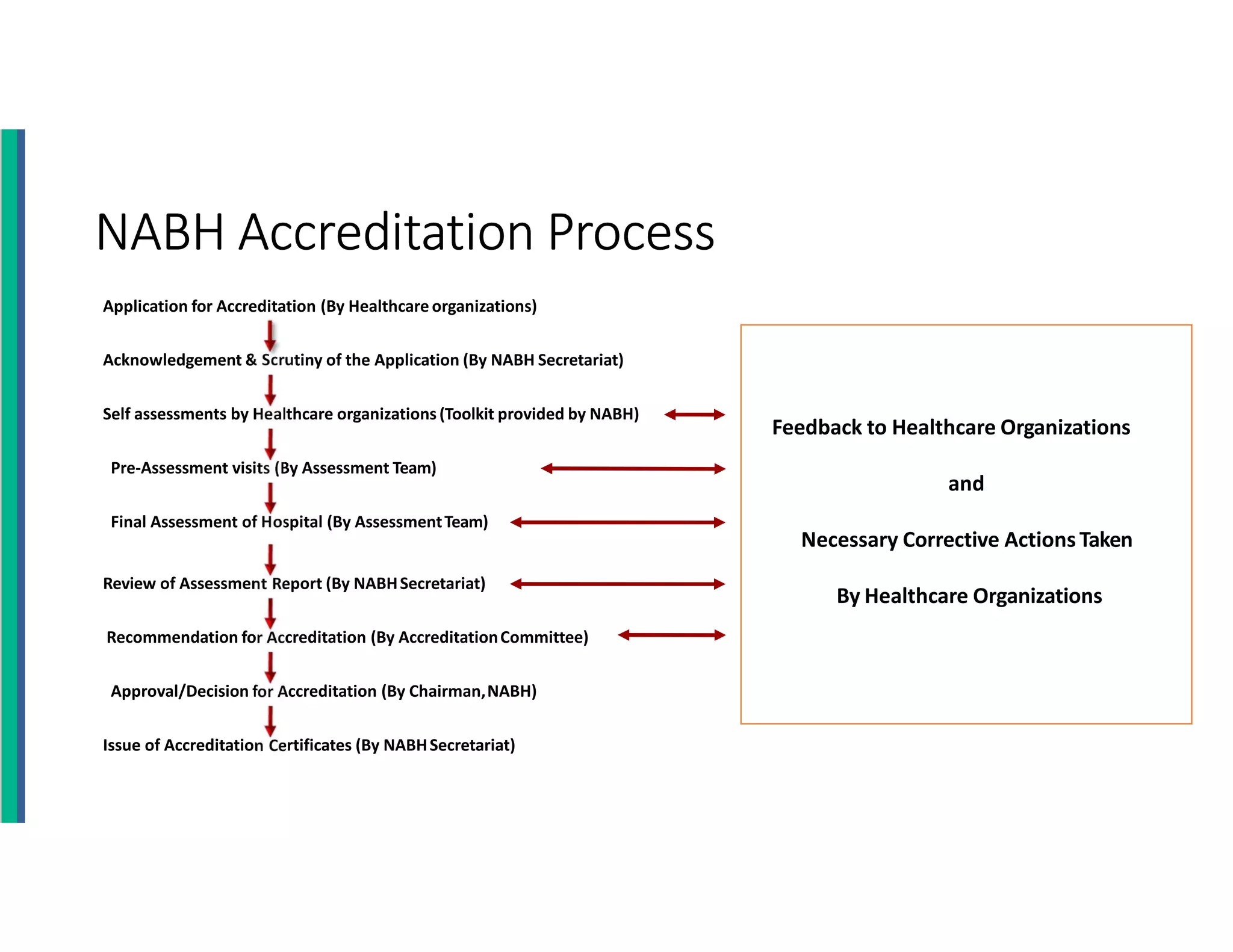
NABH Accreditation Process
Application for Accreditation (By Healthcare organizations)
Acknowledgement & Scrutiny of the Application (By NABH Secretariat)
Self assessments by Healthcare organizations (Toolkit provided by NABH)
Pre-Assessment visits (By Assessment Team)
Final Assessment of Hospital (By AssessmentTeam)
Review of Assessment Report (By NABHSecretariat)
Recommendation for Accreditation (By AccreditationCommittee)
Approval/Decision for Accreditation (By Chairman,NABH)
Issue of Accreditation Certificates (By NABHSecretariat)
Feedback to Healthcare Organizations
and
Necessary Corrective ActionsTaken
By Healthcare Organizations
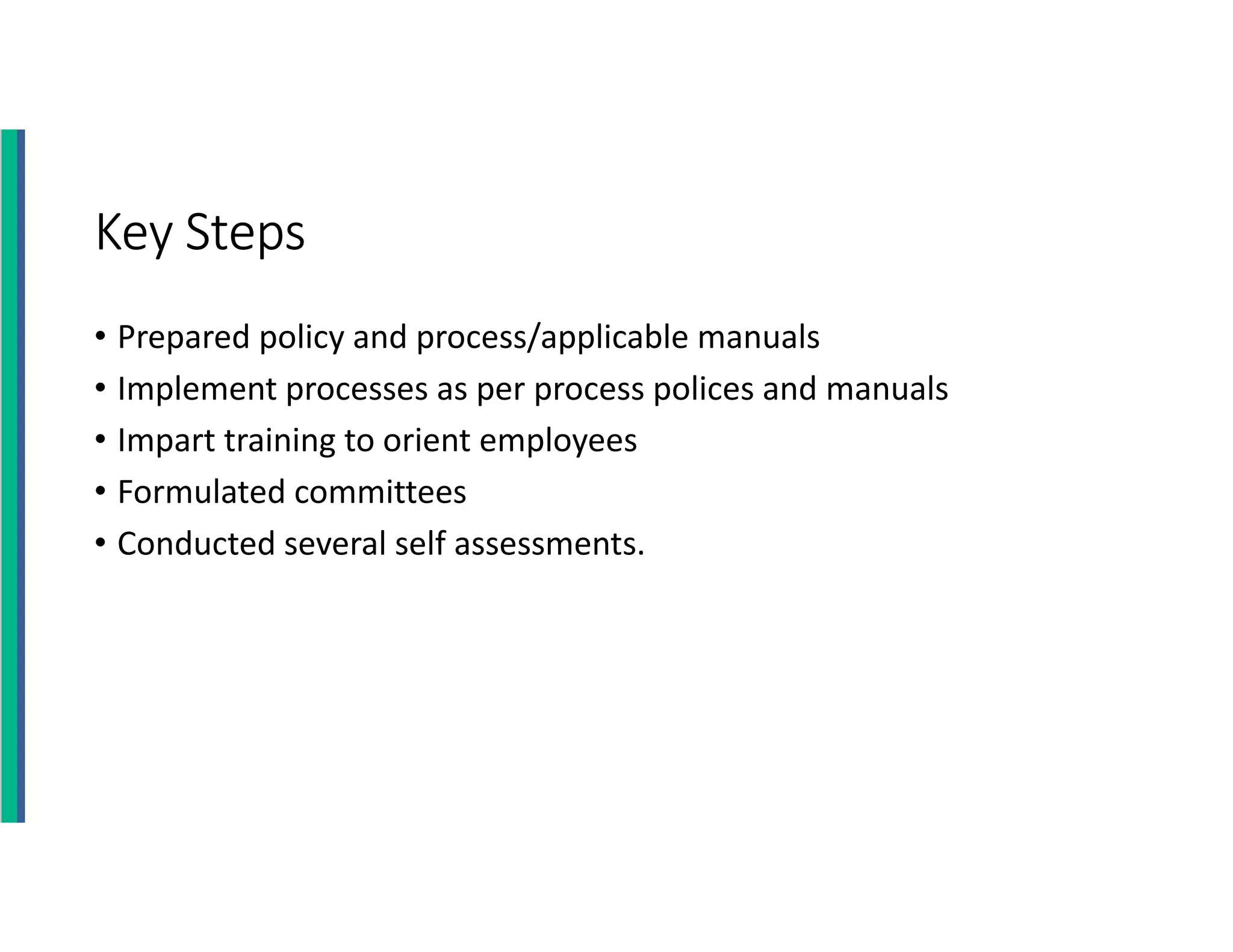
Key Steps
• Prepared policy and process/applicable manuals
• Implement processes as per process polices and manuals
• Impart training to orient employees
• Formulated committees
• Conducted several self assessments.
Key Committees
• Quality Starring Committee
• Infection Control Committee
• Drug & Therapeutic Committee
• Environmental Safety Committee
• Infection Control Committee
• Credentialing & Privileging Committee
• Employee Grievance Committee
• Female Sexual Harassment Committee
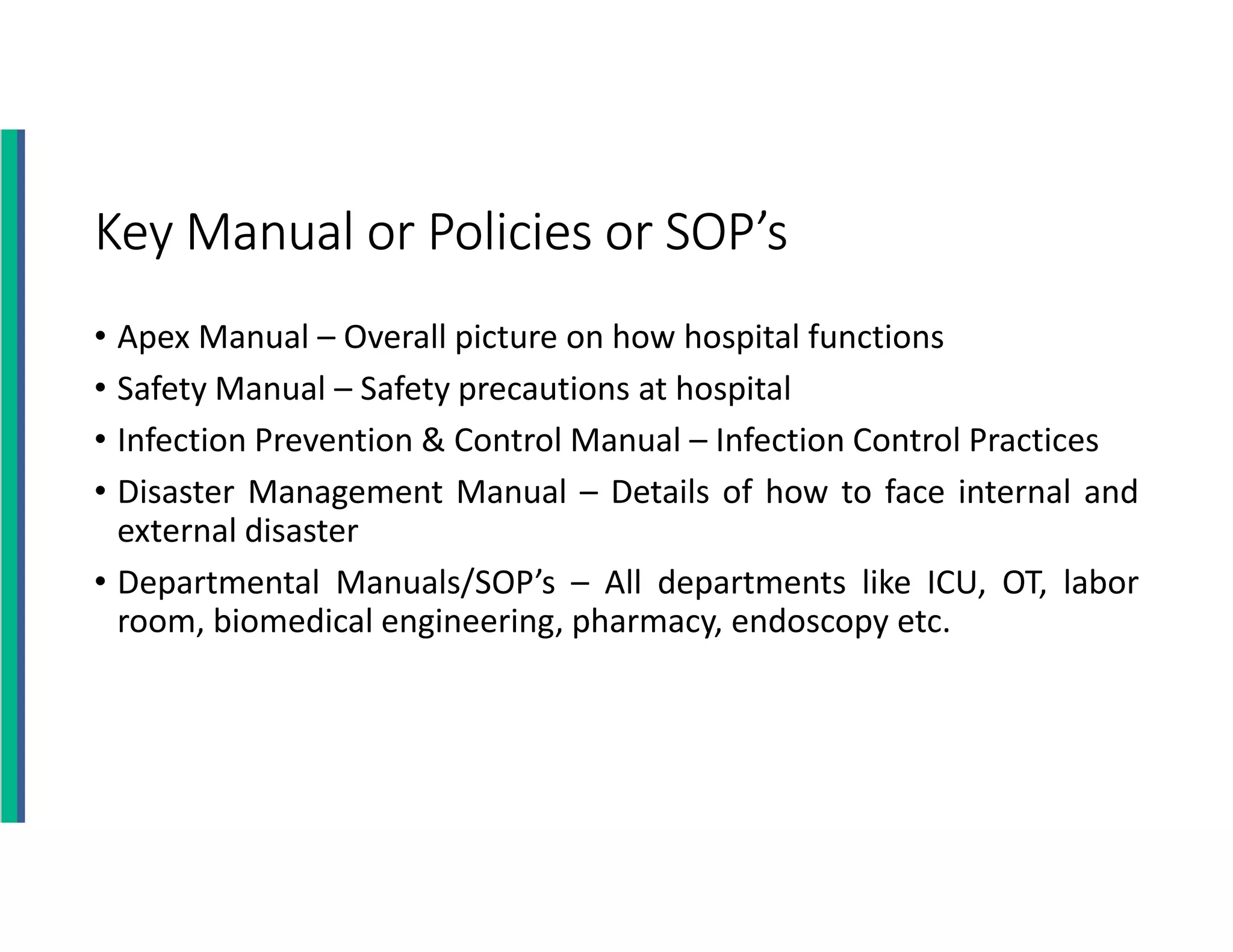
Key Manual or Policies or SOP’s
• Apex Manual – Overall picture on how hospital functions
• Safety Manual – Safety precautions at hospital
• Infection Prevention & Control Manual – Infection Control Practices
• Disaster Management Manual – Details of how to face internal and
external disaster
• Departmental Manuals/SOP’s – All departments like ICU, OT, labor
room, biomedical engineering, pharmacy, endoscopy etc.
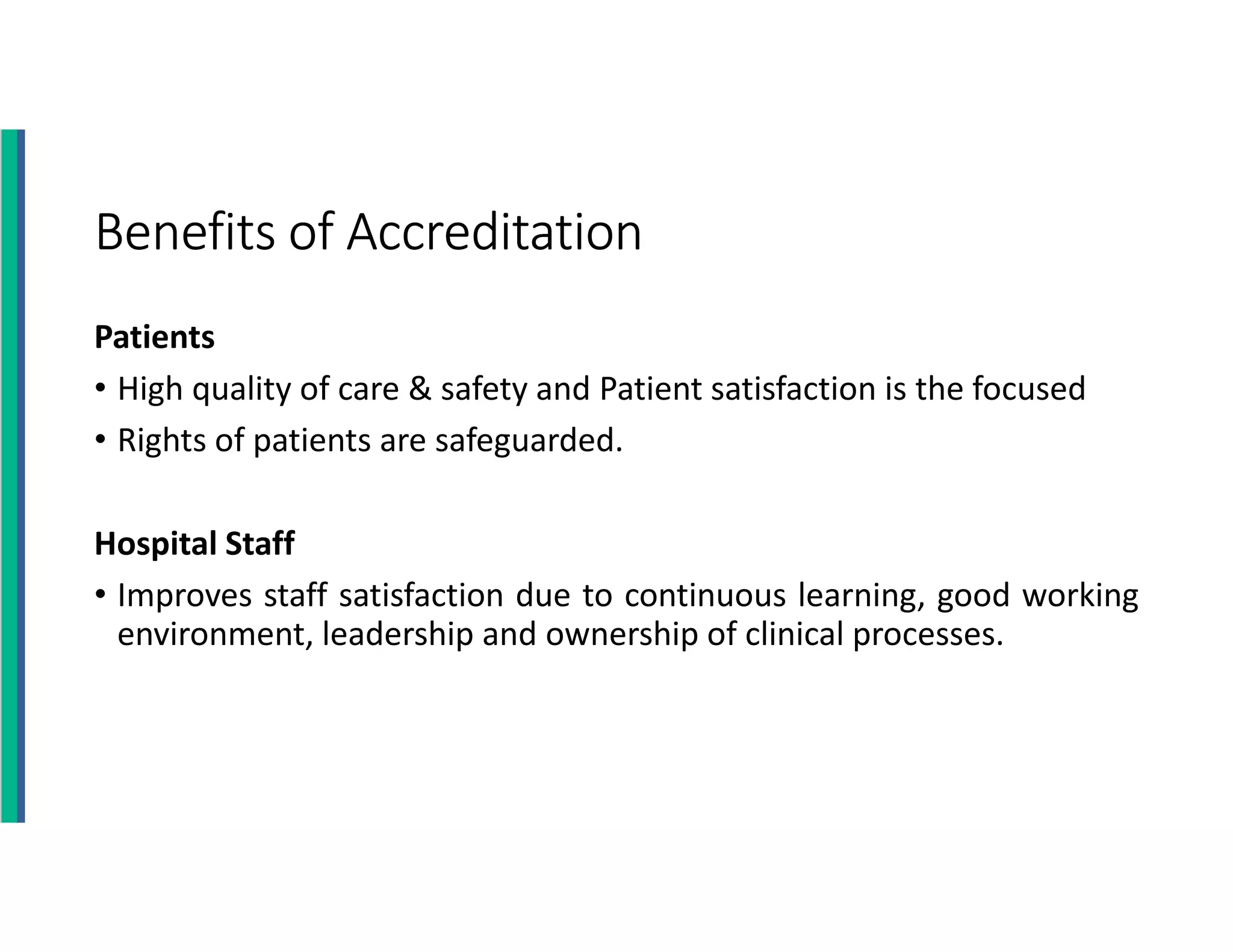
Benefits of Accreditation
Patients
• High quality of care & safety and Patient satisfaction is the focused
• Rights of patients are safeguarded.
Hospital Staff
• Improves staff satisfaction due to continuous learning, good working
environment, leadership and ownership of clinical processes.
Benefits of Accreditation
Hospitals
• Systemized approach rather than individual approach.
• Process driven rather than person/dept. driven.
• Demonstrates commitment to quality care.
• Raises community confidence in the healthcare organization.
• Opportunity for the healthcare organization to benchmark itself
against other organization or best practices.
Benefits of Accreditation
Paying & Governing Bodies
• Objective system of empanelment for insurance company and other
third parties providers.
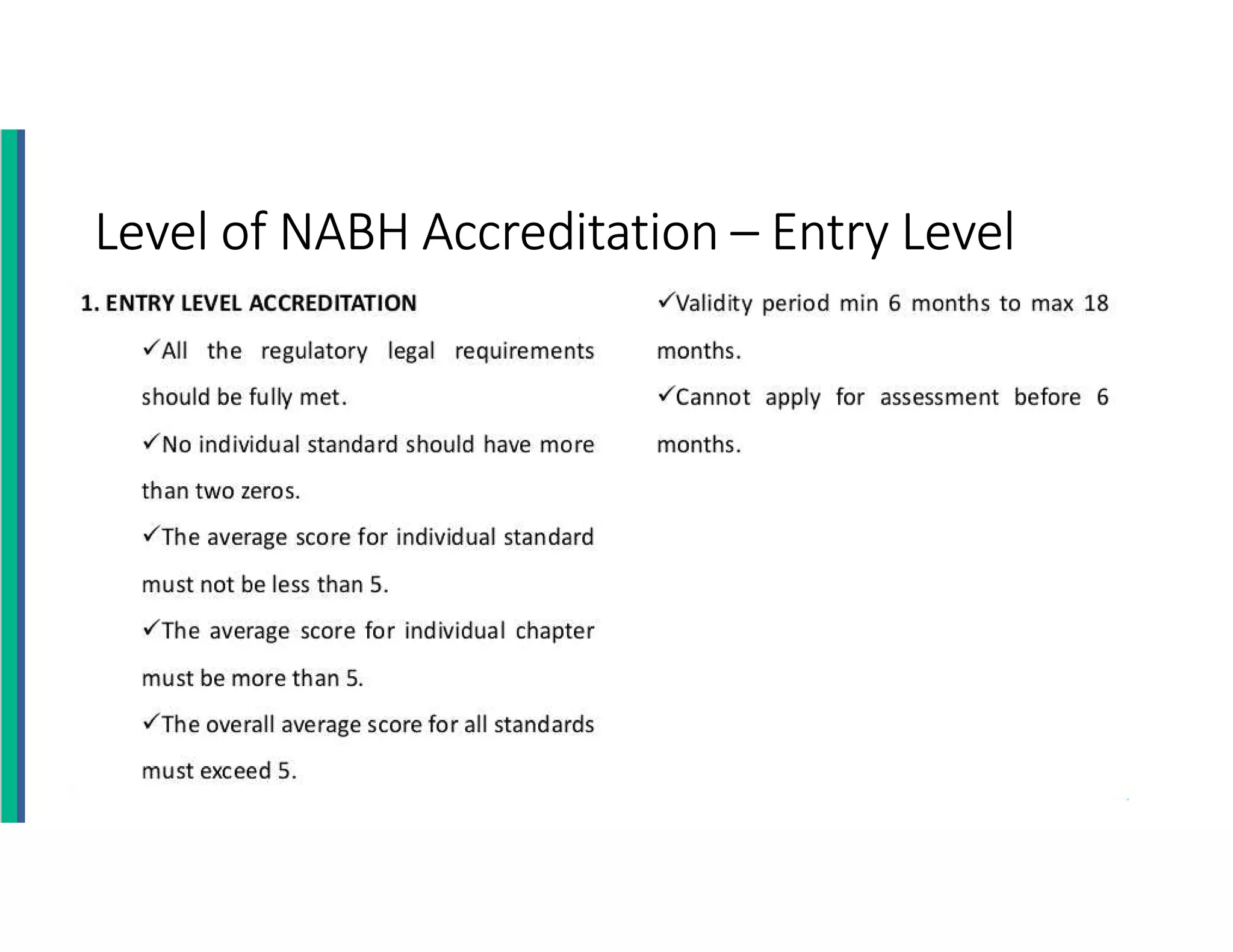
Level of NABH Accreditation – Entry Level
Level of NABH Accreditation – Progressive Level
Level of NABH Accreditation – Accreditation
Surveillance and Re-assessment
• Accreditation is valid for a period of 3 years.
• NABH conducts one surveillance of the accredited hospitals
accreditation cycle of 3 years.
• The surveillance visit will be planned during the 2nd year i.e. after 18
months of accreditation.
• The hospitals shall apply for renewal of accreditation at least four or
six months before the expiry of validity of accreditation for which
reassessment shall be conducted.
Thank You

NABH Overwiew

  • 1.
    Overview on NABH System Dr.Mahesh Patel Healthcare Quality Professional
  • 2.
  • 3.
    NABH 4th Edition •105 Standards • 683 Objective Elements • 10 Chapters • 72 Quality Indicators • Standards are non-prescriptive • Guidance (remarks, interpretations) is integrated • Shall/should vs. can/could • Intent of each chapter explained
  • 4.
    NABH Standards (10Chapters) Patient centered Standards (Chapter Overview) • Access, Assessment and Continuity of Care (AAC) – Page No. 1 • Care of patients (COP) – Page No. 32 • Management of Medication (MOM) – Page No. 73 • Patient’s rights and education (PRE) – Page No. 95 • Hospital Infection Control (HIC) – Page No. 112
  • 5.
    NABH Standards (10Chapters) Organization centered Standards • Continuous Quality improvement (CQI) – Page No. 130 • Responsibility of Management (ROM) – Page No. 151 • Facility management and safety (FMS) – Page No. 163 • Human Resource Management (HRM) – Page No. 181 • Information management system (IMS) – Page No. 195
  • 6.
    NABH Accreditation Process Applicationfor Accreditation (By Healthcare organizations) Acknowledgement & Scrutiny of the Application (By NABH Secretariat) Self assessments by Healthcare organizations (Toolkit provided by NABH) Pre-Assessment visits (By Assessment Team) Final Assessment of Hospital (By AssessmentTeam) Review of Assessment Report (By NABHSecretariat) Recommendation for Accreditation (By AccreditationCommittee) Approval/Decision for Accreditation (By Chairman,NABH) Issue of Accreditation Certificates (By NABHSecretariat) Feedback to Healthcare Organizations and Necessary Corrective ActionsTaken By Healthcare Organizations
  • 7.
    Key Steps • Preparedpolicy and process/applicable manuals • Implement processes as per process polices and manuals • Impart training to orient employees • Formulated committees • Conducted several self assessments.
  • 8.
    Key Committees • QualityStarring Committee • Infection Control Committee • Drug & Therapeutic Committee • Environmental Safety Committee • Infection Control Committee • Credentialing & Privileging Committee • Employee Grievance Committee • Female Sexual Harassment Committee
  • 9.
    Key Manual orPolicies or SOP’s • Apex Manual – Overall picture on how hospital functions • Safety Manual – Safety precautions at hospital • Infection Prevention & Control Manual – Infection Control Practices • Disaster Management Manual – Details of how to face internal and external disaster • Departmental Manuals/SOP’s – All departments like ICU, OT, labor room, biomedical engineering, pharmacy, endoscopy etc.
  • 10.
    Benefits of Accreditation Patients •High quality of care & safety and Patient satisfaction is the focused • Rights of patients are safeguarded. Hospital Staff • Improves staff satisfaction due to continuous learning, good working environment, leadership and ownership of clinical processes.
  • 11.
    Benefits of Accreditation Hospitals •Systemized approach rather than individual approach. • Process driven rather than person/dept. driven. • Demonstrates commitment to quality care. • Raises community confidence in the healthcare organization. • Opportunity for the healthcare organization to benchmark itself against other organization or best practices.
  • 12.
    Benefits of Accreditation Paying& Governing Bodies • Objective system of empanelment for insurance company and other third parties providers.
  • 13.
    Level of NABHAccreditation – Entry Level
  • 14.
    Level of NABHAccreditation – Progressive Level
  • 15.
    Level of NABHAccreditation – Accreditation
  • 16.
    Surveillance and Re-assessment •Accreditation is valid for a period of 3 years. • NABH conducts one surveillance of the accredited hospitals accreditation cycle of 3 years. • The surveillance visit will be planned during the 2nd year i.e. after 18 months of accreditation. • The hospitals shall apply for renewal of accreditation at least four or six months before the expiry of validity of accreditation for which reassessment shall be conducted.
  • 17.