Agricultural Finance
Finance is an important input of
agriculture which the farmers need for
agricultural purposes Sufficient and
timely credit to the farmers is vital and
indispensable for the rehabilitation
and progress of agriculture.
Need for finance
1. Purchase of new inputs
2. Purchase of implements
3. Better management of risk
4. Permanent improvement in land
5. Better marketing of crops
6. Facing crises
Classification of Agricultural Finance
Agricultural credit has been classified into three
categories based on the periods for which the
loan is given. Theses are
1. short-term credit (crop loan) - for 15 months
period and is meant for meeting the needs like
seed, fertilizer, labour, cattle feed, etc. The
farmer can repay the loan after harvest of the
crop.
2. Medium-term credit. The period for
medium term loan is from 15 months to
five years. These loans are provided for
meeting the expenses on land
improvements, digging of wells,
purchase of implements and machinery,
farm animals, etc. The period for
repayment is kept upto 5 years.
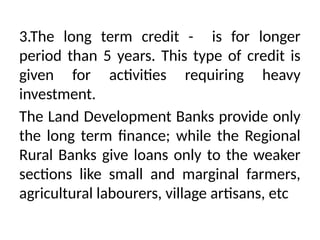
3.The long term credit - is for longer
period than 5 years. This type of credit is
given for activities requiring heavy
investment.
The Land Development Banks provide only
the long term finance; while the Regional
Rural Banks give loans only to the weaker
sections like small and marginal farmers,
agricultural labourers, village artisans, etc
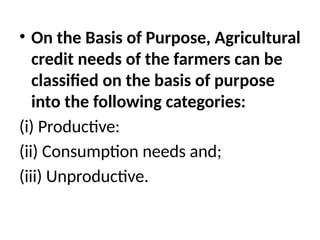
• On the Basis of Purpose, Agricultural
credit needs of the farmers can be
classified on the basis of purpose
into the following categories:
(i) Productive:
(ii) Consumption needs and;
(iii) Unproductive.
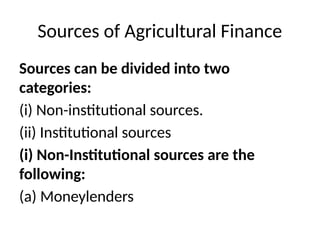
Sources of Agricultural Finance
Sources can be divided into two
categories:
(i) Non-institutional sources.
(ii) Institutional sources
(i) Non-Institutional sources are the
following:
(a) Moneylenders
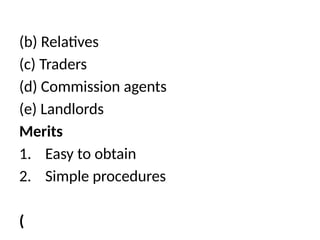
(b) Relatives
(c) Traders
(d) Commission agents
(e) Landlords
Merits
1. Easy to obtain
2. Simple procedures
(
3. Easy access
4. No restrictions
Demerits
1. Exorbitant rate of interest
2. Indebtness
3. Loss of land and property
4. Malpractices
5. Exploitation
6. Bonded labour
ii) Institutional sources:
(a) Cooperatives
(b) Scheduled Commercial Banks
(c) Regional Rural Banks (RRBs)
(a) Co operatives –
1. Provide rural credit at a lower cost
2. Provide short-term and long term loan
through credit societies via land-
development banks
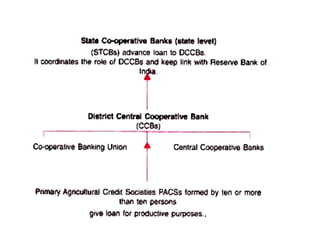
Structure of cooperatives
1. Short and Medium term credits
(i) State Co-op Banks (at state level)
(ii) Central co-op Banks (at district level)
(iii) Primary Agricultural Cooperative
Societies (PACSs) at village level
2. Long term credit
(i) State Land Development Banks (at
State level)
(ii) (ii) Primary Land Development Banks
(at district and village level)
b) Commercial banks, including RRBs,
provide both short and medium term
loans for agriculture and allied activities.
Lending can be classified as
(i) Short term –for purchasing
fertilizers, seeds, pesticides. More
than 50 % of agricultural finance of
the banks is in this category
(i) Medium and long term – for buying
cattle, equipment and improvement of
land
(ii) Direct Finance – for purchasing pumps,
tractors and other agricultural
machinery, construction of wells
(iii) Indirect Finance- to cooperative
societies , to FCI, the State Government
and other agencies for procurement,
storage and distribution of foodgrains
Land Bank Scheme
1. Launched by RBI
2. Individual commercial bank is
responsibly for the development of
individual districts with the help of
RRB and Cooperative banks.
3. The commercial bank monitor the
progress.
(c) Regional Rural Banks
1. RRBs were established in 1975 on the
recommendation of Narsimha Commmittee.
2. These Regional Rural Banks have been set up
all over the country with the objective of
meeting the credit needs of the most under
privileged sections of the society.
3. These banks are sponsored by scheduled
commercial banks.
4. At present there are 56 RRBs.
Objectives of RRB
(i) To provide cheap and liberal credit facilities to
small and marginal farmers, agri­
culture
labourers, artisans, small entrepreneurs and
other weaker sections.
(ii) To save the rural poor from the
moneylenders.
(iii) To act as a catalyst element and thereby
accelerate the economic growth in the particular
region.
(iv) To cultivate the banking habits among the
rural people and mobilize savings for the
economic development of rural areas.
(v) To increase employment opportunities by
encouraging trade and commerce in rural areas.
(vi) To encourage entrepreneurship in rural
areas.
(vii) To cater to the needs of the backward areas
which are not covered by the other efforts of
the Government?
(viii) To develop underdeveloped regions and
thereby strive to remove economic dispar­
ity
between regions.
There has not been much progress in the
performance of RRBs. To improve the functioning
of the RRBs the government should
(a) Improve the capital base of RRBs
(b)Allow greater liberty
(c) Provide refinance at lower rate of interest
(d)Provide training to the staff
Recent measures in agricultural credit
1. The flow of agricultural credit has
consistently exceeded the target
2. Farmers have been receiving crop loans upto
a principal amount of Rs 3 lakh at 7 % of
interest rate.
3. A concession under interest subvention
scheme is given to farmers who repay their
loans on time. The effective rate of interest fo
them is 4 %.
4. Post harvest loans were granted against
negotiable warehouse receipts at a commercial
rate of interest, to prevent the distress sale after
harvest.
5. The government is implementing a revival
package for short term Rural Co-operative Credit
Structure involving a financial outlay of more
than 13 crores.
6. A number of crop insurance schemes have
been introduced.
National Bank for Agriculture and Rural
Development (NABARD)
NABARD is a development bank focussing
primarily on the rural sector of the country.
It is the apex banking institution to provide
finance for Agriculture and rural
development. Its headquarter is located in
Mumbai.
• It is responsible for the development of
the small industries, cottage industries,
and any other such village or rural
projects.
• It is a statutory body established in 1982
under Parliamentary act-National Bank
for Agriculture and Rural Development
Act, 1981.
Role and functions of NABARD
• Serves as an apex financing agency for the
institutions providing investment and
production credit for promoting the various
developmental activities in rural areas
• Takes measures towards institution building
for improving absorptive capacity of the credit
delivery system, including monitoring,
formulation of rehabilitation schemes,
restructuring of credit institutions, training of
personnel, etc.
• Co-ordinates the rural financing activities of all
institutions engaged in developmental work at
the field level and maintains liaison
with Central Government state
governments, RBI and other national level
institutions concerned with policy formulation
• Undertakes monitoring and evaluation of
projects refinanced by it.
• NABARD refinances the financial institutions
which finances the rural sector.
• NABARD partakes in development of
institutions which help the rural economy.
• NABARD also keeps a check on its client
institutes.
• It regulates the institutions which provide
financial help to the rural economy.
• It provides training facilities to the institutions
working in the field of rural upliftment.
• It regulates and supervise the cooperative
banks and the RRB's, through out entire India.
Agricultural Finance by NABARD
It is an apex institution in the field of rural
credit. Therefore it does not deal directly
with farmers and other rural people. It
grants credit to them through the
cooperative banks, commercial banks,
RRBs.
NABARD provides two types of refinance.
The first is extended to RRBs, and apex
institutions, namely StCBs and State
governments. The other type of refinance
is extended to augment resources for
ground level deployment of rural credit.
(a) Microfinance
(i) Introduced in 1992
(ii) Through SHG and Bank Linkage
program the banking system reaches
to micro-enterprenuers and farmers.
(iii) About 100 million poor families are
benefitted with this scheme.
(iv) However not successful due to problems
associated with recovery of loans.
(b) Bulk Lending Support to NGOs
(c) Tribal Development Project (the Wadi
Project) om Gujrat
(d) Farm Income Insurance Scheme
Kisan Credit Card
This scheme was prepared by NABARD and introduced
in 1998-99 to facilitate access to credit from co-
operative banks, commercial banks and RRBs.
Features
• Eligible farmers to be provided with a Kisan Credit
Card and a pass book or card-cum-pass book.
• Revolving cash credit facility involving any number of
drawals and repayments within the limit
• Limit to be fixed on the basis of operational
land holding, cropping pattern and scale of
finance.
• Entire production credit needs for full year
plus ancillary activities related to crop
production to be considered while fixing limit.
• Sub-limits to cover short term, medium term
as well as term credit are fixed at the
discretion of banks.
• Card valid for 5 years subject to annual
review. As incentive for good
performance, credit limits could be
enhanced to take care of increase in
costs, change in cropping pattern, etc.
• Conversion/reschedulement of loans also
permissible in case of damage to crops
due to natural calamities.
• Security, margin, rate of interest, etc. as
per RBI norms.
• Operations may be through issuing
branch (and also PACS in the case of
Cooperative Banks) through other
designated branches at the discretion of
bank.
• Withdrawals through slips/cheques
accompanied by card and passbook.
• Crop loans disbursed under KCC Scheme
for notified crops are covered under Crop
Insurance Scheme, to protect the interest
of the farmer against loss of crop yield
caused by natural calamities, pest attacks
etc
Limitations of Institutional Finance
1. Formalities
2. Security
3. Productive loans only
4. Political interference
5. Corruption and red tapism
Suggestions
1. Extend institutional credit
2. KCC
3. Low rate of interest
4. No collateral security
5. Crop insurance
6. Minimise formalities
7. Strengthen the credit cooperatives.

Agricultural finance_ Notes for study.pptx

  • 1.
    Agricultural Finance Finance isan important input of agriculture which the farmers need for agricultural purposes Sufficient and timely credit to the farmers is vital and indispensable for the rehabilitation and progress of agriculture.
  • 2.
    Need for finance 1.Purchase of new inputs 2. Purchase of implements 3. Better management of risk 4. Permanent improvement in land 5. Better marketing of crops 6. Facing crises
  • 3.
    Classification of AgriculturalFinance Agricultural credit has been classified into three categories based on the periods for which the loan is given. Theses are 1. short-term credit (crop loan) - for 15 months period and is meant for meeting the needs like seed, fertilizer, labour, cattle feed, etc. The farmer can repay the loan after harvest of the crop.
  • 4.
    2. Medium-term credit.The period for medium term loan is from 15 months to five years. These loans are provided for meeting the expenses on land improvements, digging of wells, purchase of implements and machinery, farm animals, etc. The period for repayment is kept upto 5 years.
  • 5.
    3.The long termcredit - is for longer period than 5 years. This type of credit is given for activities requiring heavy investment. The Land Development Banks provide only the long term finance; while the Regional Rural Banks give loans only to the weaker sections like small and marginal farmers, agricultural labourers, village artisans, etc
  • 6.
    • On theBasis of Purpose, Agricultural credit needs of the farmers can be classified on the basis of purpose into the following categories: (i) Productive: (ii) Consumption needs and; (iii) Unproductive.
  • 7.
    Sources of AgriculturalFinance Sources can be divided into two categories: (i) Non-institutional sources. (ii) Institutional sources (i) Non-Institutional sources are the following: (a) Moneylenders
  • 8.
    (b) Relatives (c) Traders (d)Commission agents (e) Landlords Merits 1. Easy to obtain 2. Simple procedures (
  • 9.
    3. Easy access 4.No restrictions Demerits 1. Exorbitant rate of interest 2. Indebtness 3. Loss of land and property 4. Malpractices
  • 10.
    5. Exploitation 6. Bondedlabour ii) Institutional sources: (a) Cooperatives (b) Scheduled Commercial Banks (c) Regional Rural Banks (RRBs)
  • 11.
    (a) Co operatives– 1. Provide rural credit at a lower cost 2. Provide short-term and long term loan through credit societies via land- development banks Structure of cooperatives 1. Short and Medium term credits (i) State Co-op Banks (at state level) (ii) Central co-op Banks (at district level)
  • 12.
    (iii) Primary AgriculturalCooperative Societies (PACSs) at village level 2. Long term credit (i) State Land Development Banks (at State level) (ii) (ii) Primary Land Development Banks (at district and village level)
  • 14.
    b) Commercial banks,including RRBs, provide both short and medium term loans for agriculture and allied activities. Lending can be classified as (i) Short term –for purchasing fertilizers, seeds, pesticides. More than 50 % of agricultural finance of the banks is in this category
  • 15.
    (i) Medium andlong term – for buying cattle, equipment and improvement of land (ii) Direct Finance – for purchasing pumps, tractors and other agricultural machinery, construction of wells (iii) Indirect Finance- to cooperative societies , to FCI, the State Government and other agencies for procurement, storage and distribution of foodgrains
  • 16.
    Land Bank Scheme 1.Launched by RBI 2. Individual commercial bank is responsibly for the development of individual districts with the help of RRB and Cooperative banks. 3. The commercial bank monitor the progress.
  • 17.
    (c) Regional RuralBanks 1. RRBs were established in 1975 on the recommendation of Narsimha Commmittee. 2. These Regional Rural Banks have been set up all over the country with the objective of meeting the credit needs of the most under privileged sections of the society. 3. These banks are sponsored by scheduled commercial banks. 4. At present there are 56 RRBs.
  • 18.
    Objectives of RRB (i)To provide cheap and liberal credit facilities to small and marginal farmers, agri­ culture labourers, artisans, small entrepreneurs and other weaker sections. (ii) To save the rural poor from the moneylenders. (iii) To act as a catalyst element and thereby accelerate the economic growth in the particular region.
  • 19.
    (iv) To cultivatethe banking habits among the rural people and mobilize savings for the economic development of rural areas. (v) To increase employment opportunities by encouraging trade and commerce in rural areas. (vi) To encourage entrepreneurship in rural areas. (vii) To cater to the needs of the backward areas which are not covered by the other efforts of the Government?
  • 20.
    (viii) To developunderdeveloped regions and thereby strive to remove economic dispar­ ity between regions. There has not been much progress in the performance of RRBs. To improve the functioning of the RRBs the government should (a) Improve the capital base of RRBs (b)Allow greater liberty (c) Provide refinance at lower rate of interest (d)Provide training to the staff
  • 21.
    Recent measures inagricultural credit 1. The flow of agricultural credit has consistently exceeded the target 2. Farmers have been receiving crop loans upto a principal amount of Rs 3 lakh at 7 % of interest rate. 3. A concession under interest subvention scheme is given to farmers who repay their loans on time. The effective rate of interest fo them is 4 %.
  • 22.
    4. Post harvestloans were granted against negotiable warehouse receipts at a commercial rate of interest, to prevent the distress sale after harvest. 5. The government is implementing a revival package for short term Rural Co-operative Credit Structure involving a financial outlay of more than 13 crores. 6. A number of crop insurance schemes have been introduced.
  • 23.
    National Bank forAgriculture and Rural Development (NABARD) NABARD is a development bank focussing primarily on the rural sector of the country. It is the apex banking institution to provide finance for Agriculture and rural development. Its headquarter is located in Mumbai.
  • 24.
    • It isresponsible for the development of the small industries, cottage industries, and any other such village or rural projects. • It is a statutory body established in 1982 under Parliamentary act-National Bank for Agriculture and Rural Development Act, 1981.
  • 25.
    Role and functionsof NABARD • Serves as an apex financing agency for the institutions providing investment and production credit for promoting the various developmental activities in rural areas • Takes measures towards institution building for improving absorptive capacity of the credit delivery system, including monitoring, formulation of rehabilitation schemes, restructuring of credit institutions, training of personnel, etc.
  • 26.
    • Co-ordinates therural financing activities of all institutions engaged in developmental work at the field level and maintains liaison with Central Government state governments, RBI and other national level institutions concerned with policy formulation • Undertakes monitoring and evaluation of projects refinanced by it. • NABARD refinances the financial institutions which finances the rural sector.
  • 27.
    • NABARD partakesin development of institutions which help the rural economy. • NABARD also keeps a check on its client institutes. • It regulates the institutions which provide financial help to the rural economy. • It provides training facilities to the institutions working in the field of rural upliftment. • It regulates and supervise the cooperative banks and the RRB's, through out entire India.
  • 28.
    Agricultural Finance byNABARD It is an apex institution in the field of rural credit. Therefore it does not deal directly with farmers and other rural people. It grants credit to them through the cooperative banks, commercial banks, RRBs. NABARD provides two types of refinance. The first is extended to RRBs, and apex
  • 29.
    institutions, namely StCBsand State governments. The other type of refinance is extended to augment resources for ground level deployment of rural credit. (a) Microfinance (i) Introduced in 1992 (ii) Through SHG and Bank Linkage program the banking system reaches
  • 30.
    to micro-enterprenuers andfarmers. (iii) About 100 million poor families are benefitted with this scheme. (iv) However not successful due to problems associated with recovery of loans. (b) Bulk Lending Support to NGOs (c) Tribal Development Project (the Wadi Project) om Gujrat (d) Farm Income Insurance Scheme
  • 31.
    Kisan Credit Card Thisscheme was prepared by NABARD and introduced in 1998-99 to facilitate access to credit from co- operative banks, commercial banks and RRBs. Features • Eligible farmers to be provided with a Kisan Credit Card and a pass book or card-cum-pass book. • Revolving cash credit facility involving any number of drawals and repayments within the limit
  • 32.
    • Limit tobe fixed on the basis of operational land holding, cropping pattern and scale of finance. • Entire production credit needs for full year plus ancillary activities related to crop production to be considered while fixing limit. • Sub-limits to cover short term, medium term as well as term credit are fixed at the discretion of banks.
  • 33.
    • Card validfor 5 years subject to annual review. As incentive for good performance, credit limits could be enhanced to take care of increase in costs, change in cropping pattern, etc. • Conversion/reschedulement of loans also permissible in case of damage to crops due to natural calamities.
  • 34.
    • Security, margin,rate of interest, etc. as per RBI norms. • Operations may be through issuing branch (and also PACS in the case of Cooperative Banks) through other designated branches at the discretion of bank. • Withdrawals through slips/cheques accompanied by card and passbook.
  • 35.
    • Crop loansdisbursed under KCC Scheme for notified crops are covered under Crop Insurance Scheme, to protect the interest of the farmer against loss of crop yield caused by natural calamities, pest attacks etc
  • 36.
    Limitations of InstitutionalFinance 1. Formalities 2. Security 3. Productive loans only 4. Political interference 5. Corruption and red tapism
  • 37.
    Suggestions 1. Extend institutionalcredit 2. KCC 3. Low rate of interest 4. No collateral security 5. Crop insurance 6. Minimise formalities 7. Strengthen the credit cooperatives.