Co-operative Marketing:
Dr. Devyanee K. Nemade
Assistant Professor
Department of Agricultural Economics
& Statistics Dr. PDKV, Akola
Content:
- Meaning
- Definitions of Co-operative Marketing:
- Objective of Co-operative Marketing:
- Advantages of Co-operative Marketing
- Historical Development of Co-Operative Marketing in India
- Meaning Co-operative
- Cooperative Marketing – Need
- Functions of Co-Operative Marketing Societies
- Types of Co-Operative Marketing Societies:
- Co-operative Marketing Structure
- Reasons for Poor performance
- AMUL
- Conclusion
Meaning Co-operative:
* Co-operative – the word „Co-operation‟ is derived
from the Latin word “Co-operari”, which means
working together.
Co-operative Marketing Meaning
* Co-operative marketing consist of two words “Co-
operative” or “Co-operation” and “Marketing”.
*It is also the marketing „for the farmers‟ and „by the
farmers‟ that aim at eliminating the chain of
functionaries operating between the farmers and the
ultimate consumers and this securing maximum price
for the farmer‟s produce.
Definitions of Co-operative Marketing:
According to RBI
“Co-operative marketing is a co-operative
association of cultivators formed primarily for the
purpose of helping the members to market their produce
more profitably than is possible through private trade.”
According to FAO Co-operative Marketing is a
system through which a group of farmers join together to
carry on some or all the process involved in bringing
goods to the consumer.”
Objective of Co-operative Marketing:
* To sell the members product directly in the best market
and in a state which attracts the best price.
* To grade the produce in such a way that the best price
is obtained for all qualities to the advantages of the
grower.
* Give fair weight.
* Handle the crop without damage or waste.
Continue……..
* Strengthen the bargaining power.
* Help members to produce the best product, which has
most demand, this may include processing also.
* Educate the members in marketing.
* Stand for fair trading practices and stop manipulation
of prices.
Co-operative Marketing
* Brings in economy in cost of Marketing
* Supply quality goods to customer.
* Makes available grading and transportation facilities.
* Acts as a part of the Government for procurement
and implementation of price support policy.
* Encourage self-help and thrift.
* Link marketing with credit.
Advantages of Co-operative Marketing
* Reduce cost and improved services.
* Improve marketability-reduce all undefined and
undesirable market changes.
* Safeguards against rising costs and input prices.
* Provides credit.
* Storage facilities
* Processing of agricultural produce.
* Processing of Agricultural produce.
* Market Intelligence.
Historical Development of Co-Operative Marketing in India
* The history of co-operative marketing in India dates
back to 1912, when the Co-operative Marketing
Societies Act, 1912 was passed.
* The First market society started in India was the
Kumbakonam Agricultural Society in 1913, which
supplied seeds, manures, implements and arrangement
of sale of the products of its members.
Continue…………….
* In the year 1915 and 1917 two Marketing Co-operative
Societies were formed at Hubli and Gadag respectively.
The basic objective was to encourage the cultivation of
improved cotton and sell it collectively.
* In 1920-21 there were only 31 co-operative societies.
The Royal Commission on Agriculture (1928) stressed
the need for group marketing instead of individual
marketing.
Continue……………
* The Central Banking Enquiry Committee (1931) also
underlined the need for organized marketing. The XI
Conference of Registrars of Cooperative Societies (1934)
emphasized the importance of Cooperative marketing.
*In 1945, the Co-operative Planning Committee recommended
that at least 25 percent of marketable surplus should be
channelized through co-operative societies within the next 10
years by framing one society for the group of 200 villages.
Continue……………
* In 1958, the National Agriculture Co-operative
Marketing Federation (NAFED) came into power as the
Apex body of Co-operative Marketing.
* In 1963, the National Co-operative Development
Corporation (NCDC) was established for the promotion
of programmes relating to processing, storage, packing
and marketing of rural produce through co-operative
markets.
Continue…………..
* In 1968, the RBI recognized the linking of credit with
marketing as a necessary step for the development of
agricultural marketing.
Co-operative Marketing – Need
1. Abolition of Middlemen
2. Collective bargaining.
3. Storage facilities – for members.
4. Standardization and grading
5. Higher prices of members.
6. Market infrastructure.
7. Supplying inputs and consumer goods.
8. Facility of correct weighing.
9. Relief from illegal deductions.
10.Linking credit, processing and farming.
Cooperative Marketing – 10 Main Functions of Co-Operative
Marketing Societies
*Purchase and Sale of Produce :
The marketing co-operatives purchase the
produces from their member growers and sell it in bulk
quantities, which enables them to reduce marketing cost and
earn fair returns.
* Distribution of Agricultural Inputs :
The co-operatives supply the agricultural inputs
such as seeds, fertilizers, pesticides, agricultural implements
etc., the supply of quality materials at reasonable prices save
cost of the member producers. Sometimes these inputs may
be also given on credit basis.
Continue……………..
*Providing Storage Facility:
To provide storage facilities, the societies may
have their own Godown or hired Godown.
*Supply of Agricultural Implements:
They supply the needed agricultural
implements like tractors, tillers, power sprayers etc., on
rent basis to the cultivators for the purpose of production.
Continue……………….
* Provide Financial Assistance :
They make credit facilities to the members against
the security of the produce brought for sale. Members get
advances up to 75 percent of the market value of the
produce deposited.
* Processing of Produce :
Some societies undertake processing of
agricultural produce, which ensures high prices to the
producers after processing.
Continue……………….
*Providing Transportation Facility:
The co-operative societies make arrangements for
the transport of the produce of the members from the villages
to the market on collective basis, which reduces the
transportation costs for its members.
* Providing Market Information:
They provide latest information about the new
techniques of production as well as the market information
about the market prices from time to time, which will help the
members to get a good price for their produce.
Continue……………….
*Stable Price:
The societies adjust the supply of commodities
according to the market demand. In this way, in long run the
prices get stabilized, which helps the farmers from the evil
effects of the seasonal price fluctuations.
*Participation in Foreign Trade:
These co-operative societies participates in the
export trade of the country, which helps to get better prices for
the growers. Through export trade, the marketing co-
operatives provide wide market to the agricultural produce.
The share of agricultural exports in India‟s total exports is
around 16 percent.
Progress and Types in Co-operative Marketing Societies:
Under the active encouragement of the Government
and the RBI, cooperative marketing has made great progress in
Maharashtra, Andhra Pradesh, Tamil Nadu, Uttar Pradesh and
Bihar.
There are co-operative societies in Maharashtra
specialized in the sale of tobacco, fruit, vegetables etc.
The network of co-operative marketing structure
now comprises over 6,000 primary marketing societies, of
which 3,500 are special commodity marketing societies.
Continue………………
At the district level, there are 160 Central Marketing
Societies, covering nearly all the important mandis in the
country.
At the state level there are 29 general purpose state
level co-operative marketing federations and
16 special commodity marketing federations, and at
all India level, there are the
1. National Co-operative Development Corporation (NCDC),
2. National Agricultural Cooperative Marketing Federation
(NAFED),
3. National Co-operative Tobacco Growers Federation Ltd.,
4. National Consumers‟ Co-operative Federation and the
Tribal Co-operative Marketing Development Federation of
India (TRIFED) –
All these are working in the field of agricultural
marketing.
Types of Co-Operative Marketing Societies:
The co-operative marketing societies may be grouped
into two types:
* Single Commodity Co-operative Marketing Society
* Multi-Commodity Co-operative Marketing Society
*Multi-purpose multi-commodity Marketing Society
* Single Commodity Co-operative Marketing Societies :
These type of societies deal with only one agricultural
commodity.
For example: Cotton Co-operative Marketing Society, Oilseed
Growers, Co-operative Marketing Society etc., Areca nut co-
operative marketing society, etc.
Continue…………..
*Multi-Commodity Co-operative Marketing Societies :
These societies deal with more number of commodities
produced by the members such as oilseeds, cotton, food
grains etc.
* Multi-purpose, Multi-commodity Co-operative Marketing
Societies:
These societies market a large number of
commodities and perform such other functions as providing
credit to members, arranging for the supply of the inputs
required by them, and meeting their requirements of essential
domestic consumption goods.
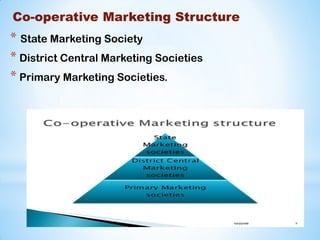
Co-operative Marketing Structure
•The co-operative marketing societies have both two-tier
and three-tier structure.
•In the states of Assam, Bihar, Kerala, Madhya Pradesh,
Karnataka, Orissa, Rajasthan and West Bengal, there is
a two-tier pattern with primary marketing societies at
the taluka level and state marketing federation as an
apex body at the state level.
•In other states, there is three-tier system with district
marketing society in the middle. At the national level,
NAFED serves as the apex institution.
The pattern of the three-tier structure is as follows:
Local Association/ Base level : PACS, Dairy Co-
operative
Regional Association : District Level, Multi
commodity exchange, Primary Marketing Co-
operative Society.
State Level Association:
* State level.
* 27 State level marketing federation.
* 199 regional co-operative marketing associations
* NAFED(National Agricultural Co-operative Marketing
Federation of India)
Co-operative Marketing Structure
* State Marketing Society
* District Central Marketing Societies
* Primary Marketing Societies.
Primary Marketing Societies:
At the base level there are primary
cooperative marketing societies. These societies market
the product of the producer members in that area. They
may be single commodity or multi-commodity societies
depending upon the production of the rural products in
the area.
Continue…………….
Primary marketing co-operatives are those
which are operating in the small and limited area, may
be either a taluka or a block. The members are the
producers engaged in production of rural produce.
These co-operatives will either buying from members or
acting as agents for the grower producers to sell, on
behalf of them.
Central or District Level Co-operative Societies:
After the primary co-operative societies operating at
block level, there are cooperative marketing societies covering
a larger area or a district. These district level co-operative
societies are called federations or marketing unions. These are
engaged in the task of buying selling and extending credit
facilities to primary cooperative societies.
Their main job is to market the produce brought for sale
by the primary cooperative marketing societies of the area.
These are located in the secondary wholesale markets and
generally offer a better price for the produce.
Continue……………..
The primary cooperative marketing societies
are members of these unions in addition to the individual
producer members. In the two-tier structure, the state
societies perform the functions of district level societies
by opening branches throughout the district.
3. State Marketing Societies:
At the State level there are apex body that is
State Co-operative marketing societies which serve the
state as a whole. Their members both the primary co-
operative societies and the Central Cooperative Union of
the State. They are above the level of central co-operative
marketing societies which is grown as a provincial
society.
Continue……………
The basic function of these is to coordinate the
activities of the affiliated societies and conduct such
activities as inter-State trade, export-import,
procurement, distribution of inputs and essential
consumer goods, dissemination of market information
and rendering expert advice on the marketing of rural
produce.
They undertake the task of granting credit that
facilitates needy and deserving co-operatives, whether
primary or central.
Continue……………….
The pyramid structure is neither well-knit nor
well developed because all co-operatives are not co-
operating with one another. This is the sorry state of
affairs, as there prevails „step mother policy‟ in business
relations which is acting as the strong impediment for the
success of co-operative societies.
At present, the co-operative marketing is having 30
state level co-operative societies, 180 District level
societies and 2900 primary co-operative societies and
3490 Special Commodities Societies.
Reasons for Poor performance:
* Lack of initiative by members, only Govt. initiative.
* Competition from credit societies, middlemen, traders,
etc.
* Lack of Co-ordination.
* Lack of audit and supervision
* Untrained persons.
* Lack of funds.
AMUL:
* The largest food brand in India and World‟s Largest Pouched
Milk Brand “Amul” is a brand name managed by Gujarat Co-
operative Milk Marketing Federation Ltd (GCMMF).
* The Gujarat Co-operative Milk Marketing Federation Ltd,
Anand is the largest food products marketing organization of
India and is the apex organization of the Dairy Co-operatives
of Gujarat.
* With a turnover of INR billon GCMMF has created an
economic network that links.
* Millions of consumers in India and abroad.
* 2.8 million village milk producers.
* A Co-operative system that includes 13,141 Village Diary Co-
operative Societies at the Village level.
Conclusion:
Marketing Societies play an important
role in order to get a better price for the produce,
better facilities and services to the farmers. This
in turn will lead to higher Income and better
lifestyle to the farmers.
National Agricultural Co-operative Marketing Federation
of India (NAFED):
The National Agricultural Co-operative
Marketing Federation of India(NAFED) is an apex
organization of Marketing Co-operatives in the country.
* Establishment Year: October 1958
* Head Office: New Delhi
* Branches: 31
* Procurement, Processing, Distribution, Export
Commodities of Agricultural Commodities.
Objective of NAFED:
* Co-ordinate and promote the marketing and trading
activities.
*Purchase, Sales and Supply (Agricultural Goods).
* Promote inter-state, intra-state and international trade.
*Own and construct Godowns.
* To make arrangements for the supply of agricultural
inputs like seed, fertilizer, manure agricultural
implements etc.
Continue……………..
* To act as an agent of the government for the purchase,
sale, storage and distribution of agricultural products
and inputs.
* Insurance agent.
* Consultancy
* Manufacture of agricultural machinery, implements,
processing and marketing.
* Marketing research and marketing Intelligence
dissemination.
* Training.
Activities of the NAFED:
* Price support operations
* Internal trade
* Foreign trade
* Marketing of agricultural Inputs
* Promotional activites
* Tribal produce marketing activity
* Setting of scientific storage system
* Processing of fruits and vegetables.
Food Corporation of India(FCI):
* Set up under Food Corporation act 1964.
* Fulfill price support to farmers, distribution of Food Grains to
Consumers and maintaining buffer stock.
* Handling food grain trade and its distribution to each section
society.
* Establishment Year: January, 1965.
* Its market operations prevent the speculative traders and
provide the remunerative prices for agricultural produces.
* Ensures prompt and un-interrupted supply of food grains.
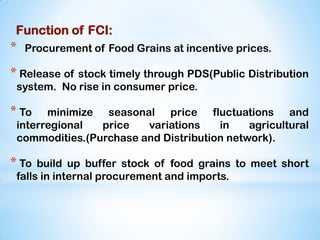
Function of FCI:
* Procurement of Food Grains at incentive prices.
* Release of stock timely through PDS(Public Distribution
system. No rise in consumer price.
* To minimize seasonal price fluctuations and
interregional price variations in agricultural
commodities.(Purchase and Distribution network).
* To build up buffer stock of food grains to meet short
falls in internal procurement and imports.
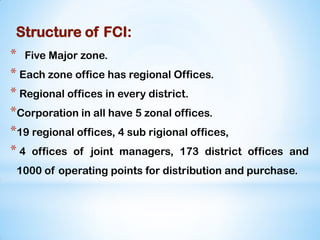
Structure of FCI:
* Five Major zone.
* Each zone office has regional Offices.
* Regional offices in every district.
*Corporation in all have 5 zonal offices.
*19 regional offices, 4 sub rigional offices,
* 4 offices of joint managers, 173 district offices and
1000 of operating points for distribution and purchase.
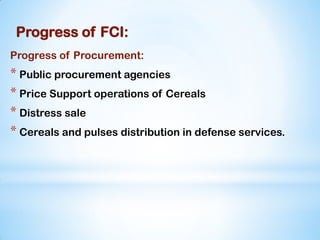
Progress of FCI:
Progress of Procurement:
* Public procurement agencies
* Price Support operations of Cereals
* Distress sale
* Cereals and pulses distribution in defense services.
Continue…………….
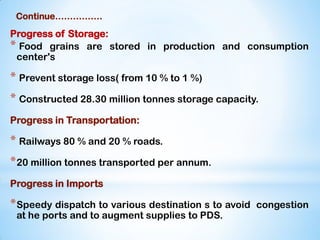
Progress of Storage:
* Food grains are stored in production and consumption
center's
* Prevent storage loss( from 10 % to 1 %)
* Constructed 28.30 million tonnes storage capacity.
Progress in Transportation:
* Railways 80 % and 20 % roads.
*20 million tonnes transported per annum.
Progress in Imports
*Speedy dispatch to various destination s to avoid congestion
at he ports and to augment supplies to PDS.
Continue…………….
Progress in Distribution:
* Distribution of procured and imported food grains.
Progress in Processing:
* 24 modern rice mills
* Paddy processing unit Tiruverur in Tamil Nadu
* Ujjain(MP): Solvent extraction plant-Gr.Nut.
* Faridabad(Hariyana) Maize mill
Cooperative Marketing, NAFED & FCI