Dr (Prof) Santosh Kumar Bhaskar
Chief Intensivist
BFH
INTRAVENOUS FLUID MANAGEMENT IN
CRITICAL PATIENTS
AN INTERACTIVE SESSION
A 53-year-old woman with a history of uncontrolled hypertension
is admitted to the ICU with subarachnoid hemorrhage. She has had
endovascular coiling of an anterior communicating artery
aneurysm.
On post-procedure day 4, she becomes acutely confused and
lethargic. On evaluation of the patient, you find her vital signs to
be the following: temperature 37.5°C, HR 110 beats/minute, BP
150/90 mm Hg, RR 16 breaths/min, 02 saturation 98% on 2L/min
oxygen by nasal cannula. She is somnolent, oriented only to
person, and has a GCS of E3 V4 M6 (13). She has no focal
neurologic deficits. Her mucous membranes are dry, her urine
output has been 25 mL/h in the past 2 hours, and her CVP is 5.
While awaiting a repeat CT scan of the head, laboratory values
return and reveal serum sodium of 128 mmol/L and serum
osmolarity of 260 mOsm/kg water.
What is your next step in management of this patient?
A. Fluid bolus with 3% NS.
B. Fluid bolus with 0.9%
NS.
C. Fluid restriction.
D. Give demeclocycline.
E. Give the patient salt tabs
to take PO.
F. Urgent hemodialysis. 26
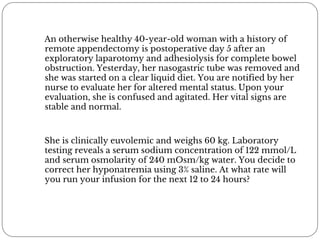
An otherwise healthy 40-year-old woman with a history of
remote appendectomy is postoperative day 5 after an
exploratory laparotomy and adhesiolysis for complete bowel
obstruction. Yesterday, her nasogastric tube was removed and
she was started on a clear liquid diet. You are notified by her
nurse to evaluate her for altered mental status. Upon your
evaluation, she is confused and agitated. Her vital signs are
stable and normal.
She is clinically euvolemic and weighs 60 kg. Laboratory
testing reveals a serum sodium concentration of 122 mmol/L
and serum osmolarity of 240 mOsm/kg water. You decide to
correct her hyponatremia using 3% saline. At what rate will
you run your infusion for the next 12 to 24 hours?
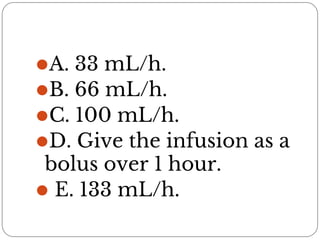
⚫A. 33 mL/h.
⚫B. 66 mL/h.
⚫C. 100 mL/h.
⚫D. Give the infusion as a
bolus over 1 hour.
⚫ E. 133 mL/h.
3% Saline= 513 mmol/L of sodium Patient's
serum sodium= 122 mmol/L TBW=30
Change in serum [Na] = (513 - 122)/(30 + 1) =
12.7 mmol
A safe target for correction of serum
sodium is 10 mmol in 24 hours. For this
patient, a correction of 10 mmol would take
790 mL ( 10/12.7 =. 79). To infuse 790 mL
over 24 hours would take a rate of 33 mL/h
FLUID PHYSIOLOGY
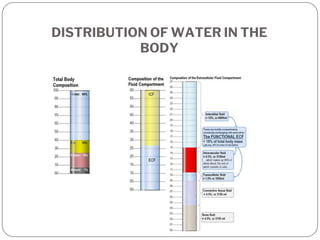
DISTRIBUTION OF WATER IN THE
BODY
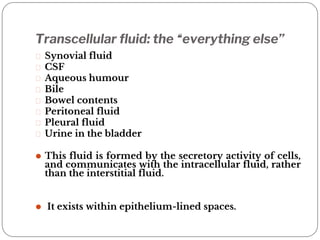
Transcellular fluid: the “everything else”
⮚ Synovial fluid
⮚ CSF
⮚ Aqueous humour
⮚ Bile
⮚ Bowel contents
⮚ Peritoneal fluid
⮚ Pleural fluid
⮚ Urine in the bladder
⚫ This fluid is formed by the secretory activity of cells,
and communicates with the intracellular fluid, rather
than the interstitial fluid.
⚫ It exists within epithelium-lined spaces.
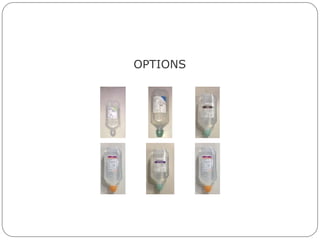
OPTIONS
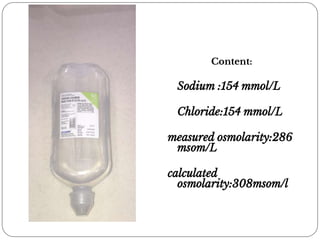
Content:
Sodium :154 mmol/L
Chloride:154 mmol/L
measured osmolarity:286
msom/L
calculated
osmolarity:308msom/l
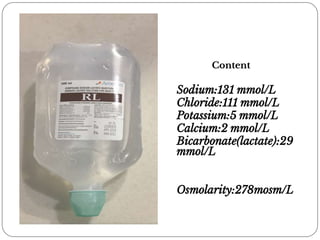
Content
Sodium:131 mmol/L
Chloride:111 mmol/L
Potassium:5 mmol/L
Calcium:2 mmol/L
Bicarbonate(lactate):29
mmol/L
Osmolarity:278mosm/L
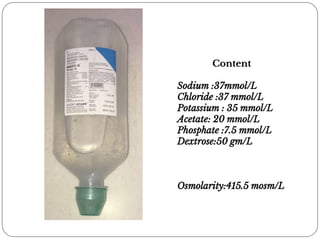
Content
Sodium :37mmol/L
Chloride :37 mmol/L
Potassium : 35 mmol/L
Acetate: 20 mmol/L
Phosphate :7.5 mmol/L
Dextrose:50 gm/L
Osmolarity:415.5 mosm/L
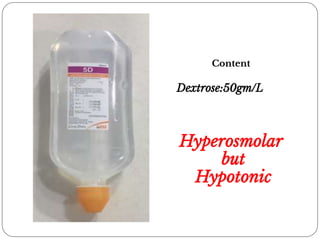
Content
Dextrose:50gm/L
Hyperosmolar
but
Hypotonic
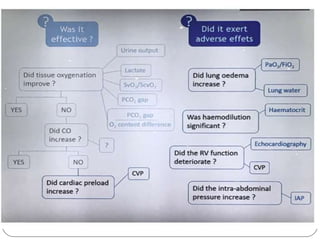
⚫How to decide about
the amount of fluid
resuscitation while
resuscitating?
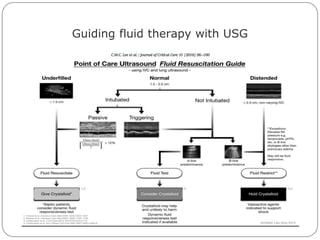
Guiding fluid therapy with USG
⚫WHAT FLUID TO
GIVE IN
HYPERKALEMIA?
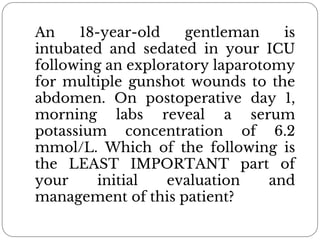
An 18-year-old gentleman is
intubated and sedated in your ICU
following an exploratory laparotomy
for multiple gunshot wounds to the
abdomen. On postoperative day 1,
morning labs reveal a serum
potassium concentration of 6.2
mmol/L. Which of the following is
the LEAST IMPORTANT part of
your initial evaluation and
management of this patient?
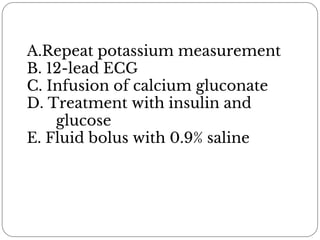
A.Repeat potassium measurement
B. 12-lead ECG
C. Infusion of calcium gluconate
D. Treatment with insulin and
glucose
E. Fluid bolus with 0.9% saline
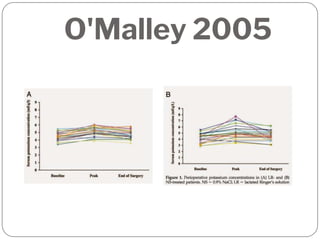
O'Malley 2005
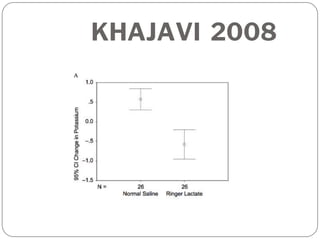
KHAJAVI 2008
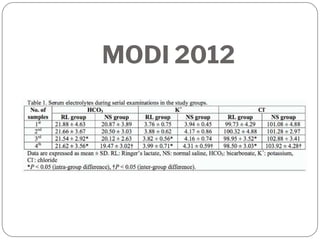
MODI 2012
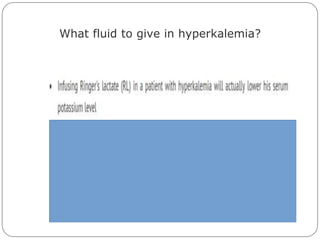
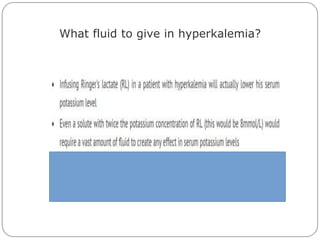
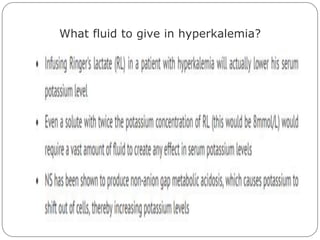
What fluid to give in hyperkalemia?
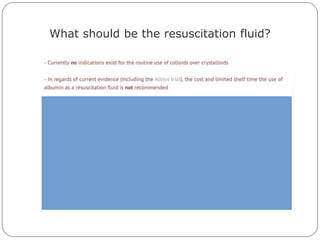
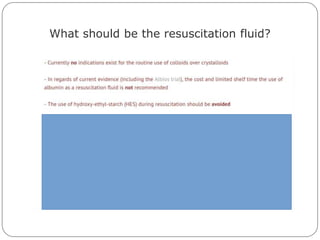
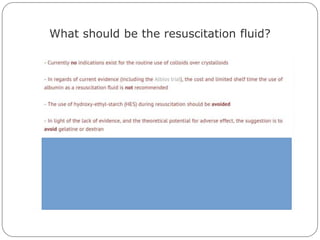
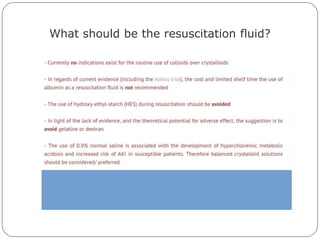
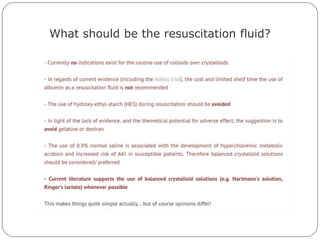
What should be the
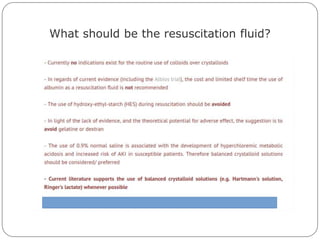
resuscitation fluid?
A 77-year-old man whose medical history
includes treated hypertension and
hypercholesterolemia, previous heavy
alcohol intake, and mild cognitive
impairment is admitted to the intensive
care unit (ICU) of a hospital from the
operating room after a Hartmann’s
procedure performed for fecal peritonitis
caused by a perforated sigmoid colon. He
has received a total of 4 liters of crystalloid
fluids, which were administered in the
operating room.
On arrival in the ICU, the arterial blood pressure is
88/52 mm Hg with marked respiratory variation,
the heart rate is 120 beats per minute in sinus
rhythm, the central venous pressure is 6 mm Hg,
and the temperature is 35.6°C. He is peripherally
cool, with prolonged capillary refill. Arterial blood
gas results while the patient is receiving mechanical
ventilation with a fraction of inspired oxygen of 0.4
are as follows: pH, 7.32; partial pressure of carbon
dioxide, 28 mm Hg; partial pressure of oxygen, 85
mm Hg; and lactate, 3.0 mmol per liter. Results of
serum biochemical analysis are as follows: sodium,
142 mmol per liter; potassium, 4.4 mmol per liter;
chloride, 109 mmol per liter; urea, 22.0 mg per
deciliter (7.9 mmol per liter); creatinine, 2.3 mg per
deciliter (203 µmol per liter); and albumin, 23 g per
liter. The urine output during the last 2 hours in the
operating room was 28 ml
Assessing the patient to have inadequate
intravascular volume, what option for fluid
resuscitation would you choose to be
administered over the next 30 minutes to
one hour?
A. A total of 1 liter of normal saline (0.9%
sodium chloride).
B.A total of 1 liter of Ringer’s lactate
(Hartmann’s solution).
C. A total of 500 ml of 6% hydroxyethyl
starch (130/0.42).
D. A total of 500 ml of 4% human albumin
solution.
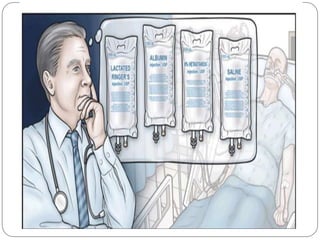
⚫A 77-year old man is in the ICU with septic
shock and is on mechanical ventilation.
Despite administration of 4 liters of
crystalloid, he remains hypotensive with
signs of inadequate intravascular volume.
What should be administered next?
What should be the resuscitation fluid?
⚫BRIEF
ABOUT
ALBIOS
TRIAL
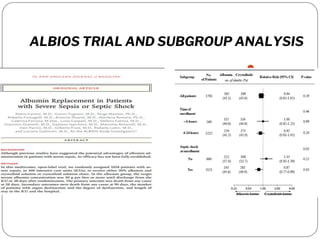
ALBIOS TRIAL AND SUBGROUP ANALYSIS
⚫.
⚫BLOOD
TRANSFUSION
:RESTRICTED OR
LIBERAL
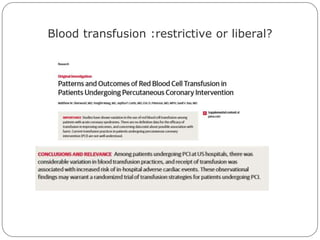
Blood transfusion :restrictive or liberal?
⚫A 28-year-old lady woman referred in extremis to
the ICU team 6 days after admission to the
gastroenterology ward for investigation and
management of weight loss. On review she was
drowsy, but oriented and found to be in type 1
respiratory failure, requiring 15 litres of oxygen via
a non-rebreathing face mask. She was in
uncontrolled atrial fibrillation (AF) with a rate of
140 bpm, profoundly hypotensive with a prolonged
capillary refill time of 4 seconds and was oligo-
anuric. Further clinical examination revealed
normal heart sounds, reduced breath sounds
bibasally, pitting oedema peripherally, but no calf
tenderness. Abdominal examination was
unremarkable.
⚫ The ward team had performed a fluid challenge
with little improvement in her clinical state and
initiated treatment with broad spectrum antibiotics
for a possible hospital acquired pneumonia.
⚫ Full blood count (FBC) had shown a normocytic,
normochromic anaemia, with normal white cell
count (WCC). Biochemistry had shown sodium,
potassium, magnesium and phosphate levels to be
at the lower end of the normal range, but renal
function was otherwise normal and apart from an
albumin level of 30 g/L, her liver function was
normal.
⚫ Blood gas results taken after clinical deterioration
showed her to be in type 1 respiratory failure, have
a metabolic acidosis with a base deficit of 10, and a
lactate of 5 mmol/l.
⚫On further review of the notes, it was
established that her admission body mass
index (BMI) was 12 kg/m2. Gastro-intestinal
investigations into the cause of weight loss
had been unremarkable. Nursing
observations confirmed poor nutritional
intake and a possible diagnosis of anorexia
nervosa were being explored. Twenty-four
hours before the current deterioration, B
vitamins had been given and nasogastric
feeding started (at 10 kcal/kg/24 hrs). A
dextrose infusion which had been begun
following an episode of low blood sugar was
continued after the enteral feed began.
⚫WHATS THE
DIAGNOSIS?
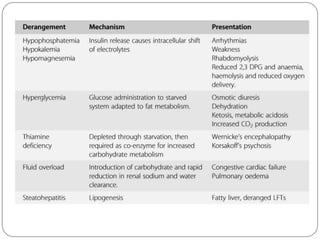
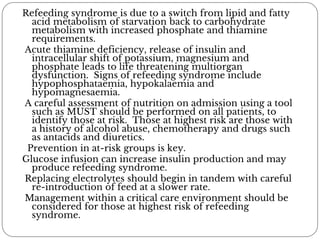
Refeeding syndrome is due to a switch from lipid and fatty
acid metabolism of starvation back to carbohydrate
metabolism with increased phosphate and thiamine
requirements.
Acute thiamine deficiency, release of insulin and
intracellular shift of potassium, magnesium and
phosphate leads to life threatening multiorgan
dysfunction. Signs of refeeding syndrome include
hypophosphataemia, hypokalaemia and
hypomagnesaemia.
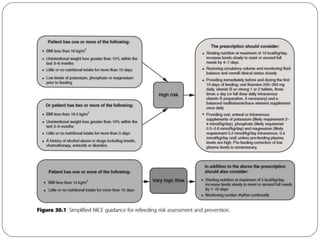
A careful assessment of nutrition on admission using a tool
such as MUST should be performed on all patients, to
identify those at risk. Those at highest risk are those with
a history of alcohol abuse, chemotherapy and drugs such
as antacids and diuretics.
Prevention in at-risk groups is key.
Glucose infusion can increase insulin production and may
produce refeeding syndrome.
Replacing electrolytes should begin in tandem with careful
re-introduction of feed at a slower rate.
Management within a critical care environment should be
considered for those at highest risk of refeeding
syndrome.
TAKE HOME MESSAGE
Thanks a lot for patient
hearing

Fluid Therapy in critically ill

  • 1.
    Dr (Prof) SantoshKumar Bhaskar Chief Intensivist BFH INTRAVENOUS FLUID MANAGEMENT IN CRITICAL PATIENTS AN INTERACTIVE SESSION
  • 2.
    A 53-year-old womanwith a history of uncontrolled hypertension is admitted to the ICU with subarachnoid hemorrhage. She has had endovascular coiling of an anterior communicating artery aneurysm. On post-procedure day 4, she becomes acutely confused and lethargic. On evaluation of the patient, you find her vital signs to be the following: temperature 37.5°C, HR 110 beats/minute, BP 150/90 mm Hg, RR 16 breaths/min, 02 saturation 98% on 2L/min oxygen by nasal cannula. She is somnolent, oriented only to person, and has a GCS of E3 V4 M6 (13). She has no focal neurologic deficits. Her mucous membranes are dry, her urine output has been 25 mL/h in the past 2 hours, and her CVP is 5. While awaiting a repeat CT scan of the head, laboratory values return and reveal serum sodium of 128 mmol/L and serum osmolarity of 260 mOsm/kg water. What is your next step in management of this patient?
  • 3.
    A. Fluid boluswith 3% NS. B. Fluid bolus with 0.9% NS. C. Fluid restriction. D. Give demeclocycline. E. Give the patient salt tabs to take PO. F. Urgent hemodialysis. 26
  • 4.
    An otherwise healthy40-year-old woman with a history of remote appendectomy is postoperative day 5 after an exploratory laparotomy and adhesiolysis for complete bowel obstruction. Yesterday, her nasogastric tube was removed and she was started on a clear liquid diet. You are notified by her nurse to evaluate her for altered mental status. Upon your evaluation, she is confused and agitated. Her vital signs are stable and normal. She is clinically euvolemic and weighs 60 kg. Laboratory testing reveals a serum sodium concentration of 122 mmol/L and serum osmolarity of 240 mOsm/kg water. You decide to correct her hyponatremia using 3% saline. At what rate will you run your infusion for the next 12 to 24 hours?
  • 5.
    ⚫A. 33 mL/h. ⚫B.66 mL/h. ⚫C. 100 mL/h. ⚫D. Give the infusion as a bolus over 1 hour. ⚫ E. 133 mL/h.
  • 6.
    3% Saline= 513mmol/L of sodium Patient's serum sodium= 122 mmol/L TBW=30 Change in serum [Na] = (513 - 122)/(30 + 1) = 12.7 mmol A safe target for correction of serum sodium is 10 mmol in 24 hours. For this patient, a correction of 10 mmol would take 790 mL ( 10/12.7 =. 79). To infuse 790 mL over 24 hours would take a rate of 33 mL/h
  • 7.
  • 8.
  • 9.
    Transcellular fluid: the“everything else” ⮚ Synovial fluid ⮚ CSF ⮚ Aqueous humour ⮚ Bile ⮚ Bowel contents ⮚ Peritoneal fluid ⮚ Pleural fluid ⮚ Urine in the bladder ⚫ This fluid is formed by the secretory activity of cells, and communicates with the intracellular fluid, rather than the interstitial fluid. ⚫ It exists within epithelium-lined spaces.
  • 15.
  • 16.
    Content: Sodium :154 mmol/L Chloride:154mmol/L measured osmolarity:286 msom/L calculated osmolarity:308msom/l
  • 17.
    Content Sodium:131 mmol/L Chloride:111 mmol/L Potassium:5mmol/L Calcium:2 mmol/L Bicarbonate(lactate):29 mmol/L Osmolarity:278mosm/L
  • 18.
    Content Sodium :37mmol/L Chloride :37mmol/L Potassium : 35 mmol/L Acetate: 20 mmol/L Phosphate :7.5 mmol/L Dextrose:50 gm/L Osmolarity:415.5 mosm/L
  • 19.
  • 21.
    ⚫How to decideabout the amount of fluid resuscitation while resuscitating?
  • 23.
  • 24.
    ⚫WHAT FLUID TO GIVEIN HYPERKALEMIA?
  • 25.
    An 18-year-old gentlemanis intubated and sedated in your ICU following an exploratory laparotomy for multiple gunshot wounds to the abdomen. On postoperative day 1, morning labs reveal a serum potassium concentration of 6.2 mmol/L. Which of the following is the LEAST IMPORTANT part of your initial evaluation and management of this patient?
  • 26.
    A.Repeat potassium measurement B.12-lead ECG C. Infusion of calcium gluconate D. Treatment with insulin and glucose E. Fluid bolus with 0.9% saline
  • 27.
  • 28.
  • 29.
  • 30.
    What fluid togive in hyperkalemia?
  • 31.
    What fluid togive in hyperkalemia?
  • 32.
    What fluid togive in hyperkalemia?
  • 33.
    What should bethe resuscitation fluid?
  • 34.
    A 77-year-old manwhose medical history includes treated hypertension and hypercholesterolemia, previous heavy alcohol intake, and mild cognitive impairment is admitted to the intensive care unit (ICU) of a hospital from the operating room after a Hartmann’s procedure performed for fecal peritonitis caused by a perforated sigmoid colon. He has received a total of 4 liters of crystalloid fluids, which were administered in the operating room.
  • 35.
    On arrival inthe ICU, the arterial blood pressure is 88/52 mm Hg with marked respiratory variation, the heart rate is 120 beats per minute in sinus rhythm, the central venous pressure is 6 mm Hg, and the temperature is 35.6°C. He is peripherally cool, with prolonged capillary refill. Arterial blood gas results while the patient is receiving mechanical ventilation with a fraction of inspired oxygen of 0.4 are as follows: pH, 7.32; partial pressure of carbon dioxide, 28 mm Hg; partial pressure of oxygen, 85 mm Hg; and lactate, 3.0 mmol per liter. Results of serum biochemical analysis are as follows: sodium, 142 mmol per liter; potassium, 4.4 mmol per liter; chloride, 109 mmol per liter; urea, 22.0 mg per deciliter (7.9 mmol per liter); creatinine, 2.3 mg per deciliter (203 µmol per liter); and albumin, 23 g per liter. The urine output during the last 2 hours in the operating room was 28 ml
  • 36.
    Assessing the patientto have inadequate intravascular volume, what option for fluid resuscitation would you choose to be administered over the next 30 minutes to one hour? A. A total of 1 liter of normal saline (0.9% sodium chloride). B.A total of 1 liter of Ringer’s lactate (Hartmann’s solution). C. A total of 500 ml of 6% hydroxyethyl starch (130/0.42). D. A total of 500 ml of 4% human albumin solution.
  • 37.
    ⚫A 77-year oldman is in the ICU with septic shock and is on mechanical ventilation. Despite administration of 4 liters of crystalloid, he remains hypotensive with signs of inadequate intravascular volume. What should be administered next?
  • 40.
    What should bethe resuscitation fluid?
  • 41.
    What should bethe resuscitation fluid?
  • 42.
    What should bethe resuscitation fluid?
  • 43.
    What should bethe resuscitation fluid?
  • 44.
    What should bethe resuscitation fluid?
  • 45.
    What should bethe resuscitation fluid?
  • 46.
    What should bethe resuscitation fluid?
  • 47.
  • 48.
    ALBIOS TRIAL ANDSUBGROUP ANALYSIS ⚫.
  • 49.
  • 50.
  • 51.
    ⚫A 28-year-old ladywoman referred in extremis to the ICU team 6 days after admission to the gastroenterology ward for investigation and management of weight loss. On review she was drowsy, but oriented and found to be in type 1 respiratory failure, requiring 15 litres of oxygen via a non-rebreathing face mask. She was in uncontrolled atrial fibrillation (AF) with a rate of 140 bpm, profoundly hypotensive with a prolonged capillary refill time of 4 seconds and was oligo- anuric. Further clinical examination revealed normal heart sounds, reduced breath sounds bibasally, pitting oedema peripherally, but no calf tenderness. Abdominal examination was unremarkable.
  • 52.
    ⚫ The wardteam had performed a fluid challenge with little improvement in her clinical state and initiated treatment with broad spectrum antibiotics for a possible hospital acquired pneumonia. ⚫ Full blood count (FBC) had shown a normocytic, normochromic anaemia, with normal white cell count (WCC). Biochemistry had shown sodium, potassium, magnesium and phosphate levels to be at the lower end of the normal range, but renal function was otherwise normal and apart from an albumin level of 30 g/L, her liver function was normal. ⚫ Blood gas results taken after clinical deterioration showed her to be in type 1 respiratory failure, have a metabolic acidosis with a base deficit of 10, and a lactate of 5 mmol/l.
  • 53.
    ⚫On further reviewof the notes, it was established that her admission body mass index (BMI) was 12 kg/m2. Gastro-intestinal investigations into the cause of weight loss had been unremarkable. Nursing observations confirmed poor nutritional intake and a possible diagnosis of anorexia nervosa were being explored. Twenty-four hours before the current deterioration, B vitamins had been given and nasogastric feeding started (at 10 kcal/kg/24 hrs). A dextrose infusion which had been begun following an episode of low blood sugar was continued after the enteral feed began.
  • 54.
  • 57.
    Refeeding syndrome isdue to a switch from lipid and fatty acid metabolism of starvation back to carbohydrate metabolism with increased phosphate and thiamine requirements. Acute thiamine deficiency, release of insulin and intracellular shift of potassium, magnesium and phosphate leads to life threatening multiorgan dysfunction. Signs of refeeding syndrome include hypophosphataemia, hypokalaemia and hypomagnesaemia. A careful assessment of nutrition on admission using a tool such as MUST should be performed on all patients, to identify those at risk. Those at highest risk are those with a history of alcohol abuse, chemotherapy and drugs such as antacids and diuretics. Prevention in at-risk groups is key. Glucose infusion can increase insulin production and may produce refeeding syndrome. Replacing electrolytes should begin in tandem with careful re-introduction of feed at a slower rate. Management within a critical care environment should be considered for those at highest risk of refeeding syndrome.
  • 58.
  • 64.
    Thanks a lotfor patient hearing