Customer Service
Customer Service Tip to Live by:
Treat each person as if your
 whole year’s salary depended on
 their happiness.
Customer Loyalty
The average business spends 6x more to attract new
  customers than it does to keep the old ones. Yet, customer
  loyalty is worth 10x the price of a single purchase.
Put Yourself in the Patient’s Shoes- “Open”
Initial Contact
Be positive and devote all attention to them.
Let them talk about their favorite subject-themselves.
 Carefully listen to statements, questions, and feelings.
Maintain eye contact and show empathy for their concerns.
Value their presence-make them feel important.
Key points to “Open”:
Exude an air of confidence.
Use your patient’s name.
Introduce yourself to your patients.
Put a smile on your face and on the phone as well!
Keep your skills updated.
Make eye contact.
Listen.
Your Voice
The energy in your voice reflects your attitude and
 enthusiasm.
People make up their minds in the first 15 seconds if they
 like you or not, this decision of you is directly related to the
 success of your business.
We all do marketing everyday!!
PR doesn’t always mean public relations but also patient
 relations
What is customer service? Relationship pampering
Quote of the Day
“It’s surprising how much you can accomplish if you don’t
  care who gets the credit.”
                               Abraham Lincoln
Changing Mindsets
“If you always do, what you’ve always done, you’ll always
 get, what you’ve always got.”
Daily Ask Yourself 3 questions:
  Do I choose to innovate?
  Do I choose to imitate?
  Or do I choose to vegetate?
  And if you vegetate, prepare to abdicate (to give up
    authorities/duties).
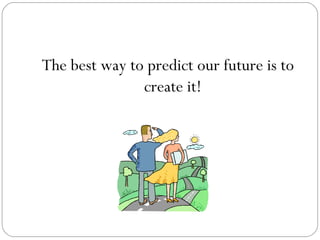
The best way to predict our future is to
               create it!
Why Professional Behavior?
The patient is seeking a professional opinion and is paying for
 this opinion.
It is 6 to 10 times more expensive to gain a patient than to
 keep one.
Once you have them in the door, KEEP THEM!
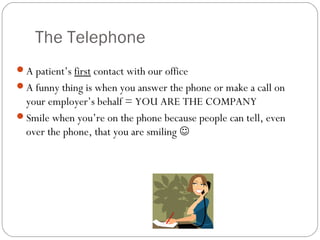
The Telephone
A patient’s first contact with our office
A funny thing is when you answer the phone or make a call on
 your employer’s behalf = YOU ARE THE COMPANY
Smile when you’re on the phone because people can tell, even
 over the phone, that you are smiling 
Telephone Techniques
Name of clinic or department and your name
How may I direct your call? How may I help you?
Talk slowly and clearly
Telephone Techniques (cont.)
Give the caller your undivided attention
Concentrate- LISTEN to what the patient is asking


Give the patient choices
Don’t just transfer a call - explain to the patient what may
  happen – e.g. voice mail
When patients call with questions
Do not keep them on hold for long periods of time.
If an answer cannot be given timely, return the call,
 timely.
Provide accurate information. If you don’t know, then
 tell them “I don’t know, but I’ll glad to find out the
 answer for you.”
Always be polite and friendly.
Respond quickly to all insurance and financial inquiries.
Specific Patient questions
When checking on things for callers –
Answer: ask them if they want to hold or offer to take
 their name & number for you to call them back .

When asked “How much is LHR treatment at your
 office?”
Answer: “We customize our treatments according to our
 patients’ needs. So we’d like for you to come in so that
 we can see the area you’d like to have treated and we
 can discuss the procedure and prices with you then.”
Message Taking
Get Enough Information
  - Patient name, DOB, phone number(s)
  - Your name, date and time
Check voicemail frequently – include provisions for emergencies
 on voicemail instructions.
Return calls promptly, at least twice a day
Failure to return phone call- perception of indifference, legal
 ramifications
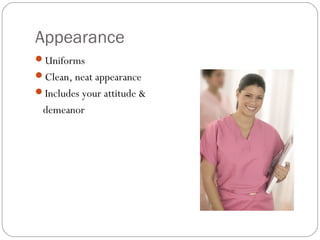
Appearance
Uniforms
Clean, neat appearance
Includes your attitude &
 demeanor
Attitude
Courteous – remain polite at all times
Respectful – to patients and coworkers
Attentive – give patient your undivided attention
Helpful – a little extra goes a long way
Demeanor
Make eye contact – DO NOT ignore the patient
Address adult patient by their last name
Address the doctor and supervisor by his professional name
Demeanor (cont.)
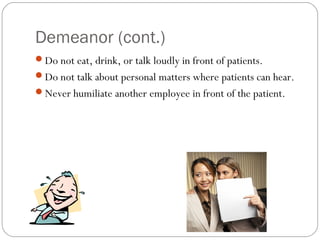
Do not eat, drink, or talk loudly in front of patients.
Do not talk about personal matters where patients can hear.
Never humiliate another employee in front of the patient.
How is Etiquette Shown?
Body Language        Speech and wording
Facial Expressions   Giving of our time
Introductions         Tone
Gestures              Appearance
Listening             Actions
Eye Contact           Attitude
Greeting your Patient
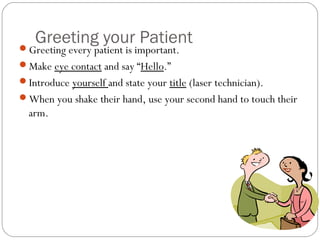
Greeting every patient is important.
Make eye contact and say “Hello.”
Introduce yourself and state your title (laser technician).
When you shake their hand, use your second hand to touch their
  arm.
Patient Chart is a legal document
Write legibly in space provided
One line through error
Spell correctly
Be as accurate as possible
Never alter medical records after the fact
Release of Information
NEVER release information to third party over
 phone.
Get request in writing.
NEVER leave test results on answering machine.
Give test results to patient only (or legal guardian if minor).
The Angry, Unhappy Patient
Do not interrupt- LISTEN!


Even if you know the patient is wrong, DO NOT ARGUE!


The patient is always right.
Diffuse Patient Anger
Apologize for the service breakdown
Don’t tell the patient he is wrong.
e.g. “Mrs. Smith, you may be right about that. Let’s take a look
  at it.”
If necessary to disagree, contradict the facts, not the patient
  himself.
The Angry Patient
Examine the cause(s) of complaint, work to eliminate the
 causes.
If situation escalates to “fight”, have fellow employee step in
 to diffuse situation.
Call Supervisor
Why do patients leave a Practice?
62% perceive an “attitude of indifference”
How does Indifference occur?

Unkept promises
Rude people
No one listened to me
Staff has “can’t do” attitude
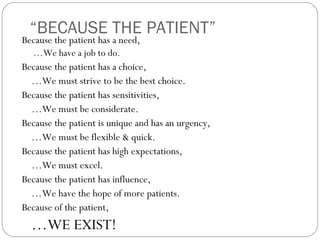
“BECAUSE THE PATIENT”
Because the patient has a need,
  …We have a job to do.
Because the patient has a choice,
  …We must strive to be the best choice.
Because the patient has sensitivities,
  …We must be considerate.
Because the patient is unique and has an urgency,
  …We must be flexible & quick.
Because the patient has high expectations,
  …We must excel.
Because the patient has influence,
  …We have the hope of more patients.
Because of the patient,
  …WE EXIST!
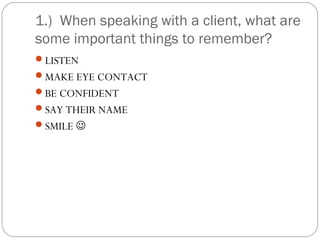
1.) When speaking with a client, what are
some important things to remember?
LISTEN
MAKE EYE CONTACT
BE CONFIDENT
SAY THEIR NAME
SMILE 
2.) How do you greet a patient?
Make eye contact and say “Hello.”
Introduce yourself and state your title (laser technician).
When you shake their hand, use your second hand to touch
  their arm.
3.) What are 5 important guidelines to
follow when charting?
Write legibly
One line through error
Spell correctly
Be accurate
Never alter medical records after the fact
4.) How do you handle an angry client?
Do not argue with them.
Do not interrupt them.
Apologize.
Work to eliminate the causes of the problem.
If necessary, call a supervisor.
6.) What are the 4 rules on releasing
information?
NEVER to a third party over the phone.
NEVER leave test results on answering machine.
Get request in writing.
Give test results to patient only (or legal guardian if minor).

N customer service

  • 1.
  • 2.
    Customer Service Tipto Live by: Treat each person as if your whole year’s salary depended on their happiness.
  • 3.
    Customer Loyalty The averagebusiness spends 6x more to attract new customers than it does to keep the old ones. Yet, customer loyalty is worth 10x the price of a single purchase.
  • 4.
    Put Yourself inthe Patient’s Shoes- “Open” Initial Contact Be positive and devote all attention to them. Let them talk about their favorite subject-themselves. Carefully listen to statements, questions, and feelings. Maintain eye contact and show empathy for their concerns. Value their presence-make them feel important.
  • 5.
    Key points to“Open”: Exude an air of confidence. Use your patient’s name. Introduce yourself to your patients. Put a smile on your face and on the phone as well! Keep your skills updated. Make eye contact. Listen.
  • 6.
    Your Voice The energyin your voice reflects your attitude and enthusiasm. People make up their minds in the first 15 seconds if they like you or not, this decision of you is directly related to the success of your business.
  • 7.
    We all domarketing everyday!! PR doesn’t always mean public relations but also patient relations What is customer service? Relationship pampering
  • 8.
    Quote of theDay “It’s surprising how much you can accomplish if you don’t care who gets the credit.” Abraham Lincoln
  • 9.
    Changing Mindsets “If youalways do, what you’ve always done, you’ll always get, what you’ve always got.” Daily Ask Yourself 3 questions: Do I choose to innovate? Do I choose to imitate? Or do I choose to vegetate? And if you vegetate, prepare to abdicate (to give up authorities/duties).
  • 10.
    The best wayto predict our future is to create it!
  • 11.
    Why Professional Behavior? Thepatient is seeking a professional opinion and is paying for this opinion. It is 6 to 10 times more expensive to gain a patient than to keep one. Once you have them in the door, KEEP THEM!
  • 12.
    The Telephone A patient’sfirst contact with our office A funny thing is when you answer the phone or make a call on your employer’s behalf = YOU ARE THE COMPANY Smile when you’re on the phone because people can tell, even over the phone, that you are smiling 
  • 13.
    Telephone Techniques Name ofclinic or department and your name How may I direct your call? How may I help you? Talk slowly and clearly
  • 14.
    Telephone Techniques (cont.) Givethe caller your undivided attention Concentrate- LISTEN to what the patient is asking Give the patient choices Don’t just transfer a call - explain to the patient what may happen – e.g. voice mail
  • 15.
    When patients callwith questions Do not keep them on hold for long periods of time. If an answer cannot be given timely, return the call, timely. Provide accurate information. If you don’t know, then tell them “I don’t know, but I’ll glad to find out the answer for you.” Always be polite and friendly. Respond quickly to all insurance and financial inquiries.
  • 16.
    Specific Patient questions Whenchecking on things for callers – Answer: ask them if they want to hold or offer to take their name & number for you to call them back . When asked “How much is LHR treatment at your office?” Answer: “We customize our treatments according to our patients’ needs. So we’d like for you to come in so that we can see the area you’d like to have treated and we can discuss the procedure and prices with you then.”
  • 17.
    Message Taking Get EnoughInformation - Patient name, DOB, phone number(s) - Your name, date and time Check voicemail frequently – include provisions for emergencies on voicemail instructions. Return calls promptly, at least twice a day Failure to return phone call- perception of indifference, legal ramifications
  • 18.
  • 19.
    Attitude Courteous – remainpolite at all times Respectful – to patients and coworkers Attentive – give patient your undivided attention Helpful – a little extra goes a long way
  • 20.
    Demeanor Make eye contact– DO NOT ignore the patient Address adult patient by their last name Address the doctor and supervisor by his professional name
  • 21.
    Demeanor (cont.) Do noteat, drink, or talk loudly in front of patients. Do not talk about personal matters where patients can hear. Never humiliate another employee in front of the patient.
  • 22.
    How is EtiquetteShown? Body Language Speech and wording Facial Expressions Giving of our time Introductions  Tone Gestures  Appearance Listening  Actions Eye Contact  Attitude
  • 23.
    Greeting your Patient Greetingevery patient is important. Make eye contact and say “Hello.” Introduce yourself and state your title (laser technician). When you shake their hand, use your second hand to touch their arm.
  • 24.
    Patient Chart isa legal document Write legibly in space provided One line through error Spell correctly Be as accurate as possible Never alter medical records after the fact
  • 25.
    Release of Information NEVERrelease information to third party over phone. Get request in writing. NEVER leave test results on answering machine. Give test results to patient only (or legal guardian if minor).
  • 26.
    The Angry, UnhappyPatient Do not interrupt- LISTEN! Even if you know the patient is wrong, DO NOT ARGUE! The patient is always right.
  • 27.
    Diffuse Patient Anger Apologizefor the service breakdown Don’t tell the patient he is wrong. e.g. “Mrs. Smith, you may be right about that. Let’s take a look at it.” If necessary to disagree, contradict the facts, not the patient himself.
  • 28.
    The Angry Patient Examinethe cause(s) of complaint, work to eliminate the causes. If situation escalates to “fight”, have fellow employee step in to diffuse situation. Call Supervisor
  • 29.
    Why do patientsleave a Practice? 62% perceive an “attitude of indifference”
  • 30.
    How does Indifferenceoccur? Unkept promises Rude people No one listened to me Staff has “can’t do” attitude
  • 31.
    “BECAUSE THE PATIENT” Becausethe patient has a need, …We have a job to do. Because the patient has a choice, …We must strive to be the best choice. Because the patient has sensitivities, …We must be considerate. Because the patient is unique and has an urgency, …We must be flexible & quick. Because the patient has high expectations, …We must excel. Because the patient has influence, …We have the hope of more patients. Because of the patient, …WE EXIST!
  • 32.
    1.) When speakingwith a client, what are some important things to remember? LISTEN MAKE EYE CONTACT BE CONFIDENT SAY THEIR NAME SMILE 
  • 33.
    2.) How doyou greet a patient? Make eye contact and say “Hello.” Introduce yourself and state your title (laser technician). When you shake their hand, use your second hand to touch their arm.
  • 34.
    3.) What are5 important guidelines to follow when charting? Write legibly One line through error Spell correctly Be accurate Never alter medical records after the fact
  • 35.
    4.) How doyou handle an angry client? Do not argue with them. Do not interrupt them. Apologize. Work to eliminate the causes of the problem. If necessary, call a supervisor.
  • 36.
    6.) What arethe 4 rules on releasing information? NEVER to a third party over the phone. NEVER leave test results on answering machine. Get request in writing. Give test results to patient only (or legal guardian if minor).