Providing Exceptional Customer Service Performance Improvement & Quality Staff Maintenance & Logistics Command Atlantic
The Basics Just what is this thing called “satisfaction”?
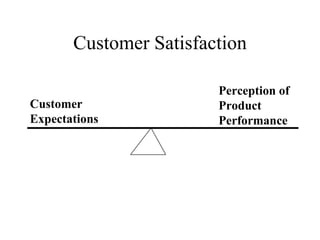
Customer Satisfaction Customer Expectations Perception of Product Performance
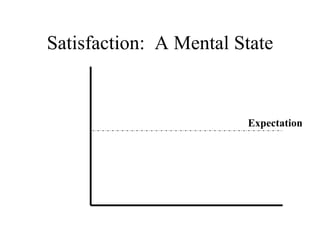
Satisfaction:  A Mental State Expectation
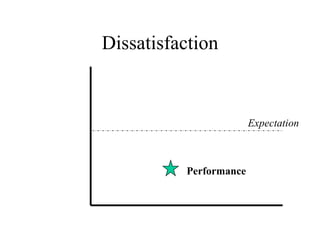
Dissatisfaction Expectation Performance
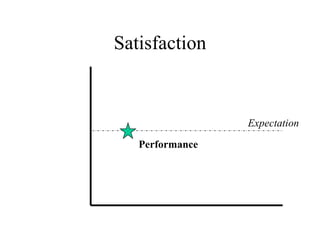
Satisfaction Expectation Performance
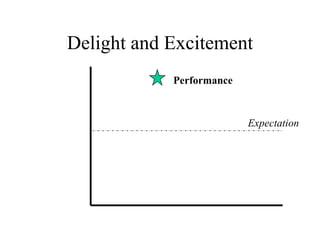
Delight and Excitement Expectation Performance
Customer Expectations Change over time E X P E C T A T I O N S T I M E
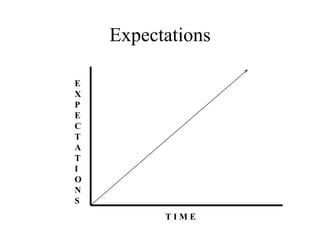
Expectations E X P E C T A T I O N S T I M E
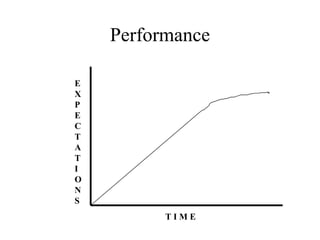
Performance E X P E C T A T I O N S T I M E
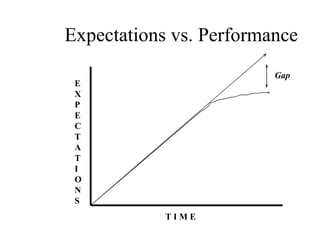
Expectations vs. Performance E X P E C T A T I O N S T I M E Gap
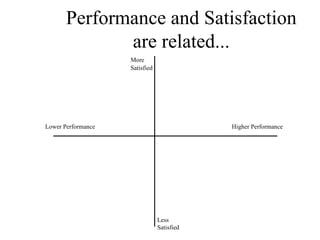
Performance and Satisfaction are related... Lower Performance Higher Performance More Satisfied Less Satisfied
“Basic Satisfaction” Expected A dissatisfier, if not delivered “ Givens” Very basic
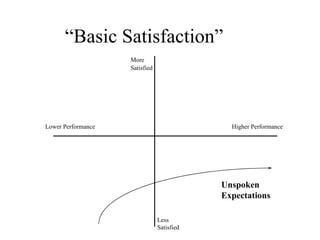
“Basic Satisfaction” Lower Performance Higher Performance More Satisfied Less Satisfied Unspoken Expectations
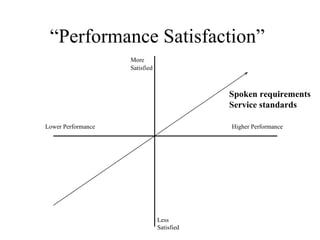
“Performance Satisfaction” Satisfaction is directly related to performance. Based on performance factors. Service standards are key to performance satisfaction.
“Performance Satisfaction” Lower Performance Higher Performance More Satisfied Less Satisfied Spoken requirements Service standards
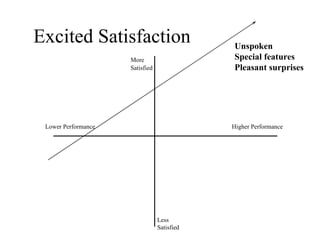
“Exciting Satisfaction” Customers don’t know about these. Creativity and innovation provide exciting satisfaction. The “bar” continually rises.
Excited Satisfaction Lower Performance Higher Performance More Satisfied Less Satisfied Unspoken Special features Pleasant surprises
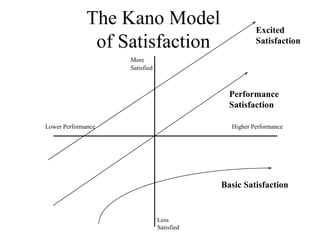
The Kano Model of Satisfaction Lower Performance Higher Performance More Satisfied Less Satisfied Basic Satisfaction Performance Satisfaction Excited Satisfaction
Things to think about What are these customers looking for?
Three Things to Consider Expand your definition of Service. Reconsider who your customers are. Develop a customer friendly attitude.
Just who are your customers ? Three types of customers: End-users Brokers Fixers The customer chain...
Develop a Customer-Friendly Attitude Two common threads: Communicating with other people Establishing Relationships Strive for instant connections Remember the “moment of truth”
Self Evaluation Answer the ten questions to see what level of customer service you provide.  Step back and objectively assess yourself to see where your service strengths and weaknesses are.
Who Determines Excellence? The  customer  is the rater…
The customer’s experience can be described in five dimensions: R eliability A ssurance T angibles E mpathy R esponsiveness
What Americans say good service means Americans want the following from their government: Fast, accurate assistance Provide reliable, timely help Readily available help Make it easy Options for where and how to get services Don’t tell us “That’s not my department.”
And still they want... Americans want their government to provide: Clear advice, letters, and publications Ask us what we want -- then listen and deliver Friendly treatment Treat us with courtesy, respect, and enthusiasm
“ Washrooms… will always tell if your company cares about its customers.” Ken Blanchard in  Raving Fans
Body Language The non-verbals…   reveal thoughts and feelings
How we receive “messages” 55% of what we learn comes from body language 38% comes from tone of voice 7% comes from the words
Primary aspects of body language Eye Contact Facial expressions Body posture and movement Hand gestures Touching Physical distance
Body Language Cultural differences...
Eye Contact Very powerful; Shows interest and attentiveness; Effective eye contact  Put soft focus on other person’s face Focus on whole face, not just the eyes Look away from time to time
Facial Expressions Your face is a billboard to those around you. Your face can set a positive tone before you utter a word. Adjust your facial expression to suit the customer’s state of mind and the situation.
Body Posture and Movement Body posture and movement show energy and interest… Signals that “it’s over”… leaning back or stepping away turning body away gathering up papers looking at watch pushing away from desk or table
Show with your body... That you are intently listening: Nod Face the customer Lean forward
Hand Gestures Using your hands when you talk is natural. So… Be natural. Your gestures should not distract from the conversation.
Hands with objects… Placing cap on a pen & putting it in a pocket Readiness to conclude meeting or conversation Tapping fingers Impatience or frustration Repeatedly clicking a ball point pen Either uneasiness or deep thought Rattling loose change in pocket Anxious and ready to move on
Hands alone... Open-hand gestures (flat hand, palm up, or palm out) When used to give directions, convey an invitation to move or look A more gracious and softer way of pointing
Those darn hands... Closed-hand gestured (pointing with index finger) Can be construed as a command, rather than an invitation. Considered rude and intimidating when directed at another person. Often communicates hostility or anger.
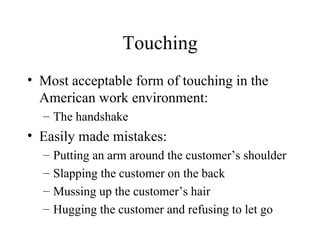
Touching Most acceptable form of touching in the American work environment: The handshake Easily made mistakes: Putting an arm around the customer’s shoulder Slapping the customer on the back Mussing up the customer’s hair Hugging the customer and refusing to let go
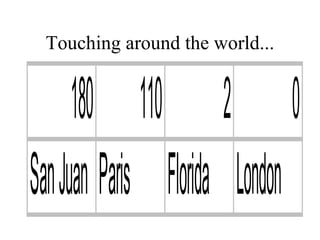
Touching around the world...
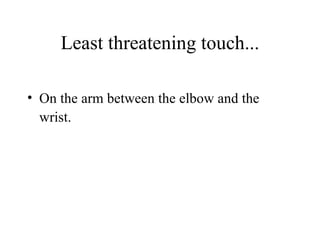
Least threatening touch... On the arm between the elbow and the wrist.
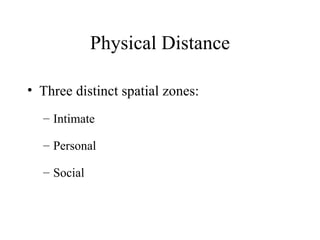
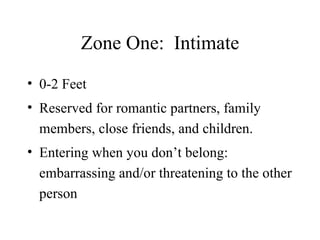
Physical Distance Three distinct spatial zones: Intimate Personal Social
Zone One:  Intimate 0-2 Feet Reserved for romantic partners, family members, close friends, and children. Entering when you don’t belong:  embarrassing and/or threatening to the other person
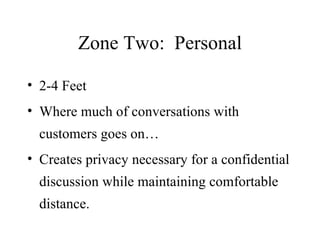
Zone Two:  Personal 2-4 Feet Where much of conversations with customers goes on… Creates privacy necessary for a confidential discussion while maintaining comfortable distance.
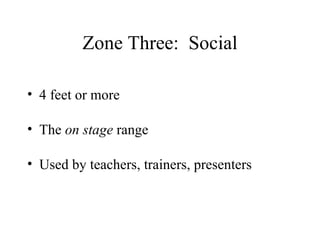
Zone Three:  Social 4 feet or more The  on stage  range Used by teachers, trainers, presenters
One Last thing... Neatness counts in how we look and how our work area looks
Tone of Voice
When you pick up the phone The tone of voice becomes the majority of the message... 86% of the message received is through tone of voice 14% through the actual words
Three things to help you become a winner on the telephone... Inflection Volume control Pacing the customer
Inflection… and things you can do The wave-like movement of highs and low in pitch… the peaks and valleys in your voice that lets people know how interested you are. To improve the quality of inflection: Smile when talking on the phone Practice stressing words Breathe (deep, long, and slow) Exaggerate your tone
Voice volume Be appropriate. Sometimes softness can speak louder than yelling.
Pacing Matching the other person’s rate of speach and intensity of feeling. Focus on the similarities.
Intensity of voice The strength of emotion that is projected along with the words you’re saying. Match, appropriately, the customers intensity to show you understand. Don’t confuse intensity with volume
Go for the Gold Ask yourself Did I speak with inflection to show interest and concern? Did I use a level of volume that gained the customer’s attention? Did I pace the customer by adjusting my rate of speech to match his or hers? Did I pace the customer by matching my intensity to match his or hers?
Telephone &  Voice Mail Etiquette
A test... Test your telephone etiquette IQ.
How to answer the phone Pick up the phone within three rings. Greet the caller. Give you name. Ask the customer if you can help.
How to put a customer on hold Ask the customers if you may put them on hold. Wait for a response. Tell customers why they are being put on hold. Give a time frame. Thank customers for holding after returning to the line
How to transfer a call Explain why the caller is being transferred and to whom. Ask the customer if he or she minds being transferred. Make sure someone is there to pick up the call before you hang up. Tell the person to whom you are transferring the call the caller’s name and the nature of the call.
How to take a message Explain your co-worker’s absence in a positive light. Inform callers of the availability of the person they want to talk to before asking for their name. Give an estimated time of your co-worker’s return. Offer to help the person yourself. take a message, or transfer to another person. Write down all important information and attach any pertinent files.
How to end the call Repeat any action steps you are going to take. Ask the caller if there is anything else you can do for him or her. Thank the customer for calling; let him know that you appreciate his bring the problem (if there was one) to your attention.
More things to do to end the call Let the caller hang up first so that she doesn’t accidently get cut off in the middle of a sentence. Write down any important information as soon as you get off the phone.
Voice mail objections... Will our customers object to talking to a machine? Won’t it remove the personal touch that we’ve always considered important? What if people don’t return their voice mail messages promptly?
The up side to voice mail Voice mail saves time. Customers can leave detailed information that the staff person can act on before calling the customer back. Voice mail increases productivity by allowing you to switch it on when you are having a meeting or discussion in your office.
Enhance the use of voice by... Returning all voice mail messages within 24 hours. Always answsering your own phone (when at your desk and not in a meeting) rather than letting v-mail do the job. Changing your voice mail message if you are going to be out of the office for more than one day.
Voice mail is a tool... It’s not inherently good or bad. Don’t use voice mail to avoid dealing with your customers. Do use voice mail as a way of making yourself more accessible and responsive.
The Extra Mile
Sometimes things go wrong... A deadline is missed An order is incorrectly filled The customer is treated rudely or unprofessionally The customer is given incorrect information The customer is unhappy with the product or service
When things go wrong... Say you are sorry Fix the problem Give the customer a care token
When You Can’t Say “Yes”
Sometimes you have to say no Federal regulations The law Coast Guard or unit policies and procedures Out of stock Just not possible
Six basic needs Friendliness Understanding and empathy Fairness Control Options and alternatives Information
Two ways to say “no” The hard no “ That’s not our policy.” “ That’s not my job.” “ I’m not allowed to do that.” “ I have no idea.” A blank stare. Distracted fidgeting Look away eyes or...
The service “no” Make “no” sound like “yes” Use the “service no” sandwich What I will do is… What you can do is...
Dealing with Difficult People
Six steps to get through the times  Let the customer vent. Avoid getting trapped in a negative filter. Express empathy to the customer. Begin active problem solving. Mutually agree on the solution. Follow up.
Let the customer vent Zip your lip Don’t take it personally
Avoid getting trapped in a negative filter A negative filter is born I’d rather switch than fight Ask yourself, “What does this customer need and how can I provide it?”
Express empathy to the customer Use empathic phrases I can see why you feel that way. I see what you mean. That must be very upsetting. I understanding how frustrating this must be. I’m sorry about this Empathy means always having to say you’re sorry.
Begin active problem solving Gather any additional information you need. Double check all the facts.
Mutually agree on the solution Don’t promise what you can’t deliver. Try to under promise and over deliver.
Follow up Score points by following up with your customer by phone, e-mail, or letter. If the customer is still not satisfied, continue to find a another, more workable solution.
Ten Habits to Develop Maintain a consistently high level of customer service with these habits...
Get into these habits... Be on time Follow up on your promises Under promise and over deliver Go the extra mile Offer your customers options
And make these comfortable, too... Express empathy Treat your customers as the most important part of your job Treat your co-workers as customers Give the customer your name and telephone number Smile and use inflection on the telephone
To eliminate bad habits… Think “What could I have done differently?” In the midst of a bad habit, stop and try something else. Think before acting; stop the bad habit before it starts...
Ten Ways to Be a Role Model Your “walk” speaks more than your “talk”
Motivate others through your own actions... Start the day off right Discuss your feelings, don’t vent them Do the right thing Support your subordinates’ and peers’ decisions Be willing not to know the answer
Others are watching you... Learn to listen Take time to socialize Use good telephone etiquette Thank your subordinates (and peers) often Say what you mean, and mean what you say
Ten Don’ts And what to do instead...
Make the right decision “ I don’t know.” “ No” “ That’s not my job.” “ You’re right -- this stinks.” “ That’s not my fault.” “ I’ll find out.” “ What I can do is…” “ This is who can help you…” “ I understand your frustration.” “ Let’s see what we can do about this.”
Always do right... “ You need to talk to my supervisor.” “ You want it by when?” “ Calm down.” “ I’m busy right now.” “ Call me back.” “ I can help you.” “ I’ll try my best.” “ I’m sorry.” “ I’ll be with you in just a moment.” “ I will call you back.”
A Dozen Ways to exceed expectations
Develop customer relationships by… Admit mistakes Ask for complaints Ask often -- what do you like that we’re doing? what can we do better? Call for no reason Create a “customer council” Cure complaints now
More things to do... Customize to their words Find unmet needs Know everything about your “business” Refer to competitors (when appropriate) Send Thank-you’s Visit (their unit)/Invite (to yours)

Providing Exceptional Customer Service

  • 1.
    Providing Exceptional CustomerService Performance Improvement & Quality Staff Maintenance & Logistics Command Atlantic
  • 2.
    The Basics Justwhat is this thing called “satisfaction”?
  • 3.
    Customer Satisfaction CustomerExpectations Perception of Product Performance
  • 4.
    Satisfaction: AMental State Expectation
  • 5.
  • 6.
  • 7.
    Delight and ExcitementExpectation Performance
  • 8.
    Customer Expectations Changeover time E X P E C T A T I O N S T I M E
  • 9.
    Expectations E XP E C T A T I O N S T I M E
  • 10.
    Performance E XP E C T A T I O N S T I M E
  • 11.
    Expectations vs. PerformanceE X P E C T A T I O N S T I M E Gap
  • 12.
    Performance and Satisfactionare related... Lower Performance Higher Performance More Satisfied Less Satisfied
  • 13.
    “Basic Satisfaction” ExpectedA dissatisfier, if not delivered “ Givens” Very basic
  • 14.
    “Basic Satisfaction” LowerPerformance Higher Performance More Satisfied Less Satisfied Unspoken Expectations
  • 15.
    “Performance Satisfaction” Satisfactionis directly related to performance. Based on performance factors. Service standards are key to performance satisfaction.
  • 16.
    “Performance Satisfaction” LowerPerformance Higher Performance More Satisfied Less Satisfied Spoken requirements Service standards
  • 17.
    “Exciting Satisfaction” Customersdon’t know about these. Creativity and innovation provide exciting satisfaction. The “bar” continually rises.
  • 18.
    Excited Satisfaction LowerPerformance Higher Performance More Satisfied Less Satisfied Unspoken Special features Pleasant surprises
  • 19.
    The Kano Modelof Satisfaction Lower Performance Higher Performance More Satisfied Less Satisfied Basic Satisfaction Performance Satisfaction Excited Satisfaction
  • 20.
    Things to thinkabout What are these customers looking for?
  • 21.
    Three Things toConsider Expand your definition of Service. Reconsider who your customers are. Develop a customer friendly attitude.
  • 22.
    Just who areyour customers ? Three types of customers: End-users Brokers Fixers The customer chain...
  • 23.
    Develop a Customer-FriendlyAttitude Two common threads: Communicating with other people Establishing Relationships Strive for instant connections Remember the “moment of truth”
  • 24.
    Self Evaluation Answerthe ten questions to see what level of customer service you provide. Step back and objectively assess yourself to see where your service strengths and weaknesses are.
  • 25.
    Who Determines Excellence?The customer is the rater…
  • 26.
    The customer’s experiencecan be described in five dimensions: R eliability A ssurance T angibles E mpathy R esponsiveness
  • 27.
    What Americans saygood service means Americans want the following from their government: Fast, accurate assistance Provide reliable, timely help Readily available help Make it easy Options for where and how to get services Don’t tell us “That’s not my department.”
  • 28.
    And still theywant... Americans want their government to provide: Clear advice, letters, and publications Ask us what we want -- then listen and deliver Friendly treatment Treat us with courtesy, respect, and enthusiasm
  • 29.
    “ Washrooms… willalways tell if your company cares about its customers.” Ken Blanchard in Raving Fans
  • 30.
    Body Language Thenon-verbals… reveal thoughts and feelings
  • 31.
    How we receive“messages” 55% of what we learn comes from body language 38% comes from tone of voice 7% comes from the words
  • 32.
    Primary aspects ofbody language Eye Contact Facial expressions Body posture and movement Hand gestures Touching Physical distance
  • 33.
    Body Language Culturaldifferences...
  • 34.
    Eye Contact Verypowerful; Shows interest and attentiveness; Effective eye contact Put soft focus on other person’s face Focus on whole face, not just the eyes Look away from time to time
  • 35.
    Facial Expressions Yourface is a billboard to those around you. Your face can set a positive tone before you utter a word. Adjust your facial expression to suit the customer’s state of mind and the situation.
  • 36.
    Body Posture andMovement Body posture and movement show energy and interest… Signals that “it’s over”… leaning back or stepping away turning body away gathering up papers looking at watch pushing away from desk or table
  • 37.
    Show with yourbody... That you are intently listening: Nod Face the customer Lean forward
  • 38.
    Hand Gestures Usingyour hands when you talk is natural. So… Be natural. Your gestures should not distract from the conversation.
  • 39.
    Hands with objects…Placing cap on a pen & putting it in a pocket Readiness to conclude meeting or conversation Tapping fingers Impatience or frustration Repeatedly clicking a ball point pen Either uneasiness or deep thought Rattling loose change in pocket Anxious and ready to move on
  • 40.
    Hands alone... Open-handgestures (flat hand, palm up, or palm out) When used to give directions, convey an invitation to move or look A more gracious and softer way of pointing
  • 41.
    Those darn hands...Closed-hand gestured (pointing with index finger) Can be construed as a command, rather than an invitation. Considered rude and intimidating when directed at another person. Often communicates hostility or anger.
  • 42.
    Touching Most acceptableform of touching in the American work environment: The handshake Easily made mistakes: Putting an arm around the customer’s shoulder Slapping the customer on the back Mussing up the customer’s hair Hugging the customer and refusing to let go
  • 43.
  • 44.
    Least threatening touch...On the arm between the elbow and the wrist.
  • 45.
    Physical Distance Threedistinct spatial zones: Intimate Personal Social
  • 46.
    Zone One: Intimate 0-2 Feet Reserved for romantic partners, family members, close friends, and children. Entering when you don’t belong: embarrassing and/or threatening to the other person
  • 47.
    Zone Two: Personal 2-4 Feet Where much of conversations with customers goes on… Creates privacy necessary for a confidential discussion while maintaining comfortable distance.
  • 48.
    Zone Three: Social 4 feet or more The on stage range Used by teachers, trainers, presenters
  • 49.
    One Last thing...Neatness counts in how we look and how our work area looks
  • 50.
  • 51.
    When you pickup the phone The tone of voice becomes the majority of the message... 86% of the message received is through tone of voice 14% through the actual words
  • 52.
    Three things tohelp you become a winner on the telephone... Inflection Volume control Pacing the customer
  • 53.
    Inflection… and thingsyou can do The wave-like movement of highs and low in pitch… the peaks and valleys in your voice that lets people know how interested you are. To improve the quality of inflection: Smile when talking on the phone Practice stressing words Breathe (deep, long, and slow) Exaggerate your tone
  • 54.
    Voice volume Beappropriate. Sometimes softness can speak louder than yelling.
  • 55.
    Pacing Matching theother person’s rate of speach and intensity of feeling. Focus on the similarities.
  • 56.
    Intensity of voiceThe strength of emotion that is projected along with the words you’re saying. Match, appropriately, the customers intensity to show you understand. Don’t confuse intensity with volume
  • 57.
    Go for theGold Ask yourself Did I speak with inflection to show interest and concern? Did I use a level of volume that gained the customer’s attention? Did I pace the customer by adjusting my rate of speech to match his or hers? Did I pace the customer by matching my intensity to match his or hers?
  • 58.
    Telephone & Voice Mail Etiquette
  • 59.
    A test... Testyour telephone etiquette IQ.
  • 60.
    How to answerthe phone Pick up the phone within three rings. Greet the caller. Give you name. Ask the customer if you can help.
  • 61.
    How to puta customer on hold Ask the customers if you may put them on hold. Wait for a response. Tell customers why they are being put on hold. Give a time frame. Thank customers for holding after returning to the line
  • 62.
    How to transfera call Explain why the caller is being transferred and to whom. Ask the customer if he or she minds being transferred. Make sure someone is there to pick up the call before you hang up. Tell the person to whom you are transferring the call the caller’s name and the nature of the call.
  • 63.
    How to takea message Explain your co-worker’s absence in a positive light. Inform callers of the availability of the person they want to talk to before asking for their name. Give an estimated time of your co-worker’s return. Offer to help the person yourself. take a message, or transfer to another person. Write down all important information and attach any pertinent files.
  • 64.
    How to endthe call Repeat any action steps you are going to take. Ask the caller if there is anything else you can do for him or her. Thank the customer for calling; let him know that you appreciate his bring the problem (if there was one) to your attention.
  • 65.
    More things todo to end the call Let the caller hang up first so that she doesn’t accidently get cut off in the middle of a sentence. Write down any important information as soon as you get off the phone.
  • 66.
    Voice mail objections...Will our customers object to talking to a machine? Won’t it remove the personal touch that we’ve always considered important? What if people don’t return their voice mail messages promptly?
  • 67.
    The up sideto voice mail Voice mail saves time. Customers can leave detailed information that the staff person can act on before calling the customer back. Voice mail increases productivity by allowing you to switch it on when you are having a meeting or discussion in your office.
  • 68.
    Enhance the useof voice by... Returning all voice mail messages within 24 hours. Always answsering your own phone (when at your desk and not in a meeting) rather than letting v-mail do the job. Changing your voice mail message if you are going to be out of the office for more than one day.
  • 69.
    Voice mail isa tool... It’s not inherently good or bad. Don’t use voice mail to avoid dealing with your customers. Do use voice mail as a way of making yourself more accessible and responsive.
  • 70.
  • 71.
    Sometimes things gowrong... A deadline is missed An order is incorrectly filled The customer is treated rudely or unprofessionally The customer is given incorrect information The customer is unhappy with the product or service
  • 72.
    When things gowrong... Say you are sorry Fix the problem Give the customer a care token
  • 73.
    When You Can’tSay “Yes”
  • 74.
    Sometimes you haveto say no Federal regulations The law Coast Guard or unit policies and procedures Out of stock Just not possible
  • 75.
    Six basic needsFriendliness Understanding and empathy Fairness Control Options and alternatives Information
  • 76.
    Two ways tosay “no” The hard no “ That’s not our policy.” “ That’s not my job.” “ I’m not allowed to do that.” “ I have no idea.” A blank stare. Distracted fidgeting Look away eyes or...
  • 77.
    The service “no”Make “no” sound like “yes” Use the “service no” sandwich What I will do is… What you can do is...
  • 78.
  • 79.
    Six steps toget through the times Let the customer vent. Avoid getting trapped in a negative filter. Express empathy to the customer. Begin active problem solving. Mutually agree on the solution. Follow up.
  • 80.
    Let the customervent Zip your lip Don’t take it personally
  • 81.
    Avoid getting trappedin a negative filter A negative filter is born I’d rather switch than fight Ask yourself, “What does this customer need and how can I provide it?”
  • 82.
    Express empathy tothe customer Use empathic phrases I can see why you feel that way. I see what you mean. That must be very upsetting. I understanding how frustrating this must be. I’m sorry about this Empathy means always having to say you’re sorry.
  • 83.
    Begin active problemsolving Gather any additional information you need. Double check all the facts.
  • 84.
    Mutually agree onthe solution Don’t promise what you can’t deliver. Try to under promise and over deliver.
  • 85.
    Follow up Scorepoints by following up with your customer by phone, e-mail, or letter. If the customer is still not satisfied, continue to find a another, more workable solution.
  • 86.
    Ten Habits toDevelop Maintain a consistently high level of customer service with these habits...
  • 87.
    Get into thesehabits... Be on time Follow up on your promises Under promise and over deliver Go the extra mile Offer your customers options
  • 88.
    And make thesecomfortable, too... Express empathy Treat your customers as the most important part of your job Treat your co-workers as customers Give the customer your name and telephone number Smile and use inflection on the telephone
  • 89.
    To eliminate badhabits… Think “What could I have done differently?” In the midst of a bad habit, stop and try something else. Think before acting; stop the bad habit before it starts...
  • 90.
    Ten Ways toBe a Role Model Your “walk” speaks more than your “talk”
  • 91.
    Motivate others throughyour own actions... Start the day off right Discuss your feelings, don’t vent them Do the right thing Support your subordinates’ and peers’ decisions Be willing not to know the answer
  • 92.
    Others are watchingyou... Learn to listen Take time to socialize Use good telephone etiquette Thank your subordinates (and peers) often Say what you mean, and mean what you say
  • 93.
    Ten Don’ts Andwhat to do instead...
  • 94.
    Make the rightdecision “ I don’t know.” “ No” “ That’s not my job.” “ You’re right -- this stinks.” “ That’s not my fault.” “ I’ll find out.” “ What I can do is…” “ This is who can help you…” “ I understand your frustration.” “ Let’s see what we can do about this.”
  • 95.
    Always do right...“ You need to talk to my supervisor.” “ You want it by when?” “ Calm down.” “ I’m busy right now.” “ Call me back.” “ I can help you.” “ I’ll try my best.” “ I’m sorry.” “ I’ll be with you in just a moment.” “ I will call you back.”
  • 96.
    A Dozen Waysto exceed expectations
  • 97.
    Develop customer relationshipsby… Admit mistakes Ask for complaints Ask often -- what do you like that we’re doing? what can we do better? Call for no reason Create a “customer council” Cure complaints now
  • 98.
    More things todo... Customize to their words Find unmet needs Know everything about your “business” Refer to competitors (when appropriate) Send Thank-you’s Visit (their unit)/Invite (to yours)