The Endocrine System


Mosby items and derived items © 2010, 2006, 2002, 1997, 1992 by Mosby, Inc., an affiliate of Elsevier Inc.
Objectives

• Distinguish between endocrine and
  exocrine glands and define the terms
  hormone and prostaglandin
• Identify and locate the primary
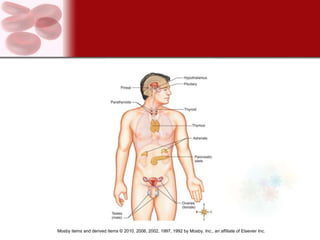
  endocrine glands and list the major
  hormones produced by each gland
• Describe the mechanisms of steroid and
  non-steroid hormone action
    Mosby items and derived items © 2010, 2006, 2002, 1997, 1992 by Mosby, Inc., an affiliate of Elsevier Inc.
Objectives

• Explain how negative and positive feedback
  mechanisms regulate secretion of endocrine
  hormones
• Explain the primary mechanisms of endocrine
  disorders
• Identify the principal functions of each major
  endocrine hormone and describe the conditions
  that may result from hyposecretion or
  hypersecretion
• Define diabetes insipidus, diabetes
  mellitus, gigantism, goiter, cretinism, and
  glycosuria
     Mosby items and derived items © 2010, 2006, 2002, 1997, 1992 by Mosby, Inc., an affiliate of Elsevier Inc.
Mechanisms of
                       Hormone Action

• Endocrine glands secrete chemicals
  (hormones) into the blood
• Hormones perform general functions of
  communication and control, but a
  slower, longer-lasting type of control
  than that provided by nerve impulses
• Cells acted on by hormones are called
  target organ cells

    Mosby items and derived items © 2010, 2006, 2002, 1997, 1992 by Mosby, Inc., an affiliate of Elsevier Inc.
Mosby items and derived items © 2010, 2006, 2002, 1997, 1992 by Mosby, Inc., an affiliate of Elsevier Inc.
Mechanisms of
                       Hormone Action

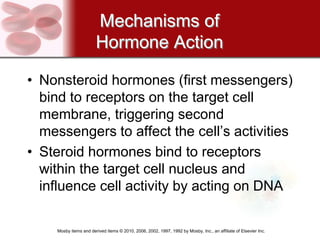
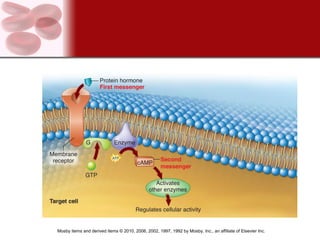
• Nonsteroid hormones (first messengers)
  bind to receptors on the target cell
  membrane, triggering second
  messengers to affect the cell’s activities
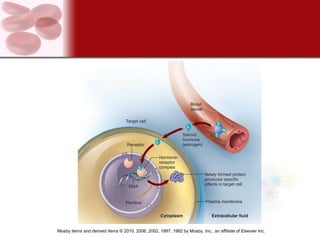
• Steroid hormones bind to receptors
  within the target cell nucleus and
  influence cell activity by acting on DNA

    Mosby items and derived items © 2010, 2006, 2002, 1997, 1992 by Mosby, Inc., an affiliate of Elsevier Inc.
Mosby items and derived items © 2010, 2006, 2002, 1997, 1992 by Mosby, Inc., an affiliate of Elsevier Inc.
Regulation of
             Hormone Secretion
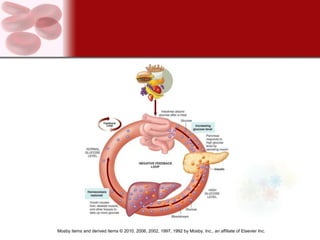
• Hormone secretion is controlled by
  homeostatic feedback
• Negative feedback—mechanisms that
  reverse the direction of a change in a
  physiological system
• Positive feedback—(uncommon)
  mechanisms that amplify physiological
  changes
    Mosby items and derived items © 2010, 2006, 2002, 1997, 1992 by Mosby, Inc., an affiliate of Elsevier Inc.
Mosby items and derived items © 2010, 2006, 2002, 1997, 1992 by Mosby, Inc., an affiliate of Elsevier Inc.
Mechanisms of
                    Endocrine Disease

• Hypersecretion—secretion of excess hormone
• Hyposecretion—insufficient hormone secretion
• Polyendocrine disorders—hyper- or
  hyposecretion of more than one hormone
• Target cell insensitivity produces results similar
  to hyposecretion
• Endocrinologists have developed many different
  strategies for treatment (e.g., surgery and
  hormone therapy)


      Mosby items and derived items © 2010, 2006, 2002, 1997, 1992 by Mosby, Inc., an affiliate of Elsevier Inc.
Prostaglandins

• Prostaglandins (PGs) are powerful substances
  found in a wide variety of body tissues
• PGs are often produced in a tissue and diffuse
  only a short distance to act on cells in that tissue
• Several classes of PGs include prostaglandin A
  (PGA), prostaglandin E (PGE), and prostaglandin
  F (PGF)
• PGs influence many body functions, including
  respiration, blood pressure, gastrointestinal
  secretions, and reproduction

      Mosby items and derived items © 2010, 2006, 2002, 1997, 1992 by Mosby, Inc., an affiliate of Elsevier Inc.
Pituitary Gland

• Anterior pituitary gland
  (adenohypophysis)
  – Names of major hormones
     •    Thyroid-stimulating hormone (TSH)
     •    Adrenocorticotropic hormone (ACTH)
     •    Follicle-stimulating hormone (FSH)
     •    Luteinizing hormone (LH)
     •    Growth hormone (GH)
     •    Prolactin (lactogenic hormone)
     Mosby items and derived items © 2010, 2006, 2002, 1997, 1992 by Mosby, Inc., an affiliate of Elsevier Inc.
Pituitary Gland

– Functions of major hormones
  • TSH—stimulates growth of the thyroid gland; also
    stimulates it to secrete thyroid hormone
  • ACTH—stimulates growth of the adrenal cortex and
    stimulates it to secrete glucocorticoids (mainly cortisol)
  • FSH—initiates growth of ovarian follicles each month
    in the ovary and stimulates one or more follicles to
    develop to the stage of maturity and ovulation; FSH
    also stimulates estrogen secretion by developing
    follicles; stimulates sperm production in the male


  Mosby items and derived items © 2010, 2006, 2002, 1997, 1992 by Mosby, Inc., an affiliate of Elsevier Inc.
Pituitary Gland

– Functions of major hormones
  • LH—acts with FSH to stimulate estrogen
    secretion and follicle growth to maturity; causes
    ovulation; causes luteinization of the ruptured
    follicle and stimulates progesterone secretion
    by corpus luteum; causes interstitial cells in the
    testes to secrete testosterone in the male


  Mosby items and derived items © 2010, 2006, 2002, 1997, 1992 by Mosby, Inc., an affiliate of Elsevier Inc.
Pituitary Gland

• GH—stimulates growth by accelerating protein
  anabolism; also accelerates fat catabolism and
  slows glucose catabolism; by slowing glucose
  catabolism, tends to increase blood glucose to
  higher than normal level (hyperglycemia)
         – Hypersecretion during childhood results in gigantism
           and during adulthood results in acromegaly
         – Hyposecretion during childhood results in pituitary
           dwarfism
• Prolactin or lactogenic hormone—stimulates
  breast development during pregnancy and
  secretion of milk after the delivery of the baby

Mosby items and derived items © 2010, 2006, 2002, 1997, 1992 by Mosby, Inc., an affiliate of Elsevier Inc.
Pituitary Gland

• Posterior pituitary gland
  (neurohypophysis)
  – Names of hormones
     • Antidiuretic hormone (ADH)
              – Hyposecretion causes diabetes
                insipidus, characterized by excessive volume of urine
     • Oxytocin (OT)


     Mosby items and derived items © 2010, 2006, 2002, 1997, 1992 by Mosby, Inc., an affiliate of Elsevier Inc.
Pituitary Gland

– Functions of hormones
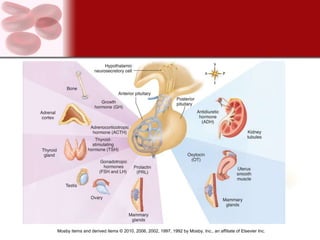
  • ADH—accelerates water reabsorption from
    urine in the kidney tubules into the
    blood, thereby decreasing urine secretion
  • Oxytocin—stimulates the pregnant uterus to
    contract; may initiate labor; causes glandular
    cells of the breast to release milk into ducts


  Mosby items and derived items © 2010, 2006, 2002, 1997, 1992 by Mosby, Inc., an affiliate of Elsevier Inc.
Mosby items and derived items © 2010, 2006, 2002, 1997, 1992 by Mosby, Inc., an affiliate of Elsevier Inc.
Hypothalamus

• Actual production of ADH and oxytocin occurs in
  the hypothalamus
• After production in the hypothalamus, hormones
  pass along axons into the pituitary gland
• The secretion and release of posterior pituitary
  hormones is controlled by nervous stimulation
• The hypothalamus controls many body
  functions related to homeostasis
  (temperature, appetite, and thirst)

     Mosby items and derived items © 2010, 2006, 2002, 1997, 1992 by Mosby, Inc., an affiliate of Elsevier Inc.
Thyroid Gland

• Names of hormones
  – Thyroid hormone—thyroxine (T4) and
    triiodothyronine (T3)
  – Calcitonin (CT)
• Functions of hormones
  – Thyroid hormones—accelerate catabolism
    (increase the body’s metabolic rate)
  – Calcitonin—decreases the blood calcium
    concentration by inhibiting breakdown of
    bone, which would release calcium into the blood

     Mosby items and derived items © 2010, 2006, 2002, 1997, 1992 by Mosby, Inc., an affiliate of Elsevier Inc.
Thyroid Gland

• Hyperthyroidism (hypersecretion of
  thyroid hormones) increases metabolic
  rate
  – Characterized by restlessness and
    exophthalmos (protruding eyes)
  – Graves disease is an inherited form of
    hyperthyroidism


    Mosby items and derived items © 2010, 2006, 2002, 1997, 1992 by Mosby, Inc., an affiliate of Elsevier Inc.
Thyroid Gland

• Hypothyroidism (hyposecretion of thyroid
  hormones)
  – May result from different conditions
  – Simple goiter—painless enlargement of
    thyroid caused by dietary deficiency of iodine
  – Hyposecretion during early development may
    result in cretinism (retardation) and during
    adulthood in myxedema (characterized by
    edema and sluggishness)
    Mosby items and derived items © 2010, 2006, 2002, 1997, 1992 by Mosby, Inc., an affiliate of Elsevier Inc.
Mosby items and derived items © 2010, 2006, 2002, 1997, 1992 by Mosby, Inc., an affiliate of Elsevier Inc.
Parathyroid Glands

• Name of hormone—parathyroid
  hormone (PTH)
• Function of hormone—increases blood
  calcium concentration by increasing the
  breakdown of bone with the release of
  calcium into the blood


    Mosby items and derived items © 2010, 2006, 2002, 1997, 1992 by Mosby, Inc., an affiliate of Elsevier Inc.
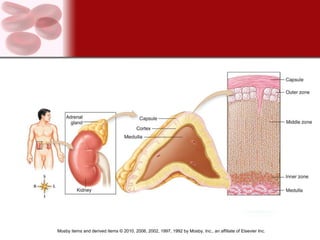
Adrenal Glands

• Adrenal cortex
  – Names of hormones (corticoids)
    • Glucocorticoids (GCs)—chiefly cortisol
      (hydrocortisone)
    • Mineralocorticoids (MCs)—chiefly aldosterone
    • Sex hormones—small amounts of male
      hormones (androgens) secreted by adrenal
      cortex of both sexes


    Mosby items and derived items © 2010, 2006, 2002, 1997, 1992 by Mosby, Inc., an affiliate of Elsevier Inc.
Adrenal Glands

– Three cell layers (zones)
  • Outer layer—secretes mineralocorticoids
  • Middle layer—secretes glucocorticoids
  • Inner layer—secretes sex hormones
– Mineralocorticoids—increase blood sodium
  and decrease body potassium
  concentrations by accelerating kidney
  tubule reabsorption of sodium and
  excretion of potassium
  Mosby items and derived items © 2010, 2006, 2002, 1997, 1992 by Mosby, Inc., an affiliate of Elsevier Inc.
Adrenal Glands

– Functions of glucocorticoids
   • Help maintain normal blood glucose concentration by
     increasing gluconeogenesis—the formation of ―new‖
     glucose from amino acids produced by the breakdown of
     proteins, mainly those in muscle tissue cells; also the
     conversion to glucose of fatty acids produced by the
     breakdown of fats stored in adipose tissue cells
   • Play an essential part in maintaining normal blood
     pressure—make it possible for epinephrine and
     norepinephrine to maintain a normal degree of
     vasoconstriction, a condition necessary for maintaining
     normal blood pressure

   Mosby items and derived items © 2010, 2006, 2002, 1997, 1992 by Mosby, Inc., an affiliate of Elsevier Inc.
Mosby items and derived items © 2010, 2006, 2002, 1997, 1992 by Mosby, Inc., an affiliate of Elsevier Inc.
Adrenal Glands

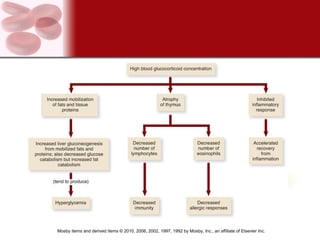
• Act with epinephrine and norepinephrine to produce an
  antiinflammatory effect, to bring about normal recovery
  from inflammations of various kinds
• Produce anti-immunity, antiallergy effect; bring about a
  decrease in the number of lymphocytes and plasma cells
  and therefore a decrease in the amount of antibodies
  formed
• Secretion of glucocorticoid quickly increases when the
  body is thrown into a condition of stress; high blood
  concentration of glucocorticoids, in turn, brings about
  many other stress responses


Mosby items and derived items © 2010, 2006, 2002, 1997, 1992 by Mosby, Inc., an affiliate of Elsevier Inc.
Adrenal Glands

• Adrenal medulla
  – Names of hormones—epinephrine (Epi), or
    adrenaline, and norepinephrine (NR)
  – Functions of hormones—help the body
    resist stress by intensifying and prolonging
    the effects of sympathetic stimulation;
    increased epinephrine secretion is the first
    endocrine response to stress

    Mosby items and derived items © 2010, 2006, 2002, 1997, 1992 by Mosby, Inc., an affiliate of Elsevier Inc.
Adrenal Glands

• Adrenal abnormalities
  – Hypersecretion of glucocorticoids causes
    Cushing syndrome: moon face, hump on
    back, elevated blood sugar levels, frequent
    infections
  – Hypersecretion of adrenal androgens may
    result from a virilizing tumor and cause
    masculinization of affected women

    Mosby items and derived items © 2010, 2006, 2002, 1997, 1992 by Mosby, Inc., an affiliate of Elsevier Inc.
Adrenal Glands

– Hyposecretion of cortical hormones may
  result in Addison disease: muscle
  weakness, reduced blood
  sugar, nausea, loss of appetite, and weight
  loss


  Mosby items and derived items © 2010, 2006, 2002, 1997, 1992 by Mosby, Inc., an affiliate of Elsevier Inc.
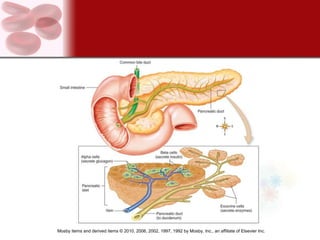
Pancreatic Islets

• Names of hormones
  – Glucagon—secreted by alpha cells
  – Insulin—secreted by beta cells
• Functions of hormones
  – Glucagon increases the blood glucose
    level by accelerating liver glycogenolysis
    (conversion of glycogen to glucose)


    Mosby items and derived items © 2010, 2006, 2002, 1997, 1992 by Mosby, Inc., an affiliate of Elsevier Inc.
Mosby items and derived items © 2010, 2006, 2002, 1997, 1992 by Mosby, Inc., an affiliate of Elsevier Inc.
Pancreatic Islets

• Functions of hormones
  – Insulin decreases the blood glucose by
    accelerating the movement of glucose out
    of the blood into cells, which increases
    glucose metabolism by cells


    Mosby items and derived items © 2010, 2006, 2002, 1997, 1992 by Mosby, Inc., an affiliate of Elsevier Inc.
Pancreatic Islets

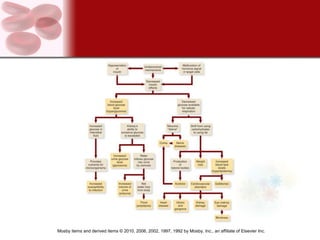
• Diabetes mellitus
  – Type 1 results from hyposecretion of
    insulin
  – Type 2 results from target cell insensitivity
    to insulin
  – Glucose cannot enter cells and thus blood
    glucose levels rise, producing glycosuria
    (glucose in the urine)

    Mosby items and derived items © 2010, 2006, 2002, 1997, 1992 by Mosby, Inc., an affiliate of Elsevier Inc.
Mosby items and derived items © 2010, 2006, 2002, 1997, 1992 by Mosby, Inc., an affiliate of Elsevier Inc.
Female Sex Glands

• The ovaries contain two structures that
  secrete hormones—the ovarian follicles
  and the corpus luteum; see Chapter 22
• Effects of estrogen (feminizing hormone)
  – Development and maturation of breasts and
    external genitals
  – Development of adult female body contours
  – Initiation of menstrual cycle
    Mosby items and derived items © 2010, 2006, 2002, 1997, 1992 by Mosby, Inc., an affiliate of Elsevier Inc.
Male Sex Glands

• The interstitial cells of testes secrete the
  male hormone testosterone; see
  Chapter 22
• Effects of testosterone (masculinizing
  hormone)
  – Maturation of external genitals
  – Beard growth


     Mosby items and derived items © 2010, 2006, 2002, 1997, 1992 by Mosby, Inc., an affiliate of Elsevier Inc.
Male Sex Glands

• Effects of testosterone
  – Voice changes at puberty
  – Development of musculature and body
    contours typical of the male


    Mosby items and derived items © 2010, 2006, 2002, 1997, 1992 by Mosby, Inc., an affiliate of Elsevier Inc.
Thymus

• Name of hormone—thymosin
• Function of hormone—plays an
  important role in the development and
  function of the body’s immune system


    Mosby items and derived items © 2010, 2006, 2002, 1997, 1992 by Mosby, Inc., an affiliate of Elsevier Inc.
Placenta

• Name of hormones—chorionic
  gonadotropins, estrogens, and
  progesterone
• Functions of hormones—maintain the
  corpus luteum during pregnancy


    Mosby items and derived items © 2010, 2006, 2002, 1997, 1992 by Mosby, Inc., an affiliate of Elsevier Inc.
Pineal Gland

• A small gland near the roof of the third
  ventricle of the brain
  – Glandular tissue predominates in children
    and young adults
  – Becomes fibrous and calcified with age
• Called third eye because its influence
  on secretory activity is related to the
  amount of light entering the eyes
     Mosby items and derived items © 2010, 2006, 2002, 1997, 1992 by Mosby, Inc., an affiliate of Elsevier Inc.
Pineal Gland

• Secretes melatonin, which:
  – Inhibits ovarian activity
  – Regulates the body’s internal clock
• Abnormal secretion of (or sensitivity to)
  melatonin may produce seasonal affective
  disorder (SAD) or winter depression, a form
  of depression that occurs when exposure to
  sunlight is low and melatonin levels are
  high
    Mosby items and derived items © 2010, 2006, 2002, 1997, 1992 by Mosby, Inc., an affiliate of Elsevier Inc.
Other Endocrine Structures

• Many organs (e.g., the
  stomach, intestines, and kidney)
  produce endocrine hormones
• The atrial wall of the heart secretes
  atrial natriuretic hormone (ANH), which
  stimulates sodium loss from the kidneys
• Fat-storing cells secrete leptin, which
  controls how full or hungry we feel
    Mosby items and derived items © 2010, 2006, 2002, 1997, 1992 by Mosby, Inc., an affiliate of Elsevier Inc.

F endocrine system

  • 1.
    The Endocrine System Mosbyitems and derived items © 2010, 2006, 2002, 1997, 1992 by Mosby, Inc., an affiliate of Elsevier Inc.
  • 2.
    Objectives • Distinguish betweenendocrine and exocrine glands and define the terms hormone and prostaglandin • Identify and locate the primary endocrine glands and list the major hormones produced by each gland • Describe the mechanisms of steroid and non-steroid hormone action Mosby items and derived items © 2010, 2006, 2002, 1997, 1992 by Mosby, Inc., an affiliate of Elsevier Inc.
  • 3.
    Objectives • Explain hownegative and positive feedback mechanisms regulate secretion of endocrine hormones • Explain the primary mechanisms of endocrine disorders • Identify the principal functions of each major endocrine hormone and describe the conditions that may result from hyposecretion or hypersecretion • Define diabetes insipidus, diabetes mellitus, gigantism, goiter, cretinism, and glycosuria Mosby items and derived items © 2010, 2006, 2002, 1997, 1992 by Mosby, Inc., an affiliate of Elsevier Inc.
  • 4.
    Mechanisms of Hormone Action • Endocrine glands secrete chemicals (hormones) into the blood • Hormones perform general functions of communication and control, but a slower, longer-lasting type of control than that provided by nerve impulses • Cells acted on by hormones are called target organ cells Mosby items and derived items © 2010, 2006, 2002, 1997, 1992 by Mosby, Inc., an affiliate of Elsevier Inc.
  • 5.
    Mosby items andderived items © 2010, 2006, 2002, 1997, 1992 by Mosby, Inc., an affiliate of Elsevier Inc.
  • 6.
    Mechanisms of Hormone Action • Nonsteroid hormones (first messengers) bind to receptors on the target cell membrane, triggering second messengers to affect the cell’s activities • Steroid hormones bind to receptors within the target cell nucleus and influence cell activity by acting on DNA Mosby items and derived items © 2010, 2006, 2002, 1997, 1992 by Mosby, Inc., an affiliate of Elsevier Inc.
  • 7.
    Mosby items andderived items © 2010, 2006, 2002, 1997, 1992 by Mosby, Inc., an affiliate of Elsevier Inc.
  • 8.
    Mosby items andderived items © 2010, 2006, 2002, 1997, 1992 by Mosby, Inc., an affiliate of Elsevier Inc.
  • 9.
    Regulation of Hormone Secretion • Hormone secretion is controlled by homeostatic feedback • Negative feedback—mechanisms that reverse the direction of a change in a physiological system • Positive feedback—(uncommon) mechanisms that amplify physiological changes Mosby items and derived items © 2010, 2006, 2002, 1997, 1992 by Mosby, Inc., an affiliate of Elsevier Inc.
  • 10.
    Mosby items andderived items © 2010, 2006, 2002, 1997, 1992 by Mosby, Inc., an affiliate of Elsevier Inc.
  • 11.
    Mechanisms of Endocrine Disease • Hypersecretion—secretion of excess hormone • Hyposecretion—insufficient hormone secretion • Polyendocrine disorders—hyper- or hyposecretion of more than one hormone • Target cell insensitivity produces results similar to hyposecretion • Endocrinologists have developed many different strategies for treatment (e.g., surgery and hormone therapy) Mosby items and derived items © 2010, 2006, 2002, 1997, 1992 by Mosby, Inc., an affiliate of Elsevier Inc.
  • 12.
    Prostaglandins • Prostaglandins (PGs)are powerful substances found in a wide variety of body tissues • PGs are often produced in a tissue and diffuse only a short distance to act on cells in that tissue • Several classes of PGs include prostaglandin A (PGA), prostaglandin E (PGE), and prostaglandin F (PGF) • PGs influence many body functions, including respiration, blood pressure, gastrointestinal secretions, and reproduction Mosby items and derived items © 2010, 2006, 2002, 1997, 1992 by Mosby, Inc., an affiliate of Elsevier Inc.
  • 13.
    Pituitary Gland • Anteriorpituitary gland (adenohypophysis) – Names of major hormones • Thyroid-stimulating hormone (TSH) • Adrenocorticotropic hormone (ACTH) • Follicle-stimulating hormone (FSH) • Luteinizing hormone (LH) • Growth hormone (GH) • Prolactin (lactogenic hormone) Mosby items and derived items © 2010, 2006, 2002, 1997, 1992 by Mosby, Inc., an affiliate of Elsevier Inc.
  • 14.
    Pituitary Gland – Functionsof major hormones • TSH—stimulates growth of the thyroid gland; also stimulates it to secrete thyroid hormone • ACTH—stimulates growth of the adrenal cortex and stimulates it to secrete glucocorticoids (mainly cortisol) • FSH—initiates growth of ovarian follicles each month in the ovary and stimulates one or more follicles to develop to the stage of maturity and ovulation; FSH also stimulates estrogen secretion by developing follicles; stimulates sperm production in the male Mosby items and derived items © 2010, 2006, 2002, 1997, 1992 by Mosby, Inc., an affiliate of Elsevier Inc.
  • 15.
    Pituitary Gland – Functionsof major hormones • LH—acts with FSH to stimulate estrogen secretion and follicle growth to maturity; causes ovulation; causes luteinization of the ruptured follicle and stimulates progesterone secretion by corpus luteum; causes interstitial cells in the testes to secrete testosterone in the male Mosby items and derived items © 2010, 2006, 2002, 1997, 1992 by Mosby, Inc., an affiliate of Elsevier Inc.
  • 16.
    Pituitary Gland • GH—stimulatesgrowth by accelerating protein anabolism; also accelerates fat catabolism and slows glucose catabolism; by slowing glucose catabolism, tends to increase blood glucose to higher than normal level (hyperglycemia) – Hypersecretion during childhood results in gigantism and during adulthood results in acromegaly – Hyposecretion during childhood results in pituitary dwarfism • Prolactin or lactogenic hormone—stimulates breast development during pregnancy and secretion of milk after the delivery of the baby Mosby items and derived items © 2010, 2006, 2002, 1997, 1992 by Mosby, Inc., an affiliate of Elsevier Inc.
  • 17.
    Pituitary Gland • Posteriorpituitary gland (neurohypophysis) – Names of hormones • Antidiuretic hormone (ADH) – Hyposecretion causes diabetes insipidus, characterized by excessive volume of urine • Oxytocin (OT) Mosby items and derived items © 2010, 2006, 2002, 1997, 1992 by Mosby, Inc., an affiliate of Elsevier Inc.
  • 18.
    Pituitary Gland – Functionsof hormones • ADH—accelerates water reabsorption from urine in the kidney tubules into the blood, thereby decreasing urine secretion • Oxytocin—stimulates the pregnant uterus to contract; may initiate labor; causes glandular cells of the breast to release milk into ducts Mosby items and derived items © 2010, 2006, 2002, 1997, 1992 by Mosby, Inc., an affiliate of Elsevier Inc.
  • 19.
    Mosby items andderived items © 2010, 2006, 2002, 1997, 1992 by Mosby, Inc., an affiliate of Elsevier Inc.
  • 20.
    Hypothalamus • Actual productionof ADH and oxytocin occurs in the hypothalamus • After production in the hypothalamus, hormones pass along axons into the pituitary gland • The secretion and release of posterior pituitary hormones is controlled by nervous stimulation • The hypothalamus controls many body functions related to homeostasis (temperature, appetite, and thirst) Mosby items and derived items © 2010, 2006, 2002, 1997, 1992 by Mosby, Inc., an affiliate of Elsevier Inc.
  • 21.
    Thyroid Gland • Namesof hormones – Thyroid hormone—thyroxine (T4) and triiodothyronine (T3) – Calcitonin (CT) • Functions of hormones – Thyroid hormones—accelerate catabolism (increase the body’s metabolic rate) – Calcitonin—decreases the blood calcium concentration by inhibiting breakdown of bone, which would release calcium into the blood Mosby items and derived items © 2010, 2006, 2002, 1997, 1992 by Mosby, Inc., an affiliate of Elsevier Inc.
  • 22.
    Thyroid Gland • Hyperthyroidism(hypersecretion of thyroid hormones) increases metabolic rate – Characterized by restlessness and exophthalmos (protruding eyes) – Graves disease is an inherited form of hyperthyroidism Mosby items and derived items © 2010, 2006, 2002, 1997, 1992 by Mosby, Inc., an affiliate of Elsevier Inc.
  • 23.
    Thyroid Gland • Hypothyroidism(hyposecretion of thyroid hormones) – May result from different conditions – Simple goiter—painless enlargement of thyroid caused by dietary deficiency of iodine – Hyposecretion during early development may result in cretinism (retardation) and during adulthood in myxedema (characterized by edema and sluggishness) Mosby items and derived items © 2010, 2006, 2002, 1997, 1992 by Mosby, Inc., an affiliate of Elsevier Inc.
  • 24.
    Mosby items andderived items © 2010, 2006, 2002, 1997, 1992 by Mosby, Inc., an affiliate of Elsevier Inc.
  • 25.
    Parathyroid Glands • Nameof hormone—parathyroid hormone (PTH) • Function of hormone—increases blood calcium concentration by increasing the breakdown of bone with the release of calcium into the blood Mosby items and derived items © 2010, 2006, 2002, 1997, 1992 by Mosby, Inc., an affiliate of Elsevier Inc.
  • 26.
    Adrenal Glands • Adrenalcortex – Names of hormones (corticoids) • Glucocorticoids (GCs)—chiefly cortisol (hydrocortisone) • Mineralocorticoids (MCs)—chiefly aldosterone • Sex hormones—small amounts of male hormones (androgens) secreted by adrenal cortex of both sexes Mosby items and derived items © 2010, 2006, 2002, 1997, 1992 by Mosby, Inc., an affiliate of Elsevier Inc.
  • 27.
    Adrenal Glands – Threecell layers (zones) • Outer layer—secretes mineralocorticoids • Middle layer—secretes glucocorticoids • Inner layer—secretes sex hormones – Mineralocorticoids—increase blood sodium and decrease body potassium concentrations by accelerating kidney tubule reabsorption of sodium and excretion of potassium Mosby items and derived items © 2010, 2006, 2002, 1997, 1992 by Mosby, Inc., an affiliate of Elsevier Inc.
  • 28.
    Adrenal Glands – Functionsof glucocorticoids • Help maintain normal blood glucose concentration by increasing gluconeogenesis—the formation of ―new‖ glucose from amino acids produced by the breakdown of proteins, mainly those in muscle tissue cells; also the conversion to glucose of fatty acids produced by the breakdown of fats stored in adipose tissue cells • Play an essential part in maintaining normal blood pressure—make it possible for epinephrine and norepinephrine to maintain a normal degree of vasoconstriction, a condition necessary for maintaining normal blood pressure Mosby items and derived items © 2010, 2006, 2002, 1997, 1992 by Mosby, Inc., an affiliate of Elsevier Inc.
  • 29.
    Mosby items andderived items © 2010, 2006, 2002, 1997, 1992 by Mosby, Inc., an affiliate of Elsevier Inc.
  • 30.
    Adrenal Glands • Actwith epinephrine and norepinephrine to produce an antiinflammatory effect, to bring about normal recovery from inflammations of various kinds • Produce anti-immunity, antiallergy effect; bring about a decrease in the number of lymphocytes and plasma cells and therefore a decrease in the amount of antibodies formed • Secretion of glucocorticoid quickly increases when the body is thrown into a condition of stress; high blood concentration of glucocorticoids, in turn, brings about many other stress responses Mosby items and derived items © 2010, 2006, 2002, 1997, 1992 by Mosby, Inc., an affiliate of Elsevier Inc.
  • 31.
    Mosby items andderived items © 2010, 2006, 2002, 1997, 1992 by Mosby, Inc., an affiliate of Elsevier Inc.
  • 32.
    Adrenal Glands • Adrenalmedulla – Names of hormones—epinephrine (Epi), or adrenaline, and norepinephrine (NR) – Functions of hormones—help the body resist stress by intensifying and prolonging the effects of sympathetic stimulation; increased epinephrine secretion is the first endocrine response to stress Mosby items and derived items © 2010, 2006, 2002, 1997, 1992 by Mosby, Inc., an affiliate of Elsevier Inc.
  • 33.
    Adrenal Glands • Adrenalabnormalities – Hypersecretion of glucocorticoids causes Cushing syndrome: moon face, hump on back, elevated blood sugar levels, frequent infections – Hypersecretion of adrenal androgens may result from a virilizing tumor and cause masculinization of affected women Mosby items and derived items © 2010, 2006, 2002, 1997, 1992 by Mosby, Inc., an affiliate of Elsevier Inc.
  • 34.
    Adrenal Glands – Hyposecretionof cortical hormones may result in Addison disease: muscle weakness, reduced blood sugar, nausea, loss of appetite, and weight loss Mosby items and derived items © 2010, 2006, 2002, 1997, 1992 by Mosby, Inc., an affiliate of Elsevier Inc.
  • 35.
    Pancreatic Islets • Namesof hormones – Glucagon—secreted by alpha cells – Insulin—secreted by beta cells • Functions of hormones – Glucagon increases the blood glucose level by accelerating liver glycogenolysis (conversion of glycogen to glucose) Mosby items and derived items © 2010, 2006, 2002, 1997, 1992 by Mosby, Inc., an affiliate of Elsevier Inc.
  • 36.
    Mosby items andderived items © 2010, 2006, 2002, 1997, 1992 by Mosby, Inc., an affiliate of Elsevier Inc.
  • 37.
    Pancreatic Islets • Functionsof hormones – Insulin decreases the blood glucose by accelerating the movement of glucose out of the blood into cells, which increases glucose metabolism by cells Mosby items and derived items © 2010, 2006, 2002, 1997, 1992 by Mosby, Inc., an affiliate of Elsevier Inc.
  • 38.
    Pancreatic Islets • Diabetesmellitus – Type 1 results from hyposecretion of insulin – Type 2 results from target cell insensitivity to insulin – Glucose cannot enter cells and thus blood glucose levels rise, producing glycosuria (glucose in the urine) Mosby items and derived items © 2010, 2006, 2002, 1997, 1992 by Mosby, Inc., an affiliate of Elsevier Inc.
  • 39.
    Mosby items andderived items © 2010, 2006, 2002, 1997, 1992 by Mosby, Inc., an affiliate of Elsevier Inc.
  • 40.
    Female Sex Glands •The ovaries contain two structures that secrete hormones—the ovarian follicles and the corpus luteum; see Chapter 22 • Effects of estrogen (feminizing hormone) – Development and maturation of breasts and external genitals – Development of adult female body contours – Initiation of menstrual cycle Mosby items and derived items © 2010, 2006, 2002, 1997, 1992 by Mosby, Inc., an affiliate of Elsevier Inc.
  • 41.
    Male Sex Glands •The interstitial cells of testes secrete the male hormone testosterone; see Chapter 22 • Effects of testosterone (masculinizing hormone) – Maturation of external genitals – Beard growth Mosby items and derived items © 2010, 2006, 2002, 1997, 1992 by Mosby, Inc., an affiliate of Elsevier Inc.
  • 42.
    Male Sex Glands •Effects of testosterone – Voice changes at puberty – Development of musculature and body contours typical of the male Mosby items and derived items © 2010, 2006, 2002, 1997, 1992 by Mosby, Inc., an affiliate of Elsevier Inc.
  • 43.
    Thymus • Name ofhormone—thymosin • Function of hormone—plays an important role in the development and function of the body’s immune system Mosby items and derived items © 2010, 2006, 2002, 1997, 1992 by Mosby, Inc., an affiliate of Elsevier Inc.
  • 44.
    Placenta • Name ofhormones—chorionic gonadotropins, estrogens, and progesterone • Functions of hormones—maintain the corpus luteum during pregnancy Mosby items and derived items © 2010, 2006, 2002, 1997, 1992 by Mosby, Inc., an affiliate of Elsevier Inc.
  • 45.
    Pineal Gland • Asmall gland near the roof of the third ventricle of the brain – Glandular tissue predominates in children and young adults – Becomes fibrous and calcified with age • Called third eye because its influence on secretory activity is related to the amount of light entering the eyes Mosby items and derived items © 2010, 2006, 2002, 1997, 1992 by Mosby, Inc., an affiliate of Elsevier Inc.
  • 46.
    Pineal Gland • Secretesmelatonin, which: – Inhibits ovarian activity – Regulates the body’s internal clock • Abnormal secretion of (or sensitivity to) melatonin may produce seasonal affective disorder (SAD) or winter depression, a form of depression that occurs when exposure to sunlight is low and melatonin levels are high Mosby items and derived items © 2010, 2006, 2002, 1997, 1992 by Mosby, Inc., an affiliate of Elsevier Inc.
  • 47.
    Other Endocrine Structures •Many organs (e.g., the stomach, intestines, and kidney) produce endocrine hormones • The atrial wall of the heart secretes atrial natriuretic hormone (ANH), which stimulates sodium loss from the kidneys • Fat-storing cells secrete leptin, which controls how full or hungry we feel Mosby items and derived items © 2010, 2006, 2002, 1997, 1992 by Mosby, Inc., an affiliate of Elsevier Inc.

Editor's Notes

  • #5 What are endocrine glands? Ductless glands that secrete hormones into intracellular spacesWhat is a target organ cell? A cell that has receptors for a specific hormone
  • #7 What are the two major classes of hormones? Nonsteroid and steroid hormonesWhat is a second messenger mechanism? Chemical that provides communication within a hormone’s target cellWhat are steroid hormones? Hormones that can pass through the target cell’s membrane to the nucleus where they bind with a receptor to form a hormone-receptor complexGive an example of a steroid hormone. Estrogen
  • #10 Give an example of positive feedback. During labor, muscle contractions become stronger by means of a positive feedback mechanism that regulates the secretion of oxytocin.Give an example of negative feedback. Insulin
  • #12 What is the name of a physician who specializes in endocrine disorders? EndocrinologistWhat are some diseases caused by hypersecretion of a hormone? Hypoglycemia, Graves disease, gigantism, water retention, Cushing syndromeWhat are some diseases caused by hyposecretion of a hormone? Goiter, cretinism, dwarfism, diabetes insipidus, Addison disease, myxedema
  • #13 Do prostaglandins meet the definition of a typical hormone? NoHow do prostaglandins differ from most hormones? Prostaglandins only influence the activities of neighboring cells.What research is being conducted with prostaglandins? The role of prostaglandins in the treatment of high blood pressure, asthma, and ulcers
  • #14 Why is the anterior pituitary gland sometimes called the master gland? It controls the thyroid gland, the adrenal cortex, the ovarian follicles, and the corpus luteum.What do the major hormones do? ACTH stimulates the adrenal cortex, causing it to increase in size and secrete larger amounts of its hormones.See Table 11-1.
  • #17 How do growth hormones promote normal growth? They speed up the movement of amino acids out of the blood and into the cells, which accelerates the cells’ anabolism of amino acids to form tissue proteins.
  • #18 What does the hyposecretion of ADH cause? Diabetes insipidusHow are dehydration and electrolyte imbalances treated? With injections or nasal sprays containing ADH
  • #21 In addition to oxytocin and ADH, what substances does the hypothalamus produce? Releasing and inhibiting hormones that travel to the anterior pituitary glandThe hypothalamus regulates many body functions related to homeostasis. Give some examples. Body temperature, appetite, and thirst
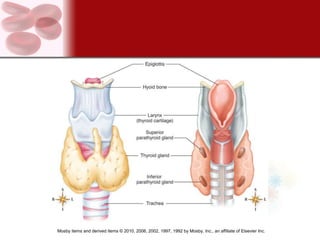
  • #22 How do T3 and T4 influence body cells? They speed up their release of energy from foods.How does calcitonin help maintain homeostasis of blood calcium? It decreases blood calcium concentrations.Where is the thyroid located? In the neck just below the larynxPlace thumb and forefinger on each side of the trachea and swallow. The part you feel that goes up and down is the thyroid.
  • #26 How does PTH increase calcium? It stimulates bone-resorbing cells to increase their breakdown of bone’s hard matrix, which frees the calcium stored there.
  • #28 Where is the adrenal gland? It curves over the top of each kidney.What are hormones secreted by the adrenal cortex called? CorticoidsWhat are the adrenal cortex and the adrenal medulla? The adrenal cortex is the outer part of an adrenal gland; the medullais its inner part.What is the chief mineralocorticoid? AldosteroneWhat does aldosterone do? Increases the amount of sodium and decreases potassium in the blood.
  • #29 Secretion of glucocorticoid quickly increases when the body is under stress.
  • #31 During periods of prolonged stress, glucocorticoids may have harmful side effects because they are anti-inflammatory and cause blood vessels to constrict.
  • #36 How do endocrine glands differ from pancreatic islets? Endocrine glands are much larger than pancreatic islets.
  • #38 What happens if the pancreatic islets don’t secrete enough insulin? Blood glucose increases: hyperglycemia.
  • #39 How are most screening tests for diabetes mellitus done? With a drop of bloodTesting for sugar in the urine is another common screening procedure.
  • #43 The cells of the testes produce what? SpermThe interstitial cells in the testes secrete what male sex hormone directly into the blood? Testosterone
  • #44 Where is the thymus located? In the mediastinum
  • #45 These hormones maintain the corpus luteum during pregnancy.What fact led to the development of the early pregnancy test? During the earliest weeks of pregnancy the kidneys excrete chorionic gonadotropins into the urine.
  • #46 Why is this gland named “pineal”? Because it resembles a pine nut.
  • #48 Nearly every organ and system has an endocrine function.