Med University Wright & FilippisPartnering to Enhance Your SuccessCustomer Service Workshop
CS101Quality Customer Service
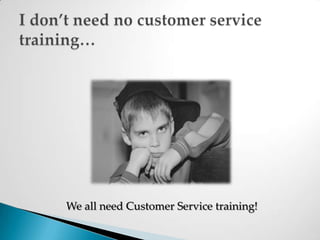
We all need Customer Service training!I don’t need no customer service training…
You may not always learn something newSometimes we just need a simple reminder of things we already knowA reminder to practice those things we know are importantI’ve already seen all of this before…
I never hear any complaints about the job I am doing…Great job!There is a risk that you are not hearing those complaints 1 in 10 customers is likely to voice a complaint the other 9 will simply leaveIf a customer is willing to voice their problems it means they trust you to take care of them
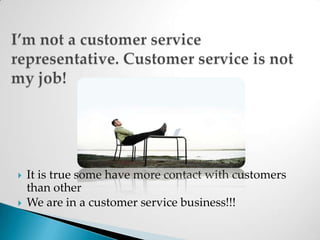
I’m not a customer service representative. Customer service is not my job!It is true some have more contact with customers than otherWe are in a customer service business!!!
You don’t know my customers!Yes we do! You have one of the most difficult jobs that exists, dealing with sick peopleIn addition you are dealing with referral sources, insurance companies, physician’ offices, etc.
Poor Service Can And Does ExistSome reasons for poor service:Some employees don’t careThere are differences in what you think the customers need and what they actually wantEmployees are offered poor training and planning for customer servicePoor handling of complaintsThere are employees who don’t have the power or the will to take care of the customersEmployees’ frustration from being treated poorly by customersQuality Service
Your job can’t survive without the business and the business can’t survive without customer serviceOne of the factors most critical to job satisfaction is the ability to feel as if we make a difference in the lives of othersThe skills necessary for effective customer service, the ability to listen, to organize and to seek creative solutions, are the foundations of every future career advancement	What’s In It For Me?
Customers are primarily interested in:Price QualityPerformance and ServiceCustomer Service: The Exchange
The Golden Rule and HME“treat others as you would want to be treated”In the HME business this is more of a challengeOur customer may have not chosen usThey are not thrilled to have to use us- due to many factors one being illnesskeeping mindful of these facts will help us to improve our customer service skills Customer Service: The Exchange
We are in the business of providing services. We know our products. What are our services?DeliveryBillingAnswering questionsProviding EMPATHYProducts vs. Services
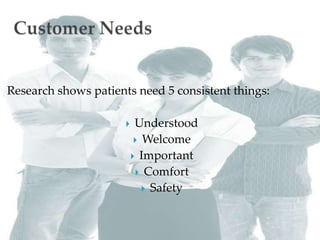
Customer Needs Research shows patients need 5 consistent things:Understood WelcomeImportantComfortSafety
Customers want to be listened to They want to be certain their concerns are being heardThey want their questions answeredCustomers want you to understand their perspectiveThey want you to understand their emotionsNeed to Feel Understood
Need to Feel WelcomeCustomers like it when you use their nameThey like to be recognizedIf they come to your storefront they like convenient parking and someone to greet them as they come in
Customers want to feel appreciatedThey want to be thankedThey want to know someone will go out of their way for themAre customers treated with courtesy?Do employees know their individual needs and challenges?Need to Feel Important
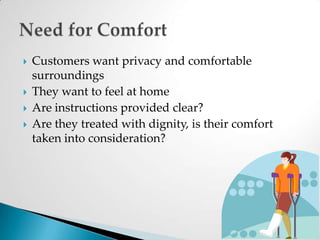
Customers want privacy and comfortable surroundingsThey want to feel at homeAre instructions provided clear?Are they treated with dignity, is their comfort taken into consideration?Need for Comfort
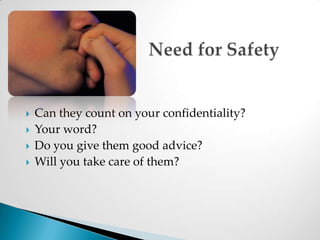
Need for SafetyCan they count on your confidentiality?Your word?Do you give them good advice?Will you take care of them?
Group Exercise #1Basic Needs of Customers
Reliability-the ability to perform the promised service Responsiveness-willingness to help customers and provide prompt serviceAssurance-knowledge and courtesy of employees and their ability to convey trust as well as confidenceEmpathy-caring, individualized attention provided to customers by the firmTangibles-appearance of physical facilities, equipment, and personnel Elements of Customer Service
Reliabilitythe ability to perform the promised service Reliability = ConsistencyDo whatyou say you are going to do. Do it when you say you are going to do it.Do it right the first time. Follow-upand follow through.
Responsivenesswillingness to help customers and provide prompt serviceResponsiveness = PromptnessDo you greet people as they come in?Do you make yourself immediately availableDo you answer the phone by the 3rd ring and when you transfer , do you make sure they are connected?How quickly do you respond when a customer needs you?
Assuranceknowledge and courtesy of employees and their ability to convey trust as well as confidenceAssurance = TrustAre you credible?Do people feel they can trust you?Can customers believe your answers?Does it ease their concerns when they hear something from you?
EmpathyCaring, individualized attention provided to customersEmpathy = PerspectiveAre you willing to see things from your customers perspective?Do you treat each customer as an individual?Do you work hard to build rapport and can you customize your service to meet each customer’s needs?
Tangiblesappearance of physical facilities, equipment, and personnelTangibles = AppearanceIs appearance appropriate and professional?How about the appearance of the staff?And correspondence that goes out with your name?
Elements of Quality Customer ServiceNow we know the basic needs of customers and the elements of quality customer service.What do you think upsets customers the most?They didn’t get what they were promisedSomeone was rudeNo one went out of their way to take care of themNo one listened to themProducts were faultyThey were put on hold without requesting permissionStaff was untrained or under qualifiedDeadlines were missedIndustry jargon was usedWhich of the above can you personally control?
They didn’t get what they were promisedSomeone was rudeNo one went out of their way to take care of themNo one listened to themThey were put on hold without requesting permissionIndustry jargon was usedWhat are our strengths and weaknesses?     Select one weakness and create a solution for that weakness this month.Lets Create a Solution!!!
	Lets anticipate what can go wrong. In order to do this we must be able to put ourselves in their place. Can you help them to systemize their needs? What kind of service should be anticipated so they don’t have to request it? (equipment maintenance, telephone checklist, systematic follow-up)Don’t wait for a problem to develop. Ask yourself: “Have I considered all of my customers needs?”“What will they need next?”“How can I improve service now for my patient?” Anticipation
			The first element			The outflow of informationWhat information do your customers need to know?What questions do they commonly have?If you have to explain something over and over, how can you systemize that explanation?Communication
The second elementFeedbackSpend time identifying what is important to your customersIdentify three things that are most important to customers and ask them those questions over and over againDon’t wait to hear from the customerActively reach out and solicit customer comments rather than listening to their complaintAsk “How are we doing?” as an approach to solicit feedbackCommunication
Communication GlitchesOverpromising – promising the customer more than you can do or can deliverFailing to stay in touch when a problem existsFailing to listenUsing industry jargonTelling but not explaining Communication without courtesyCommunication
Who is responsible for what in your organization?What could fall through the cracks?How are all parts of the delivery system kept coordinated with one another?Who is responsible for that?Make certain that someone is responsible for every step.Organization
The Personal DimensionHow can we personally improve???
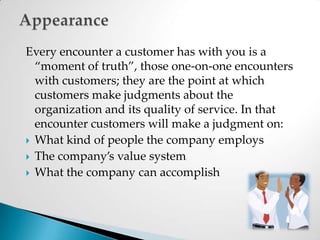
Every encounter a customer has with you is a “moment of truth”, those one-on-one encounters with customers; they are the point at which customers make judgments about the organization and its quality of service. In that encounter customers will make a judgment on:What kind of people the company employsThe company’s value systemWhat the company can accomplish Appearance
AttitudeQuality service and a positive attitude are inseparable. You will know that you have a positive when you feel challenged to find a solution rather than being frustrated by an irate customer. Avoid feeling like a victim by taking charge of your work life and choosing your disposition then maintaining it no matter who confronts you.
AttitudeThe longer I live, the more I realize the impact of attitude on life. Attitude, to me, is more important than facts. It is more important than the past, than education, than money, than circumstances, than failures, than successes, than what other people think or say or do. It is more important than appearance, giftedness, or skill. It will make or break a company ... a church ... a home. The remarkable thing is we have a choice every day regarding the attitude we will embrace for that day. We cannot change our past. We cannot change the fact that people will act in a certain way. We cannot change the inevitable. The only thing we can do is play on the one string we have, and that is our attitude ... I am convinced thatlife is 10% what happens to me, and 90% how I react to it. And so it is with you ... we are in charge of our Attitudes.
Some ideas for managing our situationsTake care of one customer at a timeIf a chronic problem arises, change itStay informed Remember to laughExpress yourself Vary your routineAttitude
If attitude is a matter of mind, it is reflected in our body language and tone of voice. Attitude is found in your smile (even on the phone)!					Keep in mind the						 tone you want present. Attitude
Tune into the customers unique needs and wants. What would you want?You would want to be heardYou would want to receive acknowledgment of your situationYou would want to know that someone caresAttentiveness
Tact involves the choice of words. Try to avoid using the word “you,” as in, “you will have to call back later” or, “You should have taken care of this earlier.” Instead try “here is what we need to do to get back on track.”Tact
Think of how you can help and what knowledge you need in order to offer good advice. Be willing to say “I don’t know, but here is how I will find out”Their lives can be better today 				because of youGuidance
Customer Service is Selling Great service and good information = improved salesThe key to creating additional sales is knowing what products would be appropriate and helpful for the patient. Selling
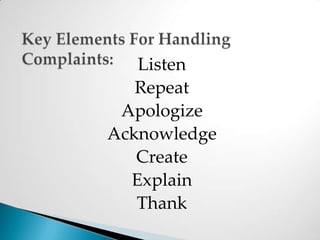
Listen RepeatApologizeAcknowledgeCreateExplainThankKey Elements For Handling Complaints:
Group Exercise #2Handling a Complaint
CS106Customer Service Fast Facts
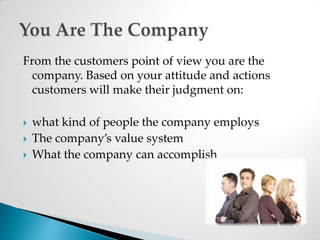
From the customers point of view you are the company. Based on your attitude and actions customers will make their judgment on:what kind of people the company employsThe company’s value systemWhat the company can accomplishYou Are The Company
Providing high quality service can save the company money. Employees spend less time reacting to problems and more time proactively improving the companyLosing customers costs a great deal more than keeping them Great service providers are making themselves valuable to the businessThe same skills that lead to customer satisfaction; listening, empathy, and empowerment;  also lead to increased productivity and satisfactionThe Value of Service
Lifetime Value of a CustomerSpend some time with a coworker or supervisor. Identify one customer and try to determine what they spend in one year. Multiply that by how many years you could expect them to be a customer.
Obviously, one of your customers is the patient, the customer who needs you service. However, your customers are also:That patients family and friends (and your potential customers)The very important referral sources who offer you business everydayThe insurance companies that often pay the bills VisitorsTreat our customers as individuals. Treat them as you would want your children and family members to be treatedKnow Your Customer
A customer is the most important person in this office- in person, by phone, or by mailCustomers are not an interruption of our work- they are the purpose for itCustomers are not dependant on us; we are dependant on them We are not doing them a favor by serving them; they are doing us a favor by allowing us to do soA customer is not someone to match wits with. Nobody ever won an argument with a customerA customer is a person who brings us their wants. It is our job to handle them profitably- to them and to ourselves
Ask yourself the following questions after a service encounterDid I completely understand what the customer wanted?Did the customer get what he or she wanted?Did I get the information in a clear and consice manner?Did the customer receive quality service?Is the customer really satisfied?Determine how you can improve in these areas for your next encounterCustomer Expectations and Satisfaction
What Matters to a CustomerCustomers want:Respect for their time (understood, important)Simplicity (comfortable)Accuracy-no mistakes (safe)Accessibility (welcomed, comfortable)You to keep your word- exceed it (safe)Courtesy (welcomed, important)Personal attention (understood)Prompt attention (important)To count on you (safe)Apprecation (welcome, important, understood)Knowledgeable staff (safe)Explanations (safe, understood)To be treated like a friend (important)
Learn to say YESProvide basic courtesyListeningUsing the phone RecoverySome Customer Service Skills and Approaches
When a customer makes a request, before answering “no”, slow down. Be different, make a difference, find a way. Be the customers advocate. Explore every alternative before saying “no” to the customer. Learning to Say YES
Always greet the customer and then offer helpConstantly use the language of courtesy,           “ thank you, you’re welcome, we appreciate your business.”Speak in positive action oriented terms: “I will, I can, the product does”Keep the customer informedProvide Basic Courtesy
Reminders about listeningWe find it difficult to listen because:We like to hear ourselves speakWe feel we have to respond to every thought, right awayWhen listening:Make notes as the conversation progressesWhen needed restate the customers words for confirmationListen for conversational toneDon’t assume what the customer is going to sayApproach every conversation from the customers perspectiveListen
			Survey says…			 	the most annoying phone habits areWhen a phone is not answered by the 3rd or 4th ringAutomated phone menusBeing put on hold without permissionNot knowing who they are speaking withUnknowledgeable employeesThe first 30 seconds of a phone call sets the tone for the remainder of the contact. The last 30 seconds are critical to establishing lasting rapportUsing the Phone
Tips:Answer by the 3rd ringIf you put them on hold let them know why, how long they will be on hold and what you will be doing during that timeAnswer the phone: greeting, company name, your nameKnow what you are talking aboutAllow them to hang up first. Always thank them for their callUsing the Phone
Apologize. Say “I’m sorry”, show the mistake mattersListen. It shows the person mattersFix it. The quicker the betterFollow-up. Make certain the problem was repairedRecovery
Practice the 4 T’s: Tell Them The TruthDo what you say you are going to do and do it right the first timeCustomers don’t want to hear “I don’t know”, “That’s not my job”, “I can’t help you”Underpromise and overdeliverRemember expectationsThings to Keep in Mind…
CS104Taking the Customers Perspective
Empathy is:The capacity to participate in another individual’s feelingsFeeling both the pain and joy of othersAn acute awareness of another person’s circumstances and how they will react to those circumstancesThe feeling of empathy is a selfless emotion that comes easier to some than to othersEmpathy: taking the customers perspective
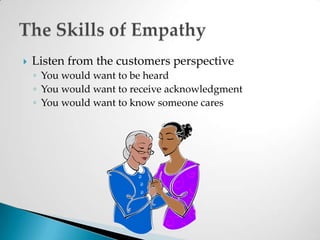
Listen from the customers perspectiveYou would want to be heard You would want to receive acknowledgmentYou would want to know someone caresThe Skills of Empathy
Steps for taking actionConsider what the situation looks like from their angleListen and observe wellAct. Respond appropriatelyTaking Action
Words to avoid:Should’ve Can’t Don’t AlwaysNeverOur company policySaying No With Empathy
Exercise #3Customer service
Exercise #4Taking Action

Med University

  • 1.
    Med University Wright& FilippisPartnering to Enhance Your SuccessCustomer Service Workshop
  • 2.
  • 3.
    We all needCustomer Service training!I don’t need no customer service training…
  • 4.
    You may notalways learn something newSometimes we just need a simple reminder of things we already knowA reminder to practice those things we know are importantI’ve already seen all of this before…
  • 5.
    I never hearany complaints about the job I am doing…Great job!There is a risk that you are not hearing those complaints 1 in 10 customers is likely to voice a complaint the other 9 will simply leaveIf a customer is willing to voice their problems it means they trust you to take care of them
  • 6.
    I’m not acustomer service representative. Customer service is not my job!It is true some have more contact with customers than otherWe are in a customer service business!!!
  • 7.
    You don’t knowmy customers!Yes we do! You have one of the most difficult jobs that exists, dealing with sick peopleIn addition you are dealing with referral sources, insurance companies, physician’ offices, etc.
  • 8.
    Poor Service CanAnd Does ExistSome reasons for poor service:Some employees don’t careThere are differences in what you think the customers need and what they actually wantEmployees are offered poor training and planning for customer servicePoor handling of complaintsThere are employees who don’t have the power or the will to take care of the customersEmployees’ frustration from being treated poorly by customersQuality Service
  • 9.
    Your job can’tsurvive without the business and the business can’t survive without customer serviceOne of the factors most critical to job satisfaction is the ability to feel as if we make a difference in the lives of othersThe skills necessary for effective customer service, the ability to listen, to organize and to seek creative solutions, are the foundations of every future career advancement What’s In It For Me?
  • 10.
    Customers are primarilyinterested in:Price QualityPerformance and ServiceCustomer Service: The Exchange
  • 11.
    The Golden Ruleand HME“treat others as you would want to be treated”In the HME business this is more of a challengeOur customer may have not chosen usThey are not thrilled to have to use us- due to many factors one being illnesskeeping mindful of these facts will help us to improve our customer service skills Customer Service: The Exchange
  • 12.
    We are inthe business of providing services. We know our products. What are our services?DeliveryBillingAnswering questionsProviding EMPATHYProducts vs. Services
  • 13.
    Customer Needs Researchshows patients need 5 consistent things:Understood WelcomeImportantComfortSafety
  • 14.
    Customers want tobe listened to They want to be certain their concerns are being heardThey want their questions answeredCustomers want you to understand their perspectiveThey want you to understand their emotionsNeed to Feel Understood
  • 15.
    Need to FeelWelcomeCustomers like it when you use their nameThey like to be recognizedIf they come to your storefront they like convenient parking and someone to greet them as they come in
  • 16.
    Customers want tofeel appreciatedThey want to be thankedThey want to know someone will go out of their way for themAre customers treated with courtesy?Do employees know their individual needs and challenges?Need to Feel Important
  • 17.
    Customers want privacyand comfortable surroundingsThey want to feel at homeAre instructions provided clear?Are they treated with dignity, is their comfort taken into consideration?Need for Comfort
  • 18.
    Need for SafetyCanthey count on your confidentiality?Your word?Do you give them good advice?Will you take care of them?
  • 19.
    Group Exercise #1BasicNeeds of Customers
  • 20.
    Reliability-the ability toperform the promised service Responsiveness-willingness to help customers and provide prompt serviceAssurance-knowledge and courtesy of employees and their ability to convey trust as well as confidenceEmpathy-caring, individualized attention provided to customers by the firmTangibles-appearance of physical facilities, equipment, and personnel Elements of Customer Service
  • 21.
    Reliabilitythe ability toperform the promised service Reliability = ConsistencyDo whatyou say you are going to do. Do it when you say you are going to do it.Do it right the first time. Follow-upand follow through.
  • 22.
    Responsivenesswillingness to helpcustomers and provide prompt serviceResponsiveness = PromptnessDo you greet people as they come in?Do you make yourself immediately availableDo you answer the phone by the 3rd ring and when you transfer , do you make sure they are connected?How quickly do you respond when a customer needs you?
  • 23.
    Assuranceknowledge and courtesyof employees and their ability to convey trust as well as confidenceAssurance = TrustAre you credible?Do people feel they can trust you?Can customers believe your answers?Does it ease their concerns when they hear something from you?
  • 24.
    EmpathyCaring, individualized attentionprovided to customersEmpathy = PerspectiveAre you willing to see things from your customers perspective?Do you treat each customer as an individual?Do you work hard to build rapport and can you customize your service to meet each customer’s needs?
  • 25.
    Tangiblesappearance of physicalfacilities, equipment, and personnelTangibles = AppearanceIs appearance appropriate and professional?How about the appearance of the staff?And correspondence that goes out with your name?
  • 26.
    Elements of QualityCustomer ServiceNow we know the basic needs of customers and the elements of quality customer service.What do you think upsets customers the most?They didn’t get what they were promisedSomeone was rudeNo one went out of their way to take care of themNo one listened to themProducts were faultyThey were put on hold without requesting permissionStaff was untrained or under qualifiedDeadlines were missedIndustry jargon was usedWhich of the above can you personally control?
  • 27.
    They didn’t getwhat they were promisedSomeone was rudeNo one went out of their way to take care of themNo one listened to themThey were put on hold without requesting permissionIndustry jargon was usedWhat are our strengths and weaknesses? Select one weakness and create a solution for that weakness this month.Lets Create a Solution!!!
  • 28.
    Lets anticipate whatcan go wrong. In order to do this we must be able to put ourselves in their place. Can you help them to systemize their needs? What kind of service should be anticipated so they don’t have to request it? (equipment maintenance, telephone checklist, systematic follow-up)Don’t wait for a problem to develop. Ask yourself: “Have I considered all of my customers needs?”“What will they need next?”“How can I improve service now for my patient?” Anticipation
  • 29.
    The first element Theoutflow of informationWhat information do your customers need to know?What questions do they commonly have?If you have to explain something over and over, how can you systemize that explanation?Communication
  • 30.
    The second elementFeedbackSpendtime identifying what is important to your customersIdentify three things that are most important to customers and ask them those questions over and over againDon’t wait to hear from the customerActively reach out and solicit customer comments rather than listening to their complaintAsk “How are we doing?” as an approach to solicit feedbackCommunication
  • 31.
    Communication GlitchesOverpromising –promising the customer more than you can do or can deliverFailing to stay in touch when a problem existsFailing to listenUsing industry jargonTelling but not explaining Communication without courtesyCommunication
  • 32.
    Who is responsiblefor what in your organization?What could fall through the cracks?How are all parts of the delivery system kept coordinated with one another?Who is responsible for that?Make certain that someone is responsible for every step.Organization
  • 33.
    The Personal DimensionHowcan we personally improve???
  • 34.
    Every encounter acustomer has with you is a “moment of truth”, those one-on-one encounters with customers; they are the point at which customers make judgments about the organization and its quality of service. In that encounter customers will make a judgment on:What kind of people the company employsThe company’s value systemWhat the company can accomplish Appearance
  • 35.
    AttitudeQuality service anda positive attitude are inseparable. You will know that you have a positive when you feel challenged to find a solution rather than being frustrated by an irate customer. Avoid feeling like a victim by taking charge of your work life and choosing your disposition then maintaining it no matter who confronts you.
  • 36.
    AttitudeThe longer Ilive, the more I realize the impact of attitude on life. Attitude, to me, is more important than facts. It is more important than the past, than education, than money, than circumstances, than failures, than successes, than what other people think or say or do. It is more important than appearance, giftedness, or skill. It will make or break a company ... a church ... a home. The remarkable thing is we have a choice every day regarding the attitude we will embrace for that day. We cannot change our past. We cannot change the fact that people will act in a certain way. We cannot change the inevitable. The only thing we can do is play on the one string we have, and that is our attitude ... I am convinced thatlife is 10% what happens to me, and 90% how I react to it. And so it is with you ... we are in charge of our Attitudes.
  • 37.
    Some ideas formanaging our situationsTake care of one customer at a timeIf a chronic problem arises, change itStay informed Remember to laughExpress yourself Vary your routineAttitude
  • 38.
    If attitude isa matter of mind, it is reflected in our body language and tone of voice. Attitude is found in your smile (even on the phone)! Keep in mind the tone you want present. Attitude
  • 39.
    Tune into thecustomers unique needs and wants. What would you want?You would want to be heardYou would want to receive acknowledgment of your situationYou would want to know that someone caresAttentiveness
  • 40.
    Tact involves thechoice of words. Try to avoid using the word “you,” as in, “you will have to call back later” or, “You should have taken care of this earlier.” Instead try “here is what we need to do to get back on track.”Tact
  • 41.
    Think of howyou can help and what knowledge you need in order to offer good advice. Be willing to say “I don’t know, but here is how I will find out”Their lives can be better today because of youGuidance
  • 42.
    Customer Service isSelling Great service and good information = improved salesThe key to creating additional sales is knowing what products would be appropriate and helpful for the patient. Selling
  • 43.
  • 44.
  • 45.
  • 46.
    From the customerspoint of view you are the company. Based on your attitude and actions customers will make their judgment on:what kind of people the company employsThe company’s value systemWhat the company can accomplishYou Are The Company
  • 47.
    Providing high qualityservice can save the company money. Employees spend less time reacting to problems and more time proactively improving the companyLosing customers costs a great deal more than keeping them Great service providers are making themselves valuable to the businessThe same skills that lead to customer satisfaction; listening, empathy, and empowerment; also lead to increased productivity and satisfactionThe Value of Service
  • 48.
    Lifetime Value ofa CustomerSpend some time with a coworker or supervisor. Identify one customer and try to determine what they spend in one year. Multiply that by how many years you could expect them to be a customer.
  • 49.
    Obviously, one ofyour customers is the patient, the customer who needs you service. However, your customers are also:That patients family and friends (and your potential customers)The very important referral sources who offer you business everydayThe insurance companies that often pay the bills VisitorsTreat our customers as individuals. Treat them as you would want your children and family members to be treatedKnow Your Customer
  • 50.
    A customer isthe most important person in this office- in person, by phone, or by mailCustomers are not an interruption of our work- they are the purpose for itCustomers are not dependant on us; we are dependant on them We are not doing them a favor by serving them; they are doing us a favor by allowing us to do soA customer is not someone to match wits with. Nobody ever won an argument with a customerA customer is a person who brings us their wants. It is our job to handle them profitably- to them and to ourselves
  • 51.
    Ask yourself thefollowing questions after a service encounterDid I completely understand what the customer wanted?Did the customer get what he or she wanted?Did I get the information in a clear and consice manner?Did the customer receive quality service?Is the customer really satisfied?Determine how you can improve in these areas for your next encounterCustomer Expectations and Satisfaction
  • 52.
    What Matters toa CustomerCustomers want:Respect for their time (understood, important)Simplicity (comfortable)Accuracy-no mistakes (safe)Accessibility (welcomed, comfortable)You to keep your word- exceed it (safe)Courtesy (welcomed, important)Personal attention (understood)Prompt attention (important)To count on you (safe)Apprecation (welcome, important, understood)Knowledgeable staff (safe)Explanations (safe, understood)To be treated like a friend (important)
  • 53.
    Learn to sayYESProvide basic courtesyListeningUsing the phone RecoverySome Customer Service Skills and Approaches
  • 54.
    When a customermakes a request, before answering “no”, slow down. Be different, make a difference, find a way. Be the customers advocate. Explore every alternative before saying “no” to the customer. Learning to Say YES
  • 55.
    Always greet thecustomer and then offer helpConstantly use the language of courtesy, “ thank you, you’re welcome, we appreciate your business.”Speak in positive action oriented terms: “I will, I can, the product does”Keep the customer informedProvide Basic Courtesy
  • 56.
    Reminders about listeningWefind it difficult to listen because:We like to hear ourselves speakWe feel we have to respond to every thought, right awayWhen listening:Make notes as the conversation progressesWhen needed restate the customers words for confirmationListen for conversational toneDon’t assume what the customer is going to sayApproach every conversation from the customers perspectiveListen
  • 57.
    Survey says… themost annoying phone habits areWhen a phone is not answered by the 3rd or 4th ringAutomated phone menusBeing put on hold without permissionNot knowing who they are speaking withUnknowledgeable employeesThe first 30 seconds of a phone call sets the tone for the remainder of the contact. The last 30 seconds are critical to establishing lasting rapportUsing the Phone
  • 58.
    Tips:Answer by the3rd ringIf you put them on hold let them know why, how long they will be on hold and what you will be doing during that timeAnswer the phone: greeting, company name, your nameKnow what you are talking aboutAllow them to hang up first. Always thank them for their callUsing the Phone
  • 59.
    Apologize. Say “I’msorry”, show the mistake mattersListen. It shows the person mattersFix it. The quicker the betterFollow-up. Make certain the problem was repairedRecovery
  • 60.
    Practice the 4T’s: Tell Them The TruthDo what you say you are going to do and do it right the first timeCustomers don’t want to hear “I don’t know”, “That’s not my job”, “I can’t help you”Underpromise and overdeliverRemember expectationsThings to Keep in Mind…
  • 61.
  • 62.
    Empathy is:The capacityto participate in another individual’s feelingsFeeling both the pain and joy of othersAn acute awareness of another person’s circumstances and how they will react to those circumstancesThe feeling of empathy is a selfless emotion that comes easier to some than to othersEmpathy: taking the customers perspective
  • 63.
    Listen from thecustomers perspectiveYou would want to be heard You would want to receive acknowledgmentYou would want to know someone caresThe Skills of Empathy
  • 64.
    Steps for takingactionConsider what the situation looks like from their angleListen and observe wellAct. Respond appropriatelyTaking Action
  • 65.
    Words to avoid:Should’veCan’t Don’t AlwaysNeverOur company policySaying No With Empathy
  • 66.
  • 67.