Licensure and Starting a Practice
Learning Objectives
1.) Form a detailed business plan.
2.) Differentiate between types of business ownership.
3.) Have the theoretical tools necessary for selecting a business
  location and facility.
4.) Use the theoretical tools necessary to set up a business.
Learning Objectives continued
5.) Conduct an employee interview.
6.) Choose the most suitable forms of
 advertising based on a budget.
The Business Plan
Document detailing all aspects of the business as it is as
 present and as it is envisioned.
The “blueprint”
Brainstorm and come up with primary list
The Primary List
Time to create
Why create it?
 Should you hire a consultant?
 Outcomes
The Primary List - Example
Demand                Structure
Main client base      Bookkeeping
Desired client base   Expansion plans
Location              Business license
Type of facility      Zoning permit
Name of business      Insurance
Style and image       Advertising
Mode of raising $
Secondary List
Give one page to each item on primary list
Brainstorm ideas related to that item
Example: Insurance
  Malpractice
  Fire/water/property damage
  Personal disability
  Payroll/worker’s compensation disability
Business-in-a-binder
Organizes information
Hold documentation and certificates needed
Each item on primary list gets its own section
Document everything!
Types of Ownership
1.) Sole proprietorship
2.) Partnership
3.) Corporation
Sole Proprietor
One self-employed owner and manager
Success is the sole responsibility of the owner
DBA (doing business as) – permit required if a business is
  going to be conducted under a name other than the business
  owner’s own name.
Partnership
Shared ideas, shared responsibility, shared liability
Generate additional investment capital
Two or more people own a business, ownership may or may
  not be equally shared
Corporation
Shared by 3 or more individuals who are identified by a state-
 mandated charter (subject to regulations and taxation).
Incorporated – protection from liability; personal assets
 protected from claims
Business Laws and Regulations
Local
  Guidelines for parking, building codes, and so on.
State
  Sales taxes, licensing, worker’s compensation, payroll taxes,
    census reports
Federal
  Payroll taxes, social security, unemployment compensation,
    insurance, MSDS
Location and Facility
Does the area have a large enough population to sustain a
 business?
Do you plan to be the sole operator, or do you plan to bring
 other hair-removal technicians into the business?
Do you plan to lease a business that gives you room for
 growth or to lease something smaller and, down the road,
 vacate, and more to a larger facility?
Things to Consider:
Location
Floor plan
Lease


**Consider available capital.
Banks want to see in a business plan the kind of facility,
  location, square footage, and leasing cost before
  committing to a loan.
Location
Easily accessible
Easy to find with simple directions
Cleary visible
Frontage appeal, eye-catching sign
Adequate parking, safe parking
Other businesses around to attract clientele
Floor plan
Is the Key
Adequate square footage with handicapped accessibility.
Open to immediate reception area
Treatment rooms large enough for all equipment
Office
Storage space
Clean, attractive restrooms
Good lighting and ventilation
The Lease
Evaluate pros and cons
Study the leasing agreement (who pays for what)
Have a lawyer look at the agreement
New construction will need to be inspected and certificate of
  occupancy issued and displayed
Home Businesses
Not really an option for laser techs
Purchasing Existing Businesses
Elicit advice from lawyer and/or accountant
Why is the business for sale?
Can the name of the business be continued for a certain time?
Will employees stay on under new ownership?
Purchasing Existing Business
Will the cost of leasing the premises go up? How much?
What equipment fixtures will remain?
Office Setup
Dispensary
  Contains all supplies for services, disinfectants, autoclaves, etc.
Treatment Rooms
  Walls, floors, surfaces that are easy to clean and disinfect (NO
   CARPET!!!)
  Uncluttered
  Background music – soft and soothing
Phone Techniques
Always provide your name
Be friendly and courteous
If they want to discuss services in depth, invite them in for
 consultation.
Offer two choices when scheduling.
NEVER put them on immediate hold.
Phone Techniques
Handling complaints
If the problem needs to be looked at, invite the client to
 come in and be seen ASAP.
Or sometimes a home-care remedy is all that is needed.
 Assure that the technician will call ASAP.
Booking Techniques
Appointment book versus computerized system
Appointment book less expensive
Write in pencil
Include daytime phone number to confirm appointments (1
  to 3 days prior)
Booking Techniques
Advantages of computerized system
Stores other pertinent info
Help with stock and inventory control
Print daily schedules
Print reports
Speeds cash-out process
Booking Techniques
Repeated no shows
Policy for charging for appointments not cancelled within 24
  hour period
  Clearly posted
  Mention policy at time of booking and confirmation
Insurance
Malpractice
  Dereliction of personal duty or failure to exercise an accepted
    degree of professional skill (pg. 265)
Equipment insurance – make sure YOU are covered
Insurance
Business owner’s liability
  Covers clients or employees being injured
  May also purchase fire, water, natural disaster, theft
Insurance
Personal disability
  People who suffer major accidents that prevent them from
    continuing work benefit from this coverage.
Service Charges
CPA can help
  Calculate using variables (overhead, materials, labor cost,
   acceptable fee in the area)
  Timing should be considered
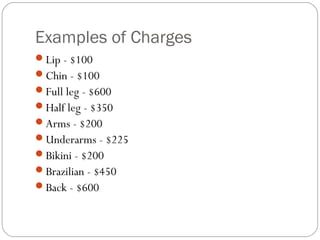
Examples of Charges
Lip - $100
Chin - $100
Full leg - $600
Half leg - $350
Arms - $200
Underarms - $225
Bikini - $200
Brazilian - $450
Back - $600
Advertising and Marketing
CRUCIAL!!
Well thought out and planned
This is everyone’s responsibility.
Referrals
Best method of advertising!
Client-referral incentive
Business Cards and Brochures
Attractive
Focus on the business’s philosophy
Pass out business cards!!
Recommendation of Additional
Services
Upselling
  Client is talking about an upcoming vacation. Suggest bikini or
    leg hair removal.
Cross-selling services
Chamber of Commerce
Mingle with local businesses
Provide help and advice
Better Business Bureau
Being a member indicates that a business is recognized for
 reputation and service.
Offered membership after 5 years of providing quality
 service, without major complaints
Television/Radio/Newspaper
TV – costliest
Radio – better deal, effective for areas of high
 traffic/commute
Ads in art programs – support community and tax deductible
 (Goodwill)
Mass Mailings
Reaches numerous local households and potential clients
Can be with or without a coupon
World Wide Web
Effective
Found using searches
The Yellow Pages
Most common form of advertising
New clients
1.) How many types of ownership
are there? Name them.
3
Sole proprietorship
Partnership
Corporation
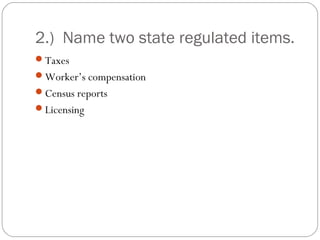
2.) Name two state regulated items.
Taxes
Worker’s compensation
Census reports
Licensing
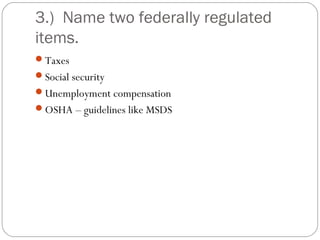
3.) Name two federally regulated
items.
Taxes
Social security
Unemployment compensation
OSHA – guidelines like MSDS
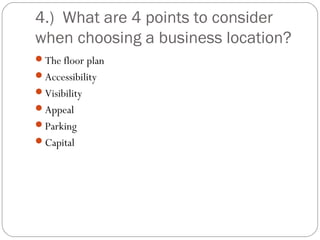
4.) What are 4 points to consider
when choosing a business location?
The floor plan
Accessibility
Visibility
Appeal
Parking
Capital
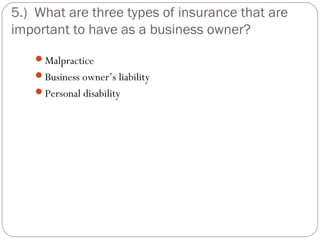
5.) What are three types of insurance that are
important to have as a business owner?
   Malpractice
   Business owner’s liability
   Personal disability
6.) What are some effective
methods of advertisement?
Referrals
Business cards, brochures
TV
Radio
Newspaper
Mass mailings
Internet
Yellow pages
7.) What is the BEST form of
advertisement?
WORD OF MOUTH!!!
8.) When setting up your treatment
room, what should you remember?
NO carpet
Walls, floors, surfaces should be easy to clean and
 disinfect
Uncluttered
Soft, soothing music
9.) If someone calls because of a
complaint what are your two options?
   Determine if they need to come in
     If they do then invite them to come in and see the laser tech
      ASAP.
     If they don’t, make sure the laser tech responds ASAP to
      recommend a home-care remedy.

M licensure and starting a practice

  • 1.
  • 2.
    Learning Objectives 1.) Forma detailed business plan. 2.) Differentiate between types of business ownership. 3.) Have the theoretical tools necessary for selecting a business location and facility. 4.) Use the theoretical tools necessary to set up a business.
  • 3.
    Learning Objectives continued 5.)Conduct an employee interview. 6.) Choose the most suitable forms of advertising based on a budget.
  • 4.
    The Business Plan Documentdetailing all aspects of the business as it is as present and as it is envisioned. The “blueprint” Brainstorm and come up with primary list
  • 5.
    The Primary List Timeto create Why create it?  Should you hire a consultant?  Outcomes
  • 6.
    The Primary List- Example Demand Structure Main client base Bookkeeping Desired client base Expansion plans Location Business license Type of facility Zoning permit Name of business Insurance Style and image Advertising Mode of raising $
  • 7.
    Secondary List Give onepage to each item on primary list Brainstorm ideas related to that item Example: Insurance Malpractice Fire/water/property damage Personal disability Payroll/worker’s compensation disability
  • 8.
    Business-in-a-binder Organizes information Hold documentationand certificates needed Each item on primary list gets its own section Document everything!
  • 9.
    Types of Ownership 1.)Sole proprietorship 2.) Partnership 3.) Corporation
  • 10.
    Sole Proprietor One self-employedowner and manager Success is the sole responsibility of the owner DBA (doing business as) – permit required if a business is going to be conducted under a name other than the business owner’s own name.
  • 11.
    Partnership Shared ideas, sharedresponsibility, shared liability Generate additional investment capital Two or more people own a business, ownership may or may not be equally shared
  • 12.
    Corporation Shared by 3or more individuals who are identified by a state- mandated charter (subject to regulations and taxation). Incorporated – protection from liability; personal assets protected from claims
  • 13.
    Business Laws andRegulations Local Guidelines for parking, building codes, and so on. State Sales taxes, licensing, worker’s compensation, payroll taxes, census reports Federal Payroll taxes, social security, unemployment compensation, insurance, MSDS
  • 14.
    Location and Facility Doesthe area have a large enough population to sustain a business? Do you plan to be the sole operator, or do you plan to bring other hair-removal technicians into the business? Do you plan to lease a business that gives you room for growth or to lease something smaller and, down the road, vacate, and more to a larger facility?
  • 15.
    Things to Consider: Location Floorplan Lease **Consider available capital. Banks want to see in a business plan the kind of facility, location, square footage, and leasing cost before committing to a loan.
  • 16.
    Location Easily accessible Easy tofind with simple directions Cleary visible Frontage appeal, eye-catching sign Adequate parking, safe parking Other businesses around to attract clientele
  • 17.
    Floor plan Is theKey Adequate square footage with handicapped accessibility. Open to immediate reception area Treatment rooms large enough for all equipment Office Storage space Clean, attractive restrooms Good lighting and ventilation
  • 18.
    The Lease Evaluate prosand cons Study the leasing agreement (who pays for what) Have a lawyer look at the agreement New construction will need to be inspected and certificate of occupancy issued and displayed
  • 19.
    Home Businesses Not reallyan option for laser techs
  • 20.
    Purchasing Existing Businesses Elicitadvice from lawyer and/or accountant Why is the business for sale? Can the name of the business be continued for a certain time? Will employees stay on under new ownership?
  • 21.
    Purchasing Existing Business Willthe cost of leasing the premises go up? How much? What equipment fixtures will remain?
  • 22.
    Office Setup Dispensary Contains all supplies for services, disinfectants, autoclaves, etc. Treatment Rooms Walls, floors, surfaces that are easy to clean and disinfect (NO CARPET!!!) Uncluttered Background music – soft and soothing
  • 23.
    Phone Techniques Always provideyour name Be friendly and courteous If they want to discuss services in depth, invite them in for consultation. Offer two choices when scheduling. NEVER put them on immediate hold.
  • 24.
    Phone Techniques Handling complaints Ifthe problem needs to be looked at, invite the client to come in and be seen ASAP. Or sometimes a home-care remedy is all that is needed. Assure that the technician will call ASAP.
  • 25.
    Booking Techniques Appointment bookversus computerized system Appointment book less expensive Write in pencil Include daytime phone number to confirm appointments (1 to 3 days prior)
  • 26.
    Booking Techniques Advantages ofcomputerized system Stores other pertinent info Help with stock and inventory control Print daily schedules Print reports Speeds cash-out process
  • 27.
    Booking Techniques Repeated noshows Policy for charging for appointments not cancelled within 24 hour period Clearly posted Mention policy at time of booking and confirmation
  • 28.
    Insurance Malpractice Derelictionof personal duty or failure to exercise an accepted degree of professional skill (pg. 265) Equipment insurance – make sure YOU are covered
  • 29.
    Insurance Business owner’s liability Covers clients or employees being injured May also purchase fire, water, natural disaster, theft
  • 30.
    Insurance Personal disability People who suffer major accidents that prevent them from continuing work benefit from this coverage.
  • 31.
    Service Charges CPA canhelp Calculate using variables (overhead, materials, labor cost, acceptable fee in the area) Timing should be considered
  • 32.
    Examples of Charges Lip- $100 Chin - $100 Full leg - $600 Half leg - $350 Arms - $200 Underarms - $225 Bikini - $200 Brazilian - $450 Back - $600
  • 33.
    Advertising and Marketing CRUCIAL!! Wellthought out and planned This is everyone’s responsibility.
  • 34.
    Referrals Best method ofadvertising! Client-referral incentive
  • 35.
    Business Cards andBrochures Attractive Focus on the business’s philosophy Pass out business cards!!
  • 36.
    Recommendation of Additional Services Upselling Client is talking about an upcoming vacation. Suggest bikini or leg hair removal. Cross-selling services
  • 37.
    Chamber of Commerce Minglewith local businesses Provide help and advice
  • 38.
    Better Business Bureau Beinga member indicates that a business is recognized for reputation and service. Offered membership after 5 years of providing quality service, without major complaints
  • 39.
    Television/Radio/Newspaper TV – costliest Radio– better deal, effective for areas of high traffic/commute Ads in art programs – support community and tax deductible (Goodwill)
  • 40.
    Mass Mailings Reaches numerouslocal households and potential clients Can be with or without a coupon
  • 41.
  • 42.
    The Yellow Pages Mostcommon form of advertising New clients
  • 43.
    1.) How manytypes of ownership are there? Name them. 3 Sole proprietorship Partnership Corporation
  • 44.
    2.) Name twostate regulated items. Taxes Worker’s compensation Census reports Licensing
  • 45.
    3.) Name twofederally regulated items. Taxes Social security Unemployment compensation OSHA – guidelines like MSDS
  • 46.
    4.) What are4 points to consider when choosing a business location? The floor plan Accessibility Visibility Appeal Parking Capital
  • 47.
    5.) What arethree types of insurance that are important to have as a business owner? Malpractice Business owner’s liability Personal disability
  • 48.
    6.) What aresome effective methods of advertisement? Referrals Business cards, brochures TV Radio Newspaper Mass mailings Internet Yellow pages
  • 49.
    7.) What isthe BEST form of advertisement? WORD OF MOUTH!!!
  • 50.
    8.) When settingup your treatment room, what should you remember? NO carpet Walls, floors, surfaces should be easy to clean and disinfect Uncluttered Soft, soothing music
  • 51.
    9.) If someonecalls because of a complaint what are your two options? Determine if they need to come in If they do then invite them to come in and see the laser tech ASAP. If they don’t, make sure the laser tech responds ASAP to recommend a home-care remedy.