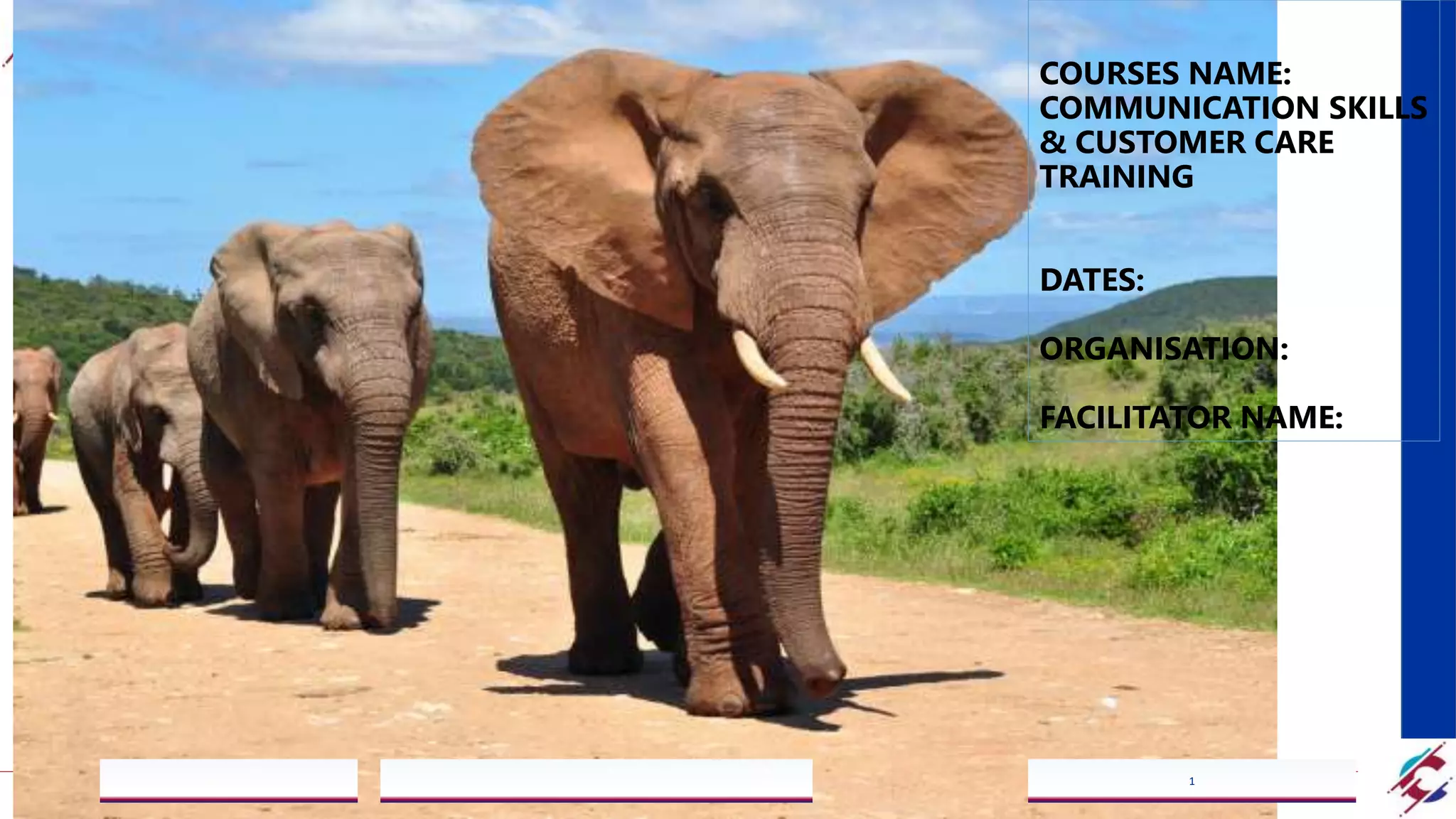
COURSES NAME:
COMMUNICATION SKILLS
& CUSTOMER CARE
TRAINING
DATES:
ORGANISATION:
FACILITATOR NAME:
6/3/2023
A Strategic Business Unit (SBU) of Fachs Group offering Corporate Training in:
Leadership, Management & Personal Mastery I Governance, Risk & Compliance I Financial & Supply Chain Management I Business Skills I Technology Skills I Industry
Certifications
1
Objectives
By the end of the training you should be able to:
• Understand the importance of the provision of good customer service
• Identify customer and organisational needs and expectations in respect of service
levels
• Describe the differences between strong and weak customer care
• Recognise how to present a professional image
• Identify the techniques used to handle customer complaints
1. Green
- Who is a customer?
- Explain the assertion that: ‘
The Customer is always
right?’ [5 Marks]
Do Activity
Challenge (Spicy)
Extension:
List and explain 3 things
that make up an
organisations image.
(10 marks)
2. Amber
List 5 effective
communication skills a
customer services person
needs
[5] Marks
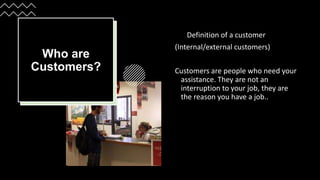
Who are
Customers?
Definition of a customer
(Internal/external customers)
Customers are people who need your
assistance. They are not an
interruption to your job, they are
the reason you have a job..
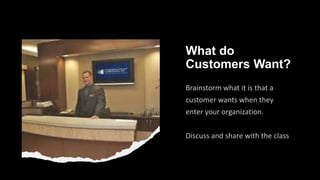
What do
Customers Want?
Communicating Effectively with Customers
Definition:
What describes GOOD service and BAD service?
Good customer service is taking that extra step to help without being asked! It’s all
about attitude and skills.
https://www.youtube.com/watch?v=ZDxIFQLOiV0
https://www.youtube.com/watch?v=qfGxAJBOzeo
A Positive Organisational Image
First impressions count and will affect the interaction. People make judgements in
the first 30 seconds.
Golden Rule – Customer is king.You only have one chance to make a first
impression!
Planning Good Customer Service
• Recording procedures (when are your busy times)
• Reporting procedures (meeting organisational/
funding/ legislative requirements)
• Observe and report customer needs
• Be proactive in improving service
• Market your organisation
• Have processes and procedures for dealing with
difficult situations BEFORE they happen and make
sure staff are trained.
Service Standards
How can you contribute to the development and maintenance of service standards
in your organisation?
• Read and understand your organisation’s policies and procedures on customer
service
• Be prompt and efficient
• Ensure services are delivered in accordance with legislative or statutory
requirements
• Maintain accurate records
• Ensure any special needs of customers are taken into account
CUSTOMER SERVICE
• Rewards for Excellent Customer Service
• Increased customer loyalty
• Positive word-of-mouth
promotion
• Happier customers
• More productive and happier employees
• Smoother working operations
Attitude Checklist
What attitudes assist in providing good service?
• Enjoy helping people
• Handle people well
• Care for your customers
• Give fair and equal treatment to all
• Be understanding of people with special needs
http://www.youtube.com/watch?v=yJYg7Nz3aPU
https://www.youtube.com/watch?v=3sllBkkcYN4
Skills for Customer Service
• Know about your organisation
• Learn the technical parts of the job
• Communicate well
• Be consistent
• Be organised
• Know your place in the team and be a team player
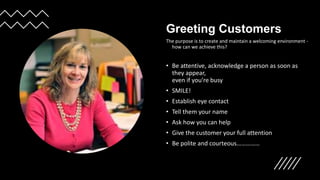
Greeting Customers
The purpose is to create and maintain a welcoming environment -
how can we achieve this?
• Be attentive, acknowledge a person as soon as
they appear,
even if you’re busy
• SMILE!
• Establish eye contact
• Tell them your name
• Ask how you can help
• Give the customer your full attention
• Be polite and courteous……………
Find out how You
can Help
• How can you find out what people
want?
• If you can’t help, what should you
do?
• Offer alternatives if possible
• If they have to wait, how would you
handle it?
How to Listen to Customers
Active listening = Attending skills (being ready)
Attend to immediate needs (if you need to finish something before giving
your full attention)
Being available
Eye contact
Attentive posture
Concentration
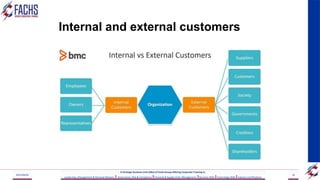
Internal and external customers
2023/06/03 16
A Strategic Business Unit (SBU) of Fachs Group offering Corporate Training in:
Leadership, Management & Personal Mastery I Governance, Risk & Compliance IFinancial & Supply Chain Management IBusiness Skills ITechnology Skills IIndustry Certifications
INTERNAL & EXTERNAL CUSTOMERS
• External customers are those who see your company mainly as a provider
of something they buy.
• Internal customers participate in your business by actually being a part of
it.
• Internal customers have a relationship with, and within, your company, either
through employment or as partners who deliver your product or service to the
end user, the external customer.
• Less obvious but certainly still significant, stakeholders and shareholders are also
internal customers.
2023/06/03 17
A Strategic Business Unit (SBU) of Fachs Group offering Corporate Training in:
Leadership, Management & Personal Mastery I Governance, Risk & Compliance IFinancial & Supply Chain Management IBusiness Skills ITechnology Skills IIndustry Certifications
Using Your Voice
Do you
• Become loud when angry or upset
• Speak faster when nervous
• Speak slowly when tired or bored
• Have a cheerful voice
• My tone of voice is warm and understanding
• Find it easy to talk to people you don’t know
• Control your tone in most situations
• Sound bossy, weak or unsure
• Have a clear and easy-to-hear voice
• Speak in a very formal or very trendy manner?
Think about how you might modify your voice in certain situations
Content
• Session 1 Introduction to customer service
• What is service?
• Why is it important?
• Identifying customer needs
• Session 2 Effective communications
• Effective and ineffective communication skills
• Questioning and listening techniques
• Telephone techniques
Content continued
• Session 3 Presenting a positive professional image
• First impressions
• Presenting a positive attitude and image
• Identifying and using appropriate body language
• Session 4 Handling customer complaints
• Why customers complain
• Resolving difficult customer situations
• Handling complaints positively
Customer Service
Customer Service is:
• Assistance & advice provided by a company to
people who buy or use its products or services
• The art of ensuring the best service to
customers while they are engaged in services
• Act of taking care of customer needs by
providing and delivering professional, helpful,
high quality service and assistance before,
during, and after the customer's requirements
are met
Customer Service
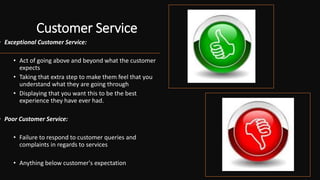
• Exceptional Customer Service:
• Act of going above and beyond what the customer
expects
• Taking that extra step to make them feel that you
understand what they are going through
• Displaying that you want this to be the best
experience they have ever had.
• Poor Customer Service:
• Failure to respond to customer queries and
complaints in regards to services
• Anything below customer's expectation
Customer Service
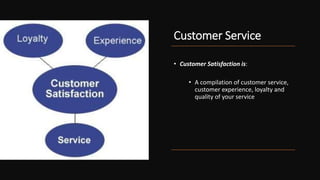
• Customer Satisfaction is:
• A compilation of customer service,
customer experience, loyalty and
quality of your service
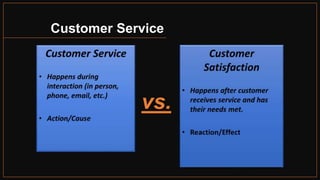
Customer Service
vs.
Customer Service
Customer Service
Customer Service
• Who are your customers?
• External Customers
• Internal Customers
Customer Service
Customer Service
Exceptional Customer Service Characteristics
• Team Player
• Accountability
• Respect
• Stewardship
• Compassion
• Persuasive
•Positive Attitude
•Patience
•Professionalism/Politeness
•Responsiveness
•Problem Solving
•Initiative
• Intentional Excellence
Customer Service
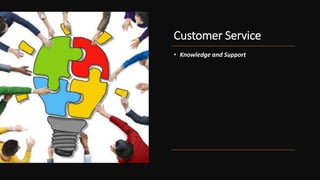
• Knowledge and Support
Customer Service
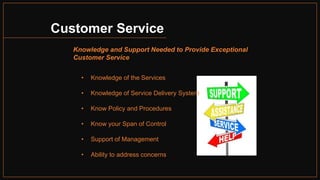
• Knowledge of the Services
• Knowledge of Service Delivery System
• Know Policy and Procedures
• Know your Span of Control
• Support of Management
• Ability to address concerns
Knowledge and Support Needed to Provide Exceptional
Customer Service
Customer Service
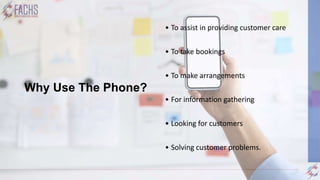
Why Use The Phone?
• To assist in providing customer care
• To take bookings
• To make arrangements
• For information gathering
• Looking for customers
• Solving customer problems.
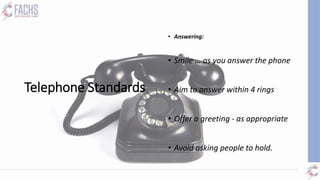
Telephone Standards
• Answering:
• Smile … as you answer the phone
• Aim to answer within 4 rings
• Offer a greeting - as appropriate
• Avoid asking people to hold.
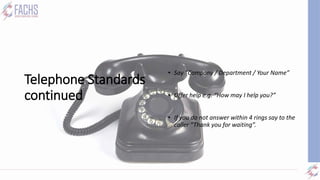
Telephone Standards
continued
• Answering:
• Say “Company / Department / Your Name”
• Offer help e.g. “How may I help you?”
• If you do not answer within 4 rings say to the
caller “Thank you for waiting”.
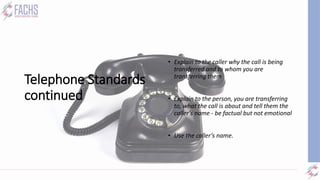
Telephone Standards
continued
• Transferring:
• Explain to the caller why the call is being
transferred and to whom you are
transferring them
• Explain to the person, you are transferring
to, what the call is about and tell them the
caller’s name - be factual but not emotional
• Use the caller’s name.
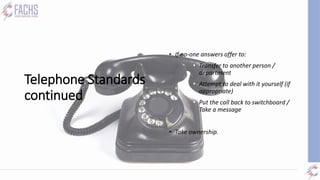
Telephone Standards
continued
• Transferring:
• If no-one answers offer to:
• Transfer to another person /
department
• Attempt to deal with it yourself (if
appropriate)
• Put the call back to switchboard /
Take a message
• Take ownership.
Telephone Standards continued
Taking Messages:
• Respond to all messages … however difficult
• f someone is not available, explain positively why the person is not
available - offer to take a message.
Telephone Standards continued
Taking Messages:
• When taking a message take all the details and repeat the
message and any information back to the caller:
• Name
• Telephone Number (including STD Code and extension as
appropriate)
• Brief message
• Name of the person / section the message is for
• Time and date of the call
• Take personal responsibility to make sure messages are passed
on quickly to the correct person/section.
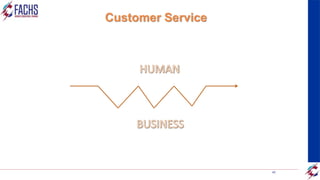
Customer Service
40
Customer Service
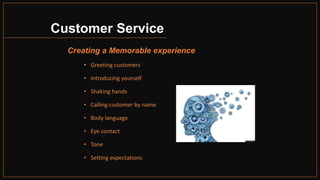
Creating a Memorable experience
• Greeting customers
• Introducing yourself
• Shaking hands
• Calling customer by name
• Body language
• Eye contact
• Tone
• Setting expectations
Customer Service
Relationship Building &
Maintenance:
• Building Rapport
• Verbal and Non-Verbal
Communication
How do you communicate that?
• You are invested in the
customer’s satisfaction
• You care
• You are trustworthy
• You can offer a solution
• You can give the customer your
full attention
• You mean business
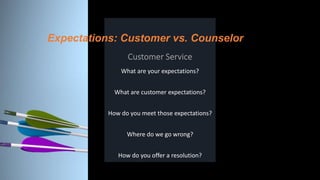
What are your expectations?
What are customer expectations?
How do you meet those expectations?
Where do we go wrong?
How do you offer a resolution?
Expectations: Customer vs. Counselor
Customer Service
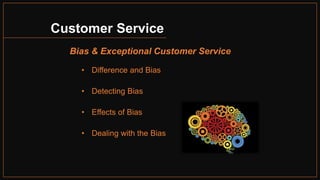
Bias & Exceptional Customer Service
• Difference and Bias
• Detecting Bias
• Effects of Bias
• Dealing with the Bias
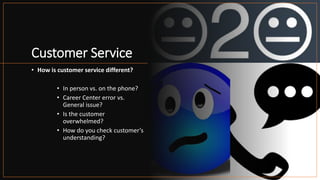
Customer Service
• How is customer service different?
• In person vs. on the phone?
• Career Center error vs.
General issue?
• Is the customer
overwhelmed?
• How do you check customer’s
understanding?
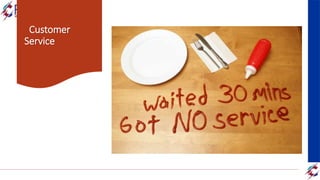
Customer
Service
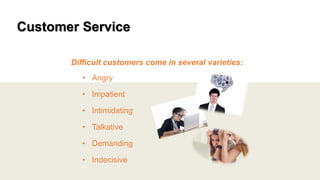
Customer Service
Difficult customers come in several varieties:
• Angry
• Impatient
• Intimidating
• Talkative
• Demanding
• Indecisive
Customer Service
• Remain in control of yourself
• Listen and let the customer vent
• Show the customer you care
• Don't blame the customer or the
company
• Try to solve the problem, or get
someone who can
• Never make promises you can't keep
• Don't take it personally
Handling Difficult Situations
Customer Service
• Tips for Difficult Customers &
Situations
• Behavior Breeds Behavior
• You can Help or Hinder a
situation
• The customer is always
right…or are they?
Customer Service
Types of Customer
Segmentation
Models?
• Demographic Segmentation.
• Behavioural Segmentation.
• Psychographic Segmentation.
• Geographic Segmentation.
• Technographic Segmentation.
• Firmographic Segmentation.
• Needs-Based Segmentation.
• Value-Based Segmentation.
A Strategic Business Unit (SBU) of Fachs Group offering Corporate Training in:
Leadership, Management & Personal Mastery I Governance, Risk & Compliance I Financial & Supply Chain Management I Business Skills I Technology Skills I Industry Certifications
51
Consequences of having disgruntled
internal customers
• if you have unhappy internal customers (i.e. your employees), this can
lead to all sorts of problems.
• Low productivity, high turnover rates, and negative word-of-mouth are just
a few of the potential consequences.
2023/06/03 52
A Strategic Business Unit (SBU) of Fachs Group offering Corporate Training in:
Leadership, Management & Personal Mastery I Governance, Risk & Compliance IFinancial & Supply Chain Management IBusiness Skills ITechnology Skills IIndustry Certifications
Customer Service
Customer Service
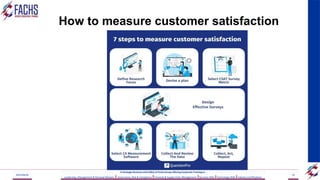
How to measure customer satisfaction
2023/06/03 55
A Strategic Business Unit (SBU) of Fachs Group offering Corporate Training in:
Leadership, Management & Personal Mastery I Governance, Risk & Compliance IFinancial & Supply Chain Management IBusiness Skills ITechnology Skills IIndustry Certifications
Satisfaction Measurement
• While tracking traditional metrics that show supply chain effectiveness will give
you a good idea of how well you’re treating your customers, you need to go
further to continually enhance your customer satisfaction.
• How many new customers are coming in every day?
• How much is every individual customer worth to you?
• What are the 5 most common reasons for a customer to leave you?
• What areas of your business receive the most complaints?
2023/06/03 56
A Strategic Business Unit (SBU) of Fachs Group offering Corporate Training in:
Leadership, Management & Personal Mastery I Governance, Risk & Compliance IFinancial & Supply Chain Management IBusiness Skills ITechnology Skills IIndustry Certifications
Customer Satisfaction Score (CSAT score)
• CSAT measures the level of satisfaction or dissatisfaction with your
product or service. Usually, customers rate their satisfaction on a scale of
1-3, 1-5, or 1-7. CSAT score is the percentage number of satisfied
customers who enjoy using your products and services.
• They are likely to continue buying your offerings in the future as well.
• The CSAT score can be an excellent metric for forecasting sales and
making smart decisions.
2023/06/03 57
A Strategic Business Unit (SBU) of Fachs Group offering Corporate Training in:
Leadership, Management & Personal Mastery I Governance, Risk & Compliance IFinancial & Supply Chain Management IBusiness Skills ITechnology Skills IIndustry Certifications
Customer Effort Score (CES)
• Like CSAT, CES works on customers’ ratings on the ease of operation or
experience. It indicates if your users had a smooth, hassle-free experience at
various touchpoints of their journey.
• For instance, you can use the below questions to calculate CES.
• How easy was it to locate our offices?
• How easy was it to operate our app?
• How easy was it to connect with our customer service staff?
• How easy was it to find the documentation you needed?
2023/06/03 58
A Strategic Business Unit (SBU) of Fachs Group offering Corporate Training in:
Leadership, Management & Personal Mastery I Governance, Risk & Compliance IFinancial & Supply Chain Management IBusiness Skills ITechnology Skills IIndustry Certifications
Net Promoter Score® (NPS)
• NPS measures customer loyalty by asking the question, ‘Based on your complete
experience with the organization, how likely are you to recommend it to your
friends and colleagues?’
• Net promoter score surveys can be distributed at various customer journey
touchpoints.
• Based on the score at each point, you can identify improvement areas.
• For example, the Net promoter score of 5 for the customer support team means
the users had a poor experience.
• They are not likely to recommend your business to others. Thus, it can be an
active area for the management team to ensure their relationship with the users
doesn’t end.
2023/06/03 59
A Strategic Business Unit (SBU) of Fachs Group offering Corporate Training in:
Leadership, Management & Personal Mastery I Governance, Risk & Compliance IFinancial & Supply Chain Management IBusiness Skills ITechnology Skills IIndustry Certifications
Surveys
• You have many options to deliver your surveys. You can email surveys to your
customers, or use apps like survey monkey and send them via short messaging
service (SMS), etc.
• These options ensure a healthy survey response rate, as these can be taken
anywhere and anytime.
• SMS surveys get a 7.5 times higher response than email surveys.
2023/06/03 60
A Strategic Business Unit (SBU) of Fachs Group offering Corporate Training in:
Leadership, Management & Personal Mastery I Governance, Risk & Compliance IFinancial & Supply Chain Management IBusiness Skills ITechnology Skills IIndustry Certifications
Other Customer Satisfaction Metrics
• Operational data / o-data e.g Sales Volume & Experience data. (X–data) provides
the context for how customers have actually experienced the service
• Overall resolution rate
• Average turnaround period
• Social media and general media sentiment monitoring
2023/06/03 61
A Strategic Business Unit (SBU) of Fachs Group offering Corporate Training in:
Leadership, Management & Personal Mastery I Governance, Risk & Compliance IFinancial & Supply Chain Management IBusiness Skills ITechnology Skills IIndustry Certifications
Performance Standards
• A performance standard is a management-approved expression of the
performance threshold(s), requirement(s), or expectation(s) that must be met to
be appraised at a particular level of performance.
• The following types of measures must be included in performance standards to
ensure adequate performance assessment: quantity, quality, timeliness, cost
effectiveness and/or manner of performance.
• Job tasks will include at least one and, in many cases, a combination of these
types of measures.
2023/06/03 62
A Strategic Business Unit (SBU) of Fachs Group offering Corporate Training in:
Leadership, Management & Personal Mastery I Governance, Risk & Compliance IFinancial & Supply Chain Management IBusiness Skills ITechnology Skills IIndustry Certifications
Customer Service
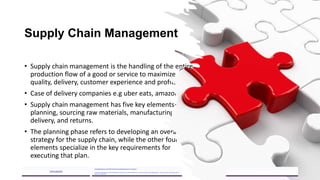
Supply Chain Management
• Supply chain management is the handling of the entire
production flow of a good or service to maximize
quality, delivery, customer experience and profitability.
• Case of delivery companies e.g uber eats, amazon etc
• Supply chain management has five key elements—
planning, sourcing raw materials, manufacturing,
delivery, and returns.
• The planning phase refers to developing an overall
strategy for the supply chain, while the other four
elements specialize in the key requirements for
executing that plan.
2023/06/03
A Strategic Business Unit (SBU) of Fachs Group offering Corporate Training in:
Leadership, Management & Personal Mastery I Governance, Risk & Compliance I Financial & Supply Chain Management I Business Skills I Technology Skills I
Industry Certifications
64
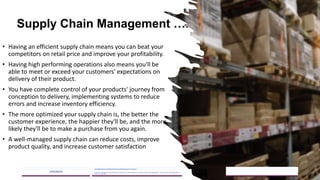
Supply Chain Management ….
• Having an efficient supply chain means you can beat your
competitors on retail price and improve your profitability.
• Having high performing operations also means you'll be
able to meet or exceed your customers' expectations on
delivery of their product.
• You have complete control of your products' journey from
conception to delivery, implementing systems to reduce
errors and increase inventory efficiency.
• The more optimized your supply chain is, the better the
customer experience, the happier they'll be, and the more
likely they'll be to make a purchase from you again.
• A well-managed supply chain can reduce costs, improve
product quality, and increase customer satisfaction
2023/06/03
A Strategic Business Unit (SBU) of Fachs Group offering Corporate Training in:
Leadership, Management & Personal Mastery I Governance, Risk & Compliance I Financial & Supply Chain Management I Business Skills I Technology Skills I
Industry Certifications
65
Main causes
of service
delivery
problems
face the
South African
Public
Sector?
• the degree of corruption,
• institutional capacity constraints relating to
appropriate skills and staff,
• lack of transparency,
• dysfunctional citizen rep committees,
• lack of accountability by public officials,
• lack of public participation in issues of governance,
• failure to comply with policies, legislation and plans
• financial difficulties,
• and ineffective strategic management.
2023/06/03
A Strategic BusinessUnit (SBU) of Fachs Groupoffering Corporate Training in:
Leadership, Management & Personal Mastery I Governance, Risk & Compliance I Financial& Supply Chain Management I Business Skills I Technology Skills I Industry Certifications
66
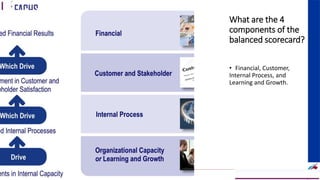
What are the 4
components of the
balanced scorecard?
A
Strategic
Business
Unit
(SBU)
of
Fachs
Group
offering
Corporate
Training
in:
Leadership,
Management
&
Personal
Mastery
I
Governance,
Risk
&
Compliance
I
Financial
&
Supply
Chain
Management
I
Business
Skills
I
Technology
Skills
I
Industry
Certifications
• Financial, Customer,
Internal Process, and
Learning and Growth.
6/3/2023 67
What to Avoid
• Saying ‘I don’t know’ without offering an option
• Saying you don’t know where a colleague is or saying they’re at lunch/ toilet/
gone for coffee etc
• Leaving people on hold for a long time
• Ignoring people if you’re busy
• Treating people unequally
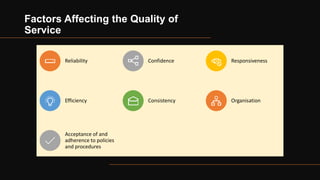
Factors Affecting the Quality of
Service
Reliability Confidence Responsiveness
Efficiency Consistency Organisation
Acceptance of and
adherence to policies
and procedures
Customers with Special Needs
People for whom English is not their first language
People with disabilities
People from other areas who may not be familiar with the way things are done here
People with limited mobility
Unaccompanied children
Dealing with Difficult Behaviour
• Label the behaviour, not the customer
• Listen
• Don’t get defensive
• Don’t take it personally
• Find out what the customer wants
• Discuss alternatives
• Take responsibility for what you CAN do
• Agree on action
The Talkative Customer
• Ask closed questions
• Limit the time available for them to interrupt (don’t have long pauses)
• Provide minimal response
• Smile and be pleasant, but don’t encourage them
• Wind up – thank them for coming, walk them to the door but don’t be rude or
dismissive
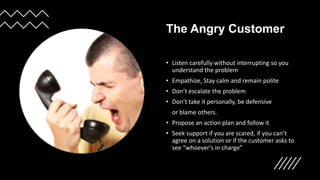
The Angry Customer
• Listen carefully without interrupting so you
understand the problem
• Empathize, Stay calm and remain polite
• Don’t escalate the problem
• Don’t take it personally, be defensive
or blame others.
• Propose an action plan and follow it
• Seek support if you are scared, if you can’t
agree on a solution or if the customer asks to
see “whoever’s in charge”
The ‘know it all’ Customer
• Acknowledge what they say
• Compliment them on their research
• Be generous with praise
• Don’t put them in their place no matter how tempting
• Don’t try to be smart – you can’t win!
• Ask them questions and use them to improve your knowledge
The Indecisive Customer
• Find out what they really want
• Ask them for the options
• Reflect back to them what they’ve said
• Assume control gently and point out the best course of action from what they’ve
told you they need
• Be logical
• Confirm a plan of action with them
• Maybe even put it in writing
The Suspicious Customer
• Establish your credibility
• Ensure you know your product or service
• They will try and catch you out so don’t guess or tell them something you’re not
sure of
• Be careful what you say
• Be polite
• Don’t take it personally, they don’t trust anyone!
TASKS
• Complete the following activities in small groups.
•
• a. Define the term customer
• b. Think of two organisations (one from private sector and another public sector)
and for each list their customers.
• c. For the customers listed above outline the main differences of the customers in
terms of their needs and importance to the organisation. (15)
2023/06/03
A Strategic Business Unit (SBU) of Fachs Group offering Corporate Training in:
Leadership, Management & Personal Mastery I Governance, Risk & Compliance I Financial & Supply Chain Management I Business Skills I Technology Skills I Industry Certifications
77
TASK 2
• Question 2 (SO 1; AC 3, AC 4, SO 2, AC 3)
•
• a) Outline using examples, the main differences between internal and external
customers.
• b) Customers have needs to satisfy. Identify three set of needs your customers
need to satisfy and your organisation can satisfy them
•
• c) What are the implications of not satisfying those needs
2023/06/03
A Strategic Business Unit (SBU) of Fachs Group offering Corporate Training in:
Leadership, Management & Personal Mastery I Governance, Risk & Compliance I Financial & Supply Chain Management I Business Skills I Technology Skills I Industry Certifications
78
TASK 3
• Question 6 (SO 6, AC 3, AC 2)
• 1. Outline the main causes of service delivery problems face the South African
Public Sector?
• 2. How can the principles of Batho Pele be used to prevent or reduce these
causes? (15)
•
2023/06/03
A Strategic Business Unit (SBU) of Fachs Group offering Corporate Training in:
Leadership, Management & Personal Mastery I Governance, Risk & Compliance I Financial & Supply Chain Management I Business Skills I Technology Skills I Industry Certifications
79
TASK 4 • Question 4 (SO 3, AC 2, AC 3)
• Identify two processes in your organisation which
leads to the provision of a service or goods. Map the
process by listing all the activities and stages to be
undertaken in their correct order. For each stage of
the process make a comment on the importance of
the activity or stage.
• Make recommendations on the process activities as
to whether they should be modified or removed (20)
2023/06/03
A Strategic Business Unit (SBU) of Fachs Group offering Corporate Training in:
Leadership, Management & Personal Mastery I Governance, Risk & Compliance I Financial & Supply Chain Management I Business Skills I Technology Skills I Industry Certifications
80
TASK 5
• Question 5 (SO 5, AC 1, AC 4)
• Define supply chain management and indicate how
the components of supply chain management can
be used to improve customer service [10]
• Question (SO 2; AC 1, AC 2, AC 3, AC 4)
• In groups outline the main goods and services your
organisation(s) offer to their external clients. On
each of the identified goods and services indicate
how you would know that you have met the
customer’s expectations or exceeded them. [10]
2023/06/03
A Strategic Business Unit (SBU) of Fachs Group offering Corporate Training in:
Leadership, Management & Personal Mastery I Governance, Risk & Compliance I Financial & Supply Chain Management I Business Skills I Technology Skills I Industry Certifications
81
Role Play
In pairs, one person takes on the role of a customer and one is the customer
service helpdesk.
• Use your own scenario if you have one
• Swap after 5 minutes
Class Task 2 – Individual Task
Unit 14 – Investigating Customer Service
•Create an evaluative report that covers
the following:
•A clear critique, highlighting your
strengths and weaknesses, identifying
gaps where improvements could be
made.
Note: Report Format 2 - 3 pages
8
3
Class Task 3 – Individual Task
Unit 14 – Investigating Customer Service
• A development plan with realistic details of
the work that needs to be done on
improving your individual skill sets (based
on the strengths and weaknesses highlighted
above) to enhance your customer service
and communication skills, including time
scales and sources of information.
8
4
What is Customer Service?
Customer Service is all about:
• Providing customers with what they want
• Offering consistent levels of service
• Exceeding and not just meeting expectations
• Fulfilling all customer needs
• Going out of your way to delight customers.
Customer Service
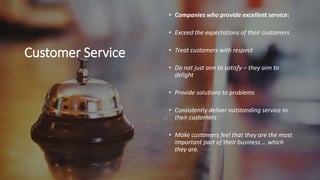
• Companies who provide excellent service:
• Exceed the expectations of their customers
• Treat customers with respect
• Do not just aim to satisfy – they aim to
delight
• Provide solutions to problems
• Consistently deliver outstanding service to
their customers
• Make customers feel that they are the most
important part of their business … which
they are.
Why is Service
Important?
• Intense competition
• Customers have a choice
• It is the only thing that can make us
different from our competitors
• Satisfied and delighted customers will
come back
• Dissatisfied customers will not come
back.
Customer
Expectations
Customers:
• Expect the core service to meet their needs for quality
• Expect polite treatment at all times – even when they
are being difficult
• Need to see attention is being paid to their requests
• Want to feel their needs are important
• Do not want to hear “No” or “I do not know”
• Want to feel secure in the knowledge that you have all
the answers and solutions
Customers
Expectations
continued
Customers:
• Want mistakes admitted to and rectified
• Expect promises that are made to be honoured
• Expect to be treated with respect
• Need to have time given to them for explanations
• Need to know when a problem arises
• Expect you to know about your job and your
company
• Expect you to be able to answer questions
• Expect you to find solutions to their problems.
Your Expectations
You:
• Expect that you will receive full training
• Need to learn about the products and services you provide
• Need to understand the systems and procedures for dealing with customers
• Expect to be supported by your manager
• Need to be treated fairly by the customer.
Organisation’s Expectations
Organisations expect you to:
• Meet the organisation's customer service policy
• Consistently deliver service standards
• Meet standards laid down in standard manuals
• Follow service procedures
• Meet legal standards related to the delivery of service
• Project a positive image at all times when dealing with
customers.
Creating and Maintaining a Safe
and Healthy Environment
• Local and National legislation.
• Dealing with hazardous waste and substances.
• Hazardous materials.
• Noise pollution.
• Hygiene standards.
Employer
Responsibilities
for Health and Safety
Employers may have specific duties
under local and national legislation
such as:
• All systems must be safe.
• The working environment must be well lit,
well ventilated, hygienic and at the
appropriate temperature.
• All plant and equipment must be kept to
the necessary standard.
Employee Responsibilities
for Health and Safety
Employees should:
• Take reasonable care of him or herself and others.
• Allow the employer to carry out his or her duties in respect of creating a
safe working environment.
• Not interfere intentionally or recklessly with any machinery or equipment.
Effective Communications
• Increases quality of service
• Saves time
• Improves customer care
• Avoids misunderstandings
• Builds good relationships
• Creates a positive atmosphere
• Encourages open discussion
• Allows for achievement of goals.
Ineffective Communications
• Hampers relationships
• Wastes time
• Affects customers and colleagues
• Destroys morale
• Creates a negative atmosphere
• Builds a negative reputation
• Hampers achievement of goals
Listening
• Look at people
• Turn off negative thoughts
• Lean towards people
• Start with the first word
• Think of speed
• Do not interrupt
• Nod
• Ask questions
• Stick to the subject
• Use their name and use “you”
Question
Technique
Open Questions
Who? – What? – Why? – Where? – How? – When?
Closed Questions
Do you? - Are you? - Is it? - Have you?
Reflecting Questions
To summarise and check back
Non-Verbal
Techniques
• Lets the customer know you are interested
• Allows you to listen to customers’ feelings as
well as their words
• The moment a customer walks up to you,
regardless of what you are doing, make
immediate eye contact
Facial Expressions
Facial expressions often show how you feel:
• Smile if you are happy!
• Frown if you are not!
Attitudes – Who are you?
Someone who
makes things
happen?
Someone who
watches things
happen?
Someone who
wonders what
happened?
They can be
so difficult
and
demanding
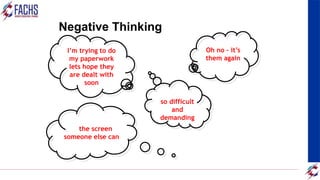
If I keep looking
at the screen
someone else can
deal with them
Oh no – it’s
them again
I’m trying to do
my paperwork
lets hope they
are dealt with
soon
Negative Thinking
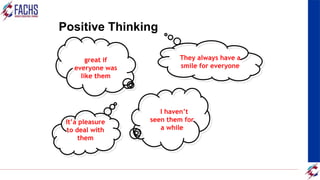
Oh - it’s them
– I haven’t
seen them for
a while
They always have a
smile for everyone
It’a pleasure
to deal with
them
Wouldn’t it be
great if
everyone was
like them
Positive Thinking
Attitude and Behaviour
Professional
Show understanding
Be patient
Professional Image
• Acknowledge
• Smile
• Apologise
• Friendly - welcoming - well mannered
• Use names
• Listen
• Ask questions
• Reassure them
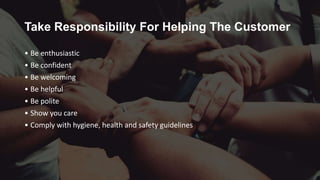
Take Responsibility For Helping The Customer
• Be enthusiastic
• Be confident
• Be welcoming
• Be helpful
• Be polite
• Show you care
• Comply with hygiene, health and safety guidelines
Projecting a Positive Image
• Appearance:
• Personal grooming and uniform standards
• Your work area
• Eye contact:
• Look at people
• Shows you are interested
Projecting a Positive
Image cont.
• Facial expressions:
• Look positive
• Look natural
• Posture and gestures:
• What impression are they creating?
• Personal space:
• How comfortable are you?
Negative Messages
• You:
• Do not like your work
• Are stressed
• Are not friendly
• Do not show respect for other people
• Do not want to help - when you do help, you do so reluctantly
First Impressions
You never get a
second chance
to make a
first impression
Handling Complaints
What are they?
An opportunity to:
• Make things right
• Turn dissatisfied customers into delighted customers
• Show you care
• Turn complainers into ambassadors.
Calming Customers
• Listening
• Actively show you are listening
• Empathy
• Show that you do care and are concerned
• Agreeing on Common Ground
• Find something to agree with
Handling Complaints
• Listen
• Apologise
• Solve
• Thank
•
• Make the most of your LAST chance!
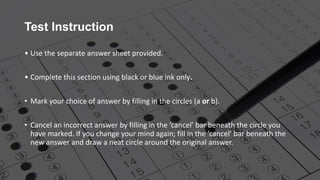
Test Instruction
• Use the separate answer sheet provided.
• Complete this section using black or blue ink only.
• Mark your choice of answer by filling in the circles (a or b).
• Cancel an incorrect answer by filling in the ‘cancel’ bar beneath the circle you
have marked. If you change your mind again; fill in the ‘cancel’ bar beneath the
new answer and draw a neat circle around the original answer.
Test Instruction continued
• Do not enter marks in the bottom section of the paper.
• Do not make any marks in any part of the paper other than the circles (a or b) and
the section with the boxes for your personal details. If you do, the marking
machine will be unable to mark your paper properly, thus affecting your score.
• Use a pen with black or blue ink only.
Questions
&
Wrap Up
CUSTOMER CARE  .pptx

CUSTOMER CARE .pptx

  • 1.
    COURSES NAME: COMMUNICATION SKILLS &CUSTOMER CARE TRAINING DATES: ORGANISATION: FACILITATOR NAME: 6/3/2023 A Strategic Business Unit (SBU) of Fachs Group offering Corporate Training in: Leadership, Management & Personal Mastery I Governance, Risk & Compliance I Financial & Supply Chain Management I Business Skills I Technology Skills I Industry Certifications 1
  • 2.
    Objectives By the endof the training you should be able to: • Understand the importance of the provision of good customer service • Identify customer and organisational needs and expectations in respect of service levels • Describe the differences between strong and weak customer care • Recognise how to present a professional image • Identify the techniques used to handle customer complaints
  • 3.
    1. Green - Whois a customer? - Explain the assertion that: ‘ The Customer is always right?’ [5 Marks] Do Activity Challenge (Spicy) Extension: List and explain 3 things that make up an organisations image. (10 marks) 2. Amber List 5 effective communication skills a customer services person needs [5] Marks
  • 4.
    Who are Customers? Definition ofa customer (Internal/external customers) Customers are people who need your assistance. They are not an interruption to your job, they are the reason you have a job..
  • 5.
  • 6.
    Communicating Effectively withCustomers Definition: What describes GOOD service and BAD service? Good customer service is taking that extra step to help without being asked! It’s all about attitude and skills. https://www.youtube.com/watch?v=ZDxIFQLOiV0 https://www.youtube.com/watch?v=qfGxAJBOzeo
  • 7.
    A Positive OrganisationalImage First impressions count and will affect the interaction. People make judgements in the first 30 seconds. Golden Rule – Customer is king.You only have one chance to make a first impression!
  • 8.
    Planning Good CustomerService • Recording procedures (when are your busy times) • Reporting procedures (meeting organisational/ funding/ legislative requirements) • Observe and report customer needs • Be proactive in improving service • Market your organisation • Have processes and procedures for dealing with difficult situations BEFORE they happen and make sure staff are trained.
  • 9.
    Service Standards How canyou contribute to the development and maintenance of service standards in your organisation? • Read and understand your organisation’s policies and procedures on customer service • Be prompt and efficient • Ensure services are delivered in accordance with legislative or statutory requirements • Maintain accurate records • Ensure any special needs of customers are taken into account
  • 10.
    CUSTOMER SERVICE • Rewardsfor Excellent Customer Service • Increased customer loyalty • Positive word-of-mouth promotion • Happier customers • More productive and happier employees • Smoother working operations
  • 11.
    Attitude Checklist What attitudesassist in providing good service? • Enjoy helping people • Handle people well • Care for your customers • Give fair and equal treatment to all • Be understanding of people with special needs http://www.youtube.com/watch?v=yJYg7Nz3aPU https://www.youtube.com/watch?v=3sllBkkcYN4
  • 12.
    Skills for CustomerService • Know about your organisation • Learn the technical parts of the job • Communicate well • Be consistent • Be organised • Know your place in the team and be a team player
  • 13.
    Greeting Customers The purposeis to create and maintain a welcoming environment - how can we achieve this? • Be attentive, acknowledge a person as soon as they appear, even if you’re busy • SMILE! • Establish eye contact • Tell them your name • Ask how you can help • Give the customer your full attention • Be polite and courteous……………
  • 14.
    Find out howYou can Help • How can you find out what people want? • If you can’t help, what should you do? • Offer alternatives if possible • If they have to wait, how would you handle it?
  • 15.
    How to Listento Customers Active listening = Attending skills (being ready) Attend to immediate needs (if you need to finish something before giving your full attention) Being available Eye contact Attentive posture Concentration
  • 16.
    Internal and externalcustomers 2023/06/03 16 A Strategic Business Unit (SBU) of Fachs Group offering Corporate Training in: Leadership, Management & Personal Mastery I Governance, Risk & Compliance IFinancial & Supply Chain Management IBusiness Skills ITechnology Skills IIndustry Certifications
  • 17.
    INTERNAL & EXTERNALCUSTOMERS • External customers are those who see your company mainly as a provider of something they buy. • Internal customers participate in your business by actually being a part of it. • Internal customers have a relationship with, and within, your company, either through employment or as partners who deliver your product or service to the end user, the external customer. • Less obvious but certainly still significant, stakeholders and shareholders are also internal customers. 2023/06/03 17 A Strategic Business Unit (SBU) of Fachs Group offering Corporate Training in: Leadership, Management & Personal Mastery I Governance, Risk & Compliance IFinancial & Supply Chain Management IBusiness Skills ITechnology Skills IIndustry Certifications
  • 18.
    Using Your Voice Doyou • Become loud when angry or upset • Speak faster when nervous • Speak slowly when tired or bored • Have a cheerful voice • My tone of voice is warm and understanding • Find it easy to talk to people you don’t know • Control your tone in most situations • Sound bossy, weak or unsure • Have a clear and easy-to-hear voice • Speak in a very formal or very trendy manner? Think about how you might modify your voice in certain situations
  • 19.
    Content • Session 1Introduction to customer service • What is service? • Why is it important? • Identifying customer needs • Session 2 Effective communications • Effective and ineffective communication skills • Questioning and listening techniques • Telephone techniques
  • 20.
    Content continued • Session3 Presenting a positive professional image • First impressions • Presenting a positive attitude and image • Identifying and using appropriate body language • Session 4 Handling customer complaints • Why customers complain • Resolving difficult customer situations • Handling complaints positively
  • 21.
    Customer Service Customer Serviceis: • Assistance & advice provided by a company to people who buy or use its products or services • The art of ensuring the best service to customers while they are engaged in services • Act of taking care of customer needs by providing and delivering professional, helpful, high quality service and assistance before, during, and after the customer's requirements are met
  • 22.
    Customer Service • ExceptionalCustomer Service: • Act of going above and beyond what the customer expects • Taking that extra step to make them feel that you understand what they are going through • Displaying that you want this to be the best experience they have ever had. • Poor Customer Service: • Failure to respond to customer queries and complaints in regards to services • Anything below customer's expectation
  • 23.
    Customer Service • CustomerSatisfaction is: • A compilation of customer service, customer experience, loyalty and quality of your service
  • 24.
  • 25.
  • 26.
  • 27.
    Customer Service • Whoare your customers? • External Customers • Internal Customers
  • 28.
  • 29.
    Customer Service Exceptional CustomerService Characteristics • Team Player • Accountability • Respect • Stewardship • Compassion • Persuasive •Positive Attitude •Patience •Professionalism/Politeness •Responsiveness •Problem Solving •Initiative • Intentional Excellence
  • 30.
  • 31.
    Customer Service • Knowledgeof the Services • Knowledge of Service Delivery System • Know Policy and Procedures • Know your Span of Control • Support of Management • Ability to address concerns Knowledge and Support Needed to Provide Exceptional Customer Service
  • 32.
  • 33.
    Why Use ThePhone? • To assist in providing customer care • To take bookings • To make arrangements • For information gathering • Looking for customers • Solving customer problems.
  • 34.
    Telephone Standards • Answering: •Smile … as you answer the phone • Aim to answer within 4 rings • Offer a greeting - as appropriate • Avoid asking people to hold.
  • 35.
    Telephone Standards continued • Answering: •Say “Company / Department / Your Name” • Offer help e.g. “How may I help you?” • If you do not answer within 4 rings say to the caller “Thank you for waiting”.
  • 36.
    Telephone Standards continued • Transferring: •Explain to the caller why the call is being transferred and to whom you are transferring them • Explain to the person, you are transferring to, what the call is about and tell them the caller’s name - be factual but not emotional • Use the caller’s name.
  • 37.
    Telephone Standards continued • Transferring: •If no-one answers offer to: • Transfer to another person / department • Attempt to deal with it yourself (if appropriate) • Put the call back to switchboard / Take a message • Take ownership.
  • 38.
    Telephone Standards continued TakingMessages: • Respond to all messages … however difficult • f someone is not available, explain positively why the person is not available - offer to take a message.
  • 39.
    Telephone Standards continued TakingMessages: • When taking a message take all the details and repeat the message and any information back to the caller: • Name • Telephone Number (including STD Code and extension as appropriate) • Brief message • Name of the person / section the message is for • Time and date of the call • Take personal responsibility to make sure messages are passed on quickly to the correct person/section.
  • 40.
  • 41.
    Customer Service Creating aMemorable experience • Greeting customers • Introducing yourself • Shaking hands • Calling customer by name • Body language • Eye contact • Tone • Setting expectations
  • 42.
    Customer Service Relationship Building& Maintenance: • Building Rapport • Verbal and Non-Verbal Communication How do you communicate that? • You are invested in the customer’s satisfaction • You care • You are trustworthy • You can offer a solution • You can give the customer your full attention • You mean business
  • 43.
    What are yourexpectations? What are customer expectations? How do you meet those expectations? Where do we go wrong? How do you offer a resolution? Expectations: Customer vs. Counselor
  • 44.
    Customer Service Bias &Exceptional Customer Service • Difference and Bias • Detecting Bias • Effects of Bias • Dealing with the Bias
  • 45.
    Customer Service • Howis customer service different? • In person vs. on the phone? • Career Center error vs. General issue? • Is the customer overwhelmed? • How do you check customer’s understanding?
  • 46.
  • 47.
    Customer Service Difficult customerscome in several varieties: • Angry • Impatient • Intimidating • Talkative • Demanding • Indecisive
  • 48.
    Customer Service • Remainin control of yourself • Listen and let the customer vent • Show the customer you care • Don't blame the customer or the company • Try to solve the problem, or get someone who can • Never make promises you can't keep • Don't take it personally Handling Difficult Situations
  • 49.
    Customer Service • Tipsfor Difficult Customers & Situations • Behavior Breeds Behavior • You can Help or Hinder a situation • The customer is always right…or are they?
  • 50.
  • 51.
    Types of Customer Segmentation Models? •Demographic Segmentation. • Behavioural Segmentation. • Psychographic Segmentation. • Geographic Segmentation. • Technographic Segmentation. • Firmographic Segmentation. • Needs-Based Segmentation. • Value-Based Segmentation. A Strategic Business Unit (SBU) of Fachs Group offering Corporate Training in: Leadership, Management & Personal Mastery I Governance, Risk & Compliance I Financial & Supply Chain Management I Business Skills I Technology Skills I Industry Certifications 51
  • 52.
    Consequences of havingdisgruntled internal customers • if you have unhappy internal customers (i.e. your employees), this can lead to all sorts of problems. • Low productivity, high turnover rates, and negative word-of-mouth are just a few of the potential consequences. 2023/06/03 52 A Strategic Business Unit (SBU) of Fachs Group offering Corporate Training in: Leadership, Management & Personal Mastery I Governance, Risk & Compliance IFinancial & Supply Chain Management IBusiness Skills ITechnology Skills IIndustry Certifications
  • 53.
  • 54.
  • 55.
    How to measurecustomer satisfaction 2023/06/03 55 A Strategic Business Unit (SBU) of Fachs Group offering Corporate Training in: Leadership, Management & Personal Mastery I Governance, Risk & Compliance IFinancial & Supply Chain Management IBusiness Skills ITechnology Skills IIndustry Certifications
  • 56.
    Satisfaction Measurement • Whiletracking traditional metrics that show supply chain effectiveness will give you a good idea of how well you’re treating your customers, you need to go further to continually enhance your customer satisfaction. • How many new customers are coming in every day? • How much is every individual customer worth to you? • What are the 5 most common reasons for a customer to leave you? • What areas of your business receive the most complaints? 2023/06/03 56 A Strategic Business Unit (SBU) of Fachs Group offering Corporate Training in: Leadership, Management & Personal Mastery I Governance, Risk & Compliance IFinancial & Supply Chain Management IBusiness Skills ITechnology Skills IIndustry Certifications
  • 57.
    Customer Satisfaction Score(CSAT score) • CSAT measures the level of satisfaction or dissatisfaction with your product or service. Usually, customers rate their satisfaction on a scale of 1-3, 1-5, or 1-7. CSAT score is the percentage number of satisfied customers who enjoy using your products and services. • They are likely to continue buying your offerings in the future as well. • The CSAT score can be an excellent metric for forecasting sales and making smart decisions. 2023/06/03 57 A Strategic Business Unit (SBU) of Fachs Group offering Corporate Training in: Leadership, Management & Personal Mastery I Governance, Risk & Compliance IFinancial & Supply Chain Management IBusiness Skills ITechnology Skills IIndustry Certifications
  • 58.
    Customer Effort Score(CES) • Like CSAT, CES works on customers’ ratings on the ease of operation or experience. It indicates if your users had a smooth, hassle-free experience at various touchpoints of their journey. • For instance, you can use the below questions to calculate CES. • How easy was it to locate our offices? • How easy was it to operate our app? • How easy was it to connect with our customer service staff? • How easy was it to find the documentation you needed? 2023/06/03 58 A Strategic Business Unit (SBU) of Fachs Group offering Corporate Training in: Leadership, Management & Personal Mastery I Governance, Risk & Compliance IFinancial & Supply Chain Management IBusiness Skills ITechnology Skills IIndustry Certifications
  • 59.
    Net Promoter Score®(NPS) • NPS measures customer loyalty by asking the question, ‘Based on your complete experience with the organization, how likely are you to recommend it to your friends and colleagues?’ • Net promoter score surveys can be distributed at various customer journey touchpoints. • Based on the score at each point, you can identify improvement areas. • For example, the Net promoter score of 5 for the customer support team means the users had a poor experience. • They are not likely to recommend your business to others. Thus, it can be an active area for the management team to ensure their relationship with the users doesn’t end. 2023/06/03 59 A Strategic Business Unit (SBU) of Fachs Group offering Corporate Training in: Leadership, Management & Personal Mastery I Governance, Risk & Compliance IFinancial & Supply Chain Management IBusiness Skills ITechnology Skills IIndustry Certifications
  • 60.
    Surveys • You havemany options to deliver your surveys. You can email surveys to your customers, or use apps like survey monkey and send them via short messaging service (SMS), etc. • These options ensure a healthy survey response rate, as these can be taken anywhere and anytime. • SMS surveys get a 7.5 times higher response than email surveys. 2023/06/03 60 A Strategic Business Unit (SBU) of Fachs Group offering Corporate Training in: Leadership, Management & Personal Mastery I Governance, Risk & Compliance IFinancial & Supply Chain Management IBusiness Skills ITechnology Skills IIndustry Certifications
  • 61.
    Other Customer SatisfactionMetrics • Operational data / o-data e.g Sales Volume & Experience data. (X–data) provides the context for how customers have actually experienced the service • Overall resolution rate • Average turnaround period • Social media and general media sentiment monitoring 2023/06/03 61 A Strategic Business Unit (SBU) of Fachs Group offering Corporate Training in: Leadership, Management & Personal Mastery I Governance, Risk & Compliance IFinancial & Supply Chain Management IBusiness Skills ITechnology Skills IIndustry Certifications
  • 62.
    Performance Standards • Aperformance standard is a management-approved expression of the performance threshold(s), requirement(s), or expectation(s) that must be met to be appraised at a particular level of performance. • The following types of measures must be included in performance standards to ensure adequate performance assessment: quantity, quality, timeliness, cost effectiveness and/or manner of performance. • Job tasks will include at least one and, in many cases, a combination of these types of measures. 2023/06/03 62 A Strategic Business Unit (SBU) of Fachs Group offering Corporate Training in: Leadership, Management & Personal Mastery I Governance, Risk & Compliance IFinancial & Supply Chain Management IBusiness Skills ITechnology Skills IIndustry Certifications
  • 63.
  • 64.
    Supply Chain Management •Supply chain management is the handling of the entire production flow of a good or service to maximize quality, delivery, customer experience and profitability. • Case of delivery companies e.g uber eats, amazon etc • Supply chain management has five key elements— planning, sourcing raw materials, manufacturing, delivery, and returns. • The planning phase refers to developing an overall strategy for the supply chain, while the other four elements specialize in the key requirements for executing that plan. 2023/06/03 A Strategic Business Unit (SBU) of Fachs Group offering Corporate Training in: Leadership, Management & Personal Mastery I Governance, Risk & Compliance I Financial & Supply Chain Management I Business Skills I Technology Skills I Industry Certifications 64
  • 65.
    Supply Chain Management…. • Having an efficient supply chain means you can beat your competitors on retail price and improve your profitability. • Having high performing operations also means you'll be able to meet or exceed your customers' expectations on delivery of their product. • You have complete control of your products' journey from conception to delivery, implementing systems to reduce errors and increase inventory efficiency. • The more optimized your supply chain is, the better the customer experience, the happier they'll be, and the more likely they'll be to make a purchase from you again. • A well-managed supply chain can reduce costs, improve product quality, and increase customer satisfaction 2023/06/03 A Strategic Business Unit (SBU) of Fachs Group offering Corporate Training in: Leadership, Management & Personal Mastery I Governance, Risk & Compliance I Financial & Supply Chain Management I Business Skills I Technology Skills I Industry Certifications 65
  • 66.
    Main causes of service delivery problems facethe South African Public Sector? • the degree of corruption, • institutional capacity constraints relating to appropriate skills and staff, • lack of transparency, • dysfunctional citizen rep committees, • lack of accountability by public officials, • lack of public participation in issues of governance, • failure to comply with policies, legislation and plans • financial difficulties, • and ineffective strategic management. 2023/06/03 A Strategic BusinessUnit (SBU) of Fachs Groupoffering Corporate Training in: Leadership, Management & Personal Mastery I Governance, Risk & Compliance I Financial& Supply Chain Management I Business Skills I Technology Skills I Industry Certifications 66
  • 67.
    What are the4 components of the balanced scorecard? A Strategic Business Unit (SBU) of Fachs Group offering Corporate Training in: Leadership, Management & Personal Mastery I Governance, Risk & Compliance I Financial & Supply Chain Management I Business Skills I Technology Skills I Industry Certifications • Financial, Customer, Internal Process, and Learning and Growth. 6/3/2023 67
  • 68.
    What to Avoid •Saying ‘I don’t know’ without offering an option • Saying you don’t know where a colleague is or saying they’re at lunch/ toilet/ gone for coffee etc • Leaving people on hold for a long time • Ignoring people if you’re busy • Treating people unequally
  • 69.
    Factors Affecting theQuality of Service Reliability Confidence Responsiveness Efficiency Consistency Organisation Acceptance of and adherence to policies and procedures
  • 70.
    Customers with SpecialNeeds People for whom English is not their first language People with disabilities People from other areas who may not be familiar with the way things are done here People with limited mobility Unaccompanied children
  • 71.
    Dealing with DifficultBehaviour • Label the behaviour, not the customer • Listen • Don’t get defensive • Don’t take it personally • Find out what the customer wants • Discuss alternatives • Take responsibility for what you CAN do • Agree on action
  • 72.
    The Talkative Customer •Ask closed questions • Limit the time available for them to interrupt (don’t have long pauses) • Provide minimal response • Smile and be pleasant, but don’t encourage them • Wind up – thank them for coming, walk them to the door but don’t be rude or dismissive
  • 73.
    The Angry Customer •Listen carefully without interrupting so you understand the problem • Empathize, Stay calm and remain polite • Don’t escalate the problem • Don’t take it personally, be defensive or blame others. • Propose an action plan and follow it • Seek support if you are scared, if you can’t agree on a solution or if the customer asks to see “whoever’s in charge”
  • 74.
    The ‘know itall’ Customer • Acknowledge what they say • Compliment them on their research • Be generous with praise • Don’t put them in their place no matter how tempting • Don’t try to be smart – you can’t win! • Ask them questions and use them to improve your knowledge
  • 75.
    The Indecisive Customer •Find out what they really want • Ask them for the options • Reflect back to them what they’ve said • Assume control gently and point out the best course of action from what they’ve told you they need • Be logical • Confirm a plan of action with them • Maybe even put it in writing
  • 76.
    The Suspicious Customer •Establish your credibility • Ensure you know your product or service • They will try and catch you out so don’t guess or tell them something you’re not sure of • Be careful what you say • Be polite • Don’t take it personally, they don’t trust anyone!
  • 77.
    TASKS • Complete thefollowing activities in small groups. • • a. Define the term customer • b. Think of two organisations (one from private sector and another public sector) and for each list their customers. • c. For the customers listed above outline the main differences of the customers in terms of their needs and importance to the organisation. (15) 2023/06/03 A Strategic Business Unit (SBU) of Fachs Group offering Corporate Training in: Leadership, Management & Personal Mastery I Governance, Risk & Compliance I Financial & Supply Chain Management I Business Skills I Technology Skills I Industry Certifications 77
  • 78.
    TASK 2 • Question2 (SO 1; AC 3, AC 4, SO 2, AC 3) • • a) Outline using examples, the main differences between internal and external customers. • b) Customers have needs to satisfy. Identify three set of needs your customers need to satisfy and your organisation can satisfy them • • c) What are the implications of not satisfying those needs 2023/06/03 A Strategic Business Unit (SBU) of Fachs Group offering Corporate Training in: Leadership, Management & Personal Mastery I Governance, Risk & Compliance I Financial & Supply Chain Management I Business Skills I Technology Skills I Industry Certifications 78
  • 79.
    TASK 3 • Question6 (SO 6, AC 3, AC 2) • 1. Outline the main causes of service delivery problems face the South African Public Sector? • 2. How can the principles of Batho Pele be used to prevent or reduce these causes? (15) • 2023/06/03 A Strategic Business Unit (SBU) of Fachs Group offering Corporate Training in: Leadership, Management & Personal Mastery I Governance, Risk & Compliance I Financial & Supply Chain Management I Business Skills I Technology Skills I Industry Certifications 79
  • 80.
    TASK 4 •Question 4 (SO 3, AC 2, AC 3) • Identify two processes in your organisation which leads to the provision of a service or goods. Map the process by listing all the activities and stages to be undertaken in their correct order. For each stage of the process make a comment on the importance of the activity or stage. • Make recommendations on the process activities as to whether they should be modified or removed (20) 2023/06/03 A Strategic Business Unit (SBU) of Fachs Group offering Corporate Training in: Leadership, Management & Personal Mastery I Governance, Risk & Compliance I Financial & Supply Chain Management I Business Skills I Technology Skills I Industry Certifications 80
  • 81.
    TASK 5 • Question5 (SO 5, AC 1, AC 4) • Define supply chain management and indicate how the components of supply chain management can be used to improve customer service [10] • Question (SO 2; AC 1, AC 2, AC 3, AC 4) • In groups outline the main goods and services your organisation(s) offer to their external clients. On each of the identified goods and services indicate how you would know that you have met the customer’s expectations or exceeded them. [10] 2023/06/03 A Strategic Business Unit (SBU) of Fachs Group offering Corporate Training in: Leadership, Management & Personal Mastery I Governance, Risk & Compliance I Financial & Supply Chain Management I Business Skills I Technology Skills I Industry Certifications 81
  • 82.
    Role Play In pairs,one person takes on the role of a customer and one is the customer service helpdesk. • Use your own scenario if you have one • Swap after 5 minutes
  • 83.
    Class Task 2– Individual Task Unit 14 – Investigating Customer Service •Create an evaluative report that covers the following: •A clear critique, highlighting your strengths and weaknesses, identifying gaps where improvements could be made. Note: Report Format 2 - 3 pages 8 3
  • 84.
    Class Task 3– Individual Task Unit 14 – Investigating Customer Service • A development plan with realistic details of the work that needs to be done on improving your individual skill sets (based on the strengths and weaknesses highlighted above) to enhance your customer service and communication skills, including time scales and sources of information. 8 4
  • 85.
    What is CustomerService? Customer Service is all about: • Providing customers with what they want • Offering consistent levels of service • Exceeding and not just meeting expectations • Fulfilling all customer needs • Going out of your way to delight customers.
  • 86.
    Customer Service • Companieswho provide excellent service: • Exceed the expectations of their customers • Treat customers with respect • Do not just aim to satisfy – they aim to delight • Provide solutions to problems • Consistently deliver outstanding service to their customers • Make customers feel that they are the most important part of their business … which they are.
  • 87.
    Why is Service Important? •Intense competition • Customers have a choice • It is the only thing that can make us different from our competitors • Satisfied and delighted customers will come back • Dissatisfied customers will not come back.
  • 88.
    Customer Expectations Customers: • Expect thecore service to meet their needs for quality • Expect polite treatment at all times – even when they are being difficult • Need to see attention is being paid to their requests • Want to feel their needs are important • Do not want to hear “No” or “I do not know” • Want to feel secure in the knowledge that you have all the answers and solutions
  • 89.
    Customers Expectations continued Customers: • Want mistakesadmitted to and rectified • Expect promises that are made to be honoured • Expect to be treated with respect • Need to have time given to them for explanations • Need to know when a problem arises • Expect you to know about your job and your company • Expect you to be able to answer questions • Expect you to find solutions to their problems.
  • 90.
    Your Expectations You: • Expectthat you will receive full training • Need to learn about the products and services you provide • Need to understand the systems and procedures for dealing with customers • Expect to be supported by your manager • Need to be treated fairly by the customer.
  • 91.
    Organisation’s Expectations Organisations expectyou to: • Meet the organisation's customer service policy • Consistently deliver service standards • Meet standards laid down in standard manuals • Follow service procedures • Meet legal standards related to the delivery of service • Project a positive image at all times when dealing with customers.
  • 92.
    Creating and Maintaininga Safe and Healthy Environment • Local and National legislation. • Dealing with hazardous waste and substances. • Hazardous materials. • Noise pollution. • Hygiene standards.
  • 93.
    Employer Responsibilities for Health andSafety Employers may have specific duties under local and national legislation such as: • All systems must be safe. • The working environment must be well lit, well ventilated, hygienic and at the appropriate temperature. • All plant and equipment must be kept to the necessary standard.
  • 94.
    Employee Responsibilities for Healthand Safety Employees should: • Take reasonable care of him or herself and others. • Allow the employer to carry out his or her duties in respect of creating a safe working environment. • Not interfere intentionally or recklessly with any machinery or equipment.
  • 95.
    Effective Communications • Increasesquality of service • Saves time • Improves customer care • Avoids misunderstandings • Builds good relationships • Creates a positive atmosphere • Encourages open discussion • Allows for achievement of goals.
  • 96.
    Ineffective Communications • Hampersrelationships • Wastes time • Affects customers and colleagues • Destroys morale • Creates a negative atmosphere • Builds a negative reputation • Hampers achievement of goals
  • 97.
    Listening • Look atpeople • Turn off negative thoughts • Lean towards people • Start with the first word • Think of speed • Do not interrupt • Nod • Ask questions • Stick to the subject • Use their name and use “you”
  • 98.
    Question Technique Open Questions Who? –What? – Why? – Where? – How? – When? Closed Questions Do you? - Are you? - Is it? - Have you? Reflecting Questions To summarise and check back
  • 99.
    Non-Verbal Techniques • Lets thecustomer know you are interested • Allows you to listen to customers’ feelings as well as their words • The moment a customer walks up to you, regardless of what you are doing, make immediate eye contact
  • 100.
    Facial Expressions Facial expressionsoften show how you feel: • Smile if you are happy! • Frown if you are not!
  • 101.
    Attitudes – Whoare you? Someone who makes things happen? Someone who watches things happen? Someone who wonders what happened?
  • 102.
    They can be sodifficult and demanding If I keep looking at the screen someone else can deal with them Oh no – it’s them again I’m trying to do my paperwork lets hope they are dealt with soon Negative Thinking
  • 103.
    Oh - it’sthem – I haven’t seen them for a while They always have a smile for everyone It’a pleasure to deal with them Wouldn’t it be great if everyone was like them Positive Thinking
  • 104.
  • 105.
    Professional Image • Acknowledge •Smile • Apologise • Friendly - welcoming - well mannered • Use names • Listen • Ask questions • Reassure them
  • 106.
    Take Responsibility ForHelping The Customer • Be enthusiastic • Be confident • Be welcoming • Be helpful • Be polite • Show you care • Comply with hygiene, health and safety guidelines
  • 107.
    Projecting a PositiveImage • Appearance: • Personal grooming and uniform standards • Your work area • Eye contact: • Look at people • Shows you are interested
  • 108.
    Projecting a Positive Imagecont. • Facial expressions: • Look positive • Look natural • Posture and gestures: • What impression are they creating? • Personal space: • How comfortable are you?
  • 109.
    Negative Messages • You: •Do not like your work • Are stressed • Are not friendly • Do not show respect for other people • Do not want to help - when you do help, you do so reluctantly
  • 110.
    First Impressions You neverget a second chance to make a first impression
  • 111.
    Handling Complaints What arethey? An opportunity to: • Make things right • Turn dissatisfied customers into delighted customers • Show you care • Turn complainers into ambassadors.
  • 112.
    Calming Customers • Listening •Actively show you are listening • Empathy • Show that you do care and are concerned • Agreeing on Common Ground • Find something to agree with
  • 113.
    Handling Complaints • Listen •Apologise • Solve • Thank • • Make the most of your LAST chance!
  • 114.
    Test Instruction • Usethe separate answer sheet provided. • Complete this section using black or blue ink only. • Mark your choice of answer by filling in the circles (a or b). • Cancel an incorrect answer by filling in the ‘cancel’ bar beneath the circle you have marked. If you change your mind again; fill in the ‘cancel’ bar beneath the new answer and draw a neat circle around the original answer.
  • 115.
    Test Instruction continued •Do not enter marks in the bottom section of the paper. • Do not make any marks in any part of the paper other than the circles (a or b) and the section with the boxes for your personal details. If you do, the marking machine will be unable to mark your paper properly, thus affecting your score. • Use a pen with black or blue ink only.
  • 116.