Mycobacteriophages
By:
Anaeli Shockey
Nicolle A. Rosa
Delaine M. Zayas-Bazán
Zuleika Velázquez Ortiz
BIOL 4997
Rise Program
Introduction
• Mycrobateriophages are viruses that infect
bacteria belonging to the Mycibacterium genus.
• They are relatively easy to isolate and
characterize.
• They are great for studying evolution.
• Bacteriophages have two cycles: lytic cycle
(reproduction) and lysogenic cycle (integration)
• In our experiment we looked for
mycobacteriophages and completed the required
steps to isolate and characterize it.
• This had some implications such as:
 Learning the Aseptic Technique
 Applying other laboratory skills: plating,
centrifugation and mixing solutions among others.
 Understanding the importance of finding and
characterizing a mycobacteriophage
Materials Sample Collection
 Lab Notebook
 Sterile 15mL conical tube with cap
 Sterile Spoon
 GPS or Google Earth
Materials Enrichment Culture
 Clean Spatula
 Approximately 0.5g of the soil sample
 Sterile 50mL conical tube with cap
 Weighing pan
 Soil Samples
Materials Harvesting and Plaque Screening
 5mL sterile disposable pipettes
 Agar Plates
 Bacteria
 Centrifuge
 Enriched Sample
 Sterile 15mL conical tube with cap
 Sterile Filter
 Sterile Syringe
 Tips
 Top Agar
Methods Sample Collection
 Identify the place for soil sample collection
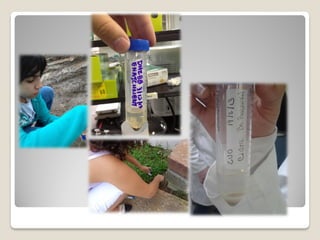
 Recollect the soil sample with a sterile spoon
and put it in the sterile 15mL conical tube with
cap
 Close quickly
 Record the location with a picture (place and
you) and the environmental data.
Methods Enrichment Culture
 Obtain ~0.5g of the soil sample
 Added it to the enrinchment solution placed in
the sterile 50mL conical tube with cap.
 Close it slightly
 Incubate at 37° C for 24 hours
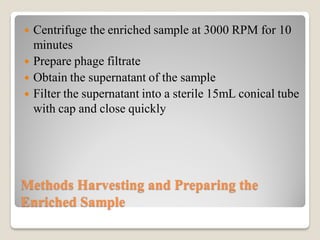
Methods Harvesting and Preparing the
Enriched Sample
 Centrifuge the enriched sample at 3000 RPM for 10
minutes
 Prepare phage filtrate
 Obtain the supernatant of the sample
 Filter the supernatant into a sterile 15mL conical tube
with cap and close quickly
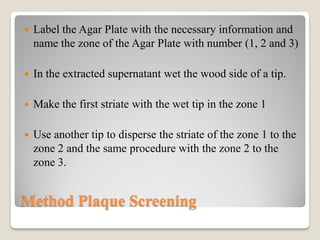
Method Plaque Screening
 Label the Agar Plate with the necessary information and
name the zone of the Agar Plate with number (1, 2 and 3)
 In the extracted supernatant wet the wood side of a tip.
 Make the first striate with the wet tip in the zone 1
 Use another tip to disperse the striate of the zone 1 to the
zone 2 and the same procedure with the zone 2 to the
zone 3.
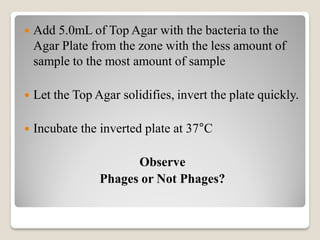
 Add 5.0mL of Top Agar with the bacteria to the
Agar Plate from the zone with the less amount of
sample to the most amount of sample
 Let the Top Agar solidifies, invert the plate quickly.
 Incubate the inverted plate at 37°C
Observe
Phages or Not Phages?
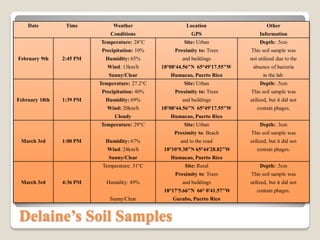
Date Time Weather Location Other
Conditions GPS Information
Temperature: 28°C Site: Urban Depth: .5cm
Precipitation: 10% Proximity to: Trees This soil sample was
February 9th 2:45 PM Humidity: 65% and buildings not utilized due to the
Wind: 13km/h 18°08'44.56"N 65°49'17.55"W absence of bacteria
Sunny/Clear Humacao, Puerto Rico in the lab.
Temperature: 27.2°C Site: Urban Depth: .5cm
Precipitation: 40% Proximity to: Trees This soil sample was
February 18th 1:39 PM Humidity: 69% and buildings utilized, but it did not
Wind: 20km/h 18°08'44.56"N 65°49'17.55"W contain phages.
Cloudy Humacao, Puerto Rico
Temperature: 29°C Site: Urban Depth: .3cm
Proximity to: Beach This soil sample was
March 3rd 1:00 PM Humidity: 67% and to the road utilized, but it did not
Wind: 24km/h 18°10'9.38"N 65°44'28.82"W contain phages.
Sunny/Clear Humacao, Puerto Rico
Temperature: 31°C Site: Rural Depth: .5cm
Proximity to: Trees This soil sample was
March 3rd 4:36 PM Humidity: 49% and buildings utilized, but it did not
18°17'5.66"N 66° 0'41.57"W contain phages.
Sunny/Clear Gurabo, Puerto Rico
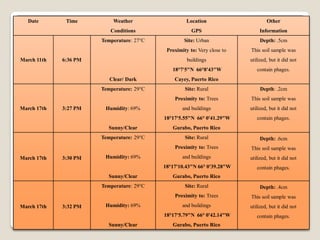
Delaine’s Soil Samples
Date Time Weather Location Other
Conditions GPS Information
Temperature: 27°C Site: Urban Depth: .5cm
Proximity to: Very close to This soil sample was
March 11th 6:36 PM buildings utilized, but it did not
18°7'5"N 66°8'43"W contain phages.
Clear/ Dark Cayey, Puerto Rico
Temperature: 29°C Site: Rural Depth: .2cm
Proximity to: Trees This soil sample was
March 17th 3:27 PM Humidity: 69% and buildings utilized, but it did not
18°17'5.55"N 66° 0'41.29"W contain phages.
Sunny/Clear Gurabo, Puerto Rico
Temperature: 29°C Site: Rural Depth: .6cm
Proximity to: Trees This soil sample was
March 17th 3:30 PM Humidity: 69% and buildings utilized, but it did not
18°17'10.43"N 66° 0'39.28"W contain phages.
Sunny/Clear Gurabo, Puerto Rico
Temperature: 29°C Site: Rural Depth: .4cm
Proximity to: Trees This soil sample was
March 17th 3:32 PM Humidity: 69% and buildings utilized, but it did not
18°17'5.79"N 66° 0'42.14"W contain phages.
Sunny/Clear Gurabo, Puerto Rico
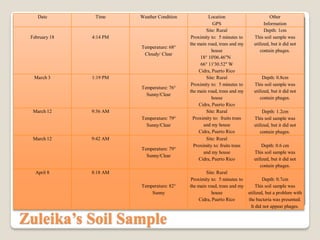
Zuleika’s Soil Sample
Date Time Weather Condition Location
GPS
Other
Information
February 18 4:14 PM
Temperature: 68°
Cloudy/ Clear
Site: Rural
Proximity to: 5 minutes to
the main road, trees and my
house
18° 10'06.46"N
66° 11'30.52" W
Cidra, Puerto Rico
Depth: 1cm
This soil sample was
utilized, but it did not
contain phages.
March 3 1:19 PM
Temperature: 76°
Sunny/Clear
Site: Rural
Proximity to: 5 minutes to
the main road, trees and my
house
Cidra, Puerto Rico
Depth: 0.8cm
This soil sample was
utilized, but it did not
contain phages.
March 12 9:36 AM
Temperature: 79°
Sunny/Clear
Site: Rural
Proximity to: fruits trees
and my house
Cidra, Puerto Rico
Depth: 1.2cm
This soil sample was
utilized, but it did not
contain phages.
March 12 9:42 AM
Temperature: 79°
Sunny/Clear
Site: Rural
Proximity to: fruits trees
and my house
Cidra, Puerto Rico
Depth: 0.6 cm
This soil sample was
utilized, but it did not
contain phages.
April 8 8:18 AM
Temperature: 82°
Sunny
Site: Rural
Proximity to: 5 minutes to
the main road, trees and my
house
Cidra, Puerto Rico
Depth: 0.7cm
This soil sample was
utilized, but a problem with
the bacteria was presented.
It did not appear phages.
Comparison
 All of the samples were diverse
 Hours, locations, and temperatures among other determining factors
 Factors
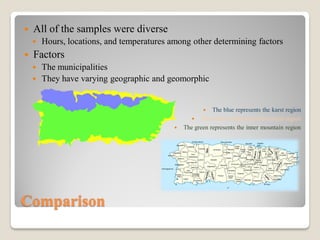
 The municipalities
 They have varying geographic and geomorphic
 The blue represents the karst region
 The yellow represents the coastal region
 The green represents the inner mountain region
 Type of soil
◦ Unfortunately this information was not adequately recorded,
because the only description mentioned was dry, moist or
normal.
◦ There are three types of soil: sand, clay and silt, and each of
those contain certain characteristics that difference them.
◦ Vegetation surrounding the location
 The vegetation is diverse from municipality to
municipality.
 The depth was diverse to and might have been the
determining factor
◦ All of the negative results were superficial, while the only
positive one was at almost 6 cm.
Conclusion
 Although the experiments and procedures were
performed accurately, no bacteriophages were found.
 This might be for any of the reasons discussed in the
comparison or because the laboratory technicalities,
such as the availability of bacteria.
 The main objective was not accomplished, but other
objectives like practicing important laboratory skills
were completed.

Mycobacteriophages

  • 1.
    Mycobacteriophages By: Anaeli Shockey Nicolle A.Rosa Delaine M. Zayas-Bazán Zuleika Velázquez Ortiz BIOL 4997 Rise Program
  • 2.
    Introduction • Mycrobateriophages areviruses that infect bacteria belonging to the Mycibacterium genus. • They are relatively easy to isolate and characterize. • They are great for studying evolution. • Bacteriophages have two cycles: lytic cycle (reproduction) and lysogenic cycle (integration)
  • 3.
    • In ourexperiment we looked for mycobacteriophages and completed the required steps to isolate and characterize it. • This had some implications such as:  Learning the Aseptic Technique  Applying other laboratory skills: plating, centrifugation and mixing solutions among others.  Understanding the importance of finding and characterizing a mycobacteriophage
  • 4.
    Materials Sample Collection Lab Notebook  Sterile 15mL conical tube with cap  Sterile Spoon  GPS or Google Earth
  • 5.
    Materials Enrichment Culture Clean Spatula  Approximately 0.5g of the soil sample  Sterile 50mL conical tube with cap  Weighing pan  Soil Samples
  • 6.
    Materials Harvesting andPlaque Screening  5mL sterile disposable pipettes  Agar Plates  Bacteria  Centrifuge  Enriched Sample  Sterile 15mL conical tube with cap  Sterile Filter  Sterile Syringe  Tips  Top Agar
  • 7.
    Methods Sample Collection Identify the place for soil sample collection  Recollect the soil sample with a sterile spoon and put it in the sterile 15mL conical tube with cap  Close quickly  Record the location with a picture (place and you) and the environmental data.
  • 8.
    Methods Enrichment Culture Obtain ~0.5g of the soil sample  Added it to the enrinchment solution placed in the sterile 50mL conical tube with cap.  Close it slightly  Incubate at 37° C for 24 hours
  • 9.
    Methods Harvesting andPreparing the Enriched Sample  Centrifuge the enriched sample at 3000 RPM for 10 minutes  Prepare phage filtrate  Obtain the supernatant of the sample  Filter the supernatant into a sterile 15mL conical tube with cap and close quickly
  • 10.
    Method Plaque Screening Label the Agar Plate with the necessary information and name the zone of the Agar Plate with number (1, 2 and 3)  In the extracted supernatant wet the wood side of a tip.  Make the first striate with the wet tip in the zone 1  Use another tip to disperse the striate of the zone 1 to the zone 2 and the same procedure with the zone 2 to the zone 3.
  • 11.
     Add 5.0mLof Top Agar with the bacteria to the Agar Plate from the zone with the less amount of sample to the most amount of sample  Let the Top Agar solidifies, invert the plate quickly.  Incubate the inverted plate at 37°C Observe Phages or Not Phages?
  • 12.
    Date Time WeatherLocation Other Conditions GPS Information Temperature: 28°C Site: Urban Depth: .5cm Precipitation: 10% Proximity to: Trees This soil sample was February 9th 2:45 PM Humidity: 65% and buildings not utilized due to the Wind: 13km/h 18°08'44.56"N 65°49'17.55"W absence of bacteria Sunny/Clear Humacao, Puerto Rico in the lab. Temperature: 27.2°C Site: Urban Depth: .5cm Precipitation: 40% Proximity to: Trees This soil sample was February 18th 1:39 PM Humidity: 69% and buildings utilized, but it did not Wind: 20km/h 18°08'44.56"N 65°49'17.55"W contain phages. Cloudy Humacao, Puerto Rico Temperature: 29°C Site: Urban Depth: .3cm Proximity to: Beach This soil sample was March 3rd 1:00 PM Humidity: 67% and to the road utilized, but it did not Wind: 24km/h 18°10'9.38"N 65°44'28.82"W contain phages. Sunny/Clear Humacao, Puerto Rico Temperature: 31°C Site: Rural Depth: .5cm Proximity to: Trees This soil sample was March 3rd 4:36 PM Humidity: 49% and buildings utilized, but it did not 18°17'5.66"N 66° 0'41.57"W contain phages. Sunny/Clear Gurabo, Puerto Rico Delaine’s Soil Samples
  • 13.
    Date Time WeatherLocation Other Conditions GPS Information Temperature: 27°C Site: Urban Depth: .5cm Proximity to: Very close to This soil sample was March 11th 6:36 PM buildings utilized, but it did not 18°7'5"N 66°8'43"W contain phages. Clear/ Dark Cayey, Puerto Rico Temperature: 29°C Site: Rural Depth: .2cm Proximity to: Trees This soil sample was March 17th 3:27 PM Humidity: 69% and buildings utilized, but it did not 18°17'5.55"N 66° 0'41.29"W contain phages. Sunny/Clear Gurabo, Puerto Rico Temperature: 29°C Site: Rural Depth: .6cm Proximity to: Trees This soil sample was March 17th 3:30 PM Humidity: 69% and buildings utilized, but it did not 18°17'10.43"N 66° 0'39.28"W contain phages. Sunny/Clear Gurabo, Puerto Rico Temperature: 29°C Site: Rural Depth: .4cm Proximity to: Trees This soil sample was March 17th 3:32 PM Humidity: 69% and buildings utilized, but it did not 18°17'5.79"N 66° 0'42.14"W contain phages. Sunny/Clear Gurabo, Puerto Rico
  • 14.
    Zuleika’s Soil Sample DateTime Weather Condition Location GPS Other Information February 18 4:14 PM Temperature: 68° Cloudy/ Clear Site: Rural Proximity to: 5 minutes to the main road, trees and my house 18° 10'06.46"N 66° 11'30.52" W Cidra, Puerto Rico Depth: 1cm This soil sample was utilized, but it did not contain phages. March 3 1:19 PM Temperature: 76° Sunny/Clear Site: Rural Proximity to: 5 minutes to the main road, trees and my house Cidra, Puerto Rico Depth: 0.8cm This soil sample was utilized, but it did not contain phages. March 12 9:36 AM Temperature: 79° Sunny/Clear Site: Rural Proximity to: fruits trees and my house Cidra, Puerto Rico Depth: 1.2cm This soil sample was utilized, but it did not contain phages. March 12 9:42 AM Temperature: 79° Sunny/Clear Site: Rural Proximity to: fruits trees and my house Cidra, Puerto Rico Depth: 0.6 cm This soil sample was utilized, but it did not contain phages. April 8 8:18 AM Temperature: 82° Sunny Site: Rural Proximity to: 5 minutes to the main road, trees and my house Cidra, Puerto Rico Depth: 0.7cm This soil sample was utilized, but a problem with the bacteria was presented. It did not appear phages.
  • 16.
    Comparison  All ofthe samples were diverse  Hours, locations, and temperatures among other determining factors  Factors  The municipalities  They have varying geographic and geomorphic  The blue represents the karst region  The yellow represents the coastal region  The green represents the inner mountain region
  • 17.
     Type ofsoil ◦ Unfortunately this information was not adequately recorded, because the only description mentioned was dry, moist or normal. ◦ There are three types of soil: sand, clay and silt, and each of those contain certain characteristics that difference them. ◦ Vegetation surrounding the location  The vegetation is diverse from municipality to municipality.  The depth was diverse to and might have been the determining factor ◦ All of the negative results were superficial, while the only positive one was at almost 6 cm.
  • 18.
    Conclusion  Although theexperiments and procedures were performed accurately, no bacteriophages were found.  This might be for any of the reasons discussed in the comparison or because the laboratory technicalities, such as the availability of bacteria.  The main objective was not accomplished, but other objectives like practicing important laboratory skills were completed.