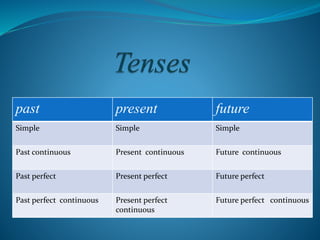
past present future 
Simple Simple Simple 
Past continuous Present continuous Future continuous 
Past perfect Present perfect Future perfect 
Past perfect continuous Present perfect 
continuous 
Future perfect continuous
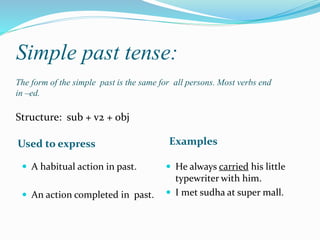
Simple past tense: 
The form of the simple past is the same for all persons. Most verbs end 
in –ed. 
Used to express Examples 
 A habitual action in past. 
 An action completed in past. 
 He always carried his little 
typewriter with him. 
 I met sudha at super mall. 
Structure: sub + v2 + obj
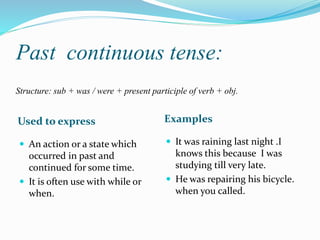
Past continuous tense: 
Structure: sub + was / were + present participle of verb + obj. 
Used to express Examples 
 An action or a state which 
occurred in past and 
continued for some time. 
 It is often use with while or 
when. 
 It was raining last night .I 
knows this because I was 
studying till very late. 
 He was repairing his bicycle. 
when you called.
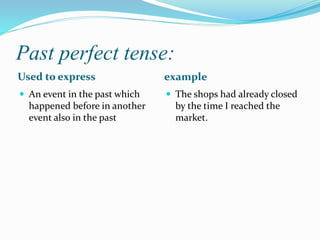
Past perfect tense: 
Used to express example 
 An event in the past which 
happened before in another 
event also in the past 
 The shops had already closed 
by the time I reached the 
market.
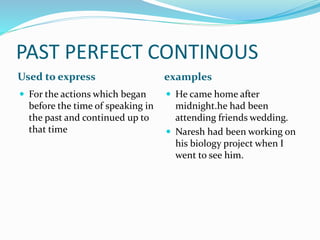
PAST PERFECT CONTINOUS 
Used to express examples 
 For the actions which began 
before the time of speaking in 
the past and continued up to 
that time 
 He came home after 
midnight.he had been 
attending friends wedding. 
 Naresh had been working on 
his biology project when I 
went to see him.
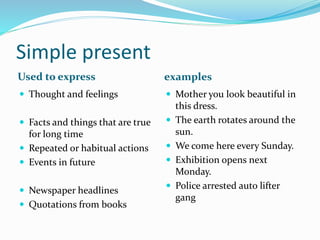
Simple present 
Used to express examples 
 Thought and feelings 
 Facts and things that are true 
for long time 
 Repeated or habitual actions 
 Events in future 
 Newspaper headlines 
 Quotations from books 
 Mother you look beautiful in 
this dress. 
 The earth rotates around the 
sun. 
 We come here every Sunday. 
 Exhibition opens next 
Monday. 
 Police arrested auto lifter 
gang
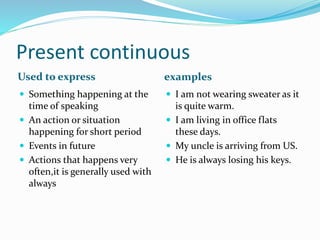
Present continuous 
Used to express examples 
 Something happening at the 
time of speaking 
 An action or situation 
happening for short period 
 Events in future 
 Actions that happens very 
often,it is generally used with 
always 
 I am not wearing sweater as it 
is quite warm. 
 I am living in office flats 
these days. 
 My uncle is arriving from US. 
 He is always losing his keys.
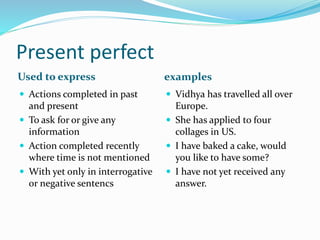
Present perfect 
Used to express examples 
 Actions completed in past 
and present 
 To ask for or give any 
information 
 Action completed recently 
where time is not mentioned 
 With yet only in interrogative 
or negative sentencs 
 Vidhya has travelled all over 
Europe. 
 She has applied to four 
collages in US. 
 I have baked a cake, would 
you like to have some? 
 I have not yet received any 
answer.
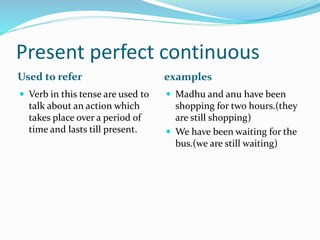
Present perfect continuous 
Used to refer examples 
 Verb in this tense are used to 
talk about an action which 
takes place over a period of 
time and lasts till present. 
 Madhu and anu have been 
shopping for two hours.(they 
are still shopping) 
 We have been waiting for the 
bus.(we are still waiting)
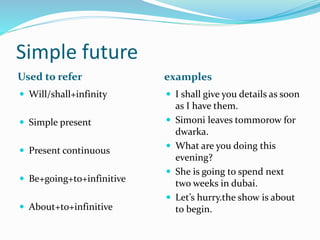
Simple future 
Used to refer examples 
 Will/shall+infinity 
 Simple present 
 Present continuous 
 Be+going+to+infinitive 
 About+to+infinitive 
 I shall give you details as soon 
as I have them. 
 Simoni leaves tommorow for 
dwarka. 
 What are you doing this 
evening? 
 She is going to spend next 
two weeks in dubai. 
 Let’s hurry.the show is about 
to begin.
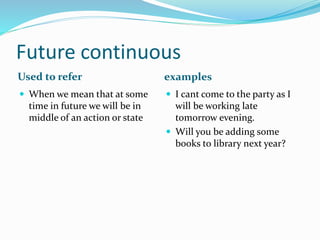
Future continuous 
Used to refer examples 
 When we mean that at some 
time in future we will be in 
middle of an action or state 
 I cant come to the party as I 
will be working late 
tomorrow evening. 
 Will you be adding some 
books to library next year?
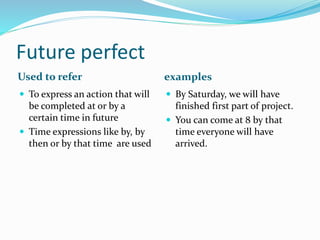
Future perfect 
Used to refer examples 
 To express an action that will 
be completed at or by a 
certain time in future 
 Time expressions like by, by 
then or by that time are used 
 By Saturday, we will have 
finished first part of project. 
 You can come at 8 by that 
time everyone will have 
arrived.
Future perfect continuous 
Will/shall+have+been+present participle of the verb 
Used to express examples 
 This form of verb is used to 
talk about an action that will 
continue in future up to 
certain time. 
 By the end of this year, she 
will have been learning 
enginering for four years

Tenses

  • 1.
    past present future Simple Simple Simple Past continuous Present continuous Future continuous Past perfect Present perfect Future perfect Past perfect continuous Present perfect continuous Future perfect continuous
  • 2.
    Simple past tense: The form of the simple past is the same for all persons. Most verbs end in –ed. Used to express Examples  A habitual action in past.  An action completed in past.  He always carried his little typewriter with him.  I met sudha at super mall. Structure: sub + v2 + obj
  • 3.
    Past continuous tense: Structure: sub + was / were + present participle of verb + obj. Used to express Examples  An action or a state which occurred in past and continued for some time.  It is often use with while or when.  It was raining last night .I knows this because I was studying till very late.  He was repairing his bicycle. when you called.
  • 4.
    Past perfect tense: Used to express example  An event in the past which happened before in another event also in the past  The shops had already closed by the time I reached the market.
  • 5.
    PAST PERFECT CONTINOUS Used to express examples  For the actions which began before the time of speaking in the past and continued up to that time  He came home after midnight.he had been attending friends wedding.  Naresh had been working on his biology project when I went to see him.
  • 6.
    Simple present Usedto express examples  Thought and feelings  Facts and things that are true for long time  Repeated or habitual actions  Events in future  Newspaper headlines  Quotations from books  Mother you look beautiful in this dress.  The earth rotates around the sun.  We come here every Sunday.  Exhibition opens next Monday.  Police arrested auto lifter gang
  • 7.
    Present continuous Usedto express examples  Something happening at the time of speaking  An action or situation happening for short period  Events in future  Actions that happens very often,it is generally used with always  I am not wearing sweater as it is quite warm.  I am living in office flats these days.  My uncle is arriving from US.  He is always losing his keys.
  • 8.
    Present perfect Usedto express examples  Actions completed in past and present  To ask for or give any information  Action completed recently where time is not mentioned  With yet only in interrogative or negative sentencs  Vidhya has travelled all over Europe.  She has applied to four collages in US.  I have baked a cake, would you like to have some?  I have not yet received any answer.
  • 9.
    Present perfect continuous Used to refer examples  Verb in this tense are used to talk about an action which takes place over a period of time and lasts till present.  Madhu and anu have been shopping for two hours.(they are still shopping)  We have been waiting for the bus.(we are still waiting)
  • 10.
    Simple future Usedto refer examples  Will/shall+infinity  Simple present  Present continuous  Be+going+to+infinitive  About+to+infinitive  I shall give you details as soon as I have them.  Simoni leaves tommorow for dwarka.  What are you doing this evening?  She is going to spend next two weeks in dubai.  Let’s hurry.the show is about to begin.
  • 11.
    Future continuous Usedto refer examples  When we mean that at some time in future we will be in middle of an action or state  I cant come to the party as I will be working late tomorrow evening.  Will you be adding some books to library next year?
  • 12.
    Future perfect Usedto refer examples  To express an action that will be completed at or by a certain time in future  Time expressions like by, by then or by that time are used  By Saturday, we will have finished first part of project.  You can come at 8 by that time everyone will have arrived.
  • 13.
    Future perfect continuous Will/shall+have+been+present participle of the verb Used to express examples  This form of verb is used to talk about an action that will continue in future up to certain time.  By the end of this year, she will have been learning enginering for four years