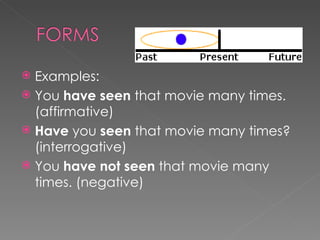
Examples: You  have seen  that movie many times. (affirmative) Have  you  seen  that movie many times? (interrogative) You  have not seen  that movie many times. (negative)
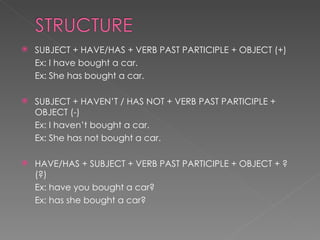
SUBJECT + HAVE/HAS + VERB PAST PARTICIPLE + OBJECT (+) Ex: I have bought a car. Ex: She has bought a car. SUBJECT + HAVEN’T / HAS NOT + VERB PAST PARTICIPLE + OBJECT (-) Ex: I haven’t bought a car. Ex: She has not bought a car. HAVE/HAS + SUBJECT + VERB PAST PARTICIPLE + OBJECT + ? (?) Ex: have you bought a car? Ex: has she bought a car?
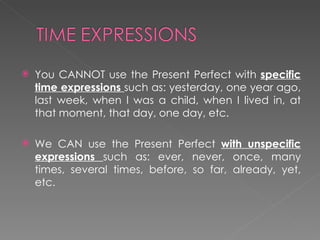
You CANNOT use the Present Perfect with  specific time expressions  such as: yesterday, one year ago, last week, when I was a child, when I lived in, at that moment, that day, one day, etc.  We CAN use the Present Perfect  with unspecific expressions  such as: ever, never, once, many times, several times, before, so far, already, yet, etc.
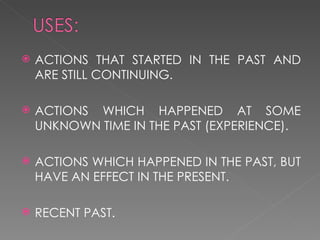
ACTIONS THAT STARTED IN THE PAST AND ARE STILL CONTINUING. ACTIONS WHICH HAPPENED AT SOME UNKNOWN TIME IN THE PAST (EXPERIENCE). ACTIONS WHICH HAPPENED IN THE PAST, BUT HAVE AN EFFECT IN THE PRESENT. RECENT PAST.
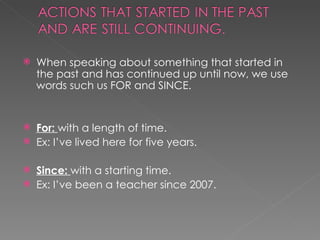
When speaking about something that started in the past and has continued up until now, we use words such us FOR and SINCE. For:  with a length of time. Ex: I’ve lived here for five years. Since:  with a starting time.  Ex: I’ve been a teacher since 2007.
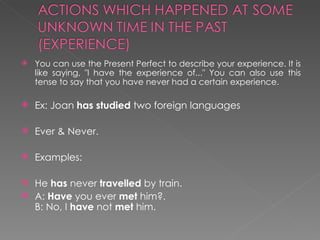
You can use the Present Perfect to describe your experience. It is like saying, "I have the experience of..." You can also use this tense to say that you have never had a certain experience.  Ex: Joan  has studied  two foreign languages Ever & Never.  Examples: He  has  never  travelled  by train. A:  Have  you ever  met  him?. B: No, I  have  not  met  him.
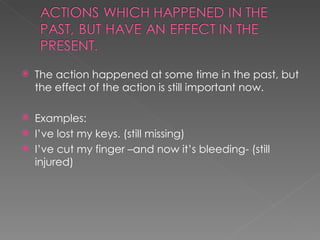
The action happened at some time in the past, but the effect of the action is still important now. Examples: I’ve lost my keys. (still missing) I’ve cut my finger –and now it’s bleeding- (still injured)
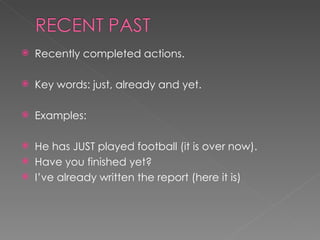
Recently completed actions. Key words: just, already and yet. Examples:  He has JUST played football (it is over now). Have you finished yet? I’ve already written the report (here it is)
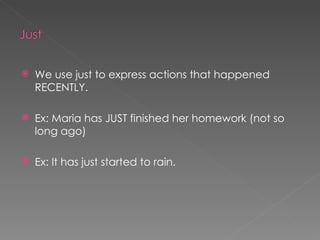
We use just to express actions that happened RECENTLY. Ex: Maria has JUST finished her homework (not so long ago) Ex: It has just started to rain.
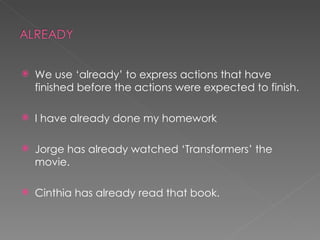
We use ‘already’ to express actions that have finished before the actions were expected to finish.  I have already done my homework Jorge has already watched ‘Transformers’ the movie. Cinthia has already read that book.
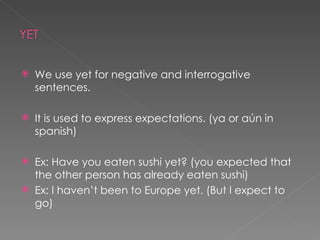
We use yet for negative and interrogative sentences. It is used to express expectations. (ya or aún in spanish) Ex: Have you eaten sushi yet? (you expected that the other person has already eaten sushi) Ex: I haven’t been to Europe yet. (But I expect to go)
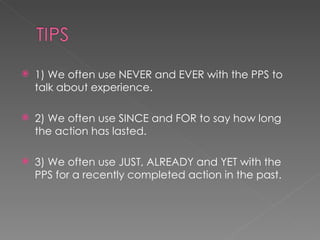
1) We often use NEVER and EVER with the PPS to talk about experience. 2) We often use SINCE and FOR to say how long the action has lasted. 3) We often use JUST, ALREADY and YET with the PPS for a recently completed action in the past.
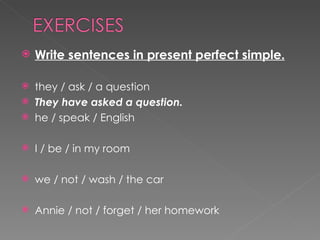
Write sentences in present perfect simple. they / ask / a question  They have asked a question. he / speak / English  I / be / in my room  we / not / wash / the car  Annie / not / forget / her homework
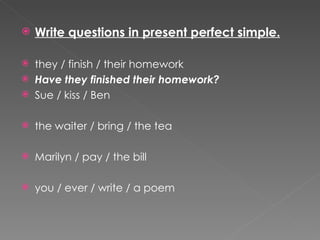
Write questions in present perfect simple. they / finish / their homework  Have they finished their homework? Sue / kiss / Ben  the waiter / bring / the tea  Marilyn / pay / the bill  you / ever / write / a poem
 

Present perfect simple

  • 1.
  • 2.
    Examples: You have seen that movie many times. (affirmative) Have you seen that movie many times? (interrogative) You have not seen that movie many times. (negative)
  • 3.
    SUBJECT + HAVE/HAS+ VERB PAST PARTICIPLE + OBJECT (+) Ex: I have bought a car. Ex: She has bought a car. SUBJECT + HAVEN’T / HAS NOT + VERB PAST PARTICIPLE + OBJECT (-) Ex: I haven’t bought a car. Ex: She has not bought a car. HAVE/HAS + SUBJECT + VERB PAST PARTICIPLE + OBJECT + ? (?) Ex: have you bought a car? Ex: has she bought a car?
  • 4.
    You CANNOT usethe Present Perfect with specific time expressions such as: yesterday, one year ago, last week, when I was a child, when I lived in, at that moment, that day, one day, etc. We CAN use the Present Perfect with unspecific expressions such as: ever, never, once, many times, several times, before, so far, already, yet, etc.
  • 5.
    ACTIONS THAT STARTEDIN THE PAST AND ARE STILL CONTINUING. ACTIONS WHICH HAPPENED AT SOME UNKNOWN TIME IN THE PAST (EXPERIENCE). ACTIONS WHICH HAPPENED IN THE PAST, BUT HAVE AN EFFECT IN THE PRESENT. RECENT PAST.
  • 6.
    When speaking aboutsomething that started in the past and has continued up until now, we use words such us FOR and SINCE. For: with a length of time. Ex: I’ve lived here for five years. Since: with a starting time. Ex: I’ve been a teacher since 2007.
  • 7.
    You can usethe Present Perfect to describe your experience. It is like saying, "I have the experience of..." You can also use this tense to say that you have never had a certain experience. Ex: Joan has studied two foreign languages Ever & Never. Examples: He has never travelled by train. A: Have you ever met him?. B: No, I have not met him.
  • 8.
    The action happenedat some time in the past, but the effect of the action is still important now. Examples: I’ve lost my keys. (still missing) I’ve cut my finger –and now it’s bleeding- (still injured)
  • 9.
    Recently completed actions.Key words: just, already and yet. Examples: He has JUST played football (it is over now). Have you finished yet? I’ve already written the report (here it is)
  • 10.
    We use justto express actions that happened RECENTLY. Ex: Maria has JUST finished her homework (not so long ago) Ex: It has just started to rain.
  • 11.
    We use ‘already’to express actions that have finished before the actions were expected to finish. I have already done my homework Jorge has already watched ‘Transformers’ the movie. Cinthia has already read that book.
  • 12.
    We use yetfor negative and interrogative sentences. It is used to express expectations. (ya or aún in spanish) Ex: Have you eaten sushi yet? (you expected that the other person has already eaten sushi) Ex: I haven’t been to Europe yet. (But I expect to go)
  • 13.
    1) We oftenuse NEVER and EVER with the PPS to talk about experience. 2) We often use SINCE and FOR to say how long the action has lasted. 3) We often use JUST, ALREADY and YET with the PPS for a recently completed action in the past.
  • 14.
    Write sentences inpresent perfect simple. they / ask / a question They have asked a question. he / speak / English I / be / in my room we / not / wash / the car Annie / not / forget / her homework
  • 15.
    Write questions inpresent perfect simple. they / finish / their homework Have they finished their homework? Sue / kiss / Ben the waiter / bring / the tea Marilyn / pay / the bill you / ever / write / a poem
  • 16.