Simple Past,
Present Perfect, and
Present Perfect Continuous
Grammar Tenses
1st BAC
Unit 3
ROGUE EAGLE
Sick on Saturday
I have just had a terrible weekend! On
Saturday I was so tired that I slept all
morning. When I woke up, I had a
headache and my throat was sore. My
body ached all over. My nose ran and
I coughed a lot. My mother took my
temperature but I did not have a fever.
My mother made me some soup for
lunch and I ate it in bed. I drank some
juice. I tried to read a book but
I couldn’t keep my eyes open. I lay in
bed and felt miserable all afternoon.
What time is this?
Simple Past
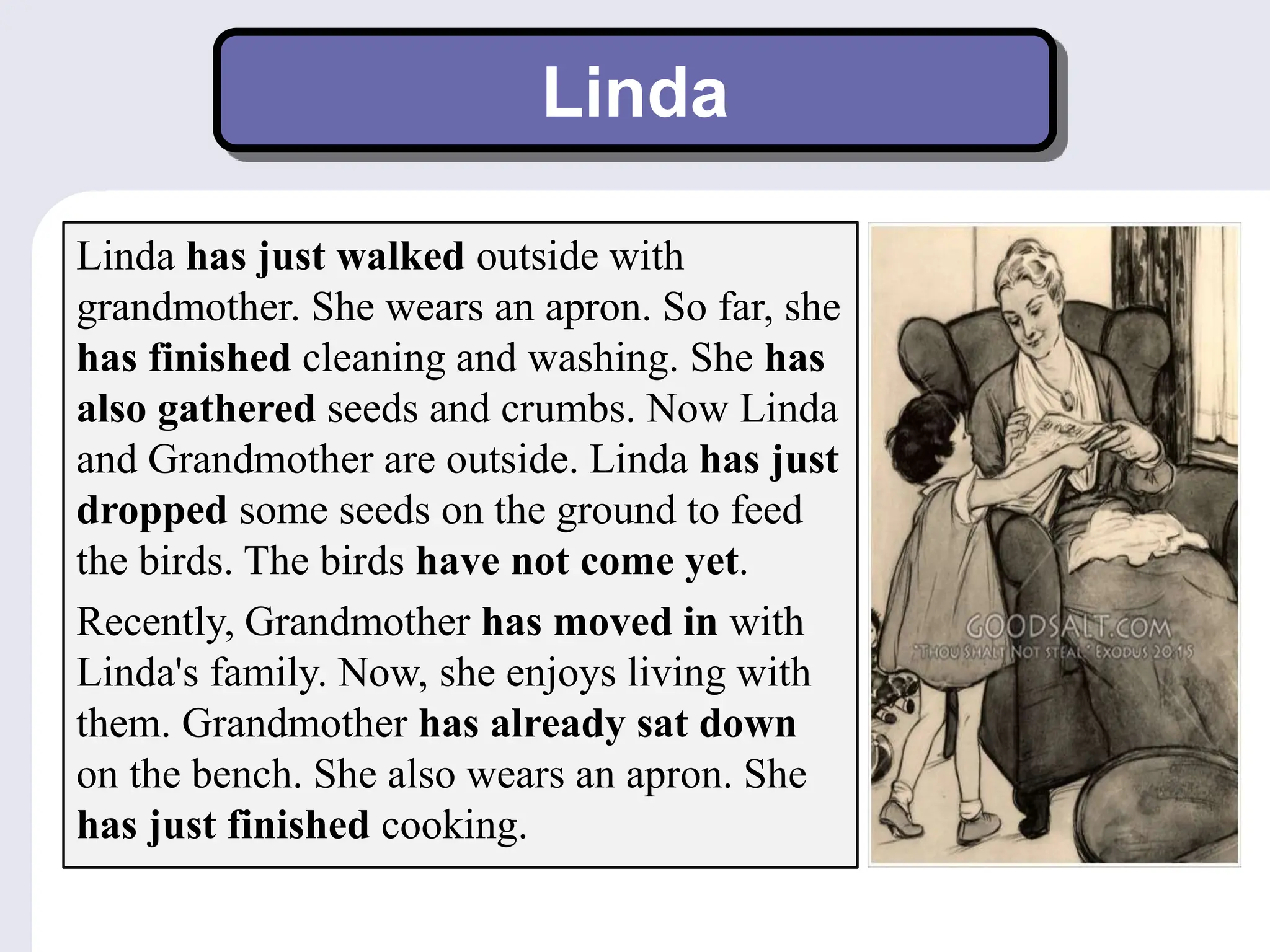
Linda
Linda has just walked outside with
grandmother. She wears an apron. So far, she
has finished cleaning and washing. She has
also gathered seeds and crumbs. Now Linda
and Grandmother are outside. Linda has just
dropped some seeds on the ground to feed
the birds. The birds have not come yet.
Recently, Grandmother has moved in with
Linda's family. Now, she enjoys living with
them. Grandmother has already sat down
on the bench. She also wears an apron. She
has just finished cooking.
What time is this?
Present perfect
I’m not watching
TV now.
It’s winter now, not
summer
Simple Past
I watched TV last night.
past
now
future
Use the simple past to talk about things that happened
and were finished in the past.
watched
I visited Rabat last summer.
visited
Last Summer
Simple Past
Use the simple past with past time expressions
such as; yesterday, last night, ago, last week, last
summer, last year …
We travelled to Ifrane last year.
He passed an exam two weeks ago.
past
now
future
last year.
ago.
Perfect Tenses
I have read many books this month.
I have finished my homework.
These actions happened in the past and
have a result in the present
have read
have finished
past
now
future
Use the present perfect to talk about things that
started in the past, but were not completed or finished.
The focus is on the result of the action.
Present Perfect
FORM
I have visited Morocco
Subject + have + past
participle
Present Perfect Continuous
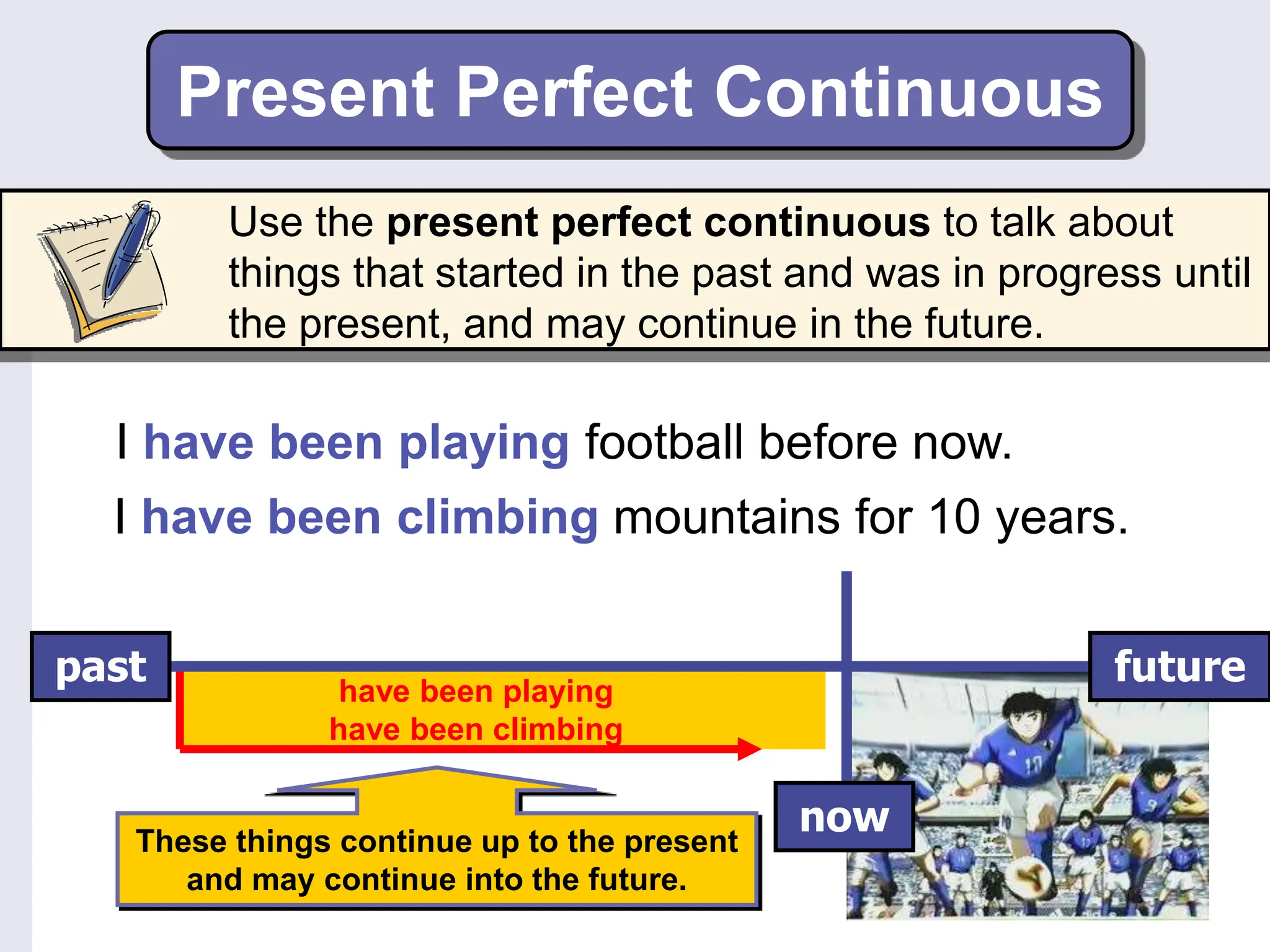
I have been playing football before now.
I have been climbing mountains for 10 years.
These things continue up to the present
and may continue into the future.
have been playing
have been climbing
past
now
future
Use the present perfect continuous to talk about
things that started in the past and was in progress until
the present, and may continue in the future.
Present Perfect Continuous
FORM
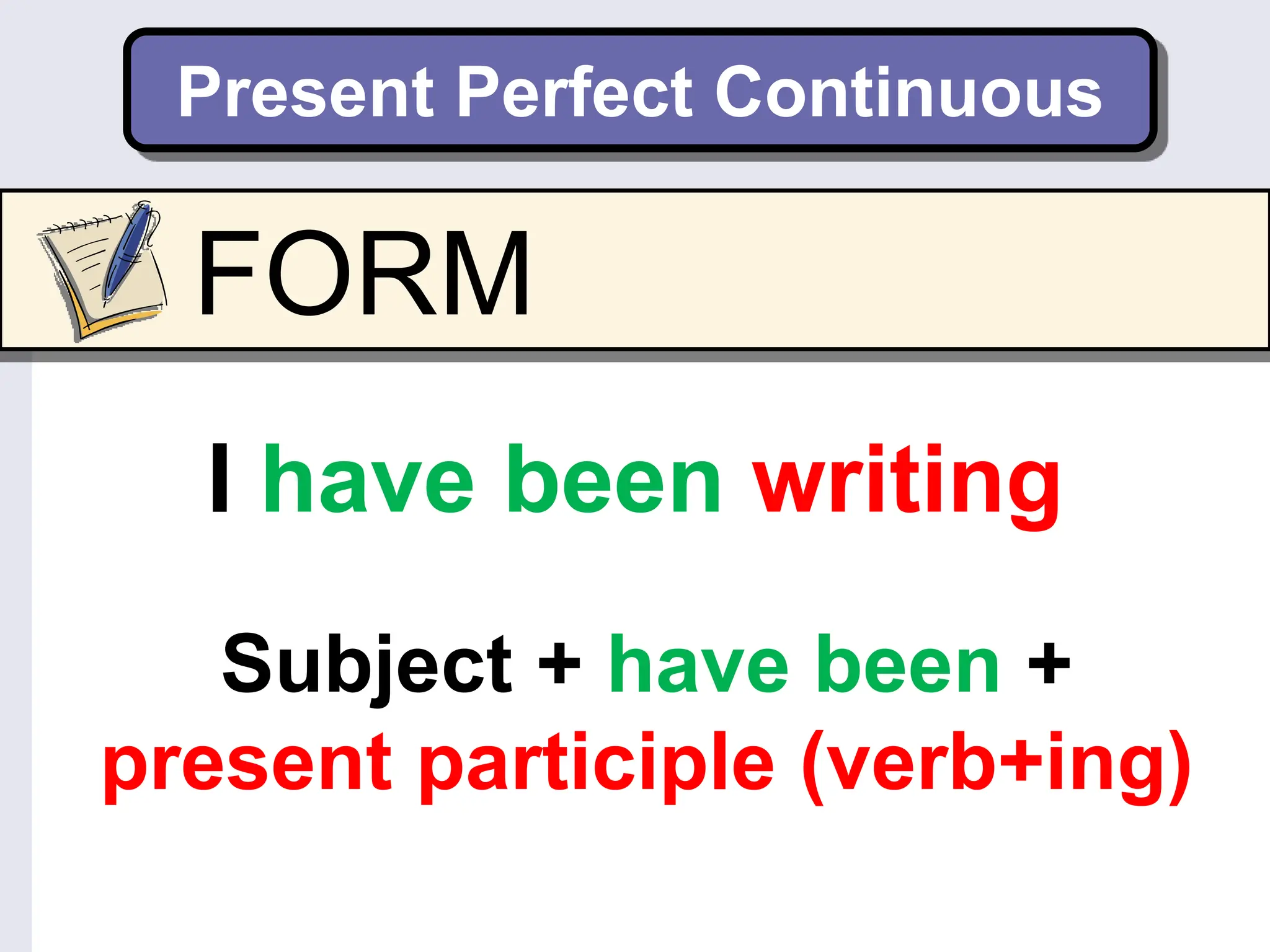
I have been writing
Subject + have been +
present participle (verb+ing)
for six years
Perfect Tenses
We often use the present perfect and the present perfect
progressive with for and since. Use for to show how long
something has been true and since to show when something started.
I have trained for six years to take this trip.
He has been working since 2000.
since
2000
for six years
past
now
future
have trained
since 2000.
has been woking
Present Perfect
Use the present perfect without time expressions to talk
about things that happened at some indefinite time in the
past. (time is not specific)
John has bought a new car.
past
now
future
We don’t know when John
bought the new car .
= Time is not important.
Time ????
Present Perfect
The present perfect without for or since shows that an
activity is finished. We often ask how often or how
many times with this use of the present perfect.
He has visited Morocco three times.
past
now
future
three times.
How often did he visit Morocco?.
for five hours
Present Perfect Progressive
The present perfect progressive shows that an
activity is not finished. We often ask how long with
the present perfect progressive.
They have been climbing for five hours.
past
now
future
for five hours.
have been climbing
The activity is not finished.
They’re still climbing.
How long have you been climbing?
She has read this book
twice this week.
She has traveled to
Alaska twice this month.
Present Perfect
Use the present perfect with unfinished time periods
such as today, this week, this month, and this year.
Notice the difference in meaning.
this month.
this week.
The week isn’t
over yet, and
she will
probably read
the book more
than twice.
The month isn’t
over yet. She
might travel
again.
Ahmed has been to
Paris.
Ahmed has gone to
Paris.
Present Perfect
What is the difference ?
Ahmed is not
in Paris now.
Ahmed is still
in Paris now.
Time Adverbs
Use the present perfect with time adverbs
such as yet, already, just.
I have already finished my homework.
My mother has just finished cooking.
Summer has not come yet
Not yet
Just now
Before
now
Time Adverbs
Use the present perfect with time adverbs
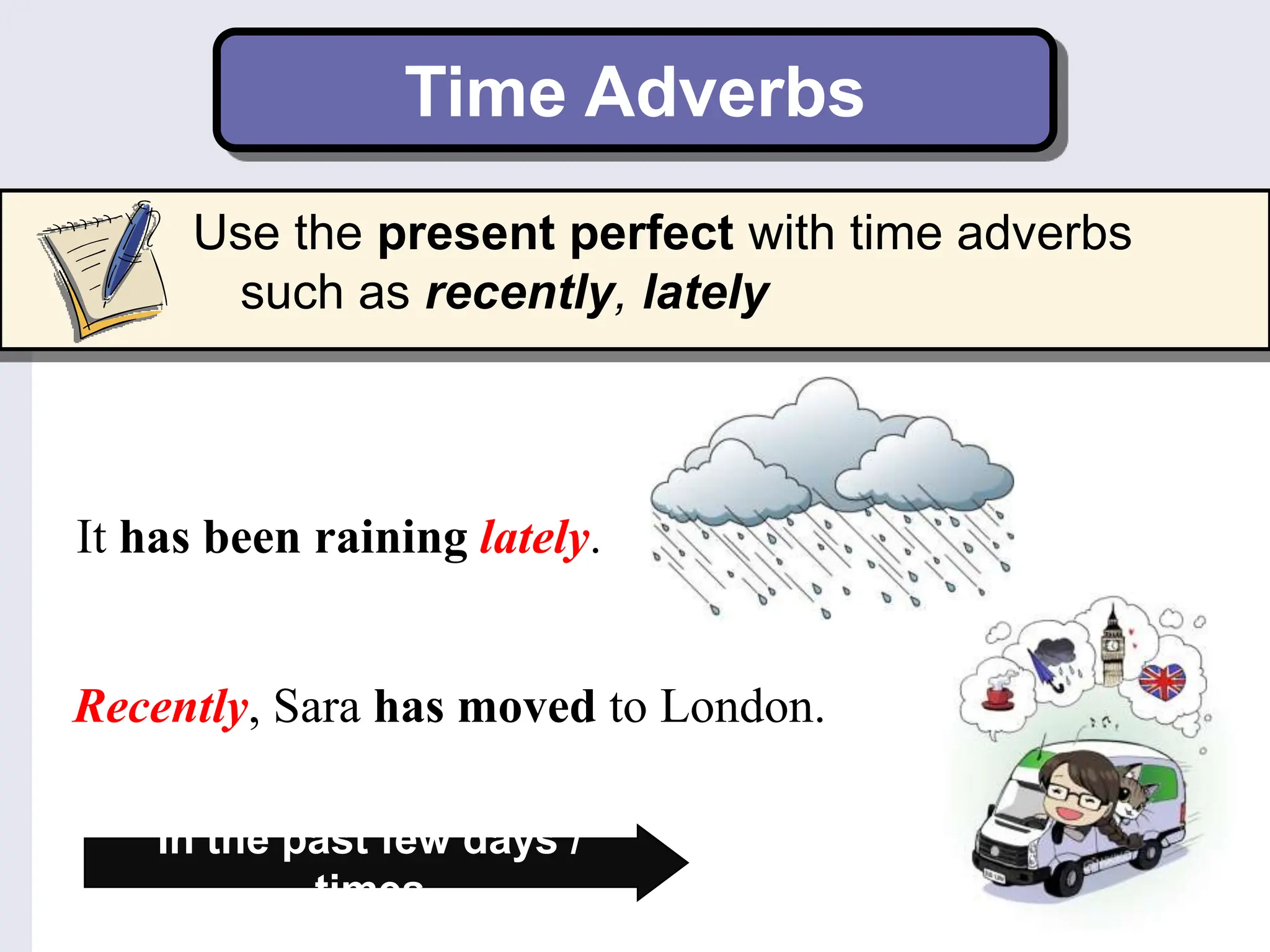
such as recently, lately
Recently, Sara has moved to London.
It has been raining lately.
In the past few days /
times
Remember!
Non-action (stative) verbs are not usually used in the
progressive.
I’ve been knowing how to climb
since I was young.
I’ve known how to climb since I
was young.
Remember!
Non-action (stative) verbs are not usually used in the
progressive.
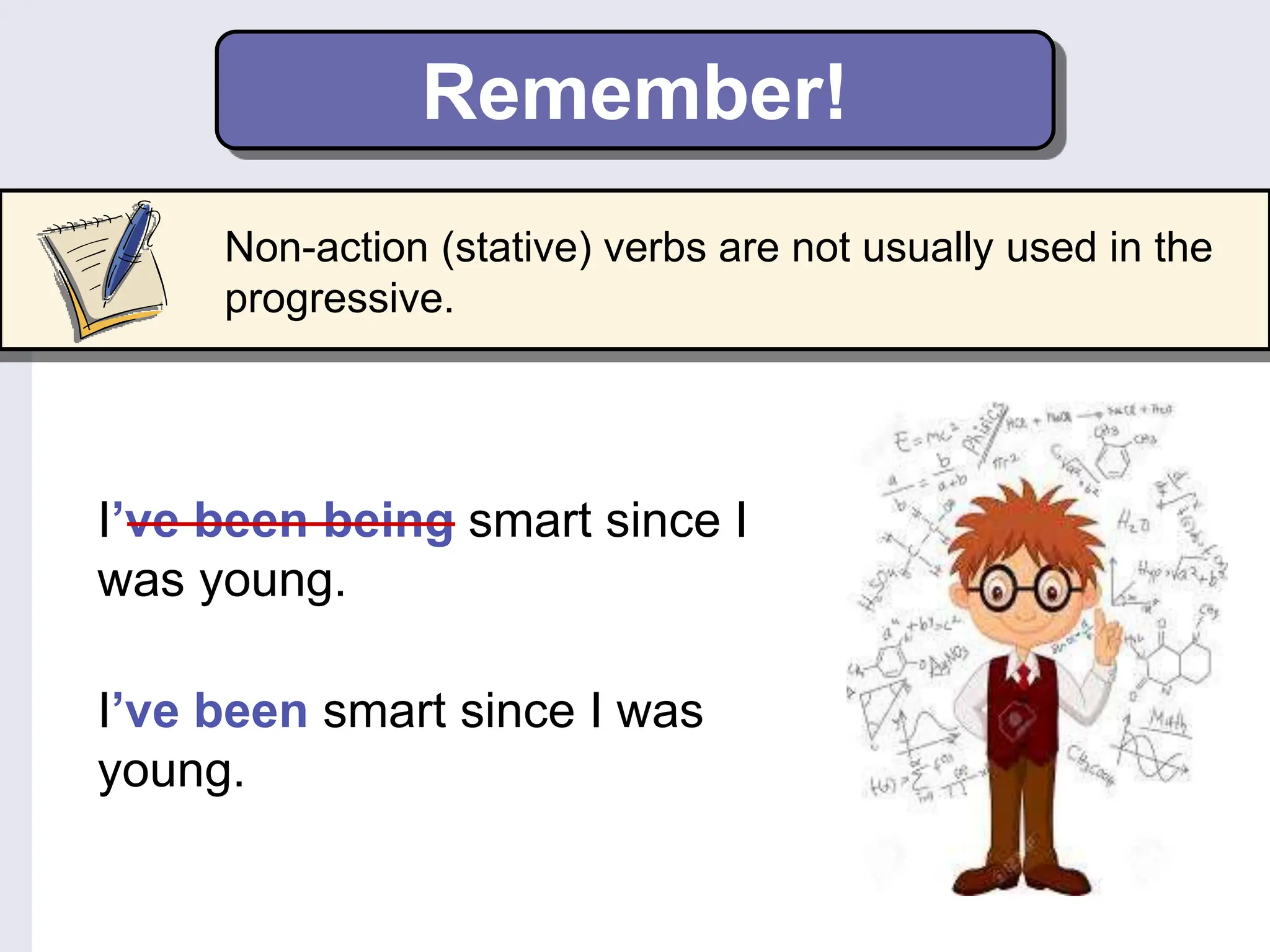
I’ve been being smart since I
was young.
I’ve been smart since I was
young.
Remember!
Non-action (stative) verbs are not usually used in the
progressive.
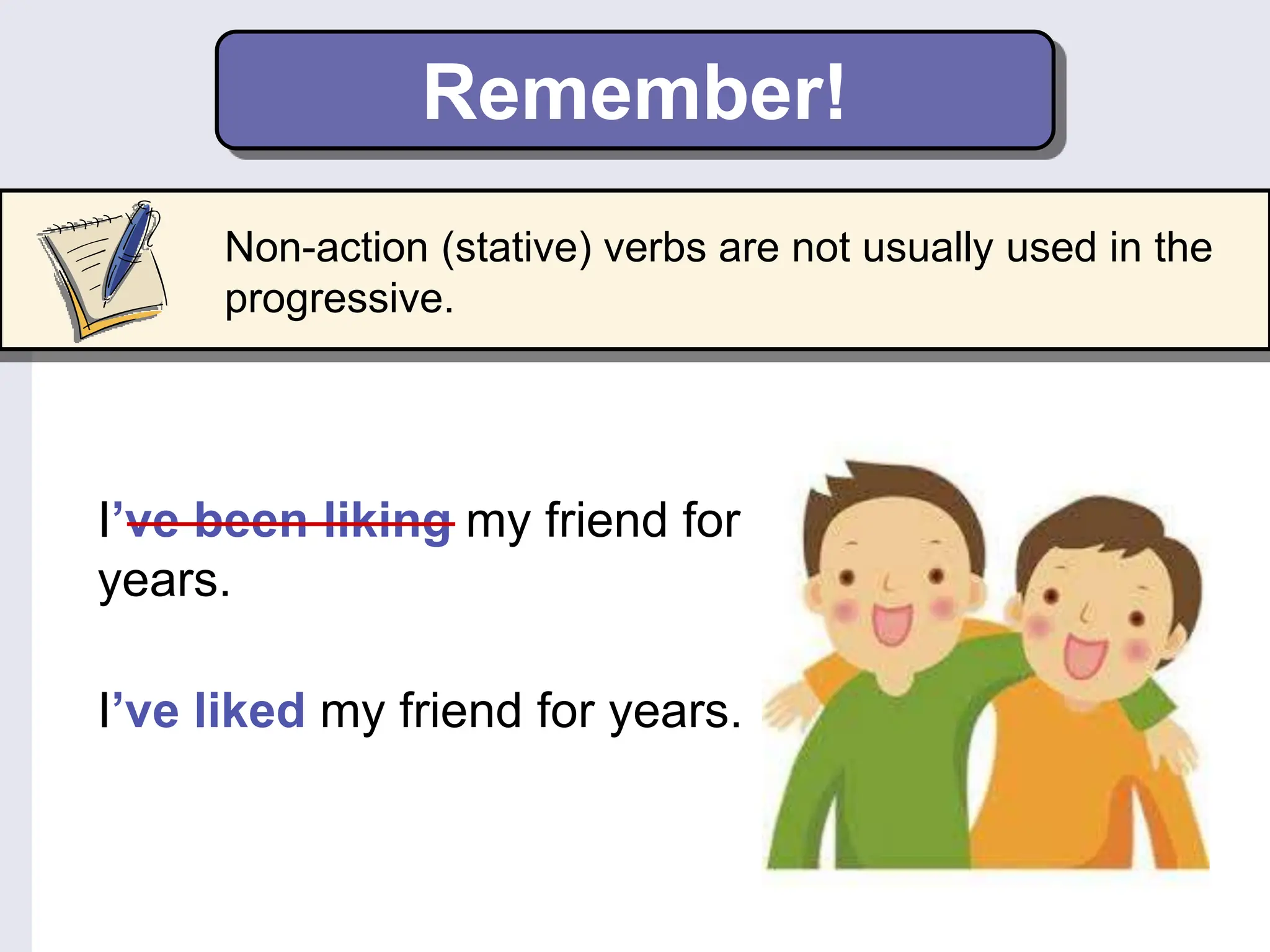
I’ve been liking my friend for
years.
I’ve liked my friend for years.
Present Perfect
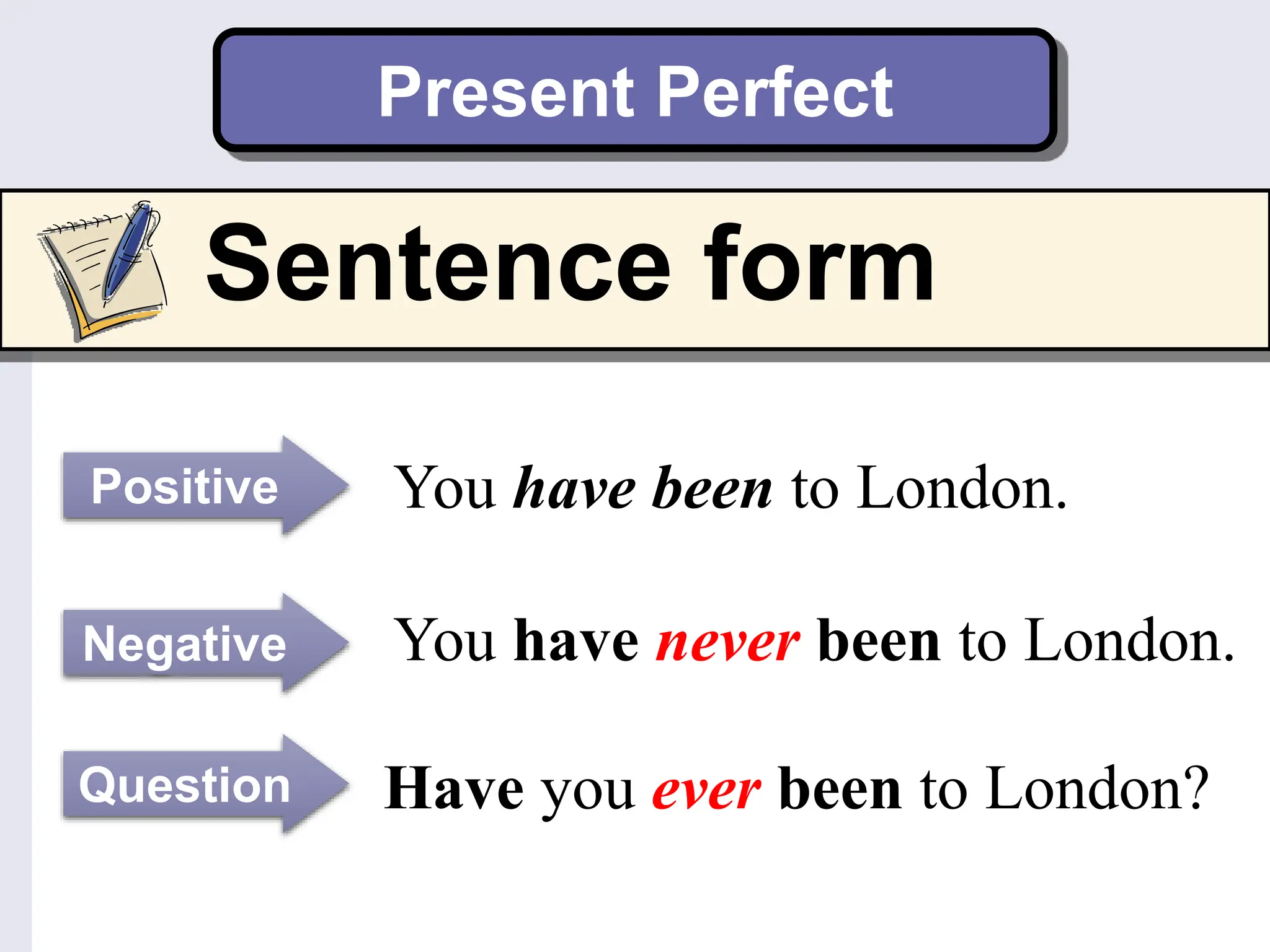
Sentence form
You have been to London.
Positive
Question
Negative
Have you been to London?
You haven’t been to London.
You have never been to London.
Have you ever been to London?
Present Perfect Continuous
Sentence form
You have been working.
You haven’t been working.
Have you been working?
Positive
Question
Negative You have never been working.
Have you ever been working?
Let’s Recap
When to use present perfect simple
and continuous ?
Actions that are finished in the past but connected with present
(actions in the past have result in the present)
When the time of the action is not specific.
I have bought a new car
I have visited my grandmother
Let’s Recap
When to use present perfect simple
and continuous ?
When we want to express an unfinished period of time (that
started in the past but continues to the present, and may continue
in the future).
I have read many books this week
To talk about life experiences
I have visited London twice
Practice 1
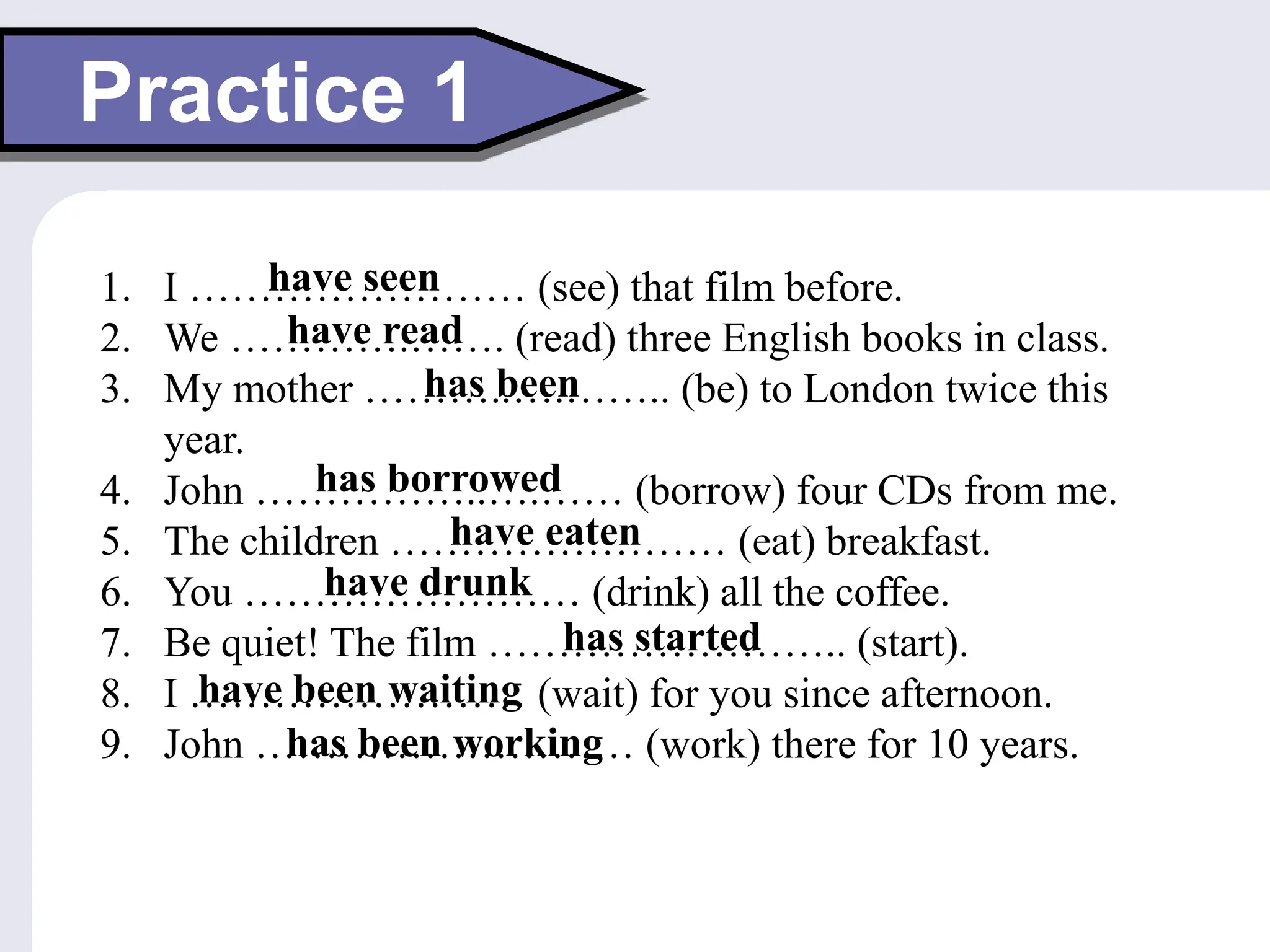
1. I …………………… (see) that film before.
2. We ………….……. (read) three English books in class.
3. My mother ………..….…….. (be) to London twice this
year.
4. John ……………..….…… (borrow) four CDs from me.
5. The children …………………… (eat) breakfast.
6. You …………………… (drink) all the coffee.
7. Be quiet! The film …………………….. (start).
8. I …………………… (wait) for you since afternoon.
9. John ……………………… (work) there for 10 years.
have seen
have read
has been
has borrowed
have eaten
have drunk
has started
have been waiting
has been working
Dear Mom and Dad,
I (sit) here for hours
looking at the beautiful birds in the rain forest. This
vacation to Brazil (be) wonderful! I
(see) so many amazing
animals since I arrived here. Last week, I
(hike) through the forest to see the tree
monkeys. Our guide on that trip (tell) us
some very interesting information. I
(learned) so much on this trip!
Love, Daniela
Practice 2
Fill in the blanks with the simple
past, present perfect, or present
perfect progressive forms of the
verbs in parentheses.
have been sitting
has been
have seen
hiked
told
have learned
Production
Talk about your life
experiences using present
perfect simple and
continous !

1BAC - Present Perfect PowerPoint Presentation

  • 1.
    Simple Past, Present Perfect,and Present Perfect Continuous Grammar Tenses 1st BAC Unit 3 ROGUE EAGLE
  • 2.
    Sick on Saturday Ihave just had a terrible weekend! On Saturday I was so tired that I slept all morning. When I woke up, I had a headache and my throat was sore. My body ached all over. My nose ran and I coughed a lot. My mother took my temperature but I did not have a fever. My mother made me some soup for lunch and I ate it in bed. I drank some juice. I tried to read a book but I couldn’t keep my eyes open. I lay in bed and felt miserable all afternoon.
  • 3.
    What time isthis? Simple Past
  • 4.
    Linda Linda has justwalked outside with grandmother. She wears an apron. So far, she has finished cleaning and washing. She has also gathered seeds and crumbs. Now Linda and Grandmother are outside. Linda has just dropped some seeds on the ground to feed the birds. The birds have not come yet. Recently, Grandmother has moved in with Linda's family. Now, she enjoys living with them. Grandmother has already sat down on the bench. She also wears an apron. She has just finished cooking.
  • 5.
    What time isthis? Present perfect
  • 6.
    I’m not watching TVnow. It’s winter now, not summer Simple Past I watched TV last night. past now future Use the simple past to talk about things that happened and were finished in the past. watched I visited Rabat last summer. visited Last Summer
  • 7.
    Simple Past Use thesimple past with past time expressions such as; yesterday, last night, ago, last week, last summer, last year … We travelled to Ifrane last year. He passed an exam two weeks ago. past now future last year. ago.
  • 8.
    Perfect Tenses I haveread many books this month. I have finished my homework. These actions happened in the past and have a result in the present have read have finished past now future Use the present perfect to talk about things that started in the past, but were not completed or finished. The focus is on the result of the action.
  • 9.
    Present Perfect FORM I havevisited Morocco Subject + have + past participle
  • 10.
    Present Perfect Continuous Ihave been playing football before now. I have been climbing mountains for 10 years. These things continue up to the present and may continue into the future. have been playing have been climbing past now future Use the present perfect continuous to talk about things that started in the past and was in progress until the present, and may continue in the future.
  • 11.
    Present Perfect Continuous FORM Ihave been writing Subject + have been + present participle (verb+ing)
  • 12.
    for six years PerfectTenses We often use the present perfect and the present perfect progressive with for and since. Use for to show how long something has been true and since to show when something started. I have trained for six years to take this trip. He has been working since 2000. since 2000 for six years past now future have trained since 2000. has been woking
  • 13.
    Present Perfect Use thepresent perfect without time expressions to talk about things that happened at some indefinite time in the past. (time is not specific) John has bought a new car. past now future We don’t know when John bought the new car . = Time is not important. Time ????
  • 14.
    Present Perfect The presentperfect without for or since shows that an activity is finished. We often ask how often or how many times with this use of the present perfect. He has visited Morocco three times. past now future three times. How often did he visit Morocco?.
  • 15.
    for five hours PresentPerfect Progressive The present perfect progressive shows that an activity is not finished. We often ask how long with the present perfect progressive. They have been climbing for five hours. past now future for five hours. have been climbing The activity is not finished. They’re still climbing. How long have you been climbing?
  • 16.
    She has readthis book twice this week. She has traveled to Alaska twice this month. Present Perfect Use the present perfect with unfinished time periods such as today, this week, this month, and this year. Notice the difference in meaning. this month. this week. The week isn’t over yet, and she will probably read the book more than twice. The month isn’t over yet. She might travel again.
  • 17.
    Ahmed has beento Paris. Ahmed has gone to Paris. Present Perfect What is the difference ? Ahmed is not in Paris now. Ahmed is still in Paris now.
  • 18.
    Time Adverbs Use thepresent perfect with time adverbs such as yet, already, just. I have already finished my homework. My mother has just finished cooking. Summer has not come yet Not yet Just now Before now
  • 19.
    Time Adverbs Use thepresent perfect with time adverbs such as recently, lately Recently, Sara has moved to London. It has been raining lately. In the past few days / times
  • 20.
    Remember! Non-action (stative) verbsare not usually used in the progressive. I’ve been knowing how to climb since I was young. I’ve known how to climb since I was young.
  • 21.
    Remember! Non-action (stative) verbsare not usually used in the progressive. I’ve been being smart since I was young. I’ve been smart since I was young.
  • 22.
    Remember! Non-action (stative) verbsare not usually used in the progressive. I’ve been liking my friend for years. I’ve liked my friend for years.
  • 23.
    Present Perfect Sentence form Youhave been to London. Positive Question Negative Have you been to London? You haven’t been to London. You have never been to London. Have you ever been to London?
  • 24.
    Present Perfect Continuous Sentenceform You have been working. You haven’t been working. Have you been working? Positive Question Negative You have never been working. Have you ever been working?
  • 25.
    Let’s Recap When touse present perfect simple and continuous ? Actions that are finished in the past but connected with present (actions in the past have result in the present) When the time of the action is not specific. I have bought a new car I have visited my grandmother
  • 26.
    Let’s Recap When touse present perfect simple and continuous ? When we want to express an unfinished period of time (that started in the past but continues to the present, and may continue in the future). I have read many books this week To talk about life experiences I have visited London twice
  • 27.
    Practice 1 1. I…………………… (see) that film before. 2. We ………….……. (read) three English books in class. 3. My mother ………..….…….. (be) to London twice this year. 4. John ……………..….…… (borrow) four CDs from me. 5. The children …………………… (eat) breakfast. 6. You …………………… (drink) all the coffee. 7. Be quiet! The film …………………….. (start). 8. I …………………… (wait) for you since afternoon. 9. John ……………………… (work) there for 10 years. have seen have read has been has borrowed have eaten have drunk has started have been waiting has been working
  • 28.
    Dear Mom andDad, I (sit) here for hours looking at the beautiful birds in the rain forest. This vacation to Brazil (be) wonderful! I (see) so many amazing animals since I arrived here. Last week, I (hike) through the forest to see the tree monkeys. Our guide on that trip (tell) us some very interesting information. I (learned) so much on this trip! Love, Daniela Practice 2 Fill in the blanks with the simple past, present perfect, or present perfect progressive forms of the verbs in parentheses. have been sitting has been have seen hiked told have learned
  • 29.
    Production Talk about yourlife experiences using present perfect simple and continous !