My Portfolio in
I’m Lara Euline A. Tibayan,
18 years of age and currently living
in Amadeo, Cavite. I’m a third year
student, studying Bachelor in
Elementary Education with a major
of Special Education at Cavite
State University-Main Campus.
This presentation includes:
• Educational Technology in a Nutshell
• Learning through EDTC 1 and EDTC 2
• The Student after EDTC
What is
?
 Educational technology is the use of technology
or technological tools to improve education.
(Wikipedia: Educational_ technology)
 It includes numerous types of media that deliver
text, audio, images, animation, and streaming
video.
 It includes technology applications and
processes such as audio or video tape, satellite
TV, CD-ROM, and computer-based learning,
and web-based learning.
What are the
goals of
?
 To provide education in the use of technology
in instruction.
 To impart learning experiences in instructional
technology – supported instructional planning.
 To increase efficiency or effectiveness of using
technological tools in teaching-learning process.
 To provide more realistic and better learning
experiences.
How technology
improves
education?
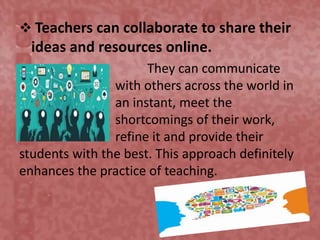
 Teachers can collaborate to share their
ideas and resources online.
They can communicate
with others across the world in
an instant, meet the
shortcomings of their work,
refine it and provide their
students with the best. This approach definitely
enhances the practice of teaching.
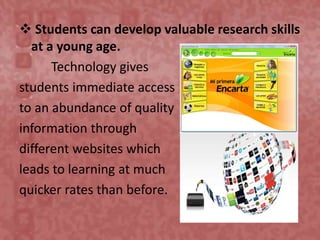
 Students can develop valuable research skills
at a young age.
Technology gives
students immediate access
to an abundance of quality
information through
different websites which
leads to learning at much
quicker rates than before.
 Students and teachers have access to an
expanse of material.
There are plenty of resourceful,
credible websites available on the Internet
that both teachers and students can
utilize. Like books,
Internet also provides a
variety of knowledge and
doesn’t limit students to
one person’s opinion.
 Online learning is now an equally credible
option.
Face-to-face interaction is huge,
especially in the younger years, but some
students work better when they can go at
their own pace. Online education
and Distance learning is
now accredited and has
changed the way we
view education.
What are the
advantages of
?
 Using computers or other forms of technology
can give students practice on core content and
skills while the teacher can work with others,
conduct assessments, or perform other tasks.
 Learning material can be used for long distance
learning and are accessible to a wider audience.
 Students can learn not only in schools but also in
their homes.
 They can improve learning experiences of
teachers and students.
What are the
disadvantages of
?
Not all students and schools here the Philippines have
enough technological tools that can be used in
teaching-learning process.
 Technology, in and of itself, does not necessarily result
in fundamental improvements to educational practice.
 Using technology can result to over-stimulation of
different electronic devices.
 Digital Divide
The concept of the digital divide is a gap between
those who have access to digital technologies and those
who do not
in the 21st
Century
 With the help of technology, real experiences
can be maximize.
 Students can do a lot of researches using the
internet and various tools.
 Technology can be used to enhance critical
thinking and critical literacy skills, evaluating the
legitimacy and accuracy of online content is the
central part of 21st century education.
 Schools should teach about responsibility and
accountability in using technologies in
classrooms.
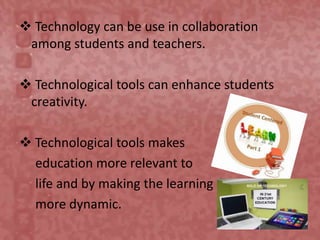
 Technology can be use in collaboration
among students and teachers.
 Technological tools can enhance students
creativity.
 Technological tools makes
education more relevant to
life and by making the learning
more dynamic.
Learning
through EDTC1
and EDTC2
Educational Technology 1 focuses on
The definition and history of educational
technology, different types and uses of
technological tools, etc. EDTC1 gives us
background about those things.
Understanding different concepts about EDTC
can help us to become aware about using
technology in daily classroom
instruction.
As we study Educational Technology
2, we learned how to incorporate different
technological tools in teaching. We also
learned how different countries teach
students in the more modern society. In
short, EDTC2 taught us how to apply the
concepts learned not only in EDTC2 but
also in EDTC1 in terms of different aspects.
The Student
after
After studying Educational Technology, we
as an educator or future educator knows that
technologies can be use a good tool in terms of
instructing or teaching students. But as an
educator, we are responsible for teaching first
the right usage of technologies or devices to our
students.
Educational technology also improves
learning experiences of students. But as we
discussed, it has its own advantages and
disadvantages. The success of every classroom
instruction not only depends on tools you are
using but it also depends on how ready you are
to teach your students and how ready they are
to listen and absorb knowledge. Remember, no
technology can replace a teacher.
My Portfolio in Educational Technology

My Portfolio in Educational Technology

  • 1.
  • 2.
    I’m Lara EulineA. Tibayan, 18 years of age and currently living in Amadeo, Cavite. I’m a third year student, studying Bachelor in Elementary Education with a major of Special Education at Cavite State University-Main Campus.
  • 3.
    This presentation includes: •Educational Technology in a Nutshell • Learning through EDTC 1 and EDTC 2 • The Student after EDTC
  • 4.
  • 5.
     Educational technologyis the use of technology or technological tools to improve education. (Wikipedia: Educational_ technology)  It includes numerous types of media that deliver text, audio, images, animation, and streaming video.  It includes technology applications and processes such as audio or video tape, satellite TV, CD-ROM, and computer-based learning, and web-based learning.
  • 6.
  • 7.
     To provideeducation in the use of technology in instruction.  To impart learning experiences in instructional technology – supported instructional planning.  To increase efficiency or effectiveness of using technological tools in teaching-learning process.  To provide more realistic and better learning experiences.
  • 8.
  • 9.
     Teachers cancollaborate to share their ideas and resources online. They can communicate with others across the world in an instant, meet the shortcomings of their work, refine it and provide their students with the best. This approach definitely enhances the practice of teaching.
  • 10.
     Students candevelop valuable research skills at a young age. Technology gives students immediate access to an abundance of quality information through different websites which leads to learning at much quicker rates than before.
  • 11.
     Students andteachers have access to an expanse of material. There are plenty of resourceful, credible websites available on the Internet that both teachers and students can utilize. Like books, Internet also provides a variety of knowledge and doesn’t limit students to one person’s opinion.
  • 12.
     Online learningis now an equally credible option. Face-to-face interaction is huge, especially in the younger years, but some students work better when they can go at their own pace. Online education and Distance learning is now accredited and has changed the way we view education.
  • 13.
  • 14.
     Using computersor other forms of technology can give students practice on core content and skills while the teacher can work with others, conduct assessments, or perform other tasks.  Learning material can be used for long distance learning and are accessible to a wider audience.  Students can learn not only in schools but also in their homes.  They can improve learning experiences of teachers and students.
  • 15.
  • 16.
    Not all studentsand schools here the Philippines have enough technological tools that can be used in teaching-learning process.  Technology, in and of itself, does not necessarily result in fundamental improvements to educational practice.  Using technology can result to over-stimulation of different electronic devices.  Digital Divide The concept of the digital divide is a gap between those who have access to digital technologies and those who do not
  • 17.
  • 18.
     With thehelp of technology, real experiences can be maximize.  Students can do a lot of researches using the internet and various tools.  Technology can be used to enhance critical thinking and critical literacy skills, evaluating the legitimacy and accuracy of online content is the central part of 21st century education.  Schools should teach about responsibility and accountability in using technologies in classrooms.
  • 19.
     Technology canbe use in collaboration among students and teachers.  Technological tools can enhance students creativity.  Technological tools makes education more relevant to life and by making the learning more dynamic.
  • 20.
  • 21.
    Educational Technology 1focuses on The definition and history of educational technology, different types and uses of technological tools, etc. EDTC1 gives us background about those things. Understanding different concepts about EDTC can help us to become aware about using technology in daily classroom instruction.
  • 22.
    As we studyEducational Technology 2, we learned how to incorporate different technological tools in teaching. We also learned how different countries teach students in the more modern society. In short, EDTC2 taught us how to apply the concepts learned not only in EDTC2 but also in EDTC1 in terms of different aspects.
  • 23.
  • 24.
    After studying EducationalTechnology, we as an educator or future educator knows that technologies can be use a good tool in terms of instructing or teaching students. But as an educator, we are responsible for teaching first the right usage of technologies or devices to our students.
  • 25.
    Educational technology alsoimproves learning experiences of students. But as we discussed, it has its own advantages and disadvantages. The success of every classroom instruction not only depends on tools you are using but it also depends on how ready you are to teach your students and how ready they are to listen and absorb knowledge. Remember, no technology can replace a teacher.