Mutation and genetic variation
• Mutations are raw material of evolution.
• No variation means no evolution and mutations are the ultimate
source of variation.
Where do new alleles come from?
• DNA made up of sequence of nucleotides. Each nucleotide includes a
sugar, phosphate and one of four possible nitrogenous bases
(adenine and guanine [both purines], and thymine and cytosine [both
pyrimidines]).
4.1a
4
.
4.1b + 4.1d
Where do new alleles come from?
• The opposite strands of the DNA molecule are complementary
because the strands are held together by bonds between the
opposing bases and adenine bonds only with thymine and cytosine
only with guanine.
• Thus, knowing the sequence on one strand enables one to construct
the sequence on the other strand.
4.2
Where do new alleles come from?
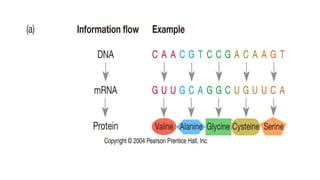
•Sequence of bases in DNA codes for protein structure
as each three base sequence codes for one amino acid
in the protein chain.
4.3a
Where do new alleles come from?
•When DNA is synthesized, an enzyme called DNA
polymerase reads one strand of DNA molecule and
constructs a complementary strand.
•If DNA polymerase makes a mistake and it is not
repaired, a mutation has occurred.
4.2
Types of mutations
•A mistake that changes one base on a DNA molecule
is called a point mutation.
•Two forms:
• Transition: one pyrimidine (T or C) substituted for the
other pyrimidine or one purine substituted for the other
purine (A or G).
• Transversion: purine substituted for pyrimidine or vice
versa
Fig 4.4
Types of mutations
•Transitions more common than transversions.
Perhaps because transitions cause less disruption
to the DNA molecule and so are less likely to be
noticed by DNA repair molecules.
Types of mutations
•Not all mutations cause a change in amino acid
coded for. These are called silent mutations.
•Mutations that do cause a change in amino acid
are called replacement mutations.
Types of mutations
•Another type of mutation occurs when bases are
inserted or deleted from the DNA molecule.
•This causes a change in how the whole DNA
strand is read (a frame shift mutation) and
produces a non-functional protein.
Mutation rates
•Most data on mutations comes from analysis of
loss-of-function mutations.
•Loss-of-function mutations cause gene to
produce a non-working protein.
•Examples of loss-of-function mutations include:
insertions and deletions, mutation to a stop codon
and insertion of jumping genes.
Mutation rates
•Some mutations cause readily identified
phenotypic changes.
•E.g. Achrondoplastic dwarfism is a dominant
disorder. An Achrondoplastic individual’s
condition must be the result of a mutation, if his
parents do not have the condition.
Mutation rates
•Human estimate is 1.6 mutations/genome/generation.
• In Drosophila rate is only 0.14 m/g/g, but when
corrected for number of cell divisions needed to
produce sperm (400 in humans 25 in Drosophila)
mutation rates per cell division are very similar.
Mutation rates
•These rates are underestimates as they are based
on loss-of-function mutations.
•Direct estimate of number of mutations of all
kinds made for roundworm Caenorhabditis
elegans by sequencing mitochondrial DNA.
Mutation rates
•Roundworms can self-fertilize so researchers tracked
74 family lines derived from one female and followed
each for 214 generations.
•At end sequenced 771,672 base pairs of mitochondrial
DNA. Found 26 mutations giving rate of 1.6X10⁻⁷
mutations per site per generation. Ten mutations were
insertion/deletions and 16 substitutions.
Mutation rates
•Applying mutation rates to entire genome gives
estimate of approximately 15
mutations/individual/generation.
Where do new genes come from?
•Mutation can produce new alleles, but new genes are
also produced and gene duplication appears to be most
important source of new genes.
Gene duplication
•Duplication results from unequal crossing over when
chromosomes align incorrectly during meiosis.
•Result is a chromosome with an extra section of DNA
that contains duplicated genes
4.7
Gene duplication
•Extra sections of DNA are duplicates and can
accumulate mutations without being selected against
because the other copies of the gene produce normal
proteins.
•Gene may completely change over time so gene
duplication creates new possibilities for gene function.
Globin genes
•Human globin genes are examples of products of gene
duplication.
•Globin gene family contains two major gene clusters
(alpha and beta) that code for the protein subunits of
hemoglobin.
Globin genes
•Hemoglobin (the oxygen-carrying molecule in red
corpuscles) consists of an iron-binding heme group
and four surrounding protein chains (two coded for by
genes in the Alpha cluster and two in the Beta cluster).
Globin genes
•Ancestral globin gene duplicated and diverged into
alpha and beta ancestral genes about 450-500 mya.
•Later transposed to different chromosomes and
followed by further subsequent duplications and
mutations.
From Campbell and Reese Biology 7th
ed.
Globin genes
•Lengths and positions of exons and introns in the
globin genes are very similar. Very unlikely such
similarities could be due to chance.
4.9
Exons (blue), introns (white), number in box is number of nucleotides.
Globin genes
•Different genes in alpha and beta families are
expressed at different times in development.
•For example, in very young human fetus, zeta (from
alpha cluster) and epsilon (from beta cluster) chains
are present initially then replaced. Similarly G-gamma
and A-gamma chains present in older fetuses are
replaced by beta chains after birth.

Mutation_and_genetic_variation- Generic Mutations

  • 1.
    Mutation and geneticvariation • Mutations are raw material of evolution. • No variation means no evolution and mutations are the ultimate source of variation.
  • 2.
    Where do newalleles come from? • DNA made up of sequence of nucleotides. Each nucleotide includes a sugar, phosphate and one of four possible nitrogenous bases (adenine and guanine [both purines], and thymine and cytosine [both pyrimidines]).
  • 3.
  • 4.
  • 5.
    Where do newalleles come from? • The opposite strands of the DNA molecule are complementary because the strands are held together by bonds between the opposing bases and adenine bonds only with thymine and cytosine only with guanine. • Thus, knowing the sequence on one strand enables one to construct the sequence on the other strand.
  • 6.
  • 7.
    Where do newalleles come from? •Sequence of bases in DNA codes for protein structure as each three base sequence codes for one amino acid in the protein chain.
  • 8.
  • 9.
    Where do newalleles come from? •When DNA is synthesized, an enzyme called DNA polymerase reads one strand of DNA molecule and constructs a complementary strand. •If DNA polymerase makes a mistake and it is not repaired, a mutation has occurred.
  • 10.
  • 11.
    Types of mutations •Amistake that changes one base on a DNA molecule is called a point mutation. •Two forms: • Transition: one pyrimidine (T or C) substituted for the other pyrimidine or one purine substituted for the other purine (A or G). • Transversion: purine substituted for pyrimidine or vice versa
  • 12.
  • 13.
    Types of mutations •Transitionsmore common than transversions. Perhaps because transitions cause less disruption to the DNA molecule and so are less likely to be noticed by DNA repair molecules.
  • 14.
    Types of mutations •Notall mutations cause a change in amino acid coded for. These are called silent mutations. •Mutations that do cause a change in amino acid are called replacement mutations.
  • 16.
    Types of mutations •Anothertype of mutation occurs when bases are inserted or deleted from the DNA molecule. •This causes a change in how the whole DNA strand is read (a frame shift mutation) and produces a non-functional protein.
  • 17.
    Mutation rates •Most dataon mutations comes from analysis of loss-of-function mutations. •Loss-of-function mutations cause gene to produce a non-working protein. •Examples of loss-of-function mutations include: insertions and deletions, mutation to a stop codon and insertion of jumping genes.
  • 19.
    Mutation rates •Some mutationscause readily identified phenotypic changes. •E.g. Achrondoplastic dwarfism is a dominant disorder. An Achrondoplastic individual’s condition must be the result of a mutation, if his parents do not have the condition.
  • 20.
    Mutation rates •Human estimateis 1.6 mutations/genome/generation. • In Drosophila rate is only 0.14 m/g/g, but when corrected for number of cell divisions needed to produce sperm (400 in humans 25 in Drosophila) mutation rates per cell division are very similar.
  • 21.
    Mutation rates •These ratesare underestimates as they are based on loss-of-function mutations. •Direct estimate of number of mutations of all kinds made for roundworm Caenorhabditis elegans by sequencing mitochondrial DNA.
  • 22.
    Mutation rates •Roundworms canself-fertilize so researchers tracked 74 family lines derived from one female and followed each for 214 generations. •At end sequenced 771,672 base pairs of mitochondrial DNA. Found 26 mutations giving rate of 1.6X10⁻⁷ mutations per site per generation. Ten mutations were insertion/deletions and 16 substitutions.
  • 23.
    Mutation rates •Applying mutationrates to entire genome gives estimate of approximately 15 mutations/individual/generation.
  • 24.
    Where do newgenes come from? •Mutation can produce new alleles, but new genes are also produced and gene duplication appears to be most important source of new genes.
  • 25.
    Gene duplication •Duplication resultsfrom unequal crossing over when chromosomes align incorrectly during meiosis. •Result is a chromosome with an extra section of DNA that contains duplicated genes
  • 26.
  • 27.
    Gene duplication •Extra sectionsof DNA are duplicates and can accumulate mutations without being selected against because the other copies of the gene produce normal proteins. •Gene may completely change over time so gene duplication creates new possibilities for gene function.
  • 28.
    Globin genes •Human globingenes are examples of products of gene duplication. •Globin gene family contains two major gene clusters (alpha and beta) that code for the protein subunits of hemoglobin.
  • 29.
    Globin genes •Hemoglobin (theoxygen-carrying molecule in red corpuscles) consists of an iron-binding heme group and four surrounding protein chains (two coded for by genes in the Alpha cluster and two in the Beta cluster).
  • 30.
    Globin genes •Ancestral globingene duplicated and diverged into alpha and beta ancestral genes about 450-500 mya. •Later transposed to different chromosomes and followed by further subsequent duplications and mutations.
  • 31.
    From Campbell andReese Biology 7th ed.
  • 32.
    Globin genes •Lengths andpositions of exons and introns in the globin genes are very similar. Very unlikely such similarities could be due to chance.
  • 33.
    4.9 Exons (blue), introns(white), number in box is number of nucleotides.
  • 34.
    Globin genes •Different genesin alpha and beta families are expressed at different times in development. •For example, in very young human fetus, zeta (from alpha cluster) and epsilon (from beta cluster) chains are present initially then replaced. Similarly G-gamma and A-gamma chains present in older fetuses are replaced by beta chains after birth.