Nitrogen Bases
&
Genetic Code
Molecular biology is the branch of biology that
deals with the molecular basis of biological
activity. This field overlaps with other areas of
biology and chemistry, particularly genetics
and biochemistry. Molecular biology chiefly
concerns itself with understanding the
interactions between the various systems of a
cell, including the interactions between the
different types of DNA, RNA and
protein biosynthesis as well as learning how
these interactions are regulated.
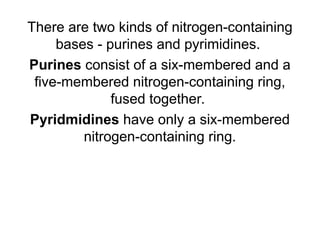
There are two kinds of nitrogen-containing
bases - purines and pyrimidines.
Purines consist of a six-membered and a
five-membered nitrogen-containing ring,
fused together.
Pyridmidines have only a six-membered
nitrogen-containing ring.
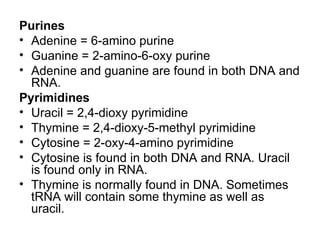
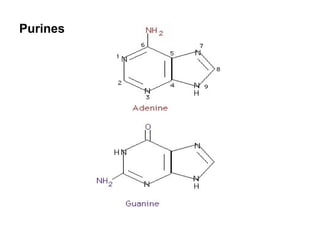
Purines
• Adenine = 6-amino purine
• Guanine = 2-amino-6-oxy purine
• Adenine and guanine are found in both DNA and
RNA.
Pyrimidines
• Uracil = 2,4-dioxy pyrimidine
• Thymine = 2,4-dioxy-5-methyl pyrimidine
• Cytosine = 2-oxy-4-amino pyrimidine
• Cytosine is found in both DNA and RNA. Uracil
is found only in RNA.
• Thymine is normally found in DNA. Sometimes
tRNA will contain some thymine as well as
uracil.
Purines
Pyrimidines
Deoxyribose versus Ribose sugars
• Ribose is a single-ring pentose [5-C]
sugar. The numbering of the carbon atoms
runs clockwise, following organic
chemistry rules. Note the absence of the
hydroxyl (-OH) group on the 2’ carbon in
the deoxy-ribose sugar in DNA as
compared with the ribose sugar in RNA.
If at C-1, OH group is at lower side, then it is known as α
(alpha) and if at C-1, OH group is at upper side, then it is
known as β (Beta).
5' to 3' Polarity / 5' to 3' Direction
• Direction of polymerization of nucleic acids.
• The primes (') refer to carbons associated with the sugars ribose or
deoxyribose (the nitrogenous bases, by contrast, are numbered
without the primes).
• The 3' hydroxyl group found on these sugars is the target for
nucleotide addition, as recognized by both DNA polymerase and,
less stringently, by RNA polymerase as well. RNA priming in fact
specifically supplies a 3' hydroxyl group in its job of initiating the
synthesis of DNA daughter strands.
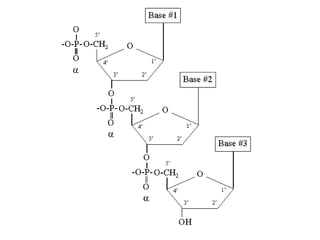
• The 3' carbon in polynucleic acids is linked to a phosphate group as
one side of a phosphodiester linkage. The 5' carbon, on the other
hand, is linked to the other side of the phosphodiester linkage. The
backbone of nucleic acid polymers therefore can be described as
consisting of phosphate group → 5' carbon → 4' carbon → 3' →
phosphate group → 5' carbon, and so on.
• Phosphodiester bond/linkage
• A phosphodiester bond is a group of strong
covalent bonds between a phosphate group and
two 5-carbon ring carbohyderates (pentoses)
over two ester bonds. Phosphodiester bonds are
essential to all known life, as they make up the
backbone of each helical strand of DNA. In DNA
and RNA, the phosphodiester bond is the
linkage between the 3' carbon atom of one sugar
molecule and the 5' carbon atom of another; the
sugar molecules being deoxyribose in DNA and
ribose in RNA. Carbon 1 of the sugar is attached
to nitrogen 9 of a purine base or to nitrogen 1 of
a pyrimidine base.
Nucleosides
• If a sugar, either ribose or 2-deoxyribose, is
added to a nitrogen base, the resulting
compound is called a nucleoside. Carbon 1 of
the sugar is attached to nitrogen 9 of a purine
base or to nitrogen 1 of a pyrimidine base. The
names of purine nucleosides end in -osine and
the names of pyrimidine nucleosides end in -
idine. The convention is to number the ring
atoms of the base normally and to use l', etc. to
distinguish the ring atoms of the sugar. Unless
otherwise specificed, the sugar is assumed to be
ribose. To indicate that the sugar is 2'-
deoxyribose, a d- is placed before the name.
• Adenosine
• Guanosine
• Inosine - the base in inosine is
hypoxanthine (a purine base also)
• Uridine
• Thymidine
• Cytidine
Nucleotides
• Adding one or more phosphates to the sugar portion of a
nucleoside results in a nucleotide. Generally, the
phosphate is in ester linkage to carbon 5' of the sugar. If
more than one phosphate is present, they are generally
in acid anhydride linkages to each other. If such is the
case, no position designation in the name is required. If
the phosphate is in any other position, however, the
position must be designated. For example, 3'-5' cAMP
indicates that a phosphate is in ester linkage to both the
3' and 5' hydroxyl groups of an adenosine molecule and
forms a cyclic structure. 2'-GMP would indicate that a
phosphate is in ester linkage to the 2' hydroxyl group of a
guanosine. Some representative names are:
• AMP = adenosine monophosphate =
adenylic acid
• CDP = cytidine diphosphate
• dGTP = deoxy guanosine triphosphate
• dTTP = deoxy thymidine triphosphate
(more commonly designated TTP)
• cAMP = 3'-5' cyclic adenosine
monophosphate
• AMP (Adnylate)
• GMP (Guanylate)
• CMP (Cytidylate)
• TMP (Thymidylate)
• UMP (Uridylate)
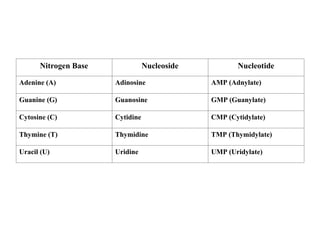
Nitrogen Base Nucleoside Nucleotide
Adenine (A) Adinosine AMP (Adnylate)
Guanine (G) Guanosine GMP (Guanylate)
Cytosine (C) Cytidine CMP (Cytidylate)
Thymine (T) Thymidine TMP (Thymidylate)
Uracil (U) Uridine UMP (Uridylate)
TYPES OF RNA
Messenger RNA
• Messenger RNA (mRNA) is synthesized from a
gene segment of DNA which ultimately contains
the information on the primary sequence of
amino acids in a protein to be synthesized. The
genetic code as translated is for m-RNA not
DNA. The messenger RNA carries the code
into the cytoplasm where protein synthesis
occurs.
Ribosomal RNA:
• In the cytoplasm, ribsomal RNA (rRNA)
and protein combine to form a
nucleoprotein called a ribosome. The
ribosome serves as the site and carries
the enzymes necessary for protein
synthesis.
Transfer RNA:
• Transfer RNA (tRNA) contains about 75 nucleotides,
three of which are called anticodons, and one amino acid.
The tRNA reads the code and carries the amino acid
to be incorporated into the developing protein.
• There are at least 20 different tRNA's - one for each
amino acid. The basic structure of a tRNA is shown in the
figure. Part of the tRNA doubles back upon itself to form
several double helical sections. On one end, the amino
acid, phenylalanine, is attached. On the opposite end, a
specific base triplet, called the anticodon, is used to
actually "read" the codons on the mRNA.
• The tRNA "reads" the mRNA codon by using its own
anticodon. The actual "reading" is done by matching the
base pairs through hydrogen bonding following the base
pairing principle. Each codon is "read" by various tRNA's
until the appropriate match of the anticodon with the
codon occurs.
• Codon: A triplet of nitrogen bases on the
messenger RNA is known as codon.
• Anticodon: A triplet of bases which are
complimentary to the codon of mRNA.
• D-Loop: D-loop is important for proper
recognition of amino acyle tRNA synthatase. It
attracts the appropriate amino acid.
• T-Loop: T-loop is involved in binding of
aminoacyl tRNA to the ribosomal surface at the
site of protein synthesis.
• Extra Loop: On the basis of this small extra
loop, different types of tRNA have been
classified.
• GENETIC CODE
• The genetic code is the set of rules by which
information encoded within genetic material (
DNA or mRNA sequences) is translated into
proteins by living cells.
• How can a polymeric nucleotide with only four
different heterocyclic amines specify the
sequence of 20 or more different amino acids? If
each nucleotide coded for a single amino acid,
then obviously only 4 of the 20 amino acids
could be accommodated. If the nucleotides were
used in groups of two, there are 16 different
combinations possible which is still inadequate.
It has been determined that the genetic code is
actually based upon triplets of nucleotides
which provide 64 different codes using the 4
nucleotides. During the 1960's, a tremendous
effort was devoted to proving that the code was
read as triplets, and also to solving the genetic
code. The genetic code was originally translated
for the bacteria E. Coli, but its universality has
since been established. The genetic code is
"read" from a type of RNA called messenger
RNA (mRNA). Each nucleotide triplet, called a
codon, can be "read" and translated into an
amino acid to be incorporated into a protein
being synthesized. The genetic code is shown
below.
Standard genetic code
1st
base
2nd base 3rd
base
U C A G
U
UUU (Phe/F)
Phenylalanine
UCU
(Ser/S) Serine
UAU
(Tyr/Y) Tyrosine
UGU
(Cys/C) Cysteine
U
UUC UCC UAC UGC C
UUA
(Leu/L)
Leucine
UCA UAA Stop (Ochre) UGA Stop (Opal) A
UUG UCG UAG Stop (Amber) UGG
(Trp/W)
Tryptophan
G
C
CUU CCU
(Pro/P) Proline
CAU
(His/H) Histidine
CGU
(Arg/R) Arginine
U
CUC CCC CAC CGC C
CUA CCA CAA
(Gln/Q) Glutamine
CGA A
CUG CCG CAG CGG G
A
AUU
(Ile/I)
Isoleucine
ACU
(Thr/T)
Threonine
AAU
(Asn/N) Asparagine
AGU
(Ser/S) Serine
U
AUC ACC AAC AGC C
AUA ACA AAA
(Lys/K) Lysine
AGA
(Arg/R) Arginine
A
AUG[A
]
(Met/M)
Methionine
ACG AAG AGG G
G
GUU
(Val/V)
Valine
GCU
(Ala/A) Alanine
GAU (Asp/D) Aspartic
acid
GGU
(Gly/G) Glycine
U
GUC GCC GAC GGC C
GUA GCA GAA (Glu/E) Glutamic
acid
GGA A
GUG GCG GAG GGG G

Nitrogenous bases and genetic code. types

  • 1.
  • 2.
    Molecular biology isthe branch of biology that deals with the molecular basis of biological activity. This field overlaps with other areas of biology and chemistry, particularly genetics and biochemistry. Molecular biology chiefly concerns itself with understanding the interactions between the various systems of a cell, including the interactions between the different types of DNA, RNA and protein biosynthesis as well as learning how these interactions are regulated.
  • 3.
    There are twokinds of nitrogen-containing bases - purines and pyrimidines. Purines consist of a six-membered and a five-membered nitrogen-containing ring, fused together. Pyridmidines have only a six-membered nitrogen-containing ring.
  • 4.
    Purines • Adenine =6-amino purine • Guanine = 2-amino-6-oxy purine • Adenine and guanine are found in both DNA and RNA. Pyrimidines • Uracil = 2,4-dioxy pyrimidine • Thymine = 2,4-dioxy-5-methyl pyrimidine • Cytosine = 2-oxy-4-amino pyrimidine • Cytosine is found in both DNA and RNA. Uracil is found only in RNA. • Thymine is normally found in DNA. Sometimes tRNA will contain some thymine as well as uracil.
  • 5.
  • 6.
  • 7.
    Deoxyribose versus Ribosesugars • Ribose is a single-ring pentose [5-C] sugar. The numbering of the carbon atoms runs clockwise, following organic chemistry rules. Note the absence of the hydroxyl (-OH) group on the 2’ carbon in the deoxy-ribose sugar in DNA as compared with the ribose sugar in RNA.
  • 8.
    If at C-1,OH group is at lower side, then it is known as α (alpha) and if at C-1, OH group is at upper side, then it is known as β (Beta).
  • 9.
    5' to 3'Polarity / 5' to 3' Direction • Direction of polymerization of nucleic acids. • The primes (') refer to carbons associated with the sugars ribose or deoxyribose (the nitrogenous bases, by contrast, are numbered without the primes). • The 3' hydroxyl group found on these sugars is the target for nucleotide addition, as recognized by both DNA polymerase and, less stringently, by RNA polymerase as well. RNA priming in fact specifically supplies a 3' hydroxyl group in its job of initiating the synthesis of DNA daughter strands. • The 3' carbon in polynucleic acids is linked to a phosphate group as one side of a phosphodiester linkage. The 5' carbon, on the other hand, is linked to the other side of the phosphodiester linkage. The backbone of nucleic acid polymers therefore can be described as consisting of phosphate group → 5' carbon → 4' carbon → 3' → phosphate group → 5' carbon, and so on.
  • 10.
    • Phosphodiester bond/linkage •A phosphodiester bond is a group of strong covalent bonds between a phosphate group and two 5-carbon ring carbohyderates (pentoses) over two ester bonds. Phosphodiester bonds are essential to all known life, as they make up the backbone of each helical strand of DNA. In DNA and RNA, the phosphodiester bond is the linkage between the 3' carbon atom of one sugar molecule and the 5' carbon atom of another; the sugar molecules being deoxyribose in DNA and ribose in RNA. Carbon 1 of the sugar is attached to nitrogen 9 of a purine base or to nitrogen 1 of a pyrimidine base.
  • 12.
    Nucleosides • If asugar, either ribose or 2-deoxyribose, is added to a nitrogen base, the resulting compound is called a nucleoside. Carbon 1 of the sugar is attached to nitrogen 9 of a purine base or to nitrogen 1 of a pyrimidine base. The names of purine nucleosides end in -osine and the names of pyrimidine nucleosides end in - idine. The convention is to number the ring atoms of the base normally and to use l', etc. to distinguish the ring atoms of the sugar. Unless otherwise specificed, the sugar is assumed to be ribose. To indicate that the sugar is 2'- deoxyribose, a d- is placed before the name.
  • 13.
    • Adenosine • Guanosine •Inosine - the base in inosine is hypoxanthine (a purine base also) • Uridine • Thymidine • Cytidine
  • 14.
    Nucleotides • Adding oneor more phosphates to the sugar portion of a nucleoside results in a nucleotide. Generally, the phosphate is in ester linkage to carbon 5' of the sugar. If more than one phosphate is present, they are generally in acid anhydride linkages to each other. If such is the case, no position designation in the name is required. If the phosphate is in any other position, however, the position must be designated. For example, 3'-5' cAMP indicates that a phosphate is in ester linkage to both the 3' and 5' hydroxyl groups of an adenosine molecule and forms a cyclic structure. 2'-GMP would indicate that a phosphate is in ester linkage to the 2' hydroxyl group of a guanosine. Some representative names are:
  • 15.
    • AMP =adenosine monophosphate = adenylic acid • CDP = cytidine diphosphate • dGTP = deoxy guanosine triphosphate • dTTP = deoxy thymidine triphosphate (more commonly designated TTP) • cAMP = 3'-5' cyclic adenosine monophosphate
  • 16.
    • AMP (Adnylate) •GMP (Guanylate) • CMP (Cytidylate) • TMP (Thymidylate) • UMP (Uridylate)
  • 17.
    Nitrogen Base NucleosideNucleotide Adenine (A) Adinosine AMP (Adnylate) Guanine (G) Guanosine GMP (Guanylate) Cytosine (C) Cytidine CMP (Cytidylate) Thymine (T) Thymidine TMP (Thymidylate) Uracil (U) Uridine UMP (Uridylate)
  • 18.
    TYPES OF RNA MessengerRNA • Messenger RNA (mRNA) is synthesized from a gene segment of DNA which ultimately contains the information on the primary sequence of amino acids in a protein to be synthesized. The genetic code as translated is for m-RNA not DNA. The messenger RNA carries the code into the cytoplasm where protein synthesis occurs.
  • 19.
    Ribosomal RNA: • Inthe cytoplasm, ribsomal RNA (rRNA) and protein combine to form a nucleoprotein called a ribosome. The ribosome serves as the site and carries the enzymes necessary for protein synthesis.
  • 20.
    Transfer RNA: • TransferRNA (tRNA) contains about 75 nucleotides, three of which are called anticodons, and one amino acid. The tRNA reads the code and carries the amino acid to be incorporated into the developing protein. • There are at least 20 different tRNA's - one for each amino acid. The basic structure of a tRNA is shown in the figure. Part of the tRNA doubles back upon itself to form several double helical sections. On one end, the amino acid, phenylalanine, is attached. On the opposite end, a specific base triplet, called the anticodon, is used to actually "read" the codons on the mRNA. • The tRNA "reads" the mRNA codon by using its own anticodon. The actual "reading" is done by matching the base pairs through hydrogen bonding following the base pairing principle. Each codon is "read" by various tRNA's until the appropriate match of the anticodon with the codon occurs.
  • 21.
    • Codon: Atriplet of nitrogen bases on the messenger RNA is known as codon. • Anticodon: A triplet of bases which are complimentary to the codon of mRNA. • D-Loop: D-loop is important for proper recognition of amino acyle tRNA synthatase. It attracts the appropriate amino acid. • T-Loop: T-loop is involved in binding of aminoacyl tRNA to the ribosomal surface at the site of protein synthesis. • Extra Loop: On the basis of this small extra loop, different types of tRNA have been classified.
  • 23.
    • GENETIC CODE •The genetic code is the set of rules by which information encoded within genetic material ( DNA or mRNA sequences) is translated into proteins by living cells. • How can a polymeric nucleotide with only four different heterocyclic amines specify the sequence of 20 or more different amino acids? If each nucleotide coded for a single amino acid, then obviously only 4 of the 20 amino acids could be accommodated. If the nucleotides were used in groups of two, there are 16 different combinations possible which is still inadequate.
  • 24.
    It has beendetermined that the genetic code is actually based upon triplets of nucleotides which provide 64 different codes using the 4 nucleotides. During the 1960's, a tremendous effort was devoted to proving that the code was read as triplets, and also to solving the genetic code. The genetic code was originally translated for the bacteria E. Coli, but its universality has since been established. The genetic code is "read" from a type of RNA called messenger RNA (mRNA). Each nucleotide triplet, called a codon, can be "read" and translated into an amino acid to be incorporated into a protein being synthesized. The genetic code is shown below.
  • 25.
    Standard genetic code 1st base 2ndbase 3rd base U C A G U UUU (Phe/F) Phenylalanine UCU (Ser/S) Serine UAU (Tyr/Y) Tyrosine UGU (Cys/C) Cysteine U UUC UCC UAC UGC C UUA (Leu/L) Leucine UCA UAA Stop (Ochre) UGA Stop (Opal) A UUG UCG UAG Stop (Amber) UGG (Trp/W) Tryptophan G C CUU CCU (Pro/P) Proline CAU (His/H) Histidine CGU (Arg/R) Arginine U CUC CCC CAC CGC C CUA CCA CAA (Gln/Q) Glutamine CGA A CUG CCG CAG CGG G A AUU (Ile/I) Isoleucine ACU (Thr/T) Threonine AAU (Asn/N) Asparagine AGU (Ser/S) Serine U AUC ACC AAC AGC C AUA ACA AAA (Lys/K) Lysine AGA (Arg/R) Arginine A AUG[A ] (Met/M) Methionine ACG AAG AGG G G GUU (Val/V) Valine GCU (Ala/A) Alanine GAU (Asp/D) Aspartic acid GGU (Gly/G) Glycine U GUC GCC GAC GGC C GUA GCA GAA (Glu/E) Glutamic acid GGA A GUG GCG GAG GGG G