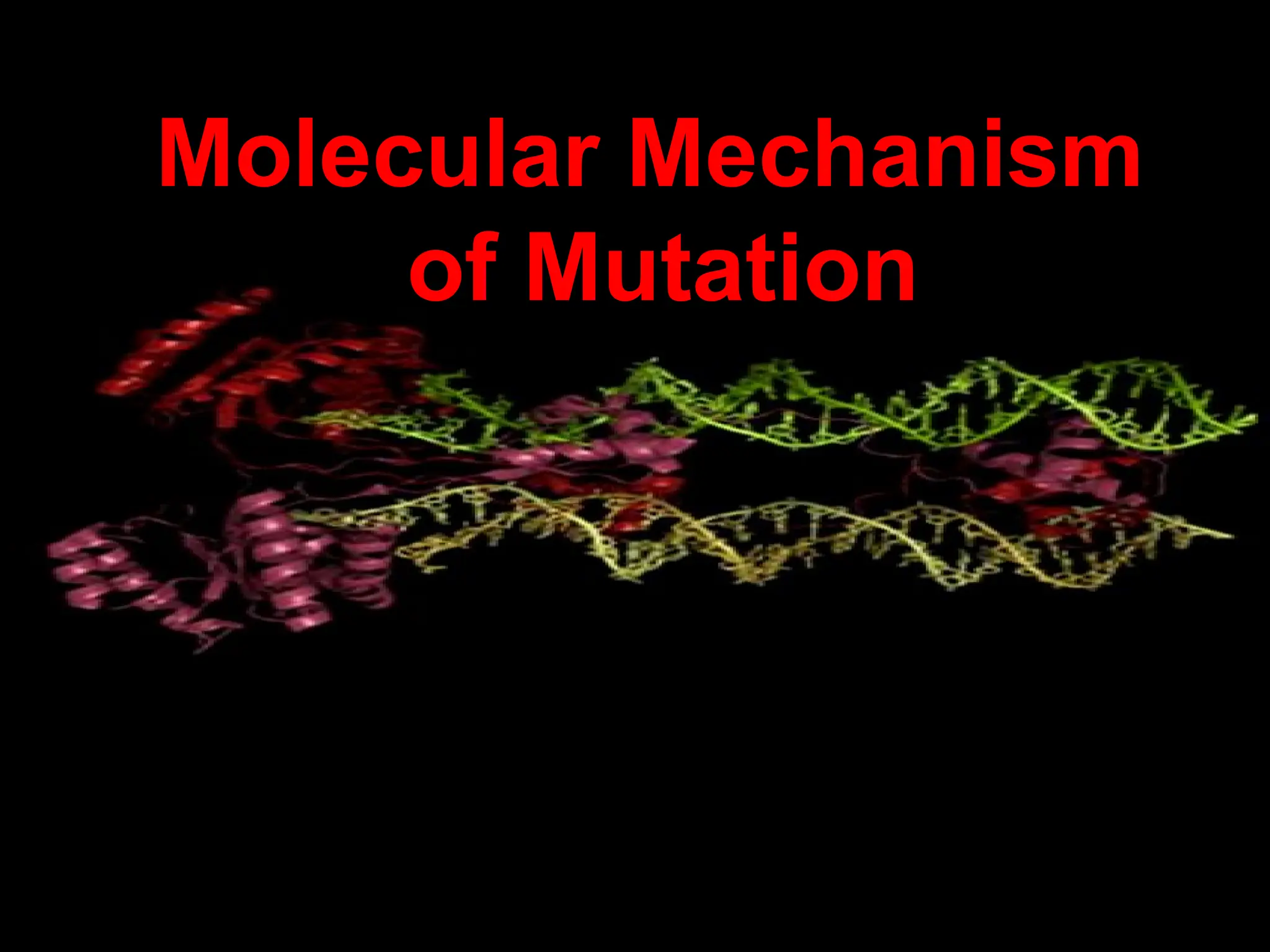
Molecular Mechanism
of Mutation
 Any sudden change occurring in
hereditary material is called as
mutation
 They may be harmful, beneficial or
neutral
 In multicellular organism, two broad
categories of mutations: Somatic
mutations & germ line mutations
Somatic mutations
 Arise in the somatic cells
 Passed on to other cells through the
process of mitosis
 Effect of these mutations depends on the
type of the cell in which they occur &
the developmental stage of the organism
 If occurs early in development, larger the
clone of the mutated cells
Germ line mutations
 They occur in the cells that produce
gametes
 Passed on to future generations
 In multicellular organisms, the term
mutation is generally used for germ
line mutations
Some Facts
 Term mutation was given by Devries
in 1901 while studying evening
primerose Oenothera lamarckiana
 Most of these were chromosomal
variations
 Some were point variations
 Originally the term mutation was
given to both chromosomal as well as
point mutations
Cont.
 Recently chromosomal mutations
are studied separately
 The term mutation is now given only
to point mutations
Definition
 DNA is a highly stable molecule that
replicates with amazing accuracy
 Some errors of replication do occur
 A mutation is defined as an inherited
change in genetic information
Types of gene mutation
Number of ways to classify gene
mutations:
 On the basis of the molecular nature of the
defect
 On the nature of the phenotypic effect--
amino acid sequence of the protein is
altered or not
 On the basis of the causative agent of the
mutation
Mutations on the basis of the molecular
nature of the defect:
 Base substitution
 Insertions & deletions
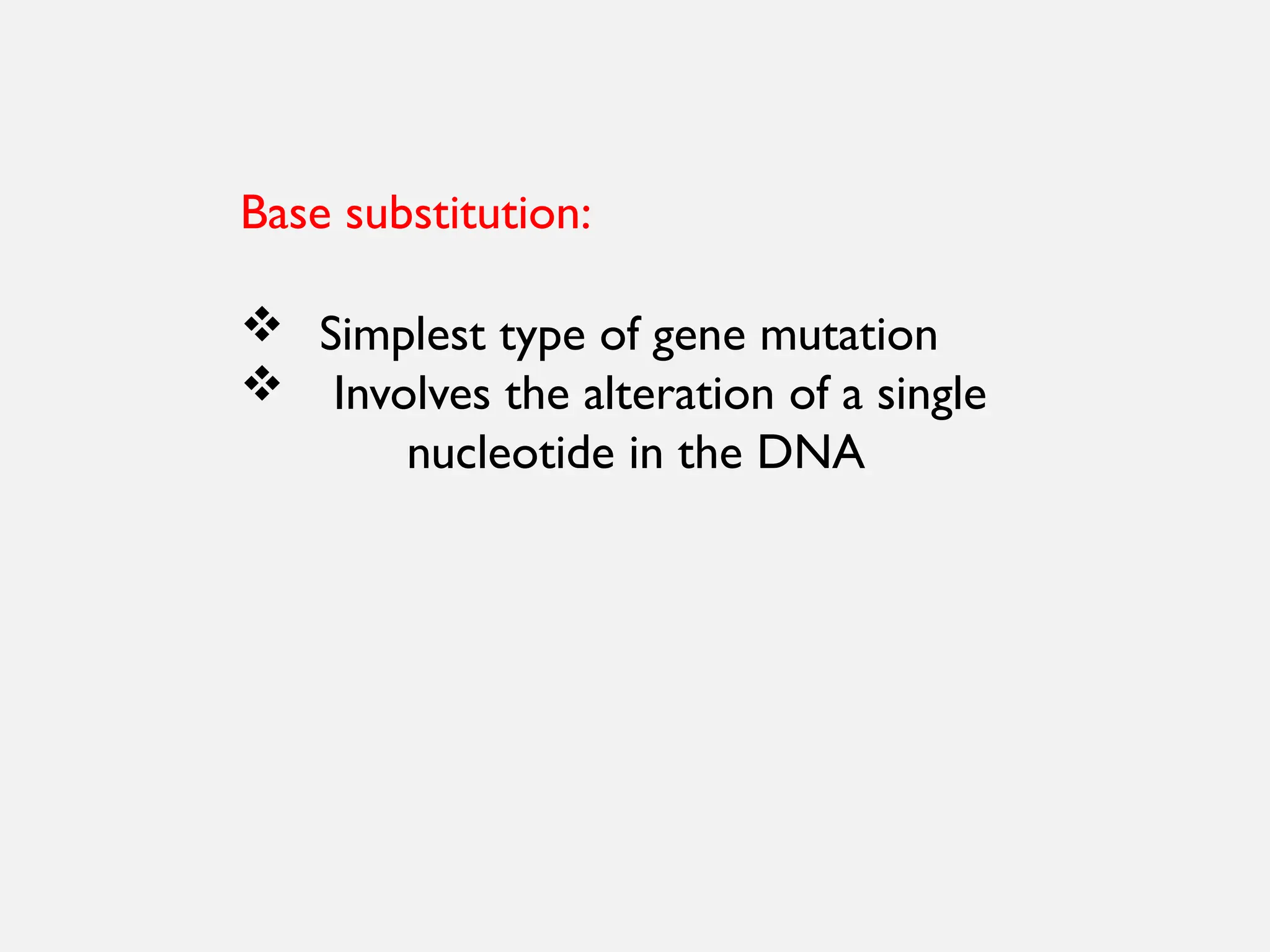
Base substitution:
 Simplest type of gene mutation
 Involves the alteration of a single
nucleotide in the DNA
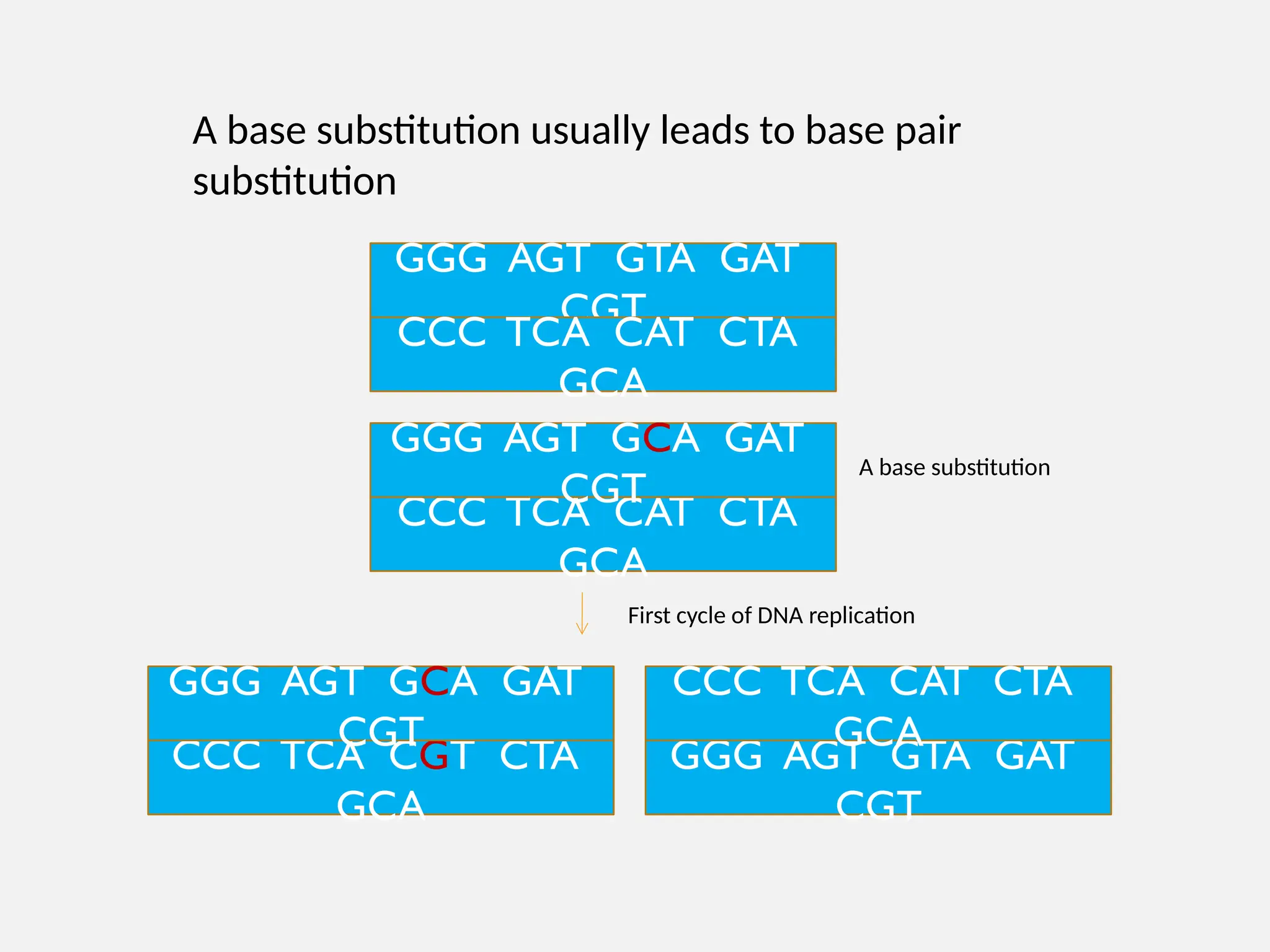
A base substitution usually leads to base pair
substitution
GGG AGT GTA GAT
CGT
CCC TCA CAT CTA
GCA
CCC TCA CAT CTA
GCA
GGG AGT GCA GAT
CGT
A base substitution
CCC TCA CGT CTA
GCA
GGG AGT GCA GAT
CGT
GGG AGT GTA GAT
CGT
CCC TCA CAT CTA
GCA
First cycle of DNA replication
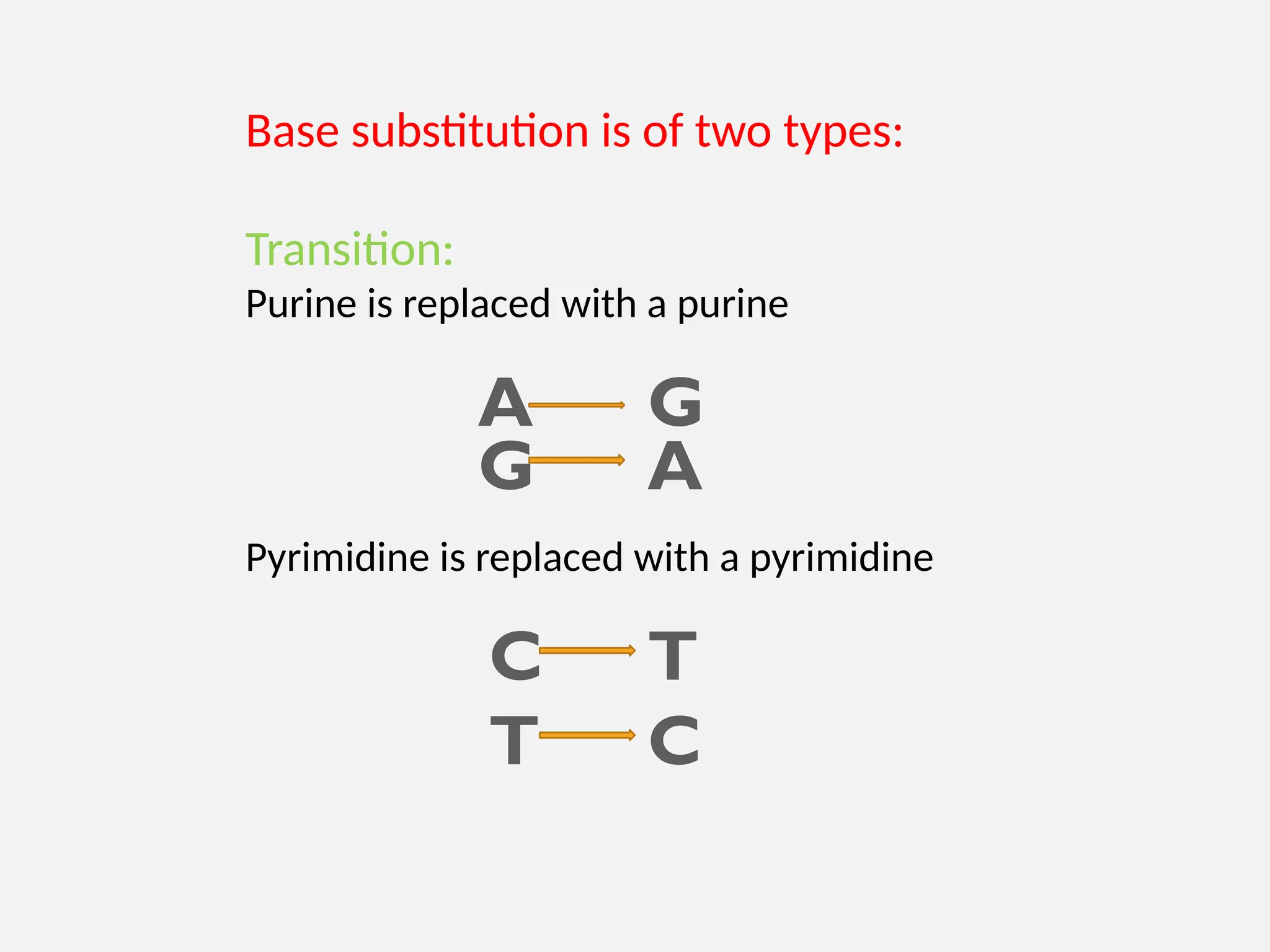
Base substitution is of two types:
Transition:
Purine is replaced with a purine
Pyrimidine is replaced with a pyrimidine
A
T
T
C
C
G
G A
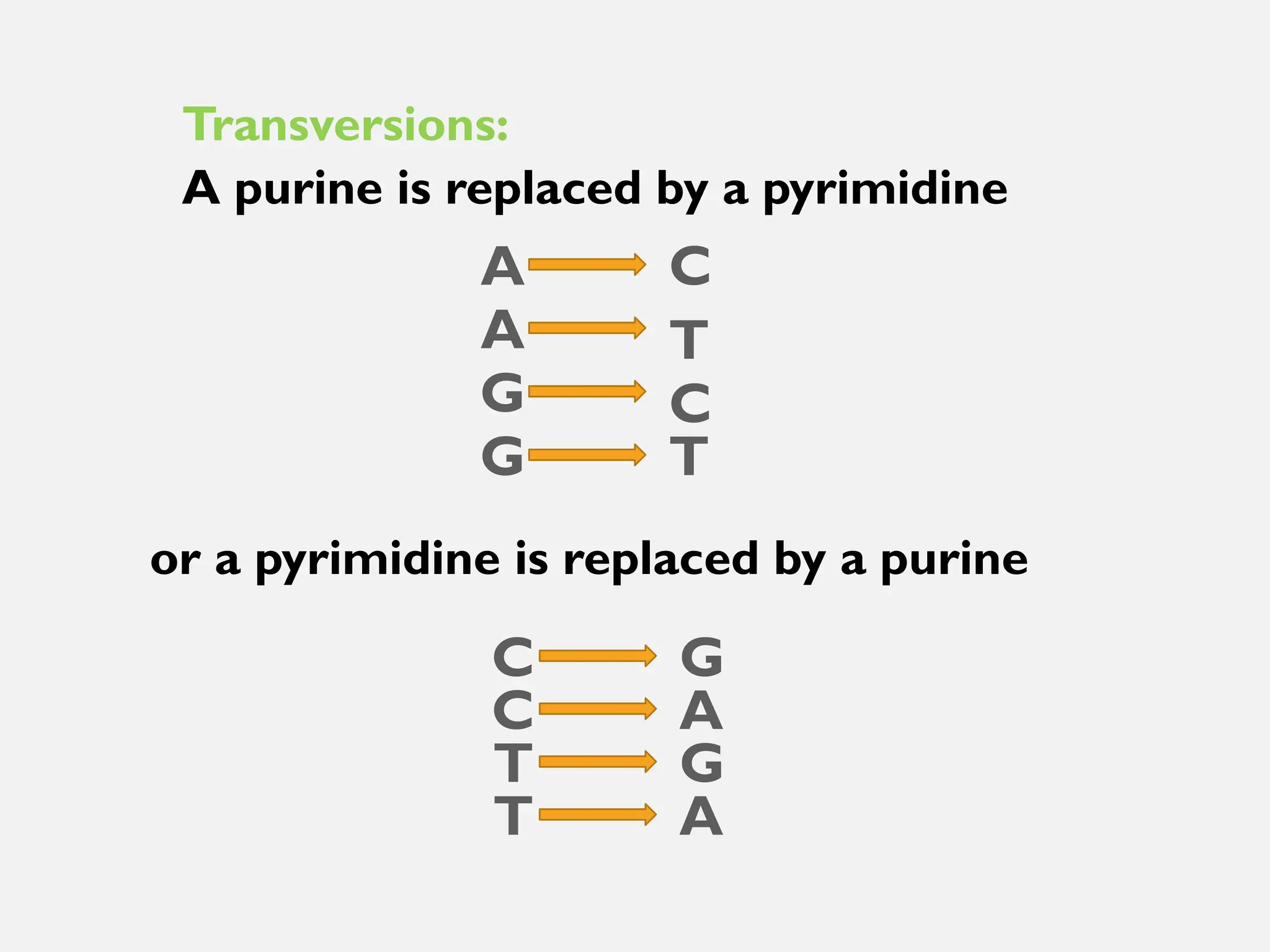
Transversions:
A purine is replaced by a pyrimidine
A
C
A
T
G
G
C
T
C
G
C
A
T G
T A
or a pyrimidine is replaced by a purine
The number of possible
transversions is twice the
number of possible transitions
But Transitions are usually
more frequent in vivo
Insertions & deletions:
 2nd
major class of gene mutation
 Addition or the removal, respectively, of
one or more nucleotide pair
 Usually changes the reading frame, altering
all amino acids encoded by codons
following the mutation
 Also called as frame shift mutations
cont.
 Additions or deletions in the multiples of three
nucleotides will lead to addition or deletion of
one or more amino acids
 These mutations are called in-frame insertions
and deletions, respectively.
Mutations on the basis of the Phenotypic effects of
mutations:
 Most common phenotype in natural populations of
the organism is called as wild type phenotype
 The effect of mutation is considered with reference
to wild type phenotype
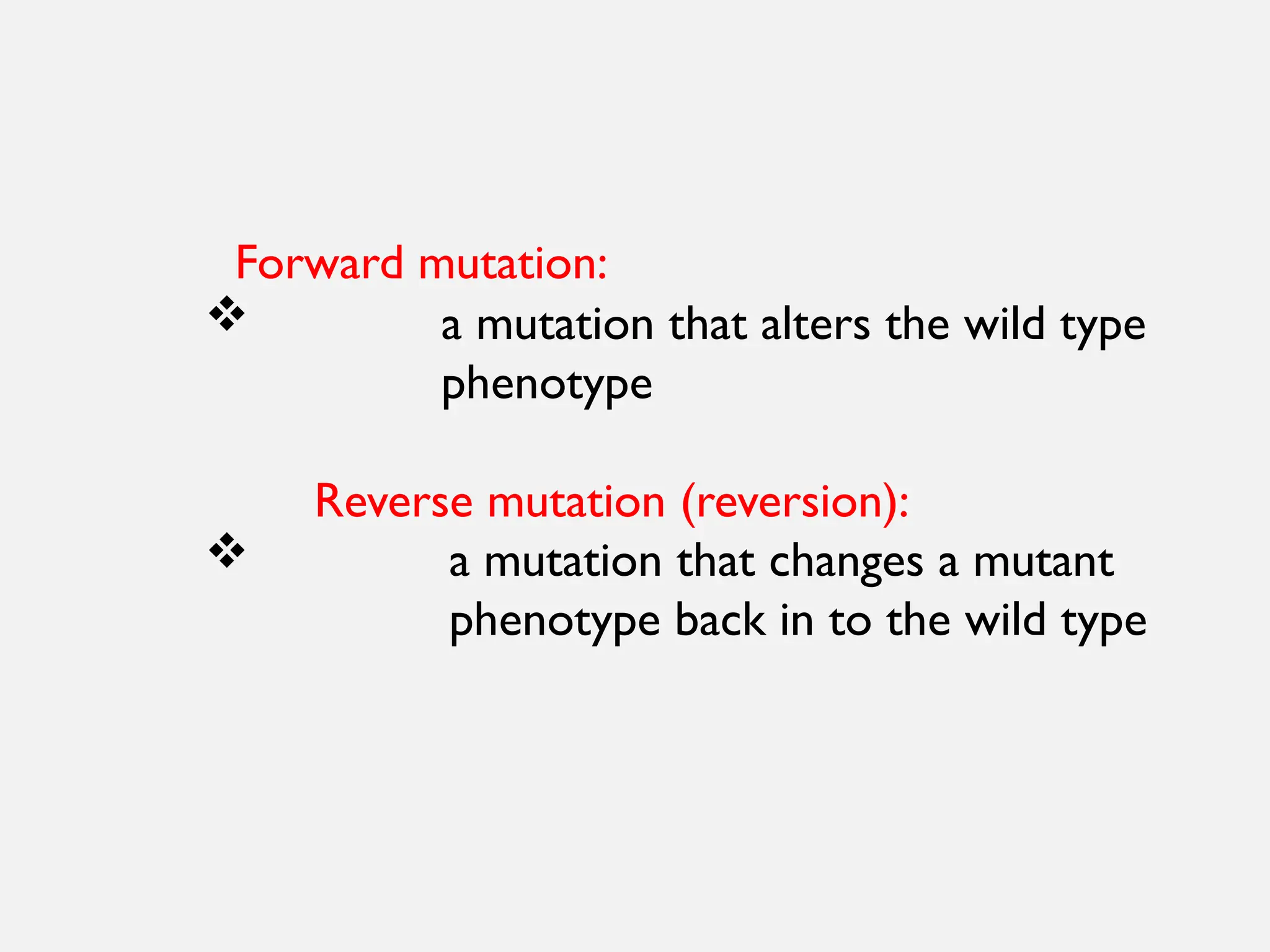
Forward mutation:
 a mutation that alters the wild type
phenotype
Reverse mutation (reversion):
 a mutation that changes a mutant
phenotype back in to the wild type
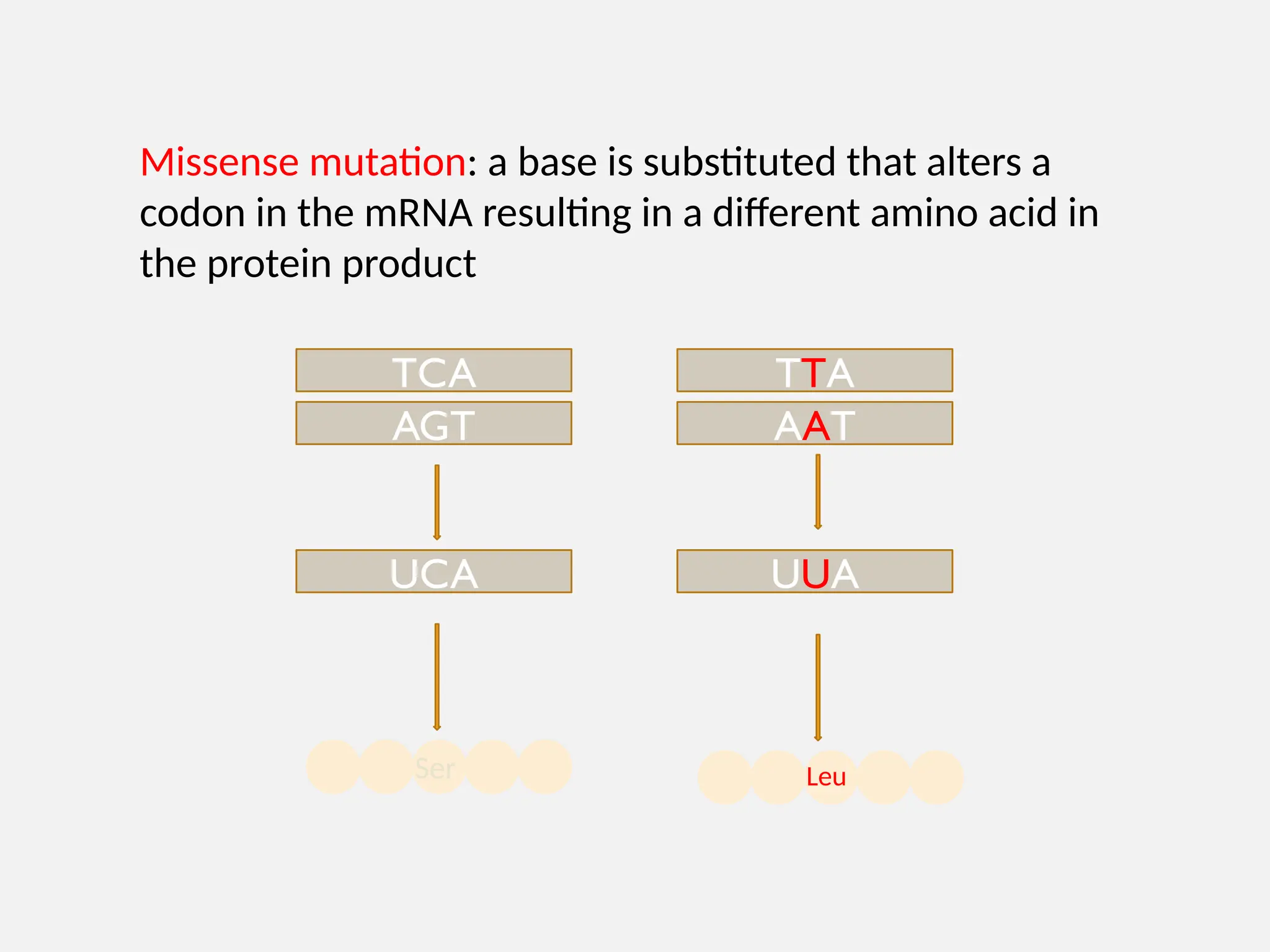
Missense mutation: a base is substituted that alters a
codon in the mRNA resulting in a different amino acid in
the protein product
TCA
AGT
UCA
TTA
AAT
UUA
Ser Leu
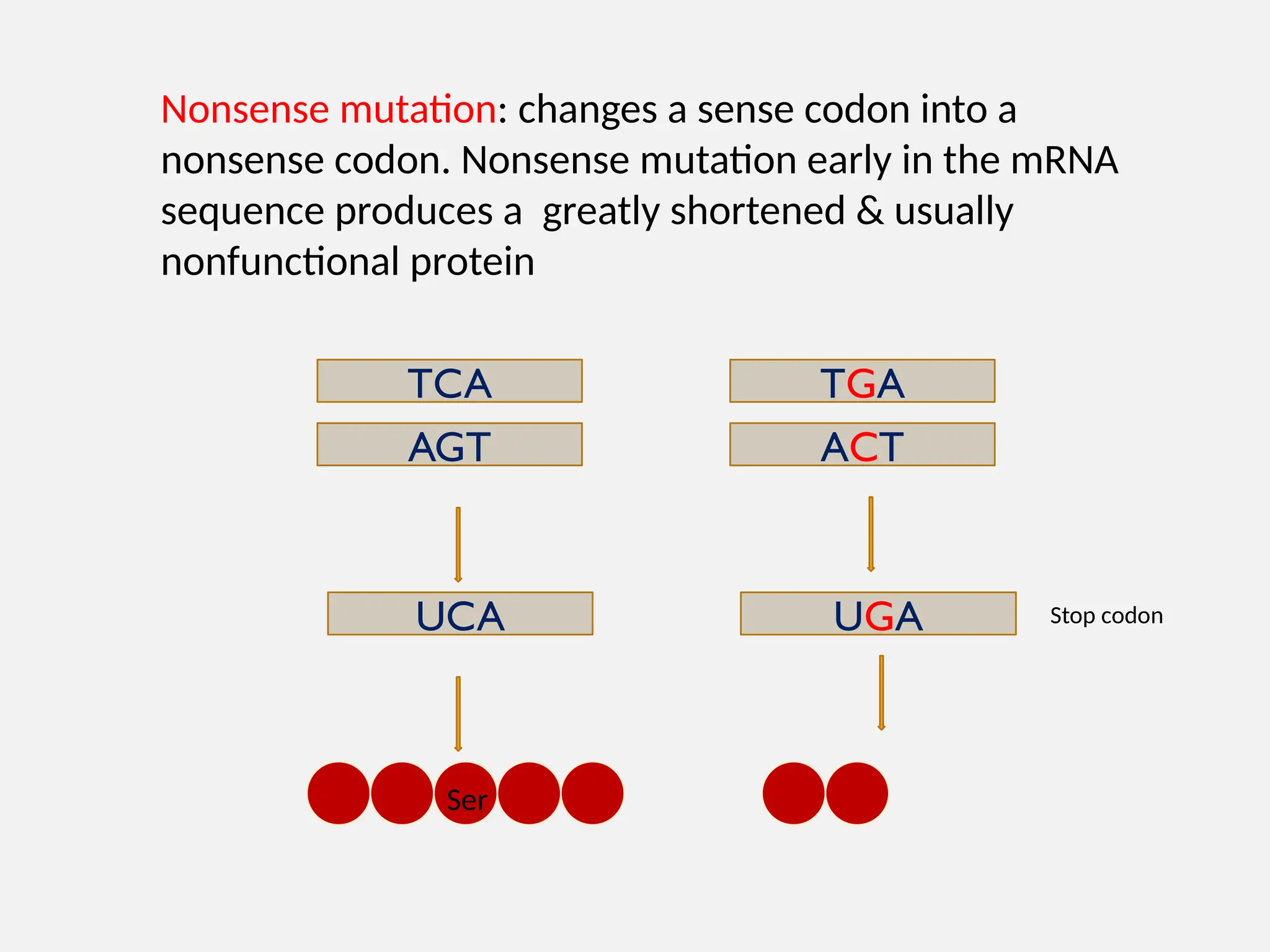
Nonsense mutation: changes a sense codon into a
nonsense codon. Nonsense mutation early in the mRNA
sequence produces a greatly shortened & usually
nonfunctional protein
TCA
AGT
UCA
TGA
ACT
UGA
Ser
Stop codon
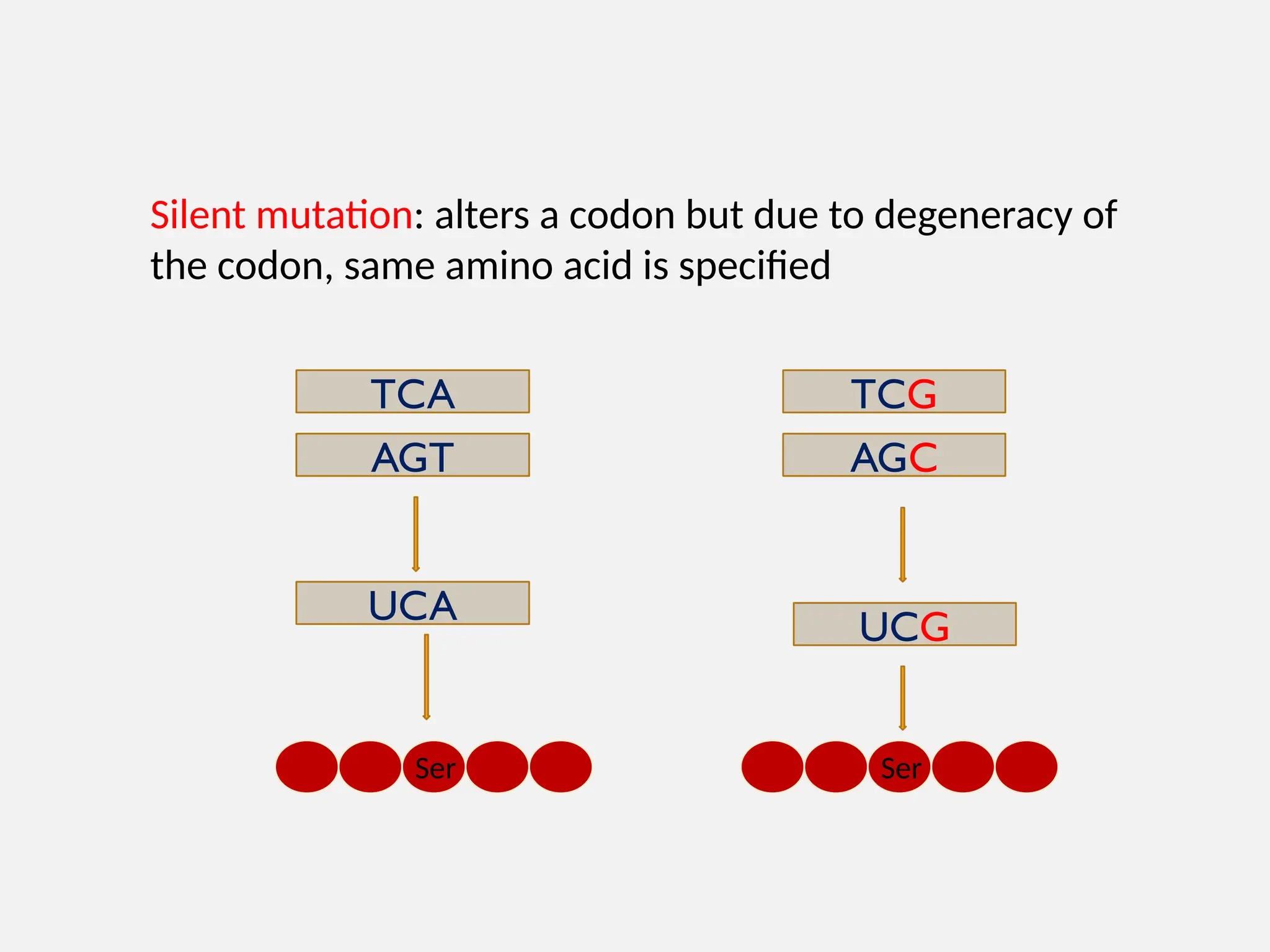
Silent mutation: alters a codon but due to degeneracy of
the codon, same amino acid is specified
TCA
AGT
UCA
TCG
AGC
UCG
Ser Ser
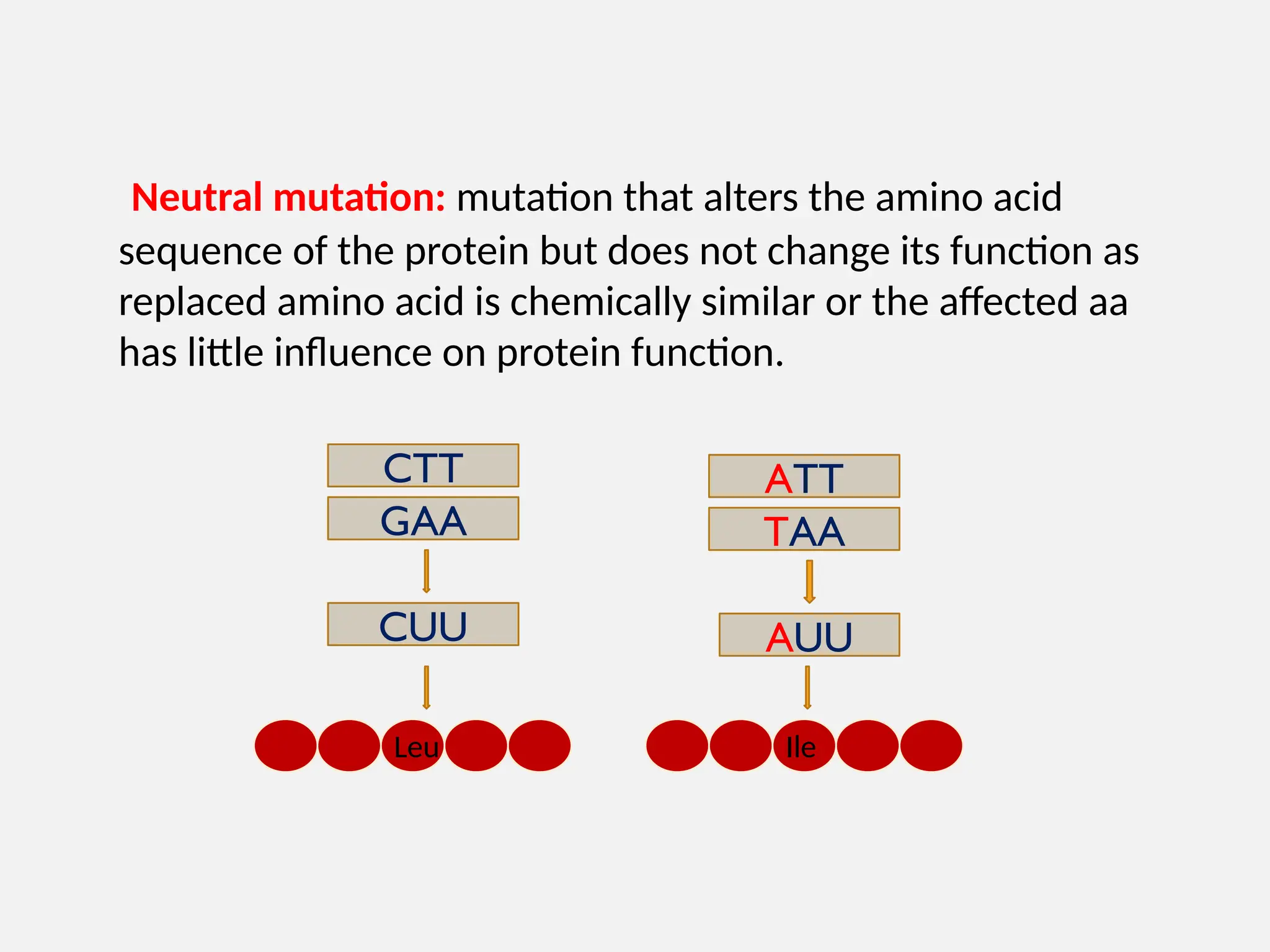
Neutral mutation: mutation that alters the amino acid
sequence of the protein but does not change its function as
replaced amino acid is chemically similar or the affected aa
has little influence on protein function.
CTT
GAA
CUU
ATT
TAA
AUU
Leu Ile
Loss of function mutations:
 Complete or partial loss of the normal function
 Structure of protein is so altered that it no
longer works correctly
 Mutation can occur in regulatory region that
affects transcription , translation or spilicing of
the protein
 Frequently recessive
Gain of function mutations:
 Produces an entirely new trait
 Causes a trait to appear in inappropriate tissues
or at inappropriate times in development
 Frequently dominant
Conditional mutations:
 Expressed only under certain conditions
Lethal mutations:
 Cause the death of the organism
Suppressor mutation:
 Suppresses the effect of other mutation
 Occurs at a site different from the site of original
mutation
 Organism with a suppressor mutation is a double
mutant but exhibits the phenotype of un mutated
wild type
 Different from reverse mutation in which mutated
site is reverted back into the wild type sequence
On the basis of Causative agent of mutation:
Spontaneous:
 Mutations that result from natural changes
in DNA
Induced:
 Results from changes caused By
environmental chemicals & radiations
 Any environmental agent that increases the
rate of mutation above the spontaneous is
called a mutagen such as chemicals &
radiations
Chemical Mutagens:
 First discovery of a chemical mutagen was made by
Charlotte Auerbach
Base Analogs:
 Chemicals with structures similar to that of any of
the four standard bases of DNA
 DNA polymerases cannot distinguish these analogs
 They may be incorporated into newly synthesized
DNA molecules
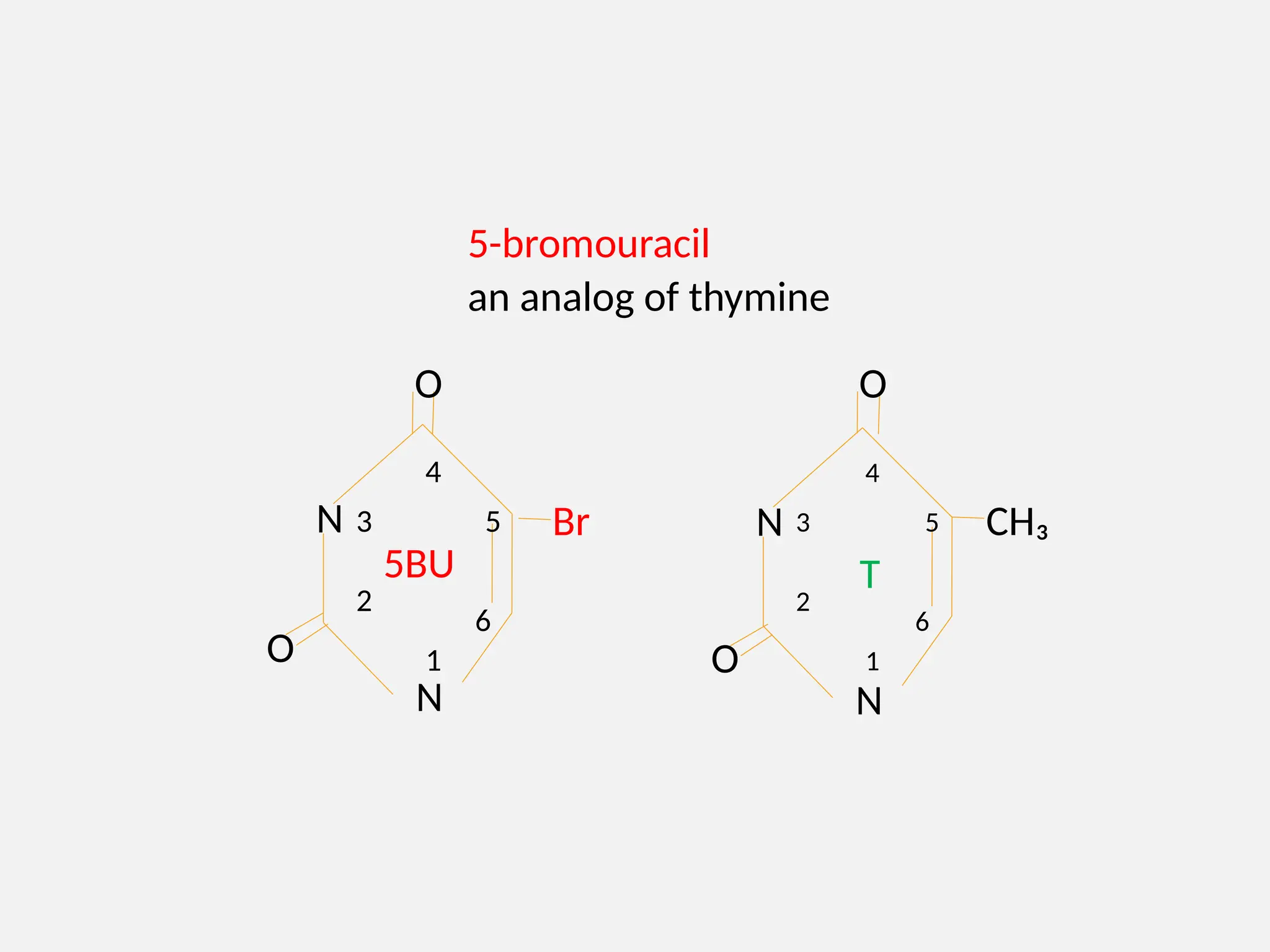
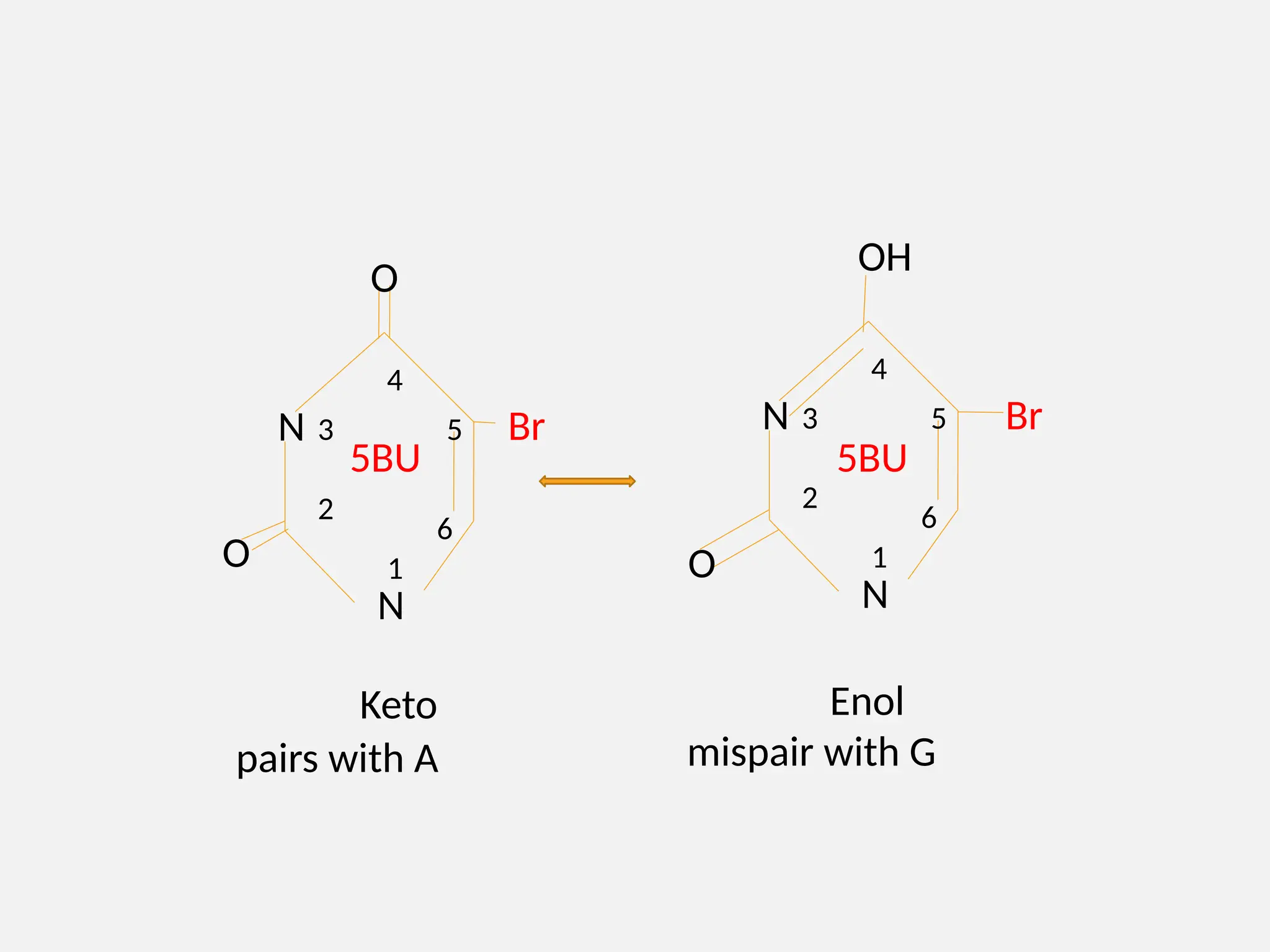
5-bromouracil
an analog of thymine
N
N
1
2
3
6
5
4
O
O
5BU
Br N
N
1
2
3
6
5
4
CH₃
T
O
O
N
N
1
2
3
6
5
4
Br
O
5BU
O
N
N
1
2
3
6
5
4
Br
O
5BU
OH
Keto
pairs with A
Enol
mispair with G
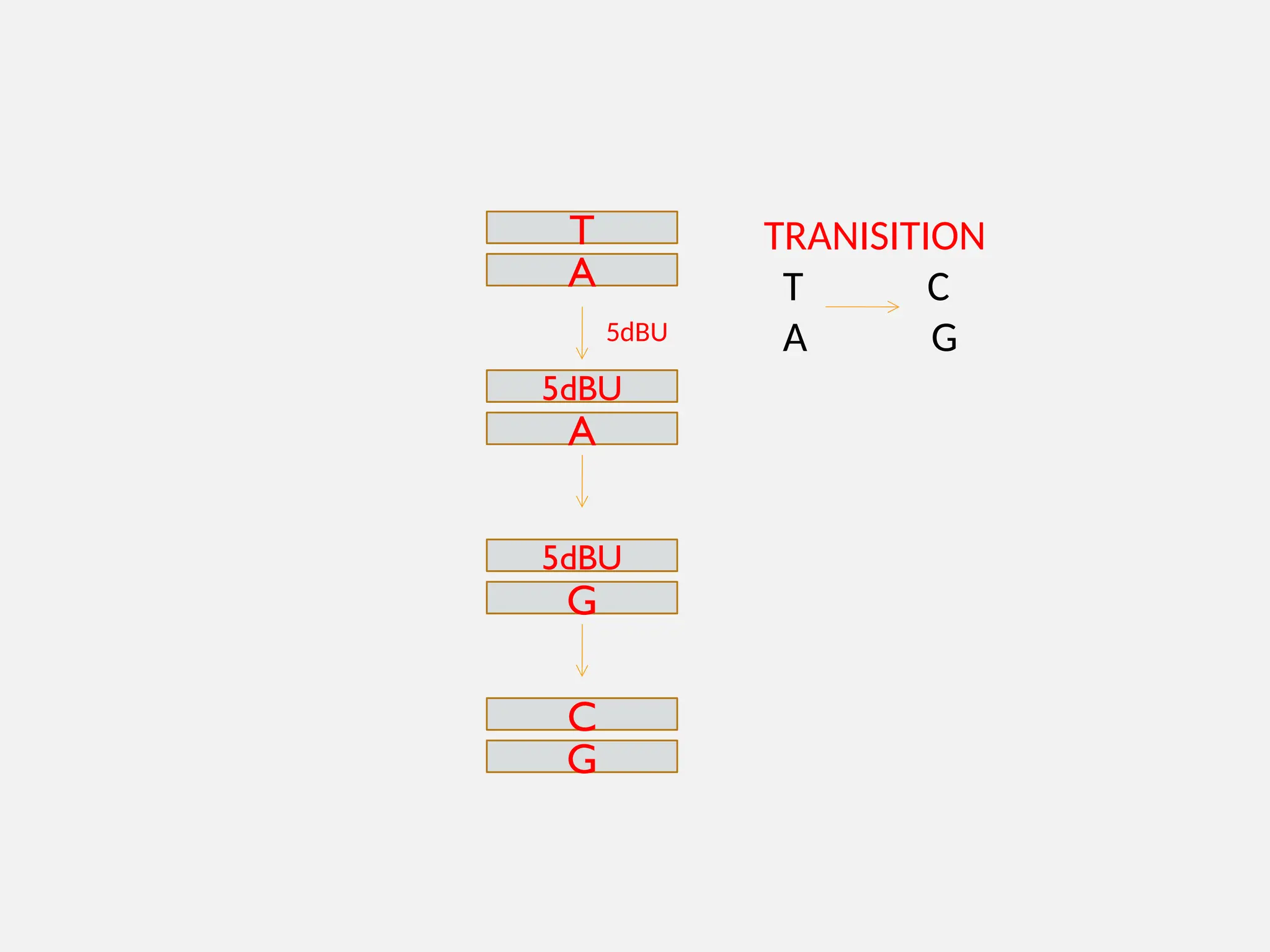
T
A
5dBU
A
5dBU
5dBU
G
C
G
TRANISITION
T C
A G
GA
C
CT
G
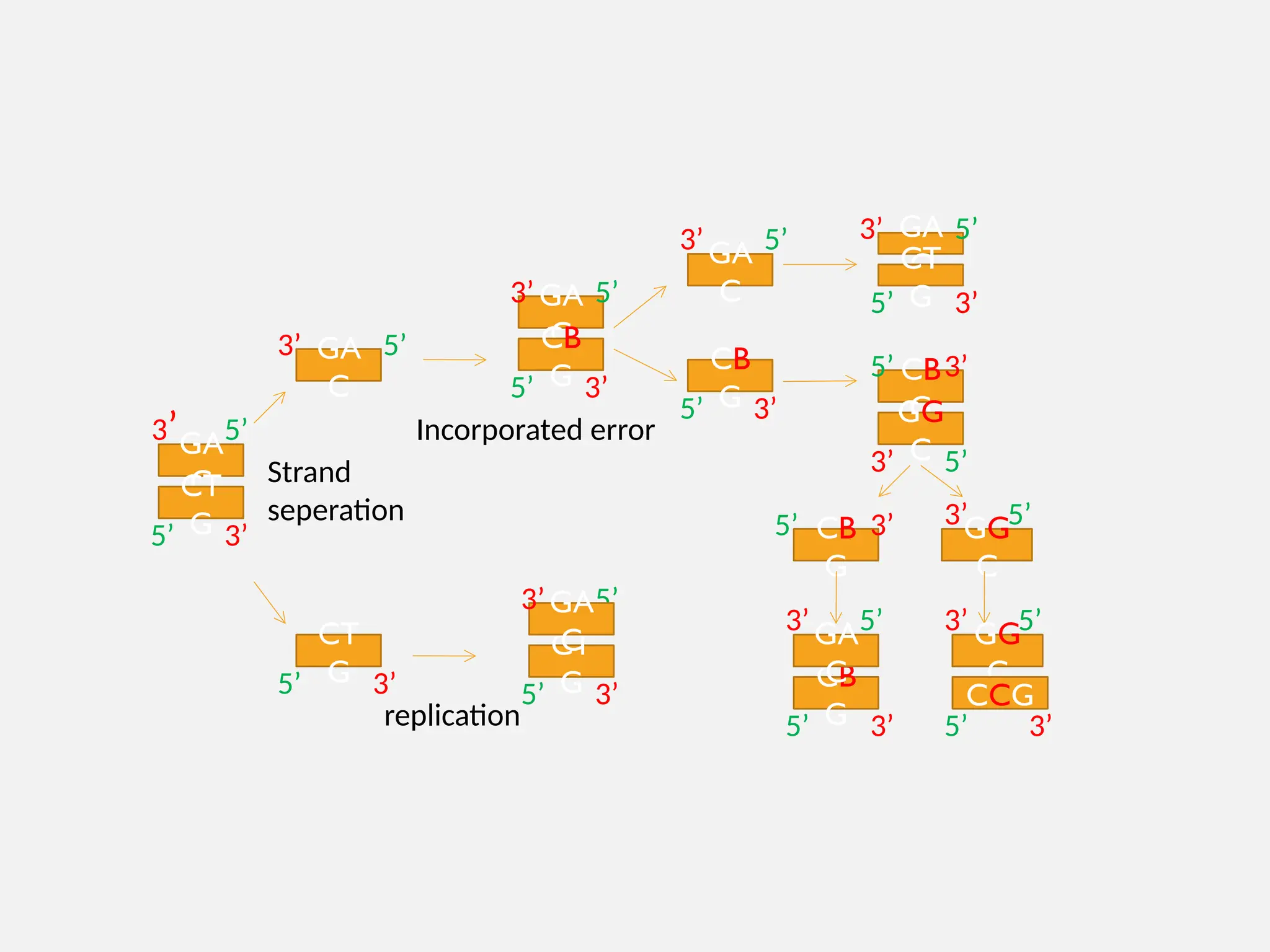
Strand
seperation
3’
5’ 3’
5’
GA
C
3’ 5’
CT
G
5’ 3’
GA
C
3’
5’
CB
G
5’
3’
CT
G
5’
3’
GA
C
3’
5’
GA
C
3’ 5’
CB
G
5’ 3’
GA
C
3’ 5’
CT
G
5’ 3’
CB
G
5’ 3’
GG
C
3’ 5’
CB
G
5’ 3’ GG
C
3’ 5’
CB
G
5’ 3’
GA
C
3’ 5’ GG
C
3’
5’
CCG
5’
3’
replication
Incorporated error
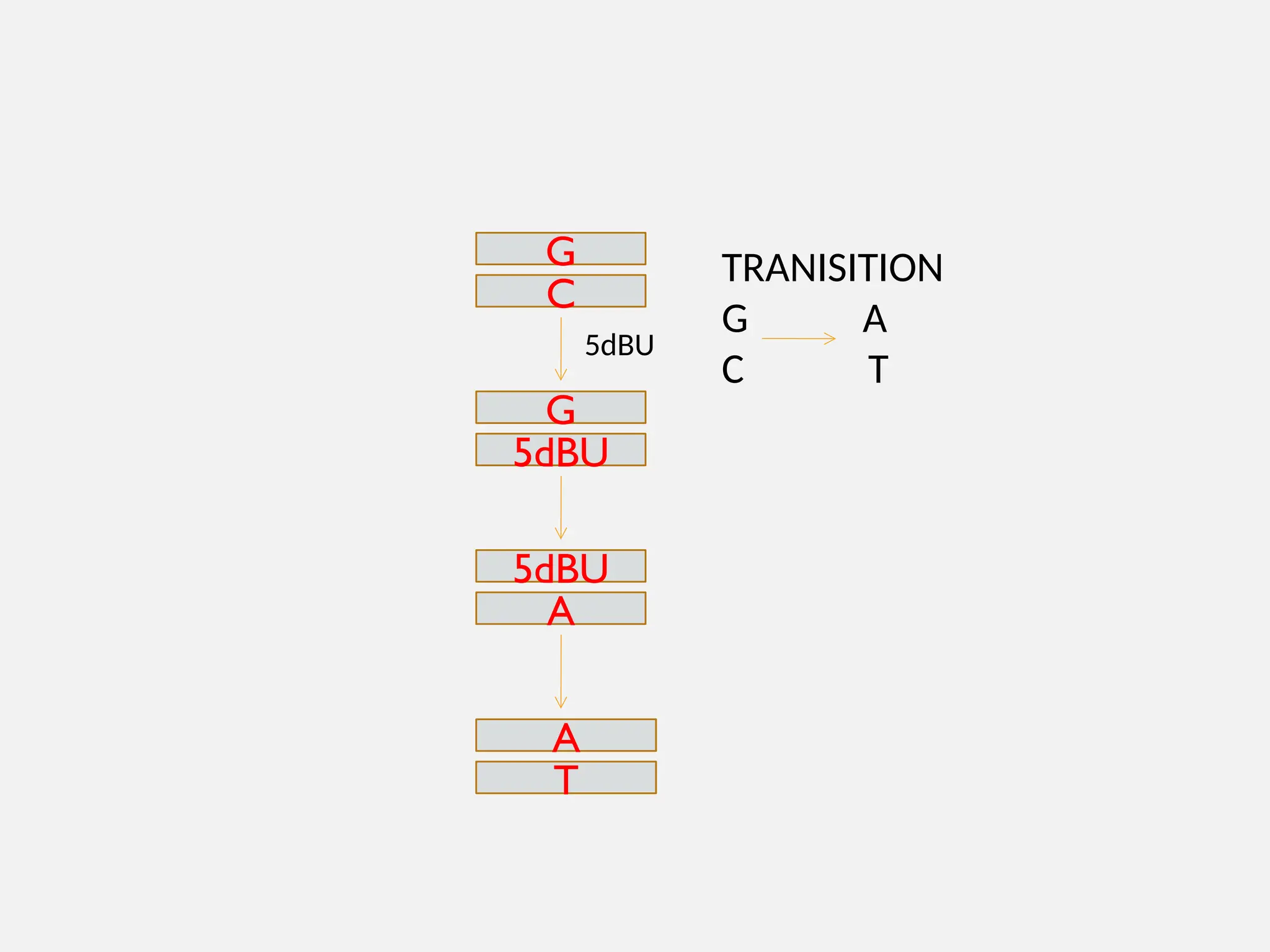
G
C
5dBU
5dBU
G
5dBU
A
A
T
TRANISITION
G A
C T
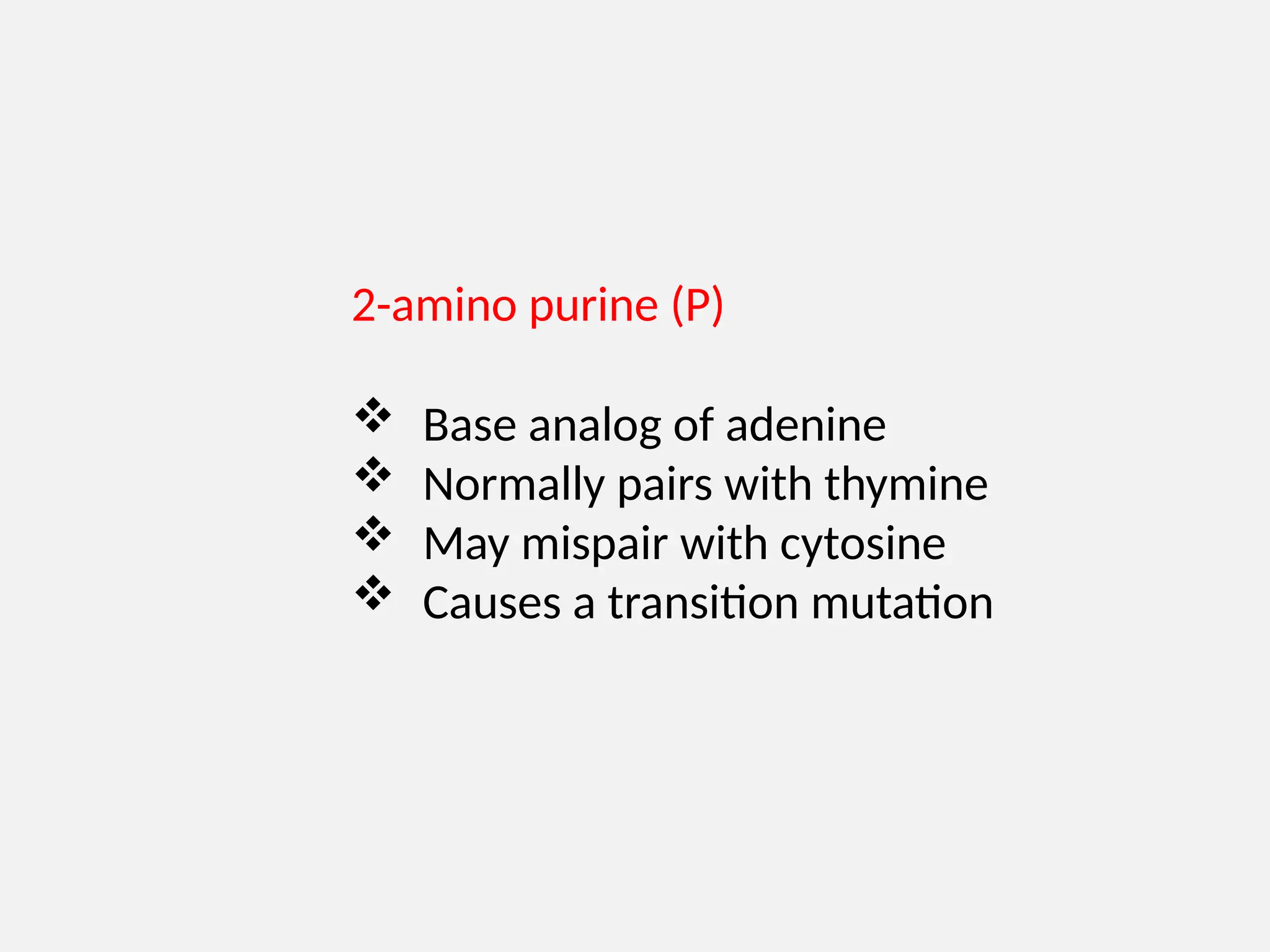
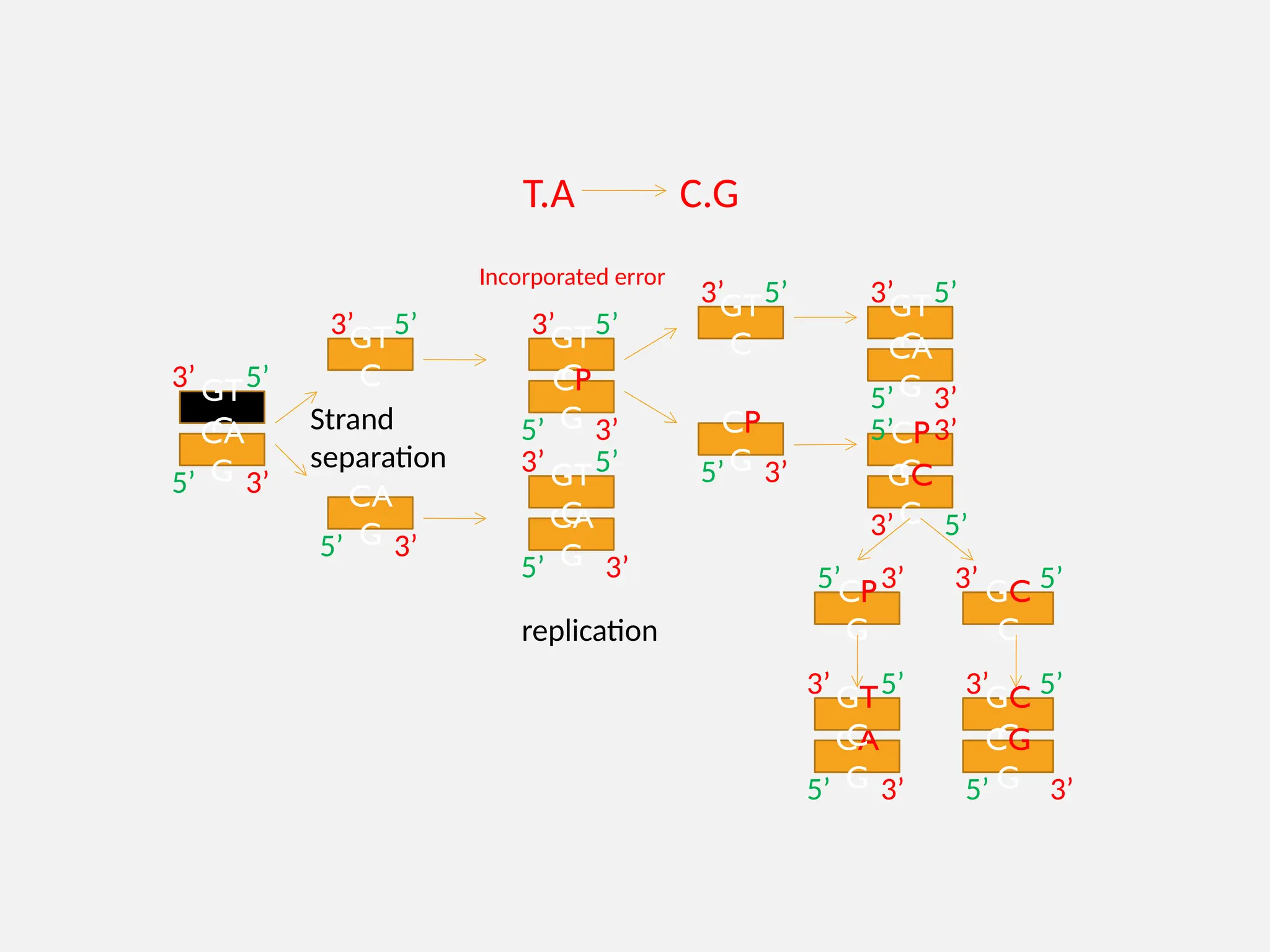
2-amino purine (P)
 Base analog of adenine
 Normally pairs with thymine
 May mispair with cytosine
 Causes a transition mutation
GT
C
CA
G
Strand
separation
3’
5’ 3’
5’
GT
C
3’
5’
CA
G
5’
3’
GT
C
3’ 5’
CP
G
5’ 3’
CA
G
5’ 3’
GT
C
3’ 5’
GT
C
3’ 5’
CP
G
5’ 3’
GT
C
3’ 5’
CA
G
5’ 3’
CP
G
5’ 3’
GC
C
3’ 5’
CP
G
5’ 3’ GC
C
3’ 5’
CA
G
5’ 3’
GT
C
3’ 5’ GC
C
3’ 5’
CG
G
5’ 3’
replication
Incorporated error
T.A C.G
T
A
2AP
2AP
T
C
2AP
C
G
TRANISITION
T C
A G
C
G
2AP
2AP
C
T
2AP
T
A
TRANISITION
C T
G A
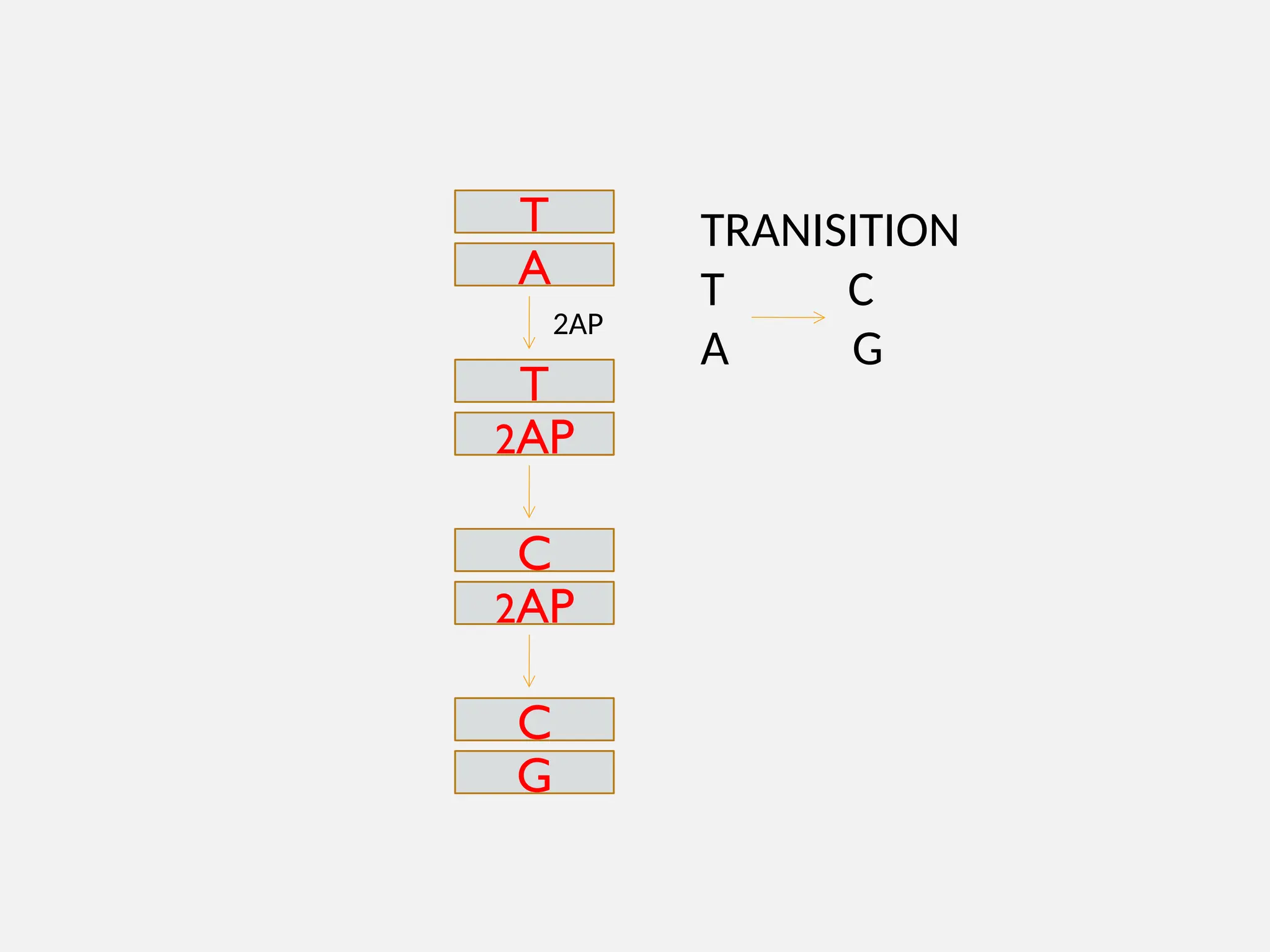
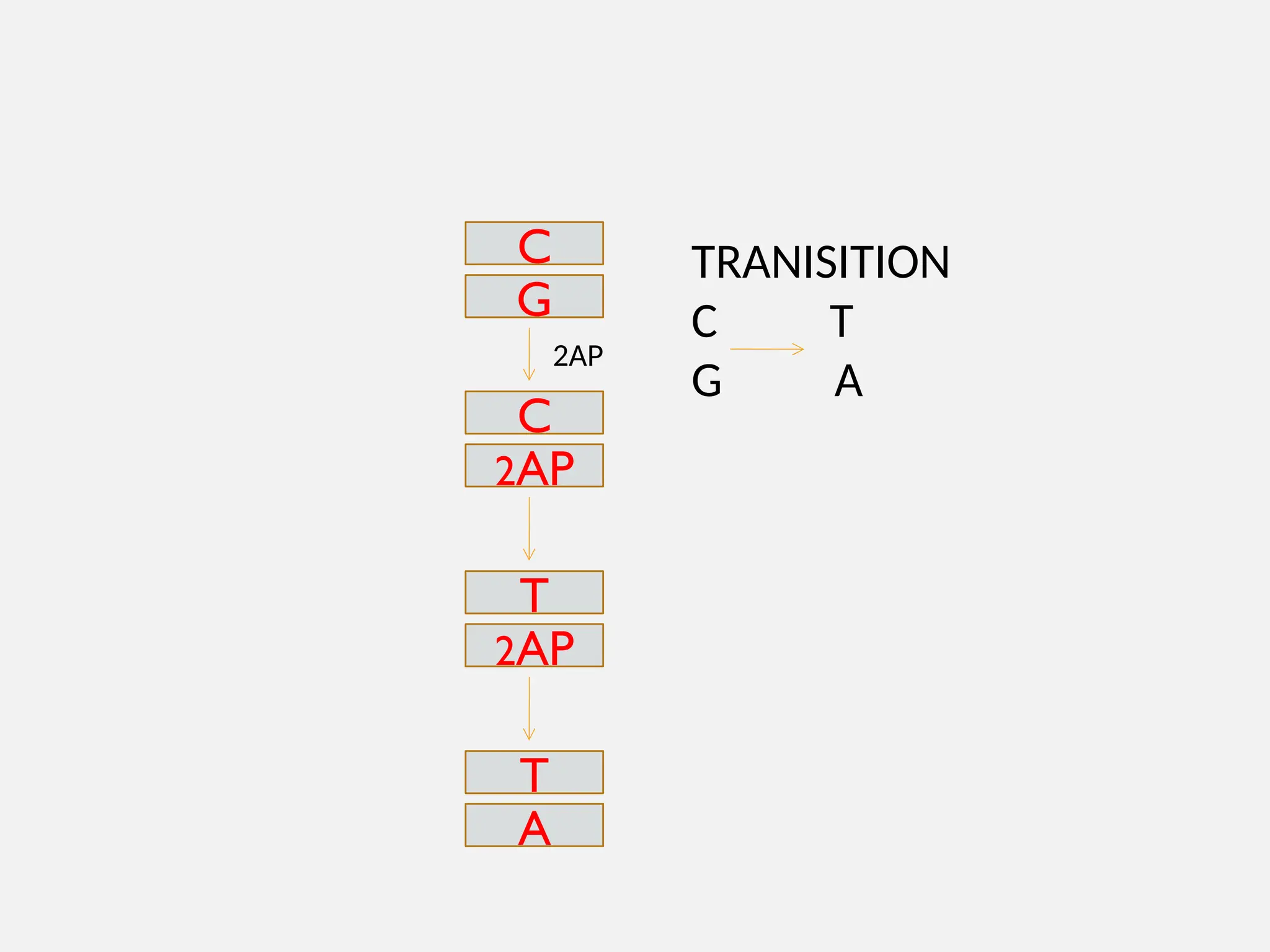
 Both base analogs produce transition
mutations
 Mutations by base analogs can be
reversed by treatment with the same
analog or different analog
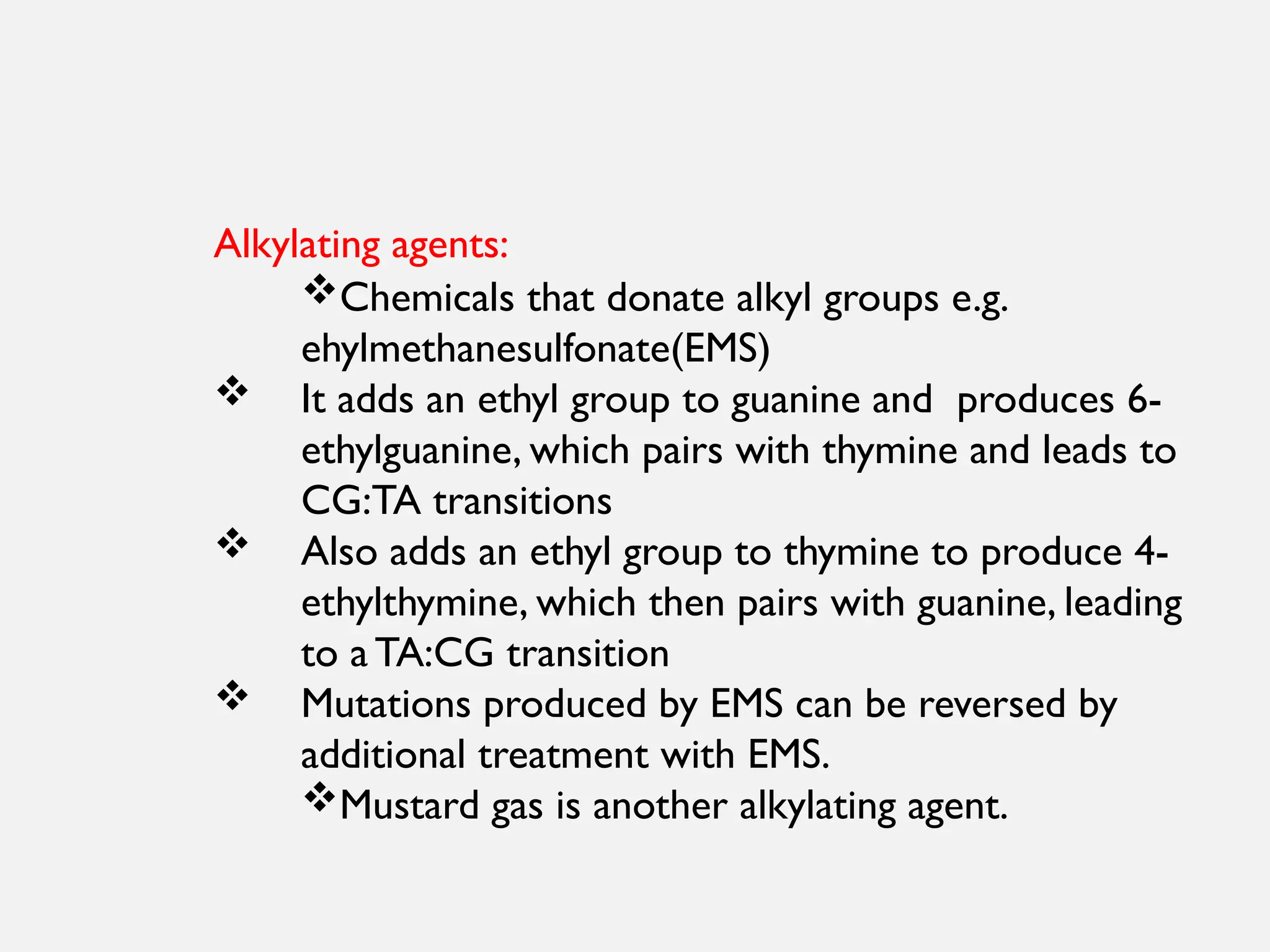
Alkylating agents:
Chemicals that donate alkyl groups e.g.
ehylmethanesulfonate(EMS)
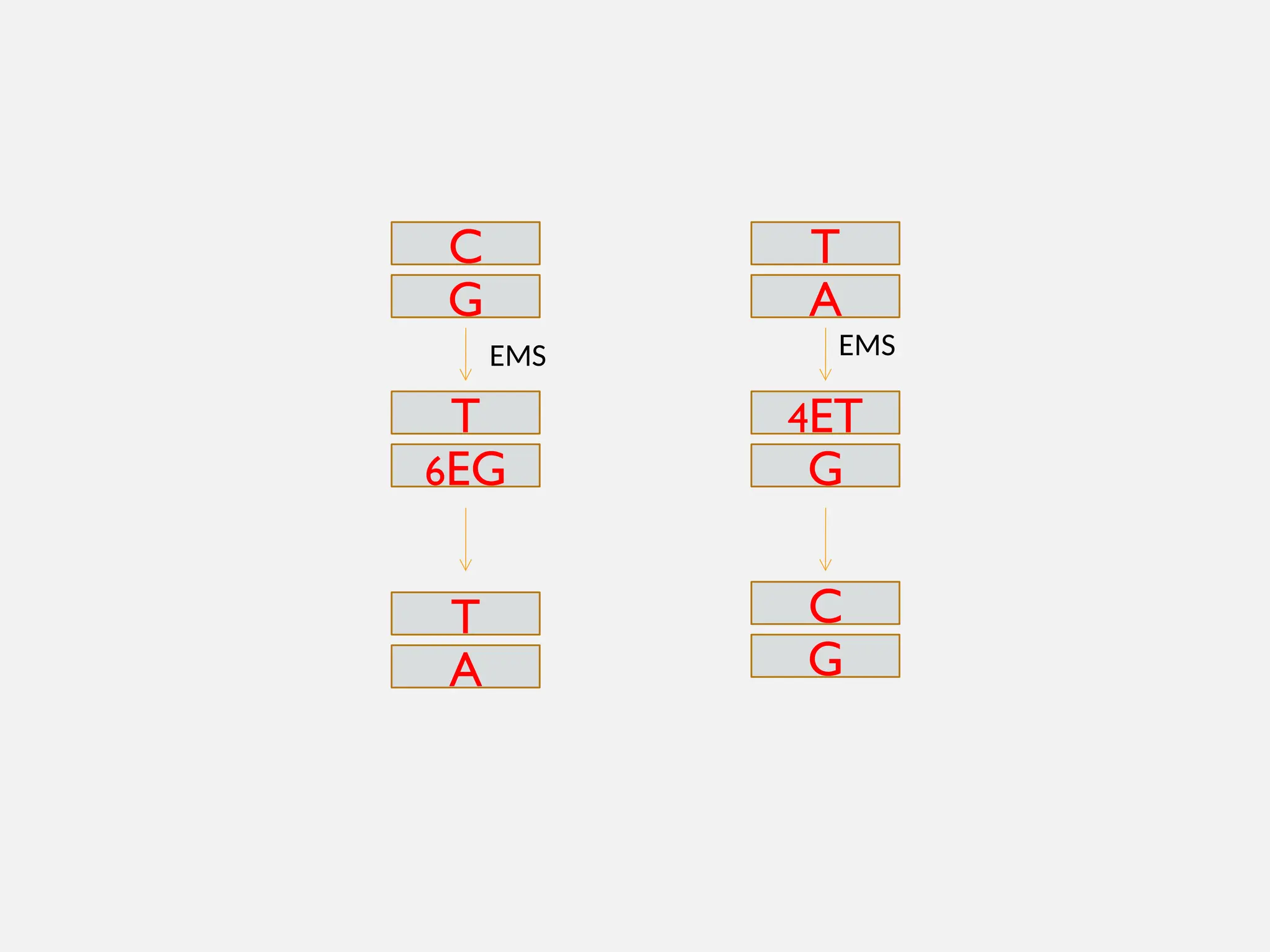
 It adds an ethyl group to guanine and produces 6-
ethylguanine, which pairs with thymine and leads to
CG:TA transitions
 Also adds an ethyl group to thymine to produce 4-
ethylthymine, which then pairs with guanine, leading
to a TA:CG transition
 Mutations produced by EMS can be reversed by
additional treatment with EMS.
Mustard gas is another alkylating agent.
C
G
EMS
6EG
T
T
A
T
A
EMS
G
4ET
C
G
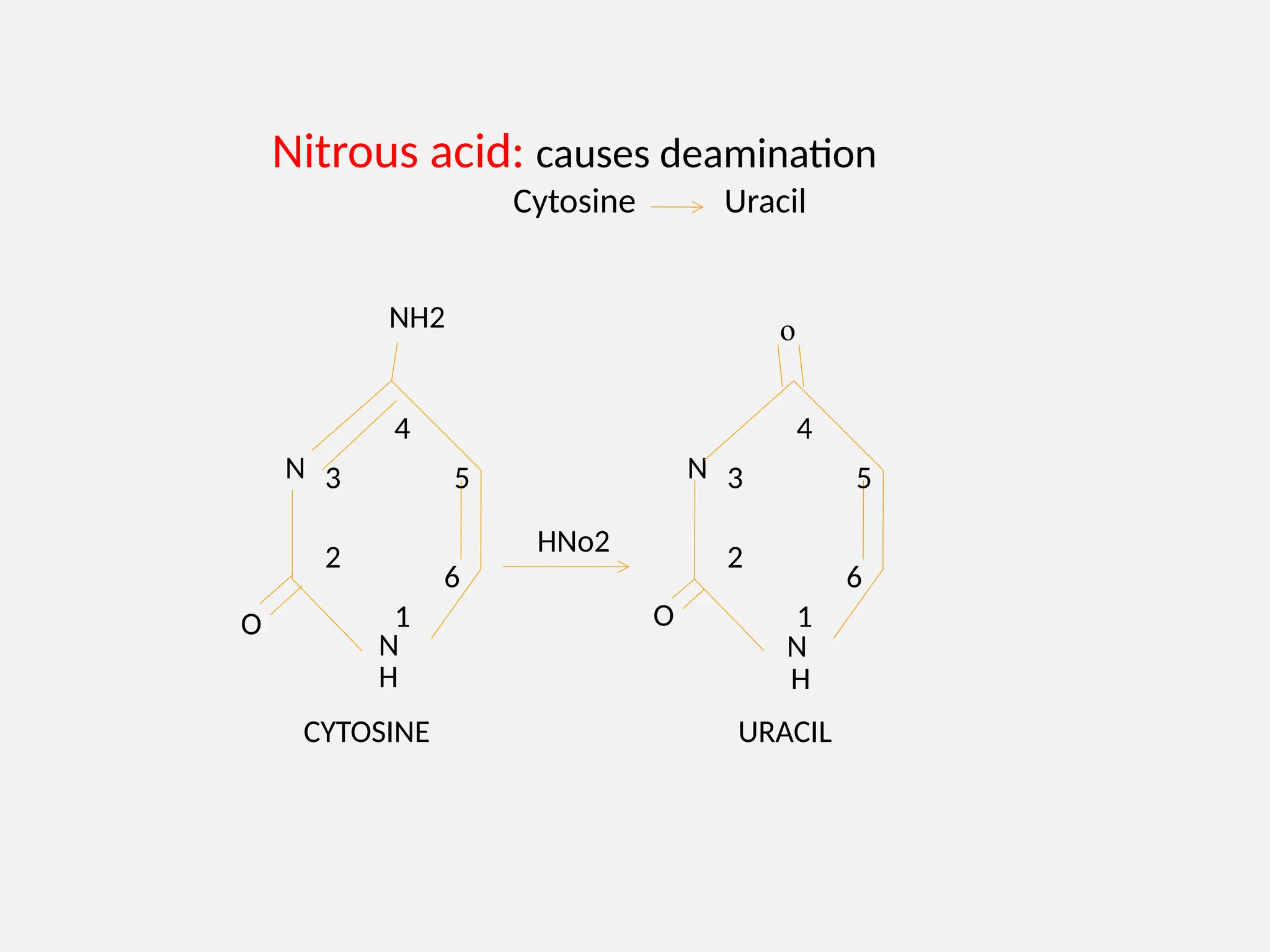
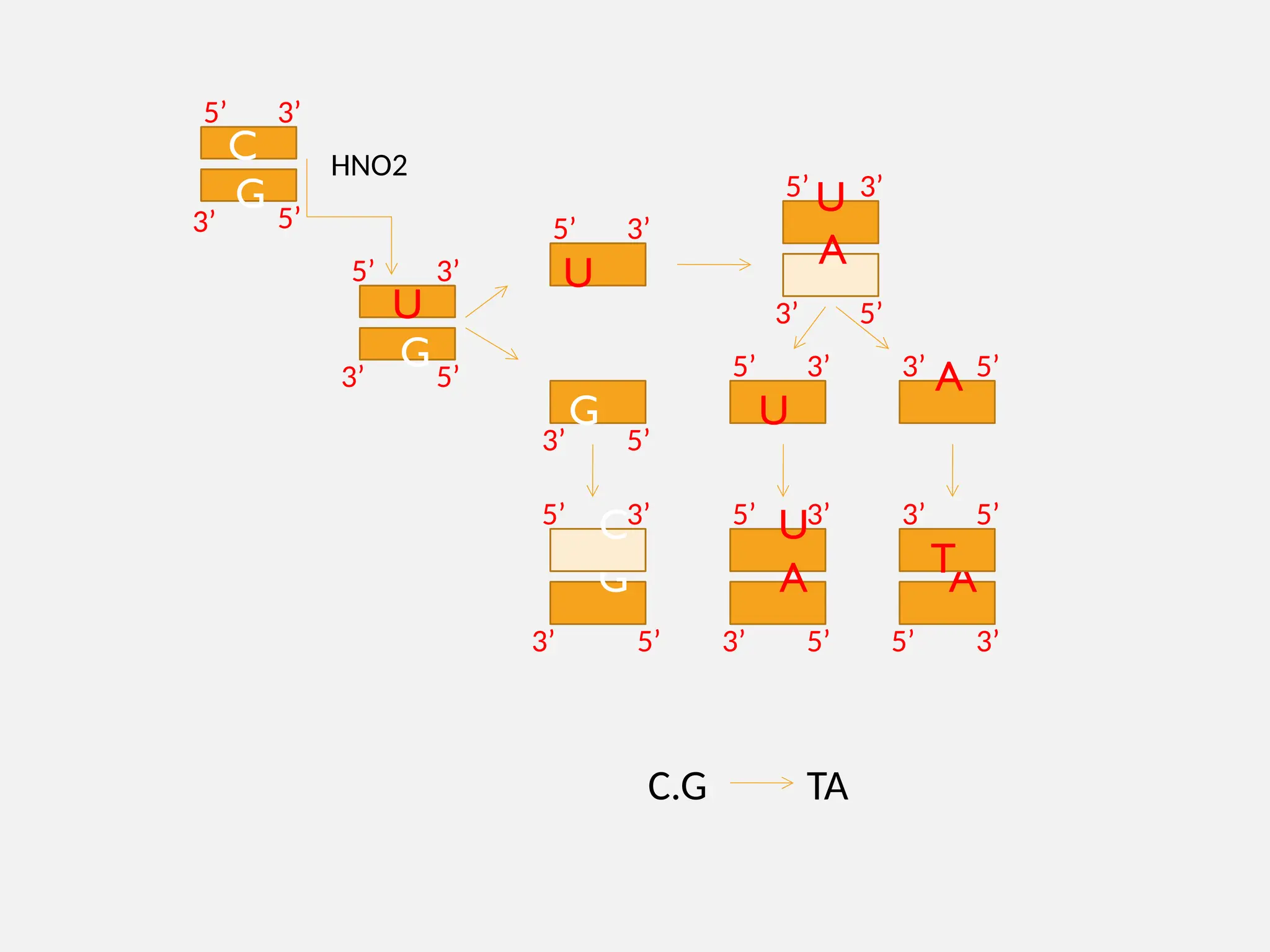
Nitrous acid: causes deamination
Cytosine Uracil
N
N
CYTOSINE
1
2
3
6
5
4
NH2
O
H
N
N
1
2
3
6
5
4
O
o
HNo2
URACIL
H
U
G
U
G
U
A
G
C
U
A
U
A A
T
C.G TA
C
G
HNO2
5’ 3’
3’ 5’
5’ 3’
3’ 5’
5’ 3’
3’ 5’
5’ 3’
3’ 5’
3’ 5’
5’ 3’
5’ 5’
3’
3’
3’
5’
5’ 3’
3’ 3’
5’
5’
H
T
H
T
H
C
A
T
H
C
H
C G
C
A.T G.C
A
T HNO2
5’ 3’
3’ 5’
5’ 3’
3’ 5’
5’ 3’
3’ 5’
5’ 3’
3’ 5’
3’ 5’
5’ 3’
5’ 5’
3’
3’
3’
5’
5’ 3’
3’ 3’
5’
5’
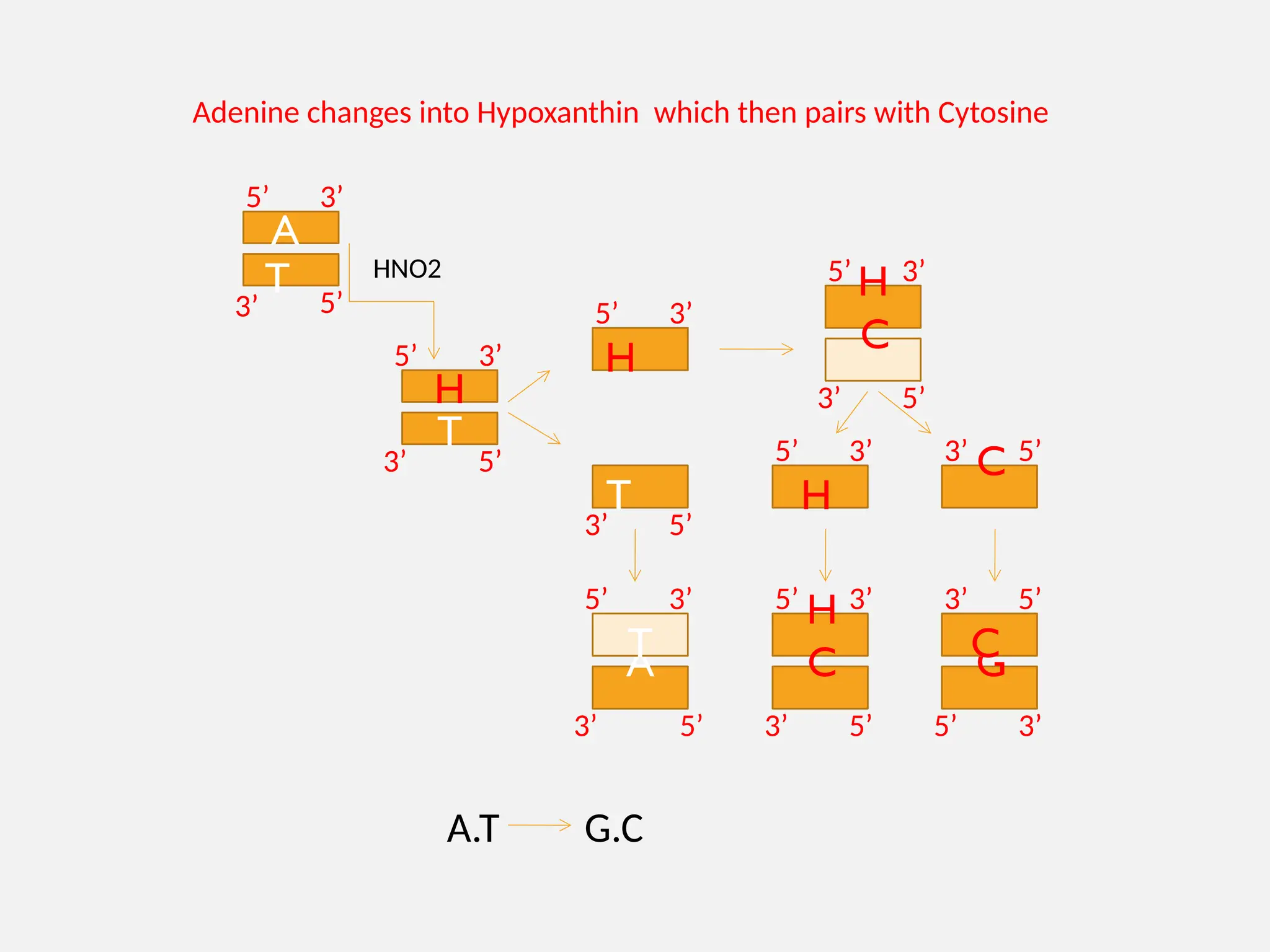
Adenine changes into Hypoxanthin which then pairs with Cytosine
X
C
X
C
X
T
C
G
X T
X
T
A
T
A.T
G.C
G
C HNO2
5’ 3’
3’ 5’
5’ 3’
3’ 5’
5’ 3’
3’ 5’
5’ 3’
3’ 5’
3’ 5’
5’ 3’
5’ 5’
3’
3’
3’
5’
5’ 3’
3’ 3’
5’
5’
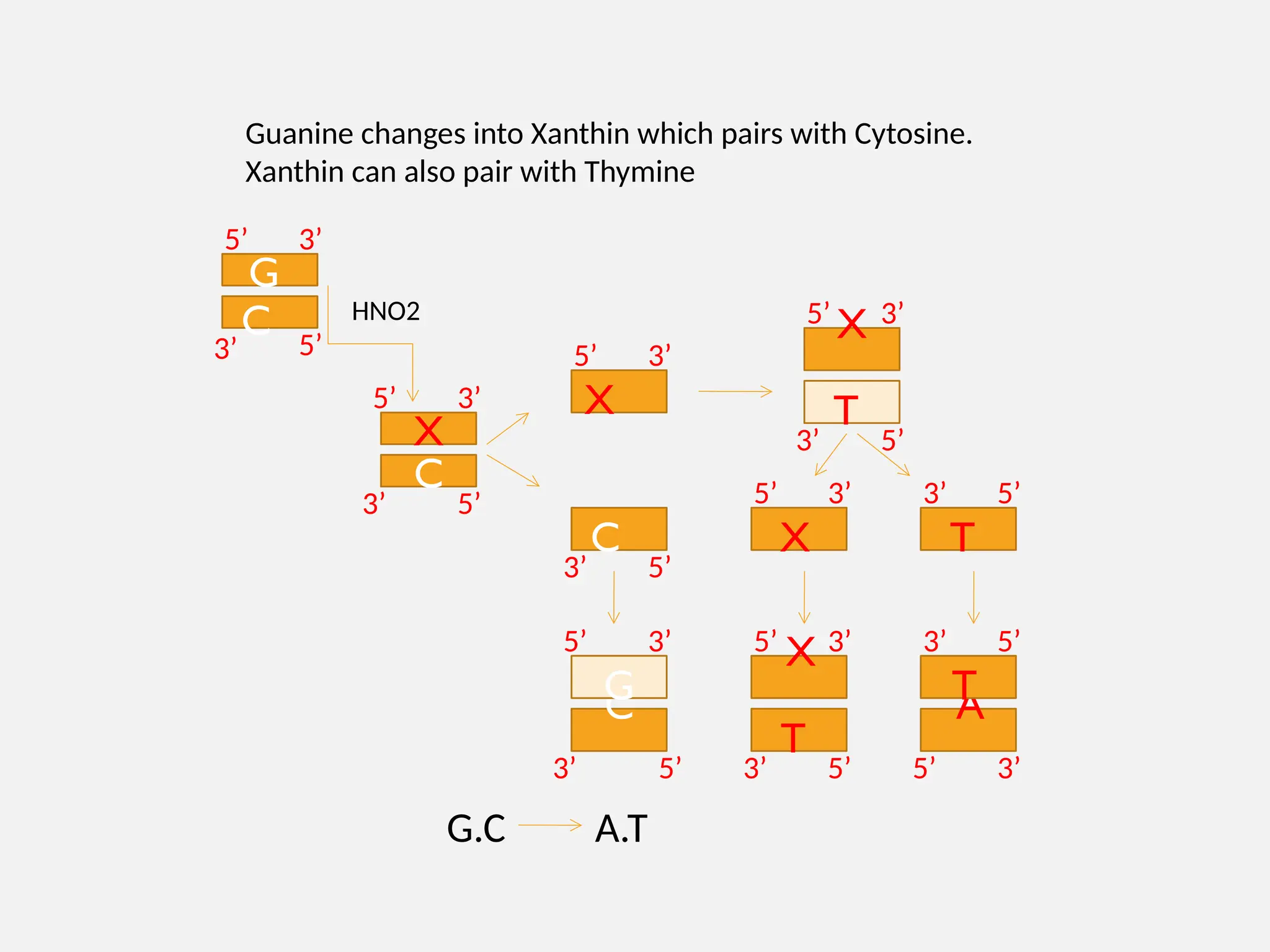
Guanine changes into Xanthin which pairs with Cytosine.
Xanthin can also pair with Thymine
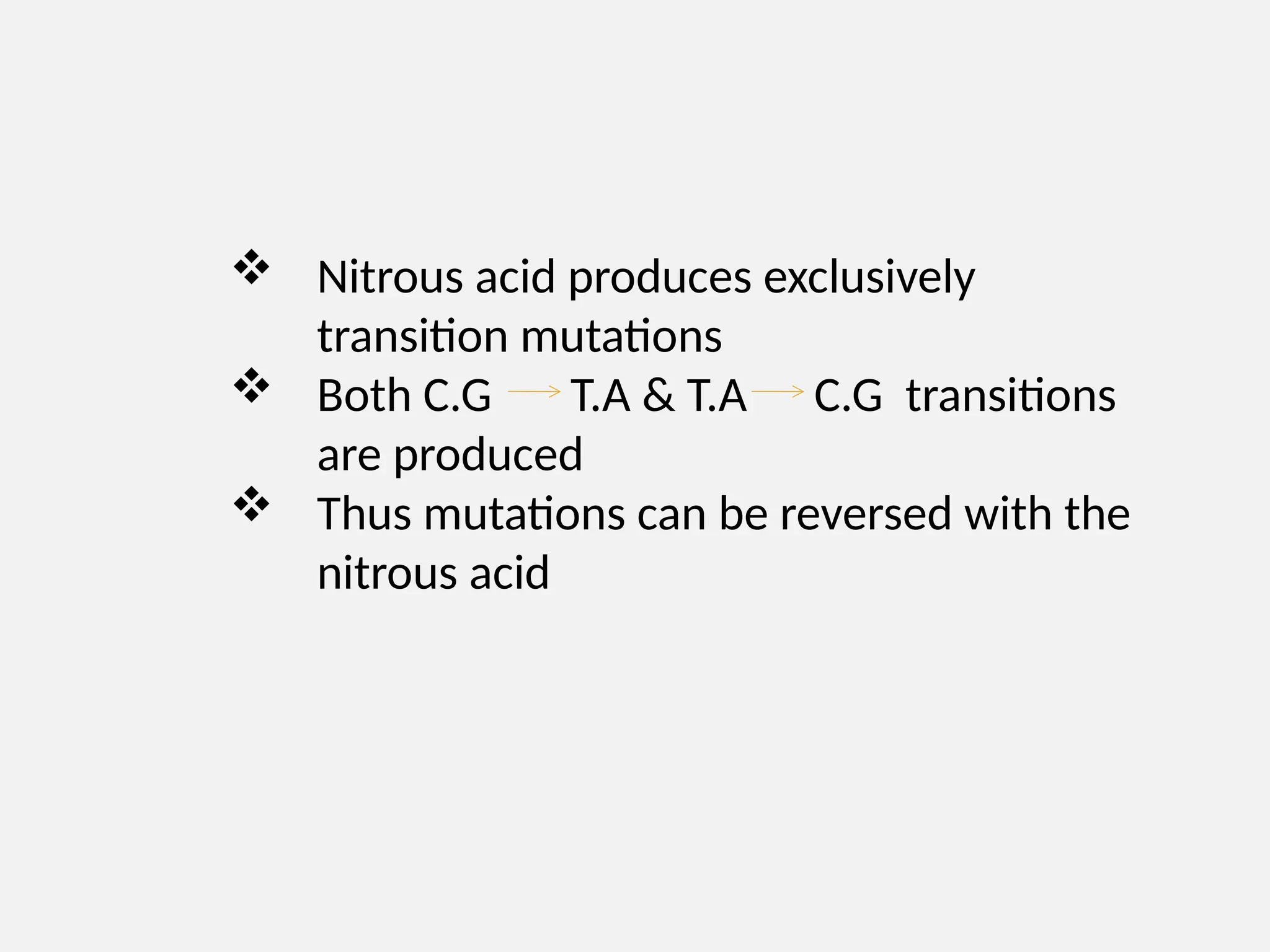
 Nitrous acid produces exclusively
transition mutations
 Both C.G T.A & T.A C.G transitions
are produced
 Thus mutations can be reversed with the
nitrous acid
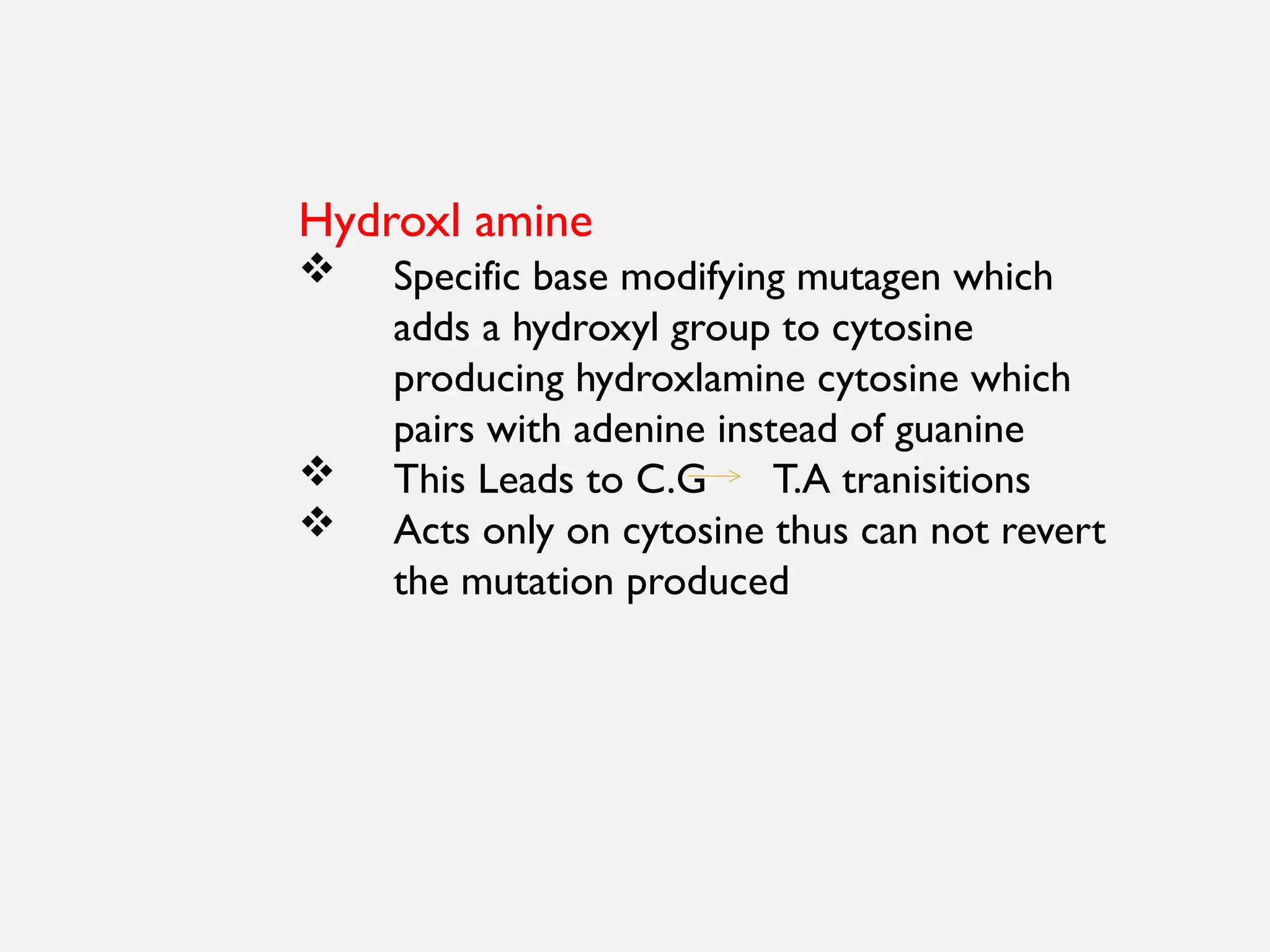
Hydroxl amine
 Specific base modifying mutagen which
adds a hydroxyl group to cytosine
producing hydroxlamine cytosine which
pairs with adenine instead of guanine
 This Leads to C.G T.A tranisitions
 Acts only on cytosine thus can not revert
the mutation produced
hC
G
hC
G
hC
A
G
C
hC A
hC
A
T
A
T.A
C.G
C
G
5’ 3’
3’ 5’
5’ 3’
3’ 5’
5’ 3’
3’ 5’
5’ 3’
3’ 5’
3’ 5’
5’ 3’
5’ 5’
3’
3’
3’
5’
5’ 3’
3’ 3’
5’
5’
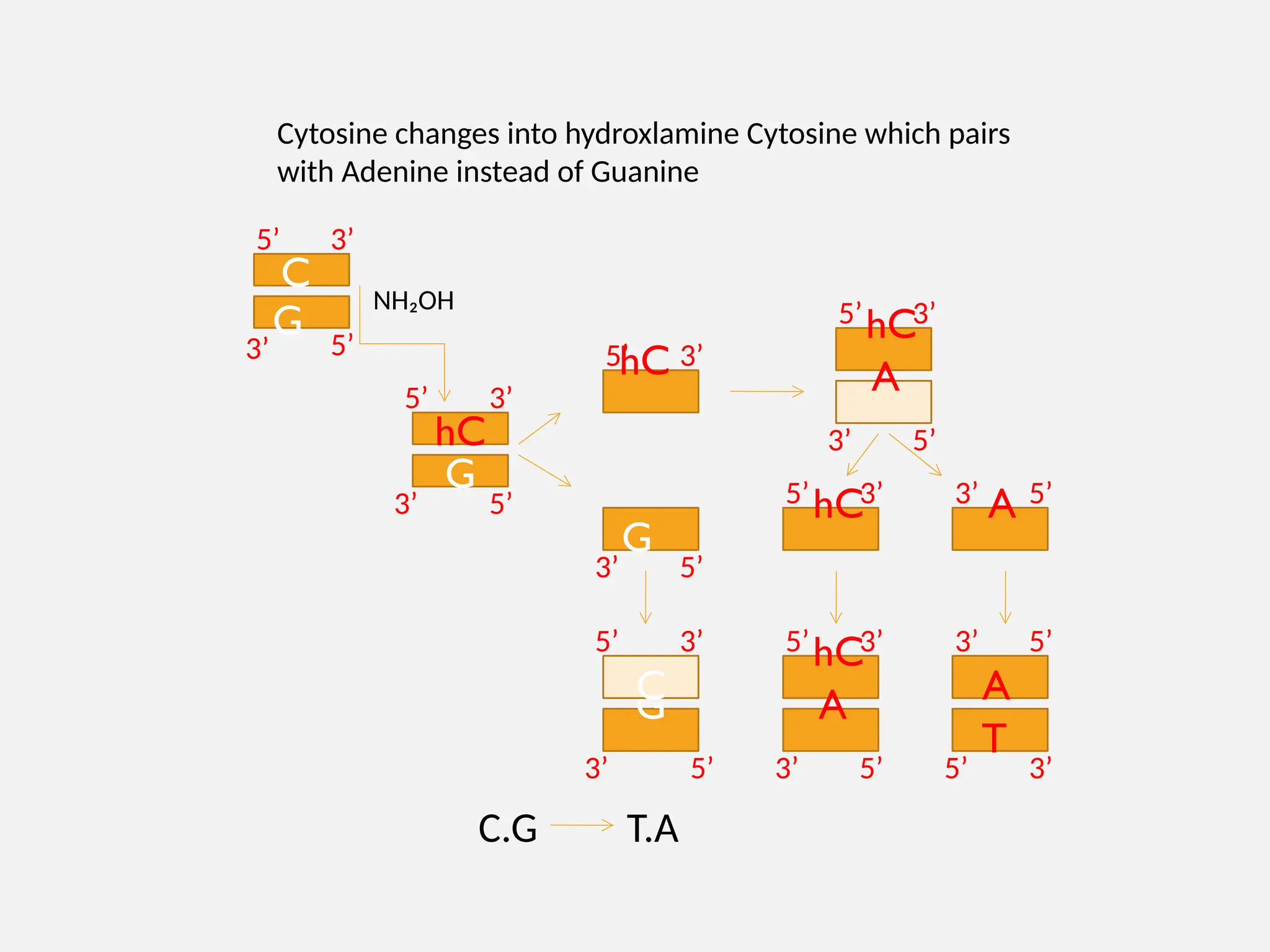
Cytosine changes into hydroxlamine Cytosine which pairs
with Adenine instead of Guanine
NH₂OH
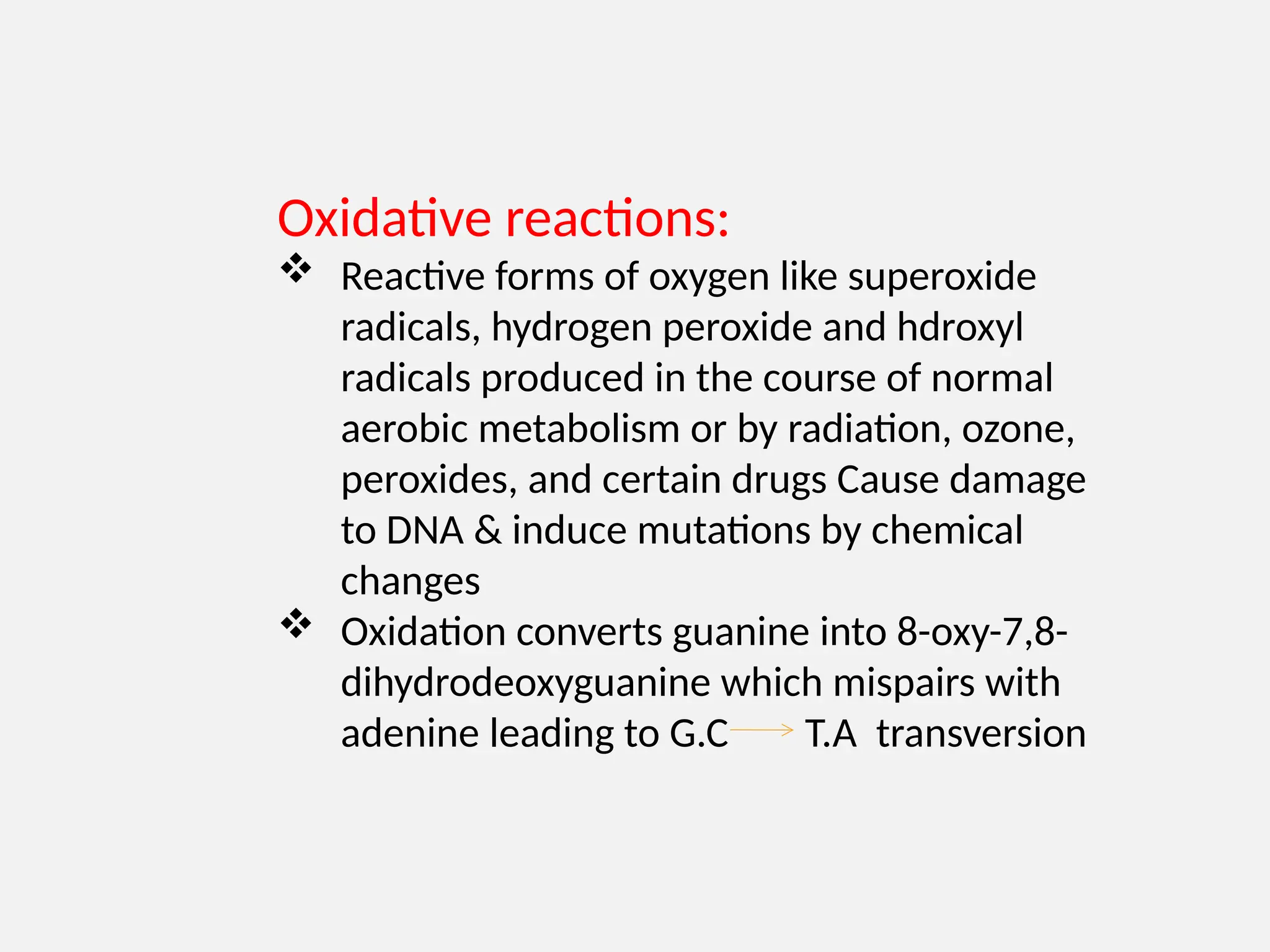
Oxidative reactions:
 Reactive forms of oxygen like superoxide
radicals, hydrogen peroxide and hdroxyl
radicals produced in the course of normal
aerobic metabolism or by radiation, ozone,
peroxides, and certain drugs Cause damage
to DNA & induce mutations by chemical
changes
 Oxidation converts guanine into 8-oxy-7,8-
dihydrodeoxyguanine which mispairs with
adenine leading to G.C T.A transversion
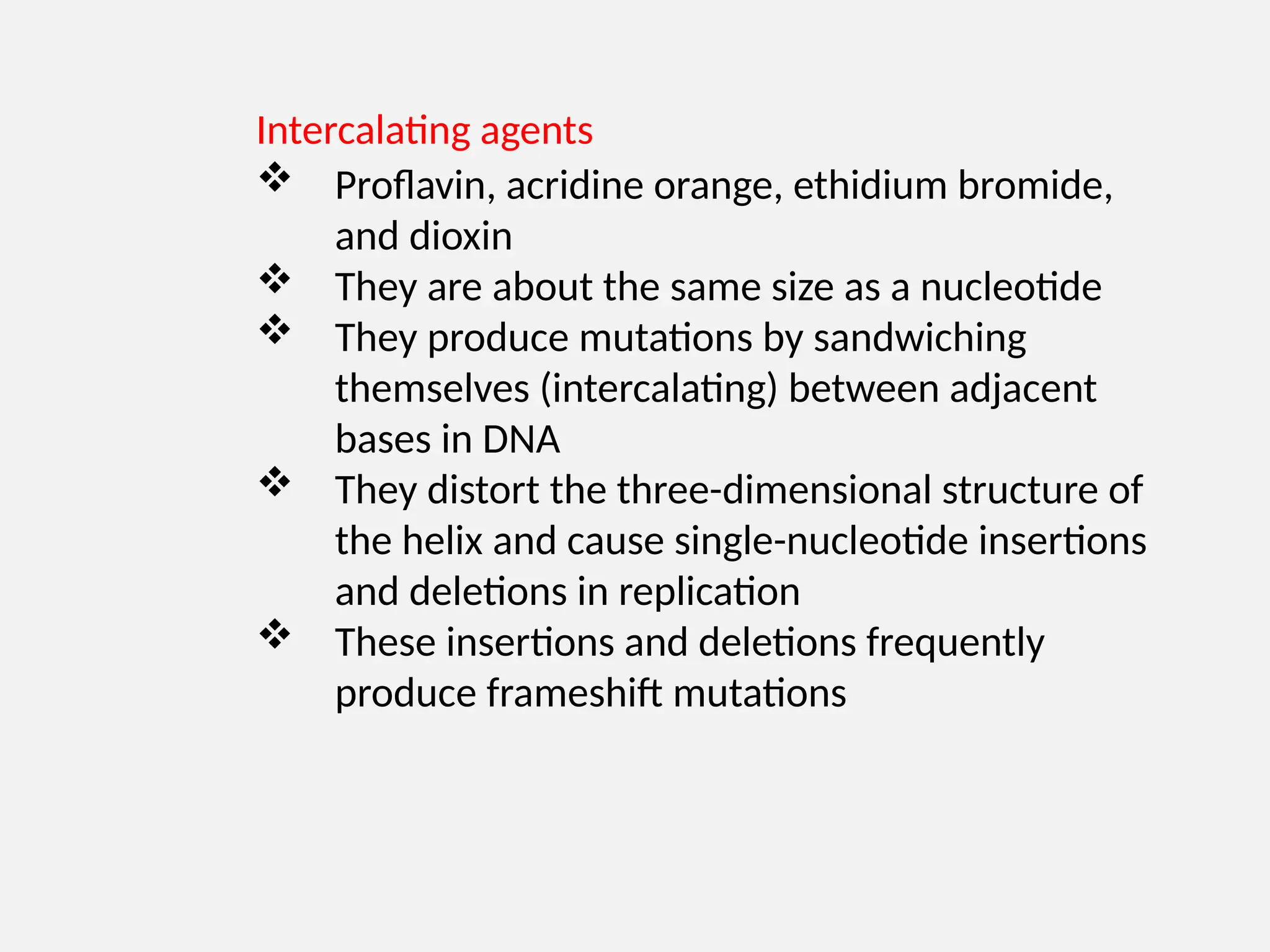
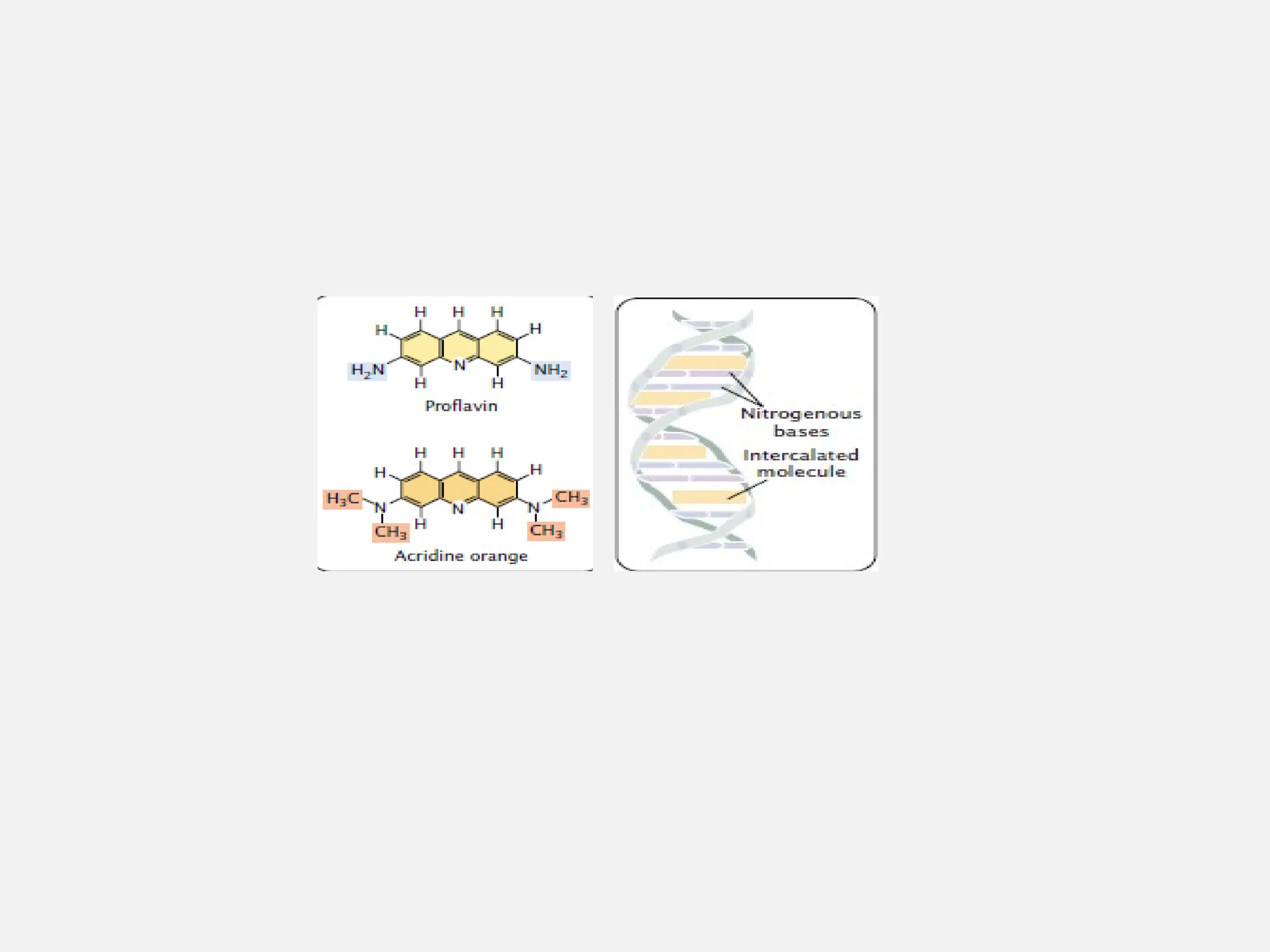
Intercalating agents
 Proflavin, acridine orange, ethidium bromide,
and dioxin
 They are about the same size as a nucleotide
 They produce mutations by sandwiching
themselves (intercalating) between adjacent
bases in DNA
 They distort the three-dimensional structure of
the helix and cause single-nucleotide insertions
and deletions in replication
 These insertions and deletions frequently
produce frameshift mutations
Radiations:
Ionizing radiations:
 In 1927, Herman Muller demonstrated that
mutations could be induced by X-rays.
 X-rays, gamma rays, and cosmic rays are all
capable of penetrating tissues and damaging
DNA.
 They remove electrons from the atoms that
they encounter, changing stable molecules into
free radicals and reactive ions which then alter
the structures of bases and break
phosphodiester bonds in DNA.
 Ionizing radiation also frequently results in
double-strand breaks in DNA.
Mutation rates
 The frequency with which a gene changes
from the wild type to a mutant is reffered to
as the mutation rate.
 Expressed as the number of mutations per
biological unit i.e. mutations per cell division,
per gamete per round of replication
e.g. mutation rate for achondroplasia
(hereditary dwarfism) is about 4 mutations per
100,000 gametes
Mutation frequency:
 Incidence of a specific type of
mutation with in a group of
individual organism
e.g. for achondroplasia, the mutation
frequency in united states is about
2x10⁻⁴
THANKS

mutation-causes,types ,mechanism and uses

  • 1.
  • 2.
     Any suddenchange occurring in hereditary material is called as mutation  They may be harmful, beneficial or neutral
  • 3.
     In multicellularorganism, two broad categories of mutations: Somatic mutations & germ line mutations
  • 4.
    Somatic mutations  Arisein the somatic cells  Passed on to other cells through the process of mitosis  Effect of these mutations depends on the type of the cell in which they occur & the developmental stage of the organism  If occurs early in development, larger the clone of the mutated cells
  • 5.
    Germ line mutations They occur in the cells that produce gametes  Passed on to future generations  In multicellular organisms, the term mutation is generally used for germ line mutations
  • 6.
    Some Facts  Termmutation was given by Devries in 1901 while studying evening primerose Oenothera lamarckiana  Most of these were chromosomal variations  Some were point variations  Originally the term mutation was given to both chromosomal as well as point mutations
  • 7.
    Cont.  Recently chromosomalmutations are studied separately  The term mutation is now given only to point mutations
  • 8.
    Definition  DNA isa highly stable molecule that replicates with amazing accuracy  Some errors of replication do occur  A mutation is defined as an inherited change in genetic information
  • 9.
    Types of genemutation Number of ways to classify gene mutations:  On the basis of the molecular nature of the defect  On the nature of the phenotypic effect-- amino acid sequence of the protein is altered or not  On the basis of the causative agent of the mutation
  • 10.
    Mutations on thebasis of the molecular nature of the defect:  Base substitution  Insertions & deletions
  • 11.
    Base substitution:  Simplesttype of gene mutation  Involves the alteration of a single nucleotide in the DNA
  • 12.
    A base substitutionusually leads to base pair substitution GGG AGT GTA GAT CGT CCC TCA CAT CTA GCA CCC TCA CAT CTA GCA GGG AGT GCA GAT CGT A base substitution CCC TCA CGT CTA GCA GGG AGT GCA GAT CGT GGG AGT GTA GAT CGT CCC TCA CAT CTA GCA First cycle of DNA replication
  • 13.
    Base substitution isof two types: Transition: Purine is replaced with a purine Pyrimidine is replaced with a pyrimidine A T T C C G G A
  • 14.
    Transversions: A purine isreplaced by a pyrimidine A C A T G G C T C G C A T G T A or a pyrimidine is replaced by a purine
  • 15.
    The number ofpossible transversions is twice the number of possible transitions But Transitions are usually more frequent in vivo
  • 16.
    Insertions & deletions: 2nd major class of gene mutation  Addition or the removal, respectively, of one or more nucleotide pair  Usually changes the reading frame, altering all amino acids encoded by codons following the mutation  Also called as frame shift mutations
  • 17.
    cont.  Additions ordeletions in the multiples of three nucleotides will lead to addition or deletion of one or more amino acids  These mutations are called in-frame insertions and deletions, respectively.
  • 18.
    Mutations on thebasis of the Phenotypic effects of mutations:  Most common phenotype in natural populations of the organism is called as wild type phenotype  The effect of mutation is considered with reference to wild type phenotype
  • 19.
    Forward mutation:  amutation that alters the wild type phenotype Reverse mutation (reversion):  a mutation that changes a mutant phenotype back in to the wild type
  • 20.
    Missense mutation: abase is substituted that alters a codon in the mRNA resulting in a different amino acid in the protein product TCA AGT UCA TTA AAT UUA Ser Leu
  • 21.
    Nonsense mutation: changesa sense codon into a nonsense codon. Nonsense mutation early in the mRNA sequence produces a greatly shortened & usually nonfunctional protein TCA AGT UCA TGA ACT UGA Ser Stop codon
  • 22.
    Silent mutation: altersa codon but due to degeneracy of the codon, same amino acid is specified TCA AGT UCA TCG AGC UCG Ser Ser
  • 23.
    Neutral mutation: mutationthat alters the amino acid sequence of the protein but does not change its function as replaced amino acid is chemically similar or the affected aa has little influence on protein function. CTT GAA CUU ATT TAA AUU Leu Ile
  • 24.
    Loss of functionmutations:  Complete or partial loss of the normal function  Structure of protein is so altered that it no longer works correctly  Mutation can occur in regulatory region that affects transcription , translation or spilicing of the protein  Frequently recessive
  • 25.
    Gain of functionmutations:  Produces an entirely new trait  Causes a trait to appear in inappropriate tissues or at inappropriate times in development  Frequently dominant
  • 26.
    Conditional mutations:  Expressedonly under certain conditions Lethal mutations:  Cause the death of the organism
  • 27.
    Suppressor mutation:  Suppressesthe effect of other mutation  Occurs at a site different from the site of original mutation  Organism with a suppressor mutation is a double mutant but exhibits the phenotype of un mutated wild type  Different from reverse mutation in which mutated site is reverted back into the wild type sequence
  • 28.
    On the basisof Causative agent of mutation: Spontaneous:  Mutations that result from natural changes in DNA Induced:  Results from changes caused By environmental chemicals & radiations  Any environmental agent that increases the rate of mutation above the spontaneous is called a mutagen such as chemicals & radiations
  • 29.
    Chemical Mutagens:  Firstdiscovery of a chemical mutagen was made by Charlotte Auerbach Base Analogs:  Chemicals with structures similar to that of any of the four standard bases of DNA  DNA polymerases cannot distinguish these analogs  They may be incorporated into newly synthesized DNA molecules
  • 30.
    5-bromouracil an analog ofthymine N N 1 2 3 6 5 4 O O 5BU Br N N 1 2 3 6 5 4 CH₃ T O O
  • 31.
  • 32.
  • 33.
    GA C CT G Strand seperation 3’ 5’ 3’ 5’ GA C 3’ 5’ CT G 5’3’ GA C 3’ 5’ CB G 5’ 3’ CT G 5’ 3’ GA C 3’ 5’ GA C 3’ 5’ CB G 5’ 3’ GA C 3’ 5’ CT G 5’ 3’ CB G 5’ 3’ GG C 3’ 5’ CB G 5’ 3’ GG C 3’ 5’ CB G 5’ 3’ GA C 3’ 5’ GG C 3’ 5’ CCG 5’ 3’ replication Incorporated error
  • 34.
  • 35.
    2-amino purine (P) Base analog of adenine  Normally pairs with thymine  May mispair with cytosine  Causes a transition mutation
  • 36.
    GT C CA G Strand separation 3’ 5’ 3’ 5’ GT C 3’ 5’ CA G 5’ 3’ GT C 3’ 5’ CP G 5’3’ CA G 5’ 3’ GT C 3’ 5’ GT C 3’ 5’ CP G 5’ 3’ GT C 3’ 5’ CA G 5’ 3’ CP G 5’ 3’ GC C 3’ 5’ CP G 5’ 3’ GC C 3’ 5’ CA G 5’ 3’ GT C 3’ 5’ GC C 3’ 5’ CG G 5’ 3’ replication Incorporated error T.A C.G
  • 37.
  • 38.
  • 39.
     Both baseanalogs produce transition mutations  Mutations by base analogs can be reversed by treatment with the same analog or different analog
  • 40.
    Alkylating agents: Chemicals thatdonate alkyl groups e.g. ehylmethanesulfonate(EMS)  It adds an ethyl group to guanine and produces 6- ethylguanine, which pairs with thymine and leads to CG:TA transitions  Also adds an ethyl group to thymine to produce 4- ethylthymine, which then pairs with guanine, leading to a TA:CG transition  Mutations produced by EMS can be reversed by additional treatment with EMS. Mustard gas is another alkylating agent.
  • 41.
  • 42.
    Nitrous acid: causesdeamination Cytosine Uracil N N CYTOSINE 1 2 3 6 5 4 NH2 O H N N 1 2 3 6 5 4 O o HNo2 URACIL H
  • 43.
    U G U G U A G C U A U A A T C.G TA C G HNO2 5’3’ 3’ 5’ 5’ 3’ 3’ 5’ 5’ 3’ 3’ 5’ 5’ 3’ 3’ 5’ 3’ 5’ 5’ 3’ 5’ 5’ 3’ 3’ 3’ 5’ 5’ 3’ 3’ 3’ 5’ 5’
  • 44.
    H T H T H C A T H C H C G C A.T G.C A THNO2 5’ 3’ 3’ 5’ 5’ 3’ 3’ 5’ 5’ 3’ 3’ 5’ 5’ 3’ 3’ 5’ 3’ 5’ 5’ 3’ 5’ 5’ 3’ 3’ 3’ 5’ 5’ 3’ 3’ 3’ 5’ 5’ Adenine changes into Hypoxanthin which then pairs with Cytosine
  • 45.
    X C X C X T C G X T X T A T A.T G.C G C HNO2 5’3’ 3’ 5’ 5’ 3’ 3’ 5’ 5’ 3’ 3’ 5’ 5’ 3’ 3’ 5’ 3’ 5’ 5’ 3’ 5’ 5’ 3’ 3’ 3’ 5’ 5’ 3’ 3’ 3’ 5’ 5’ Guanine changes into Xanthin which pairs with Cytosine. Xanthin can also pair with Thymine
  • 46.
     Nitrous acidproduces exclusively transition mutations  Both C.G T.A & T.A C.G transitions are produced  Thus mutations can be reversed with the nitrous acid
  • 47.
    Hydroxl amine  Specificbase modifying mutagen which adds a hydroxyl group to cytosine producing hydroxlamine cytosine which pairs with adenine instead of guanine  This Leads to C.G T.A tranisitions  Acts only on cytosine thus can not revert the mutation produced
  • 48.
    hC G hC G hC A G C hC A hC A T A T.A C.G C G 5’ 3’ 3’5’ 5’ 3’ 3’ 5’ 5’ 3’ 3’ 5’ 5’ 3’ 3’ 5’ 3’ 5’ 5’ 3’ 5’ 5’ 3’ 3’ 3’ 5’ 5’ 3’ 3’ 3’ 5’ 5’ Cytosine changes into hydroxlamine Cytosine which pairs with Adenine instead of Guanine NH₂OH
  • 49.
    Oxidative reactions:  Reactiveforms of oxygen like superoxide radicals, hydrogen peroxide and hdroxyl radicals produced in the course of normal aerobic metabolism or by radiation, ozone, peroxides, and certain drugs Cause damage to DNA & induce mutations by chemical changes  Oxidation converts guanine into 8-oxy-7,8- dihydrodeoxyguanine which mispairs with adenine leading to G.C T.A transversion
  • 50.
    Intercalating agents  Proflavin,acridine orange, ethidium bromide, and dioxin  They are about the same size as a nucleotide  They produce mutations by sandwiching themselves (intercalating) between adjacent bases in DNA  They distort the three-dimensional structure of the helix and cause single-nucleotide insertions and deletions in replication  These insertions and deletions frequently produce frameshift mutations
  • 52.
    Radiations: Ionizing radiations:  In1927, Herman Muller demonstrated that mutations could be induced by X-rays.  X-rays, gamma rays, and cosmic rays are all capable of penetrating tissues and damaging DNA.  They remove electrons from the atoms that they encounter, changing stable molecules into free radicals and reactive ions which then alter the structures of bases and break phosphodiester bonds in DNA.  Ionizing radiation also frequently results in double-strand breaks in DNA.
  • 53.
    Mutation rates  Thefrequency with which a gene changes from the wild type to a mutant is reffered to as the mutation rate.  Expressed as the number of mutations per biological unit i.e. mutations per cell division, per gamete per round of replication e.g. mutation rate for achondroplasia (hereditary dwarfism) is about 4 mutations per 100,000 gametes
  • 54.
    Mutation frequency:  Incidenceof a specific type of mutation with in a group of individual organism e.g. for achondroplasia, the mutation frequency in united states is about 2x10⁻⁴
  • 55.