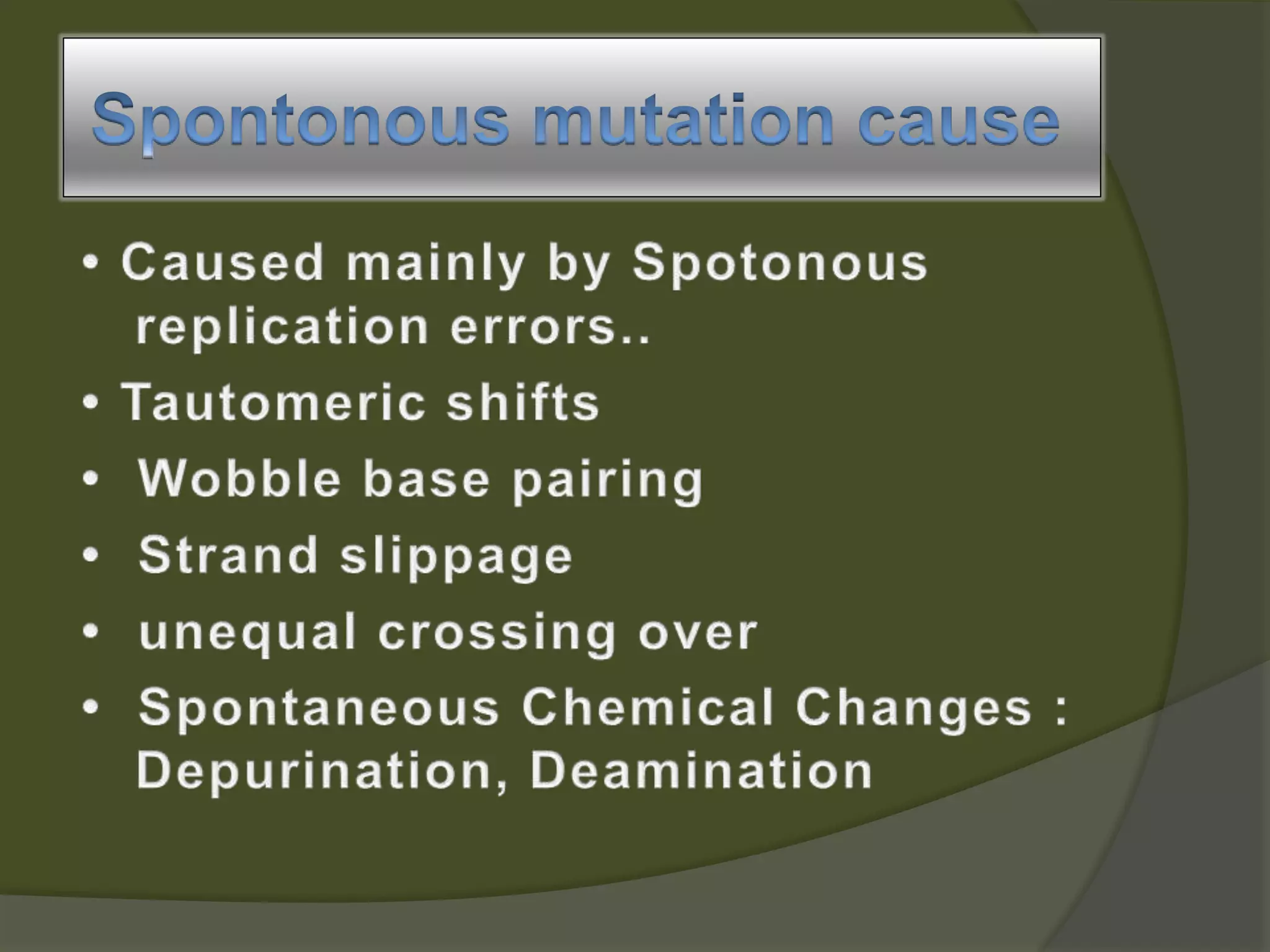
 Spontaneous mutations are the result of errors in
natural biological processes
 The spontaneous mutation rate in eukaryotes is
between 10-4-to-10-6 per gene per generation, and
in bacteria and phages 10-5-to-10-
7/gene/generation.
 Genetic constitution of the organism affects its
mutation rate.
i. In Drosophila, males and females of the same
strain have similar mutation rates.
ii. Flies of different strains, however, may have
different mutation rates. Many spontaneous errors
are corrected by the cellular repair systems, and so
do not become fixed in DNA.
 the loss of an amino group (NH2) from a
base.
 Deamination may occur spontaneously
or be induced by mutagenic chemicals.
 induced mutations are due to agents in
the environment that cause changes in
DNA structure.
 induced mutations are due to agents in
the environment that cause changes in
DNA structure.
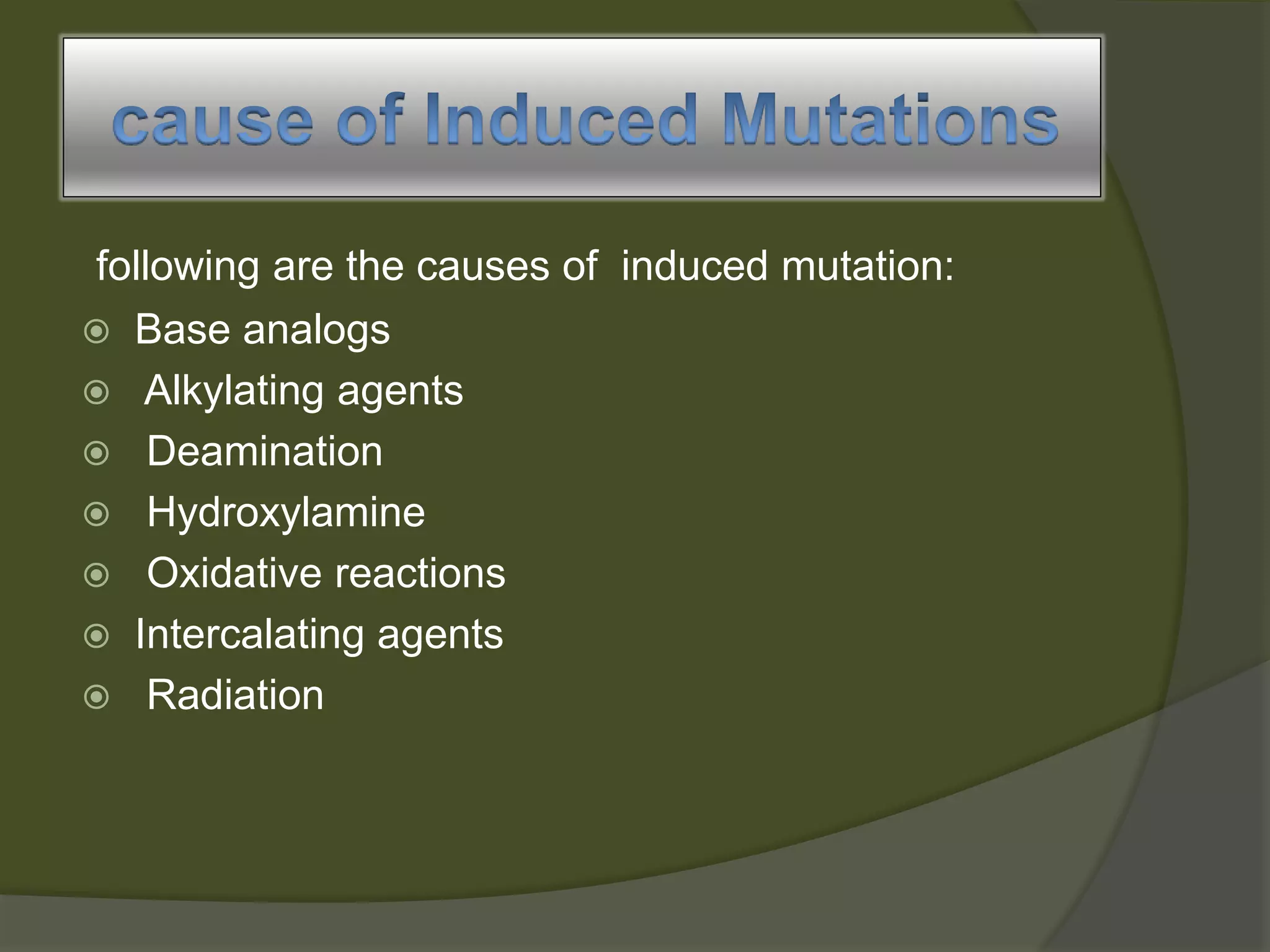
following are the causes of induced mutation:
 Base analogs
 Alkylating agents
 Deamination
 Hydroxylamine
 Oxidative reactions
 Intercalating agents
 Radiation
 chemicals with structures similar to that of any
of the four standard bases of DNA.
 DNA polymerases cannot distinguish these
analogs from the standard bases;
 so, if base analogs are present during
replication, they may be incorporated into
newly synthesized DNA molecules.
 E.g. 5-Bromouracil
 chemicals that donate alkyl groups. These agents include
methyl (CH3) and ethyl (CH3–CH2) groups, which are added
to nucleotide bases by some chemicals.
 Example, ethylmethanesulfonate (EMS) adds an ethyl group
to guanine, producing 6-ethylguanine, which pairs with
thymine
 In addition to its spontaneous occurrence, deamination can
be induced by some chemicals. •
 E.g.: nitrous acid deaminates cytosine, creating uracil, which
in the next round of replication pairs with adenine producing
a CG:TA transition mutation.
 Hydroxylamine is a very specific base modifying mutagen
that adds a hydroxyl group to cytosine.
 • It converts cytosine intohydroxylaminocytosine .
 This conversion increases the frequency of a rare tautomer.
• The tautomer pairs with adenine instead of guanine and
leads to CG:TA transitions. • Because hydroxylamine acts
only on cytosine, it will not generate TA:CG transitions.

Spontaneous vs induced_mutation_ slideshare

  • 2.
     Spontaneous mutationsare the result of errors in natural biological processes  The spontaneous mutation rate in eukaryotes is between 10-4-to-10-6 per gene per generation, and in bacteria and phages 10-5-to-10- 7/gene/generation.  Genetic constitution of the organism affects its mutation rate. i. In Drosophila, males and females of the same strain have similar mutation rates. ii. Flies of different strains, however, may have different mutation rates. Many spontaneous errors are corrected by the cellular repair systems, and so do not become fixed in DNA.
  • 6.
     the lossof an amino group (NH2) from a base.  Deamination may occur spontaneously or be induced by mutagenic chemicals.
  • 7.
     induced mutationsare due to agents in the environment that cause changes in DNA structure.  induced mutations are due to agents in the environment that cause changes in DNA structure.
  • 8.
    following are thecauses of induced mutation:  Base analogs  Alkylating agents  Deamination  Hydroxylamine  Oxidative reactions  Intercalating agents  Radiation
  • 9.
     chemicals withstructures similar to that of any of the four standard bases of DNA.  DNA polymerases cannot distinguish these analogs from the standard bases;  so, if base analogs are present during replication, they may be incorporated into newly synthesized DNA molecules.  E.g. 5-Bromouracil
  • 10.
     chemicals thatdonate alkyl groups. These agents include methyl (CH3) and ethyl (CH3–CH2) groups, which are added to nucleotide bases by some chemicals.  Example, ethylmethanesulfonate (EMS) adds an ethyl group to guanine, producing 6-ethylguanine, which pairs with thymine
  • 11.
     In additionto its spontaneous occurrence, deamination can be induced by some chemicals. •  E.g.: nitrous acid deaminates cytosine, creating uracil, which in the next round of replication pairs with adenine producing a CG:TA transition mutation.
  • 12.
     Hydroxylamine isa very specific base modifying mutagen that adds a hydroxyl group to cytosine.  • It converts cytosine intohydroxylaminocytosine .  This conversion increases the frequency of a rare tautomer. • The tautomer pairs with adenine instead of guanine and leads to CG:TA transitions. • Because hydroxylamine acts only on cytosine, it will not generate TA:CG transitions.