T.Rajeshwari
Maris Stella College
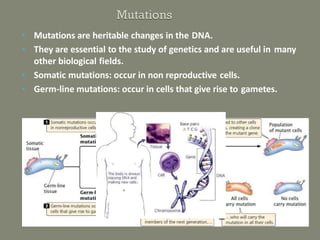
• Mutations are heritable changes in the DNA.
• They are essential to the study of genetics and are useful in many
other biological fields.
• Somatic mutations: occur in non reproductive cells.
• Germ-line mutations: occur in cells that give rise to gametes.
Mutations that are a result of natural changes in DNA structure.
1. All types of point mutations can occur spontaneously,
during S, G1 and G2 phases of the cell cycle, or by the
movement of transposons.
2. The spontaneous mutation rate in eukaryotes is between
10-4-to-10-6 per gene per generation, and in bacteria and
phages 10-5-to-10-7/gene/generation.
a. Genetic constitution of the organism affects its mutation rate.
i. In Drosophila, males and females of the same strain have
similar mutation rates.
ii.Flies of different strains, however, may have different
mutation rates.
a. Many spontaneous errors are corrected by the cellular repair
systems, and so do not become fixed in DNA.
• Caused mainly by: Spntaneous replication errors..
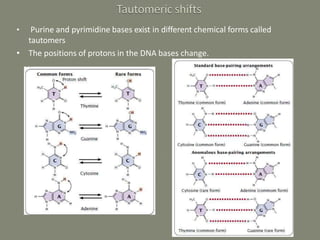
• 1.Tautomeric shifts
• 2. Wobble base pairing
• 3. Strand slippage
• 4. unequal crossing over
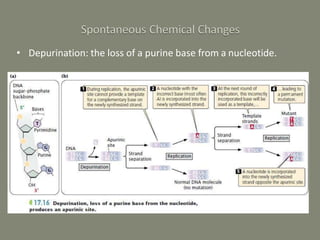
• 5. Spontaneous Chemical Changes : Depurination,
Deamination
• Purine and pyrimidine bases exist in different chemical forms called
tautomers
• The positions of protons in the DNA bases change.
• Depurination: the loss of a purine base from a nucleotide.
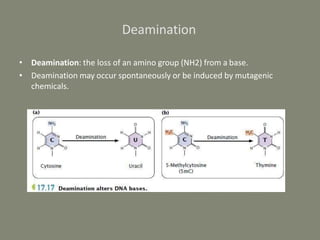
• Deamination: the loss of an amino group (NH2) from a base.
• Deamination may occur spontaneously or be induced by mutagenic
chemicals.
• Mutations those that result from changes caused by environmental
 chemicals or radiation are called as induced mutations.
• A number of environmental agents are capable of damaging DNA
including certain chemicals and radiation.
• Mutagen:Any environmental agent that significantly increases the
rate of
 mutation above the spontaneous rate.
• The first discovery of a chemical mutagen was made by
Charlotte Auerbach.
Caused by;
• Base analogs
• Alkylating agents
• Deamination
• Hydroxylamine
• Oxidative reactions
• Intercalating agents
• Radiation
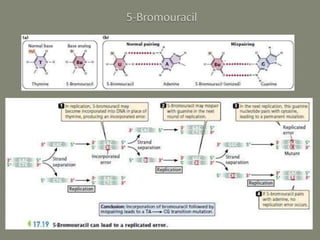
• chemicals with structures similar to that of any of the four standard bases
of DNA.
• DNA polymerases cannot distinguish these analogs from the standard
bases;
• so, if base analogs are present during replication, they may be
incorporated into newly synthesized DNA molecules.
• Eg. 5-Bromouracil
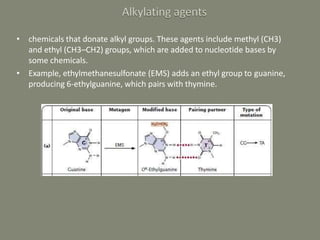
• chemicals that donate alkyl groups. These agents include methyl (CH3)
and ethyl (CH3–CH2) groups, which are added to nucleotide bases by
some chemicals.
• Example, ethylmethanesulfonate (EMS) adds an ethyl group to guanine,
producing 6-ethylguanine, which pairs with thymine.
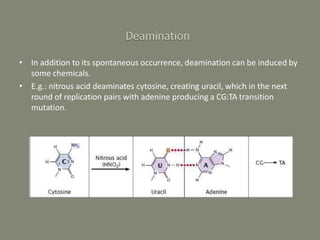
• In addition to its spontaneous occurrence, deamination can be induced by
some chemicals.
• E.g.: nitrous acid deaminates cytosine, creating uracil, which in the next
round of replication pairs with adenine producing a CG:TA transition
mutation.
• Hydroxylamine is a very specific base modifying mutagen that adds a
hydroxyl group to cytosine.
• It converts cytosine into hydroxylaminocytosine .
• This conversion increases the frequency of a rare tautomer.
• The tautomer pairs with adenine instead of guanine and leads to CG:TA
transitions.
• Because hydroxylamine acts only on cytosine, it will not generate TA:CG
transitions.
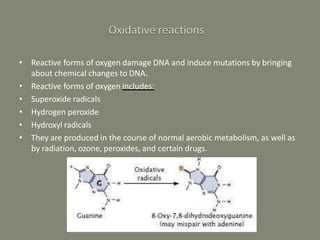
• Reactive forms of oxygen damage DNA and induce mutations by bringing
about chemical changes to DNA.
• Reactive forms of oxygen includes:
• Superoxide radicals
• Hydrogen peroxide
• Hydroxyl radicals
• They are produced in the course of normal aerobic metabolism, as well as
by radiation, ozone, peroxides, and certain drugs.
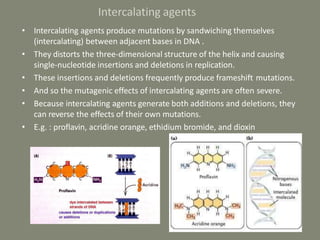
• Intercalating agents produce mutations by sandwiching themselves
(intercalating) between adjacent bases in DNA .
• They distorts the three-dimensional structure of the helix and causing
single-nucleotide insertions and deletions in replication.
• These insertions and deletions frequently produce frameshift mutations.
• And so the mutagenic effects of intercalating agents are often severe.
• Because intercalating agents generate both additions and deletions, they
can reverse the effects of their own mutations.
• E.g. : proflavin, acridine orange, ethidium bromide, and dioxin
• Ionizing radiation breaks covalent bonds including those in DNA and is the
leading cause of chromosome mutations.
• Ionizing radiation also frequently results in double-strand breaks in DNA
• Ionizing radiation has a cumulative effect and kills cells at high doses.
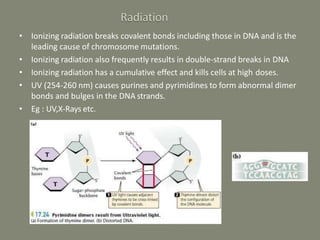
• UV (254-260 nm) causes purines and pyrimidines to form abnormal dimer
bonds and bulges in the DNA strands.
• Eg : UV,X-Rays etc.
Induced and spontaneous mutation

Induced and spontaneous mutation

  • 1.
  • 2.
    • Mutations areheritable changes in the DNA. • They are essential to the study of genetics and are useful in many other biological fields. • Somatic mutations: occur in non reproductive cells. • Germ-line mutations: occur in cells that give rise to gametes.
  • 3.
    Mutations that area result of natural changes in DNA structure. 1. All types of point mutations can occur spontaneously, during S, G1 and G2 phases of the cell cycle, or by the movement of transposons. 2. The spontaneous mutation rate in eukaryotes is between 10-4-to-10-6 per gene per generation, and in bacteria and phages 10-5-to-10-7/gene/generation. a. Genetic constitution of the organism affects its mutation rate. i. In Drosophila, males and females of the same strain have similar mutation rates. ii.Flies of different strains, however, may have different mutation rates. a. Many spontaneous errors are corrected by the cellular repair systems, and so do not become fixed in DNA.
  • 4.
    • Caused mainlyby: Spntaneous replication errors.. • 1.Tautomeric shifts • 2. Wobble base pairing • 3. Strand slippage • 4. unequal crossing over • 5. Spontaneous Chemical Changes : Depurination, Deamination
  • 5.
    • Purine andpyrimidine bases exist in different chemical forms called tautomers • The positions of protons in the DNA bases change.
  • 6.
    • Depurination: theloss of a purine base from a nucleotide.
  • 7.
    • Deamination: theloss of an amino group (NH2) from a base. • Deamination may occur spontaneously or be induced by mutagenic chemicals.
  • 8.
    • Mutations thosethat result from changes caused by environmental  chemicals or radiation are called as induced mutations. • A number of environmental agents are capable of damaging DNA including certain chemicals and radiation. • Mutagen:Any environmental agent that significantly increases the rate of  mutation above the spontaneous rate. • The first discovery of a chemical mutagen was made by Charlotte Auerbach.
  • 9.
    Caused by; • Baseanalogs • Alkylating agents • Deamination • Hydroxylamine • Oxidative reactions • Intercalating agents • Radiation
  • 10.
    • chemicals withstructures similar to that of any of the four standard bases of DNA. • DNA polymerases cannot distinguish these analogs from the standard bases; • so, if base analogs are present during replication, they may be incorporated into newly synthesized DNA molecules. • Eg. 5-Bromouracil
  • 12.
    • chemicals thatdonate alkyl groups. These agents include methyl (CH3) and ethyl (CH3–CH2) groups, which are added to nucleotide bases by some chemicals. • Example, ethylmethanesulfonate (EMS) adds an ethyl group to guanine, producing 6-ethylguanine, which pairs with thymine.
  • 13.
    • In additionto its spontaneous occurrence, deamination can be induced by some chemicals. • E.g.: nitrous acid deaminates cytosine, creating uracil, which in the next round of replication pairs with adenine producing a CG:TA transition mutation.
  • 14.
    • Hydroxylamine isa very specific base modifying mutagen that adds a hydroxyl group to cytosine. • It converts cytosine into hydroxylaminocytosine . • This conversion increases the frequency of a rare tautomer. • The tautomer pairs with adenine instead of guanine and leads to CG:TA transitions. • Because hydroxylamine acts only on cytosine, it will not generate TA:CG transitions.
  • 15.
    • Reactive formsof oxygen damage DNA and induce mutations by bringing about chemical changes to DNA. • Reactive forms of oxygen includes: • Superoxide radicals • Hydrogen peroxide • Hydroxyl radicals • They are produced in the course of normal aerobic metabolism, as well as by radiation, ozone, peroxides, and certain drugs.
  • 16.
    • Intercalating agentsproduce mutations by sandwiching themselves (intercalating) between adjacent bases in DNA . • They distorts the three-dimensional structure of the helix and causing single-nucleotide insertions and deletions in replication. • These insertions and deletions frequently produce frameshift mutations. • And so the mutagenic effects of intercalating agents are often severe. • Because intercalating agents generate both additions and deletions, they can reverse the effects of their own mutations. • E.g. : proflavin, acridine orange, ethidium bromide, and dioxin
  • 17.
    • Ionizing radiationbreaks covalent bonds including those in DNA and is the leading cause of chromosome mutations. • Ionizing radiation also frequently results in double-strand breaks in DNA • Ionizing radiation has a cumulative effect and kills cells at high doses. • UV (254-260 nm) causes purines and pyrimidines to form abnormal dimer bonds and bulges in the DNA strands. • Eg : UV,X-Rays etc.