MUSCLE
CELLS
are excitable cells.
 can transmit action potential
along their cell membrane.
 convert chemical energy
into a mechanical response
Physiologic Properties of Muscle Cells
IRRITABILITY OR
EXCITABILITY
 CONDUCTIVITY
 CONTRACTILITY
THREE MAJOR TYPES OF MUSCLES
TYPES
Striations
Location
SKELETAL
prominent
begins and ends
in a tendon
CARDIAC
less prominent
heart
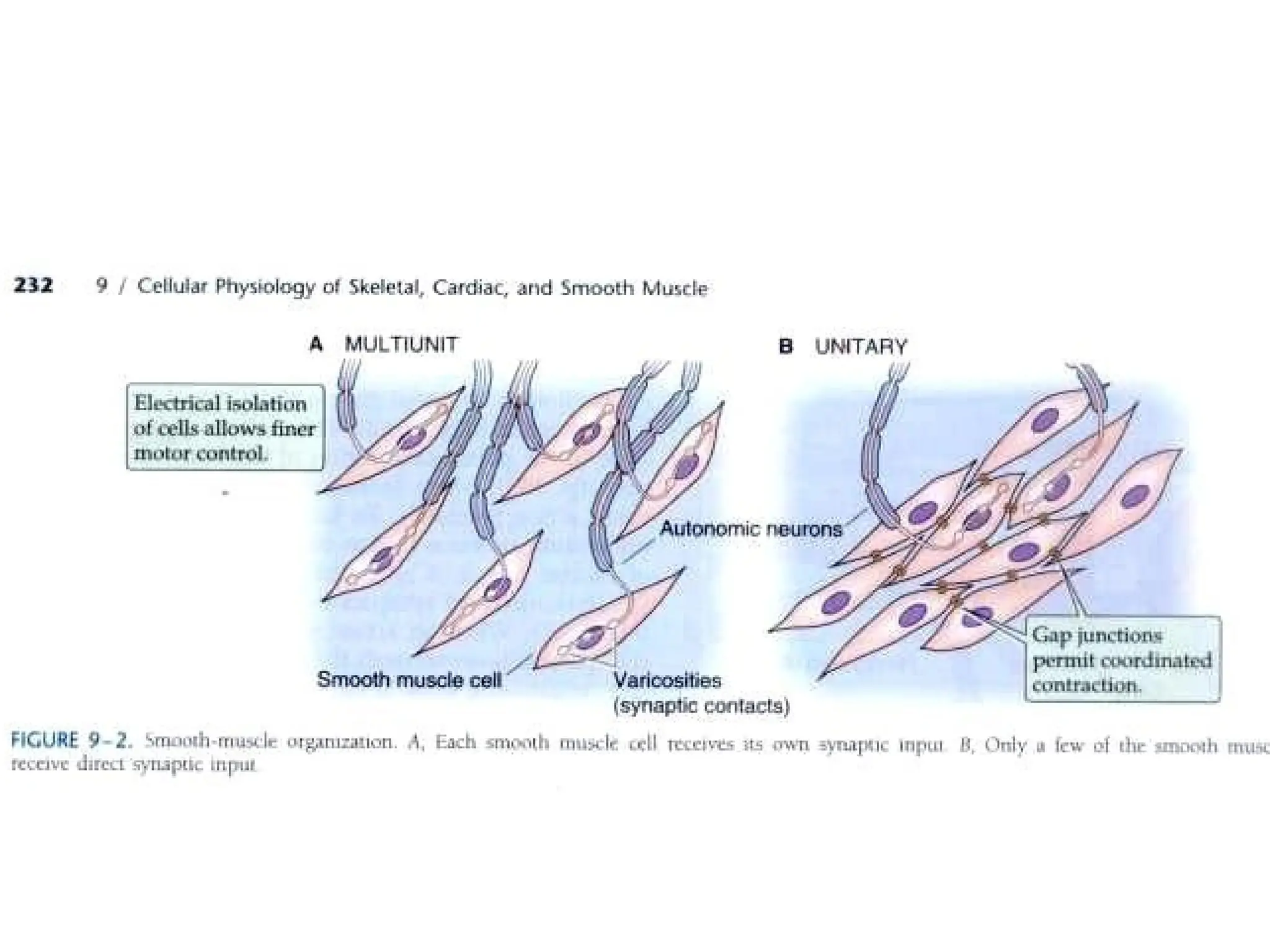
SMOOTH
none
hollow
organ
s/eyes
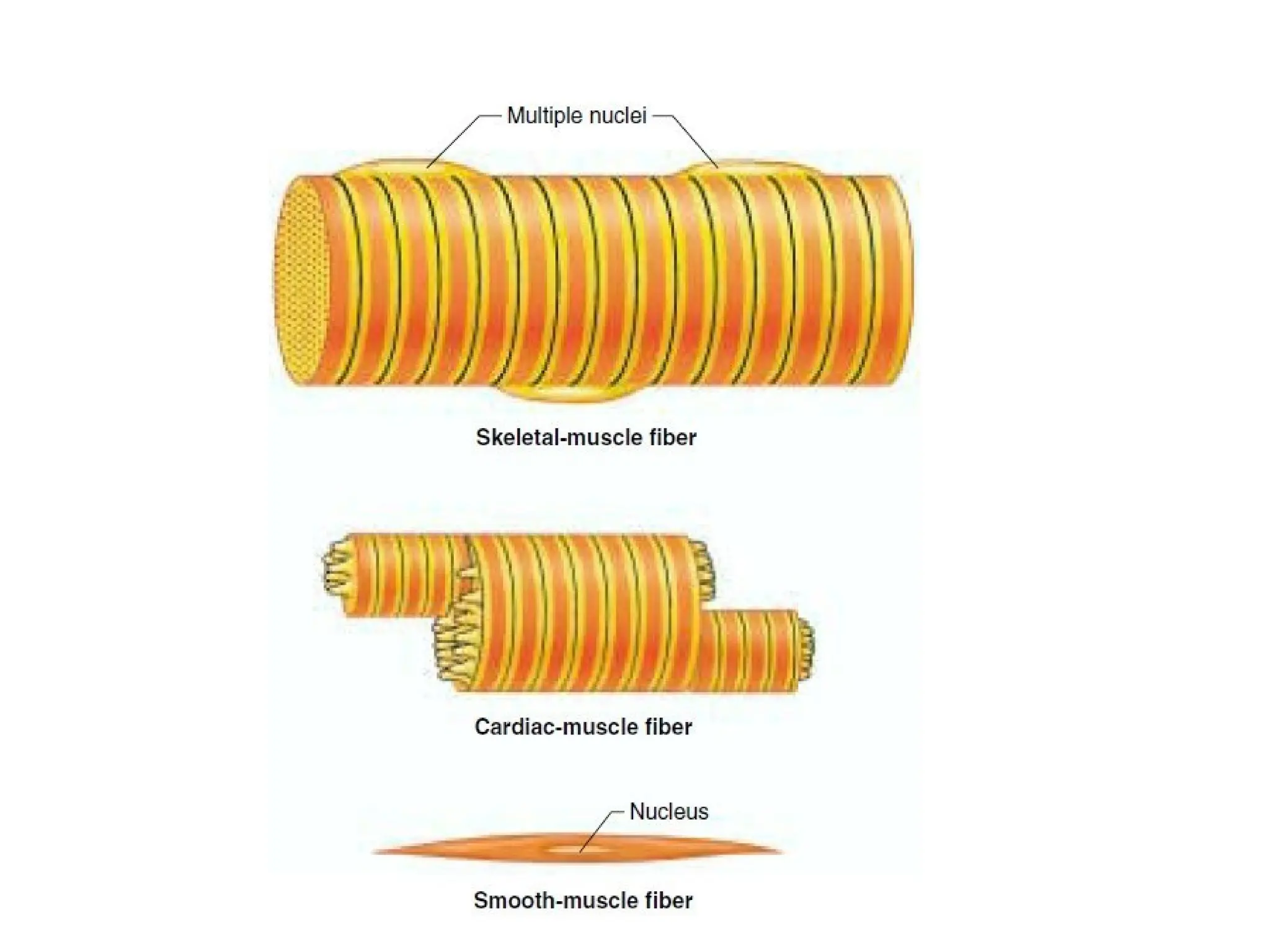
Shape long, cylindrical
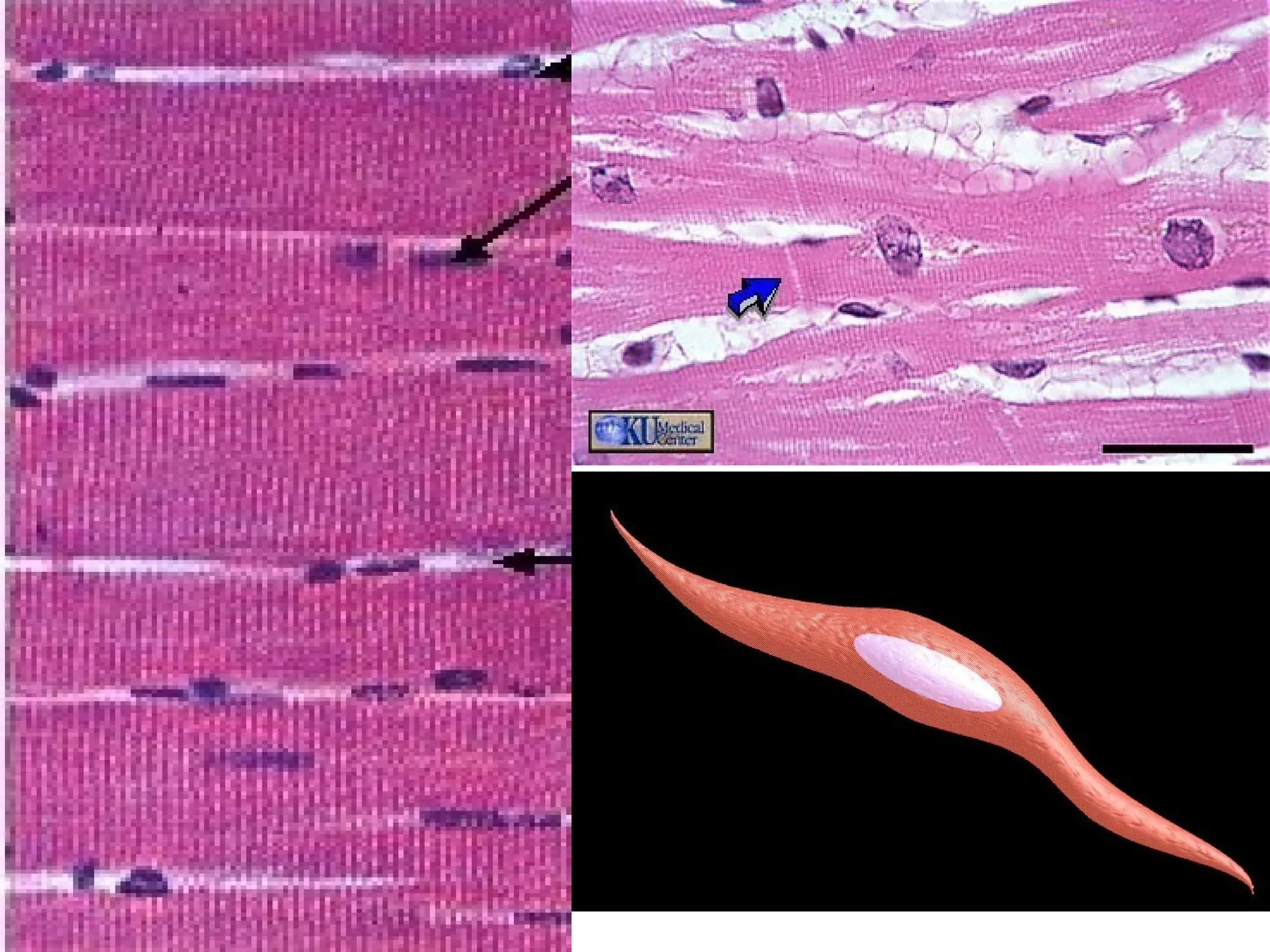
multinucleated
cylindrical
branched
mono/binucleated
present
(Intercalated disc)
spindle-shaped
mononucleated
Anatomical /
functional
connections
Special
features
absent present (unitary)
absent (multiunit)
makes up the great
mass of somatic
musculature
under voluntary
control
pacemaker cells
syncytial function
pacemaker cells
syncytial function
(unitary)
under involuntary
control
Innervation under involuntary
control
Primary
Function
generate a force or movement in
response to a physiological
stimulus by transducing chemical
or electrical stimuli into a
mechanical response.
STRUCTUREOF SKELET
AL
MUSCLE
• Forms 40% of body
weight
• Locomotion
• Striated or voluntary
• Multinucleated
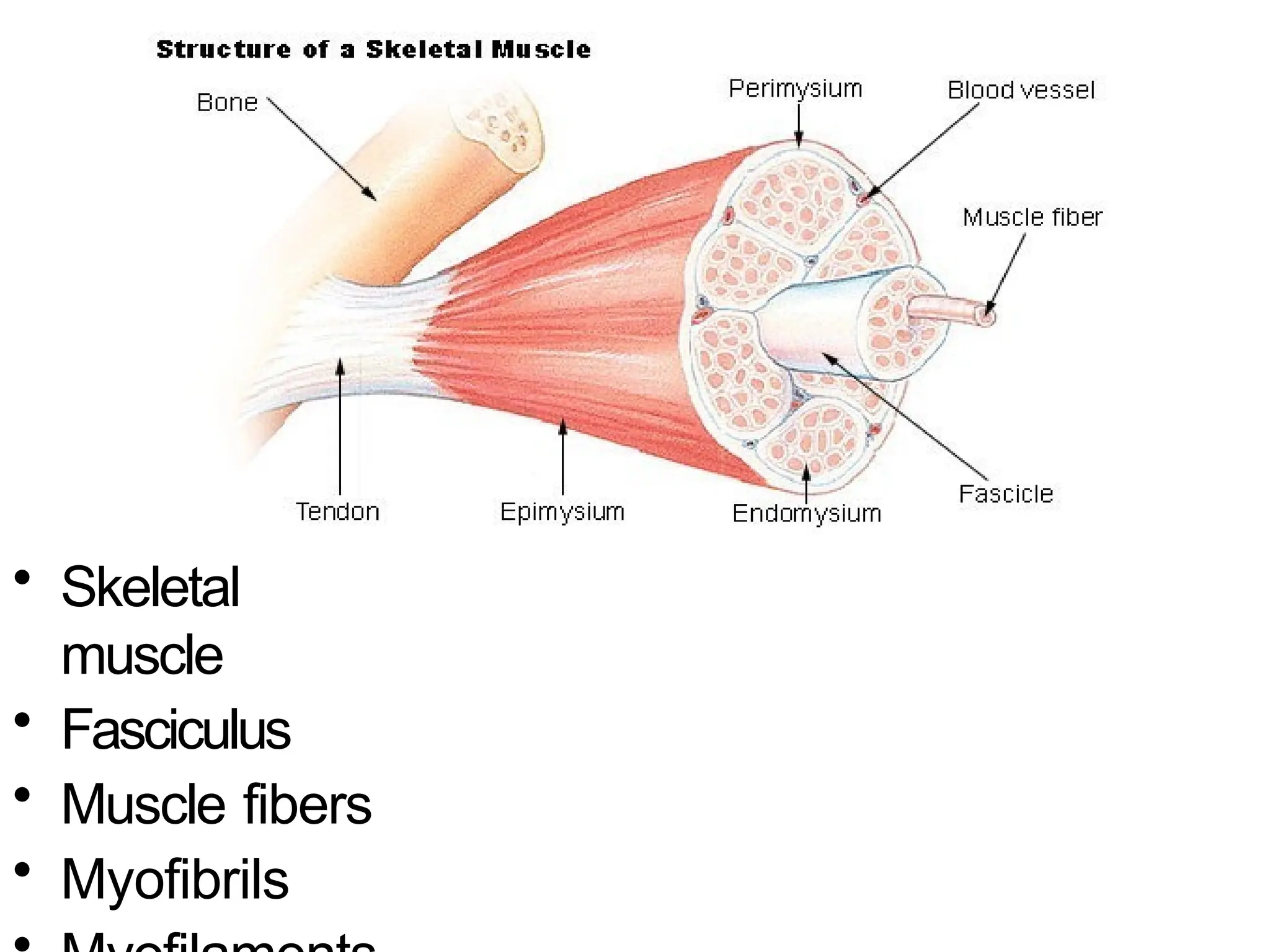
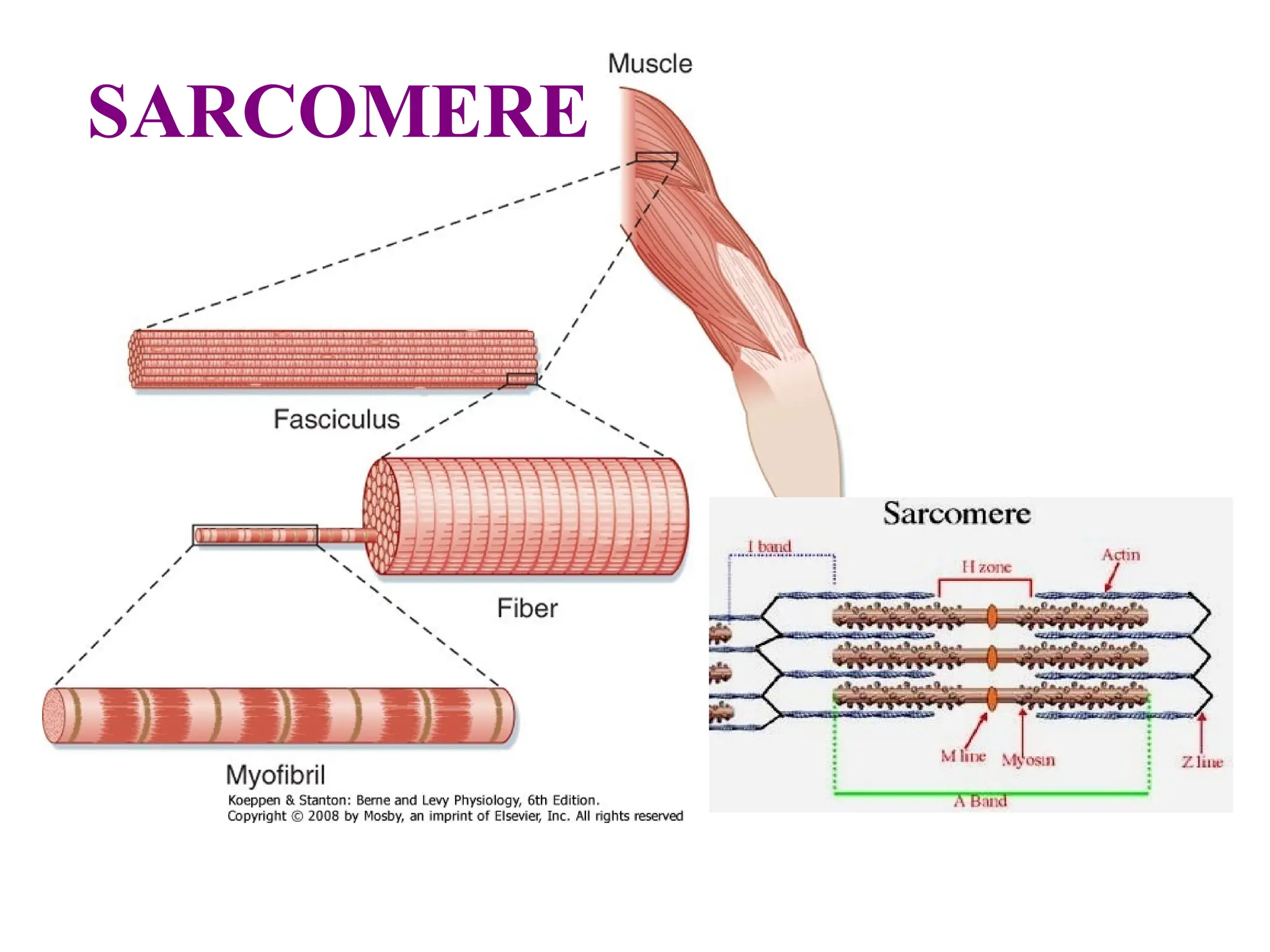
MUSCLE
(Epimysium
)
FASCICULUS
(Perimysium)
MUSCLE FIBER
(Endomysium)
MYOFIBRILS
MYOFILAMENTS
SARCOMERE
SKELETAL MUSCLE
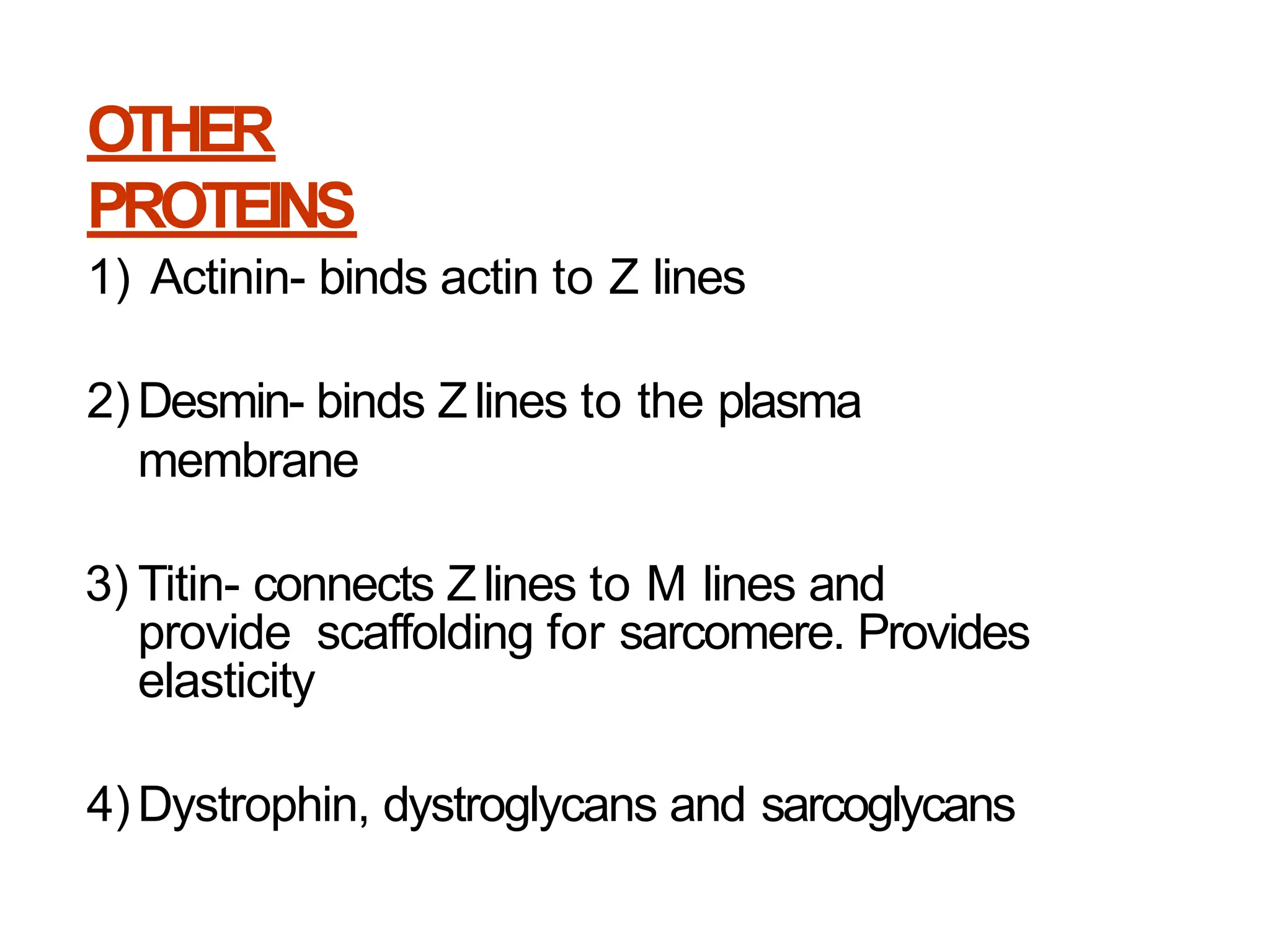
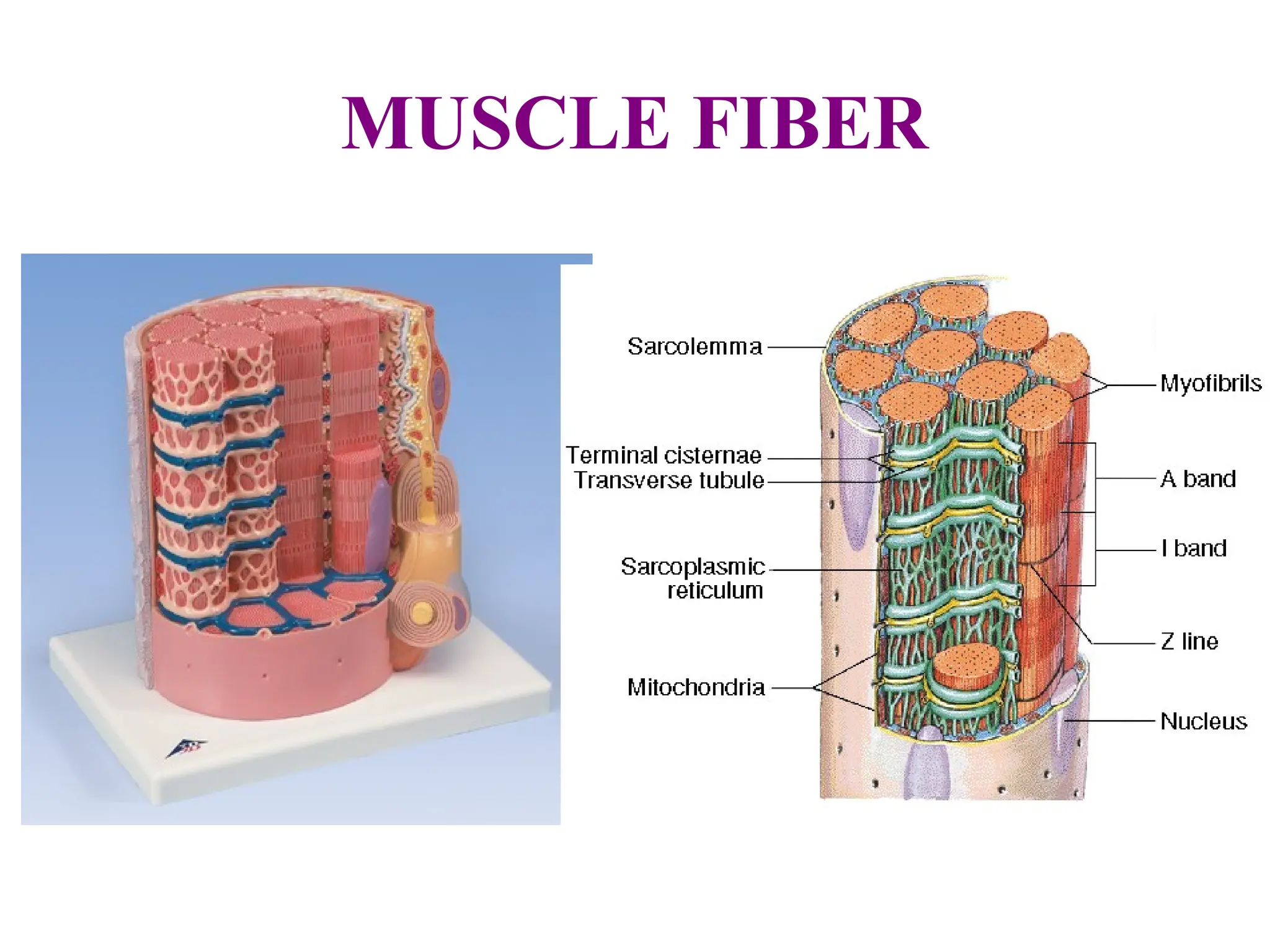
MUSCLE FIBER
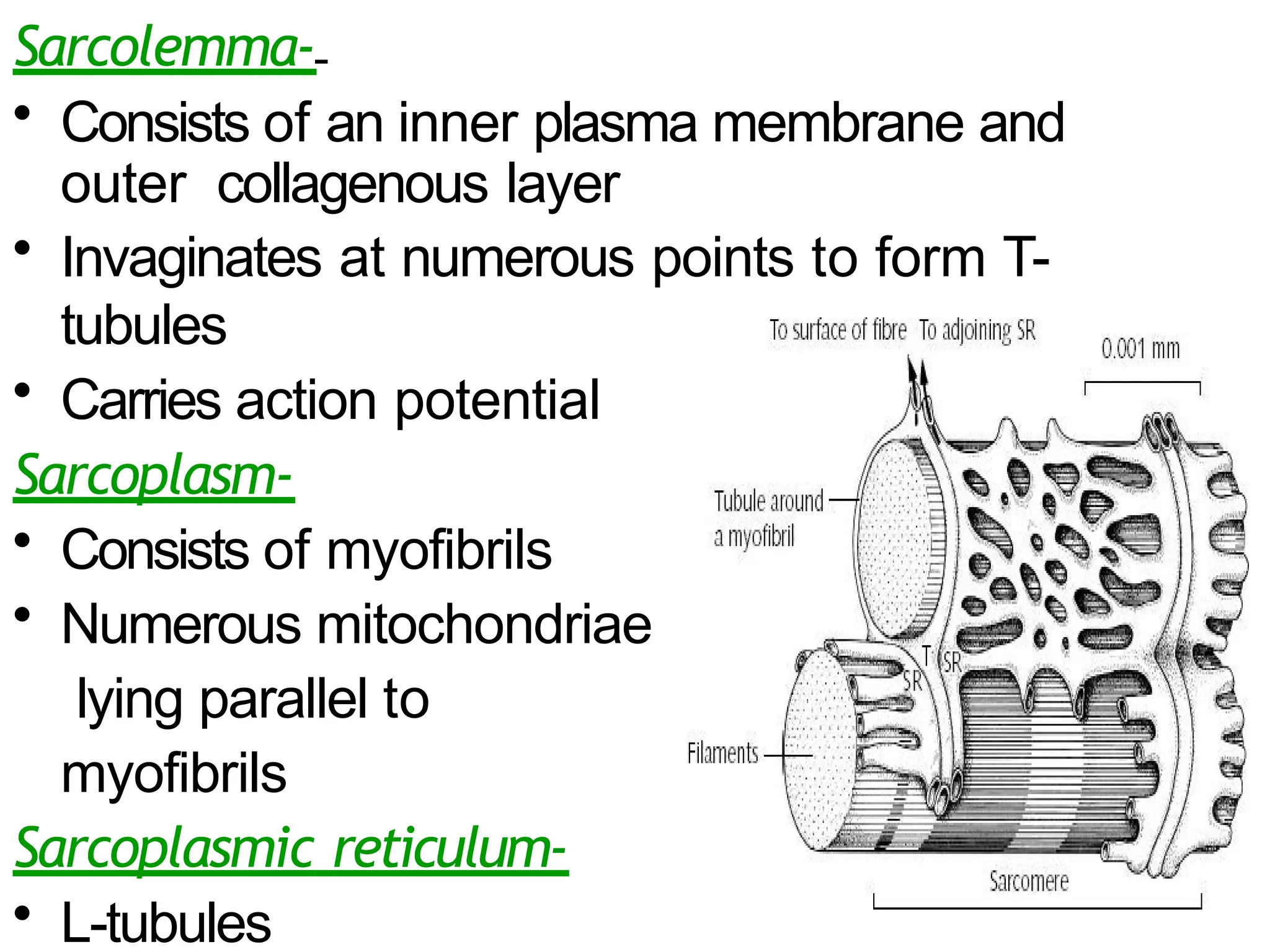
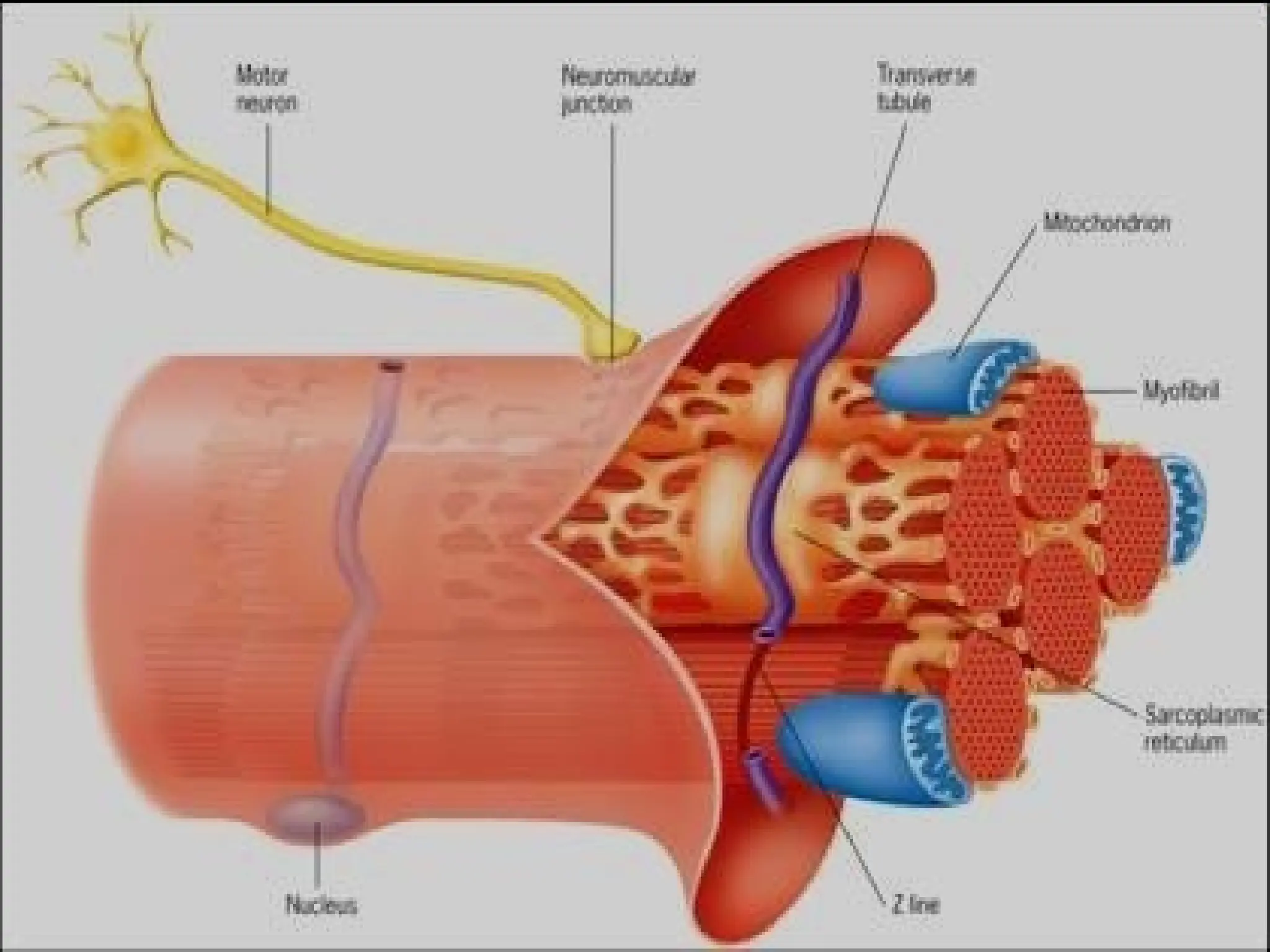
Sarcolemma-
• Consists of an inner plasma membrane and
outer collagenous layer
• Invaginates at numerous points to form T-
tubules
• Carries action potential
Sarcoplasm-
• Consists of myofibrils
• Numerous mitochondriae
lying parallel to
myofibrils
Sarcoplasmic reticulum-
• L-tubules
• Skeletal
muscle
• Fasciculus
• Muscle fibers
• Myofibrils
• Muscle fiber- 10 to 80μ in diameter each
is composed of 1000s of myofibrils
• Each myofibril is in turn made up of
myofilaments
• Myofilaments
(i) contractile- myosin II, actin
(ii) modulatory- tropomyosin, troponin
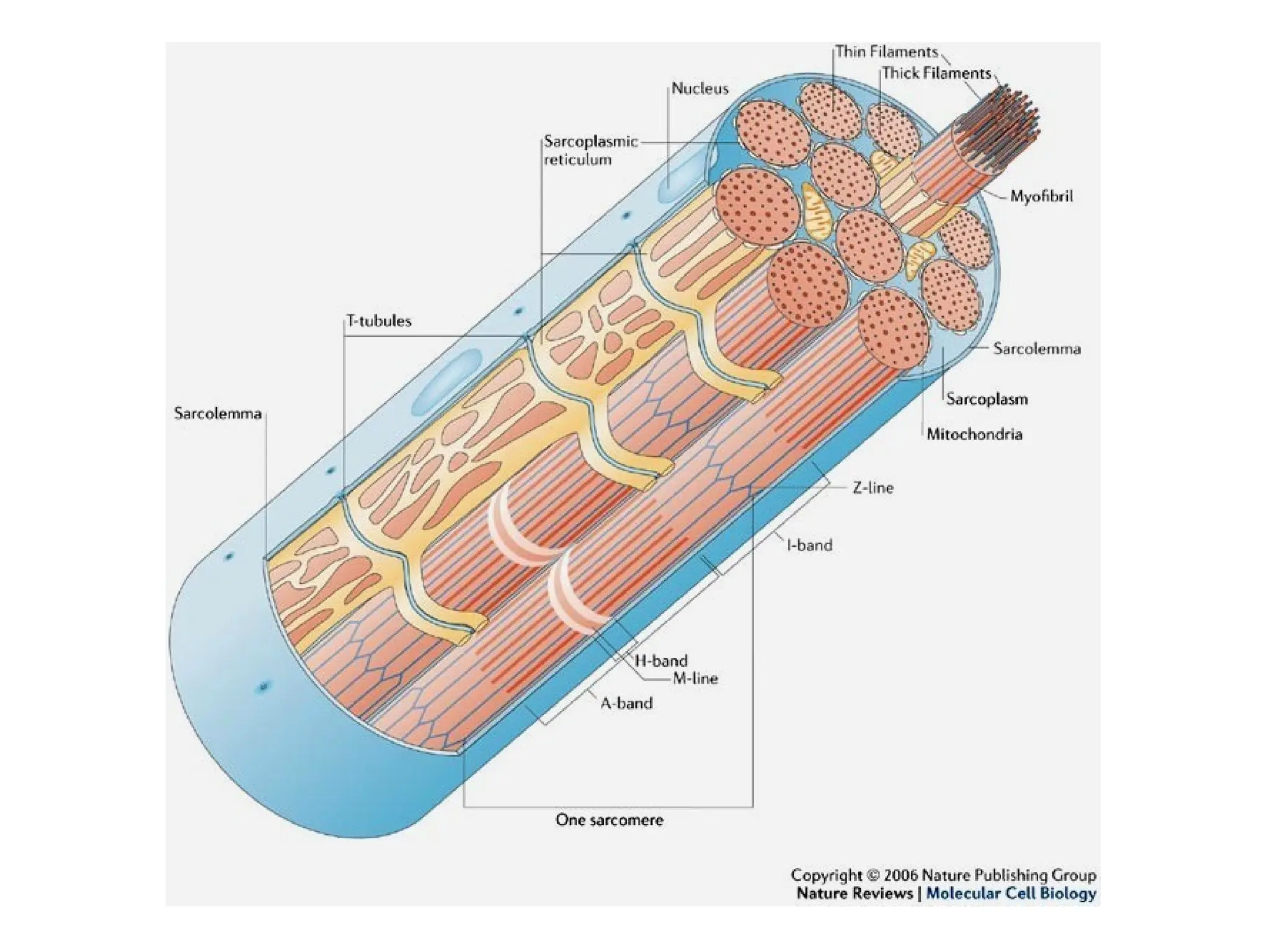
SARCOMERE
LIGHT MICROSCOPIC
STRUCTURE
•
•
•
•
•
•
•
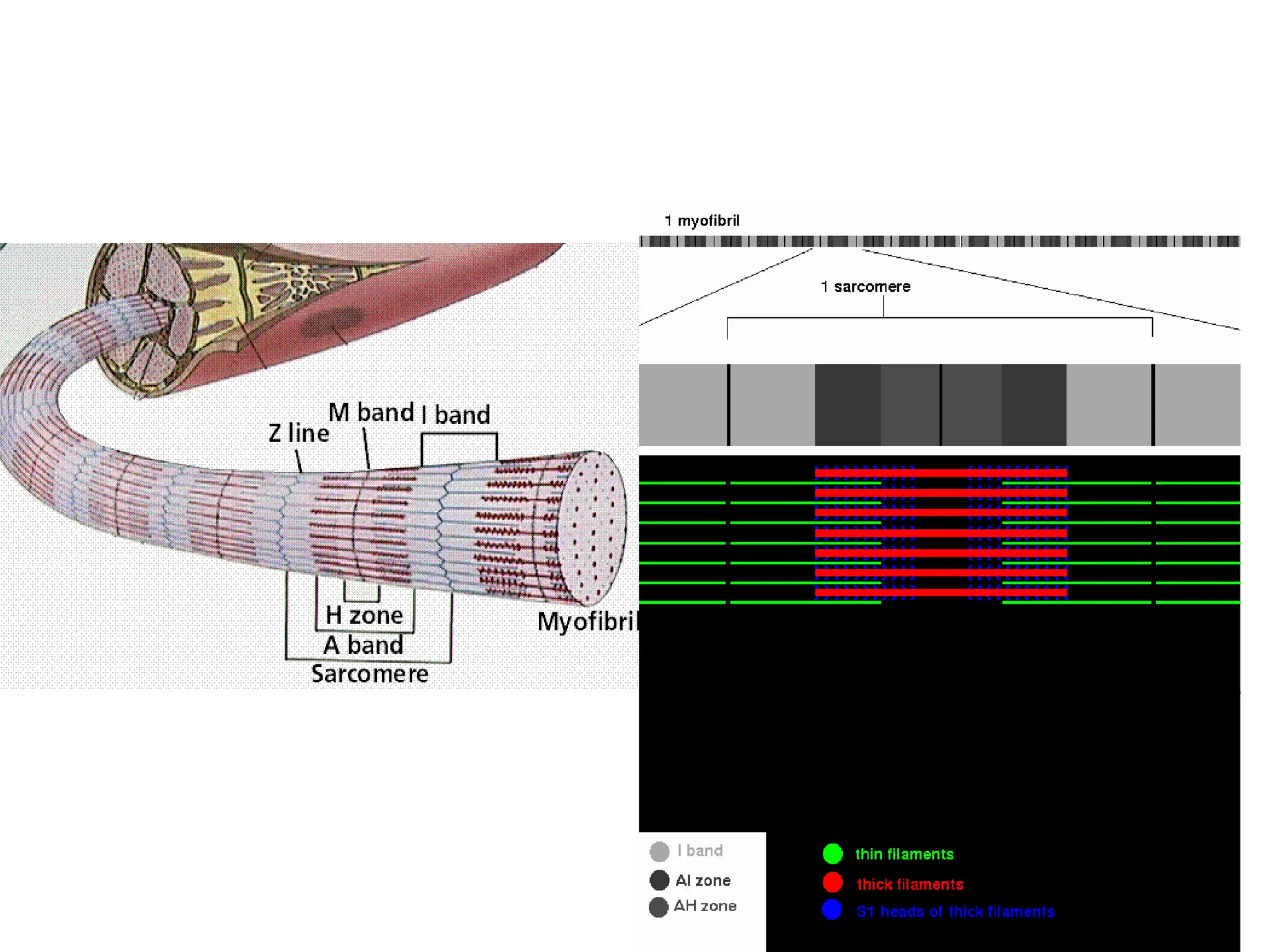
Cross striations due to alternate dark and light
bands Light band- Isotropic band- I band- thin
filaments Dark band- Anisotropic band- Aband-
birefringent
H zone- lighter zone in Aband
Zline- in the center of I band
M line- in the center of A
band
Sarcomere- between two z
lines- basic unit of muscle
ULTRASTRUCT
URE
•
•
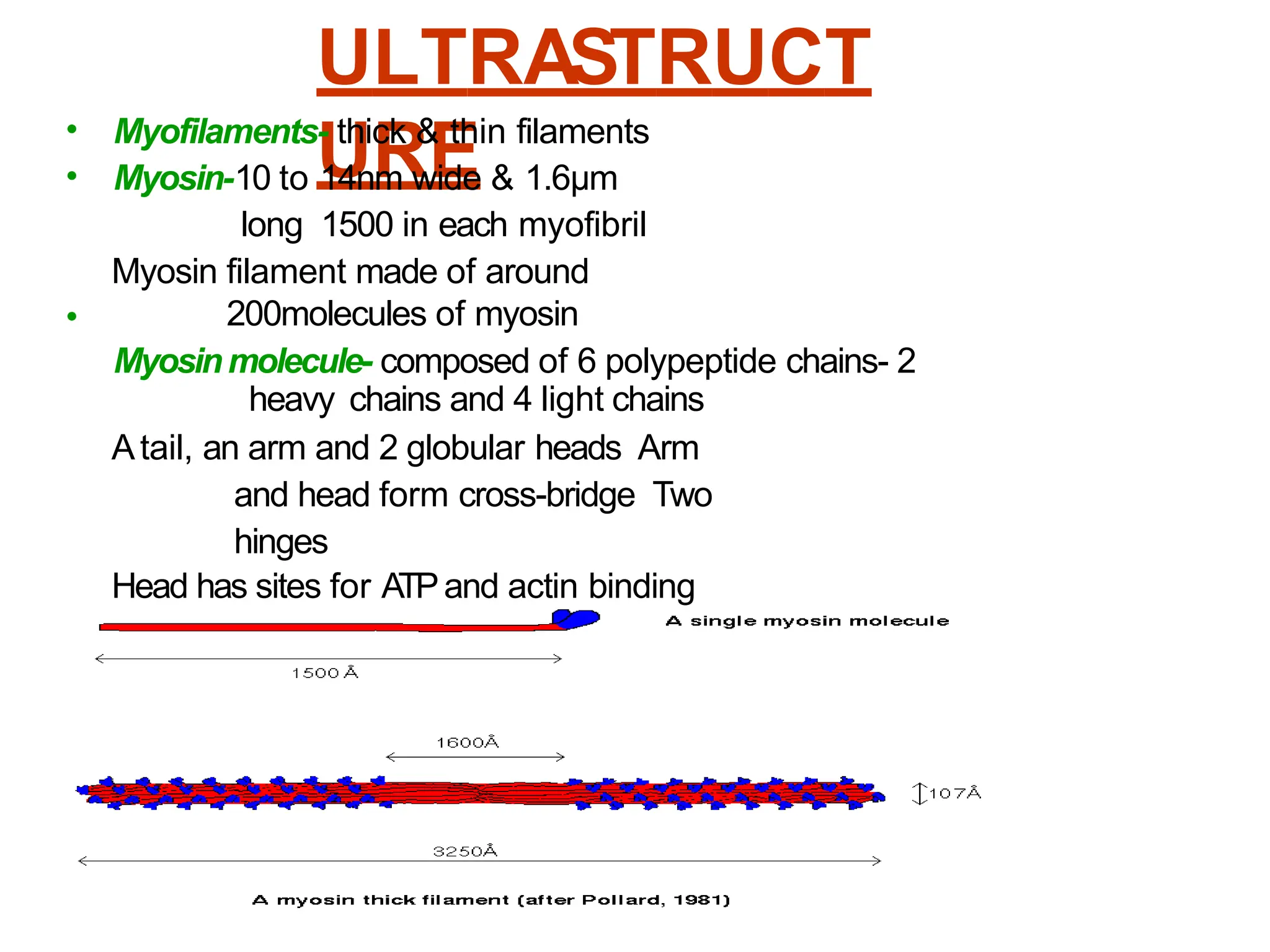
Myofilaments- thick & thin filaments
Myosin-10 to 14nm wide & 1.6μm
long 1500 in each myofibril
Myosin filament made of around
200molecules of myosin
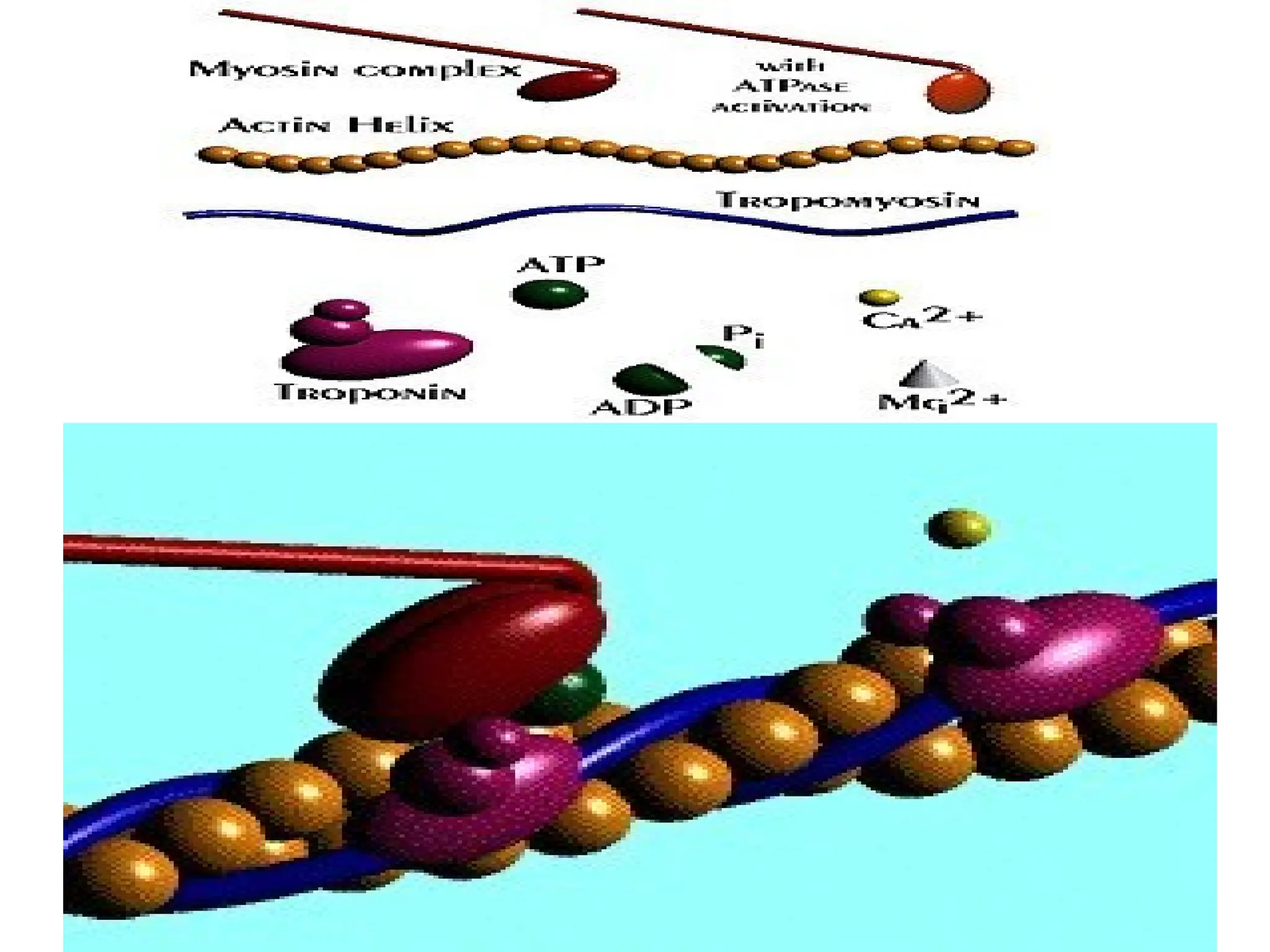
Myosinmolecule- composed of 6 polypeptide chains- 2
heavy chains and 4 light chains
Atail, an arm and 2 globular heads Arm
and head form cross-bridge Two
hinges
Head has sites for ATPand actin binding
•
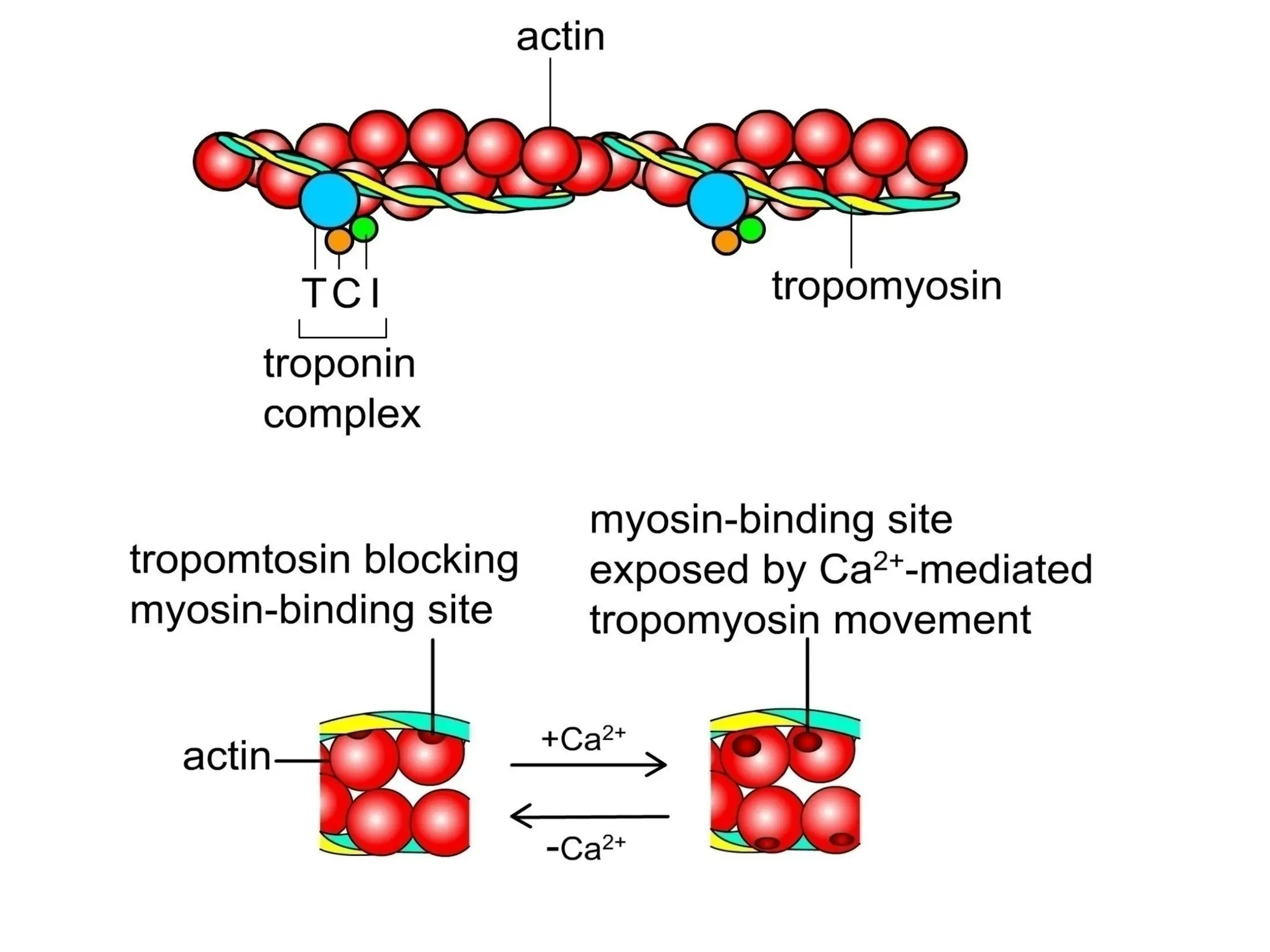
• Actin filament- 7nm wide and 1.0μm
long Extend on both sides of z-lines
F-actin forms a double helix
Made of 300 G-actin molecules (MW
42,000)
G-actin has active sites for interaction with
myosin heads
• Tropomyosin- 40nm length and MW
of 70,000.
Wrapped around actin helix & covers
active sites in resting phase
• Troponin- made of 3 protein subunits
(Tn I, Tn C& Tn T)
OTHER
PROTEINS
1) Actinin- binds actin to Z lines
2)Desmin- binds Zlines to the plasma
membrane
3) Titin- connects Zlines to M lines and
provide scaffolding for sarcomere. Provides
elasticity
4)Dystrophin, dystroglycans and sarcoglycans
MUSCLE FIBER
Sarcolemma-
• Consists of an inner plasma membrane and
outer collagenous layer
• Invaginates at numerous points to form T-
tubules
• Carries action potential
Sarcoplasm-
• Consists of myofibrils
• Numerous mitochondriae
lying parallel to
myofibrils
Sarcoplasmic reticulum-
•
SARCOTUBULAR
SYSTEM
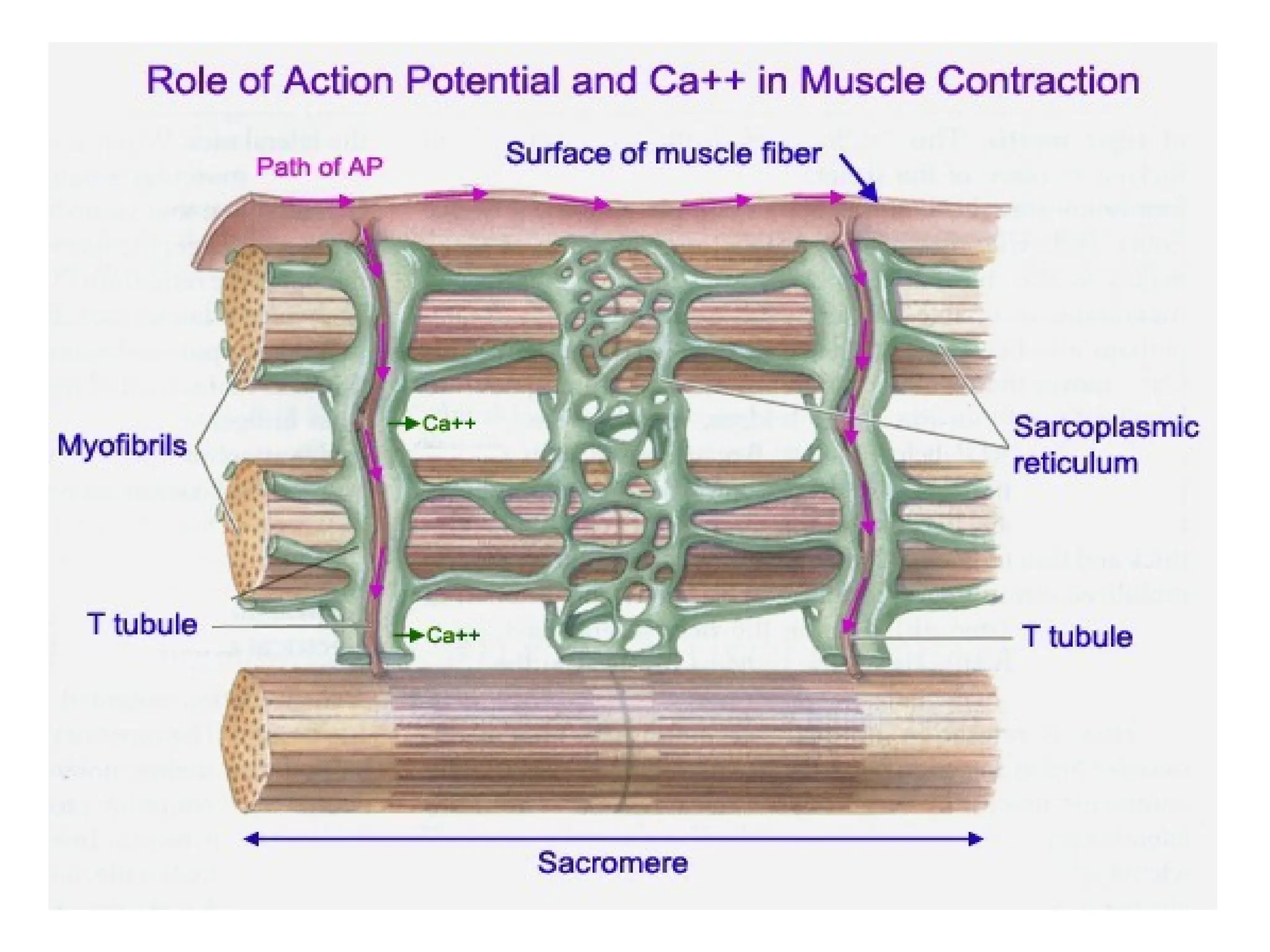
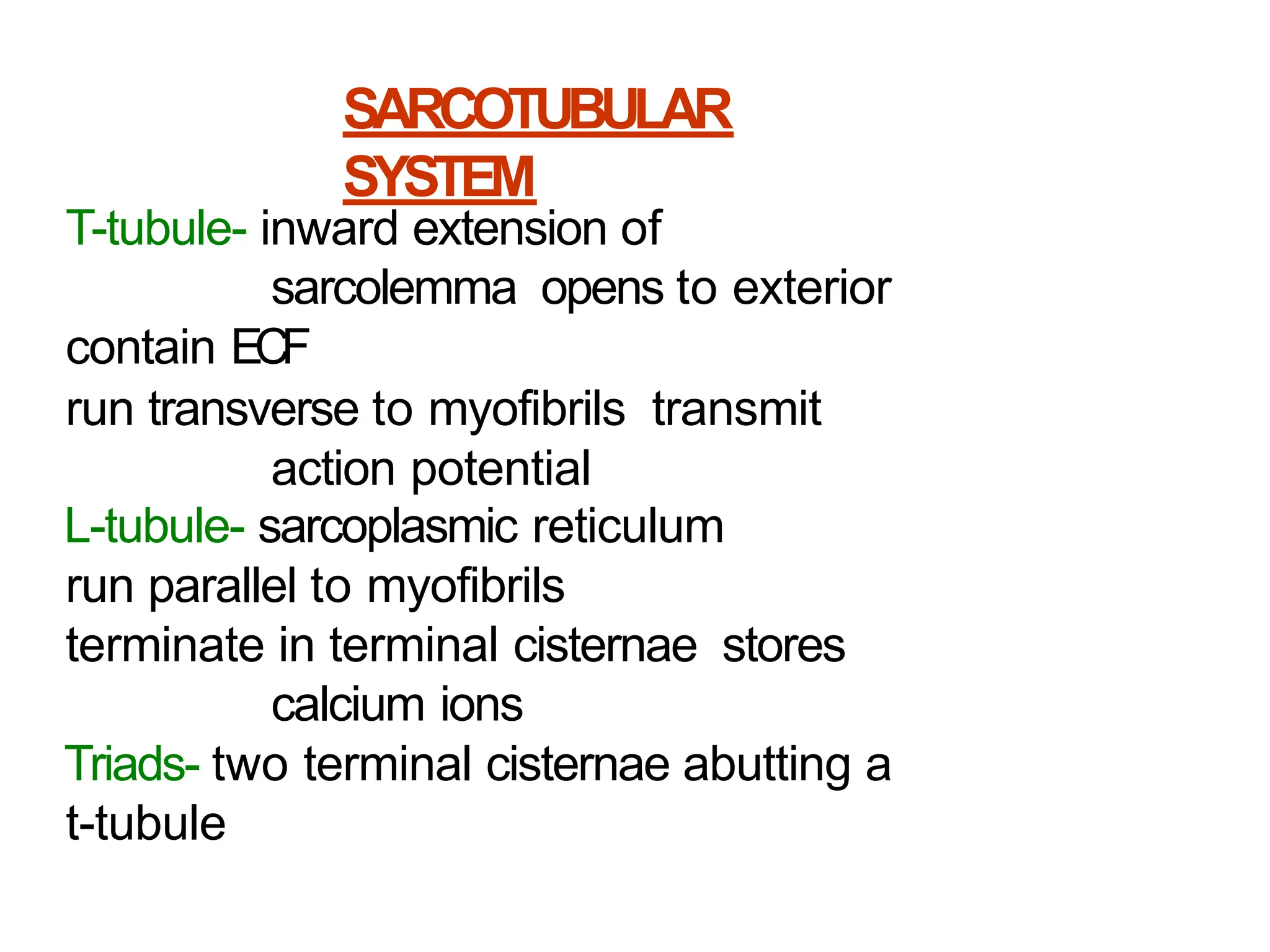
T-tubule- inward extension of
sarcolemma opens to exterior
contain ECF
run transverse to myofibrils transmit
action potential
L-tubule- sarcoplasmic reticulum
run parallel to myofibrils
terminate in terminal cisternae stores
calcium ions
Triads- two terminal cisternae abutting a
t-tubule
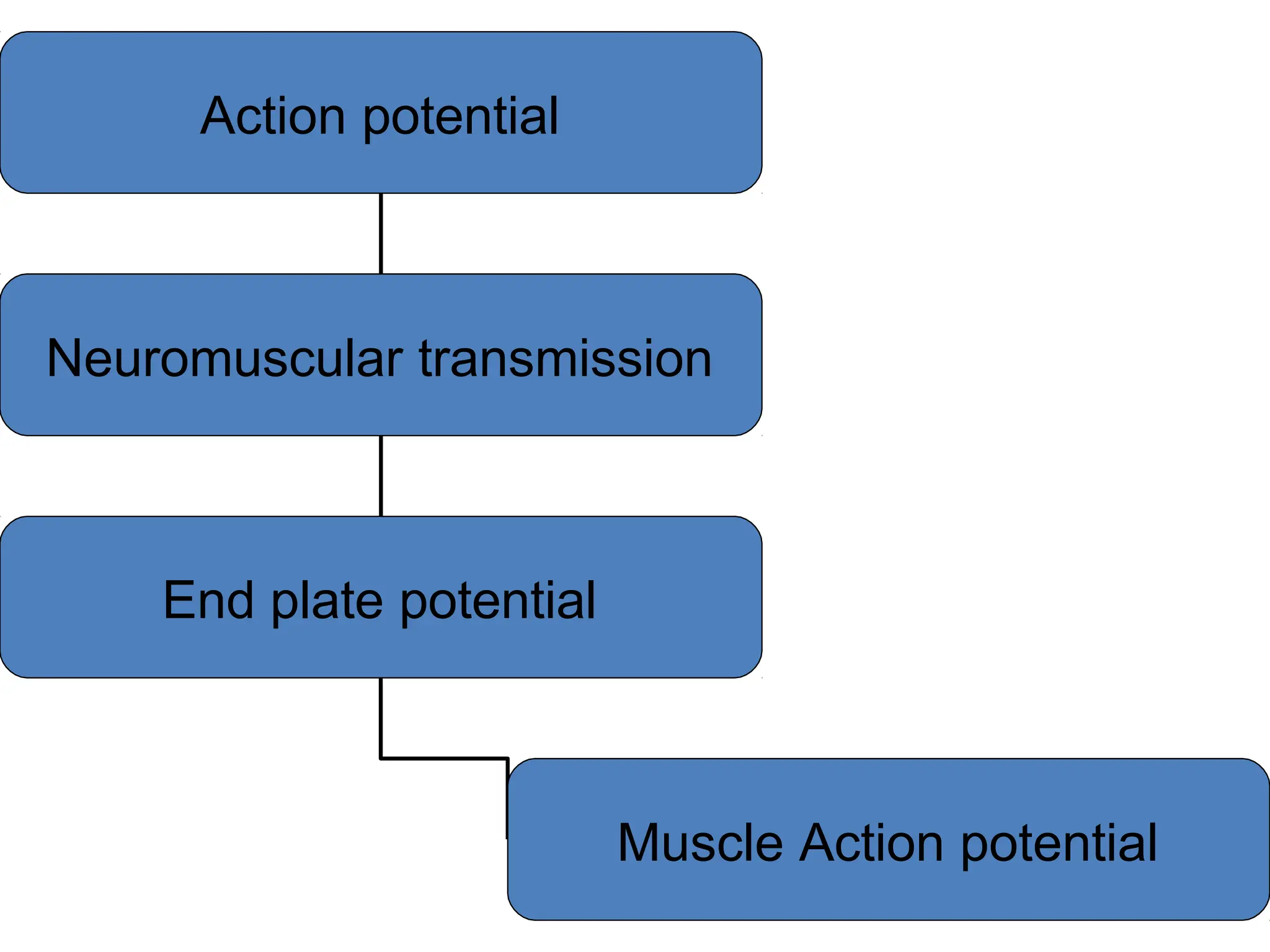
Action potential
Neuromuscular transmission
End plate potential
Muscle Action potential
Propagation of muscle AP
along sarcolemma
AP reaches triad
via T-tubule
Depolarisation
of T-tubule
Enterance of AP in cisternsae
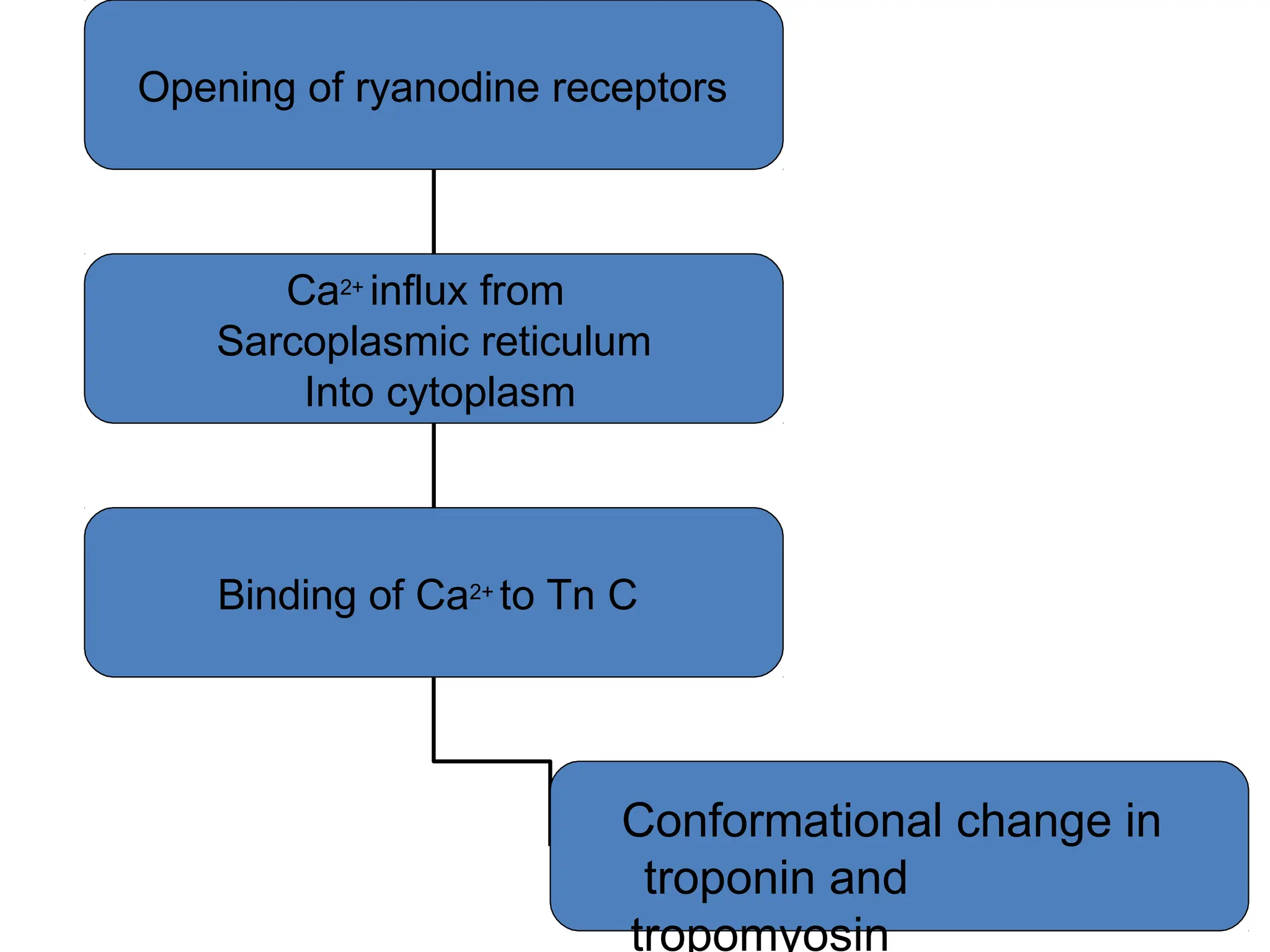
Opening of ryanodine receptors
Ca2+ influx from
Sarcoplasmic reticulum
Into cytoplasm
Binding of Ca2+ to Tn C
Conformational change in
troponin and
tropomyosin
Exposure of binding sites on actin
Interaction of actin and myosin
contraction
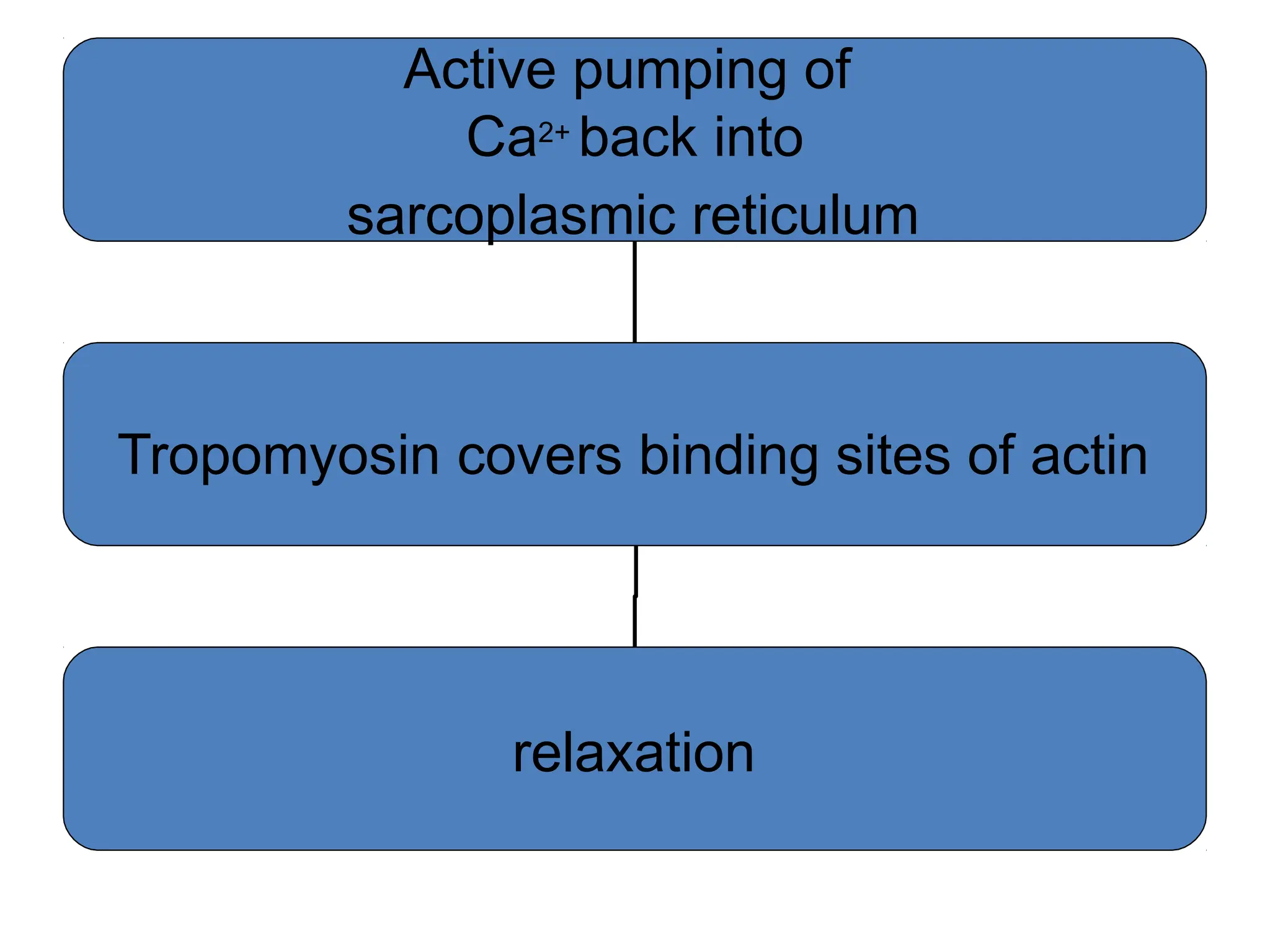
Active pumping of
Ca2+ back into
sarcoplasmic reticulum
Tropomyosin covers binding sites of actin
relaxation
Muscle
Contraction
THEORIES OF
CONTRACTION
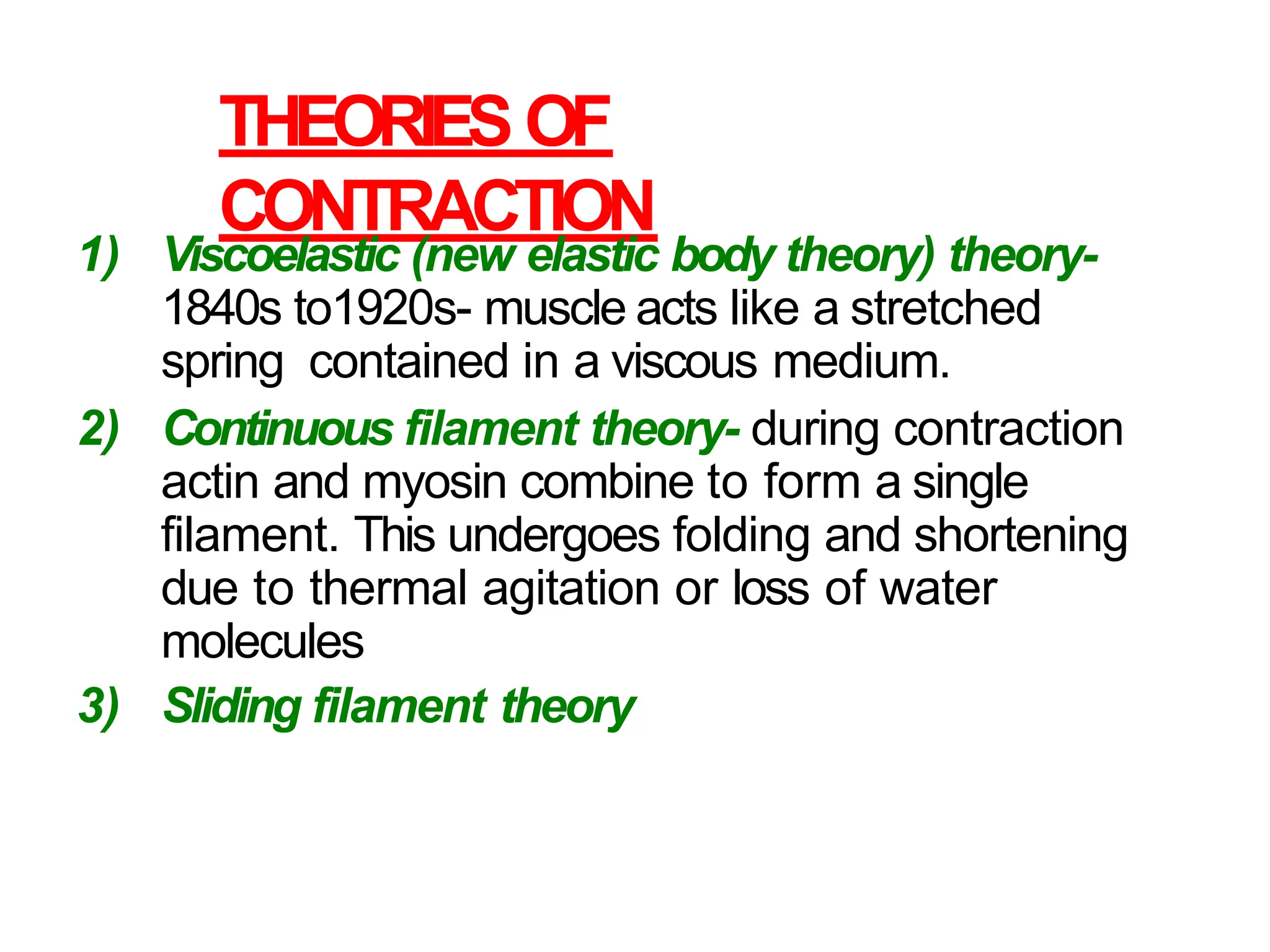
1) Viscoelastic (new elastic body theory) theory-
1840s to1920s- muscle acts like a stretched
spring contained in a viscous medium.
2) Continuous filament theory- during contraction
actin and myosin combine to form a single
filament. This undergoes folding and shortening
due to thermal agitation or loss of water
molecules
3) Sliding filament theory
SLIDING FILAMENT
THEORY
• 1954 by A.F.Huxley and
H.E.Huxley independently
• Two overlapping sets of filaments sliding
past each other.
• Thin filaments at each end of sarcomere
move towards center between thick
filaments.
• Globular heads of myosin form cross-
bridges with actin monomers- cross-bridge
theory
• Huxley (1969)- cross-bridges attach to thin
filament pull towards center detach attach
further down ratchet theory or walk-along theory
A
TPattaches to myosin
head
ATPsplit into
ADP+Pi
Myosin head cocks
up
Attaches to actin
monomer
Head tilts towards
arm
Energy for
Muscular
Contraction-
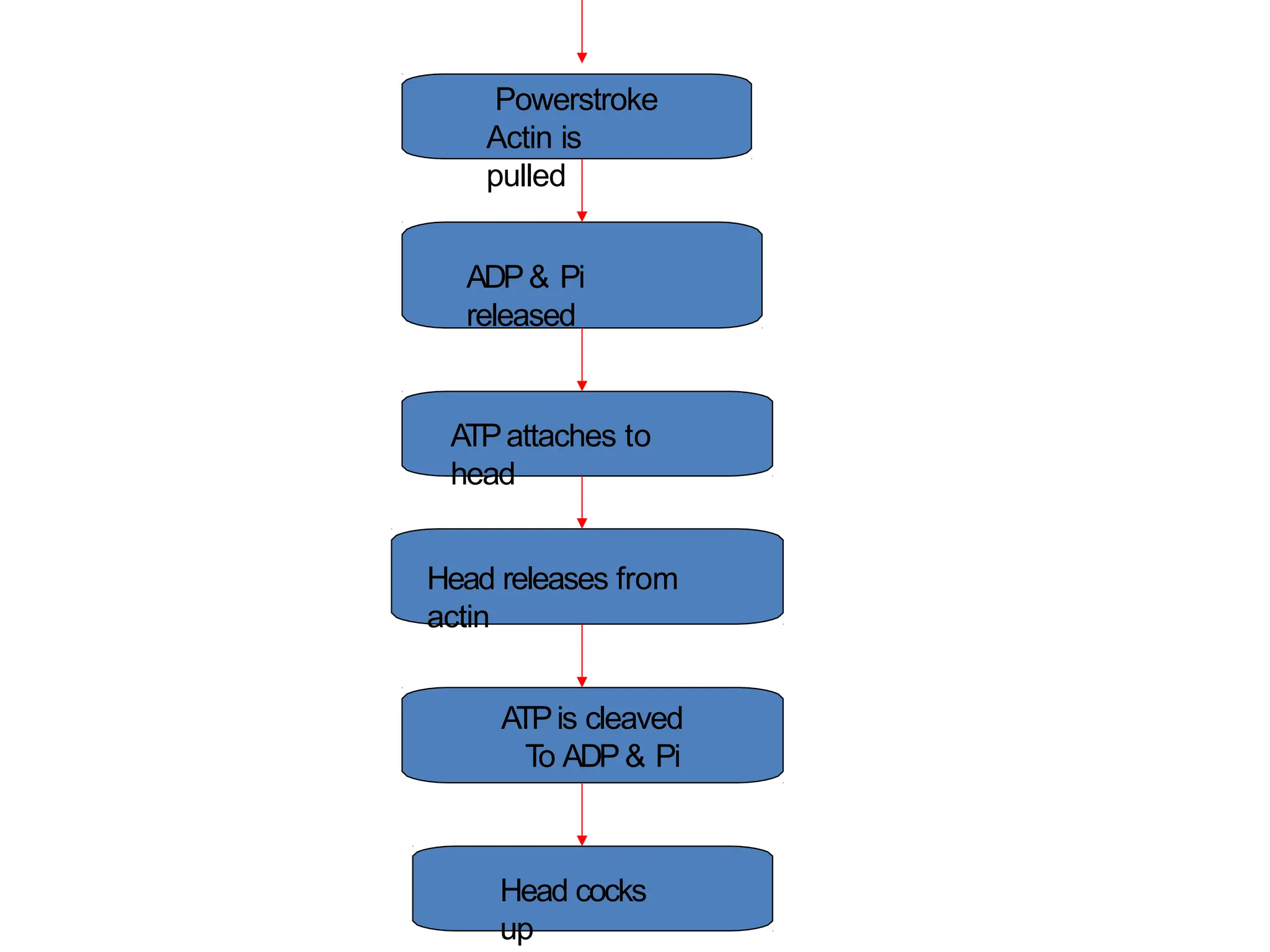
Powerstroke
Actin is
pulled
ADP& Pi
released
A
TPattaches to
head
Head releases from
actin
ATPis cleaved
To ADP& Pi
Head cocks
up
EVENTSDURING MUSCLE
CONTRACTION
1. Chemical changes
2. Mechanical
changes
3. Thermal changes
4. Electrical changes
Chemical
changes
• ATP attaches to myosin head splits to
ADP+Pi myosin head cocks up attaches
to actin power-stroke ADP& Pi
discarded new ATPattaches to myosin
head myosin head released from actin
• ATPyields 11.5kcal/mol
Sources of
ATP
1. ATP present in sarcoplasm- suffice for
1- 2sec
2. Creatine phosphate- suffice for 5-8sec.
Lohman’s reaction
CP+ADP=Creatine+ATP
3. Glycolysis- suffice for 1min
4. Oxidation of cellular foodstuff- for
longer periods
Mechanical
changes
• Isotonic contraction- shortening of muscle
but volume remains the same
• Isometric contraction- no change in the
length
Thermal
changes
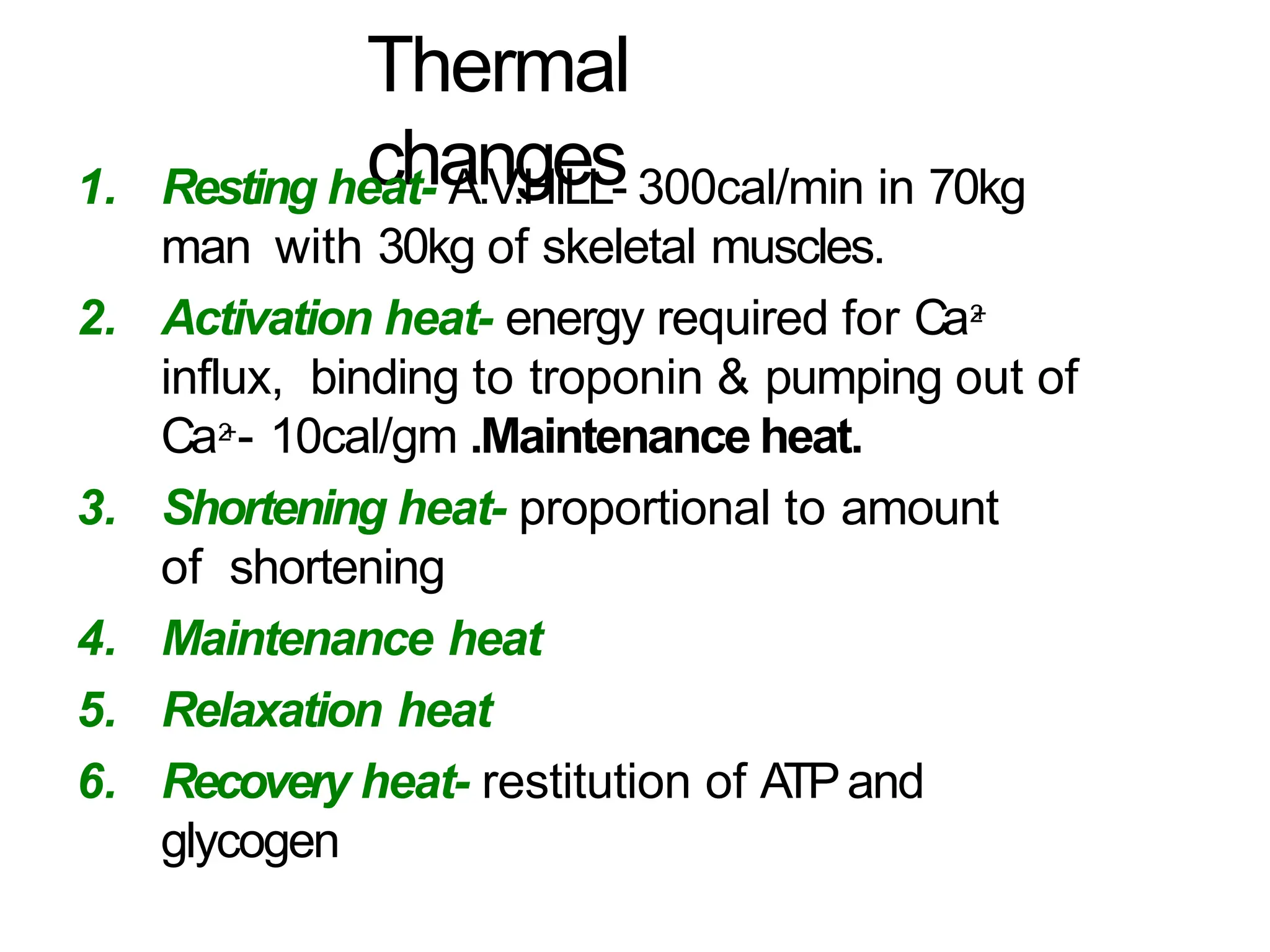
1. Resting heat- A.V.HILL- 300cal/min in 70kg
man with 30kg of skeletal muscles.
2. Activation heat- energy required for Ca2
+
influx, binding to troponin & pumping out of
Ca2
+- 10cal/gm .Maintenance heat.
3. Shortening heat- proportional to amount
of shortening
4. Maintenance heat
5. Relaxation heat
6. Recovery heat- restitution of ATPand
glycogen
Electrical
changes
• RMP of -90mv
• APmoves along sarcolemma
• Velocity of APconduction-
5m/sec
MOTOR
UNIT
• Single nerve fiber with all the muscle fibers
it supplies for a motor unit
• Motor units may contain 2 to few
hundred muscle fibers
• Smaller motor units are associated
with muscles of fine movements
MOTOR UNIT
 a single motorneuron and the muscle fibers it
innervates.
 the number of muscle fibers varies with each
motor unit.
3 – 6 muscle fibers/motor unit
> muscles concerned with fine, graded and precise
movement.
120 – 165 muscle fibers/motor unit
> muscles concerned with postural and gross
movement.
each spinal motorneuron innervates only one kind of
muscle fiber, so that all of the muscle fibers in a
motor unit are of the same type.
WORKING
MODEL
• Muscle consists of 3 components
1. Contractile element
2. Series elastic element- arms of
cross- bridges, tendon fibers
3. Parallel elastic element- connective
tissue
Non-contractile and connective tissue
in muscle itself
Tendon
TYPESOF
CONTRACTION
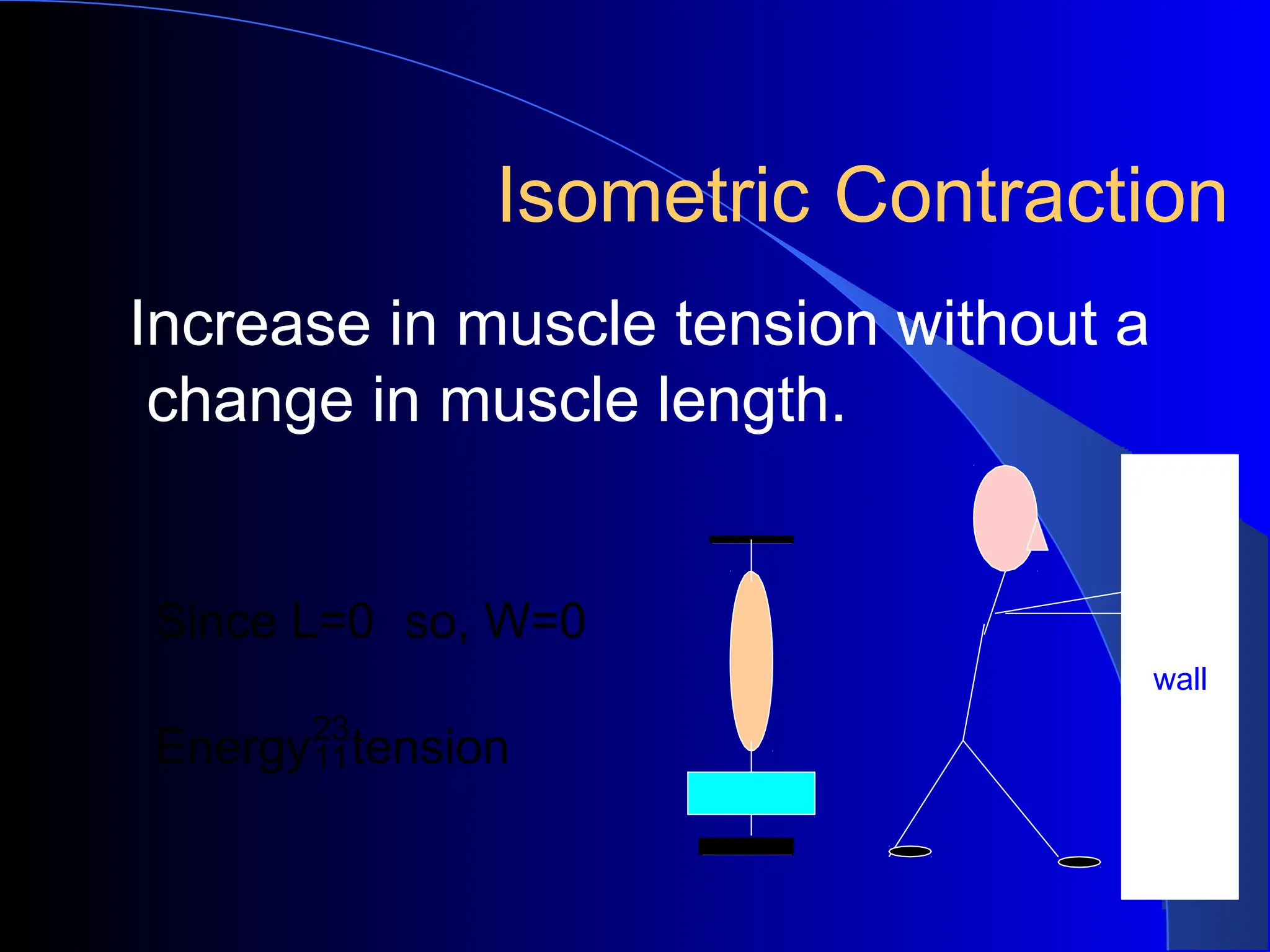
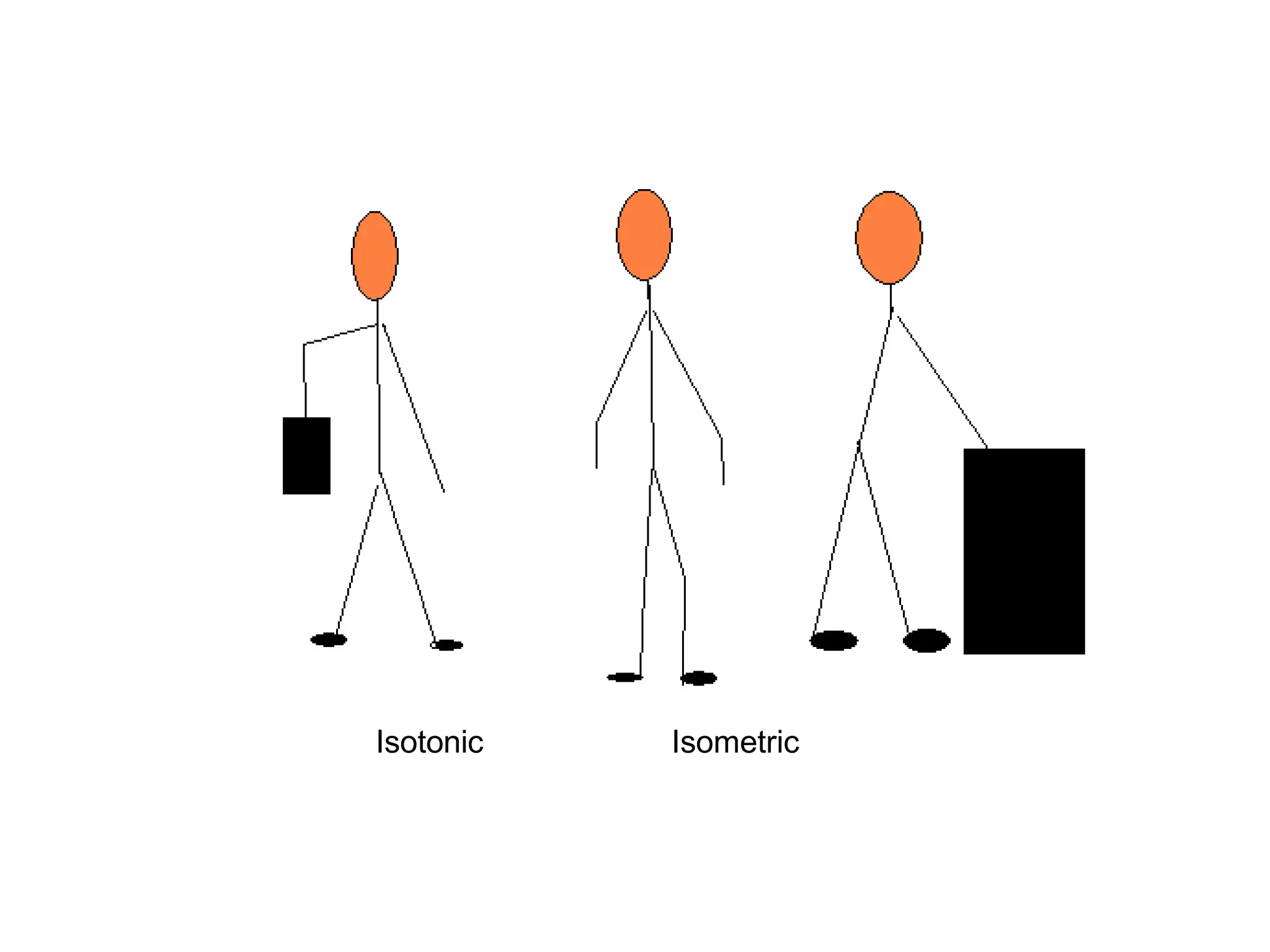
1. Isometric contraction- length remains
same whereas tension increases. Eg:
pushing the wall
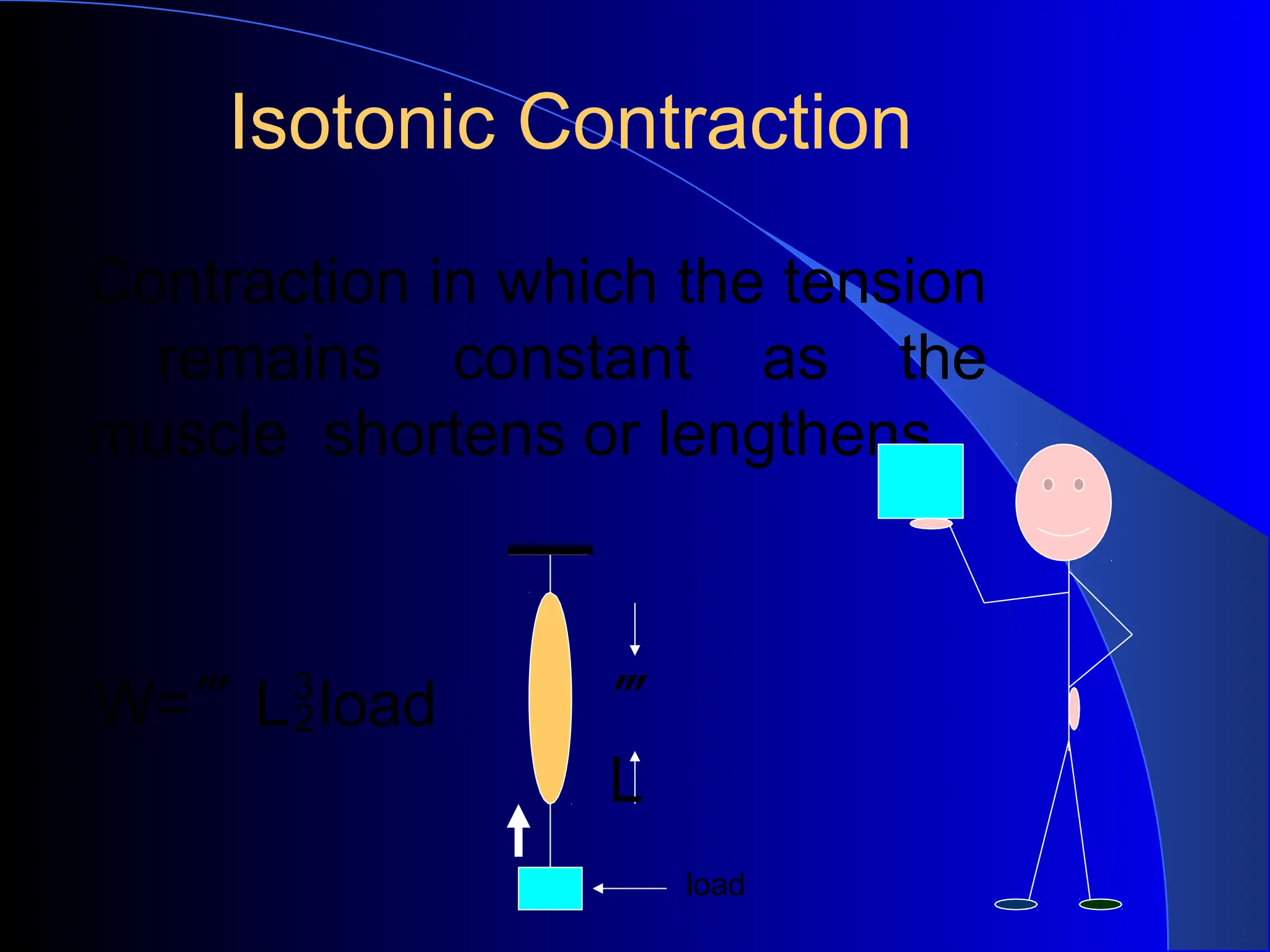
2. Isotonic contraction- tension remains
same whereas length changes. Eg:
throwing a stone
Isometric Contraction
Increase in muscle tension without a
change in muscle length.
wall
Since L=0 so, W=0
Energytension
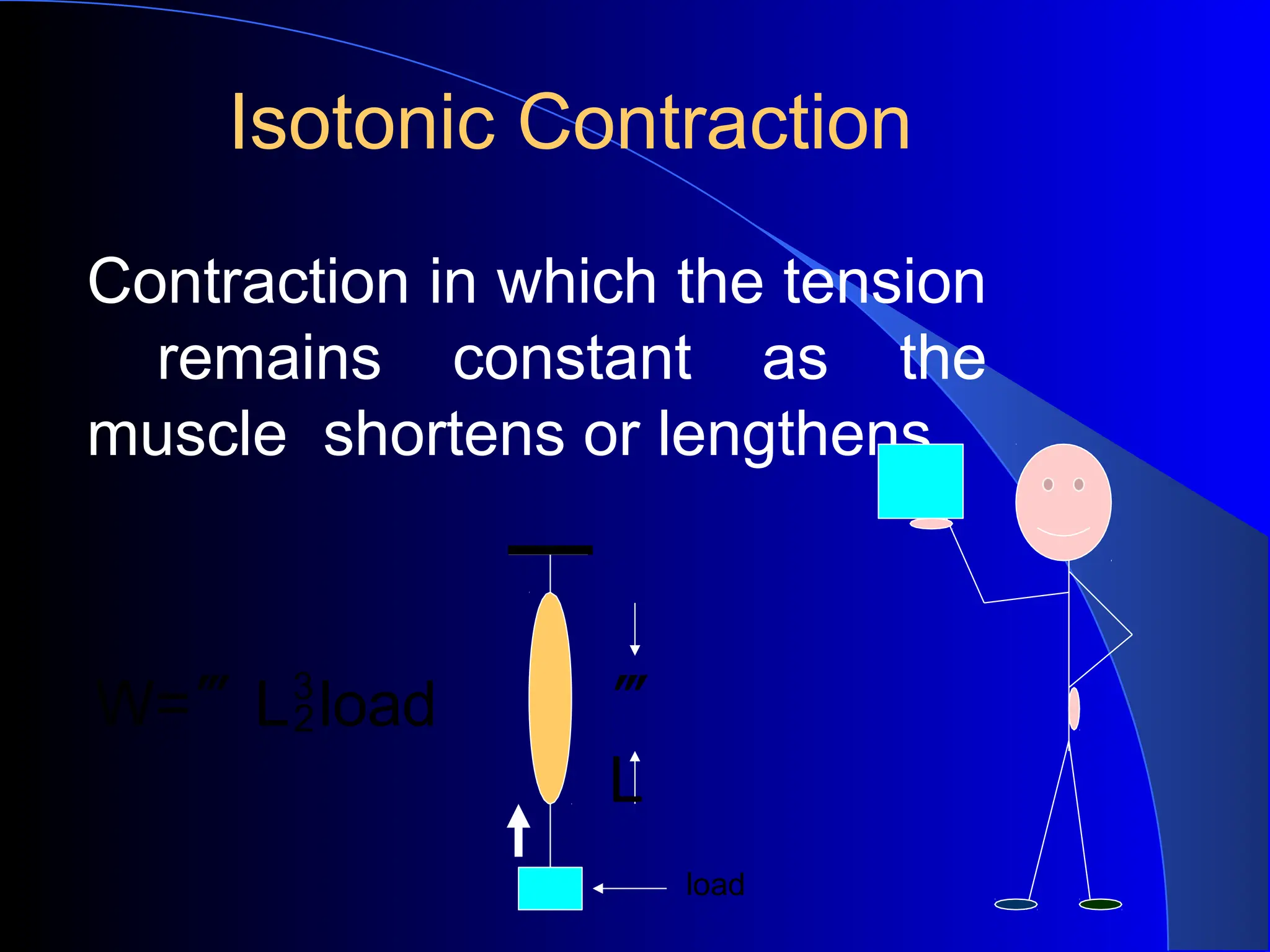
Isotonic Contraction
Contraction in which the tension
remains constant as the
muscle shortens or lengthens
W=Lload 
L
load
Isotonic Isometric
Preload and
Afterload
• Preload: load establishes the initial
muscle length. Load is carried by
muscle at rest and during
contraction.
• Afterload: load, or a portion of it,
is supporteduntil the muscle
develops enough force to lift it.
Effects of preload or
initial length on contraction
of the muscle
Transducer
S
Move up or down to change preload (initial length)
F1
F3
Initial length &
preload
F2
1. Passive tension is the tension
developed by simply stretching
a muscle to different lengths
( think of a rubber band).
2. Passive tension is determined
by preload and the elasticity
of the muscle itself.
• Total tension is the tension
developed when a muscle is
stimulated to contract at different
preload.
• It is the sum of the active tension
developed by contractile elements
of the sarcomeres and the passive
tension caused by stretching the
muscle.
• Active tension is determined by
subtracting the passive tension from the
total tension (total T-passive T).
• It represents the active force developed
when the muscle contracts, i.e., the
relation between preload and tension
generated by contraction.
• At the beginning, active tension
developed is proportional to the increase
in preload but, when the muscle is
stretched to longer length, active tension
is reduced. B
LENGTH-TENSION
RELATIONSHIP
Muscle length is held constant at
various lengths.
Muscle directly stimulated at many
points.
Tension developed is measured
using transducer.
Maximum tension at rest length.
When muscle is stretched, passive tension is
developed due stretching of elastic
elements
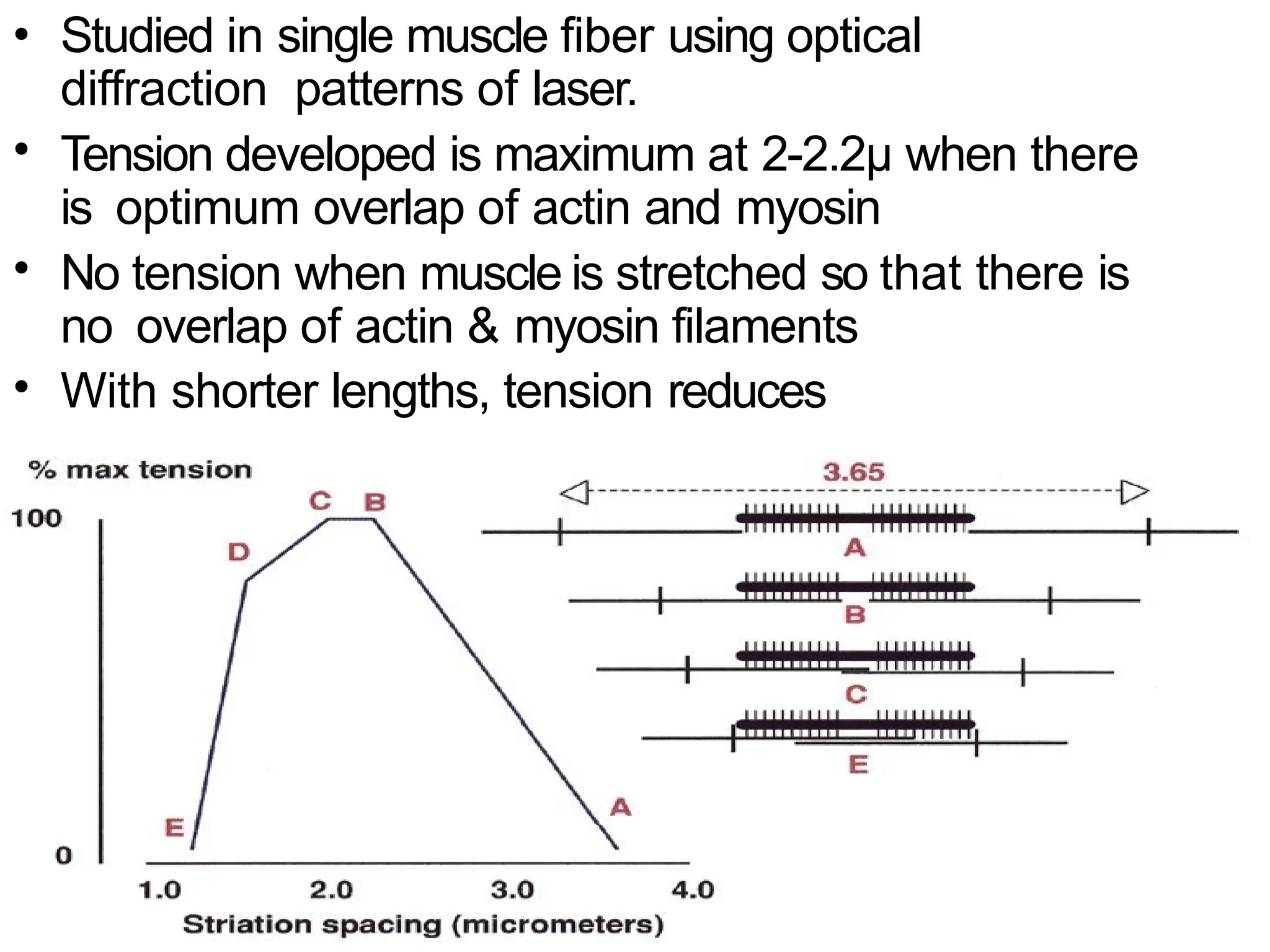
• Studied in single muscle fiber using optical
diffraction patterns of laser.
Tension developed is maximum at 2-2.2μ when there
is optimum overlap of actin and myosin
No tension when muscle is stretched so that there is
no overlap of actin & myosin filaments
With shorter lengths, tension reduces
•
•
•
The active tension is maximal when there is maximal
overlap of thick and thin filaments and maximal
cross- bridge
2 to 2.2m in
vivo
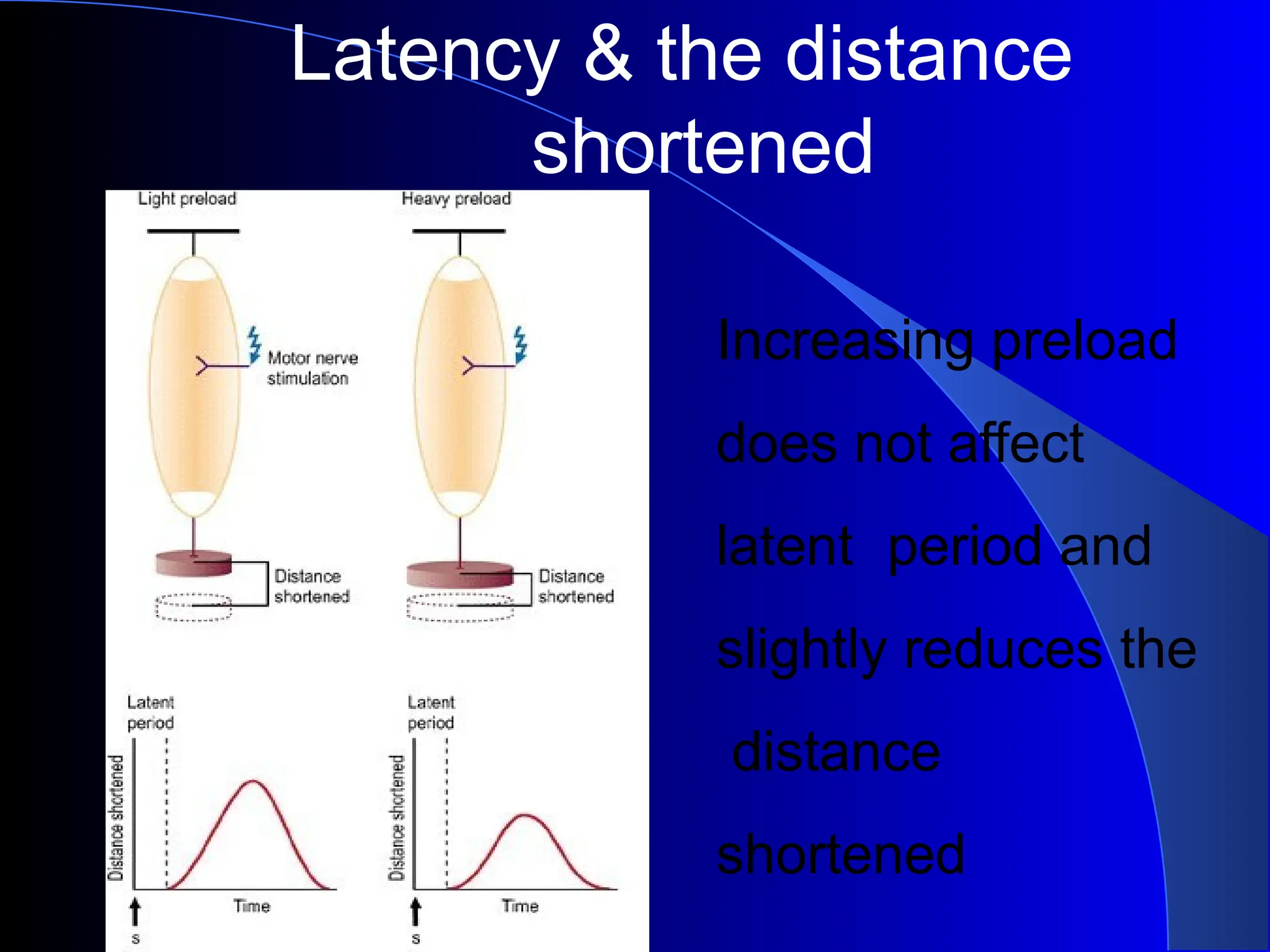
Increasing preload
does not affect
latent period and
slightly reduces the
distance
shortened
Latency & the distance
shortened
Effects of afterload on
the contraction of
muscle:
Force-Velocity
relationship
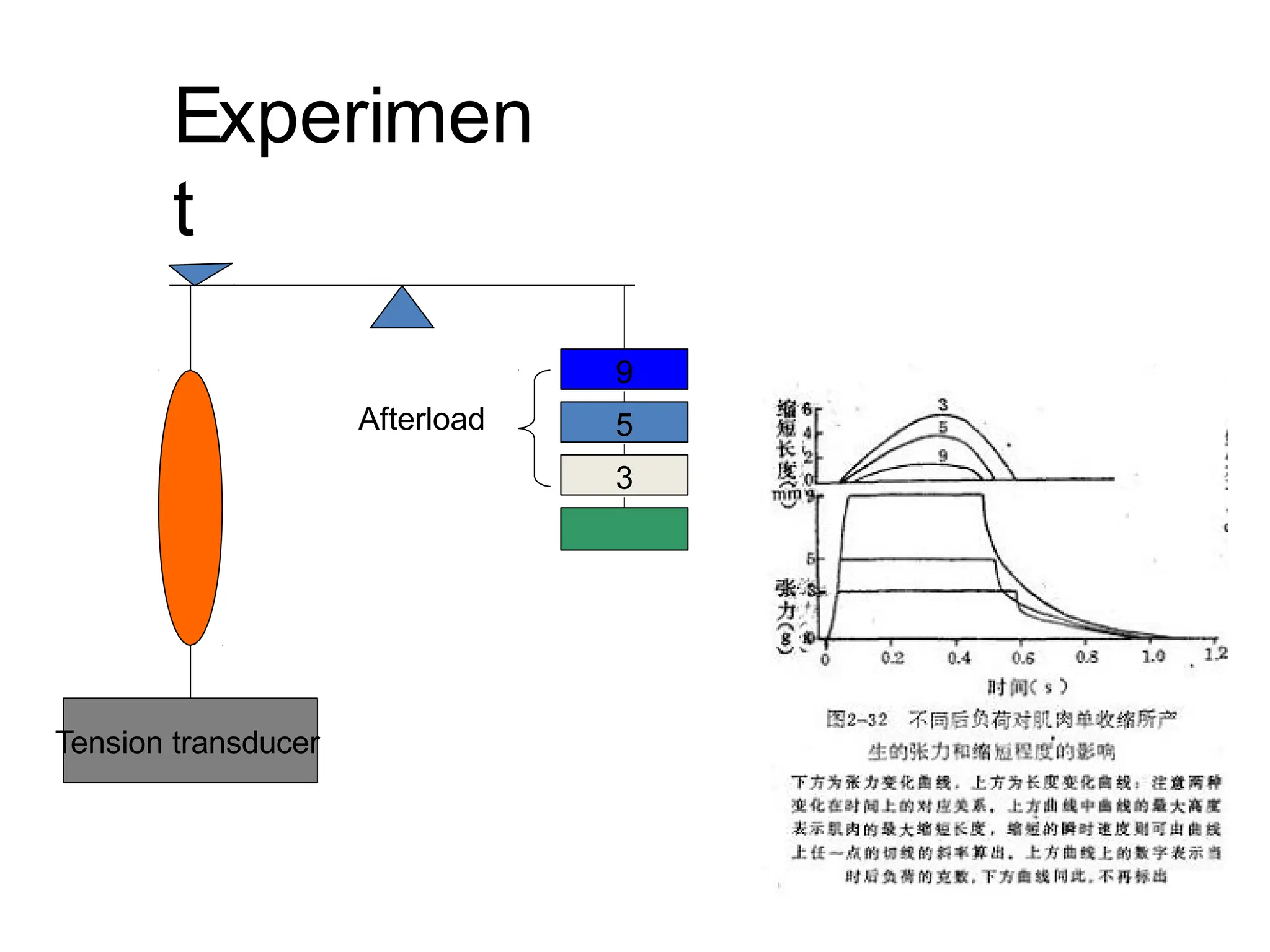
Tension transducer
3
5
Afterload
9
Experimen
t
Increasing afterload
increase the latent
period and reduces
the distance shortened
Latency & the
distance
shortened
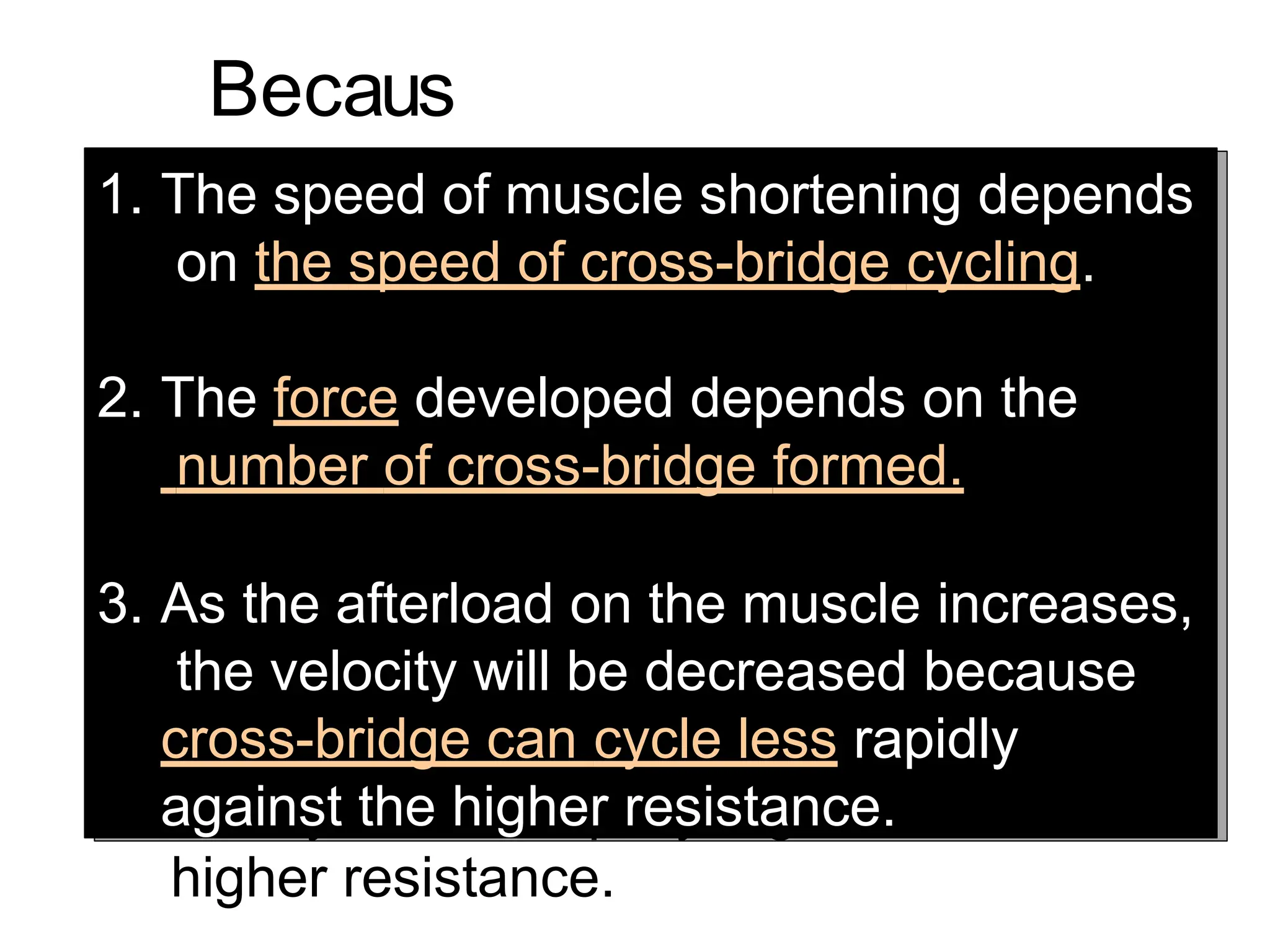
Becaus
e:
1. The speed of muscle shortening depends
on the speed of cross-bridge cycling.
2. The force developed depends on the
number of cross-bridge formed.
3. As the afterload on the muscle
increases, the velocity will be
decreased because cross-bridge
can cycle less rapidly against the
higher resistance.
1. The speed of muscle shortening depends
on the speed of cross-bridge cycling.
2. The force developed depends on the
number of cross-bridge formed.
3. As the afterload on the muscle increases,
the velocity will be decreased because
cross-bridge can cycle less rapidly
against the higher resistance.
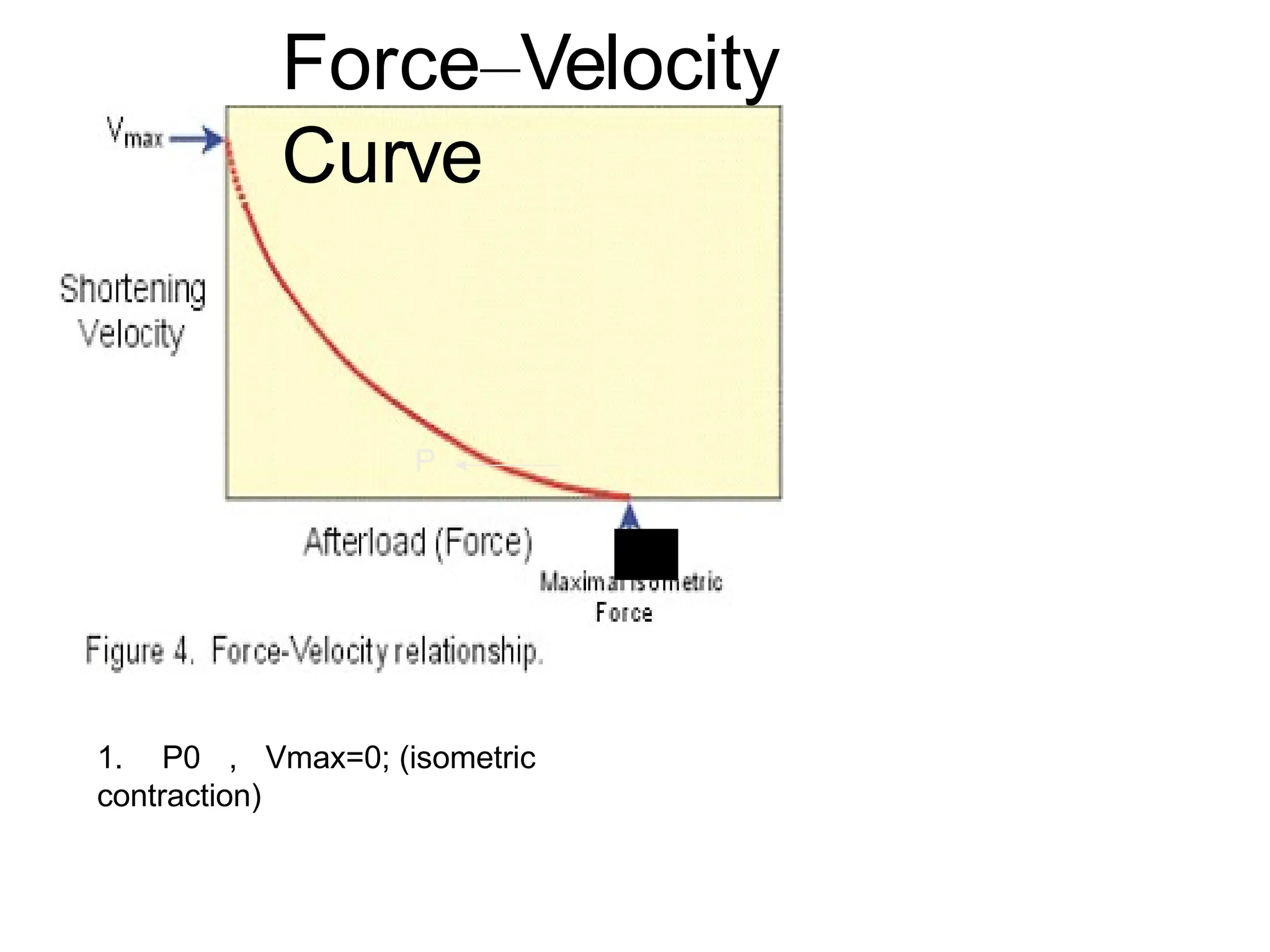
Force–Velocity
Curve
P
1. P0 , Vmax=0; (isometric
contraction)
FORCE-VELOCITY
RELATIONSHIP
• Muscle is allowed to contract with
various loads attached
• Isotonic contraction
• Initial latency is time for activation
of contractile machinery
• Later part of latency is time taken to
stretch the SEE
• As the load increases, velocity decreases
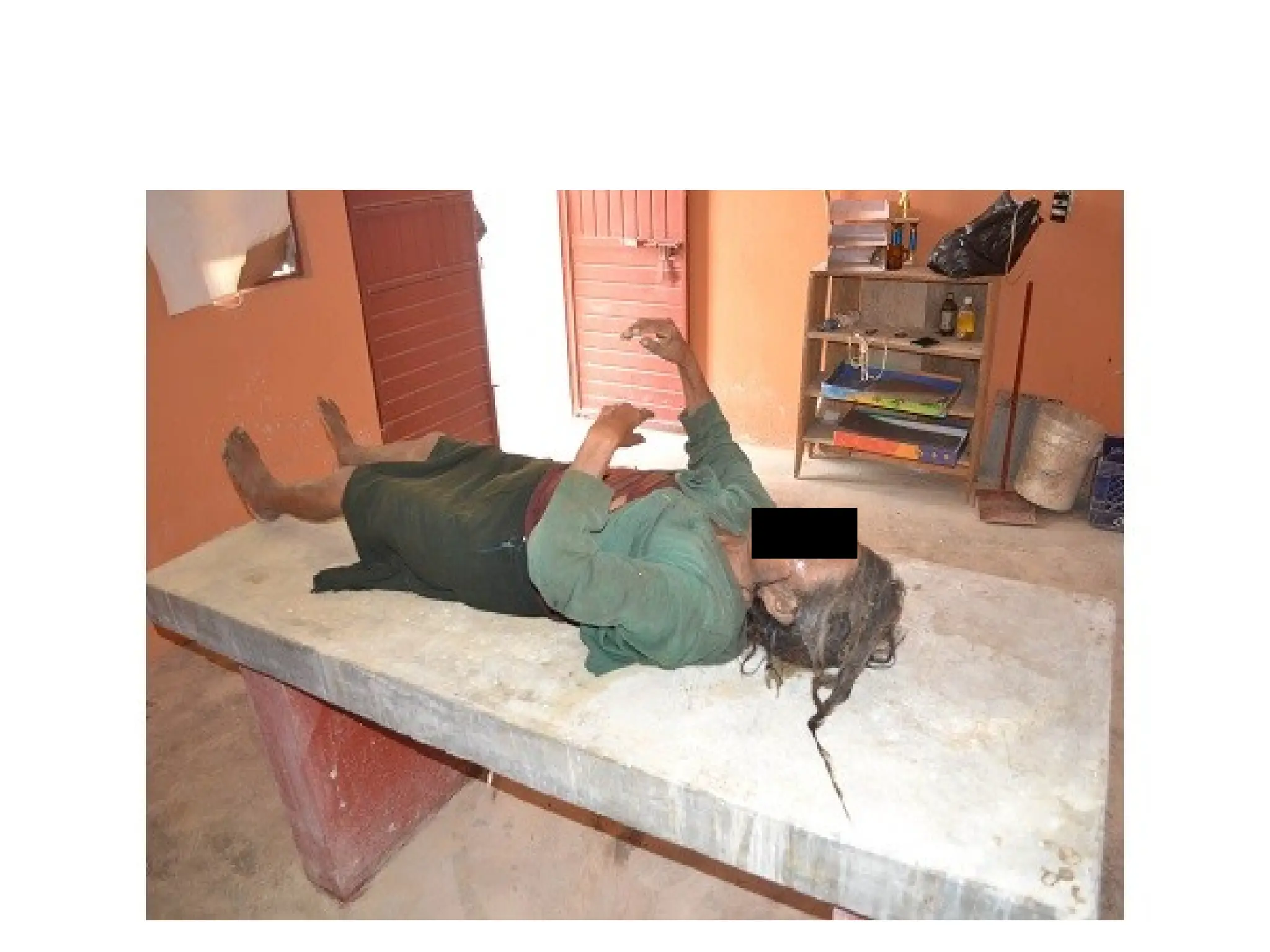
• Rigor mortis:-
Seen after death
State of extreme rigidity
Due to fixed interaction between actin
& myosin heads
ATP is needed to break actin-myosin
bond
Loss of rigidity after few hours due
to proteolysis
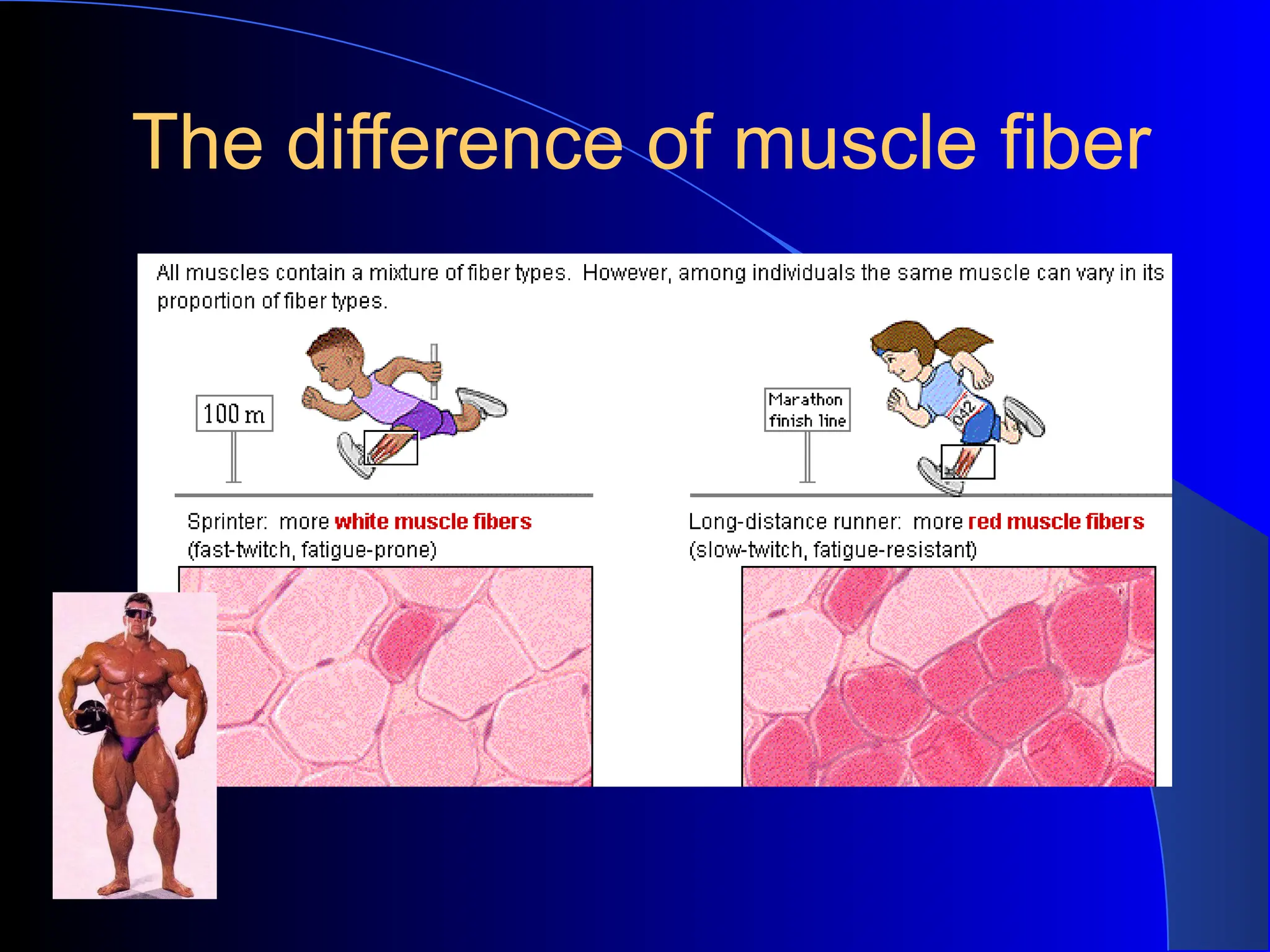
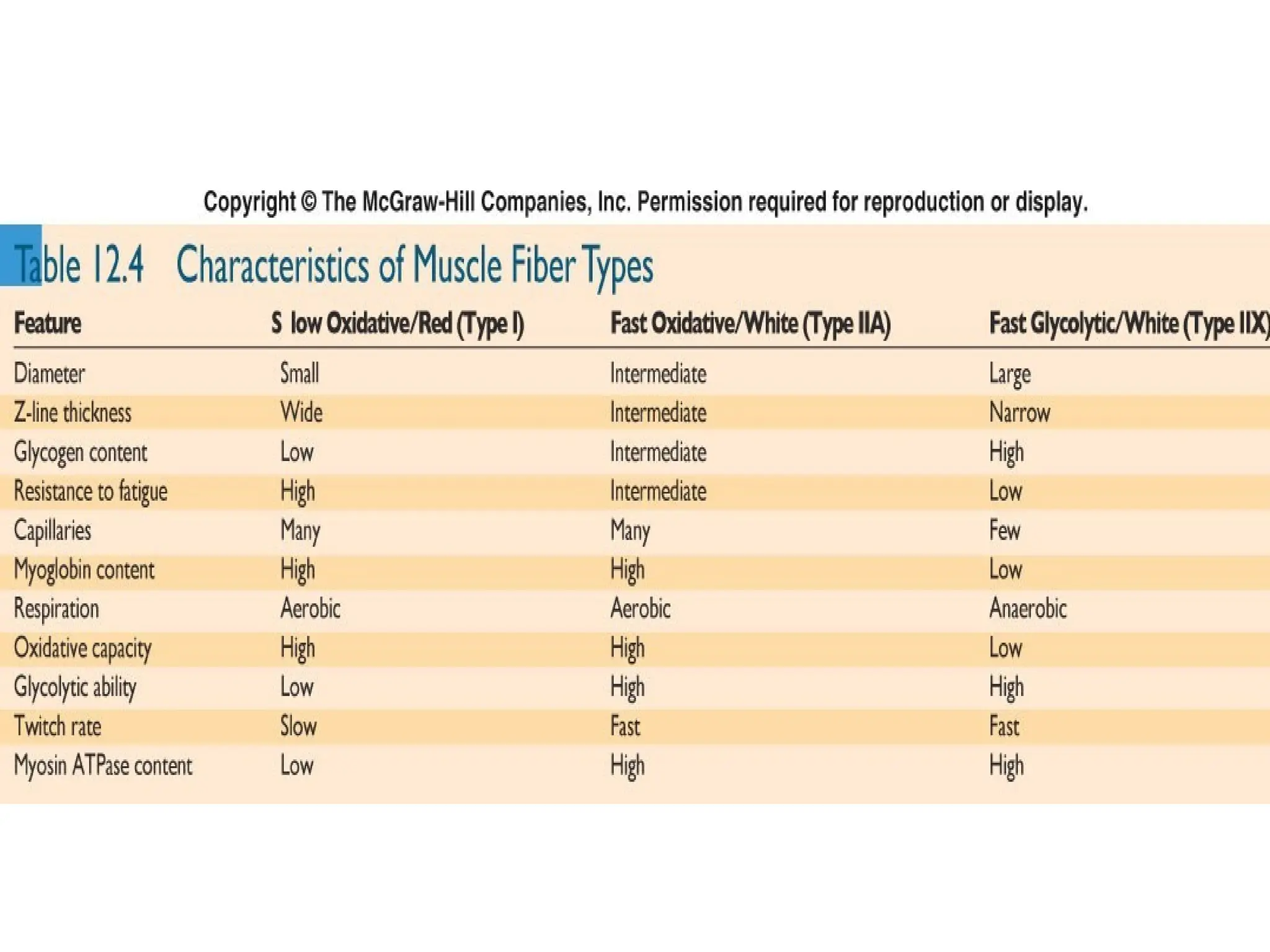
The difference of muscle fiber
Slow- and Fast-Twitch
Fibers
• Skeletal muscle fibers can be divided
on basis of contraction speed:
– Slow-twitch (type I fibers).
– Fast-twitch (type II fibers).
• Differences due to different myosin
ATPase isoenzymes that are slow or fast.
www.freelivedoctor.com
Types of skeletal
muscle
Red muscle fiber
Slow twitch period
Extensive blood supply
Thinner fiber
Plenty of
mitochondriae
Copious myoglobin
Less glycogen and
glycolytic
enzymes
White muscle fiber
Fast twitch period
Lesser blood supply
Thicker fiber
Less mitochondria
Less myoglobin
More glycogen &
glycolytic &
phosphorylase enzymes
Less ATPase activity
Short bursts of activity
Slow- and Fast-Twitch Fibers
(continued)
• Slow-twitch (type I fibers):
– Red fibers.
– High oxidative capacity for aerobic
respiration.
– Resistant to fatigue.
– Have rich capillary supply.
– Numerous mitochondria and aerobic
enzymes.
– High [myoglobin].
• Soleus muscle in the leg.
www.freelivedoctor.com
Slow- and Fast-Twitch Fibers
(continued)
• Fast-twitch (type IIX fibers):
– White fibers.
– Adapted to respire anaerobically.
– Have large stores of glycogen.
– Have few capillaries.
– Have few mitochondria.
• Extraocular muscles that position the eye.
Intermediate (type II A) fibers:
– Great aerobic ability.
– Resistant to fatigue.
People vary genetically in proportion of fast-
and
•
•
slow-twitch fibers in their
www.freelivedoctor.com
Characteristics
Type I Type II
Fast / High (very fast)
Low
Large
Many
Fast
High
High
Deliver extreme amount of
power for a few sec to min.
Velocity of
Shortening
Excitability
Diameter
MUSCLE
Number of
fiber
Contraction velocity
Fatigability
Force of unit
Function
Slow / Low (fast)
High
Small
few
Moderate
Low
low
Provide
enduranc
e
Metabolic Profile
Fiber diameter
Oxidative
Muscle fibers Classification
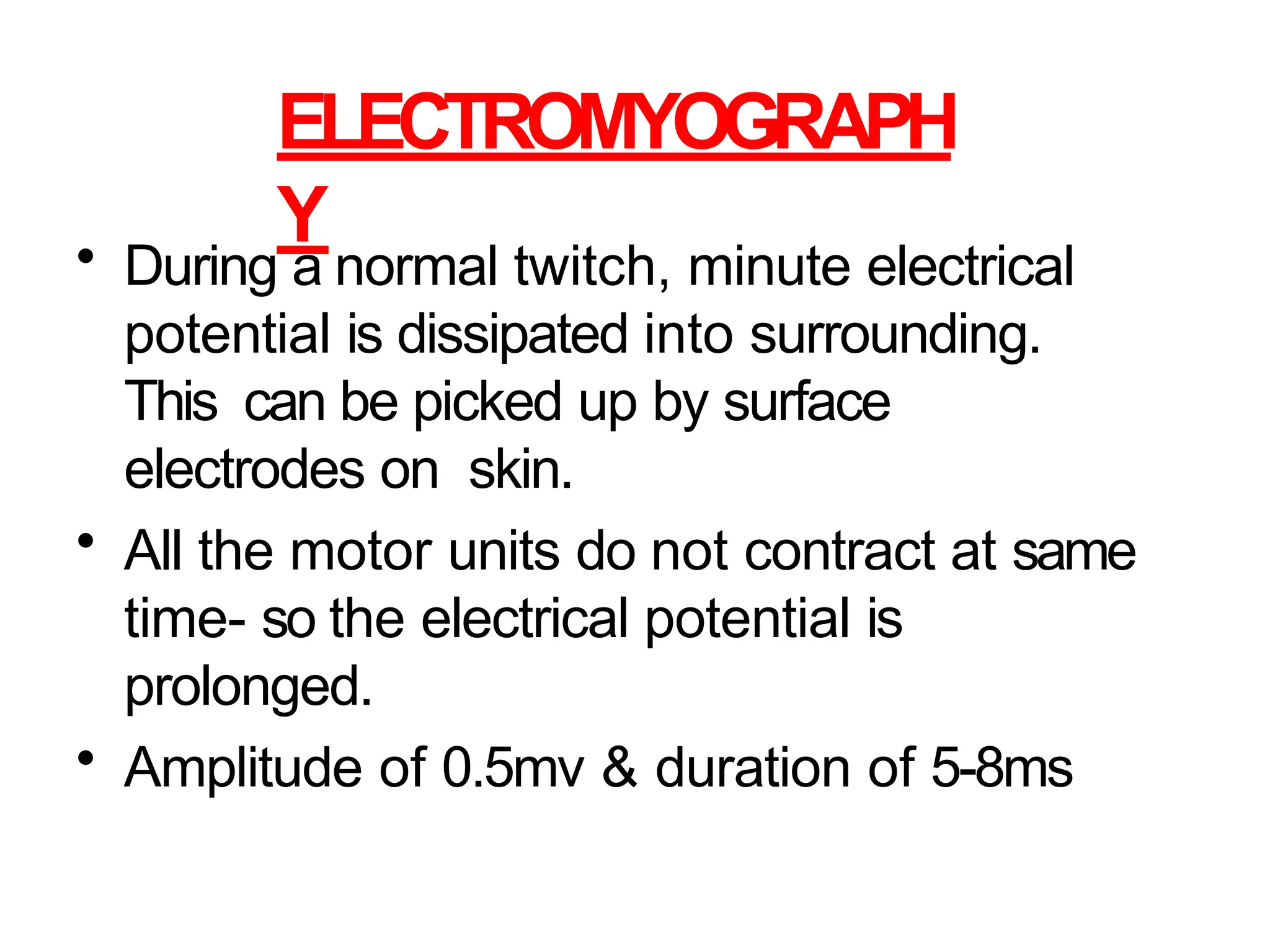
ELECTROMYOGRAPH
Y
• During a normal twitch, minute electrical
potential is dissipated into surrounding.
This can be picked up by surface
electrodes on skin.
• All the motor units do not contract at same
time- so the electrical potential is
prolonged.
• Amplitude of 0.5mv & duration of 5-8ms
• Electromyograph is a high gain amplifier
• Skin electrodes or needle electrodes are
used
• Motor unit potentials are displayed on CRO
• Potential is a sharp spike, usually biphasic
• Larger the motor-unit potential, larger
the motor unit.
• Useful for distinguishing nerve from
muscle disease
• EMGs are obtained at rest, during
slight muscle contraction, and during
maximal muscle activity
• Henneman principle
• Fibrillation- contraction of single
muscle cells
• Fasciculation- contraction of groups of
muscle cells supplied by a single axon
PROPERTIES OF SKELET
AL
MUSCLE
1. EXCITABILITY
2. CONTRACTILITY
3. CONDUCTIVITY
4. TONICITY
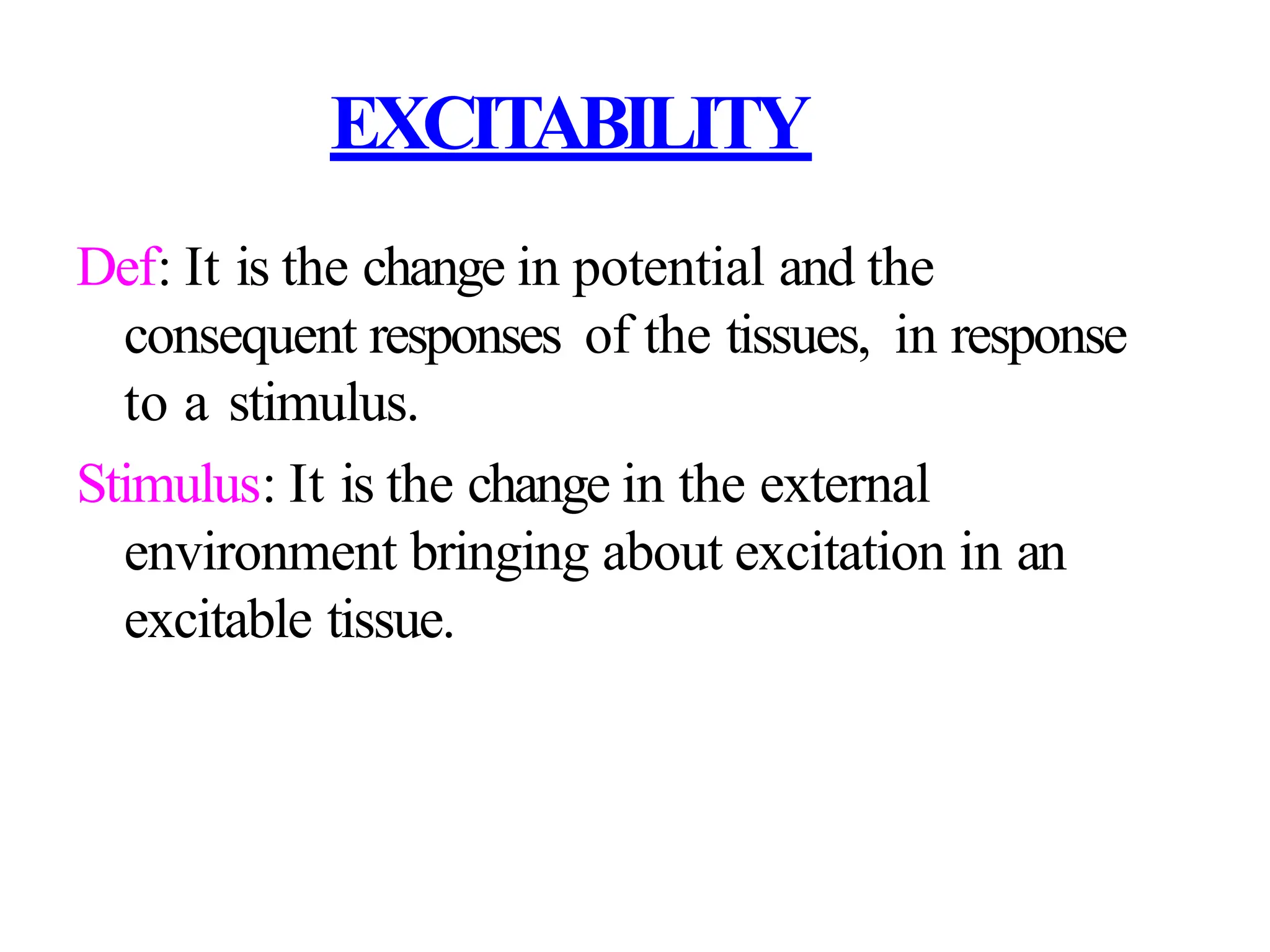
EXCITABILITY
Def: It is the change in potential and the
consequent responses of the tissues, in response
to a stimulus.
Stimulus: It is the change in the external
environment bringing about excitation in an
excitable tissue.
TYPES OF STIMULUS
• Electrical- commonly used in labs
• Mechanical
• Thermal
• Chemical
• Electro-magnetic
QUALITYOF STIMULUS
• Strength of stimulus- subminimal, minimal
(threshold), submaximal, maximal and
supramaximal
• Duration of stimulus
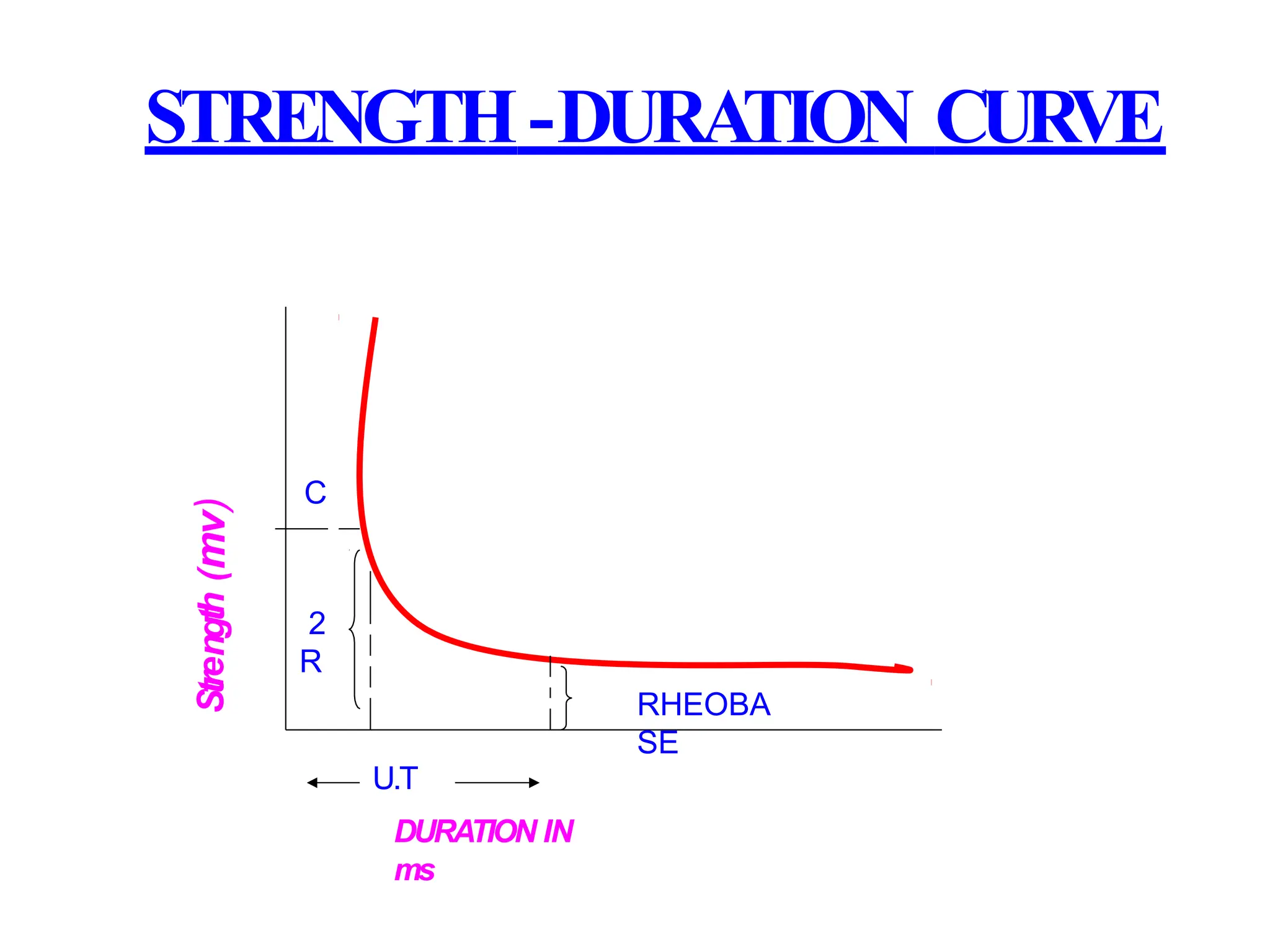
STRENGTH-DURATION CURVE
RHEOBA
SE
U.T
DURATION IN
ms
C
2
R
Strength
(
mv)
• Rheobase: the minimum strength of the current
acting on the muscle for a variable period that can
bring about a response.
Utilization time: the minimum duration for which a
current of rheobase strength is applied to excite an
excitable tissue
Chronaxie: is defined as the shortest duration of
stimulus required to excite a tissue by a current
strength equal to twice of rheobase voltage.
Chronaxie of a tissue is a definite measure of its
excitability.
•
•
•
II.CONTRACTILITY
• Def: internal events of the muscle which are manifested
by shortening or development of tension or both.
• Types of contraction:
1) isotonic contraction
2) isometric contraction
TYPESOF
CONTRACTION
1. Isometric contraction- length remains
same whereas tension increases. Eg:
pushing the wall
2. Isotonic contraction- tension remains
same whereas length changes. Eg:
throwing a stone
Isometric Contraction
Increase in muscle tension without a
change in muscle length.
wall
Since L=0 so, W=0
Energytension
Isotonic Contraction
Contraction in which the tension
remains constant as the
muscle shortens or lengthens
W=Lload 
L
load
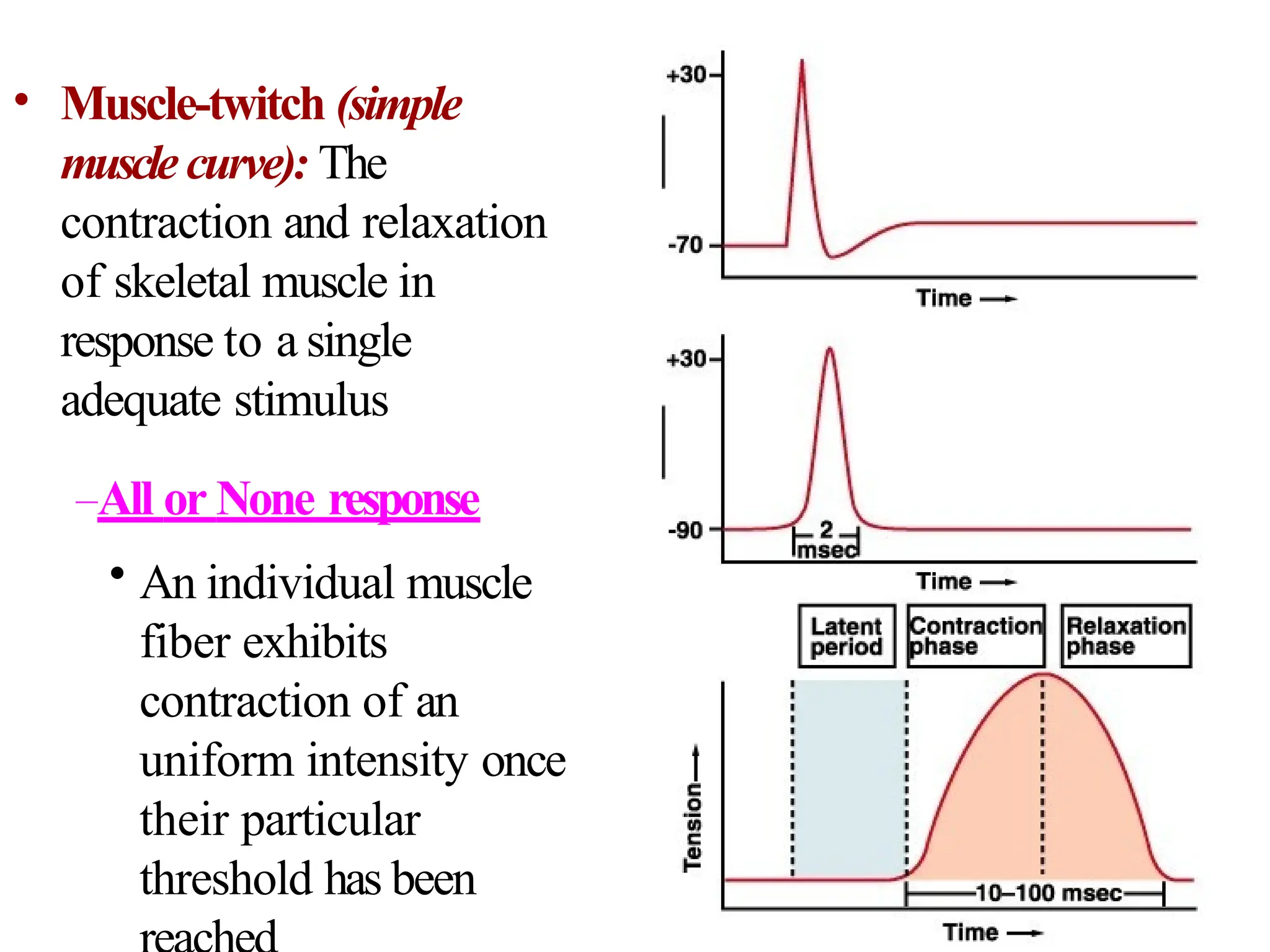
• Muscle-twitch (simple
musclecurve): The
contraction and relaxation
of skeletal muscle in
response to a single
adequate stimulus
–All or None response
• An individual muscle
fiber exhibits
contraction of an
uniform intensity once
their particular
threshold has been
F
ACTORS AFFECTING CONTRACTION
a) Strength of stimuli- Quantal summation
b) Effect of multiple stimuli:
1)effect of 2 successive stimuli:
i)beneficial effect
ii)superposition
iii)summation
1) more than two stimuli:
i)clonus
ii)tetanus
iii)treppe
iv)fatigue
c) Effect of temperature
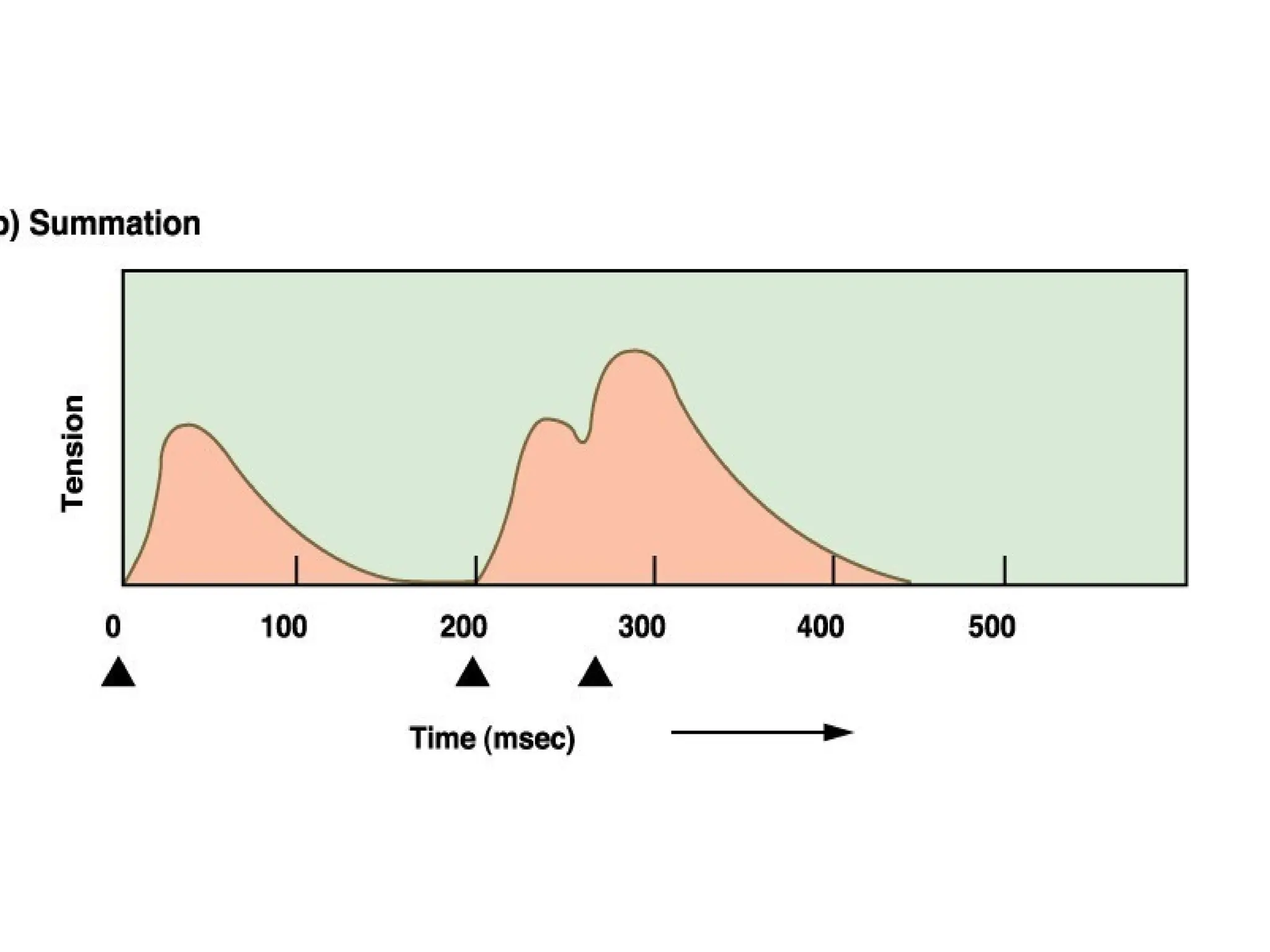
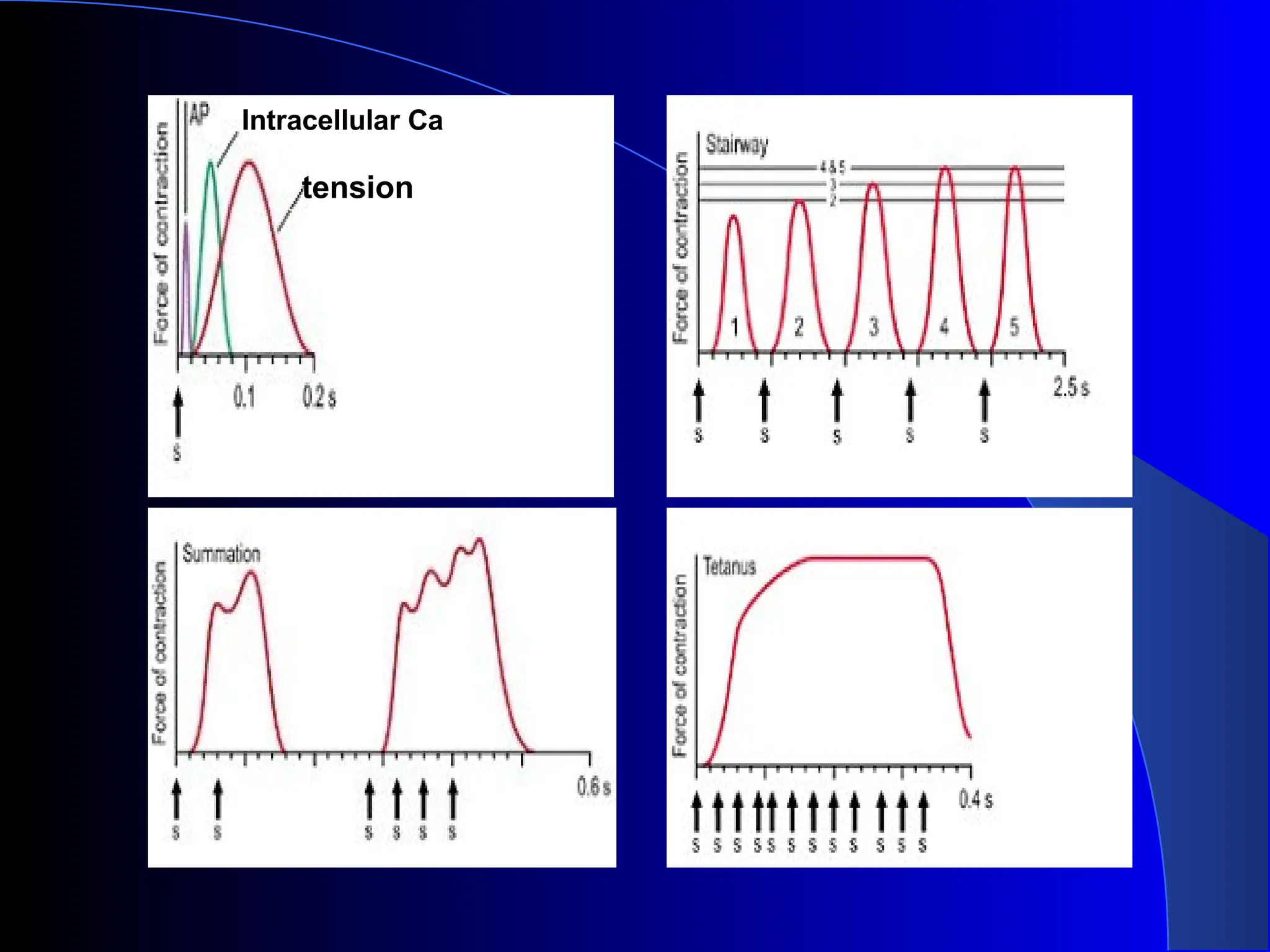
– Super-position
• The second contraction develops a greater tension
than the first one if the second stimulus is applied
before the relaxation is complete in the first one.
–Availability of more Ca+
+
–Ca+
+ from the first contraction is not
completely pumped into the SR
–Second stimulus releases Ca+
+
and adds to the
remaining Ca+
+
from the first contraction
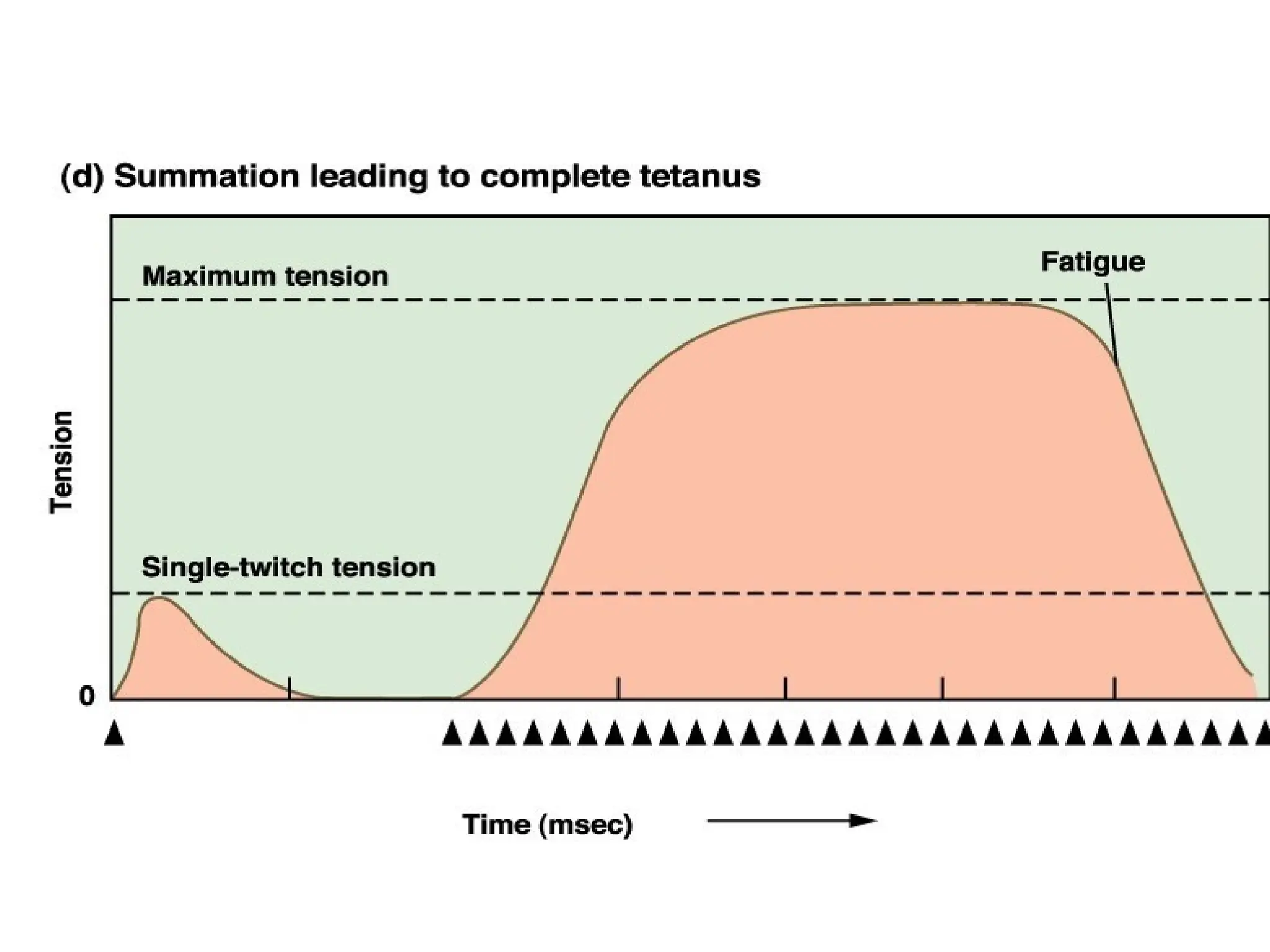
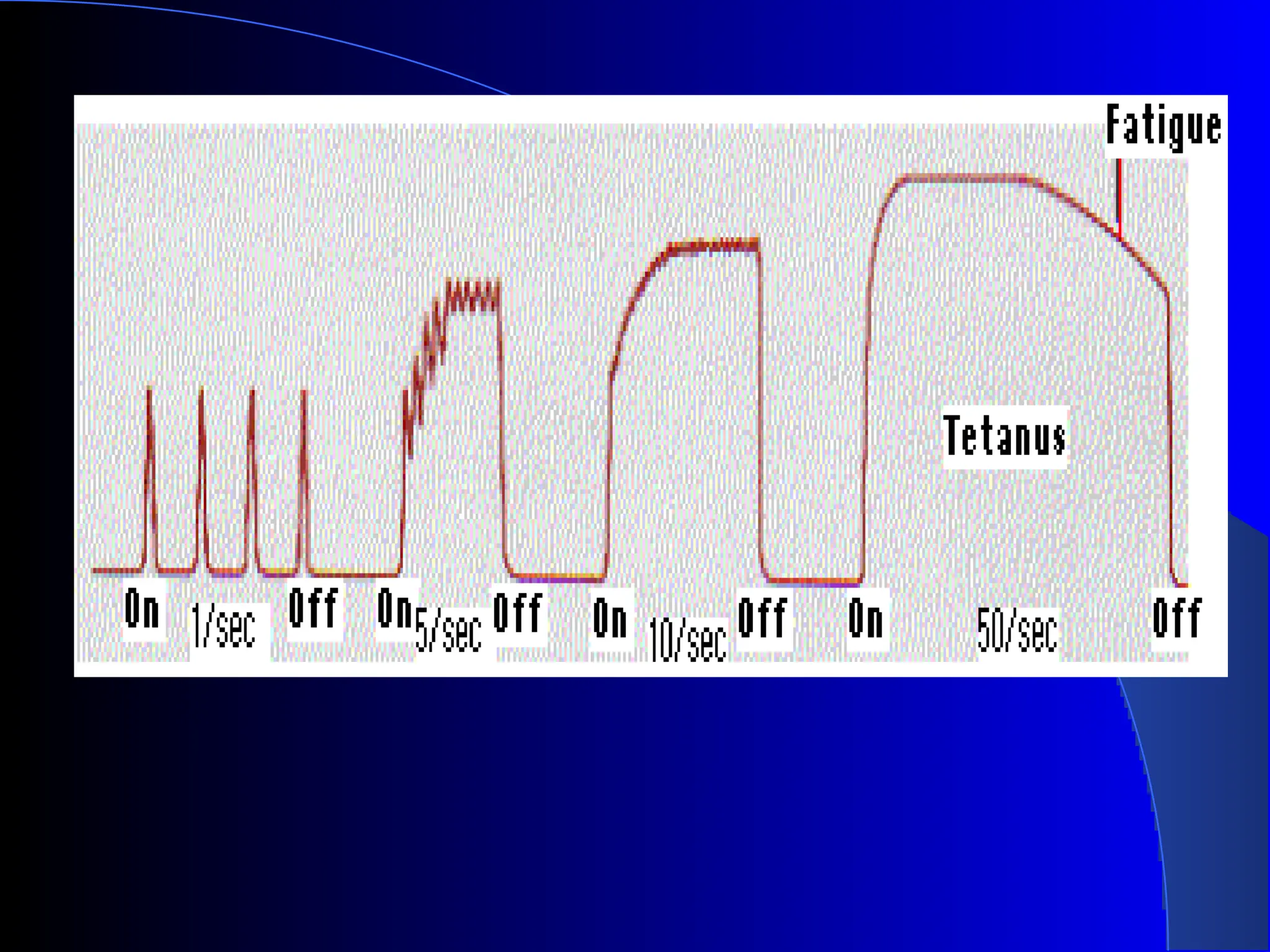
Tetanus- sustained contraction of muscle due
to repeated stimuli with high frequency.
–Treppe or Stair case effect
• After a period of rest, sudden series of stimulation
results in a series of contraction that increases in
amplitude until a steady state is reached.
• Due to redistribution of intra cellular Ca++/ more Ca+
+ availability
Intracellular Ca
tension
FATIGU
E
• Def: it is a decrease in the performance due to
continuous and prolonged activity
• Site of fatigue: CNS is the first site of
fatigue even though the muscle itself can
undergo fatigue.
• Nerve is infatigable.
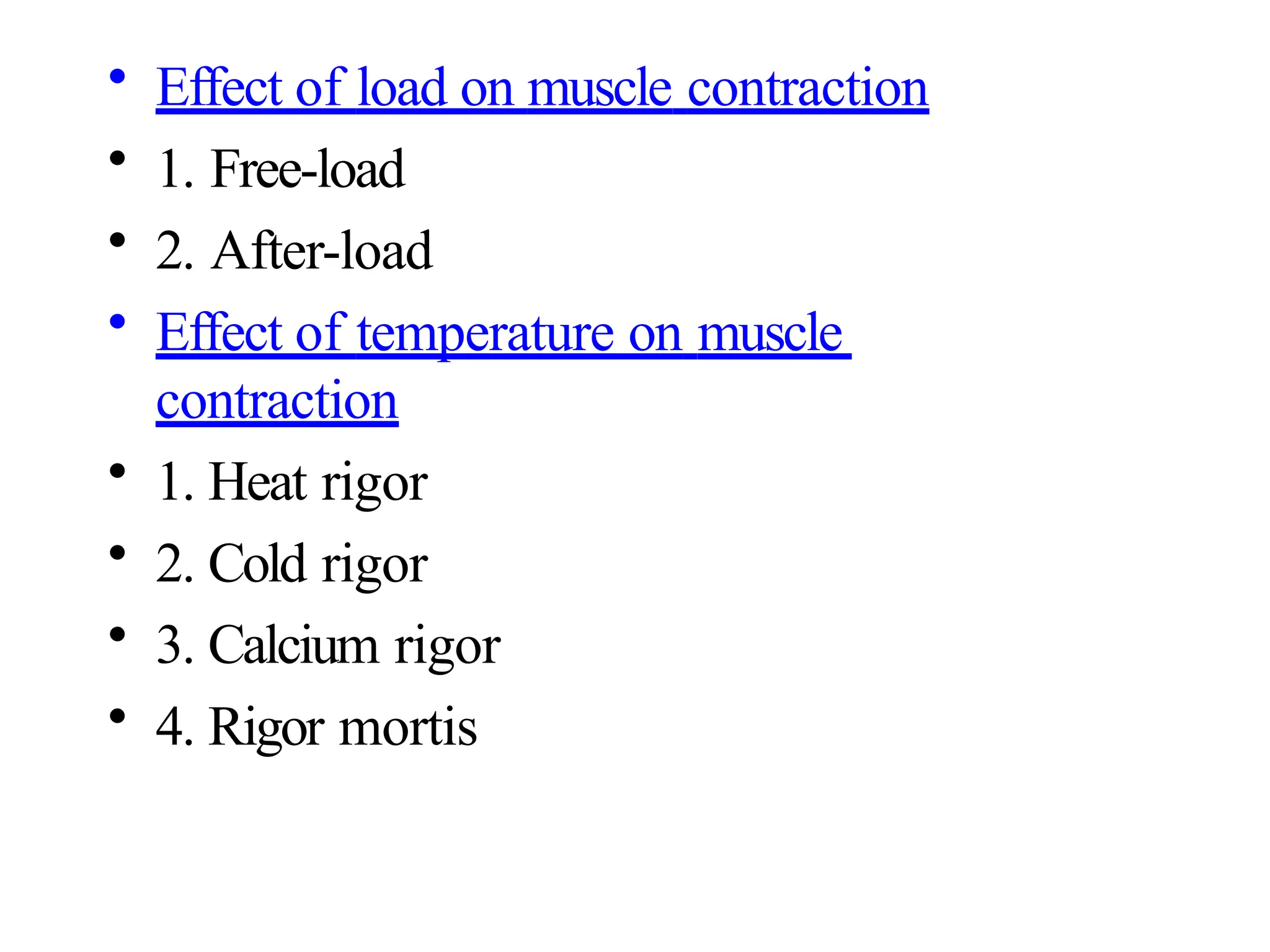
• Effect of load on muscle contraction
• 1. Free-load
• 2. After-load
• Effect of temperature on muscle
contraction
• 1. Heat rigor
• 2. Cold rigor
• 3. Calcium rigor
• 4. Rigor mortis
III.
CONDUCTIVITY
• velocity of action potential conduction
across skeletal muscle is 5m/sec
• in nerves it is up to 120m/sec
• conduction is along the sarcolemma and
moves along the T-tubules
IV
.TONICITY
• Def: it is the state of partial contraction of the
muscle
• Reflex phenomenon
• Resistance encountered on passive stretching of
muscle
• Rigidity
• Spasticity

Skeletal muscle property.pptx properties of smooth muscle

  • 1.
    MUSCLE CELLS are excitable cells. can transmit action potential along their cell membrane.  convert chemical energy into a mechanical response
  • 2.
    Physiologic Properties ofMuscle Cells IRRITABILITY OR EXCITABILITY  CONDUCTIVITY  CONTRACTILITY
  • 4.
    THREE MAJOR TYPESOF MUSCLES TYPES Striations Location SKELETAL prominent begins and ends in a tendon CARDIAC less prominent heart SMOOTH none hollow organ s/eyes Shape long, cylindrical multinucleated cylindrical branched mono/binucleated present (Intercalated disc) spindle-shaped mononucleated Anatomical / functional connections Special features absent present (unitary) absent (multiunit) makes up the great mass of somatic musculature under voluntary control pacemaker cells syncytial function pacemaker cells syncytial function (unitary) under involuntary control Innervation under involuntary control
  • 8.
    Primary Function generate a forceor movement in response to a physiological stimulus by transducing chemical or electrical stimuli into a mechanical response.
  • 9.
    STRUCTUREOF SKELET AL MUSCLE • Forms40% of body weight • Locomotion • Striated or voluntary • Multinucleated
  • 10.
  • 11.
  • 12.
    Sarcolemma- • Consists ofan inner plasma membrane and outer collagenous layer • Invaginates at numerous points to form T- tubules • Carries action potential Sarcoplasm- • Consists of myofibrils • Numerous mitochondriae lying parallel to myofibrils Sarcoplasmic reticulum- • L-tubules
  • 13.
    • Skeletal muscle • Fasciculus •Muscle fibers • Myofibrils
  • 14.
    • Muscle fiber-10 to 80μ in diameter each is composed of 1000s of myofibrils • Each myofibril is in turn made up of myofilaments • Myofilaments (i) contractile- myosin II, actin (ii) modulatory- tropomyosin, troponin
  • 15.
  • 18.
    LIGHT MICROSCOPIC STRUCTURE • • • • • • • Cross striationsdue to alternate dark and light bands Light band- Isotropic band- I band- thin filaments Dark band- Anisotropic band- Aband- birefringent H zone- lighter zone in Aband Zline- in the center of I band M line- in the center of A band Sarcomere- between two z lines- basic unit of muscle
  • 21.
    ULTRASTRUCT URE • • Myofilaments- thick &thin filaments Myosin-10 to 14nm wide & 1.6μm long 1500 in each myofibril Myosin filament made of around 200molecules of myosin Myosinmolecule- composed of 6 polypeptide chains- 2 heavy chains and 4 light chains Atail, an arm and 2 globular heads Arm and head form cross-bridge Two hinges Head has sites for ATPand actin binding •
  • 24.
    • Actin filament-7nm wide and 1.0μm long Extend on both sides of z-lines F-actin forms a double helix Made of 300 G-actin molecules (MW 42,000) G-actin has active sites for interaction with myosin heads
  • 25.
    • Tropomyosin- 40nmlength and MW of 70,000. Wrapped around actin helix & covers active sites in resting phase • Troponin- made of 3 protein subunits (Tn I, Tn C& Tn T)
  • 28.
    OTHER PROTEINS 1) Actinin- bindsactin to Z lines 2)Desmin- binds Zlines to the plasma membrane 3) Titin- connects Zlines to M lines and provide scaffolding for sarcomere. Provides elasticity 4)Dystrophin, dystroglycans and sarcoglycans
  • 30.
  • 31.
    Sarcolemma- • Consists ofan inner plasma membrane and outer collagenous layer • Invaginates at numerous points to form T- tubules • Carries action potential Sarcoplasm- • Consists of myofibrils • Numerous mitochondriae lying parallel to myofibrils Sarcoplasmic reticulum- •
  • 37.
    SARCOTUBULAR SYSTEM T-tubule- inward extensionof sarcolemma opens to exterior contain ECF run transverse to myofibrils transmit action potential L-tubule- sarcoplasmic reticulum run parallel to myofibrils terminate in terminal cisternae stores calcium ions Triads- two terminal cisternae abutting a t-tubule
  • 41.
    Action potential Neuromuscular transmission Endplate potential Muscle Action potential
  • 42.
    Propagation of muscleAP along sarcolemma AP reaches triad via T-tubule Depolarisation of T-tubule Enterance of AP in cisternsae
  • 43.
    Opening of ryanodinereceptors Ca2+ influx from Sarcoplasmic reticulum Into cytoplasm Binding of Ca2+ to Tn C Conformational change in troponin and tropomyosin
  • 44.
    Exposure of bindingsites on actin Interaction of actin and myosin contraction
  • 45.
    Active pumping of Ca2+back into sarcoplasmic reticulum Tropomyosin covers binding sites of actin relaxation
  • 48.
  • 49.
    THEORIES OF CONTRACTION 1) Viscoelastic(new elastic body theory) theory- 1840s to1920s- muscle acts like a stretched spring contained in a viscous medium. 2) Continuous filament theory- during contraction actin and myosin combine to form a single filament. This undergoes folding and shortening due to thermal agitation or loss of water molecules 3) Sliding filament theory
  • 50.
    SLIDING FILAMENT THEORY • 1954by A.F.Huxley and H.E.Huxley independently • Two overlapping sets of filaments sliding past each other. • Thin filaments at each end of sarcomere move towards center between thick filaments. • Globular heads of myosin form cross- bridges with actin monomers- cross-bridge theory
  • 53.
    • Huxley (1969)-cross-bridges attach to thin filament pull towards center detach attach further down ratchet theory or walk-along theory
  • 56.
    A TPattaches to myosin head ATPsplitinto ADP+Pi Myosin head cocks up Attaches to actin monomer Head tilts towards arm Energy for Muscular Contraction-
  • 57.
    Powerstroke Actin is pulled ADP& Pi released A TPattachesto head Head releases from actin ATPis cleaved To ADP& Pi Head cocks up
  • 59.
    EVENTSDURING MUSCLE CONTRACTION 1. Chemicalchanges 2. Mechanical changes 3. Thermal changes 4. Electrical changes
  • 60.
    Chemical changes • ATP attachesto myosin head splits to ADP+Pi myosin head cocks up attaches to actin power-stroke ADP& Pi discarded new ATPattaches to myosin head myosin head released from actin • ATPyields 11.5kcal/mol
  • 61.
    Sources of ATP 1. ATPpresent in sarcoplasm- suffice for 1- 2sec 2. Creatine phosphate- suffice for 5-8sec. Lohman’s reaction CP+ADP=Creatine+ATP 3. Glycolysis- suffice for 1min 4. Oxidation of cellular foodstuff- for longer periods
  • 62.
    Mechanical changes • Isotonic contraction-shortening of muscle but volume remains the same • Isometric contraction- no change in the length
  • 63.
    Thermal changes 1. Resting heat-A.V.HILL- 300cal/min in 70kg man with 30kg of skeletal muscles. 2. Activation heat- energy required for Ca2 + influx, binding to troponin & pumping out of Ca2 +- 10cal/gm .Maintenance heat. 3. Shortening heat- proportional to amount of shortening 4. Maintenance heat 5. Relaxation heat 6. Recovery heat- restitution of ATPand glycogen
  • 64.
    Electrical changes • RMP of-90mv • APmoves along sarcolemma • Velocity of APconduction- 5m/sec
  • 65.
    MOTOR UNIT • Single nervefiber with all the muscle fibers it supplies for a motor unit • Motor units may contain 2 to few hundred muscle fibers • Smaller motor units are associated with muscles of fine movements
  • 66.
    MOTOR UNIT  asingle motorneuron and the muscle fibers it innervates.  the number of muscle fibers varies with each motor unit. 3 – 6 muscle fibers/motor unit > muscles concerned with fine, graded and precise movement. 120 – 165 muscle fibers/motor unit > muscles concerned with postural and gross movement. each spinal motorneuron innervates only one kind of muscle fiber, so that all of the muscle fibers in a motor unit are of the same type.
  • 68.
    WORKING MODEL • Muscle consistsof 3 components 1. Contractile element 2. Series elastic element- arms of cross- bridges, tendon fibers 3. Parallel elastic element- connective tissue
  • 69.
    Non-contractile and connectivetissue in muscle itself Tendon
  • 70.
    TYPESOF CONTRACTION 1. Isometric contraction-length remains same whereas tension increases. Eg: pushing the wall 2. Isotonic contraction- tension remains same whereas length changes. Eg: throwing a stone
  • 71.
    Isometric Contraction Increase inmuscle tension without a change in muscle length. wall Since L=0 so, W=0 Energytension
  • 72.
    Isotonic Contraction Contraction inwhich the tension remains constant as the muscle shortens or lengthens W=Lload  L load
  • 73.
  • 74.
    Preload and Afterload • Preload:load establishes the initial muscle length. Load is carried by muscle at rest and during contraction. • Afterload: load, or a portion of it, is supporteduntil the muscle develops enough force to lift it.
  • 75.
    Effects of preloador initial length on contraction of the muscle
  • 76.
    Transducer S Move up ordown to change preload (initial length) F1 F3 Initial length & preload F2
  • 77.
    1. Passive tensionis the tension developed by simply stretching a muscle to different lengths ( think of a rubber band). 2. Passive tension is determined by preload and the elasticity of the muscle itself.
  • 78.
    • Total tensionis the tension developed when a muscle is stimulated to contract at different preload. • It is the sum of the active tension developed by contractile elements of the sarcomeres and the passive tension caused by stretching the muscle.
  • 79.
    • Active tensionis determined by subtracting the passive tension from the total tension (total T-passive T). • It represents the active force developed when the muscle contracts, i.e., the relation between preload and tension generated by contraction. • At the beginning, active tension developed is proportional to the increase in preload but, when the muscle is stretched to longer length, active tension is reduced. B
  • 80.
    LENGTH-TENSION RELATIONSHIP Muscle length isheld constant at various lengths. Muscle directly stimulated at many points. Tension developed is measured using transducer. Maximum tension at rest length. When muscle is stretched, passive tension is developed due stretching of elastic elements
  • 81.
    • Studied insingle muscle fiber using optical diffraction patterns of laser. Tension developed is maximum at 2-2.2μ when there is optimum overlap of actin and myosin No tension when muscle is stretched so that there is no overlap of actin & myosin filaments With shorter lengths, tension reduces • • •
  • 82.
    The active tensionis maximal when there is maximal overlap of thick and thin filaments and maximal cross- bridge 2 to 2.2m in vivo
  • 84.
    Increasing preload does notaffect latent period and slightly reduces the distance shortened Latency & the distance shortened
  • 85.
    Effects of afterloadon the contraction of muscle: Force-Velocity relationship
  • 86.
  • 87.
    Increasing afterload increase thelatent period and reduces the distance shortened Latency & the distance shortened
  • 88.
    Becaus e: 1. The speedof muscle shortening depends on the speed of cross-bridge cycling. 2. The force developed depends on the number of cross-bridge formed. 3. As the afterload on the muscle increases, the velocity will be decreased because cross-bridge can cycle less rapidly against the higher resistance. 1. The speed of muscle shortening depends on the speed of cross-bridge cycling. 2. The force developed depends on the number of cross-bridge formed. 3. As the afterload on the muscle increases, the velocity will be decreased because cross-bridge can cycle less rapidly against the higher resistance.
  • 89.
    Force–Velocity Curve P 1. P0 ,Vmax=0; (isometric contraction)
  • 90.
    FORCE-VELOCITY RELATIONSHIP • Muscle isallowed to contract with various loads attached • Isotonic contraction • Initial latency is time for activation of contractile machinery • Later part of latency is time taken to stretch the SEE • As the load increases, velocity decreases
  • 92.
    • Rigor mortis:- Seenafter death State of extreme rigidity Due to fixed interaction between actin & myosin heads ATP is needed to break actin-myosin bond Loss of rigidity after few hours due to proteolysis
  • 93.
    The difference ofmuscle fiber
  • 94.
    Slow- and Fast-Twitch Fibers •Skeletal muscle fibers can be divided on basis of contraction speed: – Slow-twitch (type I fibers). – Fast-twitch (type II fibers). • Differences due to different myosin ATPase isoenzymes that are slow or fast. www.freelivedoctor.com
  • 95.
    Types of skeletal muscle Redmuscle fiber Slow twitch period Extensive blood supply Thinner fiber Plenty of mitochondriae Copious myoglobin Less glycogen and glycolytic enzymes White muscle fiber Fast twitch period Lesser blood supply Thicker fiber Less mitochondria Less myoglobin More glycogen & glycolytic & phosphorylase enzymes Less ATPase activity Short bursts of activity
  • 96.
    Slow- and Fast-TwitchFibers (continued) • Slow-twitch (type I fibers): – Red fibers. – High oxidative capacity for aerobic respiration. – Resistant to fatigue. – Have rich capillary supply. – Numerous mitochondria and aerobic enzymes. – High [myoglobin]. • Soleus muscle in the leg. www.freelivedoctor.com
  • 97.
    Slow- and Fast-TwitchFibers (continued) • Fast-twitch (type IIX fibers): – White fibers. – Adapted to respire anaerobically. – Have large stores of glycogen. – Have few capillaries. – Have few mitochondria. • Extraocular muscles that position the eye. Intermediate (type II A) fibers: – Great aerobic ability. – Resistant to fatigue. People vary genetically in proportion of fast- and • • slow-twitch fibers in their www.freelivedoctor.com
  • 99.
    Characteristics Type I TypeII Fast / High (very fast) Low Large Many Fast High High Deliver extreme amount of power for a few sec to min. Velocity of Shortening Excitability Diameter MUSCLE Number of fiber Contraction velocity Fatigability Force of unit Function Slow / Low (fast) High Small few Moderate Low low Provide enduranc e Metabolic Profile Fiber diameter Oxidative Muscle fibers Classification
  • 100.
    ELECTROMYOGRAPH Y • During anormal twitch, minute electrical potential is dissipated into surrounding. This can be picked up by surface electrodes on skin. • All the motor units do not contract at same time- so the electrical potential is prolonged. • Amplitude of 0.5mv & duration of 5-8ms
  • 101.
    • Electromyograph isa high gain amplifier • Skin electrodes or needle electrodes are used • Motor unit potentials are displayed on CRO • Potential is a sharp spike, usually biphasic • Larger the motor-unit potential, larger the motor unit.
  • 102.
    • Useful fordistinguishing nerve from muscle disease • EMGs are obtained at rest, during slight muscle contraction, and during maximal muscle activity • Henneman principle • Fibrillation- contraction of single muscle cells • Fasciculation- contraction of groups of muscle cells supplied by a single axon
  • 104.
    PROPERTIES OF SKELET AL MUSCLE 1.EXCITABILITY 2. CONTRACTILITY 3. CONDUCTIVITY 4. TONICITY
  • 105.
    EXCITABILITY Def: It isthe change in potential and the consequent responses of the tissues, in response to a stimulus. Stimulus: It is the change in the external environment bringing about excitation in an excitable tissue.
  • 106.
    TYPES OF STIMULUS •Electrical- commonly used in labs • Mechanical • Thermal • Chemical • Electro-magnetic
  • 107.
    QUALITYOF STIMULUS • Strengthof stimulus- subminimal, minimal (threshold), submaximal, maximal and supramaximal • Duration of stimulus
  • 108.
  • 109.
    • Rheobase: theminimum strength of the current acting on the muscle for a variable period that can bring about a response. Utilization time: the minimum duration for which a current of rheobase strength is applied to excite an excitable tissue Chronaxie: is defined as the shortest duration of stimulus required to excite a tissue by a current strength equal to twice of rheobase voltage. Chronaxie of a tissue is a definite measure of its excitability. • • •
  • 110.
    II.CONTRACTILITY • Def: internalevents of the muscle which are manifested by shortening or development of tension or both. • Types of contraction: 1) isotonic contraction 2) isometric contraction
  • 111.
    TYPESOF CONTRACTION 1. Isometric contraction-length remains same whereas tension increases. Eg: pushing the wall 2. Isotonic contraction- tension remains same whereas length changes. Eg: throwing a stone
  • 112.
    Isometric Contraction Increase inmuscle tension without a change in muscle length. wall Since L=0 so, W=0 Energytension
  • 113.
    Isotonic Contraction Contraction inwhich the tension remains constant as the muscle shortens or lengthens W=Lload  L load
  • 114.
    • Muscle-twitch (simple musclecurve):The contraction and relaxation of skeletal muscle in response to a single adequate stimulus –All or None response • An individual muscle fiber exhibits contraction of an uniform intensity once their particular threshold has been
  • 115.
    F ACTORS AFFECTING CONTRACTION a)Strength of stimuli- Quantal summation b) Effect of multiple stimuli: 1)effect of 2 successive stimuli: i)beneficial effect ii)superposition iii)summation 1) more than two stimuli: i)clonus ii)tetanus iii)treppe iv)fatigue c) Effect of temperature
  • 117.
    – Super-position • Thesecond contraction develops a greater tension than the first one if the second stimulus is applied before the relaxation is complete in the first one. –Availability of more Ca+ + –Ca+ + from the first contraction is not completely pumped into the SR –Second stimulus releases Ca+ + and adds to the remaining Ca+ + from the first contraction
  • 120.
    Tetanus- sustained contractionof muscle due to repeated stimuli with high frequency.
  • 122.
    –Treppe or Staircase effect • After a period of rest, sudden series of stimulation results in a series of contraction that increases in amplitude until a steady state is reached. • Due to redistribution of intra cellular Ca++/ more Ca+ + availability
  • 123.
  • 124.
    FATIGU E • Def: itis a decrease in the performance due to continuous and prolonged activity • Site of fatigue: CNS is the first site of fatigue even though the muscle itself can undergo fatigue. • Nerve is infatigable.
  • 125.
    • Effect ofload on muscle contraction • 1. Free-load • 2. After-load • Effect of temperature on muscle contraction • 1. Heat rigor • 2. Cold rigor • 3. Calcium rigor • 4. Rigor mortis
  • 126.
    III. CONDUCTIVITY • velocity ofaction potential conduction across skeletal muscle is 5m/sec • in nerves it is up to 120m/sec • conduction is along the sarcolemma and moves along the T-tubules
  • 127.
    IV .TONICITY • Def: itis the state of partial contraction of the muscle • Reflex phenomenon • Resistance encountered on passive stretching of muscle • Rigidity • Spasticity