Didattica integrativa
31 Maggio 2016
Dott.ssa Giulia Giannini
Tutor: Dott.ssa Giovanna Calandra Buonaura
 Neurodegenerative disorder characterized by
autonomic failure with motor involvement of
parkinsonism and/or cerebellar ataxia
 Estimated mean incidence 0,6-0,7 per 100.000 per
year
 Estimated prevalence 3,9 to 4,9 per 100.000 cases
per 100.000 per year, increasing to 7,8 per 100.000
among persons older than 40 years of age
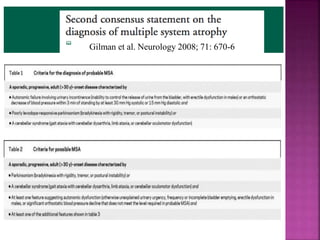
Gilman et al. Neurology 2008; 71: 670-6
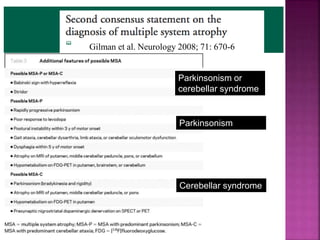
Parkinsonism or
cerebellar syndrome
Parkinsonism
Cerebellar syndrome
Gilman et al. Neurology 2008; 71: 670-6
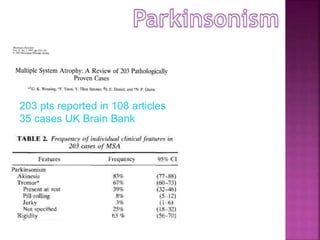
203 pts reported in 108 articles
35 cases UK Brain Bank
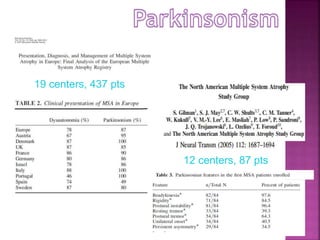
19 centers, 437 pts
12 centers, 87 pts
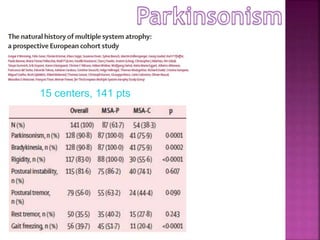
15 centers, 141 pts
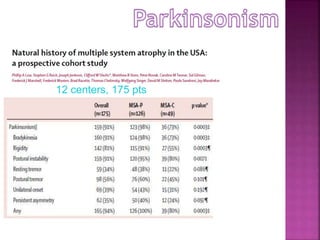
12 centers, 175 pts
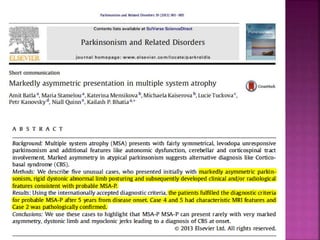
 Parkinsonism (rigidity, bradykinesia, and postural
instability) occurs in at least 90% of all patients
with MSA
 Often symmetrical akinetic-rigid picture without
tremor
 The motor findings are sometimes asymmetrical
(35-40%)
 Parkinson-like “pill-rolling” rest tremor is unusual,
whereas irregular postural and action tremor with
superimposed jerks is seen in as many as 50% of
patients with MSA
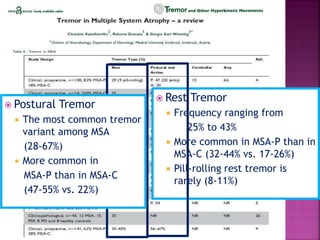
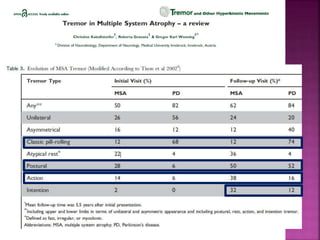
 Rest Tremor
 Frequency ranging from
25% to 43%
 More common in MSA-P than in
MSA-C (32-44% vs. 17-26%)
 Pill-rolling rest tremor is
rarely (8-11%)
 Postural Tremor
 The most common tremor
variant among MSA
(28-67%)
 More common in
MSA-P than in MSA-C
(47-55% vs. 22%)
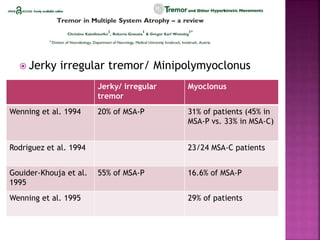
 Jerky irregular tremor/ Minipolymyoclonus
Jerky/ irregular
tremor
Myoclonus
Wenning et al. 1994 20% of MSA-P 31% of patients (45% in
MSA-P vs. 33% in MSA-C)
Rodriguez et al. 1994 23/24 MSA-C patients
Gouider-Khouja et al.
1995
55% of MSA-P 16.6% of MSA-P
Wenning et al. 1995 29% of patients
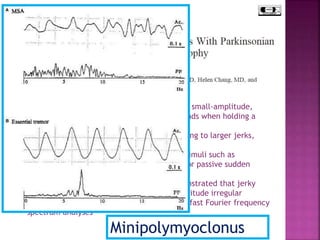
o 9 out 11 MSA-P patients presented abnormal, small-amplitude,
nonrhythmic movements of the fingers or hands when holding a
posture or at the beginning of an action;
o Involvement of proximal arm segments, leading to larger jerks,
occurred only occasionally
o During maintenance of a posture, external stimuli such as
cutaneous pinprick with a sharpened object or passive sudden
stretch elicited reflex jerks in all 9 patients
o Neurophysiological investigations have demonstrated that jerky
postural tremor in MSA consists of small-amplitude irregular
oscillations with no predominant peak in the fast Fourier frequency
spectrum analyses
Minipolymyoclonus
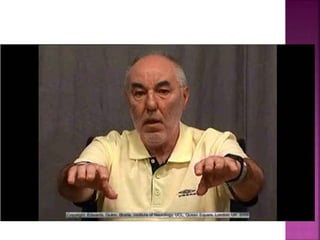
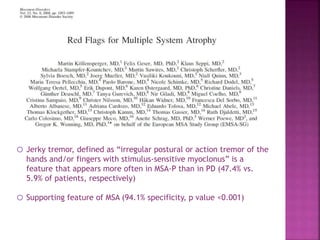
o Jerky tremor, defined as “irregular postural or action tremor of the
hands and/or fingers with stimulus-sensitive myoclonus” is a
feature that appears more often in MSA-P than in PD (47.4% vs.
5.9% of patients, respectively)
o Supporting feature of MSA (94.1% specificity, p value <0.001)
 Variant atypical or jerky components have been
reported
 the classic parkinsonian (pill-rolling) rest tremor
is only present in a minority of patients
 Pill-rolling rest tremor supports a diagnosis of
PD.
 Intention tremor points away from PD but is
typical in MSA, especially MSA-C (up to 45% of
patients).
 Tremor of the legs, head, chin, lips, and tongue
can be found in PD but are all uncommon in MSA.
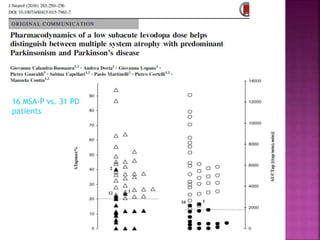
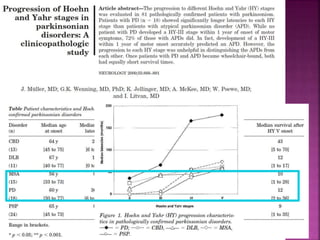
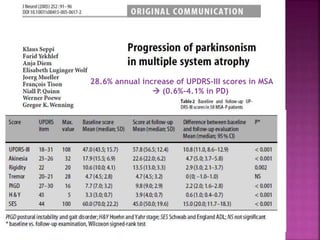
16 MSA-P vs. 31 PD
patients
28.6% annual increase of UPDRS-III scores in MSA
 (0.6%-4.1% in PD)
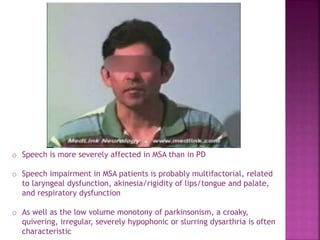
o Speech is more severely affected in MSA than in PD
o Speech impairment in MSA patients is probably multifactorial, related
to laryngeal dysfunction, akinesia/rigidity of lips/tongue and palate,
and respiratory dysfunction
o As well as the low volume monotony of parkinsonism, a croaky,
quivering, irregular, severely hypophonic or slurring dysarthria is often
characteristic
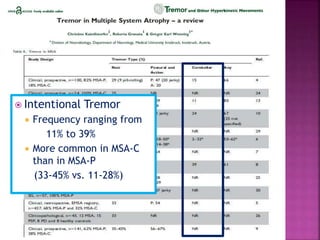
 Intentional Tremor
 Frequency ranging from
11% to 39%
 More common in MSA-C
than in MSA-P
(33-45% vs. 11-28%)
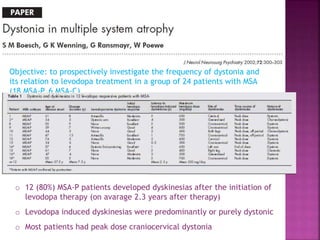
Objective: to prospectively investigate the frequency of dystonia and
its relation to levodopa treatment in a group of 24 patients with MSA
(18 MSA-P, 6 MSA-C)
Dystonia before levodopa treatment
Dystonia 11 (46%) patients
Anterocollis 6 (25%) patients, 4 MSA-P and 2 MSA-C
Unilateral limb dystonia 5 (21%) patients, 4 MSA-P and 1 MSA-C
o 12 (80%) MSA-P patients developed dyskinesias after the initiation of
levodopa therapy (on avarage 2.3 years after therapy)
o Levodopa induced dyskinesias were predominantly or purely dystonic
o Most patients had peak dose craniocervical dystonia
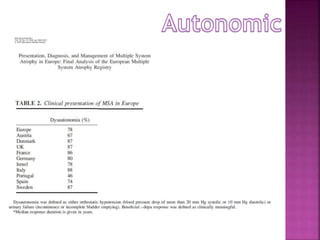
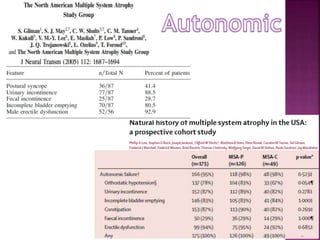
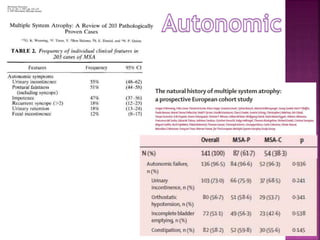
 Symptomatic dysautonomia is present in 95-99%
 OH symptoms (43-75%), documented OH (56.7-78%),
syncope (19-41.4%)
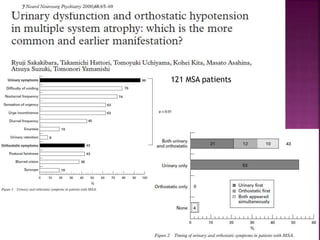
 Urinary symptoms (83-96%) Urge incontinence (55-87%),
incomplete bladder emptying (72-83%),
 Erectile dysfunction (93-96% male patients)
 Constipation (58-87%)
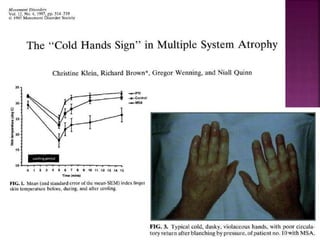
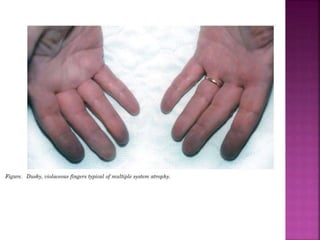
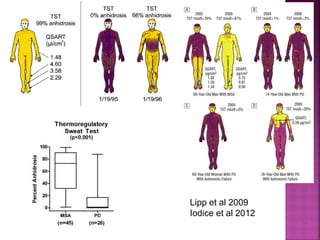
 Sudomotor disturbances (anhidrosis)
121 MSA patients
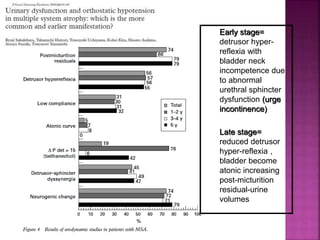
Early stage=
detrusor hyper-
reflexia with
bladder neck
incompetence due
to abnormal
urethral sphincter
dysfunction (urge
incontinence)
Late stage=
reduced detrusor
hyper-reflexia ,
bladder become
atonic increasing
post-micturition
residual-urine
volumes
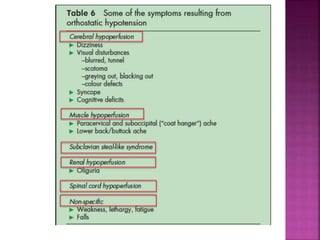
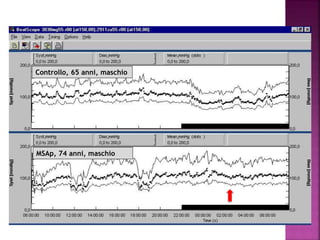
 Probable MSA: a decrease of blood pressure within 3 min of
standing by at least 30 mm Hg systolic or 15 mm Hg diastolic
 Possible MSA: significant orthostatic blood pressure decline that
does not meet the level required in probable MSA
 Orthostatic hypotension is a sustained reduction of systolic blood
pressure of at least 20 mmHg or diastolic blood pressure of 10
mmHg within 3 min of standing or head-up tilt to at least 60 on a tilt
table. Orthostatic hypotension is a clinical sign and may be
symptomatic or asymptomatic (Freeman et al. 2011)
Controllo, 65 anni, maschio
MSAp, 74 anni, maschio
Lipp et al 2009
Iodice et al 2012
 Reduced sleep efficiency and fragmented sleep
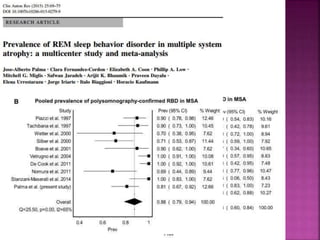
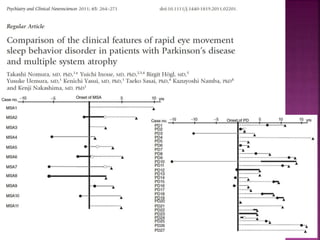
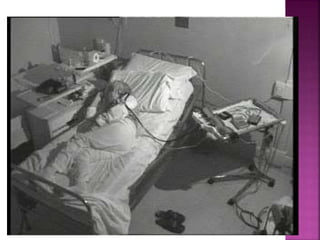
 RBD
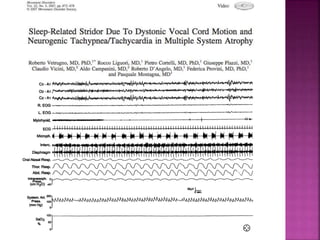
 Stridor
 OSAS (new or increased snoring is a red flag)
 Other sleep-related breathing disorders: central
apnea, tachypnea and paradoxical breathing
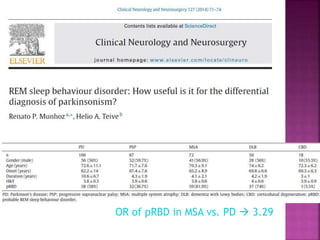
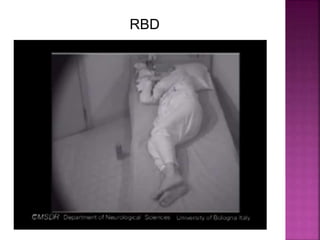
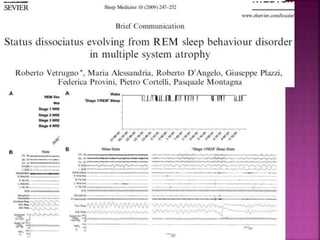
OR of pRBD in MSA vs. PD  3.29
RBD
 A harsh high-pitched respiratory sound,
almost always occurring during inspiration
due to a laryngeal narrowing
 Typically in MSA occurs during sleep
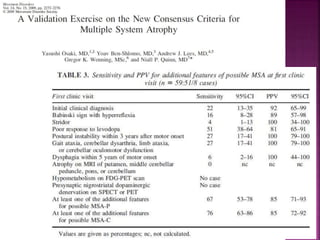
 One of the additional features for the
diagnosis of possible MSA
 Stridor prevalence (12-41%)
 Higher diagnostic positive predicted value
than clinical diagnosis at first visit (PPV:
100%; CI-34-100)
Inspiratory sights
 Abnormal sleep structure in MSA patients,
with reduced NREM deep sleep and
decreased sleep efficiency.
 Patients with stridor, already tachypnoic
during Wake, MSA patients had a significant
increase in breathing rate from Wake to
NREM and REM sleep.
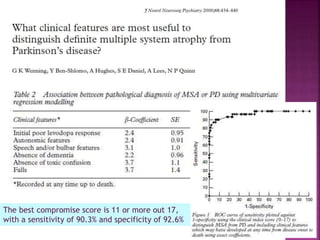
The best compromise score is 11 or more out 17,
with a sensitivity of 90.3% and specificity of 92.6%
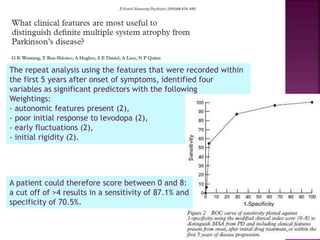
The repeat analysis using the features that were recorded within
the first 5 years after onset of symptoms, identified four
variables as significant predictors with the following
Weightings:
- autonomic features present (2),
- poor initial response to levodopa (2),
- early fluctuations (2),
- initial rigidity (2).
A patient could therefore score between 0 and 8:
a cut off of >4 results in a sensitivity of 87.1% and
specificity of 70.5%.
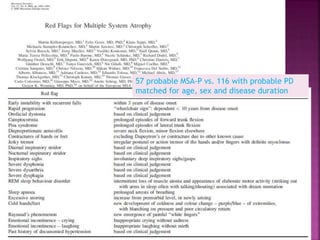
57 probable MSA-P vs. 116 with probable PD
matched for age, sex and disease duration
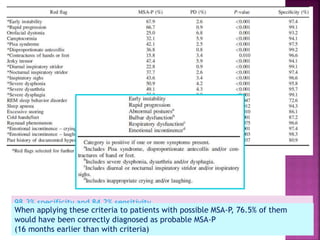
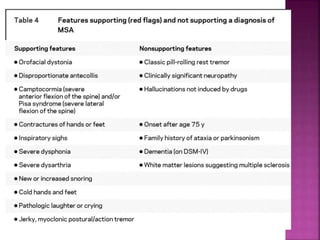
98.3% specificity and 84.2% sensitivity
PPV of 96% and NPV of 92.7% if red flags from 2 or more categories were present
When applying these criteria to patients with possible MSA-P, 76.5% of them
would have been correctly diagnosed as probable MSA-P
(16 months earlier than with criteria)
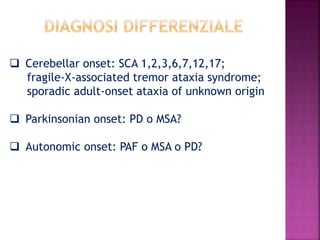
 Cerebellar onset: SCA 1,2,3,6,7,12,17;
fragile-X-associated tremor ataxia syndrome;
sporadic adult-onset ataxia of unknown origin
 Parkinsonian onset: PD o MSA?
 Autonomic onset: PAF o MSA o PD?
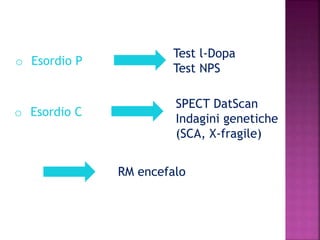
o Esordio P
Test l-Dopa
Test NPS
o Esordio C
SPECT DatScan
Indagini genetiche
(SCA, X-fragile)
RM encefalo
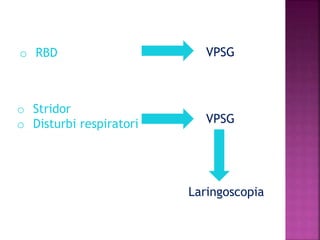
o RBD VPSG
o Stridor
o Disturbi respiratori VPSG
Laringoscopia
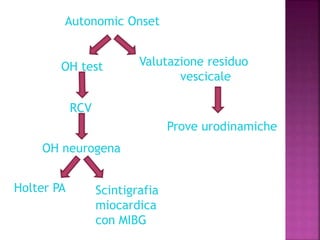
Autonomic Onset
OH test
RCV
Scintigrafia
miocardica
con MIBG
OH neurogena
Holter PA
Valutazione residuo
vescicale
Prove urodinamiche
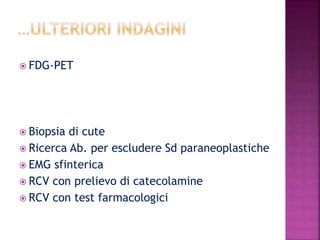
 FDG-PET
 Biopsia di cute
 Ricerca Ab. per escludere Sd paraneoplastiche
 EMG sfinterica
 RCV con prelievo di catecolamine
 RCV con test farmacologici
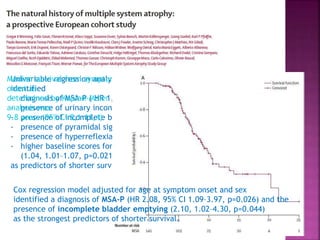
Univariable regression analysis adjusted for sex and age at symptom onset
identified
- diagnosis of MSA-P ( HR 1,84, 95% CI 1,05–3,25, p=0,034),
- presence of urinary incontinence (HR 2,45, 1,19–5,04, p=0,015),
- presence of incomplete bladder emptying (HR 2,16, 1,08–4,34, p=0,030),
- presence of pyramidal signs (1,60, 0,92–2,79, p=0,099),
- presence of hyperreflexia (2,62, 0,94–2,81, p=0,085),
- higher baseline scores for the UMSARS activities of daily living subscale
(1.04, 1.01–1.07, p=0.021)
as predictors of shorter survival at p<0・1 (the cutoff criterion).
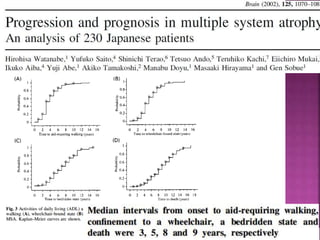
Median survival from symptom
onset as
determined by Kaplan-Meier
analysis was
9.8 years (95% CI 8,1–11,4)
Cox regression model adjusted for age at symptom onset and sex
identified a diagnosis of MSA-P (HR 2.08, 95% CI 1.09–3.97, p=0.026) and the
presence of incomplete bladder emptying (2.10, 1.02–4.30, p=0.044)
as the strongest predictors of shorter survival.
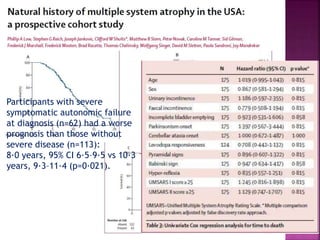
Participants with severe
symptomatic autonomic failure
at diagnosis (n=62) had a worse
prognosis than those without
severe disease (n=113):
8·0 years, 95% CI 6·5–9·5 vs 10·3
years, 9·3–11·4 (p=0·021).
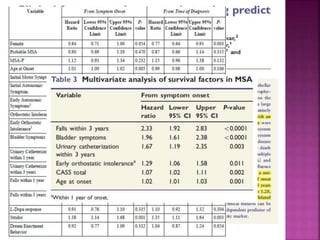
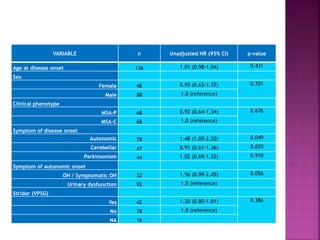
VARIABLE n Unadjusted HR (95% CI) p-value
Age at disease onset 136 1.01 (0.98-1.04) 0.431
Sex
Female 48 0.93 (0.63-1.37) 0.701
Male 88 1.0 (reference)
Clinical phenotype
MSA-P 68 0.92 (0.64-1.34) 0.676
MSA-C 68 1.0 (reference)
Symptom of disease onset
Autonomic 78 1.48 (1.00-2.20) 0.049
Cerebellar 47 0.91 (0.61-1.36) 0.655
Parkinsonism 44 1.02 (0.69-1.52) 0.910
Symptom of autonomic onset
OH / Symptomatic OH 32 1.56 (0.99-2.45) 0.056
Urinary dysfunction 92 1.0 (reference)
Stridor (VPSG)
Yes 42 1.20 (0.80-1.81) 0.386
No 78 1.0 (reference)
NA 16
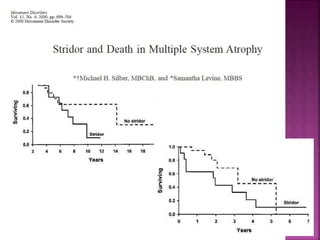
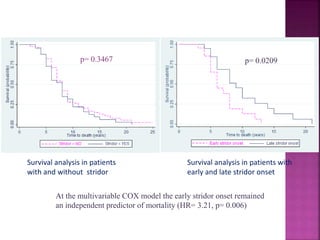
Survival analysis in patients
with and without stridor
Survival analysis in patients with
early and late stridor onset
p= 0.3467 p= 0.0209
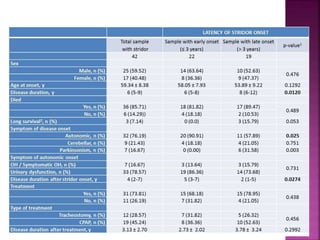
At the multivariable COX model the early stridor onset remained
an independent predictor of mortality (HR= 3.21, p= 0.006)
Grazie per
l’attenzione !!!
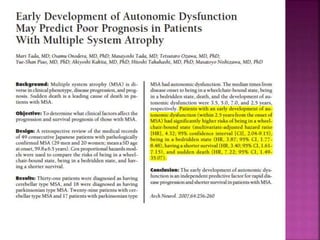
MSA Multiple System Atrophy

MSA Multiple System Atrophy

  • 1.
    Didattica integrativa 31 Maggio2016 Dott.ssa Giulia Giannini Tutor: Dott.ssa Giovanna Calandra Buonaura
  • 2.
     Neurodegenerative disordercharacterized by autonomic failure with motor involvement of parkinsonism and/or cerebellar ataxia  Estimated mean incidence 0,6-0,7 per 100.000 per year  Estimated prevalence 3,9 to 4,9 per 100.000 cases per 100.000 per year, increasing to 7,8 per 100.000 among persons older than 40 years of age
  • 3.
    Gilman et al.Neurology 2008; 71: 670-6
  • 4.
    Parkinsonism or cerebellar syndrome Parkinsonism Cerebellarsyndrome Gilman et al. Neurology 2008; 71: 670-6
  • 5.
    203 pts reportedin 108 articles 35 cases UK Brain Bank
  • 6.
    19 centers, 437pts 12 centers, 87 pts
  • 7.
  • 8.
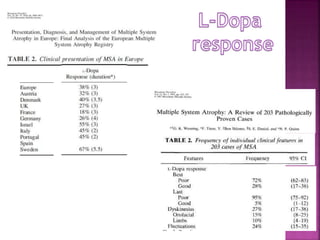
  • 10.
     Parkinsonism (rigidity,bradykinesia, and postural instability) occurs in at least 90% of all patients with MSA  Often symmetrical akinetic-rigid picture without tremor  The motor findings are sometimes asymmetrical (35-40%)  Parkinson-like “pill-rolling” rest tremor is unusual, whereas irregular postural and action tremor with superimposed jerks is seen in as many as 50% of patients with MSA
  • 11.
     Rest Tremor Frequency ranging from 25% to 43%  More common in MSA-P than in MSA-C (32-44% vs. 17-26%)  Pill-rolling rest tremor is rarely (8-11%)  Postural Tremor  The most common tremor variant among MSA (28-67%)  More common in MSA-P than in MSA-C (47-55% vs. 22%)
  • 13.
     Jerky irregulartremor/ Minipolymyoclonus Jerky/ irregular tremor Myoclonus Wenning et al. 1994 20% of MSA-P 31% of patients (45% in MSA-P vs. 33% in MSA-C) Rodriguez et al. 1994 23/24 MSA-C patients Gouider-Khouja et al. 1995 55% of MSA-P 16.6% of MSA-P Wenning et al. 1995 29% of patients
  • 16.
    o 9 out11 MSA-P patients presented abnormal, small-amplitude, nonrhythmic movements of the fingers or hands when holding a posture or at the beginning of an action; o Involvement of proximal arm segments, leading to larger jerks, occurred only occasionally o During maintenance of a posture, external stimuli such as cutaneous pinprick with a sharpened object or passive sudden stretch elicited reflex jerks in all 9 patients o Neurophysiological investigations have demonstrated that jerky postural tremor in MSA consists of small-amplitude irregular oscillations with no predominant peak in the fast Fourier frequency spectrum analyses Minipolymyoclonus
  • 17.
    o Jerky tremor,defined as “irregular postural or action tremor of the hands and/or fingers with stimulus-sensitive myoclonus” is a feature that appears more often in MSA-P than in PD (47.4% vs. 5.9% of patients, respectively) o Supporting feature of MSA (94.1% specificity, p value <0.001)
  • 18.
     Variant atypicalor jerky components have been reported  the classic parkinsonian (pill-rolling) rest tremor is only present in a minority of patients  Pill-rolling rest tremor supports a diagnosis of PD.  Intention tremor points away from PD but is typical in MSA, especially MSA-C (up to 45% of patients).  Tremor of the legs, head, chin, lips, and tongue can be found in PD but are all uncommon in MSA.
  • 22.
    16 MSA-P vs.31 PD patients
  • 24.
    28.6% annual increaseof UPDRS-III scores in MSA  (0.6%-4.1% in PD)
  • 32.
    o Speech ismore severely affected in MSA than in PD o Speech impairment in MSA patients is probably multifactorial, related to laryngeal dysfunction, akinesia/rigidity of lips/tongue and palate, and respiratory dysfunction o As well as the low volume monotony of parkinsonism, a croaky, quivering, irregular, severely hypophonic or slurring dysarthria is often characteristic
  • 33.
     Intentional Tremor Frequency ranging from 11% to 39%  More common in MSA-C than in MSA-P (33-45% vs. 11-28%)
  • 37.
    Objective: to prospectivelyinvestigate the frequency of dystonia and its relation to levodopa treatment in a group of 24 patients with MSA (18 MSA-P, 6 MSA-C) Dystonia before levodopa treatment Dystonia 11 (46%) patients Anterocollis 6 (25%) patients, 4 MSA-P and 2 MSA-C Unilateral limb dystonia 5 (21%) patients, 4 MSA-P and 1 MSA-C o 12 (80%) MSA-P patients developed dyskinesias after the initiation of levodopa therapy (on avarage 2.3 years after therapy) o Levodopa induced dyskinesias were predominantly or purely dystonic o Most patients had peak dose craniocervical dystonia
  • 43.
     Symptomatic dysautonomiais present in 95-99%  OH symptoms (43-75%), documented OH (56.7-78%), syncope (19-41.4%)  Urinary symptoms (83-96%) Urge incontinence (55-87%), incomplete bladder emptying (72-83%),  Erectile dysfunction (93-96% male patients)  Constipation (58-87%)  Sudomotor disturbances (anhidrosis)
  • 44.
  • 45.
    Early stage= detrusor hyper- reflexiawith bladder neck incompetence due to abnormal urethral sphincter dysfunction (urge incontinence) Late stage= reduced detrusor hyper-reflexia , bladder become atonic increasing post-micturition residual-urine volumes
  • 46.
     Probable MSA:a decrease of blood pressure within 3 min of standing by at least 30 mm Hg systolic or 15 mm Hg diastolic  Possible MSA: significant orthostatic blood pressure decline that does not meet the level required in probable MSA  Orthostatic hypotension is a sustained reduction of systolic blood pressure of at least 20 mmHg or diastolic blood pressure of 10 mmHg within 3 min of standing or head-up tilt to at least 60 on a tilt table. Orthostatic hypotension is a clinical sign and may be symptomatic or asymptomatic (Freeman et al. 2011)
  • 48.
    Controllo, 65 anni,maschio MSAp, 74 anni, maschio
  • 51.
    Lipp et al2009 Iodice et al 2012
  • 52.
     Reduced sleepefficiency and fragmented sleep  RBD  Stridor  OSAS (new or increased snoring is a red flag)  Other sleep-related breathing disorders: central apnea, tachypnea and paradoxical breathing
  • 54.
    OR of pRBDin MSA vs. PD  3.29
  • 56.
  • 59.
     A harshhigh-pitched respiratory sound, almost always occurring during inspiration due to a laryngeal narrowing  Typically in MSA occurs during sleep  One of the additional features for the diagnosis of possible MSA  Stridor prevalence (12-41%)  Higher diagnostic positive predicted value than clinical diagnosis at first visit (PPV: 100%; CI-34-100) Inspiratory sights
  • 62.
     Abnormal sleepstructure in MSA patients, with reduced NREM deep sleep and decreased sleep efficiency.  Patients with stridor, already tachypnoic during Wake, MSA patients had a significant increase in breathing rate from Wake to NREM and REM sleep.
  • 67.
    The best compromisescore is 11 or more out 17, with a sensitivity of 90.3% and specificity of 92.6%
  • 68.
    The repeat analysisusing the features that were recorded within the first 5 years after onset of symptoms, identified four variables as significant predictors with the following Weightings: - autonomic features present (2), - poor initial response to levodopa (2), - early fluctuations (2), - initial rigidity (2). A patient could therefore score between 0 and 8: a cut off of >4 results in a sensitivity of 87.1% and specificity of 70.5%.
  • 69.
    57 probable MSA-Pvs. 116 with probable PD matched for age, sex and disease duration
  • 70.
    98.3% specificity and84.2% sensitivity PPV of 96% and NPV of 92.7% if red flags from 2 or more categories were present When applying these criteria to patients with possible MSA-P, 76.5% of them would have been correctly diagnosed as probable MSA-P (16 months earlier than with criteria)
  • 72.
     Cerebellar onset:SCA 1,2,3,6,7,12,17; fragile-X-associated tremor ataxia syndrome; sporadic adult-onset ataxia of unknown origin  Parkinsonian onset: PD o MSA?  Autonomic onset: PAF o MSA o PD?
  • 73.
    o Esordio P Testl-Dopa Test NPS o Esordio C SPECT DatScan Indagini genetiche (SCA, X-fragile) RM encefalo
  • 74.
    o RBD VPSG oStridor o Disturbi respiratori VPSG Laringoscopia
  • 75.
    Autonomic Onset OH test RCV Scintigrafia miocardica conMIBG OH neurogena Holter PA Valutazione residuo vescicale Prove urodinamiche
  • 76.
     FDG-PET  Biopsiadi cute  Ricerca Ab. per escludere Sd paraneoplastiche  EMG sfinterica  RCV con prelievo di catecolamine  RCV con test farmacologici
  • 78.
    Univariable regression analysisadjusted for sex and age at symptom onset identified - diagnosis of MSA-P ( HR 1,84, 95% CI 1,05–3,25, p=0,034), - presence of urinary incontinence (HR 2,45, 1,19–5,04, p=0,015), - presence of incomplete bladder emptying (HR 2,16, 1,08–4,34, p=0,030), - presence of pyramidal signs (1,60, 0,92–2,79, p=0,099), - presence of hyperreflexia (2,62, 0,94–2,81, p=0,085), - higher baseline scores for the UMSARS activities of daily living subscale (1.04, 1.01–1.07, p=0.021) as predictors of shorter survival at p<0・1 (the cutoff criterion). Median survival from symptom onset as determined by Kaplan-Meier analysis was 9.8 years (95% CI 8,1–11,4) Cox regression model adjusted for age at symptom onset and sex identified a diagnosis of MSA-P (HR 2.08, 95% CI 1.09–3.97, p=0.026) and the presence of incomplete bladder emptying (2.10, 1.02–4.30, p=0.044) as the strongest predictors of shorter survival.
  • 79.
    Participants with severe symptomaticautonomic failure at diagnosis (n=62) had a worse prognosis than those without severe disease (n=113): 8·0 years, 95% CI 6·5–9·5 vs 10·3 years, 9·3–11·4 (p=0·021).
  • 84.
    VARIABLE n UnadjustedHR (95% CI) p-value Age at disease onset 136 1.01 (0.98-1.04) 0.431 Sex Female 48 0.93 (0.63-1.37) 0.701 Male 88 1.0 (reference) Clinical phenotype MSA-P 68 0.92 (0.64-1.34) 0.676 MSA-C 68 1.0 (reference) Symptom of disease onset Autonomic 78 1.48 (1.00-2.20) 0.049 Cerebellar 47 0.91 (0.61-1.36) 0.655 Parkinsonism 44 1.02 (0.69-1.52) 0.910 Symptom of autonomic onset OH / Symptomatic OH 32 1.56 (0.99-2.45) 0.056 Urinary dysfunction 92 1.0 (reference) Stridor (VPSG) Yes 42 1.20 (0.80-1.81) 0.386 No 78 1.0 (reference) NA 16
  • 85.
    Survival analysis inpatients with and without stridor Survival analysis in patients with early and late stridor onset p= 0.3467 p= 0.0209 At the multivariable COX model the early stridor onset remained an independent predictor of mortality (HR= 3.21, p= 0.006)
  • 86.

Editor's Notes

  • #4 Criteri clinici di probabilità di malattia
  • #7 1997: All patients with parkinsonism had akinesia and two thirds had rigidity or tremor. Thirty-nine percent had tremor present at rest, but in only 8% was it described as of the classic pill-rolling type.
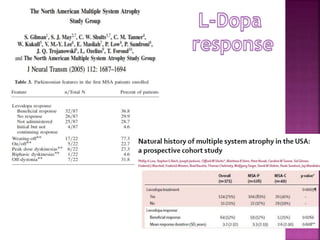
  • #8 2010: Parkinsonism was observed in 87% of all cases, since 61% of patients with MSA-C also fulfilled the UK Parkinson’s Disease Brain Bank criteria for parkinsonism. Bradykinesia was accompanied by rigidity (93%), postural instability (89%), postural (54%) andrest (33%) tremor, and freezing of gait (38%). At time of inclusion 82% of patients with parkinsonism received antiparkinsonian therapy. 2005: Examination revealed parkinsonian features in a high percentage of these patients, with bradykinesia, postural instability of the parkinsonian type and rigidity affecting a large majority of subjects (Table 3). Over one-third of these subjects had resting tremor, two-thirds showed postural tremor, and approximately one-third manifested persistent asymmetry. Also, more than half of the patients who received levodopa treatment had a continuing beneficial response.
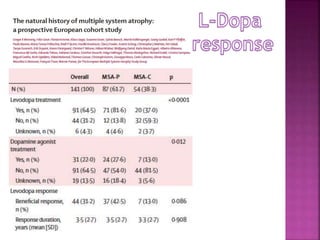
  • #9 2013: Irregular postural tremor of the outstretched arms was more common than resting tremor (56% vs 35%). A benefi cial response to levodopa was reported in 31% lasting for a mean period of 3・5 years. Some of the patients with a benefi cial levodopa response (44 patients, table 1) had motor complications, with wearing-off fluctuations (ten patients [23%]) and off - dystonia (nine [20%]) being the most common. On-off motor fluctuations (six patients [14%]) and peak-dose dyskinesias (fi ve [11%]) were less frequently present.
  • #10 2015: parkinsonian symptoms were more common in patients with MSA-P and cerebellar manifestations were more common in those with MSA-C. There was some merging of parkinsonism and cerebellar symptoms.
  • #23 1997: Although most patients had a poor or absent response to levodopa, a substantial minority (28%) of patients showed a good or excellent response, with (mainly axial) dyskinesias in some 27% of them.
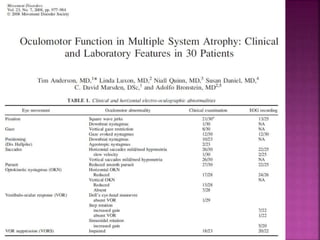
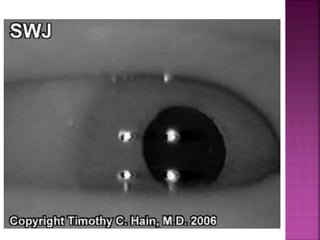
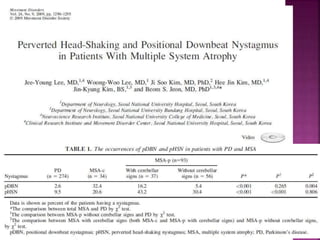
  • #32 oculomotor abnormalities, including spontaneous and gaze-evoked nystagmus, square wave jerks, slow and hypometric saccades, diminished vestibular-ocular reflex suppression, internuclear ophthalmoparesis, reduced vestibulo-ocular reflex suppression, and impaired vertical gaze
  • #33 intrusioni saccadiche orizzontali, note come nistagmo ad onda quadra ("square wave jerks") Downbeating nystagmus means that the eyes drift upward, and "beat" or jump downward Head-shaking nystagmus (HSN) is a jerk nystagmus that may follow a prolonged sinusoidal head oscillation.
  • #50 I risultati delle indagini urodinamiche mostrano la significativa presenza di residuo postminzionale in più di 2/3 dei casi, con residuo di oltre 100 ml in oltre il 50% dei pazienti. Nella metà dei pazienti con MSA, l’indagine urodinamica rileva una iperreflessia detrusoriale, con associata dissinergia detrusore-sfintere in un terzo dei casi. Una rilevante quota di questi pazienti con iperreflessia detrusoriale evolve, dopo alcuni anni, in vescica a bassa compliance, con lenta evoluzione verso una vescica atonica. E’ ipotizzabile, che la iperreflessia detrusoriale sia probabilmente, una fase precoce di compromissione del basso tratto urinario di questi pazienti. Il Reperto di un significativo PVR che eccede i 250-300 cc con una vescica a bassa compliance IMPONE COSTANTEMENTE un’Ecografia di rene e vie urinarie. La maggior parte dei pazienti con MSA sviluppano infatti un deterioramento a monte con idroureteronefrosi e compromissione renale.
  • #53 In most healthy normotensive persons, BP declines during sleep by 10–20% from mean daytime values. In fact, whereas sympathetic tone is dominant during the diurnal activity period, vagal tone is dominant during most of the nighttime period, and this day-night oscillation of the ANS is a determinant of physiological 24-h BP variation observed in normotensive subjects. Stage organization of sleep also reflects variation of ANS activity; sympathetic nervous system activity during non–rapid eye movement sleep (NREM) is lower than during wakefulness, and is associated with BP and heart rate (HR) reduction. In contrast, during REM sleep, sympathetic nervous system is enhanced to levels comparable to wakefulness, giving rise to BP and HR instability.
  • #56 Sweating abnormalities occur in 30e55% of PD patients. Hyperhidrosis or hypo/anhidrosis may occur. Hyperhidrosis is usually regional and on the upper body, such as the head, face, neck and chest, and often occurs during the off period associated with the wearing off phenomenon. Some have hyperhidrosis during the on period, often with dyskinesia. Hypohidrosis may occur more frequently in the lower body. The Quantitative Sudomotor Axon Reflex Test is used for assessing postganglionic sudomotor function and is often used in conjunction with thermoregulatory sweating testing. A combination of thermoregulatory sweat testing and the Quantitative Sudomotor Axon Reflex Test were used to differentiate between patients with MSA and PD; the results showed that the percentage of anhidrosis was significantly larger in MSA than PD and the distribution of anhidrosis was compatible with preganglionic (central) involvement in MSA in contrast with PD which had the peripheral involvement of anhidrosis. Moreover, normal axon reflex sweating in anhidrotic areas confirmed a preganglionic lesion in MSA, although some MSA patients may show reduced axon reflex sweating. the Quantitative Sudomotor Axon Reflex Test (QSART) evaluated the postganglionic sympathetic sudomotor axon and the sweat response was recorded routinely from four sites (the forearm and three leg sites). Control values were derived from studies on 223 healthy subjects aged 10–83 years Thermoregulatory Sweat Test— The TST assesses the pattern of sweat loss and provides a quantitative evaluation of per cent of anterior body surface anhidrosis. The TSTwas performed in a cabinet with a hot and humid environment (45–50°C air temperature; 35–40% relative humidity) and sweating was demonstrated by an indicator powder. The percentage of anhidrosis on the anterior body surface was calculated from images created from digital photographs of the sweat distribution. Results were expressed as the percentage of body surface area that did not sweat (100% indicates complete anhidrosis) Figure 2. Representative thermoregulatory sweat test (TST) findings in Multiple System Atrophy (MSA, left upper panel), Parkinson’s Disease (PD, right upper panel) and PD_AF (lower two panels). The regional (lower extremities) preganglionic sweat loss (TST abnormal, QSART normal) in 2002 with subsequent progression to global anhidrosis in 2005 is nearly pathognomonic of MSA. Distal sudomotor impairment with minimal progression is typical of PD. Note anhidrosis of distal feet and toes in 2004 and progression only to fingers over 4 years (right upper). PD_AF may have a normal TST (left-lower) or may show a more extensive sudomotor deficit (rightlower) that on further testing with QSART reveals a predominantly ganglionic (large truncal segmental sweat loss with reduced QSART) or a postganglionic, length-dependant deficit (feet, fingers). (Sweating in purple shading) L’atrofia multisistemica (MSA) si associa frequentemente a un’anidrosi totale o subtotale che si manifesta precocemente nel corso del disturbo e generalmente interessa il volto o il tronco (spesso sotto forma di emianidrosii) (Chaudhuri and Hu, 2000) mentre risparmia le estremità distali.
  • #82 EMG sfinterica: denervazione nella quasi totalità dei pazienti con MSA (a causa della degenerazione del nucleo di Onuf sacrale).