UNIVERSIDAD NACIONAL
DE CHIMBORAZO
HEALTH SCIENCES FACULTY
LANGUAGES CENTER
PROJECT OF LINKING
TEACHERS TRAIN TEACHERS
OBJECTIVE: KNOW ABOUT
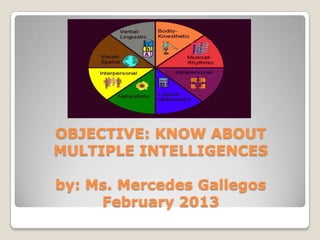
MULTIPLE INTELLIGENCES
by: Ms. Mercedes Gallegos
February 2013
What is intelligence?
When you hear the word intelligence, the concept of IQ
testing may immediately come to mind. Intelligence is
often defined as our intellectual potential; something
we are born with, something that can be measured and
a capacity that is difficult to change.
What is intelligence to Howard
Gardner?
"Intelligence is a biopsychological potential to process
information that can be activated in a cultural setting to
solve problems or create products that are of value in a
culture“
In order to capture the full range of abilities and talents
that people possess, Gardner suggests that people do
not have just a intellectual capacity, but have many
different intelligences including musical, interpersonal,
spatial-visual and linguistic intelligences.
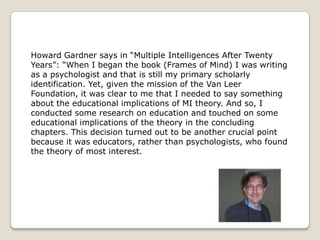
Howard Gardner says in “Multiple Intelligences After Twenty
Years”: “When I began the book (Frames of Mind) I was writing
as a psychologist and that is still my primary scholarly
identification. Yet, given the mission of the Van Leer
Foundation, it was clear to me that I needed to say something
about the educational implications of MI theory. And so, I
conducted some research on education and touched on some
educational implications of the theory in the concluding
chapters. This decision turned out to be another crucial point
because it was educators, rather than psychologists, who found
the theory of most interest.
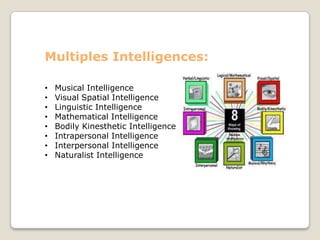
Multiples Intelligences:
• Musical Intelligence
• Visual Spatial Intelligence
• Linguistic Intelligence
• Mathematical Intelligence
• Bodily Kinesthetic Intelligence
• Intrapersonal Intelligence
• Interpersonal Intelligence
• Naturalist Intelligence
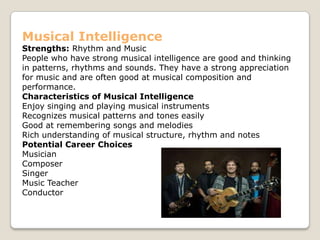
Musical Intelligence
Strengths: Rhythm and Music
People who have strong musical intelligence are good and thinking
in patterns, rhythms and sounds. They have a strong appreciation
for music and are often good at musical composition and
performance.
Characteristics of Musical Intelligence
Enjoy singing and playing musical instruments
Recognizes musical patterns and tones easily
Good at remembering songs and melodies
Rich understanding of musical structure, rhythm and notes
Potential Career Choices
Musician
Composer
Singer
Music Teacher
Conductor
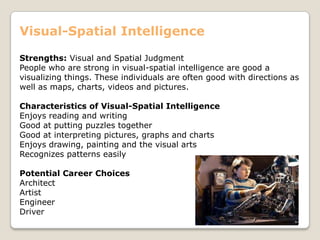
Visual-Spatial Intelligence
Strengths: Visual and Spatial Judgment
People who are strong in visual-spatial intelligence are good a
visualizing things. These individuals are often good with directions as
well as maps, charts, videos and pictures.
Characteristics of Visual-Spatial Intelligence
Enjoys reading and writing
Good at putting puzzles together
Good at interpreting pictures, graphs and charts
Enjoys drawing, painting and the visual arts
Recognizes patterns easily
Potential Career Choices
Architect
Artist
Engineer
Driver
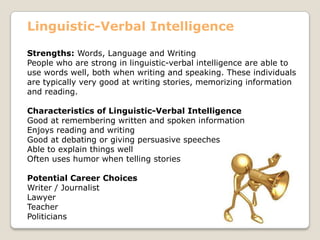
Linguistic-Verbal Intelligence
Strengths: Words, Language and Writing
People who are strong in linguistic-verbal intelligence are able to
use words well, both when writing and speaking. These individuals
are typically very good at writing stories, memorizing information
and reading.
Characteristics of Linguistic-Verbal Intelligence
Good at remembering written and spoken information
Enjoys reading and writing
Good at debating or giving persuasive speeches
Able to explain things well
Often uses humor when telling stories
Potential Career Choices
Writer / Journalist
Lawyer
Teacher
Politicians
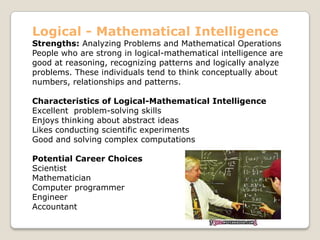
Logical - Mathematical Intelligence
Strengths: Analyzing Problems and Mathematical Operations
People who are strong in logical-mathematical intelligence are
good at reasoning, recognizing patterns and logically analyze
problems. These individuals tend to think conceptually about
numbers, relationships and patterns.
Characteristics of Logical-Mathematical Intelligence
Excellent problem-solving skills
Enjoys thinking about abstract ideas
Likes conducting scientific experiments
Good and solving complex computations
Potential Career Choices
Scientist
Mathematician
Computer programmer
Engineer
Accountant
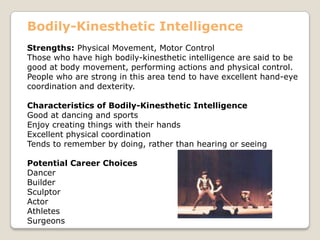
Bodily-Kinesthetic Intelligence
Strengths: Physical Movement, Motor Control
Those who have high bodily-kinesthetic intelligence are said to be
good at body movement, performing actions and physical control.
People who are strong in this area tend to have excellent hand-eye
coordination and dexterity.
Characteristics of Bodily-Kinesthetic Intelligence
Good at dancing and sports
Enjoy creating things with their hands
Excellent physical coordination
Tends to remember by doing, rather than hearing or seeing
Potential Career Choices
Dancer
Builder
Sculptor
Actor
Athletes
Surgeons
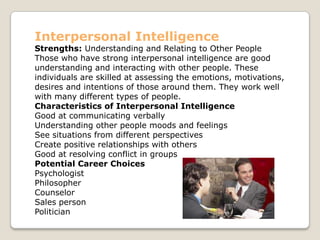
Interpersonal Intelligence
Strengths: Understanding and Relating to Other People
Those who have strong interpersonal intelligence are good
understanding and interacting with other people. These
individuals are skilled at assessing the emotions, motivations,
desires and intentions of those around them. They work well
with many different types of people.
Characteristics of Interpersonal Intelligence
Good at communicating verbally
Understanding other people moods and feelings
See situations from different perspectives
Create positive relationships with others
Good at resolving conflict in groups
Potential Career Choices
Psychologist
Philosopher
Counselor
Sales person
Politician
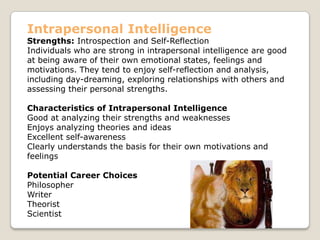
Intrapersonal Intelligence
Strengths: Introspection and Self-Reflection
Individuals who are strong in intrapersonal intelligence are good
at being aware of their own emotional states, feelings and
motivations. They tend to enjoy self-reflection and analysis,
including day-dreaming, exploring relationships with others and
assessing their personal strengths.
Characteristics of Intrapersonal Intelligence
Good at analyzing their strengths and weaknesses
Enjoys analyzing theories and ideas
Excellent self-awareness
Clearly understands the basis for their own motivations and
feelings
Potential Career Choices
Philosopher
Writer
Theorist
Scientist
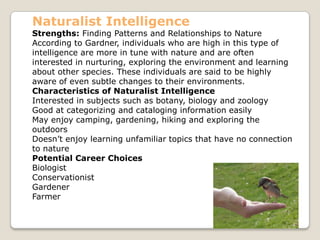
Naturalist Intelligence
Strengths: Finding Patterns and Relationships to Nature
According to Gardner, individuals who are high in this type of
intelligence are more in tune with nature and are often
interested in nurturing, exploring the environment and learning
about other species. These individuals are said to be highly
aware of even subtle changes to their environments.
Characteristics of Naturalist Intelligence
Interested in subjects such as botany, biology and zoology
Good at categorizing and cataloging information easily
May enjoy camping, gardening, hiking and exploring the
outdoors
Doesn’t enjoy learning unfamiliar topics that have no connection
to nature
Potential Career Choices
Biologist
Conservationist
Gardener
Farmer
ACTIVITIES TO DEVELOP MUSICAL
INTELLIGENCE
*Read a story out loud and focus on intonation and fluency,
discuss how this affects the story.
*Invent a new musical instrument and illustrate it.
*Assign different sounds or musical notes to your body parts
and compose a song using your body.
*Create a song to teach a friend something they don’t know.
Test them on their knowledge. Did the song work? Why or
why not?
*Create a song or a rhyme to help you remember something
new.
*Listen to instrumental music and discuss its meaning with a
friend. What emotions does the music convey to you? Are
they the same emotions that your friend is experiencing?
ACTIVITIES TO DEVELOP
MATHEMATICAL INTELLIGENCE
Map out the main ideas and sub-points of each idea from a
book you are reading. Think of a new story and map out the
main ideas and sub-points of each main idea for your new
story.
Create new riddles and share them with your friends.
Write directions for completing a task and then give them to
someone else. Discuss how effective the directions were in
helping the other person complete the tasks.
Make a puzzle.
Create a maze or crossword puzzle for a friend.
Listen to patterns in music.
ACTIVITIES TO DEVELOP
LINGUISTIC INTELLIGENCE
*Play the “what if” game with a friend (e.g. what if you were
a crocodile? What if my teacher turned into a shoe? What if
my house was made of cheese?). Write and illustrate your
stories.
*Share your stories with each other. What do the stories tell
you about the other person?
*Narrate a story for someone who cannot see. How would
you describe the scenes, events and characters of your
story?
*What are some of your challenges in narrating this story?
*Write words with each syllable in a different color.
Choose an animal or object and give someone else clues to
describe that animal or object until they guess what it is.
ACTIVITIES TO DEVELOP
INTRAPERSONAL INTELLIGENCE
*Reflect upon your goals for the next year. Outline your plan to
accomplish those goals. Try to identify some of the challenges you
might face and different strategies you might use to overcome
them.
*Write down your goals from the point above and check back on
them periodically. Are you achieving what you expected? Why or
why not? What do you need to do to get back on track?
*Read a story to someone and discuss the key points of the story.
What effect does the story have on you? How did the storytellers
create this effect?
*Keep a daily journal of things that are important to you or
interesting to note. Reflect on why these things are important to
you.
*Think about some key historical figures and the decision they have
made. Why do you think they acted that way? What would you have
done in their place?
ACTIVITIES TO DEVELOP
INTERPERSONAL INTELLIGENCE
*Take someone through a guided imagery exercise. Try to use as
much detail as possible. Try out different experiences and discuss
them with others: what works, what doesn’t work? How did the
exercise make your audience feel? Why?
*Narrate a story for someone who cannot see. How would you
describe the scenes, events and characters of your story? What are
some of your challenges in narrating this story?
*Pick a topic with a friend and initiate a group discussion about that
topic. Listen to what your friends are saying and formulate your
responses to their comments. Reflect on what is easy and what is
challenging about group discussions and how this makes you feel.
*Discuss these challenges with your friends. Do they have similar
experiences? Come up with strategies to help you cope with those
challenges.
ACTIVITIES TO DEVELOP BODILY
KINESTHETIC INTELLIGENCE
*Try writing with your toes or with your eyes closed. What
are some of the challenges you face?
*Design a machine or a structure and then give a friend
detailed instructions as to how to build the same machine or
structure. Did they succeed? Why or why not?
*Create a dance using ten different dance steps. Teach the
dance to someone else.
*Learn about your body and how it functions. How does your
body work in harmony to help you do the things you do?
What can you do to keep your body healthy?
ACTIVITIES TO DEVELOP VISUAL
SPATIAL INTELLIGENCE
*Create a secret code and write it down in a key. Write letters using
your code key. Share your code key with someone else and see if
they can decipher your message.
*Work together with a group with friends to create a story. Identify
the main points and structure of the story. Write or illustrate the
story.
*Make a puzzle.
*Create a maze or crossword puzzle for a friend.
*Choose a topic and express it through various artistic mediums:
drawing, sculpting, painting, etc. Is one medium easier to manage
than another? How does the topic change based on the medium?
ACTIVITIES TO DEVELOP NATURALIST
INTELLIGENCE
*Try different foods from different countries. How do they differ? How
are they the same? What do these foods tell you about the countries
from which they come?
*Observe the night sky and try to find patterns or images composed
of stars. Learn about the different constellations.
*Take a walk and notice the different patterns in nature. For instance,
count the leaves in different plants, compare their shapes and sizes,
look at branches and the stems that grow from them, look at petals
and compare how many petals different flowers have. What other
patterns to do you notice?
*Read books and articles about nature and the environment. Write
your own article about something you have discovered in nature or
illustrate your discovery.
Task:
Make an activity to
develop each one of
intelligences.
Kendra Cherry , 2013.
http://psychology.about.com/od/educationalpsychology/ss/multipl
e-intell.htm
http://www.blogthings.com/howdoesyourintrapersonalintelligencer
atequiz/
Karla Valenti, 2010-2013. http://totthoughts.com/multiple-
intelligences/

Multiple inteligences

  • 1.
    UNIVERSIDAD NACIONAL DE CHIMBORAZO HEALTHSCIENCES FACULTY LANGUAGES CENTER
  • 2.
  • 3.
    OBJECTIVE: KNOW ABOUT MULTIPLEINTELLIGENCES by: Ms. Mercedes Gallegos February 2013
  • 4.
    What is intelligence? Whenyou hear the word intelligence, the concept of IQ testing may immediately come to mind. Intelligence is often defined as our intellectual potential; something we are born with, something that can be measured and a capacity that is difficult to change.
  • 5.
    What is intelligenceto Howard Gardner? "Intelligence is a biopsychological potential to process information that can be activated in a cultural setting to solve problems or create products that are of value in a culture“ In order to capture the full range of abilities and talents that people possess, Gardner suggests that people do not have just a intellectual capacity, but have many different intelligences including musical, interpersonal, spatial-visual and linguistic intelligences.
  • 6.
    Howard Gardner saysin “Multiple Intelligences After Twenty Years”: “When I began the book (Frames of Mind) I was writing as a psychologist and that is still my primary scholarly identification. Yet, given the mission of the Van Leer Foundation, it was clear to me that I needed to say something about the educational implications of MI theory. And so, I conducted some research on education and touched on some educational implications of the theory in the concluding chapters. This decision turned out to be another crucial point because it was educators, rather than psychologists, who found the theory of most interest.
  • 7.
    Multiples Intelligences: • MusicalIntelligence • Visual Spatial Intelligence • Linguistic Intelligence • Mathematical Intelligence • Bodily Kinesthetic Intelligence • Intrapersonal Intelligence • Interpersonal Intelligence • Naturalist Intelligence
  • 8.
    Musical Intelligence Strengths: Rhythmand Music People who have strong musical intelligence are good and thinking in patterns, rhythms and sounds. They have a strong appreciation for music and are often good at musical composition and performance. Characteristics of Musical Intelligence Enjoy singing and playing musical instruments Recognizes musical patterns and tones easily Good at remembering songs and melodies Rich understanding of musical structure, rhythm and notes Potential Career Choices Musician Composer Singer Music Teacher Conductor
  • 9.
    Visual-Spatial Intelligence Strengths: Visualand Spatial Judgment People who are strong in visual-spatial intelligence are good a visualizing things. These individuals are often good with directions as well as maps, charts, videos and pictures. Characteristics of Visual-Spatial Intelligence Enjoys reading and writing Good at putting puzzles together Good at interpreting pictures, graphs and charts Enjoys drawing, painting and the visual arts Recognizes patterns easily Potential Career Choices Architect Artist Engineer Driver
  • 10.
    Linguistic-Verbal Intelligence Strengths: Words,Language and Writing People who are strong in linguistic-verbal intelligence are able to use words well, both when writing and speaking. These individuals are typically very good at writing stories, memorizing information and reading. Characteristics of Linguistic-Verbal Intelligence Good at remembering written and spoken information Enjoys reading and writing Good at debating or giving persuasive speeches Able to explain things well Often uses humor when telling stories Potential Career Choices Writer / Journalist Lawyer Teacher Politicians
  • 11.
    Logical - MathematicalIntelligence Strengths: Analyzing Problems and Mathematical Operations People who are strong in logical-mathematical intelligence are good at reasoning, recognizing patterns and logically analyze problems. These individuals tend to think conceptually about numbers, relationships and patterns. Characteristics of Logical-Mathematical Intelligence Excellent problem-solving skills Enjoys thinking about abstract ideas Likes conducting scientific experiments Good and solving complex computations Potential Career Choices Scientist Mathematician Computer programmer Engineer Accountant
  • 12.
    Bodily-Kinesthetic Intelligence Strengths: PhysicalMovement, Motor Control Those who have high bodily-kinesthetic intelligence are said to be good at body movement, performing actions and physical control. People who are strong in this area tend to have excellent hand-eye coordination and dexterity. Characteristics of Bodily-Kinesthetic Intelligence Good at dancing and sports Enjoy creating things with their hands Excellent physical coordination Tends to remember by doing, rather than hearing or seeing Potential Career Choices Dancer Builder Sculptor Actor Athletes Surgeons
  • 13.
    Interpersonal Intelligence Strengths: Understandingand Relating to Other People Those who have strong interpersonal intelligence are good understanding and interacting with other people. These individuals are skilled at assessing the emotions, motivations, desires and intentions of those around them. They work well with many different types of people. Characteristics of Interpersonal Intelligence Good at communicating verbally Understanding other people moods and feelings See situations from different perspectives Create positive relationships with others Good at resolving conflict in groups Potential Career Choices Psychologist Philosopher Counselor Sales person Politician
  • 14.
    Intrapersonal Intelligence Strengths: Introspectionand Self-Reflection Individuals who are strong in intrapersonal intelligence are good at being aware of their own emotional states, feelings and motivations. They tend to enjoy self-reflection and analysis, including day-dreaming, exploring relationships with others and assessing their personal strengths. Characteristics of Intrapersonal Intelligence Good at analyzing their strengths and weaknesses Enjoys analyzing theories and ideas Excellent self-awareness Clearly understands the basis for their own motivations and feelings Potential Career Choices Philosopher Writer Theorist Scientist
  • 15.
    Naturalist Intelligence Strengths: FindingPatterns and Relationships to Nature According to Gardner, individuals who are high in this type of intelligence are more in tune with nature and are often interested in nurturing, exploring the environment and learning about other species. These individuals are said to be highly aware of even subtle changes to their environments. Characteristics of Naturalist Intelligence Interested in subjects such as botany, biology and zoology Good at categorizing and cataloging information easily May enjoy camping, gardening, hiking and exploring the outdoors Doesn’t enjoy learning unfamiliar topics that have no connection to nature Potential Career Choices Biologist Conservationist Gardener Farmer
  • 16.
    ACTIVITIES TO DEVELOPMUSICAL INTELLIGENCE *Read a story out loud and focus on intonation and fluency, discuss how this affects the story. *Invent a new musical instrument and illustrate it. *Assign different sounds or musical notes to your body parts and compose a song using your body. *Create a song to teach a friend something they don’t know. Test them on their knowledge. Did the song work? Why or why not? *Create a song or a rhyme to help you remember something new. *Listen to instrumental music and discuss its meaning with a friend. What emotions does the music convey to you? Are they the same emotions that your friend is experiencing?
  • 17.
    ACTIVITIES TO DEVELOP MATHEMATICALINTELLIGENCE Map out the main ideas and sub-points of each idea from a book you are reading. Think of a new story and map out the main ideas and sub-points of each main idea for your new story. Create new riddles and share them with your friends. Write directions for completing a task and then give them to someone else. Discuss how effective the directions were in helping the other person complete the tasks. Make a puzzle. Create a maze or crossword puzzle for a friend. Listen to patterns in music.
  • 18.
    ACTIVITIES TO DEVELOP LINGUISTICINTELLIGENCE *Play the “what if” game with a friend (e.g. what if you were a crocodile? What if my teacher turned into a shoe? What if my house was made of cheese?). Write and illustrate your stories. *Share your stories with each other. What do the stories tell you about the other person? *Narrate a story for someone who cannot see. How would you describe the scenes, events and characters of your story? *What are some of your challenges in narrating this story? *Write words with each syllable in a different color. Choose an animal or object and give someone else clues to describe that animal or object until they guess what it is.
  • 19.
    ACTIVITIES TO DEVELOP INTRAPERSONALINTELLIGENCE *Reflect upon your goals for the next year. Outline your plan to accomplish those goals. Try to identify some of the challenges you might face and different strategies you might use to overcome them. *Write down your goals from the point above and check back on them periodically. Are you achieving what you expected? Why or why not? What do you need to do to get back on track? *Read a story to someone and discuss the key points of the story. What effect does the story have on you? How did the storytellers create this effect? *Keep a daily journal of things that are important to you or interesting to note. Reflect on why these things are important to you. *Think about some key historical figures and the decision they have made. Why do you think they acted that way? What would you have done in their place?
  • 20.
    ACTIVITIES TO DEVELOP INTERPERSONALINTELLIGENCE *Take someone through a guided imagery exercise. Try to use as much detail as possible. Try out different experiences and discuss them with others: what works, what doesn’t work? How did the exercise make your audience feel? Why? *Narrate a story for someone who cannot see. How would you describe the scenes, events and characters of your story? What are some of your challenges in narrating this story? *Pick a topic with a friend and initiate a group discussion about that topic. Listen to what your friends are saying and formulate your responses to their comments. Reflect on what is easy and what is challenging about group discussions and how this makes you feel. *Discuss these challenges with your friends. Do they have similar experiences? Come up with strategies to help you cope with those challenges.
  • 21.
    ACTIVITIES TO DEVELOPBODILY KINESTHETIC INTELLIGENCE *Try writing with your toes or with your eyes closed. What are some of the challenges you face? *Design a machine or a structure and then give a friend detailed instructions as to how to build the same machine or structure. Did they succeed? Why or why not? *Create a dance using ten different dance steps. Teach the dance to someone else. *Learn about your body and how it functions. How does your body work in harmony to help you do the things you do? What can you do to keep your body healthy?
  • 22.
    ACTIVITIES TO DEVELOPVISUAL SPATIAL INTELLIGENCE *Create a secret code and write it down in a key. Write letters using your code key. Share your code key with someone else and see if they can decipher your message. *Work together with a group with friends to create a story. Identify the main points and structure of the story. Write or illustrate the story. *Make a puzzle. *Create a maze or crossword puzzle for a friend. *Choose a topic and express it through various artistic mediums: drawing, sculpting, painting, etc. Is one medium easier to manage than another? How does the topic change based on the medium?
  • 23.
    ACTIVITIES TO DEVELOPNATURALIST INTELLIGENCE *Try different foods from different countries. How do they differ? How are they the same? What do these foods tell you about the countries from which they come? *Observe the night sky and try to find patterns or images composed of stars. Learn about the different constellations. *Take a walk and notice the different patterns in nature. For instance, count the leaves in different plants, compare their shapes and sizes, look at branches and the stems that grow from them, look at petals and compare how many petals different flowers have. What other patterns to do you notice? *Read books and articles about nature and the environment. Write your own article about something you have discovered in nature or illustrate your discovery.
  • 24.
    Task: Make an activityto develop each one of intelligences.
  • 25.
    Kendra Cherry ,2013. http://psychology.about.com/od/educationalpsychology/ss/multipl e-intell.htm http://www.blogthings.com/howdoesyourintrapersonalintelligencer atequiz/ Karla Valenti, 2010-2013. http://totthoughts.com/multiple- intelligences/