MULTIMEDIA
   AND
ANIMATION
PRESENTATION BY

•   SHALINI SINGH
•   SHIKHA TOMAR
•   SHIKHA MALIK
•   RAM DUTT SHUKLA
What is MULTIMEDIA?


Multimedia is combination of
more than one media into an
  information source or
       presentation.
Elements of Multimedia are
    documented through
HTML
DHTML
Macromedia flash
Adobe live motion
Quick time player
Multimedia Computer System

• It is the capability to integrate two or more
  types of media ( text, graphics, images, audio
  and video) for the purpose of generation,
  storage, representation and access of
  multimedia information.
Requirements of Multimedia
         Computer System

•   Faster Central Processing Unit (CPU)
•   Large Storage Devices.
•   Larger Main Memory.
•   Good Graphics Terminals.
•   Input/Output Devices.
MULTIMEDIA COMPONENTS
•   Text
•   Graphics
•   Audio
•   Video
•   Animation
TEXT
  Alphanumeric character are used to
    present information in text form.
 The native language of web is HTML,
which is designed to display simple text
    documents on computer screen.
Hardware and Software
    requirements for text
Keyboard.
Optical Character Recognizers (OCR).
Text Editors.
Text Style.
Text Searching.
Hypertext.
Text Importing and Exporting.
GRAPHICS

Computer graphics deals with the
generation, representation, manipulation
and display of pictures with the aid of a
computer.
Types of Graphics

• Generative Graphics

• Images
Generative Graphics

Drawings and Illustrations in the form of 2-
   Dimensional and 3-Dimensional pictures

    created for mathematical representation of
    simple objects.
  Examples
–     Illustrative Diagrams
Applications

 Computer Aided Design (CAD).
 Computer Aided Manufacturing (CAM).
Images


• These are pictures and photographs
                     .
    composed of a collection of pixels
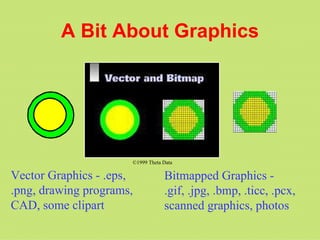
A Bit About Graphics


                      ©1999 Theta Data

Vector Graphics - .eps,           Bitmapped Graphics -
.png, drawing programs,           .gif, .jpg, .bmp, .ticc, .pcx,
CAD, some clipart                 scanned graphics, photos
Hardware and Software
         requirements
         for Graphics
 Painting or Drawing Software.
   Screen Capture Software.
   Digitizer
   Scanners
   Plotters
AUDIO
Computer audio deals with synthesizing,
 recording and playback of audio or sound with
 the aid of computer.


Example
 In Learning audio can be added to the
 animation clip.
ANALOG AND DIGITAL
          AUDIO
• Audio information travels in natural
  medium in the form of sound waves which
  are analog in nature.
• Analog Is converted in digital form by
  Transducer for the computer.
• Example
   Microphone
Hardware and Software
           requirements
             for Audio
•   Sound Card.
•   Output Device.
•   Audio File Importing.
•   Recording and playback capability.
•   Voice Recognition software.
Video
• Computer video deals with the recording
  and display of a sequence of images at a
  reasonable speed to create impression of
  movement.
• Each individual image of a sequence of
  images is called a Frame.
• For jerk-free full motion video 25-30
  frames have to be displayed per second.
Hardware and Software
            requirements
              for Video
•   Video Editors.
•   Video Monitor.
•   Video Board.
•   Input Device like video camera
•   Recording and Playback Capability.
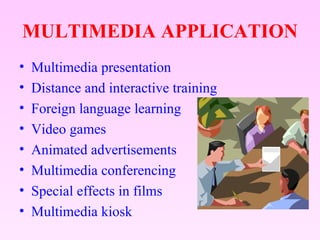
MULTIMEDIA APPLICATION
•   Multimedia presentation
•   Distance and interactive training
•   Foreign language learning
•   Video games
•   Animated advertisements
•   Multimedia conferencing
•   Special effects in films
•   Multimedia kiosk
DISTANCE AND
INTERACTIVE TRAINING
VIDEO GAMES


         game
ANIMATED ADVERTISEMENTS
MULTIMEDIA
PRESENTATION
SPECIAL EFFECTS IN
     MOVIES
MULTIMEDIA KIOSK
• Multimedia kiosk has a touch-screen monitor
  with user friendly graphical user interface for
  ease of operation by general public.
• Multimedia kiosk are often used in public
  places as information providers.
• Example –
        At Airport
MULTIMEDIA
          CONFERENCING

• Multimedia conferencing refers to a system
  that simulates face-to-face interactions among
  participating users located far from each other.
ANIMATION

• Animation deals with the generation,
  sequencing and display of a set of images to
  create an effect of visual motion.
• Visual effects such as wipes ,fades, zooms and
  dissolves , available in most authoring
  packages , are a simple form of animation.
• Television video build 30 entire frames every
  second. Movies are typically shot at a shutter
  rate of 24 frames per second.
Why use Animation?

• Animation can help organize thoughts
  and illustrate processes.
• Animation is useful for illustrating
  concepts which involve movement.
Example

• Teaching swimming –the proper way to
  swing hands for swimming can be more
  effectively illustrated with an animation.
• Flow of blood in arteries and veins can be
  illustrated with the help of animation.
TYPES OF ANIMATION

• 2-Dimensional animation
• 2-1/2 Dimensional animation
• 3-Dimensional animation
2-DIMENSIONAL
• The visual changes that bring an image alive
  occur on the flat Cartesian x and y axes on the
  screen.
• These are simple and static , not changing their
  position on the screen.
• Authoring and presentation software such as
  Flash or Power-point provide user friendly
  tools to compute positional changes.
2-1/2 DIMENSIONAL
• An illusion of depth is added to an image
  through shadowing and highlighting, but
  image still rests on flat x and y axes.
• Embossing, shadowing, beveling and
  highlighting provide a sense of depth by
  raising an image .
• Examples are Adobe illustrator , Photoshop,
  Fireworks, and After effects.
3-DIMENSIONAL

• Software creates a virtual realm in three
  dimension, and changes are calculated along
  all three axes.
• It allows the viewer to wander around and get
  a look at all the object’s parts from all angles.
PRINCIPLES OF ANIMATION

• Animation is possible because of a biological
  phenomenon known as persistence of vision
  and a psychological phenomenon called phi.
• With the simplest tools you can make a
  bouncing ball to animate your web-site using
  GIF89a.
• Making animations appear natural requires a
  basic understanding of the principles of
  physics.
Difference between animation
            and video
• Animation is commonly used in those
  instances where video graphy is not possible.
• Animation can better illustrate the concept
  than video.
• Example- Earth is revolving around its axis
  can not be video graphed but can show
  through animation.
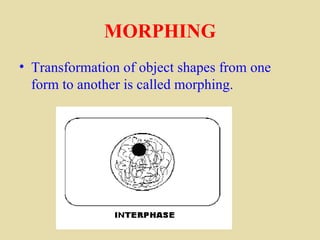
MORPHING
• Transformation of object shapes from one
  form to another is called morphing.
CONCLUSION
• Multimedia serves us an opportunity to create
  animated objects.
• Multimedia is used in every field
    In industry.
    In schools ,colleges.
    In day to day life.
    In designing.
• Multimedia will provoke radical changes in the
  teaching process during coming decades, students can
  discover they can go beyond the limits of traditional
  teaching.
Multimedia
Multimedia

Multimedia

  • 1.
    MULTIMEDIA AND ANIMATION
  • 2.
    PRESENTATION BY • SHALINI SINGH • SHIKHA TOMAR • SHIKHA MALIK • RAM DUTT SHUKLA
  • 4.
    What is MULTIMEDIA? Multimediais combination of more than one media into an information source or presentation.
  • 5.
    Elements of Multimediaare documented through HTML DHTML Macromedia flash Adobe live motion Quick time player
  • 6.
    Multimedia Computer System •It is the capability to integrate two or more types of media ( text, graphics, images, audio and video) for the purpose of generation, storage, representation and access of multimedia information.
  • 7.
    Requirements of Multimedia Computer System • Faster Central Processing Unit (CPU) • Large Storage Devices. • Larger Main Memory. • Good Graphics Terminals. • Input/Output Devices.
  • 8.
    MULTIMEDIA COMPONENTS • Text • Graphics • Audio • Video • Animation
  • 9.
    TEXT Alphanumericcharacter are used to present information in text form. The native language of web is HTML, which is designed to display simple text documents on computer screen.
  • 10.
    Hardware and Software requirements for text Keyboard. Optical Character Recognizers (OCR). Text Editors. Text Style. Text Searching. Hypertext. Text Importing and Exporting.
  • 12.
    GRAPHICS Computer graphics dealswith the generation, representation, manipulation and display of pictures with the aid of a computer.
  • 13.
    Types of Graphics •Generative Graphics • Images
  • 14.
    Generative Graphics Drawings andIllustrations in the form of 2- Dimensional and 3-Dimensional pictures created for mathematical representation of simple objects. Examples – Illustrative Diagrams
  • 15.
    Applications Computer AidedDesign (CAD). Computer Aided Manufacturing (CAM).
  • 16.
    Images • These arepictures and photographs . composed of a collection of pixels
  • 17.
    A Bit AboutGraphics ©1999 Theta Data Vector Graphics - .eps, Bitmapped Graphics - .png, drawing programs, .gif, .jpg, .bmp, .ticc, .pcx, CAD, some clipart scanned graphics, photos
  • 18.
    Hardware and Software requirements for Graphics  Painting or Drawing Software.  Screen Capture Software.  Digitizer  Scanners  Plotters
  • 19.
  • 20.
    Computer audio dealswith synthesizing, recording and playback of audio or sound with the aid of computer. Example In Learning audio can be added to the animation clip.
  • 21.
    ANALOG AND DIGITAL AUDIO • Audio information travels in natural medium in the form of sound waves which are analog in nature. • Analog Is converted in digital form by Transducer for the computer. • Example Microphone
  • 22.
    Hardware and Software requirements for Audio • Sound Card. • Output Device. • Audio File Importing. • Recording and playback capability. • Voice Recognition software.
  • 23.
  • 24.
    • Computer videodeals with the recording and display of a sequence of images at a reasonable speed to create impression of movement. • Each individual image of a sequence of images is called a Frame. • For jerk-free full motion video 25-30 frames have to be displayed per second.
  • 25.
    Hardware and Software requirements for Video • Video Editors. • Video Monitor. • Video Board. • Input Device like video camera • Recording and Playback Capability.
  • 27.
    MULTIMEDIA APPLICATION • Multimedia presentation • Distance and interactive training • Foreign language learning • Video games • Animated advertisements • Multimedia conferencing • Special effects in films • Multimedia kiosk
  • 28.
  • 29.
  • 30.
  • 31.
  • 32.
  • 33.
    MULTIMEDIA KIOSK • Multimediakiosk has a touch-screen monitor with user friendly graphical user interface for ease of operation by general public. • Multimedia kiosk are often used in public places as information providers. • Example – At Airport
  • 34.
    MULTIMEDIA CONFERENCING • Multimedia conferencing refers to a system that simulates face-to-face interactions among participating users located far from each other.
  • 36.
    ANIMATION • Animation dealswith the generation, sequencing and display of a set of images to create an effect of visual motion. • Visual effects such as wipes ,fades, zooms and dissolves , available in most authoring packages , are a simple form of animation. • Television video build 30 entire frames every second. Movies are typically shot at a shutter rate of 24 frames per second.
  • 37.
    Why use Animation? •Animation can help organize thoughts and illustrate processes. • Animation is useful for illustrating concepts which involve movement.
  • 38.
    Example • Teaching swimming–the proper way to swing hands for swimming can be more effectively illustrated with an animation. • Flow of blood in arteries and veins can be illustrated with the help of animation.
  • 39.
    TYPES OF ANIMATION •2-Dimensional animation • 2-1/2 Dimensional animation • 3-Dimensional animation
  • 40.
    2-DIMENSIONAL • The visualchanges that bring an image alive occur on the flat Cartesian x and y axes on the screen. • These are simple and static , not changing their position on the screen. • Authoring and presentation software such as Flash or Power-point provide user friendly tools to compute positional changes.
  • 41.
    2-1/2 DIMENSIONAL • Anillusion of depth is added to an image through shadowing and highlighting, but image still rests on flat x and y axes. • Embossing, shadowing, beveling and highlighting provide a sense of depth by raising an image . • Examples are Adobe illustrator , Photoshop, Fireworks, and After effects.
  • 42.
    3-DIMENSIONAL • Software createsa virtual realm in three dimension, and changes are calculated along all three axes. • It allows the viewer to wander around and get a look at all the object’s parts from all angles.
  • 43.
    PRINCIPLES OF ANIMATION •Animation is possible because of a biological phenomenon known as persistence of vision and a psychological phenomenon called phi. • With the simplest tools you can make a bouncing ball to animate your web-site using GIF89a. • Making animations appear natural requires a basic understanding of the principles of physics.
  • 44.
    Difference between animation and video • Animation is commonly used in those instances where video graphy is not possible. • Animation can better illustrate the concept than video. • Example- Earth is revolving around its axis can not be video graphed but can show through animation.
  • 45.
    MORPHING • Transformation ofobject shapes from one form to another is called morphing.
  • 46.
    CONCLUSION • Multimedia servesus an opportunity to create animated objects. • Multimedia is used in every field In industry. In schools ,colleges. In day to day life. In designing. • Multimedia will provoke radical changes in the teaching process during coming decades, students can discover they can go beyond the limits of traditional teaching.