Multimedia
MULTIMEDIA DEFINITION
• Multimedia is a broad term for combining multiple media formats. Whenever
text, audio, still images, animation, video and interactivity are combined
together, the result is multimedia.
• Multimedia is simply multiple forms of media integrated together.
• Multimedia is a media that uses multiple form of information content and
information processing.
MINIMUM REQUIREMENTS OF MULTIMEDIA
1. A 486 or a higher processor.
2. 64 MB RAM
3. 10 GB Hard disk
4. SVGA Display Monitor
5. CD/DVD Drive
6. Sound card and Micro phone
7. Keyboard , Mouse
8. Multimedia Software.
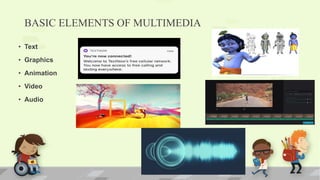
BASIC ELEMENTS OF MULTIMEDIA
• Text
• Graphics
• Animation
• Video
• Audio
TEXT
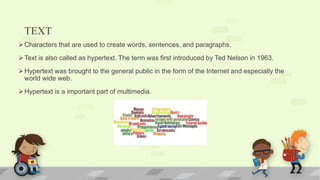
Characters that are used to create words, sentences, and paragraphs.
Text is also called as hypertext. The term was first introduced by Ted Nelson in 1963.
Hypertext was brought to the general public in the form of the Internet and especially the
world wide web.
Hypertext is a important part of multimedia.
GRAPHICS
• It is a digital representation of non-text information, such as a drawing, chart, or photograph.
• Graphics are visual Images on some surface such as a wall, screen, paper (or) entertain.
Types of Graphics files
.BMP(BitMap)
.GIF(Graphics Interchange Format)
.PNG(Portable Network Graphics)
.JPEG(Joint Photographic Expert Group)
• There are two types of Graphics:
Bitmap images- Bitmap images are real images that can be captured from devices such as
digital cameras or scanners. Generally bitmap images are not editable. Bitmap images require a
large amount of memory.
Vector Graphics- Vector graphics are drawn on the computer and only require a small
amount of memory. These graphics are editable.
ANIMATION
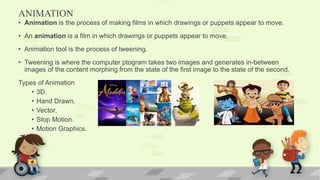
• Animation is the process of making films in which drawings or puppets appear to move.
• An animation is a film in which drawings or puppets appear to move.
• Animation tool is the process of tweening.
• Tweening is where the computer ptogram takes two images and generates in-between
images of the content morphing from the state of the first image to the state of the second.
Types of Animation
• 3D.
• Hand Drawn.
• Vector.
• Stop Motion.
• Motion Graphics.
VIDEO
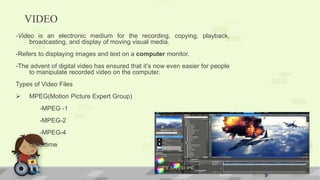
-Video is an electronic medium for the recording, copying, playback,
broadcasting, and display of moving visual media.
-Refers to displaying images and text on a computer monitor.
-The advent of digital video has ensured that it’s now even easier for people
to manipulate recorded video on the computer.
Types of Video Files
 MPEG(Motion Picture Expert Group)
-MPEG -1
-MPEG-2
-MPEG-4
 Quicktime
 AVI
AUDIO
• Audio is a term used to describe any sound or noise that is within a range the human ear is
capable of hearing.
• 2 Main uses are
- Recording/playing back audio
- Sequencing Music
• Audio editing software records incoming audios, edits it and applies effects to it.
Types of Audio files.
.WAV,
.MP3(Mpeg Layer 3) ,ogg vorbis & etc.
FUNCTIONS OF MULTIMEDIA
• It can generate huge text matters.
• It regenerates the sounds of audio system.
• It replays the recorded sound.
• It displays picture & video.
• Information stored on CD/DVD can be retrieved.
APPLICATIONS OF MULTIMEDIA
• Multimedia in Business
• Multimedia in Marketing and Advertising
• Multimedia in Entertainment
• Multimedia in Education
• Multimedia in Banks.
• Multimedia in Hospitals.
• Multimedia Pedagogues(in teaching)
ANIMATIONVIDEO
• MultimediaVideo

Multimedia.pptx

  • 1.
  • 2.
    MULTIMEDIA DEFINITION • Multimediais a broad term for combining multiple media formats. Whenever text, audio, still images, animation, video and interactivity are combined together, the result is multimedia. • Multimedia is simply multiple forms of media integrated together. • Multimedia is a media that uses multiple form of information content and information processing.
  • 3.
    MINIMUM REQUIREMENTS OFMULTIMEDIA 1. A 486 or a higher processor. 2. 64 MB RAM 3. 10 GB Hard disk 4. SVGA Display Monitor 5. CD/DVD Drive 6. Sound card and Micro phone 7. Keyboard , Mouse 8. Multimedia Software.
  • 4.
    BASIC ELEMENTS OFMULTIMEDIA • Text • Graphics • Animation • Video • Audio
  • 5.
    TEXT Characters that areused to create words, sentences, and paragraphs. Text is also called as hypertext. The term was first introduced by Ted Nelson in 1963. Hypertext was brought to the general public in the form of the Internet and especially the world wide web. Hypertext is a important part of multimedia.
  • 6.
    GRAPHICS • It isa digital representation of non-text information, such as a drawing, chart, or photograph. • Graphics are visual Images on some surface such as a wall, screen, paper (or) entertain. Types of Graphics files .BMP(BitMap) .GIF(Graphics Interchange Format) .PNG(Portable Network Graphics) .JPEG(Joint Photographic Expert Group) • There are two types of Graphics: Bitmap images- Bitmap images are real images that can be captured from devices such as digital cameras or scanners. Generally bitmap images are not editable. Bitmap images require a large amount of memory. Vector Graphics- Vector graphics are drawn on the computer and only require a small amount of memory. These graphics are editable.
  • 7.
    ANIMATION • Animation isthe process of making films in which drawings or puppets appear to move. • An animation is a film in which drawings or puppets appear to move. • Animation tool is the process of tweening. • Tweening is where the computer ptogram takes two images and generates in-between images of the content morphing from the state of the first image to the state of the second. Types of Animation • 3D. • Hand Drawn. • Vector. • Stop Motion. • Motion Graphics.
  • 8.
    VIDEO -Video is anelectronic medium for the recording, copying, playback, broadcasting, and display of moving visual media. -Refers to displaying images and text on a computer monitor. -The advent of digital video has ensured that it’s now even easier for people to manipulate recorded video on the computer. Types of Video Files  MPEG(Motion Picture Expert Group) -MPEG -1 -MPEG-2 -MPEG-4  Quicktime  AVI
  • 9.
    AUDIO • Audio isa term used to describe any sound or noise that is within a range the human ear is capable of hearing. • 2 Main uses are - Recording/playing back audio - Sequencing Music • Audio editing software records incoming audios, edits it and applies effects to it. Types of Audio files. .WAV, .MP3(Mpeg Layer 3) ,ogg vorbis & etc.
  • 10.
    FUNCTIONS OF MULTIMEDIA •It can generate huge text matters. • It regenerates the sounds of audio system. • It replays the recorded sound. • It displays picture & video. • Information stored on CD/DVD can be retrieved.
  • 11.
    APPLICATIONS OF MULTIMEDIA •Multimedia in Business • Multimedia in Marketing and Advertising • Multimedia in Entertainment • Multimedia in Education • Multimedia in Banks. • Multimedia in Hospitals. • Multimedia Pedagogues(in teaching)
  • 12.