MCM 
(Multiple-chip-module)
Definition: 
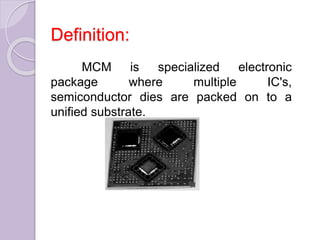
MCM is specialized electronic 
package where multiple IC's, 
semiconductor dies are packed on to a 
unified substrate.
 They have been introduced as an 
alternative packing approach to complement 
the advances which were taking place in IC 
technology. 
 Packaging of the chips has become a more 
significant factor in performance. 
 Chip interconnections play a more 
dominant & limited role in determining overall 
system speed or performance.
PHYSICAL DESIGN AUTOMATION 
 Physical design is similar as IC’s but design 
tools were distinct and cannot be directly used 
for MCM. 
 In designing the CAD tools for MCM following 
were taken in to consideration. 
1. Clock skew rate 
2. Power noise disturbance 
3. Assembly effects
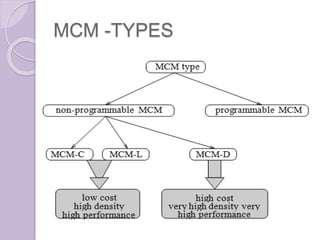
MCM -TYPES
Non-Programmable MCM’s 
1. MCM-L (Laminated MCM) 
2. MCM-C (Ceramic substrate MCM) 
3. MCM-D (Deposited MCM) 
For fast turn around we go for PMCM’S.
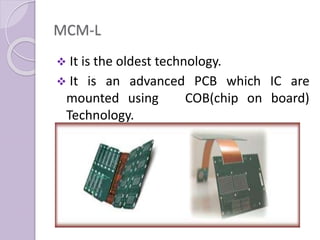
MCM-L 
 It is the oldest technology. 
 It is an advanced PCB which IC are 
mounted using COB(chip on board) 
Technology.
 It is less cost effective at higher densities where 
many additional layers are required. 
It is suitable technology for applications which 
require low risk packing approach. 
ADVANTAGES: 
1.Low cost. 
2.high density 
3.High Performance
MCM-C 
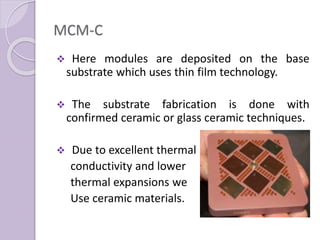
 Here modules are deposited on the base 
substrate which uses thin film technology. 
 The substrate fabrication is done with 
confirmed ceramic or glass ceramic techniques. 
 Due to excellent thermal 
conductivity and lower 
thermal expansions we 
Use ceramic materials.
 It is not applicable for high-end applications. 
 Interconnect densities = 200-400 cm/ cm2. 
Advantages: 
1.Low cost. 
2.High density. 
3.High performance. 
These have been the primary packing choice 
in many advanced applications requiring for 
both performance & reliability.
MCM-D 
 This consists of substrates which have high 
density thin-films metals and low dielectric 
materials like silicon. 
Several dielectric/metallization technologies 
were involved. 
Advantages: 
1.High performance. 
2.High density. 
Disadvantage: 
High cost.
COMPARISION
Die Attachment techniques 
 These attachment techniques are of three 
types. 
1. wire bonding 
2. TAB (tape automated bonding) 
3. Flip-chip bonding
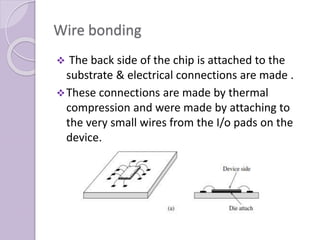
Wire bonding 
 The back side of the chip is attached to the 
substrate & electrical connections are made . 
These connections are made by thermal 
compression and were made by attaching to 
the very small wires from the I/o pads on the 
device.
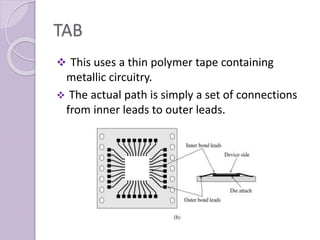
TAB 
 This uses a thin polymer tape containing 
metallic circuitry. 
 The actual path is simply a set of connections 
from inner leads to outer leads.
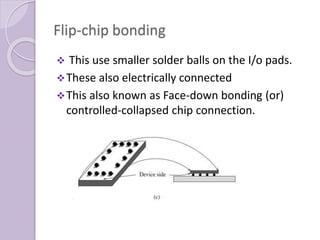
Flip-chip bonding 
 This use smaller solder balls on the I/o pads. 
These also electrically connected 
This also known as Face-down bonding (or) 
controlled-collapsed chip connection.
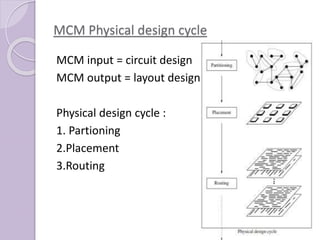
MCM Physical design cycle 
MCM input = circuit design 
MCM output = layout design. 
Physical design cycle : 
1. Partioning 
2.Placement 
3.Routing
Partioning 
 The 1st assignment of partion is to sub-divide 
the given circuit. 
 Timing, i/o pin count & power constraints . 
 As a result area also will also be added as one 
of the constraints. 
It is performance driven. 
note: No. of chips sustain in sub-ckt must be less than No. of chips 
sustain in MCM.
Placement 
 Mapping of chips. 
 It is performance driven. 
 As a result effects thermal characteristics. Due 
this there will be a effect over routing efficiency. 
 Compared to IC’s they have fewer components 
and sizes, shapes were less variable. 
Note: Thermal characteristics were considered because bare chips 
were place side by side hence during the processing certain 
amount of heat is get generated.
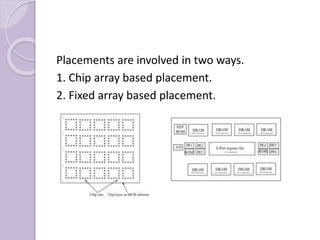
Placements are involved in two ways. 
1. Chip array based placement. 
2. Fixed array based placement.
Multi chip module

Multi chip module

  • 1.
  • 2.
    Definition: MCM isspecialized electronic package where multiple IC's, semiconductor dies are packed on to a unified substrate.
  • 4.
     They havebeen introduced as an alternative packing approach to complement the advances which were taking place in IC technology.  Packaging of the chips has become a more significant factor in performance.  Chip interconnections play a more dominant & limited role in determining overall system speed or performance.
  • 5.
    PHYSICAL DESIGN AUTOMATION  Physical design is similar as IC’s but design tools were distinct and cannot be directly used for MCM.  In designing the CAD tools for MCM following were taken in to consideration. 1. Clock skew rate 2. Power noise disturbance 3. Assembly effects
  • 6.
  • 7.
    Non-Programmable MCM’s 1.MCM-L (Laminated MCM) 2. MCM-C (Ceramic substrate MCM) 3. MCM-D (Deposited MCM) For fast turn around we go for PMCM’S.
  • 8.
    MCM-L  Itis the oldest technology.  It is an advanced PCB which IC are mounted using COB(chip on board) Technology.
  • 9.
     It isless cost effective at higher densities where many additional layers are required. It is suitable technology for applications which require low risk packing approach. ADVANTAGES: 1.Low cost. 2.high density 3.High Performance
  • 10.
    MCM-C  Heremodules are deposited on the base substrate which uses thin film technology.  The substrate fabrication is done with confirmed ceramic or glass ceramic techniques.  Due to excellent thermal conductivity and lower thermal expansions we Use ceramic materials.
  • 11.
     It isnot applicable for high-end applications.  Interconnect densities = 200-400 cm/ cm2. Advantages: 1.Low cost. 2.High density. 3.High performance. These have been the primary packing choice in many advanced applications requiring for both performance & reliability.
  • 12.
    MCM-D  Thisconsists of substrates which have high density thin-films metals and low dielectric materials like silicon. Several dielectric/metallization technologies were involved. Advantages: 1.High performance. 2.High density. Disadvantage: High cost.
  • 13.
  • 14.
    Die Attachment techniques  These attachment techniques are of three types. 1. wire bonding 2. TAB (tape automated bonding) 3. Flip-chip bonding
  • 15.
    Wire bonding The back side of the chip is attached to the substrate & electrical connections are made . These connections are made by thermal compression and were made by attaching to the very small wires from the I/o pads on the device.
  • 16.
    TAB  Thisuses a thin polymer tape containing metallic circuitry.  The actual path is simply a set of connections from inner leads to outer leads.
  • 17.
    Flip-chip bonding This use smaller solder balls on the I/o pads. These also electrically connected This also known as Face-down bonding (or) controlled-collapsed chip connection.
  • 18.
    MCM Physical designcycle MCM input = circuit design MCM output = layout design. Physical design cycle : 1. Partioning 2.Placement 3.Routing
  • 19.
    Partioning  The1st assignment of partion is to sub-divide the given circuit.  Timing, i/o pin count & power constraints .  As a result area also will also be added as one of the constraints. It is performance driven. note: No. of chips sustain in sub-ckt must be less than No. of chips sustain in MCM.
  • 20.
    Placement  Mappingof chips.  It is performance driven.  As a result effects thermal characteristics. Due this there will be a effect over routing efficiency.  Compared to IC’s they have fewer components and sizes, shapes were less variable. Note: Thermal characteristics were considered because bare chips were place side by side hence during the processing certain amount of heat is get generated.
  • 21.
    Placements are involvedin two ways. 1. Chip array based placement. 2. Fixed array based placement.