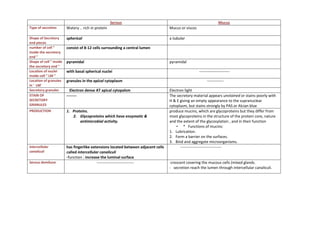
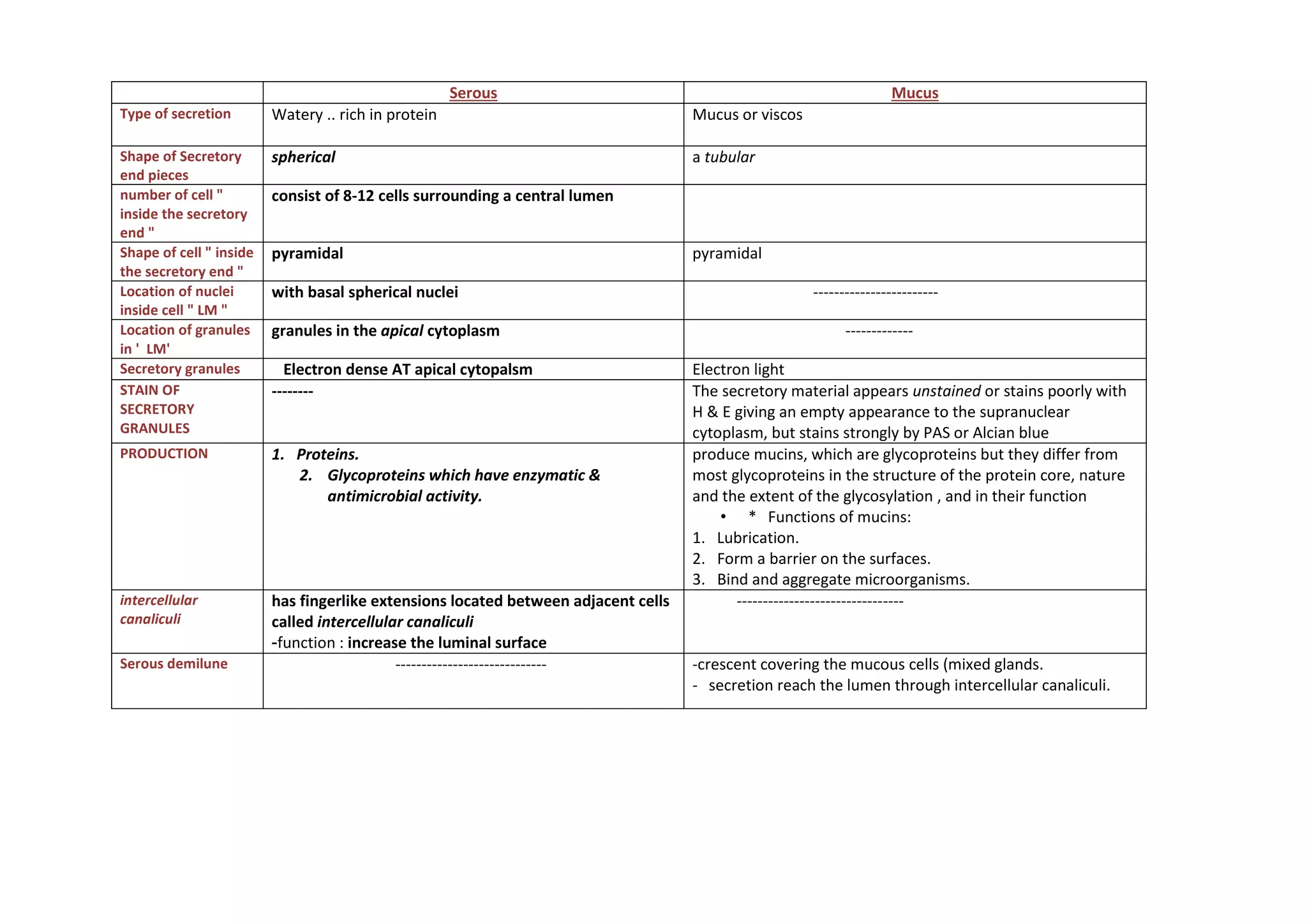
Serous Mucus 
Watery .. rich in protein Mucus or viscos 
Type of secretion 
Shape of Secretory spherical a tubular 
end pieces 
number of cell " consist of 8-12 cells surrounding a central lumen 
inside the secretory 
end " 
Shape of cell " inside pyramidal pyramidal 
the secretory end " 
Location of nuclei with basal spherical nuclei ------------------------ 
inside cell " LM " 
Location of granules granules in the apical cytoplasm ------------- 
in ' LM' 
Secretory granules Electron dense AT apical cytopalsm Electron light 
The secretory material appears unstained or stains poorly with 
H & E giving an empty appearance to the supranuclear 
cytoplasm, but stains strongly by PAS or Alcian blue 
STAIN OF -------- 
SECRETORY 
GRANULES 
produce mucins, which are glycoproteins but they differ from 
most glycoproteins in the structure of the protein core, nature 
and the extent of the glycosylation , and in their function 
• * Functions of mucins: 
1. Lubrication. 
2. Form a barrier on the surfaces. 
3. Bind and aggregate microorganisms. 
1. Proteins. 
2. Glycoproteins which have enzymatic & 
antimicrobial activity. 
PRODUCTION 
has fingerlike extensions located between adjacent cells -------------------------------- 
called intercellular canaliculi 
-function : increase the luminal surface 
intercellular 
canaliculi 
-crescent covering the mucous cells (mixed glands. 
- secretion reach the lumen through intercellular canaliculi. 
Serous demilune -----------------------------
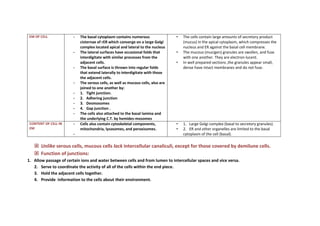
 Unlike serous cells, mucous cells lack intercellular canaliculi, except for those covered by demilune cells. 
 Function of junctions: 
1. Allow passage of certain ions and water between cells and from lumen to intercellular spaces and vice versa. 
2. Serve to coordinate the activity of all of the cells within the end piece. 
3. Hold the adjacent cells together. 
4. Provide information to the cells about their environment. 
• The cells contain large amounts of secretory product 
(mucus) in the apical cytoplasm, which compresses the 
nucleus and ER against the basal cell membrane. 
• The mucous (mucigen) granules are swollen, and fuse 
with one another. They are electron-lucent. 
• In well prepared sections ,the granules appear small, 
dense have intact membranes and do not fuse. 
- The basal cytoplasm contains numerous 
cisternae of rER which converge on a large Golgi 
complex located apical and lateral to the nucleus 
- The lateral surfaces have occasional folds that 
interdigitate with similar processes from the 
adjacent cells. 
- The basal surface is thrown into regular folds 
that extend laterally to interdigitate with those 
the adjacent cells. 
- The serous cells, as well as mucous cells, also are 
joined to one another by: 
- 1. Tight junction. 
- 2. Adhering junction 
- 3. Desmosomes 
- 4. Gap junction . 
- The cells also attached to the basal lamina and 
the underlying C.T. by hemides-mosomes 
EM OF CELL 
• 1. Large Golgi complex (basal to secretory granules). 
• 2. ER and other organelles are limited to the basal 
cytoplasm of the cell (basal). 
- Cells also contain cytoskeletal components, 
mitochondria, lysosomes, and peroxisomes. 
- 
CONTENT OF CELL IN 
EM

Mucus VS Serous

  • 1.
    Serous Mucus Watery.. rich in protein Mucus or viscos Type of secretion Shape of Secretory spherical a tubular end pieces number of cell " consist of 8-12 cells surrounding a central lumen inside the secretory end " Shape of cell " inside pyramidal pyramidal the secretory end " Location of nuclei with basal spherical nuclei ------------------------ inside cell " LM " Location of granules granules in the apical cytoplasm ------------- in ' LM' Secretory granules Electron dense AT apical cytopalsm Electron light The secretory material appears unstained or stains poorly with H & E giving an empty appearance to the supranuclear cytoplasm, but stains strongly by PAS or Alcian blue STAIN OF -------- SECRETORY GRANULES produce mucins, which are glycoproteins but they differ from most glycoproteins in the structure of the protein core, nature and the extent of the glycosylation , and in their function • * Functions of mucins: 1. Lubrication. 2. Form a barrier on the surfaces. 3. Bind and aggregate microorganisms. 1. Proteins. 2. Glycoproteins which have enzymatic & antimicrobial activity. PRODUCTION has fingerlike extensions located between adjacent cells -------------------------------- called intercellular canaliculi -function : increase the luminal surface intercellular canaliculi -crescent covering the mucous cells (mixed glands. - secretion reach the lumen through intercellular canaliculi. Serous demilune -----------------------------
  • 2.
     Unlike serouscells, mucous cells lack intercellular canaliculi, except for those covered by demilune cells.  Function of junctions: 1. Allow passage of certain ions and water between cells and from lumen to intercellular spaces and vice versa. 2. Serve to coordinate the activity of all of the cells within the end piece. 3. Hold the adjacent cells together. 4. Provide information to the cells about their environment. • The cells contain large amounts of secretory product (mucus) in the apical cytoplasm, which compresses the nucleus and ER against the basal cell membrane. • The mucous (mucigen) granules are swollen, and fuse with one another. They are electron-lucent. • In well prepared sections ,the granules appear small, dense have intact membranes and do not fuse. - The basal cytoplasm contains numerous cisternae of rER which converge on a large Golgi complex located apical and lateral to the nucleus - The lateral surfaces have occasional folds that interdigitate with similar processes from the adjacent cells. - The basal surface is thrown into regular folds that extend laterally to interdigitate with those the adjacent cells. - The serous cells, as well as mucous cells, also are joined to one another by: - 1. Tight junction. - 2. Adhering junction - 3. Desmosomes - 4. Gap junction . - The cells also attached to the basal lamina and the underlying C.T. by hemides-mosomes EM OF CELL • 1. Large Golgi complex (basal to secretory granules). • 2. ER and other organelles are limited to the basal cytoplasm of the cell (basal). - Cells also contain cytoskeletal components, mitochondria, lysosomes, and peroxisomes. - CONTENT OF CELL IN EM