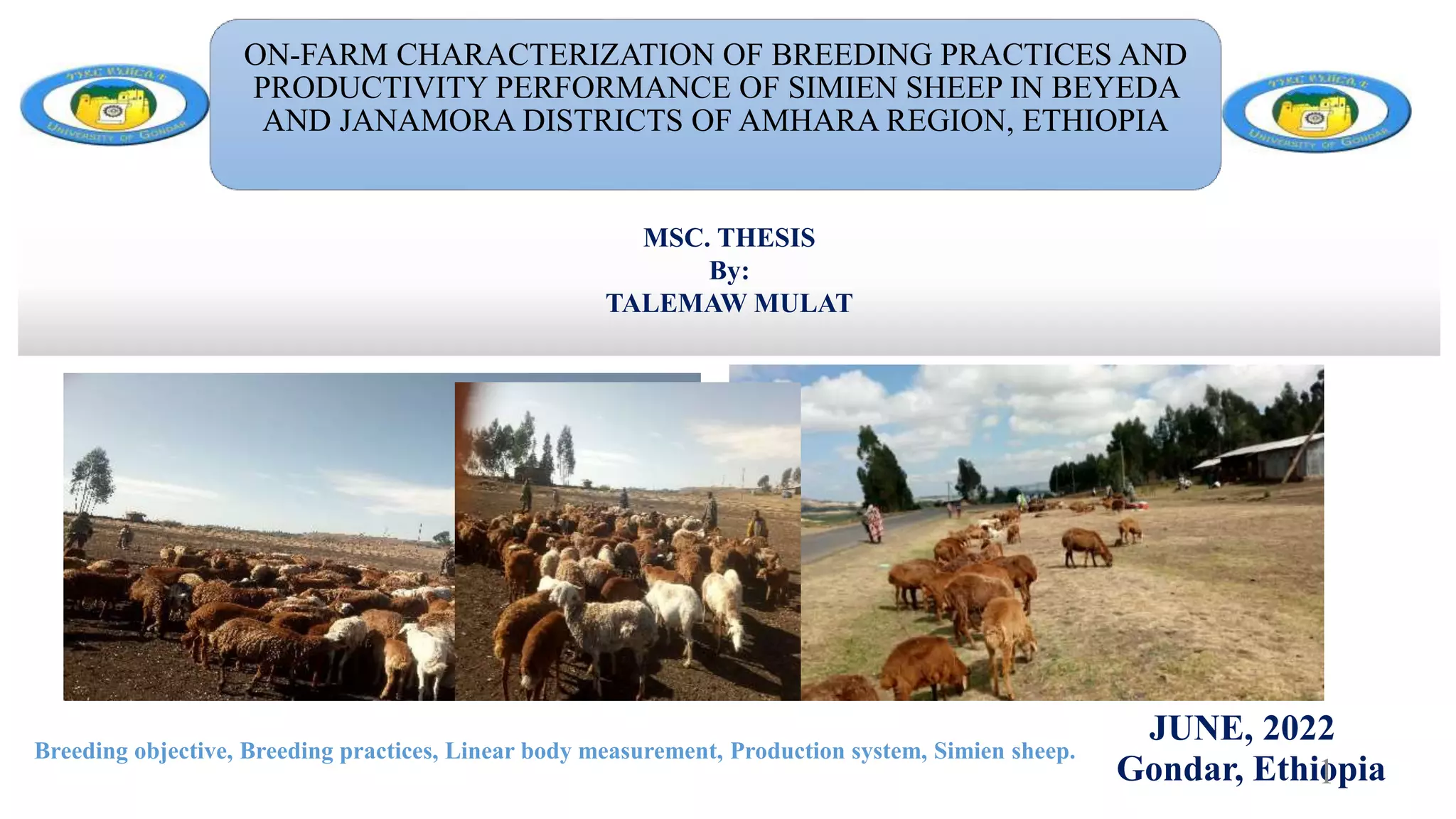
Breeding objective, Breeding practices, Linear body measurement, Production system, Simien sheep.
MSC. THESIS
By:
TALEMAW MULAT
Gondar, Ethiopia
JUNE, 2022
1
ON-FARM CHARACTERIZATION OF BREEDING PRACTICES AND
PRODUCTIVITY PERFORMANCE OF SIMIEN SHEEP IN BEYEDA
AND JANAMORA DISTRICTS OF AMHARA REGION, ETHIOPIA
Breeding objective, Breeding practices, Linear body measurement, Production system, Simien sheep
2
Presentation
outline
1. Introduction
โ€ข Background
โ€ข Statement of the problem and justification
โ€ข Objectives
2. Materials and Methods
๏‚ง Description of the study area
๏‚ง Study Approach
๏‚ง Sampling method
๏‚ง Data management and Analysis
3. Result and Discussion
4. Conclusion and Recommendations
๏ถ More than 85% of Ethiopia's population is dependent on an Agriculture
based economy in which livestock and their products play a very significant
role (CSA, 2016).
๏ถ Ethiopia has endowed with a large number of the domestic animal
population in the world.
๏ถ It is believed to have the largest livestock population in Africa with an
estimated number of :-
๏ƒ˜65 million cattle
๏ƒ˜39 million sheep
๏ƒ˜ 50 million goat
๏ƒ˜ 7 million camels
Breeding objective, Breeding practices, Linear body measurement, Production system, Simien sheep. 3
1. Introduction
Background cont.โ€ฆ
๏ƒ˜ 48 million poultry
๏ƒ˜ 2 million horses
๏ƒ˜ 0.5 million mules
๏ƒ˜ 9 million donkeys (CSA, 2020).
๏ถAmhara National Regional State has:-
๏ƒ˜15.45 million cattle
๏ƒ˜ 9.80 million sheep
๏ƒ˜ 6.09 million goats
Breeding objective, Breeding practices, Linear body measurement, Production system, Simien sheep.4
Background cont.โ€ฆ
๏ƒ˜ 0.47 million horses
๏ƒ˜ 0.18 million mules
๏ƒ˜ 2.83 million donkeys
๏ƒ˜ 0.06 million camels
๏ƒ˜19.96 million poultry
๏ƒ˜ 1.33 million beehives (CSA, 2016).
Breeding objective, Breeding practices, Linear body measurement, Production system, Simien sheep.
5
Background cont.โ€ฆ
๏ถLivestock products and by-products in the form of:-
๏ƒ˜ meat, milk, eggs, honey, butter, and cheese have great importance
๏ƒ˜It provide different nutrient that contributes to the improvement of
the nutritional status of the people (Habtamu, 2015 and Birara,
2016).
๏ถ Sheep are economically important for the national economy
and the farm household.
Breeding objective, Breeding practices, Linear body measurement, Production system, Simien sheep.
6
Background cont.โ€ฆ
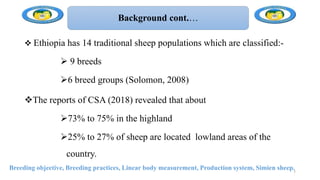
๏ถ Ethiopia has 14 traditional sheep populations which are classified:-
๏ƒ˜ 9 breeds
๏ƒ˜6 breed groups (Solomon, 2008)
๏ถThe reports of CSA (2018) revealed that about
๏ƒ˜73% to 75% in the highland
๏ƒ˜25% to 27% of sheep are located lowland areas of the
country.
Breeding objective, Breeding practices, Linear body measurement, Production system, Simien sheep.7
Background cont.โ€ฆ
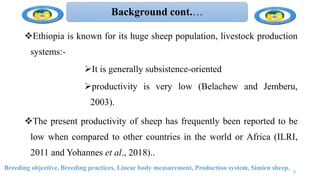
๏ถEthiopia is known for its huge sheep population, livestock production
systems:-
๏ƒ˜It is generally subsistence-oriented
๏ƒ˜productivity is very low (Belachew and Jemberu,
2003).
๏ถThe present productivity of sheep has frequently been reported to be
low when compared to other countries in the world or Africa (ILRI,
2011 and Yohannes et al., 2018)..
Breeding objective, Breeding practices, Linear body measurement, Production system, Simien sheep. 8
Background cont.โ€ฆ
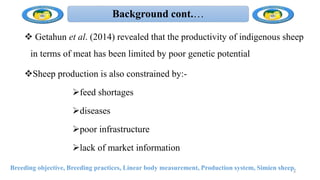
๏ถ Getahun et al. (2014) revealed that the productivity of indigenous sheep
in terms of meat has been limited by poor genetic potential
๏ถSheep production is also constrained by:-
๏ƒ˜feed shortages
๏ƒ˜diseases
๏ƒ˜poor infrastructure
๏ƒ˜lack of market information
Breeding objective, Breeding practices, Linear body measurement, Production system, Simien sheep.
9
Background cont.โ€ฆ
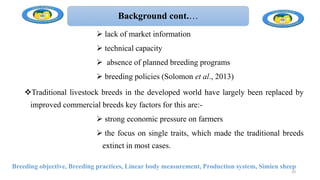
๏ƒ˜ lack of market information
๏ƒ˜ technical capacity
๏ƒ˜ absence of planned breeding programs
๏ƒ˜ breeding policies (Solomon et al., 2013)
๏ถTraditional livestock breeds in the developed world have largely been replaced by
improved commercial breeds key factors for this are:-
๏ƒ˜ strong economic pressure on farmers
๏ƒ˜ the focus on single traits, which made the traditional breeds
extinct in most cases.
Breeding objective, Breeding practices, Linear body measurement, Production system, Simien sheep
10
Background cont.โ€ฆ
๏ถOn the other hand, livestock production in the developing world is
largely based on traditional breeds.
๏ถAmong which Simien sheep is highly valued for:-
๏ƒ˜ its delectable meat
๏ƒ˜ adaptation to the harsh
๏ƒ˜ low-input production environment.
Breeding objective, Breeding practices, Linear body measurement, Production system, Simien sheep
11
Background cont.โ€ฆ
๏ถSurvival of traditional breeds is endangered as farmers are tempted to
replace them with exotic breeds perceived to be improved (Boettcher et
al., 2010; Taberlet et al., 2011; Adebabay et al., 2016).
๏ถThe major factors contributing to the loss of such genetic diversity
are:-
๏ƒ˜intervention failures in livelihood and
๏ƒ˜market-oriented agricultural systems (Wollny, 2012).
Breeding objective, Breeding practices, Linear body measurement, Production system, Simien sheep
12
Background cont.โ€ฆ
๏ถSimien sheep breeds and farming practices need to be conserved as
they harbor valuable genes lost from improved commercial breeds.
๏ƒ˜ they could serve as a source of safe and tasty products.
๏ถ Conservation of traditional breeds requires increasing their value to
the community.
๏ถImproved market access provides incentives to farmers and promotes
the conservation of traditional breeds
Breeding objective, Breeding practices, Linear body measurement, Production system, Simien sheep
13
Background cont.โ€ฆ
๏ถ Several research and development projects have been undertaken by
๏ƒ˜ national
๏ƒ˜ international agricultural research institutions
๏ƒ˜ governmental
๏ƒ˜ non-governmental development agencies (Kosgey et al., 2008).
๏ถAn achievement on breed improvement which leads the production and productivity of indigenous breeds
of Ethiopia is still not significant.
๏ƒ˜ Breed improvement challenges
๏ƒ˜impacts on sheep production
๏ƒ˜ research gaps need to be periodically evaluated to direct the research and development
efforts to achieve the desired goals.
Breeding objective, Breeding practices, Linear body measurement, Production system, Simien sheep 14
1.2. Statement of the problem and justification
๏ถ Among the various factors:-
๏ƒ˜ the absence of planned genetic improvement programs for local breeds is
one of the causes for losing their competitive advantage
๏ƒ˜ Especially the production systems or external conditions are subject to
change (Solomon, 2008; Tesfaye, 2008; Zewudu, 2008; Surafel, 2012).
๏ถTherefore, improvement and conservation of Simien sheep genetic resources could be
imperative as it has been contributing to sheep genetic diversity in Ethiopia.
Breeding objective, Breeding practices, Linear body measurement, Production system, Simien sheep
15
Statement of the problem Contiโ€ฆ
๏ถThere is a need to design and implement appropriate breeding
strategies:-
๏ƒ˜ to improve the productivity of Simien sheep to utilize
๏ƒ˜ increase its contribution to its keepers
๏ƒ˜ enhance its conservation by the community
๏ถ However, the lack of further detailed and area-specific characterization
๏ƒ˜about the production system.
Breeding objective, Breeding practices, Linear body measurement, Production system, Simien sheep
16
Statement of the problem Contiโ€ฆ
๏ƒ˜The existing breed management
๏ƒ˜traditional breeding practice
๏ƒ˜identification of important traits
๏ƒ˜on-farm growth performance, are perceived to be the most
important hindrance for genetic improvement and development of
conservation programs.
Breeding objective, Breeding practices, Linear body measurement, Production system, Simien sheep
17
Statement of the problem Contiโ€ฆ
๏ถLack of such detailed and area-specific information is a serious constraint
๏ƒ˜ to effective prioritization
๏ƒ˜ planning of breed improvement
๏ƒ˜ conservation measures including sustainable breeding strategies (Solomon et
al., 2013)
๏ถThus, characterization of the production system, breeding practices, identification of
breeding objective traits, and assessing on-farm growth performance would help to
ensure sustainable use and development of sheep genetic resources.
Breeding objective, Breeding practices, Linear body measurement, Production system, Simien sheep
18
1.4 Objectives
1.4.1 General objective
๏ถThe general objective of this study was to provide baseline information and
approaches for the improvement and conservation of Simien sheep to promote its
survival as an adapted indigenous genetic resource and its socio-economic contribution
to its keepers in Simien Mountain region of Amhara region
1.4.2 Specific objectives
๏ถTo characterize the existing sheep production systems
๏ถTo identify the breeding objective and breeding strategies
๏ถTo assess body weight and other body linear measurements at farmersโ€™ production condition
Breeding objective, Breeding practices, Linear body measurement, Production system, Simien sheep
19
3. MATERIALS AND METHODS
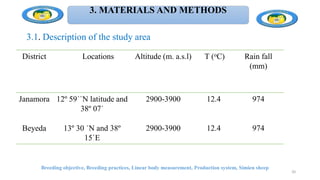
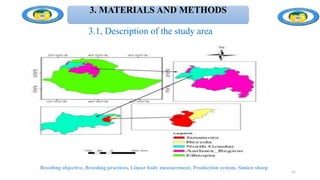
3.1. Description of the study area
Breeding objective, Breeding practices, Linear body measurement, Production system, Simien sheep
District Locations Altitude (m. a.s.l) T (oC) Rain fall
(mm)
Janamora 12ยบ 59หˆหˆN latitude and
38ยบ 07หˆ
2900-3900 12.4 974
Beyeda 13ยบ 30 หˆN and 38ยบ
15หˆE
2900-3900 12.4 974
20
Breeding objective, Breeding practices, Linear body measurement, Production system, Simien sheep
21
3. MATERIALS AND METHODS
3.1. Description of the study area
Materials and methods cont.โ€ฆ
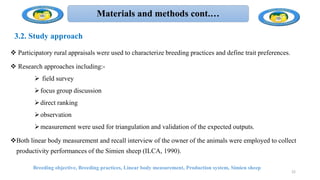
3.2. Study approach
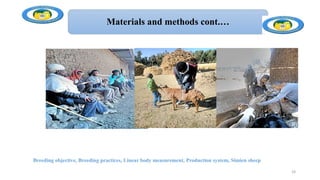
๏ถ Participatory rural appraisals were used to characterize breeding practices and define trait preferences.
๏ถ Research approaches including:-
๏ƒ˜ field survey
๏ƒ˜focus group discussion
๏ƒ˜direct ranking
๏ƒ˜observation
๏ƒ˜measurement were used for triangulation and validation of the expected outputs.
๏ถBoth linear body measurement and recall interview of the owner of the animals were employed to collect
productivity performances of the Simien sheep (ILCA, 1990).
Breeding objective, Breeding practices, Linear body measurement, Production system, Simien sheep
22
Materials and methods cont.โ€ฆ
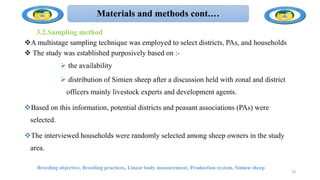
3.2.Sampling method
๏ถA multistage sampling technique was employed to select districts, PAs, and households
๏ถ The study was established purposively based on :-
๏ƒ˜ the availability
๏ƒ˜ distribution of Simien sheep after a discussion held with zonal and district
officers mainly livestock experts and development agents.
๏ถBased on this information, potential districts and peasant associations (PAs) were
selected.
๏ถThe interviewed households were randomly selected among sheep owners in the study
area.
Breeding objective, Breeding practices, Linear body measurement, Production system, Simien sheep
23
Breeding objective, Breeding practices, Linear body measurement, Production system, Simien sheep
24
Materials and methods cont.โ€ฆ
๏ถ.
Breeding objective, Breeding practices, Linear body measurement, Production system, Simien sheep
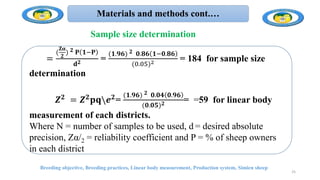
๐๐’ =
(
๐™๐›‚
๐Ÿ
) ๐Ÿ ๐ ๐Ÿโˆ’๐
๐๐Ÿ =
(๐Ÿ.๐Ÿ—๐Ÿ”) ๐Ÿ ๐ŸŽ.๐Ÿ–๐Ÿ” ๐Ÿโˆ’๐ŸŽ.๐Ÿ–๐Ÿ”
(0.05)2 = 184 for sample size
determination
๐’๐Ÿ = ๐’๐Ÿ๐ฉ๐ช๐’†๐Ÿ=
(๐Ÿ.๐Ÿ—๐Ÿ”) ๐Ÿ ๐ŸŽ.๐ŸŽ๐Ÿ’ ๐ŸŽ.๐Ÿ—๐Ÿ”
(๐ŸŽ.๐ŸŽ๐Ÿ“)๐Ÿ = =59 for linear body
measurement of each districts.
Where N = number of samples to be used, d = desired absolute
precision, Zฮฑ/2 = reliability coefficient and P = % of sheep owners
in each district
25
Sample size determination
Materials and methods cont.โ€ฆ
Data analysis and statistical models
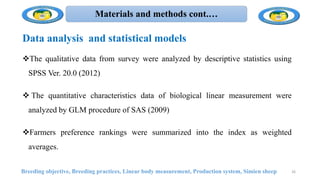
๏ถThe qualitative data from survey were analyzed by descriptive statistics using
SPSS Ver. 20.0 (2012)
๏ถ The quantitative characteristics data of biological linear measurement were
analyzed by GLM procedure of SAS (2009)
๏ถFarmers preference rankings were summarized into the index as weighted
averages.
Breeding objective, Breeding practices, Linear body measurement, Production system, Simien sheep 26
Materials and methods cont.โ€ฆ
Data analysis and statistical models
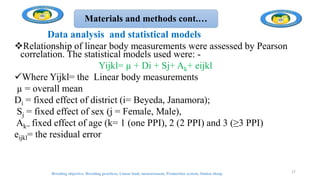
๏ถRelationship of linear body measurements were assessed by Pearson
correlation. The statistical models used were: -
Yijkl= ยต + Di + Sj+ Ak+ eijkl
๏ƒผWhere Yijkl= the Linear body measurements
ยต = overall mean
Di = fixed effect of district (i= Beyeda, Janamora);
Sj = fixed effect of sex (j = Female, Male),
Ak= fixed effect of age (k= 1 (one PPI), 2 (2 PPI) and 3 (โ‰ฅ3 PPI)
eijkl= the residual error
Breeding objective, Breeding practices, Linear body measurement, Production system, Simien sheep 27
4. Result & discussion
Description Beyeda (N = 92) Janamora (N=92) Overall(184)
N % N % N %
Sex of the respondents
Male 81 88.2 80 87.9 161 88
Female 11 11.8 12 12.1 23 12
Age categories of the respondents (years)
18-30 7 11.8 6 10.5 13 6.5
31-50 64 75.3 64 75.3 128 70.1
51-60 19 10.7 19 10.7 38 20.7
>61 2 2.2 3 3.5 5 2.7
Marital status of HH
Single 6 9.7 5 6.5 11 4.9
Married 81 83.8 80 85.3 161 87.5
Divorced 5 6.5 7 8.2 12 7.6
Breeding objective, Breeding practices, Linear body measurement, Production system, Simien sheep
Table 5: socio-economic characteristics of Households
N = Number of participant
28
Result & discussion cont.โ€ฆ
General Household Characteristics cont.โ€ฆ
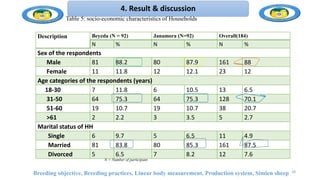
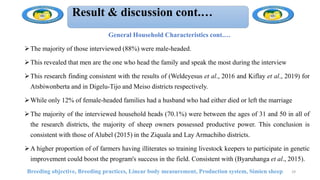
๏ƒ˜The majority of those interviewed (88%) were male-headed.
๏ƒ˜This revealed that men are the one who head the family and speak the most during the interview
๏ƒ˜This research finding consistent with the results of (Weldeyesus et al., 2016 and Kiflay et al., 2019) for
Atsbiwonberta and in Digelu-Tijo and Meiso districts respectively.
๏ƒ˜While only 12% of female-headed families had a husband who had either died or left the marriage
๏ƒ˜The majority of the interviewed household heads (70.1%) were between the ages of 31 and 50 in all of
the research districts, the majority of sheep owners possessed productive power. This conclusion is
consistent with those of Alubel (2015) in the Ziquala and Lay Armachiho districts.
๏ƒ˜A higher proportion of of farmers having illiterates so training livestock keepers to participate in genetic
improvement could boost the program's success in the field. Consistent with (Byaruhanga et al., 2015).
Breeding objective, Breeding practices, Linear body measurement, Production system, Simien sheep 29
Result & discussion cont.โ€ฆ
N= number of respondents, SE = standard Error
Table 8: Livestock mix and holdings of respondents, and family size
30
Simien Sheep
Species Beyeda (N=92) Janamora(N=92) Overall mean
Mean SE Mean SE Mean SE
Cattle 2.39 0.25 3.31 0.28 2.84 0.2
Sheep 14.14 1.01 19.4 1.15 16.75 0.79
Goat 2.65 0.27 0.27 3.9 3.3 0.2
Chicken 5.62 0.46 5.7 0.52 5.7 0.35
Donkeys 1.00 0.08 1.30 0.96 1.15 0.06
Horse 1.91 0.15 1.45 0.11 1.68 0.1
Mules 0.99 0.09 1.05 0.06 1.02 0.05
Bee hives 2.33 0.30 1.86 0.32 2.1 0.22
Crop land(ha) 1.15ยฑ.0.86 1.53ยฑ.0.86 1.34ยฑ.0.60
Grazing land(ha) 0.06ยฑ.0.26 0.14ยฑ.0.46 0.1ยฑ.0.26
Result & discussion cont.โ€ฆ
Family size, land and livestock holding cont.โ€ฆ
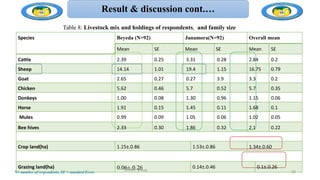
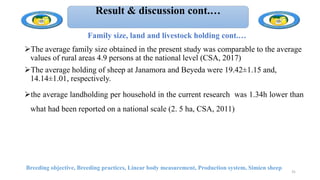
๏ƒ˜The average family size obtained in the present study was comparable to the average
values of rural areas 4.9 persons at the national level (CSA, 2017)
๏ƒ˜The average holding of sheep at Janamora and Beyeda were 19.42ยฑ1.15 and,
14.14ยฑ1.01, respectively.
๏ƒ˜the average landholding per household in the current research was 1.34h lower than
what had been reported on a national scale (2. 5 ha, CSA, 2011)
Breeding objective, Breeding practices, Linear body measurement, Production system, Simien sheep
31
Result & discussion cont.โ€ฆ
Major farming activities
Sources of home consumption
Districts Overall index
Beyeda (N= 92) Janamora (N= 92)
R1 R2 R3 Index R1 R2 R3 Index
crop production 25 29 35 0.30 29 31 18 0.31 0.31
Cattle 7 4 9 0.07 6 4 9 0.06 0.07
Sheep 29 27 19 0.28 24 27 34 0.29 0.28
Goat 8 7 14 0.09 8 6 15 0.09 0.09
Chicken 14 17 13 0.16 14 16 13 0.15 0.15
Food aid 9 8 2 0.08 11 8 3 0.09 0.09
Sources of income Sheep
Crop production
39
25
26
35
22
19
0.34
0.29
40
25
25
34
21
19
0.35
0.29
0.35
0.29
Index = [(3 ร— number of households ranking as first + 2 ร— number of households ranking as second + 1 ร— number of households
ranking as third) for each farming activities of each district]/ [(3 ร— number of households ranking as first + 2 ร— number of households ranking as second + 1 ร—
number of households ranking as third) for all farming activities for each district].
Table 10 Farming activities used for home consumption, income generation.
32
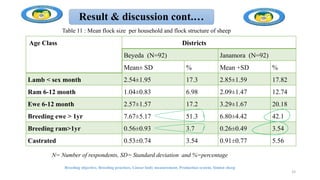
Age Class Districts
Beyeda (N=92) Janamora (N=92)
Meanยฑ SD % Mean +SD %
Lamb < sex month 2.54ยฑ1.95 17.3 2.85ยฑ1.59 17.82
Ram 6-12 month 1.04ยฑ0.83 6.98 2.09ยฑ1.47 12.74
Ewe 6-12 month 2.57ยฑ1.57 17.2 3.29ยฑ1.67 20.18
Breeding ewe > 1yr 7.67ยฑ5.17 51.3 6.80ยฑ4.42 42.1
Breeding ram>1yr 0.56ยฑ0.93 3.7 0.26ยฑ0.49 3.54
Castrated 0.53ยฑ0.74 3.54 0.91ยฑ0.77 5.56
Breeding objective, Breeding practices, Linear body measurement, Production system, Simien sheep
Result & discussion cont.โ€ฆ
Table 11 : Mean flock size per household and flock structure of sheep
N= Number of respondents, SD= Standard deviation and %=percentage
33
Result & discussion cont.โ€ฆ
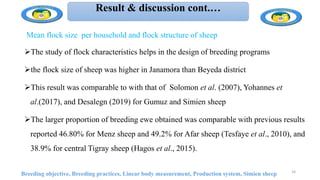
Mean flock size per household and flock structure of sheep
๏ƒ˜The study of flock characteristics helps in the design of breeding programs
๏ƒ˜the flock size of sheep was higher in Janamora than Beyeda district
๏ƒ˜This result was comparable to with that of Solomon et al. (2007), Yohannes et
al.(2017), and Desalegn (2019) for Gumuz and Simien sheep
๏ƒ˜The larger proportion of breeding ewe obtained was comparable with previous results
reported 46.80% for Menz sheep and 49.2% for Afar sheep (Tesfaye et al., 2010), and
38.9% for central Tigray sheep (Hagos et al., 2015).
Breeding objective, Breeding practices, Linear body measurement, Production system, Simien sheep 34
Result & discussion cont.โ€ฆ
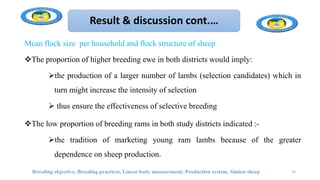
Mean flock size per household and flock structure of sheep
๏ถThe proportion of higher breeding ewe in both districts would imply:
๏ƒ˜the production of a larger number of lambs (selection candidates) which in
turn might increase the intensity of selection
๏ƒ˜ thus ensure the effectiveness of selective breeding
๏ถThe low proportion of breeding rams in both study districts indicated :-
๏ƒ˜the tradition of marketing young ram lambs because of the greater
dependence on sheep production.
Breeding objective, Breeding practices, Linear body measurement, Production system, Simien sheep 35
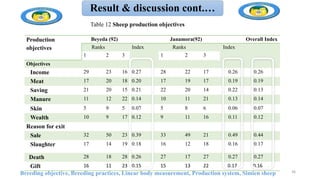
Production
objectives
Beyeda (92) Janamora(92) Overall Index
Ranks Index Ranks Index
1 2 3 1 2 3
Objectives
Income 29 23 16 0.27 28 22 17 0.26 0.26
Meat 17 20 18 0.20 17 19 17 0.19 0.19
Saving 21 20 15 0.21 22 20 14 0.22 0.13
Manure 11 12 22 0.14 10 11 21 0.13 0.14
Skin 5 9 5 0.07 5 8 6 0.06 0.07
Wealth 10 9 17 0.12 9 11 16 0.11 0.12
Reason for exit
Sale 32 50 23 0.39 33 49 21 0.49 0.44
Slaughter 17 14 19 0.18 16 12 18 0.16 0.17
Death 28 18 28 0.26 27 17 27 0.27 0.27
Gift 16 11 23 0.15 15 13 22 0.17 0.16
Breeding objective, Breeding practices, Linear body measurement, Production system, Simien sheep
Result & discussion cont.โ€ฆ
Table 12 Sheep production objectives
36
Result & discussion cont.โ€ฆ
๏ƒ˜The reasons for keeping sheep are rational and related to the farmers
needs in the long or short term.
๏ƒ˜ Results of earlier study showed that better understanding of the
purposes of keeping sheep is a prerequisite-site for defining breeding
goals (Yohannes et al., 2017)
๏ƒ˜The results of this study revealed that sheep play multi-functional
roles in both districts with similar production objectives whereby
their:-
o income
osaving
omeat function ranked as paramount importance.
Breeding objective, Breeding practices, Linear body measurement, Production system, Simien sheep 37
Sheep production objectives
Result & discussion cont.โ€ฆ
Breeding objective, Breeding practices, Linear body measurement, Production system, Simien sheep
38
๏ถ Similarly, multipurpose functions of sheep keeping were reported for sheep owners
(Mengistie et al., 2010, Tesfaye et al., 2010, Surafel, 2012, Yohannes et al., 2017,
Desalegn, 2019). in the central highlands and north western Ethiopia.
๏ถSuccessful breeding program could be mainly achieved through including:-
๏ƒ˜ the cultural
๏ƒ˜ social and
๏ƒ˜ environmental benefits in the breeding objectives for sheep under smallholder
production systems in the tropics.
๏ถTherefore, considering the different socio-cultural perspective of the sheep owners is
important in the adoption of any breeding programme.
๏ถ Knowledge about the mode of exit of sheep is important in assessing the breeding
practices of small ruminants.
Sheep production objectives
Result & discussion cont.โ€ฆ
Selling and seasons of sheep marketing
๏ถ Most smallholder farmers were sold sheep to consumers, traders and sometimes to
producers for breeding purposes consistent with findings of (Estefanos et al., 2015) and
Matawork et al. (2018).
๏ถ Farmers in both districts reported that most sheep are sold:-
๏ƒ˜ to meet immediate farm
๏ƒ˜ children education cash requirements, but there are market seasons following the
cultural holidays:
Breeding objective, Breeding practices, Linear body measurement, Production system, Simien sheep
39
Result & discussion cont.โ€ฆ
Breeding objective, Breeding practices, Linear body measurement, Production system, Simien sheep 40
๏ถIn general, information on market price, supply, and demand are not available for
farmers throughout the year. consistent with the findings of (Estefanos et al., 2015;
Matawork et al., 2018; Desalegn, 2019)
๏ถThis implies that:-
๏ƒ˜ lack of market information
๏ƒ˜ poor market chain
๏ƒ˜ absence of transportation facilities were some of the problems associated with sheep
marketing reported in the study areas.
Selling reasons and seasons of sheep marketing
Result & discussion cont.โ€ฆ
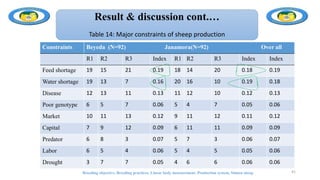
Table 14: Major constraints of sheep production
Constraints Beyeda (N=92) Janamora(N=92) Over all
R1 R2 R3 Index R1 R2 R3 Index Index
Feed shortage 19 15 21 0.19 18 14 20 0.18 0.19
Water shortage 19 13 7 0.16 20 16 10 0.19 0.18
Disease 12 13 11 0.13 11 12 10 0.12 0.13
Poor genotype 6 5 7 0.06 5 4 7 0.05 0.06
Market 10 11 13 0.12 9 11 12 0.11 0.12
Capital 7 9 12 0.09 6 11 11 0.09 0.09
Predator 6 8 3 0.07 5 7 3 0.06 0.07
Labor 6 5 4 0.06 5 4 5 0.05 0.06
Drought 3 7 7 0.05 4 6 6 0.06 0.06
Breeding objective, Breeding practices, Linear body measurement, Production system, Simien sheep 41
Result & discussion cont.โ€ฆ
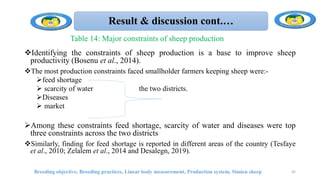
๏ถIdentifying the constraints of sheep production is a base to improve sheep
productivity (Bosenu et al., 2014).
๏ถThe most production constraints faced smallholder farmers keeping sheep were:-
๏ƒ˜feed shortage
๏ƒ˜ scarcity of water the two districts.
๏ƒ˜Diseases
๏ƒ˜ market
๏ƒ˜Among these constraints feed shortage, scarcity of water and diseases were top
three constraints across the two districts
๏ถSimilarly, finding for feed shortage is reported in different areas of the country (Tesfaye
et al., 2010; Zelalem et al., 2014 and Desalegn, 2019).
Breeding objective, Breeding practices, Linear body measurement, Production system, Simien sheep 42
Table 14: Major constraints of sheep production
Result & discussion cont.โ€ฆ
Breed, Breeding Goal, Breeding Scheme, Economic Value, Gumuz, Sheep, Simien 43
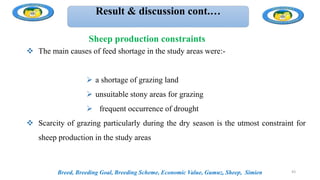
๏ถ The main causes of feed shortage in the study areas were:-
๏ƒ˜ a shortage of grazing land
๏ƒ˜ unsuitable stony areas for grazing
๏ƒ˜ frequent occurrence of drought
๏ถ Scarcity of grazing particularly during the dry season is the utmost constraint for
sheep production in the study areas
Sheep production constraints
Result & discussion cont.โ€ฆ
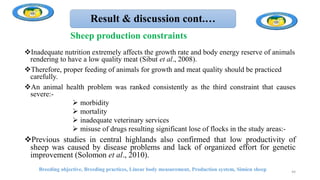
๏ถInadequate nutrition extremely affects the growth rate and body energy reserve of animals
rendering to have a low quality meat (Sibut et al., 2008).
๏ถTherefore, proper feeding of animals for growth and meat quality should be practiced
carefully.
๏ถAn animal health problem was ranked consistently as the third constraint that causes
severe:-
๏ƒ˜ morbidity
๏ƒ˜ mortality
๏ƒ˜ inadequate veterinary services
๏ƒ˜ misuse of drugs resulting significant lose of flocks in the study areas:-
๏ถPrevious studies in central highlands also confirmed that low productivity of
sheep was caused by disease problems and lack of organized effort for genetic
improvement (Solomon et al., 2010).
Breeding objective, Breeding practices, Linear body measurement, Production system, Simien sheep 44
Sheep production constraints
Result & discussion cont.โ€ฆ
๏ถThe main feed resource for sheep is natural pasture during dry and wet seasons.
๏ถThe current finding was in agreement with Amelmal (2011) in Dawuro Zone; Biruh
(2013) in South Omo Zone and Desalegn (2019) in Gondar zone.
๏ถThe sources of supplement feed included
๏ƒ˜crop residues (23.7%)
๏ƒ˜stubble grazing (22.6%)
๏ƒ˜hay (8.6) during the dry season in Beyeda district.
๏ถ in Janamora
๏ƒ˜stubble grazing (28.6%),
๏ƒ˜ crop residues (20.9%)
๏ƒ˜ hay (13.2%) comprised additional sources of feed for sheep during the dry
season
Breeding objective, Breeding practices, Linear body measurement, Production system, Simien sheep
45
Feed resources and availability used for sheep
Result & discussion cont.โ€ฆ
Table 14:-Herd management
Herding practices Respondents (%)
Beyeda Janamora
N % N %
Sheep together with Cattle 24 26.9 23 23.1
Sheep together with goat 13 10.8 12 16.5
Sheep together with equine 9 9.7 12 14.3
All herded together 40 45.2 39 40.7
Sheep herded separately 6 7.5 6 5.5
Breeding objective, Breeding practices, Linear body measurement, Production system, Simien sheep
46
Breeding managements
N= Number of respondent, %=percentage
Result & discussion cont.โ€ฆ
๏ถ The FGD showed that almost all of farmers those practiced separation of new born
lambs at day time
๏ถ Some farmers stated that if newborn lambs were separated from their dam at night:
๏ƒ˜ they made bleating noise
๏ƒ˜ disturb all other flock
๏ƒ˜ even owners as reasonable number of animals confine in family houses.
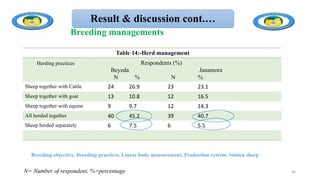
๏ถ The majority of smallholder farmers 45.2% of Beyeda
๏ถ 40.7% of Janamora were herder sheep with all other livestock
Breeding objective, Breeding practices, Linear body measurement, Production system, Simien sheep
47
Breeding managements
Result & discussion cont.โ€ฆ
๏ถThe shortage of labor in the study areas has forced them to keep sheep with other
livestock these might be due to:-
๏ƒ˜ the migration of children and
๏ƒ˜youth to the zonal
๏ƒ˜regional cities for house servants and daily laborers. Similar
findingsYohannes et al. (2017), Kiflay et al. (2019) and Desalegn (2019)
also reported in the northern highlands of the Amhara region.
Breeding objective, Breeding practices, Linear body measurement, Production system, Simien sheep
48
Breeding managements
Result & discussion cont.โ€ฆ
๏ถ 75.3% of the Beyeda
๏ถ75.8 % Janamora districts were herding their sheep with their neighborsโ€™.
๏ถWhile the remaining of the farmersโ€™ kept separately as a flock depending on the
availability of labor.
๏ถSimilar findings with reported that the possibility of mixing with other
neighboring sheep flocks (Tesfaye et al., 2010) in the central highlands of Ethiopia
๏ฑThis flock mixing practice would be a good opportunity for:-
๏ƒ˜ implementing the community-based breeding program
๏ƒ˜ it facilitates ram exchange which is one of the major components of the
community-based breeding program.
Breeding objective, Breeding practices, Linear body measurement, Production system, Simien sheep
49
Breeding managements
Result & discussion cont.โ€ฆ
๏ฑ pure breeding of Simien sheep was practiced in the Simien Mountain region.
๏ƒ˜This implies the importance of pure breeding strategies for the conservation and
improvement of Simien sheep.
๏ถ91.4% for the Beyeda farmers
๏ถ 84.6 % Janamora farmers confirmed that ram use and breeding are generally
natural and uncontrolled in the Simien mountain region consistent with Solomon
et al. (2011), Surafel et al. (2012), Halefom (2013), Yohannes, et al. (2017), and
Desalegn (2019).
Breeding objective, Breeding practices, Linear body measurement, Production system, Simien sheep
50
Breeding managements
Result & discussion cont.โ€ฆ
๏ฑ The primary reason for uncontrolled mating was :-
๏ƒ˜ the use of communal grazing areas, which is followed by:-
๏ƒ˜a lack of awareness
๏ƒ˜sailing of male lambs at an early age
๏ฑ This may be contributed to the:-
๏ƒ˜ inbreeding
๏ƒ˜early breeding of females
๏ƒ˜decreased genetic diversity
๏ƒ˜low birth weight
๏ƒ˜low survival rates
๏ƒ˜the gene pool narrows
Breeding objective, Breeding practices, Linear body measurement, Production system, Simien sheep
51
Breeding managements
Result & discussion cont.โ€ฆ
๏ฑThis has to be taken into consideration when implementing a breeding
program for Simien sheep.
๏ถ The reason for controlled mating was primarily to get the best
animals for market.
๏ถPrevious studies also indicated that controlled mating is:-
๏ƒ˜crucial for the successful implementation of genetic improvement
๏ƒ˜conservation programs (Solomon et al., 2010 and Yohannes et al.,
2018).
Breeding objective, Breeding practices, Linear body measurement, Production system, Simien sheep 52
Breeding managements
Result & discussion cont.โ€ฆ
๏ถThis study also confirmed that few proportions of rams are used for breeding
purposes.
๏ถ When rams were not available in their flocks, owners got the service from
neighbors. These results are in line with the report of Edea et al. (2012), Tesfaye et
al. (2016), Yohannes et al.(2017), and Kiflay et al., (2019) elsewhere in Ethiopia.
Breeding objective, Breeding practices, Linear body measurement, Production system, Simien sheep 53
Breeding managements
Result & discussion cont.โ€ฆ
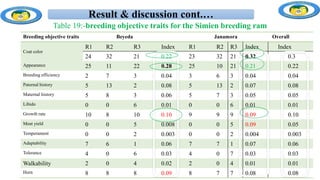
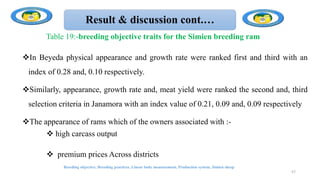
Breeding objective traits Beyeda Janamora Overall
Coat color
R1 R2 R3 Index R1 R2 R3 Index Index
24 32 21 0.22 23 32 21 0.32 0.3
Appearance 25 11 22 0.28 25 10 21 0.21 0.22
Breeding efficiency 2 7 3 0.04 3 6 3 0.04 0.04
Paternal history 5 13 2 0.08 5 13 2 0.07 0.08
Maternal history 5 8 3 0.06 5 7 3 0.05 0.05
Libido 0 0 6 0.01 0 0 6 0.01 0.01
Growth rate 10 8 10 0.10 9 9 9 0.09 0.10
Meat yield 0 0 5 0.008 0 0 5 0.09 0.05
Temperament 0 0 2 0.003 0 0 2 0.004 0.003
Adaptability 7 6 1 0.06 7 7 1 0.07 0.06
Tolerance 4 0 6 0.03 4 0 7 0.03 0.03
Walkability 2 0 4 0.02 2 0 4 0.01 0.01
Horn 8 8 8 0.09 8 7 7 0.08 0.08
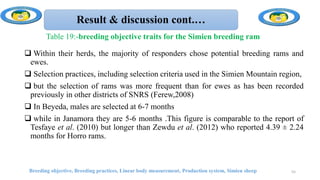
Table 19:-breeding objective traits for the Simien breeding ram
Result & discussion cont.โ€ฆ
๏ฑ Within their herds, the majority of responders chose potential breeding rams and
ewes.
๏ฑ Selection practices, including selection criteria used in the Simien Mountain region,
๏ฑ but the selection of rams was more frequent than for ewes as has been recorded
previously in other districts of SNRS (Ferew,2008)
๏ฑ In Beyeda, males are selected at 6-7 months
๏ฑ while in Janamora they are 5-6 months .This figure is comparable to the report of
Tesfaye et al. (2010) but longer than Zewdu et al. (2012) who reported 4.39 ยฑ 2.24
months for Horro rams.
Breeding objective, Breeding practices, Linear body measurement, Production system, Simien sheep 55
Table 19:-breeding objective traits for the Simien breeding ram
Result & discussion cont.โ€ฆ
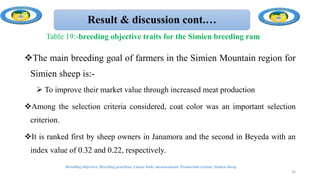
๏ถThe main breeding goal of farmers in the Simien Mountain region for
Simien sheep is:-
๏ƒ˜ To improve their market value through increased meat production
๏ถAmong the selection criteria considered, coat color was an important selection
criterion.
๏ถIt is ranked first by sheep owners in Janamora and the second in Beyeda with an
index value of 0.32 and 0.22, respectively.
Breeding objective, Breeding practices, Linear body measurement, Production system, Simien sheep
56
Table 19:-breeding objective traits for the Simien breeding ram
Result & discussion cont.โ€ฆ
๏ถIn Beyeda physical appearance and growth rate were ranked first and third with an
index of 0.28 and, 0.10 respectively.
๏ถSimilarly, appearance, growth rate and, meat yield were ranked the second and, third
selection criteria in Janamora with an index value of 0.21, 0.09 and, 0.09 respectively
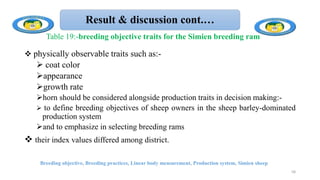
๏ถThe appearance of rams which of the owners associated with :-
๏ถ high carcass output
๏ถ premium prices Across districts
Breeding objective, Breeding practices, Linear body measurement, Production system, Simien sheep
57
Table 19:-breeding objective traits for the Simien breeding ram
Result & discussion cont.โ€ฆ
๏ถ physically observable traits such as:-
๏ƒ˜ coat color
๏ƒ˜appearance
๏ƒ˜growth rate
๏ƒ˜horn should be considered alongside production traits in decision making:-
๏ƒ˜ to define breeding objectives of sheep owners in the sheep barley-dominated
production system
๏ƒ˜and to emphasize in selecting breeding rams
๏ถ their index values differed among district.
Breeding objective, Breeding practices, Linear body measurement, Production system, Simien sheep
58
Table 19:-breeding objective traits for the Simien breeding ram
Result & discussion cont.โ€ฆ
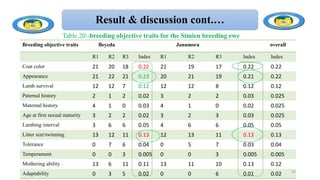
Breeding objective traits Beyeda Janamora overall
R1 R2 R3 Index R1 R2 R3 Index Index
Coat color 21 20 18 0.22 21 19 17 0.22 0.22
Appearance 21 22 21 0.23 20 21 19 0.21 0.22
Lamb survival 12 12 7 0.12 12 12 8 0.12 0.12
Paternal history 2 1 2 0.02 3 2 2 0.03 0.025
Maternal history 4 1 0 0.03 4 1 0 0.02 0.025
Age at first sexual maturity 3 2 2 0.02 3 2 3 0.03 0.025
Lambing interval 3 6 6 0.05 4 6 6 0.05 0.05
Litter sizetwinning 13 12 11 0.13 12 13 11 0.13 0.13
Tolerance 0 7 6 0.04 0 5 7 0.03 0.04
Temperament 0 0 3 0.005 0 0 3 0.005 0.005
Mothering ability 13 6 11 0.11 13 11 10 0.13 0.12
Adaptability 0 3 5 0.02 0 0 6 0.01 0.02 59
Table 20:-breeding objective traits for the Simien breeding ewe
Result & discussion cont.โ€ฆ
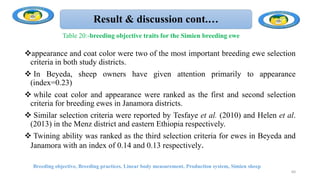
๏ถappearance and coat color were two of the most important breeding ewe selection
criteria in both study districts.
๏ถ In Beyeda, sheep owners have given attention primarily to appearance
(index=0.23)
๏ถ while coat color and appearance were ranked as the first and second selection
criteria for breeding ewes in Janamora districts.
๏ถ Similar selection criteria were reported by Tesfaye et al. (2010) and Helen et al.
(2013) in the Menz district and eastern Ethiopia respectively.
๏ถ Twining ability was ranked as the third selection criteria for ewes in Beyeda and
Janamora with an index of 0.14 and 0.13 respectively.
Breeding objective, Breeding practices, Linear body measurement, Production system, Simien sheep
60
Table 20:-breeding objective traits for the Simien breeding ewe
Result & discussion cont.โ€ฆ
Diseases prevalenceโ€™s Beyeda Janamora Overall
R1 R2 R3 Index R1 R2 R3 Index Index
Fascioliasis 13 14 16 0.15 13 13 15 0.14 0.15
Peste des petits ruminants 16 25 22 0.21 16 24 22 0.22 0.22
Shoat pox Fentata 15 21 27 0.20 14 20 27 0.19 0.25
Orf 12 11 10 0.12 11 10 10 0.09 0.11
Pasteurellosis wozwuz 16 8 7 0.13 16 9 6 0.12 0.13
Dermatophilosis 10 8 4 0.09 10 8 4 0.09 0.09
Dermatophytosis 10 5 6 0.08 12 8 8 0.10 0.09
R =Rank, Index = [(3 ร— number of households ranking as first + 2 ร— number of households ranking as second + 1 ร—
number of households ranking as third) for each selection criteria]/ [(3 ร— number of households ranking as first + 2
ร— number of households ranking as second + 1 ร— number of households ranking as third) Sheep Disease].
61
Rank indexes of Sheep Disease
Breeding objective, Breeding practices, Linear body measurement, Production system, Simien sheep
Result & discussion cont.โ€ฆ
๏ƒ˜Fascioliasis
๏ƒ˜peste des petits ruminants
๏ƒ˜ shoat pox
๏ƒ˜ orf the major reported
๏ƒ˜pasteurellosis sheep diseases affecting productivity
๏ƒ˜dermatophilosis in the study areas.
๏ƒ˜ dermatophytosis
Breeding objective, Breeding practices, Linear body measurement, Production system, Simien sheep
62
Rank indexes of Sheep Disease
Result & discussion cont.โ€ฆ
๏ถThe occurrence of sheep diseases varies along seasons where:-
๏ƒ˜ fascioliasis and sheep pox were the highest incidences limiting sheep
production during the dry season with 89.2% and 85.7% in both study
districts.
๏ถ While, Peste des petits ruminants, orf, pasteurellosis, dermatophilosis, and
dermatophytosis were the major reported sheep health problems limiting
sheep production in the study areas
Breeding objective, Breeding practices, Linear body measurement, Production system, Simien sheep 63
Rank indexes of Sheep Disease
Result & discussion cont.โ€ฆ
Breeding objective, Breeding practices, Linear body measurement, Production system, Simien sheep 64
Rank indexes of Sheep Disease
๏ถ Livestock disease prevalence and their occurrences were higher in the wet season
than the dry season.
๏ถ This result is consistent with previous studies in North Gondar (Desalegn, 2019),
๏ถ who reported that disease was the most important cause of mortality in the wet
season.
๏ถ In the Beyeda district, peste des petits ruminants, sheep pox, fascioliasis, and
pasteurellosis were major reported sheep diseases in that order.
๏ถ This study revealed that disease is a significant problem of sheep production in
the study area.
Result & discussion cont.โ€ฆ
Traits Dentition
PPI 1 PPI 2 PPI 3 PPI 4
Overall Districts
Beyeda Janamora
Sex
Male Female
Body weight
(Kg)
22.48ยฑ0.68 27.13ยฑ0.53 34.03ยฑ0.50 45.9ยฑ0.75 31.18 31.89ยฑ0.68 32.93ยฑ0.48 34.03 ยฑ0.61 30.79ยฑ0.36
Height at wither
(Cm)
53.98ยฑ2.57 56.57ยฑ1.56 71.83ยฑ1.46 103.8ยฑ2.2 67.8 71.43ยฑ1.35 71.67ยฑ1.43 74.37 ยฑ1.86 68.72ยฑ1.06
Body length
(Cm)
56.82ยฑ1.94 61.08ยฑ1.21 60.44ยฑ1.13 74.37ยฑ1.70 61.07 62.56ยฑ1. 1 63.79ยฑ1.04 65.92 ยฑ1.39 60.43ยฑ0.82
Heart girth (Cm) 53.98ยฑ2.51 56.57ยฑ1.56 71.83ยฑ1.46 103.8ยฑ2.2 67.8 71.67ยฑ1.43 71.43ยฑ1.30 74.37 ยฑ1.8 68.72ยฑ1.0
Pelvic width
(Cm)
21.88ยฑ0.29 21.91ยฑ0.18 21.51ยฑ0.17 22.35ยฑ0.25 21.8 21.76ยฑ0.15 22.08ยฑ0.16 21.99ยฑ0.21 21.86ยฑ0.12
Scrotal
circumference
(Cm)
20.01ยฑ1.34 22.89ยฑ0.46 22.06ยฑ0.35 22.32ยฑ0.54 22.29 21.80ยฑ0.43 21.84ยฑ0.5 21.82 0.38 -
Body condition
score (Cm)
2.79ยฑ0.12 2.78ยฑ0.07 2.85ยฑ0.08 3ยฑ0.11 2.78 2.80ยฑ0.07 2.90ยฑ0.06 2.98ยฑ0.09 2.73ยฑ0.05
Breeding objective, Breeding practices, Linear body measurement, Production system, Simien sheep 65
Table 21: Linear body measurements of Simien sheep by dentition, district, and sex.
Result & discussion cont.โ€ฆ
๏ถ Linear body measurement was used to indicate the growth performance of targeted
sheep.
๏ถThe present study included the major linear body measurement traits such as:-
๏ƒ˜ body weight
๏ƒ˜ wither height
๏ƒ˜ body length
๏ƒ˜ heart girth
๏ƒ˜ pelvic width
๏ƒ˜ scrotal circumstance
๏ƒ˜ body condition score were respectively.
๏ถ These all measurements were used to evaluate the growth performance of Simien
sheep at farmersโ€™ production condition
Breeding objective, Breeding practices, Linear body measurement, Production system, Simien sheep
66
Body weight and linear body measurements
Result & discussion cont.โ€ฆ
๏ถThe fixed effects of the dentition, district, and sex were a significant (p<0.05)
source of variation for body weight and other body linear measurements.
๏ถ The effect of the district maybe because of:-
๏ƒ˜the differences in the availability of grazing land
๏ƒ˜other management of sheep between the Districts
๏ถMale sheep were heavier in their mature body weight than female sheep.
๏ถ Other researchers (Kasahun, 2000; Sisay 2002; Markos et al., 2004; Markos,
2006; Mengistie et al., 2010) have widely documented the same results
๏ถ The differences in body weights observed between both sexes might be due to:-
testosterone secretion.
Breeding objective, Breeding practices, Linear body measurement, Production system, Simien sheep
67
Body weight and linear body measurements
Result & discussion cont.โ€ฆ
๏ถThe age of sheep was estimated based on dentition classes.
๏ถ Sheep with dentitions PPI 1 and PPI 2 were shorter (p<0.05) in body weight than
sheep with higher dentition groups.
๏ถ Concerning the effect of age, sheep with dentition PPI 3 were superior in wither
height (p<0.05) over their dentition PPI1 and PPI 2 counterparts.
Breeding objective, Breeding practices, Linear body measurement, Production system, Simien sheep
68
Body weight and linear body measurements
Result & discussion contโ€ฆ
Dentition Traits BW WH BL HG PW
1PpI
WH 0.832* 1
BL 0.390NS 0.444NS 1
HG 0.783** 0.889* 0.446NS 1
PW -0.276NS 0.625Ns 0.538NS -0.341NS
BCS 0.394NS 0.309Ns 0.398 NS 0.420NS -0.498NS
2
PPI
WH 0.423NS 1
BL 0.270NS 0.346NS 1
HG 0.620** 0.704NS 0.377NS 1
PW 0.251NS 0.252 NS 0.418** 0.278NS
BCS -0.299 NS 0.567 NS -0.296 NS -0.213 NS -0.08NS
3ppI
WH 0.773*
BL -0.106NS 0.337NS 1
HG 0.812*** 0.323NS 1 1
PW 0.324NS 0.553NS 0.345NS 0.733NS
BCS 0.985** 0.668 NS -0.104 NS 0.839 * 0.295 NS
4PPI
WH 0.829NS 1
BL 0.717NS 0.750NS 1
HG 0.677* 0.797NS 0.338NS 1
PW 0.338NS 0.710NS -0.239NS 0.983**
BCS -0.362 NS -0.312NS -0.396NS 0.933* 0.314NS
Table 22: Phenotypic correlation of body weight, other body measurements of ewes
69
ificant (P>0.05), *P<0.05, **P<0.01, ***P<0.001 BW - Body weight; HG - Heart girth; PW - Pelvic width; BL - Body length; W
Result & discussion cont.โ€ฆ
๏ถ Body weight was generally moderate and very highly correlated with body
dimensional traits (0.27โ€“0.83) except for pelvic width
๏ถ The correlation between body weight and other body linear measurement in 1
Pair(s) of Permanent Incisors ewes was significant in:-
๏ƒ˜ hearth girth
๏ƒ˜ wither height
๏ถThe correlation coefficient between body weight and wither height was the highest
and significant (r= 0.83) followed by heart girth (r=0.78).
๏ถ A higher correlation between body weight and heart girth may be affected by
muscle and bones in heart girth areas.
Breeding objective, Breeding practices, Linear body measurement, Production system, Simien sheep
70
Table 22: Phenotypic correlation of body weight, other body measurements of ewes
Result & discussion cont.โ€ฆ
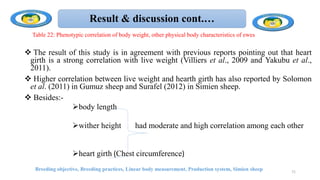
๏ถ The result of this study is in agreement with previous reports pointing out that heart
girth is a strong correlation with live weight (Villiers et al., 2009 and Yakubu et al.,
2011).
๏ถ Higher correlation between live weight and hearth girth has also reported by Solomon
et al. (2011) in Gumuz sheep and Surafel (2012) in Simien sheep.
๏ถ Besides:-
๏ƒ˜body length
๏ƒ˜wither height had moderate and high correlation among each other
๏ƒ˜heart girth (Chest circumference)
Breeding objective, Breeding practices, Linear body measurement, Production system, Simien sheep 71
Table 22: Phenotypic correlation of body weight, other physical body characteristics of ewes
Result & discussion cont.โ€ฆ
๏ถ At 2 Pair(s) of Permanent Incisors, positive and highly significant (p<0.01) correlations of
body weight with heart girth was observed.
๏ถ body length, withers height and pelvic width had a moderate and non-significant correlation
between each otherโ€™s
๏ถ At 3 and 4 dentition classes, strongly positive and highly significant correlation was observed
regularly:-
๏ƒ˜ between body weights
๏ƒ˜ heart girth.
๏ถ In all dentition classes, there is a highly significant and even non-significant correlation of :-
๏ƒ˜ body weight with heart girth
๏ƒ˜ wither height were observed.
๏ถ The observed high correlations between weight and other body measurements were in
agreement with literatures (Mengistie et al., 2010, Solomon et al., 2011, Surafel, 2012 and
Desalegn, 2019).
Breeding objective, Breeding practices, Linear body measurement, Production system, Simien sheep 72
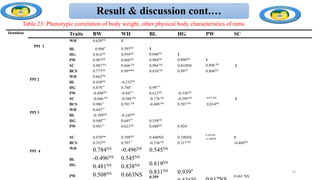
Table 22: Phenotypic correlation of body weight, other physical body characteristics of ewes
Dentition Traits BW WH BL HG PW SC
PPI 1
PPI 2
PPI 3
PPI 4
WH 0.628NS 1
BL 0.998* 0.585NS 1
HG 0.816NS 0.959NS 0.846NS 1
PW 0.987NS 0.666NS 0.994NS 0.896NS 1
SC 0.987 NS 0.666 NS 0.994 NS 0.810NS 0.896 NS
1
BCS 0.777NS 0.99*** 0.810 NS 0.997* 0.866NS
WH 0.662NS
BL 0.438NS -0.232NS
HG 0.878** 0.788* 0.99***
PW -0.498NS -0.847 * 0.612NS -0.536NS
SC -0.686 NS -0.384 NS -0.176 NS -0.599 NS 0.472 NS 1
BCS 0.980 * 0.591 NS -0.409 NS 0.597 NS 0.814NS
WH 0.643**
BL -0.399NS -0.245NS
HG 0.940*** 0.645** 0.358NS
PW 0.981** 0.621NS 0.680NS 0.924*
SC
BCS
WH
BL
HG
PW
0.978**
0.352NS
0.784NS
-0.496NS
0.481NS
0.508NS
0.709NS
0.597 *
-0.496NS
0.545NS
0.838NS
0.663NS
0.440NS
-0.338 NS
0.545NS
0.819NS
0.831NS
0.359
0.748NS
0.317 NS
0.939*
0.385NS
-0.246NS 1
-0.469NS
0.461 NS
73
Result & discussion cont.โ€ฆ
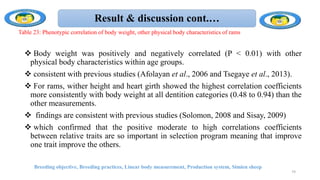
Table 23: Phenotypic correlation of body weight, other physical body characteristics of rams
Result & discussion cont.โ€ฆ
๏ถ Body weight was positively and negatively correlated (P < 0.01) with other
physical body characteristics within age groups.
๏ถ consistent with previous studies (Afolayan et al., 2006 and Tsegaye et al., 2013).
๏ถ For rams, wither height and heart girth showed the highest correlation coefficients
more consistently with body weight at all dentition categories (0.48 to 0.94) than the
other measurements.
๏ถ findings are consistent with previous studies (Solomon, 2008 and Sisay, 2009)
๏ถ which confirmed that the positive moderate to high correlations coefficients
between relative traits are so important in selection program meaning that improve
one trait improve the others.
74
Table 23: Phenotypic correlation of body weight, other physical body characteristics of rams
Breeding objective, Breeding practices, Linear body measurement, Production system, Simien sheep
Result & discussion cont.โ€ฆ
๏ถThe positive significant and highest correlation coefficient value (r=0.87 and 0.94)
between body weight and heart girth of rams was observed at dentition class PPI 2
and PPI 3.
๏ถ in agreement with other results of Mengistie et al. (2010), Solomon et al. (2011),
Surafel (2012) and Desalegn (2019).
๏ถ This implies that:-
๏ƒ˜ the heart girth is the best measurements among body traits for
predicting body weight in remote areas.
๏ถLikewise, pelvic width, scrotal circumference and wither height have the strong
positive and the most correlated measurements with body weight at dentition 3
Breeding objective, Breeding practices, Linear body measurement, Production system, Simien sheep
75
Table 23: Phenotypic correlation of body weight, other physical body characteristics of rams
Result & discussion cont.โ€ฆ
๏ถ Besides, a highly significant correlations of wither height of rams were also
observed at dentition class 1 with body condition score.
๏ถ Generally, wither height, body length; pelvic width and scrotal circumference
have a strong positive and non-significant correlation among each otherโ€™s at
dentition 1 and 4.
Breeding objective, Breeding practices, Linear body measurement, Production system, Simien sheep
76
Table 23: Phenotypic correlation of body weight, other physical body characteristics of rams
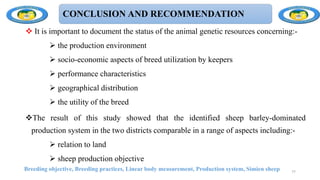
CONCLUSION AND RECOMMENDATION
๏ถ It is important to document the status of the animal genetic resources concerning:-
๏ƒ˜ the production environment
๏ƒ˜ socio-economic aspects of breed utilization by keepers
๏ƒ˜ performance characteristics
๏ƒ˜ geographical distribution
๏ƒ˜ the utility of the breed
๏ถThe result of this study showed that the identified sheep barley-dominated
production system in the two districts comparable in a range of aspects including:-
๏ƒ˜ relation to land
๏ƒ˜ sheep production objective
Breeding objective, Breeding practices, Linear body measurement, Production system, Simien sheep 77
CONCLUSION AND RECOMMEโ€ฆ
๏ƒ˜flock size
๏ƒ˜ breeding system
๏ƒ˜marketing strategies
๏ถ The average sheep flock size reported for both study districts was relatively comparable
to other breeds that reported at different districts
๏ถ its contribution to the family income generation is significant.
๏ถ It can be concluded that sheep production is an important component of the farming
activity in the study areas:-
๏ƒ˜ by providing multifunctional roles to the smallholder farmers
Breeding objective, Breeding practices, Linear body measurement, Production system, Simien sheep 78
CONCLUSION AND RECOMMEโ€ฆ
๏ถThis study revealed that Simien sheep has multifaceted roles for the smallholder
farmers in the study areas
๏ถ Participatory identification of breeding objective traits indicated a wide range of
traits that are preferred by the farmer.
๏ƒ˜Body conformation
๏ƒ˜coat colour were the top three important traits in
๏ƒ˜fast growth rate selecting breeding rams in both districts
Breeding objective, Breeding practices, Linear body measurement, Production system, Simien sheep 79
CONCLUSION & RECOMMEโ€ฆ
๏ƒ˜ Body conformation
๏ƒ˜ coat color are important traits for selecting breeding
๏ƒ˜ ability to give multiple births ewes in the Beyeda district
๏ถWhile
๏ƒ˜ coat color
๏ƒ˜ body conformation
๏ƒ˜ ability to give multiple births important traits in selecting breeding Ewes in
Janamora district
Breeding objective, Breeding practices, Linear body measurement, Production system, Simien sheep 80
CONCLUSION & RECOMMEโ€ฆ
๏ถThis indicated that physically observable traits were preferred for selecting breeding rams and ewes
in both districts.
๏ถThis might be due to:-
๏ƒ˜the lack of knowledge
๏ƒ˜awareness on ranking animals based on the whole life history of the animal
๏ถThe main breeding goals for sheep production have been defined as:-
๏ƒ˜ increasing meat production
๏ƒ˜ marketed animals (Improve growth rate and conformation)
๏ƒ˜ this is driven by market demands.
Breeding objective, Breeding practices, Linear body measurement, Production system, Simien sheep 81
CONCLUSION & RECOMME
๏ถ In addition, compared with other local sheep types, Simien were rated highly by
both producers and consumers in their tasty meat
๏ถThese characteristics make the Simien sheep economically more important.
๏ถ This implies that designing sheep improvement strategies in the area should
primarily target meat production traits.
๏ถ Conservation of Simien sheep genetic resources could be imperative as these
have been contributing most to the sheep genetic diversity in Ethiopia.
๏ถ besides its contribution to the overall genetic diversity, other features of a breed
should also be considered when designing a conservation program.
82
Breeding objective, Breeding practices, Linear body measurement, Production system, Simien sheep
CONCLUSION & RECOMME
๏ถLike
๏ƒ˜ its adaptation to specific environments
๏ƒ˜ possession of unique traits
๏ƒ˜ social and cultural value
๏ƒ˜ contribution to environmental sustainability
๏ถ Both center-based and village based-scheme will be simulated to improve the
productivity of Simien sheep to increase its contribution and thereby enhance its
conservation.
Breeding objective, Breeding practices, Linear body measurement, Production system, Simien sheep
83
CONCLUSION & RECOMME
๏ถ Because of the above, the following recommendations were suggested;
๏ฑ A comprehensive farmerโ€™s awareness program needs to be undertaken on the
disadvantages of increasing inbreeding, slaughter/marketing of young stock, adult
/ fertile stock
๏ฑ The same breeding program could be designed for Simien sheep that address both
district farmers since their breeding objectives are very similar.
๏ฑ Breeding programs need to consider body conformation, coat color, fast growth
rate, and reproductive traits.
Breeding objective, Breeding practices, Linear body measurement, Production system, Simien sheep
84
CONCLUSION & RECOMMENDATION
๏ฑ Selective breeding could be recommended since the results showed performance level of
Simien could be increased effectively if appropriate genetic improvement schemes are
designed.
๏ฑCommunity(Village)-based breeding scheme(CBBP) could be a more appropriate scheme to
introduce selective breeding as it promotes the participation of farmers
๏ฑ A proper conservation-based breeding program should be an immediate task.
๏ฑ Generally, the future of sheep in Ethiopia should lie in the appropriate approaches for
conservation combining several integrally related resources at the national level.
Breeding objective, Breeding practices, Linear body measurement, Production system, Simien sheep
85
Breeding objective, Breeding practices, Linear body measurement, Production system, Simien sheep 86

MSC Thesis presentation

  • 1.
    Breeding objective, Breedingpractices, Linear body measurement, Production system, Simien sheep. MSC. THESIS By: TALEMAW MULAT Gondar, Ethiopia JUNE, 2022 1 ON-FARM CHARACTERIZATION OF BREEDING PRACTICES AND PRODUCTIVITY PERFORMANCE OF SIMIEN SHEEP IN BEYEDA AND JANAMORA DISTRICTS OF AMHARA REGION, ETHIOPIA
  • 2.
    Breeding objective, Breedingpractices, Linear body measurement, Production system, Simien sheep 2 Presentation outline 1. Introduction โ€ข Background โ€ข Statement of the problem and justification โ€ข Objectives 2. Materials and Methods ๏‚ง Description of the study area ๏‚ง Study Approach ๏‚ง Sampling method ๏‚ง Data management and Analysis 3. Result and Discussion 4. Conclusion and Recommendations
  • 3.
    ๏ถ More than85% of Ethiopia's population is dependent on an Agriculture based economy in which livestock and their products play a very significant role (CSA, 2016). ๏ถ Ethiopia has endowed with a large number of the domestic animal population in the world. ๏ถ It is believed to have the largest livestock population in Africa with an estimated number of :- ๏ƒ˜65 million cattle ๏ƒ˜39 million sheep ๏ƒ˜ 50 million goat ๏ƒ˜ 7 million camels Breeding objective, Breeding practices, Linear body measurement, Production system, Simien sheep. 3 1. Introduction
  • 4.
    Background cont.โ€ฆ ๏ƒ˜ 48million poultry ๏ƒ˜ 2 million horses ๏ƒ˜ 0.5 million mules ๏ƒ˜ 9 million donkeys (CSA, 2020). ๏ถAmhara National Regional State has:- ๏ƒ˜15.45 million cattle ๏ƒ˜ 9.80 million sheep ๏ƒ˜ 6.09 million goats Breeding objective, Breeding practices, Linear body measurement, Production system, Simien sheep.4
  • 5.
    Background cont.โ€ฆ ๏ƒ˜ 0.47million horses ๏ƒ˜ 0.18 million mules ๏ƒ˜ 2.83 million donkeys ๏ƒ˜ 0.06 million camels ๏ƒ˜19.96 million poultry ๏ƒ˜ 1.33 million beehives (CSA, 2016). Breeding objective, Breeding practices, Linear body measurement, Production system, Simien sheep. 5
  • 6.
    Background cont.โ€ฆ ๏ถLivestock productsand by-products in the form of:- ๏ƒ˜ meat, milk, eggs, honey, butter, and cheese have great importance ๏ƒ˜It provide different nutrient that contributes to the improvement of the nutritional status of the people (Habtamu, 2015 and Birara, 2016). ๏ถ Sheep are economically important for the national economy and the farm household. Breeding objective, Breeding practices, Linear body measurement, Production system, Simien sheep. 6
  • 7.
    Background cont.โ€ฆ ๏ถ Ethiopiahas 14 traditional sheep populations which are classified:- ๏ƒ˜ 9 breeds ๏ƒ˜6 breed groups (Solomon, 2008) ๏ถThe reports of CSA (2018) revealed that about ๏ƒ˜73% to 75% in the highland ๏ƒ˜25% to 27% of sheep are located lowland areas of the country. Breeding objective, Breeding practices, Linear body measurement, Production system, Simien sheep.7
  • 8.
    Background cont.โ€ฆ ๏ถEthiopia isknown for its huge sheep population, livestock production systems:- ๏ƒ˜It is generally subsistence-oriented ๏ƒ˜productivity is very low (Belachew and Jemberu, 2003). ๏ถThe present productivity of sheep has frequently been reported to be low when compared to other countries in the world or Africa (ILRI, 2011 and Yohannes et al., 2018).. Breeding objective, Breeding practices, Linear body measurement, Production system, Simien sheep. 8
  • 9.
    Background cont.โ€ฆ ๏ถ Getahunet al. (2014) revealed that the productivity of indigenous sheep in terms of meat has been limited by poor genetic potential ๏ถSheep production is also constrained by:- ๏ƒ˜feed shortages ๏ƒ˜diseases ๏ƒ˜poor infrastructure ๏ƒ˜lack of market information Breeding objective, Breeding practices, Linear body measurement, Production system, Simien sheep. 9
  • 10.
    Background cont.โ€ฆ ๏ƒ˜ lackof market information ๏ƒ˜ technical capacity ๏ƒ˜ absence of planned breeding programs ๏ƒ˜ breeding policies (Solomon et al., 2013) ๏ถTraditional livestock breeds in the developed world have largely been replaced by improved commercial breeds key factors for this are:- ๏ƒ˜ strong economic pressure on farmers ๏ƒ˜ the focus on single traits, which made the traditional breeds extinct in most cases. Breeding objective, Breeding practices, Linear body measurement, Production system, Simien sheep 10
  • 11.
    Background cont.โ€ฆ ๏ถOn theother hand, livestock production in the developing world is largely based on traditional breeds. ๏ถAmong which Simien sheep is highly valued for:- ๏ƒ˜ its delectable meat ๏ƒ˜ adaptation to the harsh ๏ƒ˜ low-input production environment. Breeding objective, Breeding practices, Linear body measurement, Production system, Simien sheep 11
  • 12.
    Background cont.โ€ฆ ๏ถSurvival oftraditional breeds is endangered as farmers are tempted to replace them with exotic breeds perceived to be improved (Boettcher et al., 2010; Taberlet et al., 2011; Adebabay et al., 2016). ๏ถThe major factors contributing to the loss of such genetic diversity are:- ๏ƒ˜intervention failures in livelihood and ๏ƒ˜market-oriented agricultural systems (Wollny, 2012). Breeding objective, Breeding practices, Linear body measurement, Production system, Simien sheep 12
  • 13.
    Background cont.โ€ฆ ๏ถSimien sheepbreeds and farming practices need to be conserved as they harbor valuable genes lost from improved commercial breeds. ๏ƒ˜ they could serve as a source of safe and tasty products. ๏ถ Conservation of traditional breeds requires increasing their value to the community. ๏ถImproved market access provides incentives to farmers and promotes the conservation of traditional breeds Breeding objective, Breeding practices, Linear body measurement, Production system, Simien sheep 13
  • 14.
    Background cont.โ€ฆ ๏ถ Severalresearch and development projects have been undertaken by ๏ƒ˜ national ๏ƒ˜ international agricultural research institutions ๏ƒ˜ governmental ๏ƒ˜ non-governmental development agencies (Kosgey et al., 2008). ๏ถAn achievement on breed improvement which leads the production and productivity of indigenous breeds of Ethiopia is still not significant. ๏ƒ˜ Breed improvement challenges ๏ƒ˜impacts on sheep production ๏ƒ˜ research gaps need to be periodically evaluated to direct the research and development efforts to achieve the desired goals. Breeding objective, Breeding practices, Linear body measurement, Production system, Simien sheep 14
  • 15.
    1.2. Statement ofthe problem and justification ๏ถ Among the various factors:- ๏ƒ˜ the absence of planned genetic improvement programs for local breeds is one of the causes for losing their competitive advantage ๏ƒ˜ Especially the production systems or external conditions are subject to change (Solomon, 2008; Tesfaye, 2008; Zewudu, 2008; Surafel, 2012). ๏ถTherefore, improvement and conservation of Simien sheep genetic resources could be imperative as it has been contributing to sheep genetic diversity in Ethiopia. Breeding objective, Breeding practices, Linear body measurement, Production system, Simien sheep 15
  • 16.
    Statement of theproblem Contiโ€ฆ ๏ถThere is a need to design and implement appropriate breeding strategies:- ๏ƒ˜ to improve the productivity of Simien sheep to utilize ๏ƒ˜ increase its contribution to its keepers ๏ƒ˜ enhance its conservation by the community ๏ถ However, the lack of further detailed and area-specific characterization ๏ƒ˜about the production system. Breeding objective, Breeding practices, Linear body measurement, Production system, Simien sheep 16
  • 17.
    Statement of theproblem Contiโ€ฆ ๏ƒ˜The existing breed management ๏ƒ˜traditional breeding practice ๏ƒ˜identification of important traits ๏ƒ˜on-farm growth performance, are perceived to be the most important hindrance for genetic improvement and development of conservation programs. Breeding objective, Breeding practices, Linear body measurement, Production system, Simien sheep 17
  • 18.
    Statement of theproblem Contiโ€ฆ ๏ถLack of such detailed and area-specific information is a serious constraint ๏ƒ˜ to effective prioritization ๏ƒ˜ planning of breed improvement ๏ƒ˜ conservation measures including sustainable breeding strategies (Solomon et al., 2013) ๏ถThus, characterization of the production system, breeding practices, identification of breeding objective traits, and assessing on-farm growth performance would help to ensure sustainable use and development of sheep genetic resources. Breeding objective, Breeding practices, Linear body measurement, Production system, Simien sheep 18
  • 19.
    1.4 Objectives 1.4.1 Generalobjective ๏ถThe general objective of this study was to provide baseline information and approaches for the improvement and conservation of Simien sheep to promote its survival as an adapted indigenous genetic resource and its socio-economic contribution to its keepers in Simien Mountain region of Amhara region 1.4.2 Specific objectives ๏ถTo characterize the existing sheep production systems ๏ถTo identify the breeding objective and breeding strategies ๏ถTo assess body weight and other body linear measurements at farmersโ€™ production condition Breeding objective, Breeding practices, Linear body measurement, Production system, Simien sheep 19
  • 20.
    3. MATERIALS ANDMETHODS 3.1. Description of the study area Breeding objective, Breeding practices, Linear body measurement, Production system, Simien sheep District Locations Altitude (m. a.s.l) T (oC) Rain fall (mm) Janamora 12ยบ 59หˆหˆN latitude and 38ยบ 07หˆ 2900-3900 12.4 974 Beyeda 13ยบ 30 หˆN and 38ยบ 15หˆE 2900-3900 12.4 974 20
  • 21.
    Breeding objective, Breedingpractices, Linear body measurement, Production system, Simien sheep 21 3. MATERIALS AND METHODS 3.1. Description of the study area
  • 22.
    Materials and methodscont.โ€ฆ 3.2. Study approach ๏ถ Participatory rural appraisals were used to characterize breeding practices and define trait preferences. ๏ถ Research approaches including:- ๏ƒ˜ field survey ๏ƒ˜focus group discussion ๏ƒ˜direct ranking ๏ƒ˜observation ๏ƒ˜measurement were used for triangulation and validation of the expected outputs. ๏ถBoth linear body measurement and recall interview of the owner of the animals were employed to collect productivity performances of the Simien sheep (ILCA, 1990). Breeding objective, Breeding practices, Linear body measurement, Production system, Simien sheep 22
  • 23.
    Materials and methodscont.โ€ฆ 3.2.Sampling method ๏ถA multistage sampling technique was employed to select districts, PAs, and households ๏ถ The study was established purposively based on :- ๏ƒ˜ the availability ๏ƒ˜ distribution of Simien sheep after a discussion held with zonal and district officers mainly livestock experts and development agents. ๏ถBased on this information, potential districts and peasant associations (PAs) were selected. ๏ถThe interviewed households were randomly selected among sheep owners in the study area. Breeding objective, Breeding practices, Linear body measurement, Production system, Simien sheep 23
  • 24.
    Breeding objective, Breedingpractices, Linear body measurement, Production system, Simien sheep 24 Materials and methods cont.โ€ฆ
  • 25.
    Materials and methodscont.โ€ฆ ๏ถ. Breeding objective, Breeding practices, Linear body measurement, Production system, Simien sheep ๐๐’ = ( ๐™๐›‚ ๐Ÿ ) ๐Ÿ ๐ ๐Ÿโˆ’๐ ๐๐Ÿ = (๐Ÿ.๐Ÿ—๐Ÿ”) ๐Ÿ ๐ŸŽ.๐Ÿ–๐Ÿ” ๐Ÿโˆ’๐ŸŽ.๐Ÿ–๐Ÿ” (0.05)2 = 184 for sample size determination ๐’๐Ÿ = ๐’๐Ÿ๐ฉ๐ช๐’†๐Ÿ= (๐Ÿ.๐Ÿ—๐Ÿ”) ๐Ÿ ๐ŸŽ.๐ŸŽ๐Ÿ’ ๐ŸŽ.๐Ÿ—๐Ÿ” (๐ŸŽ.๐ŸŽ๐Ÿ“)๐Ÿ = =59 for linear body measurement of each districts. Where N = number of samples to be used, d = desired absolute precision, Zฮฑ/2 = reliability coefficient and P = % of sheep owners in each district 25 Sample size determination
  • 26.
    Materials and methodscont.โ€ฆ Data analysis and statistical models ๏ถThe qualitative data from survey were analyzed by descriptive statistics using SPSS Ver. 20.0 (2012) ๏ถ The quantitative characteristics data of biological linear measurement were analyzed by GLM procedure of SAS (2009) ๏ถFarmers preference rankings were summarized into the index as weighted averages. Breeding objective, Breeding practices, Linear body measurement, Production system, Simien sheep 26
  • 27.
    Materials and methodscont.โ€ฆ Data analysis and statistical models ๏ถRelationship of linear body measurements were assessed by Pearson correlation. The statistical models used were: - Yijkl= ยต + Di + Sj+ Ak+ eijkl ๏ƒผWhere Yijkl= the Linear body measurements ยต = overall mean Di = fixed effect of district (i= Beyeda, Janamora); Sj = fixed effect of sex (j = Female, Male), Ak= fixed effect of age (k= 1 (one PPI), 2 (2 PPI) and 3 (โ‰ฅ3 PPI) eijkl= the residual error Breeding objective, Breeding practices, Linear body measurement, Production system, Simien sheep 27
  • 28.
    4. Result &discussion Description Beyeda (N = 92) Janamora (N=92) Overall(184) N % N % N % Sex of the respondents Male 81 88.2 80 87.9 161 88 Female 11 11.8 12 12.1 23 12 Age categories of the respondents (years) 18-30 7 11.8 6 10.5 13 6.5 31-50 64 75.3 64 75.3 128 70.1 51-60 19 10.7 19 10.7 38 20.7 >61 2 2.2 3 3.5 5 2.7 Marital status of HH Single 6 9.7 5 6.5 11 4.9 Married 81 83.8 80 85.3 161 87.5 Divorced 5 6.5 7 8.2 12 7.6 Breeding objective, Breeding practices, Linear body measurement, Production system, Simien sheep Table 5: socio-economic characteristics of Households N = Number of participant 28
  • 29.
    Result & discussioncont.โ€ฆ General Household Characteristics cont.โ€ฆ ๏ƒ˜The majority of those interviewed (88%) were male-headed. ๏ƒ˜This revealed that men are the one who head the family and speak the most during the interview ๏ƒ˜This research finding consistent with the results of (Weldeyesus et al., 2016 and Kiflay et al., 2019) for Atsbiwonberta and in Digelu-Tijo and Meiso districts respectively. ๏ƒ˜While only 12% of female-headed families had a husband who had either died or left the marriage ๏ƒ˜The majority of the interviewed household heads (70.1%) were between the ages of 31 and 50 in all of the research districts, the majority of sheep owners possessed productive power. This conclusion is consistent with those of Alubel (2015) in the Ziquala and Lay Armachiho districts. ๏ƒ˜A higher proportion of of farmers having illiterates so training livestock keepers to participate in genetic improvement could boost the program's success in the field. Consistent with (Byaruhanga et al., 2015). Breeding objective, Breeding practices, Linear body measurement, Production system, Simien sheep 29
  • 30.
    Result & discussioncont.โ€ฆ N= number of respondents, SE = standard Error Table 8: Livestock mix and holdings of respondents, and family size 30 Simien Sheep Species Beyeda (N=92) Janamora(N=92) Overall mean Mean SE Mean SE Mean SE Cattle 2.39 0.25 3.31 0.28 2.84 0.2 Sheep 14.14 1.01 19.4 1.15 16.75 0.79 Goat 2.65 0.27 0.27 3.9 3.3 0.2 Chicken 5.62 0.46 5.7 0.52 5.7 0.35 Donkeys 1.00 0.08 1.30 0.96 1.15 0.06 Horse 1.91 0.15 1.45 0.11 1.68 0.1 Mules 0.99 0.09 1.05 0.06 1.02 0.05 Bee hives 2.33 0.30 1.86 0.32 2.1 0.22 Crop land(ha) 1.15ยฑ.0.86 1.53ยฑ.0.86 1.34ยฑ.0.60 Grazing land(ha) 0.06ยฑ.0.26 0.14ยฑ.0.46 0.1ยฑ.0.26
  • 31.
    Result & discussioncont.โ€ฆ Family size, land and livestock holding cont.โ€ฆ ๏ƒ˜The average family size obtained in the present study was comparable to the average values of rural areas 4.9 persons at the national level (CSA, 2017) ๏ƒ˜The average holding of sheep at Janamora and Beyeda were 19.42ยฑ1.15 and, 14.14ยฑ1.01, respectively. ๏ƒ˜the average landholding per household in the current research was 1.34h lower than what had been reported on a national scale (2. 5 ha, CSA, 2011) Breeding objective, Breeding practices, Linear body measurement, Production system, Simien sheep 31
  • 32.
    Result & discussioncont.โ€ฆ Major farming activities Sources of home consumption Districts Overall index Beyeda (N= 92) Janamora (N= 92) R1 R2 R3 Index R1 R2 R3 Index crop production 25 29 35 0.30 29 31 18 0.31 0.31 Cattle 7 4 9 0.07 6 4 9 0.06 0.07 Sheep 29 27 19 0.28 24 27 34 0.29 0.28 Goat 8 7 14 0.09 8 6 15 0.09 0.09 Chicken 14 17 13 0.16 14 16 13 0.15 0.15 Food aid 9 8 2 0.08 11 8 3 0.09 0.09 Sources of income Sheep Crop production 39 25 26 35 22 19 0.34 0.29 40 25 25 34 21 19 0.35 0.29 0.35 0.29 Index = [(3 ร— number of households ranking as first + 2 ร— number of households ranking as second + 1 ร— number of households ranking as third) for each farming activities of each district]/ [(3 ร— number of households ranking as first + 2 ร— number of households ranking as second + 1 ร— number of households ranking as third) for all farming activities for each district]. Table 10 Farming activities used for home consumption, income generation. 32
  • 33.
    Age Class Districts Beyeda(N=92) Janamora (N=92) Meanยฑ SD % Mean +SD % Lamb < sex month 2.54ยฑ1.95 17.3 2.85ยฑ1.59 17.82 Ram 6-12 month 1.04ยฑ0.83 6.98 2.09ยฑ1.47 12.74 Ewe 6-12 month 2.57ยฑ1.57 17.2 3.29ยฑ1.67 20.18 Breeding ewe > 1yr 7.67ยฑ5.17 51.3 6.80ยฑ4.42 42.1 Breeding ram>1yr 0.56ยฑ0.93 3.7 0.26ยฑ0.49 3.54 Castrated 0.53ยฑ0.74 3.54 0.91ยฑ0.77 5.56 Breeding objective, Breeding practices, Linear body measurement, Production system, Simien sheep Result & discussion cont.โ€ฆ Table 11 : Mean flock size per household and flock structure of sheep N= Number of respondents, SD= Standard deviation and %=percentage 33
  • 34.
    Result & discussioncont.โ€ฆ Mean flock size per household and flock structure of sheep ๏ƒ˜The study of flock characteristics helps in the design of breeding programs ๏ƒ˜the flock size of sheep was higher in Janamora than Beyeda district ๏ƒ˜This result was comparable to with that of Solomon et al. (2007), Yohannes et al.(2017), and Desalegn (2019) for Gumuz and Simien sheep ๏ƒ˜The larger proportion of breeding ewe obtained was comparable with previous results reported 46.80% for Menz sheep and 49.2% for Afar sheep (Tesfaye et al., 2010), and 38.9% for central Tigray sheep (Hagos et al., 2015). Breeding objective, Breeding practices, Linear body measurement, Production system, Simien sheep 34
  • 35.
    Result & discussioncont.โ€ฆ Mean flock size per household and flock structure of sheep ๏ถThe proportion of higher breeding ewe in both districts would imply: ๏ƒ˜the production of a larger number of lambs (selection candidates) which in turn might increase the intensity of selection ๏ƒ˜ thus ensure the effectiveness of selective breeding ๏ถThe low proportion of breeding rams in both study districts indicated :- ๏ƒ˜the tradition of marketing young ram lambs because of the greater dependence on sheep production. Breeding objective, Breeding practices, Linear body measurement, Production system, Simien sheep 35
  • 36.
    Production objectives Beyeda (92) Janamora(92)Overall Index Ranks Index Ranks Index 1 2 3 1 2 3 Objectives Income 29 23 16 0.27 28 22 17 0.26 0.26 Meat 17 20 18 0.20 17 19 17 0.19 0.19 Saving 21 20 15 0.21 22 20 14 0.22 0.13 Manure 11 12 22 0.14 10 11 21 0.13 0.14 Skin 5 9 5 0.07 5 8 6 0.06 0.07 Wealth 10 9 17 0.12 9 11 16 0.11 0.12 Reason for exit Sale 32 50 23 0.39 33 49 21 0.49 0.44 Slaughter 17 14 19 0.18 16 12 18 0.16 0.17 Death 28 18 28 0.26 27 17 27 0.27 0.27 Gift 16 11 23 0.15 15 13 22 0.17 0.16 Breeding objective, Breeding practices, Linear body measurement, Production system, Simien sheep Result & discussion cont.โ€ฆ Table 12 Sheep production objectives 36
  • 37.
    Result & discussioncont.โ€ฆ ๏ƒ˜The reasons for keeping sheep are rational and related to the farmers needs in the long or short term. ๏ƒ˜ Results of earlier study showed that better understanding of the purposes of keeping sheep is a prerequisite-site for defining breeding goals (Yohannes et al., 2017) ๏ƒ˜The results of this study revealed that sheep play multi-functional roles in both districts with similar production objectives whereby their:- o income osaving omeat function ranked as paramount importance. Breeding objective, Breeding practices, Linear body measurement, Production system, Simien sheep 37 Sheep production objectives
  • 38.
    Result & discussioncont.โ€ฆ Breeding objective, Breeding practices, Linear body measurement, Production system, Simien sheep 38 ๏ถ Similarly, multipurpose functions of sheep keeping were reported for sheep owners (Mengistie et al., 2010, Tesfaye et al., 2010, Surafel, 2012, Yohannes et al., 2017, Desalegn, 2019). in the central highlands and north western Ethiopia. ๏ถSuccessful breeding program could be mainly achieved through including:- ๏ƒ˜ the cultural ๏ƒ˜ social and ๏ƒ˜ environmental benefits in the breeding objectives for sheep under smallholder production systems in the tropics. ๏ถTherefore, considering the different socio-cultural perspective of the sheep owners is important in the adoption of any breeding programme. ๏ถ Knowledge about the mode of exit of sheep is important in assessing the breeding practices of small ruminants. Sheep production objectives
  • 39.
    Result & discussioncont.โ€ฆ Selling and seasons of sheep marketing ๏ถ Most smallholder farmers were sold sheep to consumers, traders and sometimes to producers for breeding purposes consistent with findings of (Estefanos et al., 2015) and Matawork et al. (2018). ๏ถ Farmers in both districts reported that most sheep are sold:- ๏ƒ˜ to meet immediate farm ๏ƒ˜ children education cash requirements, but there are market seasons following the cultural holidays: Breeding objective, Breeding practices, Linear body measurement, Production system, Simien sheep 39
  • 40.
    Result & discussioncont.โ€ฆ Breeding objective, Breeding practices, Linear body measurement, Production system, Simien sheep 40 ๏ถIn general, information on market price, supply, and demand are not available for farmers throughout the year. consistent with the findings of (Estefanos et al., 2015; Matawork et al., 2018; Desalegn, 2019) ๏ถThis implies that:- ๏ƒ˜ lack of market information ๏ƒ˜ poor market chain ๏ƒ˜ absence of transportation facilities were some of the problems associated with sheep marketing reported in the study areas. Selling reasons and seasons of sheep marketing
  • 41.
    Result & discussioncont.โ€ฆ Table 14: Major constraints of sheep production Constraints Beyeda (N=92) Janamora(N=92) Over all R1 R2 R3 Index R1 R2 R3 Index Index Feed shortage 19 15 21 0.19 18 14 20 0.18 0.19 Water shortage 19 13 7 0.16 20 16 10 0.19 0.18 Disease 12 13 11 0.13 11 12 10 0.12 0.13 Poor genotype 6 5 7 0.06 5 4 7 0.05 0.06 Market 10 11 13 0.12 9 11 12 0.11 0.12 Capital 7 9 12 0.09 6 11 11 0.09 0.09 Predator 6 8 3 0.07 5 7 3 0.06 0.07 Labor 6 5 4 0.06 5 4 5 0.05 0.06 Drought 3 7 7 0.05 4 6 6 0.06 0.06 Breeding objective, Breeding practices, Linear body measurement, Production system, Simien sheep 41
  • 42.
    Result & discussioncont.โ€ฆ ๏ถIdentifying the constraints of sheep production is a base to improve sheep productivity (Bosenu et al., 2014). ๏ถThe most production constraints faced smallholder farmers keeping sheep were:- ๏ƒ˜feed shortage ๏ƒ˜ scarcity of water the two districts. ๏ƒ˜Diseases ๏ƒ˜ market ๏ƒ˜Among these constraints feed shortage, scarcity of water and diseases were top three constraints across the two districts ๏ถSimilarly, finding for feed shortage is reported in different areas of the country (Tesfaye et al., 2010; Zelalem et al., 2014 and Desalegn, 2019). Breeding objective, Breeding practices, Linear body measurement, Production system, Simien sheep 42 Table 14: Major constraints of sheep production
  • 43.
    Result & discussioncont.โ€ฆ Breed, Breeding Goal, Breeding Scheme, Economic Value, Gumuz, Sheep, Simien 43 ๏ถ The main causes of feed shortage in the study areas were:- ๏ƒ˜ a shortage of grazing land ๏ƒ˜ unsuitable stony areas for grazing ๏ƒ˜ frequent occurrence of drought ๏ถ Scarcity of grazing particularly during the dry season is the utmost constraint for sheep production in the study areas Sheep production constraints
  • 44.
    Result & discussioncont.โ€ฆ ๏ถInadequate nutrition extremely affects the growth rate and body energy reserve of animals rendering to have a low quality meat (Sibut et al., 2008). ๏ถTherefore, proper feeding of animals for growth and meat quality should be practiced carefully. ๏ถAn animal health problem was ranked consistently as the third constraint that causes severe:- ๏ƒ˜ morbidity ๏ƒ˜ mortality ๏ƒ˜ inadequate veterinary services ๏ƒ˜ misuse of drugs resulting significant lose of flocks in the study areas:- ๏ถPrevious studies in central highlands also confirmed that low productivity of sheep was caused by disease problems and lack of organized effort for genetic improvement (Solomon et al., 2010). Breeding objective, Breeding practices, Linear body measurement, Production system, Simien sheep 44 Sheep production constraints
  • 45.
    Result & discussioncont.โ€ฆ ๏ถThe main feed resource for sheep is natural pasture during dry and wet seasons. ๏ถThe current finding was in agreement with Amelmal (2011) in Dawuro Zone; Biruh (2013) in South Omo Zone and Desalegn (2019) in Gondar zone. ๏ถThe sources of supplement feed included ๏ƒ˜crop residues (23.7%) ๏ƒ˜stubble grazing (22.6%) ๏ƒ˜hay (8.6) during the dry season in Beyeda district. ๏ถ in Janamora ๏ƒ˜stubble grazing (28.6%), ๏ƒ˜ crop residues (20.9%) ๏ƒ˜ hay (13.2%) comprised additional sources of feed for sheep during the dry season Breeding objective, Breeding practices, Linear body measurement, Production system, Simien sheep 45 Feed resources and availability used for sheep
  • 46.
    Result & discussioncont.โ€ฆ Table 14:-Herd management Herding practices Respondents (%) Beyeda Janamora N % N % Sheep together with Cattle 24 26.9 23 23.1 Sheep together with goat 13 10.8 12 16.5 Sheep together with equine 9 9.7 12 14.3 All herded together 40 45.2 39 40.7 Sheep herded separately 6 7.5 6 5.5 Breeding objective, Breeding practices, Linear body measurement, Production system, Simien sheep 46 Breeding managements N= Number of respondent, %=percentage
  • 47.
    Result & discussioncont.โ€ฆ ๏ถ The FGD showed that almost all of farmers those practiced separation of new born lambs at day time ๏ถ Some farmers stated that if newborn lambs were separated from their dam at night: ๏ƒ˜ they made bleating noise ๏ƒ˜ disturb all other flock ๏ƒ˜ even owners as reasonable number of animals confine in family houses. ๏ถ The majority of smallholder farmers 45.2% of Beyeda ๏ถ 40.7% of Janamora were herder sheep with all other livestock Breeding objective, Breeding practices, Linear body measurement, Production system, Simien sheep 47 Breeding managements
  • 48.
    Result & discussioncont.โ€ฆ ๏ถThe shortage of labor in the study areas has forced them to keep sheep with other livestock these might be due to:- ๏ƒ˜ the migration of children and ๏ƒ˜youth to the zonal ๏ƒ˜regional cities for house servants and daily laborers. Similar findingsYohannes et al. (2017), Kiflay et al. (2019) and Desalegn (2019) also reported in the northern highlands of the Amhara region. Breeding objective, Breeding practices, Linear body measurement, Production system, Simien sheep 48 Breeding managements
  • 49.
    Result & discussioncont.โ€ฆ ๏ถ 75.3% of the Beyeda ๏ถ75.8 % Janamora districts were herding their sheep with their neighborsโ€™. ๏ถWhile the remaining of the farmersโ€™ kept separately as a flock depending on the availability of labor. ๏ถSimilar findings with reported that the possibility of mixing with other neighboring sheep flocks (Tesfaye et al., 2010) in the central highlands of Ethiopia ๏ฑThis flock mixing practice would be a good opportunity for:- ๏ƒ˜ implementing the community-based breeding program ๏ƒ˜ it facilitates ram exchange which is one of the major components of the community-based breeding program. Breeding objective, Breeding practices, Linear body measurement, Production system, Simien sheep 49 Breeding managements
  • 50.
    Result & discussioncont.โ€ฆ ๏ฑ pure breeding of Simien sheep was practiced in the Simien Mountain region. ๏ƒ˜This implies the importance of pure breeding strategies for the conservation and improvement of Simien sheep. ๏ถ91.4% for the Beyeda farmers ๏ถ 84.6 % Janamora farmers confirmed that ram use and breeding are generally natural and uncontrolled in the Simien mountain region consistent with Solomon et al. (2011), Surafel et al. (2012), Halefom (2013), Yohannes, et al. (2017), and Desalegn (2019). Breeding objective, Breeding practices, Linear body measurement, Production system, Simien sheep 50 Breeding managements
  • 51.
    Result & discussioncont.โ€ฆ ๏ฑ The primary reason for uncontrolled mating was :- ๏ƒ˜ the use of communal grazing areas, which is followed by:- ๏ƒ˜a lack of awareness ๏ƒ˜sailing of male lambs at an early age ๏ฑ This may be contributed to the:- ๏ƒ˜ inbreeding ๏ƒ˜early breeding of females ๏ƒ˜decreased genetic diversity ๏ƒ˜low birth weight ๏ƒ˜low survival rates ๏ƒ˜the gene pool narrows Breeding objective, Breeding practices, Linear body measurement, Production system, Simien sheep 51 Breeding managements
  • 52.
    Result & discussioncont.โ€ฆ ๏ฑThis has to be taken into consideration when implementing a breeding program for Simien sheep. ๏ถ The reason for controlled mating was primarily to get the best animals for market. ๏ถPrevious studies also indicated that controlled mating is:- ๏ƒ˜crucial for the successful implementation of genetic improvement ๏ƒ˜conservation programs (Solomon et al., 2010 and Yohannes et al., 2018). Breeding objective, Breeding practices, Linear body measurement, Production system, Simien sheep 52 Breeding managements
  • 53.
    Result & discussioncont.โ€ฆ ๏ถThis study also confirmed that few proportions of rams are used for breeding purposes. ๏ถ When rams were not available in their flocks, owners got the service from neighbors. These results are in line with the report of Edea et al. (2012), Tesfaye et al. (2016), Yohannes et al.(2017), and Kiflay et al., (2019) elsewhere in Ethiopia. Breeding objective, Breeding practices, Linear body measurement, Production system, Simien sheep 53 Breeding managements
  • 54.
    Result & discussioncont.โ€ฆ Breeding objective traits Beyeda Janamora Overall Coat color R1 R2 R3 Index R1 R2 R3 Index Index 24 32 21 0.22 23 32 21 0.32 0.3 Appearance 25 11 22 0.28 25 10 21 0.21 0.22 Breeding efficiency 2 7 3 0.04 3 6 3 0.04 0.04 Paternal history 5 13 2 0.08 5 13 2 0.07 0.08 Maternal history 5 8 3 0.06 5 7 3 0.05 0.05 Libido 0 0 6 0.01 0 0 6 0.01 0.01 Growth rate 10 8 10 0.10 9 9 9 0.09 0.10 Meat yield 0 0 5 0.008 0 0 5 0.09 0.05 Temperament 0 0 2 0.003 0 0 2 0.004 0.003 Adaptability 7 6 1 0.06 7 7 1 0.07 0.06 Tolerance 4 0 6 0.03 4 0 7 0.03 0.03 Walkability 2 0 4 0.02 2 0 4 0.01 0.01 Horn 8 8 8 0.09 8 7 7 0.08 0.08 Table 19:-breeding objective traits for the Simien breeding ram
  • 55.
    Result & discussioncont.โ€ฆ ๏ฑ Within their herds, the majority of responders chose potential breeding rams and ewes. ๏ฑ Selection practices, including selection criteria used in the Simien Mountain region, ๏ฑ but the selection of rams was more frequent than for ewes as has been recorded previously in other districts of SNRS (Ferew,2008) ๏ฑ In Beyeda, males are selected at 6-7 months ๏ฑ while in Janamora they are 5-6 months .This figure is comparable to the report of Tesfaye et al. (2010) but longer than Zewdu et al. (2012) who reported 4.39 ยฑ 2.24 months for Horro rams. Breeding objective, Breeding practices, Linear body measurement, Production system, Simien sheep 55 Table 19:-breeding objective traits for the Simien breeding ram
  • 56.
    Result & discussioncont.โ€ฆ ๏ถThe main breeding goal of farmers in the Simien Mountain region for Simien sheep is:- ๏ƒ˜ To improve their market value through increased meat production ๏ถAmong the selection criteria considered, coat color was an important selection criterion. ๏ถIt is ranked first by sheep owners in Janamora and the second in Beyeda with an index value of 0.32 and 0.22, respectively. Breeding objective, Breeding practices, Linear body measurement, Production system, Simien sheep 56 Table 19:-breeding objective traits for the Simien breeding ram
  • 57.
    Result & discussioncont.โ€ฆ ๏ถIn Beyeda physical appearance and growth rate were ranked first and third with an index of 0.28 and, 0.10 respectively. ๏ถSimilarly, appearance, growth rate and, meat yield were ranked the second and, third selection criteria in Janamora with an index value of 0.21, 0.09 and, 0.09 respectively ๏ถThe appearance of rams which of the owners associated with :- ๏ถ high carcass output ๏ถ premium prices Across districts Breeding objective, Breeding practices, Linear body measurement, Production system, Simien sheep 57 Table 19:-breeding objective traits for the Simien breeding ram
  • 58.
    Result & discussioncont.โ€ฆ ๏ถ physically observable traits such as:- ๏ƒ˜ coat color ๏ƒ˜appearance ๏ƒ˜growth rate ๏ƒ˜horn should be considered alongside production traits in decision making:- ๏ƒ˜ to define breeding objectives of sheep owners in the sheep barley-dominated production system ๏ƒ˜and to emphasize in selecting breeding rams ๏ถ their index values differed among district. Breeding objective, Breeding practices, Linear body measurement, Production system, Simien sheep 58 Table 19:-breeding objective traits for the Simien breeding ram
  • 59.
    Result & discussioncont.โ€ฆ Breeding objective traits Beyeda Janamora overall R1 R2 R3 Index R1 R2 R3 Index Index Coat color 21 20 18 0.22 21 19 17 0.22 0.22 Appearance 21 22 21 0.23 20 21 19 0.21 0.22 Lamb survival 12 12 7 0.12 12 12 8 0.12 0.12 Paternal history 2 1 2 0.02 3 2 2 0.03 0.025 Maternal history 4 1 0 0.03 4 1 0 0.02 0.025 Age at first sexual maturity 3 2 2 0.02 3 2 3 0.03 0.025 Lambing interval 3 6 6 0.05 4 6 6 0.05 0.05 Litter sizetwinning 13 12 11 0.13 12 13 11 0.13 0.13 Tolerance 0 7 6 0.04 0 5 7 0.03 0.04 Temperament 0 0 3 0.005 0 0 3 0.005 0.005 Mothering ability 13 6 11 0.11 13 11 10 0.13 0.12 Adaptability 0 3 5 0.02 0 0 6 0.01 0.02 59 Table 20:-breeding objective traits for the Simien breeding ewe
  • 60.
    Result & discussioncont.โ€ฆ ๏ถappearance and coat color were two of the most important breeding ewe selection criteria in both study districts. ๏ถ In Beyeda, sheep owners have given attention primarily to appearance (index=0.23) ๏ถ while coat color and appearance were ranked as the first and second selection criteria for breeding ewes in Janamora districts. ๏ถ Similar selection criteria were reported by Tesfaye et al. (2010) and Helen et al. (2013) in the Menz district and eastern Ethiopia respectively. ๏ถ Twining ability was ranked as the third selection criteria for ewes in Beyeda and Janamora with an index of 0.14 and 0.13 respectively. Breeding objective, Breeding practices, Linear body measurement, Production system, Simien sheep 60 Table 20:-breeding objective traits for the Simien breeding ewe
  • 61.
    Result & discussioncont.โ€ฆ Diseases prevalenceโ€™s Beyeda Janamora Overall R1 R2 R3 Index R1 R2 R3 Index Index Fascioliasis 13 14 16 0.15 13 13 15 0.14 0.15 Peste des petits ruminants 16 25 22 0.21 16 24 22 0.22 0.22 Shoat pox Fentata 15 21 27 0.20 14 20 27 0.19 0.25 Orf 12 11 10 0.12 11 10 10 0.09 0.11 Pasteurellosis wozwuz 16 8 7 0.13 16 9 6 0.12 0.13 Dermatophilosis 10 8 4 0.09 10 8 4 0.09 0.09 Dermatophytosis 10 5 6 0.08 12 8 8 0.10 0.09 R =Rank, Index = [(3 ร— number of households ranking as first + 2 ร— number of households ranking as second + 1 ร— number of households ranking as third) for each selection criteria]/ [(3 ร— number of households ranking as first + 2 ร— number of households ranking as second + 1 ร— number of households ranking as third) Sheep Disease]. 61 Rank indexes of Sheep Disease Breeding objective, Breeding practices, Linear body measurement, Production system, Simien sheep
  • 62.
    Result & discussioncont.โ€ฆ ๏ƒ˜Fascioliasis ๏ƒ˜peste des petits ruminants ๏ƒ˜ shoat pox ๏ƒ˜ orf the major reported ๏ƒ˜pasteurellosis sheep diseases affecting productivity ๏ƒ˜dermatophilosis in the study areas. ๏ƒ˜ dermatophytosis Breeding objective, Breeding practices, Linear body measurement, Production system, Simien sheep 62 Rank indexes of Sheep Disease
  • 63.
    Result & discussioncont.โ€ฆ ๏ถThe occurrence of sheep diseases varies along seasons where:- ๏ƒ˜ fascioliasis and sheep pox were the highest incidences limiting sheep production during the dry season with 89.2% and 85.7% in both study districts. ๏ถ While, Peste des petits ruminants, orf, pasteurellosis, dermatophilosis, and dermatophytosis were the major reported sheep health problems limiting sheep production in the study areas Breeding objective, Breeding practices, Linear body measurement, Production system, Simien sheep 63 Rank indexes of Sheep Disease
  • 64.
    Result & discussioncont.โ€ฆ Breeding objective, Breeding practices, Linear body measurement, Production system, Simien sheep 64 Rank indexes of Sheep Disease ๏ถ Livestock disease prevalence and their occurrences were higher in the wet season than the dry season. ๏ถ This result is consistent with previous studies in North Gondar (Desalegn, 2019), ๏ถ who reported that disease was the most important cause of mortality in the wet season. ๏ถ In the Beyeda district, peste des petits ruminants, sheep pox, fascioliasis, and pasteurellosis were major reported sheep diseases in that order. ๏ถ This study revealed that disease is a significant problem of sheep production in the study area.
  • 65.
    Result & discussioncont.โ€ฆ Traits Dentition PPI 1 PPI 2 PPI 3 PPI 4 Overall Districts Beyeda Janamora Sex Male Female Body weight (Kg) 22.48ยฑ0.68 27.13ยฑ0.53 34.03ยฑ0.50 45.9ยฑ0.75 31.18 31.89ยฑ0.68 32.93ยฑ0.48 34.03 ยฑ0.61 30.79ยฑ0.36 Height at wither (Cm) 53.98ยฑ2.57 56.57ยฑ1.56 71.83ยฑ1.46 103.8ยฑ2.2 67.8 71.43ยฑ1.35 71.67ยฑ1.43 74.37 ยฑ1.86 68.72ยฑ1.06 Body length (Cm) 56.82ยฑ1.94 61.08ยฑ1.21 60.44ยฑ1.13 74.37ยฑ1.70 61.07 62.56ยฑ1. 1 63.79ยฑ1.04 65.92 ยฑ1.39 60.43ยฑ0.82 Heart girth (Cm) 53.98ยฑ2.51 56.57ยฑ1.56 71.83ยฑ1.46 103.8ยฑ2.2 67.8 71.67ยฑ1.43 71.43ยฑ1.30 74.37 ยฑ1.8 68.72ยฑ1.0 Pelvic width (Cm) 21.88ยฑ0.29 21.91ยฑ0.18 21.51ยฑ0.17 22.35ยฑ0.25 21.8 21.76ยฑ0.15 22.08ยฑ0.16 21.99ยฑ0.21 21.86ยฑ0.12 Scrotal circumference (Cm) 20.01ยฑ1.34 22.89ยฑ0.46 22.06ยฑ0.35 22.32ยฑ0.54 22.29 21.80ยฑ0.43 21.84ยฑ0.5 21.82 0.38 - Body condition score (Cm) 2.79ยฑ0.12 2.78ยฑ0.07 2.85ยฑ0.08 3ยฑ0.11 2.78 2.80ยฑ0.07 2.90ยฑ0.06 2.98ยฑ0.09 2.73ยฑ0.05 Breeding objective, Breeding practices, Linear body measurement, Production system, Simien sheep 65 Table 21: Linear body measurements of Simien sheep by dentition, district, and sex.
  • 66.
    Result & discussioncont.โ€ฆ ๏ถ Linear body measurement was used to indicate the growth performance of targeted sheep. ๏ถThe present study included the major linear body measurement traits such as:- ๏ƒ˜ body weight ๏ƒ˜ wither height ๏ƒ˜ body length ๏ƒ˜ heart girth ๏ƒ˜ pelvic width ๏ƒ˜ scrotal circumstance ๏ƒ˜ body condition score were respectively. ๏ถ These all measurements were used to evaluate the growth performance of Simien sheep at farmersโ€™ production condition Breeding objective, Breeding practices, Linear body measurement, Production system, Simien sheep 66 Body weight and linear body measurements
  • 67.
    Result & discussioncont.โ€ฆ ๏ถThe fixed effects of the dentition, district, and sex were a significant (p<0.05) source of variation for body weight and other body linear measurements. ๏ถ The effect of the district maybe because of:- ๏ƒ˜the differences in the availability of grazing land ๏ƒ˜other management of sheep between the Districts ๏ถMale sheep were heavier in their mature body weight than female sheep. ๏ถ Other researchers (Kasahun, 2000; Sisay 2002; Markos et al., 2004; Markos, 2006; Mengistie et al., 2010) have widely documented the same results ๏ถ The differences in body weights observed between both sexes might be due to:- testosterone secretion. Breeding objective, Breeding practices, Linear body measurement, Production system, Simien sheep 67 Body weight and linear body measurements
  • 68.
    Result & discussioncont.โ€ฆ ๏ถThe age of sheep was estimated based on dentition classes. ๏ถ Sheep with dentitions PPI 1 and PPI 2 were shorter (p<0.05) in body weight than sheep with higher dentition groups. ๏ถ Concerning the effect of age, sheep with dentition PPI 3 were superior in wither height (p<0.05) over their dentition PPI1 and PPI 2 counterparts. Breeding objective, Breeding practices, Linear body measurement, Production system, Simien sheep 68 Body weight and linear body measurements
  • 69.
    Result & discussioncontโ€ฆ Dentition Traits BW WH BL HG PW 1PpI WH 0.832* 1 BL 0.390NS 0.444NS 1 HG 0.783** 0.889* 0.446NS 1 PW -0.276NS 0.625Ns 0.538NS -0.341NS BCS 0.394NS 0.309Ns 0.398 NS 0.420NS -0.498NS 2 PPI WH 0.423NS 1 BL 0.270NS 0.346NS 1 HG 0.620** 0.704NS 0.377NS 1 PW 0.251NS 0.252 NS 0.418** 0.278NS BCS -0.299 NS 0.567 NS -0.296 NS -0.213 NS -0.08NS 3ppI WH 0.773* BL -0.106NS 0.337NS 1 HG 0.812*** 0.323NS 1 1 PW 0.324NS 0.553NS 0.345NS 0.733NS BCS 0.985** 0.668 NS -0.104 NS 0.839 * 0.295 NS 4PPI WH 0.829NS 1 BL 0.717NS 0.750NS 1 HG 0.677* 0.797NS 0.338NS 1 PW 0.338NS 0.710NS -0.239NS 0.983** BCS -0.362 NS -0.312NS -0.396NS 0.933* 0.314NS Table 22: Phenotypic correlation of body weight, other body measurements of ewes 69 ificant (P>0.05), *P<0.05, **P<0.01, ***P<0.001 BW - Body weight; HG - Heart girth; PW - Pelvic width; BL - Body length; W
  • 70.
    Result & discussioncont.โ€ฆ ๏ถ Body weight was generally moderate and very highly correlated with body dimensional traits (0.27โ€“0.83) except for pelvic width ๏ถ The correlation between body weight and other body linear measurement in 1 Pair(s) of Permanent Incisors ewes was significant in:- ๏ƒ˜ hearth girth ๏ƒ˜ wither height ๏ถThe correlation coefficient between body weight and wither height was the highest and significant (r= 0.83) followed by heart girth (r=0.78). ๏ถ A higher correlation between body weight and heart girth may be affected by muscle and bones in heart girth areas. Breeding objective, Breeding practices, Linear body measurement, Production system, Simien sheep 70 Table 22: Phenotypic correlation of body weight, other body measurements of ewes
  • 71.
    Result & discussioncont.โ€ฆ ๏ถ The result of this study is in agreement with previous reports pointing out that heart girth is a strong correlation with live weight (Villiers et al., 2009 and Yakubu et al., 2011). ๏ถ Higher correlation between live weight and hearth girth has also reported by Solomon et al. (2011) in Gumuz sheep and Surafel (2012) in Simien sheep. ๏ถ Besides:- ๏ƒ˜body length ๏ƒ˜wither height had moderate and high correlation among each other ๏ƒ˜heart girth (Chest circumference) Breeding objective, Breeding practices, Linear body measurement, Production system, Simien sheep 71 Table 22: Phenotypic correlation of body weight, other physical body characteristics of ewes
  • 72.
    Result & discussioncont.โ€ฆ ๏ถ At 2 Pair(s) of Permanent Incisors, positive and highly significant (p<0.01) correlations of body weight with heart girth was observed. ๏ถ body length, withers height and pelvic width had a moderate and non-significant correlation between each otherโ€™s ๏ถ At 3 and 4 dentition classes, strongly positive and highly significant correlation was observed regularly:- ๏ƒ˜ between body weights ๏ƒ˜ heart girth. ๏ถ In all dentition classes, there is a highly significant and even non-significant correlation of :- ๏ƒ˜ body weight with heart girth ๏ƒ˜ wither height were observed. ๏ถ The observed high correlations between weight and other body measurements were in agreement with literatures (Mengistie et al., 2010, Solomon et al., 2011, Surafel, 2012 and Desalegn, 2019). Breeding objective, Breeding practices, Linear body measurement, Production system, Simien sheep 72 Table 22: Phenotypic correlation of body weight, other physical body characteristics of ewes
  • 73.
    Dentition Traits BWWH BL HG PW SC PPI 1 PPI 2 PPI 3 PPI 4 WH 0.628NS 1 BL 0.998* 0.585NS 1 HG 0.816NS 0.959NS 0.846NS 1 PW 0.987NS 0.666NS 0.994NS 0.896NS 1 SC 0.987 NS 0.666 NS 0.994 NS 0.810NS 0.896 NS 1 BCS 0.777NS 0.99*** 0.810 NS 0.997* 0.866NS WH 0.662NS BL 0.438NS -0.232NS HG 0.878** 0.788* 0.99*** PW -0.498NS -0.847 * 0.612NS -0.536NS SC -0.686 NS -0.384 NS -0.176 NS -0.599 NS 0.472 NS 1 BCS 0.980 * 0.591 NS -0.409 NS 0.597 NS 0.814NS WH 0.643** BL -0.399NS -0.245NS HG 0.940*** 0.645** 0.358NS PW 0.981** 0.621NS 0.680NS 0.924* SC BCS WH BL HG PW 0.978** 0.352NS 0.784NS -0.496NS 0.481NS 0.508NS 0.709NS 0.597 * -0.496NS 0.545NS 0.838NS 0.663NS 0.440NS -0.338 NS 0.545NS 0.819NS 0.831NS 0.359 0.748NS 0.317 NS 0.939* 0.385NS -0.246NS 1 -0.469NS 0.461 NS 73 Result & discussion cont.โ€ฆ Table 23: Phenotypic correlation of body weight, other physical body characteristics of rams
  • 74.
    Result & discussioncont.โ€ฆ ๏ถ Body weight was positively and negatively correlated (P < 0.01) with other physical body characteristics within age groups. ๏ถ consistent with previous studies (Afolayan et al., 2006 and Tsegaye et al., 2013). ๏ถ For rams, wither height and heart girth showed the highest correlation coefficients more consistently with body weight at all dentition categories (0.48 to 0.94) than the other measurements. ๏ถ findings are consistent with previous studies (Solomon, 2008 and Sisay, 2009) ๏ถ which confirmed that the positive moderate to high correlations coefficients between relative traits are so important in selection program meaning that improve one trait improve the others. 74 Table 23: Phenotypic correlation of body weight, other physical body characteristics of rams Breeding objective, Breeding practices, Linear body measurement, Production system, Simien sheep
  • 75.
    Result & discussioncont.โ€ฆ ๏ถThe positive significant and highest correlation coefficient value (r=0.87 and 0.94) between body weight and heart girth of rams was observed at dentition class PPI 2 and PPI 3. ๏ถ in agreement with other results of Mengistie et al. (2010), Solomon et al. (2011), Surafel (2012) and Desalegn (2019). ๏ถ This implies that:- ๏ƒ˜ the heart girth is the best measurements among body traits for predicting body weight in remote areas. ๏ถLikewise, pelvic width, scrotal circumference and wither height have the strong positive and the most correlated measurements with body weight at dentition 3 Breeding objective, Breeding practices, Linear body measurement, Production system, Simien sheep 75 Table 23: Phenotypic correlation of body weight, other physical body characteristics of rams
  • 76.
    Result & discussioncont.โ€ฆ ๏ถ Besides, a highly significant correlations of wither height of rams were also observed at dentition class 1 with body condition score. ๏ถ Generally, wither height, body length; pelvic width and scrotal circumference have a strong positive and non-significant correlation among each otherโ€™s at dentition 1 and 4. Breeding objective, Breeding practices, Linear body measurement, Production system, Simien sheep 76 Table 23: Phenotypic correlation of body weight, other physical body characteristics of rams
  • 77.
    CONCLUSION AND RECOMMENDATION ๏ถIt is important to document the status of the animal genetic resources concerning:- ๏ƒ˜ the production environment ๏ƒ˜ socio-economic aspects of breed utilization by keepers ๏ƒ˜ performance characteristics ๏ƒ˜ geographical distribution ๏ƒ˜ the utility of the breed ๏ถThe result of this study showed that the identified sheep barley-dominated production system in the two districts comparable in a range of aspects including:- ๏ƒ˜ relation to land ๏ƒ˜ sheep production objective Breeding objective, Breeding practices, Linear body measurement, Production system, Simien sheep 77
  • 78.
    CONCLUSION AND RECOMMEโ€ฆ ๏ƒ˜flocksize ๏ƒ˜ breeding system ๏ƒ˜marketing strategies ๏ถ The average sheep flock size reported for both study districts was relatively comparable to other breeds that reported at different districts ๏ถ its contribution to the family income generation is significant. ๏ถ It can be concluded that sheep production is an important component of the farming activity in the study areas:- ๏ƒ˜ by providing multifunctional roles to the smallholder farmers Breeding objective, Breeding practices, Linear body measurement, Production system, Simien sheep 78
  • 79.
    CONCLUSION AND RECOMMEโ€ฆ ๏ถThisstudy revealed that Simien sheep has multifaceted roles for the smallholder farmers in the study areas ๏ถ Participatory identification of breeding objective traits indicated a wide range of traits that are preferred by the farmer. ๏ƒ˜Body conformation ๏ƒ˜coat colour were the top three important traits in ๏ƒ˜fast growth rate selecting breeding rams in both districts Breeding objective, Breeding practices, Linear body measurement, Production system, Simien sheep 79
  • 80.
    CONCLUSION & RECOMMEโ€ฆ ๏ƒ˜Body conformation ๏ƒ˜ coat color are important traits for selecting breeding ๏ƒ˜ ability to give multiple births ewes in the Beyeda district ๏ถWhile ๏ƒ˜ coat color ๏ƒ˜ body conformation ๏ƒ˜ ability to give multiple births important traits in selecting breeding Ewes in Janamora district Breeding objective, Breeding practices, Linear body measurement, Production system, Simien sheep 80
  • 81.
    CONCLUSION & RECOMMEโ€ฆ ๏ถThisindicated that physically observable traits were preferred for selecting breeding rams and ewes in both districts. ๏ถThis might be due to:- ๏ƒ˜the lack of knowledge ๏ƒ˜awareness on ranking animals based on the whole life history of the animal ๏ถThe main breeding goals for sheep production have been defined as:- ๏ƒ˜ increasing meat production ๏ƒ˜ marketed animals (Improve growth rate and conformation) ๏ƒ˜ this is driven by market demands. Breeding objective, Breeding practices, Linear body measurement, Production system, Simien sheep 81
  • 82.
    CONCLUSION & RECOMME ๏ถIn addition, compared with other local sheep types, Simien were rated highly by both producers and consumers in their tasty meat ๏ถThese characteristics make the Simien sheep economically more important. ๏ถ This implies that designing sheep improvement strategies in the area should primarily target meat production traits. ๏ถ Conservation of Simien sheep genetic resources could be imperative as these have been contributing most to the sheep genetic diversity in Ethiopia. ๏ถ besides its contribution to the overall genetic diversity, other features of a breed should also be considered when designing a conservation program. 82 Breeding objective, Breeding practices, Linear body measurement, Production system, Simien sheep
  • 83.
    CONCLUSION & RECOMME ๏ถLike ๏ƒ˜its adaptation to specific environments ๏ƒ˜ possession of unique traits ๏ƒ˜ social and cultural value ๏ƒ˜ contribution to environmental sustainability ๏ถ Both center-based and village based-scheme will be simulated to improve the productivity of Simien sheep to increase its contribution and thereby enhance its conservation. Breeding objective, Breeding practices, Linear body measurement, Production system, Simien sheep 83
  • 84.
    CONCLUSION & RECOMME ๏ถBecause of the above, the following recommendations were suggested; ๏ฑ A comprehensive farmerโ€™s awareness program needs to be undertaken on the disadvantages of increasing inbreeding, slaughter/marketing of young stock, adult / fertile stock ๏ฑ The same breeding program could be designed for Simien sheep that address both district farmers since their breeding objectives are very similar. ๏ฑ Breeding programs need to consider body conformation, coat color, fast growth rate, and reproductive traits. Breeding objective, Breeding practices, Linear body measurement, Production system, Simien sheep 84
  • 85.
    CONCLUSION & RECOMMENDATION ๏ฑSelective breeding could be recommended since the results showed performance level of Simien could be increased effectively if appropriate genetic improvement schemes are designed. ๏ฑCommunity(Village)-based breeding scheme(CBBP) could be a more appropriate scheme to introduce selective breeding as it promotes the participation of farmers ๏ฑ A proper conservation-based breeding program should be an immediate task. ๏ฑ Generally, the future of sheep in Ethiopia should lie in the appropriate approaches for conservation combining several integrally related resources at the national level. Breeding objective, Breeding practices, Linear body measurement, Production system, Simien sheep 85
  • 86.
    Breeding objective, Breedingpractices, Linear body measurement, Production system, Simien sheep 86