Update on sheep meat value
chain development in Ethiopia
            Barbara Rischovsky (ICARDA)

   CGIAR Research Program on Livestock and Fish
Planning Meeting September 2011
                  Planning Meeting

                    ILRI Nairobi

                27-29 September 2011
Outline suggested by Tom
1. Overview of outcome pathways
2. Status of existing engagement and key strategic
   partners
3. Synthesis of existing and planned activities/
   resources from sub-components
4. Analysis of gaps
5. Priorities for resource mobilization
6. Needs from subcomponent teams
Entry Point

• Established collaboration and lessons learnt
  from the joint ICARDA/ILRI/Boku Project
  "Developing community based breeding
  programs" for four local sheep breeds in
  Ethiopia
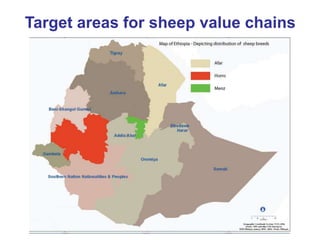
Target areas for sheep value chains
Why these target areas?
•   Horro, Menz and Afar sheep are the most populous
    breeds in Ethiopia (more than 2 million each) with wide
    area coverage
•   Pilot community based breeding programs established in
    two communities of each region
•   Regional research centers with well educated and
    interested staff in Menz and Horro region
•   Reasonably good information available on breeds and
    production systems
•   The three areas are comparatively easy accessible
•   Afar and Menz sheep are major contributors to
    households’ incomes
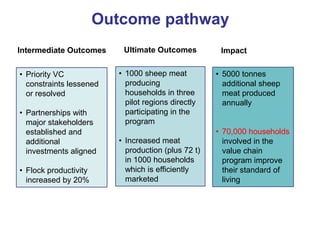
Outcome pathway
Intermediate Outcomes     Ultimate Outcomes          Impact

• Priority VC            • 1000 sheep meat          • 5000 tonnes
  constraints lessened     producing                  additional sheep
  or resolved              households in three        meat produced
                           pilot regions directly     annually
• Partnerships with        participating in the
  major stakeholders       program
  established and                                   • 70,000 households
  additional             • Increased meat             involved in the
  investments aligned      production (plus 72 t)     value chain
                           in 1000 households         program improve
• Flock productivity       which is efficiently       their standard of
  increased by 20%         marketed                   living
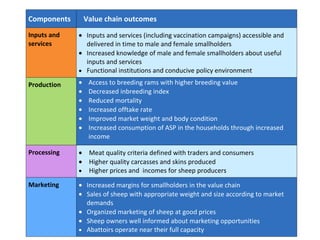
Components   Value chain outcomes
Inputs and   Inputs and services (including vaccination campaigns) accessible and
services     delivered in time to male and female smallholders
             Increased knowledge of male and female smallholders about useful
             inputs and services
             Functional institutions and conducive policy environment

Production    Access to breeding rams with higher breeding value
              Decreased inbreeding index
              Reduced mortality
              Increased offtake rate
              Improved market weight and body condition
              Increased consumption of ASP in the households through increased
              income

Processing    Meat quality criteria defined with traders and consumers
              Higher quality carcasses and skins produced
              Higher prices and incomes for sheep producers

Marketing    Increased margins for smallholders in the value chain
             Sales of sheep with appropriate weight and size according to market
             demands
             Organized marketing of sheep at good prices
             Sheep owners well informed about marketing opportunities
             Abattoirs operate near their full capacity
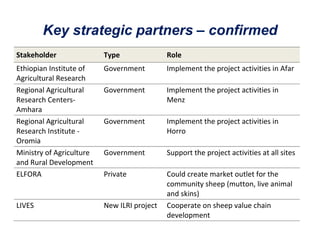
Key strategic partners – confirmed
Stakeholder               Type               Role
Ethiopian Institute of    Government         Implement the project activities in Afar
Agricultural Research
Regional Agricultural     Government         Implement the project activities in
Research Centers-                            Menz
Amhara
Regional Agricultural     Government         Implement the project activities in
Research Institute -                         Horro
Oromia
Ministry of Agriculture   Government         Support the project activities at all sites
and Rural Development
ELFORA                    Private            Could create market outlet for the
                                             community sheep (mutton, live animal
                                             and skins)
LIVES                     New ILRI project   Cooperate on sheep value chain
                                             development
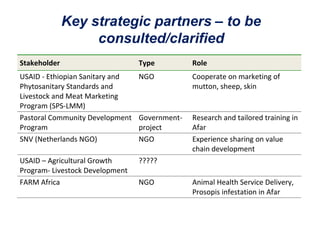
Key strategic partners – to be
                   consulted/clarified
Stakeholder                      Type          Role
USAID - Ethiopian Sanitary and   NGO           Cooperate on marketing of
Phytosanitary Standards and                    mutton, sheep, skin
Livestock and Meat Marketing
Program (SPS-LMM)
Pastoral Community Development   Government-   Research and tailored training in
Program                          project       Afar
SNV (Netherlands NGO)            NGO           Experience sharing on value
                                               chain development
USAID – Agricultural Growth      ?????
Program- Livestock Development
FARM Africa                      NGO           Animal Health Service Delivery,
                                               Prosopis infestation in Afar
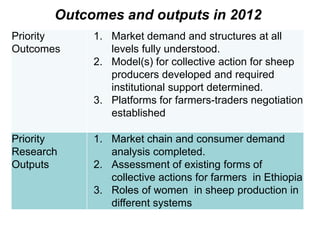
Outcomes and outputs in 2012
Priority    1. Market demand and structures at all
Outcomes       levels fully understood.
            2. Model(s) for collective action for sheep
               producers developed and required
               institutional support determined.
            3. Platforms for farmers-traders negotiation
               established

Priority    1. Market chain and consumer demand
Research       analysis completed.
Outputs     2. Assessment of existing forms of
               collective actions for farmers in Ethiopia
            3. Roles of women in sheep production in
               different systems
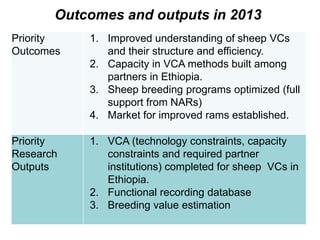
Outcomes and outputs in 2013
Priority   1. Improved understanding of sheep VCs
Outcomes      and their structure and efficiency.
           2. Capacity in VCA methods built among
              partners in Ethiopia.
           3. Sheep breeding programs optimized (full
              support from NARs)
           4. Market for improved rams established.

Priority   1. VCA (technology constraints, capacity
Research      constraints and required partner
Outputs       institutions) completed for sheep VCs in
              Ethiopia.
           2. Functional recording database
           3. Breeding value estimation
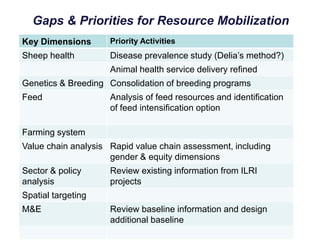
Gaps & Priorities for Resource Mobilization
Key Dimensions       Priority Activities
Sheep health         Disease prevalence study (Delia’s method?)
                     Animal health service delivery refined
Genetics & Breeding Consolidation of breeding programs
Feed                 Analysis of feed resources and identification
                     of feed intensification option

Farming system
Value chain analysis Rapid value chain assessment, including
                     gender & equity dimensions
Sector & policy      Review existing information from ILRI
analysis             projects
Spatial targeting
M&E                  Review baseline information and design
                     additional baseline
Gaps – inputs from technology
              sub-components

• Forage production development in Menz and Horro
• Barley cultivars selected for feed value in Menz
• Tools and methods developed for prioritizing feed
  interventions (Feed SC 2012)
• Feed intensification options identified and effects on
  productivity and carbon and water footprint identified
  (Feed SC 2012)
• Models for animal health delivery services in Afar and
  other sites
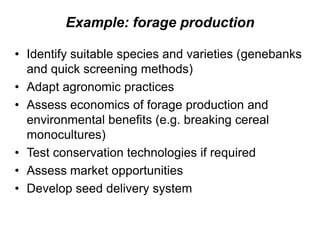
Example: forage production

• Identify suitable species and varieties (genebanks
  and quick screening methods)
• Adapt agronomic practices
• Assess economics of forage production and
  environmental benefits (e.g. breaking cereal
  monocultures)
• Test conservation technologies if required
• Assess market opportunities
• Develop seed delivery system
Gaps – inputs from cross-cutting
             VC sub-components
• Cross-cutting models for value chain development
• Methods for systematic assessment of value chain
  components
• Enhance capacity for quick and practical value chain
  analysis to identify and address bottlenecks (Feed SC
  2012)
• Ex-ante impact assessment – priority setting for
  interventions
• Mapping tools for agro-ecological assessments
• Priority interventions to improve gender equitable outcomes
  identified
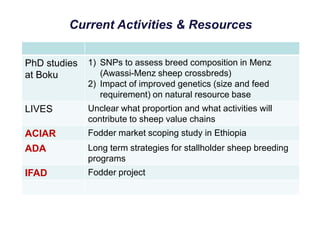
Current Activities & Resources


PhD studies   1) SNPs to assess breed composition in Menz
at Boku          (Awassi-Menz sheep crossbreds)
              2) Impact of improved genetics (size and feed
                 requirement) on natural resource base
LIVES         Unclear what proportion and what activities will
              contribute to sheep value chains
ACIAR         Fodder market scoping study in Ethiopia
ADA           Long term strategies for stallholder sheep breeding
              programs
IFAD          Fodder project
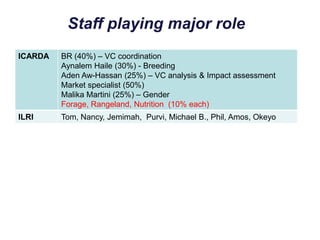
Staff playing major role
ICARDA   BR (40%) – VC coordination
         Aynalem Haile (30%) - Breeding
         Aden Aw-Hassan (25%) – VC analysis & Impact assessment
         Market specialist (50%)
         Malika Martini (25%) – Gender
         Forage, Rangeland, Nutrition (10% each)
ILRI     Tom, Nancy, Jemimah, Purvi, Michael B., Phil, Amos, Okeyo
Minimum operational resources
         required to get started
• to employ a national coordinator for the field work in
  Ethiopia: US$ 25,000
• operational budget to do VC assessments and to
  continue the work with communities: US$ 50,000
• to conduct stakeholder workshop to initiate innovation
  platforms targeting development partners: US$ 10,000
Thank you!

Update on sheep meat value chain development in Ethiopia

  • 1.
    Update on sheepmeat value chain development in Ethiopia Barbara Rischovsky (ICARDA) CGIAR Research Program on Livestock and Fish Planning Meeting September 2011 Planning Meeting ILRI Nairobi 27-29 September 2011
  • 2.
    Outline suggested byTom 1. Overview of outcome pathways 2. Status of existing engagement and key strategic partners 3. Synthesis of existing and planned activities/ resources from sub-components 4. Analysis of gaps 5. Priorities for resource mobilization 6. Needs from subcomponent teams
  • 3.
    Entry Point • Establishedcollaboration and lessons learnt from the joint ICARDA/ILRI/Boku Project "Developing community based breeding programs" for four local sheep breeds in Ethiopia
  • 4.
    Target areas forsheep value chains
  • 5.
    Why these targetareas? • Horro, Menz and Afar sheep are the most populous breeds in Ethiopia (more than 2 million each) with wide area coverage • Pilot community based breeding programs established in two communities of each region • Regional research centers with well educated and interested staff in Menz and Horro region • Reasonably good information available on breeds and production systems • The three areas are comparatively easy accessible • Afar and Menz sheep are major contributors to households’ incomes
  • 6.
    Outcome pathway Intermediate Outcomes Ultimate Outcomes Impact • Priority VC • 1000 sheep meat • 5000 tonnes constraints lessened producing additional sheep or resolved households in three meat produced pilot regions directly annually • Partnerships with participating in the major stakeholders program established and • 70,000 households additional • Increased meat involved in the investments aligned production (plus 72 t) value chain in 1000 households program improve • Flock productivity which is efficiently their standard of increased by 20% marketed living
  • 7.
    Components Value chain outcomes Inputs and Inputs and services (including vaccination campaigns) accessible and services delivered in time to male and female smallholders Increased knowledge of male and female smallholders about useful inputs and services Functional institutions and conducive policy environment Production Access to breeding rams with higher breeding value Decreased inbreeding index Reduced mortality Increased offtake rate Improved market weight and body condition Increased consumption of ASP in the households through increased income Processing Meat quality criteria defined with traders and consumers Higher quality carcasses and skins produced Higher prices and incomes for sheep producers Marketing Increased margins for smallholders in the value chain Sales of sheep with appropriate weight and size according to market demands Organized marketing of sheep at good prices Sheep owners well informed about marketing opportunities Abattoirs operate near their full capacity
  • 8.
    Key strategic partners– confirmed Stakeholder Type Role Ethiopian Institute of Government Implement the project activities in Afar Agricultural Research Regional Agricultural Government Implement the project activities in Research Centers- Menz Amhara Regional Agricultural Government Implement the project activities in Research Institute - Horro Oromia Ministry of Agriculture Government Support the project activities at all sites and Rural Development ELFORA Private Could create market outlet for the community sheep (mutton, live animal and skins) LIVES New ILRI project Cooperate on sheep value chain development
  • 9.
    Key strategic partners– to be consulted/clarified Stakeholder Type Role USAID - Ethiopian Sanitary and NGO Cooperate on marketing of Phytosanitary Standards and mutton, sheep, skin Livestock and Meat Marketing Program (SPS-LMM) Pastoral Community Development Government- Research and tailored training in Program project Afar SNV (Netherlands NGO) NGO Experience sharing on value chain development USAID – Agricultural Growth ????? Program- Livestock Development FARM Africa NGO Animal Health Service Delivery, Prosopis infestation in Afar
  • 10.
    Outcomes and outputsin 2012 Priority 1. Market demand and structures at all Outcomes levels fully understood. 2. Model(s) for collective action for sheep producers developed and required institutional support determined. 3. Platforms for farmers-traders negotiation established Priority 1. Market chain and consumer demand Research analysis completed. Outputs 2. Assessment of existing forms of collective actions for farmers in Ethiopia 3. Roles of women in sheep production in different systems
  • 11.
    Outcomes and outputsin 2013 Priority 1. Improved understanding of sheep VCs Outcomes and their structure and efficiency. 2. Capacity in VCA methods built among partners in Ethiopia. 3. Sheep breeding programs optimized (full support from NARs) 4. Market for improved rams established. Priority 1. VCA (technology constraints, capacity Research constraints and required partner Outputs institutions) completed for sheep VCs in Ethiopia. 2. Functional recording database 3. Breeding value estimation
  • 12.
    Gaps & Prioritiesfor Resource Mobilization Key Dimensions Priority Activities Sheep health Disease prevalence study (Delia’s method?) Animal health service delivery refined Genetics & Breeding Consolidation of breeding programs Feed Analysis of feed resources and identification of feed intensification option Farming system Value chain analysis Rapid value chain assessment, including gender & equity dimensions Sector & policy Review existing information from ILRI analysis projects Spatial targeting M&E Review baseline information and design additional baseline
  • 13.
    Gaps – inputsfrom technology sub-components • Forage production development in Menz and Horro • Barley cultivars selected for feed value in Menz • Tools and methods developed for prioritizing feed interventions (Feed SC 2012) • Feed intensification options identified and effects on productivity and carbon and water footprint identified (Feed SC 2012) • Models for animal health delivery services in Afar and other sites
  • 14.
    Example: forage production •Identify suitable species and varieties (genebanks and quick screening methods) • Adapt agronomic practices • Assess economics of forage production and environmental benefits (e.g. breaking cereal monocultures) • Test conservation technologies if required • Assess market opportunities • Develop seed delivery system
  • 15.
    Gaps – inputsfrom cross-cutting VC sub-components • Cross-cutting models for value chain development • Methods for systematic assessment of value chain components • Enhance capacity for quick and practical value chain analysis to identify and address bottlenecks (Feed SC 2012) • Ex-ante impact assessment – priority setting for interventions • Mapping tools for agro-ecological assessments • Priority interventions to improve gender equitable outcomes identified
  • 16.
    Current Activities &Resources PhD studies 1) SNPs to assess breed composition in Menz at Boku (Awassi-Menz sheep crossbreds) 2) Impact of improved genetics (size and feed requirement) on natural resource base LIVES Unclear what proportion and what activities will contribute to sheep value chains ACIAR Fodder market scoping study in Ethiopia ADA Long term strategies for stallholder sheep breeding programs IFAD Fodder project
  • 17.
    Staff playing majorrole ICARDA BR (40%) – VC coordination Aynalem Haile (30%) - Breeding Aden Aw-Hassan (25%) – VC analysis & Impact assessment Market specialist (50%) Malika Martini (25%) – Gender Forage, Rangeland, Nutrition (10% each) ILRI Tom, Nancy, Jemimah, Purvi, Michael B., Phil, Amos, Okeyo
  • 18.
    Minimum operational resources required to get started • to employ a national coordinator for the field work in Ethiopia: US$ 25,000 • operational budget to do VC assessments and to continue the work with communities: US$ 50,000 • to conduct stakeholder workshop to initiate innovation platforms targeting development partners: US$ 10,000
  • 19.