How are all your students included
in meaningful reading and writing
throughout the day?
How does your formative
assessment today influence what
you do tomorrow?
What have you tried? How did it
go?
Igniting a Passion for Literacy,
Part 2
Langley	Elementary	Schools	
Sept	28,	Oct	18,	Jan	19,	Apr	12	
Faye	Brownlie	
Slideshare.net/fayebrownlie/langleyoct16
Learning Intentions:
•  I	have	a	plan	to	increase	my	wriGng	
instrucGon,	including	a	focus	on	criteria.	
•  I	have	a	new	strategy	or	structure	to	try	with	
my	students.	
•  I	can	deliberately	include	the	Big	Ideas	in	my	
planning.
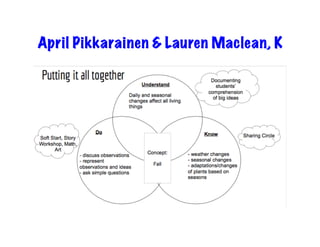
April Pikkarainen & Lauren Maclean, K
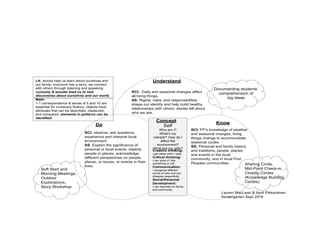
Concept
Understand
KnowDo Self
Who am I?
What’s my
role/job? How do I
affect the
environment?
What are my gifts?
SCI:: Daily and seasonal changes affect
all living things.
SS: Rights, roles, and responsibilities
shape our identity and help build healthy
relationships with others; stories tell about
who we are.
SCI: observe, ask questions,
experience and interpret local
environment
SS: Explain the significance of
personal or local events, objects,
people or places; acknowledge
different perspectives on people,
places, or issues, or events in their
lives.
SCI: FP’s knowledge of weather
and seasonal changes; living
things change to accommodate
seasonal cycles
SS: Personal and family history
and traditions; people, places,
and events in the local
community, and in local First
Peoples communities.
LA: stories help us learn about ourselves and
our family; everyone has a story; we connect
with others through listening and speaking;
curiosity & wonder lead us to new
discoveries about ourselves and our world.
Math:
1-1 correspondence & sense of 5 and 10 are
essential for numeracy fluency; objects have
attributes that can be described, measured,
and compared; elements in patterns can be
identified.
Creative thinking:
I get ideas when I play.
Critical thinking:
I can show if I like
something or not.
Communication:
I recognize different
points of view and can
disagree respectfully.
Social/Personal
Development:
I can describe my family
and community.
Documenting students’
comprehension of
big ideas
Soft Start and
Morning Meetings,
Outdoor
Explorations,
Story Workshop
Sharing Circle,
Mid-Point Check-in,
Closing Circles
(Knowledge Building
Circles)
Lauren MacLean & April Pikkarainen
Kindergarten Sept 2016
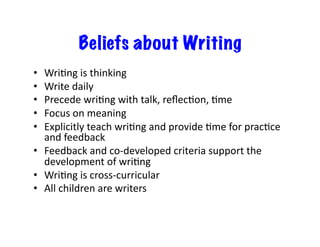
Beliefs about Writing
•  WriGng	is	thinking	
•  Write	daily	
•  Precede	wriGng	with	talk,	reflecGon,	Gme	
•  Focus	on	meaning	
•  Explicitly	teach	wriGng	and	provide	Gme	for	pracGce	
and	feedback	
•  Feedback	and	co-developed	criteria	support	the	
development	of	wriGng	
•  WriGng	is	cross-curricular	
•  All	children	are	writers
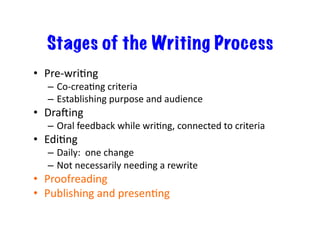
Stages of the Writing Process
•  Pre-wriGng	
–  Co-creaGng	criteria	
–  Establishing	purpose	and	audience	
•  DraQing	
–  Oral	feedback	while	wriGng,	connected	to	criteria	
•  EdiGng	
–  Daily:		one	change	
–  Not	necessarily	needing	a	rewrite	
•  Proofreading	
•  Publishing	and	presenGng
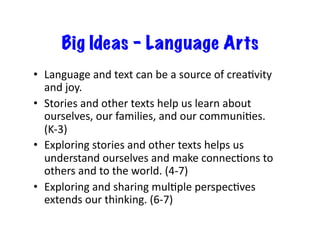
Big Ideas – Language Arts
•  Language	and	text	can	be	a	source	of	creaGvity	
and	joy.	
•  Stories	and	other	texts	help	us	learn	about	
ourselves,	our	families,	and	our	communiGes.	
(K-3)	
•  Exploring	stories	and	other	texts	helps	us	
understand	ourselves	and	make	connecGons	to	
others	and	to	the	world.	(4-7)	
•  Exploring	and	sharing	mulGple	perspecGves	
extends	our	thinking.	(6-7)
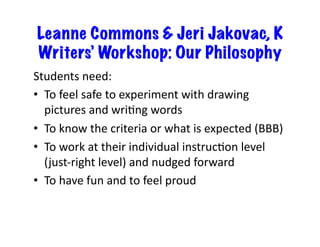
Leanne Commons & Jeri Jakovac, K
Writers’ Workshop: Our Philosophy
Students	need:	
•  To	feel	safe	to	experiment	with	drawing	
pictures	and	wriGng	words	
•  To	know	the	criteria	or	what	is	expected	(BBB)	
•  To	work	at	their	individual	instrucGon	level	
(just-right	level)	and	nudged	forward	
•  To	have	fun	and	to	feel	proud
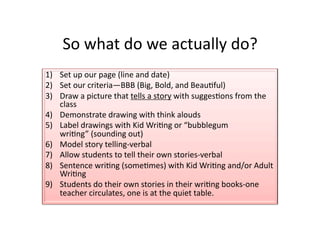
So	what	do	we	actually	do?	
1)  Set	up	our	page	(line	and	date)	
2)  Set	our	criteria—BBB	(Big,	Bold,	and	BeauGful)	
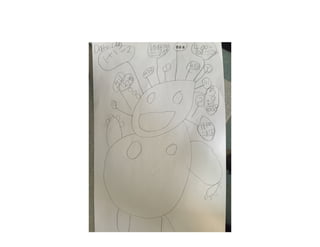
3)  Draw	a	picture	that	tells	a	story	with	suggesGons	from	the	
class	
4)  Demonstrate	drawing	with	think	alouds		
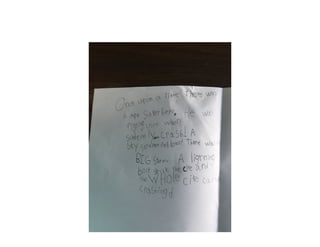
5)  Label	drawings	with	Kid	WriGng	or	“bubblegum	
wriGng”	(sounding	out)	
6)  Model	story	telling-verbal	
7)  Allow	students	to	tell	their	own	stories-verbal	
8)  Sentence	wriGng	(someGmes)	with	Kid	WriGng	and/or	Adult	
WriGng	
9)  Students	do	their	own	stories	in	their	wriGng	books-one	
teacher	circulates,	one	is	at	the	quiet	table.
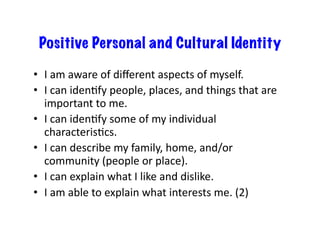
Positive Personal and Cultural Identity
•  I	am	aware	of	different	aspects	of	myself.	
•  I	can	idenGfy	people,	places,	and	things	that	are	
important	to	me.	
•  I	can	idenGfy	some	of	my	individual	
characterisGcs.	
•  I	can	describe	my	family,	home,	and/or	
community	(people	or	place).	
•  I	can	explain	what	I	like	and	dislike.	
•  I	am	able	to	explain	what	interests	me.	(2)
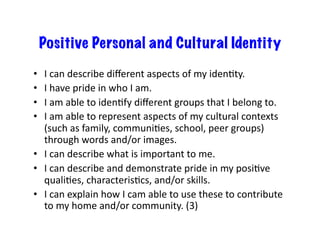
Positive Personal and Cultural Identity	
•  I	can	describe	different	aspects	of	my	idenGty.	
•  I	have	pride	in	who	I	am.	
•  I	am	able	to	idenGfy	different	groups	that	I	belong	to.	
•  I	am	able	to	represent	aspects	of	my	cultural	contexts	
(such	as	family,	communiGes,	school,	peer	groups)	
through	words	and/or	images.	
•  I	can	describe	what	is	important	to	me.	
•  I	can	describe	and	demonstrate	pride	in	my	posiGve	
qualiGes,	characterisGcs,	and/or	skills.	
•  I	can	explain	how	I	cam	able	to	use	these	to	contribute	
to	my	home	and/or	community.	(3)
A writing sequence
•  Gallery	Walk	
•  Write	
•  Build	criteria	
•  Self	assess	and	apply	criteria	
•  Ownership
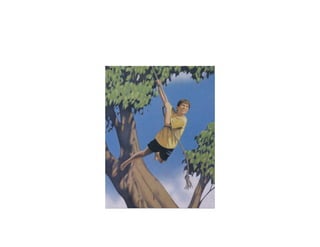
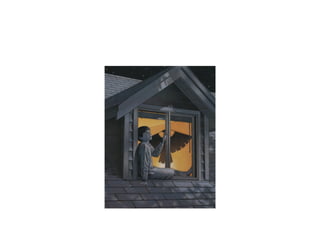
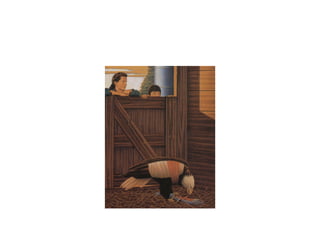
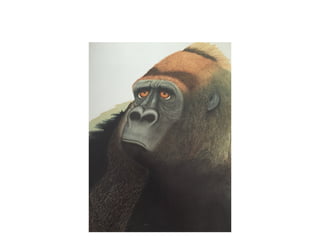
•  Place	a	series	of	pictures	around	the	room	
•  Students	in	groups	of	3	
•  3	minutes	per	picture	
•  Chat	–	How	could	you	use	this	image	in	your	
wriGng?	
•  Build	on	one	another’s	thinking	
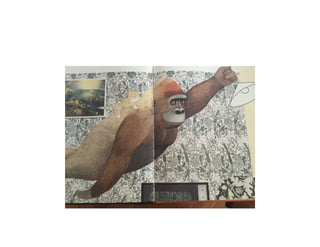
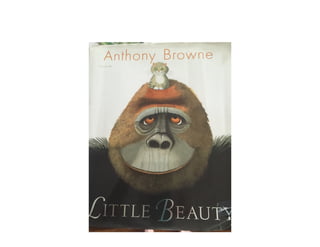
•  View	4	pictures
•  Eagle	Dreams	-		Wri.en	by	Sheryl	McFarlane	;	
Illustra;ons	by	Ron	Lightburn;		
•  ISBN:	1-55143-016-9
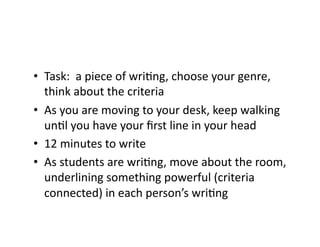
•  Task:		a	piece	of	wriGng,	choose	your	genre,	
think	about	the	criteria	
•  As	you	are	moving	to	your	desk,	keep	walking	
unGl	you	have	your	first	line	in	your	head	
•  12	minutes	to	write	
•  As	students	are	wriGng,	move	about	the	room,	
underlining	something	powerful	(criteria	
connected)	in	each	person’s	wriGng
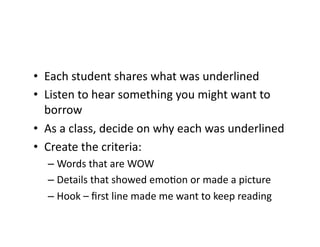
•  Each	student	shares	what	was	underlined	
•  Listen	to	hear	something	you	might	want	to	
borrow	
•  As	a	class,	decide	on	why	each	was	underlined	
•  Create	the	criteria:	
– Words	that	are	WOW	
– Details	that	showed	emoGon	or	made	a	picture	
– Hook	–	first	line	made	me	want	to	keep	reading
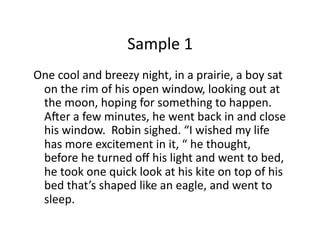
Sample	1	
One	cool	and	breezy	night,	in	a	prairie,	a	boy	sat	
on	the	rim	of	his	open	window,	looking	out	at	
the	moon,	hoping	for	something	to	happen.		
AQer	a	few	minutes,	he	went	back	in	and	close	
his	window.		Robin	sighed.	“I	wished	my	life	
has	more	excitement	in	it,	“	he	thought,	
before	he	turned	off	his	light	and	went	to	bed,		
he	took	one	quick	look	at	his	kite	on	top	of	his	
bed	that’s	shaped	like	an	eagle,	and	went	to	
sleep.
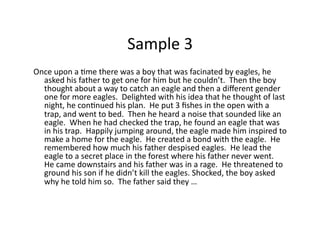
Sample	3	
Once	upon	a	Gme	there	was	a	boy	that	was	facinated	by	eagles,	he	
asked	his	father	to	get	one	for	him	but	he	couldn’t.		Then	the	boy	
thought	about	a	way	to	catch	an	eagle	and	then	a	different	gender	
one	for	more	eagles.		Delighted	with	his	idea	that	he	thought	of	last	
night,	he	conGnued	his	plan.		He	put	3	fishes	in	the	open	with	a	
trap,	and	went	to	bed.		Then	he	heard	a	noise	that	sounded	like	an	
eagle.		When	he	had	checked	the	trap,	he	found	an	eagle	that	was	
in	his	trap.		Happily	jumping	around,	the	eagle	made	him	inspired	to	
make	a	home	for	the	eagle.		He	created	a	bond	with	the	eagle.		He	
remembered	how	much	his	father	despised	eagles.		He	lead	the	
eagle	to	a	secret	place	in	the	forest	where	his	father	never	went.		
He	came	downstairs	and	his	father	was	in	a	rage.		He	threatened	to	
ground	his	son	if	he	didn’t	kill	the	eagles.	Shocked,	the	boy	asked	
why	he	told	him	so.		The	father	said	they	…
Sample	4	
At	Sunday,	the	Ximing	and	his	father	mother	go	
travel.		On,	Ximing	say	“I’m	see	a	eagle!”		His	
father	and	his	mother	is	going	to	his.		And	his	
mother	say	“Oh,	Help	it!”		OK.		It	was	heal.		OK.		
We	are	go	back	home!	
At	home:	
Today	is	very	funning.	Because	we	are	helpa	eagle!		
I’m	so	happy	now!	Ximing	is	Gme	to	eat	a	dinner	
say	mother	say	…
•  Kids	can	add/edit/conGnue	to	work	
•  Set	up	for	next	class	
–  Work	on	same	criteria	
–  Hear	again,	pieces	that	work	
–  Move	to	where	kids	can	idenGfy	criteria	in	their	own	
work	and	ask	for	help	with	criteria	that	are	struggling	
with	
•  AQer	repeated	pracGce,	students	choose	one	
piece	to	work	up,	edit,	revise,	and	hand	in	for	
marking	
•  Feedback	is	conGnuous,	personal,	Gmely,	focused
Grade 1/2, Sunshine Coast
•  The	strengths:	
– Chaoy,	love	to	share	ideas,	take	risks	with	their	
spelling	
•  The	challenge:	
– Very	diverse	group	
– Some	resistant	to	wriGng,	others	write	pages	
•  The	goal:	
– Teaching	wriGng	in	a	fun	and	inclusive	way	to	help	
everyone	grow
Langley.oct2016
Langley.oct2016
Langley.oct2016
Langley.oct2016
Langley.oct2016
Langley.oct2016
Langley.oct2016
Langley.oct2016

Langley.oct2016