Reading and Writing
Performance Standards for
Grades 4-6
SD 8
December 5, 2018
Faye Brownlie
Slideshare.net/fayebrownlie.PS.Nelson
Ministry of Education’s Definition of Literacy
Literacy is the ability and willingness to make meaning from
text and express oneself in a variety of modes and for a
variety of purposes.
Literacy includes making connections, analyzing critically,
comprehending, creating, and communicating.
B.C. Ministry of Education, 2017
2
Gallery Walk – writing lesson
• In groups, 3 things that count in writing
• Made class list and categorized
• Focus on meaning and thinking
• Description
• Imagination
• Detail
• Knowledge
• Focus
• Ideas
• Passion
• Intriguing
• Understandable
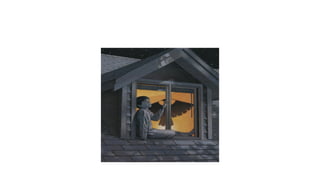
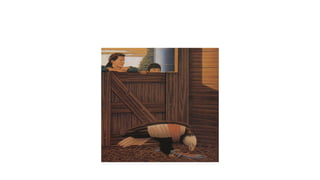
• Place a series of pictures around the room
• Students in groups of 3
• 3 minutes per picture
• Chat – How could you use this image in your writing?
• Build on one another’s thinking
• View 3 pictures
• Eagle Dreams - Written by Sheryl McFarlane ; Illustrations by Ron
Lightburn;
• ISBN: 1-55143-016-9
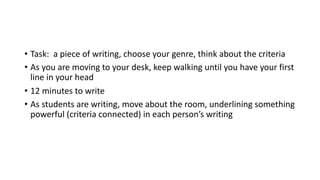
• Task: a piece of writing, choose your genre, think about the criteria
• As you are moving to your desk, keep walking until you have your first
line in your head
• 12 minutes to write
• As students are writing, move about the room, underlining something
powerful (criteria connected) in each person’s writing
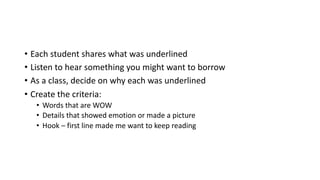
• Each student shares what was underlined
• Listen to hear something you might want to borrow
• As a class, decide on why each was underlined
• Create the criteria:
• Words that are WOW
• Details that showed emotion or made a picture
• Hook – first line made me want to keep reading
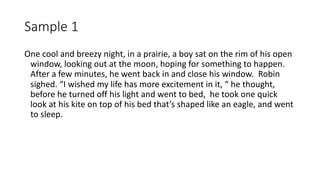
Sample 1
One cool and breezy night, in a prairie, a boy sat on the rim of his open
window, looking out at the moon, hoping for something to happen.
After a few minutes, he went back in and close his window. Robin
sighed. “I wished my life has more excitement in it, “ he thought,
before he turned off his light and went to bed, he took one quick
look at his kite on top of his bed that’s shaped like an eagle, and went
to sleep.
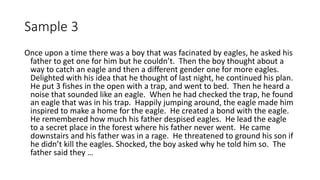
Sample 3
Once upon a time there was a boy that was facinated by eagles, he asked his
father to get one for him but he couldn’t. Then the boy thought about a
way to catch an eagle and then a different gender one for more eagles.
Delighted with his idea that he thought of last night, he continued his plan.
He put 3 fishes in the open with a trap, and went to bed. Then he heard a
noise that sounded like an eagle. When he had checked the trap, he found
an eagle that was in his trap. Happily jumping around, the eagle made him
inspired to make a home for the eagle. He created a bond with the eagle.
He remembered how much his father despised eagles. He lead the eagle
to a secret place in the forest where his father never went. He came
downstairs and his father was in a rage. He threatened to ground his son if
he didn’t kill the eagles. Shocked, the boy asked why he told him so. The
father said they …
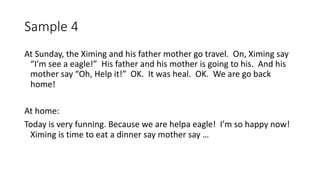
Sample 4
At Sunday, the Ximing and his father mother go travel. On, Ximing say
“I’m see a eagle!” His father and his mother is going to his. And his
mother say “Oh, Help it!” OK. It was heal. OK. We are go back
home!
At home:
Today is very funning. Because we are helpa eagle! I’m so happy now!
Ximing is time to eat a dinner say mother say …
• Kids can add/edit/continue to work
• Set up for next class
• Work on same criteria
• Hear again, pieces that work
• Move to where kids can identify criteria in their own work and ask for help
with criteria that are struggling with
• After repeated practice, students choose one piece to work up, edit,
revise, and hand in for marking
• Feedback is continuous, personal, timely, focused
Using a performance-based reading
assessment (PBA) to guide
instruction?
Reading Assessment
• The goal of teaching reading is to create readers who read with
understanding and who choose to read.
• The goal of a formative reading assessment is to determine the
strengths and areas to strengthen of a student’s reading with
understanding.
Assessment for learning
• Purpose: guide instruction, improve learning
• Timing: minute by minute, day by day
• Form: descriptive feedback
• Audience: learner and teacher
• Assessment is value driven.
• The assessment you choose must reflect what you value.
• So what do you value in reading? What does your curriculum value?
• Assessment must be purpose driven.
• Do all participants – teachers and students – understand the purpose
of your performance based assessment?
Fountas & Pinnell or Benchmarks
• Measure accuracy, fluency, comprehension, independent reading
level, instructional reading level
• 1:1 conference
• Goal: instructional reading level
Background knowledge has a greater impact on being able to read a
text than anything else.
-Doug Fisher, Richard Allington
Performance-Based Assessments
• Instructionally based
• Qualitative
• Interactive component
• Attempt to mirror ‘best practice’ in reading – i.e., including reasoning and open-ended response
• Not timed
• Require teacher judgment
• Performance measured against a rubric
• Based on our goals of reading
• Readers who can read thoughtfully
• Readers who choose to read
• Readers who read with purpose and joy
• Provide evidence for what students can and cannot yet do
• Should be non-stressful
No plan, no point
Purpose
• To determine class strengths and areas to strengthen
• To build a plan of action once these have been identified
• To return to the assessment to see if teaching has made a difference
Formative Assessment
• Information gained from an assessment should be used to influence
instruction – or the assessment is not worth doing.
• Assessments should not be too time-consuming as we need to get on
with the teaching.
• Feedback is the heart of assessment –
• Feedback from the student to the teacher
• Feedback from the teacher to the student.
Assessment FOR Learning
PBA: performance-based assessment
• Whole group building background knowledge
• Guided by the protocol
• Whole group overview of performance tasks – the
thinking paper or response sheet
• Individual quick running record
• Individual interview
• Student text – non-fiction
Assessment FOR Learning
PBA: performance-based assessment
• Descriptive scoring
• Highlight phrases that match your evidence – from the oral
reading, the interview, the student response sheet
• Coding in teams
• Class/grade profile of strengths and areas of need
• Action plans developed - what’s next?
• Individual students identified for further assessment
Together we are better: Collaborate
• Assess
• Analyze and plan
• Teach
• Reassess
• SHARE your class plans!
Standard Reading Assessment
• Choose a common piece of text.
• Build background for the reading.
• Have students respond to common prompts.
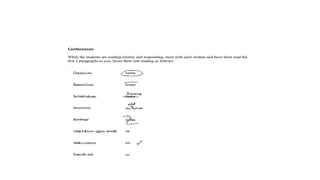
• Have students read a short section aloud and answer several interview
questions.
• Code using the Reading Performance Standards
• Described in Student Diversity, 3rd ed – Brownlie, Feniak, Schnellert & in It’s All about
Thinking – collaborating to support all learners in English, Social Studies and Humanities
– Brownlie & Schnellert & It’s All about Thinking – collaborating to support all learners in
Math & Science – Brownlie, Fullerton, Schnellert & It’s All about Thinking – creating
pathways for all learners in the middle years – Schnellert, Watson & Widdess
• Connections: How does what you read connect
with what you already knew?
• Summarizing: Choose a way to show the main
ideas and details in what you read.
• Inferencing: Read between the lines to find
something that you believe to be true, but that
isn’t actually said. Explain your reasoning.
• Vocabulary: Here are 3 challenging words from the
text. Explain what you think they mean.
• Reflecting: Was this easy or hard to understand?
How did you help your self understand?
(SD, p.27)
Interview Questions
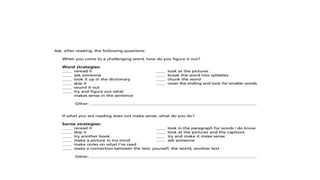
• When you come to a challenging word, how do you figure it out?
• If your reading does not make sense, what do you do?
• What is this selection mainly about?
• What surprised you about this selection? Why?
• DART
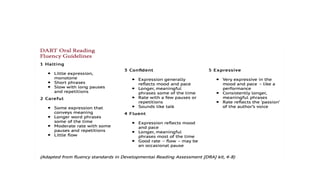
Read Aloud
• Select a portion of the text for students to read aloud.
• Record miscues as they student reads. Watch for a pattern.
• Give the student a compliment on his oral reading.
• Chose one of the following descriptors:
• Halting, careful, confident/fluent, expressive
(Its All about Thinking, p.28)
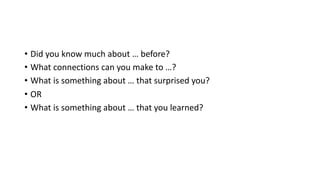
• Did you know much about … before?
• What connections can you make to …?
• What is something about … that surprised you?
• OR
• What is something about … that you learned?
P.S.Nelson
P.S.Nelson

P.S.Nelson

  • 1.
    Reading and Writing PerformanceStandards for Grades 4-6 SD 8 December 5, 2018 Faye Brownlie Slideshare.net/fayebrownlie.PS.Nelson
  • 2.
    Ministry of Education’sDefinition of Literacy Literacy is the ability and willingness to make meaning from text and express oneself in a variety of modes and for a variety of purposes. Literacy includes making connections, analyzing critically, comprehending, creating, and communicating. B.C. Ministry of Education, 2017 2
  • 3.
    Gallery Walk –writing lesson • In groups, 3 things that count in writing • Made class list and categorized • Focus on meaning and thinking • Description • Imagination • Detail • Knowledge • Focus • Ideas • Passion • Intriguing • Understandable
  • 4.
    • Place aseries of pictures around the room • Students in groups of 3 • 3 minutes per picture • Chat – How could you use this image in your writing? • Build on one another’s thinking • View 3 pictures
  • 9.
    • Eagle Dreams- Written by Sheryl McFarlane ; Illustrations by Ron Lightburn; • ISBN: 1-55143-016-9
  • 10.
    • Task: apiece of writing, choose your genre, think about the criteria • As you are moving to your desk, keep walking until you have your first line in your head • 12 minutes to write • As students are writing, move about the room, underlining something powerful (criteria connected) in each person’s writing
  • 11.
    • Each studentshares what was underlined • Listen to hear something you might want to borrow • As a class, decide on why each was underlined • Create the criteria: • Words that are WOW • Details that showed emotion or made a picture • Hook – first line made me want to keep reading
  • 12.
    Sample 1 One cooland breezy night, in a prairie, a boy sat on the rim of his open window, looking out at the moon, hoping for something to happen. After a few minutes, he went back in and close his window. Robin sighed. “I wished my life has more excitement in it, “ he thought, before he turned off his light and went to bed, he took one quick look at his kite on top of his bed that’s shaped like an eagle, and went to sleep.
  • 13.
    Sample 3 Once upona time there was a boy that was facinated by eagles, he asked his father to get one for him but he couldn’t. Then the boy thought about a way to catch an eagle and then a different gender one for more eagles. Delighted with his idea that he thought of last night, he continued his plan. He put 3 fishes in the open with a trap, and went to bed. Then he heard a noise that sounded like an eagle. When he had checked the trap, he found an eagle that was in his trap. Happily jumping around, the eagle made him inspired to make a home for the eagle. He created a bond with the eagle. He remembered how much his father despised eagles. He lead the eagle to a secret place in the forest where his father never went. He came downstairs and his father was in a rage. He threatened to ground his son if he didn’t kill the eagles. Shocked, the boy asked why he told him so. The father said they …
  • 14.
    Sample 4 At Sunday,the Ximing and his father mother go travel. On, Ximing say “I’m see a eagle!” His father and his mother is going to his. And his mother say “Oh, Help it!” OK. It was heal. OK. We are go back home! At home: Today is very funning. Because we are helpa eagle! I’m so happy now! Ximing is time to eat a dinner say mother say …
  • 15.
    • Kids canadd/edit/continue to work • Set up for next class • Work on same criteria • Hear again, pieces that work • Move to where kids can identify criteria in their own work and ask for help with criteria that are struggling with • After repeated practice, students choose one piece to work up, edit, revise, and hand in for marking • Feedback is continuous, personal, timely, focused
  • 16.
    Using a performance-basedreading assessment (PBA) to guide instruction?
  • 17.
    Reading Assessment • Thegoal of teaching reading is to create readers who read with understanding and who choose to read. • The goal of a formative reading assessment is to determine the strengths and areas to strengthen of a student’s reading with understanding.
  • 18.
    Assessment for learning •Purpose: guide instruction, improve learning • Timing: minute by minute, day by day • Form: descriptive feedback • Audience: learner and teacher
  • 19.
    • Assessment isvalue driven. • The assessment you choose must reflect what you value. • So what do you value in reading? What does your curriculum value?
  • 20.
    • Assessment mustbe purpose driven. • Do all participants – teachers and students – understand the purpose of your performance based assessment?
  • 21.
    Fountas & Pinnellor Benchmarks • Measure accuracy, fluency, comprehension, independent reading level, instructional reading level • 1:1 conference • Goal: instructional reading level
  • 22.
    Background knowledge hasa greater impact on being able to read a text than anything else. -Doug Fisher, Richard Allington
  • 23.
    Performance-Based Assessments • Instructionallybased • Qualitative • Interactive component • Attempt to mirror ‘best practice’ in reading – i.e., including reasoning and open-ended response • Not timed • Require teacher judgment • Performance measured against a rubric • Based on our goals of reading • Readers who can read thoughtfully • Readers who choose to read • Readers who read with purpose and joy • Provide evidence for what students can and cannot yet do • Should be non-stressful
  • 24.
  • 25.
    Purpose • To determineclass strengths and areas to strengthen • To build a plan of action once these have been identified • To return to the assessment to see if teaching has made a difference
  • 26.
    Formative Assessment • Informationgained from an assessment should be used to influence instruction – or the assessment is not worth doing. • Assessments should not be too time-consuming as we need to get on with the teaching. • Feedback is the heart of assessment – • Feedback from the student to the teacher • Feedback from the teacher to the student.
  • 27.
    Assessment FOR Learning PBA:performance-based assessment • Whole group building background knowledge • Guided by the protocol • Whole group overview of performance tasks – the thinking paper or response sheet • Individual quick running record • Individual interview • Student text – non-fiction
  • 28.
    Assessment FOR Learning PBA:performance-based assessment • Descriptive scoring • Highlight phrases that match your evidence – from the oral reading, the interview, the student response sheet • Coding in teams • Class/grade profile of strengths and areas of need • Action plans developed - what’s next? • Individual students identified for further assessment
  • 29.
    Together we arebetter: Collaborate • Assess • Analyze and plan • Teach • Reassess • SHARE your class plans!
  • 30.
    Standard Reading Assessment •Choose a common piece of text. • Build background for the reading. • Have students respond to common prompts. • Have students read a short section aloud and answer several interview questions. • Code using the Reading Performance Standards • Described in Student Diversity, 3rd ed – Brownlie, Feniak, Schnellert & in It’s All about Thinking – collaborating to support all learners in English, Social Studies and Humanities – Brownlie & Schnellert & It’s All about Thinking – collaborating to support all learners in Math & Science – Brownlie, Fullerton, Schnellert & It’s All about Thinking – creating pathways for all learners in the middle years – Schnellert, Watson & Widdess
  • 31.
    • Connections: Howdoes what you read connect with what you already knew? • Summarizing: Choose a way to show the main ideas and details in what you read. • Inferencing: Read between the lines to find something that you believe to be true, but that isn’t actually said. Explain your reasoning. • Vocabulary: Here are 3 challenging words from the text. Explain what you think they mean. • Reflecting: Was this easy or hard to understand? How did you help your self understand? (SD, p.27)
  • 32.
    Interview Questions • Whenyou come to a challenging word, how do you figure it out? • If your reading does not make sense, what do you do? • What is this selection mainly about? • What surprised you about this selection? Why? • DART
  • 33.
    Read Aloud • Selecta portion of the text for students to read aloud. • Record miscues as they student reads. Watch for a pattern. • Give the student a compliment on his oral reading. • Chose one of the following descriptors: • Halting, careful, confident/fluent, expressive (Its All about Thinking, p.28)
  • 35.
    • Did youknow much about … before? • What connections can you make to …? • What is something about … that surprised you? • OR • What is something about … that you learned?