Addressing the Gap Reading Interventions for Struggling Grade Three & Four Students
Introduction Evidence of decline in reading achievement for some children around the age of 9-10  Few specialised interventions in place to address this systemic failure.  Beyond Reading Recovery,  these children face a lonely battle to succeed. There were attempts by committed teachers to personalise learning through focussed and targeted  differentiation within their classrooms. Future data will provide further evidence as to whether this mainstream approach is able to effectively meet the needs of ‘at risk’ students.
What are these students like They are: a diverse group the majority are boys disengaged disruptive lack self-management strategies have low self efficacy have trouble with text books have trouble understanding in what is involved in tasks feel distrustful of teachers have a dependence of decoding absent a lot Extremely passive Lack initiative
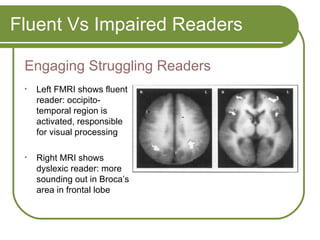
Fluent Vs Impaired Readers Engaging Struggling Readers  Left FMRI shows fluent reader: occipito-temporal region is activated, responsible for visual processing Right MRI shows dyslexic reader: more sounding out in Broca’s area in frontal lobe
Overview ‘ Without effective, specialised help, they are doomed to school failure,  illiteracy and severely limited life chances.’ (Clay, M.M., and Tuck, B. 1991) Our project  was based on the philosophy that all children can learn given the ‘right’ conditions.  addressed the needs of ‘hardest to teach’ students by linking effective teaching pedagogy with an understanding of the precise difficulties experienced by these children during their struggle to be competent readers.  Believed the challenges of bringing about successful outcomes for these children is achievable and critical.  Requires greater recognition by the educational system of the problem Challenges the system to invest knowledge and resources
Acknowledgments Strengths the commitment and collaboration of the team the generosity of the schools and colleagues we visited. access TPL (Teacher Professional Leave) which made our combined efforts possible We also thank our own schools and students for allowing us to be absent for the duration of our study.
Thanks  Schools visited: Woodend -Andy Kozack and Bev Saddler New Gisborne – Suzanne Cooke and Jill Plumber Our Lady of the Rosary Kyneton – Anne Mildura South -  Marie Therese O’Leary Irymple South  - Robyn Gallagher Red Cliffs East – Kim Ryan Nichols Point – Jo McQuinn Holy Rosary Heathcote-Melanie Heathcote-Michael Saunders Spring Gully – Ann Rochford Camp Hill – Jill Scobie and Sue Prentice Tasmania-Louise Anders Speech Therapist: Christine Sertori SRA Rep: Di Mcpherson Lioncrest Rep:  Liz  Corrective Reading Tutor : Genevieve Hosking Regional Officers Sue Hinton Helen Bandrowski (Catholic Education)) Pam Toose Peter Nicolson Anne Smith Anne Baird John Walsh Rob Sbaglia Philip Holmes-Smith Tamara Downey Andrea Chalmers Yvonne Madden Trish Priest ERIK Tutors: Kim Cheep and Leonie NAPLAN Documentation: Kangaroo Flat – Brooke Benendick
Proposal  Major factors identified as negatively impacting on reading success for students in Grades 3 /4   Inconsistency in teaching practices  Assessment   Teacher Capacity Parental Involvement   Student self-efficacy / engagement
Inconsistency in teaching practices Is evident by: Lack of Whole School agreement Can be Addressed by Establish a Professional and Development Culture  Whole school Literacy Plan with levelled scope and sequence charts
Assessment  Is evident by: Insufficient provision of support Inadequate assessment materials Can be Addressed by Provision of appropriate diagnostic tools and support from administration Whole School assessment schedule
Teacher Capacity Is evident by: Ineffective models of pedagogy Lack of differentiation Lack of support for intervention beyond grade one Lack of student accountability, task ownership and specific feedback   Can be addressed by Opportunities to grow as a teacher in order to grow students Coaching and mentoring Targeted Professional Development  Structured Professional Reading Instructional Leadership Teacher Professional Leave
Parental Involvement   Is evident by: Parents less visible at school  Can be addressed by Parent education Parent involvement in classrooms with  training Continued emphasis on parent / school partnerships   Introduction Reading Writing Speaking & Listening
Student self-efficacy / engagement   Is evident by: Poor motivation and reluctance to read  Can be addressed by Additional Support  Accurate diagnostic assessment  Targeted direct teaching and practice Teachers who engender a love of literacy in all students
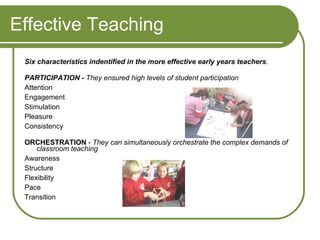
Effective Teaching Six characteristics indentified in the more effective early years teachers .   PARTICIPATION -   They ensured high levels of student participation Attention Engagement  Stimulation Pleasure Consistency  ORCHESTRATION  -  They can simultaneously orchestrate the complex demands of classroom teaching Awareness  Structure  Flexibility  Pace  Transition
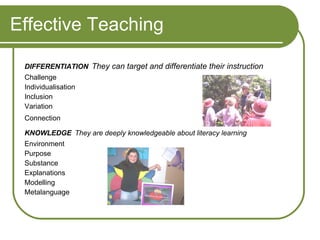
Effective Teaching DIFFERENTIATION   They can target and differentiate their instruction Challenge  Individualisation  Inclusion  Variation  Connection   KNOWLEDGE   They are deeply knowledgeable about literacy learning Environment Purpose Substance Explanations Modelling Metalanguage
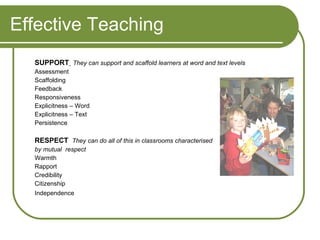
Effective Teaching SUPPORT   They can support and scaffold learners at word and text levels Assessment Scaffolding Feedback Responsiveness Explicitness – Word Explicitness – Text Persistence RESPECT  They can do all of this in classrooms characterised by mutual  respect Warmth Rapport Credibility Citizenship Independence
Learning Intentions WALT W e  A re  L earning  T o
Success Indicators Wilf W hat  I ’m  L ooking  F or
Reflection Tib T his  I s  B ecause
Intervention Programs Enhancing Reading Intervention for at Risk Students (ERIK) - University of  Melbourne and Catholic Education Office Melbourne Bridges ( Intervention )- Department of Education Tasmania Rainbow Reading (Intervention) Reading Recovery (Intervention) - Marie Clay Corrective Reading SRA (Intervention) Catch a Falling Star (Intervention) - Catholic Education Office Melbourne Children’s Literacy Success Strategy ( CLaSS ) University of Melbourne and Catholic Education Office Melbourne Science Research Associates SRA Reading Labs - McGraw Hill, Columbus , Ohio Curriculum Scientific Investigation ( CSI ) - Lioncrest STARS - Hawker Brownlow Education WA First Steps Early Years Department  of Education, Employment and Training Victoria. (Longman) MULTILIT  – Making Up for Lost Time in Literacy
Formal Assessment  Developmental Assessment Resources for Teachers (DART ) _ Australian Council for Education Research Progressive Achievement Tests in Reading (PAT-R ) -Australian Council for Educational Research Progressive Achievement Tests in Reading (PAT-R 4 ) Tests of Reading Comprehension (TORCH ) -Australian Council for Educational Research Neale Analysis of Reading Ability  - Australian Council for Educational Research Writing and Reading Assessment Profile (WRAP) - Probe Reading Assessment  - 2nd edition- Pool and Parkin, 2002, Triune Initiatives LEXILES CARS- Series B Teacher Guide 2006Hawker Brownlow Education Peter’s Dictation South Australian Spelling Test Read and Retell - Literacy Professional learning Resource – Assessment  On Demand Testing  -Education Department PM Benchmark Kit-  Nelleye & Smith 2000,nferNelson Observation Survey-  Marie Clay Assess Now
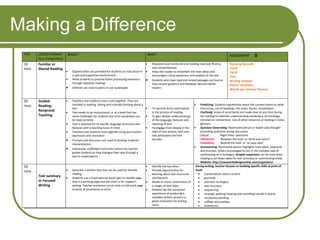
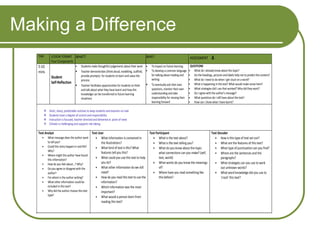
Making a Difference
Making a Difference
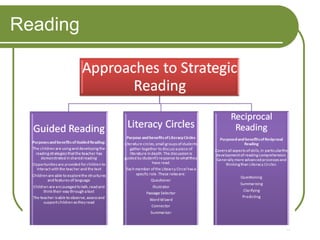
Reading
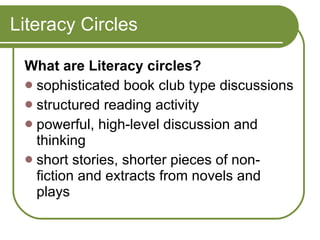
Literacy Circles What are Literacy circles? sophisticated book club type discussions  structured reading activity  powerful, high-level discussion and thinking  short stories, shorter pieces of non-fiction and extracts from novels and plays
Literacy Circles Students select, read and discuss their own texts connect with stories, articles, novels take responsibility as readers and group members construct meaning together begin to debate and challenge one another develop interpersonal skills develop higher order thinking skills develop reflective and met cognitive skills
Literacy Circles Group members  take specific responsibilities during discussion sessions.  meet regularly,  discussion roles change at each meeting. showcase their work for the rest of the class after finishing
Literacy Circles Roles  Questioner  writes questions that will lead to discussion by the group. Illustrator  uses some form of artwork to represent a significant scene or idea from the reading. Passage selector  points out interesting or important passages within the reading. Word wizard  discusses words in the text that are unusual, interesting, or difficult to understand. Connector  finds connections between the reading material and something outside the text,  Summariser  prepares a brief summary of the reading - the gist, key points, and the essence.
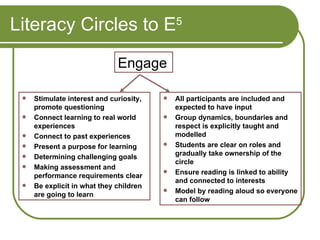
Literacy Circles to E 5 Engage Stimulate interest and curiosity, promote questioning  Connect learning to real world experiences Connect to past experiences Present a purpose for learning Determining challenging goals Making assessment and performance requirements clear Be explicit in what they children are going to learn All participants are included and expected to have input Group dynamics, boundaries and respect is explicitly taught and modelled Students are clear on roles and gradually take ownership of the circle Ensure reading is linked to ability and connected to interests Model by reading aloud so everyone can follow
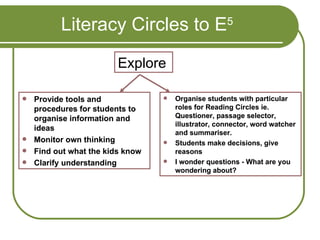
Literacy Circles to E 5 Explore Provide tools and procedures for students to organise information and ideas Monitor own thinking Find out what the kids know Clarify understanding Organise students with particular roles for Reading Circles ie. Questioner, passage selector, illustrator, connector, word watcher and summariser. Students make decisions, give reasons I wonder questions - What are you wondering about? Explore Provide tools and procedures for students to organise information and ideas Monitor own thinking Find out what the kids know Clarify understanding Organise students with particular roles for Reading Circles ie. Questioner, passage selector, illustrator, connector, word watcher and summariser. Students make decisions, give reasons I wonder questions - What are you wondering about?
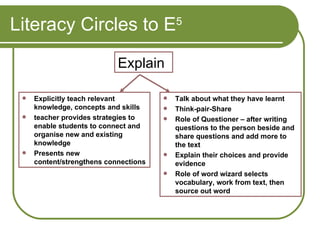
Literacy Circles to E 5 Explain Explicitly teach relevant knowledge, concepts and skills teacher provides strategies to enable students to connect and organise new and existing knowledge Presents new content/strengthens connections   Talk about what they have learnt Think-pair-Share Role of Questioner – after writing questions to the person beside and share questions and add more to the text Explain their choices and provide evidence Role of word wizard selects vocabulary, work from text, then source out word
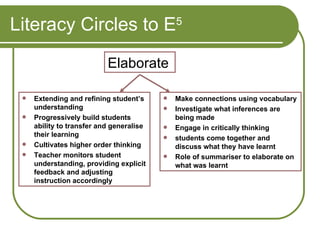
Literacy Circles to E 5 Elaborate Extending and refining student’s understanding Progressively build students ability to transfer and generalise their learning Cultivates higher order thinking Teacher monitors student understanding, providing explicit feedback and adjusting instruction accordingly   Make connections using vocabulary Investigate what inferences are being made Engage in critically thinking students come together and discuss what they have learnt  Role of summariser to elaborate on what was learnt
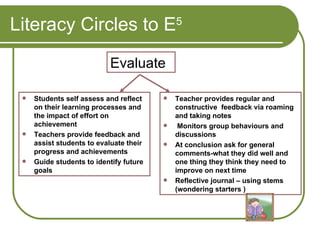
Literacy Circles to E 5 Evaluate Students self assess and reflect on their learning processes and the impact of effort on achievement Teachers provide feedback and assist students to evaluate their progress and achievements Guide students to identify future goals  Teacher provides regular and constructive  feedback via roaming and taking notes Monitors group behaviours and discussions At conclusion ask for general comments-what they did well and one thing they think they need to improve on next time Reflective journal – using stems  (wondering starters )
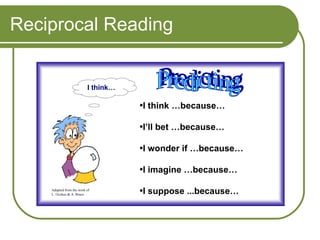
Reciprocal Reading I think …because… I’ll bet …because… I wonder if …because… I imagine …because… I suppose ...because… Predicting Adapted from the work of L. Oczkus & A. Bruce I think…
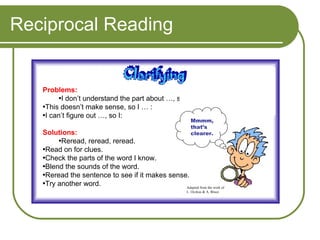
Reciprocal Reading Problems: I don’t understand the part about …, so I: This doesn’t make sense, so I … : I can’t figure out …, so I: Solutions: Reread, reread, reread. Read on for clues. Check the parts of the word I know. Blend the sounds of the word. Reread the sentence to see if it makes sense. Try another word. Mmmm, that’s  clearer. Adapted from the work of L. Oczkus & A. Bruce
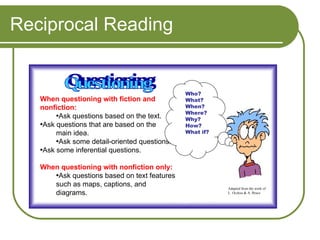
Reciprocal Reading When questioning with fiction and nonfiction: Ask questions based on the text. Ask questions that are based on the  main idea. Ask some detail-oriented questions. Ask some inferential questions. When questioning with nonfiction only: Ask questions based on text features such as maps, captions, and diagrams. Questioning Who? What? When? Where? Why? How? What if? Adapted from the work of L. Oczkus & A. Bruce
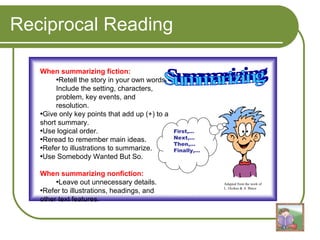
Reciprocal Reading When summarizing fiction: Retell the story in your own words. Include the setting, characters, problem, key events, and resolution. Give only key points that add up (+) to a short summary.  Use logical order. Reread to remember main ideas. Refer to illustrations to summarize. Use Somebody Wanted But So. When summarizing nonfiction: Leave out unnecessary details. Refer to illustrations, headings, and other text features. Summarizing First,… Next,… Then,… Finally,… Adapted from the work of L. Oczkus & A. Bruce
Guided Reading Purposes and benefits of guided reading using and developing the reading strategies  interact with the teacher and the text  exploration of the structures and features of language  talk, read and think their way through a text  observation, assessment and support
Guided Reading Suggested structure  Identify a suitable text and focus for the session ( individual copies of the book) text will be one that the children have not read before  Familiarise yourself with the text  Consider questions you will ask to support the children’s reading  Consider elements that will help children as they read
Guided Reading Independent reading  Each child reads independently at their own pace,  The teacher moves around the group, listening to individual children, prompting assessing understanding and progress
Guided Reading Early-finishers’ activities  Re-read the book  Read with a partner  Retell the story to a partner  Choose a favourite part or character  Identify the most interesting fact (nonfiction)  Identify words with particular spelling patterns eg double letter words; silent letters etc
Guided Reading Discussion  Share responses to the text  Focus on the children’s understanding
Guided Reading Teaching  Consolidate the children’s skills and strategies  Introduce new concepts, vocabulary, punctuation  Praise successful problem-solving and self-correction
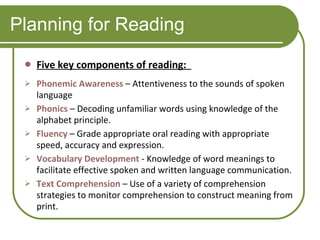
Planning for Reading Five key components of reading:  Phonemic Awareness   – Attentiveness to the sounds of spoken language Phonics   – Decoding unfamiliar words using knowledge of the alphabet principle.  Fluency   – Grade appropriate oral reading with appropriate speed, accuracy and expression. Vocabulary Development   - Knowledge of word meanings to facilitate effective spoken and written language communication. Text Comprehension   – Use of a variety of comprehension strategies to monitor comprehension to construct meaning from print.
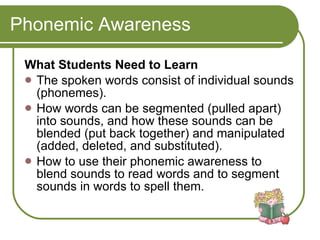
Phonemic Awareness What Students Need to Learn The spoken words consist of individual sounds (phonemes).  How words can be segmented (pulled apart) into sounds, and how these sounds can be blended (put back together) and manipulated (added, deleted, and substituted).  How to use their phonemic awareness to blend sounds to read words and to segment sounds in words to spell them.
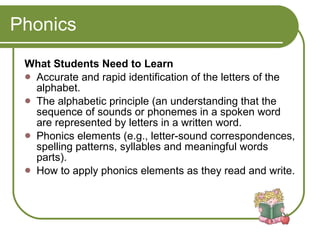
Phonics What Students Need to Learn Accurate and rapid identification of the letters of the alphabet.  The alphabetic principle (an understanding that the sequence of sounds or phonemes in a spoken word are represented by letters in a written word.  Phonics elements (e.g., letter-sound correspondences, spelling patterns, syllables and meaningful words parts).  How to apply phonics elements as they read and write.
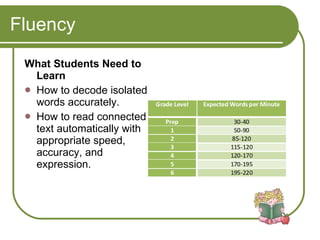
Fluency What Students Need to Learn How to decode isolated words accurately.  How to read connected text automatically with appropriate speed, accuracy, and expression.
Vocabulary Development What Students Need to Learn The meanings for most of the words in a text so they can understand what they read.  How to apply a variety of strategies to learn words meanings.  How to make connections between words and concepts.  How to accurately use words in oral and written language.
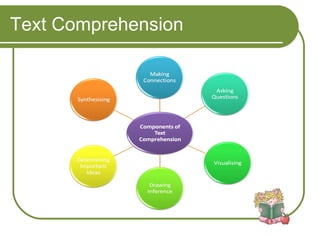
Text Comprehension
Conclusion OUR PROJECT based on anecdotal evidence  gathered from a variety of colleagues  drew on our own experiences as professional people who are close to the action.  carried out an extensive review of literature, particularly focussing on engaging struggling readers. looked at success factors for reading  used NAPLAN evidence to verify these state wide claims.
Investigate characteristics of a balanced literacy program detailed planning focussed teaching,  checking for understanding,  structuring lessons to maximise learning outcomes,  making connections and engaging students’ interests and backgrounds. Recommendations
Recommendations allow more opportunities for building teacher capacity  recognise and promote the educational benefits of the parent teacher partnership  identify and track low achieving students throughout their schooling  provide  additional assistance  embrace instructional leadership  provide student accountability and ownership of tasks and constructive, specific and targeted feedback

New TPL master

  • 1.
    Addressing the GapReading Interventions for Struggling Grade Three & Four Students
  • 2.
    Introduction Evidence ofdecline in reading achievement for some children around the age of 9-10 Few specialised interventions in place to address this systemic failure. Beyond Reading Recovery, these children face a lonely battle to succeed. There were attempts by committed teachers to personalise learning through focussed and targeted differentiation within their classrooms. Future data will provide further evidence as to whether this mainstream approach is able to effectively meet the needs of ‘at risk’ students.
  • 3.
    What are thesestudents like They are: a diverse group the majority are boys disengaged disruptive lack self-management strategies have low self efficacy have trouble with text books have trouble understanding in what is involved in tasks feel distrustful of teachers have a dependence of decoding absent a lot Extremely passive Lack initiative
  • 4.
    Fluent Vs ImpairedReaders Engaging Struggling Readers Left FMRI shows fluent reader: occipito-temporal region is activated, responsible for visual processing Right MRI shows dyslexic reader: more sounding out in Broca’s area in frontal lobe
  • 5.
    Overview ‘ Withouteffective, specialised help, they are doomed to school failure, illiteracy and severely limited life chances.’ (Clay, M.M., and Tuck, B. 1991) Our project was based on the philosophy that all children can learn given the ‘right’ conditions. addressed the needs of ‘hardest to teach’ students by linking effective teaching pedagogy with an understanding of the precise difficulties experienced by these children during their struggle to be competent readers. Believed the challenges of bringing about successful outcomes for these children is achievable and critical. Requires greater recognition by the educational system of the problem Challenges the system to invest knowledge and resources
  • 6.
    Acknowledgments Strengths thecommitment and collaboration of the team the generosity of the schools and colleagues we visited. access TPL (Teacher Professional Leave) which made our combined efforts possible We also thank our own schools and students for allowing us to be absent for the duration of our study.
  • 7.
    Thanks Schoolsvisited: Woodend -Andy Kozack and Bev Saddler New Gisborne – Suzanne Cooke and Jill Plumber Our Lady of the Rosary Kyneton – Anne Mildura South - Marie Therese O’Leary Irymple South - Robyn Gallagher Red Cliffs East – Kim Ryan Nichols Point – Jo McQuinn Holy Rosary Heathcote-Melanie Heathcote-Michael Saunders Spring Gully – Ann Rochford Camp Hill – Jill Scobie and Sue Prentice Tasmania-Louise Anders Speech Therapist: Christine Sertori SRA Rep: Di Mcpherson Lioncrest Rep: Liz Corrective Reading Tutor : Genevieve Hosking Regional Officers Sue Hinton Helen Bandrowski (Catholic Education)) Pam Toose Peter Nicolson Anne Smith Anne Baird John Walsh Rob Sbaglia Philip Holmes-Smith Tamara Downey Andrea Chalmers Yvonne Madden Trish Priest ERIK Tutors: Kim Cheep and Leonie NAPLAN Documentation: Kangaroo Flat – Brooke Benendick
  • 8.
    Proposal Majorfactors identified as negatively impacting on reading success for students in Grades 3 /4 Inconsistency in teaching practices Assessment Teacher Capacity Parental Involvement Student self-efficacy / engagement
  • 9.
    Inconsistency in teachingpractices Is evident by: Lack of Whole School agreement Can be Addressed by Establish a Professional and Development Culture Whole school Literacy Plan with levelled scope and sequence charts
  • 10.
    Assessment Isevident by: Insufficient provision of support Inadequate assessment materials Can be Addressed by Provision of appropriate diagnostic tools and support from administration Whole School assessment schedule
  • 11.
    Teacher Capacity Isevident by: Ineffective models of pedagogy Lack of differentiation Lack of support for intervention beyond grade one Lack of student accountability, task ownership and specific feedback Can be addressed by Opportunities to grow as a teacher in order to grow students Coaching and mentoring Targeted Professional Development Structured Professional Reading Instructional Leadership Teacher Professional Leave
  • 12.
    Parental Involvement Is evident by: Parents less visible at school Can be addressed by Parent education Parent involvement in classrooms with training Continued emphasis on parent / school partnerships Introduction Reading Writing Speaking & Listening
  • 13.
    Student self-efficacy /engagement Is evident by: Poor motivation and reluctance to read Can be addressed by Additional Support Accurate diagnostic assessment Targeted direct teaching and practice Teachers who engender a love of literacy in all students
  • 14.
    Effective Teaching Sixcharacteristics indentified in the more effective early years teachers . PARTICIPATION - They ensured high levels of student participation Attention Engagement Stimulation Pleasure Consistency ORCHESTRATION - They can simultaneously orchestrate the complex demands of classroom teaching Awareness Structure Flexibility Pace Transition
  • 15.
    Effective Teaching DIFFERENTIATION They can target and differentiate their instruction Challenge Individualisation Inclusion Variation Connection KNOWLEDGE They are deeply knowledgeable about literacy learning Environment Purpose Substance Explanations Modelling Metalanguage
  • 16.
    Effective Teaching SUPPORT They can support and scaffold learners at word and text levels Assessment Scaffolding Feedback Responsiveness Explicitness – Word Explicitness – Text Persistence RESPECT They can do all of this in classrooms characterised by mutual respect Warmth Rapport Credibility Citizenship Independence
  • 17.
    Learning Intentions WALTW e A re L earning T o
  • 18.
    Success Indicators WilfW hat I ’m L ooking F or
  • 19.
    Reflection Tib This I s B ecause
  • 20.
    Intervention Programs EnhancingReading Intervention for at Risk Students (ERIK) - University of Melbourne and Catholic Education Office Melbourne Bridges ( Intervention )- Department of Education Tasmania Rainbow Reading (Intervention) Reading Recovery (Intervention) - Marie Clay Corrective Reading SRA (Intervention) Catch a Falling Star (Intervention) - Catholic Education Office Melbourne Children’s Literacy Success Strategy ( CLaSS ) University of Melbourne and Catholic Education Office Melbourne Science Research Associates SRA Reading Labs - McGraw Hill, Columbus , Ohio Curriculum Scientific Investigation ( CSI ) - Lioncrest STARS - Hawker Brownlow Education WA First Steps Early Years Department of Education, Employment and Training Victoria. (Longman) MULTILIT – Making Up for Lost Time in Literacy
  • 21.
    Formal Assessment Developmental Assessment Resources for Teachers (DART ) _ Australian Council for Education Research Progressive Achievement Tests in Reading (PAT-R ) -Australian Council for Educational Research Progressive Achievement Tests in Reading (PAT-R 4 ) Tests of Reading Comprehension (TORCH ) -Australian Council for Educational Research Neale Analysis of Reading Ability - Australian Council for Educational Research Writing and Reading Assessment Profile (WRAP) - Probe Reading Assessment - 2nd edition- Pool and Parkin, 2002, Triune Initiatives LEXILES CARS- Series B Teacher Guide 2006Hawker Brownlow Education Peter’s Dictation South Australian Spelling Test Read and Retell - Literacy Professional learning Resource – Assessment On Demand Testing -Education Department PM Benchmark Kit- Nelleye & Smith 2000,nferNelson Observation Survey- Marie Clay Assess Now
  • 22.
  • 23.
  • 24.
  • 25.
    Literacy Circles Whatare Literacy circles? sophisticated book club type discussions structured reading activity powerful, high-level discussion and thinking short stories, shorter pieces of non-fiction and extracts from novels and plays
  • 26.
    Literacy Circles Studentsselect, read and discuss their own texts connect with stories, articles, novels take responsibility as readers and group members construct meaning together begin to debate and challenge one another develop interpersonal skills develop higher order thinking skills develop reflective and met cognitive skills
  • 27.
    Literacy Circles Groupmembers take specific responsibilities during discussion sessions. meet regularly, discussion roles change at each meeting. showcase their work for the rest of the class after finishing
  • 28.
    Literacy Circles Roles Questioner writes questions that will lead to discussion by the group. Illustrator uses some form of artwork to represent a significant scene or idea from the reading. Passage selector points out interesting or important passages within the reading. Word wizard discusses words in the text that are unusual, interesting, or difficult to understand. Connector finds connections between the reading material and something outside the text, Summariser prepares a brief summary of the reading - the gist, key points, and the essence.
  • 29.
    Literacy Circles toE 5 Engage Stimulate interest and curiosity, promote questioning Connect learning to real world experiences Connect to past experiences Present a purpose for learning Determining challenging goals Making assessment and performance requirements clear Be explicit in what they children are going to learn All participants are included and expected to have input Group dynamics, boundaries and respect is explicitly taught and modelled Students are clear on roles and gradually take ownership of the circle Ensure reading is linked to ability and connected to interests Model by reading aloud so everyone can follow
  • 30.
    Literacy Circles toE 5 Explore Provide tools and procedures for students to organise information and ideas Monitor own thinking Find out what the kids know Clarify understanding Organise students with particular roles for Reading Circles ie. Questioner, passage selector, illustrator, connector, word watcher and summariser. Students make decisions, give reasons I wonder questions - What are you wondering about? Explore Provide tools and procedures for students to organise information and ideas Monitor own thinking Find out what the kids know Clarify understanding Organise students with particular roles for Reading Circles ie. Questioner, passage selector, illustrator, connector, word watcher and summariser. Students make decisions, give reasons I wonder questions - What are you wondering about?
  • 31.
    Literacy Circles toE 5 Explain Explicitly teach relevant knowledge, concepts and skills teacher provides strategies to enable students to connect and organise new and existing knowledge Presents new content/strengthens connections Talk about what they have learnt Think-pair-Share Role of Questioner – after writing questions to the person beside and share questions and add more to the text Explain their choices and provide evidence Role of word wizard selects vocabulary, work from text, then source out word
  • 32.
    Literacy Circles toE 5 Elaborate Extending and refining student’s understanding Progressively build students ability to transfer and generalise their learning Cultivates higher order thinking Teacher monitors student understanding, providing explicit feedback and adjusting instruction accordingly Make connections using vocabulary Investigate what inferences are being made Engage in critically thinking students come together and discuss what they have learnt Role of summariser to elaborate on what was learnt
  • 33.
    Literacy Circles toE 5 Evaluate Students self assess and reflect on their learning processes and the impact of effort on achievement Teachers provide feedback and assist students to evaluate their progress and achievements Guide students to identify future goals Teacher provides regular and constructive feedback via roaming and taking notes Monitors group behaviours and discussions At conclusion ask for general comments-what they did well and one thing they think they need to improve on next time Reflective journal – using stems (wondering starters )
  • 34.
    Reciprocal Reading Ithink …because… I’ll bet …because… I wonder if …because… I imagine …because… I suppose ...because… Predicting Adapted from the work of L. Oczkus & A. Bruce I think…
  • 35.
    Reciprocal Reading Problems:I don’t understand the part about …, so I: This doesn’t make sense, so I … : I can’t figure out …, so I: Solutions: Reread, reread, reread. Read on for clues. Check the parts of the word I know. Blend the sounds of the word. Reread the sentence to see if it makes sense. Try another word. Mmmm, that’s clearer. Adapted from the work of L. Oczkus & A. Bruce
  • 36.
    Reciprocal Reading Whenquestioning with fiction and nonfiction: Ask questions based on the text. Ask questions that are based on the main idea. Ask some detail-oriented questions. Ask some inferential questions. When questioning with nonfiction only: Ask questions based on text features such as maps, captions, and diagrams. Questioning Who? What? When? Where? Why? How? What if? Adapted from the work of L. Oczkus & A. Bruce
  • 37.
    Reciprocal Reading Whensummarizing fiction: Retell the story in your own words. Include the setting, characters, problem, key events, and resolution. Give only key points that add up (+) to a short summary. Use logical order. Reread to remember main ideas. Refer to illustrations to summarize. Use Somebody Wanted But So. When summarizing nonfiction: Leave out unnecessary details. Refer to illustrations, headings, and other text features. Summarizing First,… Next,… Then,… Finally,… Adapted from the work of L. Oczkus & A. Bruce
  • 38.
    Guided Reading Purposesand benefits of guided reading using and developing the reading strategies interact with the teacher and the text exploration of the structures and features of language talk, read and think their way through a text observation, assessment and support
  • 39.
    Guided Reading Suggestedstructure Identify a suitable text and focus for the session ( individual copies of the book) text will be one that the children have not read before Familiarise yourself with the text Consider questions you will ask to support the children’s reading Consider elements that will help children as they read
  • 40.
    Guided Reading Independentreading Each child reads independently at their own pace, The teacher moves around the group, listening to individual children, prompting assessing understanding and progress
  • 41.
    Guided Reading Early-finishers’activities Re-read the book Read with a partner Retell the story to a partner Choose a favourite part or character Identify the most interesting fact (nonfiction) Identify words with particular spelling patterns eg double letter words; silent letters etc
  • 42.
    Guided Reading Discussion Share responses to the text Focus on the children’s understanding
  • 43.
    Guided Reading Teaching Consolidate the children’s skills and strategies Introduce new concepts, vocabulary, punctuation Praise successful problem-solving and self-correction
  • 44.
    Planning for ReadingFive key components of reading: Phonemic Awareness – Attentiveness to the sounds of spoken language Phonics – Decoding unfamiliar words using knowledge of the alphabet principle. Fluency – Grade appropriate oral reading with appropriate speed, accuracy and expression. Vocabulary Development - Knowledge of word meanings to facilitate effective spoken and written language communication. Text Comprehension – Use of a variety of comprehension strategies to monitor comprehension to construct meaning from print.
  • 45.
    Phonemic Awareness WhatStudents Need to Learn The spoken words consist of individual sounds (phonemes). How words can be segmented (pulled apart) into sounds, and how these sounds can be blended (put back together) and manipulated (added, deleted, and substituted). How to use their phonemic awareness to blend sounds to read words and to segment sounds in words to spell them.
  • 46.
    Phonics What StudentsNeed to Learn Accurate and rapid identification of the letters of the alphabet. The alphabetic principle (an understanding that the sequence of sounds or phonemes in a spoken word are represented by letters in a written word. Phonics elements (e.g., letter-sound correspondences, spelling patterns, syllables and meaningful words parts). How to apply phonics elements as they read and write.
  • 47.
    Fluency What StudentsNeed to Learn How to decode isolated words accurately. How to read connected text automatically with appropriate speed, accuracy, and expression.
  • 48.
    Vocabulary Development WhatStudents Need to Learn The meanings for most of the words in a text so they can understand what they read. How to apply a variety of strategies to learn words meanings. How to make connections between words and concepts. How to accurately use words in oral and written language.
  • 49.
  • 50.
    Conclusion OUR PROJECTbased on anecdotal evidence gathered from a variety of colleagues drew on our own experiences as professional people who are close to the action. carried out an extensive review of literature, particularly focussing on engaging struggling readers. looked at success factors for reading used NAPLAN evidence to verify these state wide claims.
  • 51.
    Investigate characteristics ofa balanced literacy program detailed planning focussed teaching, checking for understanding, structuring lessons to maximise learning outcomes, making connections and engaging students’ interests and backgrounds. Recommendations
  • 52.
    Recommendations allow moreopportunities for building teacher capacity recognise and promote the educational benefits of the parent teacher partnership identify and track low achieving students throughout their schooling provide additional assistance embrace instructional leadership provide student accountability and ownership of tasks and constructive, specific and targeted feedback