Childhood
Obesity
Moderators -
Dr Pradeep
Dr Prashanth
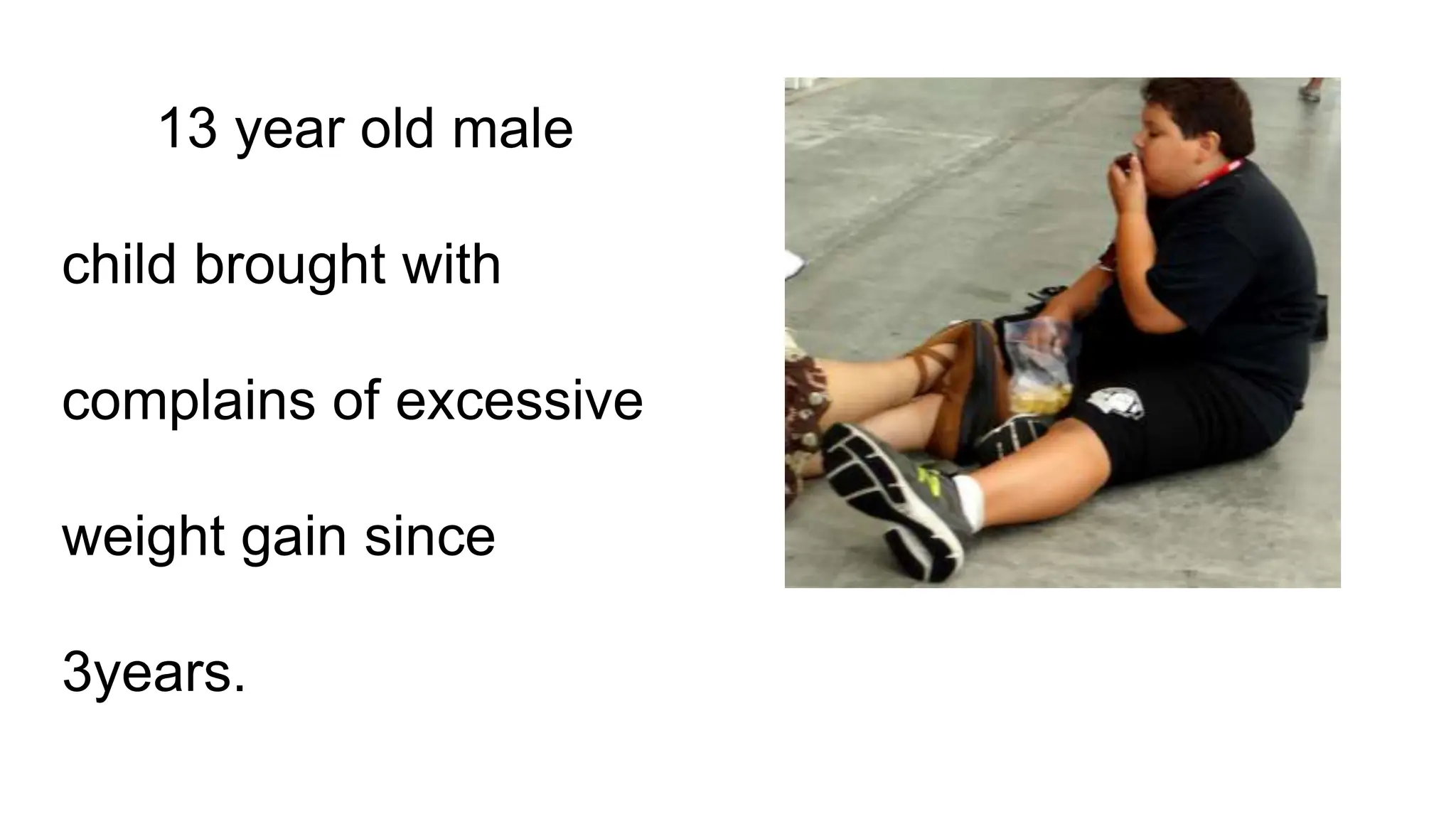
13 year old male
child brought with
complains of excessive
weight gain since
3years.
On examination, Weight is 50kg and height 138cm with
BMI 26.2 kg/m2. How will you evaluate?
What is obesity?
BMI
● 85th to 95th centile - overweight
● >95th centile - obese
● Weight for height (weight for length): Till 2 years of
age (>97.7th percentile suggest obesity).
Majority (~98%) do not have a pathological cause (exogenous
or constitutional obesity).
● Exogenous obesity: Normal growth, development, and
puberty are suggestive.
● Monogenic obesity: Early-onset obesity (before 5 years of
age) with extreme hyperphagia (food-seeking behavior-
stealing food, eating food leftover by others; impaired
satiety).
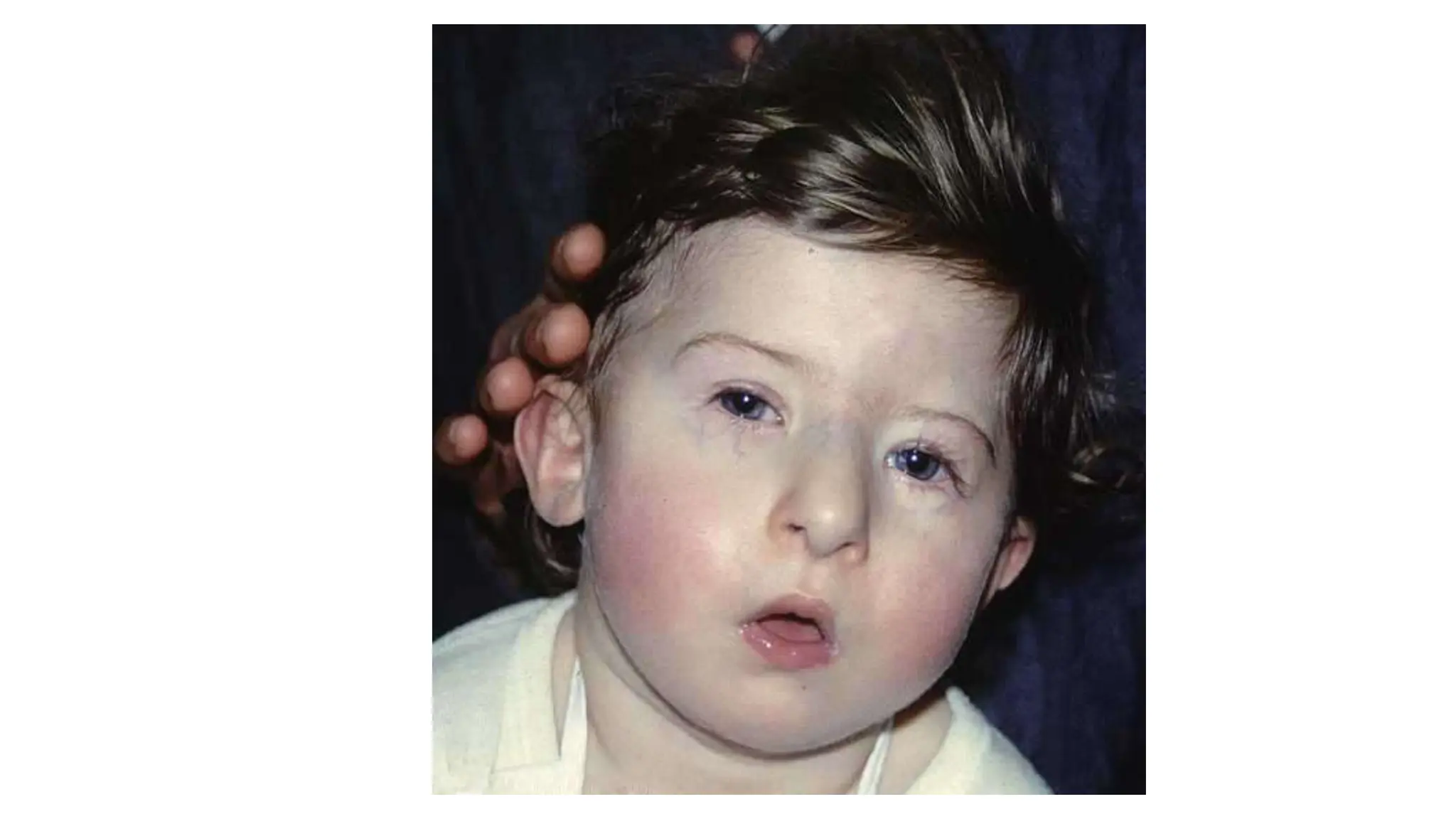
● Obesity syndromes:Distinct features (abnormal facies,
digits, vision) and systemic involvement, with hyperphagia.
● Hypothalamic obesity: Neurological features (headache,
irritability, seizures) and/or neuro-logical insult with rapid
weight gain, hyperphagia. Neuroimaging is essential to
identify a hypothalamic lesion.
● Drug-induced obesity: Associated with glucocorticoids,
antipsychotics (risperidone and olanzapine), and antiepileptic
drugs (valproate and carbamazepine).
● Endocrine causes (hypothyroidism, Cushing syndrome,
pseudohypoparathyroidism). Associated short stature is the
hallmark of underlying endocrine cause.
History -
A family history of any of the following is an indication to
screen for dyslipidemia.
• Either parent, grandparent, aunt, uncle or sibling aged < 55
years (males) and < 65 years (females) having any of these:
myocardial infarction, stroke, angina, coronary artery by-pass,
stent, angioplasty or sudden cardiac death
• Parents with total cholesterol > 240 mg/dL or known lipid
abnormalities in parents.
Antenatal and perinatal history.
● High preconcetional weight
● Maternal smoking
● IUGR
● What is thrifty gene hypothesis?
Diet history
● 24h dietary recall
Special attention to intake of fruits,
vegetables and water, as well as high
caloric food and high carbohydrate beverages.
General physical examination-
Vitals
● Blood pressure
Anthropometry
● Weight for age
● Height for age
● BMI
Hypertension in obesity is multifactorial
● altered renal sodium handling
● increased systemic vascular resistance
● activation of the sympathetic nervous system
Body mass index-
It is an age independent index.
● Erroneous diagnosis of obesity in
short stature.
● It cannot locate the site of fat.
● It cannot differentiate between obese and muscular.
● Lower reliability in pubertal age.
Skin fold thickness
● It measures body fat %.
Disadvantages
● Significant inter and intra
observer variation.
● Affected by gender and
ethnicity.
● No Indian reference data.
● No significant advantage
over BMI
Waist circumference
● Highly sensitive and specific for
central obesity.
● Cutoff - 102cm for adult males
88cm for adult females
71cm for prepubertal
children
● No Indian data.
It must be measured with a stretch resistant tape, applied
horizontally just above the upper lateral border of right ileum at
the end of normal expiration and recorded to the nearest 0.1 cm.
Waist - Hip ratio
● >0.95 in males and >0.8 in females shows significant
health risk.
Head to toe examination
One must examine the adolescent for features of
complications of obesity like insulin resistance
● acanthosis nigricans
● skin tags and
● furunculosis
● tonsillar enlargement and typical facies of obstructive sleep
apnea syndrome (OSAS)
● hepatomegaly (fatty liver in non-alcoholic fatty
liver disease - NAFLD)
● abnormal gait (slipped capital femoral epiphyses)
papilledema and VI cranial nerve palsy (pseudotumor cerebri).
● Tanner staging and Examine all adolescents for pubertal
gynecomastia (resulting from increased estrogen levels from
aromatase in adipose tissue).
● One must look for features of an underlying endocrinopathy
like goitre and delayed relaxation of reflexes (hypothyroidism)
● abdominal striae and truncal obesity (Cushing's disease)
● midline defects and cherubic facies (GH deficiency)
● short 3rd and 4th metacarpals (pseudohypoparathyroidism).
● optic fundus features of retinitis pigmentosa and polydactyly
(Bardet Biedl syndrome).
Investigations
Step-1:
The endocrine society recommends endocrine work-up of
obesity, only, if the height velocity is attenuated with respect to
the family or pubertal status OR child has markers of specific
endocrine dysfunction.
Commonly recommended screening tests include
● a fasting thyroid profile (Free T4 and TSH)
● overnight dexamethasone suppression test (ONDST)
(Cushing's disease screen).
Step-2:
● All overweight and obese adolescents must have their
fasting blood sugar, liver function test and fasting lipid
profile estimated.
A practical definition of adolescent metabolic syndrome is
the presence of three out of the following five criteria:
1. Abdominal obesity (waist circumference >90th percentile)
2. Hyper-triglyceridemia ≥ 110 mg/dL
3. High density lipoprotein (HDL) cholesterol ≤ 40 mg/dL
4. Blood pressure ≥ 90th percentile according to age, gender
and height
Step-3:
Adolescents, classified to have metabolic syndrome, or, with
even one of the five criteria positive or clinical features of insulin
resistance, need to undergo a detailed evaluation of the
metabolic profile
Management
● Behaviour changes
● Appropriate calorie intake
Prevention
● Exclusive breastfeeding till 6 months of age.
● Regular meal timings, including breakfast.
● At-least 7–8 hours of sleep daily at night.
● Lifestyle intervention should precede and should be
maintained during pharmacotherapy.
Obesity prevention guidelines from American Academy of
Pediatrics recommend Fight Childhood Obesity by ‘5-2-1-0’ rule .
Accordingly, children can consume above 5 servings of fruits and
vegetables, screen time below 2 hours, participate in one hour of
physical activity, and consume 0 sugar-sweetened beverages
daily.
Targets
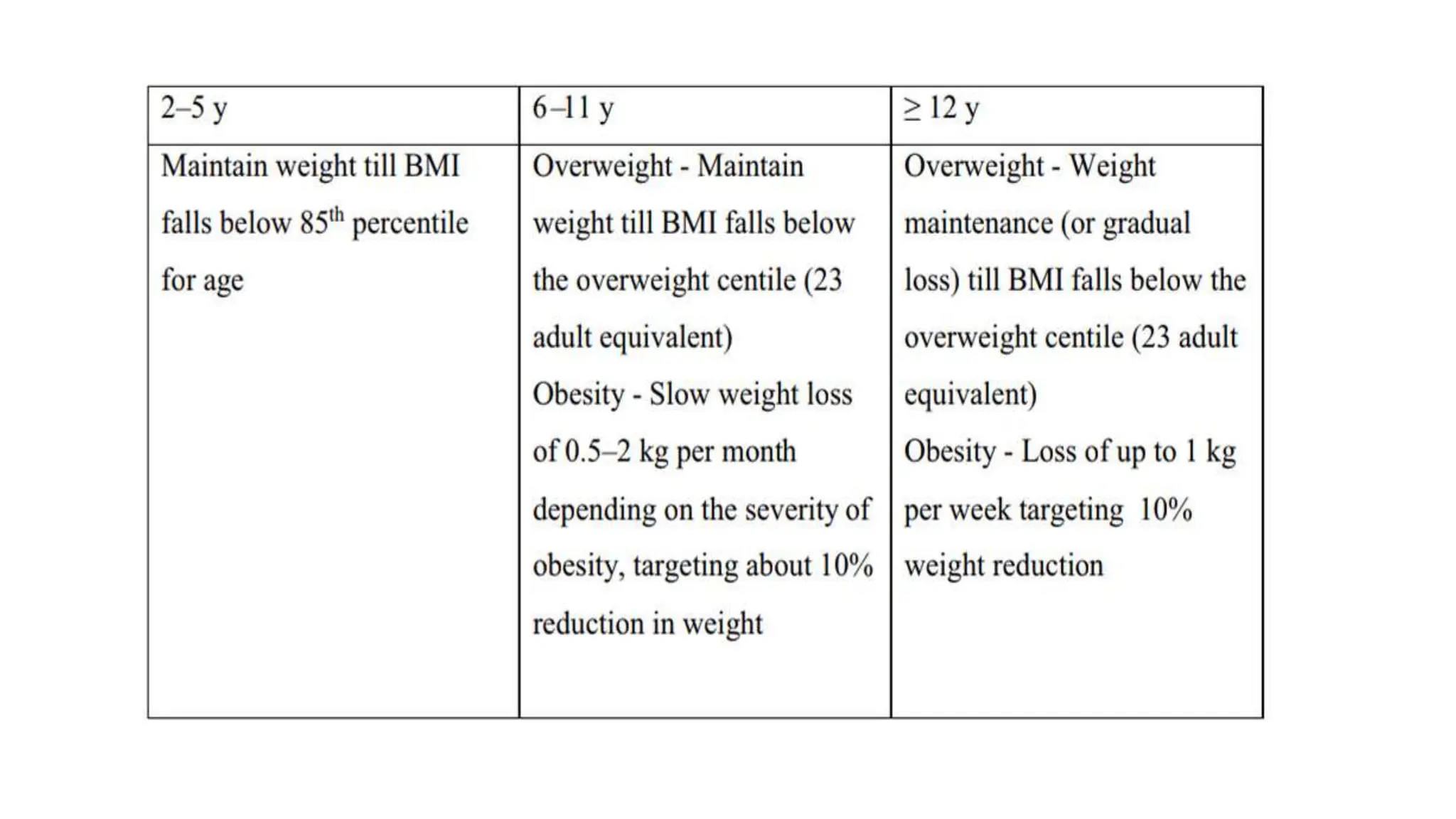
● Gradual and sustained loss.
● Body mass index (BMI) SD score (SDS) reduction of 5%
roughly translating to 7–10% weight loss over 6 months.
● Avoid loss over 1.5 kg per month.
● Pharmacotherapy
1. Phentermine
1. Orlistat
1. Locaserin
1. Liraglutide
Metformin:
Approved in Type 2 DM after 8 years of age. May consider in
causes related to antipsychotic medication, polycystic ovarian
disease, and steatohepatitis.
Surgery -
● Should be discouraged as it carries more significant
complications than adults.
● Indicated only with severe obesity (BMI >40 kg/m2 or >35
kg/m2 with complications) and only after completion of
linear growth.
● A multidisciplinary obesity team with long-term follow-up is
essential to maintain compliance with nutritional
recommendations.
● Extreme motivation, strict diet, and activity schedule must
be maintained after surgery.
Complications
● Malabsorption
● Vitamin deficiency
● Mineral deficiency
Pediatric obesity and its related complications.pptx

Pediatric obesity and its related complications.pptx

  • 1.
  • 2.
    13 year oldmale child brought with complains of excessive weight gain since 3years.
  • 3.
    On examination, Weightis 50kg and height 138cm with BMI 26.2 kg/m2. How will you evaluate?
  • 5.
  • 6.
    BMI ● 85th to95th centile - overweight ● >95th centile - obese ● Weight for height (weight for length): Till 2 years of age (>97.7th percentile suggest obesity).
  • 8.
    Majority (~98%) donot have a pathological cause (exogenous or constitutional obesity). ● Exogenous obesity: Normal growth, development, and puberty are suggestive. ● Monogenic obesity: Early-onset obesity (before 5 years of age) with extreme hyperphagia (food-seeking behavior- stealing food, eating food leftover by others; impaired satiety). ● Obesity syndromes:Distinct features (abnormal facies, digits, vision) and systemic involvement, with hyperphagia.
  • 12.
    ● Hypothalamic obesity:Neurological features (headache, irritability, seizures) and/or neuro-logical insult with rapid weight gain, hyperphagia. Neuroimaging is essential to identify a hypothalamic lesion. ● Drug-induced obesity: Associated with glucocorticoids, antipsychotics (risperidone and olanzapine), and antiepileptic drugs (valproate and carbamazepine). ● Endocrine causes (hypothyroidism, Cushing syndrome, pseudohypoparathyroidism). Associated short stature is the hallmark of underlying endocrine cause.
  • 13.
  • 16.
    A family historyof any of the following is an indication to screen for dyslipidemia. • Either parent, grandparent, aunt, uncle or sibling aged < 55 years (males) and < 65 years (females) having any of these: myocardial infarction, stroke, angina, coronary artery by-pass, stent, angioplasty or sudden cardiac death • Parents with total cholesterol > 240 mg/dL or known lipid abnormalities in parents.
  • 17.
    Antenatal and perinatalhistory. ● High preconcetional weight ● Maternal smoking ● IUGR ● What is thrifty gene hypothesis?
  • 18.
    Diet history ● 24hdietary recall Special attention to intake of fruits, vegetables and water, as well as high caloric food and high carbohydrate beverages.
  • 19.
    General physical examination- Vitals ●Blood pressure Anthropometry ● Weight for age ● Height for age ● BMI
  • 20.
    Hypertension in obesityis multifactorial ● altered renal sodium handling ● increased systemic vascular resistance ● activation of the sympathetic nervous system
  • 21.
    Body mass index- Itis an age independent index. ● Erroneous diagnosis of obesity in short stature. ● It cannot locate the site of fat. ● It cannot differentiate between obese and muscular. ● Lower reliability in pubertal age.
  • 25.
    Skin fold thickness ●It measures body fat %. Disadvantages ● Significant inter and intra observer variation. ● Affected by gender and ethnicity. ● No Indian reference data. ● No significant advantage over BMI
  • 26.
    Waist circumference ● Highlysensitive and specific for central obesity. ● Cutoff - 102cm for adult males 88cm for adult females 71cm for prepubertal children ● No Indian data.
  • 27.
    It must bemeasured with a stretch resistant tape, applied horizontally just above the upper lateral border of right ileum at the end of normal expiration and recorded to the nearest 0.1 cm.
  • 28.
    Waist - Hipratio ● >0.95 in males and >0.8 in females shows significant health risk.
  • 30.
    Head to toeexamination One must examine the adolescent for features of complications of obesity like insulin resistance ● acanthosis nigricans ● skin tags and ● furunculosis
  • 31.
    ● tonsillar enlargementand typical facies of obstructive sleep apnea syndrome (OSAS) ● hepatomegaly (fatty liver in non-alcoholic fatty liver disease - NAFLD) ● abnormal gait (slipped capital femoral epiphyses) papilledema and VI cranial nerve palsy (pseudotumor cerebri). ● Tanner staging and Examine all adolescents for pubertal gynecomastia (resulting from increased estrogen levels from aromatase in adipose tissue).
  • 32.
    ● One mustlook for features of an underlying endocrinopathy like goitre and delayed relaxation of reflexes (hypothyroidism) ● abdominal striae and truncal obesity (Cushing's disease) ● midline defects and cherubic facies (GH deficiency) ● short 3rd and 4th metacarpals (pseudohypoparathyroidism). ● optic fundus features of retinitis pigmentosa and polydactyly (Bardet Biedl syndrome).
  • 35.
    Investigations Step-1: The endocrine societyrecommends endocrine work-up of obesity, only, if the height velocity is attenuated with respect to the family or pubertal status OR child has markers of specific endocrine dysfunction.
  • 36.
    Commonly recommended screeningtests include ● a fasting thyroid profile (Free T4 and TSH) ● overnight dexamethasone suppression test (ONDST) (Cushing's disease screen).
  • 37.
    Step-2: ● All overweightand obese adolescents must have their fasting blood sugar, liver function test and fasting lipid profile estimated.
  • 38.
    A practical definitionof adolescent metabolic syndrome is the presence of three out of the following five criteria: 1. Abdominal obesity (waist circumference >90th percentile) 2. Hyper-triglyceridemia ≥ 110 mg/dL 3. High density lipoprotein (HDL) cholesterol ≤ 40 mg/dL 4. Blood pressure ≥ 90th percentile according to age, gender and height
  • 40.
    Step-3: Adolescents, classified tohave metabolic syndrome, or, with even one of the five criteria positive or clinical features of insulin resistance, need to undergo a detailed evaluation of the metabolic profile
  • 46.
    Management ● Behaviour changes ●Appropriate calorie intake
  • 47.
    Prevention ● Exclusive breastfeedingtill 6 months of age. ● Regular meal timings, including breakfast. ● At-least 7–8 hours of sleep daily at night. ● Lifestyle intervention should precede and should be maintained during pharmacotherapy.
  • 49.
    Obesity prevention guidelinesfrom American Academy of Pediatrics recommend Fight Childhood Obesity by ‘5-2-1-0’ rule . Accordingly, children can consume above 5 servings of fruits and vegetables, screen time below 2 hours, participate in one hour of physical activity, and consume 0 sugar-sweetened beverages daily.
  • 50.
    Targets ● Gradual andsustained loss. ● Body mass index (BMI) SD score (SDS) reduction of 5% roughly translating to 7–10% weight loss over 6 months. ● Avoid loss over 1.5 kg per month.
  • 51.
    ● Pharmacotherapy 1. Phentermine 1.Orlistat 1. Locaserin 1. Liraglutide
  • 52.
    Metformin: Approved in Type2 DM after 8 years of age. May consider in causes related to antipsychotic medication, polycystic ovarian disease, and steatohepatitis.
  • 53.
    Surgery - ● Shouldbe discouraged as it carries more significant complications than adults. ● Indicated only with severe obesity (BMI >40 kg/m2 or >35 kg/m2 with complications) and only after completion of linear growth. ● A multidisciplinary obesity team with long-term follow-up is essential to maintain compliance with nutritional recommendations. ● Extreme motivation, strict diet, and activity schedule must be maintained after surgery.
  • 54.
    Complications ● Malabsorption ● Vitamindeficiency ● Mineral deficiency