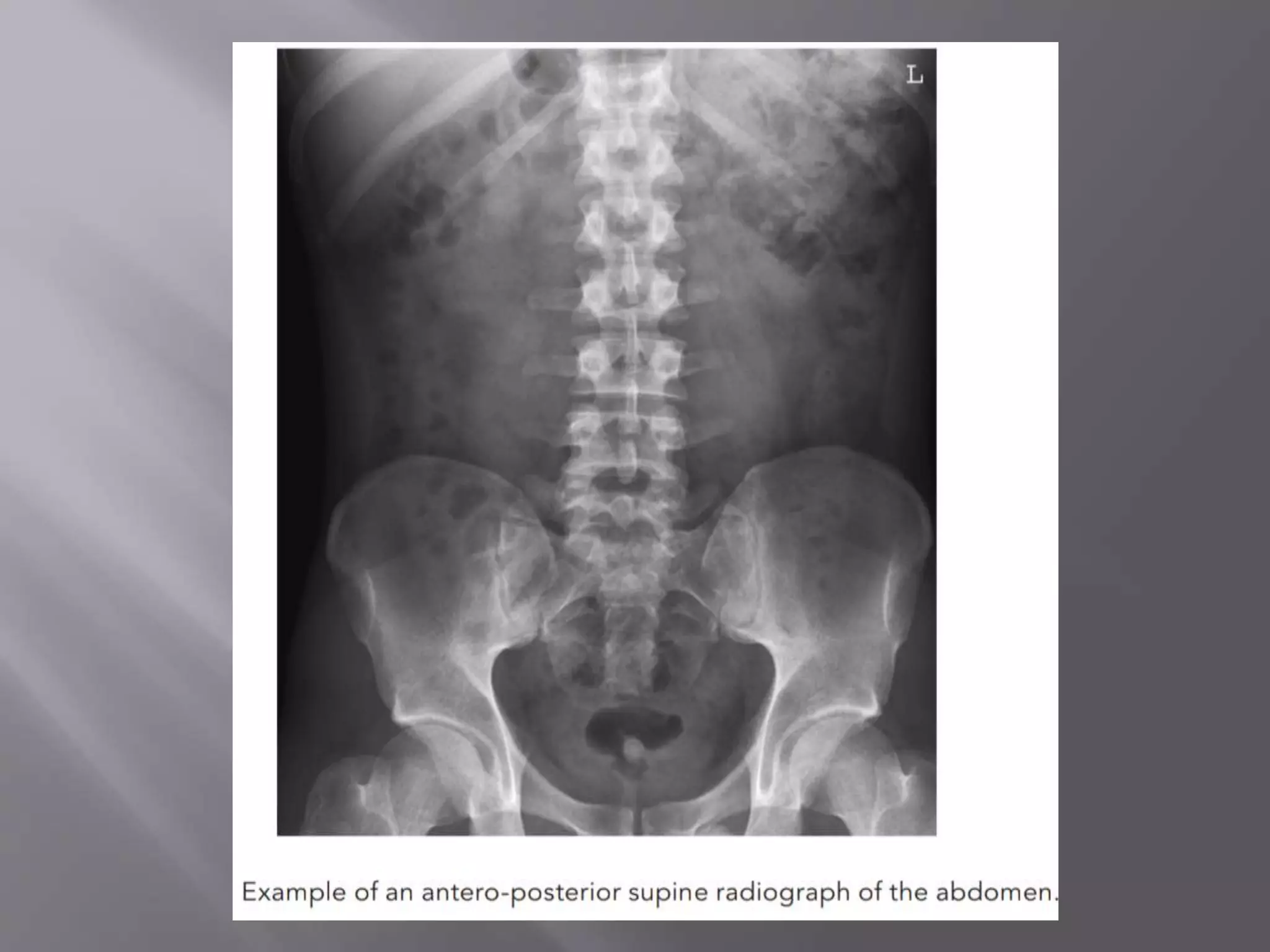
 Lies supine on the imaging table
 Median sagittal plane at right angle and
coincident with the midline of table.
 Pelvis – anterior superior iliac spine equidistant
from table top.
 If a computed radiography casette is selected, it
is placed longitudinally in the casette tray &
positioned so that the region below symphysis
pubis is included on the lower margin of image
 The centre of the image receptor will be
approximately at the level of a point located
1cm below the line joining the iliac crests.
 This will ensure that the region inferior to
pubic symphysis is included on the image.
 The collimated vertical beam is directed to the
centre of the image receptor to include the lateral
margins of abdomen.
 Using a short exposure time the exposure is made
on arrested respiration.
 Ideally, respiration should be arrested on full
expiration to allow the abdominal contents to lie in
their natural position.
 Depending on patient’s height, respiration may
need to be arrested on full inspiration to include the
whole abdomen.
 The bowel pattern should be demonstrated
with minimal lack of sharpness.
 In case of a large abdomen an immobilisation
or compression band maybe applied to reduce
the dose to the patient as well as the negative
effect of scatter on image quality.
 If required, two images can be taken in
landscape mode to ensure the coverge.
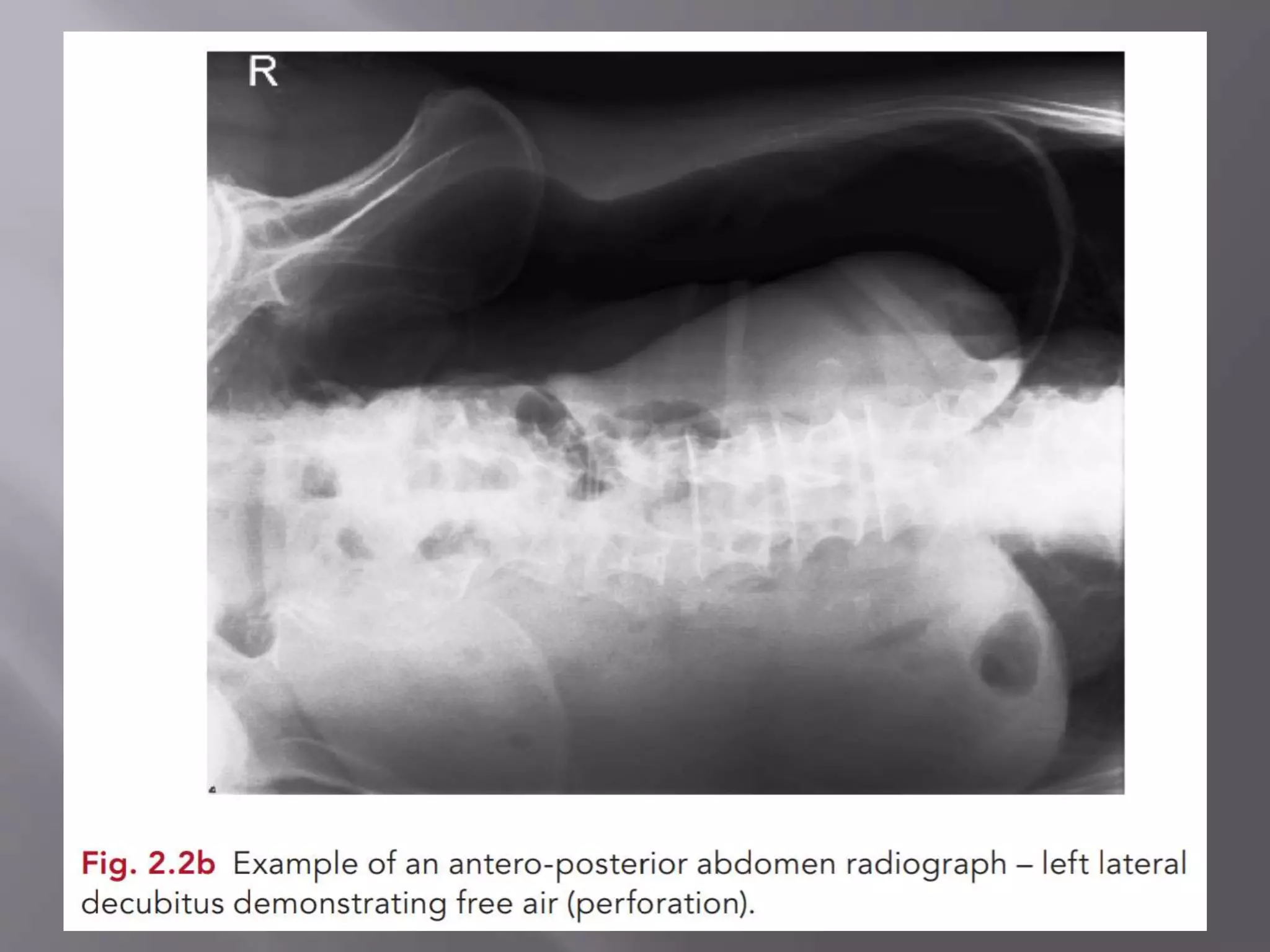
 This projection is used if the patient cannot be
positioned erect for a chest x ray & is required
to confirm the presence of sub diaphragmatic
air.
 Only when other modalities like USG or CT
cannot be used.
 May also used for bowel obstruction.
 The patient lies on their left side on a trolly or a
bed with their elbows and arms flexed so that
the hands can rest near the patient’s head.
 The patient is positioned with the posterior
aspect of the trunk against a vertical Bucky
Direct Digital Radiography system with the
upper border of the image receptor high
enough to project above the right lateral
abdominal and thorasic walls.
 Alternatively, a 35*43cm CR grid casette is
supported vertically against the patient’s back.
 When the patient lying on the left side, free gas
will rise to be located between the lateral
margin of the liver & right lateral abdominal
wall.
 Before the exposure is made ,the patient should
remain lying on left side for a short period -
10min to allow the gas to collect .
 The image receptor is positioned at right angles
to the median sagittal plane of the patient.
 The collimated horizontal central beam is
directed to the anterior aspect of the patient
and centred on the centre of image receptor.
 The lateral abdominal wall and costophrenic
angle of right lung must be included with the
patient resting on their left side for minimum
10 min. prior to exposure.
Abdominal x ray- views.pptx

Abdominal x ray- views.pptx

  • 3.
     Lies supineon the imaging table  Median sagittal plane at right angle and coincident with the midline of table.  Pelvis – anterior superior iliac spine equidistant from table top.  If a computed radiography casette is selected, it is placed longitudinally in the casette tray & positioned so that the region below symphysis pubis is included on the lower margin of image
  • 5.
     The centreof the image receptor will be approximately at the level of a point located 1cm below the line joining the iliac crests.  This will ensure that the region inferior to pubic symphysis is included on the image.
  • 6.
     The collimatedvertical beam is directed to the centre of the image receptor to include the lateral margins of abdomen.  Using a short exposure time the exposure is made on arrested respiration.  Ideally, respiration should be arrested on full expiration to allow the abdominal contents to lie in their natural position.  Depending on patient’s height, respiration may need to be arrested on full inspiration to include the whole abdomen.
  • 7.
     The bowelpattern should be demonstrated with minimal lack of sharpness.
  • 8.
     In caseof a large abdomen an immobilisation or compression band maybe applied to reduce the dose to the patient as well as the negative effect of scatter on image quality.  If required, two images can be taken in landscape mode to ensure the coverge.
  • 11.
     This projectionis used if the patient cannot be positioned erect for a chest x ray & is required to confirm the presence of sub diaphragmatic air.  Only when other modalities like USG or CT cannot be used.  May also used for bowel obstruction.
  • 12.
     The patientlies on their left side on a trolly or a bed with their elbows and arms flexed so that the hands can rest near the patient’s head.  The patient is positioned with the posterior aspect of the trunk against a vertical Bucky Direct Digital Radiography system with the upper border of the image receptor high enough to project above the right lateral abdominal and thorasic walls.  Alternatively, a 35*43cm CR grid casette is supported vertically against the patient’s back.
  • 14.
     When thepatient lying on the left side, free gas will rise to be located between the lateral margin of the liver & right lateral abdominal wall.  Before the exposure is made ,the patient should remain lying on left side for a short period - 10min to allow the gas to collect .
  • 15.
     The imagereceptor is positioned at right angles to the median sagittal plane of the patient.
  • 16.
     The collimatedhorizontal central beam is directed to the anterior aspect of the patient and centred on the centre of image receptor.
  • 17.
     The lateralabdominal wall and costophrenic angle of right lung must be included with the patient resting on their left side for minimum 10 min. prior to exposure.