Intel 8086
MICROPROCESSOR
& 8088
Features
• It is a 16-bit μp.
• 8086 has a 20 bit address bus can access up to 220 memory
locations (1 MB).
• It can support up to 64K I/O ports.
• It provides 14, 16 -bit registers.
• Word size is 16 bits.
• It has multiplexed address and data bus AD0- AD15 and A16 –
A19.
It requires single phase clock with 33% duty cycle to provide internal
timing.
8086 is designed to operate in two modes, Minimum and Maximum.
It can prefetches up to 6 instruction bytes from memory and queues
them in order to speed up instruction execution.
It requires +5V power supply.
A 40 pin dual in line package.
Address ranges from 00000H to FFFFFH
Memory is byte addressable - Every byte has a separate address.
Intel 8086/8088 Internal Architecture
Internal architecture of 8086
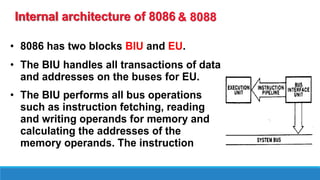
• 8086 has two blocks BIU and EU.
• The BIU handles all transactions of data
and addresses on the buses for EU.
• The BIU performs all bus operations
such as instruction fetching, reading
and writing operands for memory and
calculating the addresses of the
memory operands. The instruction
& 8088
• EU executes instructions from the instruction system byte
queue.
• Both units operate asynchronously to give the 8086 an
overlapping instruction fetch and execution mechanism
which is called as Pipelining. This results in efficient use
of the system bus and system performance.
• BIU contains Instruction queue, Segment registers,
Instruction pointer, Address adder.
• EU contains Control circuitry, Instruction decoder, ALU,
Pointer and Index register, Flag register.
EXECUTION UNIT
• Decodes instructions fetched by the BIU
• Generate control signals,
• Executes instructions.
The main parts are:
• Control Circuitry
• Instruction decoder
• ALU: The ALU performs the arithmetic,
logic & shift operations required
by an instruction.
AH AL
BH BL
CH CL
DH DL
SP
BP
SI
DI
AX
BX
CX
DX
Pointer
bits8 8 bits
16 bits
Accumulator
Base
Count
Data
Stack Pointer
Base Pointer
Source Index
Destination Index
EXECUTION UNIT – General Purpose Registers
Index
EXECUTION UNIT – General Purpose Registers
Pointer And Index Registers
• Used to keep offset addresses.
• Used in various forms of memory addressing.
• In the case of SP and BP the default reference to form a physical
address is the Stack Segment (SS-will be discussed under the BIU)
• The index registers (SI & DI) and the BX generally default to the
Data segment register (DS).
• The SI and the DI registers may also be used to access data
stored in arrays
•SP: Stack pointer
•Used with SS to access the stack segment
BP: Base Pointer
•Primarily used to access data on the stack
•Can be used to access data in other segments
•SI: Source Index register
•is required for some string operations
•When string operations are performed, the SI register points to memory
locations in the data segment which is addressed by the DS register. Thus, SI is
associated with the DS in string operations.
•DI: Destination Index register
•is also required for some string operations.
•When string operations are performed, the DI register points to memory
locations in the data segment which is addressed by the ES register. Thus, DI is
associated with the ES in string operations.
FLAGS
• 8086 has 16 bit flag register.
• Contains 9 active flags.
There are two types of flags in 8086
1.Conditional flags : 6 flags, set or reset by EU on the basis of
results of some arithmetic operation.
2.Control flags : 3 flags, used to control certain operation of the
processor.
U U U U OF DF IF TF SF ZF U AF U PF U CF
Carry
Interrupt
Sign
Zero
Auxiliary
Parity
Over flow Direction Trap
8086/8088 Flags
Memory Segmentation
Segment registers :
•In 8086/88 the processors have 4 segments registers
•Code Segment register (CS), Data Segment register (DS), Extra
Segment register (ES) and Stack Segment (SS) register.
•All are 16 bit registers.
•Each of the Segment registers store the upper 16 bit address of the
starting address of the corresponding segments.
34 BA
EB44
EB54
E695
CSR
DSR
ESR
SSR
Segment Registers
BIU
CODE (64k)
DATA (64K)
EXTRA (64K)
STACK (64K)
00000
34 BA 0
B9F44
EB 044
54 EAF
54 EB 0
64 EAF
695E0
795 DF
Each segment register store the
upper 16 bit of the starting address
of the segments
MEMORY
8086
Summary of Architecture & Registers of 8086 µP
AH AL
BH BL
CH CL
DH DL
SP
BP
SI
DI
FLAGS
D
E
C
O
D
E
R
ALU
AX
BX
CX
DX
EU
Timing
control
SP
BP
Default Assignment
BIU
IP
CS DS ES SS
PIPELINE
(or )
QUEUE
C
O
D
E
O
U
T
C
O
D
E
I
N
IP BX
DI
SI
DI
Fetch &
store code
bytes
PRESENTED BY:-
• Sukanta Das – (EIE/16/37)
-COLLEGE OF ENGINEERING AND MANAGEMENT

Mpmc

  • 1.
  • 2.
    Features • It isa 16-bit μp. • 8086 has a 20 bit address bus can access up to 220 memory locations (1 MB). • It can support up to 64K I/O ports. • It provides 14, 16 -bit registers. • Word size is 16 bits. • It has multiplexed address and data bus AD0- AD15 and A16 – A19.
  • 3.
    It requires singlephase clock with 33% duty cycle to provide internal timing. 8086 is designed to operate in two modes, Minimum and Maximum. It can prefetches up to 6 instruction bytes from memory and queues them in order to speed up instruction execution. It requires +5V power supply. A 40 pin dual in line package. Address ranges from 00000H to FFFFFH Memory is byte addressable - Every byte has a separate address.
  • 4.
  • 5.
    Internal architecture of8086 • 8086 has two blocks BIU and EU. • The BIU handles all transactions of data and addresses on the buses for EU. • The BIU performs all bus operations such as instruction fetching, reading and writing operands for memory and calculating the addresses of the memory operands. The instruction & 8088
  • 6.
    • EU executesinstructions from the instruction system byte queue. • Both units operate asynchronously to give the 8086 an overlapping instruction fetch and execution mechanism which is called as Pipelining. This results in efficient use of the system bus and system performance. • BIU contains Instruction queue, Segment registers, Instruction pointer, Address adder. • EU contains Control circuitry, Instruction decoder, ALU, Pointer and Index register, Flag register.
  • 7.
    EXECUTION UNIT • Decodesinstructions fetched by the BIU • Generate control signals, • Executes instructions. The main parts are: • Control Circuitry • Instruction decoder • ALU: The ALU performs the arithmetic, logic & shift operations required by an instruction.
  • 8.
    AH AL BH BL CHCL DH DL SP BP SI DI AX BX CX DX Pointer bits8 8 bits 16 bits Accumulator Base Count Data Stack Pointer Base Pointer Source Index Destination Index EXECUTION UNIT – General Purpose Registers Index
  • 9.
    EXECUTION UNIT –General Purpose Registers
  • 10.
    Pointer And IndexRegisters • Used to keep offset addresses. • Used in various forms of memory addressing. • In the case of SP and BP the default reference to form a physical address is the Stack Segment (SS-will be discussed under the BIU) • The index registers (SI & DI) and the BX generally default to the Data segment register (DS). • The SI and the DI registers may also be used to access data stored in arrays
  • 11.
    •SP: Stack pointer •Usedwith SS to access the stack segment BP: Base Pointer •Primarily used to access data on the stack •Can be used to access data in other segments •SI: Source Index register •is required for some string operations •When string operations are performed, the SI register points to memory locations in the data segment which is addressed by the DS register. Thus, SI is associated with the DS in string operations. •DI: Destination Index register •is also required for some string operations. •When string operations are performed, the DI register points to memory locations in the data segment which is addressed by the ES register. Thus, DI is associated with the ES in string operations.
  • 12.
    FLAGS • 8086 has16 bit flag register. • Contains 9 active flags. There are two types of flags in 8086 1.Conditional flags : 6 flags, set or reset by EU on the basis of results of some arithmetic operation. 2.Control flags : 3 flags, used to control certain operation of the processor.
  • 13.
    U U UU OF DF IF TF SF ZF U AF U PF U CF Carry Interrupt Sign Zero Auxiliary Parity Over flow Direction Trap 8086/8088 Flags
  • 14.
  • 15.
    Segment registers : •In8086/88 the processors have 4 segments registers •Code Segment register (CS), Data Segment register (DS), Extra Segment register (ES) and Stack Segment (SS) register. •All are 16 bit registers. •Each of the Segment registers store the upper 16 bit address of the starting address of the corresponding segments.
  • 16.
    34 BA EB44 EB54 E695 CSR DSR ESR SSR Segment Registers BIU CODE(64k) DATA (64K) EXTRA (64K) STACK (64K) 00000 34 BA 0 B9F44 EB 044 54 EAF 54 EB 0 64 EAF 695E0 795 DF Each segment register store the upper 16 bit of the starting address of the segments MEMORY 8086
  • 17.
    Summary of Architecture& Registers of 8086 µP AH AL BH BL CH CL DH DL SP BP SI DI FLAGS D E C O D E R ALU AX BX CX DX EU Timing control SP BP Default Assignment BIU IP CS DS ES SS PIPELINE (or ) QUEUE C O D E O U T C O D E I N IP BX DI SI DI Fetch & store code bytes
  • 18.
    PRESENTED BY:- • SukantaDas – (EIE/16/37) -COLLEGE OF ENGINEERING AND MANAGEMENT