


Hyperkinetic
Movement
Disorders
Movement Disorders
Movement disorders are classified
into two groups
Hypokinetic Movement Disorders
Hyperkinetic Movement Disorders
Examination
• Part of the body involved
• Exact Location
• Extent and Distribution
• Part of the muscle/ entire muscle/ muscle
groups/ joints/ complex
• Pattern, Rhythmicity, Uniformity/
Multiformity
• Recurrence regularity
Examination
• Course, Speed, Frequency of each movement
• Amplitude & Force of Movement
• Relationship with
• Posture/ Rest/ Voluntary activity/ Exertion/
Time of day/ Various stimuli/ Emotional
state/ Sleep
• Response to heat & cold
Examination
• Aggravating factors
• Stress/ Anxiety/ activity/ etc..
• Relieving factors
• sleep/ Rest/ etc..
• Differentiation from complex/ bizarre voluntary
movements
• Mannerisms/ Compulsions
• Palpation of Movements (for underlying fine and
clear movement)
• Videos
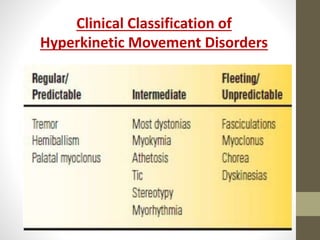
Clinical Classification of
Hyperkinetic Movement Disorders
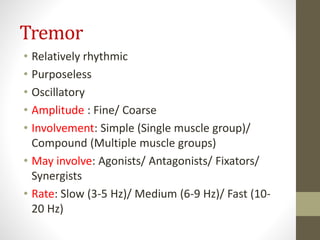
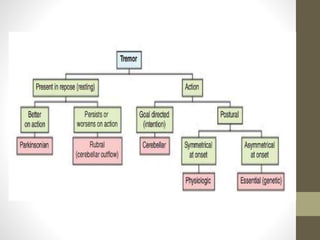
Tremor
• Relatively rhythmic
• Purposeless
• Oscillatory
• Amplitude : Fine/ Coarse
• Involvement: Simple (Single muscle group)/
Compound (Multiple muscle groups)
• May involve: Agonists/ Antagonists/ Fixators/
Synergists
• Rate: Slow (3-5 Hz)/ Medium (6-9 Hz)/ Fast (10-
20 Hz)
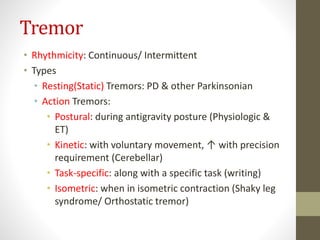
Tremor
• Rhythmicity: Continuous/ Intermittent
• Types
• Resting(Static) Tremors: PD & other Parkinsonian
• Action Tremors:
• Postural: during antigravity posture (Physiologic &
ET)
• Kinetic: with voluntary movement, ↑ with precision
requirement (Cerebellar)
• Task-specific: along with a specific task (writing)
• Isometric: when in isometric contraction (Shaky leg
syndrome/ Orthostatic tremor)
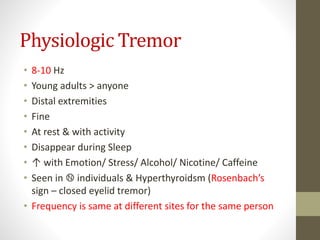
Physiologic Tremor
• 8-10 Hz
• Young adults > anyone
• Distal extremities
• Fine
• At rest & with activity
• Disappear during Sleep
• ↑ with Emotion/ Stress/ Alcohol/ Nicotine/ Caffeine
• Seen in Ⓝ individuals & Hyperthyroidsm (Rosenbach’s
sign – closed eyelid tremor)
• Frequency is same at different sites for the same person
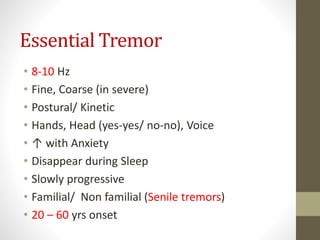
Essential Tremor
• 8-10 Hz
• Fine, Coarse (in severe)
• Postural/ Kinetic
• Hands, Head (yes-yes/ no-no), Voice
• ↑ with Anxiety
• Disappear during Sleep
• Slowly progressive
• Familial/ Non familial (Senile tremors)
• 20 – 60 yrs onset
Cerebellar abnormality in some pt (loss
of purkinjefibres, dendritic swellings)
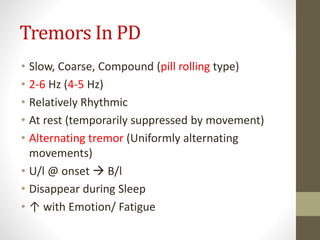
Tremors In PD
• Slow, Coarse, Compound (pill rolling type)
• 2-6 Hz (4-5 Hz)
• Relatively Rhythmic
• At rest (temporarily suppressed by movement)
• Alternating tremor (Uniformly alternating
movements)
• U/l @ onset  B/l
• Disappear during Sleep
• ↑ with Emotion/ Fatigue
Basal ganglia involvement
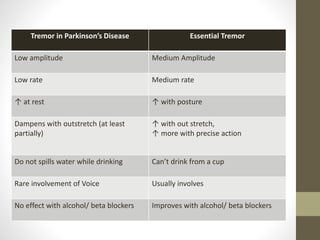
Tremor in Parkinson’s Disease Essential Tremor
Low amplitude Medium Amplitude
Low rate Medium rate
↑ at rest ↑ with posture
Dampens with outstretch (at least
partially)
↑ with out stretch,
↑ more with precise action
Do not spills water while drinking Can’t drink from a cup
Rare involvement of Voice Usually involves
No effect with alcohol/ beta blockers Improves with alcohol/ beta blockers
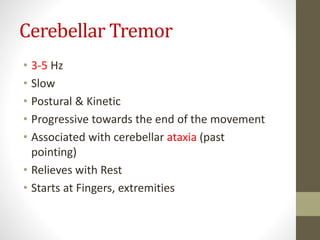
Cerebellar Tremor
• 3-5 Hz
• Slow
• Postural & Kinetic
• Progressive towards the end of the movement
• Associated with cerebellar ataxia (past
pointing)
• Relieves with Rest
• Starts at Fingers, extremities
Ex: Vascular, Iatrogenic
Cerebellar Outflow Tremor
• Combined features of Tremors in PD along with
Cerebellar Tremor
• Tremor is
• Slow (2-5 Hz), Severe (sometimes throw the patient off
balance)
• Large amplitude (as Wing-beating movement)
• Often associated with cerebellar ataxia
• Predominantly unilateral  may progress B/L
• Usually Disappears during sleep  may seen if severe
• Develops within 4 weeks to 48 months of the insult, if
not familial
• Severely disabling
• Unpredictable course on long term
• Ex: vascular, tumor
Involvesdentato-rubro-thalamictract
Chorea
• Involuntary, irregular, purposeless, Random, non-
rhythmic
• Spontaneous, abrupt, brief, rapid, jerky,
unsustained
• Chaotic, multiform, constantly changing
movements that seem to flow from one body
part to another
• Seen at rest and action
• ↑ with activity/ Emotion/ Self consciousness
• May temporarily able to supress
• Disappear in sleep
Chorea
• Disturbs motor functions/ daily activities
• Associated with hypotonia, no paralysis,
Pendular DTR
• Distal parts of UL  anywhere
• Distribution: one limb/ one half (hemichorea)/
generalised
• Inability to sustain contraction
• Parakinesia: incorporate purpose to mask chorea
• Huntington’s disease, Sydenhams chorea, etc..
CaudateNucleus,Putamen, Cerebral cortex
involvement
Ex: Huntington’s,Sydenham
Athetosis (Hammond’s Ds)
• Slower, more sustained, large amplitude when
compared to chorea
• Involuntary, irregular, coarse, relatively rhythmic,
writhing/squirming in character
• Extremities, face, neck, trunk or combination
• Constant & continuous motion
• Over flow: ↑ with movement of other body part
• Difficulty for routine activities
• U/L; B/L (double athetosis)
• Caudate nucleus and Putamen involvement
• Ex: Cerebral Palsy, vascular, Vogt’s syndrome
Dystonia
• Spontaneous, involuntary, sustained muscle contractions (co-
contraction of agonist & antagonist)
• Constant/ intermittent
• Generalised/ segmental/ focal/ multifocal/ hemi-distribution
• patterned, recur in same location
• Sensory tricks can work
• Speed:
• <1 sec (dystonic spasm)
• Several sec (dystonic movements)
• Min-Hrs (dystonic posture)
• Rapid, rhythmic (dystonic tremor)
• During voluntary action (Action dystonia)
Ex: Dystonia Musculorum Deformans, Wilson’s,
Parkinson’s, Drugs, Segawa syndrome.
Hemiballismus
• Wild, flinging, incessant movement of one side
of body
• Resembles chorea but more pronounced
• Involuntary, purposeless, more rapid, forceful
• Proximal extremities (spares face & trunk)
• U/L; B/L (Bi-ballismus), single extremities (Mono-
ballismus)
• Disappears only with deep sleep
Subthalamic nuclei involvement
Ex: Vascular
Dyskinesia
• All hyperkinetic movements are technically
• Complex involuntary movements that do not
neatly fit with another category
• ↑ by movement (kinesigenic)/ stress/ heat/
fatigue (non-kinesigenic)/ sleep (hypnogenic)
• Paroxysmal: strike suddenly & unexpectedly
while engaging in normal motor activity
Ex: Drug related (Tardive dyskinesia), Rabbit
sydrome
Myoclonus
• Single/ repetitive, abrupt, brief, rapid, lightening
like, jerky, arrythmic, asynergic, involuntary
contractions
• Multifocal, diffuse, widespread compared to
chorea
• Extremities> trunk, face, jaw, tongue, pharynx
• Successive, simultaneous involvement of many
muscles
• Symmetric on both sides of the body
• At rest/ action
• ↑ with emotion/ auditory, tactile, visual stimuli
Myoclonus
• Positive / negative (asterixis)
• Physiological: hiccups, benign nocturnal
myoclonus
• With epilepsy (JME)
• Without seizures (metabolic encephalopathy,
SSPE, CJD, Wilson’s, etc)
Ex: CJD, Metabolic
Encephalopathy, Essential, JME
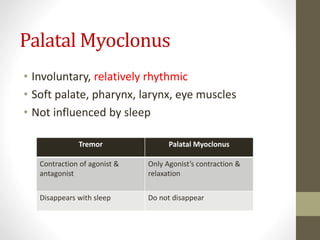
Palatal Myoclonus
• Involuntary, relatively rhythmic
• Soft palate, pharynx, larynx, eye muscles
• Not influenced by sleep
Tremor Palatal Myoclonus
Contraction of agonist &
antagonist
Only Agonist’s contraction &
relaxation
Disappears with sleep Do not disappear
• InvolvementofGullian-MollaretTriangleloop(at
midbrain)
Ex:Essential,Vascular,Tumor
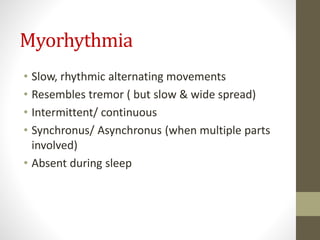
Myorhythmia
• Slow, rhythmic alternating movements
• Resembles tremor ( but slow & wide spread)
• Intermittent/ continuous
• Synchronus/ Asynchronus (when multiple parts
involved)
• Absent during sleep
Ex: CNS Whipples (Occulo-
masticatory myorhythmia)
Unvoluntary Movements
• Patient will have some degree of awareness
• He must make the movement in response to the
urge of some compelling inner force
• Pt feels restless until he performs the action.
• Ex: Tics, Akathesia, Stereotypy
Tic (Habit spasms)
• Quick, irregular, repetitive (child > adults)
• Coordinated, seemingly purposeful, brief,
involves group of muscles in their normal
synergistic relations
• Suppressible temporarily
• ↑ by emotion & tension
• Disappear during sleep
• Any body part (repetitive blinking, shrugging,
throat clearing)
Ex: Tourette’s, Essential
Akathesia
• Continuous inner urge and restlessness to
move
• Remains almost in constant motion
• Mainly drug related/ PD
Ex: Drug related, PD
Stereotypy
• Repetitive, purposeless (seemingly purposeful),
involuntary, patterned motor activity
• Simple/ complex (in OCD)
• Compared to Tic
• Suppressible
• Less Variable
• Less tension/ compulsion
Ex: Autism, MR, Tourette’s, TD
Hyperekplexia
• Pathological startle
• Excessive startle in absence of neuro
disorder
• Sporadic/ hereditary
Ex: Tay sachs, lipidoses, CJD
Sleep related dyskinesia
• Primarily during sleep
• Restless leg syndrome:
• Unpleasant, difficult to describe sensation in
legs that are temporarily relieved by
movement
• Gets up and walks (Night-walkers)
• Diagnosed by Polysomnography
Central disturbance in dopa
metabolism
Fasiculations
• Fine, rapid, flickering/ vermicular twitching
movements
• Not extensive enough to cause joint movement
• Random, irregular
• At times abundant
• ↑ by cold, fatigue, mechanical stimulation of
muscle
• Difficult to see in women
• Usually unaware, persists during sleep
• Usually appear when not looking at
Ex: Hypercaffeinism, MND,
ALS, SMA
Myokimea
• Involuntary, spontaneous, localised,
transient/ persistent, quivering movement
• Involves few muscle bundles in single
muscle
• Not extensive to cause joint movements
• Coarse, slow, undulating (worm like)
• Not affected by motion/ position
• Persists during sleep
Ex: Demyelination, Toxins,
Hypocalcemia, Issac’s (generalised)
Psychogenic (Non-Organic)
• Can simulate any type
• Not corresponds to any of the organic
types
• Bizarre, change in type from time to time
• Influenced by emotion and suggestion
• Sudden onset
• Always a disease of Exclusion
Ex: Schizophrenia
Thank You

Hyperkinesia - in a shell - Dr.Kasyapa

  • 1.
  • 2.
    Movement Disorders Movement disordersare classified into two groups Hypokinetic Movement Disorders Hyperkinetic Movement Disorders
  • 3.
    Examination • Part ofthe body involved • Exact Location • Extent and Distribution • Part of the muscle/ entire muscle/ muscle groups/ joints/ complex • Pattern, Rhythmicity, Uniformity/ Multiformity • Recurrence regularity
  • 4.
    Examination • Course, Speed,Frequency of each movement • Amplitude & Force of Movement • Relationship with • Posture/ Rest/ Voluntary activity/ Exertion/ Time of day/ Various stimuli/ Emotional state/ Sleep • Response to heat & cold
  • 5.
    Examination • Aggravating factors •Stress/ Anxiety/ activity/ etc.. • Relieving factors • sleep/ Rest/ etc.. • Differentiation from complex/ bizarre voluntary movements • Mannerisms/ Compulsions • Palpation of Movements (for underlying fine and clear movement) • Videos
  • 6.
  • 7.
    Tremor • Relatively rhythmic •Purposeless • Oscillatory • Amplitude : Fine/ Coarse • Involvement: Simple (Single muscle group)/ Compound (Multiple muscle groups) • May involve: Agonists/ Antagonists/ Fixators/ Synergists • Rate: Slow (3-5 Hz)/ Medium (6-9 Hz)/ Fast (10- 20 Hz)
  • 8.
    Tremor • Rhythmicity: Continuous/Intermittent • Types • Resting(Static) Tremors: PD & other Parkinsonian • Action Tremors: • Postural: during antigravity posture (Physiologic & ET) • Kinetic: with voluntary movement, ↑ with precision requirement (Cerebellar) • Task-specific: along with a specific task (writing) • Isometric: when in isometric contraction (Shaky leg syndrome/ Orthostatic tremor)
  • 10.
    Physiologic Tremor • 8-10Hz • Young adults > anyone • Distal extremities • Fine • At rest & with activity • Disappear during Sleep • ↑ with Emotion/ Stress/ Alcohol/ Nicotine/ Caffeine • Seen in Ⓝ individuals & Hyperthyroidsm (Rosenbach’s sign – closed eyelid tremor) • Frequency is same at different sites for the same person
  • 11.
    Essential Tremor • 8-10Hz • Fine, Coarse (in severe) • Postural/ Kinetic • Hands, Head (yes-yes/ no-no), Voice • ↑ with Anxiety • Disappear during Sleep • Slowly progressive • Familial/ Non familial (Senile tremors) • 20 – 60 yrs onset
  • 12.
    Cerebellar abnormality insome pt (loss of purkinjefibres, dendritic swellings)
  • 13.
    Tremors In PD •Slow, Coarse, Compound (pill rolling type) • 2-6 Hz (4-5 Hz) • Relatively Rhythmic • At rest (temporarily suppressed by movement) • Alternating tremor (Uniformly alternating movements) • U/l @ onset  B/l • Disappear during Sleep • ↑ with Emotion/ Fatigue
  • 14.
  • 15.
    Tremor in Parkinson’sDisease Essential Tremor Low amplitude Medium Amplitude Low rate Medium rate ↑ at rest ↑ with posture Dampens with outstretch (at least partially) ↑ with out stretch, ↑ more with precise action Do not spills water while drinking Can’t drink from a cup Rare involvement of Voice Usually involves No effect with alcohol/ beta blockers Improves with alcohol/ beta blockers
  • 16.
    Cerebellar Tremor • 3-5Hz • Slow • Postural & Kinetic • Progressive towards the end of the movement • Associated with cerebellar ataxia (past pointing) • Relieves with Rest • Starts at Fingers, extremities
  • 17.
  • 18.
    Cerebellar Outflow Tremor •Combined features of Tremors in PD along with Cerebellar Tremor • Tremor is • Slow (2-5 Hz), Severe (sometimes throw the patient off balance) • Large amplitude (as Wing-beating movement) • Often associated with cerebellar ataxia • Predominantly unilateral  may progress B/L • Usually Disappears during sleep  may seen if severe • Develops within 4 weeks to 48 months of the insult, if not familial • Severely disabling • Unpredictable course on long term
  • 19.
    • Ex: vascular,tumor Involvesdentato-rubro-thalamictract
  • 20.
    Chorea • Involuntary, irregular,purposeless, Random, non- rhythmic • Spontaneous, abrupt, brief, rapid, jerky, unsustained • Chaotic, multiform, constantly changing movements that seem to flow from one body part to another • Seen at rest and action • ↑ with activity/ Emotion/ Self consciousness • May temporarily able to supress • Disappear in sleep
  • 21.
    Chorea • Disturbs motorfunctions/ daily activities • Associated with hypotonia, no paralysis, Pendular DTR • Distal parts of UL  anywhere • Distribution: one limb/ one half (hemichorea)/ generalised • Inability to sustain contraction • Parakinesia: incorporate purpose to mask chorea • Huntington’s disease, Sydenhams chorea, etc..
  • 22.
  • 23.
    Athetosis (Hammond’s Ds) •Slower, more sustained, large amplitude when compared to chorea • Involuntary, irregular, coarse, relatively rhythmic, writhing/squirming in character • Extremities, face, neck, trunk or combination • Constant & continuous motion • Over flow: ↑ with movement of other body part • Difficulty for routine activities • U/L; B/L (double athetosis)
  • 24.
    • Caudate nucleusand Putamen involvement • Ex: Cerebral Palsy, vascular, Vogt’s syndrome
  • 25.
    Dystonia • Spontaneous, involuntary,sustained muscle contractions (co- contraction of agonist & antagonist) • Constant/ intermittent • Generalised/ segmental/ focal/ multifocal/ hemi-distribution • patterned, recur in same location • Sensory tricks can work • Speed: • <1 sec (dystonic spasm) • Several sec (dystonic movements) • Min-Hrs (dystonic posture) • Rapid, rhythmic (dystonic tremor) • During voluntary action (Action dystonia)
  • 26.
    Ex: Dystonia MusculorumDeformans, Wilson’s, Parkinson’s, Drugs, Segawa syndrome.
  • 27.
    Hemiballismus • Wild, flinging,incessant movement of one side of body • Resembles chorea but more pronounced • Involuntary, purposeless, more rapid, forceful • Proximal extremities (spares face & trunk) • U/L; B/L (Bi-ballismus), single extremities (Mono- ballismus) • Disappears only with deep sleep
  • 28.
  • 29.
    Dyskinesia • All hyperkineticmovements are technically • Complex involuntary movements that do not neatly fit with another category • ↑ by movement (kinesigenic)/ stress/ heat/ fatigue (non-kinesigenic)/ sleep (hypnogenic) • Paroxysmal: strike suddenly & unexpectedly while engaging in normal motor activity
  • 30.
    Ex: Drug related(Tardive dyskinesia), Rabbit sydrome
  • 31.
    Myoclonus • Single/ repetitive,abrupt, brief, rapid, lightening like, jerky, arrythmic, asynergic, involuntary contractions • Multifocal, diffuse, widespread compared to chorea • Extremities> trunk, face, jaw, tongue, pharynx • Successive, simultaneous involvement of many muscles • Symmetric on both sides of the body • At rest/ action • ↑ with emotion/ auditory, tactile, visual stimuli
  • 32.
    Myoclonus • Positive /negative (asterixis) • Physiological: hiccups, benign nocturnal myoclonus • With epilepsy (JME) • Without seizures (metabolic encephalopathy, SSPE, CJD, Wilson’s, etc)
  • 33.
  • 34.
    Palatal Myoclonus • Involuntary,relatively rhythmic • Soft palate, pharynx, larynx, eye muscles • Not influenced by sleep Tremor Palatal Myoclonus Contraction of agonist & antagonist Only Agonist’s contraction & relaxation Disappears with sleep Do not disappear
  • 35.
  • 36.
    Myorhythmia • Slow, rhythmicalternating movements • Resembles tremor ( but slow & wide spread) • Intermittent/ continuous • Synchronus/ Asynchronus (when multiple parts involved) • Absent during sleep
  • 37.
    Ex: CNS Whipples(Occulo- masticatory myorhythmia)
  • 38.
    Unvoluntary Movements • Patientwill have some degree of awareness • He must make the movement in response to the urge of some compelling inner force • Pt feels restless until he performs the action. • Ex: Tics, Akathesia, Stereotypy
  • 39.
    Tic (Habit spasms) •Quick, irregular, repetitive (child > adults) • Coordinated, seemingly purposeful, brief, involves group of muscles in their normal synergistic relations • Suppressible temporarily • ↑ by emotion & tension • Disappear during sleep • Any body part (repetitive blinking, shrugging, throat clearing)
  • 40.
  • 41.
    Akathesia • Continuous innerurge and restlessness to move • Remains almost in constant motion • Mainly drug related/ PD
  • 42.
  • 43.
    Stereotypy • Repetitive, purposeless(seemingly purposeful), involuntary, patterned motor activity • Simple/ complex (in OCD) • Compared to Tic • Suppressible • Less Variable • Less tension/ compulsion
  • 44.
    Ex: Autism, MR,Tourette’s, TD
  • 45.
    Hyperekplexia • Pathological startle •Excessive startle in absence of neuro disorder • Sporadic/ hereditary
  • 46.
    Ex: Tay sachs,lipidoses, CJD
  • 47.
    Sleep related dyskinesia •Primarily during sleep • Restless leg syndrome: • Unpleasant, difficult to describe sensation in legs that are temporarily relieved by movement • Gets up and walks (Night-walkers) • Diagnosed by Polysomnography
  • 48.
    Central disturbance indopa metabolism
  • 49.
    Fasiculations • Fine, rapid,flickering/ vermicular twitching movements • Not extensive enough to cause joint movement • Random, irregular • At times abundant • ↑ by cold, fatigue, mechanical stimulation of muscle • Difficult to see in women • Usually unaware, persists during sleep • Usually appear when not looking at
  • 50.
  • 51.
    Myokimea • Involuntary, spontaneous,localised, transient/ persistent, quivering movement • Involves few muscle bundles in single muscle • Not extensive to cause joint movements • Coarse, slow, undulating (worm like) • Not affected by motion/ position • Persists during sleep
  • 52.
  • 53.
    Psychogenic (Non-Organic) • Cansimulate any type • Not corresponds to any of the organic types • Bizarre, change in type from time to time • Influenced by emotion and suggestion • Sudden onset • Always a disease of Exclusion
  • 54.
  • 55.