MEDICATION-INDUCED
  MOVEMENT DISORDERS


OLADAPO SAMSON OLUWABUKOLA

         9TH JULY, 2012
Definition of terms
 Medication-induced          movement        disorder      (Extra-
    Pyramidal Side Effects, EPSE) occurs due to treatment
    with antipsychotic medications.
   It can also be defined as physical symptoms, including
    tremor,                                                 slurred
    speech, akathesia, dystonia, anxiety, distress, paranoia, an
    d bradyphrenia, that are primarily associated with improper
    dosing of or unusual reactions to neuroleptic (antipsychotic)
    medications.
   Though they are commonly caused by the typical
    antipsychotics, but can also be caused by the atypical.
   The adverse consequences of these syndromes can be
    minimized by vigilant clinicians who systematically examine
    patients at risk for these disorders and who manage them
    properly when discovered.
   The best management is, of course, prevention, which
    starts with the judicious prescription of neuroleptics, and an
    awareness of the potential for certain nonpsychiatric
Incidence
 Though the true incidence and prevalence of drug-
 induced movement disorders is unknown and likely
 vastly underappreciated because of lack of
 recognition, but studies and epidemiological evidence
 have shown that one in 500 people who take
 metoclopramide are likely to develop Extra-Pyramidal
 Side Effects (EPSE). The risk for the development of
 EPSE is highest in infants and children and adults
 younger than 30 years of age. The risk of developing
 EPS or Tardive Dyskinesia ,TD and the likely
 irreversibility of TD are related to the length of
 exposure and total accumulative exposure to the
 drug.
Incidence
 Other factors influencing the correlation of Medication
  induced Movement Disorder, MIMD and the use of
  antipsychotic drugs include:
    age of the population,
    the drug being used and the dose,
    the definition of the movement being employed in
     the study,
    design of the study.
 MIMD related to exposure to antipsychotic drugs is
  estimated to occur in 19% and 42% of patients
  receiving atypical (second-generation) and typical
  (first-generation) antipsychotic drugs, respectively.
Risk Factors
 This is a function of the exposure and the dosage of
  antipsychotics taken.
 The following populations are considered to be at
  increased risk of Medication Induced Movement
  Disorder.
Populations at High Risk for Developing Potential Reasons
MIMD
Elderly                                        Decreased functional reserve

Elderly women                                  Decreased Estrogen levels

Patients who have used Dopamine Receptor       Increased exposure to DRBDs
Blocking Drugs, DRBDs for more than 3 months
Diabetics, independent of their use of DRBD,   Impaired glucose metabolism
although the risk increases with the use of
DRBD
Persons with phenylketonuria                   Increased level of
Etiology
 The   etiology of Medication Induced
 Movement Disorders, MIMD, is largely of
 biological origin:
Etiology – Biological
 The most common antipsychotic associated with EPSE is
  haloperidol used especially in schizophrenia.
 Other antidopaminergic drugs like the antiemetic such as
  metoclopramide           or the tricyclic antidepressant
  amoxapine can also cause extrapyramidal side-effects.
 Another common cause are Selective Serotonic Reuptake
  Inhibitors (SSRIs), which decrease dopamine and
  norepinephrine neurotransmission in the Substantia Nigra.
 Others include:
    Perphenazine (Trilafon)
    Thiothixene HCl (Navane)
    Fluphenazine HCl (Prolixin)
    Trifluoperazine (Stelazine)
    Risperidone (Risperdal)
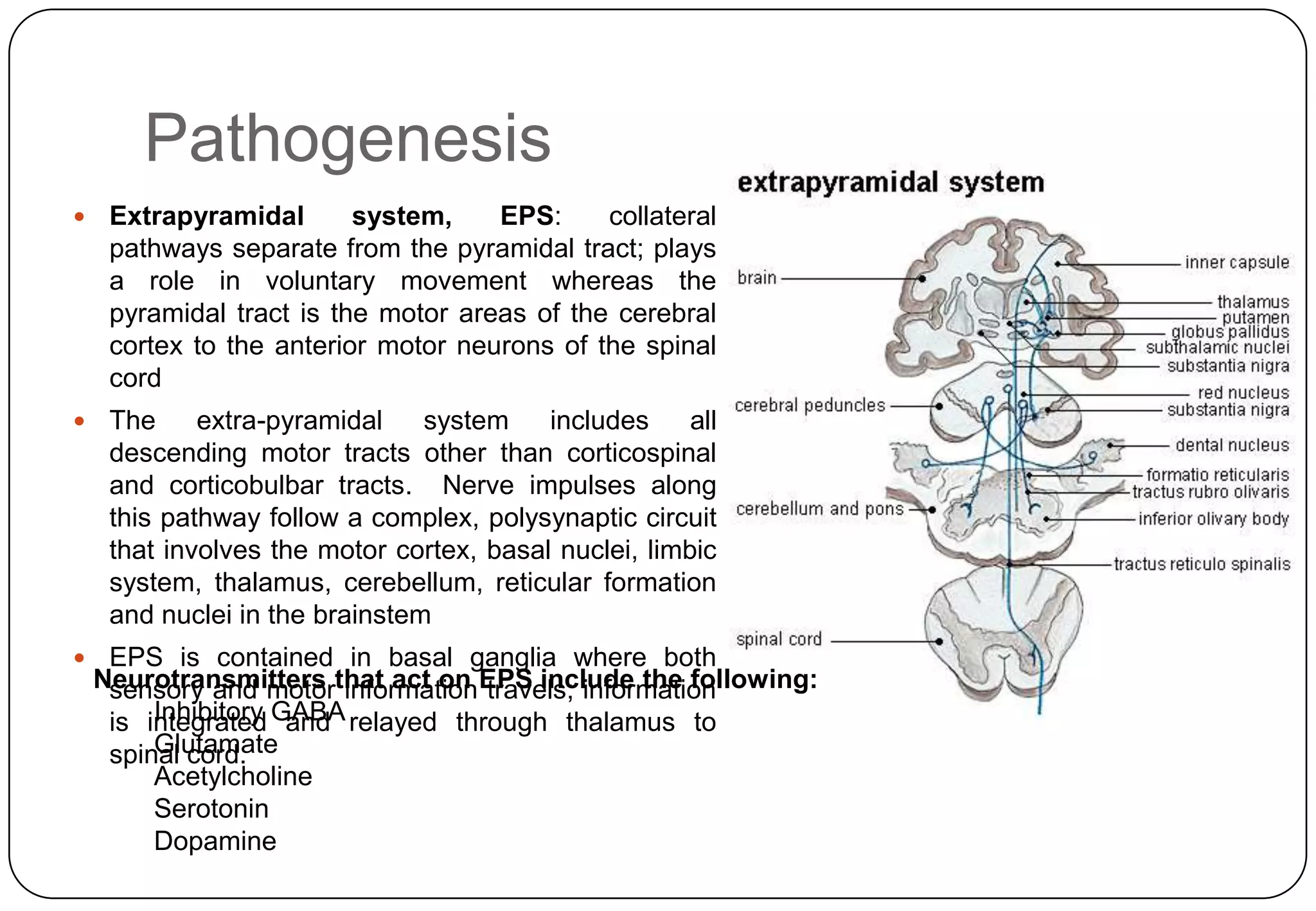
Pathogenesis
    Extrapyramidal       system,    EPS:     collateral
     pathways separate from the pyramidal tract; plays
     a role in voluntary movement whereas the
     pyramidal tract is the motor areas of the cerebral
     cortex to the anterior motor neurons of the spinal
     cord
    The     extra-pyramidal    system    includes     all
     descending motor tracts other than corticospinal
     and corticobulbar tracts. Nerve impulses along
     this pathway follow a complex, polysynaptic circuit
     that involves the motor cortex, basal nuclei, limbic
     system, thalamus, cerebellum, reticular formation
     and nuclei in the brainstem
    EPS is contained in basal ganglia where both
    Neurotransmitters that act on EPS include the following:
     sensory and motor information travels; information
     is integrated GABA relayed through thalamus to
         Inhibitory and
         Glutamate
     spinal cord.
         Acetylcholine
         Serotonin
         Dopamine
Pathophysiology
 Though the pathophysiology of MIMD has not been
 clearly elucidated yet, but certain theories and
 hypothesis suggest the interplay between:
  genetic predisposition,
  dopaminergic    system hypersensitivity in the basal
   ganglia,
  decreased functional reserve, and
  over activation of the cholinergic system.
 Postsynaptic Dopamine Receptor Hypersensitivity
 Theory
  The chronic blocking of presynaptic dopamine receptors
   enhances excitatory glutamatergic neurotransmission.
   The neurotoxic stress in the striatum, which is caused by
   increasing glutamate release and extracellular glutamate
   levels at corticostriatal terminals, ultimately destroys the
   output neurons, leading to dopaminergic hypersensitivity.
   Although this theory has been the long-held hypothesis
   as the cause of MIMD, it cannot completely account for
   the clinical findings, primarily because it does explain the
   fact that MIMD are not a universal phenomenon among
   people exposed to Dopamine Receptor Blocking Drugs,
   DRBDs
 Neurotoxicity Theory
   Suggests that MIMD are caused by the neurotoxic effects of
   free radicals that are created as a byproduct of catecholamine
   metabolism because the use of DRBDs increases the
   turnover of neurotransmitters and because the basal ganglia
   are particularly vulnerable to the effects of membrane lipid
   peroxidation.
 Dopamine-GABA Hypothesis
   Dopamine has both inhibitory and excitatory effects on GABA
   neurons, determined by the location and type of the dopamine
   receptors in the brain. In this theory, which does not disregard
   the fact that dopamine receptors become increasingly
   sensitive to the effects of DRBD, the interaction between the
   dopamine and gamma-aminobutyric acid (GABA) neurons
   plays a greater role, likely accounting for the different, yet
   simultaneous, effects of the DRBD. Unfortunately, this theory
   has not been able to be converted into a treatment paradigm
   because of the toxicity of the agents
Clinical Features
 Though the presentation of the MIMD is in no way different from
  movement disorder secondary to neurological diseases
  affecting the extrapyramidal motor system. Generally, based on
  the features, there are 3 main groups:
    Drug        induced    movement      disorders,     such     as:
      akathisia, akinesia, hyperkinesia, dyskinesias, extrapyramidal
      syndrome, and tardive dyskinesia
    Movement disorders secondary to neurological diseases
      affecting the extrapyramidal motor system, such as:
      athetosis, chorea, dystonia, hemiballismus, myoclonus, tremo
      r, tics and spasm
    Abnormal movements in psychiatric disorders, such as:
      mannerism, stereotyped behaviour and psychomotor
      retardation.
 It is of importance that the presentation of each of this disorders
  be distinguished, based on their phenomena, which is believed
  to be of help to the medical fraternity in other to make quick
Akathisia
 Akathisia is a state of motor restlessness ranging from a
  feeling of inner disquiet to inability to sit still or lie quietly.
  It’s subjective feeling of objective signs of muscle unrest,
  particularly in the lower extremities.
 Complaints of restlessness accompanied by movements
  such as fidgeting of the legs, rocking from foot to foot,
  pacing, or inability to sit or stand. Symptoms can develop
  within a few weeks of starting or raising the dose of
  traditional neuroleptic medications or of reducing the dose
  of medication used to treat extrapyramidal symptoms.
 Difficulty remaining seated, agitation, restlessness ‡
  Difficult to recognize and may be misdiagnosed with a
  psychiatric disorder ‡ Can be treated with anti-
  parkinsonian agents in addition to benzodiazepines
Rigidity - Akinesia
 Rigidity develops without tremor in many patients. When a rigid joint is
    moved, sudden, rhythmic jerks due to variations in the intensity of the
    rigidity occur, producing a ratchet-like effect (cogwheel rigidity)
   Akinesia is a state of motor inhibition or reduced voluntary movement.
    It is also known to be the absence, poverty, or loss of control of
    voluntary muscle movements.
   Slow movements (bradykinesia) are typical as rigidity progresses.
    Movement also becomes decreased (hypokinesia) and difficult to
    initiate (akinesia)
   Rigidity and hypokinesia may contribute to muscular aches and
    sensations of fatigue. The face becomes masklike – definitive sign of
    Parkinson’s Disease , with an open mouth, drooling, and reduced
    blinking.
   Patient may appear depressed because facial expression is lacking
    and movements are decreased and slowed.
   Speech becomes hypophonic, with characteristic monotonous,
    stuttering dysarthria.
   Hypokinesia and impaired control of distal musculature cause
    micrographia (writing in very small letters and makes activities of daily
    living increasingly difficult.
Dystonia
 Dystonia can be defined as dyskinetic movements due to disordered
  tonicity of muscle.
 It is sustained involuntary muscle contractions, often distorting body
  posture. It can be primary or secondary, and often can be generalized,
  focal or segmental. Diagnosis is clinical. Treatment of generalized
  dystonia is often with combination of anticholinergics, muscle relaxants,
  and benzodiazepines. Treatment of focal or segmental dystonia is often
  with botulinum toxin; more generalized or refractory cases may benefit
  from surgery.
 Tonic muscular contractions localized to one or several muscle groups,
  particularly in the eyes, mouth, throat or neck.‡ Eye manifestations
  include spasm of extra ocular muscles (oculogyric crisis). Neck
  manifestations include torticollis. Back manifestations include
  opisthotonus.‡ Pharyngeal muscle spasm or laryngospasm can be life-
  threatening.‡     Can    be    treated    with    diphenhydramine      or
  benztropine (Cogentin) which are anti-parkinsonian agents
 Common drug causes of dystonia: Phenothiazines, Thioxanthenes,
Parkinsonism
 Parkinsonism refers to symptoms that are similar to those of Parkinson’s Disease but
  caused by another condition.
 Signs and symptoms include:
   Resting tremor of one hand, maximum at rest. It is often the first symptom
   Rigidity
   Slow movements
   Postural instability
   Dementia
   Sleep disorders are common. Insomnia may result from nocturia or from the inability
     to turn in bed
   Seborrheic dermatitis
 The mechanism is blockage of or interference with dopamine’s action in the basal
  ganglia. The most common cause is ingestion of drugs that block dopamine receptors.
  Such drugs include:
   Phenothiazines
   Thioxanthenes
   Butyrophenones
   Antipsychotics – can cause reversible parkinsonism
   Reserpine
   Metoclopramide – can be dose dependent or related to the patient’s susceptibility
     (risk factors include older age and elderly women)
   Meperidine analoge – can cause sudden, irreversible parkinsonism. This occurs in IV
     drug users.
Tardive Dyskinesia
 Tardive   dyskinesia is a syndrome of abnormal
  involuntary muscle movements resulting from
  prolonged neuroleptic exposure. The syndrome may
  arise either during or following the cessation of long-
  term neuroleptic therapy. Raising the dose of
  neuroleptics suppress the movement disorder acutely,
  while lowering the dose results in an exacerbation of
  the movements acutely.
 Known to manifest itself by oral buccal dyskinetic
  movements including chewing movements, protrusion
  of the tongue, lip smacking, puckering, and pursing
  the lips, but it can consist of any hyperkinetic
  movement disorder of any part of the body, including
  the choreiform movements of the hands and feet,
  axial symptoms of pelvic thrusting, or even dyskinesia
Tardive Dyskinesia - Pathophysiology
 The dopamine supersensitivy hypothesis of tardive
  dyskinesia states that the hyperkinetic movements of
  TD result from a super-sensitivity of the dopamine
  receptor population in the striatum that is due to
  chronic dopamine receptor blockade. This is justifies
  the reason, why, TD improves acutely after increase in
  dosage of neuroleptics, and why it is transiently
  exacerbated by withdrawal of neuroleptics.
 The dopaine-acetycholine balance theory explicates
  why anticholinergics exacerbate TD that is improved
  by cholinergics.
 The GABA hypothesis explains some of the preclinical
  subtleties of TD better than the older hypothesis but is
  not as yet more clinically useful.
Other forms of Tardive movement
disorders
 Tardive dystonia – a less common form of MIMD resulting
  from prolonged exposure to neuroleptics than tardive
  dyskinesia, but tend to be more disabling. The symptoms
  include the developemnt of dystonic movements following
  prolonged neuroleptc exposure, primarily involving the
  face and neck and especially producing retrocollis -
  spasmodic torticollis in which the head is drawn back.
  Estimated prevalence among the psychiatric patients vary
  widely between 1.5% and 21%. Tardive dystonia differs
  from tardive dyskinesia not only in being more
  disabling, but in being less likely to remit.
 Tardive akathisia – generally associated with tardive
  dyskinesia and often responds well to treatment with
  dopamine depleting agents such as reserpine and
  tetrabenazine.
 Other forms of tardive movment disorders, though
  rare, includes Gilles de la Tourette’s syndrome, tardive
  myoclonus, and tardive tremor
Differential Diagnosis
 For the sake of simplicity, it is explicit to describe the
  differential diagnosis under the following heading:
   Medical
   Psychiatric
Differential diagnosis – Medical
   Parkinson’s Disease
   Benign childhood epilepsy
   Chorea Gravidarum
   Chorea in Adults
   Complex partial seizures
   Frontal lobe epilepsy
   Cortical Basal Ganglionic Disorder
   Wilson disease
   Huntington Disease dementia
   Tetanus
   Wilson Disease.
   Thyroid dysfunction
   SLE
   Polycythemia Rubra Vera
Differential diagnosis – psychiatric
 Dopamine-responsive dystonia
 Psychogenic Nonepileptic Seizures
 Alcohol related psychosis
 Mania
 Stimulant drug intoxication
 Drug withdrawal
 Agitated emotional state
 One must be wary of missing akathisia, as it may be the cause for a
 paradoxical worsening of behavior in response to antipsychotic
 treatment. Equally important is the consideration of akathisia as a
 driving force for agitation in demented patients who receive
 antipsychotic drugs for psychiatric aspects of their dementias. If the
 response to an antipsychotic is worsened behavior, akathisia
 must be considered. Because the patients are often unable to
 communicate, a high index of suspicion must be maintained. Restless
 legs (Ekbom syndrome) is not associated with dopamine blockade
 although it is relieved by L-DOPA and dopamine agonists. Patients
 develop uncomfortable sensations in their legs that are relieved by
 walking. These sensations occur primarily at night and interfere with
 falling asleep but do not occur to a significant degree during the day.
 This syndrome has been associated with iron deficiency in some
 cases. Finally, tardive dyskinesia or "pseudo akathisia" can cause a
 constellation of fidgety looking choreic movement in which patients
Investigations
 Investigations and workup may include selected laboratory
  studies, as well as imaging modalities such as CT scan,
  MRI, or Positron Emission Tomography (PET).
 Tardive blepharospasm should be evaluated with
  electroencephalography        (EEG)    and     a    complete
  ophthalmologic evaluation, including slit-lamp examination
  to rule out the Kayser-Fleischer rings of Wilson disease.
 In addition, the following tests may be appropriate:
   Thyroid function tests to exclude thyroid dysfunction
   Serum biochemistry, serum copper, serum ceruloplasmin,
    thyroid function tests, and syphilis serology to evaluate tardive
    blepharospasm
   Connective tissue disease screening tests to exclude
    systemic lupus erythematosus and other vasculitides
   Red blood cell (RBC) counts to exclude polycythemia rubra
    vera
   Serum calcium level
DSM IV Criteria for MIMDs
 333.92 – Neuroleptic Malignant Syndrome
   Severe muscle rigidity, elevated temperature, and other related
    findings (e.g. diaphoresis, dysphagia, incontinence, changes in level
    of consciousness ranging from confusion to coma, mutism, elevated
    or labile blood pressure, elevated creatine phosphokinase [CPK])
    developing in association with the use of neuroleptic medication
 333.7 – Neuroleptic-induced Acute Dystonia
   Abnormal positioning or spasm of the muscles of the head, neck,
    limbs, or trunk developing within a few days of starting or raising the
    dose of a neuroleptic medication.
 333.99 – Neuroleptic-induced Acute Akathisia
   Subjective complaints of restlessness accompanied by observed
    movements (e.g. fidgety movements of the legs, rocking from food
    to food, pacing, or inability to sit or stand still) developing within a
    few weeks of starting or raising the dose of a neuroleptic medication
    (or after reducing a medication to treat extrapyramidal symptoms).
DSM IV Criteria for MIMDs cont’d
 333.82 – Neuroleptic-induced Tardive Dyskinesia
  Involuntary choreiform athetoid, or rhythmic movements
   (lasting at least a few weeks) of the tongue, jaw, or
   extremities developing in association with the use of
   neuroleptic medication for at least a few months (may be
   for a shorter period of time in elderly persons)
 333.1 – Medication-Induced Postural Tremor
  Fine tremor occurring during attempts to maintain a
   posture that develops in association with the use of
   medication(e.g. lithium, antidepressants, valporate)
DSM IV Criteria for MIMDs cont’d
 333.90 – Medication-induced Movement Disorder
 Not Otherwise Specified – this category is for
 Medication –Induced Movement Disorders not
 classified by any of the specific disorders listed above.
 Examples include:
  Parkinsonism,   Acute Akathisia, Acute Dystonia, or
   Dyskinetic movement that is associated with a
   medication other than a neuroleptic
  A presentation that resembles neuroleptic malignant
   syndrome that is associatied with a meidcationother than
   a neuroleptic
  Tardive dystonia
Treatment
 Treatment modality of MIMD will be discussed under
 the following headlines:
   Biological
   psychological
Treatment - Biological
 Management of drug-induced movement disorders in the older
  patient requires careful consideration of the contraindications
  imposed by such agents as anticholinergics and -blockers. At
  present, the use of second-generation antipsychotics such as
  clozapine, risperidone, olanzapine or quetiapine for reducing the
  risk of treatment-emergent movement disorders in the elderly have
  not been published. However, open-label studies of atypical
  antipsychotics demonstrate a markedly lower incidence of both
  EPSE and TD compared with conventional antipsychotic treatment
  in the elderly.
 Dopamine-depleting agents: the most effective medications are
  those that deplete catecholamines (eg, reserpine, tetrabenazine).
 Atypical antipsychotics (eg, clozapine, risperidone, olanzapine)
  bind to dopamine D2 receptors and may improve tardive dystonia
  when lower doses are used. Recent trials have shown that they not
  only may cause or aggravate tardive dystonia but ultimately may
  prove to be highly useful therapeutic agents to treat dystonias.
  Long-term safety is not fully established for this indication.
Treatment – Psychological
 Patients frequently experience adverse effects of
  antipsychotics before clinical improvements of
  psychotic symptoms.
 High potency drugs are more likely to cause EPSE
  which can render a patient to poor compliance of
  taking drugs.
 Hence start management of EPS by giving pre-
  information to patients about the drug, possible
  side effects, duration, costs, and ways to minimize
  these adverse effects.
Prognosis - overall
 The prognosis of patients with tardive dystonia is very poor.
  Unfortunately, once developed, this condition is usually
  persistent.
   The discontinuation of all dopamine receptor antagonists appears to
    be the most important factor related to remission; patients who
    permanently discontinue these agents increase their chance of
    remission 4-fold compared with those patients who do not.
   Another factor related to remission is the total duration of dopamine
    receptor antagonist therapy; patients taking dopamine receptor
    antagonists for less than 10 years have a 5-times higher chance of
    remission than those with more than 10 years of exposure.
   Tardive dystonia is most likely permanent in patients who continue
    using neuroleptic drugs for more than 10 years.
   The indication for long-term use of neuroleptic agents must be well
    established. Patients must be evaluated repeatedly in hopes of early
    detection of tardive dystonia; once tardive dystonia is present, the
    causative drug should be withdrawn if possible. If the patient is not
    disabled by dyskinesia, observing and hoping for a spontaneous
    recovery, rather than treating, is best.
Prognosis
 Patients   who have previously experienced episodes of
  neuroleptic malignant syndrome are at risk for recurrences. The
  risk of neuroleptic malignant syndrome recurrence is strongly
  related to the elapsed time between an episode of neuroleptic
  malignant syndrome and restarting antipsychotics. If patients
  are rechallenged with antipsychotics within 2 weeks of an
  episode of neuroleptic malignant syndrome, 63% will have a
  recurrence. If more than 2 weeks has elapsed, only 30% will
  have a recurrence.
 87% of patients who develop neuroleptic malignant syndrome
  will be able to tolerate another antipsychotic at some point in the
  future, which is very important because most patients taking
  neuroleptics require them to maintain a reasonable functional
  status. Current practice is to switch to a different class of
  antipsychotic when reintroducing these medications. Often, one
  of the newer atypical antipsychotics is chosen because current
  evidence suggests a lower incidence of neuroleptic malignant
Prevention
 Movement disorders may be aggravated by the administration
  of dopamine-receptor blocking drugs. In vulnerable patients, the
  administration of even a single dose of a dopamine-receptor
  blocking drug may lead to incapacitating movement disorders.
 Patients with developmental disabilities, fetal alcohol syndrome,
  schizophrenia, and other neuropsychiatric disorders may be
  exquisitely vulnerable to TD upon exposure to dopamine-
  receptor blocking drugs. If a patient exhibits a movement
  disorder when given a drug, discontinuance of the
  causative drug is generally wise. Advise the patient to avoid
  receiving dopamine-receptor blocking drugs and warn against
  the administration of these drugs.
 In addition, advise all of the clinicians treating the patient to
  refrain from administering dopamine-receptor blocking drugs.
  Advise the patient to obtain a medical alert bracelet warning
  against the administration of dopamine-receptor blocking drugs.
References
 http://www.ncbi.nlm.nih.gov/pubmed/6627043
 http://www.extrapyramidalsideeffects.com/
 http://pediatrics.uchicago.edu/chiefs/documents/ExtrapyramidalSid
    eEffects.pdf
   http://www.medmerits.com/index.php/article/acute_drug_induced_
    movement_disorders/P8
   http://med.brown.edu/neurology/articles/sr55693.pdf
   http://emedicine.medscape.com/article/1151826-overview#a7
   http://books.google.com/books?id=w_HajjMnjxwC&pg=PA735&lpg=
    PA735&dq=DSM+IV+333.99+criteria&source=bl&ots=i7PQbobJ1I&
    sig=bhwZwRtb6Mggd7sLyYozgbKpjLE&hl=en&sa=X&ei=Ceb5T_av
    EcL40gHv5YGEBw&ved=0CEwQ6AEwAw#v=onepage&q&f=false
   http://emedicine.medscape.com/article/288482-followup#a2650
   Treatment of Extrapyramidal Side Effects of Antipsychotics
    Drugs, Frank. A Dept of Psychiatry MUCHS

MEDICATION INDUCED MOVEMENT DISORDERS

  • 1.
    MEDICATION-INDUCED MOVEMENTDISORDERS OLADAPO SAMSON OLUWABUKOLA 9TH JULY, 2012
  • 2.
    Definition of terms Medication-induced movement disorder (Extra- Pyramidal Side Effects, EPSE) occurs due to treatment with antipsychotic medications.  It can also be defined as physical symptoms, including tremor, slurred speech, akathesia, dystonia, anxiety, distress, paranoia, an d bradyphrenia, that are primarily associated with improper dosing of or unusual reactions to neuroleptic (antipsychotic) medications.  Though they are commonly caused by the typical antipsychotics, but can also be caused by the atypical.  The adverse consequences of these syndromes can be minimized by vigilant clinicians who systematically examine patients at risk for these disorders and who manage them properly when discovered.  The best management is, of course, prevention, which starts with the judicious prescription of neuroleptics, and an awareness of the potential for certain nonpsychiatric
  • 3.
    Incidence  Though thetrue incidence and prevalence of drug- induced movement disorders is unknown and likely vastly underappreciated because of lack of recognition, but studies and epidemiological evidence have shown that one in 500 people who take metoclopramide are likely to develop Extra-Pyramidal Side Effects (EPSE). The risk for the development of EPSE is highest in infants and children and adults younger than 30 years of age. The risk of developing EPS or Tardive Dyskinesia ,TD and the likely irreversibility of TD are related to the length of exposure and total accumulative exposure to the drug.
  • 4.
    Incidence  Other factorsinfluencing the correlation of Medication induced Movement Disorder, MIMD and the use of antipsychotic drugs include:  age of the population,  the drug being used and the dose,  the definition of the movement being employed in the study,  design of the study.  MIMD related to exposure to antipsychotic drugs is estimated to occur in 19% and 42% of patients receiving atypical (second-generation) and typical (first-generation) antipsychotic drugs, respectively.
  • 5.
    Risk Factors  Thisis a function of the exposure and the dosage of antipsychotics taken.  The following populations are considered to be at increased risk of Medication Induced Movement Disorder. Populations at High Risk for Developing Potential Reasons MIMD Elderly Decreased functional reserve Elderly women Decreased Estrogen levels Patients who have used Dopamine Receptor Increased exposure to DRBDs Blocking Drugs, DRBDs for more than 3 months Diabetics, independent of their use of DRBD, Impaired glucose metabolism although the risk increases with the use of DRBD Persons with phenylketonuria Increased level of
  • 6.
    Etiology  The etiology of Medication Induced Movement Disorders, MIMD, is largely of biological origin:
  • 7.
    Etiology – Biological The most common antipsychotic associated with EPSE is haloperidol used especially in schizophrenia.  Other antidopaminergic drugs like the antiemetic such as metoclopramide or the tricyclic antidepressant amoxapine can also cause extrapyramidal side-effects.  Another common cause are Selective Serotonic Reuptake Inhibitors (SSRIs), which decrease dopamine and norepinephrine neurotransmission in the Substantia Nigra.  Others include:  Perphenazine (Trilafon)  Thiothixene HCl (Navane)  Fluphenazine HCl (Prolixin)  Trifluoperazine (Stelazine)  Risperidone (Risperdal)
  • 8.
    Pathogenesis  Extrapyramidal system, EPS: collateral pathways separate from the pyramidal tract; plays a role in voluntary movement whereas the pyramidal tract is the motor areas of the cerebral cortex to the anterior motor neurons of the spinal cord  The extra-pyramidal system includes all descending motor tracts other than corticospinal and corticobulbar tracts. Nerve impulses along this pathway follow a complex, polysynaptic circuit that involves the motor cortex, basal nuclei, limbic system, thalamus, cerebellum, reticular formation and nuclei in the brainstem  EPS is contained in basal ganglia where both Neurotransmitters that act on EPS include the following: sensory and motor information travels; information is integrated GABA relayed through thalamus to Inhibitory and Glutamate spinal cord. Acetylcholine Serotonin Dopamine
  • 9.
    Pathophysiology  Though thepathophysiology of MIMD has not been clearly elucidated yet, but certain theories and hypothesis suggest the interplay between:  genetic predisposition,  dopaminergic system hypersensitivity in the basal ganglia,  decreased functional reserve, and  over activation of the cholinergic system.
  • 10.
     Postsynaptic DopamineReceptor Hypersensitivity Theory  The chronic blocking of presynaptic dopamine receptors enhances excitatory glutamatergic neurotransmission. The neurotoxic stress in the striatum, which is caused by increasing glutamate release and extracellular glutamate levels at corticostriatal terminals, ultimately destroys the output neurons, leading to dopaminergic hypersensitivity. Although this theory has been the long-held hypothesis as the cause of MIMD, it cannot completely account for the clinical findings, primarily because it does explain the fact that MIMD are not a universal phenomenon among people exposed to Dopamine Receptor Blocking Drugs, DRBDs
  • 11.
     Neurotoxicity Theory  Suggests that MIMD are caused by the neurotoxic effects of free radicals that are created as a byproduct of catecholamine metabolism because the use of DRBDs increases the turnover of neurotransmitters and because the basal ganglia are particularly vulnerable to the effects of membrane lipid peroxidation.  Dopamine-GABA Hypothesis  Dopamine has both inhibitory and excitatory effects on GABA neurons, determined by the location and type of the dopamine receptors in the brain. In this theory, which does not disregard the fact that dopamine receptors become increasingly sensitive to the effects of DRBD, the interaction between the dopamine and gamma-aminobutyric acid (GABA) neurons plays a greater role, likely accounting for the different, yet simultaneous, effects of the DRBD. Unfortunately, this theory has not been able to be converted into a treatment paradigm because of the toxicity of the agents
  • 12.
    Clinical Features  Thoughthe presentation of the MIMD is in no way different from movement disorder secondary to neurological diseases affecting the extrapyramidal motor system. Generally, based on the features, there are 3 main groups:  Drug induced movement disorders, such as: akathisia, akinesia, hyperkinesia, dyskinesias, extrapyramidal syndrome, and tardive dyskinesia  Movement disorders secondary to neurological diseases affecting the extrapyramidal motor system, such as: athetosis, chorea, dystonia, hemiballismus, myoclonus, tremo r, tics and spasm  Abnormal movements in psychiatric disorders, such as: mannerism, stereotyped behaviour and psychomotor retardation.  It is of importance that the presentation of each of this disorders be distinguished, based on their phenomena, which is believed to be of help to the medical fraternity in other to make quick
  • 13.
    Akathisia  Akathisia isa state of motor restlessness ranging from a feeling of inner disquiet to inability to sit still or lie quietly. It’s subjective feeling of objective signs of muscle unrest, particularly in the lower extremities.  Complaints of restlessness accompanied by movements such as fidgeting of the legs, rocking from foot to foot, pacing, or inability to sit or stand. Symptoms can develop within a few weeks of starting or raising the dose of traditional neuroleptic medications or of reducing the dose of medication used to treat extrapyramidal symptoms.  Difficulty remaining seated, agitation, restlessness ‡ Difficult to recognize and may be misdiagnosed with a psychiatric disorder ‡ Can be treated with anti- parkinsonian agents in addition to benzodiazepines
  • 14.
    Rigidity - Akinesia Rigidity develops without tremor in many patients. When a rigid joint is moved, sudden, rhythmic jerks due to variations in the intensity of the rigidity occur, producing a ratchet-like effect (cogwheel rigidity)  Akinesia is a state of motor inhibition or reduced voluntary movement. It is also known to be the absence, poverty, or loss of control of voluntary muscle movements.  Slow movements (bradykinesia) are typical as rigidity progresses. Movement also becomes decreased (hypokinesia) and difficult to initiate (akinesia)  Rigidity and hypokinesia may contribute to muscular aches and sensations of fatigue. The face becomes masklike – definitive sign of Parkinson’s Disease , with an open mouth, drooling, and reduced blinking.  Patient may appear depressed because facial expression is lacking and movements are decreased and slowed.  Speech becomes hypophonic, with characteristic monotonous, stuttering dysarthria.  Hypokinesia and impaired control of distal musculature cause micrographia (writing in very small letters and makes activities of daily living increasingly difficult.
  • 15.
    Dystonia  Dystonia canbe defined as dyskinetic movements due to disordered tonicity of muscle.  It is sustained involuntary muscle contractions, often distorting body posture. It can be primary or secondary, and often can be generalized, focal or segmental. Diagnosis is clinical. Treatment of generalized dystonia is often with combination of anticholinergics, muscle relaxants, and benzodiazepines. Treatment of focal or segmental dystonia is often with botulinum toxin; more generalized or refractory cases may benefit from surgery.  Tonic muscular contractions localized to one or several muscle groups, particularly in the eyes, mouth, throat or neck.‡ Eye manifestations include spasm of extra ocular muscles (oculogyric crisis). Neck manifestations include torticollis. Back manifestations include opisthotonus.‡ Pharyngeal muscle spasm or laryngospasm can be life- threatening.‡ Can be treated with diphenhydramine or benztropine (Cogentin) which are anti-parkinsonian agents  Common drug causes of dystonia: Phenothiazines, Thioxanthenes,
  • 16.
    Parkinsonism  Parkinsonism refersto symptoms that are similar to those of Parkinson’s Disease but caused by another condition.  Signs and symptoms include:  Resting tremor of one hand, maximum at rest. It is often the first symptom  Rigidity  Slow movements  Postural instability  Dementia  Sleep disorders are common. Insomnia may result from nocturia or from the inability to turn in bed  Seborrheic dermatitis  The mechanism is blockage of or interference with dopamine’s action in the basal ganglia. The most common cause is ingestion of drugs that block dopamine receptors. Such drugs include:  Phenothiazines  Thioxanthenes  Butyrophenones  Antipsychotics – can cause reversible parkinsonism  Reserpine  Metoclopramide – can be dose dependent or related to the patient’s susceptibility (risk factors include older age and elderly women)  Meperidine analoge – can cause sudden, irreversible parkinsonism. This occurs in IV drug users.
  • 17.
    Tardive Dyskinesia  Tardive dyskinesia is a syndrome of abnormal involuntary muscle movements resulting from prolonged neuroleptic exposure. The syndrome may arise either during or following the cessation of long- term neuroleptic therapy. Raising the dose of neuroleptics suppress the movement disorder acutely, while lowering the dose results in an exacerbation of the movements acutely.  Known to manifest itself by oral buccal dyskinetic movements including chewing movements, protrusion of the tongue, lip smacking, puckering, and pursing the lips, but it can consist of any hyperkinetic movement disorder of any part of the body, including the choreiform movements of the hands and feet, axial symptoms of pelvic thrusting, or even dyskinesia
  • 18.
    Tardive Dyskinesia -Pathophysiology  The dopamine supersensitivy hypothesis of tardive dyskinesia states that the hyperkinetic movements of TD result from a super-sensitivity of the dopamine receptor population in the striatum that is due to chronic dopamine receptor blockade. This is justifies the reason, why, TD improves acutely after increase in dosage of neuroleptics, and why it is transiently exacerbated by withdrawal of neuroleptics.  The dopaine-acetycholine balance theory explicates why anticholinergics exacerbate TD that is improved by cholinergics.  The GABA hypothesis explains some of the preclinical subtleties of TD better than the older hypothesis but is not as yet more clinically useful.
  • 19.
    Other forms ofTardive movement disorders  Tardive dystonia – a less common form of MIMD resulting from prolonged exposure to neuroleptics than tardive dyskinesia, but tend to be more disabling. The symptoms include the developemnt of dystonic movements following prolonged neuroleptc exposure, primarily involving the face and neck and especially producing retrocollis - spasmodic torticollis in which the head is drawn back. Estimated prevalence among the psychiatric patients vary widely between 1.5% and 21%. Tardive dystonia differs from tardive dyskinesia not only in being more disabling, but in being less likely to remit.  Tardive akathisia – generally associated with tardive dyskinesia and often responds well to treatment with dopamine depleting agents such as reserpine and tetrabenazine.  Other forms of tardive movment disorders, though rare, includes Gilles de la Tourette’s syndrome, tardive myoclonus, and tardive tremor
  • 20.
    Differential Diagnosis  Forthe sake of simplicity, it is explicit to describe the differential diagnosis under the following heading:  Medical  Psychiatric
  • 21.
    Differential diagnosis –Medical  Parkinson’s Disease  Benign childhood epilepsy  Chorea Gravidarum  Chorea in Adults  Complex partial seizures  Frontal lobe epilepsy  Cortical Basal Ganglionic Disorder  Wilson disease  Huntington Disease dementia  Tetanus  Wilson Disease.  Thyroid dysfunction  SLE  Polycythemia Rubra Vera
  • 22.
    Differential diagnosis –psychiatric  Dopamine-responsive dystonia  Psychogenic Nonepileptic Seizures  Alcohol related psychosis  Mania  Stimulant drug intoxication  Drug withdrawal  Agitated emotional state One must be wary of missing akathisia, as it may be the cause for a paradoxical worsening of behavior in response to antipsychotic treatment. Equally important is the consideration of akathisia as a driving force for agitation in demented patients who receive antipsychotic drugs for psychiatric aspects of their dementias. If the response to an antipsychotic is worsened behavior, akathisia must be considered. Because the patients are often unable to communicate, a high index of suspicion must be maintained. Restless legs (Ekbom syndrome) is not associated with dopamine blockade although it is relieved by L-DOPA and dopamine agonists. Patients develop uncomfortable sensations in their legs that are relieved by walking. These sensations occur primarily at night and interfere with falling asleep but do not occur to a significant degree during the day. This syndrome has been associated with iron deficiency in some cases. Finally, tardive dyskinesia or "pseudo akathisia" can cause a constellation of fidgety looking choreic movement in which patients
  • 23.
    Investigations  Investigations andworkup may include selected laboratory studies, as well as imaging modalities such as CT scan, MRI, or Positron Emission Tomography (PET).  Tardive blepharospasm should be evaluated with electroencephalography (EEG) and a complete ophthalmologic evaluation, including slit-lamp examination to rule out the Kayser-Fleischer rings of Wilson disease.  In addition, the following tests may be appropriate:  Thyroid function tests to exclude thyroid dysfunction  Serum biochemistry, serum copper, serum ceruloplasmin, thyroid function tests, and syphilis serology to evaluate tardive blepharospasm  Connective tissue disease screening tests to exclude systemic lupus erythematosus and other vasculitides  Red blood cell (RBC) counts to exclude polycythemia rubra vera  Serum calcium level
  • 24.
    DSM IV Criteriafor MIMDs  333.92 – Neuroleptic Malignant Syndrome  Severe muscle rigidity, elevated temperature, and other related findings (e.g. diaphoresis, dysphagia, incontinence, changes in level of consciousness ranging from confusion to coma, mutism, elevated or labile blood pressure, elevated creatine phosphokinase [CPK]) developing in association with the use of neuroleptic medication  333.7 – Neuroleptic-induced Acute Dystonia  Abnormal positioning or spasm of the muscles of the head, neck, limbs, or trunk developing within a few days of starting or raising the dose of a neuroleptic medication.  333.99 – Neuroleptic-induced Acute Akathisia  Subjective complaints of restlessness accompanied by observed movements (e.g. fidgety movements of the legs, rocking from food to food, pacing, or inability to sit or stand still) developing within a few weeks of starting or raising the dose of a neuroleptic medication (or after reducing a medication to treat extrapyramidal symptoms).
  • 25.
    DSM IV Criteriafor MIMDs cont’d  333.82 – Neuroleptic-induced Tardive Dyskinesia  Involuntary choreiform athetoid, or rhythmic movements (lasting at least a few weeks) of the tongue, jaw, or extremities developing in association with the use of neuroleptic medication for at least a few months (may be for a shorter period of time in elderly persons)  333.1 – Medication-Induced Postural Tremor  Fine tremor occurring during attempts to maintain a posture that develops in association with the use of medication(e.g. lithium, antidepressants, valporate)
  • 26.
    DSM IV Criteriafor MIMDs cont’d  333.90 – Medication-induced Movement Disorder Not Otherwise Specified – this category is for Medication –Induced Movement Disorders not classified by any of the specific disorders listed above. Examples include:  Parkinsonism, Acute Akathisia, Acute Dystonia, or Dyskinetic movement that is associated with a medication other than a neuroleptic  A presentation that resembles neuroleptic malignant syndrome that is associatied with a meidcationother than a neuroleptic  Tardive dystonia
  • 27.
    Treatment  Treatment modalityof MIMD will be discussed under the following headlines:  Biological  psychological
  • 28.
    Treatment - Biological Management of drug-induced movement disorders in the older patient requires careful consideration of the contraindications imposed by such agents as anticholinergics and -blockers. At present, the use of second-generation antipsychotics such as clozapine, risperidone, olanzapine or quetiapine for reducing the risk of treatment-emergent movement disorders in the elderly have not been published. However, open-label studies of atypical antipsychotics demonstrate a markedly lower incidence of both EPSE and TD compared with conventional antipsychotic treatment in the elderly.  Dopamine-depleting agents: the most effective medications are those that deplete catecholamines (eg, reserpine, tetrabenazine).  Atypical antipsychotics (eg, clozapine, risperidone, olanzapine) bind to dopamine D2 receptors and may improve tardive dystonia when lower doses are used. Recent trials have shown that they not only may cause or aggravate tardive dystonia but ultimately may prove to be highly useful therapeutic agents to treat dystonias. Long-term safety is not fully established for this indication.
  • 29.
    Treatment – Psychological Patients frequently experience adverse effects of antipsychotics before clinical improvements of psychotic symptoms.  High potency drugs are more likely to cause EPSE which can render a patient to poor compliance of taking drugs.  Hence start management of EPS by giving pre- information to patients about the drug, possible side effects, duration, costs, and ways to minimize these adverse effects.
  • 30.
    Prognosis - overall The prognosis of patients with tardive dystonia is very poor. Unfortunately, once developed, this condition is usually persistent.  The discontinuation of all dopamine receptor antagonists appears to be the most important factor related to remission; patients who permanently discontinue these agents increase their chance of remission 4-fold compared with those patients who do not.  Another factor related to remission is the total duration of dopamine receptor antagonist therapy; patients taking dopamine receptor antagonists for less than 10 years have a 5-times higher chance of remission than those with more than 10 years of exposure.  Tardive dystonia is most likely permanent in patients who continue using neuroleptic drugs for more than 10 years.  The indication for long-term use of neuroleptic agents must be well established. Patients must be evaluated repeatedly in hopes of early detection of tardive dystonia; once tardive dystonia is present, the causative drug should be withdrawn if possible. If the patient is not disabled by dyskinesia, observing and hoping for a spontaneous recovery, rather than treating, is best.
  • 31.
    Prognosis  Patients who have previously experienced episodes of neuroleptic malignant syndrome are at risk for recurrences. The risk of neuroleptic malignant syndrome recurrence is strongly related to the elapsed time between an episode of neuroleptic malignant syndrome and restarting antipsychotics. If patients are rechallenged with antipsychotics within 2 weeks of an episode of neuroleptic malignant syndrome, 63% will have a recurrence. If more than 2 weeks has elapsed, only 30% will have a recurrence.  87% of patients who develop neuroleptic malignant syndrome will be able to tolerate another antipsychotic at some point in the future, which is very important because most patients taking neuroleptics require them to maintain a reasonable functional status. Current practice is to switch to a different class of antipsychotic when reintroducing these medications. Often, one of the newer atypical antipsychotics is chosen because current evidence suggests a lower incidence of neuroleptic malignant
  • 32.
    Prevention  Movement disordersmay be aggravated by the administration of dopamine-receptor blocking drugs. In vulnerable patients, the administration of even a single dose of a dopamine-receptor blocking drug may lead to incapacitating movement disorders.  Patients with developmental disabilities, fetal alcohol syndrome, schizophrenia, and other neuropsychiatric disorders may be exquisitely vulnerable to TD upon exposure to dopamine- receptor blocking drugs. If a patient exhibits a movement disorder when given a drug, discontinuance of the causative drug is generally wise. Advise the patient to avoid receiving dopamine-receptor blocking drugs and warn against the administration of these drugs.  In addition, advise all of the clinicians treating the patient to refrain from administering dopamine-receptor blocking drugs. Advise the patient to obtain a medical alert bracelet warning against the administration of dopamine-receptor blocking drugs.
  • 33.
    References  http://www.ncbi.nlm.nih.gov/pubmed/6627043  http://www.extrapyramidalsideeffects.com/ http://pediatrics.uchicago.edu/chiefs/documents/ExtrapyramidalSid eEffects.pdf  http://www.medmerits.com/index.php/article/acute_drug_induced_ movement_disorders/P8  http://med.brown.edu/neurology/articles/sr55693.pdf  http://emedicine.medscape.com/article/1151826-overview#a7  http://books.google.com/books?id=w_HajjMnjxwC&pg=PA735&lpg= PA735&dq=DSM+IV+333.99+criteria&source=bl&ots=i7PQbobJ1I& sig=bhwZwRtb6Mggd7sLyYozgbKpjLE&hl=en&sa=X&ei=Ceb5T_av EcL40gHv5YGEBw&ved=0CEwQ6AEwAw#v=onepage&q&f=false  http://emedicine.medscape.com/article/288482-followup#a2650  Treatment of Extrapyramidal Side Effects of Antipsychotics Drugs, Frank. A Dept of Psychiatry MUCHS