MOUSE MODELS OF COLORECTAL
CANCER
Rekha Jalandra
Use of model in cancer study
Use of cell line with high throughput screening is
the primary screening method. But due to
limitation like less relevance with clinical condition
further screening using suitable in vivo model is
mandatory.
In such condition, the selection of animal model
becomes crucial. The animal model should
represent the human disease as closely as possible.
What is animal model
Weggler in 1983 defined an animal model as living
organism with an inherited, naturally acquired, or
induced pathological process that in one or more
respects closely resembles the same phenomenon in
men.
The institute of laboratory animal resources adopted
and modified Weggler’s definition as follows:
An animal model is a living organism in which
normative biology or behavior can be studies, or in
which a spontaneous or induced pathological process
can be investigated, and in which the phenomenon in
one or more respects resembles the same
phenomenon in humans or other species of animal.
Major advances in research that involved
animal models
1600’s – Function of the lungs, measurement of blood pressure
1800’s – Vaccination, understanding of infectious diseases
1900’s – Antibodies, hormones
1930’s – Mechanism of nerve impulses, tumor viruses
1940’s – Embryonic development
1960’s – Monoclonal antibodies, liver functions
1970’s – Transplantation antigens, brain functions, discovery of
prostaglandins
1980’s – Development of transgenic animals
1990’s – Understanding auto-immune disorders, in vitro
fertilization, cloning
Rodent animal models
• Mice
• Rat
• Guinea pigs
• Hamster
Difference between rats and mice:
Rats is larger in size, has greater body weight, less pointed face,
has thick and heavy tail, has longer gestation period and has a
higher pairs of chromosome i.e., 22 pairs (20 pairs in mouse).
Why do we prefer mice over rat
• Mice are most widely used in research as they are small,
inexpensive, have short life span, fast reproductive rate, possible
to investigate biological processes at all stages of the life cycle and
easy to handle.
• Mice have similar reproductive and nervous systems to humans,
and suffer from same diseases such as cancer, diabetes and even
anxiety.
• Rats are commonly used for behavioral studies because they are
much more social than mice and their behavior better mimics
behavior seen in humans.
Mouse models available for colorectal cancer
study
• Spontaneous
• Transgenic
• Knock-out/in
• Induced/carcinogens
Spontaneous models
It includes selection and use of animals with natural
incidence of cancer, for example, mice of some inbred
strains are particularly liable to develop distinct forms
of cancer.
Ex. In BDII/Han rats 87-90% animals die from
endometrial adenocarcinoma.
But spontaneous formation of CRC in mice occurs with
an incidence of >1%, making it impossible to perform
experimental studies on CRC.
Genetically Engineered Mouse Models
(GEMS)
Cancer in the genetically engineered animals
resembles human cancer better than the other
models outlined because the tumor develops
spontaneous in its natural organ, unlike xenograft
tumor, which is usually implanted.
GEMs can be divided into two categories:
1. Transgenic mice
2. Knockout mice
Transgenic mice
The transgenic mouse is the resultant progeny of the
pronucleus of a fertilized egg that is injected with a
foreign gene by microinjection, retroviral infection etc.
This progeny then carries and expresses this
exogenous gene and passes it on to its descendants.
The very first GEM of CRC, the APCmin mouse was
created. N-ethyl-N-nitrosourea (MNU) leads to
nonsense mutation in the codon 380 of the apc gene
and subsequent breeding of these animals established
the first model for multiple intestinal neoplasia (min).
These mice develop a large number of adenomas in
the small intestine after 120-140 days. Since
homozygous Apc mutation is lethal during embryonic
development, breeding of homozygous APCmin mice is
impossible.
Additional treatment of APCmin mice with AOM
increases malignancy of the resulting tumors and
simultaneous shortens the time to tumor development.
Change from C57BL/6 to a hybrid genetic background
can extend the lifespan of APCmin mice beyond one
year, resulting in high proportion of invasive
adenocarcinoma.
Disadvantage of APC mutation: Tumor formation
predominantly in small intestine.
(these mice spontaneously develop preneoplastic
intestinal polyps due to a dominant mutation of Apc
gene. Mutation of this gene is common to most human
colon cancers.)
Methods Results
ApcΔ716 (truncating mutation at codon
716)
Intestinal polyposis with emphasis
on the small intestine
Apcmin/+ (multiple intestinal neoplasia)
truncated mutation at codon 850 of Apc
gene
100 tumors in small intestine in
addition to colon tumors
Apcmin/+ + AOM 6-fold increase of colonic tumor
formation compared to ApcMin/+
Apcmin/+ + DSS High incidence of well
differentiated colonic carcinomas
Apcmin/+ + AOM + DSS Mainly small intestinal tumor
formation
Apcmin/+ + p53-/- No increased adenoma formation
compared to Apcmin/+ + p53-/+
and Apcmin/+ + p53+/+
Constructing transgenic model for colo
carcinoma
Knock out mice
A knockout is an animal model that is generated by
omitting both alleles of a specific gene.
Ex.
Homozygous p53 knockout mice.
Mutation of p53 tumor suppressor gene is the most
frequently observed genetic lesion in human cancer.
Over 50% of all human tumors have identifiable p53
gene point mutation or deletions.
Chemically Induced Colorectal
Cancer
• Tumors are induced by means of chemical carcinogens
such as AOM/DSS, PhIP, MNU.
• AOM is the direct inducer as it promotes the production of
free radicals which cause damage to intestine cells.
• AOM has high specificity for intestine.
• DSS is a sulfated polysaccharide, which directly damages
the colonic epithelium resulting in an impairment of the
mucosal barrier with consecutive entry of luminal bacteria
and associated antigens into the mucosa, triggering
inflammation.
By the use of mice with germline Apc mutation for DSS
treatment, the rate of dysplasia and carcinoma formation can
be enhances.
Advantages of chemical induced carcinomas:
• Local or distant metastases are usually absent.
• Low latency (reduced from 30 to 14 weeks).
Disadvantages of chemical induced carcinomas:
Tumor formation is not restricted to colon, but can be
commonly observed in the whole gastrointestinal tract.
Why AOM/DSS
• N-methyl-N-nitrosourea (MNU): also induces leukemia and
lung cancer.
• 2-amino-1-methyl-6-phenylimidazo[4,5-b]pyridine (PhIP):
also induces formation of mammary and prostate neoplasia.
Name of drug Properties Mutation
AOM No metastasis,
tumors more
restricted to colon
KRAS,B-catenin
mutation, apc and
p53 are rarely
mutated
MNU Colon tumors but
also induces
Leukemia and lung
cancer
Apc mutation
PhIP Induces colon
tumors but also
Mammary gland and
prostate neoplasia
Apc mutation
Mutation induced by AOM, MNU &
PhIP
Mice model Sensitivity to AOM No. of
tumors/Reference
SWR/J & AJ Sensitive to AOM 20 tumors in distal colon
DOI: 10.1111/j.1349-
7006.2004.tb03209.x
C57Bl/6J, AKR/J, 129SvJ,
DBA/2J
Resistant to AOM No tumor
DOI: 10.1111/j.1349-
7006.2004.tb03209.x
FVB/N, Balb/c Generally used for gene
knockout and transgenic
animals
Develop 3-4 tumors
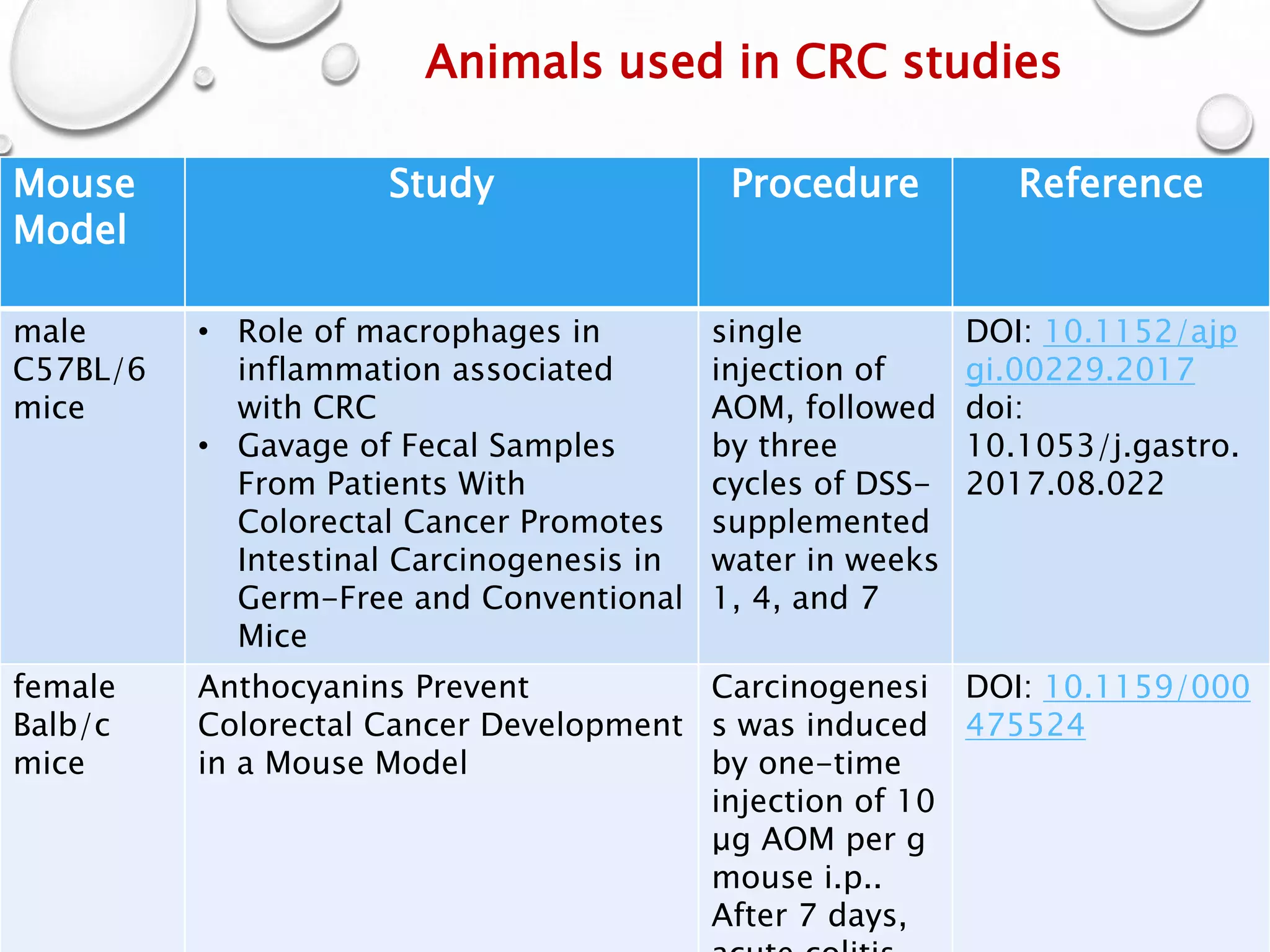
Animals used in CRC studies
Mouse
Model
Study Procedure Reference
male
C57BL/6
mice
• Role of macrophages in
inflammation associated
with CRC
• Gavage of Fecal Samples
From Patients With
Colorectal Cancer Promotes
Intestinal Carcinogenesis in
Germ-Free and Conventional
Mice
single
injection of
AOM, followed
by three
cycles of DSS-
supplemented
water in weeks
1, 4, and 7
DOI: 10.1152/ajp
gi.00229.2017
doi:
10.1053/j.gastro.
2017.08.022
female
Balb/c
mice
Anthocyanins Prevent
Colorectal Cancer Development
in a Mouse Model
Carcinogenesi
s was induced
by one-time
injection of 10
μg AOM per g
mouse i.p..
After 7 days,
DOI: 10.1159/000
475524
C57BL/6J–
ApcMin/J, BALB/c
Il-10−/− and
BALB/c T-bet−/−
Rag2−/−
Fusobacterium
nucleatum
potentiates
intestinal
tumorigenesis and
modulates the
tumor immune
microenvironment
Bacteria were fed
at 108 CFU per day
doi: 10.1016/j.cho
m.2013.07.007
male A/J mice Role of intestinal
microbiome in
American
ginseng-mediated
colon cancer
protection in high
fat diet-fed
AOM/DSS mice
AOM, 7.5 mg/kg
(intraperitoneal
injection) 2.5%
DSS in drinking
water for 7
consecutive days
doi:
10.1007/s12094-
017-1717-z
C57BL/6 male
mice
Effect and
mechanism of
vitamin D on the
development of
colorectal cancer
based on
10 mg/kg
azoxymethane
2.5% of the DSS
for one week
doi:10.1111/jgh.1
4949
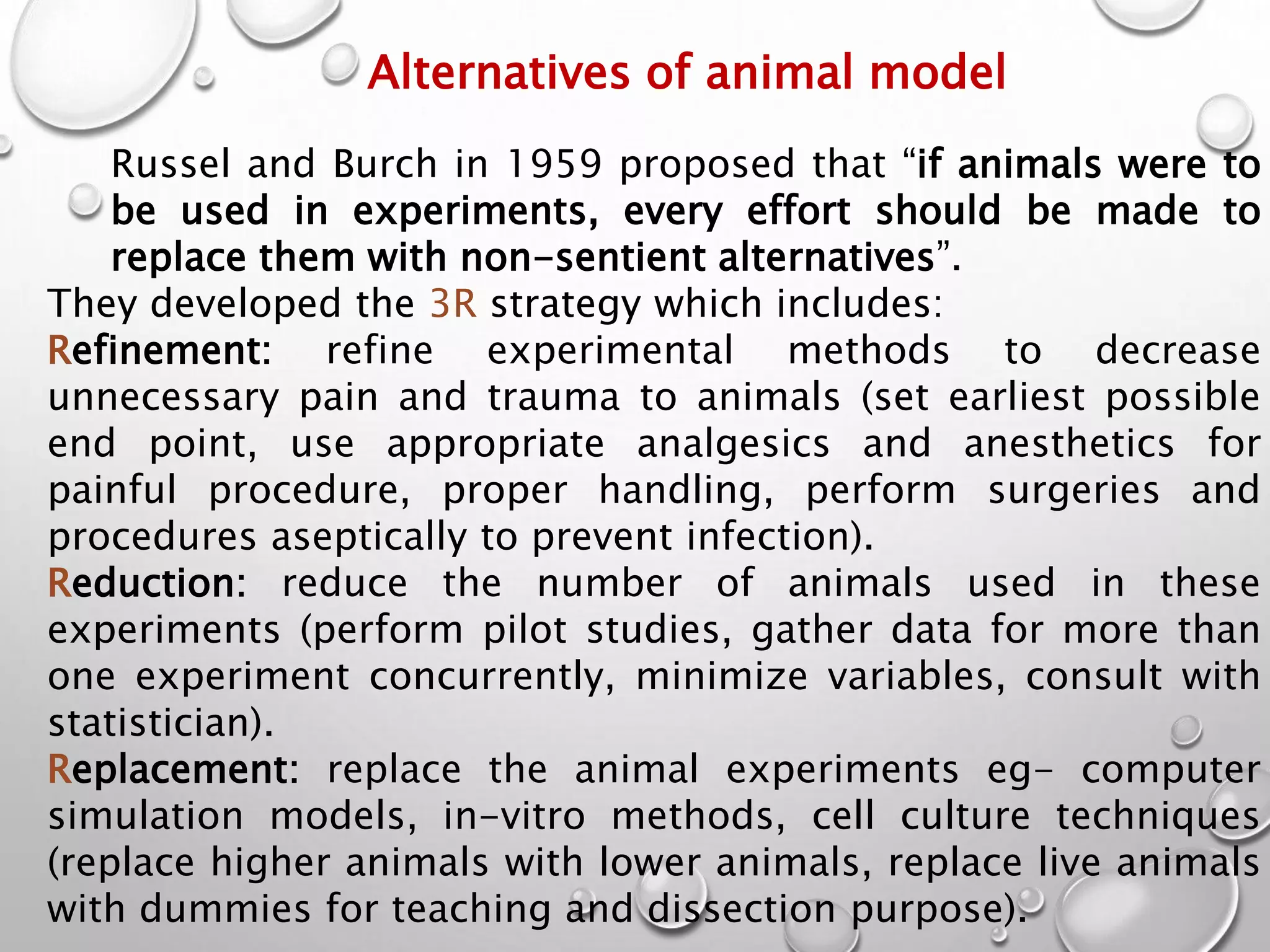
Alternatives of animal model
Russel and Burch in 1959 proposed that “if animals were to
be used in experiments, every effort should be made to
replace them with non-sentient alternatives”.
They developed the 3R strategy which includes:
Refinement: refine experimental methods to decrease
unnecessary pain and trauma to animals (set earliest possible
end point, use appropriate analgesics and anesthetics for
painful procedure, proper handling, perform surgeries and
procedures aseptically to prevent infection).
Reduction: reduce the number of animals used in these
experiments (perform pilot studies, gather data for more than
one experiment concurrently, minimize variables, consult with
statistician).
Replacement: replace the animal experiments eg- computer
simulation models, in-vitro methods, cell culture techniques
(replace higher animals with lower animals, replace live animals
with dummies for teaching and dissection purpose).
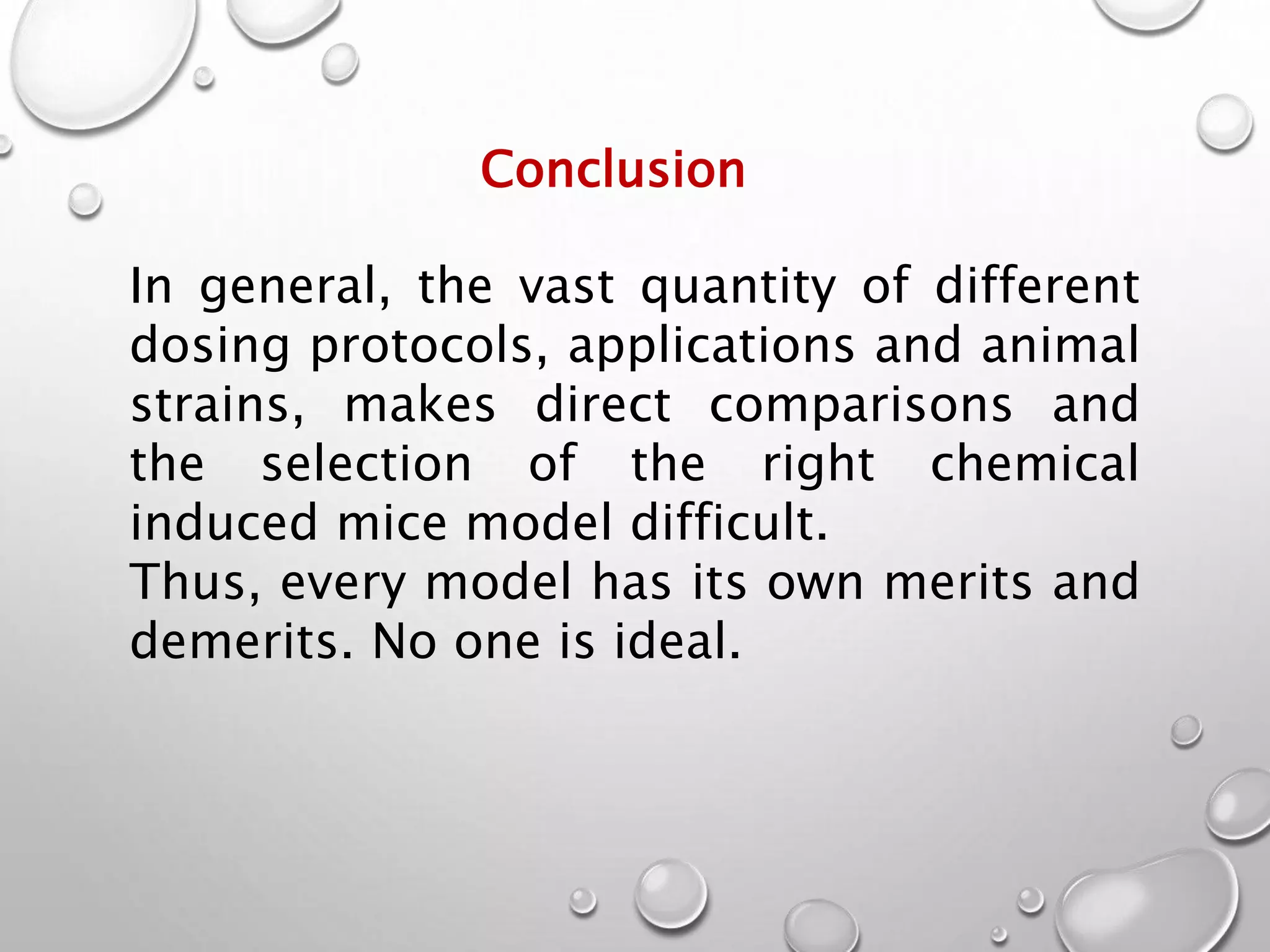
In general, the vast quantity of different
dosing protocols, applications and animal
strains, makes direct comparisons and
the selection of the right chemical
induced mice model difficult.
Thus, every model has its own merits and
demerits. No one is ideal.
Conclusion
Thank you

Mouse models of colorectal cancer

  • 1.
    MOUSE MODELS OFCOLORECTAL CANCER Rekha Jalandra
  • 2.
    Use of modelin cancer study Use of cell line with high throughput screening is the primary screening method. But due to limitation like less relevance with clinical condition further screening using suitable in vivo model is mandatory. In such condition, the selection of animal model becomes crucial. The animal model should represent the human disease as closely as possible.
  • 3.
    What is animalmodel Weggler in 1983 defined an animal model as living organism with an inherited, naturally acquired, or induced pathological process that in one or more respects closely resembles the same phenomenon in men. The institute of laboratory animal resources adopted and modified Weggler’s definition as follows: An animal model is a living organism in which normative biology or behavior can be studies, or in which a spontaneous or induced pathological process can be investigated, and in which the phenomenon in one or more respects resembles the same phenomenon in humans or other species of animal.
  • 4.
    Major advances inresearch that involved animal models 1600’s – Function of the lungs, measurement of blood pressure 1800’s – Vaccination, understanding of infectious diseases 1900’s – Antibodies, hormones 1930’s – Mechanism of nerve impulses, tumor viruses 1940’s – Embryonic development 1960’s – Monoclonal antibodies, liver functions 1970’s – Transplantation antigens, brain functions, discovery of prostaglandins 1980’s – Development of transgenic animals 1990’s – Understanding auto-immune disorders, in vitro fertilization, cloning
  • 5.
    Rodent animal models •Mice • Rat • Guinea pigs • Hamster Difference between rats and mice: Rats is larger in size, has greater body weight, less pointed face, has thick and heavy tail, has longer gestation period and has a higher pairs of chromosome i.e., 22 pairs (20 pairs in mouse). Why do we prefer mice over rat • Mice are most widely used in research as they are small, inexpensive, have short life span, fast reproductive rate, possible to investigate biological processes at all stages of the life cycle and easy to handle. • Mice have similar reproductive and nervous systems to humans, and suffer from same diseases such as cancer, diabetes and even anxiety. • Rats are commonly used for behavioral studies because they are much more social than mice and their behavior better mimics behavior seen in humans.
  • 6.
    Mouse models availablefor colorectal cancer study • Spontaneous • Transgenic • Knock-out/in • Induced/carcinogens
  • 7.
    Spontaneous models It includesselection and use of animals with natural incidence of cancer, for example, mice of some inbred strains are particularly liable to develop distinct forms of cancer. Ex. In BDII/Han rats 87-90% animals die from endometrial adenocarcinoma. But spontaneous formation of CRC in mice occurs with an incidence of >1%, making it impossible to perform experimental studies on CRC.
  • 8.
    Genetically Engineered MouseModels (GEMS) Cancer in the genetically engineered animals resembles human cancer better than the other models outlined because the tumor develops spontaneous in its natural organ, unlike xenograft tumor, which is usually implanted. GEMs can be divided into two categories: 1. Transgenic mice 2. Knockout mice
  • 9.
    Transgenic mice The transgenicmouse is the resultant progeny of the pronucleus of a fertilized egg that is injected with a foreign gene by microinjection, retroviral infection etc. This progeny then carries and expresses this exogenous gene and passes it on to its descendants. The very first GEM of CRC, the APCmin mouse was created. N-ethyl-N-nitrosourea (MNU) leads to nonsense mutation in the codon 380 of the apc gene and subsequent breeding of these animals established the first model for multiple intestinal neoplasia (min). These mice develop a large number of adenomas in the small intestine after 120-140 days. Since homozygous Apc mutation is lethal during embryonic development, breeding of homozygous APCmin mice is impossible.
  • 10.
    Additional treatment ofAPCmin mice with AOM increases malignancy of the resulting tumors and simultaneous shortens the time to tumor development. Change from C57BL/6 to a hybrid genetic background can extend the lifespan of APCmin mice beyond one year, resulting in high proportion of invasive adenocarcinoma. Disadvantage of APC mutation: Tumor formation predominantly in small intestine. (these mice spontaneously develop preneoplastic intestinal polyps due to a dominant mutation of Apc gene. Mutation of this gene is common to most human colon cancers.)
  • 11.
    Methods Results ApcΔ716 (truncatingmutation at codon 716) Intestinal polyposis with emphasis on the small intestine Apcmin/+ (multiple intestinal neoplasia) truncated mutation at codon 850 of Apc gene 100 tumors in small intestine in addition to colon tumors Apcmin/+ + AOM 6-fold increase of colonic tumor formation compared to ApcMin/+ Apcmin/+ + DSS High incidence of well differentiated colonic carcinomas Apcmin/+ + AOM + DSS Mainly small intestinal tumor formation Apcmin/+ + p53-/- No increased adenoma formation compared to Apcmin/+ + p53-/+ and Apcmin/+ + p53+/+ Constructing transgenic model for colo carcinoma
  • 12.
    Knock out mice Aknockout is an animal model that is generated by omitting both alleles of a specific gene. Ex. Homozygous p53 knockout mice. Mutation of p53 tumor suppressor gene is the most frequently observed genetic lesion in human cancer. Over 50% of all human tumors have identifiable p53 gene point mutation or deletions.
  • 13.
    Chemically Induced Colorectal Cancer •Tumors are induced by means of chemical carcinogens such as AOM/DSS, PhIP, MNU. • AOM is the direct inducer as it promotes the production of free radicals which cause damage to intestine cells. • AOM has high specificity for intestine. • DSS is a sulfated polysaccharide, which directly damages the colonic epithelium resulting in an impairment of the mucosal barrier with consecutive entry of luminal bacteria and associated antigens into the mucosa, triggering inflammation. By the use of mice with germline Apc mutation for DSS treatment, the rate of dysplasia and carcinoma formation can be enhances.
  • 14.
    Advantages of chemicalinduced carcinomas: • Local or distant metastases are usually absent. • Low latency (reduced from 30 to 14 weeks). Disadvantages of chemical induced carcinomas: Tumor formation is not restricted to colon, but can be commonly observed in the whole gastrointestinal tract. Why AOM/DSS • N-methyl-N-nitrosourea (MNU): also induces leukemia and lung cancer. • 2-amino-1-methyl-6-phenylimidazo[4,5-b]pyridine (PhIP): also induces formation of mammary and prostate neoplasia.
  • 15.
    Name of drugProperties Mutation AOM No metastasis, tumors more restricted to colon KRAS,B-catenin mutation, apc and p53 are rarely mutated MNU Colon tumors but also induces Leukemia and lung cancer Apc mutation PhIP Induces colon tumors but also Mammary gland and prostate neoplasia Apc mutation Mutation induced by AOM, MNU & PhIP
  • 16.
    Mice model Sensitivityto AOM No. of tumors/Reference SWR/J & AJ Sensitive to AOM 20 tumors in distal colon DOI: 10.1111/j.1349- 7006.2004.tb03209.x C57Bl/6J, AKR/J, 129SvJ, DBA/2J Resistant to AOM No tumor DOI: 10.1111/j.1349- 7006.2004.tb03209.x FVB/N, Balb/c Generally used for gene knockout and transgenic animals Develop 3-4 tumors
  • 17.
    Animals used inCRC studies Mouse Model Study Procedure Reference male C57BL/6 mice • Role of macrophages in inflammation associated with CRC • Gavage of Fecal Samples From Patients With Colorectal Cancer Promotes Intestinal Carcinogenesis in Germ-Free and Conventional Mice single injection of AOM, followed by three cycles of DSS- supplemented water in weeks 1, 4, and 7 DOI: 10.1152/ajp gi.00229.2017 doi: 10.1053/j.gastro. 2017.08.022 female Balb/c mice Anthocyanins Prevent Colorectal Cancer Development in a Mouse Model Carcinogenesi s was induced by one-time injection of 10 μg AOM per g mouse i.p.. After 7 days, DOI: 10.1159/000 475524
  • 18.
    C57BL/6J– ApcMin/J, BALB/c Il-10−/− and BALB/cT-bet−/− Rag2−/− Fusobacterium nucleatum potentiates intestinal tumorigenesis and modulates the tumor immune microenvironment Bacteria were fed at 108 CFU per day doi: 10.1016/j.cho m.2013.07.007 male A/J mice Role of intestinal microbiome in American ginseng-mediated colon cancer protection in high fat diet-fed AOM/DSS mice AOM, 7.5 mg/kg (intraperitoneal injection) 2.5% DSS in drinking water for 7 consecutive days doi: 10.1007/s12094- 017-1717-z C57BL/6 male mice Effect and mechanism of vitamin D on the development of colorectal cancer based on 10 mg/kg azoxymethane 2.5% of the DSS for one week doi:10.1111/jgh.1 4949
  • 19.
    Alternatives of animalmodel Russel and Burch in 1959 proposed that “if animals were to be used in experiments, every effort should be made to replace them with non-sentient alternatives”. They developed the 3R strategy which includes: Refinement: refine experimental methods to decrease unnecessary pain and trauma to animals (set earliest possible end point, use appropriate analgesics and anesthetics for painful procedure, proper handling, perform surgeries and procedures aseptically to prevent infection). Reduction: reduce the number of animals used in these experiments (perform pilot studies, gather data for more than one experiment concurrently, minimize variables, consult with statistician). Replacement: replace the animal experiments eg- computer simulation models, in-vitro methods, cell culture techniques (replace higher animals with lower animals, replace live animals with dummies for teaching and dissection purpose).
  • 20.
    In general, thevast quantity of different dosing protocols, applications and animal strains, makes direct comparisons and the selection of the right chemical induced mice model difficult. Thus, every model has its own merits and demerits. No one is ideal. Conclusion
  • 21.